
July 2013 Journal
WORDS is a monthly journal of Bitcoin commentary. This issue collects the July 2013 writing in the WORDS archive. For the uninitiated, getting up to speed on Bitcoin can seem daunting. Content is scattered across the internet, in some cases behind paywalls, and content has been lost forever. That’s why we made this journal, to preserve and further the understanding of Bitcoin.
Bitcoin, price denomination and fixed-rate fiat conversions
By Konrad S. Graf
Posted July 22, 2013
POST HEADER
POST BODY
One area of confusion seems to surround the relationship between Bitcoin and fiat money, specifically the idea that Bitcoin has somehow emerged from fiat money, something like the way the euro got started on the backs or the various European national currencies. I addressed this briefly in my 27 February 2013 article, but here are some further observations.
Such transitional conversions are done with fixed exchange rates set by law. The new currency takes up its value from the old one in an administratively managed process. This applies to historical metallic coin monies giving rise to paper money certificates through a fixed conversion rate (later dropping the convertibility) and it applies to retiring paper monies being used to launch a new paper money, as in the case of the euro. However, the attempt to apply this translation/transition model to Bitcoin runs into serious trouble because no such transitional official fixed exchange rates have ever existed for Bitcoin. Quite the contrary. Governmental actors are only beginning to so much as roughly understand Bitcoin years after it already entered active use. It emerged on the market from scratch as its own good, certainly not from any official fiat.
It could be objected that regardless of origins, Bitcoin is only able to keep functioning through its relationship to fiat money and fiat money pricing. It is a mere strange shadow of the existing systems. Goods and services are priced in fiat money and a Bitcoin equivalent is paid. Bitcoins can be bought and sold referencing current market pricing on the most liquid exchange, Mt. Gox. In other words, this argument implies, Bitcoin could not function without these props.
This raises a number of interlocking issues. Bitcoin is now useful for many reasons, among them transferring value that may or may not have been obtained through the sale of fiat money and that might or might not end up being used to buy other fiat money in the future. On the other hand, while there are certainly active speculative traders on the exchanges, there are also folks buying Bitcoin with fiat money with no intention of selling it again into fiat money, but only of using it to buy goods and services in the more or less distant future. There are merchants using Bitpay so they never have to “touch” Bitcoin, but there are also merchants giving discounts for payment in Bitcoin, and accumulating the Bitcoin. There are consumers holding Bitcoin ready to use and other consumers that might only obtain specific amounts of Bitcoin for some specific purpose and then return to a zero balance. There could be some Bitcoin miners who mainly only ever sell Bitcoin for fiat money, but never buy any with fiat money. Everything is possible.
One point the Austrian school has long emphasized in monetary theory is that while money is special in certain ways, it is also a good itself, not a mere veiled marker or representation of other values. It is a type of good distinguished from other goods and services mainly by its higher marketability.
It is true that Bitcoin users have benefited greatly from the existence of market economies with functioning price structures. Pricing is still done for the most part in local fiat currencies and will probably continue to be unless and until Bitcoin becomes more stable in purchasing power than the fiat money that users are comparing it to, each in his own decision-making context. Automatic software price conversion makes it possible for the system to piggyback on existing and familiar price structures in each local area with immense convenience.
Yet I do not think there is any fundamental reason that Bitcoin-denominated pricing of goods and services could not evolve from scratch if it hypothetically had to. Fortunately, it does not have to. If no money existed at all, it would be necessary to get it going. We just have the convenience of already being able to rely on existing market prices for goods and services and the further convenience of being able to reference real-time market prices from organized exchanges. An argument could be made for just taking the easy road and using them. I think this is all just to the good of contextualized convenience and not so theoretically fundamental. Still, there are already Bitcoin-priced goods and services, particularly starting within the Bitcoin economy. For example, the Trezor Bitcoin hardware wallet is on pre-order for the price of 1 BTC.
The extent to which Bitcoin users reference fiat pricing in commerce is probably what has given rise to some conflation with what I think is the quite different process by which one fiat money is converted into another by the official declaration of a fixed conversion price. Paper euros probably could never have taken off unless the official exchange rates with their predecessor currencies had been declared by law and the predecessor currencies had also been phased out by law. Without such official (“fiat”) declarations, printed euro notes would most likely either have been worthless or negatively valued due to the need to pay to store or dispose of them.
Bitcoin never had any official conversion price (or official anything), so how could it have gotten started? Bitcoin could never have begun to function in any other roles, such as transferring value derived from paper money over distance and converting into other paper money, if some initial users were not willing to trade any valuable goods or services for Bitcoin itself to begin with. After it began to be traded for other goods and services, one could observe it functioning in various, increasingly useful roles on that basis, some in interaction with existing monetary systems, but so long as its market price remained zero, it could not begin to serve in any such trading roles.
I think the initial-value question is probably much more narrow and technical than it is sometimes made out to be when the name of the regression theorem is invoked (the name; not necessarily the understanding). That question is how to explain a movement from a zero indirect-exchange value to non-zero indirect exchange value. Reaching non-zero from zero, especially in a digital computing context, is all that is needed for the rest to follow.
Anyone still talking about the regression theorem and Bitcoin might do well to focus on detailed historical research from the year 2009 and 2010 at the latest. After that, the deal was already done, leaving room only for efforts at explanation of what had happened. The rest was up to adoption, entrepreneurship and network-effect growth.
POST FOOTER
/post
/content-wrapper
Tiger cub growing up? Bitcoin weekly average closing prices year over year
By Konrad S. Graf
Posted July 25, 2013
POST HEADER
POST BODY

A young tiger already has some “tigerness.” Source: Sakurai Midori, Wikimedia Commons.
If the exchange value of Bitcoin is a volatile tiger cub at play, the beast has nevertheless been growing up year by year in the process. It was born sized about $0.05–$0.07 in July 2010. Now this youthful price tiger is three years old. Exchange data is available for 2011 and 2012, plus about half each of 2010 and 2013.
Short-term charts have their place. Chartists such as Rob Wilson at Bitscan brave the tough task of trying to provide parameters for those considering specific upcoming buying or selling decisions. However, a longer-term view should be assembled from vantage points that support a longer-term orientation. Moreover, understanding history ought to be done first and independently from attempting to look toward the future.
The way information appears or is remembered can create a range of impressions. The altitude from which one views the ground can change what one perceives: from ants to streets to towns to geological features to continents to small blue planets. It is useful to check in with the view from different altitudes and to consider which numbers are being used for statistical reference—and for what reason. Choice of statistics should be conscious and matched to its purpose.
Here is a chart of the all-time BTC/USD exchange rate on Mt. Gox presented differently than usual in several respects. First, it is built on weekly weighted-average exchange rates, which reflect not only moment-to-moment changes, but how much volume changed hands at which rate. Second, the dateline is not consecutive, but is for a single calendar year (2011 as calendar base). Each year has its own line with its respective weeks matched to the 2011 weeks within a couple of days. Third, a logarithmic scale is used.
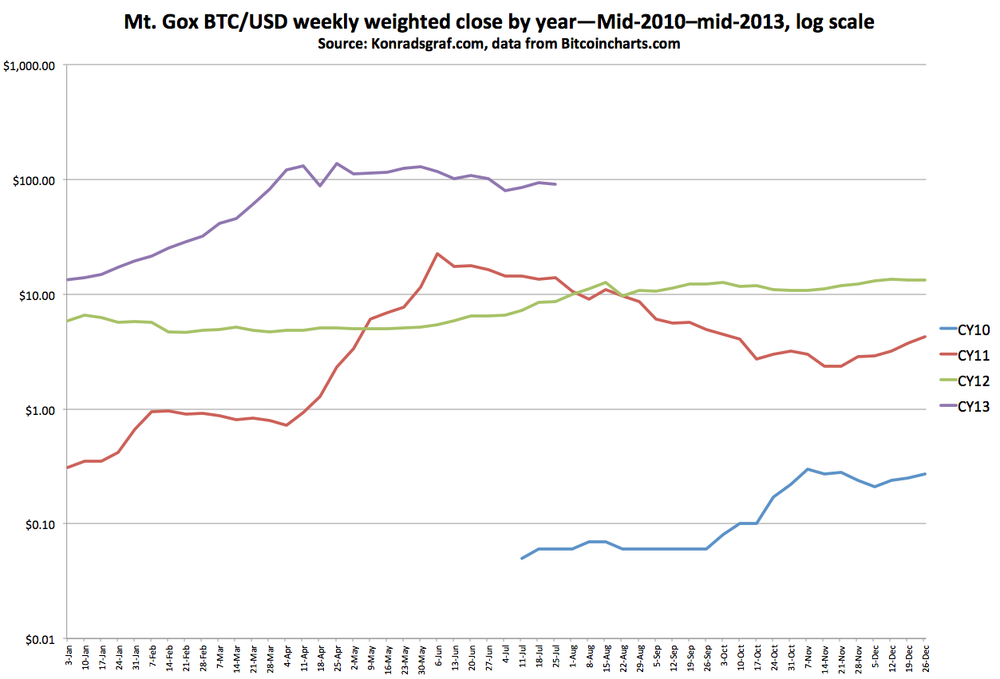
This provides some impressions that may differ from those of typical narratives. First, weekly weighted averages de-emphasize outliers, particularly the dramatic features of rush-and-crash events so beloved of speculators, critics, and headline writers alike.
Second, in the much longer-term year-over-year view (comparing the lines to one another), Bitcoin’s exchange value has only risen, usually substantially, with a single large exception. This exception was due to the first great run-up of 2011, which started with Bitcoin breaking the psychological $1 “parity” barrier in April. Despite all the drama that followed, it never came close to falling through parity again—its next weekly weighted-average bottom was $2.36 in November. While 2012 appears relatively steady in this light, it was the cub’s earlier rambunctious leap and landing in 2011 that left behind this sole period of year-over-year decline, now visible as a mountain-shaped cross-over with the 2012 line.
But what about $266?!
The obligatory darling reference of just about any commentator on Bitcoin, but particularly journalists and critics, is the $266 high on April 10. But how significant is this number?
First of all, all trading at $266 was recorded within a one-minute period. That was also a minute measured on a malfunctioning exchange that had been pushed beyond its capabilities and was suffering increasingly long response and clearing delays.
Zooming out the perceptual scope step by step, trading proceeded at anywhere over $260 for 45 minutes; anywhere above $240 for six hours and anywhere over $200 for 30 hours on 9-10 April. These are actual trading prices.
The next way to widen the perceptual scope is with weighted averaging. Turning even to dailyweighted-average data shows anything over **$160 only for 8-11 April, a total of four days (yes, that is a 1 and not a 2 in that $160). Even the peak “266” day’s own daily weighted-average was $214. Returning to the weekly weighted average, the all-time peak weekly figure was just $138.
Here is the above chart switched to a linear scale.
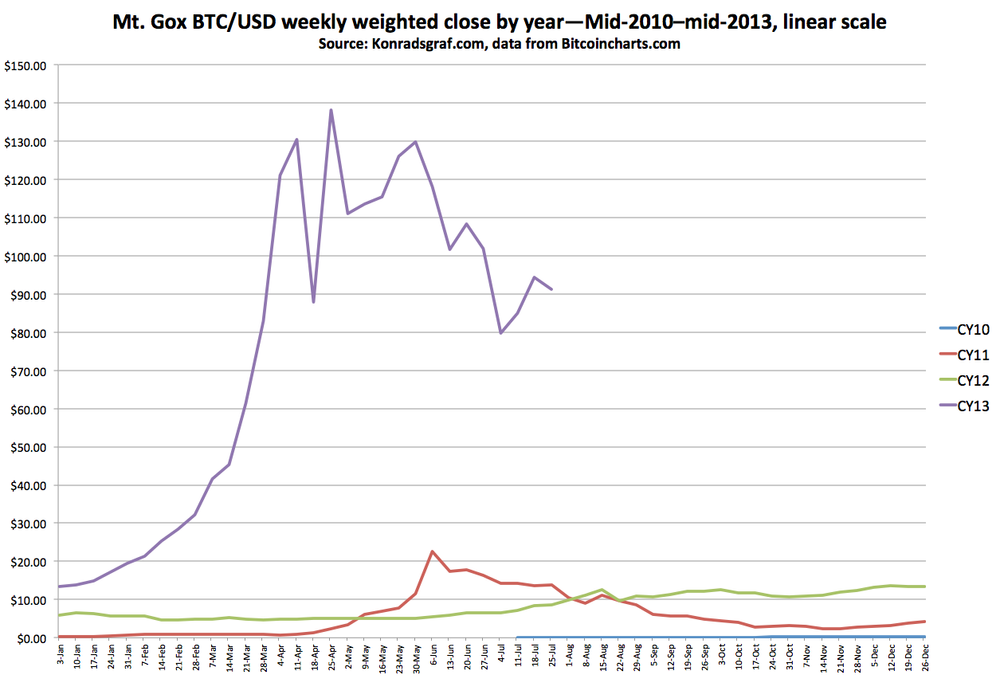
This linear view does leave a more extreme impression of 2011 and 2013 than the logarithmic view, and the penny trade of 2010, with its weekly average peak of $0.28, disappears into the baseline, but it is still considerably less extreme-looking than a chart with $266 at the top. Instead, the all-time chart of weekly weighted-average prices tops out at the relatively mundane $138.
Still, all told, that little tiger does seem to be growing up. It grows larger each year. How cute and silly when a cub ambushes a rustling leaf and tumbles off the side of a fallen tree.
Yet grown-up versions of such creatures hunt down and eat large animals. As the years go by, dismiss this still playful creature lightly at your own risk.
POST FOOTER
/post
/content-wrapper