Where did the inflation go?
| If you find WORDS helpful, Bitcoin donations are unnecessary but appreciated. Our goal is to spread and preserve Bitcoin writings for future generations. Read more. | Make a Donation |
Where did the inflation go?
By Mike Hearn
Posted March 17, 2014
… or, why critics of Satoshi-nomics are wrong
The Economist is one of my favourite magazines. This week they published two articles on Bitcoin. One covered more exotic uses of the technology. The other was a bog-standard trope claiming that deflation will kill Bitcoin and it’s not a good store of value:
Economists reckon money …. should be a stable store of value, enabling users to tuck some away and come back later to find its purchasing power more or less intact ….. the American dollar meets all three conditions. Bitcoin has some way to go.
Then they followed up with a Free Exchange blog entry that repeated the same points. I wrote the FAQ on Bitcoin deflation, but apparently it’s time to revisit this topic.
Free Exchange says,
… the idea that modern central banks with their loosey-goosey printing presses have generated an epidemic of inflation is a little nuts; if anything, rich-world central banks have become too effective at protecting the value of their respective currencies
The idea that western countries have low and stable inflation is a widely held belief. We’re told our amazing central banks have learned to tame inflation, and we should be in awe of their economic skill. What’s more we’re told that whatever the level of inflation we have is, it’s beneficial for society and a “deflationary” Bitcoin economy would look like some Detroit-esque zombie apocalypse in comparison.
But is this true? I don’t think so.
In the past decade inflation in western countries has been reported as very low, in particular Europe and America. Yet interest rates have also been very low, in fact lately they’ve been at close to zero, which theory tells us should make borrowing very cheap and encourage lots of new money creation leading to a general rise in prices. So where did all the inflation go?
The way the statistics are calculated is very transparent and the integrity of the agencies that compile them are not in question. But just because the statistics are open source and auditable does not make them automatically useful for our purposes. We’re interested in the question of whether central banks cause economic disruption that could be avoided if everyone used Bitcoin. Advocates claim a limited and stable supply of money would help avoid bubbles and build a better financial system. Skeptics quote inflation statistics to suggest the 21 million coin limit is a solution looking for a problem. So do the statistics actually help us resolve this debate?
The consumer price index most countries rely on to measure inflation is a very interesting beast. At first glance it appears to do what it says: that is, measure the prices ordinary people pay for things. But scratch the surface and a boiling morass of controversies and long-running debates appear. Pretty quickly it becomes apparent that what’s in and what’s out of the index can make a massive difference to perceived inflation.
Owner-equivalent rent
One of the aspects of CPI calculation with the least agreement between economists and countries is the matter of house prices. Intuition tells us that because lots of people buy houses they should be included in the basket of goods. A rise in house prices would then lead to a rise in inflation.
And indeed, this is how the statistics used to work. But starting in the 1970’s some countries, notably the USA, started to think that maybe this wasn’t the best way to calculate the CPI. They tried a few different approaches and starting in the mid-1980’s settled on something called “owner equivalent rent” (OER). This means that when someone buys a house, for inflation purposes they are assumed instead to be paying the rent that they would have been paying, had the house actually been rented out to them by someone else.
The justification behind this odd approach is that the CPI is not actually intended to inform debates about printing of money, even though it’s often used that way. Instead it’s meant to measure a rise in the cost of living (COLI). The assumption is that if someone didn’t have the option of buying a house they could have rented a similar house nearby. Therefore, the fact that they actually did buy the house is irrelevant for calculating the cost of living of the average person.
A long and very boring document describing the different approaches and the rationales involved can be found here. It contains some interesting facts. If you’re American and thinking that maybe the above method doesn’t accurately reflect the way ordinary people experience prices, well, just be glad that the Bureau of Labor Statistics even tries:
The rental equivalence approach is also widely accepted and used in many
countries. A recent Organization for Economic Development and Cooperation (OECD) report shows that this approach is the one used by a plurality of countries (13 out of 31 countries studied), with the next chosen alternative simply leaving owner occupied housing out of the national CPI (9 countries). Only Australia and New Zealand use an acquisitions or house price approach.
So whilst a lot of countries use this method, plenty of others choose to just ignore housing entirely!
Is OER impacted by a rise in house prices? The Economist steps in to the debate once more, this time with data. In a remarkably prescient article from 2005 they warned, “The worldwide rise in house prices is the biggest bubble in history. Prepare for the economic pain when it pops.”
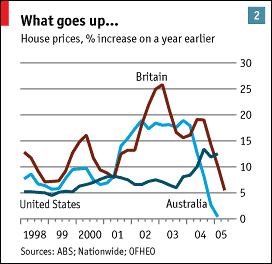
The most compelling evidence that home prices are over-valued in many countries is the diverging relationship between house prices and rents …. Calculations by
The Economist
show that house prices have hit record levels in relation to rents in America, Britain, Australia, New Zealand, France, Spain, the Netherlands, Ireland and Belgium. This suggests that homes are even more over-valued than at previous peaks, from which prices typically fell in real terms …. America’s ratio of prices to rents is 35% above its average level during 1975-2000 (see chart 1). By the same gauge, property is “overvalued” by 50% or more in Britain, Australia and Spain.
So we know that in the run-up to the financial crisis consumer price inflation was considered to be in the Goldilocks Zone (between two and three percent), yet house price inflation was more like ten to twenty percent! Clearly, the inflation statistics being used by central banks were completely disconnected from what was really happening in the housing market, by design, and as a result they kept the pedal to the metal with low interest rates thus pouring fuel on the fire.
This is all pretty mainstream thinking, at least in the alt-econ blogosphere. It’s only in the rarified world of central banking that the link between their monetary policy and giant asset bubbles gets controversial. Unfortunately the largest employer of economists is, by far, the government. So it should not really surprise us when most economists appear to agree with whatever government policy currently is.
So how does Satoshi-nomics (a.k.a. full reserve banking) actually help? Inflation is bad because the act of creating free money and giving it to someone results in misallocation of resources — instead of resources (time, electricity, food etc) being put towards projects that reflect market consensus, the lucky recipient of the inflation goes and buys up those resources instead. Is what they get used for actually beneficial? Does it increase societies wealth? It’s hard to know because the normal decision making processes broke down.
Bitcoin itself gives us a great example of this dynamic in action: we see far, far too much mining taking place relative to what’s actually needed. The inflation of Bitcoin causes reallocation of time and resources to mining, even if one more terahash doesn’t make any perceptible difference to the security of the system.
Luckily, Bitcoin inflation and the distortion it creates is temporary. The same cannot be said for the dollar, pound or euro.