Ten Mental Models Required To Understand Bitcoin
| If you find WORDS helpful, Bitcoin donations are unnecessary but appreciated. Our goal is to spread and preserve Bitcoin writings for future generations. Read more. | Make a Donation |
Ten Mental Models Required To Understand Bitcoin
By Miguel Cuneta
Posted May 8, 2019
A Tweetstorm series
Miguel Cuneta
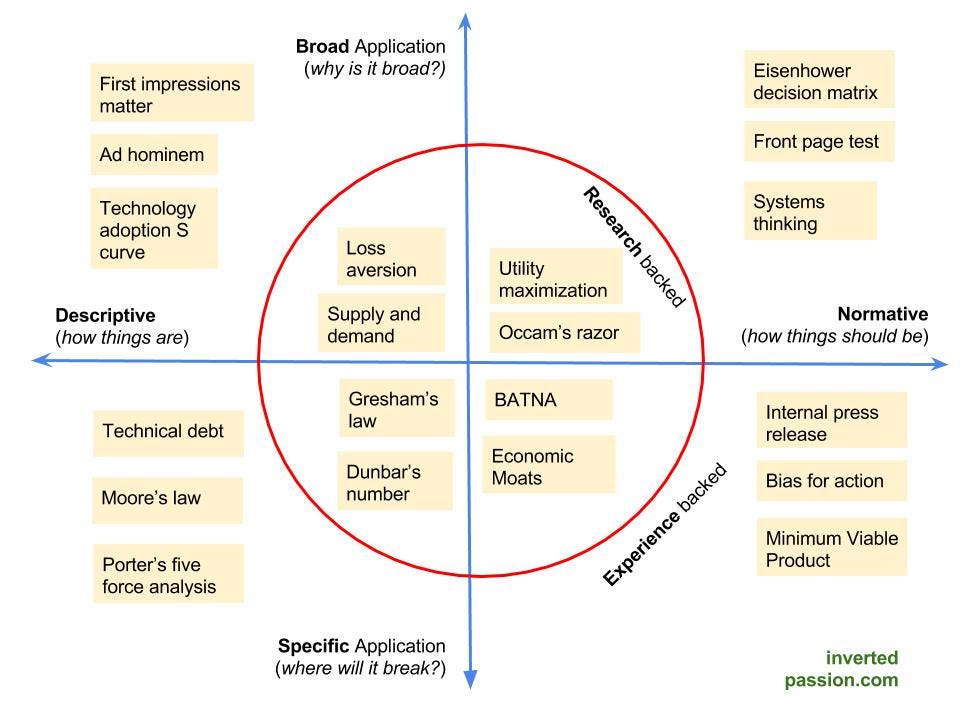
Image from Invertedpassion.com
As part of an on-goingTweetstorm Series,we showcase Twitter threads on the most interesting and controversial topics from all corners of the industry and publish them here in blog format for easier consumption and sharing beyond Twitter.
Today we explore twitter user American Hodl’s tweetstorm about the ten mental models required to understand Bitcoin. Mental models are how we understand the world. They shape what we think and how we understand connections in everything around us. Mental models are how we simplify complexity, why we consider some things more relevant than others, and how we reason with the rest of reality.
We use models to simplify the complex into understandable and organizable chunks, and something as complex as Bitcoin would be better explained using mental models anyone can grasp.
1. Emergence
“Higher-level behavior tends to emerge from the interaction of lower-order components.”
Bitcoin’s rules are simple, but from these simple rules emerge complex systems and behaviors.
2. Pareto Principle
“A small amount of specific phenomena causes a disproportionately large effect.”
Bitcoins immaculate conception caused it to be the largest and most successful digital currency. [Altcoins] are doomed to fight over a small slice of the pie (20% or less).
3. Prisoner’s Dilemma
“Shows why two completely rational individuals might not cooperate, even if it appears that it is in their best interests to do so.”
If world governments cooperated, they could kill Bitcoin. However, they have individual incentives not to cooperate.
4. Top Down
“The breaking down of a system to gain insight into its compositional sub-systems in a reverse engineering fashion.”
Contrast with emergent phenomena. [Altcoins] like EOS, Ethereum, IOTA are all architected from the top down and cannot account for black swans.
5. Black Swans
“An unpredictable or unforeseen event, typically one with extreme consequences.”
Bitcoin itself is a black swan that nobody saw coming, and consequently, effects that occur because of central bank policies like the ’08 mortgage crisis are also black swans.
6. Network Effect
“A phenomenon whereby increased numbers of people or participants improve the value of a good or service. The Internet, for example.”
The more people that come into Bitcoin the more valuable Bitcoin becomes. Satoshi referred to it as self fulfilling prophecy.
7. Scale
“Systems are sensitive to scale. Properties (or behaviors) tend to change when you scale them up or down.”
Bitcoin will exhibit different behaviors as it grows in size, none of use are able to predict these behaviors. All we can do is guess what size will bring.
8. Lindy Effect
“A theory that the future life expectancy of some non-perishable things like a technology or an idea is proportional to their current age.”
Because Bitcoin made it to ten years, we reasonably conclude that we are likely to see another decade of Bitcoin.
9. First Principles
“The fundamental concepts or assumptions on which a theory, system, or method is based.”
Bitcoin strips money back to its essential properties. Ties money closely to time, aligns human action with time. Makes it simple to store productive output for later.
10. OCCAM’S RAZOR
“In explaining a thing no more assumptions should be made than are necessary.”
Is this [altcoin] with no development really going to displace Bitcoin? Or is this all a ploy to scam me out of my money? What is simplest is most likely to be true.

American Hodlis a Bitcoiner since 2014 and a hodler of last resort. He suggests you read this article fs.blog/mental-models/) by Farnham street for a wider list of mental models.