
December 2020 Journal
WORDS is a monthly journal of Bitcoin commentary. This issue collects the December 2020 writing in the WORDS archive. For the uninitiated, getting up to speed on Bitcoin can seem daunting. Content is scattered across the internet, in some cases behind paywalls, and content has been lost forever. That’s why we made this journal, to preserve and further the understanding of Bitcoin.
7 Misconceptions about Bitcoin, and Where to Buy
By Lyn Alden
Posted November 11, 2020
Published: November 11, 2020
I initially covered Bitcoin in an article in autumn 2017, and was neutral-to-mildly-bearish for the intermediate term, and took no position.
The technology was well-conceived, but I had concerns about euphoric sentiment and market dilution. I neither claimed that it had to go lower, nor viewed it bullishly, and merely stepped aside to keep watching.
However, I turned bullish on Bitcoin in April 2020 in my research service at about $6,900/BTC and went long. It had indeed underperformed many other asset classes from autumn 2017 into spring 2020, but from that point, a variety of factors turned strongly in its favor. I then wrote a public article about it in July when it was at $9,200/BTC, further elaborating on why I am bullish on Bitcoin.
That July article received a lot of press, and the CEO of MicroStrategy (MSTR), the first publicly-traded company on a major stock exchange to put part of its cash position into Bitcoin, stated that he sent that article among other key resources to his board of directors as part of his team education process. It’s written with institutional readers in mind, in other words, in addition to retail investors.
With a price tag of over $15,000/BTC today, Bitcoin is up over 120% from the initial price at my April pivot point, and is up over 60% from July, but I continue to be bullish through 2021. From there, I would expect a period of correction and consolidation, and I’ll re-assess its forward prospects from that point.
Naturally, I’ve received many emails about Bitcoin over this summer and autumn. I’ve answered several of them via email, but figured I would summarize the most popular ones into a quick article on the subject. These are common misconceptions, risks, or questions. All of which make sense to ask, so I do my best here to address them as I see it.
If you haven’t read it, I’d recommend reading my July Bitcoin article first.
1) “Bitcoin is a Bubble”
Many people view Bitcoin as a bubble, which is understandable. Especially for folks who were looking at the linear chart in 2018 or 2019, Bitcoin looked like it hit a silly peak in late 2017 after a parabolic rise that would never be touched again.
This linear price chart goes from the beginning of 2016 to the beginning of 2019, and shows how it looked like a classic bubble:
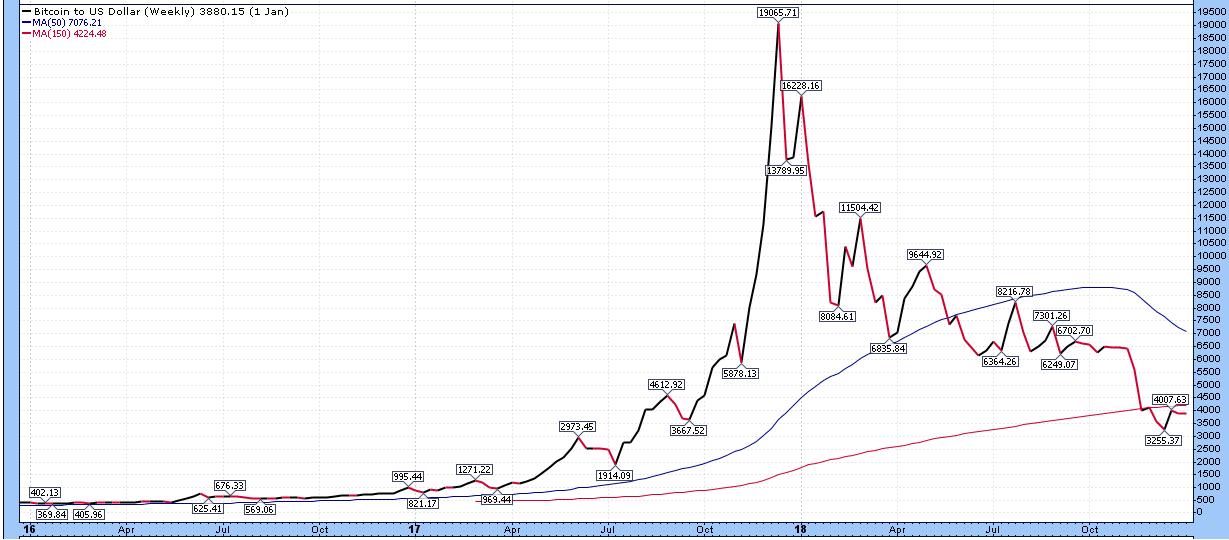
Chart: StockCharts.com
Maybe it is a bubble. We’ll see. However, it looks a lot more rational when you look at the long-term logarithmic chart, especially as it relates to Bitcoin’s 4-year halving cycle.
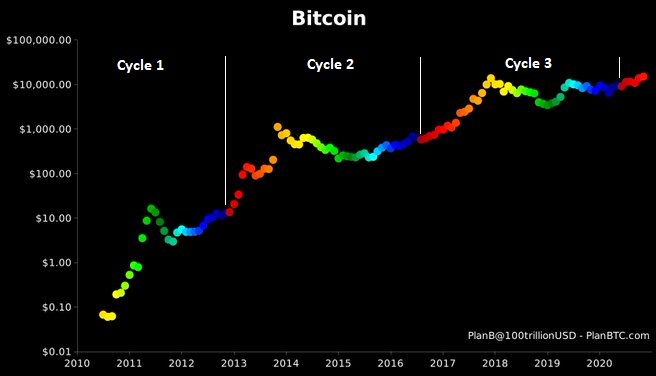
Chart Source: Chart Source: PlanB @100trillionUSD, with annotations added by Lyn Alden
Each dot in that chart represents the monthly bitcoin price, with the color based on how many months it has been since the prior halving. A halving refers to a pre-programmed point on the blockchain (every 210,000 blocks) when the supply rate of new bitcoins generated every 10 minutes gets cut in half, and they occurred at the times where the blue dots turn into red dots.
The first cycle (the launch cycle) had a massive gain in percent terms from zero to over $20 per bitcoin at its peak. The second cycle, from the peak price in cycle 1 to the peak price in cycle 2, had an increase of over 50x, where Bitcoin first reached over $1,000. The third cycle from peak-to-peak had an increase of about 20x, where Bitcoin briefly touched about $20,000.
Since May 2020, we’ve been in the fourth cycle, and we’ll see what happens over the next year. This is historically a very bullish phase for Bitcoin, as demand remains strong but new supply is very limited, with a big chunk of the existing supply held in strong hands.
The monthly chart is looking solid, with positive MACD, and a higher current price than any monthly close in history. Only on an intra-month basis, within December 2017, has it been higher than it is now:
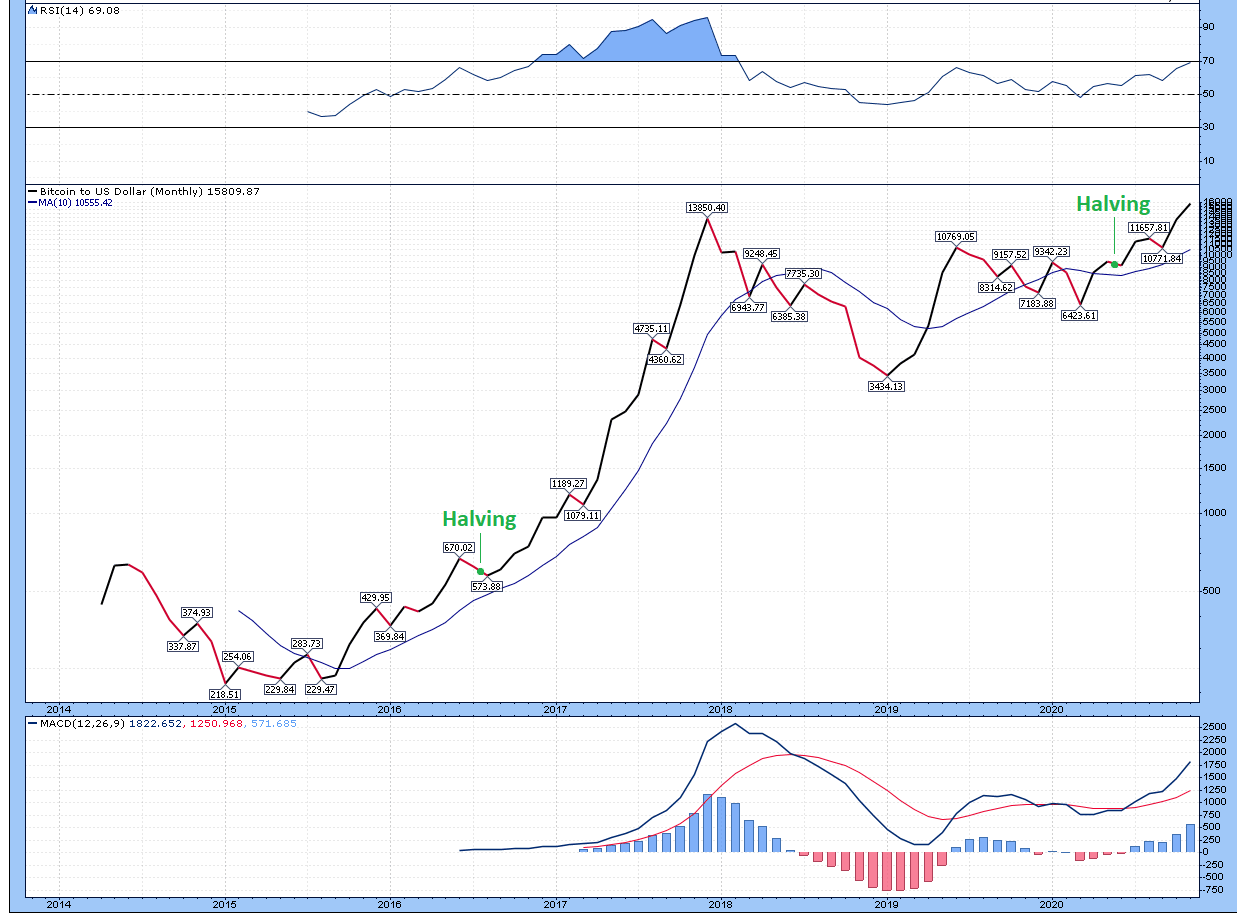
Chart Source: StockCharts.com
The weekly chart shows how many times it became near-term overbought, and how many corrections it had, on its previous post-halving bullish run where it went up by 20x:
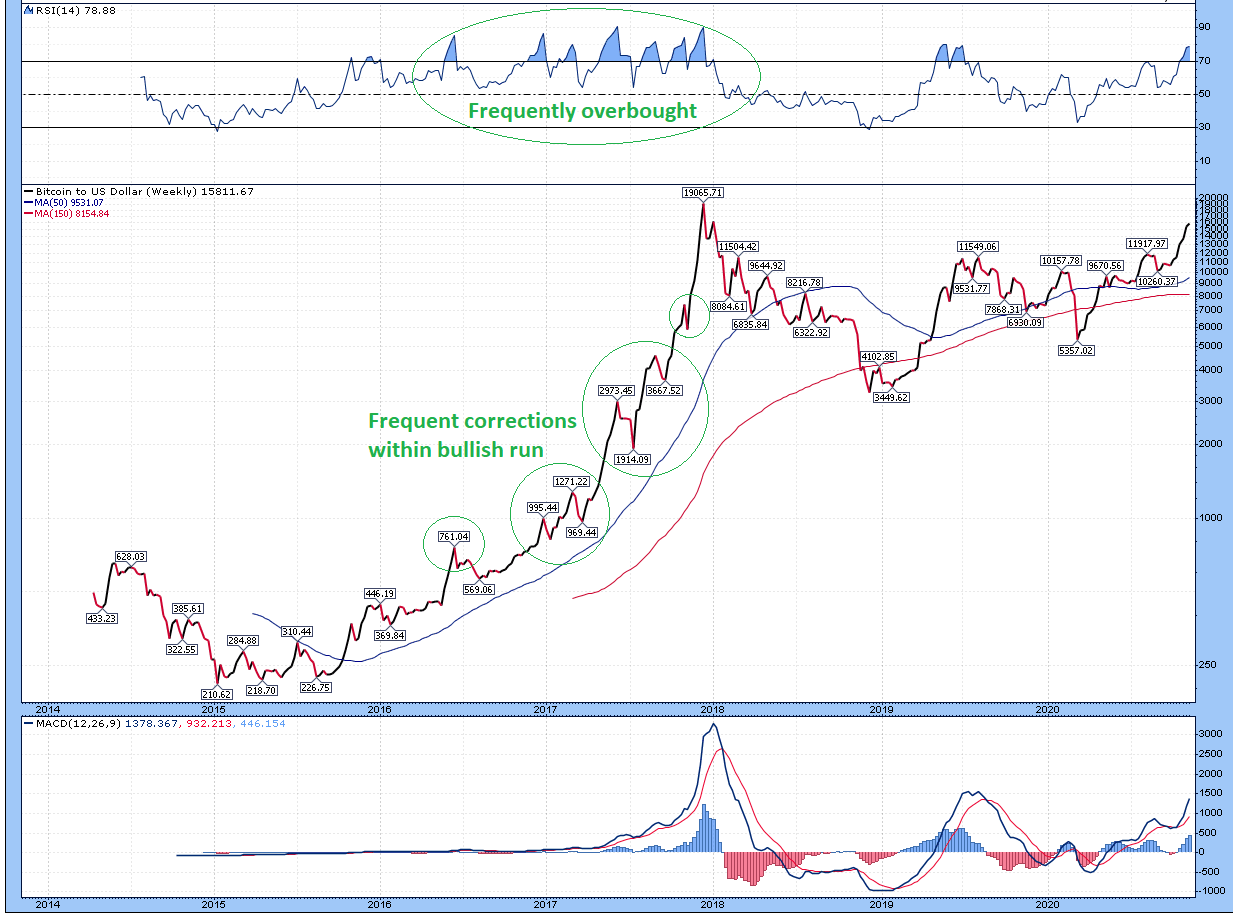
Chart Source: StockCharts.com
My job here is simply to find assets that are likely to do well over a lengthy period of time. For many of the questions/misconceptions discussed in this article, there are digital asset specialists that can answer them with more detail than I can. A downside of specialists, however, is that many of them (not all) tend to be perma-bulls on their chosen asset class.
This is true with many specialist gold investors, specialist stock investors, specialist Bitcoin investors, and so forth. How many gold newsletters suggested that you might want to take profits in gold around its multi-year peak in 2011? How many Bitcoin personalities suggested that Bitcoin was probably overbought in late 2017 and due for a multi-year correction?
I’ve had the pleasure of having conversations with some of the most knowledgeable Bitcoin specialists in the world; the ones that keep their outlooks measured and fact-based, with risks clearly indicated, rather than being constant promoters of their industry at any cost. Bitcoin’s power comes in part from how enthusiastic its supporters are, but there is room for independent analysis on bullish potential and risk analysis as well.
And as someone who isn’t in the digital asset industry myself, but who has a background that blends engineering and finance that lends itself reasonably well to analyzing it, I approach Bitcoin like I approach any other asset class; with an acknowledgement of risks, rewards, bullish cycles, and bearish cycles. I continue to be bullish here.
If this fourth cycle plays out anywhere remotely close to the past three cycles since inception (which isn’t guaranteed), Bitcoin’s relative strength index could become quite extreme again in 2021. Here’s a chart from PlanB about Bitcoin’s historical monthly RSI during the bullish and bearish phases of its 4-year halving cycle:
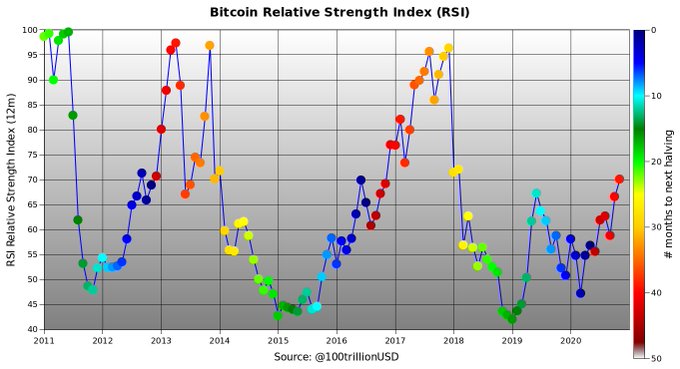
Chart Source: PlanB @100trillionUSD
For that reason, Bitcoin going from $6,900 to $15,000+ in seven months doesn’t lead me to take profits yet. In other words, a monthly RSI of 70 doesn’t cut it as “overbought” in Bitcoin terms, particularly this early after a halving event. I’ll likely look into some rebalancing later in 2021, though.
Each investor has their own risk tolerance, conviction, knowledge, and financial goals. A key way to manage Bitcoin’s volatility is to manage your position size, rather than try to trade it too frequently. If Bitcoin’s price volatility keeps you up at night, your position is probably too big. If you have an appropriately-sized position, it’s the type of asset to let run for a while, rather than to take profits as soon as it’s slightly popular and doing well.
When it’s at *extreme* sentiment, and/or its position has grown to a disproportionately large portion of your portfolio, it’s likely time to consider rebalancing.
2) “Bitcoin’s Intrinsic Value is Zero”
I approached this topic heavily in my autumn 2017 article, and again in my summer 2020 article.
To start with, digital assets can certainly have value. In simplistic terms, imagine a hypothetical online massive multiplayer game played by millions of people around the world. If there was a magical sword item introduced by the developer that was the strongest weapon in the game, and there were only a dozen of them released, and accounts that somehow got one could sell them to another account, you can bet that the price for that digital sword would be outrageous.
Bitcoin’s utility is that it allows people to store value outside of any currency system in something with provably scarce units, and to transport that value around the world. Its founder, Satoshi Nakamoto, solved the double-spending problem and crafted a well-designed protocol that has scarce units that are tradeable in a stateless and decentralized way.
In terms of utility, try bringing $250,000 worth of gold through an international airport vs bringing $250,000 worth of bitcoins with you instead, via a small digital wallet, or via an app on your phone, or even just by remembering a 12-word seed phrase. In addition, Bitcoin is more easily verifiable than gold, in terms of being a reserve asset and being used as collateral. It’s more frictionless to transfer than gold, and has a hard-capped supply. And I like gold too; I’ve been long it since 2018, and still am.
Bitcoin is a digital commodity, as Satoshi envisioned it:
As a thought experiment, imagine there was a base metal as scarce as gold but with the following properties:
– boring grey in colour
– not a good conductor of electricity
– not particularly strong, but not ductile or easily malleable either
– not useful for any practical or ornamental purposeand one special, magical property:
– can be transported over a communications channelIf it somehow acquired any value at all for whatever reason, then anyone wanting to transfer wealth over a long distance could buy some, transmit it, and have the recipient sell it.
-Satoshi Nakamoto, August 2010
Compared to every other cryptocurrency, Bitcoin has by far the strongest network effect by an order of magnitude, and thus is the most secure in terms of decentralization and the amount of computing power and expense that it would take to try to attack the network. There are thousands of cryptocurrencies, but none of them have been able to rival Bitcoin in terms of market capitalization, decentralization, ubiquity, firm monetary policy, and network security combined.
Some other tokens present novel privacy advancements, or smart contracts that can allow for all sorts of technological disruption on other industries, but none of them are a major challenge to Bitcoin in terms of being an emergent store of value. Some of them can work well alongside Bitcoin, but not in place of Bitcoin.
Bitcoin is the best at what it does. And in a world of negative real rates within developed markets, and a host of currency failures in emerging markets, what it does has utility. The important question, therefore, is how much utility.
The pricing of that utility is best thought of in terms of the whole protocol, which is divided into 21 million bitcoins (each of which is divisible into 100 million sats), and combines the asset itself with the means of transmitting it and verifying it. The value of the protocol grows as more individuals and institutions use it to store and transmit and verify value, and can shrink if fewer folks use it.
The total market capitalization of gold is estimated to be over $10 trillion. Could Bitcoin reach 10% of that? 25%? Half? Parity? I don’t know.
I’m focusing on one Bitcoin halving cycle at a time. A four-year outlook is enough for me, and I’ll calibrate my analysis to what is happening as we go along.
3) “Bitcoin Isn’t Scalable”
A common criticism of Bitcoin is that the number of transactions that the network can handle per 10 minutes is very low compared to, say, Visa (V) datacenters. This limits Bitcoin’s ability to be used for everyday transactions, such as to buy coffee.
In fact, this played a key role in the 2017 hard fork between Bitcoin and Bitcoin Cash. Proponents of Bitcoin Cash wanted to increase the block size, which would allow the network to process more transactions per unit of time.
However, with any payment protocol, there is a trade-off between security, decentralization, and speed. Which variables to maximize is a design choice; it’s currently impossible to maximize all three.
Visa, for example, maximizes speed to handle countless transactions per minute, and has moderate security depending on how you measure it. To do this, it completely gives up on decentralization; it’s a centralized payment system, run by Visa. And it of course relies on the underlying currency, which itself is centralized government fiat currency.
Bitcoin, on the other hand, maximizes security and decentralization, at the cost of speed. By keeping the block size small, it makes it possible for people all over the world to run their own full nodes, which can be used to verify the entire blockchain. Widespread node distribution (over 10,000 nodes) helps ensure decentralization and continual verification of the blockchain.
Bitcoin Cash potentially increases transaction throughput with bigger block sizes, but at the cost of lower security and less decentralization. In addition, it still doesn’t come anywhere close to Visa in terms of transaction throughput, so it doesn’t really maximize any variable.
Basically, the dispute between Bitcoin and Bitcoin Cash is whether Bitcoin should be both a settlement layer and a transaction layer (and thus not be perfect at either of those roles), or whether it should maximize itself as a settlement layer, and allow other networks to build on top of it to optimize for transaction speed and throughput.
The way to think about Bitcoin is that it is an ideal settlement layer. It combines a scarce currency/commodity with transmission and verification features, and has a huge amount of security backing it up from its high global hash rate. In fact, that’s what makes Bitcoin vs Visa an inappropriate comparison; Visa is just a layer on top of deeper settlement layers, with merchant banks and other systems involved under the surface, whereas Bitcoin is foundational.
The global banking system has extremely bad scaling when you go down to the foundation. Wire transfers, for example, generally take days to settle. You don’t pay for everyday things with wire transfers for that reason; they’re mainly for big or important transactions.
However, the banking system builds additional layers of scalability onto those types of settlement layers, so we have things like paper checks, electronic checks, credit cards, PayPal, and so forth. Consumers can use these systems to perform a large number of smaller transactions, and the underlying banks settle with each other with more foundational, larger transactions less frequently. Each form of payment is a trade-off between speed and security; banks and institutions settle with each other with the most secure layers, while consumers use the speedier layers for everyday commerce.
Similarly, there are protocols like the Lightning Network and other smart contract concepts that are built on top of Bitcoin, which increase Bitcoin’s scalability. Lightning can perform tons of quick transactions between counterparties, and reconcile them with Bitcoin’s blockchain in one batch transaction. This reduces the fees and bandwidth limitations per small transaction.
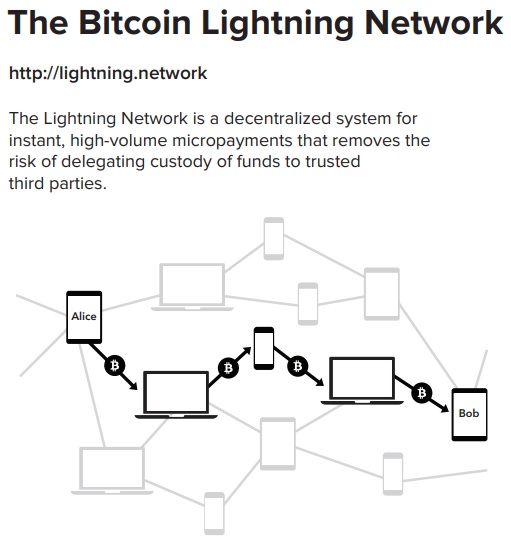
Source: Lightning.Network
I don’t know, looking back years from now, which scaling systems will have won out. There’s still a lot of development being done. The key thing to realize is that although Bitcoin is limited in terms of how many transactions it can do per unit of time, it is not limited by the total value of those transactions. The amount of value that Bitcoin can settle per unit of time is limitless, depending on its market cap and additional layers.
In other words, suppose that the Bitcoin network is limited to 250 transactions per minute, which is low. Those transactions could average $100 or $1 million, or any number. If they average $100 each, it means only $25,000 in transaction value is performed per minute. If they average $1 million each, it means $250 million in transaction value is performed per minute. If Bitcoin grows in use as a store of value, the transaction fees and inherent limitations prioritize the largest and most important transactions: the major settlement transactions.
Additional layers built on top of Bitcoin can do an arbitrary number of transactions per minute, and settle them with batches on the actual Bitcoin blockchain. This is similar to how consumer layers like Visa or PayPal can process an arbitrary number of transactions per minute, while the banks behind the scenes settle with larger transactions less frequently.
The market has already spoken about which technology it thinks is best, between Bitcoin and others like Bitcoin Cash. Ever since the 2017 hard fork, Bitcoin’s market capitalization and hash rate and number of nodes have greatly outperformed Bitcoin Cash’s. Watching this play out in 2017 was one of my initial risk assessments for the protocol, but three years later, that concern no longer exists.
4) “Bitcoin Wastes Energy”
The Bitcoin network currently uses as much energy as a small country. This naturally brings up environmental concerns, especially as it grows.
Similarly, gold mining uses a ton of energy. For each gold coin, a ton of money, energy, and time went into exploration for deposits, developing a mine, and then processing countless tons of rock with heavy equipment to get a few grams of gold per ton. Then, it has to be purified and minted into bars and coins, and transported.
It takes several tons of processed rock to get each 1-ounce gold coin, and thousands of tons of processed rock for each good delivery gold bar. The amount of energy that goes into a small unit of gold is immense.
In fact, that energy is what gives gold value, and what made it internationally recognized as money for thousands of years. Gold is basically concentrated energy, concentrated work, as a dense store of value that does not erode with time.
There’s no limit to how many dollars, euros, or yen we can print, however. Banks multiply them all the time with a stroke of a keyboard. Likewise, industrial metals like iron are very common as well; we have no shortage of them. Gold, however, is very rare, and when found, it takes a ton of energy and time to get into pure form. And then we have to spend more energy transporting, securing, and verifying it from time to time.
However, the world does that anyway, because it derives value from it compared to the value that it had to put in to get it. Gold mining and refining requires energy, but in turn, central banks, institutions, investors, and consumers obtain a scarce store of value, or jewelry, or industrial applications from the rare metal.
Similarly, Bitcoin takes a lot of energy, but that’s because it has so much computing power constantly securing its protocol, compared to countless other cryptocurrencies that are easy to attack or insufficiently decentralized.
Visa uses much less energy than Bitcoin, but it requires complete centralization and is built on top of an abundant fiat currency. Litecoin uses much less energy than Bitcoin as well, but it’s easier for a well-capitalized group to attack.
The question then becomes whether that energy associated with Bitcoin is put to good use. Does Bitcoin justify its energy usage? Does it add enough value?
So far, the market says it does and I agree. A decentralized digital monetary system, separate from any sovereign entity, with a rules-based monetary policy and inherent scarcity, gives people around the world a choice, which some of them use to store value in, and/or use to transmit that value to others.
Those of us in developed markets that haven’t experienced rapid inflation for decades may not see the need for it, but countless people in emerging markets have experienced many instances of severe inflation in their lifetimes, and tend to get the concept more quickly.
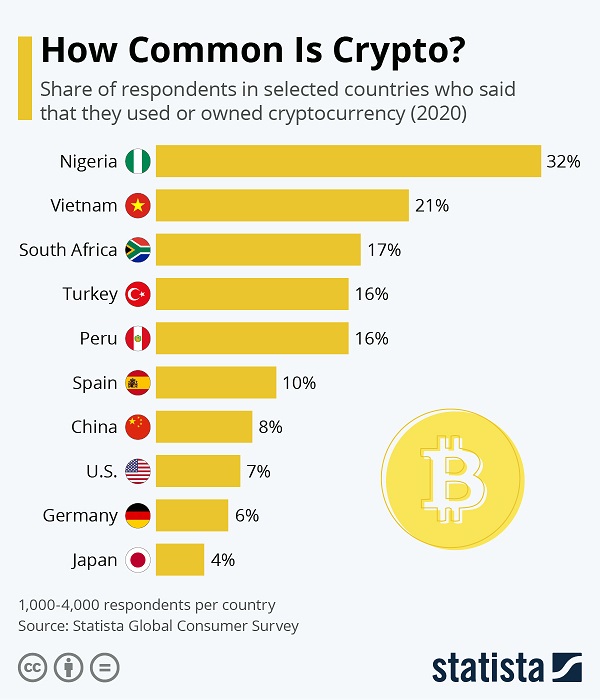
Chart Source: Statista
Furthermore, a significant portion of the energy that Bitcoin uses could otherwise be wasted. Bitcoin miners seek out the absolute cheapest sources of electricity in the world, which usually means energy that was developed for one reason or another, but that doesn’t currently have sufficient demand, and would therefore be wasted.
Examples of this include over-built hydroelectric dams in certain regions of China, or stranded oil and gas wells in North America. Bitcoin mining equipment is mobile, and thus can be put near wherever the cheapest source of energy is, to arbitrage it and give a purpose to that stranded energy production.
Bitcoin mining converts the output from those cheap stranded sources of energy into something that currently has monetary value.
5) “Bitcoin is Too Volatile”
Bitcoin is promoted as a store of value and medium of exchange, but it has a very volatile price history. This leads, again somewhat understandably, for investors to say it’s not a good store of value or medium of exchange, and thus fails at the one thing that it’s designed to do.
And they’re kind of right. Bitcoin isn’t the asset that you put money into for an emergency fund, or for a down payment on a house that you’re saving up for 6 months from now. When you definitely need a certain amount of currency in a near-term time horizon, Bitcoin is not the asset of choice.
This is because it’s an emerging store of value, roughly 12 years old now, and thus carries with it a significant degree of growth and speculation. Its market capitalization is growing over time, taking some market share from other stores of value, and growing into a meaningful asset class. We’ll see if it continues to do so, or if it levels off somewhere and starts to stagnate.
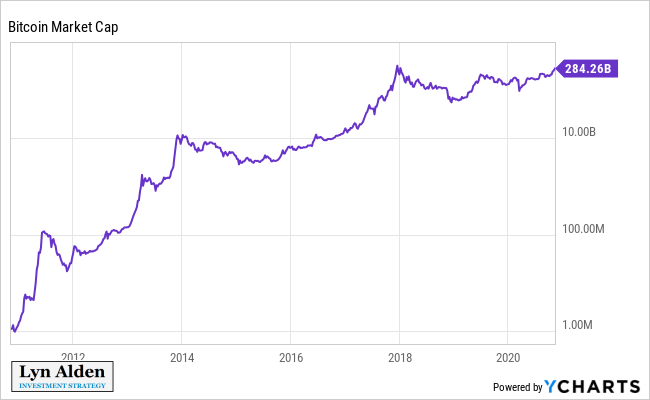
For Bitcoin’s market cap to grow from a $25 million to $250 million to $2.5 billion to $25 billion to today’s value of over $250 billion, it requires volatility, especially upward volatility (which, of course, comes with associated downside volatility).
As it grows larger, its volatility reduces over time. If Bitcoin becomes a $2.5 trillion asset class one day, with more widespread holding, its volatility would likely be lower than it is now.
Therefore, having a nonzero exposure to Bitcoin is basically a bet that Bitcoin’s network effect and use case will continue to grow until it reaches some equilibrium where it has lower volatility and is more stable. For now, it has plenty of volatility, and it needs that volatility if it is to keep growing. Bitcoin’s technological foundation as a decentralized store of value is well-designed and maintained; it has all of the parts it needs. It just needs to grow into what it can be, and we’ll see if it does.
It’s like if someone identifies a new element, and people begin discovering uses for that element, and it experiences a period of rapid growth and high price volatility, until it has been around for sufficient time that it eventually settles in to a normal volatility band.
While Bitcoin remains as volatile as it is, investors can mitigate the risk by having an appropriate position size.
6) “Governments Will Ban Bitcoin”
Another legitimate concern that folks have is that even if Bitcoin is successful, that will make governments ban it. Some governments already have. So, this falls more in the “risk” category than a “misconception”.
There is precedent for this. The United States made it illegal for Americans to own gold from 1933 to 1975, other than in small amounts for jewelry and collectibles. In the land of the free, there was a benign yellow metal that we could be sent to prison for owning coins and bars of, simply because it was seen as a threat to the monetary system.
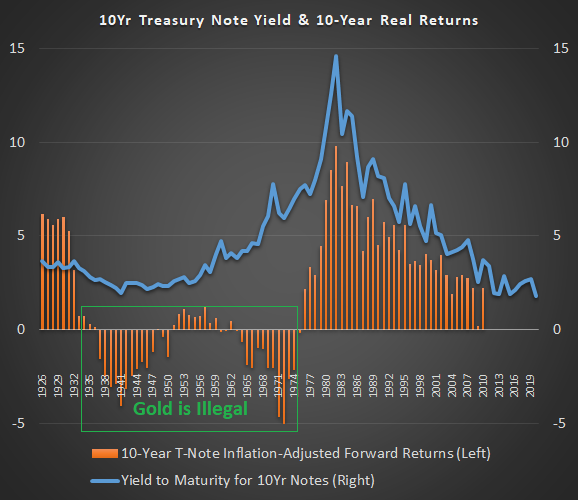
This chart shows the interest rate of 10-year Treasury yields in blue. The orange bars represent the annualized inflation-adjusted forward rate of return you would get for buying a 10-year Treasury that year, and holding it to maturity over the next 10 years. The green square shows the period of time where owning gold was illegal.
Data Sources: Robert Shiller, Aswath Damodaran
There was a four-decade period from the 1930’s to the 1970’s where keeping money in the bank or in sovereign bonds didn’t keep up with inflation, i.e. the orange bars were net negative. Savers’ purchasing power went down if they held these paper assets.
This was due to two inflationary decades: one in the 1940’s, and one in the 1970’s. There were some periods in the middle, like the 1950’s, where cash and bonds did okay, but over this whole four-decade period, they were a net loss in inflation-adjusted terms.
It’s not too shocking, therefore, that one of the release valves for investors was banned during that specific period. Gold did great over that time, and held its purchasing power against currency debasement. The government considered it a matter of national security to “prevent hoarding” and basically force people into the paper assets that lost value, or into more economic assets like stocks and real estate.
This was back when the dollar was backed by gold, so the United States government wanted to own most of the gold, and limit citizens’ abilities to acquire gold. No such backing exists today for gold or Bitcoin, and thus there is less incentive to try to ban it.
And, the gold ban was hard to enforce. There were rather few prosecutions over gold ownership, even though the penalties on paper were severe.
Bitcoin uses encryption, and thus is not really able to be confiscated other than through legal demand. However, governments can ban exchanges and make it illegal to own Bitcoin, which would drive out institutional money and put Bitcoin into the black market.
Here’s the problem. Bitcoin has over $250 billion in market capitalization. Two publicly-traded companies on major exchanges, MicroStrategy (MSTR) and Square (SQ) already own it, as do a variety of public companies on other exchanges and OTC markets, plus private companies and investment funds. Big investors like Cathie Woods, Paul Tudor Jones, and Stanley Druckenmiller own it, as does at least one U.S. senator-elect. Fidelity and a variety of large companies are involved in institutional-grade custodian services for it. PayPal (PYPL) is getting involved. Federally regulated U.S. banks can now officially custody crypto assets. The IRS treats it like a commodity for tax purposes. That’s a lot of mainstream momentum.
It would be extremely difficult for major capital markets like the United States or Europe or Japan to ban it at this point. If, in the years ahead, Bitcoin’s market capitalization reaches over $1 trillion, with more and more institutions holding exposure to it, it becomes harder and harder to ban.
Bitcoin was already an unusual asset that grew into the semi-mainstream from the bottom up, through retail adoption. Once the political donor class owns it as well, which they increasingly do, the game is basically over for banning it. Trying to ban it would be an attack on the balance sheets of corporations, funds, banks, and investors that own it, and would not be popular among millions of voters that own it.
I think regulatory hostility is still a risk to watch out for while the market capitalization is sub–$1 trillion. And the risk can be managed with an appropriate position size for your unique financial situation and goals.
7) “Where to Buy Bitcoin”
The most frequent question I get about Bitcoin is simply where to buy bitcoins. Some people don’t know how to start, and other people are familiar with the popular places to buy, but don’t know which ones are ideal.
There’s no one answer; it depends on your goals with it, and where you live in the world.
The first question to ask is whether you’re a trader or a saver. Do you want to establish a long-term Bitcoin position, or buy some with a plan to sell it in a few months? Or maybe some of both?
The second question to ask yourself is whether you want to self-custody it with private keys and a hardware wallet or multi-signature solution, which has an upfront learning curve but is ultimately more secure, or if you want to have someone else custody it for you, which is simpler but involves counterparty risk.
Bitcoin is accessible through some publicly traded funds, like the Grayscale Bitcoin Trust (GBTC), of which I am long. However, funds like these trade at a premium to NAV, and rely on counterparties. A fund like that can be useful as part of a diversified portfolio in an IRA, due to tax advantages, but outside of that isn’t the best way to establish a core position.
Bitcoin is also available on major exchanges, where it can then be sent to a private hardware wallet or elsewhere. I don’t have a strong view on which exchanges are the best. However, be careful about platforms that don’t let you withdraw your Bitcoin, like Robinhood. I personally bought my core position through an exchange in April when I turned bullish, and transferred a lot of it to personal custody.
From there, I began dollar-cost averaging through Swan Bitcoin, where it can be kept in their cold storage or transferred out to personal custody as well. Swan specializes in Bitcoin (rather than multiple types of digital assets), and has very low fees for folks who like to dollar-cost average. It’s a saver’s platform, in other words, rather than a trader’s platform. I’m an advisor to Swan Bitcoin and know several of their staff including their CEO, so it’s my preferred way to accumulate Bitcoin.
Overall, having access to a crypto exchange, and having access to a dollar-cost averaging platform like Swan, along with a personal custody solution like a hardware wallet or a multi-signature solution, is a good combo.
For folks who are early in the learning curve, keeping it on an exchange or in custody storage is also fine, and as you learn more, you can choose to self-custody if it’s right for your situation.
Acknowledgments to Michael Hartl for editing assistance.
Who Will Be the Next to Enter Into the Bitcoin World? U.S. Banks, Amazon, Apple, Warren Buffett?
By Sylvain Saurel
Posted December 1, 2020
Bitcoin is a revolution that will take everything in its path.
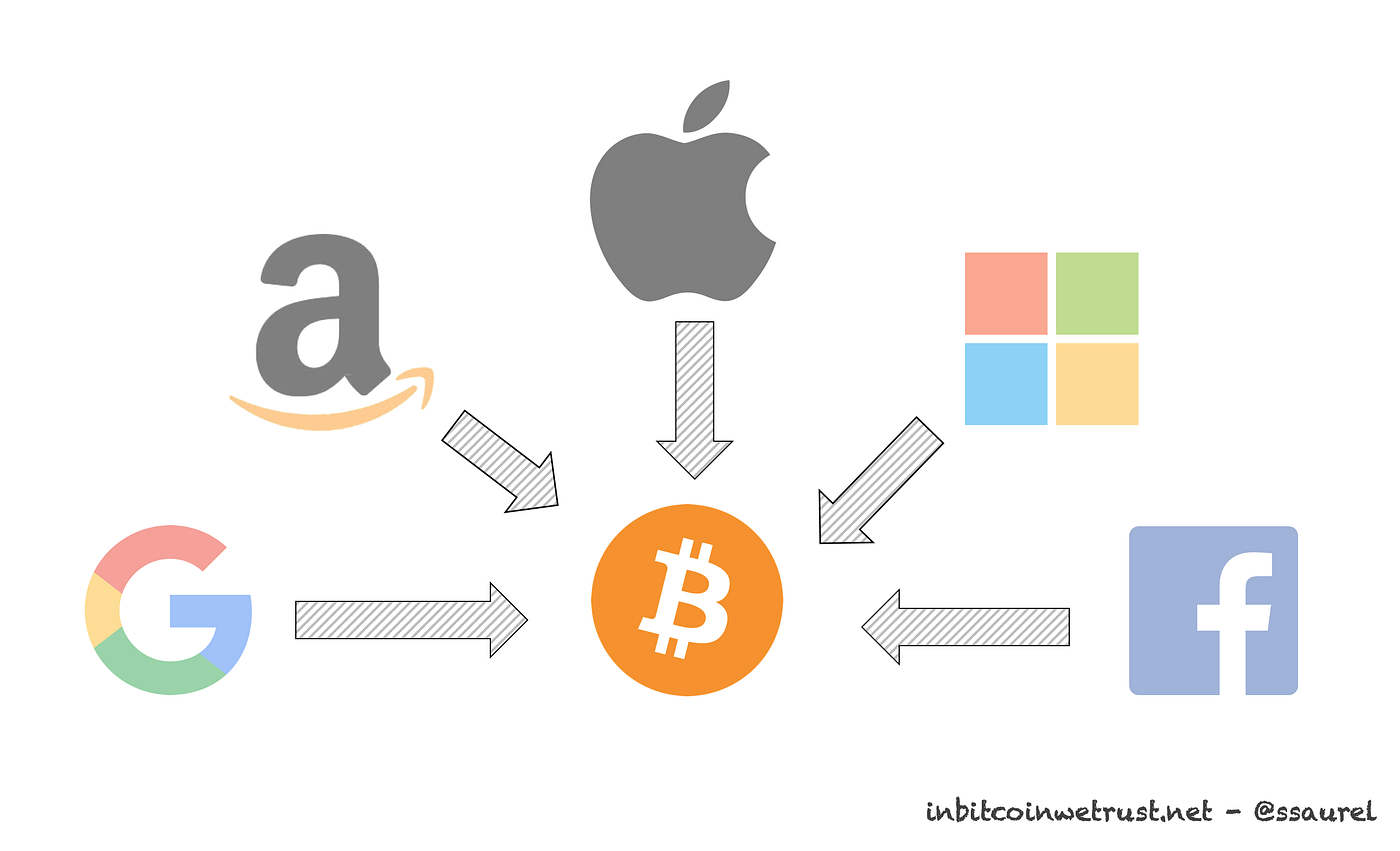
Illustration bySylvain Saurel
Bitcoin is at a major turning point in its history. The year 2020 has been marked by a coronavirus pandemic that will be recalled in a few years as the tipping point for Bitcoin.
If you are not familiar with the concept of the tipping point, it was popularized by Malcolm Gladwell in his book “The Tipping Point: How Little Things Can Make a Big Difference” published in the early 2000s.
In his book, Malcolm Gladwell explains that once this tipping point is reached, everything becomes different afterward. The coronavirus pandemic was a major event that triggered an economic crisis on a scale not seen in decades.
Central banks and governments always apply the same ineffective policies
The responses of central banks and governments have been those employed consistently since the establishment of the current monetary and financial system in August 1971:
- Lowering interest rates to zero.
- Printing money fiat out of thin air ad infinitum.
- Increase in public debt to finance stimulus plans to support the economy.
The problem is that crisis after crisis, the magnitude of the measures to be implemented keeps increasing. If billions of dollars were enough in the early 2000s, tens of billions of dollars were needed in 2008. And in 2020, we are talking in trillions of dollars.
The central banks of the major economic powers have printed more than $12 trillion since March 2020. Global debt has exploded to $277 trillion.
As the world’s leading economic power, the United States is obviously at the top of this ranking with a public debt that now exceeds $27.300 billion. The ratio of public debt to GDP has reached a record level in the United States:
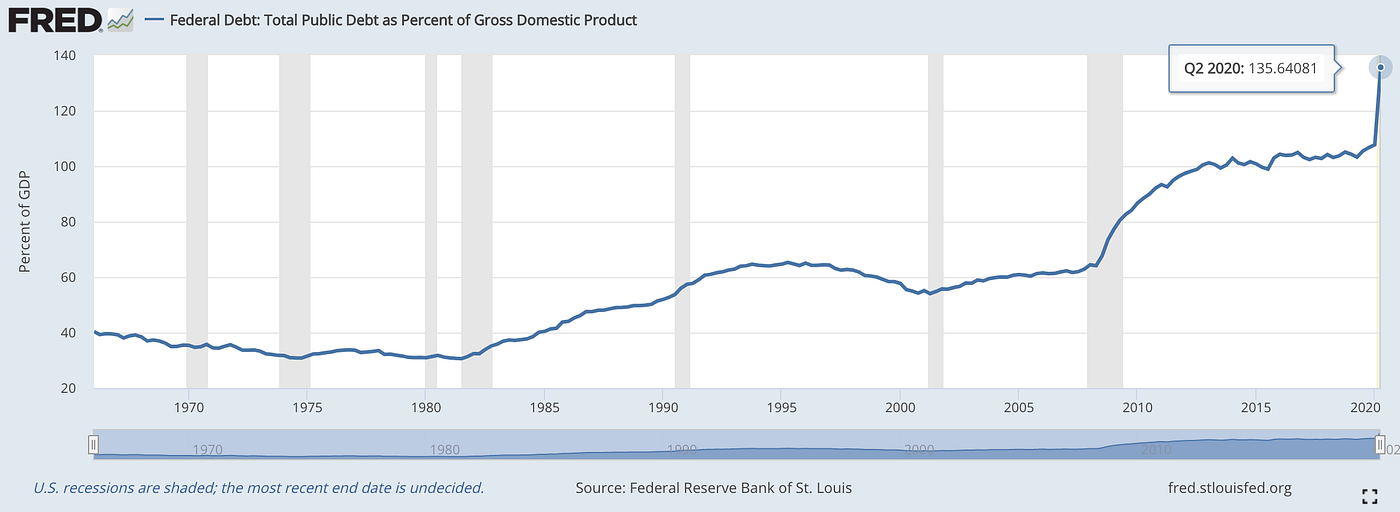
U.S. Federal Debt: Total Public Debt as Percent of GDP
Globally, the norm is now to have a public debt-to-GDP ratio well above 100 or even 110% in most of the world’s major economic powers.
The current situation is unsustainable, and a Bretton Woods 2.0 will not be enough
The current economic situation is clearly unsustainable over time. For many, the seven deadly sins of the current monetary and financial system will sooner or later lead to its collapse.
Well aware of this, many economists and politicians now call for a Great Reset of the current system. A kind of Bretton Woods 2.0 to put the world back on the right track by taking into account the new challenges of the 21st century.
What these economists do not understand is that the great monetary inflation we are currently experiencing cannot be stopped as long as central banks have such unlimited power in monetary creation.
As early as the 1980s, Friedrich Hayek called for taking control of money out of the hands of the States:
“I don’t believe we shall ever have good money again before we take it out the hands of governments.”
Friedrich Hayek has spent his life alerting people to the dangers of the current system
He has always been very critical of this system. For Friedrich Hayek, it was essential to have competitive money outside the control of the States. This would be the best protection against the risks of inflation.
For Friedrich Hayek, it was obvious that inflation decided by governments has always been carried out solely for the benefit of the governments themselves:
“I do not think it is an exaggeration to say history is largely a history of inflation, usually inflations engineered by governments for the gain of governments.”
Today, many people think that money should absolutely be a prerogative of the States. In his book “The denationalization of money” published in 1976, Friedrich Hayek argued for a money market outside the monopoly of the States.
According to him, it is essential to move away from the dogma that money should be the responsibility of the States.
Friedrich Hayek considered that money should not be the prerogative of the States
This conception, which seems obvious to us today, is very recent. In the Middle Ages and until late in history, the control of money by the royal power was limited to certifying that a gold coin was equal to one gram of gold.
Kings did not have the power to act on the money supply in circulation as central banks do today.
Friedrich Hayek, who died in 1992, must be turning over in his grave after seeing central banks print more than $10 trillion out of thin air since March 2020. Friedrich Hayek was already concerned about all this in the mid-1970s.
For him, the big culprit was the English economist Keynes. He was guilty of pushing strongly the idea of control of currencies by governments and central banks.
To stop this inflationary spiral, Friedrich Hayek saw two possibilities:
- A return to the gold standard, which makes it possible by the scarcity of the precious metal to limit inconsiderate monetary creation.
- Or a competition between currencies.
Bitcoin is the solution Friedrich Hayek dreamed of. The emergence of Bitcoin is thus the realization of Friedrich Hayek’s dream. Hayek’s vision is therefore gradually taking over from that of Keynes, which has been dominant since the middle of the twentieth century.
Attitudes are changing and Bitcoin is becoming the number one option against the GMI
In 2020, institutional investors understood that Bitcoin was the best possible weapon against the great monetary inflation (GMI) that we are experiencing. Paul Tudor Jones launched a movement in May 2020 that has not stopped growing since then.
Bitcoin Is the Fastest Horse in the Profits Race
Whether you like Bitcoin or not, it’s an undeniable reality.
medium.com
Grayscale Investments’ Bitcoin fund now holds more than 509,000 BTC for its clients which are more than 90%, institutional investors. The major companies make Bitcoin their reserve asset. The move was initiated by MicroStrategy and CEO Michael J. Saylor in early August 2020.
A major player in the Bitcoin world with its ultra-popular CashApp application that facilitates the purchase of Bitcoin, Square then joined the movement in early October 2020.
At the end of October 2020, it was the turn of PayPal to announce its upcoming entry into the Bitcoin world. By early 2021 at the latest, PayPal will allow its 346 million users worldwide to buy/sell Bitcoin directly from its platform.
Even better, PayPal will offer payments in Bitcoin to the 26 million businesses in its network. However, this raises questions in terms of self-sovereignty, as shown by a first case that made a lot of noise about a user account that was banned for too many transactions in cryptocurrencies.
The Danger of Buying Bitcoin via PayPal Has Already Come to Light With a First Example
Not your keys, Not your Bitcoin.
medium.com
Only Warren Buffett and Ray Dalio are left not to believe in Bitcoin on Wall Street
More and more legendary Wall Street investors are embracing Bitcoin, explaining that it is a unique opportunity. Bitcoin is indeed the opportunity of a lifetime. In the end, only Ray Dalio and Warren Buffett are left to fiercely oppose Bitcoin.
Ray Dalio still believes, wrongly, that Bitcoin will be stopped by governments if it becomes too big. Ray Dalio is totally mistaken. Bitcoin can no longer be stopped, and above all, the trend is rather towards a better consideration of Bitcoin through more favorable regulations.
At least this is the hope that was born after the election of Joe Biden as the 46th President of the United States.
Warren Buffett still thinks that Bitcoin is a “Rat poison squared”, but after all, at his age, it seems logical that he is not able to question himself to understand why Bitcoin is revolutionary. So I can hardly imagine that Warren Buffett will be one of the next to enter the Bitcoin world.
If Warren Buffett will not be among those who will enter the Bitcoin world in the coming months, the big question is who will be next.
The arrival of PayPal brings credibility with the general public
The entry of PayPal is important because it brings enormous credibility for Bitcoin. PayPal is a major and highly respected player in the online payment world. Those who were still hesitating to cross the pass because of Bitcoin’s bad public image will probably be reassured.
In the summer of 2020, the Office of the Comptroller of the Currency (OCC), which is the U.S. banking regulator, gave the green light to U.S. banks to buy and hold Bitcoin for their customers.
It is therefore easy to imagine that American banks will be the next to offer Bitcoin purchase/holding services to their customers.
If this is not a good thing from the point of view of the Bitcoin revolution, since banks are part of the problem that Bitcoin wants to solve, it is something that will greatly boost the adoption of Bitcoin by the general public.
U.S. Banks Can Now Hold Bitcoin, and It’s Not a Good News As You May Think at First Sight
The banks cannot be part of the solution.
medium.com
U.S. banks will follow PayPal’s lead in the coming months
Jamie Dimon, who said in May 2020 that he regretted calling Bitcoin a fraud at the end of 2017, explains that he sees Bitcoin gaining a sustainable foothold. He nevertheless specifies that it is not his thing. He urges JPMorgan to enter the Bitcoin world to take advantage of it.
Since May 2020, JPMorgan has been offering its banking services to Coinbase or Gemini, for example.
In 2021, I imagine that JPMorgan will end up offering Bitcoin to its customers. In the wake of JPMorgan, other American banks will follow like Morgan Stanley or Citibank. Citibank has just published a report in which its analysts see Bitcoin capable of reaching a price of over $318K by the end of 2021.
This is even more optimistic than my forecast of a $100K Bitcoin by the end of 2021. But why not …
Apart from the American banks, what other players could come into the world of Bitcoin in 2021?
The GAFA, with Amazon and Apple in the lead, will eventually come to the Bitcoin world
I think immediately of Amazon, which could enter the Bitcoin world by accepting Bitcoin as a means of payment on its site. This would be something that would boost the credibility of Bitcoin, but also its use.
Besides Amazon, Apple would have a double interest in entering the Bitcoin world quickly. The first would be to use part of its $192 billion cash reserve to buy Bitcoin. This move could then be followed by many other major companies in the United States. They are sitting on mountains of cash that are suffering the effects of this great monetary inflation.
The Bitcoin Rush Has Started for the Big American Companies, Nothing Can Stop It Now
Gradually, Then Suddenly.
medium.com
But Apple could also generate a lot of money if it integrated Bitcoin into Apple Pay, which is becoming more and more popular. Apple could build a secure crypto wallet directly into its iPhones.
While this might have seemed utopian a few months ago, the probability that these players will enter the Bitcoin world in the coming months and years is growing.
Conclusion
Bitcoin is a real revolution that is set to last. Faced with such a monetary revolution, there is only one choice: embrace it as soon as possible to get the most out of it. The GAFAM will be no exception to the rule, and they will have to adopt Bitcoin sooner or later.
It will be a matter of survival for them as well.
I have not even mentioned here the governments that are becoming more and more involved in Bitcoin to free themselves from the American yoke on the world. I am thinking of Iran or Venezuela, who see Bitcoin as a way to free themselves from the American sanctions.
In any case, the future looks bright for Bitcoin, and the best is yet to come. Don’t be surprised by the great announcements for Bitcoin that will multiply in the months and years to come. This is just the beginning.
In Bitcoin We Trust Newsletter
Everything around Bitcoin, Blockchain and the cryptocurrency market.
inbitcoinwetrust.substack.com
(Disclaimer: This story contains affiliate links for some books. If you choose to make a purchase after clicking these links I may receive a commission at no additional cost to you. Thank you for your support!)
This story was first published on my personal website sylvainsaurel.com
Why Does Bitcoin Have Value? – AIER
By Jeffrey A. Tucker
Posted December 2, 2020
“Think of a world without essential third parties, including the most dangerous third party ever conceived of by man: the state and the central bank. Imagine that future and you begin to grasp the fullness of the implications of our future. Ludwig von Mises would be amazed and surprised at…” - Jeffrey Tucker
Even after eleven years experience, and a per Bitcoin price of nearly $20,000, the incredulous are still with us. I understand why. Bitcoin is not like other traditional financial assets. Even describing it as an asset is misleading. It is not the same as a stock, as a payment system, or a money. It has features of all these but it is not identical to them. What Bitcoin is depends on its use as a means of storing and porting value, which in turn rests of secure titles to ownership of a scarce good. Those without experience in the sector look at all of this and get frustrated that understanding why it is valuable is not so easy to grasp.
In this article, I’m updating an analysis I wrote six years ago. It still holds up. For those who don’t want to slog through the entire article, my thesis is that Bitcoin’s value obtains from its underlying technology, which is an open-source ledger that keeps track of ownership rights and permits the transfer of these rights. Bitcoin managed to bundle its unit of account with a payment system that lives on the ledger. That’s its innovation and why it obtained a value and that value continues to rise.
Consider the criticism offered by traditional gold advocates, who have, for decades, pushed the idea that sound money must be backed by something real, hard, and independently valuable. Bitcoin doesn’t qualify, right? Maybe it does.
Bitcoin first emerged as a possible competitor to national, government-managed money in 2009. Satoshi Nakamoto’s white paper was released October 31, 2008. The structure and language of this paper sent the message: This currency is for computer technicians, not economists nor political pundits. The paper’s circulation was limited; novices who read it were mystified.
But the lack of interest didn’t stop history from moving forward. Two months later, those who were paying attention saw the emergence of the “Genesis Block,” the first group of bitcoins generated through Nakamoto’s concept of a distributed ledger that lived on any computer node in the world that wanted to host it.
Here we are all these years later and a single bitcoin trades at $18,500. The currency is held and accepted by many thousands of institutions, both online and offline. Its payment system is very popular in poor countries without vast banking infrastructures but also in developed countries. And major institutions—including the Federal Reserve, the OECD, the World Bank, and major investment houses—are paying respectful attention and weaving blockchain technology into their operations..
Enthusiasts, who are found in every country, say that its exchange value will soar even more in the future because its supply is strictly limited and it provides a system vastly superior to government money. Bitcoin is transferred between individuals without a third party. It is relatively low-cost to exchange. It has a predictable supply. It is durable, fungible, and divisible: all crucial features of money. It creates a monetary system that doesn’t depend on trust and identity, much less on central banks and government. It is a new system for the digital age.
Hard lessons for hard money
To those educated in the “hard money” tradition, the whole idea has been a serious challenge. Speaking for myself, I had been reading about bitcoin for two years before I came anywhere close to understanding it. There was just something about the whole idea that bugged me. You can’t make money out of nothing, much less out of computer code. Why does it have value then? There must be something amiss. This is not how we expected money to be reformed.
There’s the problem: our expectations. We should have been paying closer attention to Ludwig von Mises’ theory of money’s origins—not to what we think he wrote, but to what he actually did write.
In 1912, Mises released The Theory of Money and Credit. It was a huge hit in Europe when it came out in German, and it was translated into English. While covering every aspect of money, his core contribution was in tracing the value and price of money—and not just money itself—to its origins. That is, he explained how money gets its price in terms of the goods and services it obtains. He later called this process the “regression theorem,” and as it turns out, bitcoin satisfies the conditions of the theorem.
Mises’ teacher, Carl Menger, demonstrated that money itself originates from the market—not from the State and not from social contract. It emerges gradually as monetary entrepreneurs seek out an ideal form of commodity for indirect exchange. Instead of merely bartering with each other, people acquire a good not to consume, but to trade. That good becomes money, the most marketable commodity.
But Mises added that the value of money traces backward in time to its value as a bartered commodity. Mises said that this is the only way money can have value.
The theory of the value of money as such can trace back the objective exchange value of money only to that point where it ceases to be the value of money and becomes merely the value of a commodity…. If in this way we continually go farther and farther back we must eventually arrive at a point where we no longer find any component in the objective exchange value of money that arises from valuations based on the function of money as a common medium of exchange; where the value of money is nothing other than the value of an object that is useful in some other way than as money…. Before it was usual to acquire goods in the market, not for personal consumption, but simply in order to exchange them again for the goods that were really wanted, each individual commodity was only accredited with that value given by the subjective valuations based on its direct utility.
Mises’ explanation solved a major problem that had long mystified economists. It is a narrative of conjectural history, and yet it makes perfect sense. Would salt have become money had it otherwise been completely useless? Would beaver pelts have obtained monetary value had they not been useful for clothing? Would silver or gold have had money value if they had no value as commodities first? The answer in all cases of monetary history is clearly no. The initial value of money, before it becomes widely traded as money, originates in its direct utility. It’s an explanation that is demonstrated through historical reconstruction. That’s Mises’ regression theorem.
Bitcoin’s use value
At first glance, bitcoin would seem to be an exception. You can’t use a bitcoin for anything other than money. It can’t be worn as jewelry. You can’t make a machine out of it. You can’t eat it or even decorate with it. Its value is only realized as a unit that facilitates indirect exchange. And yet, bitcoin already is money. It’s used every day. You can see the exchanges in real time. It’s not a myth. It’s the real deal.
It might seem like we have to choose. Is Mises wrong? Maybe we have to toss out his whole theory. Or maybe his point was purely historical and doesn’t apply in the future of a digital age. Or maybe his regression theorem is proof that bitcoin is just an empty mania with no staying power, because it can’t be reduced to its value as a useful commodity.
And yet, you don’t have to resort to complicated monetary theory in order to understand the sense of alarm surrounding bitcoin. Many people, as I did, just have a feeling of uneasiness about a money that has no basis in anything physical. Sure, you can print out a bitcoin on a piece of paper, but having a paper with a QR code or a public key is not enough to relieve that sense of unease.
How can we resolve this problem? In my own mind, I toyed with the issue for more than a year. It puzzled me. I wondered if Mises’ insight applied only in a pre-digital age. I followed the speculations online that the value of bitcoin would be zero but for the national currencies into which it is converted. Perhaps the demand for bitcoin overcame the demands of Mises’ scenario because of a desperate need for something other than the dollar.
As time passed—and I read the work of Konrad Graf, Peter Surda, and Daniel Krawisz—finally the resolution came. Bitcoin is both a payment system and a money. The payment system is the source of value, while the accounting unit merely expresses that value in terms of price. The unity of money and payment is its most unusual feature, and the one that most commentators have had trouble wrapping their heads around.
We are all used to thinking of currency as separate from payment systems. This thinking is a reflection of the technological limitations of history. There is the dollar and there are credit cards. There is the euro and there is PayPal. There is the yen and there are wire services. In each case, money transfer relies on third-party service providers. In order to use them, you need to establish what is called a “trust relationship” with them, which is to say that the institution arranging the deal has to believe that you are going to pay.
This wedge between money and payment has always been with us, except for the case of physical proximity.
If I give you a dollar for your pizza slice, there is no third party. But payment systems, third parties, and trust relationships become necessary once you leave geographic proximity. That’s when companies like Visa and institutions like banks become indispensable. They are the application that makes the monetary software do what you want it to do.
The hitch is that the payment systems we have today are not available to just anyone. In fact, a vast majority of humanity does not have access to such tools, which is a major reason for poverty in the world. The financially disenfranchised are confined to only local trade and cannot extend their trading relationships with the world.
A major, if not a primary, purpose of developing Bitcoin was to solve this problem. The protocol set out to weave together the currency feature with a payment system. The two are interlinked in the structure of the code itself. This connection is what makes bitcoin different from any existing national currency, and, really, any currency in history.
Let Nakamoto speak from the introductory abstract to his white paper. Observe how central the payment system is to the monetary system he created:
A purely peer-to-peer version of electronic cash would allow online payments to be sent directly from one party to another without going through a financial institution. Digital signatures provide part of the solution, but the main benefits are lost if a trusted third party is still required to prevent double-spending. We propose a solution to the double-spending problem using a peer-to-peer network. The network timestamps transactions by hashing them into an ongoing chain of hash-based proof-of-work, forming a record that cannot be changed without redoing the proof-of-work. The longest chain not only serves as proof of the sequence of events witnessed, but proof that it came from the largest pool of CPU power. As long as a majority of CPU power is controlled by nodes that are not cooperating to attack the network, they’ll generate the longest chain and outpace attackers. The network itself requires minimal structure. Messages are broadcast on a best effort basis, and nodes can leave and rejoin the network at will, accepting the longest proof-of-work chain as proof of what happened while they were gone.
What’s very striking about this paragraph is that there is not even one mention of the currency unit itself. There is only the mention of the problem of double-spending (which is to say, the problem of inflationary money creation beyond which the protocol would otherwise permit). The innovation here, even according to the words of its inventor, is the payment network, not the coin. The coin or digital unit only expresses the value of the network. It is an accounting tool that absorbs and carries the value of the network through time and space.
This network is the blockchain. It’s a ledger that lives in the digital cloud, a distributed network, and it can be observed in operation by anyone at any time. It is carefully monitored by all users. It allows the transference of secure and non-repeatable bits of information from one person to any other person anywhere in the world, and these information bits are secured by a digital form of property title. This is what Nakamoto called “digital signatures.” His invention of the cloud-based ledger allows property rights to be verified without having to depend on some third-party trust agency.
The blockchain solved what has come to be known as the Byzantine generals’ problem. This is the problem of coordinating action over a large geographic range in the presence of potentially malicious actors. Because generals separated by space have to rely on messengers and this reliance takes time and trust, no general can be absolutely sure that the other general has received and confirmed the message, much less its accuracy.
Putting a ledger, to which everyone has access, on the Internet overcomes this problem. The ledger records the amounts, the times, and the public addresses of every transaction. The information is shared across the globe and always gets updated. The ledger guarantees the integrity of the system and allows the currency unit to become a digital form of property with a title.
Once you understand this, you can see that the value proposition of bitcoin is bound up with its attached payment network. Here is where you find the use value to which Mises refers. It is not embedded in the currency unit but rather in the brilliant and innovative payment system on which bitcoin lives. If it were possible for the blockchain to be somehow separated from bitcoin (and, really, this is not possible), the value of the currency would instantly fall to zero.
Proof of concept
Now, to further understand how Mises’ theory fits with bitcoin, you have to understand one other point concerning the history of the cryptocurrency. On the day of its release (January 9, 2009), the value of bitcoin was exactly zero. And so it remained for 10 months after its release. All the while, transactions were taking place, but it had no posted value above zero for this entire time.
The first posted price of bitcoin appeared on October 5, 2009. On this exchange, $1 equaled 1,309.03 Bitcoin (which many considered overpriced at the time). In other words, the first valuation of bitcoin was little more than one-tenth of a penny. Yes, if you had bought $100 worth of bitcoin in those days, and not sold them in some panic, you would be a half-billionaire today.
So here is the question: What happened between January 9 and October 5, 2009, to cause bitcoin to obtain a market value? The answer is that traders, enthusiasts, entrepreneurs, and others were trying out the blockchain. They wanted to know if it worked. Did it transfer the units without double-spending? Did a system that depended on voluntary CPU power actually suffice to verify and confirm transactions? Do the rewarded bitcoins land in the right spot as payment for verification services? Most of all, did this new system actually work to do the seemingly impossible—that is, to move secure bits of title-based information through geographic space, not by using some third party but rather peer-to-peer?
It took 10 months to build confidence. It took another 18 months before bitcoin reached parity with the U.S. dollar. This history is essential to understand, especially if you are relying on a theory of money’s origins that speculates about the pre-history of money, as Mises’ regression theorem does. Bitcoin was not always a money with value. It was once a pure accounting unit attached to a ledger. This ledger obtained what Mises called “use value.” All conditions of the theorem are thereby satisfied.
Final accounting
To review, if anyone says that bitcoin is based on nothing but thin air, that it cannot be a money because it has no real history as a genuine commodity, and whether the person saying this is a novice or a highly trained economist, you need to bring up two central points. One, bitcoin is not a stand-alone currency but a unit of accounting attached to an innovative payment network. Two, this network and therefore bitcoin only obtained its market value through real-time testing in a market environment.
In other words, once you account for the razzle-dazzle technical features, bitcoin emerged exactly like every other currency, from salt to gold, did. People found the payment system useful, and the attached accounting was portable, divisible, fungible, durable, and scarce.
A new form of money was born. This money has all the best features of money from history but adds a weightless and spaceless payment network, one that is reliable and verified in real time, that enables the entire world to trade without having to rely on third parties.
But notice something extremely important here. The blockchain is not only about money. It is about any information transfers that require security, confirmations, and total assurance of authenticity. This pertains to contracts and transactions of all sorts, all performed peer-to-peer.
To be sure, the sector has come to be dominated by third parties that operate mainly as custodians. The crucial point is that this is a market development driven by consumer desire but it is not necessary for the functioning of the system. In addition, thousands of additional tokens have appeared that operate and compete in the crypto sector which is now worth, at the time of this writing, $560 billion in market capitalization.
Think of a world without essential third parties, including the most dangerous third party ever conceived of by man: the state and the central bank. Imagine that future and you begin to grasp the fullness of the implications of our future.
Ludwig von Mises would be amazed and surprised at bitcoin. But he might also feel a sense of pride that his monetary theory of more than a century ago has been confirmed and given new life in the 21st century.
Bitcoin Astronomy: Part II
By Dhruv Bansal
Posted December 9, 2020
This is Part II in a series of speculations about the hyperbitcoinized future. In Part I, we defined the First Law of Bitcoin Astronomy and described how it incentivizes searching for energy to power our growing civilization.
In this part, we continue to follow the energy and speculate about how money and society coevolve as humanity expands through space. We begin with a brief review of Part I.
First Law 101
In Part I, we speculated about a hyperbitcoinized humanity where bitcoin has become much more than just a currency or even a global financial system. In the future, bitcoin is deeply integrated into energy, telecommunications, logistics, and other sectors of Earth’s economy. Secondary and tertiary layers of networks settling into bitcoin are how markets, supply chains, and political systems organize themselves.
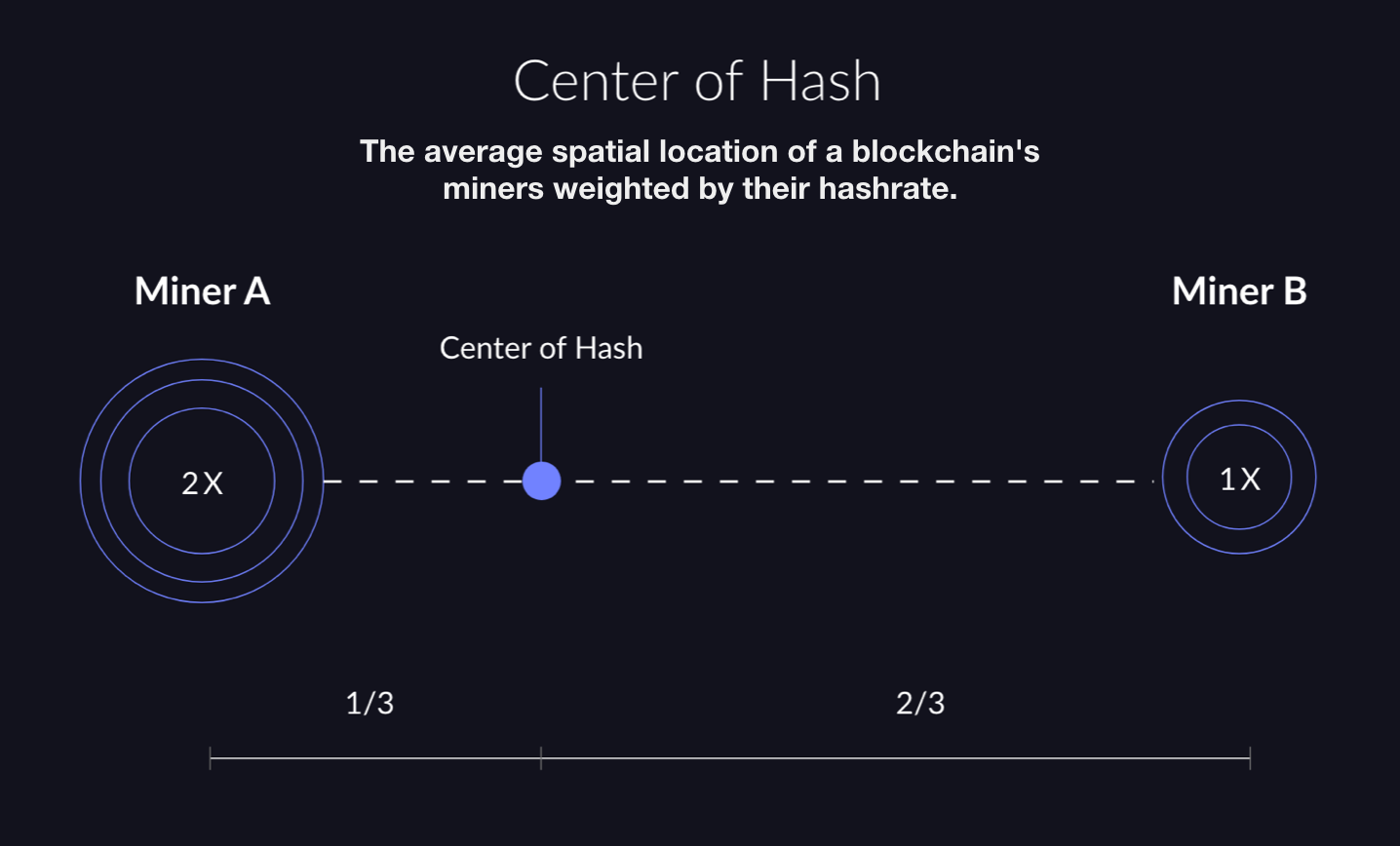
The “Center of Hash” was defined in Part I of this series.
Humanity is also beginning to settle other planets such as Mars. This led us to explore how bitcoin works when great distances separate users and miners. We introduced the idea of a center of hash (above) and explained how it leads to the First Law of Bitcoin Astronomy: proof-of-work mining is not feasible far from the center of hash of a blockchain. All of a blockchain’s miners must be co-located within the same hash horizon — a spatial sphere with a diameter comparable to the the distance light can travel within that blockchain’s block time. Bitcoin’s choice of a 10 minute block time places Mars (at an average distance of 12 light minutes) outside of Earth’s hash horizon. Martians will be able to use bitcoin, but never mine it!
Mining is one of the most important industries of the hyperbitcoinized future. It’s not just about capturing transaction settlement fees — the ability for anyone to turn energy directly into money incentivizes broader collection of energy and optimizes its distribution. Eager to kickstart this virtuous cycle (and a wave of financial speculation), distant colonies will launch their own bitcoin-like blockchains.
We followed the launch of Muskcoin, the first of these blockchains, on the planet Mars. The launch of Muskcoin is a kind of economic and political revolution. Terran miners will not support it, preferring to keep Martian transaction fees accumulating on Earth. The First Law of Bitcoin Astronomy is the reason Martians launch Muskcoin, but it will also be why Muskcoin survives; Terran miners are too far away from Muskcoin’s center of hash to prevent it from becoming the new currency of the Red Planet.
This pattern of expansion and revolution will repeat throughout the future. As great distances divide our civilization, the First Law ensures that those on the fringes will have both the incentive and the capability to launch their own blockchains. These pioneers will settle the outer planets, and eventually nearby stars, simply because they are far away.
Kardashev Civilizations
Before we continue our speculations, it will be useful to introduce some terminology for describing civilizations by their energy usage. Nikolai Kardashev’s famous scale categorizes civilizations as follows:
- A Type I civilization uses energy on a planetary scale (~1017 Watts)
- AType II civilization uses energy on a stellar scale (~1026 Watts)
- AType III civilization uses energy on a galactic scale (~1037 Watts)

This scale is not precise and is more than a little arbitrary, but it does capture the vast gulf in energy usage between civilizations of different types: a Type II stellar civilization, for example, uses billions of times more energy than a Type I planetary civilization. The three original categories have since been extended (Type IV, Type V, &c.) and interpolated. A Type 2.1 civilization, for example, would use more energy than a Type II stellar civilization but less than a Type III galactic civilization.
Science fiction frequently describes fantastic megaprojects of advanced civilizations, such as space elevators and Dyson spheres, but it seldom articulates how they pay for it all. How can money develop the reach to coordinate society across solar systems and galaxies? What size market is required to settle the sale of a star system? Which reserve currency would an immortal future investor choose to hold? These questions are ignored by most science fiction writers who view money as either uninteresting because it’s just like today’s or irrelevant because the future is post-scarcity.
…if your theory is found to be against the second law of thermodynamics I can give you no hope; there is nothing for it but to collapse in deepest humiliation.
– Sir Arthur Eddington
We believe that the laws of thermodynamics are inviolable. Energy will always be scarce, and using it will always create entropy through waste heat. The only quantity in the universe with infinite supply is human ambition. No future society will therefore ever be post-scarcity. For humanity, this means money and markets — and therefore blockchains — will always be useful for optimizing resource collection, distribution, and allocation.
Kardashev Blockchains
We believe money will scale with society’s energy usage.
Today, at the dawn of bitcoin we are (by some measures) a Type 0.7 “sub-planetary” civilization. By the time of the Muskcoin revolution, our burgeoning interplanetary civilization will have risen to somewhere between Type I and II on the Kardashev scale, though much closer to Type I.
As we continue towards becoming a Type II civilization, we will outgrow Type I “planetary blockchains,” such as bitcoin or Muskcoin. We will still value these currencies, but will forge a new, stellar blockchain to span our entire solar system. We will call this Type II blockchain Solcoin, as it will come to be used for most trade occurring in orbit of the star Sol, our sun.
But money doesn’t just scale in response to society’s energy usage, it causes it: blockchains of higher type bootstrap civilizations of lower type up the Kardashev scale. Bitcoin was a Type I blockchain built by a Type 0.7 civilization. It incentivized energy collection near the Earth, propelling us up into orbit and out into the solar system towards becoming a Type I civilization. Solcoin is a Type II blockchain built by a Type 1.x civilization. It will incentivize energy collection across the entire solar system, powering megastructures and interstellar missions, enabling our species to expand through our galactic neighborhood.
When humanity eventually reaches other stars, we will launch blockchains there, too — first planetary, then stellar. Our eventual Type 2.x interstellar society will launch Type III galactic blockchains. This positive feedback between expanding societies and new blockchains will repeat at ever larger scales determined by the distribution of matter in the universe.
We’ll begin our story with the origin of Solcoin on the once great planet of Earth, sometime after the Muskcoin revolution.
Type I Civilizations Launch Type II Blockchains
The Muskcoin Revolution was a shock to many Terrans. Earth was the oldest, most populated, and most developed world, and the hashrate of Terran miners was tremendous. Yet Mars, a small colony that would have failed without continued investment and nourishment of Earth, successfully revolted against bitcoin.
The crucial factor in the success of this revolution was the Martians’ choice of a block time short enough to place Earth outside of Muskcoin’s hash horizon, preventing Terran miners from mining Muskcoin. Had Martians chosen to endow Muskcoin with a block time of several hours, Earth would have been within Muskcoin’s hash horizon. The massively larger Terran hashrate would have out-competed Martian miners, allowing them to hash bomb Muskcoin, destroying it and the revolution without any shots fired.
Short block times are a form of economic protectionism enabled by the finite speed of light.
Martians and other potential revolutionaries intuitively understand this relationship: short block times allow fledgling blockchains to defend themselves against the predations of powerful incumbents. Long block times not only make secondary and tertiary layers of a blockchain-based economy more challenging to engineer, they also cede power to faraway interests. No revolution would be so foolish as to start a blockchain with a long block time.
The Decline and Fall of the Terran Empire
But what about an empire?
Like the American Revolution centuries prior, the Muskcoin revolution became a model for other colonies seeking independence from Terran economic and political control. Powerful interests on Earth, like the British Empire before them, are faced with the prospect of continually diminishing influence, as faraway colonies grow and, inspired by the example of Mars, demand their independence.
Clever Terrans will realize that a blockchain with a long block time may be exactly what is needed to curtail future revolutions. Martians used bitcoin on Mars for many years before they launched Muskcoin; it was the inability to mine bitcoin and the absence of the virtuous cycle of mining that prompted the revolution.
Most of the solar system’s mass is within a light day of Earth. If Terrans were to launch a blockchain with a block time of several days, its hash horizon would encompass all miners in the entire solar system. This will lead them to suggest Solcoin, the first Type II stellar blockchain.
Terrans hope Solcoin will transform potential colonial revolutionaries into productive miners, all hashing together within a single, solar-system wide market. A single money, they’ll argue, is more efficient than many separate monies. They’ll advocate for citizens of faraway colonies to use Type I planetary blockchains such as bitcoin for their daily transactions but mine Solcoin for the health of their economies.
Such an arrangement would be of great benefit to Terran miners. Large distances and short block times cut off their tremendous hashrate, largest in the solar system, from the fee markets of blockchains such as Muskcoin. Solcoin is an interplanetary fee market that all miners in the solar system can compete in. Since Terrans have the highest hashrate, they would dominate this market, capturing settlement fees that currently go to miners of other blockchains.

Solcoiners are selling their hashrate to interplanetary society. And, you know, there’s no such thing as interplanetary society. There are individual planets and moons and there are asteroids.”
– Stargaret Hasher, 2187
This point will not be lost on the governments, businesses, and people living far from Earth, already using or contemplating their own planetary blockchains. Local mining industries solar-system wide will balk at opening themselves up to competition with Terran miners, in the same way that domestic manufacturers balk at lowering tariffs on foreign imports. Detractors will argue that Solcoin is merely a ploy by perfidious Terran miners to interfere in the money and politics of the other worlds, a sign of an empire in decline, unwilling to gracefully cede interplanetary space to those who dwell there.
A Million Tiny Worlds
But Terran miners won’t be the only Solcoin supporters. To find others, we must turn our attention to the literal fringes of interplanetary society.
Not all humans will choose to live on or near planetary bodies. Many will prefer to take up residence in engineered space habitats that offer the most Earth-like living conditions away from the hustle and grime of Earth itself. Spinning cylinders can provide Earth-equivalent gravity, which is much more difficult to produce on the surface of Mars or the Moon. Fusion lamps, powered by water, can provide Earth-natural sunlight. Space habitats can thrive anywhere. Some may even migrate.

Artificial space colonies can house millions of people and orbit anywhere in the solar system. How will the builders of these bauble worlds participate in the mining industry? [Source]

These habitats will first be built in orbit near the Earth, Moon, and Mars, and then at nearby Lagrange points. But hauling large amounts of material up from a planet’s surface is inefficient and expensive. Later habitats will be built where the materials to make them are abundant and where there is no gravity well to fight: the asteroid belt between Mars and Jupiter, and the belt of comets beyond the orbit of Neptune known as the Kuiper belt (of which Pluto is the most prominent member). Asteroids and comets are made of carbon, silicon, metals, ammonia, methane and water: all raw ingredients of the space industry. They are the perfect substrate for building colonies. The belts will become full with them.
It is possible that belters on opposite sides of the solar system feel no mutual relation, but it’s also possible that the belters have their own cultural identity and economic network full of people with a shared history and similar problems. Belters will want to unite behind a blockchain they can all mine, pulling the virtuous cycle of mining into their orbit.
But a settled belt is very different than a planet. A single space colony may house a few million people, about the scale of a large city. The billions of humans eventually settling the asteroid and Kuiper belts will be spread across hundreds and then thousands of such colonies. At first the colonies may be near each other, but over time they will distribute around the full circumference of the belts. If belters were to start a blockchain, what block time should they choose?

Belts are extended objects which span significant distances in space. The asteroid belt (left), between Mars and Jupiter, is about a light-hour in diameter. The Kuiper belt (right), beyond the orbit of Neptune, is a full light-day in diameter. Type I blockchains with block times of minutes can be used by belters but will never be mined by them. The huge amounts of energy available in the belts will only be harnessed by a Type II blockchain with a block time comparable to (or, more likely, many times) their diameter.
Planetary blockchains such as bitcoin and Muskcoin have short block times of ~10 minutes and correspondingly small hash horizons. This is sufficient for civilizations such as Earth’s or Mars’, which are located near planets and span just a few light-seconds. If, like these planetary blockchains, belters choose a convenient time near 10 minutes, then their hash horizons will be similarly small. Asteroids in the asteroid belt aren’t a dangerous mine-field of obstacles, as often depicted in movies. In reality, asteroids are about 3 light-seconds apart on average, more than twice as far apart as the Earth and Moon. Comets in the Kuiper belt are even further apart. A blockchain with a small hash horizon will therefore only be able to connect miners on a few nearby colonies. A small number of nearby colonies is like a small number of nearby cities. They will not have the population, industry, or hashrate to support an entire blockchain, let alone one that could defend itself against aggression from nearby planetary blockchains. But the population of the full belt, hashing together, could hold against the center.
The geography, or perhaps the topology, of their society presents some immediate challenges. A belt is not localized near any single point. It is an annulus of material surrounding the Sun. The diameter of the asteroid belt is larger than the orbit of Mars — signals take almost a full hour to cross it. The Kuiper belt is even larger in diameter– a full light-day. A blockchain that could connect all these far-flung miners would need an extremely long block time.
This is exactly the problem a stellar blockchain such as Solcoin solves. Without Solcoin, belters could transact using any number of local planetary blockchains, but they would never be able start the virtuous cycle of mining. With Solcoin, belters can spin up mining rigs anywhere they can find energy to harvest and hope to earn transaction fees from solar-system wide trade.
Perhaps one of the great ironies of the future will be the Solcoin alliance between urbane Terrans and hillbilly belters.
Type I & II Blockchains Are Different
Though they work on the same principles, the vast difference in scale between stellar Type II and planetary Type I blockchains doesn’t just make Solcoin bigger, it makes it different.
Confirmation times are long
To allow mining across the solar system, Solcoin must have a hash horizon that is 1-2 light days wide, but this does not necessarily mean the block time should be equal to 1-2 days. It only takes a few seconds for a signal to traverse the entire Earth’s network infrastructure, yet the bitcoin block time is ten minutes, which is hundreds of times longer.
The unpredictability of proof-of-work means that block times have irreducible statistical variance — a blockchain targeting a block time of ten minutes will occasionally have blocks just a few minutes or even seconds apart. The block time needs to be long enough that the network has enough time to integrate over the current fee market in the mempool, as well as source enough hashrate to defend against adversarial attempts to reorg the chain. Block times should be at least several times the signal traversal time between the most distant miners.
If we naively scaled up the numbers, a signal traversal time of 1-2 days across the settled solar system suggests a block time of several hundred days. Linear scaling may be too conservative; it’s possible that as signal traversal times increase, the ideal multiple for block time may decrease. We might be less conservative and suggest a block time as short as 7-30 days — between a Terran standard week and month — but even in this optimistic case, a single Solcoin transaction could take_months_ to confirm!
Issuance is slow
If Solcoin’s monetary policy is comparable to bitcoin’s (fixed cap, block subsidy, halvings), then the long block time implies a correspondingly slow issuance schedule. Assuming the halving period is kept at 210,000 blocks, instead of every four years, 7-30 day blocks would imply that halvings occur every ~4,000 – 17,000 years. Bitcoin is scheduled to produce its predetermined supply of 21M BTC within ~140 years of launch. With 7-30 day blocks, Solcoin would take ~140,000 – 600,000 years to do the same . These are longer timescales than humanity has ever considered — longer, perhaps, than the history of our species itself.
Solcoin’s issuance could be accelerated by restricting its scale in space. If the poor denizens of the Kuiper belt can be excluded, then the required hash horizon of Solcoin can be reduced to, say, the diameter of Neptune’s orbit: a mere 8 light-hours. This would enable a correspondingly shorter block time, which leads to more frequent halvings. Alternatively, Solcoin could retain its desired scale in space and the corresponding 7-30 day block time but simply reduce the number of blocks between each halvings from 210,000 to perhaps as low as 10,000. This still yields ~180 – 800 years between halvings and ~6,600 – 29,000 years to produce the Solcoin supply.
It seems that regardless of what numbers we use, if we want Solcoin mining to be possible over an appreciable fraction of our solar system, then we are forced to think at very long time scales.
Difficulty & hashrate are high
As a stellar blockchain, Solcoin’s miners should not be concentrated too densely near any particular planet or colony. This means the difficulty of Solcoin blocks has to be extremely high.
During the early days of Solcoin’s launch, when hashrate is low, if minimum difficulty were also low, then it would be possible for miners who command significant hashrate in one location (a single planet) to mine blocks faster than they can be transmitted through the network (1-2 days). If more than one miner (or pool) did this, it would destabilize consensus. Difficulty should therefore be high enough that even if a significant percentage of some planet’s hashrate chooses to mine Solcoin, it would be insufficient to consistently win them blocks.
One strategy Solcoin might use to rebuff attacks from miners of planetary blockchains during its infancy is to use a unique mining algorithm. While this may initially work, it’s also possible that future advances make printing custom ASICs trivial. The surer defense is to simply set a high difficulty and not launch Solcoin until sufficient hashrate exists to operate it. Using the same mining algorithm as planetary blockchains may also be a way to encourage adoption.
To stabilize payouts in the face of such high difficulties (and long block times), Solcoin miners would be forced to create and join mining pools distributed across the solar system. (Note: Even if Solcoin hashrate grows to exceed that of planetary blockchains, by the First Law, distributed Solcoin mining pools cannot coordinate to attack planetary blockchains as most of their members would be outside a planetary blockchain’s hash horizon.)
Energy usage & price are astronomical
Because of its high difficulty, the proof-of-work in a single Solcoin block will eventually represent more energy than that used by whole planets. Solcoin isn’t just a stellar blockchain in physical diameter, it’s also a stellar blockchain in energy scale (we’ll return to this point below).
For mining to make economic sense, Solcoins must therefore become extremely valuable (in planetary currency). This hypothesis will fuel much early speculation in the Solcoin price. But speculators alone aren’t sufficient to sustain a gargantuan project such as Solcoin. If Solcoin is to succeed, it must be broadly accepted by interplanetary society. Given that Solcoin’s price and pace rule out many kinds of economic activity, what exactly would people use it for? Why would people, outside of greedy Terrans and poor belters, want to hold Solcoin?
Type I & II Civilizations are Different
Type II civilizations are as different from Type I civilizations as Type II blockchains are from Type I blockchains. As a Type I civilization evolves into a Type II, it experiences structural changes paralleled by its money. Both become lower time-preference, have longer investment horizons, and increased energy requirements. Civilizations and blockchains coevolve together.
Let’s explore some of the ways Type I & II civilizations differ, and in so doing, understand why a Type II civilization will find a Type II blockchain such as Solcoin valuable.
Culture is low time-preference
Like today’s time zone differences, the myriad day and night cycles across the solar system will make coordinating simultaneous interplanetary activities more difficult. But unlike communicating across time zones, interplanetary communication is asynchronous. When you call someone on the opposite side of the world, it may be an inconvenient time for them, but your conversation starts instantly and occurs in real-time. You don’t call someone on a different planet at all; you send them recorded messages which they receive hours later. This is an unavoidable limitation of communication imposed upon on all future civilizations by the finite speed of light.
Asynchronous communication is already commonplace in our world today — everyone emails, texts, and messages on social platforms, but live connections are important to us. Remote work and relationships are maintained through the ease of getting “online” (witness the massive increase video chat applications during the 2020 pandemic). When major parts of our civilization are incapable of live communication, the future begins to resemble the past — a slower-paced society of letters and telegrams.
But the future will also resemble no time before it. Technology, whether through medicine, computing, or both, will significantly extend human lifespans. A life expectancy of hundreds or even thousands of years may become commonplace. Long-lived, asynchronously communicating people will have a different relationship to time than humans of today. The cumulative effect of these changing temporal relationships across society, even if life extension is somewhat rare, could be profound. Patience, planning, and low time-preference — at least compared with today’s business cycles — may become the norm.
For a person who expects to live for 10,000 years and is accustomed to casual conversations bridging hours and days of light lag, the slowness of Solcoin may be unremarkable. Waiting three months for a Solcoin transaction to confirm may feel normal, just like waiting an hour for a bitcoin transaction to confirm feels normal today. Waiting a century for a time-locked Solcoin contract to activate would be like waiting just a year today for long-term capital gains to kick in. Solcoin’s pace increasingly matches the time-preference of its era.
Transportation is slow
Modern transportation networks make our world feel small. Voyages between distant worlds will take months and be expensive. This will cause interplanetary travel to become highly stratified by time-preference.
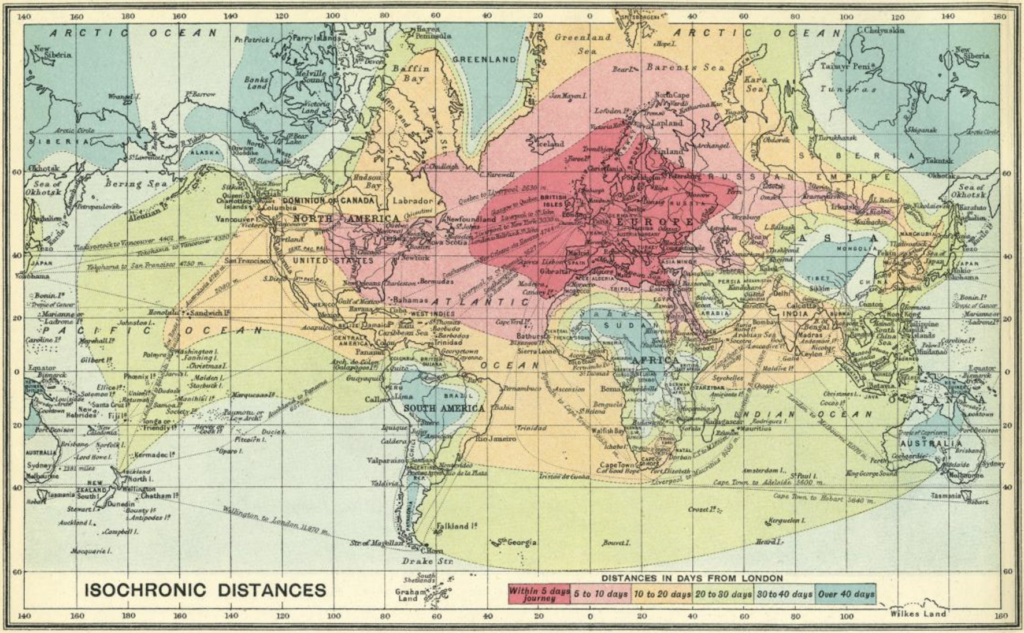 Isochrone map of distances from London, circa 1843. Anywhere in Europe could be reached within a week but it could take months to reach the more far-flung parts of the British Empire. The vast distances of space will similarly require many months to cross. In this way the future will be like the past. (source)
Transporting people or vital supplies will be done along direct, extremely expensive minimum-time routes, which will still take weeks to months, depending on the distance. But most goods will be shipped along slower, cheaper minimum-energy routes, which like the seasonal oceanic shipping routes of the past, are only sporadically available, varying with the positions of the planets in their orbits. The Hohmann transfer from Earth to Mars, for example, is one of the most energy-efficient routes between those planets but takes 9 months to complete and only presents a launch window every 24 months. Martian businesses may become accustomed to waiting up to 3 years for the next cheap delivery window from Earth.
There are even more energy efficient trajectories between worlds (utilizing the Interplanetary Transport Network) that take decades or centuries. These routes are usually ignored as too long to be practical, but they may be appropriate for transporting huge amounts of mass such as whole asteroids and comets. A significant source of revenue for belters may be the export of such objects from their home orbit to the rest of the solar system. The cheapest way to ship a 5-mile diameter water-rich comet to your Jovian orbital factory might be to pay up-front in Solcoin and wait 75 years.
Investment horizons are long

“Meths” in Netflix’s Altered Carbon series are immortal oligarchs commanding vast power and wealth. They can afford unlimited backups of their own bodies and can spend decades traveling between star systems. How would such a person store their wealth?
Longer lives don’t just mean that we can be more patient with Solcoin transactions, they change the way we invest and our risk/return tolerance. If you plan to live for 10,000 years, how would you store and preserve your wealth?
Wealth preservation is all about risk management, and the future, on a long enough time scale, is a dangerous place. You might not worry today about a catastrophic “black swan” event with a 1% chance of occurring per century, but if you lived for 10,000 years, the probability of that same event occurring at least once approaches 2-in-3. Given enough time, natural accidents like extraterrestrial impacts, solar flares, or super-volcanoes will manifest somewhere, sometime.
And given our bellicose history, it’s unlikely that future societies expanding and competing for the solar system’s resources will always remain at peace; total war in a high-energy future society could mean the destruction of an entire planet and its blockchain along with it. Even if the conflict doesn’t escalate to such a destructive level, if Earth and Mars were to go to war, could either bitcoin or Muskcoin be considered neutral money? Would bitcoin miners, united by their common location on Earth to view Mars as an enemy, choose (or be politically compelled) to censor the transactions of known Martian entities? This possibility was one of the instigating causes of the Muskcoin revolution, after all. If you are a rich Martian pondering going into cryo-stasis for 1,000 years as you await the development of your investments, you may worry about these kinds of unforeseen political conflicts.
Long time horizon investors today use real estate or commodities such as gold, oil, precious metals and — increasingly — bitcoin to hedge exposure to geopolitical risk. What assets would long time horizon investors of the future use to hedge their exposure to heliopolitical risk?
Planetary blockchains are, by definition, localized to a given planet and are therefore inseparable from the heliopolitical risks of that planet. Investors of the future can attempt to hedge this risk by holding a portfolio of planetary blockchains and rebalancing it over the centuries, or they may invest in commodities, though their choices would be different (e.g. hydrogen instead of petroleum).
By distributing consensus throughout the whole solar system, a stellar blockchain such as Solcoin provides exactly the asset that long time horizon investors are looking for. They view Solcoin’s long block times and tremendous hashrates as features, not bugs. Solcoin is a heliopolitically neutral, low-risk money for long-term capital preservation.
This will not be apparent to elites when Solcoin first launches. “Serious” money managers will not initially consider Solcoin a real asset class, but significant appreciation over some decades (or centuries) may convince them that Solcoin has superior properties as a store of wealth compared to any planetary blockchain, due to its greater robustness against local threats — natural or political. Eventually, Solcoin will be held by everyone, whether directly or through some future equivalent of an index fund.
Energy scales are increasing
Science fiction often depicts interplanetary societies launching interstellar missions or constructing megastructures, such as ringworlds, Dyson spheres/swarms, Shkadov thrusters, &c., but seldom describes how such projects are funded. Megaprojects will be the most expensive and largest collaborations in the history of our species, consuming more energy than entire planetary societies. They will take thousands of years to complete, which means thousands of years of paying designers, suppliers, & builders from Mercury to the Kuiper belt. What currency will these people and companies demand? Solcoin, of course!

A “Dyson Sphere” is a swarm of spacecraft & colonies harvesting the full energy output of a star. Which markets are hungry enough to consume a star’s worth of energy? [Source]
.png)
Solcoin’s heliopolitical neutrality makes it a natural fit for funding megaprojects. Contractors and investors across the solar system feel more comfortable relying on a neutral Solcoin rather than a possibly partisan planetary blockchain such as bitcoin. Solcoin’s timescale also matches that of megaprojects themselves, allowing their supporters to manage the risk of such a large investment over such a long time period. But there is an even deeper connection between Type II blockchains and megaprojects: they both operate at the same tremendously high energy scales.
Consider the classic example of a Dyson sphere (above). The amount of energy required to reconfigure enough matter to blot out a star, by definition, puts such a project in the Type II category. Why would humanity choose to build such a megastructure or use so much energy? A Dyson sphere can support not trillions of people but trillions of Earth’s worth of people. Simple population expansion and uninhibited consumerism alone may not be enough to generate demand for so much energy.
But there are other drivers for energy consumption. Fundamental research and interstellar missions will also require energy scales beyond a single planet. If humanity is to ever experiment on black holes or settle another star, we will require the energy budget of a Type II civilization, even if we never build a Dyson sphere. This requires creating an economic incentive to collect energy across the whole solar system.
Type I blockchains don’t provide this incentive. It’s true that concentrations of energy far from existing centers of hash will attract settlers, grow civilizations, and start their own blockchains, incentivizing energy collection in the vicinity of that planet, moon, or colony. But these Type I blockchains will not be able to incentivize the collection of energy outside their limited hash horizons. Gathering the vast energy in the comets of the Kuiper belt or from the light our sun streams out into every direction in space requires incentivizing energy collection at every point in our solar system.
This is exactly what a Type II blockchain such as Solcoin does. Solcoin’s broad hash horizon means that a miner can reliably turn harvestable energy anywhere in the solar system into profit without having to first transport it close to a planetary blockchain’s center of hash. Like bitcoin before it on Earth, Solcoin’s hashrate market is a ratchet, which cranks society into ever-higher tiers of energy production.
Turning this relationship around, we also see why it’s vital for a Type II civilization to use a Type II blockchain. Type II civilizations use billions of times more energy than Type I civilizations and, consequently, than Type I blockchains. If even a small fraction of this energy were concentrated in one spatial location and turned into hashrate, it could destabilize a local Type I blockchain — just like a hash bomb during the Muskcoin revolution. Only a Type II blockchain operates at energy scales high enough to defend against such attacks.
Type II Blockchains Won’t Displace Type I
One of the earliest lessons of hyperbitcoinization was that only one blockchain — one sound money — can exist. All other monies fail or are subsumed by bitcoin denominated trade. The successful launches of Muskcoin and other planetary blockchains was another lesson: multiple blockchains — multiple sound monies — can coexist, but only if they’re far enough away from each other in space. Solcoin claims to be a blockchain that is close to everyone (its hash horizon spans the solar system). If there can only be one sound money in one place at one time, doesn’t the success of Solcoin require it to displace all planetary blockchains?
Demand exists across time preferences
Some Solcoin-maximalists will believe this, and will therefore view all planetary blockchains as competitive and their supporters as enemies of Solcoin. But the truth is more nuanced. As we’ve seen, Type II blockchains such as Solcoin are extremely different from Type I blockchains. They’re not just larger; they’re also slower, use more energy, and are much more valuable. This difference in scale segregates economic activity by time preference.
Solcoin is designed for long-timescale, high-energy, cross-solar-system trade and projects. Planetary blockchains cannot support these use cases, which is the source of the low time preference demand for Solcoin in the first place.
But economic activity at the scale of planets will mostly continue to use planetary blockchains. In a hyperbitcoinized economy, only the largest transactions are directly put on the blockchain anyway. Planetary economies are already organized in layers, which settle to their local blockchain. Solcoin may come to be used for a small percentage of the most valuable planetary transactions, but most will continue to use planetary currency. Purchasing the quintessential space coffee will still be done using some higher layer payment network settling through the local planetary blockchain.
Higher layer networks settling to Solcoin will also arise. These layers will allow for faster Solcoin transactions, just as they do for planetary blockchains. But these layers won’t be able to bridge the gap between the Solcoin block time and the pace of daily life (opening & closing channels still requires waiting for blocks to confirm, which could take months in Solcoin). Solcoin is just too slow for most kinds of local trade. This means there will always be some demand for the tokens and hashrate of planetary blockchains. Even if you or your company prefers to operate at the ethereal scale of Solcoin, the vendors you buy from or the workers you hire may have different time preferences than you.
Over time, an increasing fraction of economic value and system-wide hashrate may gravitate to Solcoin — but planetary blockchains will survive where they can. Type II civilizations don’t displace Type I civilizations, they contain them. Similarly, Type II blockchains don’t displace Type I blockchains, they contain them.
Portfolio Management at the Kardashev Scale
One of the important roles of any blockchain is to provide a long-term store of value. Solcoin is designed to be a better store-of-value than any planetary blockchain, so some amount of savings will transfer from planetary blockchains to Solcoin. Investors will decide how much of their portfolio to store in planetary blockchains (they may decide to hold more than one) and how much to store in Solcoin based on their time preference and their heliopolitical concerns. The longer the time horizon of an investor, the more likely they are to hold their wealth in Solcoin, but the need to make investments or purchases on a planetary scale will always ensure some demand for holding planetary blockchains.
As a result, miners will have to decide how much hashrate to invest into their local planetary blockchain (bitcoin, Muskcoin, &c.) vs. how much to invest in Solcoin. The ratio each miner chooses between these two hashrates balances their beliefs about the current hashrate markets, future price movement between Solcoin and their local currency, as well as their own time preference. Miners who value immediate returns will put more hashrate towards their planetary blockchain, those who can afford to be lower time-preference will put more hashrate towards Solcoin. If too many miners in one location are hashing Solcoin, it should create an incentive for others to begin hashing on their local planetary blockchain — and vice versa. To a first approximation, the ratio of hashrate a miner dedicates to their own planetary blockchain vs. to Solcoin should equal the overall hashrate ratio between that planetary blockchain and Solcoin.
Towards a Second Law
Type I & II blockchains can “overlap” in space because the market segregates their usage by time. A physical analogy may help visualize this situation as well as provide some useful terminology.
Interference
Waves are self-sustaining oscillations that contain or transport energy. Waves are characterized by several parameters such as frequency, wavelength, amplitude, &c. These parameters are constrained: lower the frequency and the wavelength increases while the energy decreases. Interactions between waves can be very rich. When waves have different frequencies/wavelengths, they can overlap in space — one wave will “pass through” another without either being disturbed. When waves have similar frequencies/wavelengths, they can interact strongly, exhibiting constructive or deconstructive interference.
Blockchains aren’t waves, but they are self-sustaining. They contain energy, and they’re characterized by constrained parameters. Instead of a frequency, a blockchain has a block time. Instead of a wavelength, it has a hash horizon. Lower the frequency (block time) and the wavelength (hash horizon) increases (due to the First Law). Interestingly, as we saw above, lowering the frequency increases the energy — Solcoin uses much more energy than a planetary blockchain.
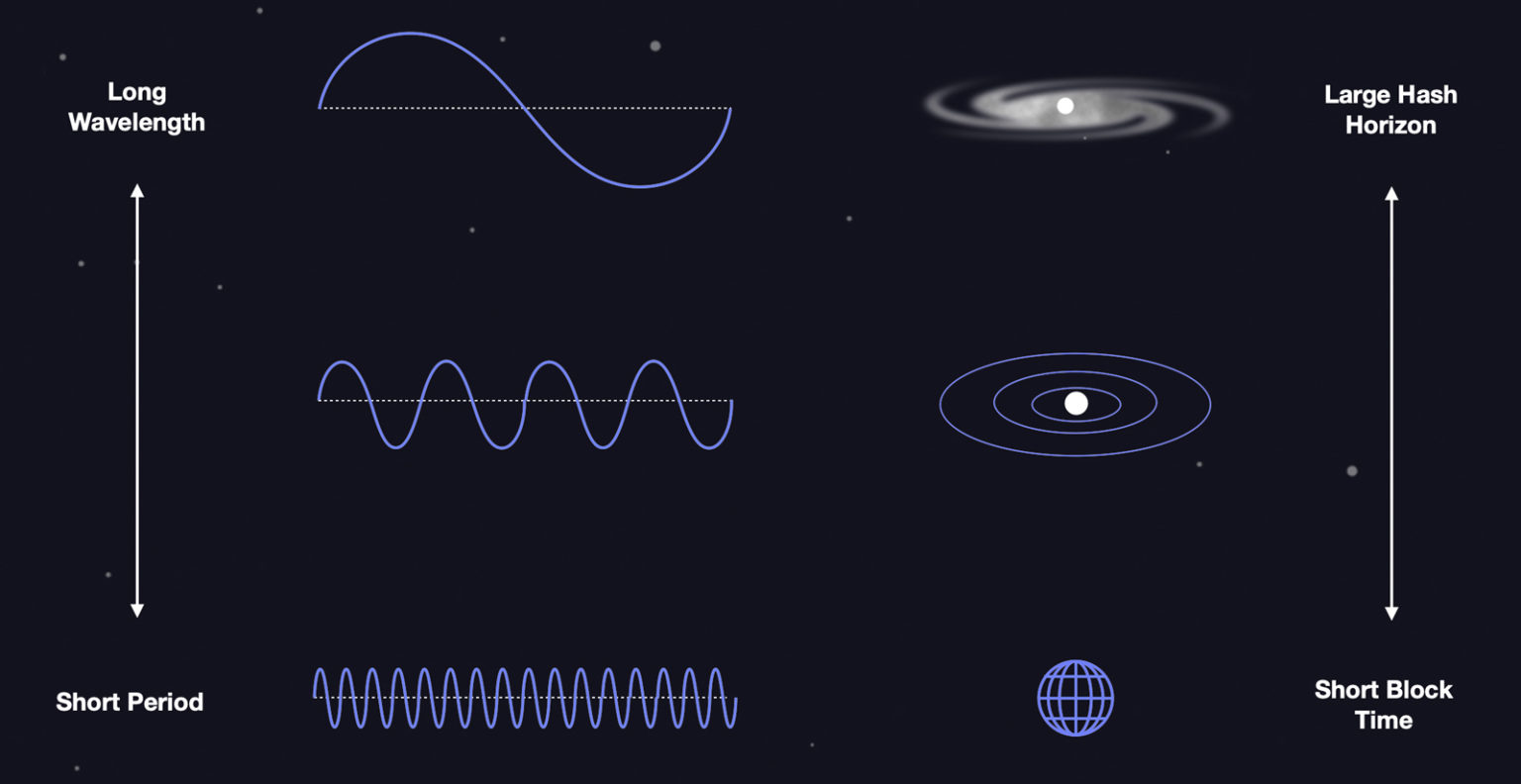
We can use this analogy to talk about blockchains in a new way. Two blockchains with very different frequencies/wavelengths (block times/hash horizons) such as Solcoin and bitcoin can overlap. They don’t “economically interfere” with each other because they operate at such different timescales. The market can support both blockchains for their different use cases.
Two blockchains of similar frequency/wavelength (block time/hash horizon) cannot overlap. They economically interfere with each other: miners and users will inevitably pick one of them. This is why altcoins died out while bitcoin survived. Blockchains of a similar frequency/wavelength must be widely separated, such as bitcoin and Muskcoin, decoupling their mining markets through the First Law.
Summarizing, blockchains can coexist if they are widely separated in physical space OR in frequency space — block time. Type I blockchains have similar block times but are far apart in space. Type I and Type II blockchains overlap in space but are far apart in frequency space — block time.
Resonance
But exactly how widely separated must blockchains be? This is another way waves provide a good analogy.
Waves in free-space (called “traveling waves”) can have any wavelength — this is why you can see light in all colors, but waves interacting with matter will react to it. Most waves will bounce off or decay. Some waves, called “standing waves” or “normal modes,” are special — they can persist for long times, storing or absorbing energy. Normal modes have “characteristic wavelengths” and “natural frequencies,” which are determined by the geometry of the matter they interact with. Normal modes can also “resonate,” quickly absorbing energy input at their characteristic frequencies. This is why no matter how you ring a bell, bang a gong, or pluck a guitar string (within reason), the same tone emerges.
Consider a blockchain with a block time of several hours designed to connect the inner planets — a Type 1.3 blockchain, say. Its block time would be long enough to make Type I transactions expensive and inefficient, yet not long enough to provide Type II risk-management capabilities. Its hash horizon would be smaller than a Type II blockchain, insufficient to include the outer planets and the belts, leaving them without a chain to mine on, dis-incentivizing the collection of energy from their orbits. Such an intermediate, Type 1.x blockchain is an awkward, partial solution.
If blockchains are like waves, then Type I & II blockchains are normal modes. Their characteristic wavelengths and natural frequencies are determined by the distributions of matter they draw energy from and the cultural timescales of the civilizations they power. Type I and II blockchains are Schelling points, resonating with the market, allowing a small group of initial supporters and low hashrate to excite a self-sustaining money that absorbs energy and value.
A Type I blockchain resonates with a 10-minute frequency around a planet or colony and is used for daily transactions and global trade.
A Type II blockchain resonates with a month-long frequency throughout a star system and is used for long-timescale capital preservation and high-energy investments such as megaprojects.
This is why we did not speculate about any blockchains intermediate in scale between Type I and Type II. We hypothesize that intermediate blockchains, should they be launched, would not be Schelling points. Far from resonance, they would decay away, surrendering their hashrate to either Type I or Type II neighbors.
Exclusion
The two analogies of interference and resonance imply a third.
Classical physics is usually continuous. Distinct energy or position states of matter can be arbitrarily close together. Quantum physics is usually discrete. Matter particles must occupy distinct states with different energies and or positions. States are usually “filled up” by matter particles in order of increasing energy, outward from some source. This is known as the Pauli exclusion principle.
Blockchains must resonate around matter distributions (planet or solar systems) and a cultural timescale (real-time or long-term), which means the set of allowable states for blockchains is discrete, not continuous. Blockchains in the same state (location and block time) economically interfere. Like matter particles, only a single blockchain can occupy a given state, and states are populated in order of increasing energy scale and distance from Earth: Type I before Type II, bitcoin before Muskcoin.
We hypothesize blockchains, like matter, obey some economic version of an exclusion principle which we promote as a Second Law:
The Second Law of Bitcoin Astronomy (The Hash Exclusion Principle): Discrete physical and temporal scales provide hierarchical states for blockchains to occupy in order of increasing energy and distance from Earth.
As humanity ascends the Kardashev scale, the Second Law describes how blockchains populate the matter our society has colonized and the timescales our culture can experience.
Blockchains are a kind of economic dark matter, shadowing normal matter wherever civilization settles, invisible but detectable through the constant pressure they exert on energy markets and supply chains.
Type II Civilizations Launch Type III Blockchains
Following the implications of the Second Law, humanity — should we survive long enough — will eventually launch a Type III galactic blockchain.
Such a heady notion requires us to first become a Type 2.x civilization which in turn requires expanding to other stars.
Interstellar missions are Type II megaprojects
Stars are extremely far apart; today’s fastest space probes will take hundreds of thousands of years to reach neighboring stars. Reducing the timeframe of such voyages to centuries or decades will require ships to travel at substantial fractions of the speed of light. Our current generation of spacecraft are also uncrewed and no bigger than cars or small buses; an interstellar mission would require a massive ship capable of supporting a human crew and some complement of (perhaps hibernating) colonists and their supplies.
More mass moving faster means the ship has more kinetic energy. The total amount of kinetic energy can be used to estimate the total cost of the mission (this estimate is an order-of-magnitude lower-bound: construction costs, inefficiencies, and many other considerations make an interstellar mission even more costly in reality). As a concrete example, consider a spaceship the size of a modern aircraft carrier moving at 10% the speed of light (such a ship would still take a century to reach even the closest stars and would barely be big enough to keep its passengers alive en route, but no matter). The kinetic energy of this ship would be orders of magnitude larger than the current annual energy usage of our entire civilization!
And that is just one ship! Launching many interstellar missions will use orders of magnitude more energy than even this. Interstellar settlement is the domain of Type II civilizations. Developing energy infrastructure on such a scale will require markets like Solcoin. If you believe humanity’s destiny is to settle other star systems then you would be a Solcoin supporter.
The cycle repeats anew
Given the years it will take to send transactions, colonists of a remote star system will barely be able to use, much less mine, any Type I blockchains such as bitcoin from our solar system. These colonists will therefore launch their own Type I blockchain to support the first colony at the new star. They may wait to start this blockchain until they arrive in the new system, but they may also start it en route, on the colony ship, or perhaps even prior to launch. As long as all the miners stay with the ship, travel together to the new star system, while continuously hashing, the blockchain — like an ember in a fire bundle — will survive the long, cold journey through interstellar space.
Over thousands of years, the colony will grow, settling other planets of the remote star system, launching additional planetary blockchains. One day there will be sufficient demand at the remote colony to launch its own Type II blockchain. Receiving genesis blocks from human colonies around other stars will make humans here in orbit around Sol feel the fierce pride of parents watching their children grown up.
The cycle grows larger
As humanity grows from a Type II to a Type III civilization, the virtuous cycle will repeat itself on an even larger and more dizzying scale.

Great chains have little chains within their hash horizons,
And little chains have lesser chains, and so ad infinitum.
– Hymenoptera, from MICHAELUS de Saylor’s A Blockchain of Paradoxes (2194)
Our stellar neighborhood will eventually host many Type II blockchains from Solcoin to Centauricoin, Siriuscoin and others. The humans — though they may increasingly not resemble the humans of today — living in orbit of these faraway stars will eventually seek to create the next blockchain on the Kardashev scale, a Type III galactic blockchain with a block time of thousands of years, designed to span our stellar diaspora the way Solcoin spans our solar system and bitcoin or Muskcoin span Earth or Mars.
This galactic blockchain would harvest the energy of unsettled star systems, rogue planets, and interstellar gas clouds. It would have a hashrate larger than the total energy usage of entire Type II civilizations. Over millions of years, it would slowly mint its fixed supply of coins, blithely robust to the occasional nova or rogue black hole.
HODL on.
Part III: Beyond Humanity
So far we have confined our speculations to the human species. But, having come this far, there is no reason we should stop. Should other intelligent civilizations exist in our galaxy, will they also discover blockchains? Will their future societies resemble ours, organized into planetary, stellar, and galactic blockchains? Will blockchains of different species ever interact?
If so, what will happen to our hyperbitcoinized future humans when they detect an indisputably intelligent extraterrestrial transmission which consists of … block headers?
If you enjoyed this article, read Part III here!
THANK YOU
Thank you so much to my wonderful colleagues at Unchained Capital for having the patience to tolerate my speculations and for providing me a platform through which to publish them. Also to be thanked are my friends Brandon Hudgeons, Brandon Quittem, Destry Saul, Joe Kelly, and Taylor Pearson, all of whom provided extended and valuable feedback on early drafts. Particular thanks are due to Martin Grogono who makes everything he touches pretty and Phil Geiger, whose enthusiasm is the second infinite resource in the universe.
Bitcoin & the legend of Prometheus
By Aleksandar Svetski
Posted December 17, 2020
Aleksandar Svetski
Bitcoin Times Ed 3
The Bitcoin Times Ed 3 is now LIVE
The dawn of a new decade has a knack for conjuring up visions of endings or new beginnings, each which seems to have an affinity to the legendary or supernatural.
Two decades since the turn of the century, the dotcom bubble and the twin towers, and just a touch over a decade since the GFC we’ve seen the world continue to hurtle toward disaster; economically, morally, socially & structurally. All the while catastrophe has been kept at bay via the counterbalancing forces of innovation, production and free speech.
2020 now ushers in the new decade along with a timely reminder of how precarious things actually are beneath the surface.
The kicking of the proverbial can down the road, the incessant hiding of risk, the welfare-isation of the economy, the unprecedented levels of monetary expansion, the censorship of speech, group identity politics, the introduction of dangerous and draconian mandates for ‘safety’ and the subsequent moral hazard associated with each have all but hollowed out society and made it more fragile than it ever was.
The world has continued on this trend, blissfully ignorant to the consequences of such decisions and oblivious to the fact that the next catastrophe would entail not only decades of social & economic destruction through the erosion of personal, private & natural capital, but that the mandates & precedents from past events would steepen the slippery slope of tyranny & send us to darker depths.
Well. It’s 2020, and reality caught up to us….again.
We are reminded of how thinly veiled the freedom and stability of our modern societies truly are.
But there is hope.
We understand darkness, because we’ve seen the light. We know hot because we’ve felt the cold. We can call out tyranny because we’ve experienced freedom, and we know right because we’ve all done some wrong.
So long as we’re not beyond the event horizon, we exist in a realm where reality is duality.
For every action there is an equal and opposite reaction and it should come as no surprise that the creation & proliferation of the ultimate tool of personal sovereignty and liberty is happening alongside the rise of the ultimate collectivist techno-dystopia.
There is never an evil large or dark enough to be all encompassing. Humans have always risen to the occasion, and this time it’s no different.
The darker the night, the brighter the day. The more suffocating the oppression, the more powerful the spirit of freedom. The more fearsome the enemy the greater the hero.
Satoshi is that hero — and we are all Satoshi.
In the chapter of history now being written, Satoshi is the modern day Prometheus who stole fire from the arrogant self-proclaimed gods of the modern world, and gave it back to the people.
He ‘planted’ Bitcoin in 2008, giving us a decade to learn to use it and set the foundation. That prescience is awe-inspiring and legends will be told of it in the centuries to come.
Bitcoin has become the light that will carry us through the hardest of times, and it could not have arrived at a more appropriate time.
2020 accelerated every draconian state agenda the few more prudent of us have been warning or rambling on about for years:
- The decimation of biological private property rights (ie; mandated vaccinations & tests for a virus for which you have no symptoms),
- The forced closure of private businesses that people have put their entire life’s work & savings into,
- “Great reset” communist agendas and propaganda telling you that “you’ll own nothing & be happy”,
- Unhinged monetary and social policies like UBI & MMT that will erode the remaining human capital & natural resources the world has,
- CBDCs that give central authorities complete control over what you can & cannot earn, what you can & cannot spend your money on and how much they will pilfer from your accounts,
- An all out war on privacy, encryption & free speech,
- Social distancing so that local communities are decimated and there is no more connection with your fellow human beings,
- No more say in whom you can spend your precious time with,
- Heavy regulation of opinions and discussions across both online & offline mediums,
- Complete control of the media and the mainstream narrative,
And worst of all, the support by people who’ve been blindly swept up in the hysteria.
Despite the evident overreach of the state, the blatantly obvious mistakes and the series of erroneous mandates made along the way, there are still millions of people supporting the imposition of ‘more mandates’ on themselves and their fellow man or woman!
Not a moment is taken to scrutinise the claims made by pseudo scientific epidemiologists that want to treat all human beings as if they’re numbers on a spreadsheet, but online shaming, dobbing on neighbours, calling people “grandma killers” or “conspiracy theorists” has become the part time job of many.

These are the same people who will be the first to line up and take a rushed vaccine, for a virus with a 99.6% survival rate.
Ignorance, hypocrisy and fear have truly consumed the masses, but in Bitcoin we find the ultimate counter-balancing forces of truth, consistency and reliability.
The contrast is as stark as can be, which is why I give thanks to Satoshi.
He birthed something that is tied to the very substructure of reality.
Something that lives at the nexus of chaos and order, embodies the flow of entropy into structure, and clarifies how we understand time, energy and objective Truth with a capital T.
Whilst the sovereignty of the individual and the nature of truth is being decimated from the top down by governments, media & the intelligentsia of the old world, a tool for ultimate individual sovereignty and pure objective truth emerges from the bottom up, for a new world.
Like a modern day Moses coming down from atop the mountain, Satoshi delivered the Whitepaper to the world on October 31st of 2008, and subsequently changed everything.
There has likely not been a more transformational time to be alive, and whilst the decade ahead will surely come with a serious set of challenges and the continued erosion of natural law, logic, truth, private property and freedoms, we should all take a moment to be deeply grateful for the introduction of an ark upon which we can board, and from which we can later rebuild.
This fire, immune from darkness, will illuminate all that is.
People will see it from every corner of the world. They will be drawn to its brilliance. They will come to it because it will shine brightest where and when it is darkest.
Bitcoin is the fire. Satoshi was Prometheus.
He took it back and passed it on to us. What we do with it now, is up to you and I.
By @AleksSvetski December 2020
The Bitcoin Times Ed 3 is now live. Be inspired by ideas on bitcoin, philosophy, economics, sovereignty and freedom.
Contributors in this edition are:
Aleksandar Svetski Jeff Booth Erik Cason Giacomo Zucco Jimmy Song Parker Lewis
Each section will be released on Medium as a free long form article, and the full, compiled version of the Bitcoin Times will be available for free at the link below. We will release a limited edition hard cover collectible, for purchase, which you’ll be notified of by email if you download the free pdf.
If you found value in this or any of the other essays and articles, please support each of the contributors by sharing it out & following their work.
Download the full guide at:
The Bitcoin Times**(https://bitcointimes.news)
Follow The Bitcoin Times on Twitter @TimelessBitcoin:
The ₿itcoin Times
The latest Tweets from The ₿itcoin Times (@TimelessBitcoin). Facts over Fiction. Practice over Theory. Timeless…
twitter.com
Written by:
Aleksandar Svetski [₿]
The latest Tweets from Aleksandar Svetski [₿] (@AleksSvetski). Hairless chimp interested in Money, Bitcoin, ⚡️…
twitter.com
Aleksandar Svetski — Medium
Read writing from Aleksandar Svetski on Medium. CEO @ www.amber.app. Editor @ https://bitcointimes.news. Bitcoin…
medium.com
Follow my work at Amber Labs:
Home Page - Amber
Amber is the easiest way to invest in Bitcoin. Make instant purchases or set up a recurring investment from as little…
amber.app
Amber #stackingsats ⚡️
The latest Tweets from Amber #stackingsats ⚡️ (@theamberapp). Making Bitcoin easy by Stacking Sats on Autopilot. Dollar…
twitter.com
Bitcoin is the Great Definancialization
By Parker Lewis
Posted December 19, 2020
Gradually, Then Suddenly (#17) — The Bitcoin Times Ed 3
Parker Lewis
Excerpt from The Bitcoin Timed Ed 3.
Have you ever had a financial advisor (or maybe even a parent) tell you that you need to make your money grow? This idea has been so hardwired in the minds of hard-working people all over the world that it has become practically second nature to the very idea of work.
The line has been repeated so many times that it is now a de facto part of working culture. Get a salaried position, max out your 401-K contribution (maybe your employer matches 3%!), select a few mutual funds with catchy marketing names and watch your money grow. Most folks navigate this path every two weeks on auto-pilot, never questioning the wisdom nor being conscious of the risks. It is just what “smart people” do. Many now associate the activity with savings but in reality, financialization has turned retirement savers into perpetual risk-takers and the consequence is that financial investing has become a second full-time job for many, if not most.
Financialization has been so errantly normalized that the lines between saving (not taking risk) and investing (taking risk) have become blurred to the extent that most people think of the two activities as being one in the same. Believing that financial engineering is a necessary path to a happy retirement might lack common sense, but it is the conventional wisdom.

Or maybe you just need a better form of money™?
Over the course of the past several decades, economies everywhere, but particularly those in the developed world (and specifically the United States), have become increasingly financialized. Increased financialization has become the necessary companion to the idea that you must make your money grow. But the idea itself — that ‘you must make your money grow’ — only really emerged in the mainstream consciousness as everyone similarly became conditioned to the unfortunate reality that money loses its value over time.
Money Loses Value → Need to Make Money Grow → Need Financial Products to Make Money Grow → Repeat.
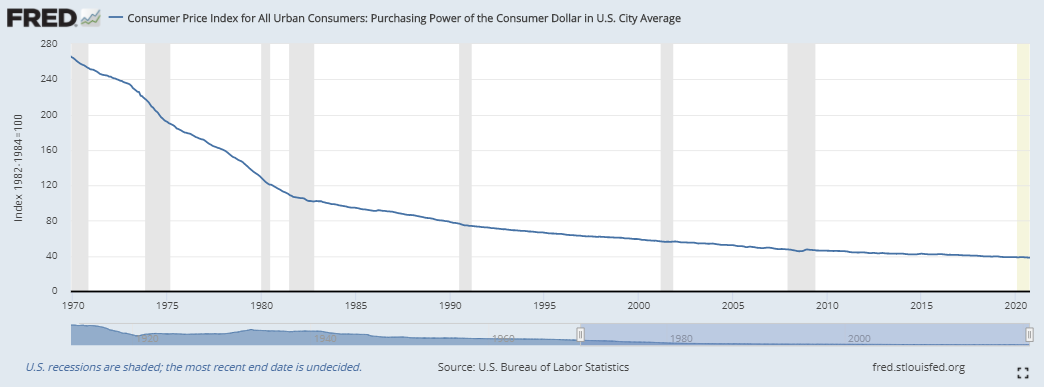
Purchasing Power of the U.S. Dollar Over Time (1970 to 2020)
The extent to which the need even exists is largely a function of money losing its value over time; that is the starting point, and the most unfortunate part is that central banks intentionally engineer this outcome. Most global central banks target the devaluation of their local currencies by approximately 2% per year and do so by increasing the money supply. How or why is less relevant; it is a reality and there are consequences. Rather than simply being able to save for a rainy day, future retirement funds are invested and put at constant risk, often just as a means to keep up with the very inflation manufactured by central banks.
The demand function is perversely driven by central banks devaluing money to induce such investments. An over financialized economy is the logical conclusion of monetary inflation, and it has induced perpetual risk taking while disincentivizing savings. A system which disincentivizes saving and forces people into a position of risk taking creates instability, and it is neither productive nor sustainable. It should be obvious to even the untrained eye, but the overarching force driving the trend toward financialization and financial engineering more broadly is the broken incentive structure of the monetary medium which underpins all economic activity.
At a fundamental level, there is nothing inherently wrong with joint-stock companies, bond offerings, or any pooled investment vehicle for that matter. While individual investment vehicles may be structurally flawed, there can be (and often is) value created through pooled investment vehicles and capital allocation functions. Pooled risk isn’t the issue, nor is the existence of financial assets. Instead, the fundamental problem is the degree to which the economy has become financialized, and that it is increasingly an unintended consequence of otherwise rational responses to a broken and manipulated monetary structure.
What happens when hundreds of millions of market participants come to understand that their money is artificially, yet intentionally, engineered to lose 2% of its value every year? It is either accept the inevitable decay or try to keep up with inflation by taking incremental risk. And what does that mean? Money must be invested, meaning it must be put at risk of loss. Because monetary debasement never abates, this cycle persists. Essentially, people take risk through their “day” jobs and then are trained to put any money they do manage to save at risk, just to keep up with inflation, if nothing more. It is the definition of a hamster wheel. Run hard just to stay in the same place. It may be insane but it is the present reality. And it is not without consequence.

The Dollar Hamster Wheel
Savings vs. Risk
While the relationship between savings and risk is often misunderstood, risk must be taken in order for any individual to accumulate savings in the first place. Risk comes in the form of investing time and energy in some pursuit that others value (and must continue to value) in order to be paid (and continue to be paid). It starts with education, training and ultimately perfecting a craft over time that others value.
That is risk taking. Investing time and energy in an attempt to earn a living and to produce value for others, while also implicitly accepting high degrees of future uncertainty. If successful, it ends with a classroom of students, a product on a shelf, a world-class performance, a full day of hard manual labor or anything else that others value. The risk is taken on the front end with the hope and expectation that someone else will compensate you for your time spent and value delivered.
Compensation typically comes in the form of money because money, as an economic good, allows individuals to convert their own value into a wide range of value created by others. In a world in which money is not manipulated, monetary savings would best be described as the difference between the value one has produced for others and the value one has consumed from others. Savings is simply consumption or investment deferred into the future; or said another way, it represents the excess of what one has produced but not yet consumed. That however is not the world that exists today. With modern money, there is a fly in the ointment.
Central banks create more and more money which causes savings to be perpetually devalued. The entire incentive structure of money is manipulated, including the integrity of the scorecard that tracks who has created and consumed what value. Value created today is ensured to purchase less in the future as central banks allocate more units of the currency arbitrarily. Money is intended to store value, not lose value and with monetary economics engineered by central banks, everyone is unwittingly forced into the position of taking risk as a means to replace savings as it is debased. The unending devaluation of monetary savings forces unwanted and unwarranted risk taking on to those that make up the economy. Rather than simply benefiting from risks already taken, everyone is forced to take incremental risk.
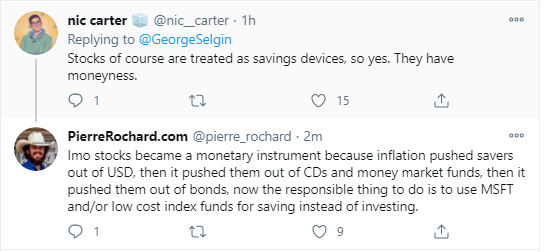
Pierre Rochard & Nic Carter Discussing Savings vs. Investing on Bitcoin Twitter
Forcing risk taking on practically all individuals within an economic system is not natural nor is it fundamental to the functioning of an economy. It is the opposite and it is detrimental to the stability of the system as a whole. As an economic function, risk taking itself is productive, necessary, and inevitable. The unhealthy part is specifically when individuals are forced into taking risk as a byproduct of central banks manufacturing money to lose value, whether those taking risk are conscious of the cause and effect or not. Risk taking is productive when it is intentional, voluntary and undertaken in the pursuit of accumulating capital.
While deciphering between productive investment and that which is induced by monetary inflation is inherently grey, you know it when you see it. Productive investment occurs naturally as market participants work to improve their own lives and the lives of those around them. The incentives to take risk in a free market already exist. There is nothing to be gained, and a lot to lose, through central bank intervention.
The operation of risk taking becomes counterproductive when it is borne more out of a hostage taking situation than it is free will. That should be intuitive and it is exactly what occurs when investment is induced by monetary debasement. Recognize that 100% of all future investment (and consumption for that matter) comes from savings. Manipulating monetary incentives, and specifically creating a disincentive to save, merely serves to distort the timing and terms of future investment.
It forces the hand of savers everywhere and unnecessarily lights a shortened fuse on all monetary savings. It inevitably creates a game of hot potatoes, with no one wanting to hold money because it loses value, when the opposite should be true. What kind of investment do you think that world produces? Rather than having a proper incentive to save, the melting ice cube of central bank currency has induced a cycle of perpetual risk taking, whereby the majority of all savings are almost immediately put back at risk and invested in financial assets, either directly by an individual or indirectly by a deposit-taking financial institution. Made worse, the two operations have become so sufficiently confused and conflated that most people consider investments, and particularly those in financial assets, as savings.
Without question, investments (in financial assets or otherwise) are not the equivalent of savings and there is nothing normal or natural about risk taking induced by central banks which create a disincentive to save. Anyone with common sense and real world experience understands that. Even still, it doesn’t change the fact that money loses its value every year (because it does) and the knowledge of that fact very rationally dictates behavior. Everyone has been forced to accept a manufactured dilemma. The idea that you must make your money grow is one of the greatest lies ever told. It isn’t true at all. Central banks have created that false dilemma. The greatest trick that central banks ever pulled was convincing the world that individuals must perpetually take risk just to preserve value already created (and saved). It is insane, and the only practical solution is to find a better form of money which eliminates the negative asymmetry inherent to systemic currency debasement.
That is what bitcoin represents. A better form of money that provides all individuals with a credible path to opt out and to get off the hamster wheel.
The Great Financialization
Whether one considers the game to be rigged or simply acknowledges that persistent monetary debasement is a reality, economies all over the world have been forced to adapt to a world in which money loses its value. While the intention is to induce investment and spur growth in “aggregate demand,” there are always unintended consequences when economic incentives become manipulated by exogenous forces. Even the greatest cynic probably wishes that the world’s problems could be solved by printing money, but then again, only kids believe in fairy tales. Rather than print money and have problems magically disappear, the proverbial can has been kicked down the road time and time again. Economies have been structurally and permanently altered as a function of money creation.
The Fed might have thought it could print money as a means to induce productive investment, but what it actually produced was malinvestment and a massively over-financialized economy. Economies have become increasingly financialized as a direct result of monetary debasement and the impact that has had in manipulating the cost of credit. One would have to be blind not to see the connection: the necessary cause and effect between a money manufactured to lose its value, a disincentive to hold money and the rapid expansion of financial assets, including within the credit system.
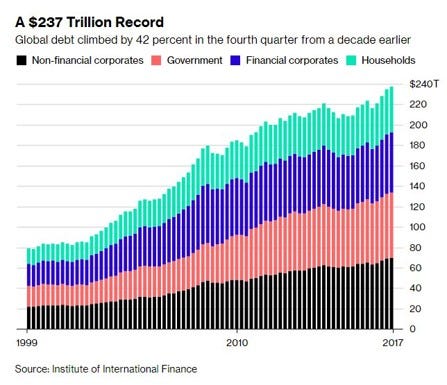
Banking and wealth management industries have metastasized by this same function. It is like a drug dealer that creates his own market by giving the first hit away for free. Drug dealers create their own demand by getting the addict hooked. That is the Fed and the financialization of the developed world economy via monetary inflation. By manufacturing money to lose value, markets for financial products emerge that otherwise would not. Products have emerged to help people financially engineer their way out of the very hole created by the Fed. The need arises to take risk and to attempt to produce returns to replace what is lost via monetary inflation.
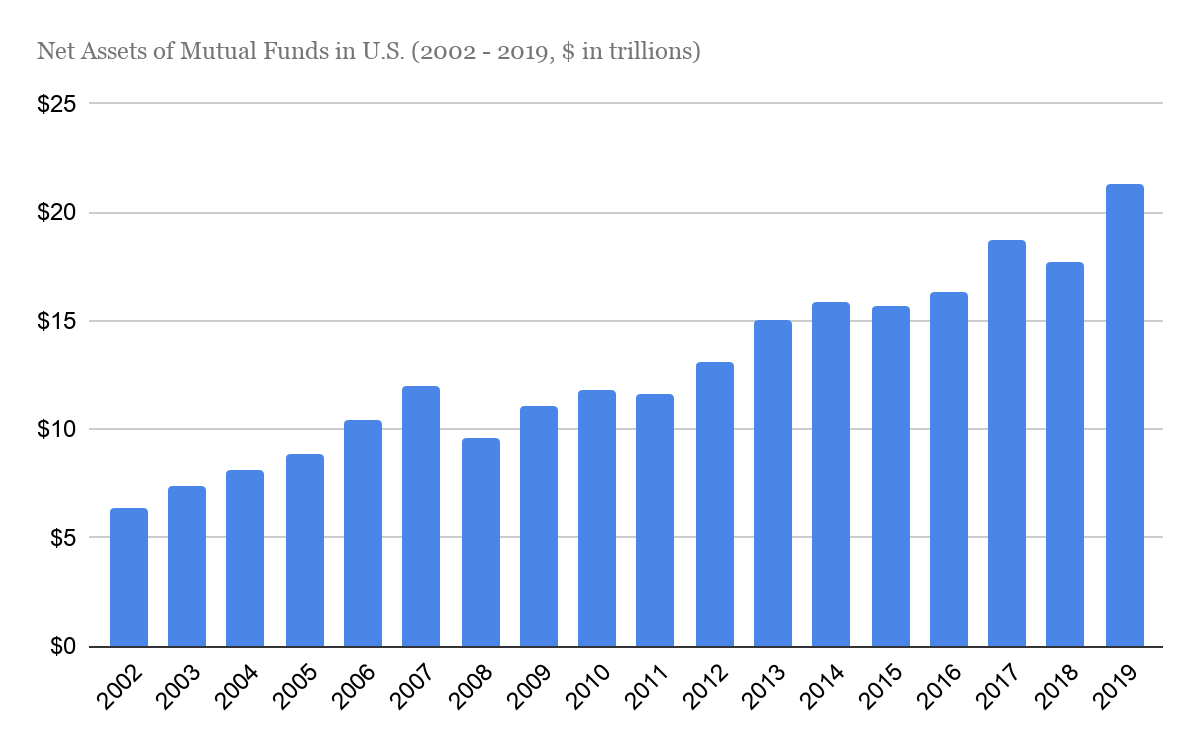
Source: Statistica.
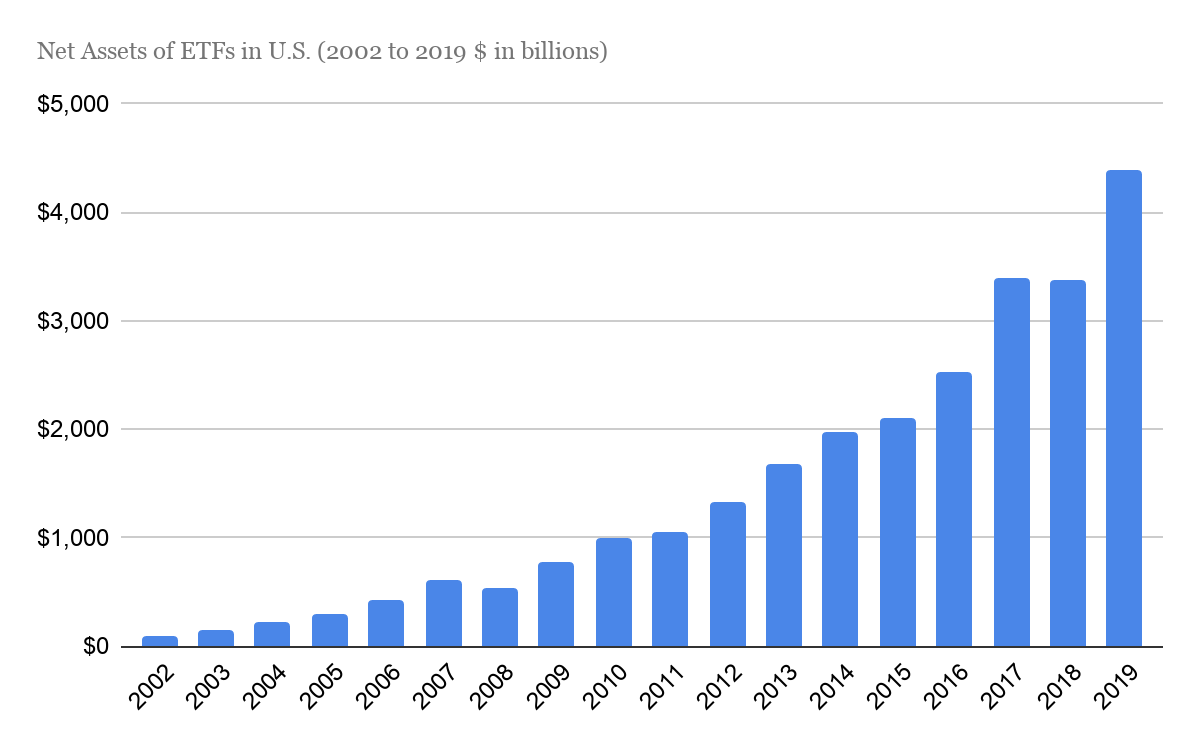
Source: Statistica.
The financial sector has captured a larger percentage of the economy over time because there is greater demand for financial services in a world in which money is constantly impaired. Stocks, corporate bonds, treasuries, sovereign bonds, mutual funds, equity ETFs, bond ETFs, levered ETFs, triple levered ETFs, fractional shares, mortgage-backed securities, CDOs, CLOs, CDS, CDX, synthetic CDS/CDX, etc. All of these products represent the financialization of the economy, and they become more relevant (and in greater demand) when the monetary function is broken.
Each incremental shift to pool, package and repackage risk can be tied back to the broken incentive structure inherent to the money underpinning an economy and the manufactured need to make money grow. Again, it is not to say that certain financial products or structures do not create value; instead, the problem is that the degree to which financial products are utilized and the extent to which risk has been layered on top of risk is largely a function of an intentionally broken monetary incentive structure.
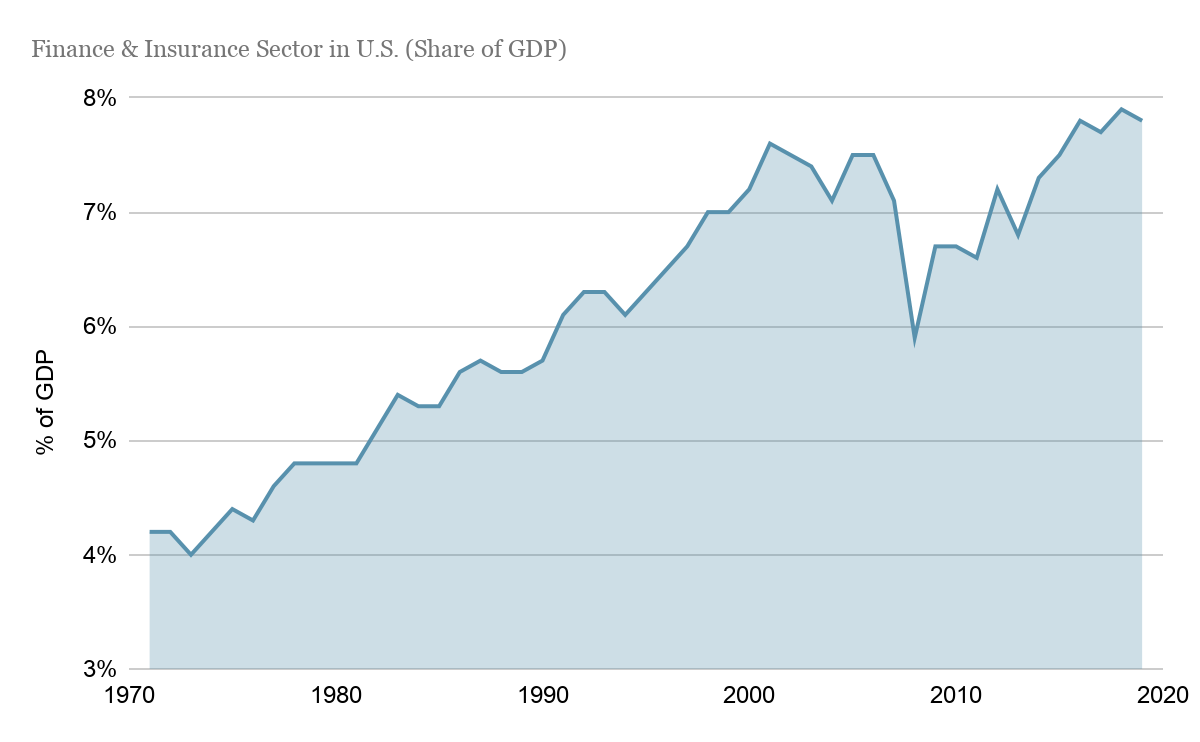
Source: Statistica.
While the vast majority of all market participants have been lulled to sleep as the Fed has normalized its 2% per year inflation target, consider the consequence of that policy over a decade or two decades. It represents a compounded 20% and 35% loss of monetary savings over 10 or 20 years, respectively. What would one expect to occur if everyone, society wide, were collectively put in a position of needing to recreate or replace 20 to 35% of their savings just to remain in the same place?
The aggregate impact is massive malinvestment; investment in activities that would not have occurred if people were not forced into a position of taking ill-advised risk merely to replace the expected future loss of current savings. On an individual level, it is the doctor, nurse, engineer, teacher, butcher, grocer, builder, etc. being turned into a financial investor, plowing the majority of their savings into Wall St. financial products that bear risk while perceiving there to be none. Over time, stocks only go up, real estate only goes up, and interest rates only go down.

For the record, the author is a Dave Portnoy fan.
How or why is a mystery to the Davey Day traders of the world, and it matters not, because that’s just the way the world is perceived to work, and everyone acts accordingly. Rest assured, it will all end badly, but most individuals have come to believe investments in financial assets are just a better (and necessary) way to save, which dictates behavior. A “diversified portfolio” has become so synonymous with savings that it is not perceived to bear risk, nor is it perceived to be a risk-taking activity. While that couldn’t be further from the truth, the choice is either to take risk via investments or to leave savings in a monetary medium that is sure to purchase less and less in the future. From an actual savings perspective, it is where damned if you do meets damned if you don’t. It is an unnerving game that everyone is either forced to play or sit it out and lose either way.
Consequences of a Disincentive To Save
Forcing everyone to live in a world in which money loses value creates a negatively reinforcing feedback loop; by eliminating the very possibility of saving money as a winning proposition, it makes all outcomes far more negative in aggregate. Just holding money is a non-credible threat when money is engineered to lose its value. People still do it, but it’s a losing hand by default. So is perpetual risk-taking as a forced substitute to saving. Effectively, all hands become losing hands when one of the options is not winning by saving money. Recall that each individual with money has already taken risk to get it in the first place. A positive incentive to save (and not invest) is not equivalent to rewarding people for not taking risk, quite the opposite. It is rewarding people who have already taken risk with the option of merely holding money without the express promise of its purchasing power declining in the future.
In a free market, money might increase or decrease in value over a particular time horizon, but guaranteeing that money loses value creates an extreme negative outcome, where the majority of participants within an economy lack actual savings. Because money loses its value, opportunity cost is often believed to be a one way street. Spend your money now because it is going to purchase less tomorrow. The very idea of holding cash (formerly known as saving) has been conditioned in mainstream financial circles to be a near crazy proposition as everyone knows that money loses its value. How crazy is that? While money is intended to store value, no one wants to hold it because the predominant currencies used today do the opposite. Rather than seek out a better form of money, everyone just invests instead!
“I still think that cash is trash relative to other alternatives, particularly those that will retain their value or increase their value during reflationary periods”
— Ray Dalio (April 2020)
Even the most revered Wall St. investors are susceptible to getting caught up in the madness and can act a fool. Risk taking for inflation’s sake is no better than buying lottery tickets, but that is the consequence of creating a disincentive to save. Economic opportunity cost becomes harder to measure and evaluate when monetary incentives are broken. Today, decisions are rationalized because of broken incentives. Investment decisions are made and financial assets are often purchased merely because the dollar is expected to lose its value. But, the consequence extends far beyond savings and investment. Every economic decision point becomes impaired when money is not fulfilling its intended purpose of storing value.
All spending versus savings decisions, including day-to-day consumption, become negatively biased when money loses its value on a persistent basis. By reintroducing a more explicit opportunity cost to spending money (i.e. an incentive to save), everyone’s risk calculus necessarily changes. Every economic decision becomes sharper when money is fulfilling its proper function of storing value. When a monetary medium is credibly expected to maintain value at minimum, if not increase in value, every spend versus save decision becomes more focused and ultimately informed by a better aligned incentive structure.
“One of the greatest mistakes is to judge policies and programs by their intentions rather than their results”
— Milton Friedman
It is a world that Keynesian economists fear, believing that investments will not be made if an incentive to save exists. The flawed theory goes that if people are incentivized to “hoard” money, no one will ever spend money, and investments deemed “necessary” will not be made. If no one spends money and risk-taking investments are not made, unemployment will rise! It truly is economic theory reserved for the classroom; while counterintuitive to the Keynesian, risk will be taken in a world in which savings are incentivized.
Not only that, the quality of investment will actually be greater as both consumption and investment benefit from undistorted price signals and with the opportunity cost of money being more clearly priced by a free market. When all spending decisions are evaluated against an expectation of potentially greater purchasing power in the future (rather than less), investments will be steered toward the most productive activities and day-to-day consumption will be filtered with greater scrutiny.
Conversely, when the decision point of investment is heavily influenced by not wanting to hold dollars, you get financialization. Similarly, when consumption preferences are guided by the expectation that money will lose its value rather than increase in value, investments are made to cater toward those distorted preferences. Ultimately, short-term incentives beat out long-term incentives; incumbents are favored over new entrants, and the economy stagnates, which increasingly fuels financialization, centralization and financial engineering rather than productive investment. It is cause and effect; intended behavior with unintended but predictable consequences.
Make money lose its value and people will do dumb shit because doing dumb shit becomes more rational, if not encouraged. People that would otherwise be saving are forced to take incremental risk because their savings are losing value. In that world, savings become financialized. And when you create the incentive not to save, do not be surprised to wake up in a world in which very few people have savings. The empirical evidence shows exactly this, and despite how much it might astound a tenured economics professor, the lack of savings induced by a disincentive to save is very predictably a major source of the inherent fragility in the legacy financial system.

The Paradox of a Fixed Money Supply
The lack of savings and economic instability is all driven by the broken incentives of the underlying currency, and this is the principal problem which bitcoin fixes. By eliminating the possibility of monetary debasement, incentives that were broken become aligned; there will only ever be 21 million and that alone is sufficiently powerful to begin to reverse the trend of financialization. While each bitcoin is divisible into 100 million units (or down to 8 decimal points), the nominal supply of bitcoin is capped at 21 million. Bitcoin can be divided into smaller and smaller units as more and more people adopt it as a monetary standard, but no one can arbitrarily create more bitcoin.
Consider a terminal state in which all 21 million bitcoin are in circulation; technically, no more than 21 million bitcoin can be saved, but the consequence is that 100% of all bitcoin are always being saved — by someone at any particular point in time. Bitcoin (including fractions thereof) will transfer from person to person or company to company but the total supply will be static (and perfectly inelastic).
By creating a world in which there is a fixed money supply such that no more or no less can be saved in aggregate, the incentive and propensity to save increases measurably on the individual level. It is a paradox; if more money cannot be saved in aggregate, more people will save on an individual basis. On one hand, it may appear to be a simple statement that individuals value scarcity. But in reality, it is more so an explanation that an incentive to save creates savers, even if more money can’t be saved in aggregate. And in order for someone to save, someone else must spend existing savings.
After all, all consumption and investment comes from savings; the incentive to save creates savers, and the existence of more savers in turn creates more people with the means to consume and invest. At an individual level, if someone expects a monetary unit to increase in purchasing power, he or she might reasonably defer either consumption or investment to the future (the key word being ‘defer’). That is the incentive to save creating savers. It doesn’t eliminate consumption or investment; it merely ensures that the decision is evaluated with greater scrutiny when future purchasing power is expected to increase, not decrease. Imagine every single person simultaneously operating with that incentive mechanism, compared to the opposite which exists today.
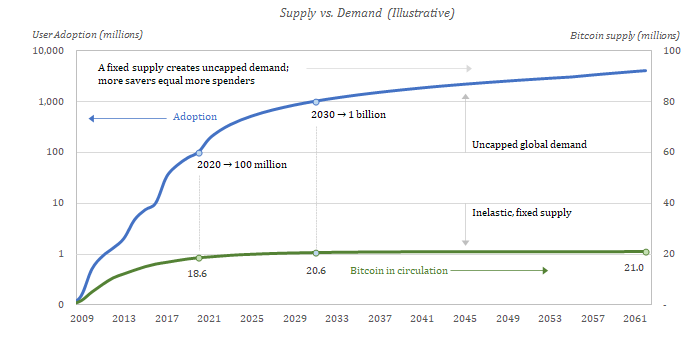
While Keynesians worry that an appreciating currency will disincentivize consumption and investment in favor of savings and to the detriment of the economy at large, the free market actually works better in practice than it does when applying flawed Keynesian theory. In practice, a currency that is appreciating will be used everyday to facilitate consumption and investment because there is an incentive to save, not despite that fact. High present demand for both consumption and investment is dictated by positive time preference and there being an express incentive to save; everyone is always trying to earn everyone else’s money and everyone needs to consume real goods every day.
Time preference as a concept is described at length in the Bitcoin Standard by Saifedean Ammous. While the book is a must read and no summary can do it justice, individuals can have lower time preference (weighting the future over the present) or a higher time preference (weighting the present over the future), but everyone has a positive time preference. As a tool, money is merely a utility in coordinating the economic activity necessary to produce the things that people actually value and consume in their daily lives. Given that time is inherently scarce and that the future is uncertain, even those that plan and save for the future (low time preference) are predisposed to value the present over the future on the margin.
Taken to an extreme just to make the point, if you made money and literally never spent a dime (or a sat), it wouldn’t have done you any good. So even if money were increasing in value over time, consumption or investment in the present has an inherent bias over the future, on average, because of positive time preference and the existence of daily consumption needs that must be satisfied for survival (if not for want).
7 billion people competing + 21 million bitcoin = Appreciating Currency + Constant Spending ✔
Now, imagine this principle applying to everyone simultaneously and in a world of bitcoin with a fixed money supply. 7 billion plus people and only 21 million bitcoin. Everyone both has an incentive to save because there is a finite amount of money and everyone has a positive time preference as well as daily consumption needs. In this world, there would be a fierce competition for money. Each individual would have to produce something sufficiently valuable in order to entice someone else to part with their hard-earned money, but he or she would be incentivized to do so because the roles would then be reversed. That is the contract bitcoin provides.
The incentive to save exists but the existence of savings necessarily requires producing something of value demanded by others. If at first you don’t succeed, try, try again. The interests and incentives align perfectly between those that have the currency and those providing goods and services, particularly because the script is flipped on the other side of each exchange. Paradoxically, everyone would be incentivized to “save more” in a world in which more money technically could not be saved. Over time, each person would hold less and less of the currency in nominal terms on average but with each nominal unit purchasing more and more over time (rather than less). The ability to defer consumption or investment and be rewarded (or rather simply not be penalized) is the lynchpin that aligns all economic incentives.
Bitcoin and the Great Definancialization
The primary incentive to save bitcoin is that it represents an immutable right to own a fixed percentage of all the world’s money indefinitely. There is no central bank to arbitrarily increase the supply of the currency and debase savings. By programming a set of rules that no human can alter, bitcoin will be the catalyst that causes the trend toward financialization to reverse course. The extent to which economies all over the world have become financialized is a direct result of misaligned monetary incentives, and bitcoin reintroduces the proper incentives to promote savings. More directly, the devaluation of monetary savings has been the principal driver of financialization, full stop. When the dynamic that created this phenomenon is corrected, it should be no surprise that the reverse set of operations will naturally course correct.
If monetary debasement induced financialization, it should be logical that a return to a sound monetary standard would have the opposite effect. The tide of financialization is already on its way out, but the groundswell is just beginning to form as most people do not yet see the writing on the wall. For decades, the conventional wisdom has been to invest the vast majority of all savings, and that doesn’t change overnight. But as the world learns about bitcoin, at the same time that global central banks create trillions of dollars and anomalies like $17 trillion in negative yielding debt continue to exist, the dots are increasingly going to be connected.
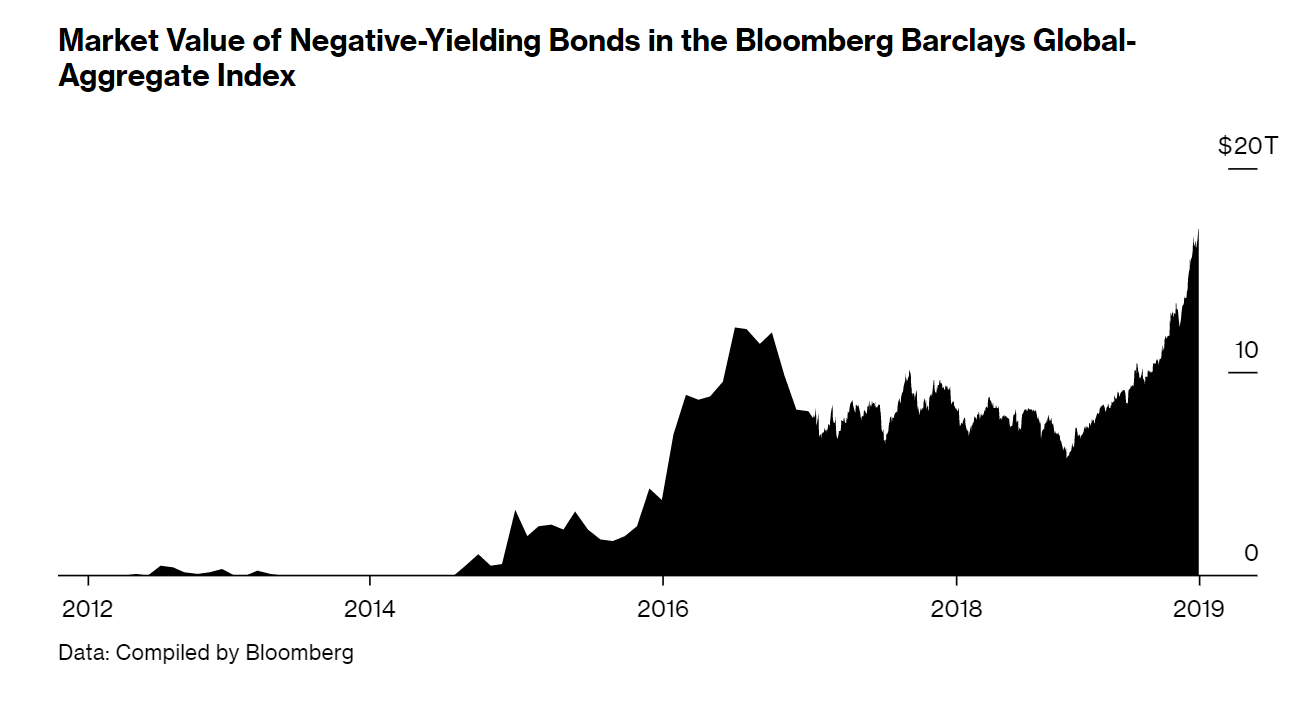
“The market value of the Bloomberg Barclays Global Negative Yielding Debt Index rose to $17.05 trillion [November 2020], the highest level ever recorded and narrowly eclipsing the $17.04 trillion it reached in August 2019.” — Bloomberg News
More and more people are going to begin to question the idea of investing retirement savings in risky financial assets. Negative yielding debt doesn’t make sense; central banks creating trillions of dollars in a matter of months doesn’t make sense either. All over the world, people are beginning to question the entire construction of the financial system. It might be conventional wisdom, but what if the world didn’t have to work that way? What if this whole time it were all backwards, and rather than everyone buying stocks, bonds and layered financial risk with their savings, all that was ever really needed was just a better form of money?
Rather than taking open-ended risk, if each individual had access to a form of money that was not programmed to lose value, sanity in an insane world could finally be restored and the byproduct would be greater economic stability. Simply go through the thought exercise. How rational is it for practically every person to be investing in large public companies, bonds or structured financial products? How much of it was always a function of broken monetary incentives? How much of the retirement risk taking game came about in response to the need to keep up with monetary inflation and the devaluation of the dollar? Financialization was the lead up to, and the blow up which caused, the great financial crisis.
While not singularly responsible, the incentives of the monetary system caused the economy to become highly financialized. Broken incentives increased the amount of highly leveraged risk taking and created a broad-based lack of savings, which was a principal source of fragility and instability. Very few had savings for a rainy day, and everyone learns the acute difference between monetary assets and financial assets in the middle of a liquidity crisis. The same dynamic played out early in 2020 as liquidity crises re-emerged. Fool me once shame on you. Fool me twice, shame on me, the saying goes.
It all comes back to the breakdown of the monetary system and the moral hazard introduced by a financial system that spawned as a result of misaligned monetary incentives. There is no mistaking it; the instability in the broader economic system is a function of the monetary system, and as more of these episodes continue to play out, more and more people will continue to seek a better, more sustainable path forward.
Now with bitcoin increasingly at center stage, there is a market mechanism that will de-financialize and heal the economic system. The process of definancialization will occur as wealth stored in financial assets is converted into bitcoin and as each market participant increasingly expresses a preference for holding a more reliable form of money over risk assets. Definancialization will principally be observed through growing bitcoin adoption, the appreciation of bitcoin relative to every other asset and the deleveraging of the financial system as a whole. Almost everything will lose purchasing power in bitcoin-denominated terms as bitcoin becomes adopted globally as a monetary standard.
Most immediately, bitcoin will gain share from financial assets, which have acted as near stores of value; it is only logical that the assets which have long served as monetary substitutes will increasingly be converted to bitcoin. As part of this process, the financial system will shrink in size relative to the purchasing power of the bitcoin network. The existence of bitcoin as a more sound monetary standard will not only cause a rotation out of financial assets, but bitcoin will also impair future demand for the same type of assets. Why purchase near-zero yielding sovereign debt, illiquid corporate bonds or equity-risk premium when you can own the scarcest asset (and form of money) that has ever existed?
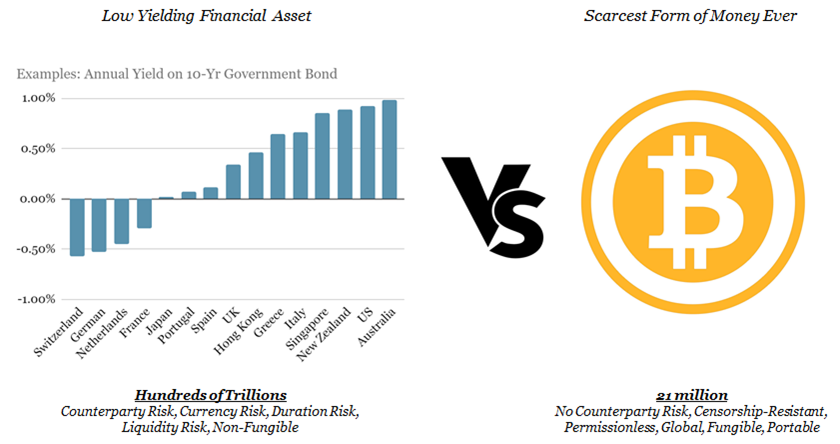
It might start with the most obviously over-priced financial assets, such as negative yielding sovereign debt, but everything will be on the chopping block. As the rotation occurs, non-bitcoin asset prices will experience downward pressure, which will similarly create downward pressure on the value of debt instruments supported by those assets. The demand for credit will be impaired broadly, which will cause the credit system as a whole to contract (or attempt to contract). That in turn will accelerate the need for quantitative easing (increase in the base money supply) to help sustain and prop up credit markets, which will further accelerate the shift out of financial assets and into bitcoin. The process of definancialization will feed on itself and accelerate because of the feedback loop between the value of financial assets, the credit system and quantitative easing.
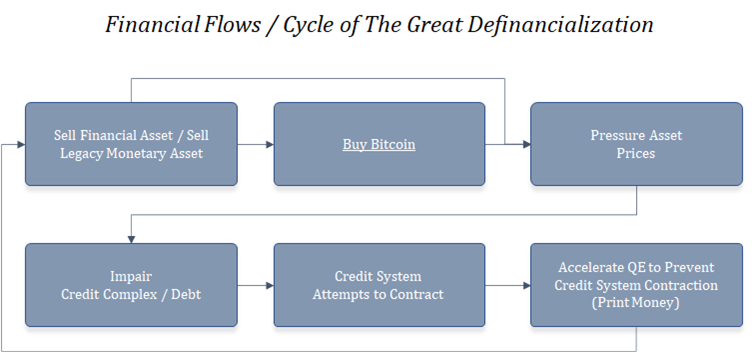
More substantively, as time passes and as knowledge distributes, individuals will increasingly opt for the simplicity of bitcoin (and its 21 million fixed supply) over the complexity of financial investing and structured financial risk. Financial assets bear operational risk and counterparty risk, whereas bitcoin is a bearer asset, perfectly fixed in supply, highly divisible, and easily transferable. The utility of money is fundamentally distinct from that of a financial asset. A financial asset has a claim on the income stream of a productive asset, denominated in a particular form of money. The holder of a financial asset is taking risk with the goal of earning more money in the future. Owning and holding money is just that; it is valuable in its ability to be exchanged in the future for goods & services. In short, money can buy groceries; your favorite stock, bond or treasury cannot, and there’s a reason.
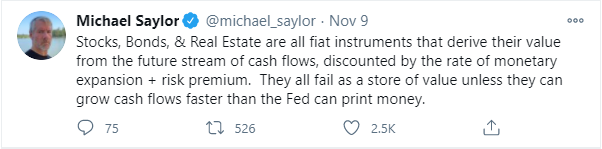
There is and always has been a fundamental difference between saving and investment; savings are held in the form of monetary assets and investments are savings which are put at risk. The lines may have been blurred as the economic system financialized, but bitcoin will unblur the lines and make the distinction obvious once again. Money with the right incentive structure will overwhelm demand for complex financial assets and debt instruments. The average person will very intuitively and overwhelmingly opt for the security provided by a monetary medium with a fixed supply. As individuals opt out of financial assets and into bitcoin, the economy will definancialize. It will naturally shift the balance of power away from Wall St. and back to Main St.
The banking sector will no longer reside at the epicenter of the economy as a rent-seeking endeavor, and instead, it will sit alongside every other industry and more directly compete for capital. Today, monetary capital is largely captive to the banking system, and that will no longer be true in a bitcoinized world. As part of the transition, the flow of money will increasingly disintermediate from the banking sector; money will more freely and directly flow among the economic participants that actually contribute value.
The function of credit markets, stock markets and financial intermediation will still exist, but it will all be right-sized. As the financialized economy consumes fewer and fewer resources and as monetary incentives better align with those that create real economic value, bitcoin will fundamentally restructure the economy. There have been societal consequences to disincentivizing savings, but now the ship is headed in the right direction and toward a brighter future. In that future, gone will be the days of everyone constantly thinking about their stock and bond portfolios, and more time can be spent getting back to the basics of life and the things that really matter.
The difference between saving in bitcoin (not taking risk) and financial investing (taking risk) is night and day. There is something cathartic about saving in a form of money that works in your favor rather than against it. It is akin to a massive weight being lifted off your shoulders that you didn’t even know existed. It might not be apparent immediately, but over time, saving in a form of money with proper incentives ultimately allows one to think and worry about money less, rather than obsess over it. Imagine a world in which billions of people, all using a common currency, can focus more on creating value for those around them rather than worrying about making money and financial investing. What that future looks like exactly, no one knows, but bitcoin will definancialize the economy, and it will no doubt be a renaissance.
Thank you to Aleks Svetski for organizing and inviting me to participate in the 2020 edition of the Bitcoin Times. I also want to thank Aleks in addition to Phil Geiger, Robert Breedlove and Will Cole for providing valuable feedback on this 17th essay in the Gradually, Then Suddenly series.
Lastly, I’d like to recognize the other contributors to the Bitcoin Times: Jimmy Song, Erik Cason, Jeff Booth, Giacomo Zucco and Aleksandar Svetski, himself (as well as Makena Rhodes for editing and design). I’m lucky to call these brave men friends, teammates, clients, twitter friends, fellow bitcoiners or a combination in certain cases. It’s an honor just to be included.
Best, Parker @parkeralewis www.unchained-capital.com

Bitcoin Native Financial Services: Learn About Unchained CapitalHere
The Bitcoin Times Ed 3 is now live. Be inspired by ideas on bitcoin, philosophy, economics, sovereignty and freedom.
Each section will be released on Medium as a free long form article, and the full, compiled version of the Bitcoin Times will be available for free at the link below. We will release a limited edition hard cover collectible, for purchase, which you’ll be notified of by email if you download the free pdf.
If you found value in this or any of the other essays and articles, please support each of the contributors by sharing it out & following their work.
Download the full guide at:
The Bitcoin Times**(https://bitcointimes.news)
Follow The Bitcoin Times on Twitter @TimelessBitcoin:
The ₿itcoin Times
The latest Tweets from The ₿itcoin Times (@TimelessBitcoin). Facts over Fiction. Practice over Theory. Timeless…
twitter.com
Bitcoin and The State of Emergency
By Erik Cason
Posted December 21, 2020
Erik Cason
The Bitcoin Times, Ed 3.
“The tradition of the oppressed teaches us that the ‘state of emergency’ in which we live is the rule. We must arrive at a concept of history which corresponds to this. Then it will become clear that the task before us is the introduction of a real state of emergency; and our position in the struggle against Fascism will thereby improve. Not the least reason that the latter has a chance is that its opponents, in the name of progress, greet it as a historical norm. — The astonishment that the things we are experiencing in the 20th century are “still” possible is by no means philosophical. It is not the beginning of knowledge, unless it would be the knowledge that the conception of history on which it rests is untenable.”
— Walter Benjamin, On the Concept of History
Our conception of history is one that is untenable.
Over the course of the 20th century humanity witnessed genocide after genocide, each being conducted with more precision and barbarism than the one before it. Again and again we see that the state — any state — has entitled itself to unlimited power and a total right over every life through the “emergency situation” which it will always find to expand and extend its power to an unlimited capacity.
By the very fact of what the 20th century was, and the testimony of those who touched bottom all throughout that century of unequivocal violence, the law has shipwrecked itself on the reef of insanity that is state totalitarianism. To be governed is no longer about any kind of social contract or obligation to one another, but about the pure oppression of the freedom and liberty of all for the sole benefit of a callous few. It is the awful and horrific truth that no one wants to look at, for the wickedness that it is, the pure evil it represents.
All States have re-established bellum omnium contra omnes (‘The war of all against all’) asbellum se ipsum alet (‘the war that feeds itself’). The true hidden nature of state power, arcanum imperii, is not to end the war of all-against-all as a great peacemaker, but rather to subject people to the parasitic nature of a continuous total war that encompasses all of biological life. It is the sinister prophecy of homo homini lupus (‘man is wolf to man’) and the guilt of innocence that has consigned all people to the concentration camps we call life. It is a future of a boot stomping on a human face forever.
Under the glare of rifle scopes, and the glistening of pistols the hips of police gangsters; people willingly go into the camps, on their own free will and volition to be subjects of exploitation, molestation, and liquidation for those who occupy the places of decadences and power. Bleating the state’s hypnotic slogan, “arbeit mit free” (work will make you free) they walked under the gates which will never give freedom, but only ash and regret. We bear witness to the transformation of Plato’s Cave into the gridded city of cold steel and unforgiving concrete where the State’s panopticon rules with the shadowy slogan:

Such warnings were ominous, we each listened as the distant thunder of deathly machinery grew louder; but with its arrival we all fell deaf, as we did blind. Even in this blinded and confused state we should have angrily shouted, “Quis custodiet ipsos custodes?” (Who watches the watchmen?) Rather we fell into a slack-jawed, starry-eyed, hypnotized gaze at the spectacle before us, the charm of the Siren’s call and her promise of ‘safety and security.’ Suffering the quivering defeat of this life, we bow in silent capitulation, waiting for our friend Death to take us in his warm embrace and show us where our home in the world should be.
Each of us in our own unique way now hold up a cog in this vicious mechanical web of death, the apparatus of oppression we call the state and law. We each silently obey every order that is given, forfeiting every right we had, and surrender ourselves into the darkest of nights under the powerless knowledge that nothing is right. A false nihilism has collapsed us into its event horizon of a public life that is not worth living. There is no light to be found, only terror and darkness that envelopes all. Each breath we take, flinch we make, every thought we have, is monitored for the safety and security of a repressive state apparatus that will destroy us at any moment’s notice for whatever reason it sees fit.
The prattling paranoia has turned everyone into a potential enemy, destroyed the very idea of community, and obscured the political into nothingness. Privacy is now only a mark of total suspicion, a crime that marks each of us with guilt and testifies towards our most heinous crime of thought. Each of us now finds ourselves in our own private cage of modern life, the permanent state of emergency where the state rules totally over every facet of life, prostituting our very being to the highest bidder in their slave auction economy.

This is the crisis of modern life, the invisible iron cage that has ensnared the entirety of life — this is the permanent emergency that we now live within. We live under the real threat of not just the abolition of privacy, but what it means to live as subjects of suspicion to always be monitored, to always remain a potential enemy combatant, and to always be stripped of the right to life at the state’s bidding. To know this crisis is to know that whatever ‘emergency situation’ might exist, we will always be stripped of all our rights to become something other than human to the totalitarian state that seeks to control everything.
Introducing The Real State of Emergency
It is only in the darkest of night that the faintest light shines the brightest…
Only in a world that has lost all reasoning, that has given itself over to the pointlessness of a worthless life, and surrendered itself to living under the state of emergency does Bitcoin create the fullness of its meaning, the grandeur of its purpose and cause. It is the hidden gem of light that offers us a path towards its liberation beyond the night that has become life.
Like a spectacular encrypted jewel of destiny, Bitcoin arrives like a ghost from the black of the internet with its messianic promise hidden within it. A secret promise that can liberate all of humanity from the chains and shackles that ensnare it — but only if we choose it. This action alone, of choosing Bitcoin over fiat money, introduces the real state of emergency; a declaration of molon labe (come and take it) against each and every state. We must always remember that the messiah does not arrive as the Redeemer, but as the vanquisher of the Antichrist. Those of us who understand this encrypted message veiled in Bitcoin know its secret truth that it is the real state of emergency; the final eschatological crisis that will destroy the state once and for all without shedding a drop of blood.
Bitcoin is the real state of emergency (aufzuheben) because it recognizes and nullifies the total state of emergency (ausnahmezustand) that we are always forced to live under. Bitcoin activates a secret total civil war (stasis) against all power structures through the ontology of cryptography and what its hidden meaning is. From the very beginning of Bitcoin, with Satoshi Nakamoto’s first appearance, he recognized that using cryptography was the only way that one could protect themselves from the state and its physical power, and that it was the only path forward towards creating a radical new commonality of wealth beyond violence or the authority of the state.
In order to fully understand the crisis that we live within, we must admit to ourselves that the crisis is not something outside or foreign to us, but something found inside of ourselves. It is the line between good and evil that divides every man’s heart, the boundary between his best self and worst self, and is the hidden capacity in any one of us for evil. To truly understand the radical power that is Bitcoin, we must assume that anyone — including ourselves — could be the real enemy, the oppressor who seeks to ‘do good’ beyond any and all reason; including evil. It is because of these possibilities that Satoshi understood that we must use cryptography to organize ourselves according to new principals that understand this state of emergency that we live under.
The state of emergency is the life that we now live each day; it is the struggle that all people everywhere share with one another, like a hidden commonwealth. This life under the state of emergency shows us that the only thing we now hold in common is our oppression, the only wealth we currently share is our poverty. It is against this, and the crisis that our lives have become, that we seek to fight back and reclaim that which is rightfully ours: Our wealth, our lives, and our freedom.
The Civil War for Freedom
Let me be clear, there is a civil war to be had.
The state and its agents will come after each and every one of us. They will cage our bodies, crush our bones, rape our minds, and attempt to take everything from us. They will threaten us personally, our families indirectly, destroy our businesses, and sully our names with falsehoods and lies — but they will not have our wealth. And that alone is the most powerful action that can take place.
Through the dangerous and insane brinkmanship of state power, and its sociopathic demand to control all wealth so it may make war on any person it labels enemy, the state has unchained itself from any notion law, justice, or consanguinity to show its face for what it really is: evil.
It is evil for it does not acknowledge any limits to its power, any crisis that it cannot overcome. It is evil for the millions it has killed under the ‘state of emergency’ that it has used to allow itself to legally conduct every major genocide of the twentieth century. It is evil for it does not recognize any right of ownership beyond itself, any security that it cannot provide, any wealth that it cannot expropriate. And it is with these hideous facts that we come to recognize the secret of state power as it has always been:
Hobbes’ Leviathan
“The obligation of subjects to the sovereign is understood to last as long, and no longer than the power lasteth by which he is able to protect them. For the right men have by nature to protect themselves when none else can protect them, can by no covenant be relinquished” — Thomas Hobbs, Leviathan
It is against this evil that we declare our war. A war against those who seek to control all wealth for the ‘safety and security’ of a few. It is against those who want to rule with fear and terror, and seek to have only a commonwealth of cowards who demand we obey beyond everything else. It is against these men in government of every creed and color, against their minions and officers who say they were only following orders, against the surveillance of everything that we object and that we will make war against.
We pleaded with them for our commonality and consanguinity that they should stop and join our side. That we humbly ask them to walk away from their part in this atrocious mess, and that we will hold no ill will towards them. But for those who believe that they have some right, some kind of duty towards a corrupt state whose robberies and crimes can never be atoned for, who think they are allowed to steal and terrorize simply because they have the power to do so, we say that they are our enemies, and we shall treat them as such.
Prudence will dictate that we shall not simply make violence against them, as all prior movements have indicated that such a way is the path towards failure. More importantly, we must refuse violence, not for it is not a valuable tool in the fight against oppression, but for that is now the indicator that allows for the state to respond with all of its might and force. No, such a stratagem has constantly ended in failure, or even worse, with the oscillation of power to a new regime whose violence is only greater and more sadistic than the one before. A totally new strategy against the state must be employed, and this strategy is the utilization of cryptography in order to create new kinds of sovereignty that is beyond violence of any kind.
This is the real state of emergency, the final crisis of law and authority where no longer are people looking for a change of affairs, the replacement of one kind of insanity with another, but a true and radical change that is beyond revolutionary. The first move in this volutionary civil war against all governments everywhere is to first strike at their money, the life-blood of their system of power, the primary mode of their exploitation. For striking at money is to strike Goliath in the eyes, to blind him and render his strength and size a moot point, and to make him vulnerable for his final fall. Together we can take down the giant, but only through introducing the real state of emergency where we no longer recognize their fiat money or false authority, but choose to create new and better ones for ourselves and our posterity.
By choosing to use Bitcoin and the radical power that lies hidden and waiting for us inside its cryptography, together we can change everything.
By @ErikCason. November 2020
The Bitcoin Times Ed 3 is now live. Be inspired by ideas on bitcoin, philosophy, economics, sovereignty and freedom.
Each section will be released on Medium as a free long form article, and the full, compiled version of the Bitcoin Times will be available for free at the link below. We will release a limited edition hard cover collectible, for purchase, which you’ll be notified of by email if you download the free pdf.
If you found value in this or any of the other essays and articles, please support each of the contributors by sharing it out & following their work.
Download the full guide at:
The Bitcoin Times**(https://bitcointimes.news)
Follow The Bitcoin Times on Twitter @TimelessBitcoin:
The ₿itcoin Times
The latest Tweets from The ₿itcoin Times (@TimelessBitcoin). Facts over Fiction. Practice over Theory. Timeless…
twitter.com
Written By:
Erik Cason - Medium
I want to start from the hypothesis that bitcoin and crypto assets are explicit military assets of war. The military…
medium.com
The Greatest Game
By Jeff Booth
Posted December 23, 2020
Jeff Booth
Bitcoin Times Ed 3.

“You never change things by fighting the existing reality. To change something, build a new model that makes the existing model obsolete”
—Buckminster Fuller
Breakthroughs, that step change our lives for the better, invariably come from something that most people couldn’t see. Our belief of how the world should exist and operate is shaped from looking backwards, not forward, so it makes sense that new paradigms that change everything — face resistance in our minds. Because most people don’t see them, breaking through an existing paradigm needs to provide enough compelling value for users to disrupt an old paradigm. Apple’s iphone for instance, didn’t copy the market leader, Research in Motion’s Blackberry design of needing a keyboard or selling to businesses who required RIM’s security. It created a digital interface when that wasn’t ‘needed’ and created an entirely new platform that changed the industry as a result. Along the way, the Blackberry died, unable to compete with the value for users, that was now increasing exponentially on Apple’s platform.
That process describes “Creative Destruction” a paradoxical term first coined by Joseph Schumpeter in 1942 to describe how Capitalism works in a “free market.” Entrepreneurs innovate and “create” value for society — and that value gained by society also often “destroys” the former monopoly power. That process and its importance is at the centre of how all modern economies have evolved and given rise to most of the benefits to society we take for granted today. New winners become so valuable that they disrupt existing market power or structures. It is all driven from a near constant flow of innovative entrepreneurs with bold ideas and the capital backing them that go up against the status quo and are only successful, “if’’ they create value for society.
For the process to work, failure is critical! Both for entrepreneurs and the capital in them whose business doesn’t work, and for legacy businesses that get disrupted by them if their innovation brings better value to society. And while failure is hard, preventing failure is much worse.
Why? — because by preventing failure, market incentives become warped, and in doing so, eventually put a small number of people (government/central banks) in charge of choosing who gets what, instead of the free market.
Unfortunately, preventing failure has been the policy makers tool for the last 20 years, and It has enormous consequences. By socializing losses and preventing failure in our economies, central banks and governments have all but ensured that the existing monetary system of the world collapses — and is replaced by something new. In other words, by preventing failure in economies in the short term, Creative destruction has only moved — now to the level of our international economic system.
I believe with what is to come, Bitcoin has a higher than average probability of overcoming all barriers and becoming a global reserve currency. More importantly, I believe it gives humanity its’ best chance for a peaceful transition to the future. A world where the abundance gained from our technological progress is more widely distributed. It is not hyperbole to say that almost everything changes as a result of this innovation.
A 10x strategy — Be a big fish in a small pond first.
When creating new technology companies, a framework I use to understand if something has an ability to win is ‘the 10x advantage’. Meaning that, unless a new company (the challenger) can deliver a 10x advantage to the market, it has no chance of creating escape velocity and becoming a new category leader. While a 10x advantage does not guarantee the success of a challenger, it greatly enhances its probability.
There are a number of reasons for this. For a company to create a new category, it has to first convince a market that its product or service is far superior to the one it is trying to replace. (ie — that people need to change). If the challenger doesn’t have a 10x type of advantage, it becomes difficult to even be “found” through the noise of an existing market. Harder still, it has to do this while battling two major forces:
- If successful, the existing monopoly will attempt to beat the innovation — either by changing their own offering, or using their existing market power to kill it, and
- With success comes many new entrants (copycats or slight innovations) that enter the market to compete. (confusing the market as to benefits)
For a challenger to continue to advance then, it must continue to offer more advantage than the copycats while staying under the radar from the monopoly for enough time to gain enough scale or gain “network effects” before the monopoly takes notice. The best way to do this — is not by competing on everything that a monopoly competes on, but instead, picking a very small part of a market that goes relatively unnoticed by the monopoly and providing the 10x advantage to only that.
Google, starting at onlysearch as their first market (when there was no money in providing search) as a start-up versus all of its competitors at the time provides a good example. First competing narrowly (only free search) against every other search website, who were selling advertising at the time was something that was underappreciated by the monopolies. With the market (individuals) moving quickly to Google for all things search, it was easier to add functionality (because the users were already there) to compete with broader platforms like Microsoft.
Therefore, winning a narrow part of the market first (10x advantage) created a path to do everything else. From Amazon’s start in only books, to Tesla starting at the Roadster, if you examine the path of almost every new company who breaks through monopoly power, they follow a similar path. The reason this path goes unnoticed, is that by the time the innovation and path is “recognized” by the broader community, it is too late. It has successfully disrupted the monopoly, and people forget what it looked like in the beginning.
This is a useful analogue when looking at Bitcoin’s evolution from where it was when Satoshi launched the genesis block to where Bitcoin might go in the future. By designing Bitcoin as the first “decentralized, non-trust-based” system and designing fixed scarcity of 21 million Bitcoins into the protocol, Bitcoin removed the need for a trusted intermediary, and at the same time created “digital” scarcity.
Bitcoins first use case could then be viewed more of a store of value, than a currency since for it to compete as a currency, it would need to be able to be used widely in society. In other words, Bitcoin’s narrow 10x advantage could be compared to Gold first, rather than as a competitor to money.
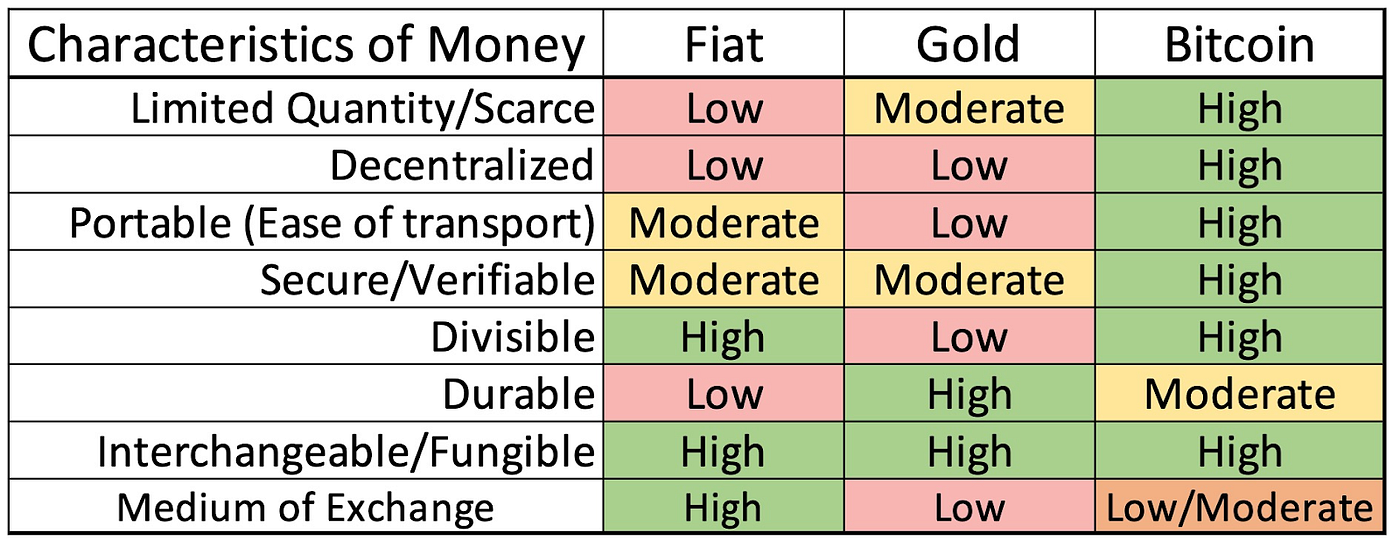
*It is rather fascinating to watch human psychology as Bitcoin emerges. Because while dismissing Bitcoin outright as a store of value, many of the same market participants faithfully believe in the absolute value of a yellow coloured rock, or a piece of paper with faces and names on it (that they know is being actively manipulated)
I will attempt to use this framework to describe why I believe Bitcoin (the Challenger) is poised (over time) to replace the existing economic system. (the Monopoly)
Before I do though, it is worth exploring why an innovation like Bitcoin is required in the first place.
Technology has changed the rules
Exponentially advancing technological gains bring efficiency. That efficiency is deflationary. Moving exponentially and into all industries which means prices should be falling on almost everything.
The reason prices are not falling is that advancing technological progress is incompatible with the existing monetary system which requires inflation to remain viable. That existing system is being manipulated so it appears viable and pushes prices up as a result.
Which sets up a conflict to be resolved at a system level.
- Exponentially increasing efficiency driven by technological progress requires a currency that allows for Deflation. (the challenger)
- The existing fiat monetary system (the Monopoly) requiresinflation and consequently, it needs manipulation to remain viable.
The reason that many people don’t see it or truly understand its implications is similar to any breakthrough in technology. They are trapped within an existing framework (the Monopoly) and use that framework to measure all interactions.
Let’s explore what happens to policy as the two forces of an inflationary monetary policy competing against exponentially advancing technology come together. Remember, they are opposing forces — entrepreneurs using technology are trying to deliver more value for less, whilst inflation is moving in the opposite direction.
Also note that I have attempted to look at the structural change through a ‘system lens’ rather than a ‘people lens’. Although any system has bad actors, the predominant force driving decisions are not because of willful neglect or bad intent, but instead, to protect the status quo (and Monopoly) because it’s very hard to imagine what the future could look like without it.
In other words, changing actors in the system would produce more of the same results and very little real change. Worse still, when much of society believes that changing actors can fix the system, society becomes more divided while only serving to perpetuate the status quo.
Additionally, for those hoping that a change to Bitcoin (or challenger system) happens all at once, be careful what you wish for. While the existing system is producing profoundly negative effects, it is important to remember, that all of our other institutions currently sit on top of the existing system (the Monopoly) and a sudden change would spell disaster for your way of life.
In my opinion, the best way for people to understand how important Bitcoin (the challenger) is for the future, is to first understand how the existing system (and not people) amplifies insecurity and how a change to a different monetary policy (the Challenger) would produce infinitely better results.
So, let’s first consider what the sequence of events would look like from the existing fiat system: (the Monopoly)
- Must create inflation. Without it, deflation takes hold and wipes out credit, and because the system is based on credit, wealth is destroyed. The chance for policy change that could have prevented a complete reset to the existing fiat system was about 20 years ago and would have required an understanding of how fast technology was moving and what it meant for the inflationary fiat monetary system. Instead policy makers made the same mistake most people do when looking at technology. They underestimated its exponential impact. This quote by Nobel Laureate Economist Paul Krugman in 1998 sums up the thinking at the time — “By 2005 or so, it will become clear that the Internet’s impact on the economy has been no greater than the fax machine’s.”
So instead of allowing nature to take its course:
- Interest rates were manipulated lower to increase growth — and almost every year, taken lower again as predictions of growth came up short against the reality of technological progress on the market. Although the chart below references the United States, this was a global phenomenon.
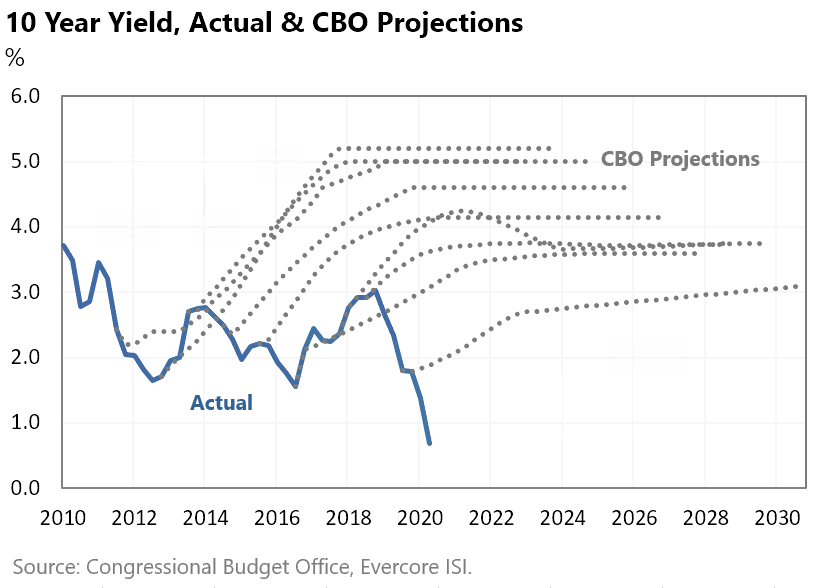
The lower rates and additional debt created produced limited growth which is to say deflation (prices going down) would have taken hold without it and made the debt un-repayable — causing a larger deflationary depression than would have happened in step 1.
Now trapped though, the system required ever lower rates, and the lower rates caused debt binges, misallocated capital and asset bubbles. Designing more fragility in the system as the severity of the reset for society only grew. Global debt rose to over $250 Trillion in 2019, with $185 trillion of that new “stimulus” coming over the last 20 years.
*Note because technology is continuing to advance exponentially, it will take exponentially more debt and easing to keep the existing system intact.*
It was impossible to see how a system operates by only looking at its individual elements so politicians, policy makers, citizens and businesses were caught along for the ride. For example — believing that housing, and education expenses always go up without asking whether they would have gone up without $185 trillion of additional stimulus, leads logically leads to #3
3) A breaking of the rules of capitalism and distortion of free markets when it is realized that the debt cannot be repaid.
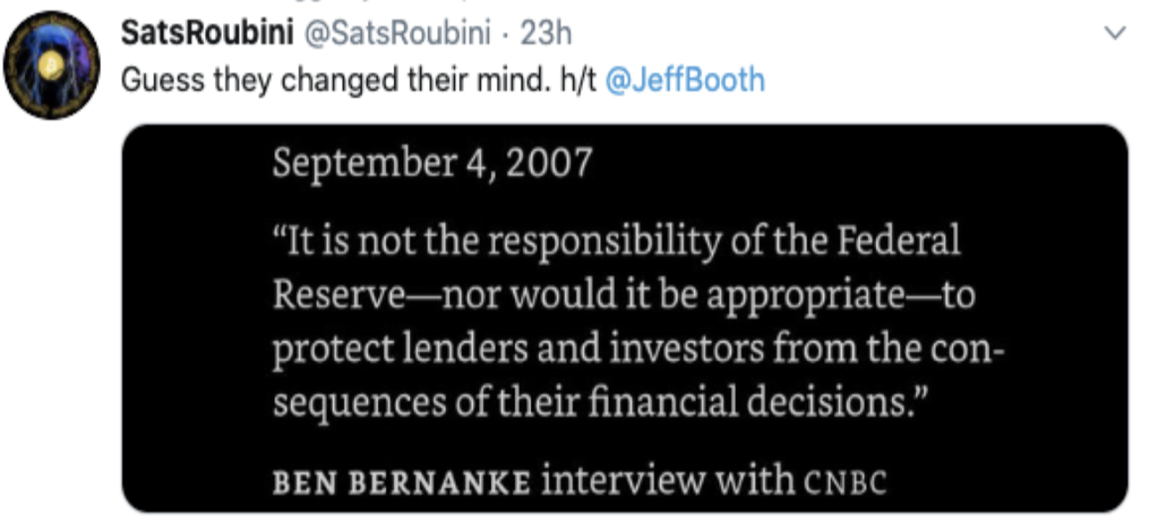
It is not debt itself that acts to undermine capitalism and the free market.
It is the act of stabilizing an economy through socializing the losses when faced with a collapse that undermines the free market and capitalism’s own institutional framework.
Preventing Creative Destruction therefore codifies bad behaviour into capitalism itself, since market participants now realize that the system will always bail them out for fear of a catastrophic collapse — which is exactly what would have happened — and would happen today without bailouts.
Goodbye to free markets.
From the policy makers (the Monopoly) perspective, at this point in the cycle, it would be hard to allow the entire economic system to collapse — so the proverbial can is always kicked down the road without full consideration of the unintended consequences.
This predictably leads to unnatural inequality, social unrest and a loss of faith in “the system” (the Monopoly)
This breakdown phase (which can last longer than people realize) is analogous to a business fighting a structural change AND because of that structural change, having a shorter runway to make the change — which causes chaos throughout the business as it deals with urgent issues and no way of fixing the underlying structure.
It should also be reinforced that by the existing fiat system (the Monopoly) I am not referring to any one country but the overall fiat monetary system. This is important because it will be easy to be fooled in the shorter term by only looking at individual elements of the system. (in this case the individual element being a country currency within that overall framework) As each government acting in its own national interests plays their own game, there could be periods of calm, chaos, uprisings and war as the overall system swings violently back and forth and accelerates its breakdown.
The breakdown phase has a couple of important aspects for how we should view the likely response by the system (the monopoly) versus the challenger (Bitcoin).
The Breakdown Phase:
A) Because the system, as it is designed today, creates unnatural inequality, social unrest and loss of faith, a rise in the merits of socialism and centrally planned economies will predictably emerge and become more popular with citizens. They will gladly transfer control to more government and policy makers to fix the problem. Ironically, they will do so without the knowledge that the problem was created by the policymakers on both sides of the political aisle in the first place; all by ignoring free markets.
B) The new policy makers will change the rules, effectively transferring the independence of the FED and other Central Banks, to Treasury and politicians to allow for a redistribution of wealth in an attempt to save the system. This will first come in the way of Modern Monetary Theory, helicopter drops of money and other fiscal programs designed to get newly printed money to citizens and businesses in an attempt to avoid unrest, and to spur inflation. (most people won’t realize that inflation actually means their real wages and value of money going down and will gladly accept the “free money”)
C) As this happens, and prices are continually manipulated higher through printing money and artificially low interest rates, businesses will be forced to remove labour faster with technology to remain competitive. If they do not, they risk becoming permanent wards of the state (Zombie companies that require money from the government to function).
Removal of labour with technology naturally accelerates the cycle of government intervention and manipulation of currencies to “save jobs.” Because inflation is equal to “real” wages going down, it can work to delay the job loss process by paying less to workers. In other words, the “real” labour component of work falls by making the labour component lower as a percentage of work. Few will realize this sleight of hand, and that inflation is a tax on those most unable to pay, so the cycle outlined in B will accelerate.
D) Along this path, we can expect the existing system (the monopoly) to attempt the introduction of their own digital currencies allowing for more control over wealth distribution in an attempt to “fix” a problem the existing system cannot.
a. We can also expect that different “currency” regimes will compete with each other to make their currency most widely used. A couple of examples of why this is becomes a requirement for the existing system:
b. Central banks cannot take their interest rates too far negative without people pulling their money from banks, which subsequently causes bank runs and the system to unwind. With a digital currency, negative interest rates could be applied immediately without those consequences. Picking your pocket with a keystroke.
For Central Banks wanting to get newly money printing into people’s hands today, it needs to go through a bank or intermediary who determines credit worthiness. Because a bank is a private enterprise with shareholders and the need to remain profitable, a bank will not lend money unless they believe that a business or individual can pay back the loan with interest (which requires an expectation of strong future earnings, ie; economic growth).
A digital currency that could be transferred by the Central Bank or Treasury into hands of citizens without this transfer mechanism of a Bank.
From the perspective of the system, (the Monopoly) these new digital currencies could slow Bitcoin (the challenger) by compelling people to use (the Monopoly) currency to gain the benefit and interact with the rest of the economy.
As they bring in their own digital currencies though, they bring much more attention, network effects, and accelerated innovation to the challenger because more of the public becomes aware of the manipulation and what it means to them. Additionally, these digital currencies put Central Banks and Treasury in direct competition with the private banking sector, who up until now, have been the largest beneficiaries of the Monopoly System.
E) Along this path we can also expect certain Governments make it more difficult for Bitcoin (or other Challengers) to compete by closing onramps/offramps or making their own digital currencies appear more attractive. While the existing Monopoly may not provide the same security as a store of value, (the Challenger’s first 10x advantage) it does currently provide a far simpler way to transact with the greater economy. Certain governments will use that advantage to slow or stop the Challengers’ advance into a wider medium of exchange.
Fortunately, by doing so, it also creates an incentive for other governments, economies and businesses to accept Bitcoin (the Challenger) either as a currency itself or as a unit of account backing their own currency. While these actions are likely to have short-term implications on Bitcoin (the Challenger), they likely also serve to reinforce the Challengers position.
Many people will not take the time to understand that every step along this path to digital currencies, they will have slowly (at first) and then suddenly transferred complete control of their monetary affairs to Government institutions and away from the free market. And, in doing so transferred their natural rights to a ruling class who determines who gets what.
Furthermore, since a small number of people in government could never match the efficiency of a free market, and government tax revenues to pay for the services that its citizens demand come as a result of a vibrant economy, living standardsmust decline. What can be given away so freely, can just as easily, be taken.
It’s along this path, that you had better hope for benevolent dictators, because it’s along this path you have given up your freedom.
Hopefully, you will see by now that just like a company trying to protect itself from being destroyed by a new competitor, the actions and reactions of Central Banks, and Policy Makers to protect the system that they know, are quite predictable. That the existing system that has people trying harder to keep up and “save” enough money, while the same system is designed to inflate those savings away is a feature of the system — not a bug. It has much of the population trading their most valuable asset — their time — for jobs with declining “real” pay — and not able to step off the wheel of insanity for fear of falling into the abyss. What the system (the monopoly) cannot see, is that by protecting itself, it is the harbinger of the real crisis — as the nature of society itself is torn apart as each person and family is forced down a path of destructive self-interest and survival.
The challenger (bitcoin) perspective.
A system design that allows humanity to move from scarcity to abundance.
Like most breakthroughs that make our lives better, one of the most interesting things in the battle between the Monopoly system and the Challenger is that the challenger, (Bitcoin) has structural advantages that allow it to get stronger as the existing Monopoly system weakens. Said another way, many of the reactions described above to protect the existing system, strengthen the challenger’s status as a store of value whilst the “network effects” of more users bring more trust and constantly enhance the value of the system. As this network effect continues, eventually each country in the existing system (monopoly) will face an important choice.
The existing system can either:
- Start to embrace the challenger (Bitcoin) and start accumulating it on their own for an eventual peg to their own currency. Which will only serve to increase the velocity of the challenger’s “network effect” and cause others to do so as well. This means early adopting countries, like the people, and the companies before them, have a larger benefit as the price moves higher because of increased trust and competition for its utility as a store of value. If this were to happen, Bitcoin’s 10x advantage as a store of value would be cemented but its innovation and advancement to the rest of the economy would probably stop there. The onramps and offramps to individual currencies would continue to function within governments which would be pegged to Bitcoin. Or
- Attempt to stop it. (To do so, it would require a coordinated fashion since individual countries trying to stop Bitcoin’s advance would lead back to #1 by creating an additional incentive for early adopting countries).
Should it happen in a coordinated fashion, the technological innovation will move beyond Bitcoin’s utility as a store of value (its’ first 10x) rapidly. In addition to being accepted as a better store of value, it will quickly become a better medium of exchange (easier to use) as a swarm of “cyber-hornets” (H/T — Michael Saylor) rush in to drive the technology forward.
When dealing with technology, most people fall into the trap of projecting their current experience with technology forward, instead of thinking about how fast the underlying technology and user experience is advancing. By projecting a current experience forward they fail to grasp the magnitude of what will happen. To illustrate this important point, look no further than the internet itself which benefits from a similar network effect and growth rate as Bitcoin. The internet in 1995 had approximately 16 million users versus about 5 billion users today. In 1995, use cases for the internet were very narrow, leading many to discount what would come next. But entrepreneurs and investors looking to what the future could hold, built some of the largest companies today — on top of that new paradigm. Amazon, Google, Facebook, Alibaba, and many others.
In my opinion, with either of these two outcomes, Bitcoin (the Challenger) is likely to become the foundation of a new monetary system. One that is congruent with where human innovation and technological progress is taking us.
With technology, there is an exponential effect in its output or power relative to its price. In other words, we get far greater benefit, and the price continues to fall. This should come as no surprise. It is all around us.
Your phone provides just one example. Twenty years ago, it was only a phone. Today, it is a phone, email + text device, social network, camera, AI assistant, map, and music player, and thousands of other things combined for a fraction of the cost previously available. That, is by definition — deflationary, which is a great thing if you understand how a new system could work to benefit humanity.
In my book, The Price of Tomorrow, Why Deflation is Key to an Abundant Future, I detail how that technology is moving into every industry at an exponential pace.
And while it is easy to get fooled looking backwards, most of the technological gains are in front of us which means getting more for less (deflation) is a completely natural process that embraces human innovation.
A new monetary system like (Bitcoin) that prevented manipulation, would embrace that natural process. And it would mean that our innovation and technological advances would translate into freeing our time, while concurrently enjoying higher living standards.
When re-framed that way, it’s hard to imagine anyone wanting to stop it.
Yes, prices would fall and keep falling as technology and a free market did away a false construct — of needing more growth to pay for prices that were only manipulated higher through money printing in the first place. With prices falling to their natural level, and on a path to free, the entire infrastructure required to support price inflation, that was only caused by ignoring the free market, will fall away.
It is not logic that makes this difficult to see. Instead, it’s because of the attempt to fit a current world view — which dominates your attention — into a new one — that is incongruent with that system. That incongruence of two systems competing in one’s mind results in a conflict. We have an inability to see how much of the existing system of cost falls away under a new system and how much cheaper it becomes to live — so we hold onto our past framework that we know manipulates prices higher for fear of loss.
We fail to comprehend that many of our biggest societal issues today might solve themselves under a new standard like Bitcoin. For instance, the manipulation of money is, by an order of magnitude, the greatest contribution to environmental destruction that no one talks about. Again, most of humanities attention is focused on the independent variables of the system instead of the system itself. One of the independent variables in this case being fossil fuel energy to keep with the growth. We miss that that manipulation of money is artificiallydriving higher prices and growth, along with the need for more of everything to pay for those higher prices. And as entrepreneurs innovate and bring lower prices to market, ever more manipulation is required to offset this benefit. More energy, more jobs, more consumption, more production, more transportation, on an ever-increasing feedback loop, just to keep it going.
And that is the truly revolutionary power of Bitcoin over the long term. As it continues its advance and eventually becomes a global reserve currency, it shatters the societal patterns we currently call reality. As more people start to realize what that means for society (after the transition) more people will also realize that many current “realities” were really only self-imposed prisons.
I’ll attempt to show this by way of another example in education.
Today, with an internet connection and browser, we already have access to many of the world’s best minds, research papers, and content — for free.
Khanacademy.org provides just one example offering a completely free education anywhere in the world in math, physics, science and computing. The courses and UX are designed to make learning engaging and ensure mastery of subjects. Those opportunities are everywhere. A staggering amount of detail, on any subject — all there for us to learn. For the curious — with enough willpower and perseverance then, a great education is already free. Why, given this inescapable fact, do we choose to spend our time in school for 12 years, to compete to get into the best college — when it is both more time consuming and costly?
We do so because historical societal patterns (our perceived reality) tell us that it is the best way to get a good paying job. That may have been true, especially looking back to a time before the technology brought that abundance of information to us. It may even be somewhat true for some jobs today, but it also is likely to be less true in the future.
For some — the future is already here. From my own experience in hiring thousands of employees over the years, I would take the curious, self-driven, learner every time.
The “perception” of scarcity 1) that education from the best schools is required to have a great career, and 2) there are only a limited of spaces available in those schools, 3) means the cost and competition for those spaces is constantly rising, which the system reinforces without us even questioning it (our self-imposed prison). That same “perceived scarcity” creates an education system that increases inequality because access to education — and along with it, the best jobs — becomes more about an ability to pay, than curiosity and drive.
Ironically, at the same time abundance of free or almost free education is already all around us — with the change in hiring that will soon follow suit.
It forces us to the realization that economics is not about value, but scarcity — real or perceived. It is difficult to charge money for abundance for the same reason it is difficult to charge for the oxygen we breathe. As something becomes abundant, the ability to monetize it drops.
Where does economic value come from?
We can look at the overall economy in a free market as a sum total of trillions of continuing experiments competing to create value for us. An endless swarm of innovation and experimentation by entrepreneurs driven to succeed — with money as a measurement of that success.
That experimentation comes in all forms and sizes — from a new local restaurant, carrying the hopes and dreams of a family with it, to an idea like Amazon that emerges quickly as a new dominant platform. Transportation, space travel, health, education — each playing field is dynamic — constantly changing and evolving. Past success doesn’t guarantee the future. Ask any entrepreneur, it is not a journey for the faint of heart. The competition is brutal and in a free market, it is not only the entrepreneur and their early employees at risk losing everything in a new venture. The capital that bets on those entrepreneurs, either wins along with success or loses with its failure.
Which is another way of saying, businesses are always on the hunt for ways to improve, because if they don’t, they die. We determine their value, by the value they bring to us. A free market, that allows Creative Destruction to work then, results in more experiments and more value created in our lives. Technology amplifies this entire process — and with it, will bring breakthroughs to our lives that were previously inconceivable and open the doors for almost anyone to create them.
This becomes a feature of a new monetary system backed by Bitcoin because it forces out manipulation and as a result — distributes broad society gains as a natural consequence.
Because, unmanipulated, the result of all of that free market competition — must give us more for less — or we wouldn’t use it. Which is to say, a monetary standard like Bitcoin would ensure the exponentially improving value created by a combination of technology and competition, would fall in price to match the new realities of supply and demand in a digital world. That seemingly small change, unnoticed by most of society, changes everything else. In time, society will realize that it also allows for an expansion of the very meaning of success.
In the great game of business, a monopoly rarely dies overnight. They have too much market power for that. What often happens is that they miss a key technological change that would have allowed them to offer value differently, and then set out on a series of actions to protect their existing business. Because the change delivers better value to society, those actions to protect what was — all but guarantee failure in the end.
It is exactly the same thing, playing out before our eyes in the greatest game of all — the international monetary game and the rise of Bitcoin — which is connected to everything else.
For the first time in history though, the unique characteristics of Bitcoin gives everyone a choice on how they play the game. I suspect that as more people come to understand how remarkable this breakthrough is for money and what it means — that things will never be the same.
Learn about Bitcoin. Learn why its importance is so much greater than wealth it might create for you and your family. When you do, teach others. Their futures may depend on it.
It is bound to be an epic battle.
A battle between the free market and entrepreneurs competing to create more value on one side, and manipulation and power concentrated in the hands of a few — eventually leading to totalitarian control on the other.
My hope for humanity is that we’re on the winning side.
By Jeff Booth Nov 2020
The Bitcoin Times Ed 3 is now live. Be inspired by ideas on bitcoin, philosophy, economics, sovereignty and freedom.
Each section will be released on Medium as a free long form article, and the full, compiled version of the Bitcoin Times will be available for free at the link below. We will release a limited edition hard cover collectible, for purchase, which you’ll be notified of by email if you download the free pdf.
If you found value in this or any of the other essays and articles, please support each of the contributors by sharing it out & following their work.
Download the full guide at:
The Bitcoin Times**(https://bitcointimes.news)