
 WORDS is a monthly journal of Bitcoin commentary. For the uninitiated, getting up to speed on Bitcoin can seem daunting. Content is scattered across the internet, in some cases behind paywalls, and content has been lost forever. That’s why we made this journal, to preserve and further the understanding of Bitcoin.
Donate & Download the May 2018 Journal PDF
Remember, if you see something, say something. Send us your favorite Bitcoin commentary.
The Future of Bitcoin: What Lightning Could Look Like
By Aaron van Wirdum
Posted May 2, 2018
After years of conceptualization and development, the first Lightning implementations are now in beta. As a result, more nodes are appearing online every day, a growing number of users are opening channels with one another, and some merchants even started to accept Lightning payments.
But of course, these are still the very early days of the Lightning Network. While the main implementations are usable and some wallets and other applications are available, Bitcoin’s overlay payment network is projected to improve over the next few years in areas ranging from network architecture to security and usability, and more.
These are some of the more important Lightning projects currently in development.
Dual-Funded Channels
The Lightning Network consists of a series of payment channels. Each payment channel exists between two users, allowing funds to be sent back and forth between them.
However, in this early stage of development, payment channels can only be funded by one of the two parties. The funding party must first make a transaction to his counterparty; only then can that counterparty return a payment within the same payment channel.
The Lightning Network white paper, however, proposed dual-funded channels, for which a specification proposal has now also been made by ACINQ, the company behind eclair. As the name suggests, dual-funded channels will let both users partly fund a payment channel by each depositing some bitcoin. This should bring more flexibility to the Lightning user experience, as users can immediately send as well as receive payment after having opened a channel.
Submarine Swaps
In order to make a Lightning payment, users must deposit funds in a Lightning channel. Once in a channel, these funds cannot be sent to regular (on-chain) Bitcoin addresses (unless the channel is first closed). This means that bitcoin in a Lightning channel is somewhat separated from bitcoin in a regular wallet, not unlike how money in a checking account is somewhat separated from money in a savings account.
But there are solutions to make switching between Lightning and on-chain payments more seamless.
One solution is Submarine Swaps. Developed by Alex Bosworth (but conceptualized by Lightning Labs CTO Olaoluwa Osuntokun even before that), Submarine Swaps essentially let users send Lightning payments to a middleman on the Lightning Network; that middleman will send a corresponding amount of bitcoin to a regular (on-chain) Bitcoin address. It also works the other way around: users can send regular on-chain payments to the middleman; that middleman will then send a corresponding amount of bitcoin to a receiving Lightning node on the Lightning Network.
Importantly, with Submarine Swaps, this conversion is done “atomically.” Using a trick that is already embedded in the Lightning Network, the Lightning payment and the on-chain payment can effectively be linked to each other. This makes it impossible for the middleman to steal funds by not forwarding the payment. (In agreement with the users, he could charge a small fee for his service.)
Splicing
Another solution to make the Lightning user experience more seamless is called “splicing.” In essence, splicing would let a user “top up” funds in an existing Lightning channel, or “drain” funds from it, potentially while keeping the channel open.
The idea is simple. Any Lightning channel starts with an opening transaction, which ensures that both users consent to moving the funds in the channel. The rest of the Lightning channel consists of a series of subsequent transactions exchanged between the users, which aren’t usually broadcast to the Bitcoin network. The funds in the opening transaction don’t move until the channel is closed.
When “splicing in,” users take the opening transaction to instead send funds to a replacement opening transaction, which includes more bitcoin, from one or both users. Once this new opening transaction confirms on the blockchain, the channel is topped up. Until the new opening transaction is confirmed, the two users can simply update both the old and the new channel at the same time to avoid any “channel downtime.”
Conversely, when they “splice out,” users take the opening transaction to send funds to a regular (on-chain) address, and potentially keep some of it in the channel using the same trick. This way, users can make on-chain transactions straight out of a Lightning channel.
Eltoo
Each time a new payment is made, Lightning channels between users are updated to reflect their mutual balances. The trick used to accomplish this currently includes a penalty for users who try to cheat by broadcasting an older balance (presumably because that older balance would pay them more). Cheating users can lose all the funds they have in a channel.
The problem is that the broadcasting of old balances is not always a cheating attempt. There are a number of scenarios in which users can accidentally broadcast an older balance; for example, because of a software bug or a backup gone wrong. In such scenarios, a complete loss of channel funds is quite a heavy punishment.
First published on April 30, 2018, eltoo is the newest proposal featured in this article. Developed by Blockstream’s c-lightning development team — Dr. Christian Decker and Rusty Russell — and Lightning Labs’ Osuntokun, eltoo updates a channel by building a chain of time-locked transactions, where each transaction spends funds from the previous one to reflect the latest channel balance.
If one user broadcasts an older transaction (representing an older channel balance), her counterparty has some time to broadcast the latest transaction (representing the latest channel balance).
A solution like this could work today, but it isn’t practical in cases of failure. It would require that the entire chain of transactions be broadcast and recorded on the Bitcoin blockchain, more or less defeating the purpose of the Lightning Network. Decker therefore proposed a soft-fork change to the Bitcoin protocol to introduce a type of hierarchy in these types of transactions: any newer transaction can override any older transaction without requiring that all transactions in the entire chain be broadcast.
If this soft fork is adopted and activated on the Bitcoin network, Lightning users could create channels in both the current style and by using eltoo, depending on what they prefer.
Compact Client-Side Block Filtering
While the Lightning Network is a second-layer protocol, the Bitcoin blockchain itself is still relevant for Lightning users for security purposes. Specifically, Lightning users must keep an eye on the blockchain to see if specific transactions are included. This can be resource intensive, in particular for mobile users.
A solution for this is called Simplified Payment Verification (SPV) and was described in the Bitcoin white paper. Current SPV wallets use a trick called “Bloom filters “ to find out whether any relevant transactions happened.
Unfortunately, Bloom filters are rather privacy-unfriendly, as wallets essentially reveal all of their addresses to nodes on the Bitcoin network. They also have some scaling and usability issues, as each individual SPV wallet takes up resources from at least one full Bitcoin node.
To tackle these issues, Lightning Labs’ Osuntokun and Alex Akselrod, along with Coinbase developer Jim Posen, designed a new solution called “compact client-side block filtering,” which they are implementing in the Neutrino wallet.
Compact client-side block filtering essentially inverts the trick that current SPV wallets use. Instead of wallets requesting transactions relevant to them by creating and sending out a Bloom filter to full nodes, full nodes create a filter for all Neutrino wallets. The Neutrino wallet then uses this filter to establish that the relevant transaction did not happen — which is really all that users need to know to be sure they are not being cheated. (If the filter produces a match, Neutrino fetches the relevant block to see if the match really concerns the exact transaction instead of a false positive.)
Interestingly, while this trick was designed with the Lightning experience in mind, it could be utilized to benefit regular light wallets as well.
Watchtowers
To avoid being cheated, Lightning users must keep track of potential on-chain transactions that could be relevant to them.
While compact client-side block filtering should make things much easier, users do need to “check in” once in a while to make sure they’re not being cheated. If they forget to check, it creates a security risk.
“Watchtowers” are a potential solution that can be traced back to the Lightning Network white paper and has since been improved by Lightning Network white paper co-author and lit developer Tadge Dryja and others. As the name suggests, Watchtowers could let users outsource blockchain monitoring to third parties.
Current Watchtower designs are not set in stone but would roughly work like this. Whenever users update a channel, they send a small data package to a Watchtower. The first part of this package is a “hint” of a transaction they should look out for, as if it were a piece of a puzzle. This hint alone doesn’t reveal anything about the content of the transaction that the Watchtower must look out for; users don’t give up any privacy in this sense.
However, if the relevant transaction shows up in the Bitcoin blockchain, the Watchtower can use the hint to recognize it. Then, with the transaction data on the blockchain itself, the Watchtower can use the second part of the package they’ve received to reconstruct the penalty transaction. This penalty transaction sends all funds in the channel to the user that is being cheated. (Or in the case of eltoo, it just broadcasts the correct channel balance.) The penalty transaction can also be designed to let the Watchtower claim part of the funds as a reward, as an incentive to do its job.
Users can outsource channel monitoring to multiple Watchtowers. Even if one fails, another might not, limiting the risk for Lightning users to the point where it’s arguably negligible.
Atomic Multi-Path Payments
What makes the Lightning Network a network is that the payment channels between users are interconnected. Users can pay across payment channels, through peers on the network that act as “middlemen,” to users they don’t have a direct channel open with.
However, right now a single payment must be routed over a single route. If one user wants to pay 5 mBTC to another, not only must he have 5 mBTC in a single channel, all the middlemen on the route must also have 5 mBTC ready in a channel to forward. The bigger a payment is, the smaller the odds of this being the case.
Atomic Multi-Path Payments (AMPs) could go a long way of solving this limitation. First proposed by Lightning Labs’ Osuntokun and Conner Fromknecht, the idea is simple: Larger payments can be “cut up” into smaller pieces, all of which have their own route from the payer to the payee, through different middlemen.
A challenge to realize this solution is that Lightning payments can fail, which would in this case mean that a payment is made partially. Partial payments can easily be a bigger problem than no payment at all, however: a merchant won’t be satisfied with a partial payment, while a customer won’t be happy spending any money for nothing.
The solution to this problem is that AMPs use an extension to the hash time-locked contracts, which are already used along Lightning routes and involve passing secret data along a network. Using a trick similar to the one used by deterministic wallets (which generate multiple Bitcoin addresses from a single seed), the smaller pieces of a larger payment can only be redeemed by the payee if all of them are: if some secret data doesn’t make it through the route whole, the entire payment fails.
Atomic Swaps
The Lightning Network is designed as a scaling layer for Bitcoin. But since many altcoins are software forks of Bitcoin’s codebase(s), it’s often not difficult to create similar scaling layers for these altcoins. Already, a small Litecoin Lightning Network exists, and more Lightning Networks are likely to follow.
Interestingly, these networks don’t need to remain separated in the future.
Using a fundamental building block of the Lightning Network called “atomic swaps” (first proposed by Tier Nolan and realized on Lightning by Lightning Labs’ Fromknecht), payment channels can be linked across different blockchains. In other words, a user can send bitcoin, and as long as a node on the network is willing to make the exchange, another user can receive the payment as litecoin.
Of course, this also means that users can send such payments to themselves: they can send bitcoin and receive litecoin. In effect, the Lightning Network could establish a network of trustless cryptocurrency exchanges. For more information on this topic, see: “Atomic Swaps: How the Lightning Network Extends to Altcoins.”
Channel Factories
The main benefit of the Lightning Network is arguably its potential to vastly increase the upper limit of bitcoin transactions without burdening the Bitcoin network. As long as two users both have funds in their channel, they can pay each other a virtually unlimited number of times, while only requiring two on-chain transactions: one to open a payment channel and one to close it.
Still, two transactions per payment channel could add up if Bitcoin and the Lightning Network gain more adoption over time.
A proposal by ETH Zurich researchers Christian Decker (also of Blockstream), Roger Wattenhofer and Conrad Burchert called “Channel Factories” could further decrease the average number of on-chain transactions required per payment channel, perhaps significantly.
Loosely based on an earlier Lightning-like proposal by Decker and Wattenhofer from 2015, Channel Factories are a type of payment channel that can exist among many users. Meanwhile, like any payment channel, a Channel Factory only ever requires two on-chain transactions. (If Schnorr signatures are implemented on Bitcoin, these transactions could be quite compact, even if it involves many users.)
The Channel Factories can, in turn, act sort of like “sub-channels” for the Lightning Network. Participants within a Channel Factory can open and close a virtually unlimited number of Lightning channels with each other, without requiring any additional on-chain transactions. By doing so, they could, in theory, bring the number of required on-chain transactions for the Lightning Network down by a magnitude. For more information on this topic, see: “This New Scaling Layer Could Make Payment Channels Ten Times More Effective”.Thanks to Blockstream developer Christian Decker, Lightning Labs developer Conner Fromknecht, ACINQ CEO Pierre-Marie Padiou and others for information and feedback.
The Poverty of Tokens
By Erik Cason
Posted May 13, 2018
The tokenization of everything won’t change anything if the revolutionary nature of crypto is lost.
Since the early days of bitcoin there has been the ‘tokenization’ of various assets using the bitcoin blockchain. From ‘colored-coins’ to the short-lived bitcoin stock markets, tokens are nothing new to crypto. However, with Ethereum, Neo, and other smart contract platforms having made tokenization so easy, there is now a massive land grab going on in the crypto-ecosystem to tokenize nearly everything. While tokenization itself is potentially revolutionary in its ability to radically change and distribute forms of ownership, it is rendered meaningless if it is expropriated to serve the current economic paradigm crypto-assets are seeking to escape.
Right now the whole crypto-ecosystem is in the throws of a dangerous reactionaryism that is losing itself in the mania of ICOs, shitcoins, and KYC/AML bureaucracy. By taking blockchains and making them non-anonymous, pre-mined, and mutable destroys the very sovereign power that exist within blockchains; rendering their true power inactive and meaningless. Furthermore, the inversion of blockchain technology in this reformist way can create a panopticon of terrifying proportions if we are not careful. There is a real danger of blockchain technology being captured and empowering the very institutions and regulations that it was created to escape from if we continue on this path. The process of tokenization as it is today is little more than a mutilated form of techno-banking that reinforces the economic disparities of the world, forgetting the conditions that allowed for its creation in the first place.
If we simply trade bankers for coders and regulations for mutable blockchains; we will find ourselves in a worst position than when we started. While bitcoin and many crypto-assets will always have at the core of them the radical possibility that is always contained in cryptography; it is important to remember that it is possible for it to be rendered idiotic and mute to itself.
“Whether the pupils have lost It [their Scripture] or weather they are unable to decipher it comes down to the same thing, because without the key that belongs to it, the Scripture is not Scripture, but life. Life as it is lived in the village at the foot of the hill on which the castle is built.” -Walter Benjamain
Through serving the same masters of capital and state, and focusing only on the economic nature of crypto assets; and not the political, philosophical, and even religious, the Key to this technology is lost. Without understanding these critical aspects of this technology, we profane the radical nature which created it in the first place and will find ourselves under the glare of the castle at the foot of the hill.
The Radical Possibilities Within Cryptography
Yes, [we will not find a solution to political problems in cryptography.] but we can win a major battle in the arms race and gain a new territory of freedom for several years.
Governments are good at cutting off the heads of a centrally controlled networks like Napster, but pure P2P networks like Gnutella and Tor seem to be holding their own. -Satoshi
While there is still the possibility that we can use this technology to explode a radical new epoch into reality, there is a real danger that it can fail, or be turned against us. Not for the lack of the technological capacity to create such a future; but from the lack of political will, thought, or vision beyond just economic means to accomplish it. The poverty of tokenization is it profanes the radical nature of crypto assets and encrypts the very meaning of crypto to itself. It is creating life as it is lived in the village at the foot of the hill as in Kafka’s novel The Castle.
If we want to keep alive the vision that allowed for this technology to flourish in the first place, than we cannot betray the cypherpunk roots and crypto-anarchist principals which allowed for this whole ecosystem to bloom thus far. We must continue to insist upon fungibility through anonymity, consensus through decentralized participation, and the mathematic-legal guarantees of cryptography which allows for immutable blockchains to exist. Projects robbed of these features will do nothing more than serve the empire of old wrapped in the garb of new.
In order to keep the revolutionary possibilities of crypto alive, and to win the arms race to ensure the Internet remains a sovereign and free territory, we must acknowledge the political and philosophical nature that lies hidden at the very centre of these systems. Until there is a wide acknowledgment that this technology goes far beyond just economic means, tokenization will continue to prove the poverty of its philosophy.
The Internet’s Magna Carta Moment: Bitcoin & The Value of Strong Assurances
By Spencer Bogart
Posted May 20, 2018

Symbolically, the Magna Carta marked a long-standing movement toward broader applicability of rule-of-law (Kings and Nobles not immune to rule of law) and people’s rights (rights for everyone, not just the elite).
By providing stronger assurances regarding property rights and rule-of-law, this movement changed economic incentives in favor of investment and growth which ultimately, hundreds of years later, led to the UK’s Bill of Rights, the industrial revolution, and a vast improvement in the human condition.
Similarly, highly decentralized networks are providing an open foundation with strong assurances for objective property rights, impersonal rules and consistent enforcement.
An important difference, however, is that with the Magna Carta, the powers on high decided to relinquish some of their privileges and rights — first to nobles and elites and, eventually, to everyone.
In contrast, highly decentralized networks are constructing these rights in reverse — starting from the ground up with the “every-man”. These networks don’t ask for the king’s permission to exist and facilitate the rights they offer — they simply are.
A profound implication
A profound implication of some highly decentralized networks is the opportunity, at scale, to deliver stronger assurances than even the largest nation-states today — and in doing so to offer a robust, digital foundation for economic growth.
The Bitcoin network, for example, is a self-contained, rules-based, self-arbitrating court where valid transactions are clearly defined, objectively verifiable, and unerringly enforced by network participants. More on that to follow, but we’re getting ahead of ourselves…
WTF are “strong assurances”?
First, what do we mean by “strong assurances”?
Simply put, “strong assurances” means “the rules are the rules” and they will be enforced consistently and objectively. In practice, we’re also talking about defining and enforcing property rights: Your exclusive right to determine the use of a good, earn income from the good and to transfer the good to others.
Why strong assurances matter
Overall, property rights and “strong assurances” may sound like a mundane topic, but property rights are a foundational component of economic growth and a primary explanatory variable for understanding differences in growth outcomes between jurisdictions.¹ ² ³ ⁴
Intuitively, it makes sense: Innovators and builders take their ability and ingenuity to where they can build with the least uncertainty. The greater the risk of unexpected outcomes or enforcement (rule-changes, asset seizures, etc), the less inclined builders are to incur the risk of operating on a particular platform or country. This intuition is supported unequivocally by the growth trajectories of countries that have provided the strongest assurances and property rights for participants.¹
Said differently, strong assurances are valuable in that they de-risk economic activity and, consequently, encourage growth. If it were an actionable trade, investors would have been handsomely rewarded by “going long” jurisdictions that offered strong property rights over the past 100 years — these jurisdictions account for most of the world’s economic growth over the same period.
In particular the main transmission channels that lead from strong property rights and consistent rules-enforcement to economic growth include:
1. Reducing the risk of expropriation: More likely to invest time, money and labor when the fruits of such efforts are less likely to be seized unexpectedly.
2. Reducing the risk of unfavorable rule changes: Investors and operators are more likely to invest and build when the rules of the system are less likely to shift beneath their feet.
3. Reducing the cost of protecting assets: If ownership is ill-defined, participants must allocate greater time and resources to engaging in activities that might subsequently define ownership (or risk that others will). For example, if private keys define ownership, then users can focus time toward securing private keys (instead of myriad activities that might subsequently redefine ownership).
4. Increasing the opportunities to realize gains from trade: With clearly defined and publicly recognizable property rights, owners can engage in contractual arrangements for the asset and more fully utilize the asset to maximize value production.
Strong assurances in a digital, decentralized context
As we move to a world where people increasingly build in the cloud, economic activity will migrate to a digital equivalent: an accessible digital foundation that offers strong assurances and consistently enforces clearly defined (digital) property rights. Such a platform will be increasingly valuable as the frontier of economic activity pushes further into the digital world.
Considering there’s billions of dollars and millions of man-hours dedicated to building the parallel world of crypto-finance, the foundational platform(s) — the highly decentralized networks — that underpin it all are mission critical. The networks that attract and retain builders in the medium to long-term will be the ones that deliver a track record of strong assurances — a track record of consistent and objective rule enforcement.
Historically, strong assurances of this sort have only been possible via strong and credible central authorities that commit to defending stated rights and rules with vast resources (e.g. powerful nation states).
Interestingly though, once we depart from a strong centralized authority, strong assurances might only be possible at the other end of the spectrum: via highly decentralized networks. The middle ground — quasi-decentralized networks — will likely be co-opted by economic and social pressures in such a way that they present an inferior option (weak assurances) relative to both centralized and highly decentralized alternatives (more on that here: The Long Game in Crypto- Why Decentralization Matters).
A network of strong assurances: Bitcoin as an institution for digital property rights
Bitcoin, for example, offers a self-contained, reliable foundation for property rights in a digital world. The Bitcoin network is a rules-based, self-arbitrating court — it’s likely the fairest, most transparent and most predictable court in the world.
This is due, in no small part, to the fact that the Bitcoin network intentionally limits its scope to enforcing a minimal set of functions. This deliberately limited network scope offers participants greater predictability in the outcome and enforcement of network activity: Valid transactions are clearly defined, objectively identifiable, and unerringly enforced by the network.
In this way, the Bitcoin network is a decentralized institution that defines, monitors, and enforces property rights. It is a reliable foundation of strong assurances on top of which we can efficiently architect arbitrary degrees of complexity and allow innovation and economic growth to flourish.
Tying it all together
Ultimately, strong assurances are fundamental to human progress as most economic growth has gravitated toward and emanated from jurisdictions that offered strong property rights coupled with consistent rules and enforcement.
In the jurisdiction of the Cloud — which is witnessing unprecedented growth in economic activity — highly decentralized networks are taking the notion of strong assurances even further:
· Global in nature: The strong assurances offered by highly decentralized networks like Bitcoin are global in nature (whereas, historically, strong assurances have been limited by geography and citizenship).
· Clearly defined: The Bitcoin network’s rules are clearly defined whereas most historical rights and rule-sets have left ample room for subjective interpretation — an additional element of risk.
· Perfectly Enforced: The Bitcoin network enforces its rule-set objectively and unerringly — something every justice system ostensibly seeks to accomplish, but none have delivered on.
In the end, highly decentralized networks like Bitcoin offer a fertile foundation for economic growth in the digital world and will likely be important underpinnings of our increasingly digital economy. Much like how, at the turn of the 20th century, jurisdictions that offered strong assurances for economic activity were at the center of innovation and growth, so too will highly decentralized networks like Bitcoin that offer strong assurances prove to be fruitful for growth and development of the digital world.
Sources:
[1] Claessens Stijn and Luc Laeven. “Financial Development, Property Rights, and Growth.” Journal of Finance. 2003 December: 58(6): 2401–2436.
[2] Kerekes, Carrie and Claudia Williamson. Unveiling de Soto’s mystery: property rights, capital formation, and development. Journal of Institutional Economics. 2008 December: 4(3): 299–325.
[3] North, D. (1990), Institutions, Institutional Change and Economic Performance, Cambridge: Cambridge University Press.
[4] Acemoglu, Daron and Johnson, Simon and Robinson, James A. “Institutions as a Fundamental Cause of Long-Run Growth”. Handbook of Economic Growth, Volume 1A. MIT.
Rethinking Metcalfe’s Law applications to cryptoasset valuation
Introducing Network Value to Metcalfe (NVM) ratio and using it to identify and predict price bubbles
By Dmitry Kalichkin
Posted May 21, 2018
This is the second article from our series on cryptoasset valuation techniques. The first article is Rethinking Network Value to Transactions (NVT) Ratio .
For cryptoasset investors the first quarter of 2018 has been drastically different from 2017. Following a truly remarkable (albeit, not 100% healthy) 60x appreciation in 2017, the crypto market has experienced a strong correction, falling 58.2% from an opening $612bn in total network value on January 1st, to $256bn at the end of Q1. In April, the markets have turned around and regained some of these Q1 losses. Following all this volatility, right now many investors are puzzled by the question as to whether this is the end of price corrections, or just a temporary reprieve.
To answer this question Cryptolab Capital uses a data-driven approach to cryptoasset valuations and looks at the fundamental foundations of asset prices. In our February article Rethinking Network Value to Transactions (NVT) Ratio we shared one of the quantitaive metrics that we use. Today I’m excited to tell you about how we use Metcalfe’s Law for cryptoasset valuation and investment decisions, and to introduce the Network Value to Metcalfe ratio (NVM).
Summary
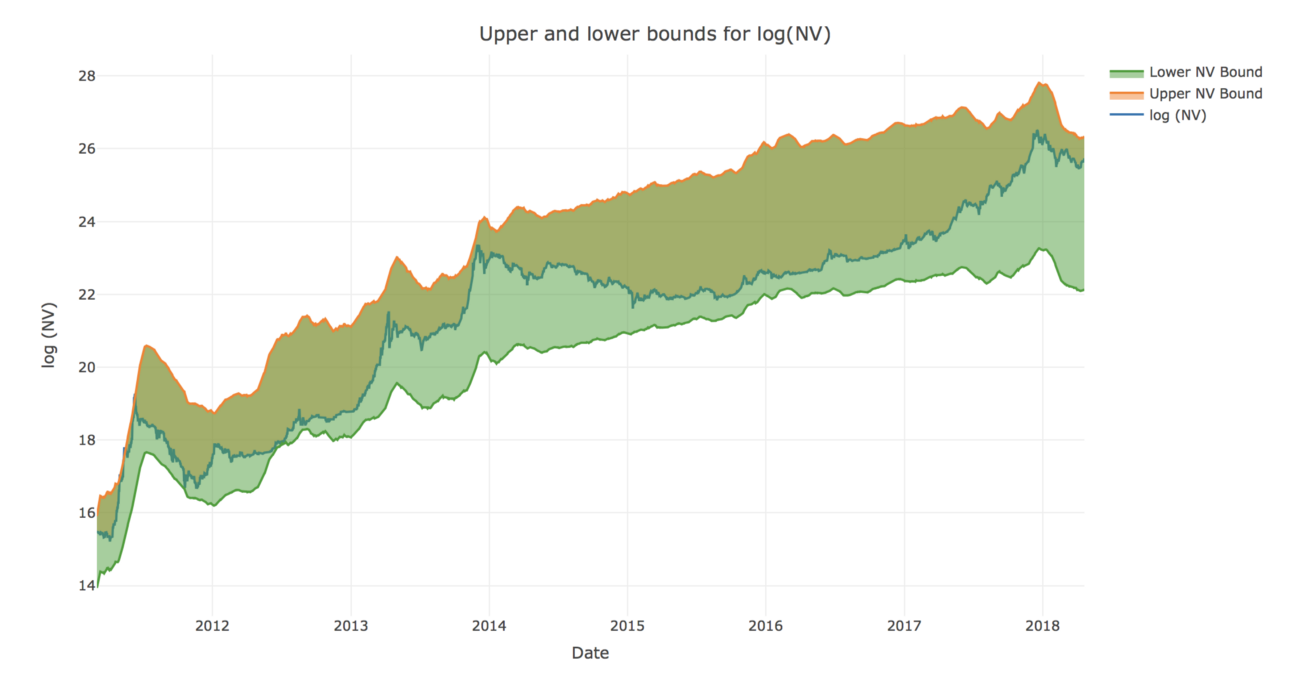
Our goal was to estimate whether current Bitcoin price is supported by activity on the network. To do this we have built robust upper and lower bounds for Bitcoin Network Value, based on a number of Daily Active Addresses (DAA), using different variations of Metcalfe’s Law. Using these bounds, we have defined bottom-up valuation of the Bitcoin network as a function of DAA.
When we compared this valuation with actual market Network Value across different time periods, we have found that historically overvaluation can be predicted by Network Value to Metcalfe (NVM) ratio:

We analyzed current (as of early May 2018) Bitcoin price using this NVM ratio, and came to the conclusion that despite significant correction in Q1 2018, there might be another bubble (and following correction) on the horizon.
Having said this, while we see a risk of correction, we stay bullish on Bitcoin price in the long run.
Metcalfe’s Law: how it all began
Cryptoassets are networks of users connected in digital space. Users can interact with each other by exchanging information and engaging in transactions. Due to the fact that these networks are digital, always online, and published on the the blockchain, network usage data is more readily available than for other types of networks (telephone, fax, messengers, and social media). Transaction data availability combined with public crypto markets create a unique opportunity to analyze and value these networks in real time.
Nearly four decades ago, Xerox Palo Alto Research Center (PARC) employee Robert Metcalfe proposed arelationship between the value of a network and its size(Metcalfe, 2013). He stated that the value of the network is proportional to the square of the network nodes (users). This relationship is based on the so-called “network effect”: a positive effect described in economics and business that an additional user of a product or service increases its value to others. The original Metcalfe’s Law has the following form:

The logic behind this formula is the following: the number of unique connections in a network with n nodes can be expressed as n(n − 1)/2, which is proportional to n² asymptotically.
Over time, some variations of this law were proposed. For example, Andrew Odlyzko et al. noticed that Metcalfe’s Law estimates a number of potential_connections between users of the network, while, in fact, there are certain limitationsto how many _useful connections one user can have. He proposed to use n * log n instead of n² for network value estimation for large n. There were multiple other modifications to the original law. Some researchers have successfully applied the law to describe Facebook and Tencent user growth and financial metrics.
Usage in cryptoasset valuation
Over the past year, a lot of research has been done on the topic of valuing cryptoassets using Metcalfe’s Law. Cryptolab Capital research on Metcalfe’s Law was initially inspired by Thomas Lee of Fundstrat, who has stated back in November 2017 that 94% of Bitcoin price movement can be explained by Metcalfe’s Law.
We decided to dig deeper and have found an earlier paper on the topicpublished by Ken Alabiin June 2017. In all these articles the number of network users is usually approximated by the number of Daily Active Addresses (DAA). For internet companies with strong network effects, the analogous Daily Active Users (DAU) indicator is one of the most important performance and valuation metrics.
One of the recent articles on the topic by the Clearblocks team explored in detail how well different versions of Metcalfe’s Law describe Bitcoin price. Their research revealed 3 candidates for the title of “the most predictive model”:
- Original Metcalfe’s Law: NV ~ n²
- Generalized Metcalfe’s Law: NV ~ n^1.5
- Odlyzko Law (also called Zipf’s Law): NV ~ n • log n
They calculated Pearson correlations for all three of these laws over the period between 2010 and 2018, and based on this analysis chose law #2. They then used it to define Price-to-Metcalfe Ratio by dividing actual Network Value by the one predicted by the law:

where n is Daily Active Addresses (DAA), and 30 day MA is 30 day moving average.
There is an issue here, however: it is very hard to objectively choose between these three laws,and the Clearblocks team admits it in the article themselves:
All formulas show near perfect correlation with BTC’s USD price, particularly on a natural log scale. In any other field, such a correlation would be considered witchcraft… The differences in correlations are so small they can effectively be considered equal
At the same time the value of the ratio (and hence the results of PMR analysis) depends greatly on which law you choose for denominator. Different values in denominator give you contradicting results when it comes to predicting December 2017 bubble and to describing current BTC price.
Different laws — contradicting results
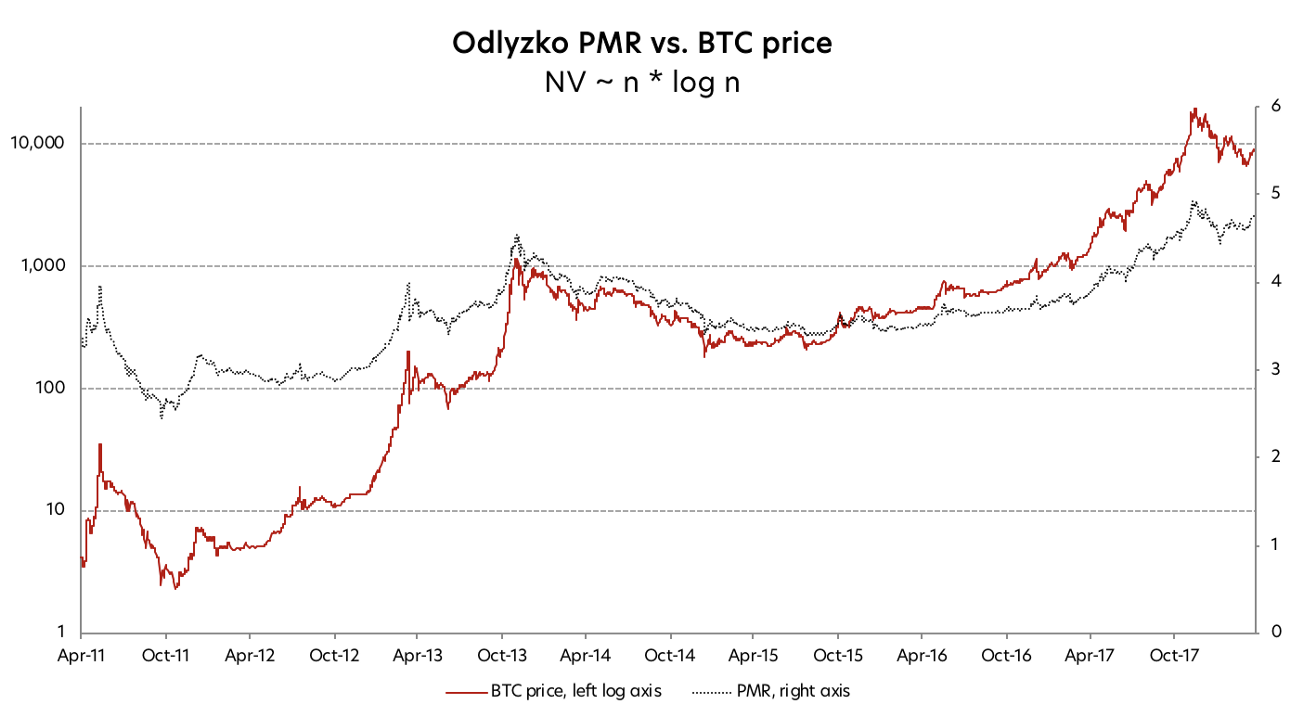
If you define the PMR denominator using Odlyzko Law (NV ~ n log n), you will get the following formula:

where n is DAA. If you then plot the resulting Odlyzko PMR against Bitcoin price, you will get the graph below. Based on this graph, PMR is at its all-time high level of around 5, and we are still in the middle of the worst bubble in Bitcoin history. Corrections in Q1 2018 didn’t help much — even at around $6k in February 2018 Bitcoin was still presumably significantly overvalued according to this analysis.
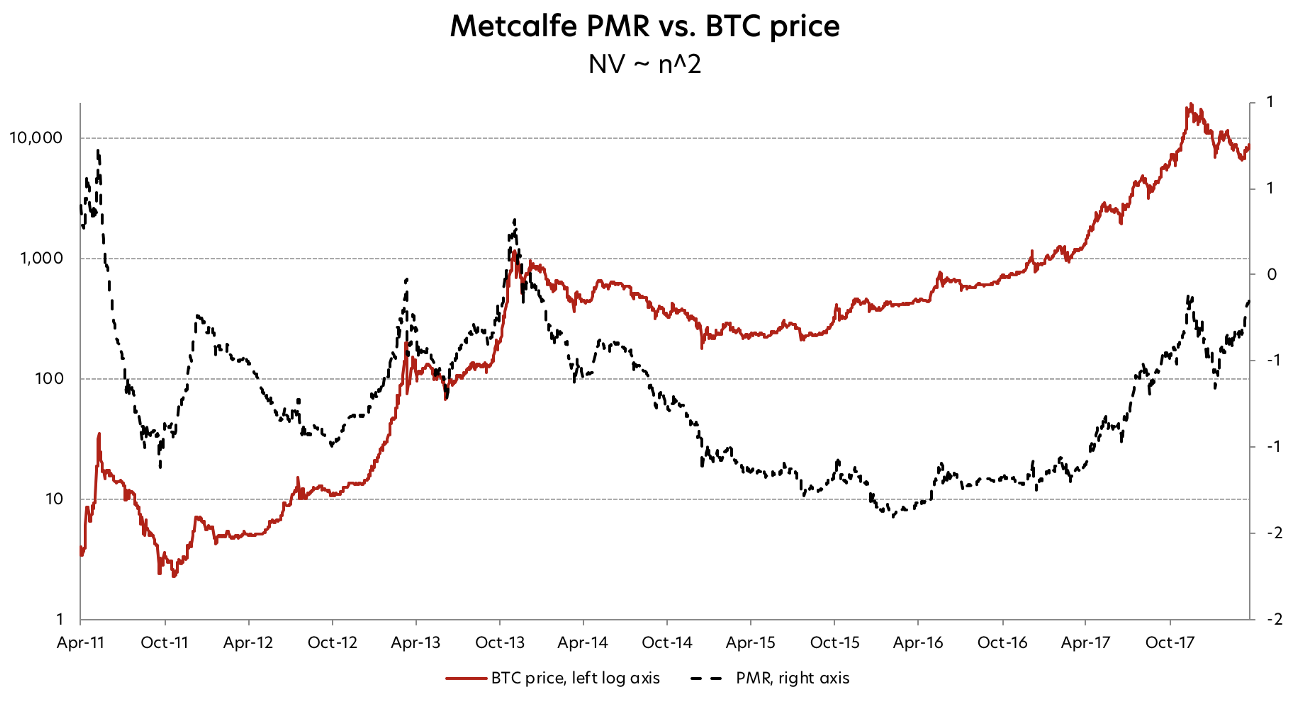
Now let’s use the original Metcalfe’s Law as the PMR denominator giving the formula below:

If you now plot this PMR against BTC price, you will get very different chart. By closely examining this chart you can see that current PMR value is around 0, which is nowhere close to the bubbles of 2011 and 2013. And at the lowest point of correction in Q1 2018 PMR was around -0.5. Last time it was on the same level in October 2014 and August 2017. As we now know, in both of these cases it was a good time to buy BTC.
As we said above, PMR analysis gives contradicting results for December 2017 and for May 2018, depending on which law you choose for the PMR denominator.But it is also impossible to choose between the laws based on their all-time correlations between the actual and predicted Network Values.
Here we asked ourselves 2 questions:
- Can we come up with a better heuristic for choosing the best law?
- If not, is there a way to somehow use both of these laws instead of choosing one?
Unfortunately, the answer to the first question is “no, we can’t”. Those of you interested in the algebra and statistics behind this conclusion can find detailed explanation here.
Luckily, the answer to the second one is yes. We used both Metcalfe’s Law and Odlyzko Law to define extremely robust upper and lower bounds for Network Value, and derived a ratio that is indicative of Bitcoin overvaluation.
Two laws are better than one
According to the logic behind the Metcalfe’s Law, n² is a number of potential_connections between users of the network, and in reality there are limitationstonumber of _useful connections one user can have. So Metcalfe’s Law (Network Value ~ n²) probably overestimates network value, which is why it’s logical to use it as an upper boundfor valuation of Bitcoin network. At the same time we can use Odlyzko Law (Network Value ~ n • log n) as alower bound:
 Upper bound based on Metcalfe’s
 Law Lower bound based on Odlyzko Law
Constants a and b for each bound were chosen empirically to have the narrowest corridor possible that still covers all the movements of Network Value. To make sure we didn’t overfit and didn’t use future information, we used only first 2 years of data to select a’s and b’s. After fixing the constants based on this “training” set, we checked that the relationship holds well for the rest of the data (“validation set”).
If we now plot the Network Value and respective bounds derived from Metcalfe and Odlyzko Laws, we can see that NV robustly stays within these bounds all time except a few days back in 2011 (and even then it barely crosses the border).
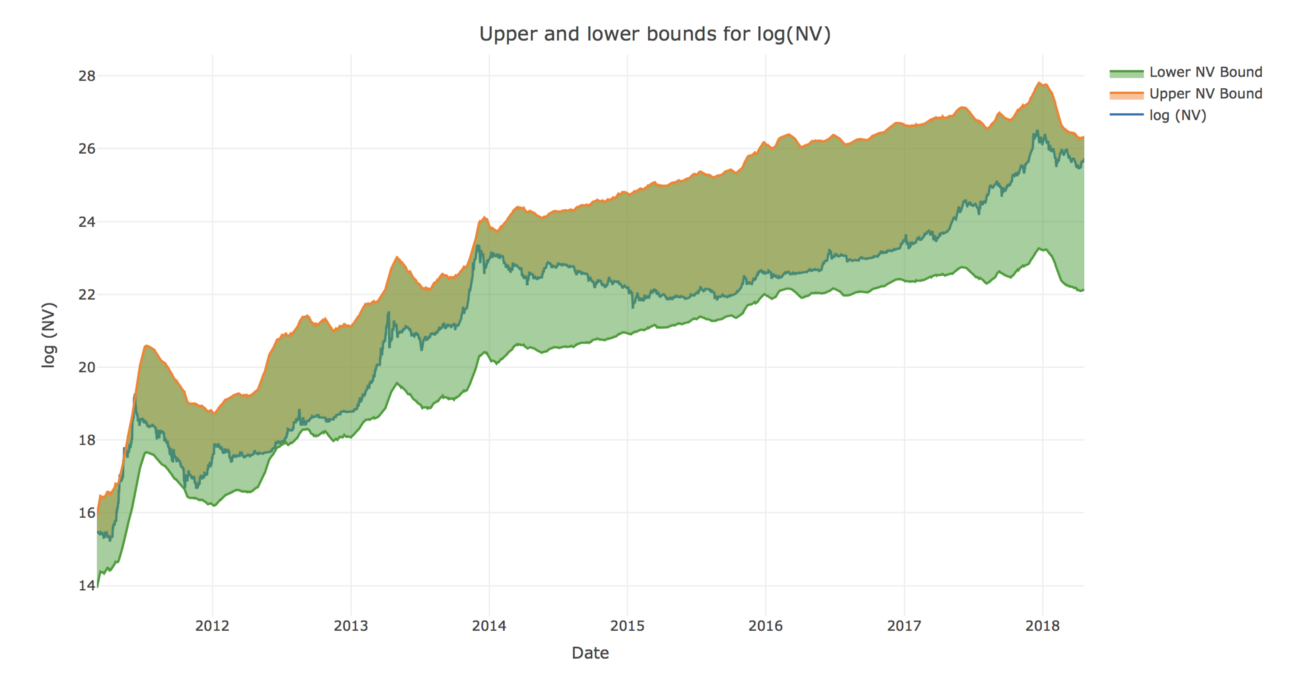
Now that we have robust upper and lower bounds, we can, with confidence, use the halfsum of upper and lower bounds as a bottom-up valuation of the Bitcoin network as a function of DAA:

Below is a chart of actual and Metcalfe-estimated fundamental Network Values. Visually, this relationship is staggering.
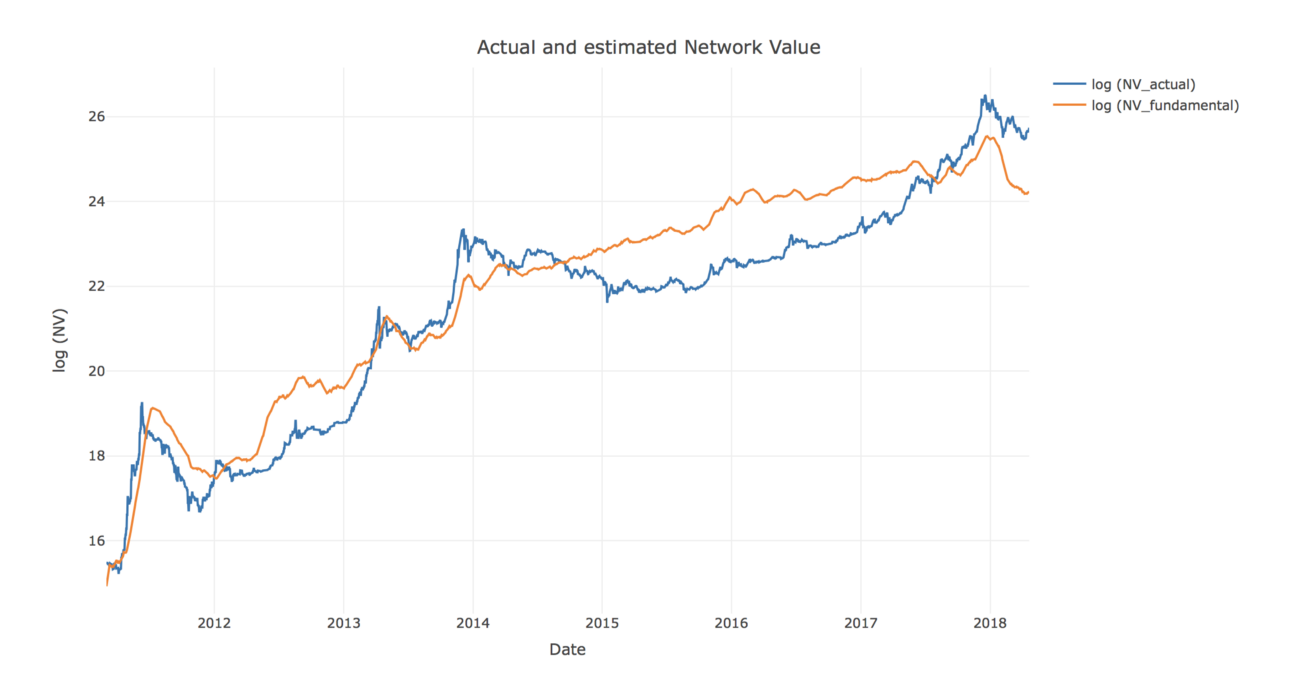
Moreover, on the previous chart with the bounds we can clearly see that every time Network Value has approached its upper bound, there was a correction that followed. And conversely, every instance when Bitcoin Network Value was near the lower border, it was a good time to invest.
Using our newly defined Metcalfe network valuation, we can formalize this logic into a new, refined, indicator that we called Network Value to Metcalfe ratio (NVM):

One last transformation: let’s normalize NVM so that it always stays between -1 and 1 no matter how wide the corridor between the bounds is:

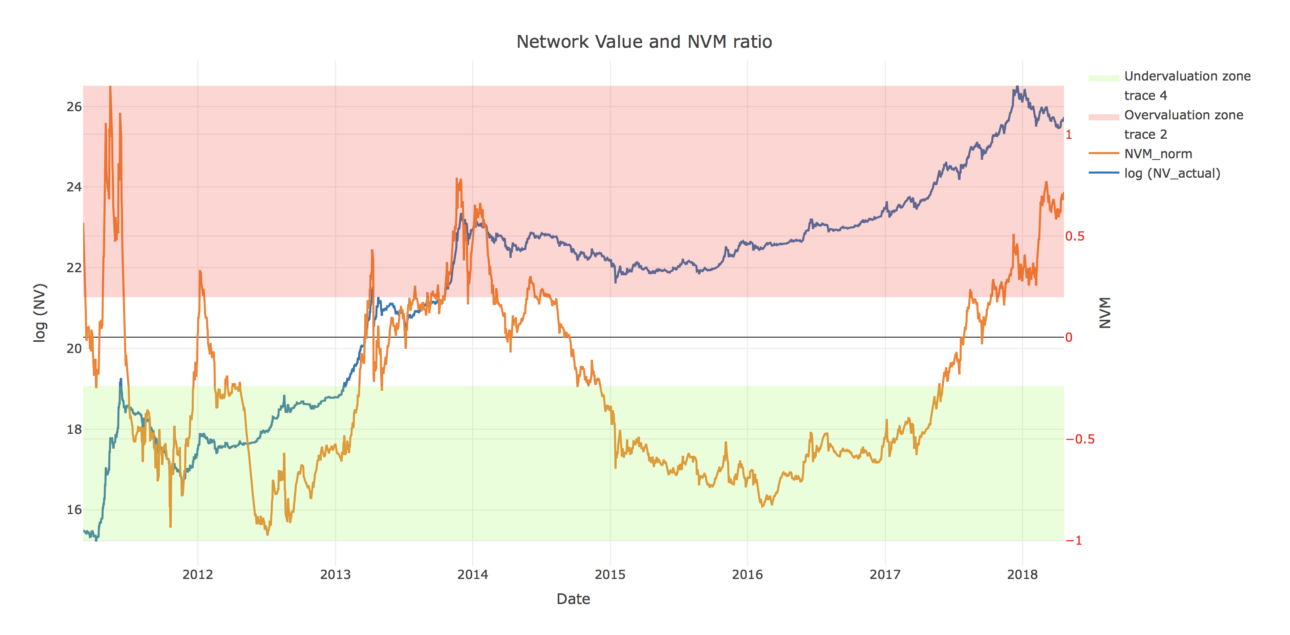
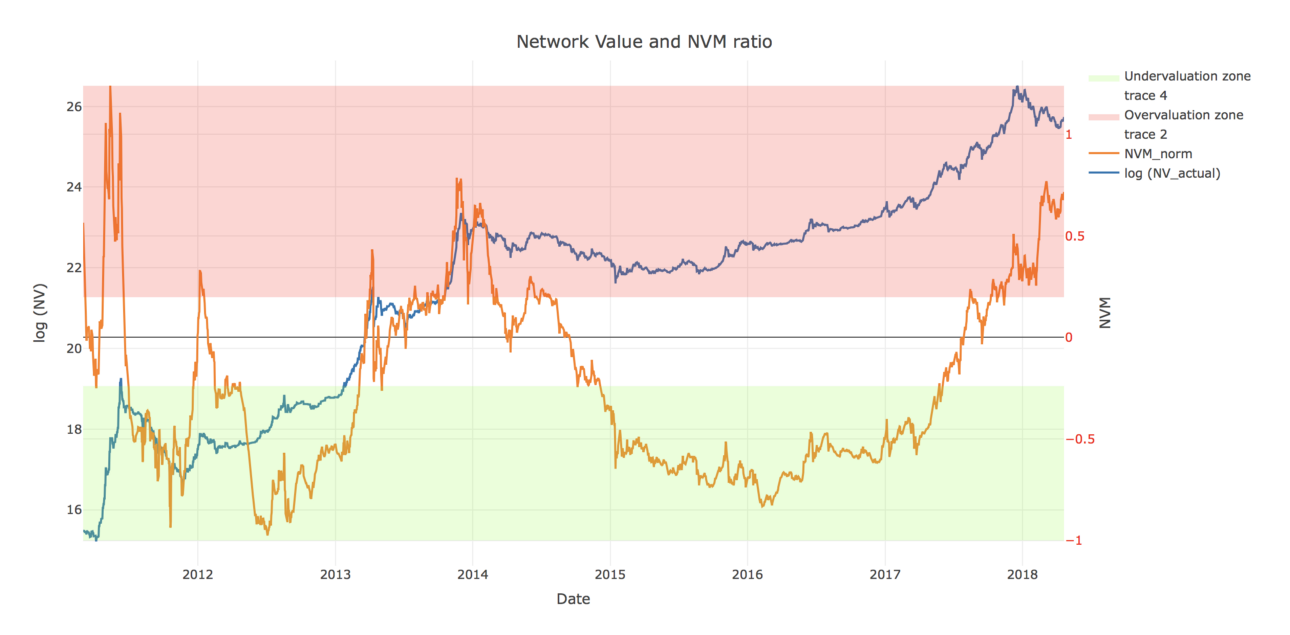
NVM describes Network Value position relative to the upper and lower bounds, and thus quantifies any overvaluation or undervaluation.Normalized NVM of -1 means that Network Value is near the lower bound, and a value of 1 signifies that it has reached the upper bound.
Below is the chart of normalized NVM and Bitcoin Network Value. As can be seen on the chart, high NVM has successfully predicted corrections in 2011, 2012, 2013, 2014, and late 2017.
So, are we in the bubble?
BTC Network Value is close to the upper bound, and NVM is around 0.75. Current NVM value is even higher than it was in December 2017, and is at the same level it was at the height of the 2014 bubble.
High NVM suggests that Bitcoin is overvalued at the moment, compared to the Metcalfe NV estimation derived from DAA data. According to our model, Metcalfe network valuation is around $33bn, while the actual NV as of May 6th is $162bn. If we take this result at face value, this means that BTC is ~ 5x overvalued, compared to a Metcalfe price of about $2,000. But let’s dive one level deeper, and try to analyze why NVM is at this level right now.
Let’s look for analogies in traditional finance. High PE ratio is usually considered to be a signal of company overvaluation. But it can also be explained by unusually low recent earnings caused by business seasonality or other factors. If low earnings are expected to increase shortly, high PE is not necessarily bad.
Let’s try to apply similar logic to NVM. Based on the historic NVM performance, from here it can go one of two ways:
- NVM will decrease because of lower numerator. BTC price correction will bring Network Value closer to(or even below) the Metcalfe-derived valuation. This will be similar to the pattern we saw in early 2014.
- NVM will decrease because of higher denominator. Daily Active Addresses will grow, thus increasing the Metcalfe valuation and bringing it closer to actual Network Value. A similar pattern can be seen in early 201
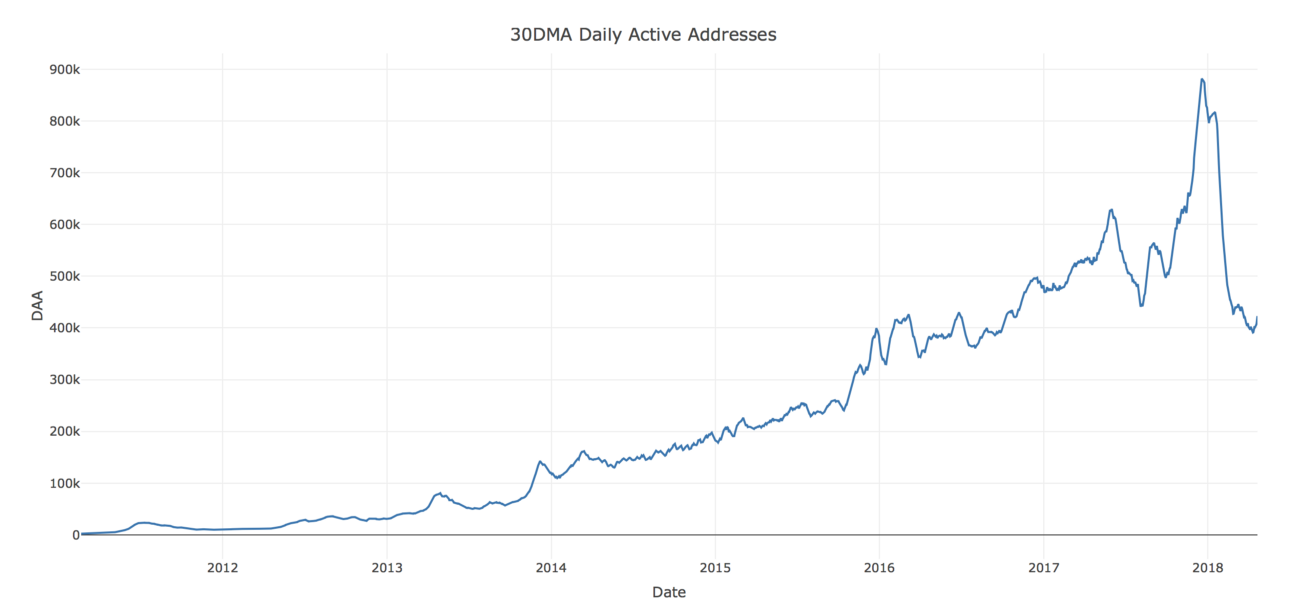
Let’s have a look at number of Daily Active Addresses. The chart below shows there was a significant drop in DAA in Q1 2018.
Let’s again compare the current May 2018 situation with December 2017:
- As we noticed before, NVM was high in both cases
- But in December 2017 DAA was unusually high — well above the long-term trend. Given an expected drop in DAA back to the trendline, price correction was the only way to bring Network Value close to fundamental Metcalfe valuation.
- On the contrary, in May 2018 the Daily Active Addresses figure is unusually low
- If DAA to bounces back up to the trendline, it will increase fundamental Bitcoin valuation
Overall, while the current price level is healthier than in December 2017, it is still not 100% supported by fundamentals.Investors should closely monitor the DAA dynamic relative to market Network Value. If Bitcoin price continues growing further without advancing growth of DAA, there might be another bubble (and another correction) on the horizon.
Acknowledgements
There were a few people who have contributed to this research, and inspired us to do it in the first place:
- Thomas Lee for the original inspiration to look into Metcalfe’s Law applications to cryptoassets
- Haseeb Quereshi,Ivan Bogatyy, and Chris Burniske for feedback on the article
- Professor Susan Athey from Stanford and Professor Christian Catalinifrom MIT Cryptoeconomics Lab for being great mental sparring partners on everything crypto
- Special thanks goes to all the Cryptolab Capital team, and especially to our analyst Roman Skoromnyi who did a lot of data heavy-lifting during this research
Disclaimer: none of the statements in the article should be considered investment advice. Due to the various risks and uncertainties, actual performance of the assets may differ materially from that reflected or contemplated in forward-looking statements.
Liberation Through Radical Decentralization
By Vitalik Buterin
Posted May 21, 2018
By Vitalik Buterin and Glen Weyl
Wealthy societies around the world are facing a growing crisis of confidence in established authorities. Stagnating economies, mounting inequality, political corruption and the increasing monopolization of technology for the benefit of elites have provoked a populist backlash. We share and are driven by these feelings of discontent. However, we also fear that the most common responses on both the right and the left (a retreat from technology, markets and international cooperation) would destroy much of what we treasure in contemporary society while worsening the problems they seek to solve. Over the last half decade, each of us has, in his own way, been working on a part of an alternative solution: to find ways to harness markets and technology to radically decentralize power of all sorts and shift our reliance from authority and to formal rules. In what follows, we discuss how these projects interrelate and complement each other.
One of us has focused on technological solutions to the increasingly centralized control that has been established by powerful monopolies in the digital economy and financial spheres. Bitcoin and other cryptocurrencies in particular emerged directly as a reaction to the perceived excesses of the traditional financial system, with “The Times 03/Jan/2009 Chancellor on brink of second bailout for banks” carved indelibly into Bitcoin’s genesis block. That said, the decentralized technologies behind cryptocurrencies have potential applications far beyond finance. The news is filled with the failures of centralized systems to protect people’s privacy, ranging from large-scale hacks such as Equifax to more recent concerns around social media privacy. Such events are increasing interest and innovation in “self-sovereign” user-centric identity management systems; the use of a blockchain as an expensive but decentralized and very high-assurance store of data and computation features often in such designs.
The other has focused on designing rules of the economic and political games of mainstream society, aiming to both break up and reduce the need for concentrated centralized authority — what he calls “Radical Markets”. Traditional private property tends to create and perpetuate inequality of power, monopolizing resources in a few hands rather than deploying them to their best uses. A truer, radical free market would create greater competition and equality by a greater use of auctions and commonly owned property. One-person-one-vote democracy tends to oppress minorities, who then seek protection from the judicial system or international authorities, thus subverting democracy. A more creative democratic forms that give power to minorities to protect their own most deeply valued interests can restore the legitimacy of government. A leading candidate is “Quadratic Voting” (QV), in which citizens can use a (possibly artificial) currency to buy votes at the cost of the square of the votes bought on the issues that are most important to them.
Our projects developed largely separately and each of us has hesitations about especially the near-term aspects of the other’s project. For all their potential, cryptocurrencies show dangerous tendencies towards bubble behavior and the precise set of use cases in which they make the most sense remain to be worked out. Radical new kinds of social institutions, whether technical or economic or political, top-down or bottom-up, are best adopted incrementally and slowly, to give opportunity for experimentation and social learning and reduce the risk that they might disrupt existing social structures in a way that would cause precisely the sort of conflict they seek to heal.
Yet both of us also see great potential for collaboration and complementarity between our programs. Because Ethereum and other cryptocurrencies (intentionally) lack trusted judges and other authorities to adjudicate disputes, they depend heavily on formal and transparent rules. The failings of standard property and voting rules quickly manifest themselves when stripped of the protective coating of human-driven judicial discretion. Blockchain-based projects therefore have a strong demand for better rules that can help to maintain the decentralization of economic power and for governance rules that can avoid the need for large bureaucracies these communities cannot support; a Radical Market that can operate successfully on the blockchain is one that most fully achieves the goal of avoiding reliance on discretionary power. Finally, the cryptocurrency community is one with aligned philosophical values, and an unusual openness to innovation, that makes it an ideal place where Radical Market ideas can be tested at relatively limited broader social cost.
We thus see many opportunities to collaborate and are actively working to foster connections between our respective communities. Even if neither community achieves its sweeping social ambitions, there are a wide range of narrower contexts where collaborations seem capable of making important social impacts, including using blockchains to improve security of data markets and QV for aggregation of opinions in blockchain-based social networks. And beyond the specific ideas we have worked on, a range of related collaborations seem possible, from using electronic “postage” to deter spam to expanding access to high-quality financial planning for those with limited resources.
One particular example of a possible area for collaboration, and which illustrates some of the challenges involved, is the use of QV to address the substantial governance problems blockchain-based communities have faced. There have been many attempts to use votes to gauge community sentiment when deciding on potentially controversial protocol changes, but so far they have been criticized either for being too vulnerable to manipulation by sockpuppets (fake accounts) and malicious voting by non-community-members or for being too skewed toward reflecting the views of a small group of wealthy coin holders. Some form of QV could present a moderate alternative, as participants’ differing strength of views and stake in the community are taken account, but because the cost of buying many votes quickly becomes prohibitive (1000 votes would cost 1,000,000 credits) the ability for a small elite to disproportionately affect outcomes is limited.
However, QV also poses important technical and conceptual challenges to existing crypto-currency communities. In particular, QV relies heavily on the notion of verifiable, separate human identities, because a community member could multiply her effective influence dramatically by misrepresenting herself as multiple individuals (sockpuppets). The frequent use of anonymity and pseudonymity in crypto-currency communities is in tension with the need for such clearly-delineated identities, though also naturally gives rise to some of the inegalitarian wealth and power dynamics these communities hoped to avoid. After all, a system that formalizes only capital and not human individuality may inexorably serve wealth rather than humanity. In this sense, experiments with Radical Markets may help clarify important outstanding technical questions within crypto-currency communities.
More generally, as we have arguably seen with parts of the internet and the web, excessive and naïve reliance on any formalism intended to decentralize authority can inadvertently have the perverse effect of reestablishing monopolies and oligarchies. Only by making technical systems that offer a variety of mechanisms for checking concentrations of power and by simultaneously building social ideologies constantly on the lookout for failure modes of these mechanisms can we hope to succeed where previous attempts at decentralizing authority have failed. But we are hopeful that some combination of blockchain and Radical Markets technologies can make an important contribution to breaking up the most oppressive forms of corporate, government and technical power and building towards a more free, open and cooperative world in the 21st century.
The New Social Contract of Crypto
By Erik Cason
Posted May 13, 2018
How crypto assets are creating a new kind of agreement that departs from the problems of sovereignty by banishing violence in exchange for economic enforcement.
In order to understand how bitcoin and crypto assets create their value, we first must speak to their very political and philosophical nature in order to unveil the non-monetary value found within them. While the economic functions of crypto assets are essential for their operations, we must start from the philosophical and political nature to expound any tenable economic theory. In order to do that, we need to understand what Satoshi Nakamoto’s political objectives were around the nature of Bitcoin and cryptography.
Yes, [we will not find a solution to political problems in cryptography.] but we can win a major battle in the arms race and gain a new territory of freedom for several years.
Governments are good at cutting off the heads of centrally controlled networks like Napster, but pure P2P networks like Gnutella and Tor seem to be holding their own. -Satoshi
This indicates that Satoshi understood that cryptography is a munition of war and was specifically developed for communication under duress, which also serves his purpose. This hints towards why cryptography is so essential to how the blockchain functions and why the Nakamoto protocol actually solves the byzantine general’s problem. Cryptography accepts the _a priori _nature of the State of Exception that can put anyone outside and beyond the power of the law, and expose them to the conditions of total unbracketed conditions of war.
Satoshi accepted that in order to create a new form of economic value that was beyond any state’s control that he would be fully exposed to the full force of the violence of the State, as many prior examples to create a non-state money have proven. Walter Benjamin in On the Concept of History offers us another way to understand what it means to operate from the tradition of the oppressed that Satoshi found himself captured within.
“The tradition of the oppressed teaches us that the “emergency situation” in which we live is the rule. We must arrive at a concept of history which corresponds to this. Then it will become clear that the task before us is the introduction of a real state of emergency; and our position in the struggle against Fascism will thereby improve.” -Walter Benjamin, On the Concept of History, VII
The oppression of our traditions is one in which we all understand the ‘emergency situation’ that we live is the rule. From Satoshi’s first correspondence, he kept his face and real identity concealed for an understanding of the history of our world, and the meaning of the task he was to introduce. Now we have a real state of emergency, where the hidden meaning of crypto is improving our position in the struggle against the renewed shadow of fascism in a technological cloak.
Satoshi, in the quote at the introduction, offers us a key insight to understanding how government authority functions within the State of Exception. State apparatuses use the process of juridification to place themselves outside and above the law, while any person can be branded as Homo Sacer and placed outside and beneath the law (the PATRIOT act is this par excellence). This is the fundamental form of the State of Exception, and how it overthrows all law through emergency decree under which we all live today. Satoshi does not cite the law, but rather the violence which the governments uses to “cut the head off” that which they find undesirable. He also points out that decentralized networks are not vulnerable to this kind of violence, which has great importance. This quote of Satoshi’s above seems to reference the following Michel Foucault interview in “Truth and Power”:
Sovereign, law and prohibition formed a system of representation of power which was extended during the subsequent era [the modren age] by the theories of right: political theory has never ceased to be obsessed with the person of the sovereign. Such theories still continue today to busy themselves with the problem of sovereignty. What we need, however, is a political philosophy that isn’t erected around the problem of sovereignty, nor therefore around the problems of law and prohibition. We need to cut off the King’s head: in political theory that has still to be done. Michel Foucault, Truth and Power
So the real question that we should be asking ourselves is:
Does Bitcoin and other crypto assets somehow create a new form of social agreement and political philosophy which no longer sullies itself with the problems of sovereignty, law, and prohibition? Does crypto somehow create a new stratagem of law through cryptoeconomics by departing from the theology of law in exchange for a science of mathematic verifications? Why can pure P2P networks resist decapitation by governments and why do governments need to attack these networks under the guise of ‘safety and security’ and not the law itself?
These questions took me on a long journey of intellectual exploration that had me go through the likes of Michel Foucault, Georges Sorel, Mikhail Bakunin, Karl Marx, Vlad Lenin, Georg Lukacs, Walter Benjamin, Hannah Arendt, Martin Heidegger, Carl Schmitt, Theodor Adorno, Max Horkheimer, Joseph Schumpeter, Max Weber, Friedrich Hayek, Ludwig von Mises, Pierre Proudhon, Auguste Blanqui, Henry Thoreau, The Invisible Committee, Tiqqun, Friedrich Hegel, Rudolf Rocker, Louis Althusser, Friedrich Nietzsche, Thomas Hobbes, and Jacques Derrida, but I have found that Giorgio Agamben’s work investigating sovereign power in the Homo Sacer series has been the most valuable to me in this investigation.
What led me to his works was the fourth book in the series called “The Sacrament of Language: An Archaeology of the Oath” (summery here). This text, which is specifically deals with the topology of power found in the oath, observes the relationship between the judicial and theological institutions, and how the oath precedes both of them. This offers an archeological understanding and explanation for what the oath is, and perjury that must coincide with it, which fuses law and violence into singularity order to render the law potent. In the quote below, Agamben points out the true function of the oath:
“The oath does not concern the statement as such, but is the guarantor of its efficacy: what is in question is not the semiotical or cognitive functions of language as such but the assurance of its truthfulness and its actualization.” Giorgio Agamben, The Sacrament of Language
While it may be possible and expected for humans to profane their words in the oath (thus demanding the violence that must be the final arbitrator of all human law), machines that are governed by the very language of the code that creates their existence does not have this luxury. Machines are held within the complete poverty of their language; incapable of violating the oath upon which their handshake is predicated.
Code is the only language machines can obey; there are no laws which are capable of prohibiting the exchange that is their existence.
The machines are doomed to the total obligation of the code which animates them and must fulfill their oath within the code that is their law. This means what is at stake in the oath for machines is distinctly different from that of humans. The Oath of Man allows for him to create Law, but it is also what allows for him to profane it; enacting the spectre of violence which oscillates between law-making, and law-preserving violence for all of history. Machines, however, cannot violate the very form-of-life that express them — their language that is the code — condemning them to the sanctity of what is written to always give it meaning, even in error.
Machines specifically lack any capacity to profane their oath. There is no God to hold them accountable except the brute facts of Mathematics; the spectre of a nihilistic Spinozian god who sees all within His celestial sphere. The decisions of such a god are immediate and binary, or as Philo pointed out “God spoke and it was done, with no interval between the two.”
There is no God for the machines to foresake; only a semantic form of rule which captures their total existence. Math, the God of the Machines; absolutely cannot be profaned, and their oath to the equation cannot be broken. They are completely obligated to their Yahweh watching them always, immediately, forever, and infinitely.
If the ‘law’ of code is a sacrosanct to itself, than we must accept that what is at stake in the oath of the code is the realness of its assertion in semantic sense, which allows for it to communicate itself. Otherwise it would be unintelligible copypasta incapable of rendering itself. In order to better understand the full ramification that the oath of machines cannot be broken in the same way that man’s can, we need to look at one the preeminent scholars on sovereignty to better understand this: Carl Schmitt.
“The Sovereign is he who decides on the state of exception”
Carl Schmitt, Political Theology
This was the fundamental dictum that Schmitt presented in “Political Theology.” All sovereign rulers must be capable of deciding on the exception, or they are not sovereign. Within cryptosystems there is no possibility of an exception, of banishing the mathematical laws which govern the system; or of creating some kind of exception to which math cannot be held accountable[1]. Starting from the acknowledgment that The State of Exception is the norm for the operation of all law within the modern state, and understanding that any person can be captured in this Zone of Indistinction that creates Homo Sacer; Satoshi understood the need to conceal his identity and remain anonymous in order to consummate the functions of this new system of agreement. In Satoshi’s need to conceal his identity also enlies the signature of the hideous fact of what it is to be governed today:
“Auctoritas, non veritas facit legem” (Authority, not truth makes legitimacy).
As surmised by Hobbes about sovereign power in De Cive:
Cryptosystems absconds from the legitimacy of lies of legalism by creating a new system from which rules can dictate the exact opposite of Hobbes’ Leviathan:
“Veritas, non auctoritas facit legem.” (Truth, not authority makes legitimacy)
By abandoning the authority of legal power and the violence it must entail, for the economic power and protection of cryptography, a whole new strategy of agreement and law is born. This brings us to the second dictum of Schmitt’s Theology of Politics, which also has stark ramifications for this study:
“All significant concepts of the modern theory of the state are secularized theological concepts not only because of their historical development — in which they were transferred from theology to the theory of the state, whereby, for example, the omnipotent god became the omnipotent lawgiver — but also because of their systematic structure, the recognition of which is necessary for a sociological consideration of these concepts. The exception in jurisprudence is analogous to the miracle in theology. Only by being aware of this analogy can we appreciate the manner in which the philosophical ideas of the state developed in the last centuries.” -Carl Schmitt, Political Theology
It is from this hidden weakness found in the scales of Leviathain’s underbelly that the achilles’ heel of sovereignty, law, and prohibition is exposed. It is from this understanding of the law as being secularized theological concepts that Satoshi was able to develop new digital-social agreement which could depart from the schizophrenic violence of the sovereign by reactivating the power of the liturgical oath through cryptography.
This oath found in cryptography is unlike the oath taken between sovereign and subject. This is due to the fact that the sovereign is non-existent in this system, and thus the rule of law has no way to be suspended. This oath is similar to that which was found in the old Swiss Confederacy called eidgenossenschaft, or oath-fellowship roughly in English. This allows for a form of agreement that is based on mutualism of the oath, and the equality of each party within that agreement to act as enforcers, rather than allowing for force to be relegated to authoritative bodies.
Using this hidden theological power buried in cryptography, a new form of oath that cannot be violated is created. Enforced by the machines, cryptosystems homogenize power and dissipates it through the body of the system as a form of an internal panopticon as nodes. This surveillance is no different from the theological concept of the watchful eye of God of any religion, or the light from the spire of the panopticon itself. This ensures that power remains decentralized, and controlled by no single individual but by its very architecture which creates at-rest enforcement defused into a system of optics. This is similar to how ‘the law’ was enforced in monastic forms-of-life, the conjurationes _agreements which created the sovereign communes of the early middle age in Europe, and citizenship in Roman Republic. Everyone takes responsibility in the policing of the system, or as Romans would say, “_Ius civile vigilantibus scriptum est.”(Civil law was either written by, or for, the watchful).
Let us see what Foucault has to say about the nature of power in panopticons and what relationship this may have to the blockchain in order to understand the topology of this form of power.
“The Panopticon is a marvelous machine which, whatever use one may wish to put it to, produces homogeneous effects of power. A real subjection is born mechanically from a fictitious relation. So it is not necessary to use force to constrain the convict to good behavior, the madman to calm, the worker to work, the schoolboy to application, the patient to the observation of the regulations.” -Foucault, Punishment and Discipline
Foucault points out how panopticons operate on a different topology of power from the sovereign, which blockchains also use. Through the monitoring functions of surveillance (also found within blockchains), violent force is dislocated and replaced with systems of disciplines. Panopticons create modes of disciple without violence, and punishment without force. This is no different from how God surveils within His Kingdom, and enforces within His Convent. Through taking this methodology of surveillance and inverting it inorder to use it economically against the corrupt powers that be, the blockchain transmutes into an apparatus of sousveillance, or policing the police. This allows for blockchains to create a new form of law that is predicated upon the explicit banishment of violent force, in exchange for an economic one. This yields a fundamentally different form of agreement from that of sovereignty, law, and prohibition by banishing the violence which inherently must be found in all forms of state law and contracts.
Let us revisit what Walter Benjamin has to say about the possibility of non-violent conflict resolution in Critique of Violence:
“Is any non-violent resolution of conflict possible? Without Doubt. The relationship of private persons are full of examples of this. Nonviolent agreement is possible wherever a civilized outlook allows the unalloyed means of agreement. Legal and illegal means of every kind that are all the same violent may be confronted with nonviolent ones as unalloyed means. Courtesy, sympathy, peaceableness, trust, and whatever else might here be mentioned, are the subjective preconditions. Their objective manifestation, however, is determined by the law (the enormous scope which cannot be discussed here) that unalloyed means are never those of direct, but always those of indirect solutions. They therefore never apply directly the resolution of conflicts between man and man, but only to matters concerning objects. The sphere of nonviolent means opens up in the realm of human conflicts relating to goods.” -Walter Benjamin, Critique of Violence
The blockchain engages in this same nonviolent form of economic agreement taken to its most extreme place. People under the sovereign protection of the divinity of crypto knowingly abandon the false protection of any state in order to allocate that power to only unalloyed means. Cryptopians understand this offers greater protection than any false ‘rights’ the state could offer, as the code cannot forsake itself in the same way that the law has proven itself to. In other words, Veritas, non auctoritas facit legem [Truth, not authority creates legitimacy] is the law that animates blockchains. Through the abandonment of the possibility of legal or physical force, and replacing it with an economic imperative, a new form of agreement that is antithetical to law and the violence it is inherently bound up with, is born.
While the focus on crypto assets has overwhelmingly been on their banal economic nature, there is a very real new form of power that goes far beyond the economic wealth that has been created. So long as cryptopians continue to ignore the philosophical and inherently political praxis of cryptography and how blockchains engage this new form power, it will remain hidden, unable to reveal its true nature to a people who are wholly unworthy of it. We will continue to find boring, ill-informed, and un-insightful analysis that offers nothing more than the poverty of economics and the idiocy of money.
If we are to allow for this technology to change the world, than we cannot deny the revolutionary nature active at the center of this technology. To have a means of economic exchange that cannot be predicated upon violence opens the possibility for a new epoch under what can only be called Messianic Law. Once again all the eternal forms are open to pure divine violence, which myth bastardized with law. It may manifest itself in a true war, stasis, exactly as in the divine judgement of the multitude on the criminal. It can only be so fitting that we would be given the divine holy grail hidden in something so vain and hollow as money.
- ‘Salus populi suprema lex esto’ in regard to hardforks ‘changing the law’ is something more ackin to Stasis via mutatis mutandis than creating an exception within the law of code. This is what has allowed for projects like Monero to become successful with forking bitmonero, and allocation power to Fluffyponey, or even the first bitcoin hardfork which destroyed all of the coins made from the erroneous op codes. We could also see Bitcoin Cash as a form of stasis within the oikonomos of Bitcoin.
Thumb Sucking Anti-Bitcoiners!
By Beautyon
Posted May 21, 2018


It was inevitable that as “normies” enter Bitcoin they would bring their baggage with them. Expecting them to not arrive with any baggage would be like thinking a tortoise can shed its shell.
Part of the baggage these “Blockchainers” bring with them is an almost religious belief in the State. They cannot conceive of life without the State ordering every aspect of life, and have been very well trained to resist any idea that in any way turns society towards that goal. This is why they hate Bitcoin; they hate it so much that they’ve constructed a new vocabulary to talk about Bitcoin without talking about it directly. That’s why they habitually use the meaningless words, “Blockchain” and “Cryptocurrency”.
Bitcoin has nothing to do with belief. Saying that Bitcoin users are “believers” is a thinly veiled attempt to disparage people working to flesh out Bitcoin’s ecosystem of software and services. There is nothing at all subversive about Bitcoin, any more than it is subversive to replace snail mail with email. It only appears to be subversive to people who believe that the State should be the only organization that creates and manages the form and supply of money. People who have positioned themselves as outsiders to Bitcoin by their own thinking are deeply resentful of what they incorrectly perceive as a closed group of elitists, where in fact, nothing could be further from the truth.
Bitcoin is very open, tolerant and accepting of people from different backgrounds and cultures. Vegans get along with beef only carnivores. Libertarians tolerate Socialists. All the different people in Bitcoin know that the thing they have in common supersedes everything else while they are together for this one subject. It is a remarkable side effect of being involved in such an important project. People who don’t understand this, or don’t know their limitations, and who refuse to put aside their personal beliefs have a real problem, however. Bitcoiners are a no-nonsense, facts only group of people with a laser focus. They have been through almost a decade of attacks both on the software and on the personal level and a group like that values camaraderie, honesty and skill, and the ability of people to sacrifice or suspend their deeply held beliefs so that they can maintain that camaraderie for the good of Bitcoin.
In reality, there are no internal divisions in Bitcoin. The software is the standard and rallying point that everyone must agree on for the system to work. After that, it is a matter of what projects you want to build on that standard. What is intolerable on the other hand, are liars, hucksters, fraudsters and other types, trying to attach themselves to Bitcoin, and then expecting the same courtesy, camaraderie and respect as Bitcoiners receive, as if these are tick boxes on an HTML form. They are not.
Fraudsters, hucksters, and liars should be admonished and shunned. If outsiders don’t understand why these people are being shunned and ridiculed, this is a problem that they have, and not a problem that people in Bitcoin have. Cohesiveness at any cost is toxic to orderly systems being created, and if you remember, there were SegWit2X proponents who openly said that community cohesion was more important than the software. This is exactly the sort of nonsense that is intolerable, and that will not be tolerated.
The people who try to corrupt Bitcoin know deep down that this is correct. If it were not the case, the huge numbers coming into “The Space” would not pay any attention to the “intolerant ” Bitcoiners. The fact of the matter is that people are paying attention to what Bitcoiners are thinking and doing, because what they’re doing is what matters, and what other people are doing does not. It is what Bitcoin is doing that will change the world and nothing else. Once again, if that is not true, then why are you complaining? Go ahead and change the world with your alt-coin “Permissioned Blockchain” reversible transaction vapourchain.
The incumbents who don’t understand Bitcoin can say whatever they like. The fact of the matter is that despite all their money, they cannot out-compete Bitcoin and can’t develop rival systems. They tried with R3CEV and failed, conceding that they’re completely abandoning “Blockchain”. The “real world” that these people inhabit can’t innovate, and Bitcoin is only impractical for them. It is on the other hand, very practical, useful and transformative for everyone else, and this is the true source of their anti-Bitcoin rage; they don’t want to be disrupted and are grinding their teeth and clenching their fists as Bitcoin continues to grow in size and threat.
There are no real internecine battles in Bitcoin. Bitcoin has won, and all alt-coins are inferior. That is a statement of plain fact. Anyone paying attention knows this, and people who don’t know it can be forgiven for falling behind. There is so much development going on, so much to read (much of it hard to find) that no one can keep up with all of it. There is a minimum amount that you need to know, and if you know that amount, you can safely make some predictions. This is what the “normies” can’t do, and because accepting the actual truth means they will need to change their minds it is painful for them to hear things like, “All alt-coins are garbage and can never beat Bitcoin”. Remember — many of these people have invested money in alt-coins and expect them to rise in value dramatically. “Bitcoin Maximalists” telling them, “You’re insane, LOL: HODL” not only hurts their feelings, but it also makes them frightened because they’re going to lose money.
Bitcoin twitter is a very useful place to be kept abreast of what’s going on, and when a scam is identified there, you can bet the information is good, especially if it comes from one of the top 300 accounts. Saying something is a scam is not “derision” it is a public service announcement. Any honest man would welcome an alarm system like this, which helps to keep people away from losses. People without any experience in software culture find it difficult and harsh. It has been like this for decades, and it will not change to accommodate people without any stake in either money or software, and it is right that it should remain a ruthless place that doesn’t tolerate fools.
Believing that a united front could help ensure a more constructive legal environment is the opinion of outsiders with no stake in Bitcoin or software. They don’t own companies either, and don’t understand what Bitcoin is. Their belief that a “Constructive Legal Environment” is needed for development is just that — a belief — and furthermore, it is one that isn’t based in reality. This is why people in Bitcoin react with impatience to nocoiner nobody normies desperate to inject nonsense like “Governance” into Bitcoin; they don’t know how anything works, and want to “normieize” Bitcoin. It’s pointless and stupid.
Globally important infrastructure software has been developed for decades without the involvement of the State or a “legal environment”, and anyone familiar with the software I’m talking about knows this. All of it was built without a “regulatory framework” or any other worthless garbage, and the internet we have and rely upon and love works perfectly as a result of engineers working on problems without “help” from regulators or wannabe regulators, normies, and other types. This is an indisputable fact, and it applies unambiguously to Bitcoin which is nothing more than a software project, like any other. It doesn’t require help from non-software developers, the companies that use it don’t need special frameworks or legal environments either. There are more than enough laws to cover every possible circumstance and company/user interaction in Bitcoin; the current general legal structure was sufficient to allow the Internet and all the services on it to grow and serve, and Bitcoin and services built with it are no exception.
Whatever you may think Bitcoin is, (which is probably wrong, if you think Bitcoin has DNA) you are free to develop your own software and put it on the market. Bitcoin has a single purpose, and all the developers on it know what that purpose is. Your agreement is not required or requested, and neither is your understanding. You are free to use whatever software you like and to project your values on to it and inject them into the rules you develop. If your tools work, and the market wants it, then you win. If they do not, then you fail and you lose. What you cannot do is go to other people’s projects and demand that they obey you and submit to your ethics or crazy ideas.
As for “Bitcoin Maximalists” being in a minority, this is once again, normie politics trying to insinuate itself into Bitcoin. Bitcoin is not a democracy; there are no votes on technical decisions, and if you had been paying attention, everyone has been through this before; the majority does not rule in Bitcoin. Even by this logic, if you really had a majority who believed what you believe, you should be able to jumpstart your own Bitcoin alternative since you have the numbers. The question is, why don’t you do it? The answer is that no one will follow you, because they are all rational actors who have common cause in Bitcoin. They don’t want your “majority rule” they want their money protected.
You can believe that accommodation with “policymakers” (who some Bitcoiners call violent thugs) is a good idea, but this will not change the facts. No one wants your conception of what Bitcoin should be, and it has been rejected several times. Your belief that tools can only achieve their potential for humanity in concert with regulators has already been proven false thousands of times, and Bitcoiners are not willing to allow this ahistoric view to dominate and ruin Bitcoin. These people know that launching a crippled alt-coin while Bitcoin exists is pointless because Bitcoin will always be superior; the only way their world-view can survive is if Bitcoin is corrupted or destroyed. That is why they keep focussing on it. Bitcoin is right over the target; that’s why its users are taking flak.
Libertarians don’t care if you use Coinbase for your Bitcoin needs. What they care about is being able to use software in ways that they want. The normies can’t stomach the idea that people will be able to “be their own bank” and control their money. They know secretly that when everyone finds out how easy it is to be your own bank, Coinbase will die and so will any chance that the State will be able to regulate Bitcoin. This is the real subject that these people will not talk about. Libertarians and Bitcoiners are not “hardliners”. That’s like saying people who demand the correct change when they go to the supermarket are hardliners; no, they just know how to do math.
These people can’t accept that institutions are no longer needed for trust. They are the true believers, not Bitcoiners; they are believers in The State. They are the ones mesmerized by Doric columns and glass skyscrapers. They are the ones who accept Security Theatre instead of security. They are the ones who believe in the FDIC, the Federal Reserve and its paper dollars and all things like it. With Bitcoin, an entire layer of their psychological model and world view is replaced by something they can’t understand, and hate, and this is deeply terrifying for them.
Trustlessness is not an ideal; it is here right now, and it is the foundation of “The Transformation”. You may not believe that it is possible, but this is a problem of your thinking only. Furthermore, you may not want to live in the Bitcoin world, but you don’t have a choice in the matter. You can’t force other people to live in your lowest common denominator changeless nightmare because you don’t like the sound of Bitcoin. It is very telling that people who reject the absolute truth of math and Bitcoin’s trustlessness prefer Ronald Reagan’s “Trust, but verify.” over “Don’t trust, verify”. This is the thinking of Statists, who believe (mistakenly) that the State is more trustworthy than arithmetic. It is the thinking of totally captured, brainwashed men, who are more like battery chickens than humans. Bitcoin has opened the door to their cage, and they refuse to step out into the sunlight because they’re frightened. So sad!
These people say, “trust is unavoidable if we are to thrive”. Who is “we”? I think “we” in this case are the Socialists and violent Statists who have suddenly woken up to the death blow threat that Bitcoin represents to their inherently unethical and dying system. These emotional and pathetic pleas for tolerance of their bad ideas are all they have left as an argument to Bitcoin. “I just don’t want it to win!” they shriek, with their cereal box economic theory. People can form networks now that don’t require trust. This is the breakthrough that Bitcoin gives us. Rejecting this offer like a spoiled brat who sucks on the corner of his blanket will not be accepted as the standard response or baseline. It won’t be accommodated, pandered to or given any quarter.
As usual, nocoiners talk about Internet Of Things and all sorts of use cases that have nothing to do with the problem Bitcoin was designed to solve. These are nothing more than a giant Straw Man, and once again, there is nothing preventing you or anyone else from building these “Blockchain” systems like R3 tried to do. If they work and serve a purpose, then no one can or will have anything to say, and if they do, you can always answer with, “I’m rich and you’re not”. You cannot, however, say you are launching a record-keeping token (without any software) and expect not to be ridiculed. Speculation about future use cases is interesting and welcome, but that isn’t the basis of anything real, and calling on the SEC to stop scammers from doing this is absurd, because these people are engaging in fraud, for which there are many laws to punish them with.
Bear in mind also, that the SEC only has jurisdiction in the USA. Asking for one country to seize control of the lever of Bitcoin is inexcusable. You are not the boss of Bitcoin, and no single country or agency inside a country has the right (or power) to govern Bitcoin. If you concede that the SEC does have jurisdiction over Bitcoin, why should it be the SEC, and not the CNV, ASIC, APRA, AUSTRAC, FMA, SCB, SCB (BS), CBB, FSMA, IFSC, NBFIRA, CVM, FSC, BNB, IIROC, CIPF, CIMA, CSRC, FSCEY, HANFA, CySEC, CNB, DFSA, EFSA, FSAEE, MKM, FINFSA, AMF, CECEI, REGAFI, ACPR, NBG, BaFin, FSC, CMC, SFC, FinCom, HFSA, CBH, SEBI, CDSL, NSDL, CoFTRA, CBI, ISA, CONSOB, FSC, JSDA, FSA, JSC, CMA, KCCI, FCMC, BDL, AFE, LSC, CSSF, MFSA, FSC, CNBV, CDVM, AFM, FSPR, NZX, FDRS, NFSA, SEC, SMV, SEC, PFSA, CMVM, QCB, CNVMR, FCSM, CRFIN, Naufor, CROFR, CBR, ARB, ASROS, ЦРОФР, FMRRC, FSA, CMA, FSA(SC), MAS, FSB, CNMV, CBSL, SEC, FSA, FINMA, SCB, BOT, CMB [SPK], NSSMC, UCRFIN, DFSA, U.A.E, SCA, FCA, CFTC, FINRA, NFA, SIPC, FDIC, FATCA, or the VFSC?
Who made you the boss? Who do you think you are?
The irreversibility of Bitcoin is non-negotiable. You may not like it that systems like this exist, but Bitcoin’s features are all essential and will not be weakened to make you feel good. You may be able to concoct prosaic scenarios where a reversible transaction may be desirable, and you may be able to write a tool that can do it. The question is, once again, why does this have anything to do with Bitcoin, and why are you unwilling to tolerate analysis of your idea before a single line of software is written? Once again, these people fail to understand why Bitcoin exists, and the nature of the problem it solved.
It is not vital that standards, governance models and, legal frameworks be added to any statute. Bitcoin has very rigorous standards, and its governance is rigid and safe. There are enough laws on the books to cover fraud, and it is fraud and bad actors that are the problem, not service providers. Calls of this kind, for regulation and governance, are asking for something simply to make the hapless impotent nocoiner feel good; they base everything on their feelings and not facts.
The only thing Bitcoin needs is technical development on both the client software and the services built on it. Every other internet service, from Facebook to Twitter to every BitTorrent site was built that way, and these services changed the world, without the help of frightened men who don’t like change chiming in with their paranoia. Bitcoin doesn’t need “governance” either. It is extremely well governed, well protected and moving forward at a fantastic pace, without any help from normies, nocoiners and other types.
You will be prevented from interfering with Bitcoin, and judging by the recent court cases rejecting the idea that Bitcoin is money, and the near-universal admission that BitLicense was a terrible terrible mistake, the Bitcoiners are being proven right. Every day that Bitcoin persists and grows and becomes stronger, the arguments for governance get weaker. Previous attempts to impose governance have failed and all future attempts will fail also. No one wants what you’re suggesting, no one needs it. Bitcoin will thrive without it and tens of thousands of companies and billions of people will use it without any of the blanket sucking nonsense that a vanishingly small non-contributors are crying for.
Bitcoin is perfectly fine. It has never been better, or more exciting. It is going to not only change the way people pay online, change the way people use and see money, open e-commerce to billions who were excluded, but it will change the way people think about governance.
GAME OVER.
If you like the content and feel so obliged to send some love via BTC donations you can do so at the address below:↴

It’s summer. buy the author a jug of Pimms!
The Sources of Bitcoin Ignorance
By Beautyon
Posted May 24, 2018


Here are some of the reasons why people are ignorant about Bitcoin. It’s taken years to dispel the many myths, misunderstandings and lies that have swirled around Bitcoin, but there are people who remain wilfully ignorant, and who openly double down on their ignorance, despite many patient attempts to educate them. There is only one Internet, running on one set of fundamental rules, and there will be only one “money of the internet” running on a fundamental set of rules. Everyone doesn’t, “have their own protocol”. There will be no “Fatburger Token” for all burger chains. How can people, almost ten years into Bitcoin still believe the nonsense of multicoiners? It’s baffling. Here is a short list of what ails the Bitcoin deniers.
Computer Illiteracy
You are ignorant about Bitcoin because you are Computer Illiterate. This means you have little to no understanding of how your devices or accounts work, and very probably have no interest either. You use Microsoft Windows,”Because it’s the Standard”. You don’t care how things work as long as they appear to work. You defend your ignorance like the Beavers shore up their dams.
This class of user is a massive problem, not only because they are computer illiterate; most people can get along without knowing the intricate details of the tools they use. They are a massive problem because they are computer illiterate, and they insist on “having their say” about Bitcoin, how it should be treated by market actors, by developers and how Bitcoin itself works.
Crypto Illiteracy
You are ignorant about Bitcoin because you are Crypto Illiterate. You don’t encrypt your email, despite knowing that the State and other attackers can and do read all your emails and look at your photos. You prefer willful, blissful ignorance to easily obtained absolute security, and when pushed to explain why you behave in this irrational way, have only platitudes, fallacies and learned by rote garbage as a response.
This user presents a cultural challenge to anyone who wants privacy to be the default. Many great efforts, aside from the writing of privacy enabling software like GPG, have been undertaken for years, and it is only now that that work is bearing fruit in the form of mass adoption on Instant Messaging platforms. There is a long way to go before we achieve total blackout, but now the light (or dark) at the end of the tunnel is approaching.
Monetary Illiteracy
You are ignorant about Bitcoin because you are a Monetary Illiterate. Monetary illiterates come in several forms, but there is a small number that is the worst of the worst, and they are responsible for the majority of what’s wrong in this category; Keynesians and Statists. Keynesians believe that the money supply must increase forever. This is a lie. It’s like arguing that the number of numbers must increase over time because the number of things you need to measure is always increasing.
This user of government money is a problem to anyone who wants a stable economy and an end to the warfare state. The inflationary fiat currencies in use today are toxic to liberty, prosperity, and peace, and this was one of the reasons Bitcoin was developed; to create a money that was separate from the State, economically sound, global and irrevocable. Monetary illiteracy is what stops people clamoring for sound money. They have no idea they are being robbed on a daily basis. If they understood what was being done to them, it would be pitchforks and bonfires in every world capital.
Statism
You are ignorant about Bitcoin because you are a Statist. A Statist is a man or woman who believes that only the State should be the final arbiter of every activity man can engage in. In Bitcoin, Statists are a constant irritant and lethal toxin. Their belief that people should be forbidden from sending messages to each other over a public network is un-American and completely irrational. You don’t need to identify yourself to use WhatsApp, and its messages are fundamentally no different to Bitcoin; its encrypted with the same “tech” Bitcoin uses, yet these Statists can’t explain why the latter should require a passport to use and the former does not.
This user is delusional, violent and extremely destructive to human progress. She believes everyone must be dragged down to her level of base stupidity, and is very often a monstrous admixture of all the bad qualities listed above and below, increasing her toxicity. Once again, these people are not content to wallow in their own mud; they insist on dirtying and contaminating everything they touch with their error, making it increasingly difficult to get work done, make progress, integrate seamlessly with the market and help humanity. Eventually, these people are always swept away by the flow of history, but when they are at their peak, they are a constant chafing, sore making irritant.
Clinical Paranoia
You are ignorant about Bitcoin because you are Clinically Paranoid. People with paranoid personality disorder are very suspicious of other people. They often feel that they are in danger, and constantly look for evidence to support their irrational suspicions. They have trouble seeing that their distrustfulness is out of proportion to their environment. There are many people like this, who will (for example) immediately select only the perceived flaws in a new device or service, rather than the obvious benefits. In Bitcoin, an example of this would be immediately pointing out that it can be used by criminals to pay debts. Once again, this demographic overlaps with some of the other categories listed here.
This user is highly distracting and negative, and they exist in every generation. The same class of individual made bogus, unsubstantiated claims the State had broken PGP (it never did) and today, they claim that Bitcoin is broken (it isn’t) or that some vendor with a radical new design is vulnerable to an abstract Straw Man Flaw (nonsense). It appears that we will be stuck with these types forever as there are always insane people in every generation, and the only way they can be shut up is if mass adoption of the trigger for their paranoia makes it socially unacceptable to spread FUD. There are only two good things about these types: 1) They sometimes provide healthy analysis.2) They are powerless since they don’t overlap with the State when talking only about the hardware and software.
Eventually, as the killer Bitcoin business model emerges, everyone will settle on the correct definition of Bitcoin, and no one will suffer from any of the traits above. Bitcoin will become as normal as bottled water. It will invoke no curiosity, questions or false assumptions. It will just be. It will be everywhere, in every pocket, on every computer, just like email, just like cameras and telephony.
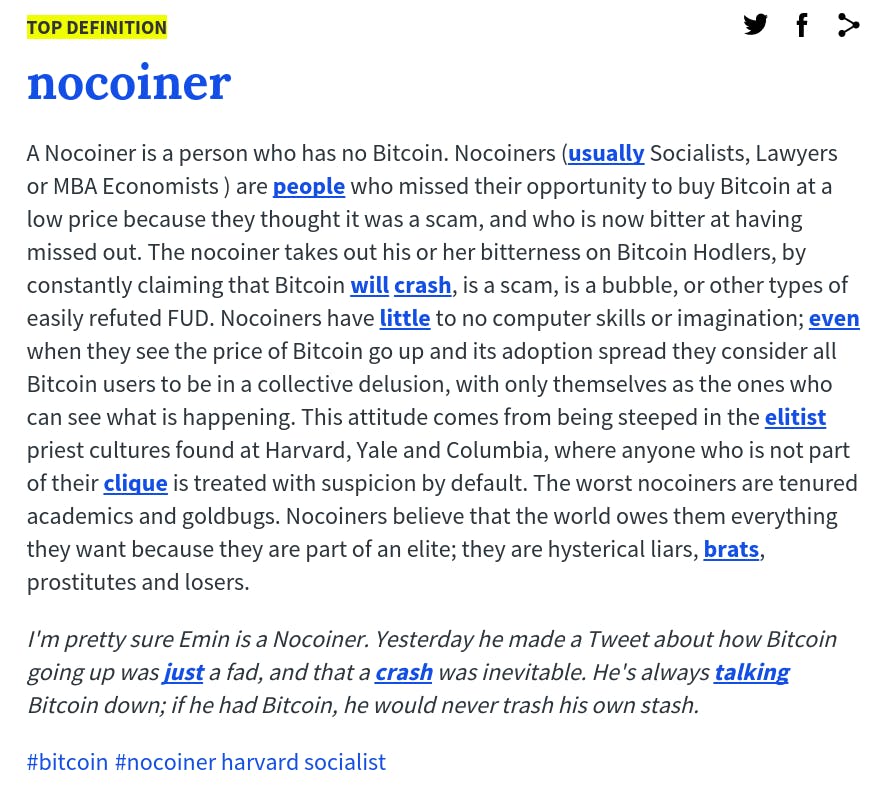
Nocoiners can’t predict the future, and they can’t have any influence over it either. They can rant and rave about what is wrong with Bitcoin all they like; but they would have more success shouting at the Moon to cause it to shatter into a trillion trillion cheese wedges that rain down to feed their poor fellow mice of Earth.
No matter how much you shout, the moon will not suddenly be made of cheese, nor will it shatter and solve “The Crisis in Parmesan”. Bitcoin’s greatest long-term side effect will be to sideline, constrain and exclude Moon Cheese eating Blockchain monkeys. The keys to the kingdom are being permanently revoked from them, replaced by the only keys that will matter; your Private Keys.
Computer Illiteracy will not matter, because the complexity will disappear.Crypto Illiteracy will not matter, just as it doesn’t to WhatsApp users.Monetary Illiteracy will disappear with the death of Keynesianism.Statism will disappear…because there will be no State!Clinical Paranoia will remain. Strictly for the lulz.
If you like the content and feel so obliged to send some love via BTC donations you can do so at the address below:↴

Bitcoin Data Science (Pt. 2): The Geology of Lost Coins
By Dhruv Bansal
Posted May 29, 2018
This is part 2 of a series
- Bitcoin Data Science (Pt. 1): HODL Waves
- Bitcoin Data Science (Pt. 2): The Geology of Lost Coins
- Bitcoin Data Science (Pt. 3): Dust & Thermodynamics
There are many stories of people losing BTC in large amounts - especially in the early days - when BTC wasn’t worth much, and was easily forgotten on an old hard-drive, USB memory stick, even a scrap of paper.
Is it possible to quantify how much BTC is really lost? Blockchains track their internal data forever, and as we showed in Part 1 of this series, one can visualize Bitcoin’s UTXO age distribution to illuminate historical trends in ownership:
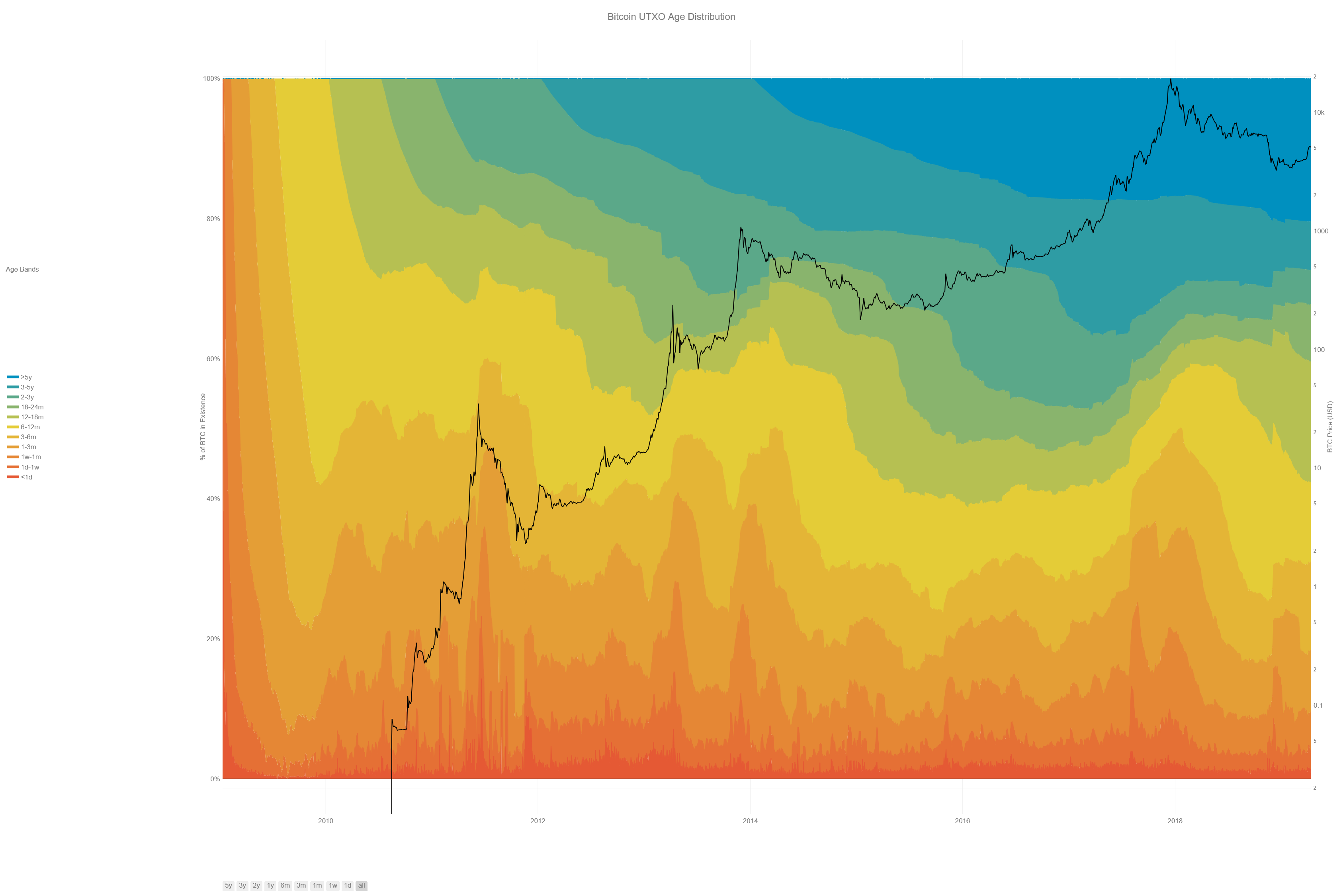 The colored bands show the relative fraction of Bitcoin in existence that was last transacted within the time window indicated in the legend. The bottom, warmer colors (reds, oranges) represent Bitcoin transacted very recently, while the top, cooler colors (greens, blues) represent Bitcoin that hasn’t transacted in a long time. Bitcoin’s money supply grew from 50 BTC to ~ 17M BTC over this time period, so the chart has been normalized by the BTC in existence at each date (left y-axis). The black line shows the USD/BTC price (logarithmically, right y-axis). Chart lovingly made by Nelson Morrow based on prior work by @jratcliff [Direct Link]
After seeing the UTXO age distribution above, many readers of Part 1 commented, “a large fraction of the oldest coins are probably lost.” This is a reasonable intuition. There were many reasons for BTC holders to transact in 2017 & 2018: a price rally and a pullback, the rise of ICOs, the BTC/BCH fork, new segregated witness addresses, etc. Coins which remain unspent for >5 years have a high likelihood to be lost forever. Can we make this intuition more precise?
Despite the richness of blockchain data, it’s extremely difficult to measure how much cryptocurrency is truly lost, as lost coins leave no trace in the blockchain. Lost BTC sits idly in the UTXOs of its last transaction, aging quietly as time passes. The problem is that so much BTC which is not lost looks exactly the same on the blockchain.
Still, the UTXO age distribution does provide insight into how to think about lost BTC. The cooler-colored, older age bands can be thought of as low-pass filters which only allow the oldest coins to pass into them. As a result, they experience slower, less volatile changes than the hotter colored, younger age bands.
UTXO age bands are like geological strata: evidence of coins held some time ago, buried beneath layers of more recent transactions. Distinguishing lost coins from those dearly held requires unearthing subtle data from the oldest layers, from the deepest records of the blockchain.
The study of lost bitcoin is geology masquerading as data science.
We believe bitcoin loss occurred over two distinct “cryptogeologic” eras:
- Systemic loss: a large cohort of BTC which was mined together and lost together in the earliest days of Bitcoin by Satoshi and the other first miners. (Bitcoin’s carboniferous period.)
- Incremental loss: BTC lost by individual users gradually over different periods of time.
We’ll show that the era of systemic loss has ended, and demonstrate that we are now in the era of incremental loss. Finally, we’ll estimate bounds on how much bitcoin is lost. Let’s turn to the data.
Early Systemic Loss
What was happening in Bitcoin in its earliest days in 2009? Answer: Almost nothing.
Satoshi published the original whitepaper in October, 2008 after working on the concept and the code for the prior couple of years. Satoshi mined the genesis block on January 3rd, 2009, and promptly released the first version of the bitcoind software (v. 0.1) on January 9th.
Very few people took Satoshi or Bitcoin seriously in those early days. Gwern Branwen’s excellent article Bitcoin-is-Worse-is-Better describes some of the initial negative reaction from “professional” cryptographers.
In the first days of Bitcoin, poor Satoshi was mostly mining alone, occasionally joined by other crazy people such as Hal Finney. The result was extremely low hashpower, as the chart below shows. Satoshi and the first miners were unable to exceed the minimum hashrate required to trigger an upward difficulty adjustment till the first days of 2010. The average time between blocks didn’t hit the target of 10 minutes until a month later, in February, 2010.
 Chart depicting hashrate and the average time between blocks over 2009 and the first quarter of 2010. It’s likely that only Satoshi and a few other small groups were mining Bitcoin during the entirety of 2009. Chart originally appeared in an article by Evan Klitzke.
Despite the apparent stagnation above, there were still many, many blocks mined in 2009, and over 5M BTC was produced in this period by Satoshi and the first miners through 2011. That’s more than 23% of the all BTC that will ever exist. Where did it go?
 This chart groups the current UTXO set by age and then plots the average BTC balance per UTXO at each age group. The cohort of UTXOs older than 7 years (approx. 1.9M BTC), all mined before 2011, is clearly visible as a “shelf” on the right side of the plot, with the average balance sitting at 50 BTC, the coinbase reward in that era.. [Direct Link]
The above plot shows that the oldest 1.9M BTC of UTXOs in existence are a distinct population. They are the cohort of coins mined by Satoshi and the first miners during those early years of Bitcoin. They form a “shelf” at 50 BTC in the chart because the block reward at that time was 50 BTC (and fees were negligible): they are coinbase outputs that were never spent. (Note that the rapid falloff of this shelf between 6.5–7 years ago occurred in 2011. We’ll come back to this date below.)
Bitcoin’s Carboniferous Period
The carboniferous period occurred about 300M years ago and corresponds to the age in which Earth was covered in trees, but nothing existed which could eat trees. As a result, layers of dead trees accumulated, unable to decay.
 A late 19th century etching of what a forest would look like during the carboniferous period (300–360 Mya). [From Wikipedia]
2009–2011 was Bitcoin’s carboniferous period: huge amounts of coins were mined but unused, accumulating in the blockchain, eventually becoming lost, unuseable, and buried.
It’s ironic that, eons later, the trees which accumulated in the carboniferous period became coal, the chief energy source used for most Bitcoin mining today :)
Transition to Incremental Loss
Something dramatic happened to Bitcoin in 2011. The cohort of oldest UTXOs noted above diminished rapidly. 5 years later, in 2016, the rate at which BTC was entering the >5 years age band correspondingly diminished. This manifests as an inflection point or “kink” in the >5 years age band of the UTXO age distribution in 2016. One can see the echo of dramatic changes in Bitcoin, 5 years prior, in 2011. This chart shows the net rate-of-change of the amount of BTC >5 years old over time (trailing 90-day average). Between 2014–2016 (highlighted in blue) we see the effect of Bitcoin’s “carboniferous period”, which occurred 5 years earlier, from 2009–2011, when many coins were being lost. This period ends abruptly in 2016, corresponding to a dramatic change in Bitcoin 5 years prior in 2011. The time-axis of the chart starts in 2014 because this is the first year in which BTC could enter the >5 years age band (the genesis block having been mined in 2009). [Direct Link]
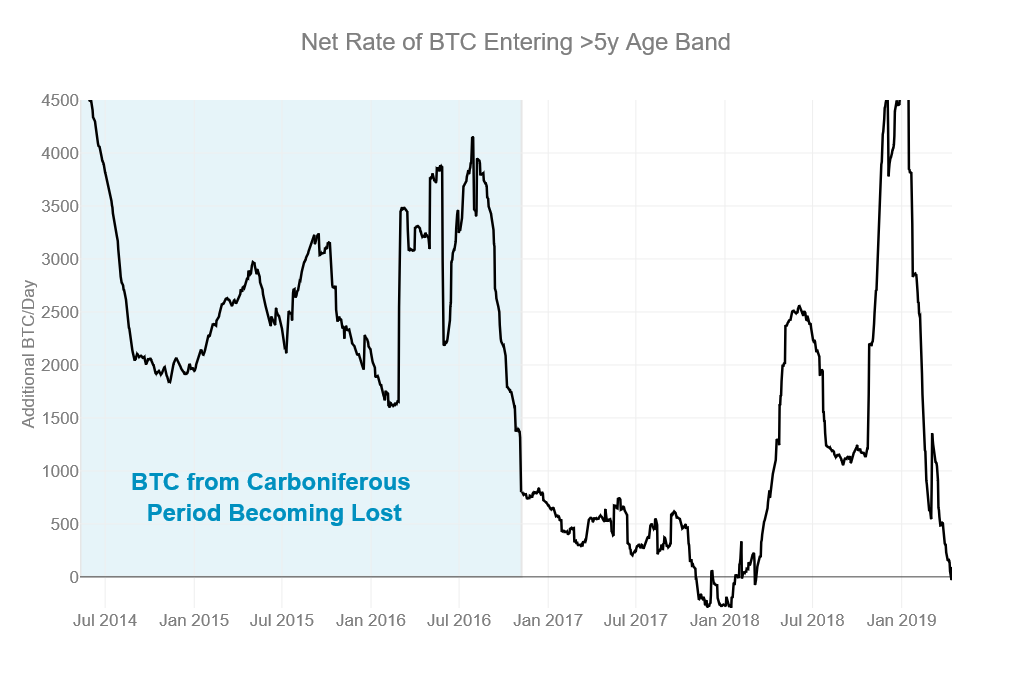 The above plot summarizes this transition. Between 2014–2016 (highlighted in blue) the rate at which BTC was entering the >5 years age band was extremely high. This corresponds to coins which last transacted during Bitcoin’s carboniferous period of 2009–2011, when Satoshi and the first miners mined, then subsequently lost, many coins.
A dramatic decrease in the rate of BTC entering the >5 years age band occurs in 2016, corresponding to the end of Bitcoin’s carboniferous period in 2011. The real, geological carboniferous period ended when bacteria evolved which could digest wood, preventing dead trees from piling up for eternity. What caused Bitcoin’s carboniferous era to end?
Curiosity to Commodity
In June, 2011, Bitcoin experienced its first major rally. Over a couple of short months, Bitcoin’s price went from less than $1 to a peak of $33. This created significant wealth for many early miners — at least those who hadn’t lost their keys.
Before the sudden price increase to $33, Bitcoin miners may have been lax with the security or safe-keeping of the BTC they were earning. The tragic tales of lost hard drives containing untold digital wealth largely occurred around this time. Afterwards, anyone mining BTC would have taken note: 1) BTC was valuable, and 2) it could quickly grow in value by orders of magnitude again.
These lessons fostered a radically different attitude towards mining and safeguarding bitcoin. At <$1/BTC, daily mining revenues would be only a few thousand dollars per day, amounting to perhaps ~ $1M per year — a market barely large enough to support a single small business. At $33/BTC, however, daily mining revenues reached almost $250k, creating a yearly revenue stream of >$80M. Bitcoin went from being a curiosity to a commodity, and Bitcoin mining transitioned from a hobby to an industry.
Echoes of the Great HODL?
A remarkable feature of the above chart is the upswing in the rate of BTC entering the >5 years age band in the last couple of months. This upswing represents BTC which last transacted in the middle of 2013, 5 years ago.
In Part 1 of this series we identified the HODL wave pattern of changes in the UTXO age distribution. This recent upswing in the rate of BTC entering the >5 years age band is the arrival of the leading edge of the Great HODL wave started in 2013/2014, when Bitcoin rallied to $1k/BTC.
We know that the Great HODL wave was disrupted by the 2017 rally to $19k/BTC, so it’s unlikely that all the 1.5M BTC in UTXOs which entered the 3–5 age band in 2016 would have survived to enter the >5y age band in 2018; many would have been transacted with during the rally, the fork, SegWit, &c.
So, in distinction to Bitcoin’s carboniferous period, we predict this recent upswing to be much smaller and abate more quickly. We estimate <500k BTC should enter the >5 years age band over the next 18 months.
So how much Bitcoin is lost?
It’s impossible to know. But, based on the analysis above, we can make an informed guess at some bounds. This will be easier with an absolute version of the UTXO age distribution:
 An absolute version of the UTXO age distribution chart which has not been normalized by the available BTC supply. The two prior halvings are clearly visible as kinks in the overall rate of production (as discussed in the text, hashpower was unstable in 2009, causing a departure from linearity). Due to the vast difference in the BTC supply between 2009 and 2018, the earlier HODL waves are harder to see though the Great HODL of 2013/2014 is still quite clear. [Direct Link]
A conservative lower bound for the amount of lost BTC is the cohort of coins mined in 2009–2011 by Satoshi and the first miners that remain unspent to this day: 1.9M BTC. This is about 2/3 of the BTC in the current >5 years age band. There are certainly many more Bitcoins which were lost in the intervening years since 2011, but can this amount be quantified?
During the 2017 rally, the 3–5 years age band shrinks significantly, but the >5 years age band barely changes. This strongly suggests that many coins in the 3–5 years age band are still controlled by someone, but that most coins in the >5 years age band are lost. At some age between 3–5 years, we should expect the former pattern to crossover to the latter pattern. This also suggests a less conservative lower bound of 3M lost BTC — the size of the >5 years age band. A version of the UTXO age distribution “zoomed into” the 3–5 years age band, split into 3-month intervals, covering the rally of 2017. [Direct Link]
 This “zoomed-in” version of the UTXO age distribution shows finer-grained detail on the 3–5 years age band, splitting it into several 3-month age bands. A HODL wave is evident as a cohort of coins makes its way through the finer-grained age bands in 3 month periods.
The earlier age bands (36 — 39 months) are significantly slimmer today than they were in a year ago, indicating that most of those coins are controlled by someone who was able to transact with them during the rally of 2017. The older age bands (57 — 60 months) show almost no change during the rally of 2017, just like the >5 years age band.
We estimate the boundary between these behaviors occurs between 45 to 51 months. If we make the rough assumption that most coins older than this are lost, it suggests that an upper bound of 3.8M BTC are inaccessible. Our final estimate from looking at the UTXO age distribution is that between 3–3.8M BTC are lost.
A More Precise Estimate
It’s difficult to be precise when using just UTXO ages to estimate how much BTC is lost. A better approach would label and track individual UTXOs with external metadata, which would distinguish the context of different transactions: miners, exchanges, etc. This approach takes after archaeology more than geology.
Happily, our friends at Chainalysis have already made such an analysis. In an excellent Forbes article published last year, they use such an approach and make their own estimate: 2.78–3.79M BTC lost. It is encouraging that our simple approach, based on looking at just UTXO ages, accords with Chainalysis’ more sophisticated approach.
Many thanks to Philip Gradwell and Kim Grauer from the Chainalysis Team for helpful discussions. Check out the Chainalysis Blog for more fascinating work from their team.
This post is the second in a series using data science to tell stories about Bitcoin; unearthing the deep geological history of the blockchain, while searching for lost treasure.
You might also enjoy:
- Part 1: In which we describe market cycles with HODL waves.
- Part 3: In which we analyze UTXO dust in the chain.
Unchained Capital has been performing data science on blockchains for years. Discovering the large amount of Bitcoin UTXOs older than 12 months convinced us to start a lending business to help cryptocurrency owners get value from their digital assets today while continuing to hold them into the future.
If you are holding BTC (and soon ETH) and you’d like to borrow against your holdings, please sign up for an account on our website and apply for a loan.
Remember : Friends don’t let friends sell Bitcoin.
Fat protocols aren’t new: What blockchain can learn from p2p file sharing
By John Backus
Posted May 29, 2018

Starting in 1999, we saw an explosion of p2p file sharing technology. We had Gnutella (the protocol behind Limewire), FastTrack (Kazaa), eDonkey, and BitTorrent. Limewire, Kazaa, and eDonkey all died, but the protocols they helped create lived on!
People have speculated on what a future with fat protocols will look like. File sharing protocols aren’t exactly the same, but they have a lot of similarities we can learn from.
Looking at the p2p ecosystem, a few things are clear:
- Fat protocol ecosystems have way more variety and experimentation when network effects don’t stop people from creating new clients
- Protocols live on and evolve regardless of whether the original creators are working on them or not
- The application layer seems to capture little value for the protocol creator,**but third party competition to build on top of the protocol may be a powerful force for finding product/market fit
- While people weren’t able to figure out how to integrate a token into p2p file sharing technologies back in the day, it does seem like a properly calibrated token marketplace would have solved a lot of problems and accelerated p2p’s breakneck adoption even more.
Vibrant and competitive ecosystems
… by replicating and storing user data across an open and decentralized network
rather than individual applications controlling access to disparate silos of information, we
reduce the barriers to entry
for new players and create a
more vibrant and competitive ecosystem
of products and services on top.
Fat Protocols
from Union Square Ventures
What file sharing application did you use before BitTorrent? Was it LimeWire, BearShare, Shareaza, giFT, Morpheus, Phex, or Acquisition? All of those were separate applications made by different teams that all connected to Gnutella network! There was also FrostWire, LimeWire Pirate Edition, and WireShare which were forks of Limewire’s client.
I’m not going to do the same song and dance here listing a dozen clients for FastTrack and eDonkey, but I could. Every protocol had tons of clients. In fact, Limewire wasn’t the creator of the Gnutella protocol, their app was just really popular because they added a lot of features.
Features
People didn’t all just build near identical clients of course. Different companies competed to build clients to the Gnutella protocol that served different needs. BearShare seemed to focus on building a good client. It had a straightforward search, a “theater” to preview movies and music while they downloaded, and plenty of other features like a place to chat with other users.
BearShare provided a full featured experience
Quality
The eDonkey company developed their own network (“eDonkey2000 Network”) and a corresponding client. Even though they developed the protocol, they had to compete with a very popular open source client called eMule which many viewed as having a better user interface!
Which would you rather use?
Generalization
Some people tried to improving the user experience via better interfaces. Others tried to provide access to as much content as possible by creating clients that used multiple networks.
Shareaza became popular by supporting every file sharing protocol under the sun:
Shareaza … supports the Gnutella, Gnutella2, eDonkey, BitTorrent, FTP, HTTP and HTTPS network protocols and handles magnet links, ed2k links, and the now deprecated gnutella and Piolet links
Shareaza searcheseverything
Abstraction
The giFT project was similar to Shareaza in trying to implement every protocol, but it aimed to be a file sharing backend that others could build user interfaces for:
Two totally different frontends (GiFTcurs and Apollon) using giFT on the backend
giFT supported most protocols and was compatible with Windows, Linux, and Mac.
Bitcoin: Past and Future
By Murad Mahmudov and Adam Tache
Posted May 30, 2018
Foreword
This is a follow-up to The Many Faces of Bitcoin, which discussed four schools of thought of Bitcoin. This article will analyze these perspectives by discussing trade-offs, philosophical divides within the community, and expected behaviors of the proposed systems.
Index
- Bitcoin as Money
- Roles of Full Nodes & Miners in Bitcoin & Bitcoin Cash
- Addressing “Satoshi’s Original Vision”
- Role of SPV
- Segregated Witness
- Bitcoin Maximalism
- Upper-Layer Systems and Alt-Coins
Bitcoin As Money
Bitcoin presents us with an opportunity to reinvent gold, or even rethink money for the digital future. A number of economists have suggested that it may be more appropriate to evaluate items based on their degree of moneyness. According to this thinking, it isn’t that something either is or is not money; on the contrary, many items can play a monetary role and some items can play this role more effectively than others. In a number of ways, bitcoins have a high degree of moneyness. They are more portable, durable, divisible, and scarce than both gold and government fiat currency.
As of today, bitcoins can best be described as digital commodities with monetary properties. According to the Bitcoin Maximalist interpretation of monetary history, it is likely that a new, scarce form of money would evolve roughly along the following lines:
- Collectible
-
- Store of Value
-
- Medium of Exchange
-
- Unit of Account.
Proponents of bitcoins as digital cash believe that utility should initially take precedence over store of value, and prioritize attaining the medium of exchange role before store of value by making payments as cheap as possible.
Those who believe bitcoin will become the future global monetary standard ascribe current volatility to the fact that bitcoin is undergoing the process of monetization, and that a global cognitive shift is slowly occurring. In their view, despite great volatility, the long-term parabolic ascent of the price is a testament to more and more people believing in a future world where Bitcoin is widely used.
Crypto-Austrianswho consider themselvesRothbardians, such as authorSaifedean Ammous, believe that bitcoin’s disinflationary nature and cap on supply makes it the most sound money ever invented. They believe that bitcoin, with its fixed monetary supply, is the only fair form of money, as well as one which allows for the most efficient capital allocation by individuals and most efficient price signalling by the market as a whole.
Many individuals in this group are against the idea of fractional-reserve banking and consider it to be fraudulent. They believe that a fractional-reserve banking system is unlikely to emerge atop bitcoin, as bitcoins lack the physical centralization of gold, which forced settlements and clearance to necessarily pass through centralized choke-points, allowing governments to have complete control over the money supply, transmission, and the monetary regime at large. The governments had so much control that they were able to get rid of the gold-standard (which was organically chosen by the market over centuries) and introduce their own fiat standards, not backed by any commodity.
These individuals believe that fractional-reserve systems are simply unsustainable in the long run without lenders of last resort, which do not inherently exist in Bitcoin, and that people would be unwilling to accept bitcoin-substitutes in the market.
Those in the “Free Banking” wing of the Austrian school, such as George Selgin and Lawrence White, believe that bitcoin’s strictly fixed-supply and lack of lenders of last resort do not technically prevent a competitive system of fractional-reserve banks and entities arising atop bitcoin, or in an economy where bitcoin is the defacto monetary standard.
It is clear that there is a chance that bitcoin can, at the very least, emerge as a mildly volatile digital commodity, a store of value akin to digital gold. However, doubts remain whether it will transcend the raw store of value role and achieve low enough volatility to become a global medium of exchange and a unit of account.
Some believe that, due to its strictly inelastic supply, bitcoin is unlikely to be stable in its purchasing power anytime soon, if ever, and that people prefer for their day-to-day currency to be stable in purchasing power. These people have expressed excitement about the emergence of cryptocurrencies with more flexible and self-regulating monetary policies built in. For example, stablecoins aim to peg their market value against another form of value, such as the USD or a basket of goods, using an algorithmic central bank.
Othersbelievethat, despite bitcoin’s strictly inelastic supply, bitcoin is a perfect solution toJohn Nash’sIdeal Moneyproposal that he worked on for over fifty years. Nash, a Nobel Laureate in Economics,[proposed(http://web.math.princeton.edu/jfnj/texts_and_graphics/Main.Content/IDEAL_MONEY…/Campus_for_Finance_of_2010/?source=post_page—————————)that central banks could inflation-target their currencies against an apolitical index to achieve international relational stability of all state currencies. In response to increasing demand for bitcoin, some believe banks will value target their currencies against bitcoin as a basis for the standardization of the value of money.
Deflationary Death Spiral
Mainstream, Keynesian, and Monetarist economists have expressed concerns with Bitcoin’s fixed-supply. They fear the possibility of harsh deflationary pressures if bitcoin becomes the predominant currency through the process known as hyperbitcoinization.
Their fear is that the inability to expand the money supply would result in bitcoin’s purchasing power growing by 2–3% per annum, roughly in line with the growth rates of global economic output. Some have expressed concerns that deflationary economics might reduce aggregate demand in the present and the near-term, result in excessive savings and hoarding of money, and produce less consumption, investment and entrepreneurial risk-taking by individuals.
Austrian economists believe that the fears associated with a deflationary form of money are overblown and that the ‘deflationary spiral’ is a myth. Austrian’s counter the Keynesian and Monetarists concerns that the delay in spending doesn’t last in perpetuity by reminding them that this spending is merely delayed into the future. People will now have a lower time-preference and that instead of buying “useless” things with their “hot potato” decaying money, they will turn their attention to long-term productivity.
They also believe that business profit margins will not be hurt because not only would product prices, but also business costs, deflate at the same rate, leaving the profit margins unchanged. Austrians believe that deflation is absolutely normal, and absent central control on the money supply, both capitalism and technology are naturally deflationary phenomenons. This can be seen in the less-regulated electronics industry, where increased storage/memory/compute capacities are becoming cheaper every year.
According to Austrians, it is the central bank inflationary fiat printing that exacerbates recessions and business cycles, as the perpetually-decaying money embeds the citizenry constant anxiety and stress, resulting in not well though-out investments and expenditures, collectively referred to as ‘malinvestment’. These malinvestments are typically inefficient allocations of capital, which are unlikely to result in personal gains, societal gains, productivity, or capital stock.
Roles of Full Nodes & Miners in Bitcoin & Bitcoin Cash
The Scaling Debate
The debate over how to scale Bitcoin is very polarizing, and is about scaling throughput, also known as transactions per second (TPS). The main contention is how much it should cost to run a full node, and what the role of full nodes and miners should be in the the system.
In July 2010, Satoshi Nakamoto, the creator of Bitcoin, supposedly added a 1 MB maximum block size limit as an anti-DoS (Denial of Service) prevention mechanism. This 1 MB block size limit stood in place, and until transaction volume increased heavily in 2017, the blocks were never close to full capacity. When this limit was introduced, 1 MB was hundreds of times the size of an average block.
In August 2017, an update called Segregated Witness (SegWit for short, see dedicated section below) was activated, which increased the amount of data that could be stored in a block to above 1 MB. Taking many by surprise, at around the same time, on August 1, a fork of Bitcoin (BTC) named Bitcoin Cash (BCH) spawned from users dissatisfied with the BTC developers’ scaling roadmap and emphasis on bitcoins as digital gold. The developers of this fork quickly implemented 32 MB blocks and are planning to increase the limit much further, which would allow for more on-chain transactions per block and cheaper fees but make it more expensive to run a full node.
Factors that influence the cost of running a full node include required bandwidth, the size of the UTXO set (see this primer on Bitcoin transactions if you’re not familiar with the UTXO concept), and required CPU, RAM, and disk space, which are all impacted by the block size.
Those who favor small blocks view them as essential to maintain decentralization of the system by allowing any user to afford validation using a full node, and to develop a fee market in order to guarantee miner compensation as the block reward decreases.
The proponents of Bitcoin Cash, “big blockers,” view a block size limit as an artificial limit maintained through a centralized planning mechanism in the form of consensus rules. Many prefer miners selecting the size of blocks they are willing to create based on market conditions. There are other blockchain projects where this is the case, such as Ethereum where miners can vote to adjust the gas limit, which is analogous to the block size in Bitcoin, a certain factor each block.
The perspective of “small blockers” (Bitcoin project)
Full nodes relay transactions and blocks and do full verification of the data they relay to other members of the (full node) network, enforcing consensus rules and serving as watchful eyes against potentially malicious miners. Bitcoin’s value arose from the system eliminating trust in third-parties, having resilience to state-level attacks, and its censorship-resistant nature. All users having the ability to run a full node is essential to maintain these characteristics. As the cost of running a full node increases, a smaller percentage of users can afford validation and enforce consensus rules, and a greater percentage of users are forced into using Bitcoin in a trusted manner, relying on others to be honest, rather than the robustness of the system as a whole. Massive blocks will eventually result in full nodes residing only in data centers, which increases centralization by putting consensus in the hands of a limited number of entities, puts Bitcoin at a greater risk of getting shut down, and degrades privacy by requiring users to connect to other nodes. SPV (Simple Payment Verification) clients, which are lightweight clients that can prove a transaction is included in a block without downloading the entire blockchain, are incapable of trustless and complete validation.
At this time, even low-end computing devices such as a Raspberry Pi can serve as a functioning full node. Many desire a future where even smartphones can serve as full nodes.
In order for a full node to perform validation, it must propagate the entire UTXO set that it derived by processing the entire chain. The UTXO set can shrink by users and companies consolidating outputs, but it has been shownto steadily increase over time and can grow infinitely in size.
By primarily using the blockchain as a settlement layer for off-chain transactions and optimizing space efficiency through technological improvements, the UTXO set is managed much more efficiently, block propagation latency and initial blockchain syncing times are reduced, and the amount of bandwidth, CPU power, RAM, and disk space required to run a full node are minimized.
Off-chain payment-channels (like the Lightning Network) are being developed, which will be able to settle thousands or millions of transactions in a single transaction on the Bitcoin blockchain.
Although miners are the only entities that can produce new candidate blocks, economic full node operators signal and provide the incentive for miners to create valid blocks by rejecting invalid ones. If a miner were to produce an invalid block, such as one with differing consensus rules than those defined by the rest of the network (e.g. tampering with issuance rate of new bitcoins or altering the maximum number of bitcoins), full nodes would automatically ignore it even if a majority of the hash power accepted the block as valid.
The ability for full nodes to reject invalid blocks and trustlessly verify transactions leads to the saying “Don’t Trust, Verify” — and this is why full nodes are deemed the network that miners are being paid to serve.

This is not to say that miners don’t have any control at all. Both full node operators and miners power aspects of the system, despite having differing roles. Miners can choose what transactions they include in blocks (profit-maximizing miners will likely include ones with higher fees) and create new blocks, whereas merchants and other full node operators (including mining pool node operators) determine validity of blocks and transactions, enforcing consensus rules.
A User Activated Soft Fork (UASF) event in 2017 demonstrated that users operating full nodes were able to push miners to activate SegWit despite only a minority of miners initially signaling that they were in favor of the update.
 The perspective of “big blockers” (Bitcoin Cash project)
Bitcoin Cash proponents look to scale toward unlimited block size and do not believe in the importance of full nodes being cheap to run for all. They claim the best version of Bitcoin was outlined by Satoshi Nakamoto in his original whitepaper, blog posts, and emails. They believe Satoshi only considered miners to be the network and that consensus should be handled purely through hash power.
Some big blockers believe that users simply transacting never need to run full nodes, but some recommend incrementally increasing the block size in accordance to Nielsen’s Law of bandwidth to allow users with “reasonable” computers and internet connections to continue to run full nodes.
Miners are held accountable through profit-maximization and game theoretic market incentives. Miners will never collude as they are in direct competition with one another to find new blocks and get bitcoins as a reward. The security model of SPV is good enough for end-users, and full nodes are powerless, passive observers to the mining network. Full nodes are only needed by firms such as payment processors to provide services such as 0-confirmation transactions and serving merkle-branch proofs to SPV clients. There is nothing sacred about non-monetary Bitcoin consensus rules, which should be allowed to emerge through a market process.

From Mark Wilcox:
“The whole point of the Proof of Work game is that nodes cannot be trusted. The only thing we can trust is the difficulty of solving the problem, and the economic interests of everyone involved. This means that, quite crucially, ‘everyone is responsible’ is different from ‘everyone must do everything’. We collectively need to protect the network. But the whole point of rewarding nodes that contribute hashpower is to free everyone else of the burden of having to worry about attacks on monetary policy or denial of service.”
BCH proponents equate decentralization to competition and the network topology of miners instead of full node cost. They rejected SegWit, and Bitcoin Cash was their response. They encourage on-chain applications, such as the social network Memo, which small blockers would likely view as spam and encourage to be developed on upper-layer systems instead.
Addressing “Satoshi’s Original Vision”
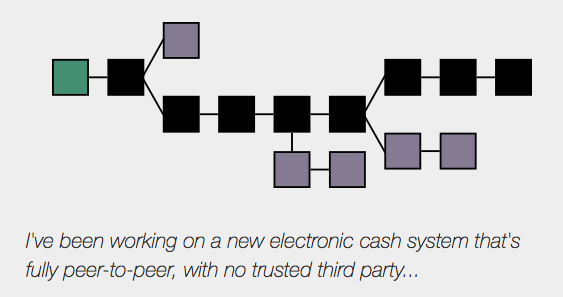 The perspective of “small blockers” (Bitcoin project)
BTC proponents believe that appealing to Satoshi’s words is a logical fallacy of appealing to authority, and that Satoshi should no longer matter.
“If you see the Buddha or a Buddha, kill him.”
They generally refer to BCH proponents as whitepaper “religious fundamentalists” who are unable to accept that Bitcoin has organically evolved since its inception. They view BTC as a far superior and more decentralized system than BCH due to the ability for full nodes to serve as a p2p network governance mechanism(not a democracy).
Many view BCH as a fraudulent project guided by leaders attempting to take over the Bitcoin brand and establish a centralized, miner-controlled system that requires trust in third-parties.
BTC proponents also mention that Satoshi laid the groundwork for the Lightning Network through a high-frequency trading payment channel design.
Satoshi’s last words about block size were written in December 2010 during a discussion about BitDNS, a proposal to use Bitcoin for domain name issuance which led to the creation of a merged-mined blockchain called Namecoin.
“BitDNS users might be completely liberal about adding any large data features since relatively few domain registrars are needed, while Bitcoin users might get increasingly tyrannical about limiting the size of the chain so it’s easy for lots of users and small devices.”
Here, Satoshi alluded to the scaling debate and suggested limiting the size of the blockchain might gain consensus.
Bitcoin Cash did not receive social consensus to be called Bitcoin based on the User Activated Soft Fork, market cap, and hash rate. Instead, Bitcoin Cash hard forked to create a new network, whereas Segregated Witness was an update to the original Bitcoin network in which old software still functions.
The perspective of “big blockers” (Bitcoin Cash project)
BCH proponents pronounce that “Bitcoin Cash is Bitcoin” as they believe Bitcoin was designed to scale on-chain without ‘non-mining full nodes’ limiting the throughput of the system. They note that Satoshi referred to miners as ‘nodes’ in his writings.
From Satoshi Nakamoto:
“Only people trying to create new coins would need to run network nodes. At first, most users would run network nodes, but as the network grows beyond a certain point, it would be left more and more to specialists with server farms of specialized hardware.” “The current system where every user is a network node is not the intended configuration for large scale. That would be like every Usenet user runs their own NNTP server. The design supports letting users just be users. The more burden it is to run a node, the fewer nodes there will be. Those few nodes will be big server farms.”
BCH proponents feel small blockers co-opted the Bitcoin project to create a settlement network with high on-chain fees when blocks are full. Some believe Core developers succeeded at changing people’s understanding of Proof-of-Work (PoW) game theory, as they interpret Satoshi’s descriptions of PoW as mining being the only consensus mechanism.
BTC proponents stronglyobjectto the contention that miners ever controlled consensus rules. They note that even in theoriginalnode software, the longest PoW chain rule only applied to resolving disputes between multiple chains using the same consensus rules, and nodes had the option to generate coins or not.
Role of SPV
In contrast to full nodes, the type of software for lightweight Bitcoin clients is SPV (Simple Payment Verification). SPV clients allow a user to connect to one or more nodes (i.e. from a smartphone), determine the latest block with longest PoW chain, and request block headers (80 bytes each) from the node(s).
As described in section 8 of the whitepaper, a user can obtain the merkle branch which confirms their transaction is inside a block with a valid block header and proof of work. Further confirmations (new blocks on top of the other block) demonstrate further work was done.
SPV clients cannot validate blocks or consensus rules themselves, so they must trust the validation of the node(s) they are connected to.
A theoretical way to increase SPV security, among others, was proposed by Satoshi in the whitepaper. It would allow nodes to alert SPV clients when invalid blocks are detected. Fraud proofs could prove the existence of these invalid blocks with minimal resources required. Although fraud proofs are not implemented today, SegWit enables them to be integrated into Bitcoin with a soft-fork, which is a change that is backwards compatible with old clients and tightens or adds new rules.
Segregated Witness
A 2017 soft-fork to BTC called Segregated Witness, or SegWit for short, was activated as the result of a multiple year scaling debate. It was primarily a bug fix to an issue involving the malleability of transactions, but also adds more space for transactions and enables easier future updates and extensions through soft forks.
What is malleability?
Before SegWit, there were malleable (changeable) parts of transactions. For example, a node relaying a transaction or a miner including it in a block could add extra bytes to the transaction’s signature. This changes the ID, which is a cryptographic hash of the entire transaction, including the signature.
Although there is malleability in other computer software, in the case of Bitcoin, changing the transaction ID after the transaction propagated to the network prevented wallet software to track transactions by ID, users from performing certain types of transactions, and developers from creating certain types of smart contracts.
For example, a valid transaction can spend an unconfirmed output (not yet included in a block) as an input to another transaction in the same block. If the transaction ID of the unconfirmed output was malleated, the first transaction would be confirmed as it’s still valid, but the second transaction would be invalid because the transaction data would include aninvalid Previous tx attribute.
Miners, full nodes, and users can choose to use SegWit or not, since it was a soft fork. As of May 2018, transactions with SegWit inputs make up approximately 35% of transactions, and SegWit nodes are at approximately 99% distribution.
The rest of this section is fairly technical, so feel free to skim or skip to the “Bitcoin Maximalism” section if you are a beginner.
Witness data refers to signatures and unlocking scripts. With SegWit, miners “segregate the witness” by placing the witness data in a separate merkle tree (the data structure inside a block that holds transactions) called the witness merkle tree, which mirrors the transaction tree. The witness root hash is stored in the coinbase transaction, which is the transaction that miners use to pay themselves newly minted bitcoins. Therefore, signatures for SegWit transactions are still included in blocks, since the coinbase transaction affects the merkle root hash that is stored in the block header of a block.
If miners choose to not update to SegWit, then they can’t mine blocks with SegWit inputs, as to them these are non-standard transactions. They can still receive SegWit transactions with the witness structure stripped.
The SegWit update(for more detail see SegWit benefits) :
- Phases out block size in favor of block weight. Currently, blocks can have at most 4 million weight units (WU). A byte in the original block structure weighs 4 WU, whereas a byte in the witness structure only weighs 1 WU. For more, see “Understanding Segwit Block Size.”
- Reduces the UTXO size for SegWit transactions by the size of witnesses, which is around 60–75% of the data. The discount on weight units for the witness structure was introduced to incentivize more responsible growth of the UTXO set by lowering fees.
- Increases the amount of data that can be stored in blocks as the percentage of SegWit transactions increases. The largest block we have seen is 2.1MB.
- Allows payment channels, such as the Lightning Network, to take advantage of the malleability fix.
- Fixes quadratic scaling of Sighash operations.
- Enables the checksummed Bech32 address format.
- Introduces Script versioning to allow for easier soft-forks in the future for features such as SPV Fraud Proofs, Schnorr signatures and Signature aggregation and MAST which compress data and further aid on-chain scaling, and Confidential Transactions.
- Makes covert ASICBoost ineffective (though some dispute the relevance of ASICBoost in the first place).
The following are arguments against SegWit:
- Some users prefer that Bitcoin developers change Satoshi’s codebase as little as possible.
- SegWit and the Lightning Network do not solve the scaling debate because users will always have disagreements over how much it should cost to run a full node.
- SegWit technically used a mandatory extension block making it an “Evil Fork” or “Forced Fork.”
- Pushing the new Bech32 address format onto users invalidates the network effect that was built upon the original address format over the last nine years.
- It is technically possible for miners to censor SegWit transactions in an anti-UASF movement by not including any transactions involving SegWit inputs.
- Jihan Wu, the CEO of Bitmain which is the largest mining ASIC manufacturer, called SegWit transactions “unfairly cheap” due to the discount on witness data.
Bitcoin Maximalism
There are different flavors of Bitcoin Maximalists, but they all believe that Bitcoin is the best and most secure blockchain which has the strongest network effect, most desirable monetary policy, and a highly-capable scripting language built which allows for future development.
Bitcoiners generally believe the idea of a ‘token economy’ reveals a deep misunderstanding of monetary systems as a whole and view tokens as snake oil. They strongly reject a future world of 10,000 currencies, seeing it as no different to barter — the very problem that money is supposed to eliminate. They believe that value accrues to the money held, not necessarily the one transacted with, and the long tail of ‘tokens’ will suffer from extremely high velocity, rendering them with little to no value accrual and serving as unnecessary friction even if abstracted away from the end user.
Upper-Layer Systems and Alt-Coins
Many Bitcoiners view alt-coins as testing grounds for features that may eventually be integrated into Bitcoin if desirable by users.
It is theoretically possible to copy almost any blockchain, even a giant block one, and put it on a Bitcoin sidechain. Paul Sztorc’s Drivechain project, which is currently under development, would allow these blockchains to inherent Bitcoin’s mining security, although it requires a soft-fork and is awaiting more extensive peer review.
There are three main categories of changes that would (likely) never be integrated into Bitcoin’s base layer.
- Alternative consensus mechanisms to replace Nakamoto Consensus, such as Proof-of-Stake (Tendermint, Ethereum’s Casper, DFINITY’s Threshold Relay), Chia’s Proof-of-Space, EOS’ Delegated Proof-of-Stake, Algorand’s Weighted Proof-of-Stake, or Ripple and Stellar’s Federated Byzantine Agreement.
- Alternative data structures to replace the blockchain, such as Coda’s succinct blockchain, DAGlabs and HashGraph’s DAG, or Nano’s block-lattice.
- Alternative governance mechanisms to replace full node p2p network governance, such as Decred or Tezos’ on-chain governance, DFINITY’s Blockchain Nervous System AI governance, or Bitcoin Unlimited’s miners voting.
Bitcoiners generally take issue with Proof-of-Stake (PoS) where validators propose and vote on blocks instead of solving energy-intensive cryptographic puzzles. They believe Bitcoin software should be handled with the same respect as nuclear reactor software, and discount PoS due to its “subjective” nature, which means participation in the network requires subjective information like social information. This contrasts to PoW objectivity where nodes necessarily arrive at the current state by observing the heaviest PoW chain.
Many view PoS as a digital version of the fiat-money system, with PoS validation being anti-competitive in comparison to mining and lacking any ties to real-world value (energy).
Meanwhile, PoS advocates have “learned to love” weak subjectivity and aim to simulate the security of PoW through threats of economic penalties for validators (slashing dishonest actors by taking away deposits) instead of burning physical energy. They deem PoW as energy wasteful, and think it’s possible to design a PoS protocol that is more secure, decentralized, offers faster block times, and is more flexible than PoW, which is “limited” by physics.
In distributed systems terms, Nakamoto Consensus favors liveness (availability) over safety (consistency) and achieves probabilistic finality of transactions that increases with the number of new blocks.
Currently, with Casper’s PoS, for example, economic finality is to be achieved once validators fully commit to a block and comes at the cost of some availability. Because finality requires some upper-bound synchrony asumption, extraordinary events could theoretically partition a significant portion of the network or shut down the entire network for a greater amount of time than this upper-bound validator response time.
This could cause either some partitions to lack the majority of votes needed to come to consensus or the lack of ability for the network to choose a canonical chain when the partition or shut down ends. This could end with liveness or safety faults requiring human action, whereas with PoW, network partitions create temporary forks, which are necessarily resolved through the heaviest chain once the partition is resolved.
There is overwhelming consensus that there should be no experimentation and as little changes made as possible to the base BTC layer, and that payment channels and sidechains should not weaken the security of the base layer. Some users are enthusiastic about the potential of upper-layer systems to bootstrap further utility on Bitcoin.
The main philosophy is to have a hyper-decentralized, hyper-secure base layer that is used to bootstrap security for slightly more insecure protocols on top layers.
Lightning Network
Proponents of the Lightning Network consider it to be the most feasible solution to the current Bitcoin scalability problem, allowing people to transact nearly without limits using peer-to-peer payment channels and smart contracts, while using the main Bitcoin chain for occasional settlement purposes.
Despite only being conceptualized three years ago, and only being in beta for several months, the Lightning Network is already seeing a wave of innovations, such as Dual-Funded Channels, Submarine Swaps, Channel Splicing and Factories, Watchtowers, Eltoo, Atomic Swaps, and more all covered here.
One common concern about second-layer solutions is that they will negatively impact miners revenue by taking more transactions off-chain. Initial research, presented at Scaling Bitcoin 2017, estimated that miner revenue could increase after 20 million users were using the Lightning Network, although decrease under that threshold.
It is important to note that Lightning Network is an extremely new, unproven and immature system. However, many developers believe that it will greatly improve the scalability of Bitcoin and enable cheap micro-transactions, paving a way for Bitcoin to potentially be used as an effective medium of exchange and true global currency.
At the very least, Lightning Network occupies a niche, which will be valuable in itself. And at the most, we haven’t even scratched the surface of the upside, potential, and capabilities enabled by the Lightning Network, such as third-layer projects.
Conclusion
Bitcoin is the original, longest-lasting cryptocurrency with the highest levels of hashpower, network effects, liquidity, market capitalization, and arguably the highest amount of “HODLers of last resort.” This article attempted to outline the so-called ‘small blocker’ and ‘big blocker’ positions on the most notable changes, milestones and debates throughout Bitcoin’s past and its near-term future.
The open-source, global and decentralized nature of these digital money-forms makes the governance of these systems complex and even minor changes contentious and controversial. Almost 10 years into its history, Bitcoin and other cryptocurrencies as an asset class are beginning to challenge monetary metals as the defacto store of value assets of the future, as well as challenge existing global payment rails and mechanisms. We believe that the future is bright for Bitcoin and its spiritual brethren.
Bitcoin, Ethereum, And The Parallel World Of Crypto-Finance
By Spencer Bogart
Posted May 30, 2018
As originally published onForbes**
Photographer: Tomohiro Ohsumi/Bloomberg
While much of the world remains unaware or skeptical, Bitcoin and its crypto-cousins are quietly building a parallel financial system. It’s a friction-less system of economic networks with global 24/7 availability and advanced functionality that, in many respects, already exceeds the capabilities of big banks and legacy financial infrastructure.
This rapidly emerging crypto-economic network will become the world’s largest and you, dear reader, will one day be an eager and delighted user. Importantly, this parallel financial system — which is built on the back of public blockchains like Bitcoin and Ethereum — is its own distinct ecosystem, not an “add-on” to legacy banking products.
There’s a lot of questions: Why should anyone care about this parallel world of crypto-finance? Why are tens of thousands of developers dedicating themselves to building out these economic networks which, in aggregate, are already valued north of $120 billion? Who will be the winners in this sea change of money and finance?
Digital infrastructure for a digital age
First, let’s address the most important question: Why is this happening? Why is this parallel world of crypto-finance emerging so rapidly and why are so many of the brightest minds dedicating themselves to this space?
At the core, it comes down to a simple reality: That which is natively digital is more functional. The parallel world of crypto-finance is enabling the world’s first natively digital assets. Natively digital goods are programmable and free from the constraints that limit us in the offline world.
Many years ago, PayPal helped bring money into a digital age by creating a layer on top of legacy systems. But while PayPal made it easier to use legacy financial infrastructure in a digital context, it didn’t create new financial infrastructure. PayPal is a digital front-end with an offline legacy back-end. In contrast, public blockchains like Bitcoin and Ethereum are new financial infrastructure: Digital infrastructure for a digital age.
Programmable assets
Two examples that highlight the advanced functionality of natively digital assets are “time-locked transactions” and “multi-signature transactions”. The former allows users to “lock” bitcoin such that it can only be spent or withdrawn at a particular point in the future while the latter allows users to specify that particular bitcoins are restricted from being spent or withdrawn unless, say, 2 of 3 people agree (or 7 of 10, or whatever parameter the user establishes).
These are things that I can replicate in the traditional financial system with crude hacks that require hours of legal time and effort to create something like a Trust. However, that cost and burden has been reduced to a couple lines of code in Bitcoin and Ethereum. “Time-locked” and “multi-signature” transactions are just two early examples of what will become dozens and eventually hundreds of advanced functions that will be combined in novel new ways. Programmable money is finally here.
Software is finally eating the world of financial assets and value transfer and the outlook is incredible. We’re talking about an empowering world of advanced functionality, seamless exchange, and 24/7 global availability.
Surviving without Big Banks
But how do we get there? After all, the big banks and legacy financial system as a whole have been hesitant to even acknowledge Bitcoin, let alone support, integrate or build off public blockchains.
I used to struggle with this conundrum: On the one hand, public blockchains like Bitcoin and Ethereum are the valuable innovation that can change finance and money forever but, on the other hand, banks are subject to regulations that make it difficult or impossible to fully integrate these chains. It’s a “square-peg, round-hole” problem.
For years, the question was whether these public blockchains could survive out in the cold on their own without support from the legacy system. However, as these blockchains have grown in value from $1 billion to north of $120 billion, that question has been definitively answered: They aren’t waiting for permission or support — they are creating a parallel world of crypto-finance.
Winners and losers: banks, tech companies, and startups
So how will banks and technology companies be affected by this transition? Who will be the winners?
Given their constraints, I expect that legacy financial institutions will be confined to the fringes of this rapidly emerging parallel world. It’s entirely possible that legacy financial institutions will only be as relevant to this new crypto economic network as telephone companies were to the internet: Valued on- and off-ramps but not much more.
I expect that big banks will begin to offer rudimentary services for crypto-assets such as trading and custodianship over the next 12–24 months. The good news for legacy financial institutions is that this is a new product to sell and may help engage an otherwise difficult-to-capture millennial audience.
The bad news is that crypto-assets like Bitcoin inside the legacy financial system will really only be a launch pad to something else: The parallel world of crypto-finance.
In this sense, Bitcoin is a passport to a new, voluntary economic network — one that is natively digital and more functional than its legacy predecessor. It’s an opt-in system that users will adopt not because JPMorgan said to, but because it’s capabilities and fundamental features drive user adoption.
After all, users didn’t wait for City Hall to figure out Uber, they just started using it. They didn’t wait for the post office to get faster, they just chose email. Similarly, you don’t have to wait for JPMorgan to evolve, you can start using Bitcoin at any time.
In the forthcoming battle to capture market share in crypto-finance, tech companies will likely fare better than legacy financial institutions — this will be the tech industry’s first real push to create and support new financial infrastructure.
Why will tech companies be able to capture more of the opportunity than legacy financial institutions? Simply put, tech companies are better positioned to assume the substantial risk involved in pursuing new ventures with large upside opportunity. In contrast, banks and their investors are more conservative with lower growth expectations (that’s why you’ve never heard of a “Moonshot Factory” at Citibank).
The difference in expectations is evident in comparing the P/E ratios of large tech companies vs. Big banks. While JPMorgan and Bank of America have P/E ratios of 13–15x, Google and Facebook have P/E ratios of 34–37x. Investors pay ~2.5x more for each dollar earned by Google and Facebook than they do for each dollar earned by JPMorgan and Bank of America because they expect the former group to grow into huge new markets (like crypto-finance).
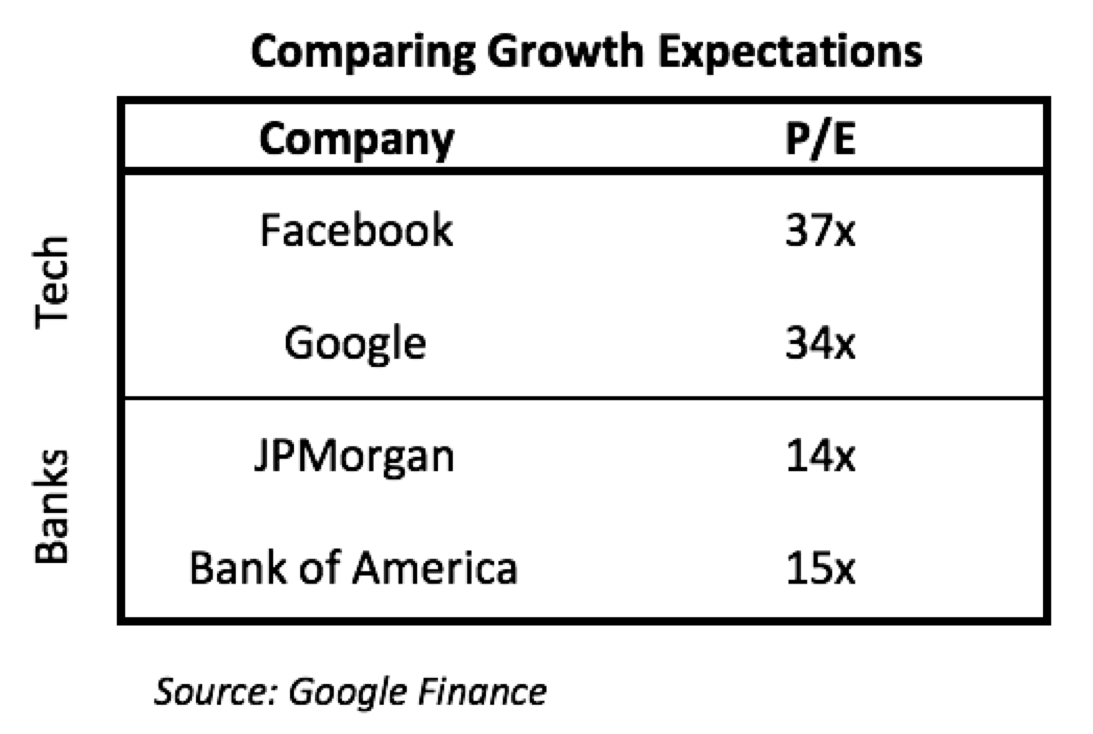
Even then, while large established tech companies will likely capture more of the crypto market than banks, I expect that the majority of the opportunity will be captured by new startups.
The desire from established tech companies to capture new markets will certainly push them toward the crypto industry but, like banks, they also have a lot to lose and will be similarly constrained by regulatory concerns. As a result, large established tech companies won’t be the most aggressive in building out crypto infrastructure and applications.
The crypto industry is still very risky and, simply put, startups are best positioned to assume risk. For this simple reason, I expect startups will capture the majority of the value created in the crypto industry over the next 3–5 years.
The fear of new technology
As with any new technology, there’s also an element of fear associated with cryptocurrencies. The first thing to recognize is that this parallel world of crypto-finance is not a threat. It’s an opt-in, voluntary world of cryptocurrencies, cryptographic protocols, and digital assets that together are creating the world’s largest economic network.
You don’t have to use it and it’s not going to make the legacy financial system function any worse than it already is. You didn’t have to give up Walmart to try Amazon. Similarly, you don’t have to give up Wells Fargo to try Bitcoin, Ethereum, or smart contracts — and I expect that most people will want to try these things over the next few years.
As with any new technology, there will be significant ups and downs for the crypto industry, and they’ll be far more evident than they have with past disruptive technology trends because assets like Bitcoin and Ether trade 24/7 from day 1 whereas fluctuations in the value of Facebook and Snapchat were opaque until their equity was traded publicly many years later.
Ultimately, this technology isn’t going to be un-invented, it’s not going away — on the contrary, it’s getting stronger, more resilient, and more functional. It’s being built outside of the legacy financial system and, over the next few years, users will increasingly find themselves popping over from the old system to the new system to pursue new opportunities and leverage its advanced functionality.