
September 2017 Journal
WORDS is a monthly journal of Bitcoin commentary. This issue collects the September 2017 writing in the WORDS archive. For the uninitiated, getting up to speed on Bitcoin can seem daunting. Content is scattered across the internet, in some cases behind paywalls, and content has been lost forever. That’s why we made this journal, to preserve and further the understanding of Bitcoin.
Diversity and Inclusion for Bitcoin
By Elaine Ou
Posted September 16, 2017
[
No field of technology has accomplished as much as Bitcoin when it comes to promoting diversity and inclusion. Check it out — In recent weeks, we’ve learned:
- North Korea spun up hundreds of Bitcoin (mining?) nodes beginning in May.
- Japanese digital services company GMO is investing $90M in a new Bitcoin mining facility.
- Putin’s Internet ombudsman is raising $100M for a Bitcoin mining farm. It will reportedly take advantage of Russia’s excess power capacity at deeply discounted rates.
Bitcoin’s strength lies in its jurisdictional diversity. Every transaction is created equal, no matter by whom or where. China’s concentration of mining power has been one of the biggest threats to Bitcoin, but if these new developments play out, we could see multiple state-sponsored server farms jockeying for power.
The biggest benefit of diversity is that every new idea is confronted with lots of competing opinions, so no decision ever gets done. This preserves the blockchain’s doctrine of immutability and permissionless access. The most inclusive state of the network is one in which every node is divided in a Mexican standoff.
I know, I know: People like to signal virtue by bemoaning Bitcoin’s lack of gender diversity. That’s okay. Signaling serves an important evolutionary function, and I have much respect for anyone privileged enough to expend resources on such an activity.
Still, diversity-driven virtue signaling is horribly misguided. Gender diversity is of zero concern for anything but the elitest of elite Western institutions. Bitcoin and its blockchain brethren are global: No other technological advancement so effectively serves state-oppressed Venezuelans as well as Silicon Valley software engineers. That’s the power of inclusion and equality.
Catallaxy: the origins of Bitcoin and innovation
By Francis Pouliot
Posted September 19, 2017
Catallaxy: the origins of Bitcoin, innovation and spontaneous order

The term Catallaxy describes the process by which order emerges from the seeming chaos of countless individual interactions between participants in a complex system. This spontaneous human coordination is the result of the individual action of the system’s participants, but the resulting order is not shaped consciously by human design.
Catallaxy is perhaps the most powerful concept in economics, because it allows us to understand, and be amazed by, the imperceptible unstoppable forces that shape our civilization. It explains how and why technological innovation, free markets and Bitcoin come to exist.
The Catallaxy should be embraced by businesses and organizations that wish to survive the black swans of modernity. More importantly: understanding emergent order is an exercise in self-awareness. Embracing the forces that shape the systems our lives depend upon is the key to becoming a sovereign individual in the coming information age.
Truly disruptive innovation emerges only out of Catallaxy. Antifragile systems are born when Catallaxy is left unbound, which is why they are desirable. Understanding Catallaxy empowers one to identify, and foster, the conditions that yield the most innovation.
The term Catallaxy itselft is derived from the greek verb Katallato, which means not only “to exchange” but also “to admit into the community” and “to turn a foe into a friend”. The term catallactics is defined as “the science of exchange”, because it studies economics by looking at the primary evidence: individual transactions.
This concept was popularized by the philosophers Friedrich Hayek and Ludwig von Mises, pioneers of the Austrian School of Economics. Disruptors of the economic establishment in their time, they had a radical new understanding of how the world worked and needed a new word for it.
Indeed, the mainstream term “economy” was invented by Aristotle and original meant “the art of household management”, in reference to the ancient Greek elites that would expertly manage their income, slaves, properties and business dealings. Thus, the term “economy” implies that there is, or ought to be, some guiding force and that there is some shared objective that all participants should aspire to pursue, and that the economy can (and should) be managed.
According to this worldview, the economy is mechanic: you should tweak it here and there and attempt to control the engine and process to create the best outcome possible. This was the premise which, engrained in the institutions of authority, had dramatic consequences which Hayek and Mises vowed to oppose: the rise of economic central planning.
When I gave a presentation on this subject in Vancouver, I walked outside of the Airbnb I rented and found a coffee shop within 10 meters that served me a small (double-shot) latté for 4.31$ The information contained in the availability and price of this beverage is beyond human imagination, because it is the abstraction of the millions of individual actions of every single participant in the supply chains that resulted in this coffee. As such, no urban or economic planner could have designed a better coffee market outcome: my breakfast transaction was exactly as it was meant to be.
To Hayek and Mises, the economy is to be thought of as organic: a complex and intricate balance, built naturally from the ground up. The information required for people to make decisions, simply put, is completely decentralized and truly only relevant on a peer-to-peer basis. It is a grassroots, bottom-up iterative process.
Catallaxy is the equivalent of the Cosmos, the spontaneous order of the universe, applied to economics. Only out of chaos and disorder can the true equilibrium be discovered.
The concept of emergent order is a generalization of what Catallaxy represents for the particular field of economics. Many examples of emergent order include:
- Languages and dialects
- Common law
- Free markets
- Pre-fiat currencies
- The internet
- Memes and culture
- Evolution through natural selection
These are all open dynamic network effects. They emerge as a result of participant’s action, but spontaneously without any overarching human design. They exist because participants collectively maintain them for their benefit and because they produce the best possible outcomes. They emergeand mutatewithout any identifiable conductor.
Bitcoin: applied catallaxy
Bitcoin, for example, is better understood using the conceptual lense of the Catallaxy: participants in Bitcoin spontaneously form a decentralized monetary and financial ecosystem, collectively choosing Bitcoin as a medium of exchange and store of value. Bitcoin is quintessentially antifragile and an irrefutable demonstration of spontaneous order in action.
Bitcoin emerged from seemingly out of nowhere: a black swan event that could never have been predicted. But it was the cumulation of an iterative process where ideologically-motivated individuals continuously innovated on each other’s work, guided by the foundational organizational principles of open-source software and cypherpunk ideology. It was a truly unpredictable disruptive innovation.
There is nothing magical about Bitcoin’s technology, although it is extremely state-of-the-art. It is the human participants, which collectively assume individual portions of risk and expense, that bring utility to the Bitcoin network because it is in their self-interest to do so. The requirement to follow the rules of the Bitcoin protocol in order to participate in its network ensures the alignement of incentives between self-interested anonymous participants, resulting in Bitcoin maintaining its decentralization. This is Satoshi’s true genius.
In peer-to-peer networks, peers (nodes) produce and consume resources at the same time. In Bitcoin, an enormous workload and set of responsibilities rests on the peers which do the work because it allows them to benefit directly from the network. The incentive for nodes is self-validation, making sure that their transactions are on the correct version of the blockchain and that the miners are following the rules, while the incentive for miners is the reward paid by all participants.
The participants converge spontaneously around the longest valid chain because it is in everybody’s best interest to do so. As we have seen, the ecosystem also converges around the same consensus rules and rule change activation processes, and when it does not, part of the system leaves, resulting in the participants being in stronger consensus. This should not be used as a maxim to encourage splitting the Bitcoin network when a faction disagrees. Money is the strongest network effect: if you’re on the wrong network, you die. Because the value of a cryptocurrency is derived from its network effect, the possibility of losing most (if not all) value weighs heavily chosing one blockchain over another.
While the possibility of exit is possible, the associated costs and risks of breaking consensus are enormous. This keeps the Bitcoin network adaptable and antifragile, but ultimately extremely reliable as a foundational institution of the information age.
The Bitcoin ecosystem emerges so naturally that it sometimes it feels like a living organism. It’s ability to immunize itself from internal and external attacks of all sorts extends beyond the protocol: the community, aligned by spontaneous agreement on core principles of self-sovereignty, privacy and decentralization, adopts norms and informal institutions against social attacks over time.
The constant addition of blocks and cumulation of proof-of-work, as well as the purchasing power of bitcoins, are measurable proofs that participants in this spontaneous order derive value and utility.
Satoshi’s achievement is not only in design: he bootstrapped the network by himself, following the very principles he coded in Bitcoin. He released the first implementation of Bitcoin in the wild, naked and unsecured. He built a community of ideologically-driven early contributors that maintained Bitcoin’s ability to evolve, which quickly surpassed him in technical skill.
Satoshi inspired others to collaborate through sheer persuasion and skill, logic and mathematics, profound wisdom. He was idolized and followed by early entrepreneurs building key institutions (e.g. exchanges) allowing dynamic market feedback loops from participants with skin in the game. He provided all the ingredients for extremely fast-paced disruptive innovation, and disappeared leaving the project in the hands of the world’s smartest and most dedicated pioneers.
Origins of innovation
Innovation cannot be designed. It happens in the trenches. To find the frontline of innovation, look for mass graves. Look where the rate of failure is the highest and the fastest. Innovation happens at the edges, on the frontier. Look where the participants have skin in the game and where the will pay a high price for their mistakes.
Charles Darwin, in The origin of species (1859), outlines the concept of evolution through natural selection, validating that natural ecosystems emerge spontaneously through countless imperceptible deadly mistakes that remove the least adapted DNA from the system. He writes:
“From the war of nature, from famine and death, the most exalted object which we are capable of conceiving, namely, the production of the higher animals, directly follows. There is grandeur in this view of life, with its several powers, having been originally breathed by the Creator into a few forms or into one; and that, whilst this planet has gone cycling on according to the fixed law of gravity, from so simple a beginning endless forms most beautiful and most wonderful have been, and are being evolved.”
Thankfully, unlike our DNA, individuals and companies can modify their business plans and wealth management strategies. Today’s innovators can fail without risking their life, but feel enough pain to still be strongly incentivized.
Innovation is a central propertyof systems which makes them antifragile (thus survive over time), and antifragile systems by their exposure to volatility foster necessity, which drives innovation.
Innovation must happen at the edges, because it is where the negative externalities are the lowest for other participants in the system. The failure of entrepreneurs shouldn’t be fatal and cause harm to others. This is why large corporations acquire startups, and why altcoins and second-layer protocols complement Bitcoin’s blockchain. This is why innovation, in decentralized networks, happens on the higher layers where innovation is not only permissionless, but forgiving.
Antifragility is defined by Nassim Taleb as:
“a convex response to a stressor or source of harm (for some range of variation), leading to a positive sensitivity to increase in volatility (or variability, stress, dispersion of outcomes, or uncertainty, what is grouped under the designation “disorder cluster”). Likewise fragility is defined as a concave sensitivity to stressors, leading to a negative sensitivity to increase in volatility”
Considering the unfathomable disruptions that the information age has yet to deliver, having the systems we rely upon be antifragile is not a strategy of optimization: it’s survival.
Innovation, just like evolution, happens where the iterative development cycles are fastest. This is true for the “agile/lean” startup models that many Bitcoin businesses and open-source projects follow. Information signals and feedback loops that are meaningful, such as consumer adoption, revenue generation, market valuation, number of contributors, provide part of the answer on how innovation occurs.
Open competition, permissionless innovation, and widely distributed information need to provide a constant threat. Nothing spurs necessity for an entrepreneur like incoming bankruptcy from competition. For the greediest and largest players, there needs to exist a possibility of taking over the entire market share and obtaining near-monopoly status. Smaller firms must be able to challenge larger market participants if they are to justify the expense of required resources.
Market signals must be meaningful and dynamic in addition to being from those with skin in the game. For example, ICO projects that receive all the funding upfront are unlikely to yield any innovation whatsoever, since they are completely removed from any stressor that would cause the necessity to innovate. Their value is derived mainly from marketing and network effect bootstrapping strategies rather than actual utility. Subsidies remove critical information from the decision making process: market feedback.
Innovation happens where participants have skin in the game. There must be strong symmetry between decision-making and its consequences. For example, think of industry participants and lobbyist/consultants that create organizations to collect and distribute government subsidies. Since the decision makers allocating resources don’t have skin in the game, they lead to misallocation of resources and market failures with not only no mechanism for feedback and adjustment other than the central planners’ judgement, but no incentive to obtain feedback in the first place. The incentives transform the optimal strategy for entrepreneurs away from innovation into the realm of rent-seeking.
The chinese philosopher Zhuang Zhou, like Hayek and Mises, argued against the mainstream intellectual movement (confucianism). He wrote in 300 BC:
“there has been such a thing as letting mankind alone; there has never been such a thing as governing mankind with success. Good order results spontaneously when things are let alone”
The best human planners could never reproduce the magnificent equilibrium of nature’s ecosystems (at least not at scale). So how could economists and politicians do it for the production and allocation of wealth?
In order to create an optimal equilibrium, one would need to “reverse-engineer” all the individual interactions that compose iy. To do this, one would have to have not only all the information available to the participants, but also an intimate knowledge of all that makes them unique as a human beings. Only an omniscient being could recreate the optimal equilibrium, and not even he could do better than just letting humans act on their own.
To make matters worse, artificial state intervention in the Catallaxy often disrupts the equilibrium in imperceptible ways that produce negative outcomes, regardless of the motivations. These are “unseen” effects, as 19th century French economist Frederic Bastiat explains:
“In the economic sphere an act, a habit, an institution, a law produces not only one effect, but a series of effects. Of these effects, the first alone is immediate; it appears simultaneously with its cause; it is seen. The other effects emerge only subsequently; they are not seen; we are fortunate if we foresee them (…) it almost always happens that when the immediate consequence is favorable, the later consequences are disastrous, and vice versa. Whence it follows that the bad economist pursues a small present good that will be followed by a great evil to come, while the good economist pursues a great good to come, at the risk of a small present evil.”
To find sources of innovation, go see practitioners, startups and entrepreneurs, tinkerers, hackers, fanatical early adopters, hobbyists, traders, meetup organizers, passionate educators, open-source project developers, inventors. Go see those with skin in the game and that not only positive react to, but significantly contribute to, market-based feedback loops. Innovators don’t need to be unscalable at first, because they are in a process of innovation.To foster innovation, identify the market-validated winners and amplify them with ressources so they can scale.
If you’re not the wave, be the surfer
There is a wave coming, and better to be on a surfboard than swim against the current. The surfer can never tell the wave where to go: the best it can do is stay afloat and use the wave’s momentum. Those who can feel the wave and anticipate its underlying trend will go the farthest. The wave always reaches the shore, but this is not true for the surfer.
Bitcoin is not just a wave: it’s a tsunami.
Acknowledgements.
This essay was inspired by recent podcasts/articles by Nassim N. Taleb @nntaleb and @econtalker, as wall as numerous contributors and commentators in the Bitcoin ecosystem. The image used is “Wanderer above the sea fog”
SegWit2X And The Case For Strong Replay Protection (And Why It’s Controversial)
By Aaron van Wirdum
Posted September 22, 2017
Prefer us on Google Download App Download App
Come November, the remaining signatories of the “New York Agreement” (NYA) plan to deploy the “SegWit2X” hard fork to double Bitcoin’s block weight limit, allowing for up to 8 megabytes of block space. Since noteveryone supports this hard fork, this could well “split” the Bitcoin network into two incompatible blockchains and currencies, not unlike Bitcoin and Bitcoin Cash (Bcash) did two months ago.
But this NYA hard fork is controversial and not only because it lacks consensus. It’s also controversial because of design choices made by the development team behind BTC1, the software client associated with the New York Agreement. Perhaps most importantly, this development team, led by Bloq CEO Jeff Garzik, has so far refused to implement replay protection, a measure that Bcash did take. Partly for this reason, at least one NYA signatory —Wayniloans — has backed out of the agreement.
So what is replay protection, why should BTC1 implement it … and why doesn’t it?
What Is Replay Protection? (And What Are Replay Attacks?)
Bitcoin could see another “split” by November. (It’s arguably more accurate to consider the “splitting” nodes and miners as an entirely new cryptocurrency with a new blockchain and token — not an actual split of Bitcoin itself.) For the purpose of this article, we’ll refer to the blockchain and currency that follows the current Bitcoin protocol as “Legacy Bitcoin” and “BTC.” The blockchain and currency that follows the New York Agreement hard fork is referred to as “SegWit2X” and “B2X.”
If this split happens, the two blockchains will be identical. All past transactions and (therefore) “balances” are copied from the Legacy Bitcoin blockchain onto the SegWit2X blockchain. Everyone who owns BTC will own a corresponding amount of B2X.
Without replay protection, new transactions will be equally valid on both chains as well. This means that these transactions can be copied or “replayed,” from one chain to the other — in other words, for them to happen on both. This is called a “replay attack.”
So, let’s say Alice holds BTC at the time of split, which means she also owns B2X after the split. Then, after the split, she wants to send BTC to Bob. So, she creates a transaction that spends BTC from one of her Legacy Bitcoin addresses to one of Bob’s Legacy Bitcoin addresses. She then transmits this transaction over the Legacy Bitcoin network for a Legacy Bitcoin miner to pick it up and include in a Legacy Bitcoin block. The payment is confirmed; all is good.
But this very same transaction is perfectly valid on the SegWit2X blockchain. Anyone — including Bob — can take Alice’s Legacy Bitcoin transaction and also transmit it over the SegWit2X network for a miner to include in a SegWit2X block. (This can even happen by accident quite easily.) If this payment is also confirmed, Alice has inadvertently sent Bob not only BTC but also an equal amount of B2X.
And, of course, all of this is true in reverse as well. If Alice sends B2X to Bob, she might accidentally send him BTC as well. A lack of replay protection, therefore, is a problem for users of both chains. No one wants to accidentally send any money — not even if it was “free money.”
Technically, there are ways to “split” coins on both chains to ensure they can only be spent on one chain. This would, for example, require newly mined coins to be mixed into a transaction. Tiime-locks can also offer solutions. But this takes effort and is not easy, especially for average users — not to mention that many average users may not even know what’s going on in the first place.
To avoid this kind of hassle, at least one side of the split could add a protocol rule to ensure that new transactions are valid on one chain but not the other. This is called replay protection.
Why Should BTC1 Implement Replay Protection? (And Why Not Bitcoin Core?)
In case of a split, at least one side must implement replay protection. But many — Bitcoin Core developers and others — believe there’s only one viable option. It’s the splitting party — in this case BTC1 — that should do it.
There are several arguments for this.
First of all, it makes the most sense for BTC1 to implement replay protection because that requires the least effort. BTC1 is a new client that’s already implementing new protocol rules anyway, and it’s not very widely deployed yet. It would be relatively easy for BTC1 to include replay protection.
Meanwhile, it would not be sufficient for Bitcoin Core to implement replay protection on its own. While it is dominant, and even considered by some to be the protocol-defining reference implementation, Bitcoin Core is not the only Bitcoin implementation on the network. Bitcoin Knots, Bcoin, Libbitcoin and other alternative clients would all have to implement replay protection, too. (And that’s not even taking non-full node clients into account.)
But even more importantly, the reality of the current situation is that all deployed Bitcoin nodes do not have replay protection implemented. And logically, they can’t: Some of these nodes even predate the New York Agreement. So even if Bitcoin Core and other implementations were to implement replay protection in new releases of their software, it wouldn’t suffice. All users must then also update to this new version within about two months: a very short period of time for a network-wide upgrade.
If only some of the nodes on the network upgrade to these new releases, Bitcoin could actually split in three: Legacy Bitcoin, SegWit2X and “Replay Protected Bitcoin.” Needless to say, this three-way split would probably make the problem worse — not better.
Lastly, there is a bit of a philosophical argument. Anyone who wants to adopt new protocol rules, so the argument goes, has the responsibility to split off as safely as possible. This responsibility should not fall on those who want to keep using the existing protocol: They should be free to keep using the protocol as-is.
Many developers — including RSK founder Sergio Lerner who drafted the SegWit2Mb proposal on which SegWit2X is based — have argued that BTC1 should implement replay protection. In fact, many developers think that any hard fork, even a hard fork that appears entirely uncontroversial, should implement replay protection.
But so far, the BTC1 development team will only consider optional replay protection.
What’s Wrong With Optional Replay Protection?
Implementing optional replay protection, as proposed by former Bitcoin developer Gavin Andresen, for example, is currently on the table for BTC1.
In short, this type of optional replay protection would make certain specially crafted (“OP_RETURN”) Legacy Bitcoin transactions invalid on the SegWit2X chain. Anyone who’d want to split their coins could spend their BTC with such a transaction. These transactions should then confirm on the Legacy Bitcoin blockchain but not on the SegWit2X chain. This effectively splits the coins into different addresses (“outputs”) on both chains.
Such optional replay protection is probably better than nothing at all, but it’s still not a definitive solution.
One problem is that the Legacy Bitcoin blockchain would have to include all these OP_RETURN transactions. This would probably result in more transactions on the network and would require extra data for each transaction. All this data must be transmitted, verified and (at least temporarily) stored by all Legacy Bitcoin nodes. It presents a burden to the Legacy Bitcoin network.
But more importantly, it would probably still not be very easy to utilize this option. It might suffice for professional users — exchanges, wallet providers and other service providers — as well as tech-savvy individual users. But these are generally also the types of users that would be able to split their coins even without replay protection. Average users, if they are even aware of what’s going on, would probably find it much more difficult to utilize optional replay protection.
Optional replay protection, therefore, offers help to those who need it least and does little for those who need it most.
Does the NYA Preclude Replay Protection?
While it’s unclear what was (or is) discussed behind closed doors, the New York Agreement seems to be a very minimal agreement. Published on May 23, 2017, it really only consists of two concrete points:
-
Activate Segregated Witness at an 80 percent threshold, signaling at bit 4, and
-
Activate a 2 MB hard fork within six months.
With the first point completed through BIP91, the only remaining point is a hard fork to 2 megabytes before November 23. (This assumes that this hard fork wasn’t completed with the creation of Bitcoin Cash which is supported by a number of NYA signatories.)
Notably, a lot of details are not filled in. For example, the agreement does not even state that signatories must specifically run the BTC1 software: Any software implementation that implements a hard fork to 2 megabytes might do. This could even include a software implementation that implements replay protection. And, of course, nothing in the NYA stops BTC1 from implementing replay protection; some signatories may have even expected it.
Why Won’t BTC1 Implement Replay Protection?
There are really several reasons why BTC1 — both stated and speculated — might not want to add replay protection.
The first reason is that replay protection would require simplified payment verification (SPV) wallets and some other thin clients to upgrade in order to send and receive transactions on SegWit2X. Replay protection would, therefore,in the words of BTC1 developer Jeff Garzik, “break” SPV wallets; they wouldn’t be compatible with SegWit2X until upgraded.
This framing and choice of words is disputed. If SegWit2X were to implement replay protection (and if SPV wallets don’t upgrade), these wallets could still send and receive transactions on Legacy Bitcoin perfectly fine. On top of that, they wouldn’t accidentally spend B2X when they don’t mean to.
Meanwhile, if the SegWit2X chain does not implement replay protection (and if SPV-wallets don’t upgrade), users may not be sure if their wallet is receiving or sending BTC transactions or B2X transactions or both. They also may not be sure if the balance in their wallet is a BTC balance or a B2X balance or both. And if hash power moves from one chain to another over time, these wallets could even switch from displaying BTC balances to B2X balances or the other way round without users knowing. (This problem could be solved, to some extent, through another workaround, but this is not yet implemented in either.)
Indeed, not implementing replay protection on SegWit2X could arguably “break” SPV wallets much worse.
The only (plausible) scenario where implementing replay protection would perhaps not break SPV wallets much worse is if there is no Legacy Bitcoin to speak of. Indeed, the New York Agreement very specifically intends to “upgrade” Bitcoin, rather than split off into a new coin as Bcash did. And based on miner signaling and statements of intent by several big Bitcoin companies, some NYA signatories claim that Legacy Bitcoin will not be able to survive at all.
Implementing replay protection is, therefore, sometimes considered an admission that SegWit2X will split off from (Legacy) Bitcoin into something new and will not be considered the upgraded version of Bitcoin.
But the assumption that Legacy Bitcoin won’t be able survive is a big one. In reality, miner signaling is effectively meaningless, while Bitcoin Core — the dominant Bitcoin implementation —will not adopt the hard fork. There is also a significant list of companies that have not stated that they support the hard fork, including two top-10 mining pools. Similarly, it’s not clear if many (individual) users will support SegWit2X either. The implementation of wipe-out protection (another safety measure) also suggests that even BTC1 developers aren’t so sure that there will only be one chain.
And perhaps even more importantly, it’s not clear that replay protection would affect any of this. If miners, developers, companies and users are to consider SegWit2X an upgrade of Bitcoin, they will probably do so with or without replay protection.
This is why it has also been suggested that BTC1 is rejecting replay protection for the specific purpose of being as disruptive as possible. If the Legacy Bitcoin chain is effectively made unusable, SegWit2X might stand the best chance of being recognized as “Bitcoin.”
For more information and debate on replay protection, also see the therelevantthreads on the SegWit2X mailing list.
Previous articleVaultoro Continues on Its VC Funding Road to Future Growth With Finlab AGNext articlePatientory’s Journey to Change Healthcare
RELATED ARTICLES CULTURE GUIDES CULTURE
LATEST NEWS
Understanding the Block Size Debate
By Jordan Clifford
Posted September 26, 2017
The crux of the issue
Background
No issue in the history of cryptocurrencies has been debated as passionately, as often, or as forcefully as the bitcoin block size. To an outsider, it must be quite comical to witness folks debating a consensus parameter within the bitcoin network — no joke — as if it were a matter of life or death. To insiders, the stakes are high, tribal lines are drawn, and crossing them risks your reputation among your peers.
The block size limit entered the world innocuously enough. A maximum block size limit of 1MB was added by Satoshi Nakamoto without any fanfare, or even any explanation, in July of 2010. Satoshi’s intent remains a debated topic, yet the parameter’s effect is clear — it limits the size of a block, the size of the batch of updates to the global ledger.
Recall that the Bitcoin network batches transactions into blocks that are released to the network approximately every ten minutes. To participate in the bitcoin network without a trusted third party, all of this blockchain data must be downloaded and verified in more or less real time. The more data that needs to be downloaded and verified to keep pace with the network, the larger the system requirements (bandwidth, cpu, storage) will necessarily be.
The Bitcoin max block size limits the rate at which information is etched into the blockchain. Essentially, it acts to throttle the entire system. This limits the number of “on-chain” transactions that can be processed. The parameter’s value is of great consequence as it dictates the transactional throughput of the base layer. It also dictates the system requirements for participating in Bitcoin without needing to trust another party.
Let the debate begin
Chronicling the debate in its entirety is outside the scope of this post. There are too many characters, complexities and interactions to capture them all, but a few defining moments stand out.
The earliest moments of the debate can be seen in this seminal post from Jeff Garzik in 2010. Jeff is one of the earliest contributors to Bitcoin, first committing to the project in March of 2011. Jeff thought Bitcoin supporting more than 3–10 tps (transactions per second) would win Bitcoin favor in the court of public opinion. He offered a simple patch to scale up the network to Visa levels. Theymos, moderator of bitcointalk.org and /r/Bitcoin, correctly pointed out this is a consensus parameter change, and deployment would need to be coordinated across the network. The patch was rejected.
The thread went dormant after Satoshi suggested that the change could be later phased in when needed. Satoshi left the community before executing on his strategy. Gavin Andresen took over in 2010 after Satoshi disappeared. He stewarded the project until 2014 when he stepped back to focus on the longer term vision for Bitcoin.
Discussion and debate of the block size would linger as background noise until Gavin posted a series of blog posts in May of 2015. The debate stage was now set, but without Satoshi, the Bitcoin community at large would struggle for years to converge on a path forward.
All in favor
The existing Visa credit card network processes about 15 million Internet purchases per day worldwide. Bitcoin can already scale much larger than that with existing hardware for a fraction of the cost. It never really hits a scale ceiling. If you’re interested, I can go over the ways it would cope with extreme size.
— Satoshi Nakamoto, April 2009
Proponents of increasing the block size primarily argue one reason to raise the block size: capacity. If bitcoin is going to become a useful global currency, then it must have enough transactional capacity to service its users’ needs. Not just the users of today or yesterday, mind you, but the users of the future as well.
Big blockers contend that larger blocks allows room for more users and makes Bitcoin more useful as money and more competitive as a payment solution. They believe that Bitcoin is ultimately a product that must compete in the market for adoption. A congested network with slow confirmation times and high fees pushes users elsewhere — an outcome that should be avoided.
Furthermore, many believe capacity should not be subject to an enforced production quota at all. Rather, Bitcoin miners should be allowed to produce additional capacity until supply meets demand. A planned quota introduces economic inefficiency by preventing mutually consensual activity.
Additionally, many big blockers posit that larger blocks would not adversely impact decentralization. With a larger block size, the network would accommodate more users with cheaper fees — enticing more parties to join. While larger blocks may raise the barrier to entry for participation, big blockers argue it would actually diffuse control over more parties.
All opposed
The decentralized Bitcoin blockchain is globally shared broadcast medium — probably the most insanely inefficient mode of communication ever devised by man.
— Gregory Maxwell, September 2016
Opponents to a block size argue that increasing the block size limit is unimaginative, offers only temporary relief, and damages decentralization by increasing costs of participation. Increasing the block size may set dangerous precedent for future increases. Additionally, introducing a social/technical process for a hard fork risks that very same process becoming a future attack vector within Bitcoin.
Small blockers argue that effort should instead be spent optimizing use of the block space we already have. They favor scaling solutions that push transactions off chain, and have no problem being patient while they are developed.
Small blockers believe Bitcoin’s main value proposition is its censorship-resistant nature and ability to minimize needed trust. They contend that these properties can only come from a Bitcoin that cannot be controlled. To evade control [read: attacks] from government regulators, mining cartels, and other adversaries, the system should strive to remain maximally decentralized, avoiding single points of failure or control.
In order to preserve decentralization, system requirements to participate should be kept low. To understand this, consider an extreme example: very big blocks (1GB+) would require data center level resources to validate the blockchain. This would preclude all but the wealthiest individuals from participating.
A low barrier to entry preserves the ability for individuals and small parties to participate fully in the network, without needing trusted third parties. Small blocks also increase network nimbleness by reducing the time it takes to bring new nodes online. This allows seamless network reconfigurations in the event of an attack.
Who’s in charge anyway?
With so many stakeholders with very different priorities, the scaling debate has failed to converge. The Bitcoin network must stay in consensus with itself, so without different factions able to agree on a path forward, the status quo prevails. As a meta problem, creating a process to increase the block size remains controversial. Any process, action and/or inaction results in winners, losers, and possibly dangerous precedent.
The small blockers prefer not to change the block size limit, believing that it is too risky. They instead argue for a proposal called Segregated Witness (SegWit), a backwards compatible change that allows for additional capacity, opens the door to future scaling improvements, and also changes the fee calculus to help combat bloat.
Big blockers worry that activating SegWit, especially without being paired with a simple block size increase, puts a nail in the coffin in the idea of Bitcoin ever acting as a scaled payment network. Miners like Jihan Wu refused for months to activate SegWit without a block size increase.
Compromise?
Compromise efforts have given us signed agreements attempting to bust the stalemate, notably the Hong Kong agreement in Feb 2016 (SegWit + 2MB), and more recently the New York Agreement (NYA) in May 2017 (essentially identical to the Hong Kong agreement). However, these proposals to modify the block size limit have run in to staunch resistance.
The NYA — an active proposal set to activate SegWit followed by a doubling of the block size within 6 months — does not satisfy everyone. Big blockers and small blockers alike groan that the agreement may ruin Bitcoin. Small blockers believe a hard fork block size increase is not needed, and a closed door meeting deciding Bitcoin’s fate is a deal breaker, while big blockers argue that the agreement vindicates the small block philosophy, offering only temporary relief without enough future capacity growth.
What’s next?
Differences in priorities and visions have already led to a permanent split in the community. On August 1st, 2017, a minority contingent of miners and exchanges, upset with the the prioritization of SegWit and lack movement on the block size, launched Bitcoin Cash.
In November of this year, it looks likely that we have the ingredients for another split. Jeff Garzik’s btc1 project aims to become the new Bitcoin reference client upon activating a 2MB hard fork, completing the NYA agreement. The NYA currently boasts signaling from 90+% of the hash rate and support from some of the most prominent Bitcoin companies [Coinbase, BitPay, Bitmain, etc.]. Core developers remain vehemently opposed to the agreement.
Ultimately, Bitcoin is an anarchic system. There is no official governance structure to it, which can be a feature or a bug, depending on your point of view. Disputes are settled via code that users choose to run and the tokens they choose to value. Exchanges and miners are two important Schelling points for coordination on which software version to run. The Bitcoin Core developers also have sway over many users. However, it’s ultimately up to the market [read: millions of users] to decide what Bitcoin is.
The Blockchain Economy: A beginner’s guide to institutional cryptoeconomics
By Cryptoeconomics
Posted September 27, 2017
Chris Berg, Sinclair Davidson and Jason Potts are from theRMIT Blockchain Innovation Hub, the world’s first social science research centre into the economics, politics, sociology, and law of blockchain technology.
The blockchain is a digital, decentralised, distributed ledger.
Most explanations for the importance of the blockchain start with Bitcoin and the history of money. But money is just the first use case of the blockchain. And it is unlikely to be the most important.
It might seem strange that a ledger — a dull and practical document associated mainly with accounting — would be described as a revolutionary technology. But the blockchain matters because ledgers matter.
Ledgers all the way down
Ledgers are everywhere. Ledgers do more than just record accounting transactions. A ledger consists simply of data structured by rules. Any time we need a consensusabout facts, we use a ledger. Ledgers record the facts underpinning the modern economy.
Ledgers confirm ownership. Property title registers map who owns what and whether their land is subject to any caveats or encumbrances. Hernando de Soto has documented how the poor suffer when they own property that has not been confirmed in a ledger. The firm is a ledger, as a network of ownership, employment and production relationships with a single purpose. A club is a ledger, structuring who benefits and who does not.
Ledgers confirm identity. Businesses have identities recorded on government ledgers to track their existence and their status under tax law. The register of Births Deaths and Marriages records the existence of individuals at key moments, and uses that information to confirm identities when those individuals are interacting with the world.
Ledgers confirm status.Citizenship is a ledger, recording who has the rights and is subject to obligations due to national membership. The electoral roll is a ledger, allowing (and, in Australia, obliging) those who are on that roll a vote. Employment is a ledger, giving those employed a contractual claim on payment in return for work.
Ledgers confirm authority. Ledgers identify who can validly sit in parliament, who can access what bank account, who can work with children, who can enter restricted areas.
At their most fundamental level, ledgers map economic and social relationships.
Agreement about the facts and when they change — that is, a consensus about what is in the ledger, and a trust that the ledger is accurate — is one of the fundamental bases of market capitalism.
Ownership, possession, and ledgers
Let’s make a distinction here that is crucial but easy to miss: between ownershipand possession.
Take passports. Each country asserts the right to control who crosses its borders, and each country maintains a ledger of which of its citizens have the right to travel. A passport is a physical item — call it a token — that refers back to this ledger.
In the pre-digital world, possession indicated ownership of that right. The Australian passport ledger consisted of index cards held in by the government of each state. Border agents presented with a passport could surmise that the traveller who held it was listed on a distant ledger as allowed to travel. Of course this left border control highly exposed to fraud.

A Belgian passport held by the Australian National Archives, A435 1944/4/2579
Possession impliesownership, but possession is notownership. Now modern passports allow the authorities to confirm ownership directly. Their digital features allow airlines and immigration authorities to query the national passport database and determine that a passenger is free to travel.
Passports are a relatively straightforward example of this distinction. But as Bitcoin has shown: money is a ledger, too.
Possession of a banknote token indicates ownership. In the nineteenth century the possessor — ‘bearer’ — of a banknote had a right to draw on the issuing bank the value of the note. These banknotes were direct liabilities for the issuing bank, and were recorded on the banks’ ledger. A regime of possession indicating ownership meant that banknotes were susceptible to be both stolen and forged.
In our era fiat currencies a five dollar bill cannot be returned to the central bank for gold. But the relationship remains — the value of the bill is dependent on a social consensus about the stability of the currency and government that issued it. Banknotes are not wealth, as Zimbabweans and Yugoslavians and Weimar Republic Germans have unfortunately learned. A bill is a call on a relationship in a (now synthetic) ledger and if that relationship collapses, so does the value of the bill.
The evolution of the ledger
For all its importance, ledger technology has been mostly unchanged … until now.
Ledgers appear at the dawn of written communication. Ledgers and writing developed simultaneously in the Ancient Near East to record production, trade, and debt. Clay tablets baked with cuneiform script detailed units of rations, taxes, workers and so forth. The first international ‘community’ was arranged through a structured network of alliances that functioned a lot like a distributed ledger.
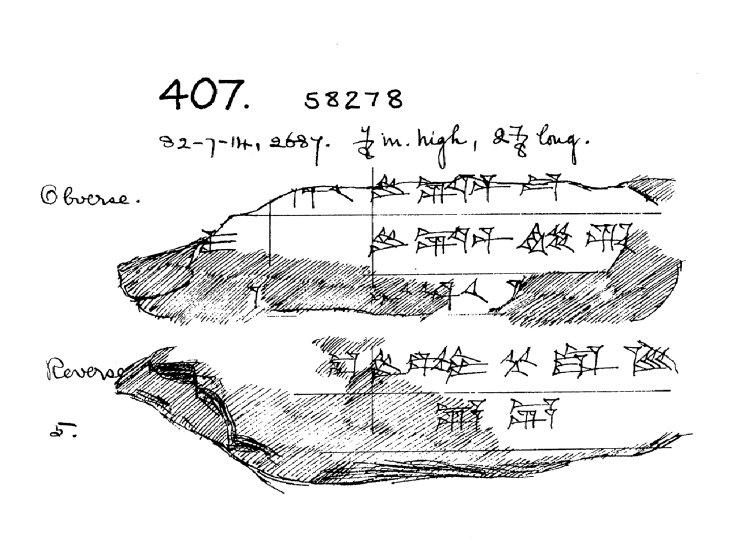
A fragment of a late Babylonian cuneiform ledger, held by the British Museum, 58278
The first major change to ledgers appeared in the fourteenth century with the invention of double entry bookkeeping. By recording both debits and credits, double entry bookkeeping conserved data across multiple (distributed) ledgers, and allowed for the reconciliation of information between ledgers.
The nineteenth century saw the next advance in ledger technology with the rise of large corporate firms and large bureaucracies. These centralised ledgers enabled dramatic increases in organisational size and scope, but relied entirely on trustin the centralised institutions.
In the late twentieth century ledgers moved from analog to digital ledgers. For example, in the 1970s the Australian passport ledger was digitised and centralised. A database allows for more complex distribution, calculation, analysis and tracking. A database is computable and searchable.
But a database still relies on trust; a digitised ledger is only as reliable as the organisation that maintains it (and the individuals they employ). It is this problem that the blockchain solves. The blockchain is a distributed ledgers that does not rely on a trusted central authority to maintain and validate the ledger.
Blockchain and the economic institutions of capitalism
The economic structure of modern capitalism has evolved in order service these ledgers.
Oliver Williamson, the 2009 Nobel laureate in economics, argued that people produce and exchange in markets, firms, or governments depending on the relative transactions costs of each institution. Williamson’s transactions cost approach provides a key to understanding what institutions manage ledgers and why.
Governments maintain ledgers of authority, privilege, responsibility and access. Governments are the trusted entity that keeps databases of citizenship and the right to travel, taxation obligations, social security entitlements, and property ownership. Where a ledger requires coercion in order to be enforced, the government is required.
Firms also maintain ledgers: proprietary ledgers of employment and responsibility, of the ownership and deployment of physical and human capital, of suppliers and customers, of intellectual property and corporate privilege. A firm is often described as a ‘nexus of contracts’. But the value of the firm comes from the way that nexus is ordered and structured — the firm is in fact a ledger of contracts and capital.
Firms and governments can use blockchains to make their work more efficient and reliable. Multinational firms and networks of firms need to reconcile transactions on a global basis and blockchains can allow them to do so near-instantaneously. Governments can use the immutability of the blockchain to guarantee that property titles and identity records are accurate and untampered. Well-designed permissioning rules on blockchain applications can give citizens and consumers more control over their data.
But blockchains also compete against firms and governments. The blockchain is an institutional technology. It is a new way to maintain a ledger — that is, coordinate economic activity — distinct from firms and governments.
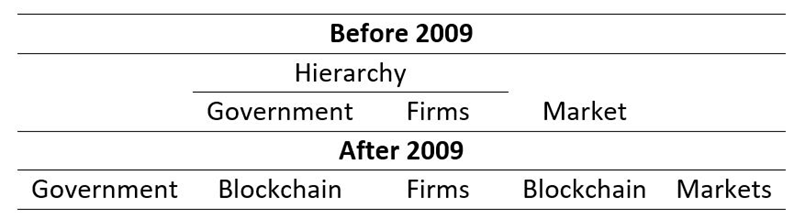
The new economic institutions of capitalism
Blockchains can be used by firms, but they can also replacefirms. A ledger of contracts and capital can now be decentralised and distributed in a way they could not before. Ledgers of identity, permission, privilege and entitlement can be maintained and enforced without the need for government backing.
Institutional cryptoeconomics
This is what institutional cryptoeconomics studies: the institutional consequences of cryptographically secure and trustless ledgers.
Classical and neoclassical economists understand the purpose of economics as studying the production and distribution of scarce resources, and the factors which underpinned that production and distribution.
Institutional economics understands the economy as made of rules. Rules (like laws, languages, property rights, regulations, social norms, and ideologies) allow dispersed and opportunistic people to coordinate their activity together. Rules facilitate exchange — economic exchange but also social and political exchange as well.
What has come to be called cryptoeconomics focuses on the economic principles and theory underpinning the blockchain and alternative blockchain implementations. It looks at game theory and incentive design as they relate to blockchain mechanism design.
By contrast,institutionalcryptoeconomics looks at the institutional economics of the blockchain and cryptoeconomy. Like its close cousin institutional economics, the economy is a system to coordinate exchange. But rather than looking at rules, institutional cryptoeconomics focuses on ledgers: data structured by rules.
Institutional cryptoeconomics is interested in the rules that govern ledgers, the social, political, and economic institutions that have developed to service those ledgers, and how the invention of the blockchain changes the patterns of ledgers throughout society.
The economic consequences of the blockchain
Institutional cryptoeconomics gives us the tools to understand what is happening in the blockchain revolution — and what we can’t predict.
Blockchains are an experimental technology. Where the blockchain can be used is an entrepreneurial question. Some ledgers will move onto the blockchain. Some entrepreneurs will try to move ledgers onto the blockchain and fail. Not everything is a blockchain use case. We probably haven’t yet seen the blockchain killer app yet. Nor can we predict what the combination of ledgers, cryptography, peer to peer networking will throw up in the future.
This process is going to be extremely disruptive.The global economy faces (what we expect will be) a lengthy period of uncertainty about how the facts that underpin it will be restructured, dismantled, and reorganised.
The best uses of the blockchain have to be ‘discovered’. Then they have to be implemented in a real world political and economic system that has deep, established institutions that already service ledgers. That second part will not be cost free.
Ledgers are so pervasive — and the possible applications of the blockchain so all-encompassing — that some of the most fundamental principles governing our society are up for grabs.
Institutional creative destruction
We’ve been through revolutions like this before.
It is common to compare the invention of Bitcoin and the blockchain with the internet. The blockchain is Internet 2.0 — or Internet 4.0. The internet is a powerful tool that has revolutionised the way we interact and do business. But if anything the comparison undersells the blockchain. The internet has allowed us to communicate and exchange better — more quickly, more efficiently.
But the blockchain allows us to exchange differently. A better metaphor for the blockchain is the invention of mechanical time.
Before mechanical time, human activity was temporally regulated by nature: the crow of the rooster in the morning, the slow descent into darkness at night. As the economic historian Douglas W. Allen argues, the problem was variability: “there was simply too much variance in the measurement of time … to have a useful meaning in many daily activities”.
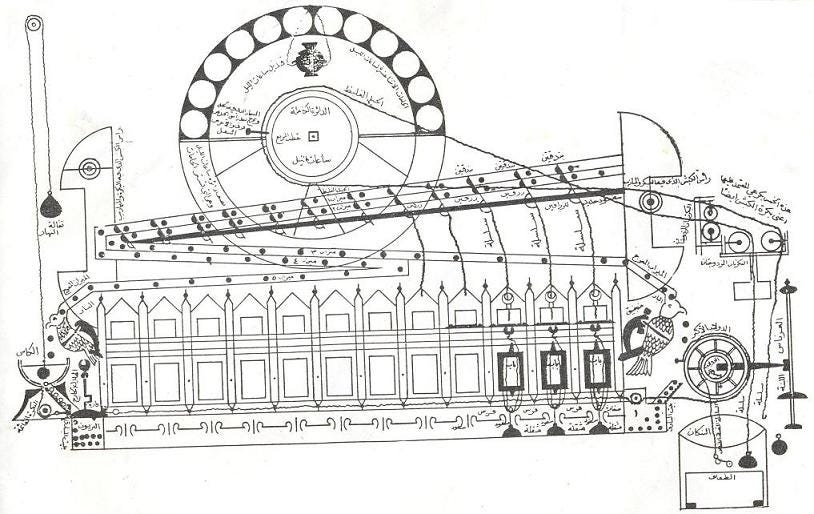
The 12th century Jayrun Water Clock
“The effect of the reduction in the variance of time measurement was felt everywhere”, Allen writes. Mechanical time opened up entirely new categories of economic organisation that had until then been not just impossible, but unimaginable. Mechanical time allowed trade and exchange to be synchronised across great distances. It allowed for production and transport to be coordinated. It allowed for the day to be structured, for work to be compensated according to the amount of time worked — and for workers to know that they were being compensated fairly. Both employers and employees could look at a standard, independent instrument to verify that a contract had been performed.
Complete and incomplete smart contracts
Oliver Williamson and Ronald Coase (who was also an economics Nobel prize winner, in 1991) put contracts at the heart of economic and business organisation. Contracts are at the centre of institutional cryptoeconomics. It is here that blockchains have the most revolutionary implications.
Smart contracts on the blockchain allows for contractual agreements to be automatically, autonomously, and securely executed. Smart contracts can eliminate an entire class of work that currently maintains, enforces and confirms that contracts are executed — accountants, auditors, lawyers, and indeed much of the legal system.
But the smart contracts are limited by what can be specified in the algorithm. Economists have focused on the distinction between complete and incomplete contracts.
A complete contract specifies what is to occur under every possible contingency. An incomplete contract allows the terms of the contract to be renegotiated in the case of unexpected events. Incomplete contracts provide one explanation for why some exchanges take place in firms, and why others take place in markets, and provides a further guide to questions surrounding vertical integration and the size of the firm.
Complete contracts are impossible to execute, while incomplete contracts are expensive. The blockchain, though smart contracts, lowers the information costs and transactions costs associated with many incomplete contracts and so expands the scale and scope of economic activity that can be undertaken. It allows markets to operate where before only large firms could operate, and it allows business and markets to operate where before only government could operate.
The precise details of how and when this will occur is a challenge and a problem for entrepreneurs to resolve. Currently, oraclesprovide a link between the algorithmic world of the blockchain and the real world, trusted entities that convert information into data that can be processed by a smart contract.
The real gains to be made in the blockchain revolution, we suggest, are in developing better and more powerful oracles — converting incomplete contracts to contracts that are sufficiently complete to be written algorithmically and executed on the blockchain.
The merchant revolution of the middle ages was made possible by the development of merchant courts — effectively trusted oracles — that allowed traders to enforce agreements privately. For blockchain, that revolution seems yet to come.
Whither government?
The blockchain economy puts pressure on government processes in a whole host of ways, from taxation, to regulation, to service delivery.
Investigating these changes is an ongoing project of ours. But consider, for instance, how we regulate banks.
Prudential controls have evolved to ensure the safety and soundness of financial institutions that interact with the public. Typically these controls (for example, liquidity and capital requirements) have been justified by the fact that depositors and shareholders are unable to observe the bank’s ledger. The depositors and shareholders are unable to discipline the firm and its management.
Bank runs occur when depositors discover (or simply imagine) that their bank might not be able to cover their deposits, and they rush to withdraw their money.

The bank run in Mary Poppins (1964)
One possible application of the blockchain would allow depositors and shareholders to continuously monitor the bank’s reserves and lendings, substantially eliminating the information asymmetries between them and the bank management.
In this world, market discipline would be possible. Public trust in the immutability of the blockchain would ensure no false bank runs occurred. The role of the regulator might be limited to certifying the blockchain was correctly and securely structured.
A more far reaching application would be a cryptobank— an autonomous blockchain application that borrows short and lends long, perhaps matching borrowers with lenders directly. A cryptobank structured algorithmically by smart contracts would have the same transparency properties as the bank with a public blockchain ledger but with other features that might completely neglect the need for regulators. For example, a cryptobank could be self-liquidating. At the moment the cryptobank began trading while insolvent, the underlying assets would be automatically disbursed to shareholders and depositors.
It is unclear what regulatory role government should have in this world.
Tyler Cowen and Alex Tabarrok have argued that much government regulation appears to be designed to resolve asymmetric information problems — problems that, in a world of information ubiquity, often do not exist any more. Blockchain applications significantly increase this information ubiquity, and make that information more transparent, permanent, and accessible.
Blockchains have their uses in what is being called ‘regtech’— the application of technology to the traditional regulatory functions of auditing, compliance, and market surveillance. And we ought not to dismiss the possibility that there will be new economic problems that demand new consumer protections or market controls in the blockchain world.
Nevertheless, the restructuring and recreation of basic economic forms like banks will put pressure not just on how regulation is enforced, but what the regulation should do.
Whither Big Business?
The implications for big business are likely to be just as profound. Business size is often driven by the need to cover the costs of business hierarchy — in turn due to incomplete contracts and technological necessity of large scale financial investment. That business model has meant that shareholder capitalism is the dominant form of business organisation. The ability to write more complete contracts on the blockchain means that entrepreneurs and innovators will be able to maintain ownership and control of their human capital and profit at the same time. The nexus between operating a successful business and access to financial capital has been weakening over time, but now might even be broken. The age of human capitalism is dawning.
Entrepreneurs will be able to write a valuable app and release it into the “wild” ready to be employed by anyone and everyone who needs that functionality. The entrepreneur in turn simply observe micro-payments accumulating in their wallet. A designer could release their design into the “wild” and final consumers could download that design to their 3D printer and have the product almost immediately. This business model could see more (localised) manufacturing occur in Australia than at present.
The ability of consumers to interact directly with producers or designers will limit the role that middlemen play in the economy. Logistics firms, however, will continue to prosper, but the advent of driverless transportation will see disruption to industry too.
Bear in mind, any disruption of business will also disrupt the company tax base.It may become difficult for government to tax business at all — so we might see greater pressure on sales (consumption) taxes and even poll taxes.
Conclusion
The blockchain and associated technological changes will massively disrupt current economic conditions. The industrial revolution ushered in a world where business models were predicated on hierarchy and financial capitalism. The blockchain revolution will see an economy dominated by human capitalism and greater individual autonomy.
How that unfolds is unclear at present. Entrepreneurs and innovators will resolve uncertainty, as always, through a process of trial and error. No doubt great fortunes will be made and lost before we know exactly how this disruption will unfold.
Our contribution is that we have a clear understanding of a model that can be deployed to provide clarity to the disruption as and when it occurs.