
June 2017 Journal
WORDS is a monthly journal of Bitcoin commentary. This issue collects the June 2017 writing in the WORDS archive. For the uninitiated, getting up to speed on Bitcoin can seem daunting. Content is scattered across the internet, in some cases behind paywalls, and content has been lost forever. That’s why we made this journal, to preserve and further the understanding of Bitcoin.
Crypto Tokens: A Breakthrough in Open Network Design
By Chris Dixon
Posted June 1, 2017
It is a wonderful accident of history that the internet and web were created as open platforms that anyone — users, developers, organizations — could access equally. Among other things, this allowed independent developers to build products that quickly gained widespread adoption. Google started in a Menlo Park garage and Facebook started in a Harvard dorm room. They competed on a level playing field because they were built on decentralized networks governed by open protocols.
Today, tech companies like Facebook, Google, Amazon, and Apple are stronger than ever, whether measured by market cap, share of top mobile apps, or pretty much any other common measure.
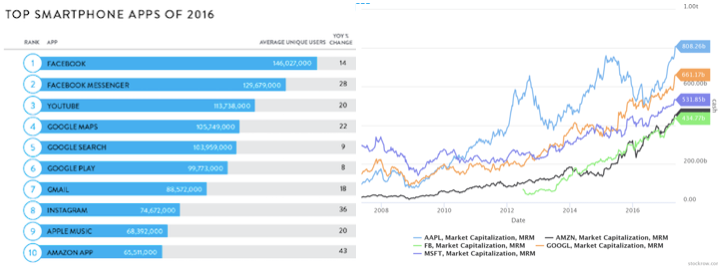
Big 4 tech companies dominate smartphone apps (source); while their market caps continue to rise (source)
These companies also control massive proprietary developer platforms. The dominant operating systems — iOS and Android — charge 30% payment fees and exert heavy influence over app distribution. The dominant social networks tightly restrict access, hindering the ability of third-party developers to scale. Startups and independent developers are increasingly competing from a disadvantaged position.
A potential way to reverse this trend are crypto tokens — a new way to design open networks that arose from the cryptocurrency movement that began with the introduction of Bitcoin in 2008 and accelerated with the introduction of Ethereum in 2014. Tokens are a breakthrough in open network design that enable: 1) the creation of open, decentralized networks that combine the best architectural properties of open and proprietary networks, and 2) new ways to incentivize open network participants, including users, developers, investors, and service providers. By enabling the development of new open networks, tokens could help reverse the centralization of the internet, thereby keeping it accessible, vibrant and fair, and resulting in greater innovation.
Crypto tokens: unbundling Bitcoin
Bitcoin was introduced in 2008 with the publication of Satoshi Nakamoto’s landmark paper that proposed a novel, decentralized payment system built on an underlying technology now known as a blockchain. Most fans of Bitcoin (including me) mistakenly thought Bitcoin was solely a breakthrough in financial technology. (It was easy to make this mistake: Nakamoto himself called it a “p2p payment system.”)
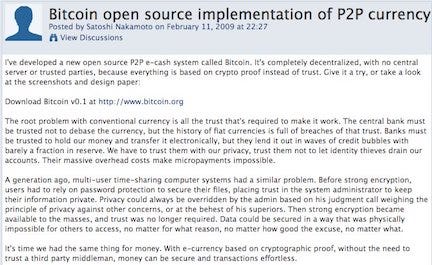
2009: Satoshi Nakamoto’sforum postannouncing Bitcoin
In retrospect, Bitcoin was really two innovations: 1) a store of value for people who wanted an alternative to the existing financial system, and 2) a new way to develop open networks. Tokens unbundle the latter innovation from the former, providing a general method for designing and growing open networks.
Networks — computing networks, developer platforms, marketplaces, social networks, etc — have always been a powerful part of the promise of the internet. Tens of thousands of networks have been incubated by developers and entrepreneurs, yet only a very small percentage of those have survived, and most of those were owned and controlled by private companies. The current state of the art of network development is very crude. It often involves raising money (venture capital is a common source of funding) and then spending it on paid marketing and other channels to overcome the “bootstrap problem” — the problem that networks tend to only become useful when they reach a critical mass of users. In the rare cases where networks succeed, the financial returns tend to accrue to the relatively small number of people who own equity in the network. Tokens offer a better way.
Ethereum, introduced in 2014 and launched in 2015, was the first major non-Bitcoin token network. The lead developer, Vitalik Buterin, had previously tried to create smart contract languages on top of the Bitcoin blockchain. Eventually he realized that (by design, mostly) Bitcoin was too limited, so a new approach was needed.
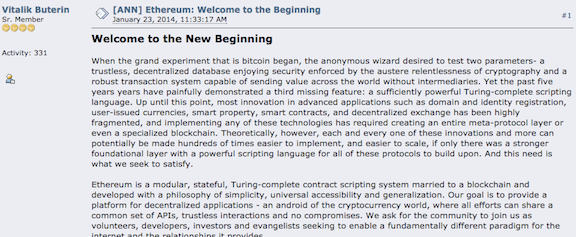
2014: Vitalik Buterin’sforum postannouncing Ethereum
Ethereum is a network that allows developers to run “smart contracts” — snippets of code submitted by developers that are executed by a distributed network of computers. Ethereum has a corresponding token called Ether that can be purchased, either to hold for financial purposes or to use by purchasing computing power (known as “gas”) on the network. Tokens are also given out to “miners” which are the computers on the decentralized network that execute smart contract code (you can think of miners as playing the role of cloud hosting services like AWS). Third-party developers can write their own applications that live on the network, and can charge Ether to generate revenue.
Ethereum is inspiring a new wave of token networks. (It also provided a simple way for new token networks to launch on top of the Ethereum network, using a standard known as ERC20). Developers are building token networks for a wide range of use cases, including distributed computing platforms, prediction and financial markets, incentivized content creation networks, and attention and advertising networks. Many more networks will be invented and launched in the coming months and years.
Below I walk through the two main benefits of the token model, the first architectural and the second involving incentives.
Tokens enable the management and financing of open services
Proponents of open systems never had an effective way to manage and fund operating services, leading to a significant architectural disadvantage compared to their proprietary counterparts. This was particularly evident during the last internet mega-battle between open and closed networks: the social wars of the late 2000s. As Alexis Madrigal recently wrote, back in 2007 it looked like open networks would dominate going forward:
In 2007, the web people were triumphant. Sure, the dot-com boom had busted, but empires were being built out of the remnant swivel chairs and fiber optic cables and unemployed developers. Web 2.0 was not just a temporal description, but an ethos. The web would be open. A myriad of services would be built, communicating through APIs, to provide the overall internet experience.
But with the launch of the iPhone and the rise of smartphones, proprietary networks quickly won out:
As that world-historical explosion began, a platform war came with it. The Open Web lost out quickly and decisively. By 2013, Americans spent about as much of their time on their phones
looking at Facebook
as they did the whole rest of the open web.
Why did open social protocols get so decisively defeated by proprietary social networks? The rise of smartphones was only part of the story. Some open protocols — like email and the web — survived the transition to the mobile era. Open protocols relating to social networks were high quality and abundant (e.g. RSS, FOAF, XFN, OpenID). What the open side lacked was a mechanism for encapsulating software, databases, and protocols together into easy-to-use services.
For example, in 2007, Wired magazine ran an article in which they tried to create their own social network using open tools:
For the last couple of weeks, Wired News tried to roll its own Facebook using free web tools and widgets. We came close, but we ultimately failed. We were able to recreate maybe 90 percent of Facebook’s functionality, but not the most important part — a way to link people and declare the nature of the relationship.
Some developers proposed solving this problem by creating a database of social graphs run by a non-profit organization:
Establish a non-profit and open source software
(with copyrights held by the non-profit) which collects, merges, and redistributes the graphs from all other social network sites into one global aggregated graph. This is then made available to other sites (or users) via both public APIs (for small/casual users) and downloadable data dumps, with an update stream / APIs, to get iterative updates to the graph (for larger users).
These open schemes required widespread coordination among standards bodies, server operators, app developers, and sponsoring organizations to mimic the functionality that proprietary services could provide all by themselves. As a result, proprietary services were able to create better user experiences and iterate much faster. This led to faster growth, which in turn led to greater investment and revenue, which then fed back into product development and further growth. Thus began a flywheel that drove the meteoric rise of proprietary social networks like Facebook and Twitter.
Had the token model for network development existed back in 2007, the playing field would have been much more level. First, tokens provide a way not only to define a protocol, but to fund the operating expenses required to host it as a service. Bitcoin and Ethereum have tens of thousands of servers around the world (“miners”) that run their networks. They cover the hosting costs with built-in mechanisms that automatically distribute token rewards to computers on the network (“mining rewards”).
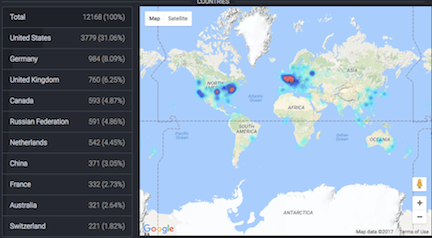
There are over 20,000 Ethereum nodes around the world (source)
Second, tokens provide a model for creating shared computing resources (including databases, compute, and file storage) while keeping the control of those resources decentralized (and without requiring an organization to maintain them). This is the blockchain technology that has been talked about so much. Blockchains would have allowed shared social graphs to be stored on a decentralized network. It would have been easy for the Wired author to create an open social network using the tools available today.
Tokens align incentives among network participants
Some of the fiercest battles in tech are between complements. There were, for example, hundreds of startups that tried to build businesses on the APIs of social networks only to have the terms change later on, forcing them to pivot or shut down. Microsoft’s battles with complements like Netscape and Intuit are legendary. Battles within ecosystems are so common and drain so much energy that business books are full of frameworks for how one company can squeeze profits from adjacent businesses (e.g. Porter’s five forces model).
Token networks remove this friction by aligning network participants to work together toward a common goal— the growth of the network and the appreciation of the token. This alignment is one of the main reasons Bitcoin continues to defy skeptics and flourish, even while new token networks like Ethereum have grown along side it.
Moreover, well-designed token networks include an efficient mechanism to incentivize network participants to overcome the bootstrap problem that bedevils traditional network development. For example, Steemit is a decentralized Reddit-like token network that makes payments to users who post and upvote articles. When Steemit launched last year, the community was pleasantly surprised when they made their first significant payout to users.
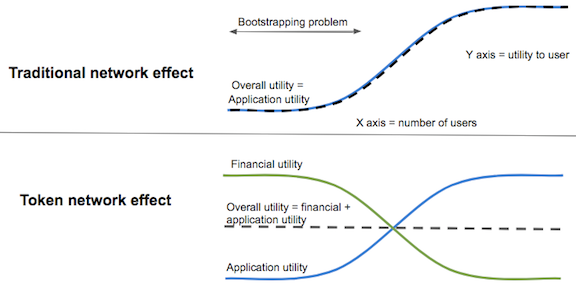
Tokens help overcome the bootstrap problem by adding financial utility when application utility is low
This in turn led to the appreciation of Steemit tokens, which increased future payouts, leading to a virtuous cycle where more users led to more investment, and vice versa. Steemit is still a beta project and has since had mixed results, but was an interesting experiment in how to generalize the mutually reinforcing interaction between users and investors that Bitcoin and Ethereum first demonstrated.
A lot of attention has been paid to token pre-sales (so-called “ICOs”), but they are just one of multiple ways in which the token model innovates on network incentives. A well-designed token network carefully manages the distribution of tokens across all five groups of network participants (users, core developers, third-party developers, investors, service providers) to maximize the growth of the network.
One way to think about the token model is to imagine if the internet and web hadn’t been funded by governments and universities, but instead by a company that raised money by selling off domain names. People could buy domain names either to use them or as an investment (collectively, domain names are worth tens of billions of dollars today). Similarly, domain names could have been given out as rewards to service providers who agreed to run hosting services, and to third-party developers who supported the network. This would have provided an alternative way to finance and accelerate the development of the internet while also aligning the incentives of the various network participants.
The open network movement
The cryptocurrency movement is the spiritual heir to previous open computing movements, including the open source software movement led most visibly by Linux, and the open information movement led most visibly by Wikipedia.
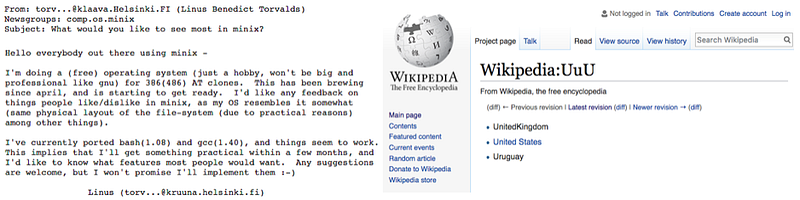
1991: Linus Torvalds’ forumpostannouncing Linux; 2001: the first Wikipediapage
Both of these movements were once niche and controversial. Today Linux is the dominant worldwide operating system, and Wikipedia is the most popular informational website in the world.
Crypto tokens are currently niche and controversial. If present trends continue, they will soon be seen as a breakthrough in the design and development of open networks, combining the societal benefits of open protocols with the financial and architectural benefits of proprietary networks. They are also an extremely promising development for those hoping to keep the internet accessible to entrepreneurs, developers, and other independent creators.
The Token Frenzy and its Impact on Venture Capital Thinking
By Beautyon
Posted June 6, 2017

Something historic and very interesting is happening right now with what we are calling The Token Frenzy. There is no way that Satoshi could have predicted what’s happening now when he released Bitcoin, but it is actually happening, and this Token Frenzy, like “Blockchain not Bitcoin” mania before it, is having a negative effect on businesses trying to penetrate, create a new market and grow. This negative effect will be short lived thankfully, but no rational man wants to waste time teaching people how to drink out of a glass, and they don’t want to see people get hurt through losing their money to irrational exuberance.
We received a letter today from a company interested in investing in new ideas. This company is run by men who have no idea about the fundamentals driving the excitement fuelling interest in Bitcoin, and who get all their information from the wrong sources. They are explicitly looking for, “people who are reinventing the building blocks of the internet using the principles of distributed computing through blockchain technology”.
If you have read and understood any of my writing on this subject, you are now triggered. I’ll take this letter apart piece by piece. As usual, it doesn’t matter who said this. What matters is that it is an example of thinking that we’re seeing again and again; it is essentially a generic response. The sender says they are interested in companies that are…
reinventing the building blocks of the internet
First of all, the building blocks of the internet are its low level protocols. These will not be disrupted any time soon. Everyone has built on top of them, and if it happens at all, it will take decades for the underlying infrastructure to be replaced, and that will only happen if there is a real need. Look at IPV6 for an example of that. Also, there is no money in it. The only way you could make money out of a new internet protocol is if you did what Apple tried to do with “itms://” — widely recognised as a strategic blunder. Internet protocols need to be open, the property of no one, and not under the control of any single country or jurisdiction. Looking for someone to bring this to you is like saying you are waiting for someone to bring you the Philosopher’s Stone.
using the principles of distributed computing
Distributed computing has been around for a long time. Anyone who ran Stanford’s Folding at Home software knows how it works. It’s useful, and can solve big problems, but it is not a replacement for the underlying architecture of the internet, and cannot be used to make new building blocks or replace old ones. The best you can do to add new services to the Internet is add a layer on top. Once you concede that is the only way to contribute, then the only rational choice is Bitcoin, because it is the only fundamentally new idea that adds a crucial, world-changing missing layer to the Internet; money.
through blockchain technology
There is no such thing as “blockchain technology”. There is only software. There is no blockchain without Bitcoin. If you have been reading my Medium posts on this subject you know this is true.
The triggering in this letter continues, “There are plenty of onramps for Bitcoin already which we agree will be the onramps to the the crytpocurrency ecosystem. They certainly could be more user friendly and their are opportunities to build an application layer that is more approachable, akin to what Netscape did tot he internet and browsers. We are just much more interested in funding what happens after that event occurs”
Oh dear me.

There are plenty of onramps for Bitcoin already which we agree will be the onramps to the the crytpocurrency ecosystem.
No, there are not “plenty of on-ramps”. There are very few on-ramps to Bitcoin, and most of them are hideously complicated, slow and invasive. It is a fact that Coinbase, one of the worst offenders, has a staggering backlog of 400,000 new users in their account “verification” and activation queue. There are almost no easy on-ramps to Bitcoin, and the ones that are easiest to use charge up to 20% for the privilege of using their services. The on-ramps of today are absolutely horrible, and ripe for total disruption. Anyone who knows what they are talking about understands this. The amount of friction on the Bitcoin on-ramps is so great, that it’s amazing that anything can touch the surface of them, such is the heat generated by the rubbing.
Several companies are working on solving this problem; Azteco and HodlHodl are two of them. Both of these companies are streamlining and removing friction from the process of getting Bitcoin, and making access to it so simple that literally anyone can do it, and in the case of Azteco, do it with a delay that is close to 0 minutes. That is disruptive.
They certainly could be more user friendly and their are opportunities to build an application layer that is more approachable
If this is true, then there is an interesting market opportunity. There is a clear problem that even these people have identified, that the process of getting Bitcoin is not user friendly, and they have also identified that there is an opportunity to build an application layer that is consumer friendly. This means that in fact, “Yes, you have an idea, and this is a problem that needs to be solved”, to which the correct reply should be, “Lets discuss this in detail as soon as possible”.

akin to what Netscape did to he internet and browsers. We are just much more interested in funding what happens after that event occurs”
The Netscape analogy does not work here in the way they describe, and actually inadvertently makes a case for Azteco. Netscape built a browser that abstracts away the complexity of using the web from the user. Before browsers, people used to use terminal based tools to look around the early web. They were hard to use. You didn’t use a mouse to navigate; it was all done via keyboard shortcuts.
Then the first browser NCSA Mosaic came along, pushing all the complexity away so that anyone could use the web. Going to an ftp site meant clicking on an ftp://foo.bar link, rather than opening an ftp only command line curses tool. Everything was now in one place, handling all file types, protocols and all the services built on them, with a point and click interface.
This is coming with Bitcoin. Right now, getting Bitcoin means engaging in a process that is far worse than using WAIS or Lynx. It’s worse because not only is the experience horrible, but you have to submit to the violation of your personal data, and agree to a custodian potentially arbitrarily denying you network access. Users of Lynx never had to put up with those bad things, all they had to do was learn some keyboard short cuts.
Azteco, and the products we have planned, will be the equivalent of the browser transition from Lynx to Netscape. Tools like OpenDime will make storage extraordinarily simple. We make getting and using Bitcoin extremely simple, so that everyone can use it, just like Mosaic and later Netscape made using the web simple enough for everyone. This is a large market opportunity, obviously, and it is bigger than Netscape’s was because we are not dealing exclusively with access to information; we are dealing with access to money, the reserve currency of the entire internet: Bitcoin.
We are just much more interested in funding what happens after that event occurs
Assuming for a moment that there is something coming after this Straw Man construction (which there cannot be) how are you going to be able to spot it, if you don’t understand the fundamentals in the first place? In order for the event you are waiting to occur to happen, someone has to build and concentrate the fundamental elements that will make the critical mass event take place. What this person is saying, is that they can understand the potential of Netscape, but don’t want to invest in it until the browser revolution has happened. This is not rational, obviously.
There is nothing wrong with a “wait and see” position. Conservatism and being risk averse is sensible, however, you cannot say you are interested in fundamental disruption and be conservative and risk averse at the same time. If we are to take this letter at face value, you must understand that you only have one chance to get in at the beginning of the construction of fundamental technologies. That means embracing risk, preparing to fail, embracing the unfamiliar and being reflexively attracted to ideas that seem strange or wrong on their faces, but for which there is no obvious objection and there is a working application.

Which brings us back to the Token Frenzy. The people who are investing in these Tokens and the start ups selling them are all making a huge error in calculation, but they are absolutely correct in the larger calculation of embracing the big risk. In super complex software systems (and in this case, it’s not just complex software, but economics and investing that most people don’t fully grasp) that only a handful of experts comprehend, it isn’t possible for everyone getting involved in them to understand the fundamentals. They use proxies to determine what is right and wrong, and these proxies are normally pseudo experts with a fractional hold on the total picture.
These pundits, “Tech Oracles”, understand (mostly pretend to understand) the underlying software that powers these ideas. They condense, or chew, the ideas into easy bites that are then swallowed whole by people with spare money who are looking to make high returns on investments. The Token Frenzy is exactly this, and it is having an effect not only on investors looking to buy into high performance instruments, but it is having an effect on a few Venture Capitalists, who appear to be as rudderless and adrift as anyone else trying to understand the sea change that is happening. The only difference between these two groups is the amount of money they have to invest.
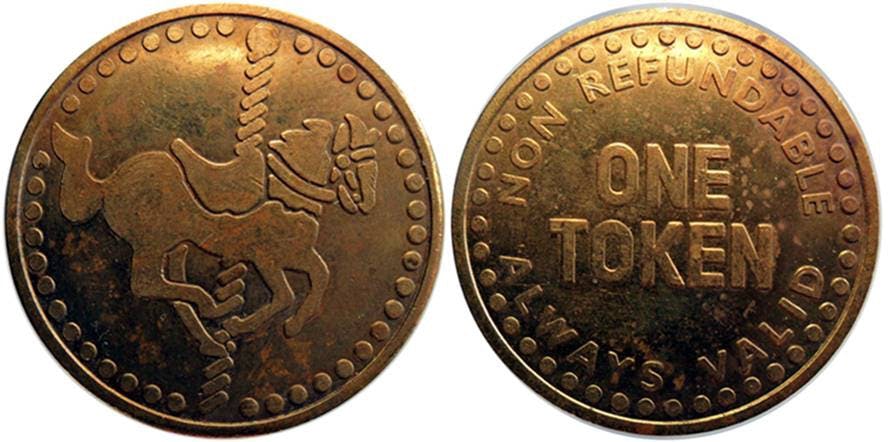
During the “Blockchain not Bitcoin” frenzy, companies built by rational entrepreneurs could not get anyone to pay attention to them because the word “Bitcoin” was in their promotional and public facing materials. People wrote them off simply because a taboo word was on display. There was no consideration or understanding of what was built, how it worked or the underlying principles; it was all feelings, impressions, gut, and what the Tech Oracles were saying that counted.
Now that Bitcoin is still here, and having a meteoric rise, the word “Bitcoin” is no longer taboo, and its proposition is accepted, even by mainstream thinkers who previously scoffed at it. It is very important in software to know something about how things actually work. It’s the only way to make sense of what is going on, and to properly assess any business model and its potential. Thankfully, the tide is changing:
Important people have finally begun to realise that the innovation is Bitcoin, Blockchain without Bitcoin makes no sense at all, and trying to remove Bitcoin from “The Blockchain” is just a fantasy. In parallel, people are waking up tot he fact that Bitcoin is not a threat or in any way dangerous. It’s simply another tool that can be used in an innumerable permutation of ways, just like a screwdriver, water or the English language. The question is no longer “What is Bitcoin?” but “How do you design an optimal service to deliver Bitcoin to the public?”. We have answered that question with Azteco.
As it has been for decades, after the pioneers have showed everyone what is possible, there is not a single person left who will scoff at a radical idea. A perfect example of this is Steve Balmer scoffing at the first iPhone, and the others who laughed out loud at the idea of a mobile phone without any buttons on it. Now the idea of a mobile phone with buttons on it is the butt of jokes. The same thing will happen with Bitcoin, and everyone will understand that the models presented by Ethical Bitcoin Companies are the correct ones, both in terms of business model, and the rigorous, innovative approaches to this fundamental addition to our internet toolbox: the one Internet native money, Bitcoin.
Send Internet Tokens (AKA Bitcoin) to this address ↴

Bitcoin seems to become mainstream
By Marc van der Chijs
Posted June 7, 2017
.entry-header
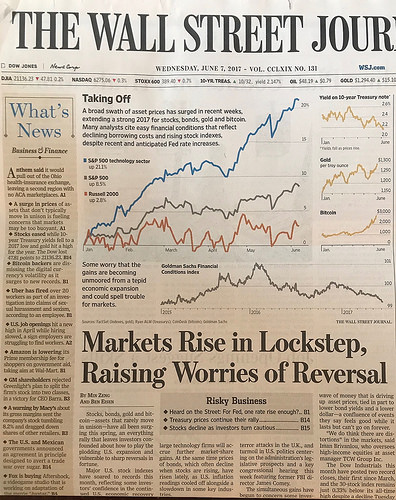
Over the past couple of months the Bitcoin price exploded, from around $1000 in early January to almost $3000 earlier this week. The price increase not only leads to more people being aware of the cryptocurrency, but also to mainstream financial media taking it more serious. This morning I was very surprised to see that the Wall Street Journal casually mentioned on its front page the four asses classes stocks, bonds, gold and bitcoin! That is huge, as far as I know that has never happened before. Bitcoin has come a long way, happy to see it’s becoming a lot more mainstream.
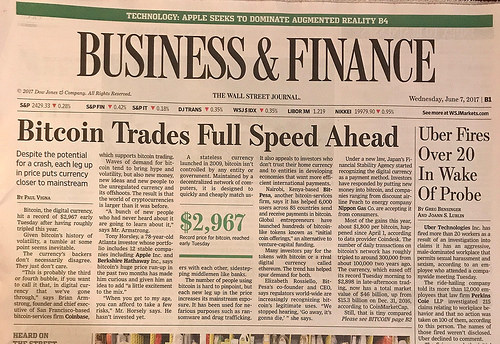
Going to the Business & Finance section of today’s WSJ, my surprise got even bigger when I saw the title of the main article on the front page of that section “Bitcoin Trades Full Speed Ahead”. Wow… For years I have told people why Bitcoin won’t go away, why it is so valuable, and why people should invest 5% of their net assets in it. For years most people did not want to listen, but at least the ones that listened made incredible money on their bitcoin investments. And then all of a sudden the WJS puts bitcoin in the same league as stocks, bonds, and gold! This really made my day.
By the way, I still believe bitcoin is undervalued and the bitcoin price will go up a lot more. If you follow my Twitter feed this is no news to you, I have been telling people for years to keep buying bitcoin and also told them to buy Ethereum and Ethereum Classic in early February (people who did that made $15,000-$20,000 for every $1000 they invested – in just 4 months).
But what will happen to the bitcoin price now that it’s at almost $3000? Is this a bubble? I wrote an article about this earlier this week to the investors in First Block Capital, the management company that runs several bitcoin and altcoin funds. I copy/paste the article below with some small changes to avoid that this is seen as marketing for our own funds (it is not of course, it is my personal opinion that anybody can agree or disagree with).
—
Cryptomarket overview
Since we closed our investment round in late April the cryptomarket suddenly went into exponential growth mode. Bitcoin grew from $1360 in late April to about $2700 in late May, before bouncing back to about $2000 and then growing back to $2900 at the time of writing (June 5). Altcoins have seen even stronger growth, with not only the smallcap coins but even some of the larger coins such as Ripple, Ethereum, and Ethereum Classic exploding in value. Daily price increases of 30-50% were not uncommon for some of these coins during this period.
What is behind this trend, specifically for Bitcoin? Is it a bubble? Yes and no, growth rates of consistently more than 10% per day are highly unusual and normally a clear sign of a bubble. That’s why I was quite happy to see Bitcoin go down 25% in 2 days around May 25. After this cooling off period slower growth started immediately, showing that nobody had lost appetite in Bitcoin yet. After about a week the price was back at $2500 and then over the past 2 days the price started increasing with about 10% per day.
The reason for the fast growth is simply supply and demand. The bitcoin supply is fixed at 21 million coins, and currently about 16.4 million coins have been mined. The rate of growth in coins is decreasing and only 4.6 million more will ever be created. At the same time more people hear about Bitcoin. People who may have dismissed it a few years ago are surprised Bitcoin is still around and growing faster than ever. Suddenly they realize they may have been wrong all along or they may still not get it, but want to at least hedge their bets. So they want to own a Bitcoin themselves. When not enough new coins are created and nobody is selling (most Bitcoin holders are so called HODLers – they “Hold On for Dear Life” in the Bitcoin rollercoaster) the price will automatically go up until someone feels enticed to sell.
And what happens if the price goes up? More people hear about it and want to own a coin as well, leading to even faster growth. This is what happened in May and what will happen very soon again. There are just not enough coins available and demand is going through the roof. Bitcoin exchange Coinbase added 400,000 users just in May this year. The average waiting time to get approved by an exchange is up to 3-4 weeks for most exchanges. All these people will talk to their friends after they made 20% profit in just a few days, and then some of their friends will want to get into the game as well.
A bubble, yes, but not an unsustainable one. Look in your direct circle of friends or family, likely most of you will not have more than 2 or 3 good friends or family members that hold Bitcoin. That means most people you know have not even thought about buying coins, let alone really bought them. That’s not the sign of a bubble. Institutional money is not even in the game yet, simply because most funds can’t invest directly in Bitcoin (we are working on solving that!). Or think about it this way, the US has about 11 million millionaires. If all of them wanted to have just one Bitcoin that would be impossible. There are only 4.6 million coins left, prices would likely have to go into the hundreds of thousands of dollars per coin to convince enough people to sell.
Some people may say that Bitcoin prices of $2500 are crazy, but I don’t agree. I have been in the market since prices were below $100 and each time the price hit a new psychological hurdle people said that Bitcoin was overpriced. At those lower prices I was never fully convinced whether Bitcoin would make it and whether the prices reflected the real value of Bitcoin. But the longer Bitcoin survived, the more I realized how resilient it is. Now that the public is finally waking up to Bitcoin I believe the currency is suddenly very undervalued. I have seen the fast growth from $100 to $1000, I have seen the crash from $1000 to $200, followed by the slow growth back to $1000. I have then seen the fast growth from $1000 to 3000, I am now fully convinced we may see $5000 quite soon and potentially even $10,000 later this year. And after that? Nobody knows. But if Wall Street gets into the game and if people really start treating Bitcoin as digital gold prices of $100,000 or more are very well possible. We will get lots of crashes in between, it won’t be straight growth. But keep in mind that you should HODL – don’t sell your coins in a sudden panic wave of sell orders.
There are still some risks, but they are getting smaller. The biggest risk is still how to keep your coins safe, and that is what First Block Capital will help its investors with. Later this month we will go live with a campaign on FrontFundr so Canadian retail investors can invest in Bitcoin as well. A self fulfilling prophecy? Partly, but a prophecy in which I believe completely.
Next time some more information on some of the major alt coins that we plan to invest in through our hedge fund and what I see happening there. Always feel free to get in touch with remarks or questions and keep in mind I intentionally left a lot of information out (Segwit and Hard Fork anyone?). Happy crypto investing!
Marc van der Chijs
June 5, 2017
—
.entry-content
Published
June 7, 2017
.post-author-bottom
.entry-meta
Coup You
By Beautyon
Posted June 9, 2017
The key to ruling Bitcoin is control of the Reference Client. Once you are in charge of that, you have de facto control over all of Bitcoin. You can add features, remove them, centralize it, or change its essential character completely. Once you control the reference client, you can steer Bitcoin’s destiny. This power in Bitcoin is maintained through control of access to the software “repository” stored on GitHub.
GitHub is where additions and changes to Bitcoin are coordinated. Changes can only be made by people who have been granted “commit access”, meaning permission given to them by the owners to add or remove code from the source used to compile new versions of the Reference Client. It is the Reference Client that defines and enforces all the rules that make up the Bitcoin protocol which is Bitcoin.
There have been three attempts to control Bitcoin by stealing its reigns through the launch of a new reference client:
- Bitcoin-XT (Mike Hearn MI5)
- Bitcoin Classic (Gavin Andressen CIA)
- Bitcoin Unlimited (Roger Ver Starbucks)
“Bitcoin-XT” was designed to increase the block size radically, introduce address blacklists and other nefarious ant-Bitcoin things, to stop what Hearn famously called, “Anarchist Jive”.
“Bitcoin Classic” was a similar attempt, to introduce centralizing policies by increasing the block size, after which, full government controls could be added by legislation targeted at companies offering access to third partites. You can read about this in “The Bitcoin Gauntlet”.
“Bitcoin Unlimited” was an attempt to put Bitcoin on a block size increase regime to pull the ladder up for new market entrants needing to run a full node, remove Bitcoin Core as the steering group for the Bitcoin protocol and remove the need for incumbents to re-write their software platforms to accommodate Segregated Witness.
All three of these attempts failed.
Now “BTC1” is the latest attempt to steal control of Bitcoin by introducing a non compliant reference client clone. It is being developed in a new repository on GitHub. The aim of this BTC1 client is to:
- Seize control of the Reference Implementation by substitution.
- Centralize Bitcoin by increasing the Block Size parameter.
- Permanently remove and exclude Bitcoin Core from its role as sole steering group for all future Bitcoin Reference development.
In order for this latest coup attempt to succeed, the majority of users running a full node need to stop the version of Bitcoin Core (or compliant variants) they are currently operating, install BTC1 and then run it instead of Bitcoin Core.
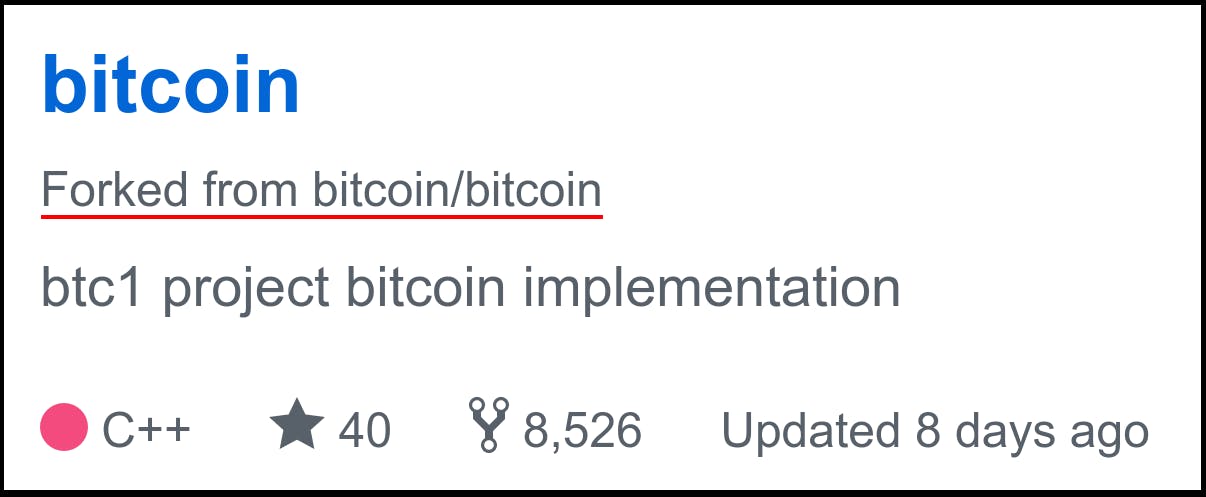
Screen grab from the GitHub page of BTC1, clearly showing BTC1 is forked from bitcoin. Calling BTC1 “Bitcoin” is not honest. Other implementations use unique names as shown above, to differentiate themselves from other projects, and BTC1, were its motives clean would do exactly the same and use a distinct name.
Once they do that, then BTC1 would be the reference client, and all changes to it going forward would have to come from their repository on GitHub. Bitcoin Core’s developers, who do not have access to that repository, would cease to be able to steer the protocol.
Even if Bitcoin Core’s developers were given commit access after BTC1 became the default, they would not be able to reverse the damage done by BTC1 and their non compliant SegWit+2M software fork. We would be on the road to an ever increasing block size forever, and a centralized Bitcoin.
BTC1 becoming the reference client would mean business preferring not to do the hard work of building on the advantages provided by Segregated Witness could do so without consequence. Having seized control of Bitcoin’s development, they can keep increasing the block size parameter by any arbitrary amount they choose, and expand the network’s capacity in that way, rather than through the intelligent and long horizon increases provided by Segregated Witness and other planned efficiencies and innovations.
This would result in a Bitcoin where there would be no incentive to write SegWit into their existing services, because Bitcoin would, on the surface, work exactly as it did in its early days. It would also have other advantages for incumbents to charge new companies for access to the Bitcoin block chain, since hosting a full copy would be prohibitively expensive in hardware and bandwidth.
Note also, how “BTC1” is not making the mistake its predecessors made, by re-naming its work to “Bitcoin-X”. They are going to attempt to claim that this clone is actually Bitcoin, which of course, it will not be; it will be a copy or fork of the true reference client, whose sole purpose is to supplant and usurp the ethical developers of Bitcoin Core. They are also hijacking the name “SegWit”, and replacing Core’s BIP141 with a bastardized version of their own.
Bearing all of this in mind, obviously you should not ever run BTC1, since it is not Bitcoin and exists only as a means of perpetrating a coup. If you have a stake in Bitcoin or are interested in the long term strength and proposition of Bitcoin, you should also not run BTC1 when it is finally released, pour encourager les autres. These coup attempts are wastes of time; thankfully the market pays no attention to them, and they have no effect on the price. No matter what anyone proposes or what software they write, if no one runs the code, it has no effect on anything. Software is not about feelings or voting. It is about how many people are running your code.
BTC1 is unethical. Its motives are not honest, and it is clearly using deception to move Bitcoin into the big block direction, by shutting out Bitcoin Core. This is a subtle form of “Bait and Switch”. What BTC1 is proposing seems reasonable on the surface; get everyone on board, reach “consensus”, heal the divisions, and move Bitcoin forward. Its all lies, of course. What they really want is to kill Bitcoin Core and make SegWit into a distraction wile the block size increases and centralized Bitcoin is born. This is an aggressive attempt, just like the last three, to steal Bitcoin.
By August 1st the UASF (User Activated Soft Fork) will have happened. Whilst personally I don’t like the idea of mobs dictating how software is written, this is an emergency created by an imbalance in Bitcoin’s incentives. A single miner has so much power that they can block the activation of SegWit, so they can continue to collect high fees. This is an intolerable hostage situation, obviously, that merits a strong emergency reaction, and that is what UASF is. Once SegWit activates, there will be no need for any more actions like UASF, and the transaction rate floodgates will open. In any case, large issues like this may become less frequent as time goes on.
Very few can keep up with BIPS and the rapid rate of development in Bitcoin: and its going to get worse. One dedicated, ethical, selfless, trusted team is needed, Bitcoin Core, to guard the reference from bad actors, Ambulance Chasers and “Caffeinds” (caffeine fiends). When the transaction rate is higher than VISA and MasterCard combined, and pennies per transaction, everyone will be back to developing business models and software, rather than trying to perpetually explain why you can’t fit two pints of bitter into a one pint glass.
Thanks to @MediumSqueeze and @AnselLindner for fact checking this post.
100 Double Espresso…because the fees are too damn high.↴

Tokenomics — A Business Guide to Token Usage, Utility and Value
By William Mougayar
Posted June 10, 2017

Despite the incredible amount of attention and material written about cryptocurrency tokens, there hasn’t been a good mainstream definition of what they are. In the technical realm of the blockchain, the concept of a cryptocurrency token is well understood. It represents a programmable currency unit that is bolted to a blockchain, and is part of smart contract logic in the context of a specific software application. But in the non-technical arena, what is a token, really?
A token is just another term for a type of privately issued currency. Traditionally, sovereign governments issued currency and set its terms and governance; in essence directing how our economy works with money as the exchange medium for value. With the blockchain, we now have new types organizations (and soon, more of the existing type) who are issuing their own currency in the form of digital money as cryptocurrency, and they are setting their own terms and rules around its operations, in essence creating new self-sustainable mini-economies.
What was the purview of governments is now in the hands of the many.
In the business realm, we can define the token as:
A unit of value that an organization creates to self-govern its business model, and empower its users to interact with its products, while facilitating the distribution and sharing of rewards and benefits to all of its stakeholders.
The Achilles heel of token-based models will be how they are concocted to interact with the business model that underlies them. However, much of the attention has been on designing ICO’s to optimize for cryptoeconomics, a term that has come to describe the mechanics and specifics of token distribution, according to a given sale and ownership structure.
Going forward, the token usage relationships will be far more important than the design of its underlying cryptoeconomics. As this article aptly points out, there is no perfect token salestructure. You can precisely engineer an ICO and that will get you to launch it properly, but then you still need to deliver a viable business model for the long term.
In early 2015, I explained (yes, it was quite early) token usages in the context of a Distributed Autonomous Organization Operational Framework, and I summarized a few usage models including the rights, rewards and work models that are being practiced now. Much of what I wrote then applies today, even more so, especially this part:
“The key objective of a DAO is value creation or production, and to make that happen, there needs to be a specific linkage between user actions and the resulting effects of those actions on the overall value to the organization.”
“Usage without value linkage is a waste and will result in a failure backlash. A new DAO is like a startup. It requires a product/market fit, business model realization and a lot of users/customers.”
The utility role of the token is a primary consideration in the success of the models that intend to exploit their powers. Tokens are multi-purpose instruments, and we are beginning to see more clarity in how they are being applied.
After analyzing dozens of past and upcoming ICOs, I have come up with the following comprehensive categorization for the role, features and purpose of tokens. This should help prospective and existing ICO-based companies to hone-in and focus their efforts on what will matter for their future success.
The framework I’m proposing has 3 tenets for the token utility:
Role — Features — Purpose
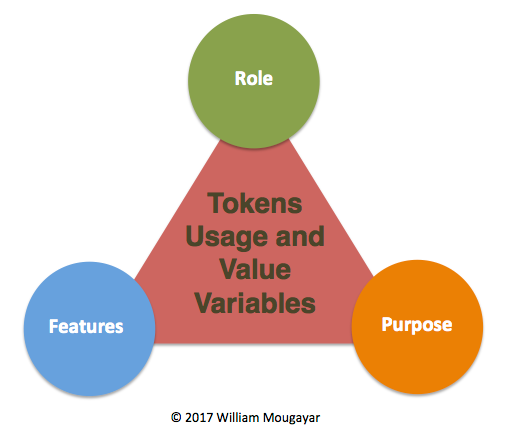
Each role has a key purpose, as depicted in the below chart.
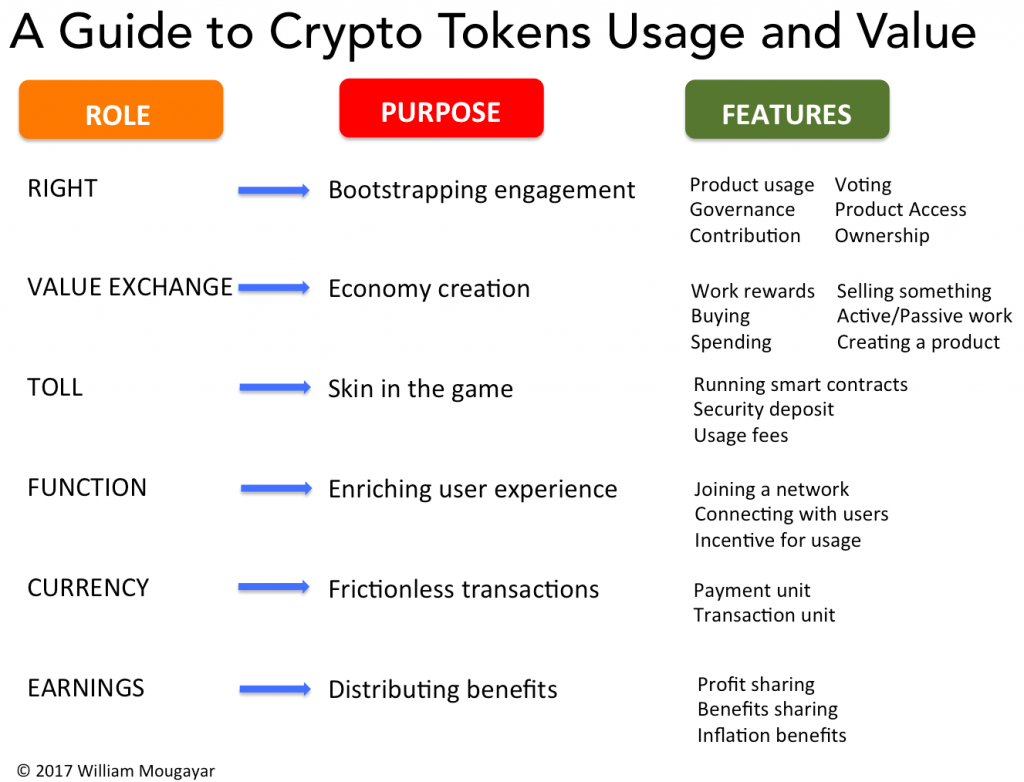
The Right
Owning a token bestows a right that results in product usage, a governance action, a given contribution, voting, or plain access to the product or market. In some cases, tokens will grant real ownership, even if most organizations are trying to avoid passing the Howey Test by skirting around the ownership aspect. For examples, look at Numerai, DigixDAO, FirstBlood and Tezos.
The Value Exchange
The token is also an atomic unit of value exchange inside a particular market or app, resulting in the creation of a transactional economy between buyers and sellers. This consists of features that allow users to earn value and to spend it on services that are internal to the inherent ecosystem. They can earn it by doing active work (real work and actions), or passive work (e.g. sharing data). The creation of such an internal economy is arguably one of the most important outcomes, and one that must be sustained over time. For examples, look at Steemit, Kik, Tezos, and Augur.
The Toll
Just like paying a toll to use a freeway, the token can be the pay-per-use rail for getting on the blockchain infrastructure or for using the product. This also ensures that users have skin in the game. It can include running smart contracts to perform a specific function, paying for a security deposit, or plain usage fees in the form of transaction fees or other metered metric. For examples, look at Gnosis, Augur, Melonport, Tezos, Dfinity, Ethereum, and Bitcoin.
The Function
The token can also be used as a lever to enrich the user experience, including basic actions like joining a network, or connecting with users. It can also be used as an incentive, if it is given in return to begin usage or for on-boarding. For examples, look at Dfinity, Steemit, Civic, and Brave.
The Currency
The token is a very efficient payment method and transaction engine of choice. This is key for enabling frictionless transactions inside these closed environments. For the first time, companies can be their own payment processors without the cumbersome or costly aspects of traditional financial settlement options. Tokens offer a much lower barrier for processing end-to-end transactions inside a given market.
The Earnings
An equitable redistribution of the resulting increased value is part of what blockchain-based models can enable. Whether it is profit sharing, benefits sharing or other benefits (such as from inflation), sharing the upside with all the stakeholders is expected.
Assessing the Token Utility
When evaluating a given token-based organization, the more boxes that can be ticked pertaining to the role of the token, the better it would be. The role of tokens is like nails that encroach on your business model. You want more than a single one to hold it firmly in place, and keep it defensible and sustainable.
This is where entrepreneurs creativity has been shining, as they invent and create the many ways that a token can be put to use, at the operational level, i.e. as the rubber meets the road. It’s really about innovation at the token level.
If the token usage is obscure, not well explained, or not defensible, there is weakness in that model.
I’m not sure that app coins vs. protocol coins are the right way to segment these tokens. It doesn’t provide added clarity to an already obscure and new practice.
Here is a proposed set of questions to ask. If you are an ICO-based organization, give yourself 1 point for each yes answer, totalling a maximum of 20 points:
- Is the token tied to a product usage, i.e. does it give the user exclusive access to it, or provide interaction rights to the product?
- Does the token grant a governance action, like voting on a consensus related or other decision-making factor?
- Does the token enable the user to contribute to a value-adding action for the network or market that is being built?
- Does the token grant an ownership of sorts, whether it is real or a proxy to a value?
- Does the token result in a monetizable reward based on an action by the user (active work)?
- Does the token grant the user a value based on sharing or disclosing some data about them (passive work)?
- Is buying something part of the business model?
- Is selling something part of the business model?
- Can users create a new product or service?
- Is the token required to run a smart contract or to fund an oracle? (an oracle is a source of information or data that other a smart contract can use)
- Is the token required as a security deposit to secure some aspect of the blockchain’s operation?
- Is the token (or a derivative of it, like a stable coin or gas unit) used to pay for some usage?
- Is the token required to join a network or other related entity?
- Does the token enable a real connection between users?
- Is the token given away or offered at a discount, as an incentive to encourage product trial or usage?
- Is the token your principal payment unit, essentially functioning as an internal currency?
- Is the token (or derivative of it) the principal accounting unit for all internal transactions?
- Does your blockchain autonomously distribute profits to token holders?
- Does your blockchain autonomously distribute other benefits to token holders?
- Is there a related benefit to your users, resulting from built-in currency inflation?
Keep in mind that even if a company ticks the above list with a high score, they still need to execute on it. So, this list is more necessary than sufficient, for success.
All ICO-based companies are encouraged to review their token usage. The more usage scenarios they can check, the more resilient their Token-to-Market fit might be.
(Republished from Startup Management)
From the Bottom, Up
By Beautyon
Posted June 15, 2017

Bitcoin is not about your opinion. It doesn’t rely on your feelings or “point of view” for it to work. Bitcoin is about facts. We can get to this conclusion in several steps.
We know that there are facts, and not everything is a matter of opinion. Here is an example of two facts. The speed of light is 299,792,458m/s. This is a fact. Potential Energy PE = mgh. This is a fact.
I’ve just listed a natural constant, and an equation that tells you the potential energy of a mass moving at a velocity. The potential energy equation always works to produce a correct result. The speed of light never changes; that’s what it means to say it is a natural constant.
There are many rules expressed in math that we can use to predict how natural phenomena behave. The potential energy equation is just one of them. We know that if you multiply the mass of an object by the gravitational constant “g” and multiply those by the object’s height above the ground, you get a number that represents the masse’s potential energy. This is true, and a fact. It never changes, just like the speed of light in a vacuum is always the same.
Math never changes. 1+1 always equals 2. It is an immutable part of nature, and everything in nature can be related to it. The speed of light never changes. No rational man expects to have his own opinion about math, its nature or how it works, or natural constants.
Software is made up of rules that are math. Binary math. When programmers write software, it conforms exactly to the rules laid out by the person who wrote it. This is always true, even if the software is designed to produce output that is unpredictable, like a random number generator, a function to calculate Pi, or a Lorenz attractor.
Money is a tool whose properties are no different to any other system of math. People call it “accounting” but it is in fact math. We know that in math and nature there are constants, and we rely on these every instant of every day, whether we are making those calculations consciously or not. You are held down by F = Gm1m2/r² whether you understand it or not. Your genes replicate and self repair with mathematical precision whether you know about it or not.
We know that if the money supply is not constant, you can’t address the market correctly. This isn’t a problem of market information; if the supply of money is unknown, then any accurate market calculation is literally impossible. The best you can do is make a guess. It would be impossible to send a spacecraft to Jupiter or plot an orbit if the gravitational constant was controlled by the Federal Reserve. This is a real problem, and Bitcoin solves this problem. Completely.
Bitcoin is made of software, which is math. It is only software, all the time. It is built on immutable natural constants to provide an artificial constant, that everyone can use to measure the value of goods in a predictable way. It is no different to the British Imperial System of Measurement. This is the fundamental breakthrough that is impossible to see if you don’t understand what a fact is, and you think your opinion, belief or “thesis” literally creates the structure of reality.
Immediately, people will say this idea is false; that money serves a social function, that it is a “shared illusion”, that it really is based on belief, that its supply must increase with the increase of the size of the market (Keynesianism), that its form and supply should be the sole responsibility of government, there are other factors affecting price that are the ones that count, and every other Pavlovian reaction they’re trained to respond with when confronted with fundamental questions about the nature of money and facts about Bitcoin. The problem for them, is that math can’t care about their opinions and beliefs.
No matter what these people believe, math doesn’t change depending on your point of view or opinion. No florid, prosaic explanation of any theory of money can stand up to math. The geocentric model of the solar system fell to observation of the facts. Epicycles and all the complex, totally false explanations of the motion of the planets were destroyed by putting the sun at the center of the solar system. This is what Bitcoin does with money. It replaces untruths with fact.
Once Bitcoin is at the centre of the solar system, replacing fiat currency, then everything in economics will suddenly stop making no sense, and will become totally rational and predictable. The entire economy will be run not on fantastic Epicycles and Epicyclets — Keynesian loops within Keynesian loops — but on simple, fundamental facts. E=mc². Money will be a natural constant, like the speed of light or gravity, and from this foundation, a rational, orderly and incredibly stable civilization can and will be built, because it will be possible to make economic calculations with a tool based on a system that is fixed. The future will be totally predictable with reference to the money supply, because it will have its foundation irrevocably rooted in math; not only as a means of measurement, but as the source of its nature AND a means of measurement. For the first time, these two functions will be expressed in one thing.
Given the above, clearly the transition from fiat to Bitcoin is one of the biggest events in the history of man, equal in consequences to the introduction of fiat as the synthetic reserve currency of the world. This event can only happen once. The gold standard, which lasted for thousands of years was a natural constant. The fiat era was an anomaly, a blip. Money will return to being a natural constant, only this time, it will be based on math, and not mass.
The transition to Bitcoin is not going to be clean. There will be fighting over it and against it. If a single entity manages to gain control over Bitcoin, they will seize control of the entire world, just as the Federal Reserve and its owners control all the foundation of money on Earth, and can wreak havoc through that control. It is well within the realms of possibility (and the proper goal) that no one ends up controlling Bitcoin, and that it acts like a synthetic natural constant. This would be the ideal outcome. But I digress.
Bitcoin is not about your opinion. It is about facts. Your feelings about it, and what you learned about money and the State in school are irrelevant. Nature doesn’t obey your perceptions, opinions or perspective. Nature and math are separate from you and your parochial thinking, and now there is a tool that makes money inextricably wedded to math, running on top of a distribution tool that itself cannot be stopped — the internet.
The days of your opinion being indulged are over. The days of mass delusion and deception about the form and nature of money are over. The consumer society is going to come to an end. This is “The Transformation”, where the rigid discipline of math and the laws of nature are superimposed on economics in an irrevocable way, that cannot be refuted or refused. The Transformation will cause pain to many people, as their long held superstitions, assumptions and personal beliefs are shown to be totally false and are smashed to pieces. The world will cease to work for them, as reality re-asserts itself.
This is a very good thing.
Jug of Pimm’s with wild fruit, pub treats, jug of Sangria, chorizo slices.↴

Segwit2x: What you need to know
By Jimmy Song
Posted June 19, 2017
Bitmain rocked the Bitcoin world last week when they published a press release detailing their plans for a hard fork should BIP148 gain traction. The very next day, Segwit2x merged a pull request to make their client software compatible with BIP91. The day after, a group of miners published their own press release proclaiming that they’d start signaling for Segwit2x starting on June 19.
Current state of Bitcoin
In this article, I’m going to describe the events of the last 5 days or so and explain how things will play out. In the process, I hope to enlighten you on how BIP91 works and how Segwit will get activated on the network and what needs to happen when in order to avoid a soft fork on August 1.
Bitmain’s Press Release
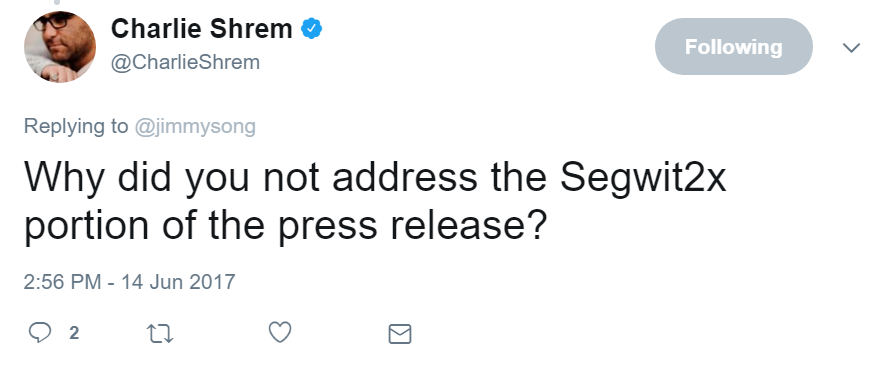
I’ve already examined the press release, but as Charlie Shrem points out in the above tweet, I forgot to include one point about Segwit2x. To wit:
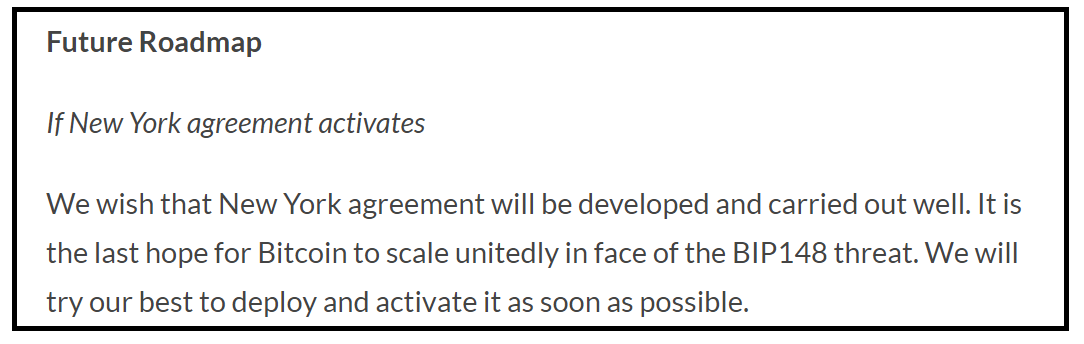
Bitmain is saying that they would prefer the New York Agreement to any hard fork. Bitmain would like Segwit2x (aka New York Agreement) to activate before BIP148. One big reason this may be the case is that Segwit2x requires Segwit and thus, if Segwit is locked in on the network, BIP148 won’t do anything.
So naturally, you may be wondering how does Segwit2x activate? This is actually a trickier question than it may seem.
Segwit2x Activation Mechanism
The original New York Agreement stated this:
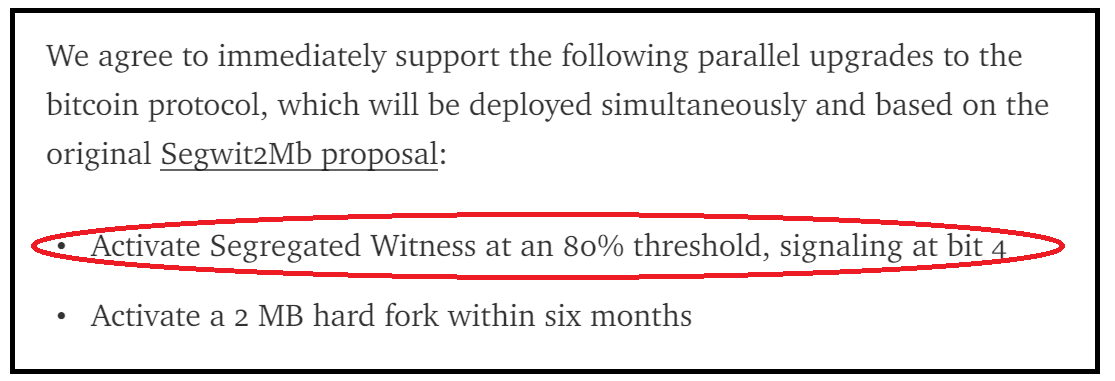
The press release actually doesn’t get into technical detail about Segwit activation other than the one bullet point circled in red above. Note that the original Segwit proposal, BIP141, requires 95% threshold and is signaled at bit 1. Those are obviously different, so the community was left wondering, would the two signals be compatible at all? Is it possible to signal for Segwit2x and not BIP141 or vice versa?
What would happen, for example, if Segwit2x managed to activate Segwit, but nodes running BIP141 thought it wasn’t active or vice versa?
To solve these problems, a clever mechanism was proposed (interestingly on May 22, a day before the New York Agreement publication) by James Hilliard on the Bitcoin Devs mailing list. It is this clever mechanism (now called BIP91) that leads us to the next part of the story.
Merging the two Segwit activation mechanisms
BIP91 is a clever way to translate 80% signaling to 95% signaling. The way it does so is like this:
- Signaling at bit 4 is accepted.
- If 269 of 336 blocks signal either bit, BIP91 is locked in.
- After another 336 blocks, BIP91 is activated.
- When BIP91 is active, blocks not signaling bit 1 (that is, signaling for Segwit BIP141) are rejected from the network.
If this last point sounds familiar, it should. It’s exactly what BIP148 does. As a result of “forced signaling”, the chain will have 100% signaling for BIP141 (Segwit) and will lock in and activate. The difference between BIP91 and BIP148 is that BIP91 waits for 80% of the miners to agree first.
What happened last Thursday is that BIP91 was merged into the Segwit2x repository, ensuring that Segwit would activate with 80% mining support.
The Miner Roundtable Resolution
The next day, the Chinese miners published a press release proclaiming that they would run the Segwit2x software. As the software is not ready, they are not going to signal either bit 1 or bit 4 but actually add the string “NYA” into the Coinbase string. These miners represent about 80% of all hashing power and will presumably signal bit 4 as soon as the Segwit2x software is ready.
What this means for you
Here’s what needs to happen in order to avoid a soft fork on August 1:
- Segwit2x software has to be released and in the hands of miners
- At least 269 of 336 blocks must signal bit 4 (about 80%). This would achieve BIP91 lock-in.
- Another 336 blocks must pass. This achieves BIP91 activation. After this point, every block must signal bit 1 (Segwit/BIP141).
If all of the above happen before August 1, BIP148 will not do anything and no soft-fork will result. What’s still unclear is if we’re at step 2 on August 1. Would the BIP148 supporters take that as “good enough” and not soft fork? Probably, but thus far, BIP148 supporters haven’t clarified that with a statement. It would probably be in the interests of everyone that BIP148 supporters clarify this as soon as possible.
But Wait, There’s More
This is a positive development if you’re hoping to avoid a permanent split as it looks like Bitcoin will stay on one chain. But the battle is not over. The bigger and more contentious issue of a 2MB hard fork is the one that still needs to be settled.
Per the New York Agreement, a 2MB Hard Fork must be activated within 6 months. What software will activate the 2MB Hard Fork? Will that be Bitcoin Core? Unlikely since they didn’t sign the agreement. Segwit2x? Possible, but how is that going to get rolled out? Bitcoin Unlimited? BUIP0055 already has a target date of October 18, but it allows blocks larger than 2MB.
Furthermore, if a client other than Bitcoin Core is what the New York Agreement signers will run, how is that repository going to get managed? Will Bitcoin Core developers be involved or not? If Segwit2x is proposed as a merge to Core, what if Core rejects it?
None of these questions have been answered. We are by no means out of the woods yet.
Conclusion
The steps taken in the past week look like Segwit will be activated and avoid a network fork on August 1. This is good news in the short term, but the long term question of whether there will be a hard fork to larger blocks or not is still unanswered. There is room for optimism, but there are still more battles to be fought.
*Edit: Thanks to Aaron van Wirdum for pointing out a flaw in my article. I’ve corrected it.
Bitcoin Is Money
By Valentin Schmid
Posted June 21, 2017
Understanding money is the key to understanding the value of decentralized electronic currency
[
Mark Us Preferred on Google](https://www.google.com/preferences/source?q=theepochtimes.com)
Julia Tsokur/Shutterstock
| Valentin Schmid6/21/2017 | Updated: 8/3/2017 |
Up 158 percent against the U.S. dollar this year, bitcoin is now the best-performing currency. Many are confused as to how this mathematical protocol can be worth more than $2,600, and why it keeps going up. The short answer: Bitcoin is money, just a little better and cheaper than the alternatives.
If you don’t understand money, you cannot understand bitcoin. For most of us, money is the U.S. dollar, the fiat currency of the United States issued by the Federal Reserve and maintained by the commercial banking system.
But even this system is confusing. Most people don’t hold Federal Reserve notes anymore; they hold money in checking accounts or use their credit cards to buy things. This is electronic fiat money, stored on the servers of banks like JPMorgan Chase and Bank of America.
Since the creation of the Federal Reserve in 1913, the dollar has lost about 95 percent of its purchasing power.
This type of money is a great medium of exchange. Because the state mandates the acceptance of fiat money by all commercial actors, you can pay everywhere with dollars and, as a bonus, the prices of consumer goods seldom change more than a few percent per year.
Other attributes that make the dollar useful as a medium of exchange are its divisibility, recognizability, and indestructability—at least in electronic form—and the ease with which it can be exchanged.
However, there is a problem with the dollar as a medium of exchange over time. Since the creation of the Federal Reserve in 1913, the dollar has lost about 95 percent of its purchasing power. This devaluation is hardly visible over the course of days, months, and even years, but it is painfully felt over the span of decades.
So it’s hard, if not impossible, to exchange the same value over time with the U.S. dollar, and investors need to expose themselves to other assets to protect purchasing power. This is a general problem of fiat currencies and bank money, which are both prone to mismanagement by the state and banks, mostly because they can be reproduced at will. More dollars chasing the same amount of goods leads to rising prices.
Gold cannot be replicated at will and therefore is a better way of exchanging value over time.
Value Over Time
This is the reason why people have traditionally resorted to gold to protect themselves from monetary inflation. Gold is also easily recognizable, divisible, durable, and concentrates a lot of value in little space. One troy ounce now costs about $1,250.
However, its uses as legal tender have been limited since the demise of the true gold standard at the beginning of the 20th century, and it is not easily transferred in physical form like the electronic dollar. Furthermore, its price is relatively volatile when measured in dollars in the short term, and the IRS collects tax on gains in dollars, making gold even less exchangeable.
But gold cannot be replicated at will and therefore is a better way of exchanging value over time. One dollar bought almost 20 bottles of Coca-Cola in the 1930s. It now buys less than one. One ounce of gold bought 700 bottles of Coke in the 1930s; it now buys almost 800.
Decentralized Electronic Money
Once one understands that money needs to be able to exchange value in time and space, it is easier to see why bitcoin is so attractive.
Although it cannot handle as many transactions as the banking system, it is relatively easy and cheap to transfer. Hundreds of thousands of businesses and individuals voluntarily accept bitcoin as payment. Its mathematical properties are recognizable, infinitely divisible, and indestructible.
As a medium of exchange, mainly because of legal tender laws, bitcoin is not as widely accepted as the dollar or other fiat currencies, but it is easier to transfer than gold and it is also subject to taxation.
In the long term, bitcoin has similar properties to gold because it cannot be replicated at will and the number of coins is limited to 21 million. This means that bitcoin is better than the dollar for transferring purchasing power through time. It is similar to gold, although gold has a far longer track record.
Its decentralized management is another factor making it attractive for people who distrust fiat currency and the banks.
Cheap Alternative
Given that bitcoin is better than gold in the short term and much better than the dollar in the long term across the dimensions we have described, it’s not surprising that people chose to diversify their money holdings into this independent currency due to frustration with the mismanagement of fiat money and manipulation of gold prices.
There is another reason why bitcoin is attractive as a currency. Despite its record high in dollar terms, it is still cheap in aggregate. All Bitcoins are only worth $43 billion. All gold ever mined is worth around $7.5 to $10 trillion, although estimates vary. As for the U.S. dollar, just the M2 measure of bank money, including checking accounts, puts its worth at $13.5 trillion.
If bitcoin were to establish itself as an alternative currency and store of value alongside gold and the dollar, a total valuation of $1 trillion would not be inconceivable. That’s $47,600 per coin.
https://fried.com/history-of-bitcoin
NO!
By Beautyon
Posted June 21, 2017

1/ Blockchains will replace networks with markets.
This is not true. There is no such thing as “Blockchains”. The new database structure designed for the specific case of Bitcoin is not a utility that can be re-purposed for any need. You can use a database secured with GPG for all needs that do not require Bitcoin.
Markets are a by product of exchange of goods for money. It is a fundamental characteristic of exchange. Networks are groups of people who trade with each other, or computers that signal to each other. Software can facilitate exchange, but it cannot become exchange itself.
2/ Humans are the networked species. The first species to network across genetic boundaries and thus seize the world.
Man is an individual. He is not networked. He is not telepathic, or connected in any way to any other man once he is free from his mother’s womb. Saying man, “is the first species to network across genetic boundaries” is gibberish.
3/ Networks allow us to cooperate when we would otherwise go it alone. And networks allocate the fruits of our cooperation.
Networks are communication tools in one sense, or social connections in another. It’s pointless to conflate the meaning of these words. People cooperate for profit or some other gain, no matter what the nature of that gain is.
4/ Overlapping networks create and organize our society. Physical, digital, and mental roads connecting us all.
There is no such thing as “society”. There are no “mental roads” that “connect us all”, that are either physical or digital.
5/ Money is a network. Religion is a network. A corporation is a network. Roads are a network. Electricity is a network…
Money is not a network. This has been refuted many times, and anyone interested in finding out what money is should go to the Mises website. Religion is not a network, and never has been, and never will be. There is only one God and that is Jesus Christ. Roads are a network. Electricity is distributed by a network.
6/ Networks must be organized according to rules. They require Rulers to enforce these rules. Against cheaters.
This is a lie. Networks can form spontaneously without rules or rulers. Only Statists believe that there must always be a ruler to organize men, and only the most dismal thinker believes that man is more inclined to cheat than not. Also, Underwriter’s Laboratory is a perfect example of how people don’t need a ruler to exclude manufacturers (for example) from the market.
7/ Networks have “network effects.” Adding a new participant increases the value of the network for all existing participants.
TRUE!
8/ Network effects thus create a winner-take-all dynamic. The leading network tends towards becoming the only network.
FALSE. Networks display Power Law dynamics. There is a biggest player and many smaller players. The biggest player can always be unseated in a free market.
9/ And the Rulers of these networks become the most powerful people in society.
Not rulers, but owners. Words matter!
10/ Some are run by kings and priests who choose what is money and law, sacred and profane. Rule is closed to outsiders and based on power.
The rule of kings (sadly) is mostly over. For now. The State is still in charge of saying what money is by fiat. This is what Bitcoin is here to destroy; the power of the State to create and require a form of money.
Note too, how the source of this power is omitted, “Power comes from the people through democracy” is the sort of nonsense you’d expect in number 10.
11/ Many are run by corporations. The social network. The search network. The phone or cable network. Closed but initially meritocratic.
Corporations are not autonomous AI omniscient super beings. They are run by men and women. They provide tools that you can use or decline at your leisure. They are not “closed” either. Anyone can start a corporation and run a business or service through it.
12/ Some are run by elites. The university network. The medical network. The banking network. Somewhat open and somewhat meritocratic.
There is no such thing as “elites”. Only socialists use terms like this. In a free society, there are people who can do things and people who can not. The people who have extraordinary skills have the same rights as everyone else, and no, rights do not come from the State.
Banks have an unfair advantage thanks to the State, including (literally) a license to print money out of nothing. This is one of the problems Bitcoin was designed to solve, and Socialists should be FOR Bitcoin because it makes this power meaningless. You can print all the funny money you like; no one wants it in a Bitcoin world.
13/ A few are run by the mob. Democracy. The Internet. The commons. Open, but not meritocratic. And very inefficient.
Democracy is evil. The internet is not evil. There is no such thing as “The Commons”. Democracy is not “open”. It IS inefficient, and unethical.
14/ Dictatorships are more efficient in war than democracies. The Internet and physical commons are overloaded with abuse and spam.
Dictatorships are more efficient in everything, not just war. Rome is a good example of this. The internet is not “overloaded with spam and abuse”. Only men hypnotized by Political Correctness culture think the internet is full of abuse. The internet is very controllable, filterable and manageable. Email spam has been eliminated. Anyone with a Gmail account knows this. The market can solve all problems; that’s why Socialists hate it.
15/ The 20th century created a new kind of network — market networks. Open AND meritocratic.
Nonsense. Even by the Socialist thinking, a market network can’t be meritocratic, because the “rich” have privileged access.
16/ Merit in markets is determined by a commitment of resources. The resource is money, a form of frozen and trade-able time.
Yet another definition of what money is. Money is energy, money is time, money is Bitcoin, money is dollars, money is a shared illusion, money is this, money is that.
Merit in markets is determined by the market participants. That is how people choose one good over another. It has nothing to do with “commitment of resources”. Pet Rocks are a good example of this. Taking no resources other than a cardboard box and stones from a beach, Pet Rocks had market merit, despite being totally useless…apart from fun and novelty.
17/ The market networks are titans. The credit markets. The stock markets. The commodities markets. The money markets. They break nations.
Credit markets are not true markets, neither is the Stock Exchange or Commodities and Money Markets. All of these are highly regulated and distorted by the State. This is why gold is languishing at $1,000 when it should be $50,000 minimum given the level of inflation.
These markets do not “break nations” it is the State that does this, and the State is not the same as the nation. The financial crisis (each one) is a side effect of the State and its market distortion and fiat money.
18/ Market networks work where there is a commitment of money. Otherwise they are just mob networks. The applications are limited.
Nonsense. There are markets of many types, that do not have anything to do with money. What on earth is a “Mob Network”? Sounds like a swarm of BitTorrent users Pir8’n the latest warez…or DEMOCRACY.
19/ Until now.
DERP.
20/ Blockchains are a new invention that allows meritorious participants in an open network to govern without a ruler and without money.
Nonsense. There are no “Blockchains”. Software can’t determine the merit of any exchange of data. When these people talk about “Blockchain” do they mean “Open Blockchain” or “Public Blockchain”? They’ve come up with so many permutations; all of them are nonsense, of course.
The idea of removing money from society is an old one, and not a very smart one either. Google “Society without money” for some lulz.
21/ They are merit-based, tamper-proof, open, voting systems.
Nonsense. Computers cannot determine merit. Even if they could, only the “rich” could participate, because you need a computer to join in this debacle. Blockchains are not “tamper proof”. Only Bitcoin is tamper evident and of course, we know that Etherium is very “not tamper proof”, as long as you are a friend of the controller of it.
Buying something in the market is not a “vote” in the sense of how democracy works. This is a commonly held idea, that somehow, choosing one flavour of ice cream over another is a “vote for chocolate ice cream”. This thinking is the result of decades of pro-democracy brainwashing in government schools.
22/ The meritorious are those who work to advance the network.
The USSR, all over again, with a lick of Blockhain coloured paint.
23/ As society gives you money for giving society what it wants, blockchains give you coins for giving the network what it wants.
Which coins? Bitcoin? Or a coin from one of the millions of other “Blockchains” that have ICO’d and sprayed coins into the market? These coins, in order to be valuable, have to be scarce. This is basic economics, of the kind these hand waving types are totally ignorant of.
Everyone can’t release their own coin. You can’t have a world with a million different currencies, one for every operating business. On the one hand, this person says, “8/ Network effects thus create a winner-take-all dynamic.” but on the other hand, says that there will be many coins in the market. Why are power laws applicable to network effects, but not money? Money has the biggest network effect of all, an is something were winner takes all is actually true. Why is it not true in this case?
Tough questions for ICO pumpers!
24/ It’s important to note that blockchains pay in their own coin, not the common (dollar) money of financial markets.
And if those “coins” (I thought your’re calling them “tokens” now?) are not directly interoperable, you will have hundreds of thousands of different coins that cannot be exchanged for each other. Please Google “Fungible”.
If everyone used one coin, Bitcoin, then the money (Token or Coin, take your pick) would be fungible, universal, have massive network effect and would act like money. The “many coins” thesis is totally absurd, and it’s incredible that people are promoting it as a sound idea. Nuts!
25/ Blockchains pay in coin, but the coin just tracks the work done. And different blockchains demand different work.
But your grocer demands one sort of money. He doesn’t want your bicycle courier coin. He wants grocery coin. This is called “Coincidence of wants”. Google it.
26/ Bitcoin pays for securing the ledger. Ethereum pays for (executing and verifying) computation.
No one wants Etherium, and no one will want it. Etherium can’t beat Bitcoin to be the money of the internet. If you want to pay for executing computation, you need electricity and hardware, and you pay for them with fiat or Bitcoin.
27/ Blockchains combine the openness of democracy and the Internet with the merit of markets.
Democracy is evil, and it is not “open”. The internet is great precisely because it is a free market, where people can post “abuse” and “spam” which are actually speech. Americans understand this. Of course, if you are an owner of a service, you have an absolute right to reject any message you do not want to carry. But there are evil men who want “Net Neutrality” which would force property owners to carry traffic in ways and content that they would rather not.
You can’t be for the market and for Net Neutrality. You can’t be for Democracy and meritocracy.
28/ To a blockchain, merit can mean security, computation, prediction, attention, bandwidth, power, storage, distribution, content…
Yes indeed. Anything can mean anything to a Blockchainer. Nothing has a discreet meaning. You can wave away objections and facts with your hands, as you gesticulate away all questions. Sadly, hand waving will not produce products and services, or conjure up business models and software.
29/ Blockchains port the market model into places where it couldn’t go before.
Nonsense. More magical thinking.
30/ Blockchains’ open and merit based markets can replace networks previously run by kings, corporations, aristocracies, and mobs.
More nonsense. There are no “Blockchains”.
31/ It’s nonsensical to have a blockchain without a coin just like it’s nonsensical to have a market without money.
ORLY?! LOL!!!!
32/ It’s nonsensical to have a blockchain controlled by a sovereign, a corporation, an elite, or a mob.
But this is EXACTLY what these ICO coins like Bancor are, where the owner can delete coins at will. Also, is this man now arguing against the control of the US Dollar by the Federal Reserve? The dollar is mostly electronic, and could be run on a private database (blockchain) is he really saying that the State should not be in charge of the form of money society uses?
33/ Blockchains give us new ways to govern networks. For banking. For voting. For search. For social media. For phone and energy grids.
More nonsense. Gives WHO new ways to govern? And govern HOW exactly? Someone must own the hardware and manage the software; those men are the owners of the network as we are about to see with UASF.
This is “Turtles all the way down” level absurdity.
34/ Networks governed without kings, priests, elites, corporations and mobs. Networks governed by anyone with merit to the network.
That actually is the definition of the mob. Everyone will have access to it, everyone will have their say, everyone will be voting on everything. That is the definition of mob rule.
35/ Blockchain-based market networks will replace existing networks. Slowly, then suddenly. In one thing, then in many things.
Nope. The Blockchain hype is already dying and everyone is waking up to the fact that it was all about Bitcoin all along. There is going to be a massive crash in the Blockchain industry. Popcorn at the ready.
36/ Ultimately, the nation-state is just a network (of networks). FIN
Nonsense, yet again.
37/ Thank you, Satoshi Nakomoto. And to all the shoulders that Satoshi stands upon.
Thank you Satoshi for Bitcoin. Bitcoin will make nightmare scenarios like the one outlined in these 36 points completely impossible, even if they were technically possible or economically feasible. You have freed us from these tin pot tinkerers, economic illiterates, violent Statists, wreckers and lunatics.
And that is worth money.
Segwit2x: What you need to know about the 2x Hard Fork (aka 2MB non-Segwit Transaction Capacity per block/8MB Total Block Size HardFork)
By Jimmy Song
Posted June 26, 2017
Segwit2x: What you need to know about the 2x Hard Fork (aka 2MB non-Segwit Transaction Capacity per block/8MB Total Block Size Hard Fork)
When I wrote my last article on Segwit2x, I concluded with questions about the lack of clarity around the 2x part of Segwit2x. Since then, there’s been more clarification, especially in the btc1/bitcoin (aka Segwit2x) repository. In this article, I’m going to describe what is likely to happen for those running Segwit2x and how that will affect you.

Yet another BIP — BIP102
BIP102 is a flag-day hard fork to 2MB, written in 2015 by Jeff Garzik. Jeff Garzik created a pull request to the Bitcoin Core repository on July 16, 2015 and after 8 months of discussion, it was never merged. Jeff Garzik closed this pull request in September of 2016 as it seemed pretty clear that BIP102 was not getting merged into Core.
BIP102 has surfaced again recently as part of Segwit2x in modified form, which is unsurprising since the lead developer of Segwit2x is none other than Jeff Garzik. The essence of this BIP (Bitcoin Improvement Proposal) is that there’s a hard fork to 2MB on a “flag day”. This is a coordinated date where all network participants start accepting 2MB blocks. If this sounds familiar, it should. This “flag day” activation was the proposed mechanism for the original User-Activated Soft Fork (UASF) to Segwit by shaolinfry.
In any case, the original BIP102 had a hard flag date (literally a unix timestamp). The modified BIP102 proposal in Segwit2x activates exactly 144*90 blocks after Segwit activation. 144 blocks takes about 1 day (10 minutes * 144 = 1 day) so this is meant to activate a hard fork roughly 3 months after Segwit activates.
Segwit2x Contents
It may be useful at this point to look at what Segwit2x actually is.
Segwit2x branched off the Bitcoin Core 0.14 release and has a diff of less than 500 lines as of this writing from Bitcoin Core 0.14. About half are related to BIP91 (orphan blocks that don’t signal Segwit) and the rest is split between testnet5 (new testnet), change of name (Bitcoin Core => Segwit2x) and BIP102 (2MB Blocks). It’s within the realm of possibility that this code can get merged into Core, for example.
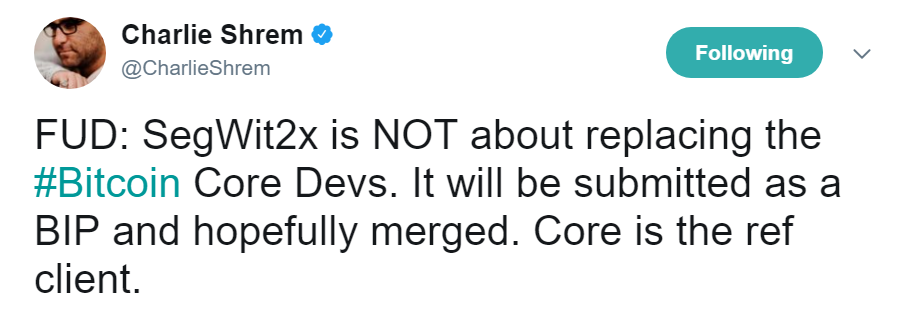
In fact, according to Charlie Shrem’s tweet above, the hope of Segwit2x is that the hard fork changes would simply be accepted into Bitcoin Core. Of course, some signers of the New York Agreement have explicitly stated they don’t want Core to control the reference client, so this is an open question.
Who’s going to run this software?
The big question, then, is who’s going to be running Segwit2x? Who is willing to run a Bitcoin client that’s not Bitcoin Core? Well, according to the New York Agreement, everyone who’s signed the agreement has essentially agreed to run this software. Based on the latest statistics from coin.dance, that’s roughly 87% of mining hash power, a lot of exchanges, a lot of merchants and a lot of wallets. If these companies do what they said they’d do in the agreement, that would represent a significant portion of the economic nodes in Bitcoin.
The notable companies that aren’t obligated to run Segwit2x are BlockStream, Chaincode Labs, BitGo, Poloniex, BitStamp, Bithumb, BitFinex, Kraken and Gemini. As they have not signed the agreement, they are not obligated to follow it.
What can we expect?
The easiest way to think about what will happen is with some rough dates:
- July 21 — Segwit2x is due to be released and presumably all participants to the New York Agreement will run it. The miners currently signaling “NYA” in their coinbase transactions, or about 87% of the last 24 hours’ worth of blocks, are a good estimate of blocks that will mine using Segwit2x.
- July 23 — BIP91 should lock in (requires 80% of 336 blocks to signal)
- July 26 — BIP91 should activate. At this point, all blocks are required to signal for Segwit (BIP141) or they will be orphaned off the network.
- Around July 26–27 — This is also around when we can expect a new difficulty adjustment period to begin. The last one as of this writing was June 17 and they typically take 12–14 days (closer to 13 since new hardware comes online constantly). So June 30 (block 473760), July 13 (block 475776) and July 26 (block 477792) seem to be the next 3 difficulty adjustment period starts.
- August 10 — This is around when we can expect block 479808, which is the end of the difficulty adjustment period. Very close to 100% of blocks in this difficulty adjustment period should be signaling for BIP141 (Segwit). As this is above 95%, Segwit should be locked in.
- August 23 — This is around when we can expect block 481824, which is when Segwit should activate. From this block on, Segwit transactions will be legal on the network. This also sets the activation date for BIP102 on Segwit2x to block 494784 (exactly 144*90 blocks later).
- November 18 — This is around when we can expect block 494784, which is when Segwit2x should hard fork to 2MB blocks.
What this means for you
Practically speaking, as long as Segwit2x releases something that works for mining by July 21, we should get Segwit on the network around August 23. That means that Lightning Network transactions should be available soon after and everyone will be watching to see if block congestion and transaction fees reduce.
Assuming Segwit2x release goes without a hitch, it should be safe to transact until block 494784, which will be when the 2MB hard fork for Segwit2x is expected to occur. This is expected to happen around November 18 and depending on how much of the network (miners, merchants, economic nodes) hard forks and what response Bitcoin Core and some objecting companies may have, this may mean 2 Bitcoins at that point.
My recommendation previously was to be very careful transacting after August 1. That still may be the case if Segwit2x is not released on time. If Segwit2x is released on time, then the new date becomes November 18 (or thereabouts) and I would recommend being very careful about transacting after the hard fork as many of the problems I’ve written about before, such as replay and wipeout attacks become serious problems.
Conclusion
Segwit looks like a reality on the network, but with it comes a 2MB hard fork. Whether the 2MB hard fork will have teeth is an open question, but the fact that a significant percentage of the economic nodes have signed an agreement to hard fork means, well, that there will probably be a hard fork. If there is even a little resistance to a hard fork, we can expect two Bitcoins around November 18.
That said, it’s important to note that there are a lot of moves from here until November 18. Bitcoin Core, Blockstream, Chaincode Labs, BitGo and other non-signers of the New York Agreement will all have something to say about this turn of events and it would be very surprising if they don’t. It would then be up to the New York Agreement signers to respond and so on.
In other words, the Bitcoin scaling drama isn’t over. This is may be the 2nd inning. In the meantime, enjoy the relative peace of the ceasefire.
Edit: Updated the list of non-signers of NYA perAlex B.
Want to get curated Technical Bitcoin News?Sign upfor the Bitcoin Tech Talk newsletter!
The Final Battle of the Crypto Wars is Over, and We Have Irrevocably Won.
By Beautyon
Posted June 27, 2017
TL;DR
You can’t be against crypto and keep hackers out of critical infrastructure.You can’t be against crypto and keep “Russian Hackers” at bay.You can’t be against crypto and be for secure e-commerce.You can’t be against crypto and want to keep people safe.You can’t be against crypto and be a centre for banking.You can’t be against crypto and be for “Tech-City”.You can’t go back to the pre crypto days, ever.Embrace crypto now for the global win.
The Long Version
The final battle of the “Crypto Wars” is over, and we have won. We’ve won because everyone on earth has common cause against the State’s desire to spy on all our communications. Crypto (properly called Cryptography) has not won as an idea, but it has won as a working tool because cryptography is essential to everyone’s security, equally, world-wide.
A PGP Public Key. This block of text and others like it, are what all the fuss is about. It changes everything, and shifts the balance of power to everyone equally.
The US and UK are proposing that all cryptography be deliberately broken so they can have back door access. They’re using decades old and very tired excuses as pretexts for requesting this, ranging from pornography to terrorism. Once everyone understands that what USUK is proposing means exposing them to the theft of their money and personal data, 99% of all citizens will say “absolutely not” to any weakening of cryptography.
Leading the charge in this battle against the state are Apple and Google, two of the biggest companies on earth that are law abiding and straight laced. These companies can only take this stance in what is an existential battle and they are not going to weaken their products to make them inferior, especially when anyone can make a secure phone and sell it. The entire foundation of global commerce is unbreakable cryptography. These companies will literally lose everything if cryptography is crippled, along with every person who uses the web or a credit card or a chat app.
Government “representatives” claim to be concerned about hackers getting into power stations and other critical infrastructure. First of all, critical infrastructure should not be exposed to the open internet. Ever. Power stations ran for decades without being connected to the internet; why should they be connected to it now? Secondly, strong cryptography keeps that infrastructure safe in the same way that it keeps you safe on line. Weakening cryptography makes critical infrastructure vulnerable to attack, and it makes you personally vulnerable to hacking and theft.
Representatives claim to be keen to promote their ability to gain from the new economy, like the “Tech City” area in Shoreditch London, which they want to become the centre of the software explosion that is changing the way everything is done. What they don’t understand is that what makes Tech City possible is cryptography. Without cryptography, there can be no “Tech Revolution”.
What is needed?
Members of the public and businesses don’t need help from the government to cause London or any other place to be the centre of the tech revolution. People moved to Shoreditch and Silicon Valley and wrote software and started businesses without being told to do so by Downing Street or Washington. Innovation will happen and tech will flourish in the UK and US without any interference, and in fact a l_ack_ of interference will make it happen faster and in a more robust fashion.
There has been simmering background chatter about Bitcoin being some sort of vague threat. The people whose trade is fear and “security thinking” can’t decide what the exact threat is. Here is a good example:

A sword piercing the world. Nice.
“A spokesperson for India’s Central Bureau of Investigation (CBI), its top law enforcement agency, has revealed bitcoin and digital currencies will be an area of focus during an upcoming conference organized by Interpol to be held in India.
Running from 17th to 19th November, the sixth-annual Global Focal Point Conference on Asset Recovery will more broadly focus on fighting corruption and financial crime. According to statements from Interpol, measures to be discussed will include a new global police alerts system that would help global agencies better trace and recover stolen assets.
However, a new report by The Economic Times indicates that the CBI has said digital currency and its role in facilitating trade on the dark web will be discussed. While not quoted directly, CBI spokesperson Devpreet Singh reportedly said the technology has caused concerns among law enforcement agencies for its growing use in cybercrime.”
What these people fail to understand is that the cryptography that protects everyone, and Bitcoin as a tool, are already here, can spread frictionlessly throughout all the internet, and the benefits far outweigh the minuscule negative effects. Bitcoin and cryptography are not threats; they are boons.
The problem here is that none of these people understand what these tools can actually do singly, and cannot conceive of what they could do in concert. For example, Bitcoin could completely eliminate credit card and e-commerce fraud forever, protecting billions of people globally and the twenty four trillion dollars of annual transactions made on line. That is $24,000,000,000,000. The savings in insurance, security measures, time and lost money is difficult to calculate, but its on the order of hundreds of billions over a decade.
And that is the benefit of Bitcoin alone, excluding the benefits of SSL, HTTPS, GPG, full disc encryption, and secure tools like WhatsApp, iMessage, Apple Mail and many other apps used by hundreds of millions of people globally every minute of every day of the year, all put at risk by deliberately crippling encryption
The savings and improvements that are sure to follow from incorporating Bitcoin as the means to move money everywhere cannot be predicted. Solving the problem of the 2 billion un-banked people by itself will cause billions to be fraudlessly injected into global e-commerce. The way things are done globally will change, and will be made better in ways that we can barely glimpse today. Without encryption, this can’t happen.
Everyone Knows the Truth
Everyone is against the statutory weakening of e-commerce. From all sides of the political spectrum, from literally the biggest companies on earth to the basement dweller, not a single person who understands what this means is for it. The State has lost this one, and by extension, they can’t touch Bitcoin, because it is constructed from the same stuff.

A “Goddamned Piece of Paper” according to those sworn to defend it.
Any country with a properly written constitution can’t mandate controls on cryptography. The USA’s “First Amendment” guarantees a citizen’s right to create whatever texts he desires by whatever means, be it a pencil or multiplying a text turned to numbers by a random number. Bitcoin and all cryptography is text. Bitcoin and cryptography are speech. They can’t be regulated in a free country like the USA with guaranteed inalienable rights.
The world is going through a profound transformation powered by information. The old men who run the institutions that provided security in different areas are going to be completely disrupted. The banks that provided security and consumer interfaces for money are going to vanish. There was a time before them, and there will be a time after them.
The security institutions may or may not survive, but what is certain is that if they do survive, they will be completely transformed. Any security service that relies on spying on individuals from a central location must completely re-invent itself if it is to avoid being closed down as redundant.

The days of sitting back in orthopaedic office chairs while the world’s information comes to you are over. You now have to go to the information.
Oddly enough, this could mean a radical expansion of staffing and infrastructure at security services, since people are going to have to be personally surveilled. It will mean concentrating on actual criminals, narrowly targeting them with limited resources and doing good work, instead of other, “undemocratic” things. Cryptography is a benefit for the security services industry and democracy. It means vastly increased budgets, more work and more ethical work.
It should be clear to anyone who can think that the final outcome of the Crypto Wars is net benefit to everyone everywhere. Since it really is inevitable, and manifestly beneficial, anyone who is against it is a fool.

Let go!
A glass of strange purple milk↴

My Thoughts On Your Thoughts
By The Pirate Who Can’t Be Named
Posted June 28, 2017

Disclaimer: I am writing this in form to Erik Voorhees, but this is for everyone to read.
The fact that this sits at the top of the page above your written thoughts is the epitome of irony Erik. Hopefully you will see why as I break down what I see in your thoughts.
Firstly, you start off by quoting Sergio Lerner on his proposal. He himself explicitly acknowledges that the disagreements over current proposals are entirely political and not technical in nature. He also portrays the nature of a blocksize increase somewhat inaccurately. It is neither standard nor something done before. I’m assuming what he meant to do, and by extension what you did in quoting him, was to equivocate previous historical raises of a soft limit that is entirely separate from the hard limit enforced by consensus code to a complete change of the enforced hard limit that will for a fact partition the network in a way that is permanent. That has never been done before, and comes with systemic risks that individuals such as yourself trivialize at every opportunity. Continuing to frame things in such an intellectually dishonest way is what is inflaming the current stalemate. It is literally what started it in the first place.
Status Quo: The Threat of a Hostage
You go on to say that Bitcoin is important. Yes, I agree completely with this statement. It is very important. I don’t think you understand why it is important though. You go on to say in further irony, that Bitcoin must be extended as an offer of “refuge from tyranny” and not forced upon them. You go on to create a nostalgic image of the past, when everyone just got along, implying things should be like that. That things have to be like that for Bitcoin to work, to be valuable. Nothing could be further from the truth. If Bitcoin required everyone to just get along to work, it will never work globally unless spontaneous global utopia springs upon us from the ether(not that ether). Disagreement is almost universal, you will never get everyone to agree on everything.
You even attempt to paint the false image of two honest participants in a debate with two honest interpretations of the point of debate. This is false in the sense of oversimplifying things into a dichotomy, and false in the sense of painting all participants as equally honest when that is not the case at all.
“Just that little innocuous thing that is the specific way a data structure is formatted
has profound implications on the economics, incentives, and scalability of the system.”
The data that is put into the blockchain is an externalization of cost onto every validating user. Miners are paid for this, but not businesses validating, self-validating users, or anyone else running a node.This is a tragedy of the commons. So many people in this space, a large number of them advocating for very reckless blocksize increases(and do not try to continue this false dichotomy by responding that I am implying here all supporters of larger blocks fall into this category, I am not), completely refuse to acknowledge this dynamic. I am willing to bet even you refuse to really acknowledge the truly nuanced nature of this and the many intricate ways seemingly disconnected aspects of this system feed into the problem.
The block size is consistently paraded around as the central point of scaling, the scaling problem, the scaling bottleneck, etc. Anyone doing this is demonstrating a complete lack of understanding of the realities and nuances of Bitcoin scaling and what its problems are. The blocksize is only related to scaling issues in a tertiary way. It is what acts as a throttle to the growth of the Unspent Transaction Output(UTXO) set. The UTXO set is the central point of Bitcoin scaling, it is the real bottleneck. It is completely impossible for any fully validating Bitcoin node, whether they are miners or not, to function without the entire UTXO set. It is impossible to validate any transaction at all without checking that it is validly in the UTXO set. The only way to guarantee an output is validly in the UTXO set with 100% certainty, trustlessly, is to have derived the UTXO set yourself by processing the entire historical chain. I might also add, there is no upper limit of any kind on the size of the UTXO set. The only limitation exists indirectly through the blocksize, which places an upper bounds on how fast it can grow. It can shrink as well, but historically it has increased in size.
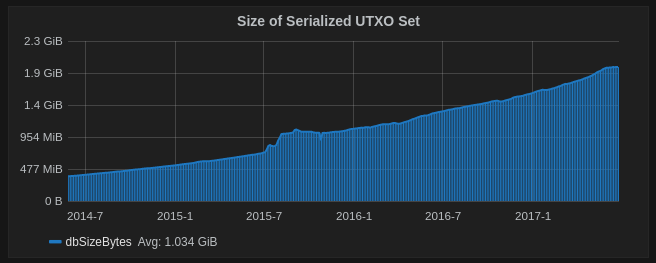
Historical UTXO set growth from statoshi.info
It seems common sense that this is a result of more people buying Bitcoin, and it being of a finite supply, they are broken up into more and more outputs of smaller denominations. This is entirely unavoidable. Taken to an extreme though, it easily gets into the Petabytes, or dozens of Petabytes. The worst case is that every Satoshi is its own output, which would be somewhere around 574 Petabytes(~350 bytes * 16.4 million[mined coins] * 100 million[satoshis in a bitcoin]. Why is this always ignored? Why are people given platitudes of “just this one bump in blocksize isn’t too much” while you wave away all the other implications of that? The blocksize isn’t what is going to impede people from validating, or raise the cost of operating a node to the breaking point at the end of the day. Its going to be the UTXO set. But ultimately most people in this space just sweep this under the rug, gripe about the blocksize, and ignore any longer term thinking on scalability.
As you yourself said, “There is clearly a problem and we need to fix it.” The problem is I think you fail to grasp the nature of the problem, let alone the nature of the solutions.
The Hollow Understanding
The entire parallel section to this in your piece is literally one giant straw man. Everyone involved, especially the developers, understands that Bitcoin is not merely a technical thing. We understand that very well. I think it is you who fails to grasp the nuanced and complicated way in which the social, economic, and technical aspects are intertwined.
Take the basic structure of a transaction for instance. Inputs and Outputs. Just the fact that the signature of an input is inherently a part of that Input structure has profound implications for the scaling of Bitcoin. Fees are a direct result of the datasize of a transaction, and because of the size of signatures relative to every other part of a transaction, that has a direct economic effect on the fee cost of certain transactions, and an effect on the incentives for users regarding the UTXO set. Fees are larger for transactions with more inputs, thereby both incentivizing users not to spend many small inputs while simultaneously creating more by breaking up few larger ones because that is cheaper in terms of fees. Really think about that.
That has a very serious systemic effect. Users over time cannot avoid winding up with multiple scattered unspent outputs as a consequence of transacting, which results in compounding fee costs. Businesses can’t avoid it period. This encourages users to bloat the UTXO set until they no longer can, because they are economically penalized for doing the opposite. This also imposes a cost of transacting heavily skewed in disfavor of businesses accepting payments at any scale from customers frequently.
Just that little innocuous thing that is the specific way a data structure is formatted has profound implications on the economics, incentives, and scalability of the system.But you throw the spotlight on the blocksize. You carve up the field of debate into a false dichotomy. You build up ridiculous straw men that wildly misrepresent what other people are saying and arguing. You then have an argument with this imaginary straw man, and then write pieces such as the one I am responding to reinforcing all of your ridiculously oversimplified arguments. All the while completely dismissing the nuances that render your simple arguments void. All the while ignoring the realities of scaling this system.
Then you run around advocating we loosen the limits on UTXO set growth while displaying a complete lack of appreciation on any level of that being a scaling concern, while completely dismissing and trivializing the upgrades both ready to go live right now and in the pipeline that work to address some of the most fundamental exacerbating factors to this scaling issue. You are so fixated on the blocksize you do not appreciate the gravity of how it affects the much more important scaling issue of the UTXO set. You dismiss all the compounding problems you worsen in attempts to put together a nice public perception for the Fiscal Quarter.
Look at how BU bills itself as a “solution to scalability” while addressing none of what I just highlighted, on an ICO page none-the-less.
The Cost of Bullshit
Let me break down the current roadmap that is being fought tooth and nail with nonsense:
- Segregated Witness: Begins a restructuring of transaction format to correct the imbalances mentioned above, solves the case of transaction malleability impeding functional payment channel systems, and introduces the witness discount to begin counteracting the skewed fees regarding UTXO condensing versus fragmenting and the resulting misalignment of incentives.
- Schnorr Signatures: Introduces a new signature scheme with the mathematical properties needed to implement things like Aggregate Signatures. This brings the the discount introduced with Segwit more into line with the actual data being externalized onto the network. It allows one signature regardless of number of inputs. This scales to help users, businesses, CoinJoins, or anything where the signers can interact or a single signer needs to make multiple signatures. Oh, it also comes with a huge privacy benefit because now multisig is indistinguishable from regular addresses, therefore making channel openings and closings and CoinJoins look just like regular transactions.
- MAST(Merkelized Abstract Syntax Tree): A system to allow more complicated smart contracts to be packaged into merkle trees, allowing coins to be encumbered to much more complicated scripts that only require the parts being executed to be submitted to the Bitcoin network. This takes more complex contracts and drastically lessens the amount of data they externalize onto the network in order to be processed.
- Lightning Network: Creates a decentralized top-layer that allows users to transact without each individual transaction having an immediate effect on the state and size of the UTXO set. If implemented with an onion-routing protocol for payments as intended, it also maintains a high degree of privacy for payments while moving to a mode of transacting much more efficient with UTXO creation/destruction. It also helps the issue of validation by removing the need for other nodes to validate anything but the opening and closing of a channel, giving much more room for transaction throughput without externalizing everything onto the commons of validating nodes.
Look what all of that does in totality. It corrects the economic misalignment of user incentives relating to growth of the UTXO set while in the same swoop solving transaction malleability by restructuring transactions to provide better functionality to payment channel systems. It also makes upgrading Bitcoin’s script easier, and makes many other things such as chaining transactions safer. Schnorr Signatures then gives a more efficient signature algorithm, which in turn lays the foundations for Aggregate Signatures to close the gap in terms of data externalities versus its fee price that is introduced with Segwit. As another benefit it comes with sorely need privacy improvements. MAST then reintroduces more powerful scripting capability while also greatly reducing the data externalities of more complex scripts. To really drop the cherry on top, Lightning Network introduces a way for users to transact with much more efficiency regarding UTXO creation while maintaining privacy.
Is your trivialization of all of this just shellshock from too much winning? Is your desire to continually push courses of action that worsen the problems I’ve highlighted before correcting the agitating factors some attempt to counteract all the winning?
The entire position being argued by Sergio’s proposal and the New York Agreement is to the effect of “Let’s take one step forward, then two steps back.” And I’m willing to bet many people pushing in that direction don’t even realize that. People of this mindset are literally trying to present making one problem worse as a solution to another problem that is both not as important as it’s made to seem and is presented in a false light regarding its interplay with other problems. This kind of intellectually dishonest interaction is the root of Bitcoin’s problems.
Unity and Segwit2X
Segwit2x will never create Unity. I don’t say this to agitate, or divide, I say this as a conclusion reached through observation and assessment. It does not address real problems. What it does do is worsen critical ones while trying to hide it by treating the symptoms. It also injects the precedent of admittedly entirely political compromise into the process of upgrading and defining the protocol. That is not okay.
You erroneously made the assertion that developers and people such as myself do not appreciate the social or economic aspects of Bitcoin, I have demonstrated that to be false. I will remind you of the reason for the carefully designed synchronicity between the technical, the social, and the economic: immutability. Not just of the blockchain itself, but of the rules that define its validity. If you cannot verify the rules you agreed to are being followed, then you are forced to trust the people that do. You are also forced to just follow the rules those people enforce with no say or recourse.
Remember this?
Whether people like it or not, the cost of validating is intrinsically tied to whether or not users can utilize Bitcoin without trusting anyone else. Without relying on third parties that can choose to act as gatekeepers. When I am confronted with the types of ultimatums, arguments, emotionally manipulative pleas(such as the ones in your article trying to stoke fear of a contentious hardfork while at the same time advocating for one) from people who seemingly fail to grasp the true complexities and nature of Bitcoin’s scaling issues, I see it as people attempting to take control of my money.
I will never accept that. I will never compromise that. That’s not because of tribalism, or “blindness” to the non-technical aspects of Bitcoin. That is because I am here for a trustless immutable money. If that is what you are here for, there is no need for compromises, just patience.
The higher the cost of running a validating node gets, the higher the total percentage of Bitcoin users forced to use Bitcoin as a trusted system gets. And the less people decide what the rules of that system are. The further we go in that direction, the more Bitcoin’s immutability in all senses gets weaker. You will never get unity until the people refusing to acknowledge the gravity of that reality, refusing to acknowledge the complexity of the issues that stand to accelerate that process, wake up and acknowledge it. Unity comes from open collaboration, not dictating terms to win disproportionate favor in a compromise.
Thinking Correctly About Bitcoin
By Beautyon
Posted June 28, 2017

This piece was written August 30th, 2011. Today, people don’t point to a single exchange to say that Bitcoin has “failed” or has problems; they use the price across the many exchanges to make this absurd and bogus claim. They were wrong to conflate Bitcoin with MTGox in 2011 and they are wrong to conflate Bitcoin with groups of exchanges today.
Because Bitcoin is so new to most people it is hard to think about it correctly. The vast majority experience great discomfort when exposed to the idea that money doesn’t need to come from the State, and become even more disturbed when they’re told that no one controls Bitcoin. These are ideas that the “normies” are going to get used to, just as they are used to chatting on WhatsApp; a very novel and 21st Century activity.
An essential feature of the standard attack against Bitcoin is to point to the price charts generated by a single Bitcoin exchange and then use that as definitive proof of Bitcoin’s unsuitability for any purpose.
The attack uses these single source charts to ‘prove’ that Bitcoin is a mania, like the Dutch Tulip mania or Bollengekte of 1637, or that Bitcoin is ‘insecure’ or any other fundamental flaw, technical, financial, philosophical or psychological you care to mention.
Let us be perfectly clear; these Bitcoin detractors are ignorant of what Bitcoin is. They are near horizon thinkers, dullards, luddites, and the sweetest irony of it all is they are peddling their flawed ideas on a medium that directly disproves their theories.
I have already debunked and quashed many of the fallacies that are routinely trotted out whenever Bitcoin is discussed by the ignorant on our blog; now I want to clear up a different fundamental mistake that all the current detractors of Bitcoin are routinely making, which is perfectly exemplified by the recent MarketWatch video item, which unintelligently parrots all the anti-Bitcoin nonsense as if it were being read from a centrally provided script or press release.
The fundamental mistake these ignorant people are making is this; Bitcoin is not an investment, it is a container and payment method.
When you think about Bitcoin in these terms, it becomes instantly clear that Bitcoin itself should not be treated like stocks or commodities. If you think of Bitcoin as only a container you use to shuttle payments to people for things on and off-line, you immediately understand that looking at stock market style charts of its value from a single exchange as a way of gauging its future potential is completely ridiculous.
Bitcoin’s potential lies in its power to facilitate peer to peer purchases; it is not a commodity or a stock or a company, it is a method, a container, a protocol that people use to make purchases between themselves.
Think about it this way; if, in 1997 you were told about a thing called ‘the Internet’, that would replace sending letters, utility bills and postcards through the mail to people all over the world at no cost, via a system that would not be run by any central authority and which was sure to utterly change the world and make people millions of dollars, you would be interested in it as an investment.
Someone could (having fundamentally misunderstood what the Internet actually is) buy many domain names and then issue certificates against them, put these certificates into an exchange, and then start to sell them to investors. Charts would have been generated, and as a land rush began as the potential of the Internet became apparent to everybody, you would have seen a massive spike in the quoted prices of domain name certificates.
Unique names like ‘sex.com’ could have been bought into by syndicates, who issued shares in it so that the cost of investing in ‘rare’ domain names could be spread out. You could buy shares in that domain name syndicate, and see their value rocket up.
Are you beginning to get the picture? Domain names are nothing more than a method to instruct client programmes on computers to connect to a numeric address that refers to a server computer on the internet. They have no value in and of themselves; the value in a domain name rests solely in the work that programmers put into expressing the ideas of entrepreneurs who run the websites the domain points to.
A three letter domain name like ‘sex.com’ is no guarantee of success on the web in and of itself; the same is true of Bitcoin. No one would have paid a billion dollars for the domain name ‘google.com’ before Google put millions of man hours and genius into their software, for example.
If you want to ‘invest in the Internet’, you need to invest in a company that uses the internet to provide value to people. You cannot invest directly in the Internet, which is nothing more than a series of protocols defining containers for information that have been agreed upon by individuals. When you think about Bitcoin in these terms, you start to understand why all these foolish pundits sound so ridiculous. They literally have no idea what they are talking about.
Bitcoin is a way to convey value from one person to another without a third party. Email is to postal services as Bitcoin is to money. It has no monetary value in and of itself; it has a very high utility, not intrinsic value. This is why looking at a single chart from MTGox and inferring anything about Bitcoin in general, or its future, or its utility and true nature is completely absurd. This is why attempting to apply Austrian monetary theory to Bitcoin is a fool’s errand. Bitcoin is not money, any more than a leather wallet is money or an email is a letter written on your personal stationary; you would not define a wallet as money, or a domain name as money or a piece of paper with ink on it simply because someone buys and sells them as goods.
The real issue is not whether Bitcoin will ever be so widely adopted that it, “acts like a real, stable currency”. The only issue is wether or not it is widely adopted, and when the disruptive effects it will have on the current crop of online payment systems that are in thrall to the State, begin to emerge.
And Bitcoin is a very very disruptive technology.
Think about Bitcoin in comparison to PayPal. PayPal is essentially a centralized brick-less bank, that keeps a ledger of user’s accounts and transfers, and which charges per transaction fees. It strictly controls how much of your own money you can withdraw from them to your own bank account, how much of your own money you can spend at any one time, and PayPal are notorious for their freezing of user’s accounts, service problems and lust for compliance with the regulations of the State. For example, users of PayPal unfortunate enough to live under the yoke of the government of India have recently been informed that they will not be allowed to receive payments that exceed $500 per transaction and that they will not be able to keep any of their money in their PayPal accounts longer than one week; all money received into PayPal must be transferred to their Indian bank account within 7 days.
I will take for granted your outrage at these anti-human and arbitrary restrictions.
Now consider Bitcoin. Bitcoin turns every user into an operator of their own fully functional, trans continental, free of State control PayPal service. They can accept money and then transfer Bitcoins from their computer to anywhere in the world instantly, without interference from anyone. They can accept Bitcoins on their computer in exchange for goods or services in a similar manner. The key insight that mainstream thinking people are missing is that Bitcoin can be exchanged for anything, not just money. Its accounts are essentially disposable and not tied to you permanently. You do not have to identify yourself to any third party in order to use it. If you adopt Bitcoin you are at liberty to use it in any way you like, with as much of your money as you like.
When you think about Bitcoin correctly, you can begin to see that its potential is as big as the advent of the internet itself, since money is half of all transactions. In the same way that email disrupted the postal service, Bitcoin will disrupt the making and receiving of payments. If you want to send a post card, you do not have to use a postman or government mail. You simply send an email. From your mobile phone. This is taken for granted, now, but it represents a tectonic shift in the way people communicate.
Think about how the internet and Fraunhofer-Gesellshaft’s Perceptual Audio Coding software (that powers the MP3 file format) has changed the way music is distributed and consumed. No more buying Cassettes, Vinyl records and CDs in stores; no more middle men between the musicians and the music lovers. This is what Bitcoin is going to do in the realm of money transfer. And of course, the circle will be completed when music lovers pay tributes to their favourite musicians with Bitcoins.
Very small payments will now become possible and plentiful…anyone can develop their own money transfer and content monetizing service on top of Bitcoin without having to interface with one of the main payment processing companies. This represents a massive shift and unprecedented opportunity on a global scale. There are so many possible uses of Bitcoin you could spend all day imagining its potential uses, and you might still completely miss its killer application.
None of the people trying to pour cold water on Bitcoin ever mention Namecoin, which is a DNS alternative based on Bitcoin. This is probably because they are ignorant of what Bitcoin actually is, and are simply regurgitating what others have written and said about Bitcoin, rather than doing their own thinking about it. DNS, as I say above, is the system of marrying words with the numeric addresses of computers on the internet. It is how people connect to sites on the net with their browsers, allowing them to type in a name instead of a number. The DNS system is being attacked by the State as a way of taking publishers off-line. Google “ICE domain seizures” to find out what I am talking about. Namecoin has the potential to decentralise the DNS system, making it impossible for the State to seize domain names and attack publishers.
This is only one possible future use of Bitcoin, and as we have seen with the appalling totalitarian police state scandals surrounding government sabotage and poisoning of the centralised DNS system, Namecoin could remove the power of the State to control this critical part of the Internet infrastructure.
The potential of Bitcoin is obvious to those that are intelligent, that understand computers and software, who have some knowledge of the present state of and recent history of the internet and the problems of money transfer online. Anyone who knows what this really means is awestruck, gobsmacked at how everything is about to fundamentally change.
To conclude, whenever you hear anyone attack Bitcoin, your first response should be to be skeptical of the intelligence and depth of understanding of the attacker. They will cite any or all of the following to try and dissuade you from adopting Bitcoin:
- Bitcoin has no backing
- The exchange rate is volatile (with obligatory MTGox chart)
- Bitcoin is a Speculative Bubble
- Bitcoin is used for buying drugs
- Bitcoin is run by amateurs ‘The MyBitcoin Fiasco’
- Bitcoin is only for techies, not for the average person
All of these reasons for avoiding Bitcoin are straw men, trotted out by the unintelligent who cannot think for themselves, have weak powers of insight, are very probably computer illiterate, or who are philosophically predisposed to disliking Bitcoin because they have mistaken it for money due to other people having claimed that it is money.
The first and last straw men are particularly galling. The dollar is backed by nothing, and these same people insist that it is money simply because other people accept it as money, but by magic, this logic cannot simultaneously apply to Bitcoin. The Internet was once ‘only for techies’ and now everyone uses it, and the people who do not are the exception, the ‘disadvantaged’ who must be helped to get onto it. If it were not so tragic, you would think these pretexts for rejecting Bitcoin were funny.
I predict that the same will be true of the mass adoption of Bitcoin as it was for the mass adoption of the Internet. In the very near future, the people who do not use Bitcoin for sending and receiving payments will be the exceptions, and the disadvantaged.
I will leave it to you to extrapolate from that, what the true value of Bitcoin is.
Roasted Ginan Nuts, Grilled Mackerel, Rice, Tskune, Sake, Shisomaki, 2 taxis↴

WTF is The Blockchain?
By Mohit Mamoria
Posted June 28, 2017
Translations **[
EN](https://hackernoon.com/wtf-is-the-blockchain-1da89ba19348)[
ES](https://hackernoon.com/lang/es/wtf-is-the-blockchain-1da89ba19348)
Your browser does not support the audio element.

The ultimate 3500-word guide in plain English to understand Blockchain.
Unless you’re hiding under the rock, I am sure you’d have heard of Bitcoins and Blockchain. After all, they are the trending and media’s favorite topics these days — the buzzwords of the year. Even the people who’ve never mined a cryptocurrency or understand how it works, are talking about it. I have more non-technical friends than technical ones. They have been bugging me for weeks to explain this new buzzword to them. I guess there are thousands out there who feel the same. And when that happens, there comes a time to write something to which everyone can point the other lost souls to — that’s the purpose of this post — written in plain english that any regular internet user understands.
By the way, I am curator of a weekly newsletter, Unmade, which delivers one idea from the future to your inboxes.
Blockchain: why do we even need something this complex?
“For every complex problem there is an answer that is clear, simple, and wrong.” — H. L. Mencken
Unlike every other post on the internet, instead of first defining the Blockchain, we’ll understand the problem it solves.
Imagine, Joe is your best friend. He is traveling overseas, and on the fifth day of his vacation, he calls you and says, “Dude, I need some money. I have run out of it.”
You reply, “Sending some right away,” and hung up.
You then call your account manager at your bank and tell him, “Please transfer $1000 from my account to Joe’s account.”
Your account manager replies, “Yes, sir.”
He opens up the register, checks your account balance to see if you have enough balance to transfer $1000 to Joe. Because you’re a rich man, you have plenty; thus, he makes an entry in the register like the following:

The Transaction Register
Note: We’re not talking about computers only to keep things simple.
You call Joe and tell him, “I’ve transferred the money. Next time, you’d go to your bank, you can withdraw the $1000 that I have just transferred.”
What just happened? You and Joe both trusted the bank to manage your money. There was no real movement of physical bills to transfer the money. All that was needed was an entry in the register. Or more precisely, an entry in the register that neither you nor Joe controls or owns.
And that is the problem of the current systems.
To establish trust between ourselves, we depend on individual third-parties.
For years, we’ve depended on these middlemen to trust each other. You might ask, “what is the problem depending on them?”
The problem is that they are singular in number. If a chaos has to be injected in the society, all it requires is one person/organization to go corrupt, intentionally or unintentionally.
- What if that register in which the transaction was logged gets burnt in a fire?
- What if, by mistake, your account manager had written $1500 instead of $1000?
- What if he did that on purpose?
For years, we have been putting all our eggs in one basket and that too in someone else’s.
Could there be a system where we can still transfer money without needing the bank?
To answer this question, we’ll need to drill down further and ask ourselves a better question (after all, only better questions lead to better answers).
Think about it for a second, what does transferring money means? Just an entry in the register. The better question would then be —
Is there a way to maintain the register among ourselves instead of someone else doing it for us?
Now, that is a question worth exploring. And the answer is what you might have already guessed. The blockchain is the answer to the profound question.
It is a method to maintain that register among ourselves instead of depending on someone else to do it for us.
Are you still with me? Good. Because now, when several questions have started popping in your mind, we will learn how this distributed register works.
Yes, but tell me, how does it work?
The requirement of this method is that there must be enough people who would like not to depend on a third-party. Only then this group can maintain the register on their own.
“It might make sense just to get some Bitcoin in case it catches on. If enough people think the same way, that becomes a self-fulfilling prophecy.” — Satoshi Nakamoto in 2009
How many are enough? At least three. For our example, we will assume ten individuals want to give up on banks or any third-party. Upon mutual agreement, they have details of each other’s accounts all the time — without knowing the other’s identity.

1. An Empty Folder
Everyone contains an empty folder with themselves to start with. As we’ll progress, all these ten individuals will keep adding pages to their currently empty folders. And this collection of pages will form the register that tracks the transactions.
2. When A Transaction Happens
Next, everyone in the network sits with a blank page and a pen in their hands. Everyone is ready to write any transaction that occurs within the system.
Now, if #2 wants to send $10 to #9.
To make the transaction, #2 shouts and tells everyone, “I want to transfer $10 to #9. So, everyone, please make a note of it on your pages.”

Everyone checks whether #2 has enough balance to transfer $10 to #9. If she has enough balance, everyone then makes a note of the transaction on their blank pages.

First transaction on the page
The transaction is then considered to be complete.
3. Transactions Continue Happening
As the time passes, more people in the network feel the need to transfer money to others. Whenever they want to make a transaction, they announce it to everyone else. As soon as a person listens to the announcement, (s)he writes it on his/her page.
This exercise continues until everyone runs out of space on the current page. Assuming a page has space to record ten transactions, as soon as the tenth transaction is made, everybody runs out of the space.

When page gets filled
It’s time to put the page away in the folder and bring out a new page and repeat the process from the step 2 above.
4. Putting Away The Page
Before we put away the page in our folders, we need to seal it with a unique key that everyone in the network agrees upon. By sealing it, we will make sure that no one can make any changes to it once its copies have been put away in everyone’s folder — not today, not tomorrow and not even after a year. Once in the folder, it will always stay in the folder — sealed. Moreover, if everyone trusts the seal, everyone trusts the contents of the page. And this sealing of the page is the crux of this method.
[Jargon Box] It is called ‘mining’ on the page to secure it, but for the simplicity of it, we’ll keep calling it ‘sealing.’
Earlier the third-party/middleman gave us the trust that whatever they have written in the register will never be altered. In a distributed and decentralized system like ours, this seal will provide the trust instead.
Interesting! How do we seal the page then?
Before we learn how we can seal the page, we’ll know how the seal works, in general. And as a pre-requisite to it is learning about something that I like to call…
The Magic Machine
Imagine a machine surrounded by thick walls. If you send a box with something inside it from the left, it will spit out a box containing something else.
[Jargon Box] This machine is called ‘Hash Function,’ but we aren’t in a mood to be too technical. So, for today, these are ‘The Magic Machines.’
The Magic Machine (aka Hashing Function)
Suppose, you send the number 4 inside it from the left, we’d find that it spat out the following word on its right: ‘dcbea.’
How did it convert the number 4 to this word? No one knows. Moreover, it is an irreversible process. Given the word, ‘dcbea,’ it is impossible to tell what the machine was fed on the left. But every time you’d feed the number 4 to the machine, it will always spit out the same word, ‘dcbea.’
hash(4) == dcbea
Given the word, ‘dcbea,’ it is impossible to tell what the machine was fed on the left. But every time you’d feed the number 4 to the machine, it will always spit out the same word, ‘dcbea.’
Let’s try sending in a different number. How about 26?
hash(26) == 94c8e
We got ‘94c8e’ this time. Interesting! So, the words can contain the numbers too.
What if I ask you the following question now:
“Can you tell me what should I send from the left side of the machine such that I get a word that starts with three leading zeroes from the right side of it? For example, 000ab or 00098 or 000fa or anything among the others.”
Predicting the input
Think about the question for a moment.
I’ve told you the machine has a property that we cannot calculate what we must send from the left after we’re given the expected output on the right. With such a machine given to us, how can we answer the question I asked?
I can think of one method. Why not try every number in the universe one by one until we get a word that starts with three leading zeroes?
Try everything to calculate the input
Being optimistic, after several thousand attempts, we’ll end up with a number that will yield the required output on the right.
It was extremely difficult to calculate the input given the output. But at the same time, it will always be incredibly easy to verify if the predicted input yields the required output. Remember that the machine spits out the same word for a number every time.
How difficult do you think the answer is if I give you a number, say 72533, and ask you the question, “Does this number, when fed into the machine, yields a word that starts with three leading zeroes?”
All you need to do is, throw the number in the machine and see what did you get on the right side of it. That’s it.
The most important property of such machines is that — “Given an output, it is extremely difficult to calculate the input, but given the input and the output, it is pretty easy to verify if the input leads to the output.”
We’ll remember this one property of the Magic Machines (or Hash Functions) through the rest of the post:
Given an output, it is extremely difficult to calculate the input, but given an input and output, it is pretty easy to verify if the input leads to the output.
How to use these machines to seal a page?
We’ll use this magic machine to generate a seal for our page. Like always, we’ll start with an imaginary situation.
Imagine I give you two boxes. The first box contains the number 20893. I, then, ask you, “Can you figure out a number that when added to the number in the first box and fed to the machine will give us a word that starts with three leading zeroes?”
This is a similar situation as we saw previously and we have learned that the only way to calculate such a number is by trying every number available in the entire universe.
After several thousand attempts, we’ll stumble upon a number, say 21191, which when added to 20893 (i.e. 21191 + 20893 = 42084) and fed to the machine, will yield a word that satisfies our requirements.
In such a case, this number, 21191 becomes the seal for the number 20893. Assume there is a page that bears the number 20893 written on it. To seal that page (i.e. no one can change the contents of it), we will put a badge labeled ‘21191’ on top of it. As soon as the sealing number (i.e. 21191) is stuck on the page, the page is sealed.

The sealed number
[Jargon Box] The sealing number is called ‘Proof Of Work,’ meaning that this number is the proof that efforts had been made to calculate it. We are good with calling it ‘sealing number’ for our purposes.
If anyone wants to verify whether the page was altered, all he would have to do is — add the contents of the page with the sealing number and feed to the magic machine. If the machine gives out a word with three leading zeroes, the contents were untouched. If the word that comes out doesn’t meet our requirements, we can throw away the page because its contents were compromised, and are of no use.
We’ll use a similar sealing mechanism to seal all our pages and eventually arrange them in our respective folders.
Finally, sealing our page…
To seal our page that contains the transactions of the network, we’ll need to figure out a number that when appended to the list of transactions and fed to the machine, we get a word that starts with three leading zeroes on the right.
Note: I have been using the phrase ‘word starting with three leading zeroes’ only as an example. It illustrates how Hashing Functions work. The real challenges are much more complicated than this.
Once that number is calculated after spending time and electricity on the machine, the page is sealed with that number. If ever, someone tries to change the contents of the page, the sealing number will allow anyone to verify the integrity of the page.
Now that we know about sealing the page, we will go back to the time when we had finished writing the tenth transaction on the page, and we ran out of space to write more.
As soon as everyone runs out of the page to write further transactions, they indulge in calculating the sealing number for the page so that it can be tucked away in the folder. Everyone in the network does the calculation. The first one in the network to figure out the sealing number announces it to everyone else.

Immediately on hearing the sealing number, everyone verifies if it yields the required output or not. If it does, everyone labels their pages with this number and put it away in their folders.
But what if for someone, say #7, the sealing number that was announced doesn’t yield the required output? Such cases are not unusual. The possible reasons for this could be:
- He might have misheard the transactions that were announced in the network
- He might have miswritten the transactions that were announced in the network
- He might have tried to cheat or be dishonest when writing transactions, either to favor himself or someone else in the network
No matter what the reason is, #7 has only one choice — to discard his page and copy it from someone else so that he too can put it in the folder. Unless he doesn’t put his page in the folder, he cannot continue writing further transactions, thus, forbidding him to be part of the network.
Whatever sealing number the majority agrees upon, becomes the honest sealing number.
Then why does everyone spend resources doing the calculation when they know that someone else will calculate and announce it to them? Why not sit idle and wait for the announcement?
Great question. This is where the incentives come in the picture. Everyone who is the part of the Blockchain is eligible for rewards. The first one to calculate the sealing number gets rewarded with free money for his efforts (i.e. expended CPU power and electricity).
Simply imagine, if #5 calculates the sealing number of a page, he gets rewarded with some free money, say $1, that gets minted out of thin air. In other words, the account balance of #5 gets incremented with $1 without decreasing anyone else’s account balance.
That’s how Bitcoin got into existence. It was the first currency to be transacted on a Blockchain (i.e. distributed registers). And in return, to keep the efforts going on in the network, people were awarded Bitcoins.
When enough people possess Bitcoins, they grow in value, making other people wanting Bitcoins; making Bitcoins grow in value even further; making even more people wanting Bitcoins; making them grow in value even further; and so on.
The rewards make everyone keep working in the network.
And once everyone tucks away the page in their folders, they bring out a new blank page and repeat the whole process all over again — doing it forever.
[Jargon Box] Think of a single page as a Block of transactions and the folder as the Chain of pages (Blocks), therefore, turning it into a Blockchain.
And that, my friends, is how Blockchain works.
Except that there’s one tiny thing I didn’t tell you. Yet.
Imagine there are five pages in the folder already — all sealed with a sealing number. What if I go back to the second page and modify a transaction to favor myself? The sealing number will let anyone detect the inconsistency in the transactions, right? What if I go ahead and calculate a new sealing number too for the modified transactions and label the page with that instead?
To prevent this problem of someone going back and modifying a page (Block) as well as the sealing number, there’s a little twist to how a sealing number is calculated.
Protecting modifications to the sealing numbers
Remember how I told you that I had given you two boxes — one containing the number 20893 and another empty for you to calculate? In reality, to calculate the sealing number in a Blockchain, instead of two boxes, there are three — two pre-filled and one to be calculated.
And when the contents of all those three boxes are added and fed to the machine, the answer that comes out from the right side must satisfy the required conditions.
We already know that one box contains the list of transactions and one box will contain the sealing number. The third box contains the output of the magic machine for the previous page.
With this neat little trick, we have made sure that every page depends on its previous page. Therefore, if someone has to modify a historical page, he would also have to change the contents and the sealing number of all the pages after that, to keep the chain consistent.
If one individual, out of the ten we imagined in the beginning, tries to cheat and modify the contents of the Blockchain (the folder containing the pages with the list of transactions), he would have to adjust several pages and also calculate the new sealing numbers for all those pages. We know how difficult it is to calculate the sealing numbers. Therefore, one dishonest guy in the network cannot beat the nine honest guys.
What will happen is, from the page the dishonest guy tries to cheat, he would be creating another chain in the network, but that chain would never be able to catch up with the honest chain — simply because one guy’s efforts and speed cannot beat cumulative efforts and speed of nine. Hence, guaranteeing that the longest chain in a network is the honest chain.
Longest chain is the honest chain.
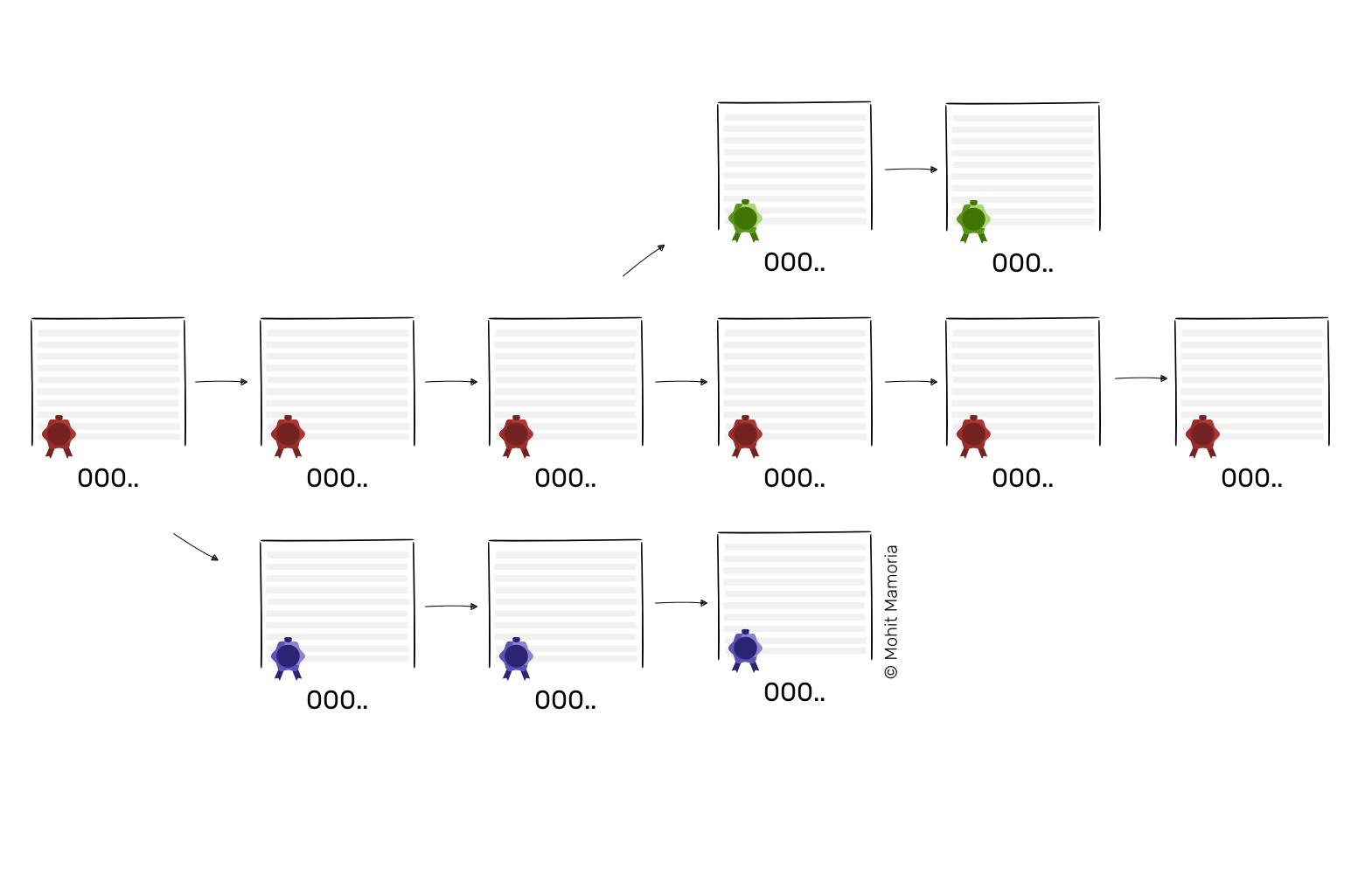
Longest chain is the honest chain.
When I told you that one dishonest guy cannot beat nine honest guys, did it ring any bell in your head?
What if, instead of one, six guys turn dishonest?
In that case, the protocol will fall flat on its face. And it is known as “51% Attack”. If the majority of the individuals in the network decides to turn dishonest and cheat the rest of the network, the protocol will fail its purpose.
And that’s the only vulnerable reason why Blockchains might collapse if they ever will. Know that, it is unlikely to happen but we must all know the vulnerable points of the system. It is built on the assumption that the majority of a crowd is always honest.
And that, my friends, is all there is about Blockchains. If you ever find someone feeling left behind and wondering, “WTF is the Blockchain?” you know where you can point them to. Bookmark the link.
Can think of someone right now who should read this? The ‘Share’ button is all yours.
—
About the author
Mohit Mamoria is the curator of a weekly newsletter, Unmade, which delivers one idea from the future to your inboxes.
You might also like
Who owns the Blockchain?_How democratic is the decentralization?_medium.com