
May 2017 Journal
WORDS is a monthly journal of Bitcoin commentary. This issue collects the May 2017 writing in the WORDS archive. For the uninitiated, getting up to speed on Bitcoin can seem daunting. Content is scattered across the internet, in some cases behind paywalls, and content has been lost forever. That’s why we made this journal, to preserve and further the understanding of Bitcoin.
Solidifying the Idea of Bitcoin
By Beautyon
Posted May 8, 2017

A few months ago, a journalist of the good sort interviewed me about Bitcoin. It is possible, when you are dealing with reasonable people, to explain Bitcoin to them and have them understand it in the proper context. The starting point here was a provocative article of the type we are familiar with, claiming that “Bitcoin is dead”. In 2017 no less. You have two choices in Bitcoin if you want to talk about it; learn patience and be prepared to hear the same objections over and over, or stop talking about it. The thankless task of education will not end for at least a decade.
For starters, what are your initial thoughts on the “Death of Bitcoin” article?
I think the article is misinformed, and is typical of the sort of thing written a few years ago. There will always be computer illiterates and Bitcoin illiterates, but their numbers are dwindling as Bitcoin’s user base expands. I guarantee you that if that outlet took Bitcoin for subscriptions or donations they would never open their mouths to attack it in any way.
What’s your response, then, to the warning that Bitcoin is too politically risky? That politicos will eventually do everything they can to blast it out of existence? That it’s only a matter of time?
This is FUD (Fear Uncertainty and Doubt) or “Scaremongering”. Japan has just formally legalized Bitcoin, and Hong Kong has explicitly said they will not regulate, with their “hands off” approach. Other countries will follow, and they will absorb all the Bitcoin businesses, who will serve everyone globally.
Bitcoin is not politically risky; it is math, and nothing more than math. It is no different than Linden Dollars or Monopoly Money. Troll writers like to characterize Bitcoin as money and dangerous, missing the irony that they are publishing on the internet, using the same basic software tools to spread their drivel that are used in Bitcoin. All the software techniques in Bitcoin are very old; what is new is the novel arrangement of these tools. If Bitcoin is risky, then so is SSL, the tool that secures your chats and Amazon purchases. You can’t have it both ways; you can’t be against Bitcoin and for Amazon. You can’t be against Bitcoin sold simply through vouchers (as http://azte.co) does and be against Amazon Gift Cards, that work exactly the same way.
Bitcoin is a sea change in the way people think about money and how they account for it. Before Bitcoin, the word “fiat” was used only by the readers of http://lewrockwell.com now, everyone, even people who do not like Bitcoin call the dollar “fiat”. A powerful transformation is taking place, and it will not be stopped. The USA is not the entire world, and Bitcoin is global. If everywhere other than the USA adopts Bitcoin, then it will be one of the greatest software successes of all time. There is nothing to stop the rest of the world adopting Bitcoin; the GSM standard was everywhere except the USA and eventually they had to capitulate and adopt it.
Bitcoin will succeed. There is nothing any government can do to stop it, just like they can’t stop file sharing over BitTorrent and IRC. It isn’t a question of time either. No amount of time can put the Bitcoin genie back in the bottle. This change is forever. The only way out for anyone whose business is challenged by Bitcoin is for them to totally embrace and integrate it. The Japanese have understood this.
The courts in the USA (one in Brooklyn and the other in Miami) are also forcing people to wake up out of their collective hysteria. Two separate courts in different jurisdictions have now ruled that Bitcoin is not money. This means the “politicos” have no law to resort to to stop it. Texas has tabled a law to protect Bitcoin as a right. Slowly but surely, everyone is moving to the correct side of Bitcoin.

Could you explain in a little more detail how and why you believe bitcoin won’t be stopped? Many Americans still believe the government can and will simply pass a federal law and… poof… make bitcoin go away. As a colleague wrote recently, “Bitcoin itself, it’s doomed. The end is near. Soon as Congress has a reason, they figure out how to shut it down. You mark my words. Too many banks have too much to lose. And if we know one thing, it’s that big banks and Congress are part of the same beast. The move is, like I’ve said before, folks have to get their heads out of the clouds. Digital currency — the anonymity, quote unquote security… that’s all great… in theory. In reality, in the real world, all those great parts have just as many if not more potential pitfalls. “The sooner people realize that, the better. You bet on bitcoin, you’re playing with fire. I can’t be clear enough about that. There’s too much REAL good news around us that’s compelling and actionable for me to spend one more second thinking about bitcoin.” Your response?
“Ugly Americanism” is anti Americanism. Remember GSM. Look at how prohibition is collapsing all over the US. America is the greatest country on earth but it’s not perfect, and some of its citizens are insular, ignorant and parochial. In the age of the internet, it’s impossible to stop good ideas from spreading, and the world of 2017 is not like 1957, 67 or 77. Many parts of what used to be called The third World now rival the USA in infrastructure. America doesn’t have the option of Luddism and ignorance; someone will eat it’s lunch.
Bitcoin cannot be stopped. This is not a belief, but a fact, based on the evidence of how it works and previous peer to peer software that has lasted for decades. You only need to look at two examples to come to this conclusion. First, over Internet Relay Chat, software was traded for many years uninterrupted and undetected. Then, after several iterations of how to arrange a Peer to Peer network (Napster, Gnutella, BitTorrent) BitTorrent emerged as a way to share files that cannot be stopped. One third of all internet traffic is taken up with BitTorrent, and billions of files have been swapped without any consequence. There is no way to stop BitTorrent, and in some cases, its use is impossible to detect.
Bitcoin is the same in its effect, and is more safe in many ways. Rather than having to expose your IP address for a significant amount of time, a Bitcoin transaction takes a fraction of a second, and is indistinguishable from other internet traffic. It can be accessed in a number of different ways, through different clients, and these transactions cannot be stopped in advance of being made without shutting the entire internet off. Bitcoin, like file sharing, will not be stopped, and unlike file sharing, there is no company that can change its distribution model to adapt to the new reality. Bitcoin is good money, and all the State can produce is bad money. The only meaningful way Bitcoin can be stopped is if the State creates its own Bitcoin network with identical features. We know that this is unlikely to happen, because the State is obsessed with controlling people and not helping them. Several governments are working on Bitcoin competitors and all of them will fail, because they are sub optimal, anti market offerings that Bitcoin beats every time, because it is a pure free market tool.
Passing a law did not stop file sharing, and threatening massive fines and gaol time did not stop it. No law can stop people from engaging in the market; drug prohibition has been a dismal failure and is being repealed across the USA. Any attempt to ban Bitcoin will similarly fail, only this time, it will be much worse, because everyone needs money, in numbers that greatly exceed the number of people who want to smoke Marijuana. Money is one half of all transactions. Americans, once they wake up to Bitcoin, will flock to it. It will become “The money of the internet”. The American government can no more make Bitcoin go away than it can make Marijuana smoking go away.
“Soon as Congress has a reason, they figure out how to shut it down.” This is ridiculous. Congress finding a reason to “shut down Bitcoin” will not result in them finding a way to do it. Also, Congress has no power over anyone in any other country other than America. Internet Poker is illegal in the USA, but it is thriving globally. By your colleague’s logic, Congress should be able to “shut down internet poker”. It’s not very intelligent. And of course, people in America play internet poker illegally every day. With Bitcoin, they will be able to play internet poker and be paid in Bitcoin. Who is the loser in this? The American government, who does not collect taxes and fees from internet poker sites, draining what is probably a lot of money from the USA to the EU and other jurisdictions.
Your colleague says banks have too much to lose. So did the telephone companies with Skype. So do the Taxi companies with Uber. Just because some established group has something to lose, it doesn’t necessarily follow that they will be able to stop an innovation. This is not very serious thinking, clearly. Bitcoin is a very difficult topic to understand. People who are computer illiterate, do not have passports, know nothing about the history of software, have a very hard time understanding how it is possible, and how the changes that are coming are going to be unstoppable. It doesn’t matter what you can or cannot understand; Bitcoin’s nature is not subject to the ignorance of the lowest common denominator ugly American. No one cares about whether an ignorant, uneducated man does not want to spend time thinking about Bitcoin. Bitcoin was written without reference to these sorts of people, and it persists without reference to them also. In the same way that some people refuse to use eBooks or even email, there will be people who refuse to use Bitcoin, just as when the telephone was commercialized, there were people who refused to have them in their houses. There will always be unintelligent, uneducated people; they are a part of the way things are. The world changes because intelligent people don’t care about them, and carry on inventing and helping the public.

What are some, if any, of your predictions about bitcoin and cryptocurrency in general? Also, what are the implications of mainstream adoption?
Bitcoin will become as big as email. It will be on every cellphone, phablet, tablet, laptop and desktop on Earth. It will be used for every conceivable purchase and for some presently inconceivable purpose.
When mobile phones had to be carried in briefcases, no one imagined that literally everyone, including children, would have one. The same will be true of Bitcoin. The logic goes like this: “Everyone needs to use money, everyone is on the internet. Everyone needs to spend money on the internet, Bitcoin is the money of the internet, everyone needs Bitcoin.”
The implications of Bitcoin and mass adoption are harder to flesh out, but we can say for certain that Bitcoin means the final death of government fiat money. It means the death of banks as we know them today. It means the end of inflation (an increase in the supply of money). It means the end of Big Government. It means an era of unprecedented prosperity, as savings once again become the source of investment.
Then there are the impossible to predict consequences of not only the economic effects of Bitcoin, but the fact that a programmable money substitute is a global tool. One service that offers a glimpse into this is Purse, which opens up eCommerce to everyone on earth, because Bitcoin is a guaranteed payment that can be made conditional through MultiSig transactions. The other programming functions coming to Bitcoin, like paying in the future, will by themselves cause new services to emerge that no one can imagine.
People who are computer and economic illiterates can’t understand even the most basic premiss of Bitcoin; but they don’t have to. They don’t understand how GSM in their phones work, or the A5 algorithm that scrambles and descrambles their voices and have no problem using a cellphone. It will be the same with Bitcoin. Bitcoin will just “be” and that’s it. You will just use it, be paid with it and in it, and you will accept it, just as you accept email, cellphones, internet chat apps and all the other fantastically complicated things that are taken for granted.
When you pay with a credit card on line, you never think about what the green lock means and how many steps and technologies are used to keep your information safe. You don’t think about how credit cards work, how UPS routes packages or anything else. You blithely go about your business buying what you want to buy. Bitcoin will be another layer that everyone accepts, and they will accept it, because everyone else is using it, and in order to participate in society, you will need to use Bitcoin, just as it is when you receive a phone call; if you want to receive phone calls, you must accept that you need a phone and a number or an app. You don’t question how it works under the hood, you just use it.
Прочтите эту статью на русском языке.
A bowl of organic pistachios and a whisky sour ↯

The Perfect Storm
By Beautyon
Posted May 15, 2017

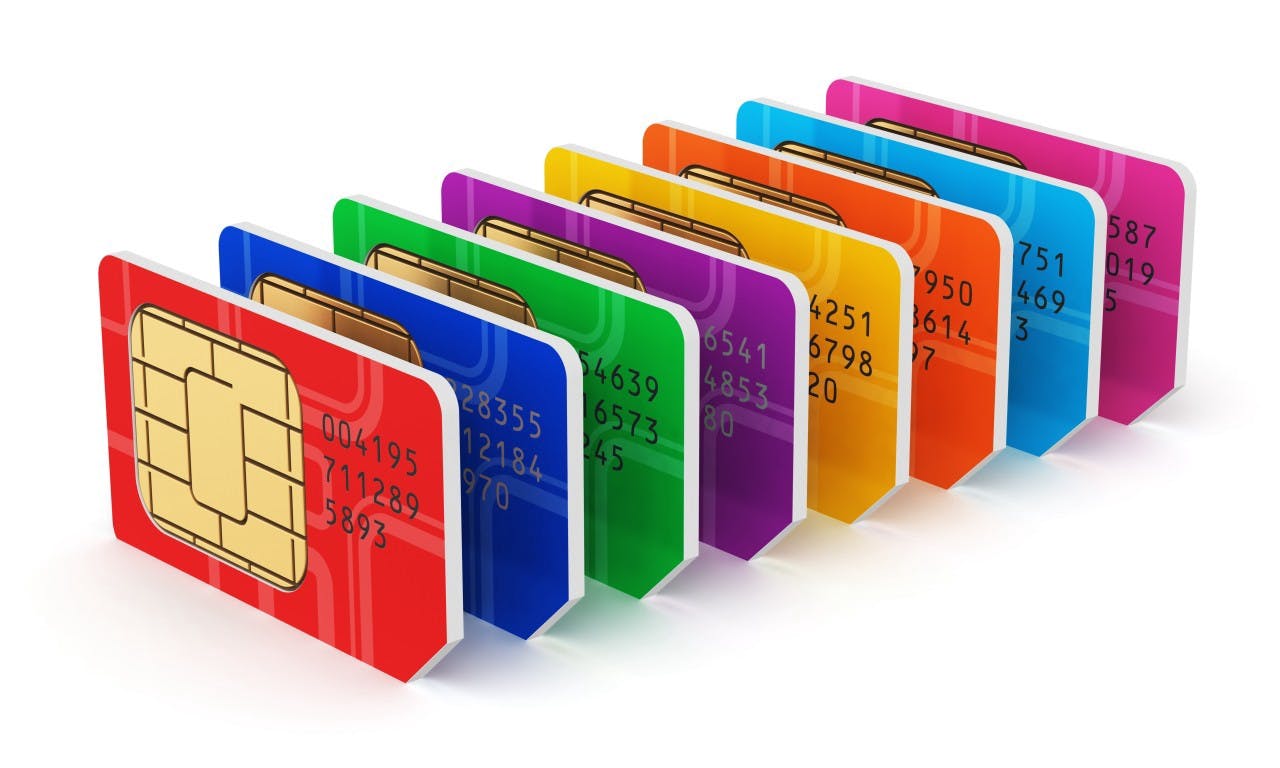
Synopsis. Bitcoin is a perfect fit for the Pay as You Go (PAYG) mobile user population. The excellent Bitrefill service processes 16,000 top ups per month where users pay with Bitcoin to top up their air-time. It is only a small step to these users adopting Pay as You Go Bitcoin, charged with Azteco Vouchers, that they are already familiar with.
The Pre Paid User Market
Usage of prepaid cellphone service is common in most parts of the world. Around 70% of customers in Western Europe and China use prepaid phones with the figure rising to over 90% for customers in India and Africa. 23% of cellphone users in the United States were using prepaid service as of 2011, a share that’s expected to rise to 29% by 2016.
Methods of payment (Wikipedia):
- Credit card or debit card or online payment processors such as PayPal or SafetyPay.
- Direct draw from bank account using an ATM
- Retail store purchase with a “top-up voucher” or “refill card” at retail. These vouchers and cards carry a unique numeric code which must be entered into the phone in order to add the credit onto the balance.
- Retail store purchase using a swipe card where the balance is credited automatically to the phone after the retailer accepts payment.
- Retail store or online purchase: a person can top-up a prepaid phone in another country by asking for “international top-up”. Often, migrant workers will send prepaid top-up internationally as a form of support.
- Other mobile phones on certain networks which provide international top-up services, where the initiator of the top up is often a migrant worker wanting to add minutes to the prepaid mobile phone of a family member back home.
The Numbers
There are half a billion mobile phone users in Africa, and 70% of these users are on PAYG That means there are 350,000,000 users in Africa relying on PAYG to top up their phones. For them, topping up and running phones in this way this is perfectly normal, and not the activity of “the financially excluded”. In 2015 it was projected that there will be 125,500,000 smart phone users. Each of these is capable of running their own Bitcoin wallet.
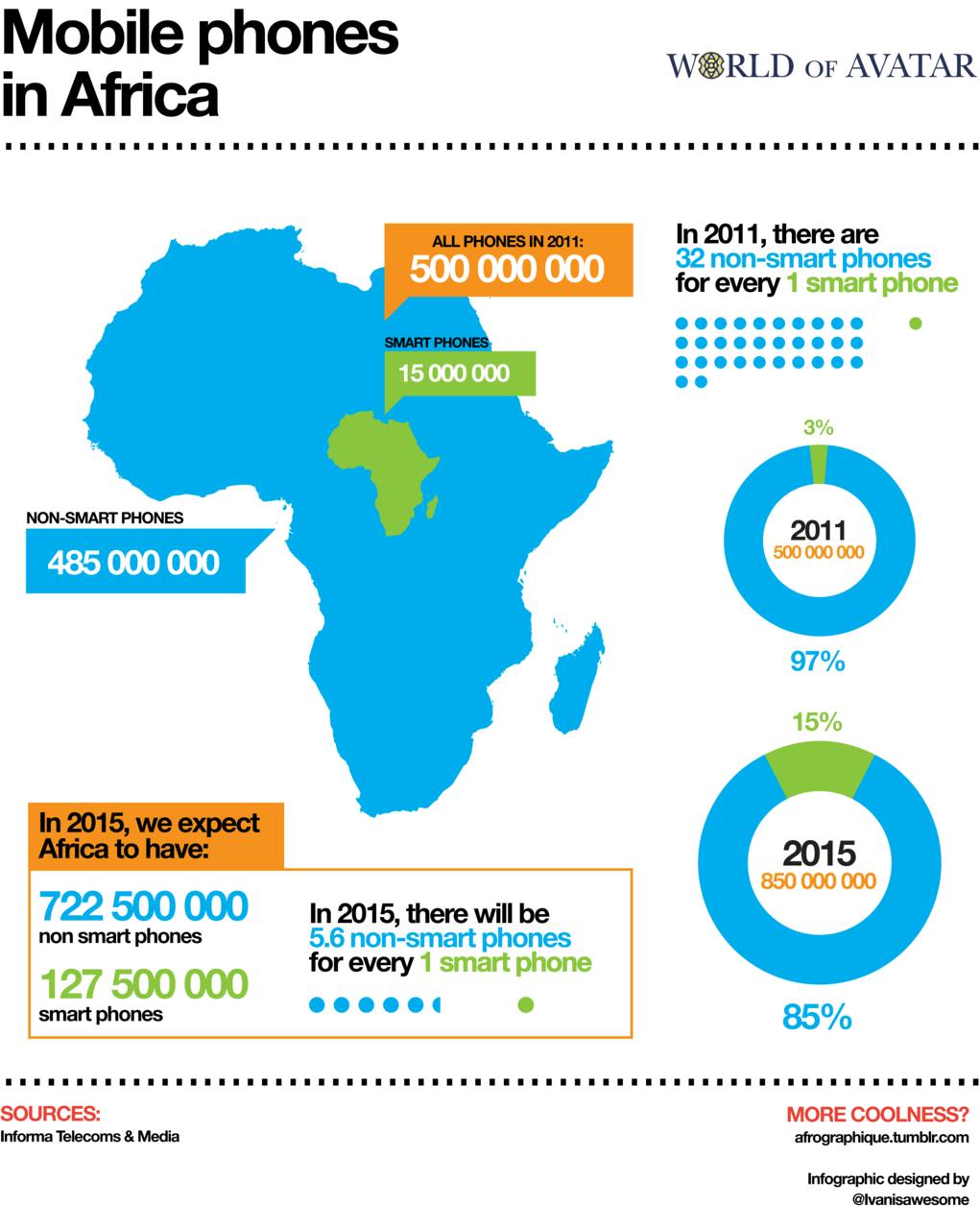
Out of the 350 million PAYG mobile users in Africa, 226 million are smart phone users. This means there are 226 million potential Bitcoin wallet users in Africa alone. All of these people:
- Do not have bank accounts or credit cards
- Are used to mobile top ups by voucher or refill card
- Use remittance services to send and receive money
And remember; these users will be fed Bitcoin by their diaspora populations, as well as Bitcoin moving from these populations to foreign destinations.
Clearly, in this scenario, Bitcoin Wallets serve as universal “flexible SIM for money”. Every user can download a Bitcoin wallet for free, and charge it in the same way that they do their PAYG SIM cards, through a voucher supplied by a local vendor.
Beating Western Union, Rio and its Ilk
Sending money to Africa using Western Union has a base level transfer fee service charge of $4.99. Bitcoin, once it is purchased, has fees that are in the pennies on the Lightning and “Layer 2” infrastructure.
Walmart in the USA costs $4.50 for transfers up to $50 and $9.50 to send up to $900. That means their fees are 10%. Western Union, in comparison, charges $5 for a money transfer of up to $50, but a transfer of $900 could cost $76. There are a number of price points in between, dependent on the amount of money to transfer. (CNN)
At 4% Azteco beats both Walmart, Rio, Western Union and all other remittances services. On top of this price advantage, the money arrives instantly at the recipient’s wallet, and does not have to be collected. Furthermore, that money can be spent directly by the recipient at any retailer on line, including Amazon (via Purs.io) globally. It can also be sent to any other Bitcoin user globally, for extremely low fees, without reference to any third party.
Finally, Western Union customers, by figures published by them, are 70% banked. That means we are not competing directly with Western Union when we address and serve everyone who un-banked. There are 2bn people in that demographic, 60m in Mexico 88m in the USA (for example). These people are not Western Union users, and we will not be competing against the 700lb Gorilla. At first.
Fear, Uncertainty and Doubt
We must include a section analysing the perceived downsides, so here it is.
As of July 2013, at least 80 countries globally (including 37 on the African continent) have mandated, or are actively considering mandating, the registration of prepaid SIM users.
The reason is a concern of police and security agencies that anonymous use of prepaid mobile services facilitates criminal activities. Note that this is a “concern” and not legislation designed to stop something that is actually happening in real life.
Prepaid phone users can be anonymous for two reasons:
- In certain countries, the prepaid SIM card can be sold in a shop like any other goods. There is no need to register them at point of sale, unlike postpaid phones who have to credit check the user before allowing them to purchase and enter into a contract.
- Prepaid services can often be topped up using cash and vouchers, there is no way to trace the payment and hence determine the identity of a prepaid phone user from payment records.
While there is no doubt that criminals use prepaid SIM cards to help stay anonymous and avoid easy detection, to date there has been no empirical evidence to indicate that:
- Mandating the registration of prepaid SIM users leads to a reduction in criminal activities; and
- The lack of any registration of prepaid SIM users is linked to a greater risk of criminal or terrorist activities.
In fact, a publicly available policy assessment report from Mexico showed that mandatory SIM registration introduced there in 2009 had failed to help the prevention, investigation and/or prosecution of associated crimes. As a result, policymakers decided to repeal the regulation three years later.
Clearly, it makes sense not to go down this route, as it has no effect on the prevention or detection of crime. The needs of the many outweigh the needs of the few, and crime is an extremely small percentage of the billions of PAYG top ups that have taken place since they were introduced. All of this applies directly to Bitcoin.
Conclusion
It is clear that we are on the cusp of a perfect storm, where Bitcoin will sweep across the entire globe. There is an enormous population of potential users who are familiar with mobile PAYG systems and topups via vouchers.
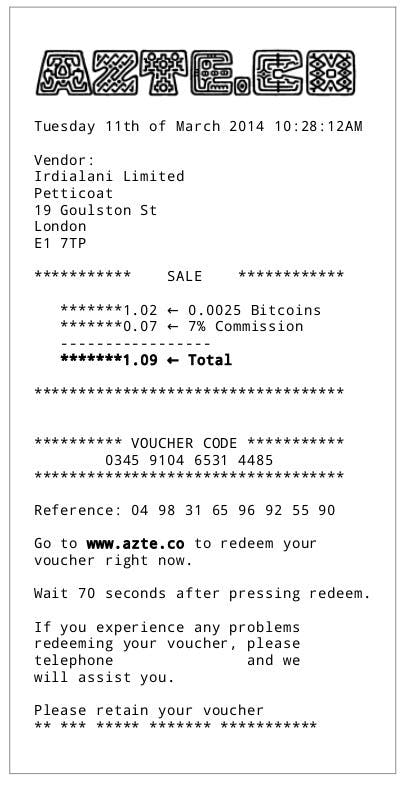
Azteco addresses this market perfectly. We remove all the complexity from obtaining Bitcoin, and fit it into a paradigm that removes any need for in depth education, since all the users are already pre disposed to using it.
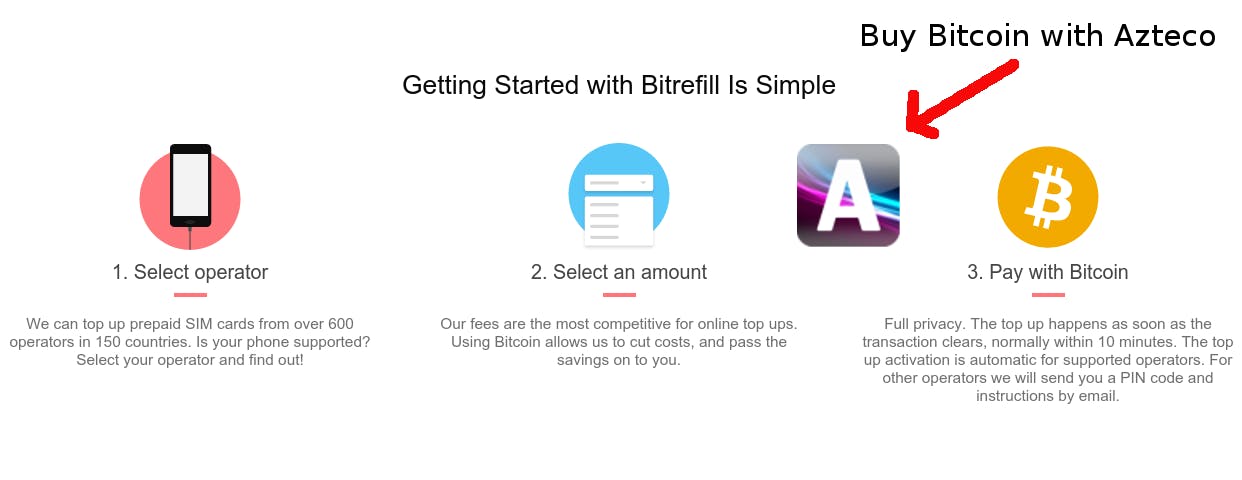
The missing link.
Simple to use retail Bitcoin is the missing link. It is the final step that will onboard billions of people to global e-commerce. The image above from the Bitrefill is illustrative of the problem Azteco solves; it has a missing step in its, Getting Started with Bitrefill diagram; how do their customers obtain Bitcoin to buy their top-ups? Azteco.
We can say for certain that when Azteco launches, Bitrefill and services like it that need this important step to be inserted will see an increase in their numbers, as we close the missing part of the Bitcoin ecosystem circle: how to easily obtain Bitcoin.
Economics of Bitcoin as a settlement network
By saifedean
Posted May 19, 2017
.entry-header
As Bitcoin’s popularity continues to increase, its transaction fees rise as well, leading to the customary chorus of doom and gloom by those still stuck in stage 1 of dealing with Bitcoin grief. With average transaction fees exceeding $2, the doom-mongers assure us Bitcoin is doomed, because nobody wants to pay $2 to make a payment, when credit cards, paypal, and many other options charge far less transaction costs.
The problem here, as usual, is not with Bitcoin, but with people’s misunderstanding of Bitcoin, and the first clue to that can be found in the sky-rocketing price: if Bitcoin is so doomed, why are people still buying it? The answer is that Bitcoin’s value proposition is not in making the small consumer purchases, but in making large and important payments, particularly across borders. Payments in person, for small amounts, can be conducted in a wide variety of options: physical cash, barter, favors, credit cards, bank checks, and so on. Payments across the world, however, are a very different story.
There are only a few currencies that are accepted for payment worldwide, namely: the US Dollar, the Euro, gold, and the IMF’s SDR’s. The vast majority of international payments are denominated in one of these currencies, with only a tiny percentage shared by a few other major currencies. To send these currencies in values around thousands of dollars internationally costs dozens of dollars usually, and is subject to invasive forensic examination by financial institutions. Compared to these transactions, Bitcoin’s transaction fees of $2.5 are still a bargain.
However, the volume of these international flows is far larger than what Bitcoin’s blockchain can handle, and if more such payments move to Bitcoin, fees will rise to limit the demand for them. Yet, that would also not spell doom for Bitcoin, because sending these individual payments is not the limit of Bitcoin’s capabilities.
Bitcoin is money free of counter-party risk, and its network can offer final settlement of large volume payments within minutes. Bitcoin can thus best be compared to settlement payments between central banks and large financial institutions, and it compares favorably to them, being infinitely cheaper and more verifiable. The only other form of money in history which is free of counter-party risk is gold, and moving that around is incomparably more expensive.
An interesting thought experiment is to imagine the shape of a global economic system built around settlement in Bitcoin. Bitcoin’s current capacity is to verify around 350,000 transactions per day. This number of transactions can allow a global network of 850 banks to each have one daily transaction with every other bank on the network. (The number of unique connections in a network equals n(n-1)/2, where n is the number of nodes.)
Bitcoin can support an international network of 850 central banks capable of performing daily final settlement with one another. Such a network would have two major advantages over the current network of central banks: First, the finality of settlement on Bitcoin does not rely on any counter-party, and does not require any single bank to be the de facto arbiter, making it ideal for a network of global peers, rather than a global hegemonic centralized order. Second, the Bitcoin network is based on a form of money whose supply cannot be inflated by any single member bank, making it a more attractive store of value proposition than national currencies whose creation was precisely so their supply can be increased to finance governments.
In a world in which no government can create more Bitcoin, these Bitcoin central banks would compete freely with one another in offering physical and digital Bitcoin-backed monetary instruments. Without a lender of last resort, fractional reserve banking becomes an extremely dangerous arrangement, and the only banks that’ll survive in the long-run would be sound money banks offering financial instruments 100% backed by Bitcoin. They would settle payments between their own customers off of Bitcoin’s blockchain, and then perform final daily settlement between each other over the blockchain.
I am currently writing a book explaining Bitcoin’s main value proposition as a sound money, and elucidating the significance of this concept across history, which far exceeds the significance of small transaction costs on consumer payments. Sound money has been a necessary building block of human civilizations, and its demise has usually coincided with civilizational decline. The modern world was built in the 19th century on sound money, funded by investors with the low time preference engendered from a sound money. The consumerist culture of instant gratification of the twentieth century, on the other hand, was the culture of ever-devaluing fiat money, which discourages saving, and incentivizes short-term orientation.
The obsession with consumer payments in the Bitcoin community is an unfortunate relic of the fiat money era. Generations that have only known monetary hot potatoes that need to be spent before they devalue have come to view life as a quest of mass consumption. In a world of sound money, people will still consume, of course, because they need to survive. But consumption will come at a high opportunity cost in the future, since savings appreciate. As result, consumption will stop being a compulsive part of life, and people will buy things they need, and things that last for a long time. Instead of wasting their money on plastic bullshit they don’t need and expensive sugary addictions, people will save their money for the future, and watching it appreciate, achieve financial independence.
The number of transactions in a Bitcoin economy can still be as large as it is today, but the settlement of these transactions will not happen on Bitcoin’s ledger, whose immutability and trustlessness is far too valuable for individual consumer payments. The reality is that buying a coffee does not require the level of security and trustlessness that Bitcoin offers; it can be more than adequately handled on second layer solutions denominated in Bitcoin. Using Bitcoin for consumer purchases is akin to driving a Concorde jet down the street to pick up groceries: a ridiculously expensive waste of an astonishing tool. Consumer payments are a relatively trivial engineering problem which the modern banking system has largely solved with various forms of credit and debit arrangements. Whatever the limitations of current payment solutions, they will stand to benefit immensely from the introduction of free market competition into the field of banking and payments, the most sclerotic industry in the modern world economy, owing to its control by governments that can print the money on which it runs.
If the consumer-payments view of Bitcoin were correct, the rise in transaction fees would hurt adoption of the network, leading to stalling in the price, or a drop, as the network is relegated to the status of a curiosity. On a day in which the price of a Bitcoin hit $2,000, this is becoming an increasingly untenable argument. From the settlement layer view, the growing adoption of Bitcoin is increasing its liquidity internationally, allowing it to compete with global reserve currencies for increasingly more valuable transactions, causing transaction fees to rise. As this processes continues in the future, expect much higher transaction fees, and a global Bitcoin settlement network to grow in importance.
.entry-content .clear
Bitcoin and Software Reliability
By Beautyon
Posted May 27, 2017

A small group of disgruntled people who feel left out of Bitcoin’s meteoric rise complain that Bitcoin’s developers add new features to its basic tool kit “too slowly”, and that innovation on it has stagnated. It is not true that Bitcoin is stagnating. Bitcoin is the fundamental backbone of the missing infallible payments layer of the Internet. In order for it to be infallible and totally reliable, there is only one possible approach to maintaining and extending the software that governs it.
The mindset and approach needed is not many quick iterations and “break things” mentality; instead, what is needed is the thinking behind super high uptime software, where methodical, slow, evidence-based improvement cycles are employed, and where features are added only when it is proven that stability, compatibility and integrity are absolutely guaranteed.
This is not a new approach in software. Mission-critical systems and applications where life and death are at stake opt for vendors who are very conservative and focussed on stability and reliability.
These systems have uptimes (the amount of time a system is available without interruption) measured in years. Visa’s recent downtime shows they are not running systems built to this high and exacting standard, and Bitcoin shows that it is built to this standard, with its uninterrupted, infallible and continuous service measured in years.
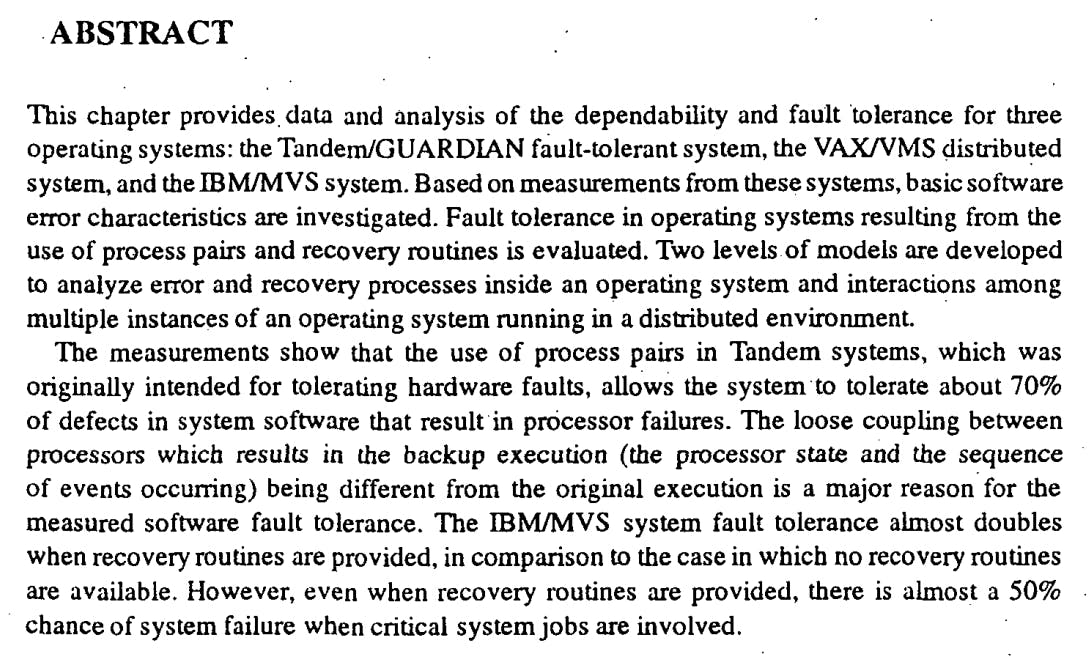
Bitcoin isn’t an operating system, but the principles of fault tolerance and careful extension apply nonetheless. The “To the Moon” meme provides a useful context. NASA’s software fault tolerance requirements are very strict. When astronauts are involved, their lives are at stake. “Break stuff” in that context means “Kill People”. The software simply must work every time, no compromise, no guesswork, no exceptions. There are no “do overs” or roll-backs. Guaranteed performance is possible in software, because everything about the systems, including the hardware, can be known in advance and thoroughly tested.
High fault tolerance software development has been going on for decades. It is a very well understood discipline, and the practices, methods and mentality are also established and known to work. This is why regular satellite launches work exactly as expected every time. People take them for granted, but there is a culture behind the processes that make regular flawless space launches possible that needs to be applied to Bitcoin, if it is to serve everyone as is hoped. It is not unreasonable to expect Bitcoin to never have an error in its operation. This expectation is already understood to be achievable in Air Traffic Control systems, where once again, lives are at stake.
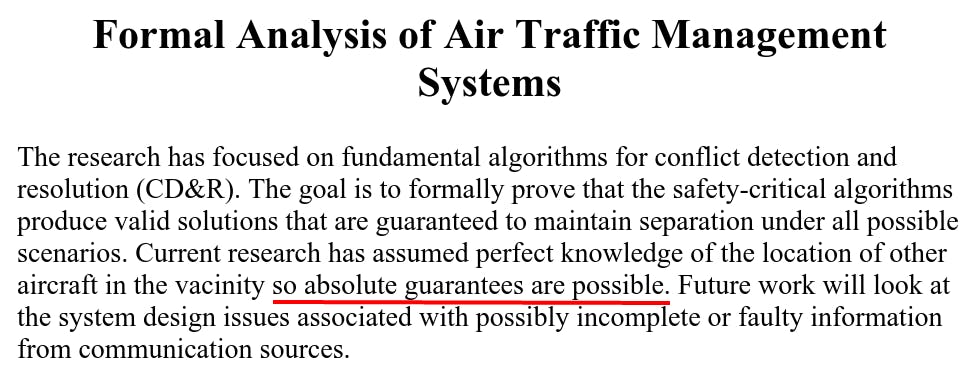
https://shemesh.larc.nasa.gov/fm/fm-atm.html
With Bitcoin, lives and money are at stake. Interruption of its service can cause a cascade of losses and unintended consequences for potentially millions of people and billions of fiat dollars. If it is possible to build a Bitcoin that cannot fail, that should be the goal, and no compromise should be acceptable. It is also clearly possible that a distributed Bitcoin with that characteristic can exist. Bitcoin can be absolutely fault free and distributed at the same time; in fact, any centralization of Bitcoin into data centres increases the probability of critical faults. For certain, there is a math function to describe this. Can you write it out? The exam question would be something along the lines of,
“If Bitcoin is run from a single data centre and that data centre goes off-line, Bitcoin goes down. If Bitcoin is in two data centres and one of them goes off-line, Bitcoin stays up. Describe a function that explains this, showing the number of data centres in relation to the probability of Bitcoin going down, where going down means Bitcoin is totally inoperable. Extra marks for providing a graph of the function.”
Bitcoin is not a social network or chat app. It is a mission-critical software project that has greater integrity than any financial software project in history, in both senses of the word “integrity”. It never goes down, is always available, and is absolutely predictable. All other projects next to it pale in comparison. It is a solid foundation to build against — more solid, in fact, than the operating systems used to build the services that take advantage of it.
The vast majority of tool builders are not held to the standards that NASA and Mission-Critical, High Availability systems are held to; it is a special discipline that most people are unaware of. Participants who are not even software developers at all have no clue about this specialist field, let alone the expert field of software that isn’t life or death fault tolerant itself; that field is two times removed from them, and is not a part of their thinking at all.

Cherenkov Radiation in a Nuclear Reactor. TOXIC!
The more you look at what Bitcoin has achieved, how specialised its disciplines and requirements are, the number of things outside the software realm that constrain its operation (like the speed of light) the more you’re astonished that it has even happened, and the more you want to stay as far away as you can possibly get from its inner workings…if you are sane. This doesn’t mean that you can’t build on Bitcoin as an ordinary developer; on the contrary, its APIs are easy to understand and build against. What you cannot do, however, is enter the “radiation zone” where unseen problems can literally irradiate and kill you. The speed of light is a perfect example.
There is an upper limit to the block size beyond which the Bitcoin network cannot stay in sync. Because it takes time for data to move across the network, the speed of light is a limiting factor. You can’t have blocks of a size that are beyond that limit, and have Bitcoin as a distributed network. The obvious question is, “what is that magic block size number?”. It is certainly a function of the fastest possible network transmission speed, which is very much slower than the speed of light in air. Normal fibre optic cable transmits light at one third the speed of light, which suggests another exam question,
“Calculate the largest theoretical block size the Bitcoin network can manage and maintain a distributed peer structure if it were running on a perfect fibre optic network where the connections between all nodes run at half the speed of light, over a geographic area the size of the Earth. Any node on the network must be a maximum of one microsecond behind any other node at any time during normal Bitcoin operation.”
This is the sort of question big blockers don’t ask and don’t have the math to answer. New ultra-thin photonic-bandgap rim, mode division multiplexing fibre optic cable can transmit light at 99.7% of c, but it will take decades to replace all the “slow” fibre optic cable globally. For now, Bitcoin must operate within the constraints we have today. This matter of speed constraints is a question High-Frequency Traders have already posed, and found a solution to; put everything in one data centre:
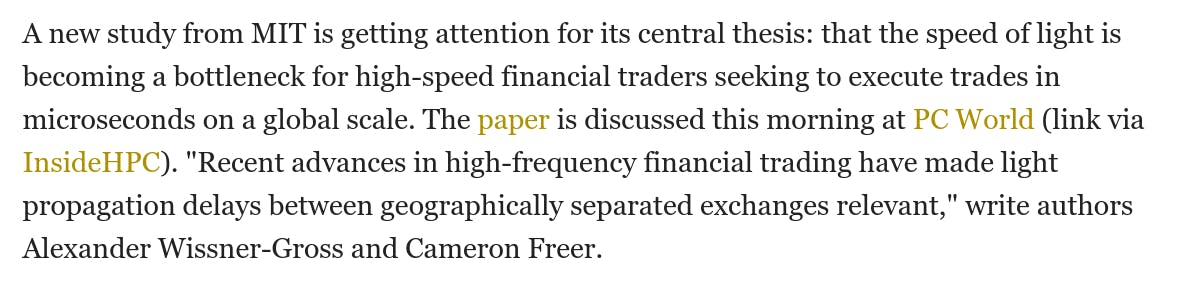
This means that traders who are competing against each other buy rack space in specialist data centres where their boxen can execute trades with the equipment of other traders. This is not acceptable for Bitcoin, obviously, because it exists outside of the State and its regulations. High-speed trading data centres are all “compliant” and regulated. Bitcoin is not regulable. It can never exist in a data centre without losing its force of nature characteristic. This is not to say that Bitcoin is in opposition to anything; the rain, wind and snow are not in opposition to crops, roads or your vacation; they simply are, just as Bitcoin is. Putting Bitcoin in a data centre is like trying to put lightning in a Leyden Jar. It isn’t lightning any more, but static electricity.
Decades from now, when fibre optic cable runs at near-lightspeed it may be possible to increase the block size, and do other things that take advantage of the inevitable improvements in hardware and software. Certainly, as Bitcoin unleashes the forces of the free market, these innovations will come faster than they would have under the fiat currency fueled State. For now, however, Bitcoin must exist inside the constraints imposed by today’s technology. And it will be enough to change everything.
If you like the content and feel so obliged to send some love via BTC donations you can do so at the address below:↴

Thoughts on Tokens
By Balaji S. Srinivasan
Posted May 27, 2017
Tokens are early today, but will transform technology tomorrow.
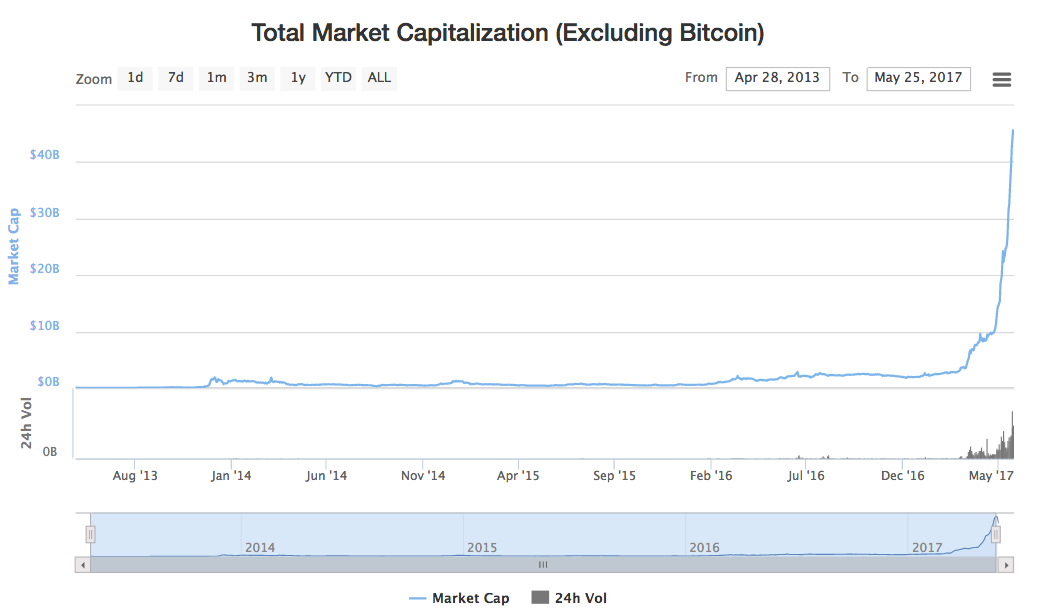
The exponential rise of non-Bitcoin tokens prior to the coming correction. Data fromcoinmarketcap.com/charts
In 2014, we wrote that “Bitcoin is more than money, and more than a protocol. It’s a model and platform for true crowdfunding — open, distributed, and liquid all the way.”
That new model is here, and it’s based on the idea of an appcoin or token: a scarce digital asset based on underlying technology inspired by Bitcoin. While indisputably frothy, as of this writing the token sector sits at a combined market cap in the tens of billions. These new “fat protocols” may eventually create and capture more value than the last generation of Internet companies.
Here we discuss many concepts related to tokens, beginning with the basics for folks new to the space and then moving to advanced ideas.
The most important takehome is that tokens are not equity, but are more similar to paid API keys. Nevertheless, they may represent a >1000X improvement in the time-to-liquidity and a >100X improvement in the size of the buyer base relative to traditional means for US technology financing — like a Kickstarter on steroids. This in turn opens up the space for funding new kinds of projects previously off-limits to venture capital, including open source protocols and projects with fast 2X return potential.
But let’s start with the basics first. Why now?
1. Tokens are possible because of four years of digital currency infrastructure
The last time the public at large heard much about digital currency was in late 2013 to early 2014, when the Bitcoin price last touched its then all-time high of $1242 dollars. Since then, several things happened:
- Bitcoin experienced a massive multi-year crash and recovery all the way down to $173 and back up to the recent all-time highs of $2800+
- Dozens of exchanges arose in many countries to facilitate the conversion of fiat currencies like dollars or yen into digital currencies like Bitcoin and Ethereum
- Major financial institutions began exploring the blockchain technology underpinning Bitcoin to build so-called “private blockchains” or distributed ledgers for internal or consortium use
- The programmable Ethereum blockchain launched, endured its own major crises, brought on major corporate support, and surged in value in early 2017
In 2013, the legality of digital currency was still in question, with many predicting death and others going so far as to call Bitcoin “evil”. Those kneejerk headlines eventually gave way to Satoshi billboards in Davos and the Economist putting the technology behind Bitcoin on its cover.

By 2017, every major country has a digital currency exchange and every major financial institution has a team working on blockchains. The maturation of infrastructure and societal acceptance for digital currencies has set the stage for the next phase: internet-based crowdfunding of novel Bitcoin-like tokens for new applications.
2. Tokens vary in their underlying blockchains and codebases
To first order, a token is a digital asset that can be transferred (not simply copied) between two parties over the internet without requiring the consent of any other party. Bitcoin is the original token, with bitcoin transfers and issuances of new bitcoin recorded in the Bitcoin blockchain. Other tokens also have transfers and changes to their monetary base recorded in their own blockchains.
One key concept is that a token’s codebase is different from its blockchain database. As an offline analogy, imagine if the US banking infrastructure was repurposed to manage Australian dollars: both are “dollars” and have a shared cultural origin, but a completely different monetary base. In the same way, two tokens may use similar codebases (monetary policies) but have different blockchain databases (monetary bases).
The success of Bitcoin inspired several different kinds of tokens:
- Tokens based on new chains and forked Bitcoin code. These were the first tokens. Some of these tokens, like Dogecoin, simply changed parameters in the Bitcoin codebase. Others like ZCash and Dash innovated on privacy-preserving features. Still others like Litecoin also began as simple tweaks to Bitcoin’s code, but eventually became test grounds for new features. All of these tokens initiated their own blockchains, completely separate from the Bitcoin blockchain.
- Tokens based on new chains and new code. The next step was the creation of tokens based on wholly new codebases, of which the most prominent example is Ethereum. Ethereum is Bitcoin-inspired but has its own blockchain and was engineered from the ground up to be more programmable. Though this comes with an increased attack surface, it also comes with new capabilities.
- Tokens based on forked chains and forked code. The most important example here is Ethereum Classic, which was based on a hard fork of the Ethereum blockchain that occurred after a security issue was used to exploit a large smart contract. That sounds technical, but essentially what happened is that a crisis caused the Ethereum community to split 90/10 with two different go-forward monetary policies for each group. A real world example would be if all the citizens of the US who disagreed with the 2008 bailouts changed in their dollars for “classic dollars” and adopted a different Fed.
- Tokens issued on top of the Ethereum blockchain. Examples include Golem and Gnosis, all based on ERC20 tokens issued on top of Ethereum.
In general, it is technically challenging to launch wholly new tokens on new codebases, but much easier to launch new tokens through Bitcoin forks or Ethereum-based ERC20 tokens.
The latter deserves particular mention, as Ethereum makes it so simple to issue these tokens that they are the first example in the Ethereum tutorial! Nevertheless, the ease with which Ethereum-based tokens can be created does not mean they are inherently useless. Often these tokens are a sort of public IOU intended for redemption in a future new chain, or some other digital good.
3. Token buyers are buying private keys
When a new token is created, it is often pre-mined, sold in a crowdsale/token launch, or both. Here, “pre-mining” refers to allocating a portion of the tokens for the token creators and related parties. A “crowdsale” refers to a Kickstarter-style crowdfunding in which internet users at large have the opportunity to purchase tokens.
Given that tokens are digital, what do token buyers actually buy? The essence of what they buy is a private key. For Bitcoin, this looks something like this:
5Kb8kLf9zgWQnogidDA76MzPL6TsZZY36hWXMssSzNydYXYB9KF
For Ethereum, it looks something like this:
3a1076bf45ab87712ad64ccb3b10217737f7faacbf2872e88fdd9a537d8fe266
You can think of a private key as being similar to a password. Just like your private password grants you access to the email stored on a centralized cloud database like Gmail, your private key grants you access to the digital token stored on a decentralized blockchain database like Ethereum or Bitcoin.
There is one major difference, however: unlike a password, neither you nor anyone else can reset your private key if you lose it. If you have the private key, you have possession of your tokens. If you do not, you have lost access.
4. Tokens are analogous to paid API keys
The best existing analogy for tokens may be the concept of a paid API key. For example, when you buy an API key from Amazon Web Services for dollars, you can redeem that API key for time on Amazon’s cloud. The purchase of a token like ether is similar, in that you can redeem ETH for compute time on the decentralized Ethereum compute network.
This redemption value gives tokens inherent utility.
Tokens are similar to API keys in another respect: if someone gains access to your Amazon API keys, they can bill your Amazon account. Similarly, if someone sees the private keys for your tokens, they can take your digital currency. Unlike traditional API keys, though, tokens can be transferred to other parties without the consent of the API key issuer.
So, tokens are inherently useful. And tokens are tradeable. As such, tokens have a price.
5. Tokens are a new model for technology, not just startups
Because tokens have a price, they can be issued and sold en masse at the inception of a new protocol to fund its development, similar to the way startups have used Kickstarter to fund product development.
The money is typically received in digital currency form and goes to the organization issuing the tokens, which can be a traditional company or an open source project funded entirely through a blockchain.
In the same way that boosting sales is an alternative to raising money, token launches can be an alternative to traditional equity-based financings — and can provide a way to fund previously unfundable shared infrastructure, like open source. A word of caution, though: read these three posts and consult a good lawyer before embarking on a token launch!
6. Tokens are a non-dilutive alternative to traditional financing
Tokens aren’t equity, because they have intrinsic use and because they are non-dilutive to the company’s capitalization table. A token sale is more similar to a Kickstarter sale of paid API keys than equity crowdfunding.
However, when considered as an alternative to classic equity financing, token sales yield a >100X increase in the available base of buyers and a >1000X improvement in the time to liquidity over traditional methods for startup finance. The three reasons why: a 30X increase in US buyers, a 20–25X increase in international buyers, and a 1000X improvement in time-to-liquidity.
7. Tokens can be bought by any American (>30X increase in buyers)
A token launch differs from an equity sale — the latter is regulated by the 1934 Act, while the former is more similar to a sale of API keys.
While equities can only be sold in the US to so-called “accredited investors” (the 3% of adults with >$1 million in net worth), the US could not restrict the sale of API keys to accredited investors alone without crippling its IT industry. Thus, if tokens (like API keys) can be sold to 100% of the American population, it would represent an increase of 33x in the available US buyer base relative to a traditional equity financing for a US startup.
Do note, however: some people might want to issue a token and explicitly advertise it as a way to share in the profits of their efforts as a company. For example, the issuer might want to make token holders entitled to corporate dividends and voting rights, or make the company’s total ownership stock denominated in tokens. In these cases, we really are talking about tokenized equity (namely securities issuance), which is very different than the appcoin examples we’ve discussed. Don’t issue tokenized equity unless you want to be limited to accredited investors under US securities laws. The critical distinction is whether the token is simply a useful and tradable digital item like a paid API key. Again: read these three posts and consult a good lawyer before embarking on a token launch!
8. Tokens can be sold internationally over the internet (~20–25X increase in buyers)
Token launches are typically international affairs, with digital currency transfers coming in from all over the world. New bank accounts receiving thousands of wires from all over the world in minutes for millions of dollars would likely be frozen, but a token sale paid in digital currency is always open for business. Given that the US is only ~4–5% of world population, the international availability provides another factor of 20–25X in the available buyer base.
9. Tokens have a liquidity premium (>1000X improvement in time-to-liquidity)
A token has a price immediately upon its sale, and that price floats freely in a global 24/7 market. This is quite different from equity. While it can take 10 years for equity to become liquid in an exit, you can in theory sell a token within 10 minutes — though founders can and should cryptographically lock up tokens to discourage short-term speculation.
Whether or not you choose to sell or use your tokens, the ratio between 10 years and 10 minutes to get the option of liquidity is up to a 500,000X speedup in time, though of course any appreciation in value is likely to be larger and more sustainable over a 10 year window.
This huge liquidity premium alone would cause tokens to predominate whenever they are legally and technically feasible, because the time to liquidity enters inversely in the exponent of the compound annual growth rate. Fast liquidity permits reinvestment in new tokens permits faster growth.
10. Tokens will decentralize the process of funding technology
Because token launches can occur in any country, the importance of coming to the United States in general or Silicon Valley / Wall Street in particular to raise financing will diminish. Silicon Valley will likely remain the world’s leading technology capital, but it will not be necessary to physically travel to the United States as it was for a previous generation of technologists.
11. Tokens enable a new business model: better-than-free
Large technology companies like Google and Facebook offer extremely valuable free products. Despite this, they have sometimes come under fire for making billions of dollars while early adopters only receive the free service.
After the early kinks are worked out, the token launch model will provide a technically feasible way for tech companies (and open source projects in general) to spread the wealth and align their userbase behind their success. This is a better-than-free business model, where users make money for being early adopters. Kik is the first example of this, but expect to see more.
12. Token buyers will be to investors what bloggers/tweeters are to journalists
Tokens will break down the barrier between professional investors and token buyers in the same way that the internet brought down the barrier between professional journalists and tweeters and bloggers.
This will have several implications:
- The internet allowed anyone to become an amateur journalist. Now, millions of people will become amateur investors.
- As with journalism, some of these amateurs will do extremely well, and will use their token-buying track-record to break into professional leagues.
- Just like it eventually became a professional requirement for journalists to use Twitter, investors of every size from seed funds to hedge funds will get into token buying.
- New tools analogous to Blogger and Twitter will be developed that make it easy for people to use, buy, sell, and discuss tokens with others.
We don’t yet have a term for this, but perhaps it will be “commercial media” by analogy to “social media”.
13. Tokens further increase the primacy of the technologist over the traditional executive
Since the rise of Bill Gates in the late 70s, there has been a trend towards ever more tech-savvy senior executives. This trend is going to accelerate with token sales, as folks who are even more predisposed to the pure computer science end of the spectrum end up founding valuable protocols. Many successful token founders will have skillsets more similar to open source developers than traditional executives.
14. Tokens mean instant custody without intermediaries
Because token buyers need only hold private keys to guarantee custody, it changes our notion of property rights. For tokens, the final arbiter of who possesses what property is not a national court system but an international blockchain. While there will be many contentious edge cases to work through, over time blockchains will provide “rule-of-law-as-a-service” as an international, programmable complement to the Delaware Chancery Court.
15. Tokens may be generalizable to every tech company through paid logins
Can the token model can be extended beyond pure protocols like Bitcoin, Ethereum, or ZCash? It’s not hard to imagine selling tokens as tickets — for access to logins, to car-rides, to future products. Or distributing them as rewards to the authors who power social networks and the drivers who power ride-sharing networks. Eventually, tokens can be extended to hardware as well: every time someone buys a slot in line for a Tesla Model 3 or re-sells a ticket, they’re exchanging a primitive token. But the model will need to work for protocols first before being generalized.
Conclusion
The token space is very early, and is likely to experience a dramatic correction over the next few weeks. To deal with the coming profusion of tokens we will need review sites like Coinlist, portfolio management tools like Prism, exchanges like GDAX, and many other pieces of supporting technical and legal infrastructure.
But the world has changed. Tokens represent a 1000X improvement over the status quo, and those don’t come around very often.
PS: If you thought this post was interesting, go join the list at Earn.com/digital-currency/join. You’ll get notified of several upcoming token launches.
Thanks to my friend and colleague Naval Ravikant for helping think through many of the ideas in this post! Go follow him on Twitter at@naval.
Bitcoin, UASF and Skin in the Game
By Jimmy Song
Posted May 29, 2017
If you’ve been following various Bitcoin personalities on Twitter, you’ll notice that a lot of people have UASF in their Twitter name. If you don’t know what it is, the supporters of a User-Activated Soft Fork (UASF) have an informative website and if you’re technical, you can read the Bitcoin Improvement Proposal (BIP-148). I will note here that BIP-149 is another UASF proposal, but BIP-148 is a bit more urgent as there’s an important date set by that proposal on August 1, 2017.
In this article, I seek to show what the UASF actually does and what each actor in this unfolding drama has to weigh going forward. In particular, I will attempt to make clear what support or opposition to BIP-148 looks like and what it would mean to each constituency in the Bitcoin network. I have written about this before, but this article will spell out what will be required for the UASF to work.
What Does BIP-148 Actually Do?
BIP-148 has reference implementation code for exactly what it does:
// BIP148 mandatory segwit signalling.int64_t nMedianTimePast = pindex->GetMedianTimePast();if ( (nMedianTimePast >= 1501545600) && // Tue 01 Aug 2017 00:00:00 UTC (nMedianTimePast <= 1510704000) && // Wed 15 Nov 2017 00:00:00 UTC (!IsWitnessLockedIn(pindex->pprev, chainparams.GetConsensus()) && // Segwit is not locked in !IsWitnessEnabled(pindex->pprev, chainparams.GetConsensus())) ) // and is not active.{ bool fVersionBits = (pindex->nVersion & VERSIONBITS_TOP_MASK) == VERSIONBITS_TOP_BITS; bool fSegbit = (pindex->nVersion & VersionBitsMask(chainparams.GetConsensus(), Consensus::DEPLOYMENT_SEGWIT)) != 0; if (!(fVersionBits && fSegbit)) { return state.DoS(0, error("ConnectBlock(): relayed block must signal for segwit, please upgrade"), REJECT_INVALID, "bad-no-segwit"); }}
If you don’t read C++, the comments themselves are pretty instructive. All these conditions have to be met for BIP-148 software to reject a block that’s otherwise valid:
- The block has to be found between the dates August 1, 2017 and November 15, 2017. August 1, 2017 is the date chosen by BIP-148 for block rejection. November 15, 2017 is when the current Segwit proposal expires.
- Segwit is not already on the network
- Block is not signaling Segwit.
How will this affect the network?
Practically speaking there will come a block X, the first block after August 1, 2017 not signaling Segwit, that will be rejected by the BIP-148 nodes, but accepted by the non-BIP-148 nodes. For the sake of clarity, we’ll call the block before X, C. BIP-148 nodes will be on C, other nodes on X.
At some point, miners running BIP-148 will produce block Y, building on block C.
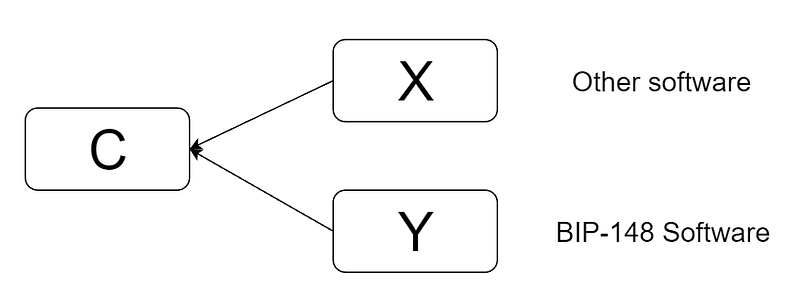
We have what’s called a fork, though for the time being, this will be what’s called a “soft fork”. Now should there be no miners running BIP-148, the scenario would look like this:
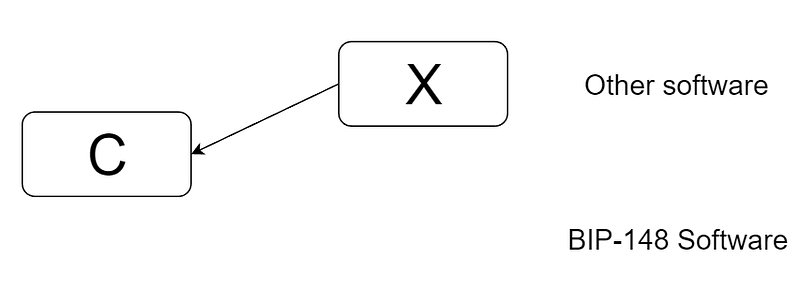
In this case, BIP-148 nodes will simply stop at C and will be stuck with no transactions possible until the software is changed.
Who can make this happen?
As shown above, despite having “user-activated” in the name, the actual fork still is triggered by a miner. At least one miner needs to be running BIP-148 software to fork. In fact, short of a switch to proof-of-stake or something similar, there really isn’t a way for any sort of fork to be triggered by anyone but a miner.
This is an important point, because despite all the rhetoric, BIP-148 still needs miners to have any chance of success. Essentially, BIP-148 is creating a new consensus rule for its chain, namely, signaling for Segwit.
This means that for the BIP-148 fork, provided there is enough hashing power, Segwit will activate as 100% of their blocks will be signaling Segwit, which is above the 95% needed.
What does this mean for me?
If you’re a user on the network, that means that transactions will be slower for two weeks at a minimum (longer if the hashing power is lower) and more likely, there will be some serious disruption as merchants and exchanges will likely suspend any Bitcoin transactions until there’s some clarity on the forking situation.
Further, even after the forking situation is resolved, there’s a high likelihood of there being two Bitcoins and a very messy divorce.
So why is it called “user-activated”?
There are two ways in which BIP-148 is “user-activated”.
The first is that if enough users buy coins on the UASF chain, they can make even a minority fork succeed by giving it more economic value than the other chain. Indeed, that is the power users have, to buy and sell the currency. The hope is that by giving the UASF chain more value, they can create incentives for miners to mine more on their chain and eventually overtake the other chain in length. At this point, without a permanent fork, the other chain would disappear in a really large reorg. In this way, the proponents of BIP-148 believe the users would show everyone who’s boss and bring the miners to heel.
The other argument is that it’s actually not user-activated as much as “economic node” activated. Economic nodes are the nodes that matter, like the nodes at various exchanges, wallets, miners, etc. The hope is that if enough economic nodes can be convinced to run BIP-148 software, that more users would then utilize the chain, giving it more value and creating better monetary incentives for miners eventually overtaking the other chain in length. Once again, the end game here would be making the other chain disappear.
What does supporting BIP-148 mean, anyway?
Many users on reddit seem to think that if enough users ran BIP-148 software, that it would make BIP-148 more likely. Perhaps, but there’s a lot of evidence to the contrary. First, running node software is very easy and cheap. In fact, it’s so easy that you really shouldn’t be trusting the node statistics as it’s very easy to fake. Node software is useful because the node owners can validate the transactions and blocks for themselves. Essentially, node software is useful because you don’t have to trust others, but doesn’t do much for the actual blockchain state unless you mine.
As a node, you have the right to reject blocks or transactions for any reason, but that, too, is not useful unless others agree with you. This is why BIP-148 proponents desire support from “economic nodes” such as miners, exchanges, wallets and merchants. Let’s take a look at each and see what their incentives might be.
Users and BIP-148
From the perspective of a user, owning and transacting the coin is the main concern. Supporting BIP-148 means being able to own and transact the coin that results from the fork. That doesn’t preclude owning or transacting the other fork. In fact, most supporters of BIP-148 will want to have a non-BIP-148 node running so they can sell it!
Exchanges and BIP-148
From the perspective of an exchange, the main thing they’ll need to do is to allow deposits and withdraws for people using their service. Supporting BIP-148, then means that their users can buy and sell the BIP-148 coin should it happen. Note this does not preclude supporting the other chain! In fact, it’s very much in the interest of the exchanges and even UASF advocates for the exchange to support the other chain as many will want to trade one chain’s coin for the other.
This unfortunately, has a lot of consequences. Exchanges likely will not support a coin without some sort of replay-protection. That is, transactions on one chain should not be valid on the other. This cannot happen as Bitcoin currently stands without a permanent fork. Thus, getting an exchange’s support likely means there is no chance of Bitcoin merging back to one chain.
That said, there may be a way around this by using futures. That is, not actually trade the coins themselves, but the potential split in the future. Bitfinex already does this with the Bitcoin Unlimited fork. This has its own perils, however, as there may not be enough liquidity and bitcoins will have to be locked up with the exchange for the duration of the whole drama (much like Bitcoin Unlimited coins on Bitfinex today).
Because of this lockup custodial risk, futures are not something we can expect the vast majority of bitcoin holders to utilize. As a result, we can expect much less liquidity in a futures market than in a normal market. Low liquidity means that the futures are very easily manipulated, which likely means futures won’t be a reliable indicator until the event happens (for those that doubt this, ask betting markets what happened with Brexit or Trump).
Wallets and BIP-148
Wallets in the Bitcoin space are almost entirely open-source. Support for BIP-148 simply means that the wallet is compatible with the software. Should the wallet developers oppose BIP-148, a fork will likely be made supporting BIP-148 and vice-versa. In fact, a wallet that supports both forks is desirable since everyone will want to know the balance of their coins on both chains. Even if the values of the coins on the forks are $10000 and $100, you’ll still want to transact on the chain with $100 so you can do something with it (like trade for coins on the higher-value fork).
Merchants and BIP-148
Merchants and payment processors mainly want to get paid for their goods or services. Supporting BIP-148 simply means allowing people to pay for goods on that chain. This is not an unreasonable expectation and once again, does not preclude utilizing the other chain. Again, this may be desirable even from UASF advocates since being able to spend coins from the other chain gives it liquidity.
Of course, merchants will have the same expectations as exchanges in that the coins they receive won’t simply disappear. Hence, they’ll want some chain reorg protection and replay protection before supporting both chains.
Miners and BIP-148
For all constituents that we’ve examined thus far, supporting BIP-148 means they can support both forks when the UASF happens. There are really only economic benefits, not really economic penalties for supporting a BIP-148 fork other than some fixed costs (running a node, changing some software, etc). These actors in the Bitcoin Ecosystem do not have to choose which software they run, they can run both and really, they should if they want to maximize their value.
Miners are the exception. When mining a block, they have to choose which fork to build on. In fact, they are the only ones in the entire ecosystem that are forced to choose. Everyone else can and probably will run both forks should a UASF happen. Miners have to choose one or the other fork when they mine a block.
Skin in the game
Skin in the game means that there’s cost to supporting something. Everybody else, as seen above, essentially has only fixed costs (often fairly small) to support BIP-148. Miners have a significant continuing cost to support BIP-148. Miners, because of the forced choice of having to signal one way or the other in blocks that they mine, have significant skin in the game.
This has some significant consequences.
You would expect that miners will be the last ones to show support for BIP-148 since they take the most risk. This seems to be the case as only 1 miner out of the top 17 seem to be supporting BIP-148. And that one, Bitfury, seems to now be backing the agreement from Consensus 2017. In other words, more than 94% of the mining hash power (probably a lot more) are not supporting BIP-148.
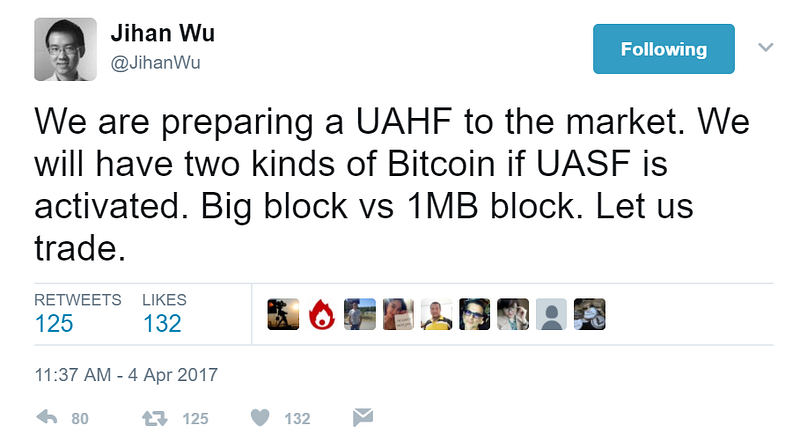
You would expect that miners on the side of the fork that has chain reorganization risk to protect the skin they’ve put in by forcing a hard fork should a UASF happen. Indeed, that seems to be the plan:
Conclusion
Really the only way, then, to have skin in the game and support BIP-148 is to mine BIP-148 blocks. Everyone else will simply be running both chains as it’s to their advantage. Mining equipment has dropped in price recently and mining yourself is really the only way to really contribute to a UASF via BIP-148. All other attempts are really attempts to solve the Byzantine General’s Problem without Proof-of-Work.
This should make intuitive sense. Bitcoin is a decentralized system where if a big change were achievable with little in the way of money, resources, or time, it would get exploited very quickly. There’s a real cost to change things and that very well may mean lots of money ($700+) spent by lots of people (1000+). In other words, Bitcoin is really hard to change, and that’s a wonderful feature.
Our culture is used to being able to sign some meaningless change.org petition and feel like we’ve done something to actually change things. Advertisers tell you all the time that if you only buy their product, your problems would be solved. Our society that wants to believe there are easy answers to everything. We’re used to wishful thinking, minimal effort and rejecting responsibility.
Bitcoin. Doesn’t. Care.
Bitcoin doesn’t care if you post arguments on Reddit. Bitcoin doesn’t care if you put something clever in your Twitter name. Bitcoin doesn’t care if you educate people, write articles, or make clever Twitter insults. Bitcoin doesn’t care about your wishes, your feelings or your arguments.
With Bitcoin, you have to put real skin in the game. Real time, like years spent refining software to remove vulnerabilities. Real money like millions of dollars to design, test and manufacture ASICs. Real resources like developers, marketers, project managers and venture capital making real things like node software, wallets, mining equipment, payment processors and exchanges.
Whatever side you’re on in this debate, this is a certainty: If you want to change Bitcoin, you have to pay the price.