
March 2017 Journal
WORDS is a monthly journal of Bitcoin commentary. This issue collects the March 2017 writing in the WORDS archive. For the uninitiated, getting up to speed on Bitcoin can seem daunting. Content is scattered across the internet, in some cases behind paywalls, and content has been lost forever. That’s why we made this journal, to preserve and further the understanding of Bitcoin.
The Bitcoin Filibuster
By Beautyon
Posted March 1, 2017

In the fight over the activation of Segregated Witness it’s clear that many people don’t understand the true reason why the actors who are against it are doing what they are doing.
They are filibustering.
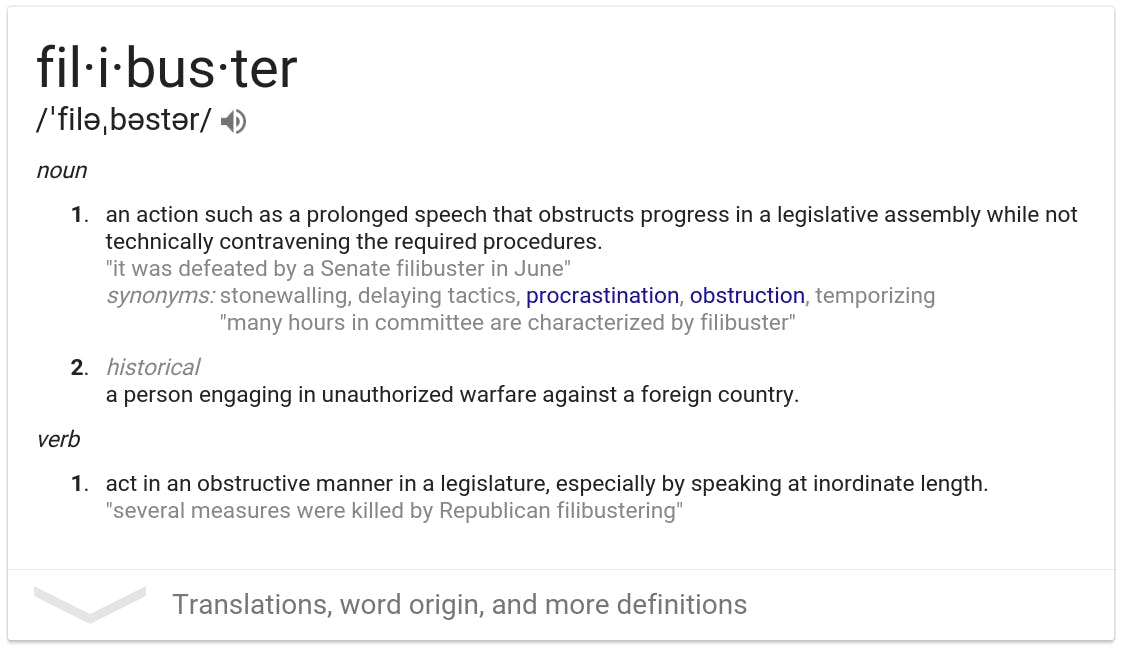
In the US Senate (for example) a filibuster is used to block the opposition from passing a motion. It means standing up for hours in an extemporised address, using the rules of the house to prevent other members from carrying on with legitimate business.
Senator Rand Paul’s recent filibuster is a good example. He spoke for almost thirteen hours straight.
I ran a poll on Twitter, exploring what the inevitable outcome of Bitcoin Core adding new functions to the reference client would be, given that Segregated Witness (SegWit) would be included in all future releases of their client. I reasoned that if SegWit is in all future reference clients, and it is set to signal by virtue of you running it, eventually, since Core has the best developers and is doing all the improvements and extensions and the majority of users are running it, SegWit will activate by default.
Logically, if this is right, then all we have to do is wait till everyone is several versions along with the Reference Client, and SegWit will activate. It doesn’t matter how long it takes, in fact, it’s better if it takes longer, because it gives companies more time to roll out software for this fantastic, game changing, genius addition to the Bitcoin protocol.
There is a small problem with this conclusion. It’s wrong. No matter how many people are running the Reference Client, it makes no difference to SegWit activation.
After reading this, I went to the documentation. I then went through our bitcoin.conf to find the line where you can turn SegWit signalling on or off. You would expect to find it it there, like everything else to control the Reference Client. There is no parameter there. Wait, what?!
And it gets worse. And this brings us to the title of this piece.
It appears that if SegWit is not activated by the 15th of November 2017 it will become “ineligible” for activation. Which I take to mean it dies. I could be wrong of course, just as I was wrong in assuming that SegWit would inevitably be activated by attrition.
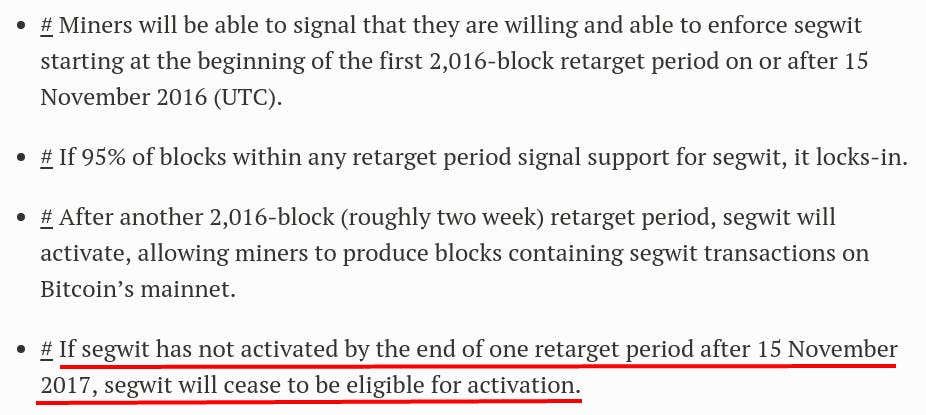
From the Bitcoin Core Site on the latest Reference Client
Obviously, the people who do not want SegWit to activate, were aware of this vulnerability, and understood that if they filibustered activation for long enough, SegWit would simply die. They could then argue that there was no community support for SegWit, and so therefore, an 8 megabyte block size should be immediately imposed, since SegWit has been rejected.
Anyone who wants Bitcoin to remain decentralized understands that raising the block size parameter is a bad idea
The Bitcoin Gauntlet_The Facts_medium.com
the people pushing for a block size increase are doing so for several reasons:
- They want a centralized, tame Bitcoin
- They do not want to re-write their software
- They want to gain control of all future development by displacing Core
- They want Bitcoin to “fail” so their own coin can supplant it
All of these are reasonable assumptions. They may be wrong. What do you think?
One thing we can say for sure is this. Bitcoin Core are extremely professional, and absolutely ethical. If I have this right, and SegWit can expire, they have deliberately created an activation system that kills their extraordinary improvement, that very few really understand, because other people who are less skilled than them and with motivations that do not align with Bitcoin do not want it. They are accommodating everyone, to their own detriment. What they have done is worked very hard, without compensation, and given this innovation free of charge, and whilst they could have imposed it and forced activation slowly over time, chose instead to have total respect for everyone, even Bitcoin’s enemies, by using this time limited signalling system.
These men are unselfish, very patient and clearly have the best interests of Bitcoin and it’s ethos at heart. They also do not want to exclude anyone’s ideas or needs. They offer their solutions for the constituency to reject or accept as they wish, without any pressure of any kind. They are manifestly not dictators nor bad guys.
As for the users who want SegWit and it’s incredible benefits

They are at the mercy of the people who can either decide to signal SegWit by setting a special bit in their software or not. If all Bitcoin user’s incentives were aligned, SegWit would already be activated, but they are not, because there are people who do not like Bitcoin for political reasons, business reasons, petty and infantile personal reasons, reasons of inertia and some who are just computer illiterate.
This business at the protocol level is very complicated, and just as you must trust the Linux Kernel developers not to be evil, people who are not qualified shouldn’t attempt to go where the curly brace monsters are. Influence in techincal matters should be exerted only by people who are peers. A used car salesman doesn’t go to Mercedes asking, no, demanding that they make engineering changes. By all means you can ask, if your approach is correct, but you must be ready to be told you are wrong, and not double down, but accept it and be grateful you have a kind teacher.
I have no way of knowing whether or not SegWit will activate. Judging by what I understand on a synopsis level, it’s an absolute no brainer. Bitcoin Core have bent over backwards to accommodate everyone, and no one will be harmed by it activating. The incredible increase in throughput in SegWit will change everything. And that is an understatement.
All countdown sites numbering the SegWit signalling services should include a deadline of the 15th of November, because after that, SegWit will become ineligible for activation.
If you have fingernails say goodbye to them.
T-Bone, medium, fries, house red↴

14rtDb46NQJkuqFJuHqZG3o6uAWwGbV58z
A stock market crash is inevitable
By MAYBE
Posted March 13, 2017
.entry-header
For months I have been surprised to see that the US stock market keeps breaking records. Yes, I get it of course, corporations and investors believe the Trump presidency means lower taxes and more stimulus for businesses. However, by now any rational person should realize that most of this will be pure wishful thinking.
In my opinion the USA is headed for disaster, but most market participants don’t want to see it. Trump behaves like he is crazy, just looking at his tweets it is clear that he does not belong in the White House. Not only does he not seem to grasp what it means to be president, but with his erratic behavior and thin skin he is a danger to the world. Most of his voters didn’t want to see it before the election, which was a surprise to me. But it seems most still don’t want to see it, and that is why I believe the US economy -and with that the stock market- is headed for disaster. When will that happen? I think fairly soon. I see so many red flags that I wanted to write a quick blog post about it.
This week the world faces some important economic and political events that may lead to a perfect storm. First of all the Brexit vote. If the UK indeed decides to leave the EU this will be a major setback and could lead to a shockwave on financial markets. On Wednesday the Dutch will have their elections. Normally not an important event (at least not for the rest of the world), but given that the right-wing populist party of Geert Wilders has a chance to win, this could lead to a new shockwave. Next to that the FED will make a decision on the interest rates. Trump wants to see economic growth, so he wants to keep the rates low, but it seems likely that the FED will start increasing its rates this week. That’s bad news for business, especially because this will be the beginning of a series of rate increases.
But most important, and something you don’t read much about in the media (yet), is that Wednesday night the US will reach its debt ceiling. That means that the country is not able to borrow more money to finance its deficit. With $20 trillion (!) in debts the country is in unsustainable territory already, but now things are getting even worse. In the past debt ceilings were always increased, although sometimes at the last moment and after a serious stand-off. However, now that Trump is in power there is no Democrat who would vote for an increase in the debt ceiling. So the world may realize on Thursday morning that the good times might suddenly be over.
The US has enough money to keep paying its bills until early this summer (mainly interest payments on debt), but it will have cut a lot of other costs do so. That in itself is problematic already, but when that happens Trump might finally realize that his plans for tax cuts and additional infrastructure and defense expenses simply won’t work. Or if he still doesn’t get it, it is likely that at least the market will understand that fiscal stimulus measures are unlikely to happen.
And what will happen the moment the US really runs out of cash is anybody’s guess. I would actually not be surprised if Trump would choose to go for a default its obligations and then blame it on the Democrats (he indicated this once during his election campaign!). I believe this would pave the way for a dictatorship: the economy would completely fall apart, people would not only lose their social security but also their pensions, and riots would be very likely. Trump would then re-emerge as the strong man who will solve it, by blaming anybody but himself for the mess.
Summarizing, from an economic point of view I don’t believe the stock market rally can continue for much longer. To me it seems a huge stock market crash is inevitable. It’s not a question if it will happen, but only when it will happen. The moment the first investors start heading for the exits the whole house of cards may collapse. If you are an investor you should consider hedging your bets by going into gold, silver and possibly Bitcoin. Don’t wait too long.
.entry-content
Published
March 13, 2017
.post-author-bottom
.entry-meta
The great Bitcoin blocksize debate as an ideological battle
By Peter Surda
Posted March 21, 2017
I’m greatly saddened by the fighting between the two big Bitcoin camps. Even though they don’t have official labels and my own labels may not be fully accurate, I have to use some labels, otherwise my article will make no sense. I’ll simply label one of the groups “Bitcoin Core”, and the other one “Bitcoin Unlimited”. Even though I’m not involved in research of Bitcoin anymore because my work on Bitmessage takes almost all of my time, as a dedicated HODLer I feel it as my obligation to try to explain to the people interested in Bitcoin why the discord exists, and why it’s pointless to spend time on it. I hope that it will help people deeply think about their own values, and use them productively instead.
Governance?
The conflict is often explained as a governance problem. I think this while there is an element of truth in it, misses the point. The reason for the conflict isn’t a lack of procedures, but an emphasis of the differences in values.
Main axis: conservative versus progressive
The main reason why there is discord is the conservative vs. progressive affinity of the members of each groups. The “Bitcoin Core” group tends to be more conservative whereas the “Bitcoin Unlimited” tends to be more progressive. For the purposes of this article, I’ll differentiate betwen the groups by their reaction to obstacles with respect to the existing rules; when facing an obstacle, the conservatives delay changing the rules and try to find a solution within, while the progressives more readily embrace a rule change and consider it as a part of solution. Conservatives view the rules as containing a historic wisdom which may not be apparent. Progressives view them as contextual and as a reaction to contemporary phenomena.
These tendencies are a naturally occurring phenomenon and are largely influenced by psychology. They reflect themselves in all areas of life. People are unlikely to change their affinity. They associate themselves with people with similar affinities, and the community membership gives them a sense of belonging. If someone tries to treat obstacles in a way conflicting with their affinity, they will view it as an attack on their values, and follow by an immediate counter by any means available. Typical reactions are accusations of being a traitor (collaboration with the enemy), segregating their opinions (censorship), ridicule and other ad hominems. It happens in politics (Brexit, Trump), or in religion (the different branches of Christianity or Islam). Even in cases when there is some element of truth in the accusations, they are mainly a symptom rather than a cause of the problem.
Unfortunately, psychology tends to catch up even well educated, highly experienced and an otherwise reasonable people, and they go full retard. This causes an enormous waste of resources, which otherwise could be spent on productive endeavours. Perhaps millenia ago, in hunter / gatherer societies, such a reaction to conflict made more sense, as there may not have been enough time to discuss the allocation of resources rationally.
People in the Bitcoin community of all should acknowledge that some people are naturally more conservative and some more progressive. This would help to calm down the situation.
Secondary axis: collectivism versus individualism
A second characteristic, orthogonal to the conservative / progressive one, is an affinity towards collectivism versus individualsim. Collectivists want everyone to adhere to a broad set of rules, whereas individualists want just a very narrow set of rules for everyone. In the forking debate, collectivists want there to be only one Bitcoin and the other to either die or never start in the first place, whereas individualists are either indifferent or prefer that both survive. In the forking debate, collectivists point to lost network effect, consumer confusion and similar things. Individualists argue that a fork would prevent oppression and allow to refocus resources productively.
While this axis explains a smaller proportion of the debate, it is perhaps more important. You see, conservatives and progresives can get along, as long as they are individualists. Once they calm down, they will leave each other alone and try to resolve conflicts peacefully. But there is no such solution with collectivists. They will appeal to the higher good and demand your subjugation to it (i.e. them).
Plea
Next time you’re reading, writing, listening or talking on the topic of the blocksize, try to see the arguments from the point of view of the two axes I outlined. You’ll be surprised how much of the underlying implications can be explained by the affinities. Please recognise that the conservative/progressive split is more or less a given and both sides have a legitimate reason for their position, and therefore there is a legitimate potential for a conflict. Remember that the real danger is collectivism and its most encroaching manifestation, the state. If afterwards you still think that a common solution cannot be found, then calmly prepare for a fork, and spemnd your time and resources in your part of the comunity, in a productive way.
The Lightning Paradox
By Alex Berge
Posted March 21, 2017
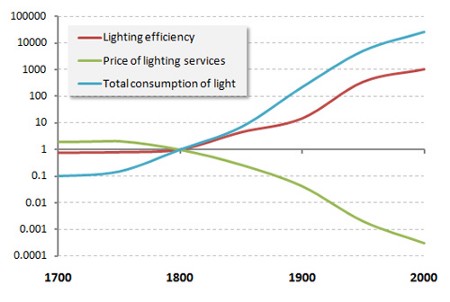 Historical demand for light over centuries of technological innovation
The goal of this post is to argue that second-layer technologies will ultimately translate to a growth in revenue for miners who will increasingly be relied upon to secure settlements of contracts across the various use cases enabled by technologies such as the Lightning Network.
The introduction of the Lightning Network was a paradigm shift in terms of how we all imagined the Bitcoin Network could scale to accommodate a global demand for transactional capacity. Inspired by the ideas put forth by the system’s creator, the protocol leads us to reconsider our assumptions about the nature of Bitcoin transactions and how users should leverage the unique properties of the blockchain and the resources allocated to it by its peers.
Intermediate transactions do not need to be broadcast. Only the final outcome gets recorded by the network — Satoshi Nakamoto
In the original implementation of the system, every transaction was to be recorded on-chain and appended to the blockchain. Early contributors to the project quickly realized that such a decentralized global broadcast system involved very poor scalability properties.
Enter payment channels: an implementation of a smart-contract allowing users to enter into relationships wherein consensus around the history of transactions they are involved depends only on the participants of the contract. In case of a dispute, the Bitcoin blockchain is used as a trustless adjudicator which ensures accountability and prevents uncooperative parties from cheating their respective counterparties. The Lightning Network, first proposed in a paper by Joseph Poon and Tadge Dryja, extends this construction to allow contracts to be interconnected, creating a multi-lateral network of counterparties & channels that is used to to move obligations among peers in the network and leverage the liquidity they provide. For a high-level description of how this is achieved, I recommend Lightning Labs’ Elizabeth Stark’s excellent primer available on the CoinCenter website.
The emergence of such a system begs us to re-examine the role of miners as the main processors of Bitcoin transactions. Considering that the long-term security of the network is expected to be financed by transaction fees, many flags have been raised questioning the decision to move the bulk of these revenue-generating transactions to a layer which miners cannot monetize directly. Fortunately, history is ripe with examples of how the introduction of more efficient technologies affected the demand for an underlying resource. More importantly, these economic dynamics are well-studied and provide us with a valuable point of reference as to how the market for Bitcoin transactions may unfold post-Lightning.
The price elasticity of demand
Little in-depth analysis has been made of Bitcoin’s demand curve and a great deal less of the elasticity of said demand under increasing transaction fees. On the other hand, one does not have to look too hard to detect many instances of use cases that, along the way, were priced out of the market only to be replaced by a persistent influx of higher fee paying transactions. Early adopters will remember the bulk of transactions originating from services such a SatoshiDice or other micro-payment services such a faucets & tipping bots. It is worth mentioning that at its peak the former was responsible for anywhere from 80 to 90% of Bitcoin’s transaction volume.
Today, most of these applications have been moved to off-chain services. Their inefficient usage of the space available in blocks made them unable to compete with organic growth of transactions coming from users who possess little to no alternative available which could provide the same unique features that Bitcoin does. Of course, history indicates that demand for Bitcoin transactions has persisted and pushed through continuous all-time highs, even with the recent materialization of a more competitive fee market.
While these are only anecdotal evidence, they offer strong indications that the demand for Bitcoin transactions is considerably inelastic. What this suggests is that the supply of space in blocks will find demand even as transaction fees increase. The reasons for this are subjective and hard to accurately assay as they are simply the result of decisions made by independent market actors. Nevertheless, this observation has strong implications for anyone interested in figuring out Bitcoin’s value proposition.
When gauging the price elasticity of demand, perhaps the main determinant is the availability of substitute goods. As it turns out, it may be that the opportunity cost of opting for current alternatives which are more centralized and less liquid or secure is much higher than the price of having one’s transaction included into the Bitcoin blockchain.
The Lightning engine
It is wholly a confusion of ideas to suppose that the economical use of fuel is equivalent to a diminished consumption. The very contrary is the truth. — William Stanley Jevons
The Jevons paradox is a staple of environmental economics used to describe how the introduction of more efficient technologies tends to increase the consumption of resources rather than decrease it. In his thesis “The Coal Question”, Jevons challenges conventional wisdom by pointing out the resounding impact that James Watts’ steam engines had on the consumption of coal during England’s industrial revolution.
With Bitcoin ushering in a new revolution of its own, it’s interesting to draw parallels between Jevons’ analysis and the current issue that concerns us. Provided we can agree that the space in blocks is a scarce economic resource and considering solutions such as the Lightning Network are a clear innovation in terms of how efficiently we use this resource, can we arrive at the same conclusion that Jevons did?
…new applications of coal are of an unlimited character. In the command of force, molecular and mechanical, we have the key to all the infinite varieties of change in place or kind of which nature is capable. No chemical or mechanical operation, perhaps, is quite impossible to us, and invention consists in discovering those which are useful and commercially practicable…. — William Stanley Jevons
I highlighted above various examples of use cases which have been priced-out of the on-chain transaction market over the years. The fact is that a plethora of other use cases involving transfers of bitcoins between individuals have never made in on-chain. Consider, for example, intra-platform transfers between users of Bitcoin exchanges and other services. In a recent conference call held by Needham & Company, Wences Casares, CEO of Bitcoin company Xapo, revealed that his company were doing upwards of 500,000 transactions per day off-chain. These transactions are potential revenues which the miners are never going to be able to tap into under the current technological context.
More importantly, there is an entire class of potential use-cases relying on high-frequency micro-transactions that would never make it onto a blockchain either because of fees, delays or throughput. By using Lightning as an aggregation layer, we optimize the utilization of block space and allow users to process these transactions between themselves and ultimately incur fees of which a fraction is released to miners any time a channel is opened or closed. Considering the potential rate of return bestowed to users who allocate their assets to Lightning channels, it is more likely than not that they will, in turn, be willing to pay higher fees for those on-chain transactions.
Economists have long observed that the induced demand from technological improvements generally drives along with it further economic growth. This idea is more popularly known as the Khazzoom-Brookes postulate and derives its insights from Jevons’ argument that improving energy efficiency makes the use of resources more economically viable for a larger share of market participants and use cases.
In this regard, the Lightning Network may turn out to be the steam engine of the Bitcoin economy. By introducing a cache layer which users can leverage for low-cost access to blockchain storage, Lightning provides a more efficient way for us to make use of the raw and scarce block space resource. Such a development creates endless opportunities for entrepreneurs, inventors & market forces to come up with new products and services that directly contribute to the economic growth of our ecosystem. Consequently, miners will not only benefit from an increased demand for on-chain transactions but will also profit from potentially dramatic appreciation of the underlying asset.
Conclusion
We are in the age of digital gold. We are replaying the history of money right now and I think today we are smack dab in the 1700s and for the past 5–6 years I think we have been 2000 BC. We have been talking about pure value but this value is a foundation for everything else we build on top of it. First you need money, after that you need payment systems, after that contracts, institutions, etc. — Joseph Poon
At this most important juncture of our journey, it is important to take a step back and acknowledge how far we still have to go until we can fully realize the promises brought about by the invention of Bitcoin. While Bitcoin users tend to scoff at traditional financial systems and their failure of upholding the trust lent to them by market participants, it would be unwise for us to dismiss the innovations they fostered over centuries of evolution. We have an opportunity to learn from this history but also to use the technology available to us today to build superior systems. This transformation will not happen without leveraging the layered infrastructure that enabled the economic growth that we have enjoyed under the old paradigm.
Lightning is the first large scale implementation of a contract system on top of Bitcoin. While it challenges early expectations about the economic relationships between protocol participants, market dynamics suggest that the outcome of this incoming revolution presents little to no drawbacks for everyone involved. New markets will be opened to the benefits of all users and the value extracted from those will necessarily trickle down to miners securing the chain backing all of these applications.
For that reason, I believe the apprehension we are experiencing should leave place to enthusiasm and lead everyone to embrace the potential of these breakthroughs. We are working at the frontier of technology and while the path ahead is unarguably challenging, we cannot allow uncertainty to prevent us from moving forward.
Nothing in life is to be feared, it is only to be understood. Now is the time to understand more, so that we may fear less. — Marie Curie
Thanks to the various people who reviewed and provided inputs for this post, especially to Chris Belcher for introducing me to Jevons’ work.
Ask a simple question… • Gavin Andresen
By Gavin Andresen
Posted March 24, 2017
Ask a simple question…
This is a conversation with Matt Corallo (Bitcoin Core contributor) that started on twitter and migrated into email:
Matt Corallo @TheBlueMatt - Mar 19 Bitcoin Core does not want to and does not make decisions on Bitcoin’s consensus rules
Gavin Andresen @gavinandresen - Mar 23 Might a small, well-tested patch that added a default-false option to disable block-size checks be accepted by Core?
Matt Corallo if it a) took HF risks seriously and had protections for then and b) had community consensus to do a HF, sure!
Gavin Andresen I’ll email you– if you really don’t want to dictate consensus rules, give your users a choice!
Matt Corallo cool. You may also want to check out some of the HF proposals at https://bitcoinhardforkresearch.github.io
From: Gavin To: Matt Subject: Expanding an idea from Twitter…
If Core really wants to avoid taking sides in the Great Scaling Debate, why not let users simply opt-out of block size-related checks?
The idea would be “IF there is a hardfork, you can run with the -anyblocksize=true option to follow the most-work branch of the chain.”
On twitter you say “if it took HF risks seriously” : it is paternalistic for you to decide risk/reward, and when you do you just make lots of people really upset.
… and “had community consensus to do a HF” : again, you are just making lots of people really upset by taking sides in the debate– who are you to judge community consensus?
I think a neutral statement from Core like “IF there is a hard fork over the block size, Core software is able to follow either branch” along with a trivial patch/option that, again, simply skips the validation checks for max base block size / max block sigops / max segwit block size if the option is set – would be a really good way of extricating the Core project from the insanity of the debate.
(I haven’t looked at the code, but maintaining a 1MB max transaction size would mitigate any quadratic hashing attack-block concerns)
From: Matt
I get the paternalistic view, I really do, but that is neither the intent, nor based on reality of peoples’ views. It is very much based on a misunderstanding of what roles developers are willing to play in the community. No one wants to be a decision maker, and that feature is a key differentiator of Bitcoin when compared to alternative systems.
As I’ve said many times, if a reasonable hard fork is proposed which doesnt have massive risk and has real community backing, it will be released in some supported version or branch of Core (if nothing else, supported by me). What this doesn’t mean is a hard fork with no opt-in replay protection or with a webapp to select consensus rules or a commitment to 20GB blocks or a low-hashpower-commitment activation criteria.
This also doesnt mean that I wont, personally, argue against it, but if there’s real community backing, I’m happy to maintain the code. I’m not “one to judge consensus”, that is for each individual to judge, and if they think it exists they can and should run the code for it, even if it doesn’t come from Core.
Because any realistic hard fork is going to have more than just a simple block size rule relaxation (activation criteria, replay protection, n**2 sighash protection, additional commitments to block data, etc, etc, see Spoonnet for a reasonable example of likely fixes), such a change only serves to mislead users into thinking they are running something other than an SPV client (might as well just have an SPV mode..we’ll likely do one of these days..when someone gets around to it).
I’m disappointed that you seem to have bought into the deliberate misunderstanding of the view of most devs in the community that a few very loud voices in the community have been touting for their own political gain. If you believe something other than Bitcoin Core has consensus, you can and should run it! This is both critical to Bitcoin’s success and a deeply held view by every serious developer I know. The view that developers are refusing to allow a consensus change that has real community backing is more than a little insulting, and only exists to create diviceness and attempt a negotiation with a group that can’t negotiate except as individuals who can, individually, advocate to the community for changes.
From: Gavin
So… that’s a no?
Would a command-line option to allow users to say ‘I want to go along with hashpower consensus when it comes to block size’ be unacceptable for some reason?
No code related to a hard fork AT ALL, zero expression on what the max block size should or shouldn’t be…
Also: would you be willing to make this conversation public?
From: Matt
That is a “you know as well as I do that no one individual can or should make decisions about forks”. Have you seen https://bitcoinhardforkresearch.github.io with recent proposed hard forks by Core contributors? I helped a ton early and contributed some to Johnson’s most recent one, but then I assume you saw the bitcoin-dev discussion and coindesk article about it. Sadly the community seems to have a much lower appetite for hard fork proposals these days, or at least has no interest in any of those proposals.
If you want to follow hashpower, great! You’re an SPV Client, and there are many great SPV clients out there for people to run.
As for making it public, oops…I already posted my response (with your name and original email omitted, of course).
Bitcoin Doesn’t Waste Electricity
By Beautyon
Posted March 30, 2017
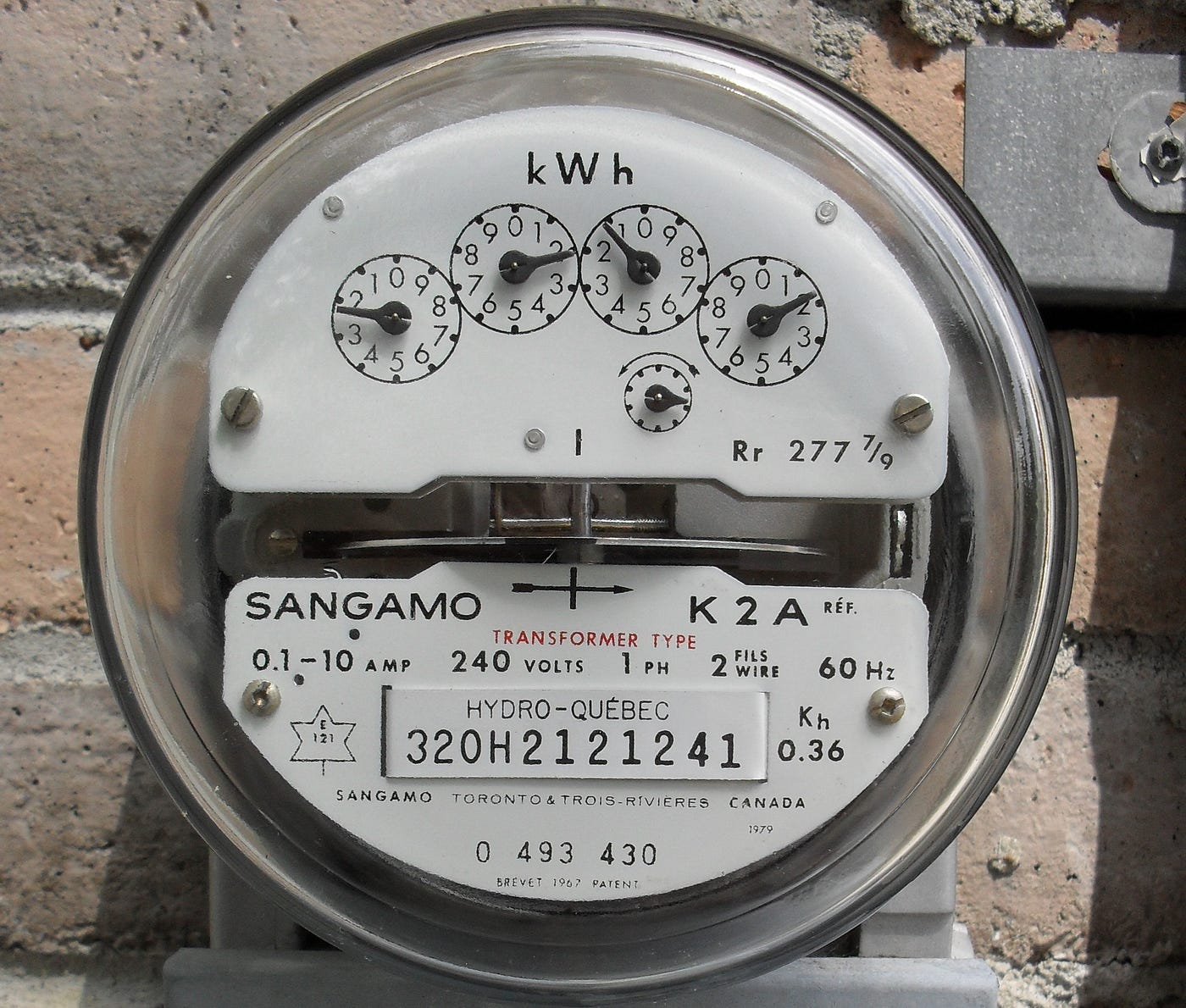
Sangamo 240v/60Hz, consumer electricity meter from Hydro-Québec: 320H2121241. Toronto & Trois-Rivières. 0 493 430, 1967/1979
Beautyon
Of all the objections to Bitcoin, the objection that it “wastes” electricity is the most absurd. This thinking betrays a fundamental misunderstanding of how electricity works, how markets work, and what waste is.
Electricity is a real time service. It is transmitted by specialist companies, through either Solar, Nuclear, Wind, Coal or Water generation. When these services produce electricity, the consumers of it draw it in real time, and pay for it per kilowatt-hour, the unit used to measure quantities of electricity. Electricity is used for many purposes; cooking, entertainment (TV/Internet) and now cars run on stored electricity supplied by generating companies.
Whatever use you choose to put the electricity you pay for to, if you are satisfied, then the electricity has not been wasted. Furthermore, and this is most important; the electricity you consume could never have been used by anyone else after consumption.It is used once, and then it isgone.Electricity isn’t a physical good like water that is pumped down a pipe to you. It is weightless****, *and not physical at all.
Once you draw mains electricity into your devices and its consumed, it can never be sent back or re-purposed; it is a stream that is irreversible. That electricity could only ever have been used by you, and since you pay for it at the agreed rate, how you use it is nobody’s business but yours. There is no difference between a consumer choosing to heat their outdoor swimming pool to 90°F in winter with electricity and a Bitcoin miner performing Proof of Work calculations. Waste is subjective with electricity, which is an intangible service, not a physical product.
Compare and contrast electricity usage with wasteful packaging. Here are some examples

That is a 2mm diameter hex nut.

Insane.

This is how fragile Hard Drives are delivered, not robust plastic plug adapters. Totally MAD.

Very dumb. And of course, all these huge packages take up space in the vans, meaning more van runs, and wasted gas.
All of these pitiful images are examples of actual waste, because the packaging was objectively unnecessary, and the physical matter of the packaging persists after the job they were used for is done, unlike electricity, which is literally consumed in total. They are all clearly irrational. In each of the above cases, the product could have been safely delivered intact without the elaborate packaging, with less left over material — waste. This is very different to electricity, because physical resources are consumed that the consumer did not ask for or need. And yes, this really does need to be spelled out, because some people think that Bitcoin mining “wastes electricity”.
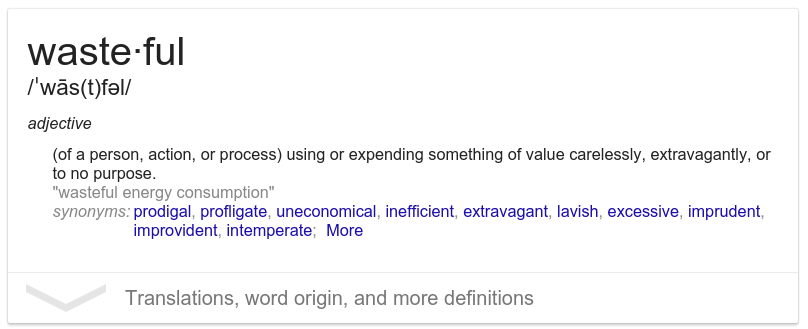
Bitcoin miners do not consume electricity carelessly or extravagantly and certainly not to no purpose. If you depend on dictionary definitions as your basis for reality, Bitcoin mining does not fit the description of a wasteful activity at all. Note how the example Google provides of the word in use, is… “wasteful energy consumption”. I smell propaganda!
As I’ve explained many times when writing about Bitcoin, it is crucial that people use English correctly when talking about it, otherwise, confusion is spread, and people get hurt. There is nothing wrong with efficiency as a goal, but it is not correct to categorize other people’sconsumption of a good or service as right or wrong. As long as they are paying for the service they consume, its up to them how they consume those services, and of course, electricity is a service, not a good, that produces no waste.
You may try to make the argument that the heat produced by Bitcoin mining is “wasted energy” but you will fail. No Bitcoin miner wants to have the electricity they consume turned into heat; they want it to be turned into Bitcoin; the heat their rigs produce (and dispersing it) is a cost of business that they all accept. If a new, more efficient type of integrated circuit that mined without producing a lot of heat came on to the market, rational miners would switch to it for the power savings and increased profits. The market encourages participants to strive for efficiency. Bitcoin miners are not stupid….oh wait, BU.
The next time someone tells you that Bitcoin mining wastes electricity, you can now explain to them why this is not so. There is no “better use that that electricity could have been put to”. Electricity doesn’t work like that. And don’t be too harsh on them either. Many people don’t know how electricity works!
People keep commenting that electrons are not actually weightless. If you were planning to make this comment, especially citing the actual mass of an electron, (0.000548597 a.m.u. or 9.1 x 10-³¹ kg),well done.*You’re paying close attention when you read. Everyone should read carefully with their guard up!
If you like the content and feel so obliged to send some love via BTC donations you can do so at the address below:↴




Hacker Noon is how hackers start their afternoons. We’re a part of the @AMI family. We are now accepting submissions and happy to discuss advertising & sponsorship opportunities.
If you enjoyed this story, we recommend reading our latest tech stories and trending tech stories. Until next time, don’t take the realities of the world for granted!

Fork wars
By Oleg Andreev
Posted March 30, 2017
After some miners declared a hard fork war on Bitcoin to give miners power over the block size, anonymous Bitcoin developer shaolinfry declared a soft fork war in response (so called “user-activated soft fork”, or UASF) aimed at forcing miners to respect segregated witness rules.
It’s interesting to compare consequences of possible outcomes of each war.
If either of these proposals fails to get off the ground: that is, majority of miners ignore HF or majority of economy does not enforce segwit, nothing really changes.
If any proposal leads to a harsh split, the outcome is the same for both of them: majority of hashrate diverges from the rules enforced by economic majority, uncertainty leads to price drop, and (unless things get corrected in one direction or the other), Bitcoin is doomed, experiment is over, everyone can go home.
So what happens when either of proposals actually succeeds?
In the first case, if miners convince stakeholders that Bitcoin Unlimited is the way to go, stakeholders would effectively grant miners the requested powers and accept the cost of risk and difficulties adopting hard forks.
However, if UASF succeeds, that is, users convince miners to enforce additional rules (or at least not interfere with them), then miners would accept the limit of their powers and agree with priority of the users in decision-making around consensus.
The win of a hard fork would demonstrate that Bitcoin is governed by producers of proof of work, and majority of users would simply delegate all “checks and balances” to a minority of users who run mining pools.
The win of a UASF would demonstrate that the role of miners remains restricted and the rules of the protocol are decided by the whole community of users, including miners.