
February 2017 Journal
WORDS is a monthly journal of Bitcoin commentary. This issue collects the February 2017 writing in the WORDS archive. For the uninitiated, getting up to speed on Bitcoin can seem daunting. Content is scattered across the internet, in some cases behind paywalls, and content has been lost forever. That’s why we made this journal, to preserve and further the understanding of Bitcoin.
The Meaning of Decentralization
By Vitalik Buterin
Posted February 6, 2017
“Decentralization” is one of the words that is used in the cryptoeconomics space the most frequently, and is often even viewed as a blockchain’s entire raison d’être, but it is also one of the words that is perhaps defined the most poorly. Thousands of hours of research, and billions of dollars of hashpower, have been spent for the sole purpose of attempting to achieve decentralization, and to protect and improve it, and when discussions get rivalrous it is extremely common for proponents of one protocol (or protocol extension) to claim that the opposing proposals are “centralized” as the ultimate knockdown argument.
But there is often a lot of confusion as to what this word actually means. Consider, for example, the following completely unhelpful, but unfortunately all too common, diagram:
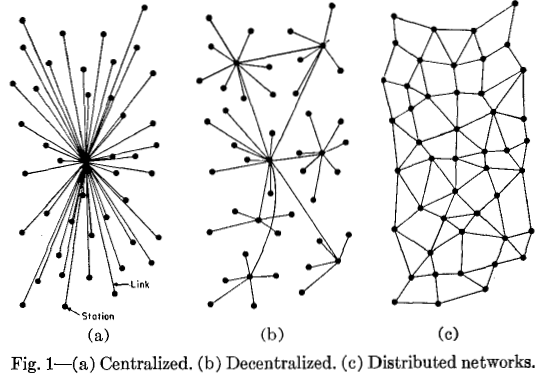
Now, consider the two answers on Quora for “what is the difference between distributed and decentralized”. The first essentially parrots the above diagram, whereas the second makes the entirely different claim that “distributed means not all the processing of the transactions is done in the same place”, whereas “decentralized means that not one single entity has control over all the processing”. Meanwhile, the top answer on the Ethereum stack exchange gives a very similar diagram, but with the words “decentralized” and “distributed” switched places! Clearly, a clarification is in order.
Three types of Decentralization
When people talk about software decentralization, there are actually three separate axes of centralization/decentralization that they may be talking about. While in some cases it is difficult to see how you can have one without the other, in general they are quite independent of each other. The axes are as follows:
- Architectural (de)centralization— how many physical computers is a system made up of? How many of those computers can it tolerate breaking down at any single time?
- Political (de)centralization — how many individuals or organizations ultimately control the computers that the system is made up of?
- Logical (de)centralization— does the interface and data structures that the system presents and maintains look more like a single monolithic object, or an amorphous swarm? One simple heuristic is: if you cut the system in half, including both providers and users, will both halves continue to fully operate as independent units?
We can try to put these three dimensions into a chart:
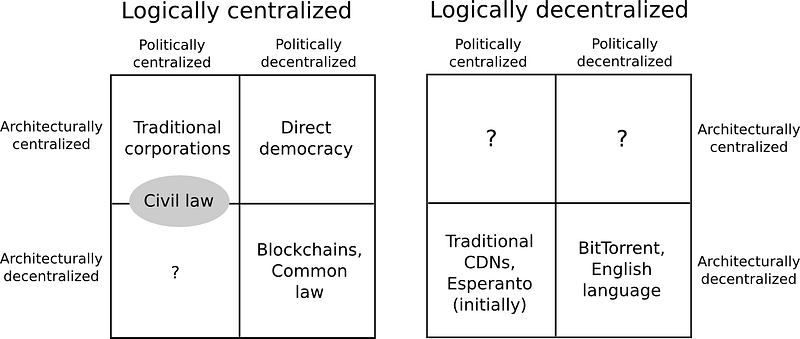
Note that a lot of these placements are very rough and highly debatable. But let’s try going through any of them:
- Traditional corporations are politically centralized (one CEO), architecturally centralized (one head office) and logically centralized (can’t really split them in half)
- Civil law relies on a centralized law-making body, whereas common law is built up of precedent made by many individual judges. Civil law still has some architectural decentralization as there are many courts that nevertheless have large discretion, but common law have more of it. Both are logically centralized (“the law is the law”).
- Languages are logically decentralized; the English spoken between Alice and Bob and the English spoken between Charlie and David do not need to agree at all. There is no centralized infrastructure required for a language to exist, and the rules of English grammar are not created or controlled by any one single person (whereas Esperanto was originally invented by Ludwig Zamenhof, though now it functions more like a living language that evolves incrementally with no authority)
- BitTorrent is logically decentralized similarly to how English is. Content delivery networks are similar, but are controlled by one single company.
- Blockchains are politically decentralized (no one controls them) and architecturally decentralized (no infrastructural central point of failure) but they are logically centralized (there is one commonly agreed state and the system behaves like a single computer)
Many times when people talk about the virtues of a blockchain, they describe the convenience benefits of having “one central database”; that centralization is logical centralization, and it’s a kind of centralization that is arguably in many cases good (though Juan Benet from IPFS would also push for logical decentralization wherever possible, because logically decentralized systems tend to be good at surviving network partitions, work well in regions of the world that have poor connectivity, etc; see also this article from Scuttlebot explicitly advocating logical decentralization).
Architectural centralization often leads to political centralization, though not necessarily — in a formal democracy, politicians meet and hold votes in some physical governance chamber, but the maintainers of this chamber do not end up deriving any substantial amount of power over decision-making as a result. In computerized systems, architectural but not political decentralization might happen if there is an online community which uses a centralized forum for convenience, but where there is a widely agreed social contract that if the owners of the forum act maliciously then everyone will move to a different forum (communities that are formed around rebellion against what they see as censorship in another forum likely have this property in practice).
Logical centralization makes architectural decentralization harder, but not impossible — see how decentralized consensus networks have already been proven to work, but are more difficult than maintaining BitTorrent. And logical centralization makes political decentralization harder — in logically centralized systems, it’s harder to resolve contention by simply agreeing to “live and let live”.
Three reasons for Decentralization
The next question is, why is decentralization useful in the first place? There are generally several arguments raised:
- Fault tolerance— decentralized systems are less likely to fail accidentally because they rely on many separate components that are not likely.
- Attack resistance— decentralized systems are more expensive to attack and destroy or manipulate because they lack sensitive central points that can be attacked at much lower cost than the economic size of the surrounding system.
- Collusion resistance— it is much harder for participants in decentralized systems to collude to act in ways that benefit them at the expense of other participants, whereas the leaderships of corporations and governments collude in ways that benefit themselves but harm less well-coordinated citizens, customers, employees and the general public all the time.
All three arguments are important and valid, but all three arguments lead to some interesting and different conclusions once you start thinking about protocol decisions with the three individual perspectives in mind. Let us try to expand out each of these arguments one by one.
A definition of “Bitcoin”
By Gavin Andresen
Posted February 7, 2017
Engineers are great at not seeing the forest for the trees. They get stuck on details and lose track of the bigger picture.
I’ve seen it most often (and have been guilty myself) when they’re optimizing something to make it faster. They’ll start out OK– “it is taking eleven seconds to agitate the snarks, and seven seconds of that is just precomputing the eigenwidgets!”
So they’ll take a day and make precomputing the eigenwidgets ten times faster.
And then realize with just a little tweaking and a really nifty algorithm and two hundred more lines of code they can make it one hundred times faster!
So they spend a few days making snark agitation take 0.63 seconds faster (4.07 seconds instead of 4.7 seconds), instead of moving on to the next performance bottleneck. They can become focused on one little thing (Performance of this routine! or Security! or Decentralization! or Compatibility!) and ignore everything else.
I’d like to propose this big-picture technical definition of “Bitcoin”:
“Bitcoin” is the ledger of not-previously-spent, validly signed transactions contained in the chain of blocks that begins with the genesis block (hash 000000000019d6689c085ae165831e934ff763ae46a2a6c172b3f1b60a8ce26f), follows the 21-million coin creation schedule, and has the most cumulative double-SHA256-proof-of-work.1
If we can agree that is what we mean when we say “Bitcoin” then I think a lot of needless argument about “the trees” might be avoided.
Is there a nifty new type of transaction that is accepted by majority hashrate? Yes, still Bitcoin. Different arrangement of the merkle tree in the block header? Yes, still Bitcoin. Fix the off-by-one error in the difficulty retarget code? Yes, still Bitcoin.
Is there a minority hashrate branch of the chain? Not Bitcoin. Change the proof-of-work? Not Bitcoin. Majority hashrate decides 1% inflation a year is a Good Idea? Not Bitcoin.
Is there a better technical definition of what should or shouldn’t be considered “Bitcoin” ?
- Apologies if I’m accidentally stealing this from somebody, it seems like the obvious definition given Satoshi’s original whitepaper and implementation. ↩
Other definitions of Bitcoin
By Gavin Andresen
Posted February 8, 2017
Yesterday’s post triggered some interesting discussion on reddit and twitter.
I realize now I should have been more specific– when I said “technical definition of Bitcoin” I meant a couple of things:
I am thinking of what Bitcoin is today and in the near future, not what it might eventually evolve into. While it is fun to talk about what Bitcoin will be in 100 years, that wasn’t the point of my blog post. I didn’t mean to imply that any definition of what Bitcoin is today and in the near future would somehow be iron-clad and binding and never change; thinking you can control how a technology evolves is even sillier than thinking you’ll be able to predict beyond a decade or maybe two.
I also want a definition that could be useful in determining which of two competing ledgers a neutral geek would point at and say “that one is Bitcoin as described in the original Bitcoin whitepaper”. It is very possible I’m not seeing the forest for the trees, and I should think of the whole social infrastructure that is Bitcoin and accept the fact that “Bitcoin” is a human-generated concept that cannot be pinned down. But I think that’s stupid, and even imperfect definitions can help to bring clarity.
I found two suggestions for modifying the definition interesting. First, instead of talking about double-SHA256-proof-of-work, just say “chain with most energy expended on proof of work.” I do think that if SHA256 was ever horribly broken the proof-of-work could change and the result should still be called “Bitcoin”.
That other is to declare that “Bitcoin” is the ledger starting with the genesis block that has the biggest market cap (exchange rate times number of coins) instead of most proof-of-work. That probably matches people’s intuitive notion better than proof-of-work, and if there was some fast, secure way to determine which branch of the ledger has the larger market cap it would even be a useful technical/engineering definition.
In practice, the chain with the biggest market cap will be the chain with the most proof-of-work. I can imagine extremely unlikely scenarios involving economically irrational miners trying to destroy Bitcoin where that isn’t true, but Bitcoin’s two-week difficulty adjustment period makes it expensive for a minority of hashpower to maintain a split in the blockchain.
The DCG is not Bitcoin. You are Bitcoin
By Beautyon
Posted February 11, 2017


It’s Big.
There is widespread panic and seemingly insurmountable confusion on many sides about “Segregated Witness”; the complete solution to the Bitcoin scaling problem. This confusion, and the irrational opposition to it is yet another symptom of the problem of widespread Computer Illiteracy.
The “Digital Currency Group” or “DCG” is run by a group of people who are not software developers, trying to crowbar a place for themselves in The Transformation; the global shift away from fiat currency to a market generated and programmable sound money in the shape of Bitcoin. The DCG serves no useful purpose in Bitcoin. They don’t produce any software, and when they discuss Bitcoin with legislators, their Computer Illiteracy causes profound misunderstandings that once upon a time, before the election of President Donald J. Trump, may have triggered a raft of damaging legislation like the notorious and corrosive BitLicense of New York.
The recent publication by the DCG Scaling Bitcoin: Reflections from the DCG Portfolio exemplifies this problem very well, which is why I will use it today as a framework to address this dangerous, reckless group.
The article starts with the following TL;DR top level assessment:
It’s difficult to know what to support and how to contribute to Bitcoin scaling. We want to break out of this current template.
It is only difficult to know what to support if you don’t understand Bitcoin and what improvements Segregated Witness (SegWit) offers. Anyone who has an interest in Bitcoin has looked at Segregated Witness and the alternative of changing a single parameter to increase Bitcoin’s transaction rate capacity.
Bitcoin, in order to remain Bitcoin, cannot have its shape changed so that only a few gatekeeper businesses own nodes that can initiate transactions. Everyone should be able to send transactions without permission. Read this article about what Bitcoin is and potential barriers to entry caused by a reckless block size increase.
The DCG want to “break out of this template” but what does this actually mean? No one is forcing the companies in this group to use Bitcoin; they can all join together with their billions in capital and launch their own version of Bitcoin that works exactly the way they want it to, and then watch Bitcoin die. The problem is that none of the people at the DCG can write software, and none of the developers (sorry boys) at any of its member companies is as gifted as the developers contributing to Bitcoin Core.
You can never “break out” from Bitcoin, because you can’t develop software. Even if you do as I recommend, and fork Bitcoin, you will forever be stuck on a branch where there is no groundbreaking development. R3 tried it and failed, and you would fail also, while Bitcoin improves in exponential leaps and bounds, leaving you in the dust. More on that later.
Following a few days of chatter, we all agreed it would be beneficial to take these discussions, piece them into a more structured narrative, and share with the broader community in the hopes of fostering a more open, pragmatic dialogue about how to break out of this current pattern of stalemate, which seems to be affecting everyone in different, but overall negative, ways.
This is the problem. “Chatter” doesn’t create executable software. Narratives are for novelists, not software. There is no “Bitcoin Community”. Dialogue doesn’t matter; software matters. Bitcoin is not in a stalemate. Eventually SegWit will activate, and when it does, everything will change. There is time for this to happen, and even if SegWit were to activate now, a significant amount of retrofitting, business model adjustment and software development needs to be done to accommodate it.
There are no libraries in high level languages that developers can use to make integrating SegWit processes easier, and there are conceptual mountains to climb in integrating it. I have a suspicion that it is this software retrofitting that many companies simply do not want to do, as it is time consuming, expensive and risky. They understand the proposition of Bitcoin, and now they are being asked to un-know what they know and rethink everything. It’s painful to think about. Software is a tough racket.

We (as most if not all of you) are affected by network congestion and it’s difficult to know how to push bitcoin forward from a scaling perspective. Last year we got on the Bitcoin Classic bandwagon out of desperation. Our stance was: Segwit sounds complex and Classic seems easy and buys us time. Today, a year after, it’s difficult to know what to support and how to contribute to Bitcoin scaling.
All of the businesses have built their work on a broken model, based on a flawed idea of what Bitcoin is. There are many people like this, and the more brave ones have created forks of Bitcoin that reflect their curious notions of what money is, Freicoin being my favourite example; a coin that decrements your balance if you don’t spend your money, inspired by the fanciful idea of demurrage.
They say SegWit sounds complex. This is an astonishing statement for people in the software industry. Every software tool used by everyone on earth is as complex as SegWit at the protocol level. Take reading this page for example. Loading this page in a browser might sound “simple” to the DCG, but it is in fact, a hideously complex process.
Whenever you visit a site that has SSL enabled (the little green lock in the upper left hand corner of the window, to the left of the URL [the address of this page] for this Medium post) a fantastically complex series of steps is undertaken, but all you as the user see, is a little green lock, that means the content of your session cannot be observed by eavesdroppers
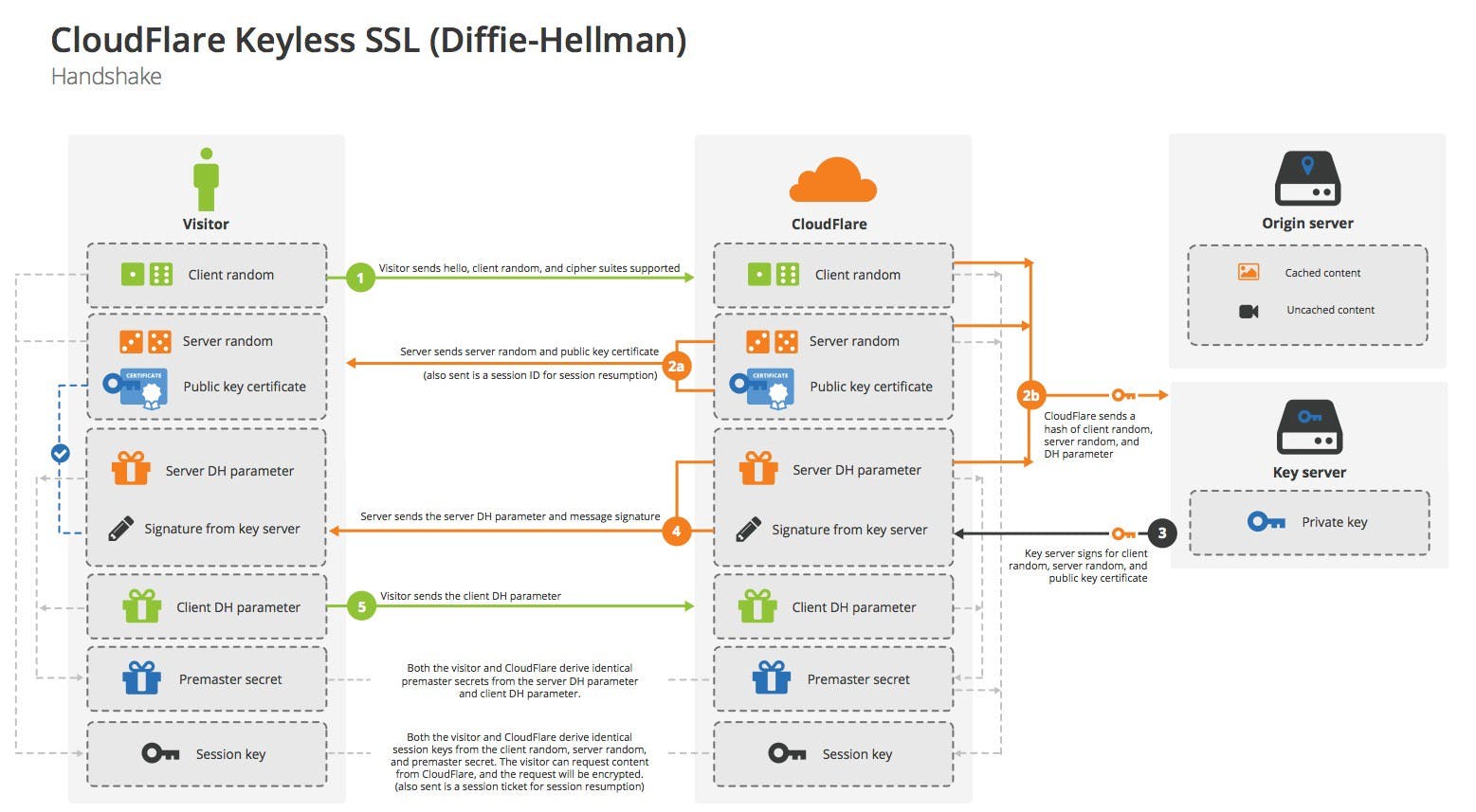
And I am leaving out the other very complex networking steps that HTTP servers use to deliver content, and all the other layers to do with displaying images, styling text and so much more.
Web developers, the equivalent to the members of the DCG, never interact with any of this complexity, which has been abstracted away into high level tools that are simple to use. For example, with Lets Encrypt, setting up SSL is much simpler than it used to be, requiring a single command line instruction, whereas before, it was a real headache.
SegWit is exactly the same as SSL on the web, and SMTP, POP3 with email. All of these low level protocols are hideously complex, but you don’t have to worry about them, once they are abstracted away from you. Very few people will ever interact with these protocols directly, but billions will use them without knowing anything about it, every second of every day.
The DCG says classic “seems easy”. This statement is not serious. It is the same sort of lightweight thinking that created “Blockchain not Bitcoin”:
Software is not about what looks or sounds nice, and certainly no decision about anything should be made on the strength of “it seems easy”. Once again, anyone with sensible objections does not speak like this. Increasing the block size has profound and detrimental implications for Bitcoin, and anyone who brushes them off with a scoff is a propagandist, not a serious contributor to discussion.
We took risks and built on bitcoin with our current project — not generic “blockchain” but real public-blockchain BTC… simply demoing to prospective customers has been an exercise in frustration due to simple user experience issues with the network confirming transactions. e.g. we pay an above-average fee and sometimes still takes multiple blocks to confirm.
You took risks. Risk does not mean you are guaranteed success, or give you special privileges above any other user. Risk means there is a real possibility that you will fail. This attitude is the result Millennials being trained from a young age that “everyone gets a prize” and trying hard is enough.
It’s interesting that these people, who are promoters of “Blockchain not Bitcoin” now say they represent Bitcoin. Which is it? Once again, your frustration is a result of your broken business models, not any problem with Bitcoin, which never made and could never make any promises to anyone. The people who built correct business models, like LocalBitcoins are thriving. You should look to them for inspiration, and cease trying to shove Bitcoin into your Procrustean Bed.
Its been particularly bad last few days, some users sending to [our exchange] were sending over 100 satoshis/byte and still waiting for over 12 hours for a confirm.
This is whining. Bitcoin is far cheaper and quicker than Western Union, and it doesn’t violate your privacy. This is nothing more than temper tantrum antics, and really, should not be listed at all as a complaint. If Bitcoin could handle billions of transactions per second, all of them taking exactly 12 hours to confirm, it would still change everything. This is not a valid objection, and it’s why serious men don’t invite you to secret meetings.
It’s really bad right now. Bitcoin is starting to make SWIFT look attractive. If this isn’t fixed, I expect we’ll see the non-speculative use cases migrate to other chains.
This is worthless emotionalism. Saying SWIFT is better than Bitcoin shows that whoever made this statement doesn’t understand what Bitcoin is for, or why it was developed in the first place. They should stop using Bitcoin now, as their fundamental premises are wrong. And by all means, migrate to other “chains”. Thats what they are there for. They’re waiting for you.
The current situation is that a Bitcoin node code revision has been put forward (by Core), and it has not secured sufficient ‘votes’ from miners to be ‘adopted’ by the network. Why is this?
The language in this is telling. Nodes running Bitcoin Core version v0.13.1 are not “voting”. Bitcoin is not a democracy. It is taking time for everyone to upgrade to SegWit for several reasons. One of which I outlined above. You cannot take advantage of SegWit without writing software, and this is difficult, expensive and dangerous. Also, there has been a concerted propaganda effort from celebrity Bitcoin investors who are not developers who have been spreading FUD. This is “why”…and why do you ask? Even if SegWit were activated immediately, none of these people are ready to take advantage of it because there are no libraries to accommodate easy, abstracted access.
The sensible thing to do in this case, in their own narrative of being “Good members of the Bitcoin Community”, would be to write and freely release SegWit libraries so that developers can take advantage of it as soon as it activates. Of course, this means putting weapons in the hands of their agile and unencumbered commercial adversaries. Difficult choices for the people desperate to pull up the ladder!
As you can see in the SegWit adoption list, there are 106 (one hundred and six) companies that are actively preparing for SegWit, with confidence it will activate. They’re doing the hard, low level work that needs to be done, quietly, and everyone will eventually benefit from it. Compare and contrast this with people who don’t even run a full node, or who haven’t run any tests, let alone build services against the new software.
So how do we cross this impasse before it’s too late? There have been quite a number of attempts to secure agreement on the best path, and yet here we are, no further forward. Why is this?
“Too Late”? Too late for who? 106 companies are not sitting around waiting to see what will happen, they are well along the SegWit path, gaining knowledge and building tools. “Wait and see” is not how entrepreneurs behave, they forge ahead and take risk. And note how throughout this, the DCG talks about miners as an abstract other or third person. If they are not DCG members, why not, and if they are, why do they not cite, “the miners who are our members”?
When they say “too late” I suspect they mean that these businesses are not profitable, and they are burning through VC cash with no prospect of ever becoming profitable with Bitcoin as it is. They made a bad bet on Bitcoin and are desperately, frantically trying to tweak their way out of it. This is probably why Coinbase is making insane bets like adopting Etherium.
SegWit, is at its core, a technical issue. For entrepreneurs who are busy running their company and trying to keep their products and platforms running for the paying customers, it can be challenging to also try to focus on making serious changes to the core bitcoin protocol.
Another telling paragraph. The entrepreneurs in Bitcoin are in a technical field, they are not in a field that is separate from the nature of Bitcoin. This thinking is a leftover from the days when bosses used to dictate to typists on typewriters, and years later secretaries on desktop computers clacking out emails. Your business IS the “tech”. You cannot be separated from it, ignore it or do anything other than be totally immersed in it if you want to succeed. The days of developers being “back room boys” are over, and this is part of The Transformation.
The geeks run the world now. They design the software that runs your cars, washing machines, phones and the locks on your doors. Nothing happens today without software mediating it, except growing carrots. If you think you can suceed in Bitcoin by dictating to geeks you will fail. Your business models must start with the geeks otherwise, you will not be able to compete.

Bitcoin works exactly as expected. It is you that has to change. What we are seeing here is a group of people bereft of imagination and creativity. There are ways that services can scale to billions right now; all it takes is some imagination and skill. Entrepreneurialism can never be free of risk. Risk is your business; that’s why you’re in Bitcoin.
Our summary of SegWit is not “bad” but “complex” — in all senses of the word. SegWit is a good “lego block” foundation advancing the ecosystem. It is also very complex, technically, governance-wise, from a technical readiness standpoint, and more. This is why we’re working on a “SegWit for CTOs” style document.
See my points about complexity above. This is a patently absurd complaint. It’s apt that Lego is used as an analogy. The point about SegWit being complex governance wise is telling. These are the people who are desperate to inject the poison of the State into Bitcoin. There are no “governance” problems in Bitcoin, SegWit or any software. Bitcoin is self governing and doesn’t need any help from non entrepreneurs or developers in keeping the system running.
We’ve been asked by a number of people now to endorse it (whatever that means), and while we like it conceptually, I don’t think it would be responsible to endorse it unless we’ve performed rigorous analysis and testing ourselves (which we’ve not)
Similarly, the DCG “endorsing” SegWit is completely meaningless, unless they run a cluster of full nodes full time. What these people think has no effect on running software, and it’s amazing that they don’t employ developers to contribute meaningfully and usefully, or even do the most simple act of running a cluster of full nodes. All they do is arrange for people to be bullied by the legislature. Thanks to Trump, they will be milked of their venom and de-fanged.
They say they like SegWit “conceptually”. This is not possible, obviously, since they are not capable of understanding it. They admit they haven’t done any analysis or testing of it, and they are not capable of doing so either. There is nothing wrong with not having a skill, expertise or understanding; the problem is not having them, and then running to the legislature to control the men who do.
Testnet has been SegWit-active for a while now, but little testing has been done by major bitcoin network players. Several larger players are waiting for lib updates to go to production before beginning their own testing.
Little testing has been done. How do you know this? If you know this, why have you not paid for testing to be done so you can accept or reject SegWit based on evidence instead of feelings? As for lib updates….I told you!
Our understanding is its only been tested by core devs on testnet… the main worry would be that this testing may not match what enterprises actually need on a production level
Bitcoin does not belong to “enterprises” who happen to be your members, and what they require is irrelevant to Bitcoin, which does not belong to your members or any particular person. Once again, you can solve this problem by starting your own DCG alt-Coin, where all your members and their collective genius and billions can have absolute control over what you are using, and exclude anyone who doesn’t agree with you.
Some of us feel that SegWit and Lightning are both in the “exciting, but still in the lab” category — and that nuance is often lost in the SegWit / Lightning excitement.
SegWit is in the wild. Your feelings don’t count. Nuance?!….

THIS IS WHY WE CAN’T HAVE NICE THINGS.
We don’t want to be anti-SegWit or pro-SegWit, just pro-pragmatism. There seems to be a disconnect between what the devs are developing, and what business actually need and want, which is a bigger problem about how resources are directed.
You can’t be anti-SegWit and also pro-Bitcoin. SegWit is Bitcoin. It is also absolutely pragmatic, with exponential benefits for everyone, causing Bitcoin’s capacity to exceed VISA and MasterCards transaction per second rates. What business wants is not what matters. Bitcoin is not a “business network” or a tool made for business. It is made for users of every class; businesses are nothing more than peers on the network, with no special position, precedence or privilege or right to demand anything whatsoever.
In general, the bigger problem is the pursuit of niche projects over business & user needs that could actually change the the user experience in much needed ways.
Bitcoin itself was a niche project when it was released. None of the people who want the block size increase today even cared about the form of the money in their pockets in 2009, or encrypted their email or had any dream of a stateless, irrevocable anarchist currency. I do not invoke the ridiculous, bogus, worthless and frankly stupid claim that because you were an early participant in something, your opinion counts more than others, but it is a plain fact that Bitcoin was designed for a specific political and philosophic purpose, and that purpose was not to serve a small number of businesses who want a life without having to innovate.
Calling SegWit a “niche project” is not sane. Given that SegWit will cause Bitcoin to outperform the biggest credit card companies on earth, combined, while maintaining its distributed network shape is a staggering achievement of breathtaking creativity and genius, and it is an unimaginably powerful and profound addition to Bitcoin. Taking into consideration what SegWit will deliver, it’s worth dismantling all the software the DCG members have written and re-writing it to accommodate SegWit. If they don’t accommodate SegWit, someone else will.
It would be helpful to have a constructive dialogue with realistic views on technology timelines vs. user experience benefits delivered by technology to prioritize how and when upgrades are deployed to benefit the greatest number of stakeholders.
Helpful to who? A dialogue with whom? Who is to say what is realistic and what isn’t? The capacity of Bitcoin SegWit, if you had offered those numbers two years ago would have been thought completely unrealistic, and now, they are real. This section is nothing more than a pre Trump Washington Wonkesque call for the takeover of Bitcoin Core, with its oily talk of “stakeholders”. No one is buying any of this. If SegWit does not activate, you will not gain control of Bitcoin. If it does, you will not gain control of Bitcoin.
Overall, there are better ways we could deal with new technology as a community. For example, NASA deals with new-new technology all the time, and came up with a ladder to assess how close to production a technology is, called a Technology Readiness Level: https://www.nasa.gov/directorates/heo/scan/engineering/technology/txt_accordion1.html
NASA? Really? This is absurd, but what else would you expect from people who think you need the State to regulate Bitcoin? In case you have’nt been watching the YouTube, you don’t need the State to get into Space, (or regulate Bitcoin) and NASA’s way of doing things is completely shown up by Space-X who are performing acts that are mind blowing in their innovation, from the live video links of every section of the fight to the shriek inducing landings of the first stage boosters on robot platforms.
It’s 2017, and you’re asking the government for guidance? Give me a break.
And there is no Bitcoin community. What you are talking about is the needs of your monoculture members, not anyone else, pure Argumentam Ad Populum.
We’ve never understood why it has to be one or the other — why can’t there be both? Why can’t we introduce 2nd layer technologies (as they are ready) AND have a block size increase as well?
You don’t understand because you don’t understand Bitcoin. You can’t have both because increasing the block size will lead to centralization, which is anti-Bitcoin.
If you remove all the us vs them rhetoric being thrown around — we could gain benefits from both approaches (block size increase and SegWit)
Here we go with the “sotto voce violation of the Verbal Morality Statute” mantra that robust arguing is counter productive and inappropriate. This really is a matter of “us vs them”. On one side, you have a group of men who have a limited horizon view of Bitcoin with strong incentive to repay Venture Capital firms so they can exit and rid themselves of this seething morass of anarchists and geeks. On the other, you have the seething morass of anarchists and geeks, and a few ethical entrepreneurs thrown in for good measure. This is a fight over the biggest software breakthrough since public key cryptography, or the various tools that make up the basic internet protocols. Bitcoin has the potential to change everything; expecting people not to argue over it is irrational.
There are no gains to be made from centralizing Bitcoin, if you are interested in Bitcoin. What the DCG call “gains” people interested in Bitcoin call death. These people are wrong because they can escape at any time and form their own network. In years, if they have made the right bet, they will be the biggest financial network on earth. The problem is they have already bet incorrectly once, and are nervous about making another wrong bet, while Bitcoin goes on to explode without them. They also know that they have a serious technical deficit in the form of strong developers; if this were not the case, they would not be complaining about SegWit, and would be busy writing the libraries I described and that the DCG concedes must be written.
All of this is a logical conclusion based on the facts, and you are not entitled to your own facts. You cannot refuse to take a side, because there are no sides in this matter. SegWit is the logical choice and it should be activated immediately. The only reason why you would be against this is that you are frightened that a startup is waiting in the wings to eat your lunch with its zero conf high speed service that wipes you out. If things stay the same and SegWit never activates, then you get to avoid having to spend a fortune on new, dangerous software, and can pull the ladder up and prevent a startup from obliterating you. The choice is clear for them; SegWit must be stopped. They can participate in any future centralized Bitoin Clearing specialist as privileged actors and the VC spigot will never be turned off. They might even end up being the ones running it. These are the secret thoughts behind the anti SegWit animus.
It’s difficult to identify how we move the discussion forward productively — anyone who takes any sort of position in public, even one of compromise, is instantly labeled to be a seg-wit supporter or a seg-wit blocker and the discussion just ends/degrades into name calling
This is more soap opera. There are developers who are above this sort of nonsense, being more concerned with the quality of their important work. What anyone “labels” you is irrelevant. People who were undecided have openly said they now support SegWit activation, often after having it explained to them. It’s not easy to understand. There is no discussion to move forward in any case; software is not about discussion; it is about the delivery of code.
We know that increasing the block size alone will irreparably damage Bitcoin, so this is not an option. We know that SegWit will increase the capacity of Bitcoin beyond VISA and MasterCard. Thats it. It’s a no-Brainer. Furthermore, the block size limit will be increased to 2meg giving companies with anxiety time to get their SegWit solutions in place.
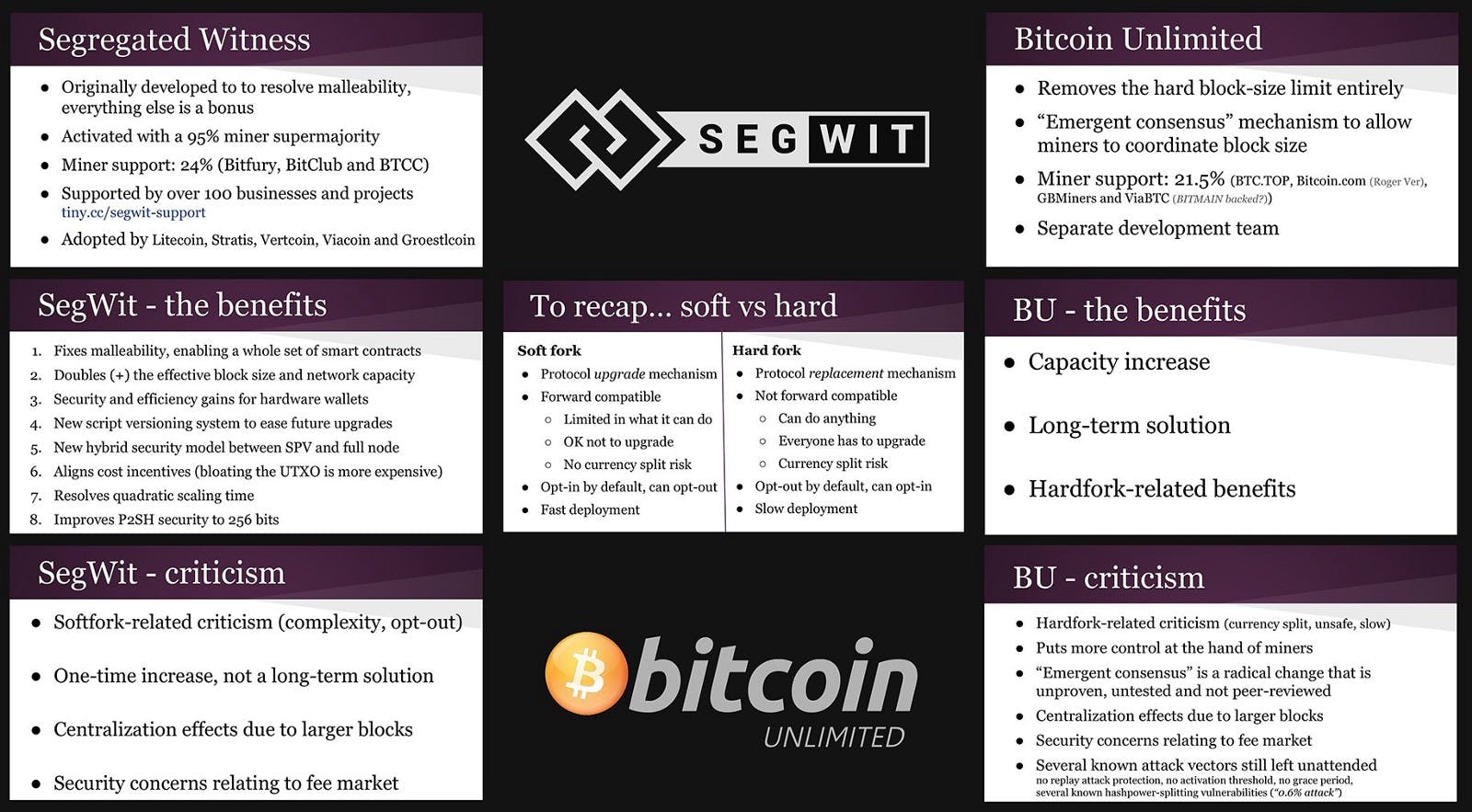
Everybody wins with SegWit
As a community, we should avoid all-positive documents on SegWit (prudent to include some cautions), just as we should avoid all-negative SegWit commentary. This is a hugely complex upgrade, as the devs themselves have noted many times.
Another call to group think, and DCG wants to be the cult leader. It’s a fascinating position to take, but quite understandable when you consider that they are absolutely bereft of power and influence. There is nothing at all bad about making a categorical statement that something is completely wrong if it is in fact, wrong; this is another way of claiming that this matter is nuanced. which should trigger anyone who is interested in Bitcoin’s success. It is a way to say that no matter what your position is, it is always flawed in some way or subject to interpretation, which is obviously wrong.
There are absolutes, there is right and wrong, there is good and evil.
What we’ve observed is that communication has done downhill — people are calling one another liars, claiming the “other side” is destroying bitcoin, calling anything that doesn’t match their proposal a “coup,” and it’s incredibly unprofessional. It makes everyone in bitcoin look bad. We want to see communication return to a professional, scientific level.
In order to melt iron you need heat. You cannot produce steel without a hot furnace. When men debate, they get angry, they fight, they use curse words and lose their tempers. This is completely normal, expected and useful.
The people who want to centralize Bitcoin really are on the other side of an argument. They really are a threat, not only to the idea of Bitcoin, but to what people can do with their money; transmit it without permission. If you threaten to steal someone’s money, they are going to get angry. This is completely normal, rational and legitimate. As government issued fiat is withdrawn, permission-less Bitcoin is now more important than ever. This not just an academic debate any more, this is a matter of human liberty and dignity.
Trying to wrest control of the Bitcoin source repository and control of the protocol by lying, threatening, attacking the network with thousands of artificial transactions has all the markings of a coup:

Spreading FUD, attacking the network with spam, whispering in the ears of company owners to get employees who are pro SegWit fired, (yes this actually happened) are all attempts to take over the root operation of Bitcoin but worst of all, is the launch of a buggy rival reference client “Bitcoin Unlimited”, which is tantamount to the firing of a weapon against the Bitcoin network. This is in no uncertain terms an attack, and an attempt to steal control of or spoil Bitcoin, and it is entirely justifiable and reasonable to call these attempts a coup and to vociferously argue against them.
It is not unprofessional to protect your work, and in software, the only thing that matters is whether or not your code works correctly. This is why in offices all over the world, the geeks are allowed to wear their hair in any way they like, are allowed to smell, to keep their work spaces like pig styes, work in their pyjamas and all other sorts of unimaginable, filthy indulgences that only a few years ago would be unthinkable behaviour for any office. In fact, if you do not provide beds, slides, free food, massages and an absence of rules (on top of a fortune in money, equity and benefits) you can forget hiring the best developers. I could Google many shocking pictures to prove this, but ill spare you having to buy a new keyboard. Heh.
Nobody who writes software cares about looking bad in front of normies. All they care about is their work, and that it compiles, and is appreciated by their peers. This is why Open Source software has eaten the world; people working for the good of other people and respect of their peers; those motivations were enough to change everything, and now that energy is being applied to the problem of replacing fiat money.
Making a claim that people are not being professional because they won’t tolerate you destroying their money is absurd. Men really are trying to destroy Bitcoin; this is not exaggeration; it is a statement of fact. That is why people are so angry and they are right to be angry at the reckless selfish acts of vandalism that are being launched at Bitcoin, and the useful idiots who know nothing about Bitcoin, can’t write “hello world” in C but who think they are “Stakeholders” trying to force their ideas on something they know nothing about and that they’re fundamentally ideologically opposed to.
But It’s Clear the Current Approach Isn’t WorkingWe’ve thought long and hard about this — if anything, what we would really like to see is compromise (e.g. both sides working together on a solution that works for as many as possible) — but its like trying to get someone from the extreme political right and left to agree on something they fundamentally disagree on — any push towards compromise/confronting the issue seems to just entrench the two sides that much further
Yes, it is working. SegWit has been developed and is now in the reference client. SegWit is the solution, if you want to work with Bitcoin. No one should compromise with any idea that means Bitcoin becomes centralized, in other words, stops being Bitcoin. This is the problem the DCG does not understand; they are looking at Bitcoin through the lens of their iPhones and not at what makes it work, or valuable. Its just a number on a flat screen, indistinguishable from any other.
[The Flat Screen DilemmaThere is a lot of talk about using “Blockchains” to improve data integrity, but what all these solutions fail to…_medium.com](https://medium.com/@beautyon/the-flat-screen-dilemma-e84384cfd19f?ref=hackernoon.com)
And as for the comparison between left and right in politics, this is a perfect example of how the DCG does not understand Bitcoin. The left in politics believes that the Federal Reserve and central banks should control the supply of money, by right. Bitcoin was written because its author understood that this is not correct, and that money is a product and service that should be produced by the market, not the State. If anything, the DCG is a Socialist organization, because it is for the State and its “regulations” and the de facto centralization of Bitcoin.
The men who produced SegWit are not entrenched. They’ve produced working software that will change everything, and that you may opt not to use. Every single member of the DCG can carry on exactly as they are and not adopt SegWit. No one is being forced to do anything, and this change is very accommodating and respectful of everyone, not breaking anyone’s software or disrupting anything.
Compare and contrast this with Bitcoin Unlimited, which will eventually push small operators off of the market by making it impossible for them to run a full node. They are the bad guys. It is they who have launched a poison fork, it is they who are spamming the network, running propaganda and asking for employees with different opinions to theirs to be ruined. No one from the SegWit side is going those unethical things.
It seems that so far, the approach of “get [devs] to all sit down and figure out how to work together” is a lost cause and that trying to push it has done more harm than good. Events like the Hong Kong Meeting, the various Roundtables, have all isolated rather than included opinion.
There is nothing to discuss any further. There have been many hours of discussions, and flying all over the world to solve this “problem” and everyone has had literally years to write software to make their vision real. Only Bitcoin Core has come up with something, at great personal expense, and it’s more than just something, it’s a work of genius that changes everything.
Anyone that has anything to offer needs to offer it in the form of working software. Talk is meaningless and so are the endless “white papers” that cannot do anything. If you really have something to offer, you can write some C, or develop a service; either way, you have to write some software to have influence. That is the only thing that matters.
Private, closed-door meetings do little to address the main issues found in support tickets that we’re seeing every day. We need to talk about alternatives and options to get these issues addressed. It seems like a better use of energy to identify a new mechanism that gets devs, business operators, and miners together — not in secret, invite-only roundtables
This is a veiled threat to push for the State to directly intervene in Bitcoin’s governance as Primavea De Philippi brazenly called for in Wired
this is what it means when the DCG says, “a new mechanism”. And there is a reason why men have to meet in secret to discuss these matters. All of them are on the same side of this problem. They want Bitcoin to scale. They want to continue to profit. They do not want Bitcoin to break. They all know what they are talking about, at a source code and network protocol level. Having the DCG and other people, even entrepreneurs who run services on top of Bitcoin but who don’t have expertise in cryptography or C at a meeting would be completely pointless. The people who can’t contribute feel left out, become emotional, and feel like they are being talked down to…which is true and often completely justifiable.

Bitcoin is not about community, meetings, the DCG, endless conferences and lawyers; it is about software. It is not about your opinion. There is no “we” that needs “other methods”. You do not “have a say”.
Whether SegWit activates (it should) or not, what we are dealing with is a profound cultural mismatch between at least three different camps. Two of these camps are powerless, and they can’t stand it. They don’t have the ability to start their own network, or write their own software, and they can’t influence the Bitcoin network, one of the most successful and reliable software projects ever launched. They are trapped. It is the success of Bitcoin which everyone now understands and that is attracting undesirables who want to change the rules of something they never saw the need for and couldn’t possibly have imagined.
As I’ve said many times, if Bitcoin cannot successfully repel these low level attackers, it will have no chance against the State. This is the big picture of the Bitcoin Unlimited vs SegWit competition, which is about the future of Bitcoin, and how in that future everyone interacts with it.
Now, everyone buy me beer: writing is very thirsty work!

The True Cost of Bitcoin Transactions
By Erik Voorhees
Posted February 11, 2017
It seems the Bitcoin community is not correctly tallying the true cost of Bitcoin transactions.
The belief is that Cost = Miner Fee. We’ll show why this is wrong, but the fee is of course part of the cost, so let’s examine it first…
Fees are currently averaging in the range of $0.30 to $1.00 per transaction. Here’s an anecdotal sample as I’m writing this:
Block #451871 $1,287 in fees / 1347 txs = $0.95 avg fee
Block #451872 $1649 in fees / 2161 txs = $0.76 avg fee
Block #451873 $1,497 in fees / 1450 txs = $1.03 avg fee
Block #451874 $1,209 in fees / 1582 txs = $0.76 avg fee
Block #451875 $1,591 in fees / 2180 txs = $0.73 avg fee
Total: $7,233 fees / 8720 txs = $0.83 avg fee
83 cents per transaction on average…
Is that “too expensive?” That’s a judgement call, and sincere people can disagree about what is “too expensive.” It depends what one uses Bitcoin for.
Some people, indeed, are using Bitcoin to move “normal” amounts of money around (ie – like a “peer-to-peer cash system”). This doesn’t refer to “micro transactions,” which are fractions of a dollar and have been impractical in Bitcoin for years, rather it refers to casual payments of $1-$50 in value, which make up the vast majority of human economic activity broadly, and a great deal of Bitcoin activity, specifically. An $0.83 fee doesn’t matter for a $2,500 payment, but it matters if you’re sending $7 to a friend. Indeed, it will actually preclude a $3 daily wage payment.
Consider that a great way to make Bitcoin centralized is to reduce its utility to only the world’s richest.
And those who imagine such users to be using Bitcoin “wrong” are perhaps not understanding what consequences that sentiment invites: such users, finding less utility in Bitcoin, will be incentivized to go to other platforms or just stick with the status quo: fiat. How tragic that someone would actually prefer fiat, but many will if Bitcoin is too expensive to use as a peer-to-peer cash system.
So on the topic of the explicit miner fee, maybe $0.83 is too high, and maybe not. It depends what a user is trying to accomplish.
But $0.83 isn’t the true cost… and this is a point most observers are missing.
The true cost of a Bitcoin transaction can be better considered as:
Cost = F + T + Ru
Cost = Fee + Time taken to determine fee + Risk of uncertainty. What do I mean by this?
Those people who are using Bitcoin today pay more than a miner fee, they pay in time and uncertainty (risk). As blocks are full, users often need to change the fee they add to their transaction (before or after they send it). Some wallets do an okay job of this, but most don’t (and before you vilify wallet creators, realize that “smart fee policy” is nowhere near a science yet, and changes all the time). So, in addition to the $0.83 miner fee, the user currently has to also spend Time to determine that it ought to be $0.83 in the first place.
A highly-skilled Bitcoiner can figure out an appropriate fee in a minute, but Bitcoin cannot be imagined as a platform only for highly-skilled Bitcoiners. If that is the target market, then the project is doomed. A normal user (meaning most users) struggle with the fee estimation (hell, I’ve been doing Bitcoin for six years and I’m not the most graceful at fee calculation myself).
Many casual (read: normal) users of Bitcoin get horribly confused, and if they even bother trying to figure it out, they may wander over to /r/bitcoin to ask advice.
Look at this comment on Reddit to a user who was confused about transaction delays and fees:
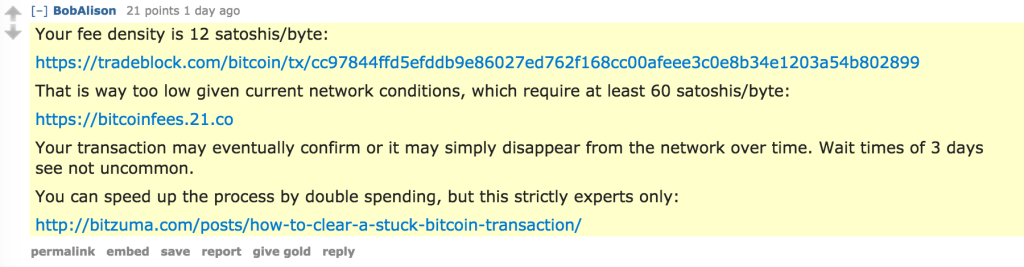
We should realize how awkward and confusing that is for a normal Bitcoin user (ie – a non-technical person who wants a system that is easy and convenient).
And at least that comment was trying to be helpful. Many users get responses more like this:

Jesus. Add in the misery of dealing with people like /u/MinersFolly and it’s amazing Bitcoin is gaining users at all.
So back to our equation, the true cost of a transaction is: $0.83 (maybe?) + time to determine $0.83 + Risk of uncertainty.
What do I mean by uncertainty? Well, even if a user figures out a recommended fee, there is no guarantee it will be confirmed in the next block. Using a recommended fee gives zero guarantee of delivery time.
Here’s a depressing real world anecdote: A couple months ago I had some friends over for a Civ 6 LAN party. One guy didn’t have the game, so I offered to buy it on Steam for him (they accept Bitcoin!). I paid the BitPay invoice for the Steam game, and waited. And waited. And waited. 25 minutes later it still hadn’t showed up. Three blocks had already happened. Everyone is sitting around waiting. Ultimately, I just pulled out a credit card and bought the game (paying again) so that we could all play. A year ago, this would not have happened. What went wrong? Was my fee incorrect? (I paid the high fee option in Jaxx wallet). Was the mempool too full? We just wanted to play, so back to the 50 year old credit card technology I went.
There are some in the community who read the above and actually think, “meh, what’s the big deal?” Or perhaps respond, “just wait two years for Lightning!” Cool, tell me that when I’m trying to buy Civ 7.
Back to the present… because of this uncertainty users are facing, one of two consequences happen:
1) the user gets annoyed at the delay, or actually suffers some kind of economic loss, or
2) the user can’t use Bitcoin for this tx at all because it is time sensitive and user can’t risk the uncertainty.
And be careful not to discount the utility loss to a Bitcoin user, who was getting excited about making a Bitcoin transaction (the future of money!), only to discover his tx is stuck in the mempool for 33 hours. We’re lucky if that user ever gives Bitcoin another chance.
Fee + Time + Risk of uncertainty (F+T+Ru). Since T and Ru are not measureable, it seems most engineers in the industry have been completely oblivious to them. The costs are more apparent to an economist, and are very apparent to anyone in business with actual users (there’s a reason why nearly every Bitcoin business with more than ten thousand users is very eager to see both SegWit and a hardfork blocksize increase… but that’s another topic).
As blocks approach capacity:
1) Miner fees get more expensive
2) Time/effort to determine fees rises
3) The reliability of transactions falls toward zero (risk of hours-long delay for first confirmation, even with “good fees”)
Many people have only been considering #1, above.
Those who look at a recent tx fee of $0.30 and obnoxiously proclaim, “transactions are cheap, you can’t expect the system to be free!” are really missing the point and are harming the prospects of this project. The miner fee is only part of the cost that users are dealing with, and if peoples’ time and sanity are worth anything, it is the lesser part.
And let’s end this silly false dichotomy of Bitcoin as a “payment system” vs a “settlement system.” Such distinction is a relic of fiat banking networks and has no place with blockchain-based assets. The reality is this: every payment on a blockchain network is a settlement, and the cheaper these transactions, the more widespread uses the platform will find, meaning greater utility, a broader and more decentralized user-base, higher market capitalization, more liquidity, and therefore more hashpower dedicated to it, and more security derived therefrom.
If Bitcoin transactions are too expensive (considering F+T+Ru), people will use other platforms instead for some or all of their economic activity, period. As I tweeted yesterday, I’ve found myself now holding a modest balance of Ethereum merely for the purpose of small (not micro) payments to friends. It’s just cheaper and more reliable. And I’m doing that with more allegiance to Bitcoin than almost anyone on Earth, how dedicated will a normal person be to a platform that isn’t helpful to them?
The response of some has been, “so what, good riddance.” Such people are being arrogant, naïve, and suffering from a disease common in the business world: not listening to or respecting customers. Such people are free to have that sentiment, of course, just as they are free to end up on a lonely platform.
Now, obviously a blockchain cannot (and should not) handle all the world’s transactions on-chain, but that doesn’t mean we shouldn’t do all we can to acquire as much transaction marketshare as safely possible. This is a platform about network effects, after all. Just because it’s true that Bitcoin’s blockchain can’t handle Visa-level scale on-chain, doesn’t mean we should be comfortable and complacent about a 5 tx/sec threshold today, especially during Bitcoin’s formative years, while the world is still watching and waiting to see if it catches on as the money protocol of the future (those who think Bitcoin’s dominance is “inevitable” are, again, suffering arrogance).
Conclusion
The community needs to take at- or near-capacity blocks seriously, and yet many have dismissed the issue, saying silly things like “well when fees rise it’s just the free market at work.” Sure it is, and when users leave Bitcoin, or never bother a second transaction because their first was obnoxious and unreliable, their preference of alternatives will also “just be the free market at work.” The goal should be to do everything practical to make Bitcoin cheaper and more efficient, because if we don’t, it leaves a huge opportunity for Bitcoin’s successor. Bitcoin is free-market money. It competes, and it must be competitive.
As the true cost of Bitcoin transactions rises, utility at the margin falls, and the platform’s fundamental value as a tool for human economic interaction declines alongside. Reduce the number of use-cases for which Bitcoin makes sense, and the quantity and quality of people willing to hold a portion of Bitcoin declines.
As will the price, as will the promise.

Erik Voorhees http://www.ShapeShift.io Erik Voorhees, CEO of leading digital asset exchange ShapeShift.io, is among the top-recognized serial Bitcoin advocates and entrepreneurs, understanding Bitcoin as one of the most important inventions ever created by humanity. Erik’s former project, the groundbreaking gaming phenomenon SatoshiDICE, was, at its peak, responsible for more than half of all Bitcoin transactions on Earth and popularized the concept of “provable fairness.” Having been a featured guest on Bloomberg, Fox Business, CNBC, BBC Radio, The Peter Schiff Show, and numerous Bitcoin and industry conferences, Erik humbly suggests that there is no such thing as a “free market” when the institution of money itself is centrally planned and controlled. This blog is about the human struggle for the separation of money and state, and about Bitcoin as the instrument by which it will happen.
You can start editing here.
The Parable of Alpha
By Erik Voorhees
Posted February 13, 2017
This is a followup to my recent post on the True Cost of Bitcoin Transactions. A legion of Twitter trolls has been yelling at me, proclaiming that “since people are willing to pay higher prices, that proves Bitcoin’s value is growing.”
This is actually a common sentiment among those who believe that blocks filling up is “no big deal.” As space gets tight, the argument goes, the transaction fees rise and this balances out supply and demand. This is referred to as the “fee market” where fees determine who gets into a block, and it has become a way to dismiss anyone raising concern about network congestion on Bitcoin.
As with all good rhetorical distractions, it has some truth to it. Indeed, as blocks approach capacity, fees rise, and only those transactions willing to pay the most will be included. Sounds very “market-esque” doesn’t it? You have to pay to play, after all. You shouldn’t expect to “freeride” on the Bitcoin blockchain.
There is a really serious problem with this mentality, however…
Here is a point of economic truth: If Bitcoin blocks fill to the point where prices are rising, utility at the margin falls.
What does this mean? It means that of the universe of potential uses of Bitcoin, the subset of uses which makes sense is diminished by rising costs. If it costs $0.10 to send a Bitcoin transaction, X number of use cases are theoretically practical. But if it costs $100 to send a Bitcoin transaction, X-Y use cases are theoretically practical (a smaller amount). Thus, the higher the cost of transactions, the fewer the applications. For a technology that relies on network effect, this is very important.
Regardless of this truth, some people point to the increasing transactions we see on Bitcoin today, notice that the blocks are filling up, and proclaim that this is sign of success because “lots of people are finding the system useful.” Yes, that’s true. Bitcoin is increasingly finding use among people, and this should be celebrated, to an extent.
But this is the “seen,” as Bastiat would say. What is “unseen” is that as transaction costs rise, potential transactions that would otherwise occur, no longer do. Thus, as the actual transaction count on the network increases, and prices rise, the theoretical transaction count (ie – the sum of all potentially useful transactions) falls.
To illustrate this principle, and why it is existentially important for Bitcoiners to understand, let’s consider a hypothetical situation with an imaginary cryptocurrency, AlphaCoin.
AlphaCoin has ten potential Use Cases around the world (Use 1, Use 2, … Use 10). Each Use Case has up to 200,000 transactions per block of potential demand based on adoption and price. Thus, a fully-realized AlphaCoin could enable theoretically 2,000,000 transactions per block.
The Parable of Alpha
Assume that each AlphaCoin block can fit 20,000 transactions, on average. And assume that, on Day 1, there are 15,000 transactions per block happening per the below Use-Cases. Thus, blocks aren’t totally full, and let’s assume fees are $0.10 per transaction under these circumstances.
Day 1 – AlphaCoin
- Use Case 1 = 3,000 txs per block
- Use Case 2 = 5,000 txs per block
- …Use Case 3-10 = 7,000 txs per block
- Capacity = 15,000/20,000 txs per block
- Fees = $0.10 per tx
- Total Revenue to Miners = $1,500 per block
Next, assume that on Day 100, there are now 20,000 transactions per block happening in AlphaCoin. Use Case 1 and Use Case 2 have grown considerably, and the users are happy to pay the now higher ($2.00) transaction fee, for it’s still well worth it to them.
Day 100 – AlphaCoin
- Use Case 1 = 10,000 txs per block
- Use Case 2 = 10,000 txs per block
- …Use Case 3-10 = 0 txs per block
- Capacity = 20,000/20,000 txs per block
- Fees = $2 per tx
- Total Revenue to Miners = $40,000 per block
Use Case 1 and 2 grew, and the AlphaCoin system itself grew (20,000 transactions per block now, nice!) Clearly, AlphaCoin is providing more value to users and is succeeding.
But wait… what has happened to Use Cases 3-10? They’ve been priced out. $2 per transaction is too expensive for those Use Cases. They’ve left AlphaCoin. Maybe they went to another crypto platform, and maybe they just don’t happen at all anymore.
Should AlphaCoin advocates be happy about the above situation? Well, it depends. If the goal was to build a network that supported a limited number of Use Cases, then yes they can celebrate, for those Use Cases have grown to the max and are fully and adequately served by AlphaCoin. Transactions have grown 33%, fees are up 2,000%, and miners are earning $40,000 per block so hashrate security is higher. Clearly the world is finding AlphaCoin increasingly useful and AlphaCoiners are going to the moon.
That’s the seen. What about the unseen?
What if the goal was to support many other Use Cases? What if the goal was to change the global financial system, with all its myriad users and demands, for example? In this case, celebration may not be as warranted, for all those other Use Cases, finding previous utility with AlphaCoin, have now left.
In the noise of aggregate transaction growth, the potential Use Cases and marginal utility of AlphaCoin fell. Maybe when transaction quantity rose, and especially when AlphaCoin price increase, AlphaCoiners don’t realize what has happened.
And let’s ponder how this could play out a little further…
Fast forward to Day 1,000, Use Cases 3-10, priced out of AlphaCoin, gradually migrated to BetaCoin (all the AlphaCoiners confidently proclaim BetaCoin a scam, of course), and it looks like the below…
Day 1,000 – AlphaCoin
- Use Case 1 = 10,000 txs per block
- Use Case 2 = 10,000 txs per block
- …Use Case 3-10 = 0 txs per block
- Capacity = 20,000/20,000 txs per block
- Fees = $1.50 per tx
- Total Revenue to Miners = $30,000 per block
Day 1,000 – BetaCoin
- Use Case 1 = 15,000 txs per block
- Use Case 2 = 15,000 txs per block
- …Use Case 3-10 = 1,000,000 txs per block
- Capacity = 1,030,000/2,000,000 txs per block
- Fees = $0.05 per tx
- Total Revenue to Miners = $51,500 per block
That’s interesting… By pricing out Use-Cases 3-10 from AlphaCoin, a competing platform (BetaCoin) that permits more transactions per block has earned those users. Has AlphaCoin failed? No, it’s still “hugely successful,” for it’s running at capacity, with fees 1,500% higher than on Day 1. Clearly, “users are still finding huge value with AlphaCoin.”
But look what else happened: BetaCoin now has 1,030,000 transactions per block, serving not only Use Cases 3-10, but actually 1 and 2, as well. In fact, it has more transactions from Use Case 1 and 2 than does AlphaCoin even! And while fees are cheaper, only $0.05 per tx, it appears that BetaCoin is actually more secure than AlphaCoin, for it’s paying miners $51,500 per block vs AlphaCoin’s $30,000 per block.
In other words, BetaCoin now enjoys a higher hashrate, and much higher use, than AlphaCoin. Not only that, but BetaCoin’s existence with lower fees has made AlphaCoin less competitive, and thus fees on AlphaCoin itself have fallen, from $2 per txs on Day 100 to $1.50 on Day 1,000. AlphaCoin’s own security is now lower and it is, by far, less successful and widely adopted than BetaCoin.
The lesson…
Transaction costs matter, and as costs rise, marginal utility of a platform falls. We should not be so blind to think that just because transaction count is rising, and fees are rising alongside, that a platform is “getting better.”
If fees are rising because we are truly at a technological capacity limit, then fine. But if fees are rising because we are at an artificial/arbitrary limit, then that should be examined. If such limits encourage other Use Cases to explore other platforms, Bitcoin jeopardizes not only its continued adoption, but in fact its very security.
The Parable of Alpha isn’t a guarantee of what will happen to Bitcoin. Rather, it’s an example of a real risk of lost users to the extent transaction throughput is throttled and transaction costs artificially heightened.
For a community that weighs very heavily the risk of any marginal loss of decentralization, there is a disturbing tendency to wholly discount the risk of any marginal loss of actual users. A network with a hundred nodes and a hundred users is perfectly decentralized, while the network of 20,000 nodes and one billion users is proportionally less decentralized. Yet, which would should be the goal for Bitcoin? Perfectly relative decentralization on a small network, or significant decentralization on a globally used network? The benefit to academics may come from the former, but the benefit to humanity comes from the latter.
The Bitcoin community should be embracing more use cases, and more users, by advocating and working toward lower transaction costs as a fundamental goal. If it doesn’t, another platform may.

Erik Voorhees http://www.ShapeShift.io Erik Voorhees, CEO of leading digital asset exchange ShapeShift.io, is among the top-recognized serial Bitcoin advocates and entrepreneurs, understanding Bitcoin as one of the most important inventions ever created by humanity. Erik’s former project, the groundbreaking gaming phenomenon SatoshiDICE, was, at its peak, responsible for more than half of all Bitcoin transactions on Earth and popularized the concept of “provable fairness.” Having been a featured guest on Bloomberg, Fox Business, CNBC, BBC Radio, The Peter Schiff Show, and numerous Bitcoin and industry conferences, Erik humbly suggests that there is no such thing as a “free market” when the institution of money itself is centrally planned and controlled. This blog is about the human struggle for the separation of money and state, and about Bitcoin as the instrument by which it will happen.
You can start editing here.
Bitcoin is. And that is enough.
By Beautyon
Posted February 20, 2017


OXYGEN BLUE
Bitcoin is not what you think it is. It is what we say it is.
There are widespread misconceptions about what Bitcoin is, and these misconceptions when peddled as the truth and mixed with people who have power to control others, makes for a toxic cocktail that can potentially hurt millions of innocent people. Rather than accept that Bitcoin has a fixed nature that has nothing to do with their pet beliefs and living with it, people substitute their inability to control Bitcoin with a worthless desire to control the way something is said, rather than the substance.
The problem here is the mistaken idea that there is a standard way for people to talk to each other, across all populations, cultures and sub-cultures. This is idea is wrong. For example, people who work for the UN have an understanding of how people should speak to each other that is the descendent of generations of international diplomacy with its roots in court manners. The language on the more brusque edges of IRC are a quite different matter, and between UN diplomacy and IRC, you find a huge spectrum of different expectations and standards, and that is just only the line between the UN and IRC in English. There are many lines stretching in all directions, and at every extreme, is the worst (or best) form of behaviour and standards. Most of the time, these constituencies never mix, but in Bitcoin they do, because the smell of money is in the air.
The idea that forms of interaction with speech should be standardized is generally the same position that the EU/UN type takes when it comes to the “regulation” of Bitcoin. These bedfellows with Luddites think government is the solution to every problem between people, and that it is an automatic stakeholder in everyone’s business and product, no matter what it is. They are completely wrong.
The discussion around Bitcoin and Segregated Witness is strong because one side is telling the absolute truth and the other is not, and real people get angry when others are trying to steal from them. There has been a lot of gentle talk, many meetings, persuasive articles and easy to understand explanations made for everyone to absorb. It’s impossible to keep up with all of it. Very few people have read the page that lists all the companies that are working on integrating SegWit, and even fewer the technical documentation. Even people who are running Bitcoin related services have not read this documentation. The only way to stay productive is to specialize and abandon trying to know everything, and everyone has this overload problem. What is not acceptable is not trying to keep up, not even running your own full node or providing a service of any kind, and then telling the people that are doing the hard specialized work that what they are doing is wrong.
First, do no harm
Bitcoin is not about free speech in the way some people describe. I make the argument that Bitcoin is speech in the software sense, to explain why it cannot be regulated in a free country:
People who are talking about harming other people are intolerable. For example It is not acceptable to call for the genocide of other people, or to call for people to be disenfranchised or robbed. There is no way the people trying to kill SegWit would accept those bad behaviours (this is an absolute certainly if they were on the receiving end of them) or claim that having their work or money stolen were, “all part of the mix” of opinions. The same goes for anyone who says that the right to develop software should be regulated. This is part of the reason why KYC/AML promoters are intolerable. There is right and wrong and there are absolutes in life. Moral relativism and nuance are not correct. KYC/AML is not, “a point of view” or “perspective” any more than it is “a point of view” or “perspective” to claim that, “murder is just another way of solving problems”. Ethics is not an à la carte affair that you can pick and choose from depending on your needs.
The root of the problem in people forcing others to call Bitcoin “money” is that it leads directly to the sorts of abuses that no decent person wants to see in society. It’s very important in the discussion of Bitcoin to not conflate different aspects of what everyone is working on, and not to apply thinking that is inapplicable. Bad thinking inevitably leads to calling for the harm of others based on a mistaken idea of what Software and Bitcoin are.
Bitcoin is not Reddit
Bitcoin is not a forum where people debate, and there are no arguments (!) in math and software, only proofs on paper and running code. People’s opinions are irrelevant in math; the idea that “everyone’s opinion counts” is a side effect of the false idea that Bitcoin is a community. It isn’t. All of the people who think they should “have a say” in Bitcoin do not raise their voices on any other software matter, like email encryption, SSL, the shape of browser tabs or anything else that is done in software. They simply take what they are given and use it. This is exactly what they should do with Bitcoin.
When Apple releases an upgrade to OSX, everyone just accepts it and uses the new version. You don’t get a bunch of people believing that they have a right to demand that Apple change the way OSX works; they understand that if they don’t like the new OSX, they can simply not upgrade, buy a Windows computer or go Linux. Also, the idea that if you own Bitcoin you are a “Stakeholder” is absurd. Owning Bitcoin is no different to owning a copy of OSX and using it. Using Bitcoin grants you no rights of any kind, or any guarantees. You can only do one thing with it; transmit signed messages to be broadcast to the network for inclusion in the public record. People really need to embrace this truth. Once they do, they will not bother with the inner workings of what Bitcoin is, and instead, will concentrate on building businesses on its attributes and just using Bitcoin in whatever way they can fit it into their needs.
Bitcoin is Software
Bitcoin is a software project like any other, save that it has uniquely caused widespread confusion about the nature of this software in the minds of people who don’t have any experience in it, and who can’t make the connection between the software that is given to them in their phones and laptops and Bitcoin. The illusion of money has made them think differently® and inappropriately when it comes to Bitcoin, and some of these people are very dangerous (CoinCenter, DCG, EU/UN types) because they use their misunderstanding as the basis for approaches and recommendations to the legislature, with consequences that are very negative for everyone.
SegWit is a perfect example of how dangerous these people are, and why everyone gets so upset when they try to “help” by going to law makers to “explain” Bitcoin. The payment channels in SegWit, from their perspective, will probably be categorized as “money transmission lines” where anyone who opens a SegWit channel becomes a de facto “money transmitter”, exposing them to all sorts of legal problems. Clearly this categorization is not correct, but this is exactly what we can expect from these people, who by their own admission have no direct experience in any of the new software or thinking at all.

PREDATOR
No one appointed these people as representatives of Bitcoin, indeed, no one can, and they have no right whatsoever to go to any legislature as self appointed representatives and help draft toxic laws that poison everyone, everywhere, who have no contract or part in the DCG or CoinCenter. These people are acting 100% ultra vires and to anyone trying to build a business that runs Bitcoin by its nature, they are a threat. Thanks to BitLicense, anyone unfortunate enough to live in New York and who wants to work with Bitcoin there, has to find millions of dollars to apply for and maybe be granted a license. Look what just happened to GDAX with their appeal to the SEC to create a new product. They were rebuffed with an illogical screed, fuelled by submissions by foreigners and anonymous submitters. Shocking. These are the real world corrosive and destructive effects of the DCG, CoinCenter, SEC and all people who don’t understand Bitcoin, software, or the processes in entrepreneurialism and who are entirely unethical and damaging.
From what we read, CoinCenter is running on one million dollars per year. That money could have been put to Public Relations to dampen down PR fires and steer correct perception of what Bitcoin is and what it can do. If Edward Bernays could convince women to smoke cigarettes, modern PR with a million dollar per year budget can convince the public that Bitcoin is good for them. Or that its ledger is maintained by an army of chocolate mice storing blocks in the holes of Swiss cheese in racks. That is the correct way to influence the public and steer perception, not by lobbying the State. If you are working in Bitcoin, you should watch the documentary I just linked to very, very carefully.
There is History in Permissionless Innovation
Uber and Skype both started their software products and released them without permission. They captured the market and changed everyone’s lives for the better.
Had Skype gone to the legislatures and explained what they were planning to do, the eyes of the legislatures would have glazed over, they would have intoned, “You sound like a telephone to me. It even rings like a phone!”and Skype would never have succeeded.
This is the explicit account of Skype’s founder, when he explains why they did not seek permission to launch. Also, all the descendants of Skype, from FaceTime to Jitsi to AppearIn would suffer from the precedent Skype set that you have to get permission to launch a telephony service. All of them, and all future VOIP apps, would have been burdened from being mischaracterised by a single act of snivelling, lickspittle cowardice by Skype. But Skype didn’t do that. Skype released their app without permission. It went viral, and became a hit and a fact of life. The Skype network relied on the users for the infrastructure, meaning they didn’t have to build huge data centers to handle all the calls. Does that sound…familiar? It should. Bitcoin’s architecture is distributed in the same way, with no single point of control. The legislatures didn’t consider that Skype was telephony, and it just “was”. Now it never even enters the mind of anyone wanting to start a chat app, or video call app that they should seek a “license” before releasing their app for free. The idea would be laughed out of the room. This is exactly what should happen with Bitcoin.
This is why the market needs Azteco; to correct and shape the perception of Bitcoin. It is a service which treats Bitcoin by its nature, and removes all friction from providing access to Bitcoin, through a process that is familiar and simple. In fact it is so simple, removing any part of it would cause it not to function.
By reducing a Bitcoin transaction to a 16 digit number in the user perspective, all the complexity is distilled into something that anyone can understand and transmit. It’s like taking a large text file, and zipping it so it’s small and transportable. It means that you don’t have to manage your own wallet to send Bitcoin, or interact in any way other than to pay, and then receive a voucher number.
By breaking up all the steps involved in Bitcoin and not making any assumptions about what Bitcoin is, including needing a wallet, dealing with it only by its nature, it’s possible to design services that are totally frictionless, and utterly consumer-centric.
Now that SegWit is in the process of being activated, and yes, it will be activated, billions of tiny transactions will be made, and all manner of new business models will be possible and viable, like the beautiful SatoshiPay, which will wipe out all advertising on the web. Paying for your daily newspaper with Bitcoin topped up by Azteco is easy to understand, and no risk for the user, who will no longer need to be exposed to identity fraud to buy a news article.
Azteco and other Ethical Bitcoin Companies are going to change the perception of Bitcoin and help spread it to every corner of the earth. The benefits we will bring to millions will cascade everywhere and for years to come, and there is no downside; this is exactly like the early days of the internet, and every bit as important and transformative. The internet is not, “The world’s Library” and Bitcoin is not money.
There is no Conflict
To say that the debate over SegWit is a “conflict” is to give too much importance to things non developers say. There is no “conflict” that requires conflict resolution specialists, managers or as the incredible Primavera De Filippi and others suggest, a board of EU appointees to manage Bitcoin. And this question must always be posed whenever someone tries to assert their influence over Bitcoin; “Who are you?” Who are you to say that “we” need to settle on anything? Do you write any software? And if you have, why are you not listed in the Bitcoin Core developer’s page? The only people that matter in Bitcoin are the people who are writing software. If you have no software, you have no say. You can start your own business that uses Bitcoin, or just use it as a private user, and you are warmly welcomed to do that, but you have no right to have your wishes implemented, and even if you do manage to write software, you have no right to have your changes integrated and imposed on everyone.
Over 130 companies are working on integrating SegWit right now. All most onlookers are seeing is the surface of what is happening, because they’re not software developers and don’t run a company where they employ developers who make everything happen. Bitcoin doesn’t need the DCG or CoinCenter or the EU/UN. They produce no software, no useful analysis, and can’t even be bothered to run a single full Bitcoin node themselves, yet, they think they have the right to tell others that SegWit is a “niche project” and to go to the legislature to have laws drafted that control others. It’s absolutely outrageous, and if anyone tried this with the Linux Kernel, half the world would be deafened by the howls of outrage. These people are taking advantage of everyone’s patience and good manners, and everyone is patient with them because we know what is going to happen next, and we know just how powerless they really are.
Bitcoin Core and all people in Bitcoin have been extraordinarily restrained and respectful, given the reckless behaviour of these people and the vicious thugs who have acted like Crony Capitalists by calling for progress killing legislation to control others. Their actions have been violent and anti human, with a direct effect, in the case of New York, on people writing software, who have had to remove New York from the places where they operate. These are not the acts of respectful, peaceful, thoughtful people who show restraint; these are the acts of ruthless killers, who will do anything to capture and dominate the market and exclude new market entrants, including underhanded, dirty things like advocating for BitLicense.
Thankfully, now there is a chance that BitLicense and all other un-American legislation that touches Bitcoin will be repealed. Under the new, “Two laws out for every new law in”, Executive Order the low hanging legislative fruit will be first for the chop as the Congress sits. And a Texas representative has just announced new legislation to protect Bitcoin from reckless legislators:
BitLicense and all other anti-American nonsense is sure not to survive. Once it is explained to any American that foreign countries are ahead of the USA in Bitcoin (the second internet, and final piece of “The Transformation”) they should instantly understand that BitLicense and all variants of it are extremely dangerous to American prosperity on a fundamental level once Bitcoin takes off. They should go out of their way to ensure that all Bitcoin touching laws never make it onto the statutes, so that mining, trading and ordinary commerce can flourish, begin and end in the USA, along with the consumer innovation that is needed to cause Bitcoin to completely replace credit cards globally. And yes, that is now possible with SegWit, which will boost Bitcoin’s transaction per second rate to exceed both VISA and MasterCard combined.
“If you Strike me down…”
I said that we know what is going to happen next, and we know just how powerless they really are. Nothing exemplifies this better than the following chart:

This is a chart showing weekly LocalBitcoins volume in China. The spike is a direct result of the People’s Bank of China “cracking down” on Bitcoin exchanges there, putting arbitrary restrictions on how Bitcoin can move through companies facilitating easy access to the Bitcoin Network.
All the people impacted by this rule have simply stopped using the restricted services, and switched to using their own phone wallets on a person to person basis, mediated by the LocalBitcoins service. This activity cannot be stopped, and is also not just a local phenomenon; these people can send and receive Bitcoin from anywhere on Earth. China may try to block the LocalBitcoins website, but that will not stop them networking informally and moving Bitcoin between themselves.
This spike is a signal. It is an indication of how the market will react to any attempt to control or restrict Bitcoin anywhere in the world. Before the irrational Chinese crack down, LocalBitcoins volume was growing slowly, and everyone was happy with the government sanctioned Bitcoin Businesses. I say “sanctioned” because these businesses have to report to the State, and operate with their permission. People were satisfied with the way things were, but obviously they are not willing to put up with having their money in a service that can be arbitrarily restricted at any time without notice. This is completely rational and logical and an expected behaviour.
What is irrational is what the Chinese government is doing. If it were rational, it would look at the graph above, and realise that its regulations are pushing Bitcoin into a use mode that they can never control. If they were rational, they would remove all restrictions on Bitcoin Businesses in China, and watch that spike plummet. No ordinary user looks for a service with the complexity of LocalBitcoins; they want the implicit guarantees and user experience that the registered businesses offer. And realise also, that this spike represents a loss in sales for the Bitcoin businesses in China, and an increase in sales of LocalBitcoins, a foreign company. LocalBitcoins is draining money from China.
If it carries on like this, China is going to lose its Bitcoin first mover advantage. Its bureaucrats still don’t understand that they can’t control Bitcoin without fully embracing Bitcoin on Bitcoin’s terms, and anything other than embracing it on its terms will make them a vassal colony in the new economy. They had a head start in the mining business and have very good exchanges and super talented developers to work them. It’s their’s to lose, and no one cares if they lose it. Entrepreneurs in Bitcoin who are Chinese are now seriously considering pulling up stakes and moving to another jurisdiction. They are not irrational or stupid. At all.
There is Cream Tea
No normal man sits quietly and lets his business, work and opportunities be destroyed with a smile on his face. This is true for the Chinese facing obliteration and anyone who want Bitcoin to scale. People who want everyone to discuss Bitcoin scaling and SegWit as if they are having a cream tea in Vienna are not being realistic. And it is for the people trying to regulate software to show restraint and not run to legislators to spoil the market before it even exists, not developers and entrepreneurs, who create the markets, who concentrate on bringing new services to it and who harm no one; we are not doing anything harmful to other people they are. We are the ethical ones, not them. And anyone who makes excuses for them, and tells the people who are exposing their naked corruption to “be nice”…has some thinking to do.
If you want to participate in Bitcoin, you are most welcome, and you have many opportunities and choices, and everyone can bring their expertise to the table; but you can only do so through software. If you want to bring Bitcoin to remote parts of the world, you need to write software and create a service to do that. You do not have endless meetings and go to the State for its blessing; you write software and create a service that people need. Google didn’t ask permission to enter every country on earth with its search and email products, it just did it by virtue of the nature of the Internet. Bitcoin is no different to this in any way, and no one should be running to legislatures and lying to say that it is.
Everyone needs to understand that the new way of mediating between people is software, not going to the State to ask it to do things for them. Buyer and seller conflicts on eBay are resolved internally to everyone’s satisfaction, without ever invoking the law. Eventually, everyone will understand this, as The Transformation begins to take root, and all the market actors who are not in software begin to understand that their actions are producing nothing. The Chinese LocalBitcoins spike is a signal of this.
All entrepreneurs will be like Skype and Uber; they will release their products and services and they will succeed or fail by the market. Bitcoin, because it replaces money as the thing everyone exchanges for goods and services, will be the biggest software project in the history of the world,
touching more people than television did, and spreading prosperity everywhere at the speed of light, eliminating payer and identity fraud, opening the third world to e-commerce, and saving everyone billions. Anything that stops this, slows it down, increases friction, and seeks to prevent its spread is against humanity.
If you found this article stimulating, feel free to send me some Bitcoin. I like Bitcoin. A lot. In both senses!

3BVztD7c56Fp82dPiRdbn6muVZAHq2rmnh
The Myth of the Irrational Token Holder
By KathleenB
Posted February 20, 2017
Blockchain governance doesn’t fit squarely into any existing model.
Tezos is a blockchain with a first-in-kind implementation of a native governance mechanism. All proposed changes to the protocol are decided upon by the community, then pushed automatically to the network. By providing a way to decide upon and enforce upgrades in a decentralized fashion, our team believes we can launch an innovative platform that does not fall privy to the whims of a centralized core development team.
When people first hear about our platform, they typically relate it to a governance structure they’re familiar with. We think that the nature of blockchain-based systems offers a unique model.
Skin in the game Tezos has no concept of a registered identity, so all decisions on protocol changes will be weighed in proportion to the quantity of tokens owned by a participant. Some assume that our system ought to have “one person, one vote.” However, entities are hard to group or identify meaningfully when ownership is controlled by a cryptographic key and, more importantly, we prefer to have those with the greatest skin in the game impacting long term decisions.
We see proportional voting based on ownership of tokens as a desirable trait of our governance system. In fact, the title of this post is a play on the title of Bryan Caplan’s book, The Myth of the Rational Voter, wherein Caplan observes that voters in a democracy rarely have incentives to consider their beliefs thoughtfully. Though it doesn’t inspire a civic spirit, it’s fair to say that devoting little time to considering electoral issues is rational insofar as most policy decisions don’t make any direct impact on the welfare of most voters. By contrast, when it is explicitly costly to be wrong, actors have a tendency to give more thought to their decisions and may even act in a way that goes against their biases.
And so, when people object to relying on the opinions of token holders to govern our blockchain by citing poor outcomes in democracies such as massive property redistribution, it doesn’t really resonate with our model. We think of Tezos governance as being more similar to the dynamics of corporate governance than the dynamics of a democracy. That is, all the relevant parties have a theoretical interest in critically thinking in order to preserve the value of the network and people with more skin in the game have a greater stake in those choices.
Stockholders versus token holders Some interlocutors will latch on to the similarities to corporate governance structures and Tezos immediately. Part of what invites this comparison is our use of delegates to vote, which can replicate the logic of proxies in a corporate setting. (This has also been referred to as “liquid democracy.”) At this point, some interesting scenarios are presented as theoretical objections. Corporations are not perfectly governed and, what’s more, it’s not necessarily costly for executives or activist shareholders to make bad decisions once they have positions of power. This is a flipside of the tension with democratic processes: won’t large token holders have too much power?
While we can learn a lot from failures of corporate governance structures, we think there’s a key distinction to be made when considering blockchains as a particular use case. The only asset of a blockchain-based network is the faith of the people who use it. Cryptographic tokens, much like fiat money, are lifted and destroyed by the belief that other people will find them valuable and want to hold them.
Recently, Vitalik Buterin speculated that, in the Tezos network, one could feasibly use bribery to create a coalition to vote for explicitly favorable laws towards one group at the expense of another. An evil corporate raider raising her stake in an oil rig company from 50% to 100% by bribing the board owns twice as many oil rigs as she did before. However, in the case of blockchain assets, it’s very clear to us that this sort of tampering would only yield, in the words of Voltaire*, rule over cemeteries from once-fertile plains. (This also goes without mentioning that the same “attack” is no less feasible within the highly centralized decision-making processes of existing public blockchains, particularly those with a propensity to hard-fork.) Once a community has reason to believe that the deck is set against them by a few select actors, the network loses its value in an irrevocable way.
Additionally, if a group of actors did try and succeed in pushing through amendments that disproportionately hurt a group, social consensus would simply take over. If a group of Bitcoin miners somehow managed to abscond with some Bitcoins through a deep reorganization of the chain, there’s no doubt that the other people holding a stake in its $17 billion market capitalization would find a way to exclude or ignore the responsible parties.
To be clear… In our first iteration, we use a straight vote (with an option to delegate your vote) to select, then accept or reject, upgrades to the network. We don’t believe that our governance model is anywhere near perfect — which is why we created a mechanism to change it within the protocol itself. There are many opportunities to improve upon this model. Through the use of formal proofs, for example, we can incorporate a sort of economic constitutionalism by requiring mathematical evidence that all code submissions satisfy certain properties such as capping coin issuance. By running a prediction market for proposals, we can introduce a form of futarchy. There’s even room to express some form of representative democracy through elected councils.
There are many theoretical objections to what we have proposed, not least of which is the fallibility of our wholesale judgement. However, we have reason to believe that the flavors of our issues will be different than what we see in a corporation or Congress. The nature of blockchains represents an interesting opportunity to create a new decentralized paradigm.

Thomas Jefferson experimented with new governance mechanisms and cryptography! … but not at the same time.