
August 2016 Journal
WORDS is a monthly journal of Bitcoin commentary. This issue collects the August 2016 writing in the WORDS archive. For the uninitiated, getting up to speed on Bitcoin can seem daunting. Content is scattered across the internet, in some cases behind paywalls, and content has been lost forever. That’s why we made this journal, to preserve and further the understanding of Bitcoin.
Fat Protocols
By usv
Posted August 8, 2016
.entry-header
Note: see the 2020 follow-up post here: Thin Applications
Here’s one way to think about the differences between the Internet and the Blockchain. The previous generation of shared protocols (TCP/IP, HTTP, SMTP, etc.) produced immeasurable amounts of value, but most of it got captured and re-aggregated on top at the applications layer, largely in the form of data (think Google, Facebook and so on). The Internet stack, in terms of how value is distributed, is composed of “thin” protocols and “fat” applications. As the market developed, we learned that investing in applications produced high returns whereas investing directly in protocol technologies generally produced low returns.

This relationship between protocols and applications is reversed in the blockchain application stack. Value concentrates at the shared protocol layer and only a fraction of that value is distributed along at the applications layer. It’s a stack with “fat” protocols and “thin” applications.
We see this very clearly in the two dominant blockchain networks, Bitcoin and Ethereum. The Bitcoin network has a $10B market cap yet the largest companies built on top are worth a few hundred million at best, and most are probably overvalued by “business fundamentals” standards. Similarly, Ethereum has a $1B market cap even before the emergence of a real breakout application on top and only a year after its public release.

There are two things about most blockchain-based protocols that cause this to happen: the first is the shared data layer, and the second is the introduction cryptographic “access” token with some speculative value.
I wrote about the shared data layer about a year ago. Though the post has gathered some dust since, the main point remains: by replicating and storing user data across an open and decentralized network rather than individual applications controlling access to disparate silos of information, we reduce the barriers to entry for new players and create a more vibrant and competitive ecosystem of products and services on top. As a concrete example, consider how easy it is to switch from Poloniex to GDAX, or to any of the dozens of cryptocurrency exchanges out there, and vice-versa in large part because they all have equal and free access to the underlying data, blockchain transactions. Here you have several competing, non-cooperating services which are interoperable with each other by virtue of building their services on top of the same open protocols. This forces the market to find ways to reduce costs, build better products, and invent radical new ones to succeed.
But an open network and a shared data layer alone are not not enough of an incentive to promote adoption. The second component, the protocol token[1] which is used to access the service provided by the network (transactions in the case of Bitcoin, computing power in the case of Ethereum, file storage in the case of Sia and Storj, and so on) fills that gap.
Albert and Fred wrote about this last week after we had a number discussions at USV about investing in blockchain-based networks. Albert looked at protocol tokens from the point of view of incentivizing open protocol innovation, as a way of funding research and development (via crowdsales), creating value for shareholders (via token value appreciation), or both.
Albert’s post will help you understand how tokens incentivize protocol development. Here, I’m going focus on how tokens incentivize protocol adoption and how they affect value distribution via what I will call the token feedback loop.
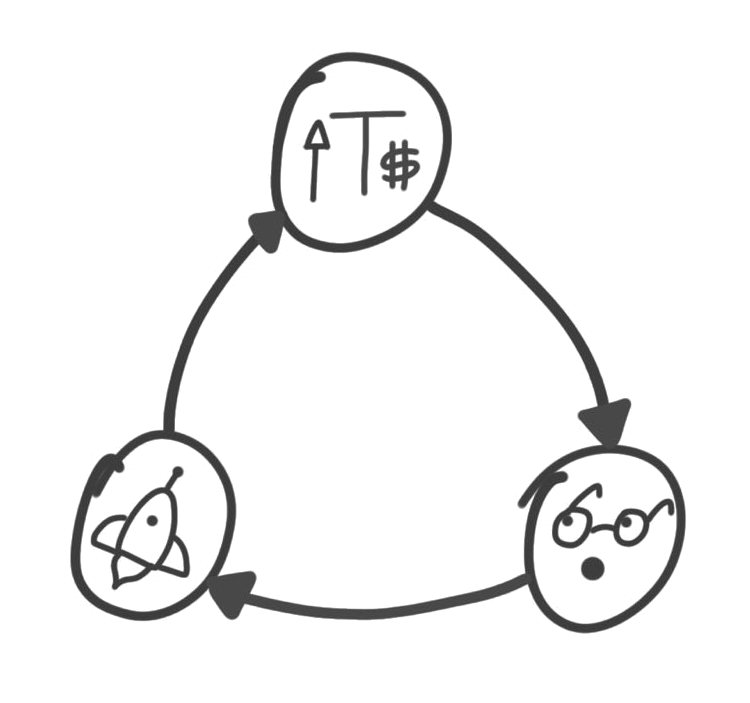
When a token appreciates in value, it draws the attention of early speculators, developers and entrepreneurs. They become stakeholders in the protocol itself and are financially invested in its success. Then some of these early adopters, perhaps financed in part by the profits of getting in at the start, build products and services around the protocol, recognizing that its success would further increase the value of their tokens. Then some of these become successful and bring in new users to the network and perhaps VCs and other kinds of investors. This further increases the value of the tokens, which draws more attention from more entrepreneurs, which leads to more applications, and so on.
There are two things I want to point out about this feedback loop. First is how much of the initial growth is driven by speculation. Because most tokens are programmed to be scarce, as interest in the protocol grows so does the price per token and thus the market cap of the network. Sometimes interest grows a lot faster than the supply of tokens and it leads to bubble-style appreciation.
With the exception of deliberately fraudulent schemes, this is a good thing. Speculation is often the engine of technological adoption [2]. Both aspects of irrational speculation — the boom and the bust — can be very beneficial to technological innovation. The boom attracts financial capital through early profits, some of which are reinvested in innovation (how many of Ethereum’s investors were re-investing their Bitcoin profits, or DAO investors their Ethereum profits?), and the bust can actually support the adoption long-term adoption of the new technology as prices depress and out-of-the-money stakeholders look to be made whole by promoting and creating value around it (just look at how many of today’s Bitcoin companies were started by early adopters after the crash of 2013).
The second aspect worth pointing out is what happens towards the end of the loop. When applications begin to emerge and show early signs of success (whether measured by increased usage or by the attention (or capital) paid by financial investors), two things happen in the market for a protocol’s token: new users are drawn to the protocol, increasing demand for tokens (since you need them to access the service — see Albert’s analogy of tickets in a fair), and existing investors hold onto their tokens anticipating future price increases, further constraining supply. The combination forces up the price (assuming sufficient scarcity in new token creation), the newly-increased market cap of the protocol attracts new entrepreneurs and new investors, and the loop repeats itself.
What’s significant about this dynamic is the effect it has on how value is distributed along the stack: the market cap of the protocol always grows faster than the combined value of the applications built on top, since the success of the application layer drives further speculation at the protocol layer. And again, increasing value at the protocol layer attracts and incentivises competition at the application layer. Together with a shared data layer, which dramatically lowers the barriers to entry, the end result is a vibrant and competitive ecosystem of applications and the bulk value distributed to a widespread pool of shareholders. This is how tokenized protocols become “fat” and its applications “thin”.
This is a big shift. The combination of shared open data with an incentive system that prevents “winner-take-all” markets changes the game at the application layer and creates an entire new category of companies with fundamentally different business models at the protocol layer. Many of the established rules about building businesses and investing in innovation don’t apply to this new model and today we probably have more questions than answers. But we’re quickly learning the ins and outs of this market through our blockchain portfolio and in typical USV fashion we’re going to share that knowledge as we go along.
[1] Also known as App Coins,as coined – pun intended – by Naval in 2014
[2] Edward Chancellor writes a thorough and entertaining history of financial speculation and its place in society (you’ll be in awe by how similar cryptocurrency speculation today is to prior bursts of financial exuberance!) and Carlota Perez describes the important role of bubbles in the development of new technologies by attracting financial capital to research and development.
.entry-content
The Importance of Bitcoin Not Being Money
By Erik Voorhees
Posted August 8, 2016
For years, many in the Bitcoin industry have eagerly defined and advocated “Bitcoin as money” to a skeptical world.
I share the blame: with certainty I argued that Bitcoin was not only money, but was the best money mankind had ever seen.
But in our haste, we misled ourselves and others. Bitcoin isn’t money after all.
Our mistake, as Bitcoin advocates, was that in our excitement over an early, popular use of one facet of the technology, we allowed that specific facet to become its defining property, the expression of which we repeated and highlighted to all who would listen. This was understandable, but premature.
Incidentally, a precedent-setting Florida case has now said as much, declaring “Bitcoin isn’t money” based both on government definitions and prudent legal restraint. The Foundation for Economic Education did a good job analyzing the context of that decision.
But a legal case doesn’t make something true or false. The reason Bitcoin isn’t money is actually more fundamental, standing regardless of that opinion.
Several years into the Bitcoin experiment, it’s time to challenge and re-examine a claim we made and took for granted.
Bitcoin =/= Money
To be sure, Bitcoin, or more specifically “bitcoins” as scarce and discernible units, can be traded easily under certain conditions, but this fact should not signal or cast the broad system – especially as broad as the Bitcoin blockchain itself – as money. Many things can be “easily traded” and we do not so quickly accept a definition of those things as money.
More specifically, here’s the problem… Bitcoin is not money in the same way and for the same reason that an internal combustion engine is not transportation. The distinction is important. The former can be used for the latter, sure, but they are not the same thing and to categorize them synonymously leads to error. One is a specific application of the other. Money is a specific application, a sub-purpose, of Bitcoin, just as transportation is a specific application, a sub-purpose, of an engine. We quickly see the inaccuracy of claiming “combustion engines are transportation.” We need to similarly recognize the inaccuracy of claiming “bitcoins are money.”
To provide clarity and justification for this distinction, let’s compare Bitcoin to something we know to be money (both legally and in popular impression): fiat paper (cash). Consider the statement, “Bitcoin is not money, but can be used as money.” This is a reasonable statement, but the same statement falls apart for cash: “cash is not money, but can be used as money.”
That doesn’t really make sense; cash is only money and it makes sense to define it only as such because no other use or application of it exists. “Cash” cannot be applied to some other use, in any meaningful sense, other than perhaps its utility in a bathroom (zing!). The thing (cash) and the application of the thing (money) are one and the same, inseparable. It is therefore reasonable to define one as the other. On the other hand, the thing (Bitcoin) and the application of the thing (money) are not one and the same. They are not only separable, but by default should be comprehended separately. It is therefore unreasonable to define one as the other.
Consider that while money is indeed one specific application of the underlying technology of paper, it would be foolish to, as a legal or practical definition, categorize all paper to be money. Besides being inaccurate, it would lead to ridiculous and impractical outcomes, such as an inventory of printer stock suddenly requiring a money transmission license to ship across state lines.
In the same way, money is indeed one specific application of another underlying technology, that of Bitcoin (or blockchains, generally). And yet it is similarly foolish, as a legal or practical definition, to categorize Bitcoin to be money, for it would lead to ridiculous and impractical outcomes, such as an inventory of Bitcoins requiring a money transmission license to ship across state lines.
To continue the parallel, “transportation” is a specific application of a combustion engine, its underlying technology in this instance. And yet it would be again foolish, as a legal or practical definition, to categorize combustion engines always as “transportation.” Installing an industrial engine in a factory might then require the permission of the Highway Safety Administration and operating it would demand a Driver’s License.
See the issue? This is the fallacy currently taking place with Bitcoin. Again, this is largely our own fault, and we ought to correct our thinking.
What, if not money?
Bitcoin, the technology, is finding an increasing quantity of applications beyond its prototypical use case. Many of these applications involve the inscription and communication of blockchain messages, which is all a “Bitcoin transaction” really is: communication.
Applications of blockchains (including Bitcoin’s) that are explicitly “non-money”:
- Demonstration of credit-worthiness/collateral
- Information anchoring and “truth proving”
- Meta-token creation (itself a nearly limitless subcategory)
- Access keys
- Voting
- Title tracking
- Identity formulation and demonstration
- Secure messaging
- Content hosting and dissemination (see LBRY)
- Video game assets (see Spells of Genesis or Beyond the Void)
- Intellectual property (see what Imogen Heap is up to or Blockai)
And only an unimaginative observer would think the applications of this technology are limited to the concepts above. Consider the early days of the internet, and how few of today’s popular applications were fathomed at its genesis.
Blockchains and the tokens built upon them should be understood as a diverse suite of specific technologies, with all manner of diverging unspecific applications built upon them.
One of those applications can be “money,” sometimes, and perhaps that use was all many people recognized in the blockchain’s early years. But – and this is why it’s important to let an innovation blossom before striving too hard to narrowly define it (or regulate it) – as Bitcoin and other blockchains have evolved, it has become clear that money is but one narrow application of many for which they excel, just as transportation became one narrow application of combustion engines.
Bitcoin and other blockchains are fundamentally communication tools between humans; a mechanism for speech. Blockchains do little but convey messages of various forms, in a highly secure, decentralized, transparent, and honest form. This is profoundly advantageous for society. Like the printing press and the internet (two other technologies which can also be used “for money,” and yet shouldn’t be defined as such), the blockchain is a human tool for speech and communication, and should be categorized as such, if categorization is required.
And as a tool for speech, blockchain communication deserves the exact same sanctity as world wide web communication, or phone communication, or written communication. If the protection of speech is not meant to encompass the forming, publishing, and conveyance of important messages between people, then what is it for, exactly?
A blockchain message is fundamentally no different than a message over the web, indeed, it is a message over the web. Knowing that a blockchain message occurred does not demonstrate that “money” happened any more than knowledge of an internet packet demonstrates that “file sharing” happened.
If specific applications of these communication tools require narrow definition, categorization, and legal treatment, then so be it, but the general inscription of a bitcoin message should not, by any reasonable person, be categorized automatically as “money” any more than the general inscription of an FTP message should be categorized as “filesharing,” though indeed both categories of activity occur on those platforms. On its own, aglance at the packets (in the case of FTP), or the transactions and blocks (in the case of BTC), establishes neither the application nor the appropriate legal treatment of that application.
Why does this matter?
This distinction is important for anyone who cares about the technology’s technical, social, and regulatory development and, specifically, the value it will bring to billions of individuals standing downstream.
When defined holistically as money, Bitcoin and other blockchains inevitably fall within a narrow, unreasonable, incorrect, and dangerously limiting legal framework. The restrictions architected around money, designed decades ago upon a wholly different system of value transmission (namely corruptible, opaque, siloed, and centrally controlled), have cut deep into the flesh of innovation, tearing at it upon every attempt at movement.
To the extent that Bitcoin as a communication platform (its rightful, most factually accurate definition) is improperly defined universally as money, all who build upon it, all who would use it, and indeed all who attempt to regulate it, will be led toward undue burden, cost, confusion and regret. This may not have been obvious in 2012, but it should be increasingly obvious now. Again, this is why many of us in the community have urged prudent regulators to “wait and see.”
Within a few short years, the branches of this technology have been reaching out swiftly in all directions. We should not cast the whole tree as but one branch.
The Long View
Peer just slightly into the future… The reputational value of a parent’s Identity Token will be leveraged as collateral for a car loan. Access to the car, once purchased, will be transferred to the owner’s daughter via a blockchain key. In the car, the daughter will play the latest Taylor Swift single, tokenized in limited quantity for her Number 1 fans, which she acquired by bartering her tokenized Candy Crush trophy earned the prior day. This single, it should be noted, is streamed to the car over a P2P network, seeded by a man in Toronto with spare bandwidth, paid in real time with Platform Tokens that he intends to use to buy pizza, once he acquires 10,000 of them.
Most, and probably all, of these activities should not by any reasonable person be construed under the same regulatory apparatus as an interbank currency transfer. If “Bitcoin is money,” they become indistinguishable.
If the narrative doesn’t change today, Harvard Law professors of tomorrow will teach a class on this folly, while the students snicker at the pigeonhole into which early 21st century observers so naively placed blockchain technology. Legal professionals: don’t let your hard work become the joke of the future. Squeezing Bitcoin into the Bank Secrecy Act of 1970 is a recipe for humiliation.
I fault myself for this mischaracterization, and must admit that I was both wrong, and myopic, in my early years of Bitcoin when I spent so much time and effort trying to classify this technology as money.
I’d encourage everyone in the community, from technologists to regulators to the actual users, to revisit their categorical assumptions, commonly made during a prototypical period, when the bright light of novelty made the delineations of this technology difficult to discern.

Erik Voorhees http://www.ShapeShift.io Erik Voorhees, CEO of leading digital asset exchange ShapeShift.io, is among the top-recognized serial Bitcoin advocates and entrepreneurs, understanding Bitcoin as one of the most important inventions ever created by humanity. Erik’s former project, the groundbreaking gaming phenomenon SatoshiDICE, was, at its peak, responsible for more than half of all Bitcoin transactions on Earth and popularized the concept of “provable fairness.” Having been a featured guest on Bloomberg, Fox Business, CNBC, BBC Radio, The Peter Schiff Show, and numerous Bitcoin and industry conferences, Erik humbly suggests that there is no such thing as a “free market” when the institution of money itself is centrally planned and controlled. This blog is about the human struggle for the separation of money and state, and about Bitcoin as the instrument by which it will happen.
You can start editing here.
Stop calling Bitcoin hacks, “Bitcoin hacks”
By Elaine Ou
Posted August 18, 2016

Occupy Mt. Gox
They’re exchange hacks, they’re wallet hacks, they’re service-provider hacks. It just so happens that bitcoin was stolen. To call these breaches “Bitcoin hacks” is like calling the SWIFT hack a “US dollar hack.” Obviously the USD did not get hacked; only the central bank does that.
Bitfinex was an unregistered Bitcoin exchange with over $150M in custody. Rumor has it they’re based in Hong Kong, owned by a parent company in the British Virgin Islands, with a management team spread all around the world. The only listed contact information is an email address and a Twitter handle.
What did you think would happen?? Go ahead, drop your life savings into a southeast-Asian bank you found on the internet and see how well that works out for you.
Securing tiny electronic files from leaking – keys – pushes the bounds of known computer science. –Jeff Garzik, Co-Founder of Bloq
The fact that Jeff Garzik has trouble keeping his keys in his pants is not a fundamental flaw of Bitcoin, or even of known computer science. The frequency and magnitude of Bitcoin losses reflect the fact that users are giving full custody of their funds to irresponsible third parties.
Bitcoin’s underlying technology is fine; the problem is that people do dumb things on top of that underlying technology. Of the fifty largest Bitcoin-related thefts, only one can be definitively attributed to the protocol*. Everything else was caused by a higher-level breach, most commonly an unauthorized server access. You know, the same thing that happened at JP Morgan Chase in 2014.
Preventing data leakage isn’t a matter of pushing the bounds of computer science, it’s a matter of responsible access control. This is a problem faced by every industry in every part of the world. A Bitcoin service provider is a financial institution, and should be held to the same level of scrutiny one might employ when selecting a financial institution.
Bitcoin rarely gets hacked. Bitcoin only fails when we expect digital bucket shops to provide the bulletproof security of a private Fort Knox.
*In 2013, an inadvertent Bitcoin hard fork temporarily enabled users to double-spend their money. Only one such attack was conducted, and the attacker later returned the money. This is the only “Bitcoin hack” on a Bitcoin service provider (that I know of).
See Also: The Wretched, Endless Cycle of Bitcoin Hacks –Bloomberg
Bitcoin is not Energy
By Beautyon
Posted August 22, 2016

A nice article has popped out of the ether like a quantum particle. We observed it, and that observation has consequences.
People who have no idea about money or the decades of work that went into creating Bitcoin have a hard time describing it. Its many parts are derived from disparate disciplines, Maths, Cryptography, Economics, Computer Science, Software, Psychology, and its rare to find someone who is an expert in all of these simultaneously. Satoshi, apparently was someone in that class of man; a gifted, deeply experienced generalist.
In order to make Bitcoin understandable, people must resort to analogy. This creates many problems and toxic side effects, one you will be familiar with, “Bitcoin is Money”. That single wrong idea has created an entire industry based around the regulation of Bitcoin “Because its Money”. Other analogies don’t have a toxic side effect, but are equally incorrect and confusion spreading. A new analogy of this type is that, “Bitcoin is Energy”.
Lets take it apart.
First to define is energy, since Bitcoin is harder to define:
In physics, energy is a property of objects which can be transferred to other objects or converted into different forms.[1] The “ability of a system to perform work” is a common description, but it is misleading because energy is not necessarily available to do work.[2] For instance, in SI units, energy is measured in joules, and one joule is defined “mechanically”, being the energy transferred to an object by the mechanical work of moving it a distance of 1 metre against a force of 1 newton.[note 1] However, there are many other definitions of energy, depending on the context, such as thermal energy, radiant energy, electromagnetic, nuclear, etc., where definitions are derived that are the most convenient.
The erroneous argument we are addressing is that money is energy since it can be used to do work via payments to people. This argument is false. Money is not a form of energy, it is an arbitrary store of value. It has no utility out of the context of exchange; in other words, if there is no one to accept your money (whatever form it takes) it has no value at all.
Energy on the other hand, exists independent of man. Heat and electricity exist on Mars, where there are no men. Electricity stored in a battery has the same Electrical Potential Energy (closest equivalent a capacitor is a better fit) no matter where it is used or not used. It is a fact of nature that does not depend on you or how you use it.
Thinking about money as “Economic Energy” is an exceptionally poor analogy. Prices are not the same as volts or ergs. Kenyan shillings and all fiat currency in this analogy would mean that energy (the fictitious “Economic Energy”) could be created out of nothing. No physicist thinks that is possible. This is the Law of Conservation of Energy, the first law of thermodynamics,which says: “Energy cannot be created or destroyed, merely transformed.”
A $100 bill does not “have energy”; it is debt, created by the Federal Reserve. In the context of the US economy, people are forced by Legal Tender Laws to accept pieces of paper in exchange for goods; it is a medium of exchange, not “Economic Energy”. Its easy to get confused by the language of economics. When we say that inflation reduces the “spending power” of your savings, someone from outside the discipline of economics could conflate the word “power” from its use in physics (the rate of doing work) and then build an idea around this fundamental mistake.
Similarly, proof-of-work (PoW) has nothing to do with “work” in the physics sense:
In physics, a force is said to do work if, when acting there is a displacement of the point of application in the direction of the force. For example, when a ball is held above the ground and then dropped, the work done on the ball as it falls is equal to the weight of the ball (a force) multiplied by the distance to the ground (a displacement).
The term work was introduced in 1826 by the French mathematician Gaspard-Gustave Coriolis[1][2] as “weight lifted through a height”, which is based on the use of early steam engines to lift buckets of water out of flooded ore mines. The SI unit of work is the joule (J).
In the Bitcoin context, “Proof of Work” means mathematical proof that you have performed calculations and solved a problem. Since this is done in a modern computer, nothing moves to do this task, save electrons. The only way this analogy would make even a slight amount of sense, if if Proof of Work calculations were performed on a Babbage Difference Engine:
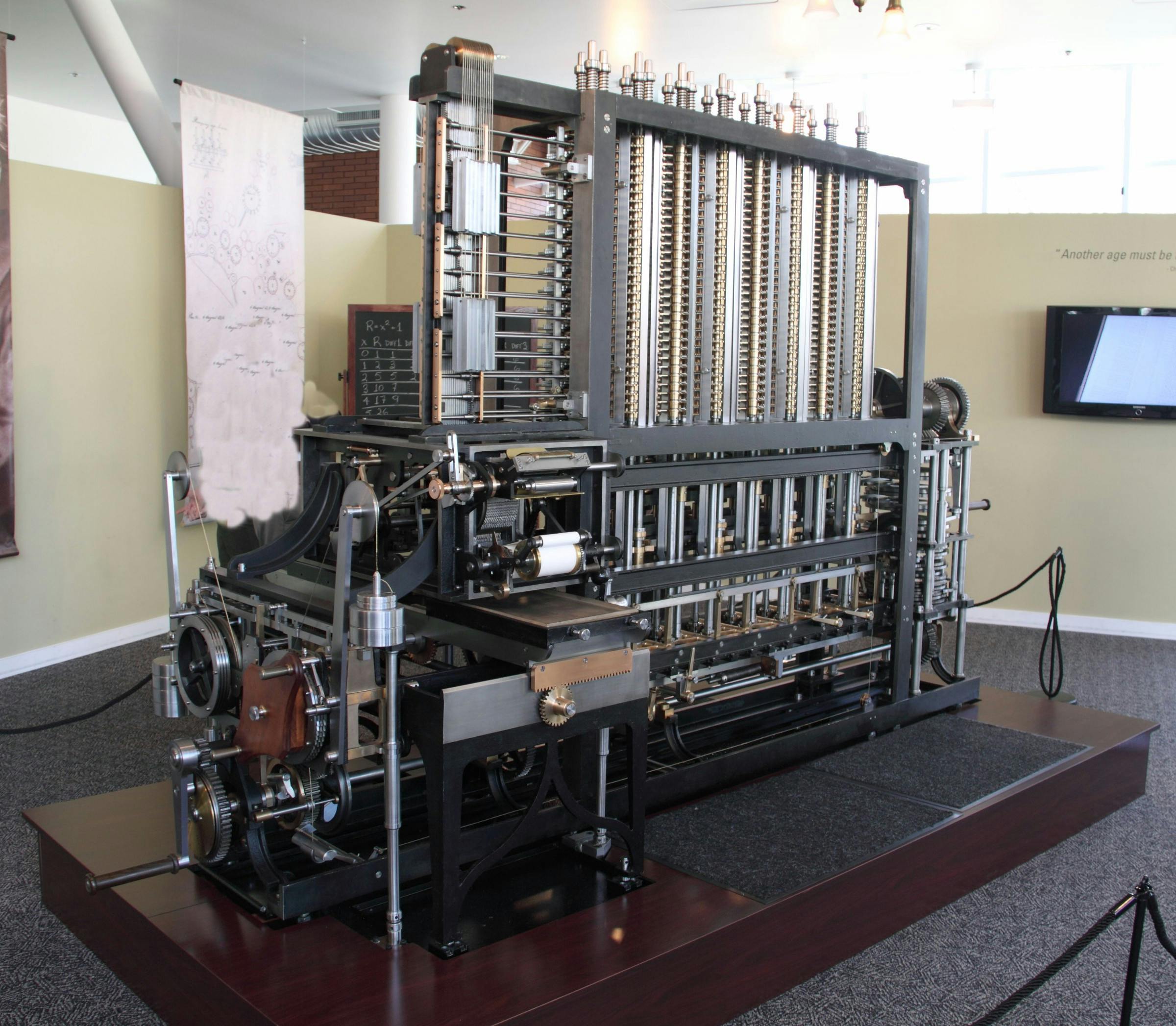
This machine was powered by cranking a handle. Que “Bitcoin is Indentured Servitude” arguments!
Value or spending power is not energy. When dollars are created, energy is not taken from pre-existing holders of dollars; the value of those dollars is diminished. The correct definition for this is inflation.
The writer claims that “Energy” is transformed from old coins to new coins in Proof of Stake systems, and that energy “flows” from old coins to new coins. This idea is very broken. The notion here is that by creating new coins, “Economic Energy” can flow between holders of the coins, even without a transaction. Its an odd analogy, that stretches beyond stretching.
Bitcoin does not consume electrical energy. The hardware that performs the calculations consumes electricity; Bitcoin is data, consumes nothing and is inert. It is also a safe bet (not that it matters one iota) that no one in Bitcoin thinks that the electricity used to manage Bitcoin is “transformed into economic energy”, or that pre existing coins “lose energy” or contain it or transfer it. They have to pay the bills for their electricity, and have no illusions about it.
There is no need to come up with a very bad analogy to describe what happens when the fiat dollar is used as money. People who store their wealth in dollars have the value of that money stolen from them. People who use Bitcoin and precious metals cannot have their stored value stolen from them. Note how I do not use the phrase “spending power” here. If I did, someone would no doubt chime in with, “but but but you yourself use the phrase spending pooowwer!”.
Bitcoin miners have not found a way to convert electrical energy into economic energy. First of all, they have found nothing. They have joined the Bitcoin train using tools that have been gifted to them after decades of research. They are performing calculations in the same way that computational drug design participants of Folding at Home users do; and those people are not, “converting electrical energy into medical advances”, though that analogy feels like it makes more sense than “Money is Energy”.
People with sense will store their money as anything other than fiat because they do not want to have their money stolen from them. It is as simple as that, and does not need an explanation more complicated than that.
Understanding Bitcoin is hard. Like many modern innovations, it sometimes helps to work from an overview of a device or service’s capabilities, and leave everything else about it to “Black Box” thinking. No one thinks about how SSL works; all of its complexity is reduced to a green padlock. When you see that padlock, you are secure. In Bitcoin, it will be the same thing eventually; “when you see that number, that is the Bitcoin you can spend”.
This thinking not only has the advantage of removing the need to describe Bitcoin to anyone, it also has a side effect of killing any service that does not allow you to spend your Bitcoin as you choose, when you choose. It creates the distinction between Real Bitcoin and Fake Bitcoin. Real Bitcoin is Bitcoin in your full control. Fake Bitcoin is a number displayed on a service where you need permission to spend it, and your balance is a arbitrary text displayed on a screen.
Finally, it appears that we are well past the “Bitcoin Denial” stage. No one that is serious claims that Bitcoin doesn’t work, or that it is a scam. In fact, some people are looking at its unbroken multi year record of flawless performance as a historic and highly significant technical achievement. They do this and claim that you can have Blockchian without Bitcoin in the same breath but we all know about that problem.
Spicy potato filled pastry turnovers topped with crispy vermicelli, yoghurt, coriander. Tamarind chutneys’ and chickpeas↴

Time and money
By Oleg Andreev
Posted August 22, 2016
Time is not easily measured in money. It’s rather money that can be measured in time.
Time is not fungible, money is. Yesterday’s missed opportunity not necessarily comes back today, even if you have all day. Everyone has their own money, but timeline is shared by all of us.
You can buy some time with money, but that will be different time, not the one you want to get back. Good thing, though, you can buy money with time and that will be the same money.
Turns out, it’s more accurate to say “money is time”, not “time is money”. Because making money always takes time, while some time cannot be bought back with any amount of money.