
July 2016 Journal
WORDS is a monthly journal of Bitcoin commentary. This issue collects the July 2016 writing in the WORDS archive. For the uninitiated, getting up to speed on Bitcoin can seem daunting. Content is scattered across the internet, in some cases behind paywalls, and content has been lost forever. That’s why we made this journal, to preserve and further the understanding of Bitcoin.
Bitcoin Analogies
By Beautyon
Posted July 4, 2016

People use analogies to try and describe how new tools and complex systems work. Email was sold to many as “electronic letters” and Skype as “internet telephone”, even though both of those software systems have nothing to do with paper letters and how they were written, posted, paid for, sorted and delivered (in the email case) and how telephone calls were made in the case of Skype.
Now we have a new tool, Bitcoin, which men are having a hard time categorising so that it can be understood by consumers who know nothing about software and the true nature of money. This has led to many perception problems, as each person brings their own ideas to Bitcoin. Entrepreneurs have the biggest problem of all, because they are trying to sell a service with the software, so their need to find a good analogy that fits has many consequences for adoption of their product.
As you may know, Bitcoin has characteristics that currently make it suitable for a class of transactions. Note how I do not say that Bitcoin has limitations; the people who say that are trying to use Bitcoin inside a mental model that creates analogies like, “Bitcoin is digital cash”. Which it can be…but I’ve written about that before.
The analogy in question goes like this:
“Bitcoin with one meg blocks is like a highway with one lane”
That analogy is completely wrong, because it assumes that Bitcoin is like a car on a motorway (what Americans call a “highway”) when it is more like a train on rails.

British Rail High Speed Train near Chesterfield
Trains travel on fixed rails, have set ticket prices, carriages with a fixed number of seats, and fixed schedules. Lets think about this.
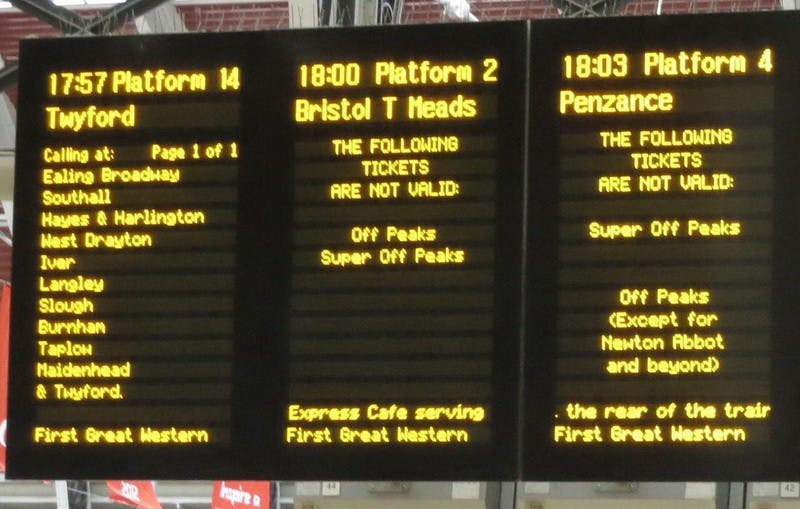
Train departure display at Paddington Station, London. Trains to Twyford, Bristol Temple Meads, and Penzance. Platforms 14, 2 and 4.
You know when the train (The Blocks with a fixed size) is leaving, you know when (The Schedule) it will arrive with your goods (your transaction) or with you the passenger.

A “Single Day Return” British Rail ticket, Bognor Regis to Norbiton (not London), Printed 09:19, 2nd November 2005 Price £19.50, valid on one day only, Ticket Number 13303.
You know how much it costs to ride, either in first class or standard fare (The Fee).
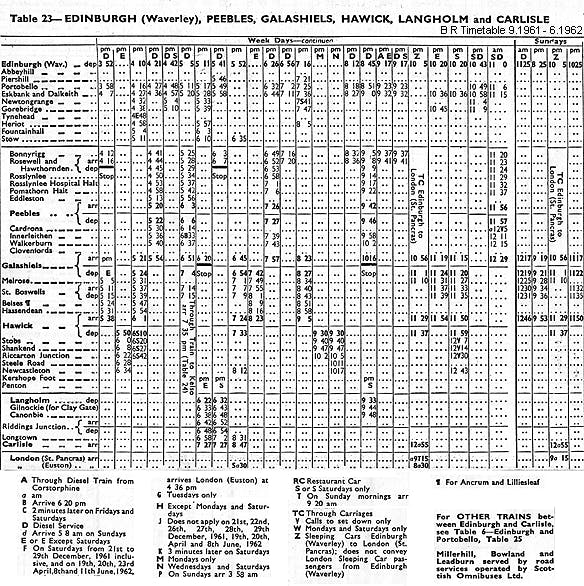
Time table 23, circa 1962. Edinburg (Waverley), Peebles, Galashiels, Haywick, Langholm and Carlisle, showing all times, carriages and stops.
You know the best time to catch a train in advance (The Congestion), because the schedule is published (The Blockchain), and you can rely on the people who run the service that it will perform exactly as specified (The Miners). And the internet is The Rails.
Trains are a much better analogy for Bitcoin. Bitcoin takes a set amount of time (more or less, depending if you are in rush hour) to process a transaction. There is a fixed set of rails it runs on, and a set of more or less fixed prices to ride.

British Rail Inter City 125 interior, circa 1980.
The number of carriages with a set number of seats is also fixed, and that is the block size.
No one expects extra capacity to be laid on in a train system (sufferers of British Rail on the Paddington to Cornwall route know what that is like) they understand that the British Rail networks is a system with a fixed capacity, and that if they want a seat, they need to book one in advance or pay to travel First Class. Lets take, by analogy, the idea of increasing the British Rail network’s capacity on this notorious Paddington to Cornwall line. No one who is serious talks flippantly or casually about “increasing the train length”.
Anyone familiar with how train systems work knows that increasing the train length to increase passenger capacity has serious repercussions and side effects and is not a simple and easy fix. First of all the platforms on the British Rail network are all of a set length, and passengers getting on and off of a train cannot be accommodated without increasing the platform length along the entire system. The Euro Star system, being designed all at once for a target capacity, has platforms that are suitable for its coaches. The British Rail system on the other hand is very old, and is a rickety patchwork of ancient short stations and old rails. Many times when you are on an InterCity 125 train, the manager will say, “If you are leaving us at Castle Cary, please note that you will only be able to leave the train from coaches three, four and five as the platform is short”. This is exactly like saying, “If you want your Bitcoin transaction to clear quickly, you need to use a slightly higher fee”.
Increasing the block size alone will not produce a Bitcoin that can handle more transactions per second without side effects, and once again, the need for this increase is not universal; it is only people who see Bitcoin as a rival to PayPal who characterise this capacity feature as a problem.
Unlike the real world consumer railways, Bitcoin is software you can set up yourself. You can have your own Bitcoin network, like a model railway set

Insert insult here.
and design it to do whatever you like. You can build a massive, accurate miniature rail network, that has no empty rails on it and nothing but trains, or a network with only an engine on it, with miles of track. Its your personal world, where you can do whatever you like.
In the real world however, Bitcoin does not conform to any single person’s idea of what its true purpose is. It has some specific characteristics that make it unique, mainly that it is decentralized and safe from the control of the State. This single feature is, to many, its greatest attribute. It is trivial to set up a MySQL database money simulation that can out perform PayPal. It is not so easy to design and run Bitcoin, which is a hard problem that took the finest software minds decades to solve.
Whatever anyone thinks of Bitcoin, they are free to use it or to decline to use it. What they cannot do is superimpose their ideas by force on everyone else who uses the network in its correct function. There is no argument that anyone will accept to cause them to abandon Bitcoin’s central proposition, and as I said before, if you want a PayPal 2.0, you have MySQL to power it and you don’t need Bitcoin.
Lentil soup, fresh bread, fresh unsalted butter.↴

Block Size Political Economy Follow-Up 1: Software Choice, Market Differentiation, and Term Selection
By Konrad Graf
Posted July 8, 2016
POST HEADER
POST BODY
An interview with me on the Bitcoin block size limit appeared on 4 May 2016 on Bitcoin.com. Below, I develop additional clarifications and examples partly inspired by a range of comments and reactions to it. This is meant to build on and develop ideas in the original interview. For ease of reference, here is a PDF version of that interview.
This is a three-part series. Part 1 below covers a range of issues including the need to differentiate the market that was discussed in the interview from other distinct markets and non-market choice phenomena such as free software selection. It also begins to discuss the use of the term market intervention in this context. Part 2 will then continue by arguing that neither the voluntary nature of cryptocurrency participation nor the subjective nature of user preferences nor any alleged motivations on the part of the various actors involved alters my analysis. Finally, Part 3 will focus on economic distinctions between the 21-million bitcoin production schedule and the block size limit, arguing that these are different in kind and thus poor objects for analogy.
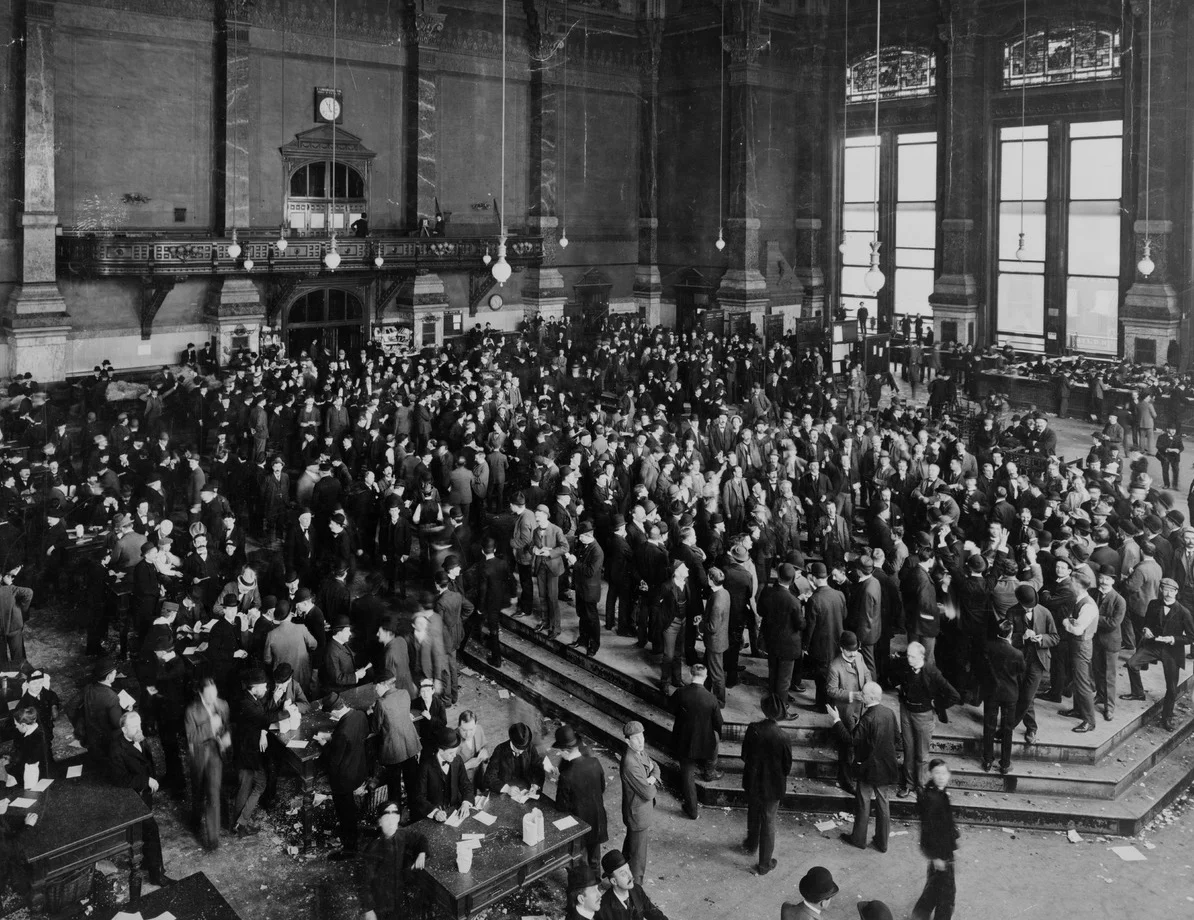
Chicago Board of Trade: People buying and selling form a market. Prices are key artifacts that market processes leave behind.
Two markets and a non-market choice sphere
One idea that showed up in comments was that I had expressed some view as to which Bitcoin software one ought to run. However, I did not address this at all. I have only published one previous preliminary article on the block size limit, on 20 June 2015, and this also did not mention implementation choice. Various views on this topic do not alter my analysis of the topics that I did address.
A related idea is that the current dominant software implementation already reflects “the choice of the market.” Therefore, any discussion of differences between a cryptocurrency having or not having a given block size limit is moot: the “market” has already spoken and this is evident in implementation share statistics.
It should be cautioned, however, that software choice reflects many considerations. Interpreting it as a proxy for a single issue is imprecise. Such choices may well reflect a generalized confidence in perceived quality and reliability. A user could therefore make a particular software choice either: 1) becauseof one specific code issue, 2) despite that same particular issue, or 3) regardless of it.
Such imprecision and ambiguity are among the reasons I did not discuss this matter at all. A more fundamental reason, however, is that it has no bearing on my analysis. Whether some percentage of a given population prefers Pepsi or Earl Grey tea does not alter the composition of the respective beverages in the slightest way, nor their respective effects on metabolism. Such things can be studied and assessed independently of the current statistical shape of user preferences.
In addition, choice of which free software to run does not really constitute a market, except in a metaphorical sense. Developers offer software products and users select and run such products. In a free software context, nothing is bought or sold between these groups. No price signals exist directly between users and developers.
In contrast, the central topic I addressed—the market for the inclusion of transactions on the Bitcoin blockchain—is indeed a market, one that involves quite different roles and actions than producing or running one version or another of free software. This is**a market in which bidders send transactions, which takers (miners) either include or not in each respective candidate block. This market involves specific senders of specific transactions (not senders in general of transactions in general). At the other end, specific miners build each of their respective candidate blocks. In deciding whether to include any, all, or some transactions, fee/byte (bid) is salient. Node operators act as key intermediaries, like referring brokers, currently uncompensated. On-chain and off-chain transacting options, both existing and potential, coexist in this context in a complex blend of competition and synergy.
There are therefore at least several phenomena to differentiate. First, the buying and selling of bitcoin forms textbook markets on the order of commodities and forex markets. Those effectively controlling given bitcoin units can sell such control in exchange for some other money unit, product, or service, or give them away as gifts. Second, bidding for on-chain transaction inclusion and miner decisions to include or not include transactions in candidate blocks forms a distinct open-bid market for on-chain inclusion priority. Third, developers offering free software and users making decisions on which implementations to run for their various purposes does not constitute a market in the sense of a complex of buying and selling behavior.
Whatever one may choose to call these three phenomena, each is meaningfully distinct from the other, describing different sets of actions and roles. To claim that “the market has spoken” in the context of software choice is therefore far less informative that it might at first appear to be. Making such a claim requires specifying what exactly has allegedly spoken (it isn’t a market) and the content of this purportedly speaking thing’s alleged message (ambiguously mixed with considerations such as general perception of code reliability).
The term “market intervention”
Several commenters took issue with my use of the term market intervention in this context. It is true that market intervention has a negative connotation for many readers, though not all. Indeed, a great many persons eagerly advocate some form of governmental intervention in economic affairs as part of their ordinary political opinions. Still, one interpretation would be that I had set out to create negative connotations and thus arrived at my word choice using rhetorical criteria.
A different interpretation would be that I set out to select the most accurate available technical term to describe the phenomenon under consideration. I then specified what I meant in using this term and excluded certain inapplicable historical and institutional associations. This is my own first-hand interpretation of what I did in selecting this language. That it still has negative connotations for some may be natural in that what it describes has negative effects. However, word choice one way or another does not alter such effects.
Another related but more substantive criticism that appeared in several variants argues that a block size limit is just a qualitative characteristic of a cryptocurrency as a good. A given limit is baked into what the good is. As such, it cannot be construed using the model of economic intervention. If a characteristic is already in the product, how could it possibly be construed as intervention (from outside)?
However, I had already stressed in the interview how novel and unprecedented this situation is. My argument was that even though the legal and practical contexts of traditional interventionism conducted by state agencies are completely different, nevertheless, the economic effects are on this transaction-inclusion market as a government enforced industrywide output ceiling would be. This will be addressed further in Part 2.
A commenter suggested that I was arguing from history that the current block size limit was not part of “consensus.” Consensus, in this debate, often seems to transcend a mere computer science fact to also encompass an allusion to a hard Bitcoin Realpolitik. Any other considerations, such as the documented history of the block size limit, are irrelevant to this current reality.
However, I did not reference or use any concept of consensus at all. Nor did I question the reality of any given state of consensus on the network at any given time. What I did was analyze differences between possible states of code and then describe economic and social implications of such differences.
A loosely related idea was that my analysis was tantamount to advocating that cryptocurrencies should not maintain any limits or standards. If calling into question one sort of limit, such as the current Bitcoin block size limit, why not just question all limits? Why not just also advocate raising the maximum coin count? That, after all, is also a “limit,” so why not call keeping that in place an “intervention” too? This will be addressed in greater detail in Part 3.
The interview itself concerned one such limit and not any others. Why? I could have branched off to discuss the sociology of decision-making or described a software preference. But I did no such things. I could have discussed any other protocol characteristic or issue. Why did I discuss only this one? The answer is that I think thislimit has unique economic**features that are both important and poorly understood. Explaining this was therefore the focus.
Continues with Part 2.
POST FOOTER
/post
/content-wrapper
Block Size Political Economy Follow-Up 2: Market Intervention through Voluntary Community Rules
By Konrad S. Graf
Posted July 9, 2016
POST HEADER
POST BODY
Continues from Part 1.
If a given block size limit is part of a given cryptocurrency at a given time, can economists legitimately say anything with regard to such a limit? Must this topic be left alone as a mere qualitative characteristic of a product that users have freely selected?
From one perspective, if user preferences are subjective matters of taste and opinion, nothing can be said other than that Ravi prefers this, Setsuko prefers that, and Heinrich prefers some other thing. If various users prefer a cryptocurrency with one block size limit or another, economists must remain silent and leave users to their purely subjective preferences, only taking note in abstract and neutral terms of the shape of these preferences. Personal preferences are “ultimate givens,” their specific content irreducible “black box” starting points for economists.
This appears to be a sounder critique. Block size limits are indeed characteristics of specific cryptocurrencies as products. Users may well differ in their subjective preferences on such matters for reasons not even fully understandable. Users differ in their values. Motivations can even include various grades of membership signaling. An economist speaking on such things, this criticism goes, merely “smuggles in” his own particular personal preferences or party affiliation “dressed up as” objective analysis.
Can any role for economic analysis here be rescued from this critique? It may help to take a step back and consider some other scenarios to gain perspective and then return to apply that perspective to the case under consideration.
First, consider two hypothetical cryptocurrencies, one with a block size limit that directly influences the ordinary structure of supply and demand in its transaction-inclusion market, and another that does not (this can equally be the same cryptocurrency, such as Bitcoin, at two different phases in its history). The first cryptocurrency’s code alters the operation of the market between transaction senders and miners, limiting the total quantity of services that can be supplied per time period. Certain economic and industry-structure effects follow. These effects apply to a coin with this characteristic, but not to one without it. What are those differences? Those differences were the central theme of the interview to which this series follows.
Yet subjective individual preferences do not alter the distinctions analyzed. Thus, even though the content of the preferences themselves may be a black box for economists, the two differing transaction-inclusion markets still have objectively describable economic distinctions independent of any such preferences. Dropping a stone from the Tower of Pisa is a choice, one with all manner of possible motivations, but the resulting acceleration of gravity is not altered by any personal opinion as to the nature and effects of such gravity.
Three intentional communities and their altcoins

Next, consider several hypothetical intentional communities. It is possible to establish and run such communities under various rule sets. Although intentional communities have often been to some degree communistic (“commune”), it is possible to set up other idealistic havens, perhaps some real-life attempt at an Ayn-Rand-style Galt’s Gulch or a Neal-Stephenson-style Thousander retreat. Participation is governed by a kind of “social contract,” but in this context the contract is more likely to be one that actually exists, including specified conditions to which participants have assented by joining and staying, possibly even signing a written agreement with terms of residence.
Let us assume that in all cases, no matter what the other internal rules and cultures, participants are not forced to either join or stay. This freedom of entry and exit corresponds to cryptocurrency participation choices.
Now consider three such voluntary intentional communities. Bernieland features a $20 minimum wage. MagicCorner bans “wage relations” altogether. Finally, Murrayville has no numerical restrictions on wage agreements. Even though all three are voluntary communities, only Bernieland and MagicCorner include labor rules that restrict wage rates. The voluntarily agreed community rules specify certain wage-market restrictions. These types of restrictions are traditionally analyzed under the rubric of market intervention by state agencies, which are often subsumed under the term “government.” Whether one wants to also call a complex around intentional community rules and enforcement measures a type of “government” or not is beside the point. There may be valid reasons for either using or not using that word, provided suitable definitions and qualifications are set out.
In this case, it is analytically valuable to be able to note how Murrayville is free of rules that specify restrictions on the existence or range of wages in its labor market. Murrayville might therefore be described within this context as having a labor market free of intervention—unlike Bernieland and MagicCorner. Considering this difference alone, one would expect Murrayville to therefore have the best functioning labor market of the three, with more ample employment opportunities for those aiming to work on a wage basis.
The fact that all participants in all three communities voluntarily join and agree to the respective terms of each does not alter the economic distinctions between their differing labor market rules. Even though all three communities are voluntary, it remains that only one has a minimum wage, another bans wages, and a third does neither.
Arguing that the term “intervention” can only apply to state agency actions does not aid in the economic analysis of wage rate restrictions within these voluntary intentional communities. One might try to suggest a better term to use here instead of intervention. However, since the effects of wage restrictions have already been analyzed under the rubric of state-made laws described as “interventions,” using established terms—with suitable qualifications, as was done—easily accesses the appropriate implications.
Now in an effort to compete for residents, each community launches its own altcoin. Berniecoin does not allow any transaction with a fee above 1.5 Bernielashes/byte to be mined. This seeks to create a price ceiling for transaction inclusion. No one can pay more within the protocol. No one can use greater wealth to supersede other transaction senders. MCcoin’s protocol includes no way for transaction fees to be included at all; no one can bid for priority by including a fee. Finally, Murraycoin does neither. Transactions with any fee, or none, can be sent, and each miner is free to include or exclude any of these. Each node is likewise free to either relay any of them or not, or to try to figure out some ways to monetize such services.
Once again, based on this alone, Berniecoin and MCcoin demonstrate forms of what has heretofore been best characterized as “market intervention” within their respective communities. In this case, their protocols specify this directly. Murraycoin alone is free of any such effective intervention in its transaction-inclusion market. The others have policies that place a ceiling on the payment of transaction fees. The voluntary nature of participation in all three does not alter this distinction. One cryptocurrency has a maximum transaction fee, another bans fees, and the third does neither. These respective encoded policies are indeed part of what users implicitly choose when they use one rather than another. Nevertheless, distinct economic and social implications follow from those differences, and do so apart from any beliefs or wishes as to the nature of such implications.
This price-ceiling example demonstrates the general applicability of market intervention analysis within the context of voluntary arrangements. With the issue of a block size limit that restricts normal transaction volume, the relevant concept is not a price ceiling, but an output ceiling.
How to have a cartel without forming one
A subtler misconstrual of my interview assumes that I argued that since a particular situation or dynamic exists, someone must have acted to bring it about. However, I made no mention of any specific persons or groups, nor did I attribute any intentionality or motive. If there is thunder, it does not necessarily follow that Thor must have hammered it out.
Instead, I identified a market. I noted an effective limit to industrywide service provision as actual market volume begins to interact with a limit long in place, but formerly inert for this purpose. I described some of the general effects of any such limit to the extent it actually begins to limit ordinary volume. I argued that these effects are negative, but also easy for observers and participants of all kinds to miss or underestimate because they entail hidden costs and distort industry structure evolution from paths it could have taken instead, but did not, thus rendering those possibly better alternative paths “not seen” in Bastiat’s sense.
Certain economic effects follow from output ceilings and these have commonly been analyzed in terms of cartel situations. Yet this implies no necessary argument that anyone has set out to form a cartel or to create any of these situations or dynamics. That would be a completely different argument, more journalistic in nature and evidence requirements.
Being encoded in a protocol is a new way for an output ceiling to exist. Normally—but not in this case—any given industry actor, either current player or potential entrant, could just violate such a ceiling unless facing some overt or threatened form of legal or quasi-legal enforcement. Consider post-war Japanese steel production. An industrywide output ceiling was maintained for many years to limit competition. The Ministry of International Trade and Industry “recommended” this as a “voluntary” measure for domestic steelmakers. Of course, when some rebels sought to exceed the limit, MITI simply refused to approve their requests for increased purchases of more iron ore and fuel, which it also oversaw. Only through MITI could such a limit be maintained.
This type of limit sets up an upside-down and sub-zero-sum dynamic in an industry. There are concentrated gains for the inefficient (who should otherwise probably quit and sell off assets), somewhat less concentrated losses for the more efficient (who are unable to expand as much), hidden losses for would-be entrants (who are never seen because they avoid entering a market with an arbitrary ceiling), and dispersed and nearly invisible losses for many anonymous end users (who mostly have little clue about any of this and how it is happening at their own expense). Once again, though, all this can be so regardless of anyone’s knowledge or intentions.
To say with regard to the block size limit that there exists an industry situation with effects like those of an enforced cartel does not necessarily also imply that 1) some people set out to create it, or that 2) all or even any such people actually benefit from it on balance, or that 3) any of them fully understands it. Each actor has his own intentionality and working models of causality, but all of this combines into social outcomes that result, but were not necessarily planned from the outset to take the forms taken. Describing such unplanned social effects, Adam Ferguson wrote in 1767 that, “nations stumble upon establishments, which are indeed the result of human action, but not the execution of any human design.”
That said, noting the social science concept of spontaneous emergence as one factor to consider does not also constitute a claim that certain effects have notbeen planned or that they do not actually produce special interest benefits for some at the expense of others. It only points out that any such intentions and plans as may or may not exist are not directly relevant to the comparative analysis of rule effects. The topics are distinct.
Continues with Part 3.
POST FOOTER
/post
/content-wrapper
The Bitcoin Halving and Monetary Competition
By saifedean
Posted July 9, 2016
.entry-header
Today witnesses the second “halving” event in Bitcoin’s history, during which the growth rate in the supply of bitcoin will drop by half, from an annualized rate around 8% to 4%. These halvings occur roughly once every four years, and ensure the supply of bitcoin continues to grow at an ever-decreasing rate. Three quarters of all the bitcoins that will ever exist will have come into existence by today. The other quarter will be produced over the coming century or so.
For the first four years of its existence, the bitcoin supply grew at 50 coins every 10 minutes (roughly), or around 2.6 million coins per year. On 28 November 2012, after 210,000 blocks were mined, the supply growth rate dropped by half, to around a 1.3 million new coins per year. As the stock of existing coins increases and the new supply decreases, the supply growth rate declines, reaching zero after 120 years or so, when the total supply will stabilize at exactly 21 million coins, the maximum number of bitcoins that will ever be produced.
This often-overlooked feature of Bitcoin is one of the most important drivers of bitcoin’s success, and reflects a deep understanding of monetary economics and the history of money by Bitcoin’s creator. Had bitcoin generation not been capped, the high inflation rate would likely cause the value of bitcoins to languish and drop, which would reduce the rewards for miners who secure the network, and make the currency no more than a quirky internet experiment among cryptography enthusiasts.
To understand the significance of the dropping supply rate, a familiarity with monetary theory and history is important. Money is defined as a medium of exchange; in essence, it is any good which is acquired not for the sake of consuming it or owning it but for the sake of exchanging it for another good. There is nothing in principle that stipulates what should or should not be used as money. Any person choosing to purchase something with the aim of exchanging it for something else is making it de facto money, and as people vary, so do their opinions and choices on what constitutes money. Throughout human history, many things have served the function of money: gold and silver, most notably, but also government-issued paper, copper, precious stones, salt, seashells, and even alcohol and cigarettes. People’s choices are subjective, and so there is no “right” and “wrong” choice of money. There are, however, consequences to each choice.
Human beings are differentiated from other animals (and certain economists) by our superior ability to think of and provide for our future needs, i.e. by having a lower time preference. Humans do not always want to consume everything they produce immediately. We have the foresight to store value we produce for the future, so we can consume it when we are unable or unwilling to produce. The fundamental concern of a person choosing a medium of exchange is that they would like their money to hold its value over time, in other words, they would like their money to be a good store of value.
This makes perishable goods a particularly bad choice for a medium of exchange, as they are likely to perish before the owner can exchange them for something else, which explains why nobody in their right mind would use apples as their medium of exchange. But even among non-perishable goods, market prices fluctuate over time, and so it is not a trivial consideration to pick the right money to maintain its value over time. The choice is quite complicated because a person’s choice of money itself, paradoxically, sows the seeds of turning it into bad money: choosing something as money raises its market value, incentivizing its producers to make more of it, which will generally bring its price crashing down.
To understand why, we need to differentiate between a good’s market demand (demand for consuming or holding the good for its own sake) and its monetary demand (demand for a good as a medium of exchange and store of value). Any time a person chooses a good as a store of value, they are effectively increasing the demand for it beyond the regular market demand for it, which will cause its price to rise. For example: Market demand for copper in its various industrial uses is around 20 million tons per year, at a price of around $5,000 per ton, and a total market valued around $100 billion. Imagine a billionaire deciding they would like to store $10 billion of their wealth in copper. As his bankers run around trying to buy 10% of annual global copper production, they would inevitably cause the price of copper to increase. Initially, this sounds like a vindication of the billionaire’s monetary strategy: the asset he decided to buy has already appreciated before he even completed his purchase. Surely, he reasons, this appreciation will cause more people to buy more copper as a store of value, bringing the price up even more.
But even if more people join him in monetizing copper, our billionaire is in trouble. The rising price makes copper a lucrative business for workers and capital across the world. The quantity of copper under the earth is beyond our ability to even measure, let alone extract, so practically speaking, the only binding restraint on how much copper can be produced is how much labor and capital is dedicated to the job. More copper can always be made with a higher price, and the price and quantity will continue to rise until they satisfy the monetary investors’ demand, let’s assume that happens at 10 million extra tons and $10,000 per ton. But at that point, monetary demand subsides, and some holders of copper will want to offload some of their stockpiles to purchase other goods, since, after all, that was the point of buying copper.
After the monetary demand subsides, all else being equal, the copper market would go back to its original supply and demand conditions, with 20,000,000 annual tons selling for $5,000 each. But as the holders begin to sell their accumulated stocks of copper, the price will drop significantly below that. The billionaire will have lost money in this process, as he was driving the price up, he bought most of his stock for more than $5,000 a ton, but now his entire stock is valued below $5,000 a ton. The others who joined him later bought at even higher prices, and will have lost more money.
This model is applicable for all consumable commodities such as copper, zinc, nickel, brass, or oil, which are primarily consumed and destroyed, not stockpiled. Global stockpiles of these commodities at any moment in time are around the same order of magnitude as new annual production. New supply is constantly being generated to be consumed. Should a saver decide to store their wealth in one of these commodities, their wealth will only buy a fraction of global supply before bidding the price up enough to absorb all his investment, since he is competing with all the consumers of this commodity who use it productively in industry. As the revenue to the producers of the good increases, they can then invest in increasing their production, bringing the price crashing down again, and robbing the saver of his wealth. The net effect of this entire episode is the transfer of the wealth of the misguided saver to the producers of the commodity he purchased.
What I just described is the anatomy of a market bubble: increased demand causes a sharp rise in prices, which drives further demand, raising prices further, incentivizing increased production and increased supply which inevitably brings prices down punishing everyone who bought at a price higher than the usual market price. Investors in the bubble are fleeced, while producers of the asset benefit immensely. For copper and almost every other commodity in the world, this dynamic has held true for most of recorded history, consistently punishing those who choose these commodities as money by devaluing their wealth and impoverishing them in the long run, and returning the commodity to its natural role as a market good, and not a medium of exchange.
For anything to function as a good store of value, it has to beat this bubble trap: it has to appreciate when people demand it as a store of value, but its producers have to be constrained from inflating the supply significantly to bring the price down. Such an asset will reward anybody who chooses it as their store of value, increasing their wealth in the long run as it becomes the prime store of value because those who chose other commodities will either reverse course by copying the choice of their more successful peers, or they will simply lose their wealth.
There has only been one example of such a commodity throughout history: gold, which maintains its monetary role due to two unique physical characteristics that differentiate it from other commodities: Firstly, gold is so chemically stable that it is virtually impossible to destroy, and secondly, gold is impossible to synthesize from other materials (alchemists’ claims notwithstanding), and can only be extracted from its unrefined ore which is extremely rare in our planet.
The chemical stability of gold implies that virtually all of the gold ever mined by humans is still more or less owned by people around the world. Humanity has been accumulating an ever-growing hoard of gold in jewelry, coins, and bars that is never consumed and never rusts or disintegrates. The impossibility of synthesizing gold from other chemicals means that the only way to increase the supply of gold is by mining gold from the earth, an expensive, toxic, and uncertain process in which humans have been engaged for thousands of years, with ever-diminishing returns. This all means that the existing stockpile of gold held by people around the world is the product of thousands of years of gold production, and is orders of magnitude larger than new annual production. Over the past seven decades with relatively reliable statistics, this growth rate has always been around 1.5%, never exceeding 2%.
####### Source: US Geological Survey.
It is this consistently low rate of supply of gold that is the fundamental reason it has maintained its monetary role throughout human history, a role which it continues to hold today, as central banks continue to hold significant supplies of gold to protect their paper currencies. Official central bank reserves are at around 33,000 tons, or a sixth of total above ground gold.
####### Source: World Gold Council
To understand the difference between gold and any consumable commodity, imagine the effect of a large increase in store of value demand that causes the price to spike and annual production to double. For any consumable commodity, this doubling of output will dwarf any existing stockpiles, bringing the price crashing down and hurting the holders. For gold, a price spark that causes a doubling of annual production will be insignificant, increasing stockpiles by 3% rather than 1.5%. If the new increased pace of production is maintained, the stockpiles grow faster, making new increases less significant. It remains practically impossible for gold miners to mine quantities of gold large enough to depress the market significantly.
Only silver comes close to gold in this regard, with an annual supply growth rate around 5%, higher than that of gold for two reasons: Firstly, silver does corrode and can be consumed in industrial processes, which means the existing stockpiles are not as large relative to annual production as gold’s stockpiles are relative to its annual production. Secondly, silver is less rare than gold in the crust of the earth and easier to refine. This explains why the silver bubble has popped before and will pop again: as soon as significant monetary investment flows into silver, it is not as difficult for producers to increase the supply significantly and bring the price crashing down, in the process taking the savers’ wealth.
But commodities are not the only pretenders to monetary status. It is perfectly possible to create an artificially scarce asset to endow it with a monetary role. Governments around the world did this after abandoning the gold standard, as did Bitcoin’s creator, with contrasting results.
Government-issued paper currencies were at one point backed fully by gold, making them no more than receipts for real gold, and ensuring their supply cannot be inflated. After the gold standard was abandoned, paper monies have had a higher growth in their supply rate than gold, and a collapse in their value compared to gold. The total US M2 measure of the Money Supply in 1971 was around $600 billion, while today it is in excess of $12 trillion, growing at an average annual rate of 6.7%. Correspondingly, in 1971, 1 ounce of gold was worth $35, and today it is worth more than $1,300.
The “stable” and “strong” currencies of the developed countries have had growth rates similar to those of silver, but with a much higher variance, including contractions of the supply during deflationary recessions. Developing country currencies have at many times experienced supply growth rates closer to those of consumable commodities, leading to disastrous hyperinflation and the destruction of the wealth of holders.
I conducted a review of the annual supply growth rate of the broadest available measure of the most important global currencies over the period from 1984 to 2013 for a recent paper and found that they are at least double the average growth rate of gold. This helps explain why global central banks still maintain reserves in gold. While it is useful to have the major global reserve fiat currencies for settling international payments, it is useful to have gold reserves to protect from the erosion of the value of these currencies, which have all fared badly compared to gold in the post-Bretton Woods period.
####### Source: author’s calculations from data from St. Louis Federal Reserve Bank and World Gold Council.
The problem with government-provided money is that those in charge of it will inevitably fail to resist the temptation to inflate the supply of money. Whether it’s because of downright graft, “national emergency”, or an infestation of inflationist schools of economics, government will always find a reason and a way to print more money, expanding government power while reducing the wealth of the currency holders. This is no different from copper producers mining more copper in response to monetary demand for copper, it rewards the producers of the monetary good, but punishes those who choose to put their savings in copper.
Should a currency credibly demonstrate its supply cannot be expanded, it would immediately gain value significantly. In 2003, when the US invaded Iraq, aerial bombardment destroyed the Iraqi central bank, and with it, the capability of the Iraqi government to print new Iraqi dinars. This led to the dinar drastically appreciating overnight, as Iraqis became more confident in the currency given that no central bank could print it anymore. Money is more desirable when demonstrably scarce than when liable to being expanded.
And yet people the world over continue to be forced to use government money via coercive tax and legal tender laws. Gold is not an easily accessible option for most people given high transaction costs involved in moving it around, and the fact that the enormous central bank reserves can act as an emergency excess supply that can be used to flood the gold market to prevent the price of gold from rising during periods of increased demand, to protect the monopoly role of government money. As Alan Greenspan once explained: “central banks stand ready to lease gold in increasing quantities should the price rise.”
While it is technically possible to produce a new asset with a lower growth rate, no such asset has succeeded because its producers can not credibly commit that they will never, under any conditions, expand the supply at a fast rate. But in 2009, Satoshi Nakamoto succeeded in making bitcoin the second asset in human history with an ironclad guarantee that the supply will never increase at a high rate (after the first few formative years).
Bitcoin takes the macroeconomists, politicians, presidents, revolutionary leaders, military dictators, and TV pundits out of monetary policy altogether. Money supply growth is determined by a programmed function adopted by all members of the network. There may have been a time at the start of this currency when this inflation schedule could have been conceivably changed, but that time has well passed.
The supply growth rate was very high in the first few years, similar to that of consumable commodities. By 2013, after the first halving, it dropped to a rate similar to that of moderately inflationary paper currencies (10-15%), where it remained until this year. Starting today, it will drop to growth rates similar to those of the world’s strong reserve currencies and silver (4-6%). Around the year 2023, bitcoin’s inflation rate will drop below that of gold. From then on, it will become increasingly negligible.
####### Source: blockchain.info for data up to 2015. Author’s projections from 2016
Being new and only beginning to spread, bitcoin’s price has fluctuated wildly as demand fluctuates, but the impossibility of increasing the supply arbitrarily by any authority in response to price spikes explains the meteoric rise in the purchasing power of the currency. When there is a spike in demand for bitcoin, bitcoin miners cannot increase production beyond the set schedule like copper miners can, and no central bank can step in to flood the market with increasing quantities of bitcoin, as Greenspan suggested central banks do with their gold. The only way for the market to meet the growing demand is for the price to rise enough to incentivize the holders to sell some of their coins to the newcomers. This helps explain why in less than 8 years of existence, the price of a bitcoin has gone from $0.00076 in the first recorded transaction, to around $650 at the time of writing, an increase of 85,000,000%.
The real significance of bitcoin is that it has given everyone in the world the chance to save their wealth in easily-accessible sound money that cannot be inflated by any authority in the world. While initially the most promising potential for bitcoin seemed to be in offering cheap instant global payments for everyone, it is beginning to look more likely that its use as a store of value and hedge against inflation is the more important role, at least for the time being. Bitcoin is currently capable of processing only around 300,000 transactions per day. It remains to be seen whether various scaling options, such as Segwit and Lightning Network, will increase capacity significantly.
The world needs a liquid and easily-accessible sound money far more than it needs a low-fee small-payments network. Bitcoin could evolve into a global online reserve currency or base money, with further layers of intermediation and payment clearance on top of it, and in the process profoundly improve the options people worldwide have for saving value. On-chain transactions would become increasingly expensive and be used for important and large payments, while less important and smaller transactions are processed by intermediaries, with hourly or daily balances reflected on the block-chain to save on transaction costs.
While having bitcoin intermediaries processing payments may seem to fly in the face of bitcoin’s original vision, these intermediaries will not be able to engage in fractional reserve banking, which can only survive if backed by a lender of last resort with the ability to inflate the money supply when needed. No such lender can exist in Bitcoin, but that is a topic for another day.
.entry-content .clear
Block Size Political Economy Follow-Up 3: Differentiation from the 21-million Coin Production Schedule
By Konrad S. Graf
Posted July 10, 2016
POST HEADER
POST BODY
Continues from Part 2.
One popular argument compares the Bitcoin block size limit to the coin production schedule that sets up a terminal maximum of 21 million bitcoins that can ever be created. Raising the block size limit, this argument continues, could set a precedent for changing the coin production schedule, and then what? Changing the block size limit opens up a slippery slope that could threaten to lead to the end of cryptocurrency standards and boundaries. Just as the coin limit is an essential value proposition of Bitcoin, so other types of limits must be conservatively protected as well.
How can this type of argument be considered?
First, note that this represents an approach opposite to the one I have taken. I have identified and discussed the block size limit as something uniquely and importantly different within Bitcoin from an economic standpoint. The above argument, in contrast, presents these different “limits” as quite similar to one another for this purpose and therefore ripe for analogizing.
Next, one might note how Bitcoin started with its production schedule already in place, whereas the block size limit was added about 20 months later and at just under 1,200 times larger than the average block size of the time. The limit’s original proponents defended it from critics as a merely temporary measure and thus of no real concern.
A common retort to such observations is, in effect, “that was then, this is now.” The project is at a more advanced stage. The current developers have more experience and a more mature view than the early pioneers. The system now carries far more value and the stakes are higher. Today, we can no longer afford to be so cavalier as to just put a supposedly temporary limit right into the protocol code where it could prove difficult to change later…
That is…we can no longer be so cavalier as to just remove such a previously cavalierly added temporary limit…That is…it is time to move on from reciting old founder tales and look to the present concerns.
And indeed, such matters of historical and technical interpretation are subject to many differing assessments. However, there is an altogether different and more enduring level on which to consider this matter. There are substantive economic distinctions between a block size limit and a coin production schedule that render the two remarkably different in kind and thus weaker objects for analogy than they could at first appear.
When “any number will do” and when it will not
This is because raising the total quantity of a monetary unit by changing its production schedule has completely different types of effects from changing the total quantity of a given service that can be provided. Producing an increased quantity of a given cryptocurrency is entirely unlike producing an increased quantity of transaction-inclusion services. This follows from a unique feature of monetary units as contrasted with all other economic goods and services. An arbitrary initial setting for the production of new coins (which operates to define an all-time maximum possible production quantity) works quite well for a cryptocurrency, but does so only for unique and distinctive reasons.
With money, barring certain divisibility issues of mainly historical interest, any given total quantity of money units across a society of users facilitates the same activities as any other such total quantity. This includes mediating indirect exchange (facilitating buying and selling), addressing uncertainty through keeping cash balances (saving; the yield from money held), and facilitating lending and legitimate commercial credit (not to be confused with “credit expansion”). The particular total number of money units across a society of money users is practically irrelevant to these functions. What is critical to a money unit’s value is users’ confidence that whatever this total number (or production schedule) is, money producers cannot arbitrarily alter it, especially upward, so as to rob money holders through devaluation.

Subject to constraints of mineral reality.
A hypothetical model of physical commodity money production on a free market differs in certain important respects from both cryptocurrency and fiat money and bank-credit models. We should therefore closely consider the meaning of arbitrary with regard to these distinct cases.
With precious metal coins produced by ordinary businesses on a free market, the number of units cannot be increased arbitrarily for reasons rooted directly in physical constraints. Each additional precious metal coin to be produced requires specific scarce materials and energy combined with various manufacturing and other business costs, from mining to minting. Each such coin is much like any other good produced and exchanged on the market in that it is a product to be used in the market as money as opposed to a product to be used in the kitchen as dinner. Material scarcity itself protects money users from rouge money producers by preventing arbitrary changes to the quantity of money units. Changes in quantity supplied reflect supply and demand for such coins, including marginal production costs, as with other products.
In sharp contrast to this, a state-run system of fiat money and bank credit supports “flexible” increases in the “money supply.” These are arbitrary in that, unlike hypothetical commercial precious metal coin makers, these legally privileged money producers can generate additional money units at little to no cost to themselves. Notes can be printed and differing numbers of zeroes can be designed into printing plates as the denomination at no difference in printing cost. Likewise, cartel-member bankers can issue “loans” of nothing, filling customer accounts with what has been aptly described as “fountain pen money,” limited to a degree by the current policies and practices of those managing the banking cartel (“regulators,” etc.). Legal frameworks provide some protection for users of such money, most of the time (except when they do not), but such protections are far weaker and less reliable than those from the harder constraints of mineral reality.
Against this backdrop, some cryptocurrencies, led by Bitcoin, feature a novel and innovative third way to protect money users from arbitrary increases in new add-on supply. A production schedule can be specified within the effective definition of what a given cryptocurrency is.
Now in considering the exact number of possible units of a given cryptocurrency, consider two almost identical parallel universes, A and B, which differ in only one respect. Assuming sufficient divisibility in both cases (plentiful unit sub-division is possible), 30 widgetcoins out of a 300-trillion widgetcoin supply across a given society in Universe A carry the same purchasing power as 60 halfwidgetcoins out of a 600-trillion halfwidgetcoin supply across a given society in Universe B.
In each universe, one can buy the same kilogram of roast beef, in one case with 30 units, in the other with 60. Since the 300-trillion versus 600-trillion total money supply is the only difference between these two universes, it makes no difference whether the roast beef is bought with 30 units in Universe A or with 60 units in Universe B. Since the people in the two universes are wholly accustomed to their own respective numerical pricing conditions, their psychological and felt interpretations of the value associated with “30” in the one case and “60” in the other, are likewise indistinguishable.
Naturally, many individuals and organizations in any universe dream of having “more money.” For example, considering that 20 units of a good is worth more than 10, it is easy to equate having more units with having morewealth. Twenty good apples represent an amount of wealth (ordinally) greater than 10 such apples do. This is also the case with holding quantities of the same monetary unit. Twenty krone represents more wealth than 10.
But the crucial point now arrives: the foregoing “more is better” with regard to money applies to the number of units in a given party’s possession, but does not apply—as it does with ordinary non-money goods and services—to the wealth of the society of money users as a whole. Viewed across an entire society, intuitive associations from personal and business experience between larger numbers and greater wealth do not translate into a way to raise overall wealth. Political funny-money schemes with names such as “monetary policy” and “credit expansion” instead produce only sub-zero-sum transfers of wealth from some monetary system participants to others. Such transfers produce win/lose results in which some gain at the expense of others, not to mention the additional net losses from the transfer process itself (thus sub-zero-sum).
With Bitcoin, when the initial design was set—but not afterwards—42 million units, or other possible numbers, would have been as serviceable as 21 million. After the system launched, however, no general benefits could follow from increasing the quantity of possible bitcoins beyond their initially defined schedule. Such a later increase would instead tend to 1) reduce the purchasing power of each unit below what it would have otherwise been, 2) transfer wealth to recipients of new add-on units away from all other holders of existing units, 3) raise uncertainty about the coin’s reliability, likely depressing its market value with an uncertainty discount, 4) create demand for an analog of a “Fed watching industry” that speculates on what might happen next with the malleable production schedule, and 5) give rise to an industry of lobbyists, academics, and other experts dedicated to influencing such decisions.
While the block reward framework does indeed also “transfer wealth” in a sense to miners from existing bitcoin holders as in item (2) above, it crucially does so only in a predefined way, knowable to all participants in advance. The block reward schedule, defined before launch, provides a form of compensation for mining services in the system’s early days. This has enabled the system to evolve and succeed from its launch to the present. This follows not from any arbitrary change to the production schedule, but merely from the ongoing operation of the production schedule initially set.
One free pass only
In sum, a peculiar characteristic of money units when viewed across an entire society of money users provided a one-time and unique economic free pass for setting an arbitrary number of possible bitcoins at 21 million. This free pass could only be valid before initial launch (prior to 2009, or at the very latest, prior to the evolution of any tradable unit value). Changing the schedule later, especially in such a way as to increase unit creation, would have completely different and wholly negative effects from a systemic perspective.
Now returning to non-money goods and services the case is quite different again. The foregoing unique monetary free pass is entirely absent, whether after launch or before it. When non-money goods and services are likewise viewed at the level of a given society as a whole, “almost any number will do” does not apply. An increased total quantity of a non-monetary good or service supplied canbe in the general interest, not only in special interests. It can be win/win and not win/lose. If there are more apples or cattle to go around in a given society (as opposed to just more pesos), this does tend to lower the costs of acquiring those goods in a meaningful way. This does enhance wealth in society, not just transfer it around. It represents a real increase in production, not just a “flexible” money fraud as in the case of arbitrary inflation on the part of money producers.
Miners provide one such ordinary “non-money” service when including a given transaction in a candidate block. This is a scarce service provided (or not) to a specific end user by specific miners. It does not fall under the unique category of the total number of monetary units in a society of money users. The total possible number of bitcoins, however, does fall under this unique category. The two numbers differ in kind and for that reason make poor objects for analogy. Both may, indeed, be viewed as “limits,” but it is important to recognize the contrasting economic roles and natures of these two types of limits.
POST FOOTER
/post
/content-wrapper
It’s Not About the Technology, It’s About the Money
By Daniel Krawisz
Posted July 13, 2016
Blockchain Technology
The Bitcoin world is full of people who know nothing about economics or cryptography; they only know that they could have made millions if they had not sold at the bottom. These people tell themselves that they are redeemable, that Bitcoin is just the MySpace of cryptocurrencies, that they will have another opportunity to get in early on some other revolution. These people can be dangerous, but most of them are easily preyed upon.
I think this may explain the origin of “blockchain technology”. It lets people talk as if clones of Bitcoin are important without having to remind themselves of Bitcoin. If someone says “blockchain technology” to me I give him the benefit of the doubt and write him off as someone who doesn’t know what he’s talking about. If I find out that he’s intelligent, then he’s most likely a con artist.[1]
When people say “blockchain technology” to you, you can often replace it with “mana”, or “chakras”, or “quantum” and it makes sense the same way. “Blockchain technology” has evolved into a sound Bitcoiners use to extract money from venture capitalists and one another, similar to the way that male birds use a song to attract females. It’s a phrase for people who know there is a lot of money around, but don’t exactly know where it’s coming from.
I don’t see that there is a lot of use for some kind of general “blockchain technology” outside of its application in Bitcoin. In Bitcoin, the blockchain is a way of solving the double-spending problem without privileging any party as to the creation of new units or of establishing a consistent history. This is an extremely costly and complicated way of maintaining an accounting ledger. How often do I really need to do my accountancy in this way? I would say that it is only a good idea when the game being played is so important that no one can safely be put in the position of referee. There are not a lot of things that I would really need that for, but I think there is a good argument to be made that a blockchain is a reasonable alternative to the monetary system under which the rest of the world is currently oppressed. Otherwise I’d really rather be able to keep my accounting records to myself rather than leaving them out in public.
There are no applications of blockchains which do not involve a double-spending problem. A blockchain that was used for an application with no double-spending problem is nothing more than a database, so you could just replace it with a distributed hash table. People have also used the blockchain for timestamping. This only works because Bitcoin has become well-known as a point of reference. If you had a need for timestamps, you certainly wouldn’t invent a blockchain to do it.
Yet people are running around everywhere in the Bitcoin world screaming “blockchain blockchain blockchain” for all kinds of non-intuitive purposes until they’re buried under piles of money. I can’t believe how long it’s taking for people to get wise to this ruse, but I hope it won’t last too much longer. A blockchain does not have a wide range of applications. However, there is one application[2], namely that of being a currency, which is overwhelmingly important.
Money as a Hallucination
The foundational fallacy about money is to explain in physical terms what is really a sociological phenomenon.[3] Gold is not valuable because it is durable, fungible, portable, and scarce; it is valuable because of a beneficial and self-sustaining tradition in which it has a special place. The physical properties of gold make such a tradition possible, but they do not determine that it will arise; other goods with similar properties may also become the traditionally established monetary good. Bitcoin is the same way, of course. It could not run without the technology behind it, but what makes it important is the fact that it is seen as having value, thus making it exchangable for goods and services. People who think “blockchain technology” is important are making the same kind of mistake as the people who think gold has intrinsic value.
What’s weird to me is that I know I have heard many people express correct ideas about what money is and then look at me like I’m crazy when I seriously consider the implications of what they said. I have heard people say to me things like, “money is just a shared hallucination” or “the value of money is whatever we all agree it is”. Yes! That is correct. That’s exactly what I’m saying. And if money is a shared hallucination, then you can’t replicate Bitcoin’s value by replicating the technology. You would have to also replicate the hallucination, which you can’t. You’ll have two blockchains, but only one of them has a shared hallucination. This makes one of them valuable, the other worthless.
If that seems like a strange claim, think about the alternative: it means that it should be possible to create value for essentially no work. Every new blockchain ever produced was built on the premise that you can create a valuable investment that offers no income for the fixed cost of copying Bitcoin with alterations.
There is nothing magic here. Human behaviors have real costs and benefits. Money may be little other than a bunch of people attributing value to something without much direct use. It doesn’t matter if this sounds ridiculous; if there is a behavior that corresponds to this belief which benefits people, then they will keep behaving that way. Other people had better understand what they’re doing or else they will become relatively poorer.
Money as a Behavior
The overwhelmingly most popular thing to do with gold is to store it away and leave it for long periods of time. Therefore, an explanation for the price of gold should mostly depend on the reasons someone would want something that is good for being stored away, with some minor additions due to gold’s use as jewelry and in industry. We can study money as behavior by abstracting away all the uses of money other than that of storing it. No matter how silly that sounds, we know that it must be good for something because people actually do it and have been for some time.
When I talk about money as a behavior what that means is that everybody has a socially established number that is objectively associated with them. They can show other people how much they have, and everyone will agree as to what the number is. People can do something which subtracts from this number and adds to another person’s number. Also, people demand to have higher numbers. This means that they are willing to give up other things in order to increase their number. If we know the costs and benefits of increasing the number, then we can understand the price of these numbers on the market.
There could be many reasons that people are able to behave in this way. The numbers could correspond to amounts of a physical good, like gold or wampum, which people physically pass among one another. They could correspond to numbers which are managed and guaranteed by an institution, like dollars or World of Warcraft gold; or it could be numbers that are stored in a blockchain as in Bitcoin; or maybe we all just use the honor system and keep track of our own balances and don’t cheat.
Often, economists define money in a way that makes money a unique good in an economy. I do not define money this way. There could be more than one good which acts like money. Instead, I will show that in the long term I would expect a single money to dominate.
The Risk of Money
Money is often explained in terms of the inconvenience of trading in a barter system.[4] While bartering might well be inconvenient, that alone is not enough to explain the existence of money. It would certainly be nice if we could all settle on a good to use as money. However, there is no guarantee that everyone will be nice enough to do that. It is possible to imagine a tribe of people who are all very good economists and who all understand and like the idea of money, without having enough confidence in one another as to get it working for real. The first person among them would be taking a risk because he would have to work or sell his property in exchange for something that’s good for not much other than being stored. His risk would only pay off if everyone else was willing to follow suit, and how could they possibly guarantee to him that they really would do so?
For almost a year, this was what it was like in Bitcoin. Although Bitcoiners suspected that Bitcoin could be money some day, its price was zero. Consequently, it was completely useless as a form of money. For a long time, Bitcoiners wanted the price to be higher than zero, but they could not make it so just by wanting it. Bitcoin did not fundamentally change as a piece of software when it first developed a price; the only thing that changed was people’s’ willingness to trade dollars for it.
In general, there is always an individual cost to accepting money, even when the use of money is very widespread. If I work in exchange for money, how do I know that money will still be valuable by the time work is out and I am ready to do my shopping? If I work for something I can directly consume then at least I can get some utility out of it no matter what. But if I accept something whose main use is as a medium of exchange, then I am depending on there being future people willing to accept that money later.
This is why people can’t just will money into existence and why the inconvenience of a barter system cannot explain the existence of money. There’s a risk. In order to explain why people would use money, we need an individual benefit to match with the individual cost; otherwise people would never prefer to use money no matter how socially beneficial it was.
The Utility of Money
There is an individual benefit to using money, and it’s very simple. The person who accepts money gets to defer his decisions about what to buy to a later time. Someone who does not want to use money must have a better idea about what he is going to do with the goods he receives in payment than the person who accepts money. When one has money, then one is not committed. If I am the first person to accept money in payment and my bet on it pays off, then I have the option to choose what I want later, and I do not have to choose based on the limited information I have now. This benefit explains why someone would want something that is good for keeping in storage. If he wants to keep his options open, then he can open his vault the moment that the right opportunity comes along.
I have now provided a trade-off which, I contend, explains the value of money. I have not proved that there are no other costs and benefits to using money, but I don’t know of any others. If someone can show me that there is another reason to hold money, please do. Now I’ll talk about what this tradeoff implies for the value of money.
The Value of Money
In this article, I mean value in the investment sense. So the value of money is the purpose it serves in your portfolio and how much you would want. For the investor, the value of money is determined by the tradeoff of commitment versus optionality. If he wants more deferred choices, then he needs more cash. If he wants more income, then he should get stocks or bonds.
The reason someone might want to defer his choices is because there are limited periods of time in which investments go on sale. A difficult thing about business is that it is easy to make mistakes whose consequences are not evident until long after they are unavoidable. When that happens a business needs cash in order to survive long enough correct itself. During these times, good businesses can be bought cheaply for limited periods of time. This is why an investor wants a cash balance ready to spend. You never know what is coming, but if you have cash you are prepared for whatever it is. Holding a stock is a commitment to a particular enterprise, whereas cash keeps your options open.
The reason that buying an investment is a commitment is that you cannot always sell an investment easily for cash. It might go on sale, just as in the previous paragraph, and then the investor cannot get the same amount of cash back that he put into it. If there is a crash, the investor might not be able to follow through on his commitment and must sell at a loss. On the other hand, an investor who can realistically make the commitment won’t care so much if there is a recession because he is prepared to weather safely through any bad times.
The interesting thing about the tradeoff of optionality versus commitment is that changes in the overall use of money in an economy can change the nature of that tradeoff for an individual person. The more demand for money there is, the less risky it is for an individual person to hold money. If you were the first person to sell goods or labor for money, then you would probably look insane or immensely stupid to bet that other people would want this stuff in the future. On the other hand, if many people are using money, then you are merely depending on there not being a hyperinflationary event in the immediate future. In that case, you might look insane or stupid for worrying about such a remote possibility at all.
In short, money becomes more useful the more people use it. This may seem like a very obvious conclusion given how many words I took to arrive at it, but it has some funny implications that are hard for a lot of people in Bitcoin to accept because they have money riding on a presumption that the opposite is true. As more people begin to hold money, the rational response of everyone else is to try to hold more than they already have. Everyone, therefore, will try to increase his cash balance at the same time, and they will do this by bidding larger amounts of other goods in exchange for it. In other words, all prices tend to go down, and money becomes more valuable. Effectively, everyone ends up with more money, except that they end up with more valuable units of money rather than higher sums of it; and furthermore they end up with larger fractions of their portfolio in money as well.
The Network Effect
This is the opposite of how most investments work. If the price of a stock goes up, then the value decreases because its dividend yield is smaller in proportion to its price. If the price goes up too much, an investor would eventually want to sell for something cheaper. By contrast, 100 worth of bitcoins today has a better value than 100 worth several years ago, even though the price of bitcoin is much greater. The value is better because there are more opportunities to unload the bitcoins at the owner’s discretion.
A positive feedback between price and value implies that the growth or shrinkage of money can be self-sustaining. One might well find this conclusion hard to accept. Afterall, value in a business is built by hard work and careful strategy, whereas money can somehow drive its own value according to me. I would invite anyone to explain Bitcoin’s value any other way. And saying “bubble” doesn’t count because that’s virtually the same thing. Money is basically a self-sustaining bubble. We don’t yet know if Bitcoin will arrive at a self-sustaining state, and even if it doesn’t the “blockchain tech” people are still wrong because in that case there would be no good blockchains rather than one.
What would a self-sustaining bubble look like? Naturally, there must be a limit to the growth of money. As the value of money increases, eventually the individual benefits of holding more of it will go down. This happens as the market cap of currency becomes a larger and larger fraction of the whole economy. There are only so many errors that the economy produces for a cash-holder to take advantage of. The economy becomes saturated with money once there are enough investors sitting around with piles of money such that they are able to catch all the errors that are worthwhile. At that point it is no longer individually beneficial to hold more money even if the value of money has gone up. This prevents the value of money from going up further until more people or businesses are added to the economy.
This limit is independent of the underlying technology of the money. If people were sufficiently honest, it could run on nothing but the honor system. Thus, the value of money is a macroeconomic phenomenon, even for a tiny, quirky cryptocurrency like Bitcoin. This is the reason why Bitcoin can be worthless one year and valuable the next without a fundamental change to the software or protocol, and why it can range in price by enormous margins over short periods of time for reasons that seem inscrutable. It’s because the value of money is a shared hallucination, and the price is caused by the vividness of that hallucination.
How Bitcoin’s Value Was Created
For a year after Bitcoin was first released, it had no price and was quite worthless. Therefore, the value was not created when the software was originally developed. It was caused by step-by-step investments that came later. Since it first gained a price, Bitcoin has had periods of rapid price increases. There can be events which are set off for no apparent reason in which Bitcoin’s price drives itself rapidly up or down. A small price increase is interpreted as an increase in demand. An increase in demand would mean that bitcoin is becoming more useful and therefore more valuable. Hence, more people buy in and cause another price increase. These manias make people outside wonder if Bitcoin is for real. They make people who previously thought that Bitcoin was stupid to think that they should maybe buy a little bit just in case there could actually be something to it. In other words, they are starting to think that Bitcoin is good for the only thing that money is actually good for, which is to be kept just in case.
Above I wrote about the hypothetical idea of a tribe of economists who all wanted to develop a money economy but could not because each felt the investment to be too risky. Here is how they could solve that problem. They could go around in a circle and take turns investing tiny amounts. Then none of them has to take a big risk. Their economy would not be monetized after one round, but they could see who among them was willing to take a small risk. If they had all shown themselves willing to invest a little bit, then many of them would be willing to risk a second round. If the game should proceed well, the economists would start to think about how wealthy each would be if they managed to get more than the rest. Soon the game would cease to be orderly as they all tried to sell as much as possible in order to buy the new money while it was cheap.
Bitcoin did not arise out of a barter system. The dollar and the other state-managed currencies had long since subsumed nearly all trade. However the calculation of the initial investors to Bitcoin was very similar to that which faced the economist tribesmen. It was clear to many that Bitcoin would be cool if you could actually buy things with it. However you can’t buy anything with it and its investment prospects depend on the presumption that it somehow one day will be demanded in exchange for goods. How could one even estimate the risk of such a possibility? The fact that other currencies already existed does not change the problem. From the perspective of a Bitcoin investor, Bitcoin might well have existed in a barter system in which Dollars, Yuan, Euro, Pound, and Yen were traded rather than tea, silk, salt, and flint. The only difference is that the national currencies are better competitors than tea or salt, so the risk is greater than if Bitcoin had arose in a real barter system.
Competing Currencies
I’m not against competing currencies in the sense of thinking people should be physically prevented from creating them. I am against competing currencies in the sense that I think currency competition is inherently monopolistic and that it is extremely dishonest or stupid to promote a new currency as an investment without taking this reality into account. So I am against competing currencies in the sense that someone who creates a new currency had better be able to present a case that his idea is capable of replacing the current system, and should be treated as a con artist otherwise.
The fact that money has a positive feedback between demand and value implies that there cannot normally be a stable equilibrium between two moneys. Any initial imbalance between them would tend to expand. If one currency was slightly more preferred than the other, people would react to this by demanding slightly more. This makes the preferred even more preferable than before. Any two moneys will interact in this way, thus leaving one to dominate the rest.
Many people get fooled upon first entering Bitcoin because they think diversification is important. The problem with diversification is that it is possible to create an infinite amount of bullshit at no cost, and if you diversify into that you lose everything. Diversification only makes sense among investments which are not bullshit. If we were looking at a bunch of stocks that all already paid dividends, then diversification would make sense. On the other hand, there are potentially an infinite number of scamcoins. During late 2013 and early 2014, new ones were being produced and hawked every day. They can be produced at this rate until everyone who thinks diversification is a good idea goes broke. Now that all the dumbest people have gone broke, the focus has shifted to using “blockchain tech” to exploit ignorant venture capitalists.
There is always some risk in accepting money in payment, even something very well-established like dollars. If everyone settles on the same money, then they have coordinated so as to reduce that risk as much as possible. If you expect people to use two currencies, you have to have some reason that both would offset risk in different ways. I have never seen an altcoiner or “blockchain tech” enthusiast come anywhere near to addressing this issue. Clearly, if two currencies are virtually identical, such as Bitcoin and Litecoin, then whichever currency is bigger has the advantage. Recently, Litecoin’s price has decoupled from Bitcoin’s somewhat, so maybe people have finally figured this out. Once Litecoin loses its shared hallucination, no amount of sloganeering will bring it back.
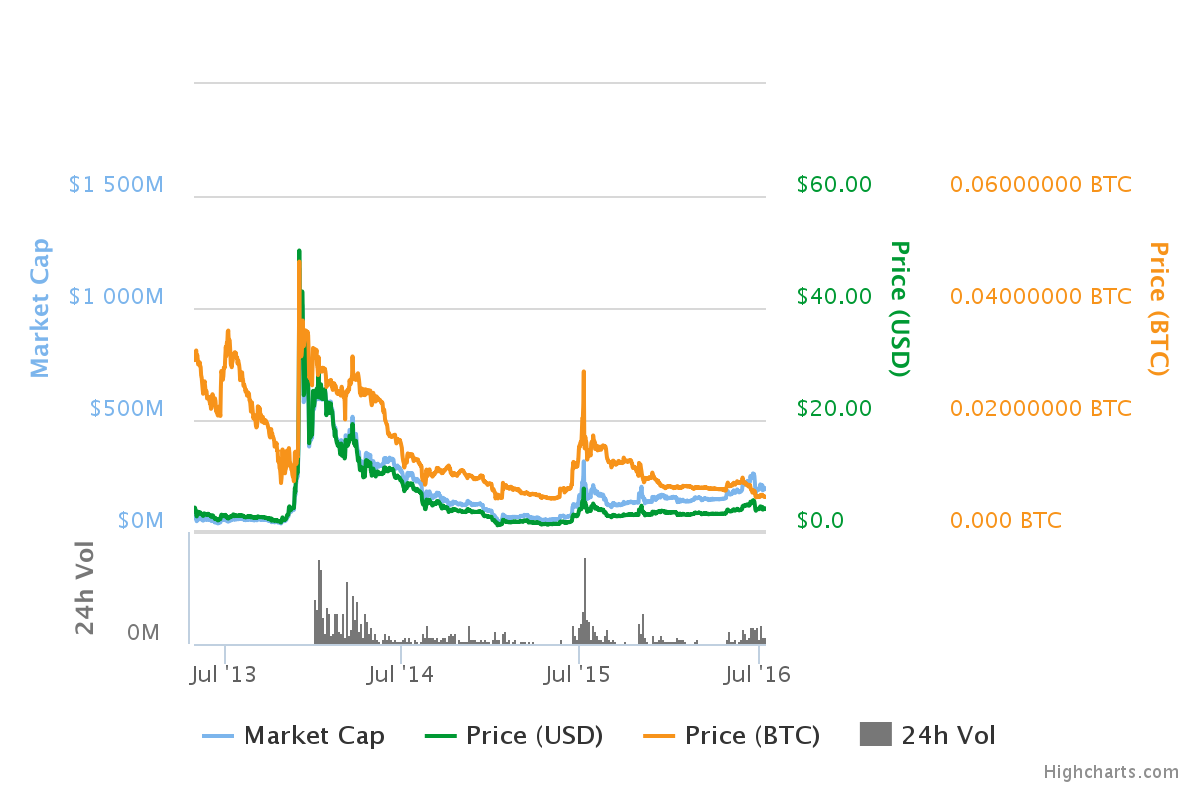
Litecoin prices, all-time (viaCoinMarketCap)
But what about something more elaborate? Let’s pretend for a moment that Ethereum actually worked and was actually something that competed with Bitcoin on some level. Do its smart contracts give it a serious advantage over Bitcoin? I don’t see how Ethereum’s smart contract system would tend to bring in opportunities to unload ethers which are superior to the opportunities provided by Bitcoin. No matter how cool smart contracts sound, they make Ethereum just another appcoin, and as with other appcoins, people will reduce the risk of holding them by not holding them, or holding them for as short a time as possible. This will drive the price down until they are useless in trade.
By the way, I would prefer to be called a “Bitcoin minimalist” rather than a “Bitcoin maximalist” because the other blockchains appear useless and are easliy eliminated.
Bitcoin Versus the Dollar
On the other hand, Bitcoin improves over the dollar (and other fiat currencies) where it actually counts. The dollar is not very good for storing “just in case”. Over long periods, it loses value due to inflation. You can’t carry cash around or the police will take it, and if you leave it in a bank, you can have your account frozen and the money drained if you use it for purposes deemed unacceptable. You cannot own dollars the way that you can own bitcoins. It is not that Bitcoin comes at no risk; it is rather that you can always expect to have the same fraction of the total later on, if you secure them properly.
The national currencies are affected by forces which are beyond your knowledge or control. They are managed by committees serving the governments issuing them. The people on these committees speak in a jargon that is not only incomprehensible to most people, but unbearably dull even to those who do understand it. Everyone is affected by them, but most people will not bother to learn to understand them. They manage the currency in the national interest, which is not always the same thing as your interest. They can change the rules about how the currency can be spent you can use them or increase the government’s supply. [5] It is usually not possible to predict what they will do, at least over long time spans.
This is not possible under Bitcoin’s current rules, and it would be difficult to change them in ways that might eventually enable anything similar. Although many new bitcoins will be created in the future, the release schedule is publicly known, and is therefore already priced into current Bitcoins. Therefore Bitcoin will not lose value as a result of inflation. It might lose value as a result of losing popularity, and this risk is greater than that of the dollar’s (at the moment).
Thus there is a genuine qualitative difference between Bitcoin and the dollar, from an investment standpoint. It doesn’t mean that Bitcoin will necessarily defeat the dollar. It just means that Bitcoin has a relevant competitive edge. There are still significant disadvantages to Bitcoin; it is slow to confirm and difficult to maintain anonymity. However, Bitcoin has done well against the dollar so far and there is real-world commerce that has grown to rely on it. In addition, every time bitcoin grows, its risks decline relative to the dollar’s.
Final Thoughts
The reason, therefore, that the monetary aspects of Bitcoin are particularly interesting is the possibility that Bitcoin could become the preferred good for being stored away. If it did, then its value would grow until it was a significant part of the world economy. That would be a significant change for the world and for Bitcoin’s early adopters. Call me crazy, but I think that possibility has more portent than the possibility of applications of blockchains outside of Bitcoin, and is a lot more likely, too.
Bitcoin the protocol is like a great work of engineering. Its pieces are all adapted to its function. It is not the technology, but what the technology enables, that is most interesting. The blockchain as a concept had no reason to escape the esoteric circles of developers and engineers. Yet when people looked at Bitcoin, the only terms by which they knew how to understand it was as a new technology. But Bitcoin is more like a new tradition than a new technology. It is as if a small section of the crowd in a packed stadium has started to do the wave, and you can bet on whether the wave will eventually fill up the entire stadium.
If someone says “blockchain tech” to you, you might as well walk away right there.[6] They’re just trying to sell you on their new decentralized crowdfunded blockchain tech internet of bitthings appscam. You know that they’re lying because everyone who acts like them is a liar and someone who was not a liar would actually do something to distinguish himself from them. Someone who knew what he was talking about would know that you can’t just string a bunch of buzzwords together in order to generate an idea that makes sense. Unfortunately, if a lack of basic critical thought is widespread, and if everyone becomes invested in everyone else’s stupidity, then nobody wants to know either, at least not before they’ve found a favorable time to exit their position. This will probably never happen because although they may think they’re preying on other people’s stupidity, they are more likely being preyed upon instead.
- On the other hand, just because someone is dumb does not mean that he is not a con artist. Based on my experience in Bitcoin, I think that many con artists have an instinct to remain as stupid as possible about how they get money so that they can keep believing that they are brilliant entrepreneurs. ↩︎
- “do one thing and do it well” ↩︎
- The theory I am presenting in this article is the Austrian theory of money. To learn more about this idea, consult any standard Austrian tome, such as Murary Rothbard’s Man, Economy, and State or Mises’s Human Action. ↩︎
- When Austrian economists say barter system all they mean is an economy in which no good is used as money, even though the term has much more specific connotations for many people. ↩︎
- In the US, it is really congress and the executive branch changing the rules, and the Federal Reserve changing the supply. This distinction doesn’t really matter for the purposes of this article, but some people think it’s important because the federal reserve is designated as a private institution, whereas congress is composed of elected representatives. ↩︎
- This includes Hillary Clinton. ↩︎
The Destituent Power of Crypto
By BTCtheory
Posted July 27, 2016

“There is something that all people, whether they admit it or not, know in their heart of hearts: that things could have been different, that that would have been possible. They could live not only without hunger and also probably without fear, but also freely. And yet, at the same time—and all over the world—the social apparatus has become so hardened that what lies before them as a means of possible fulfillment presents itself as radically impossible” –Theodor Adorno
We will witness the radical impossibility that has been promised since antiquity: a world unified under the banner of true freedom. Through the power of digital technology and crypto, this world will become a reality. This is because the form of power that crypto is based upon is only a destituent kind of power–it only finds value in a world where money, language, and politics have been fully corrupted, and the only thing left to do is to refuse it. Through the deactivation of the power structure as we understand it through a totally new strategy of power inoperativity, we break the whole system.
The new digital economic exist outside and beyond the control of any and all forms of government. It does this through deactivating the control states have on the economy through creating a new monetary system. From the NSA, CIA, and DOD, there is no lettered agency that can claim any degree of sovereignty over our means of economic exchange, and private communications that we have made for ourselves within the framework of crypto. There is nothing they can do other then display their powerlessness against the majesty of cryptography, and their own selfish and fearful need to control everything. Crypto is the bases for the new society that we shall create in the shell of the old.
Destituent Power
“If revolutions and insurrections correspond to constituent power, that is, a violence that establishes and constitutes the new law, in order to think a destituent power we have to imagine completely other strategies, whose definition is the task of the coming politics. A power that was only just overthrown by violence will rise again in another form, in the incessant, inevitable dialectic between constituent power and constituted power, violence which makes the law and violence that preserves it.” -Giorgio Agamben


The goal is not to create a new form of money–that has already been achieved. The real objective is to render a new kind of law; a new kind of politics. A kind of politics that does not taint itself with the violence of man, or the machinery of the state. There no longer is a need for the law-making violence of the state machine, and we are creating a new world where such crude and barbaric forms of violence can no longer legitimize themselves. We shall vanquished such evil from this world through simply absconding into bits spread all through the globe.
A new epoch is beginning and the first goal is to render both old money and old politics not just worthless; but as a testament of its corruption.
Our power is a destituent one. A power which robs the current laws and politics of any meaning through displaying their total corruption. This empowering a new system which they cannot affect, they cannot touch, and they cannot corrupt. We can do this through shattering the current economic-political monopoly, and rending those powerful in old world indifferent to that of the digital realm.
We seek to reactivate Law as it was suppose to be, rather then attempting to constituting changes through the corrupt system of today. The laws of the old world are meaningless in this digital space; and now we need to make this is true in the world of flesh and steel as well. Once we see that abandonment of the current political architecture is the only way forward, that we will be able to start to creating our new form of politics.
The digital system radically divides itself from the state system of laws through a political praxis of non-violence. Through protecting information with encryption, and widely distributing media against corruption and injustice as a form of truth, we can create a new world.
The legal violence which enacts state laws and creates their power simply cannot exist here: there is no territory in which it can apply itself. This radical division is what fundamentally divides our codified digital laws from contemporary violence made laws. We don’t need the violence of statism to cooperate.
The Digital Commons as an Economic and Political Praxis
Through the power of the internet and the digital commons, we can recreate our systems of government to be the Utopian fantasies they were dreamed to be. We can reactivate the power of being ruled by constitutions–agreements to what we are entitled to as citizens. This can allow for us to be governed by the science and immutability of technology, rather then the finicky wills of men who corrupt with ease for selfish gains. No longer do we need to tolerate the violations of our sacred compacts, and the trouncing of the very rights which create our governments.
The deployment of all of these new cryptosystems with harden cryptography is not just a mathematical breakthrough, but the roots of an epochal change. The economic power of digital currencies deposes of state economic system in exchange for a digital one. This is just the very beginning of the deposition of power away from the hands of the state, and back into that of the people. Over the next decade these systems are going to fundamentally challenge the state, and their control on every level of life.
This power deposes because it is an explicit exit from the current, corrupt economic and political system that is pervasive and all-encompassing in our lives. In the digital, the whole multitude of society can exist; with no minders or masters. Here we have chosen to construct all of this for ourselves, without the help of our masters of state, or their capitalist allies who have corrupted our systems of government for private gains.
Towards the Future
We can create a radical new world where the freedom of all is not just a hope, but a reality. The power of technology has drawn us closer then we have ever been before, and now we can see the world as it truly is:
There are untold billions of us living in the most destitute of situations, fighting for the smallest of scraps from Empire. Once we see that there is the greatest of strengths in creating a new form of digital solidarity which can beat back the beast of global fascism, we then might stand a chance for a real future which we are no longer slaves; but truly free to determine the world which we will make.
Crypto Tokens and the Coming Age of Protocol Innovation
By continuations
Posted July 28, 2016
HTTP as the underlying protocol of the web allows for decentralized publishing. Anyone can operate a web server and publish their own content. And anybody with a web browser can access that content (subject to governments and ISPs imposing limitations). But as a stateless protocol, HTTP needs a data layer for any application functionality, which until recently was provided by companies such as Google (search), Facebook and Twitter (social), Amazon and eBay (commerce). Because we didn’t know how to maintain state in a decentralized fashion it was the data layer that was driving the centralization of the web that we have observed.
The potential for blockchain technology to provide an organizationally decentralized alternative for maintaining state is beginning to be be reasonably well understood. I first wrote about this possibility on the USV blog in 2013 and a year later here on Continuations, clarifying why bitcoin represents such a foundational innovation. Organizationally decentralized but logically centralized state will allow for the creation of protocols that can undermine the power of the centralized incumbents. At USV we have invested in a number of companies that are active in this area, including Blockstack, Mediachain and OB1.
Historically many key protocols, such as TCP/IP and HTTP, have come from researchers. Subsequent iterations of these protocols were often handled by nonprofit organization that tried to wrangle with more or less success the various commercial interests that sprang up around this protocols (the companies that were making and selling software and hardware based on them). The more money was involved the harder this became.
Now, however, we have a new way of providing incentives for the creation of protocols and for governing their evolution. I am talking about cryptographic tokens. You can think of these like the tokens you might buy at a fair to get on a ride: different operators can have their own rides and set their own price in terms of tokens. You only need to buy tokens once (in exchange for fiat currency) and then can use them throughout the fair. With blockchains we now have a way of issuing and redeeming these tokens digitally (the underlying blockchain can be Bitcoin or Ethereum or possibly its own as in the case of Steemit).
A for profit company can now create a new protocol and create value for itself (and its investors) by retaining some of the tokens. If the protocol becomes widely used, the value of the tokens will increase. For instance, think of a decentralized storage service (a la Amazon’s S3). Anyone can implement the storage protocol in whatever language they want to as long as they meet the protocol spec. They can then get paid in the relevant storage tokens. The original creator of the protocol will make money to the extent that it is adopted and to the degree they have retained some of the tokens (so they can sell them at a higher price later on). This is not hypothetical as there are a variety of such protocols out there, including Storj, SIA and Filecoin.
I can’t emphasize enough how radical a change this is to the past. Historically the only way to make money from a protocol was to create software that implemented it and then try to sell this software (or more recently to host it). Since the creation of this software (e.g. web server/browser) is a separate act many of the researchers who have created some of the most successful protocols in use today have had little direct financial gain. With tokens, however, the creators of a protocol can “monetize” it directly and will in fact benefit more as others build businesses on top of that protocol.
Given this new incentive I expect a lot of resources to be devoted to protocol innovation. That would be great as we have many missing protocols to make a decentralized data world work well. There is also a natural rate limit on how much of the wealth can be retained. Because the protocol is public (by definition) if a creator tries to retain too many tokens there is an incentive for everyone else to replicate the protocol with a new token none of which is retained.
More generally, the evolution of these protocols will be governed by the decision of those who have adopted it to adopt a future version. This has the potential to provide a much more democratic process for changing protocols over time then the historic committee process. Just how democratic it will be depends on a lot of factors starting with how concentrated the group of protocol operators is. We are just at the beginning of this world and are in the process of learning a ton (for instance from the recent hard fork of Ethereum where there is an attempt to maintain the old chain as well).
There are also questions as to how these tokens will be treated by existing regulators such as the SEC. I am hoping they will see them as tokens to a global fair and not as securities. The need to comply with regional securities laws would likely kill the amazing potential that tokens have for protocol innovation. We are just at the beginning of this. I am excited about where it can go!
Posted: 28th July 2016 – Tags: tokens protocols blockchain innovation