
June 2016 Journal
WORDS is a monthly journal of Bitcoin commentary. This issue collects the June 2016 writing in the WORDS archive. For the uninitiated, getting up to speed on Bitcoin can seem daunting. Content is scattered across the internet, in some cases behind paywalls, and content has been lost forever. That’s why we made this journal, to preserve and further the understanding of Bitcoin.
Original vision of Bitcoin
By Oleg Andreev
Posted June 1, 2016
Some people feel bad about Bitcoin being harder to scale than any successful centralized system such as Myspace or Altavista. They often claim that “I signed up for a P2P Electronic Cash System, not a settlement layer” which is a way to say that Satoshi envisioned something else than what we have today.
I’d like to challenge this argument, even though I realize that it is absolutely irrelevant: whatever Satoshi thought he was doing, existence and evolution of Bitcoin is not subject to anyone’s wishful thinking, but to a humankind’s ability to actually improve it.
So Satoshi called Bitcoin an “electronic cash system”. What does that mean?
First of all, “cash” means something else than “quick settlement”. It primarily means a bearer instrument as opposed to a contract with a third party providing credit (as with credit cards, for instance). When accepting “cash” instead of a credit card, I am somewhat protected against reversal of the transaction by a third party — a credit card company. But how exactly am I protected? Turns out, there is another third party involved: a centrally controlled mint (e.g. a central bank) that provides difficult-to-counterfeit notes and uses a subsidized (by taxes) police force to discover and eliminate counterfeiters. So instead of two third parties (CB + CC company), cash leaves only one (CB) in our threat model. CB also adds a risk of debasement of currency, so if you receive 0.10% of total currency today, tomorrow it may turn out to be just 0.09%. You are essentially paying a rent on money with little assurances of stability of that rent. Also note a somewhat hidden cost of tax-subsidized minting and law enforcement to protect authenticity of the money.
Lets scroll back a few hundred years to the age of silver and gold coins. “Cash” was more decentralized: gold is gold no matter what face is printed on it. But why have faces on gold coins at all? Elementary, Watson: because it’s a huge pain in the arse to verify the coin on the spot. So central mints were used to provide hard-to-counterfeit stamps that allow quicker verification of coin validity. Mints were still a source of debasement risk, but at least some independent verification was more possible and debasement could not have been done overnight (as the saying goes, Rome was not debased in one day).
So even precious metal coins are not better than paper cash (if they were, paper would never take off in the first place): they seem to be decentralized, but related costs are so high, that to make them useful we still need centralized authorities built around them.
Is it the kind of cash Satoshi attempted to turn into electronic form? Lets read bitcoin.pdf from the very beginning:
A purely peer-to-peer version of electronic cash would allow online payments to be sent directly from one party to another without going through a financial institution.
Note that the Mint (or Central Bank) involved in coinage and printing paper bills is as much a financial institution as your bank or Visa.
If one is to create a truly decentralized bearer instrument, one must make both issuance and authenticity checks decentralized, not simply the transfer mechanism. And the only workable way that we know so far is to collectively (as a civilization) continuously build a proof-of-work chain of transfers authenticated via public key cryptography.
Folks who focus on payments without discussing issuance and corresponding holding costs (risks of debasement) are like grasshoppers who spend before saving, so when winter comes they all go to ants begging for the share of what the ants saved. This has happened all the time in the history: first, ants abstain from unnecessary spending in order to save some food for later, then ants are forced to abstain even more by all the stupid and hungry grasshoppers who come to take their savings. A truly decentralized cash would prevent the most badass grasshoppers issuing and debasing their own currency and asymmetric security of public key cryptography allows all ants, no matter how poor or rich, have equally cheap protection against even the strongest of grasshoppers.
But lets get back to our “original vision of Bitcoin”. We now clearly see that it is not fair to compare Bitcoin’s performance to performance of Visa electronic payments (large throughput, but a lot of trusted third parties and risks of reversal and censorship) or even paper bills or minted coins.
So how does Bitcoin compare to a fully decentralized gold bullion then, the best known decentralized money before Bitcoin? How many transactions a day can the naked chunks of gold settle around the world? How quick is each payment verification? How do costs scale with different amounts of payments, from the smallest to the largest? We will leave answering these questions as an exercise to the reader and jump right to the conclusion:
Decentralized physical cash sucks in all ways imaginable compared to Bitcoin. Bitcoin is faster, cheaper and safer than any other forms of decentralized cash that ever existed.
In addition, if you take Bitcoin and build payment layers on top of it by relaxing some underlying security requirements, you will still get better electronic cash than the paper cash today: faster, easier to verify, better protected against debasement etc etc.
Satoshi was building a basis layer for electronic cash by eliminating trusted third parties as a requirement. He succeeded. Everything else is simply an optimization. If some optimizations relax security requirements of Bitcoin (e.g. need some level of centralization), then they do not belong to Bitcoin, but to additional layers around Bitcoin.
Bitcoin is designed to be free from intervention as in “fuck you”.
Bitcoin security model: Trust by computation
By Andreas M. Antonopoulos
Posted June 3, 2016
FirstpublishedFebruary 2014 in O’Reilly Radar
Bitcoin is a distributed consensus network that maintains a secure and trusted distributed ledger through a process called “proof-of-work.”
Bitcoin fundamentally inverts the trust mechanism of a distributed system. Traditionally, as we see in payment and banking systems, trust is achieved through access control, by carefully vetting participants and excluding bad actors. This method of trust requires encryption, firewalls, strong authentication and careful vetting. The network requires investing trust in those gaining access.
The result is that such systems tend to be closed and small networks by necessity. By contrast, bitcoin implements a trust model of trust by computation. Trust in the network is ensured by requiring participants to demonstrate proof-of-work, by solving a computationally difficult problem. The cumulative computing power of thousands of participants, accumulated over time in a chain of increasing-difficulty proofs, ensures that no actor or even collection of actors can cheat, as they lack the computation to override the trust. As proof-of-work accumulates on the chain of highest difficulty (the blockchain), it becomes harder and harder to dispute. In bitcoin, a new proof-of-work is added every 10 minutes, with each subsequent proof making it exponentially more difficult to invalidate the previous results.
Here’s the most important effect of this new trust model of trust-by-computation: no one actor is trusted, and no one needs to be trusted. There is no central authority or trusted third party in a distributed consensus network. That fact opens up a completely new network model, as the network no longer needs to be closed, access-controlled or encrypted. Trust does not depend on excluding bad actors, as they cannot “fake” trust. They cannot pretend to be the trusted party, as there is none. They cannot steal the central keys as there are none. They cannot pull the levers of control at the core of the system, as there is no core and no levers of control.
As a result, the network can be open to all; the transactions can be broadcast on any medium, unencrypted; and applications can be added at the edge without vetting or approval. In other words, bitcoin is not just money for the Internet, it is the Internet of money — an open, de-centralized, standards-based network where innovation can occur at the edge without permission and where the network itself is simply a neutral and open transport layer.
Like the Internet and other open networks, blockchain-based crypto-currency networks are susceptible to denial-of-service and other nuisance attacks. Attacks that cannot violate the trust of the distributed asset ledger, but can clog the pipes and attempt to confuse the participants. When such attacks occur, they can cause deep concern among those who have a predilection for the security model of access control. If a bad actor gains access to a closed financial network, the results are catastrophic. Open access and trust are fundamentally at odds in a closed centralized network based on access control. Therefore, within that context, a denial of service attack or any bad actors on the network have dire consequences and signify a compromise of security and a failure of the trust model.
On bitcoin and other open crypto-currency networks, however, bad actors on the network are inconsequential because the trust model does not depend on excluding them. The bad actors are not trusted any more than any other user of the network and their access does not grant them any special rights. The trust model depends on computation and the demonstration of computation through proof-of-work. As long as good actors form the majority of the computation used for forming consensus, the bad actors cannot change the trusted ledger.
It will take time for the idea of decentralized trust through computation to become a part of mainstream consciousness, and until then, the idea creates cognitive dissonance for those accustomed to centralized trust systems. With thousands of years of practical use, centralized systems of trust are accepted unconditionally and without much thought as the only model of trust.
Until recently, decentralized trust at scale was not possible. Now that it is, it conflicts with most people’s understanding of the world. That’s why when you explain crypto-currencies to people, they immediately search for the central actor or authority that establishes the trust, establishes the value or has the control: “Yes, I see it is decentralized, but who runs it? Who controls it? Can’t someone take over?” These questions reveal the context of trust centralization, which is deeply embedded in our culture and our thinking. We’ve been taught to fear the bad actor and look for self-interested “trusted” individuals; we no longer have to do that.
Gradually, decentralized trust will be accepted as a new and effective trust model. We have seen this evolution of understanding before — on the Internet. The Internet led to the decentralization of authority-of-opinion, by making it possible for anyone to be a publisher without a multi-story building-sized printing press. At first, this challenged our expectations and forced us to reconsider the source of authority. If anyone could have an opinion and publish it, how can we tell which opinions are important? We had used the centralization of printing presses and distribution and the purchasing of ink by the barrel as a proxy metric of authority, to help us filter our news and opinions. Suddenly, we were thrust into a new world in which these anchors of authority were swept away and each opinion had to be judged by its merits, not the size of the publisher’s press.
Now, we must rethink the source of trust in networks and the source of monetary value of currencies, disconnected from the issuer, without a central authority and without the need for access control. The trust model has already changed, but it will take a while for society to accept that a new model is possible.
Failure is an option
By Andreas M. Antonopoulos
Posted June 3, 2016
Firstpublishedin March 2014, in the immediate wake of the failure of Japan-based bitcoin exchange Mt.Gox
In the free market, failure is always an option. The United States has one of the world’s most vibrant entrepreneurial cultures, where millions of people start small businesses, create new products and invent new technology. Part of the startup culture is the idea of failing fast, failing cheap and failing towards success by learning the lessons taught by failure. Cultures that punish even minor failure in business with shame, exclusion and stigma are far less likely to foster entrepreneurs because they prevent experimentation by making it too risky.
Recently, the US has been infected by the “failure is not an option” mantra, a toxic hubristic fallacy, disguised as a truism, which promotes the idea that risk can be removed from life; that 100% security and 100% control are possible, even desirable. Those who attempt to remove the possibility of failure, to de-risk financial systems, end up creating the probability of spectacular failure. By removing the option to fail cheap and fail fast, they instead concentrate risk and ensure we will fail hard, fail expensively, fail across the board.
In the 1970s the US developed a policy of forestry that espoused 100% prevention of forest fires; let’s call it “fire is not an option”. This policy resulted in the systemic suppression of small fires and eventually into very unbalanced forest ecosystems where fire is now not just an option, but a certainty of disaster. We now know that fire is a natural part of a forest’s life-cycle. Without fire, the forest floor gets overgrown, making it a source for bigger and hotter fires. When fires break out in a “managed” forest where fires have been suppressed for years, they burn so hot they turn the ground to glass. Fires that were survivable by trees are now so destructive that they denude hills and wipe out the entire ecosystem. Our financial system has become much like a poorly managed forest, harboring within it the increasing probability of a systemic and destructive conflagration.
Capitalism and entrepreneurial innovation require risk, as it is a fundamental component of business evolution. When companies are allowed to fail, their resources get reallocated in the market, just like a fire that converts sparse undergrowth into fertilizer for the next generation of trees. If instead, the failed companies are prevented from failing but are propped up to maintain the illusion of solvency, they fester and consume more and more resources while creating greater and greater risk. Eventually, bail-outs must be followed by even greater bail-outs and then bail-ins. Finally, the systemic risk of too-big-to-fail becomes too-big-to-bail and the economy suffers a conflagration of defaults. De-risking increases the risk of failure and turns localized risk into a systemic risk. If you stop the small fires, you get a fire so big it turns the ground to glass.
Last week, the long-festering bitcoin exchange Mt.Gox failed. It is too early to tell exactly what happened and what will happen next, but I have some predictions: Gox will not be bailed out. Gox’s competitors will not be forced to tax their customers to support Gox’s investors or customers. The bitcoin currency will not be inflated to provide quantitative-easing to keep Gox alive. Gox will not receive 0% loans for half a decade, perverting the incentives of the entire market. Other bitcoin exchanges will not find it more profitable to seek these 0% loans instead of innovating. Gox will not be allowed to acquire smaller companies to fatten their balance sheet to hide losses, nor will Gox be acquired by a larger exchange with loan guarantees from bitcoin miners to hide Gox’s insolvency. Gox executives will not be rewarded with bonuses paid by bitcoin inflation and taxation. Gox will not receive a deferred prosecution because they are too big to jail. Gox will not be even bigger and even less solvent in a few years. Most likely, some people involved in the Gox failure will end up in prison. Gox’s executives will not be invited to Davos to pal-around with the leaders of government. No, those are all things that happen in the “real” economy where de-risking is the toxic fad of the decade and too-big-to-fail is too-big-to-jail.
Gox will simply fail. It will fail in an isolated way so that it won’t cause greater systemic failures. As we must lament the losses and tragic consequences for the customers of Gox, let’s not lament the failure of Gox itself. This is not a failure of the bitcoin currency or a failure of capitalism. This is how capitalism should work.
The fact that such failure appears strange and uncomfortable only shows how far from true competition and capitalism we have been led by promises of de-risking. In bitcoin, at least, failure is an option. Allowing Gox to fail is a good thing and it will only make bitcoin stronger. It’s much scarier to have your eyes wide open, but it’s less dangerous than keeping them firmly shut and basking in the delusional comfort of de-risked capitalism. With failure comes risk but also innovation and fertile ground for re-invention and new growth. Welcome back to the free market, where failure is always an option.
Why Dumb Networks Are Better
By Andreas M. Antonopoulos
Posted June 3, 2016
Firstpublishedin FEE, in March 2015.
In computer and communications networks, decentralization leads to faster innovation, greater openness, and lower cost. Decentralization creates the conditions for competition and diversity in the services the network provides.
But how can you tell if a network is decentralized, and what makes it more likely to be decentralized? Network “intelligence” is the characteristic that differentiates centralized from decentralized networks — but in a way that is surprising and counterintuitive.
Some networks are “smart.” They offer sophisticated services that can be delivered to very simple end-user devices on the “edge” of the network. Other networks are “dumb” — they offer only a very basic service and require that the end-user devices are intelligent. What’s smart about dumb networks is that they push innovation to the edge, giving end-users control over the pace and direction of innovation. Simplicity at the center allows for complexity at the edge, which fosters the vast decentralization of services.
Surprisingly, then, “dumb” networks are the smart choice for innovation and freedom.
The telephone network used to be a smart network supporting dumb devices (telephones). All the intelligence in the telephone network and all the services were contained in the phone company’s switching buildings. The telephone on the consumer’s kitchen table was little more than a speaker and a microphone. Even the most advanced touch-tone telephones were still pretty simple devices, depending entirely on the network services they could “request” through beeping the right tones.
In a smart network like that, there is no room for innovation at the edge. Sure, you can make a phone look like a cheeseburger or a banana, but you can’t change the services it offers. The services depend entirely on the central switches owned by the phone company. Centralized innovation means slow innovation. It also means innovation directed by the goals of a single company. As a result, anything that doesn’t seem to fit the vision of the company that owns the network is rejected or even actively fought.
In fact, until 1968, AT&T restricted the devices allowed on the network to a handful of approved devices. In 1968, in a landmark decision, the FCC ruled in favor of the Carterfone, an acoustic coupler device for connecting two-way radios to telephones, opening the door for any consumer device that didn’t “cause harm to the system.”
That ruling paved the way for the answering machine, the fax machine, and the modem. But even with the ability to connect smarter devices to the edge, it wasn’t until the modem that innovation really accelerated. The modem represented a complete inversion of the architecture: all the intelligence was moved to the edge, and the phone network was used only as an underlying “dumb” network to carry the data.
Did the telecommunications companies welcome this development? Of course not! They fought it for nearly a decade, using regulation, lobbying, and legal threats against the new competition. In some countries, modem calls across international lines were automatically disconnected to prevent competition in the lucrative long-distance market. In the end, the Internet won. Now, almost the entire phone network runs as an app on top of the Internet.
The Internet is a dumb network, which is its defining and most valuable feature. The Internet’s protocol (transmission control protocol/Internet protocol, or TCP/IP) doesn’t offer “services.” It doesn’t make decisions about content. It doesn’t distinguish between photos and text, video and audio. It doesn’t have a list of approved applications. It doesn’t even distinguish between client and server, user and host, or individual versus corporation. Every IP address is an equal peer.
TCP/IP acts as an efficient pipeline, moving data from one point to another. Over time, it has had some minor adjustments to offer some differentiated “quality of service” capabilities, but other than that, it remains, for the most part, a dumb data pipeline. Almost all the intelligence is on the edge — all the services, all the applications are created on the edge-devices. Creating a new application does not involve changing the network. The Web, voice, video, and social media were all created as applications on the edge without any need to modify the Internet protocol.
So the dumb network becomes a platform for independent innovation, without permission, at the edge. The result is an incredible range of innovations, carried out at an even more incredible pace. People interested in even the tiniest of niche applications can create them on the edge. Applications that only have two participants only need two devices to support them, and they can run on the Internet. Contrast that to the telephone network where a new “service,” like caller ID, had to be built and deployed on every company switch, incurring maintenance cost for every subscriber. So only the most popular, profitable, and widely used services got deployed.
The financial services industry is built on top of many highly specialized and service-specific networks. Most of these are layered atop the Internet, but they are architected as closed, centralized, and “smart” networks with limited intelligence on the edge.
Take, for example, the Society for Worldwide Interbank Financial Telecommunication (SWIFT), the international wire transfer network. The consortium behind SWIFT has built a closed network of member banks that offers specific services: secure messages, mostly payment orders. Only banks can be members, and the network services are highly centralized.
The SWIFT network is just one of dozens of single-purpose, tightly controlled, and closed networks offered to financial services companies such as banks, brokerage firms, and exchanges. All these networks mediate the services by interposing the service provider between the “users,” and they allow minimal innovation or differentiation at the edge — that is, they are smart networks serving mostly dumb devices.
Bitcoin is the Internet of money. It offers a basic dumb network that connects peers from anywhere in the world. The bitcoin network itself does not define any financial services or applications. It doesn’t require membership registration or identification. It doesn’t control the types of devices or applications that can live on its edge. Bitcoin offers one service: securely time-stamped scripted transactions. Everything else is built on the edge-devices as an application. Bitcoin allows any application to be developed independently, without permission, on the edge of the network. A developer can create a new application using the transactional service as a platform and deploy it on any device. Even niche applications with few users — applications never envisioned by the bitcoin protocol creator — can be built and deployed.
Almost any network architecture can be inverted. You can build a closed network on top of an open network or vice versa, although it is easier to centralize than to decentralize. The modem inverted the phone network, giving us the Internet. The banks have built closed network systems on top of the decentralized Internet. Now bitcoin provides an open network platform for financial services on top of the open and decentralized Internet. The financial services built on top of bitcoin are themselves open because they are not “services” delivered by the network; they are “apps” running on top of the network. This arrangement opens a market for applications, putting the end user in a position of power to choose the right application without restrictions.
What happens when an industry transitions from using one or more “smart” and centralized networks to using a common, decentralized, open, and dumb network? A tsunami of innovation that was pent up for decades is suddenly released. All the applications that could never get permission in the closed network can now be developed and deployed without permission. At first, this change involves reinventing the previously centralized services with new and open decentralized alternatives. We saw that with the Internet, as traditional telecommunications services were reinvented with email, instant messaging, and video calls.
This first wave is also characterized by disintermediation — the removal of entire layers of intermediaries who are no longer necessary. With the Internet, this meant replacing brokers, classified ads publishers, real estate agents, car salespeople, and many others with search engines and online direct markets. In the financial industry, bitcoin will create a similar wave of disintermediation by making clearinghouses, exchanges, and wire transfer services obsolete. The big difference is that some of these disintermediated layers are multibillion dollar industries that are no longer needed.
Beyond the first wave of innovation, which simply replaces existing services, is another wave that begins to build the applications that were impossible with the previous centralized network. The second wave doesn’t just create applications that compare to existing services; it spawns new industries on the basis of applications that were previously too expensive or too difficult to scale. By eliminating friction in payments, bitcoin doesn’t just make better payments; it introduces market mechanisms and price discovery to economic activities that were too small or inefficient under the previous cost structure.
We used to think “smart” networks would deliver the most value, but making the network “dumb” enabled a massive wave of innovation. Intelligence at the edge brings choice, freedom, and experimentation without permission. In networks, “dumb” is better.
My O’Reilly conference talk on this topic:
Why Central Banks Will Fail at Digital Currency
By Beautyon
Posted June 7, 2016

This Medium post analyses the address Adam Ludwin of Chain gave at the Federal Reserve in Washington. Read his address before reading this. Прочитайте эту статью на русском языке.
Introduction
100 central bankers and regulators from around the world came to the Federal Reserve (the organization that inadvertently caused the creation of Bitcoin) in Washington D.C. for an event titled “Finance in Flux: The Technological Transformation of the Financial Sector”. It was jointly hosted by the IMF and World Bank, two organizations participating in the global fiat money Ponzi Scheme. Bitcoin is no longer regarded with any doubt by people at the top of democracy. Everyone who was saying that it works completely as described is now 100% vindicated, and all the people who said it did not work are humiliated. What these bankers are doing is reacting to this clear and present threat to their role as monetary intermediaries. Chain wants to be the vendor of choice for the software providing the middle man services to these central banks. Adam Ludwin made a sales pitch, without explicitly asking “who is going to write this software for you?”
As I have said before, you cannot have Blockchain without Bitcoin, and this article by professor Saifedean Ammous published in the prestigious American Banker expounds this fact nicely.
Actors who try and separate Blockchain from Bitcoin are inevitably software vendors desperately trying to sell their services, trying to separate the inseparable because they can’t come up with business models where they interact directly with Bitcoin. They also tend to be Statists with a fervent belief in the absolute authority of government and implicit legitimacy of the money it mandates everyone accept in payment.
These people have a problem explaining this software plainly, and sometimes they just make things up. Talking about “blockchain architectures” could actually be a codeword for “MySQL”. Everything that these vendors offer can be done in a MySQL database centrally controlled and secured with GPG. I have described how this would work in a previous essay. What these vendors are leveraging is computer illiteracy; its a safe bet that none of the attendees listening to this talk understood a single software concept that was presented to them; they were there merely to represent their organizations.
The perspective Adam gives in his talk is misleading and troubling. The true background story of Bitcoin is a deep dissatisfaction with the fiat currency system that steals money from the poor, fuels war and destroys economies. It is the State and its fraudulent money that was the sole driving force behind the creation of Bitcoin, and a search for a solution to the double spending problem had been ongoing for more than twenty years before Lehman Brothers collapsed; the idea that Bitcoin’s creation had anything to do with Lehman Brothers is goldfish memory in full effect.
Those who understand what money is fully expected collapses like Lehman Brothers, and the inevitable hyperinflation event that is coming to the US dollar. Economists from the Austrian School successfully predicted the housing collapse also:
These are the true origins of Bitcoin and everyone knows it. Bitcoin is a solution to the problem of the State having absolute control over the form and supply of money and the regulation of banks. That is why it is so powerful; it solves two difficult problems at once, and offers an unimaginable number of secondary uses that are tangential to the money use of Bitcoin.
The Federal Reserve “stimulus” programmes, secret bailouts and money creation that have destroyed the value of the US Dollar are well understood by anyone familiar with The Austrian Theory of Money and even Socialists understand that the Federal Reserve is acting against the interests of anyone that is forced to use its money:
This is the true perspective behind Bitcoin, not some sugar coated false history of why Satoshi Nakamoto created it. Bitcoin was created by Anarchists who understand Austrian Monetary Theory, who limited its supply deliberately because they understood that in order for money to be sound, its supply must be fixed. They understood that money should not be in the control of the State, but should be solely a product or service produced by the market. These facts are missing from Adam’s talk, and the omission is deliberate. He knows how to speak to these bankers, and he knows their severe limitations when it comes to computers and software. They work primarily on instinct and emotion in this area; any mention of the Austrian School, the reasons for the limited money supply, Anarchism, or the anti-Fed animus built in to Bitcoin (expressed by the image below)
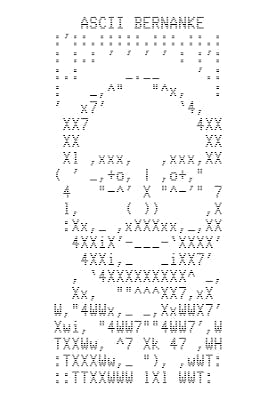
IMAGE “ASCII Bernanke” Bitcoin’s creator knows what money is and what needs to be done about the inherent problems associated with fiat currency; destroy the Federal Reserve irrevocably and return the control of money production to individuals acting in concert voluntarily. This the only way the problem of inflation is going to be solved. That is what Bitcoin does. The portrait on the right is embedded in the Bitcoin Blockchain as a tribute to Federal Reserve Chairman Ben Bernanke, who destroyed the Federal Reserve Dollar in a Keynesian frenzy of money printing, defrauding millions of people.
would cause these people to reject the idea he is selling, no matter what it is worth or its capabilities. This is why, for many years, people simply did not accept that Bitcoin did what its proponents claimed it could do, despite the software being available and examinable. These people don’t understand anything connected with the computer world; they are leaves in the wind, where the wind is coming from a hand held blower, wielded by software vendors.
Evidence that Adam has dumbed down his talk to suit his audience’s capacity is found in his use of the phrase, “In an obscure corner of the Internet”. There are no “obscure corners of the Internet”. All parts of it are equally accessible to everyone. This is the sort of descriptive language that is needed to explain Bitcoin, but which simultaneously plagues it, because many of the speakers trying to contextualize it don’t have the eloquence to make a good job of clarifying and simplifying its true nature.
Its also interesting that the widely cited “Bitcoin White Paper” now universally held in the highest regard (even by people who know nothing about software, maths or economics) is entitled “Bitcoin: A Peer-to-Peer Electronic Cash System”, but these crony capitalists choose to deliberately focus only on the means by which a P2P electronic cash system was achieved, not the idea of a new way of managing and accounting for tokens.
The Federal Reserve and central bankers believe that only they have the right to issue money. Bitcoin, explicitly created to issue a new form of money, cannot have its name or true purpose associated with Blockchain Vendors, because the threat to them is implicit in Bitcoin’s genesis and operation. More on this later.
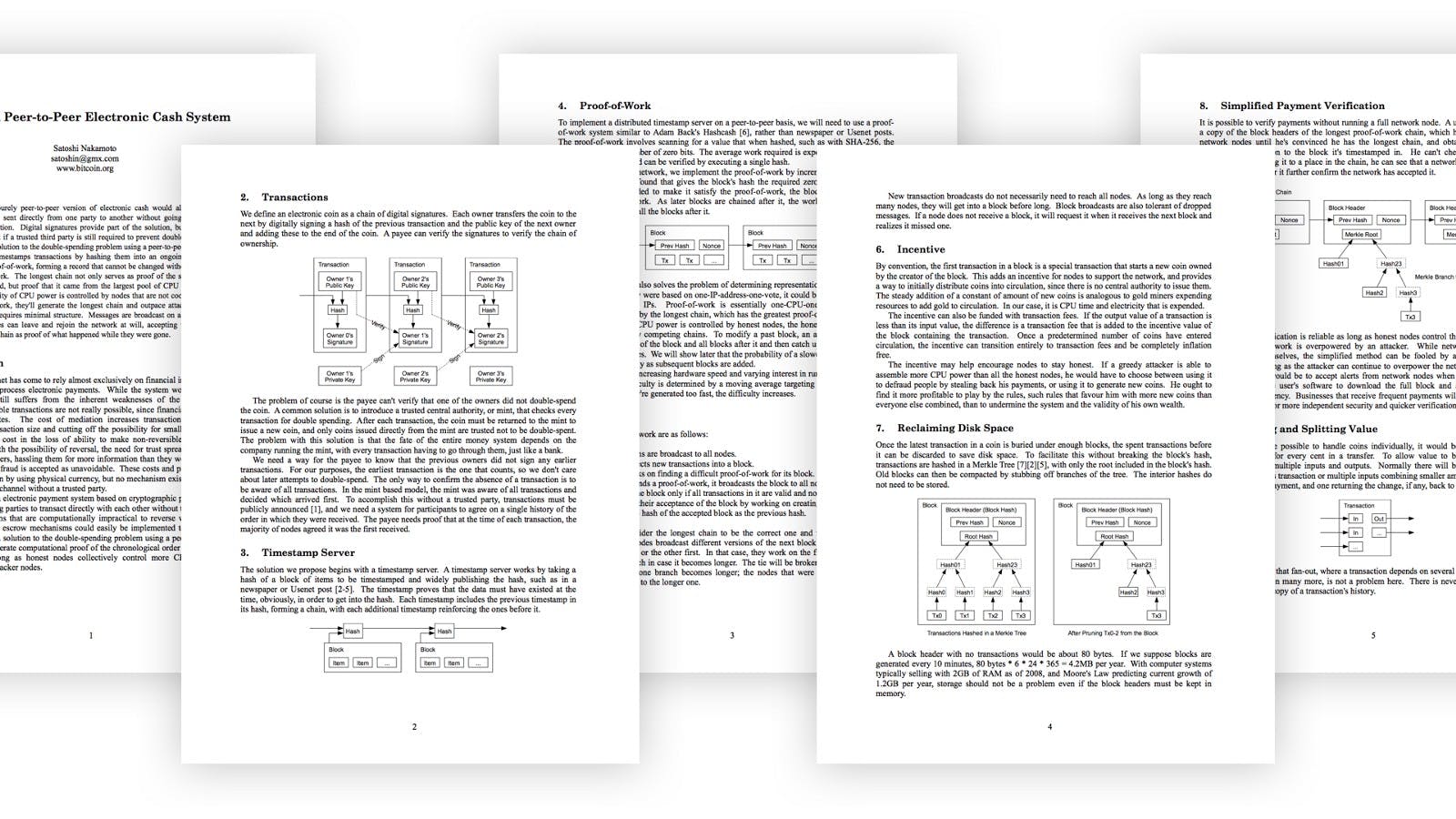
The Bitcoin Whitepaper. A death notice to fiat money and central banks.
Ludwin says that the Bitcoin network has proven to be robust. Bitcoin has always been robust, was never a Ponzi Scheme, fraud, about to collapse, or any of the other lies spread about it by computer illiterates. Why exactly Ludwin asserts that it is resilient now, and why anyone should believe him over anyone else is not fleshed out in his talk. There is no more reason to think that Bitcoin does what its creators claim it can do now, than at any time during the vicious, brainless, evidence-less attacks on it by academics, journalists, economists and other assorted idiots.
This controversy that Ludwin mentions was a tissue of lies from the beginning. Unfortunately, we must all deal with a world populated by types who cannot and who refuse to think, and this talk at the Federal Reserve and their inadvertent anointing of Bitcoin will greatly strengthen the perception of Bitcoin globally. This is the only thing we have to be thankful for from this meeting. Now, no one will be able to lie about Bitcoin in any serious publication. The same software that the Blockchain not Bitcoin vendors are trying to sell powers Bitcoin. If the latter works, the former must work, and anyway, “The Federal Reserve said it works”.
On top of this new faith in Bitcoin are the extensions and features Bitcoin that are being added by Bitcoin Core that increase its capabilities. It is impossible for any single government or corporation to out innovate an Open Source software project with many developers working on the same system. Linux is the living proof of this; no one can come close to the amount of genius being poured into Linux. That is why it is every where, in billions of devices, and increasingly on desktop computers. Bitcoin domination, even as a universal financial backbone, is inevitable and there is nothing anyone can do to stop it.
Bitcoin did not create a new asset class. Bitcoin is money, in the same way that fiat cash is used as money, or metal buttons stamped in Birmingham in the late 1700s were money.
Institutions are buying software from hungry vendors because they do not want to be left out of the latest innovations. The vendors sell them snake oil solutions to problems that they don’t have, and because they don’t have any understanding of computers, cryptography or economics, they buy these systems and pilot them so as to appear cutting edge.
As an example, there is no such thing as “digitizing existing asset classes”. Databases hold entries that are text. That is all that they do, and Bitcoin is nothing more than a write once read many database. What is happening now with the Blockchain not Bitcoin vendors is a direct mirror image of the Intranet fad that happened in the 1990s
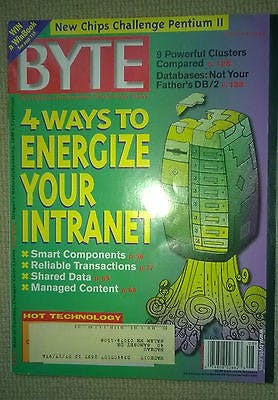
The computer illiterates of that era, were sold the idea of private networks based on a series of false assumptions and an inability to understand what they were working with. Vendors set up a compelling story, and sold them expensive bespoke systems. The idea of an “Intranet” which sounds like “Internet” was an easy sell. Much less sexy is “Local Network” which is exactly what these Intranets are, and today they work on standard protocols, not bespoke systems. The Blockchain not Bitcoin people are creating the same worthless intermediary step to total Internet acceptance that the Intranet vendors did in the 1990s.
Of course, they are free to do this, but because the function of money is what Bitcoin is replacing, and because the Federal Reserve and the other central banks have the entire force of government behind them, this will not be like Intranet vs Internet and private protocols vs open protocols debate. If the central banks try and release their own cryptocurrency alt coin, they will anoint it and supercharge it with Legal Tender status. That means that it will be illegal for anyone to refuse to accept their alt coin for settlement of debts.
Essentially, they will move their Ponzi Scheme from one set of databases that they have exclusive access to, to another database they own where all market participants have direct access to the generated tokens. That is the only change that will happen; the fundamental and unethical nature of the money will remain unchanged. It will be imposed by force, and its supply will be managed by a secret process. It will be as unreliable as all fiat currency ever was. This is the very definition of lipstick on a pig.
All asset classes like shares, are already held in databases. What Ludwin is trying to sell in a “bait and switch” is a new form of database where he claims layers of trust are removed. The switch comes where layers of trust are re-inserted because what he is selling is a “permissioned” database requiring trusted parties.
Omitted from his model is that in Bitcoin, no one needs to be trusted; all Blockchain not Bitcoin vendors must break the trust model of Bitcoin to re-assert the control that the Federal Reserve and NASDAQ (for example) have over who gets to control the money supply and who authorizes shares to move respectively. There is no place in the Bitcoin world for the Federal Reserve; Bitcoin was designed to destroy it. This is the real reason these institutions are testing new networks.
Adam says that the blockchain is designed to issue and transfer Bitcoins. This is true, but Bitcoin can be used to transfer any good, tangible or intangible. How is this doable? Stocks and all other assets are serialized.

A bearer bond issued by the government of Ghana, with unique serial number 01AA637969
All stocks come with a serial number that is unique to the share. The same is true of bonds and even paper fiat money. It is trivial in software terms to attach a stock to a Bitcoin transaction; instead of having a printed serial number, a Bitcoin transaction can be assigned to the share. The people behind “Coloured Coins” have been working on precisely this way of representing and managing real world assets:
In other words, this problem has already been solved, where you have all the now admitted resilience and reliability of Bitcoin and the ability to “attach” real world certificates of ownership to entries in the Bitcoin database. There is no need whatsoever to create a bespoke, private, illegitimate Federal alt-coin, unless your aim is to sell software services, as Adam Ludwin does.
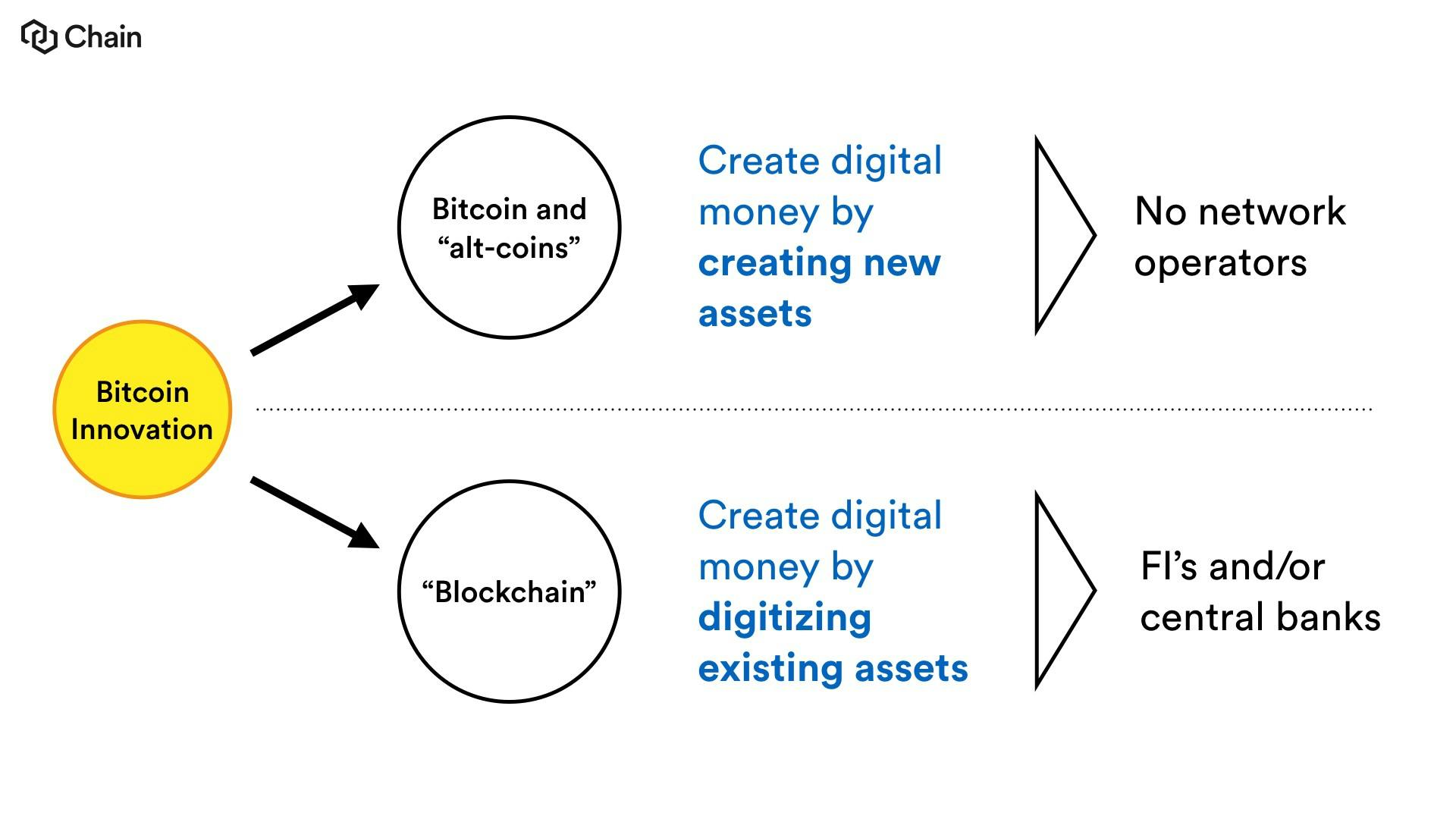
This diagram makes no sense.
This diagram from Adam’s talk shown above makes no sense. The yellow circle represents the founding of Bitcoin. It then splits into two parts, “Bitcoin and alt-coins”, and “Blockchain”. The problem here is that there is no Blockchain without Bitcoin:
The downward fork from the “Bitcoin innovation” bubble (!) has an intermediary step called “Create digital money by digitizing existing assets”. This is hand waving nonsense. The only thing that can be offered here is serializing assets against a database and nothing more. Note also how the upper terminating bubble says “no network operators” which makes is seem like its a dead end of sorts. Of course the exact opposite is true; the bubble actually contains everyone on Earth who has a computer; they can all access the Bitcoin network as peers and use it as money without permission of “FIs or Central Banks”. This is a very problematic diagram, whose effect is to mischaracterize the difference between the Bitcoin network and the Blockchain without Bitcoin snake oil being offered.
Blockchain: a not a new medium for money
The yellow circle in the previous diagram contains Bitcoin as an innovation. The big idea of Bitcoin is that it is money out of control of the Federal Reserve and the central banks. Its big idea is that the nature of money is not subject to twisted inhuman and destructive fantasies like Keynesianism. The big idea of Bitcoin is that money is forever fixed in its supply and that it can never be revoked or replaced with bad money.
Using music and movies as an analogy to Bitcoin is helpful when talking about the disruptive effects of software, but in the case of Bitcoin, the disruption is not in the manner that Adam and the Federal Reserve would like. Converting music and books into data has meant that no one ever need pay for music or books again, unless they choose to. The market structure of the music and movie industry has been transformed by force, and there is nothing that the State can do to stop people copying music and movies. This is an absolute, indisputable fact.
The losers in the music and movie industries are the companies that used to sell physical products to consumers that contained their intellectual property. Now that music and movies have been dematerialized, the losers are the music and movie businesses and the winners are the public.
The same will now happen with the dematerialization of money. The central banks and the State will be the losers, and the winners will be the public, as people move to private (in both senses) monies like Bitcoin, completely cutting out the central bank’s fraudulent fiat currencies. There are only advantages to switching to Bitcoin, and no downsides. You will never see a story like this in the future:
when everyone runs their own bank, with global access to send and receive money without permission, in any amount, you will never again see people complaining that a bank where they had an account has shut off their access to their own money. All the artificial rules and restrictions of the central bank licenced banking system evaporate in Bitcoin. Because it is frictionless and feels extremely satisfying and empowering compared to banking, Bitcoin will transform the world at a rapid pace, and anyone using it will be able to move faster than other market players. They will have a built in advantage when they use Bitcoin; word of this will spread and The Transformation will be unstoppable like nuclear fission.
Bitcoin is not a simple transition to a new medium. It is a paradigm shift. Every assumption about what money is, how it is stored, who should control its production, how it is transmitted and managed is turned on its head in Bitcoin. This is not a simple matter of moving from Oracle to MySQL; this is the equivalent of computing without computers. Its something that is very hard to accept for people inured to the idea that the State should be the sole provider of money; Bitcoin is money without the State. It is banking without banks. Its wire transfer without wire transfer services. It destroys everything that the 100 people at this meeting rely upon and take for granted. It ends their world forever.
Bitcoin is not a bearer instrument. It is not like a silver certificate dollar from the time before the dollar became entirely illegitimate.
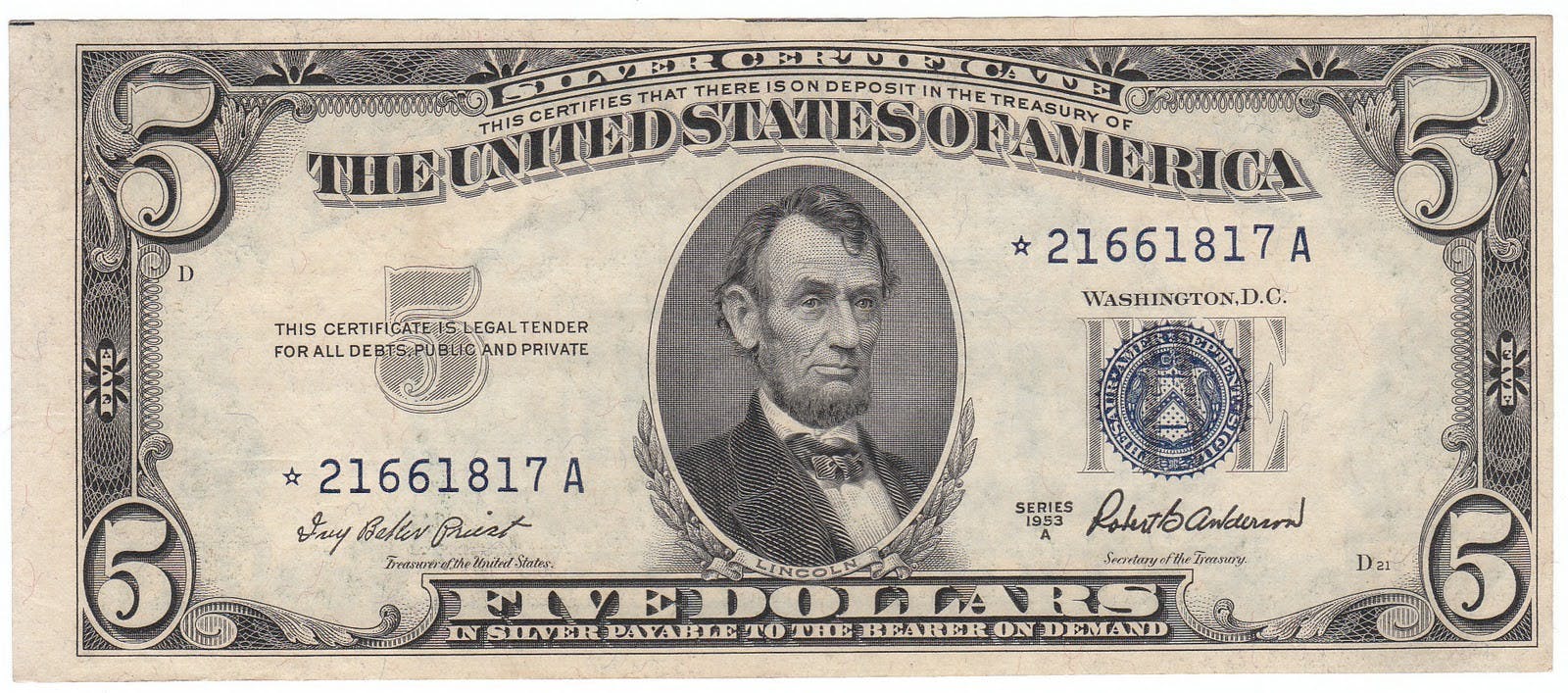
A 1953 five dollar silver certificate, redeemable to the bearer on demand. Serial number 21661817 A
a bearer instrument is, as this five dollar note is, a certificate redeemable by someone for something of value. In the past, everyone knew that the paper money was not valuable in itself; it was only a place holder for real money held by the bank, which was either gold or silver. Everyone knew that if they wanted to, they could redeem the paper for actual money and so they were willing to conditionally and temporarily accept the paper tokens in lieu of real money for their daily transactions.
That is the true nature of a bearer instrument; it is a document or note backed with a legally binding promise and guarantee from an institution, redeemable on demand to whoever has the note in their hand “the bearer”.
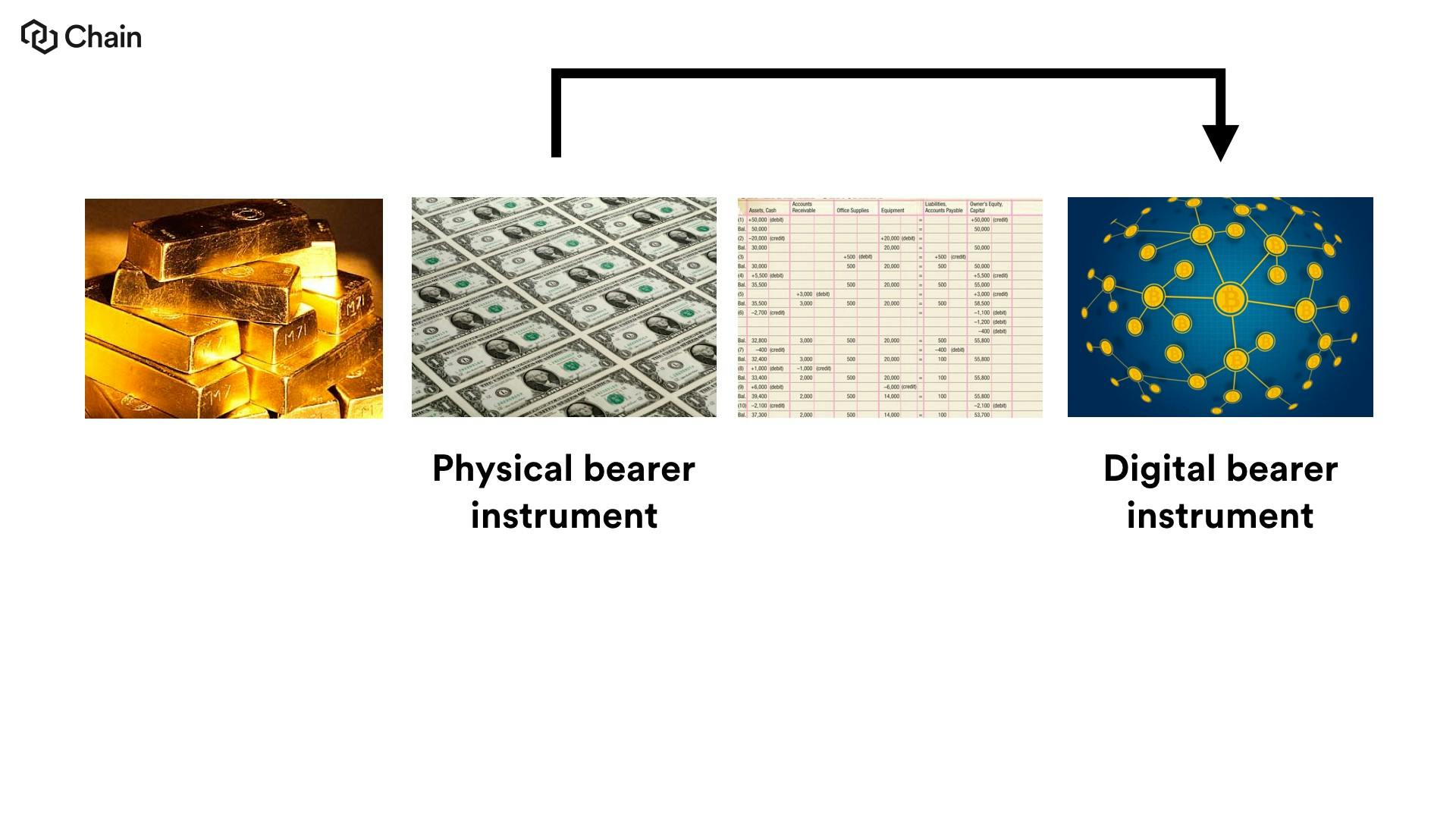
Another bogus illustration
Bearing this in mind you can see immediately why Bitcoin is not a bearer instrument, quite apart from the technical reality of Bitcoin that it never moves from one place to another, and is never borne by anyone. It is not backed by any institution, is not redeemable for anything and has no promise, guarantee or contract of any kind from anyone anywhere on Earth attached to it.
And this is the incredible breakthrough of Bitcoin.
Not only has the double spending problem been solved, but the problem of relying on a trusted issuer has been eliminated. Now, everyone in the market is the entity that promises to return goods of any kind in return for Bitcoin. Instead of a money backed by gold and silver, Bitcoin is backed by all the goods on Earth. Anyone with anything to sell for Bitcoin is acting like a guarantor of the value of Bitcoin; instead of a central bank guaranteeing to give you silver for your certificate, each market participant guarantees to deliver you goods of any kind for Bitcoin, on demand.
The idea of central bank silver backed money has been turned on its head, disintermediated and decentralized. Now the source of the value of fiat currency, in this case Bitcoin, is distributed and pushed into the market itself. Now money is not separate from the market, it is part of the market at a purchase by purchase level. It is so fine grained that it is hard to grasp its size and impossible to measure its complexity. All goods and money are one in the new economy; “The Transformation“. In the light of this, the idea that anyone should rely on a State issuer of an alt-coin for money is absurd.
A key principle of a bearer instrument is that you do not have to rely on anyone to spend it. You can steal a $20 note, wave it around and claim that you are the owner, but that would be a lie. All you are doing by waving that stolen note is showing that you posses it, not that you are its owner. If you hand that stolen note to someone else, you are trafficking in stolen goods, and the recipient is no more the legitimate owner of it than you the thief are. Having control of a thing does not mean you are the owner of a thing. Subtle matters of rights are absent from the thinking of anyone who believes that the Federal Reserve and its funny money are something to look up to and preserve.
During his talk, Adam sent some Bitcoin to the Wikimedia Foundation, whereupon he claimed that, “It is as if I handed them cash”. Of course, this is not at all true. What really happened is that nothing moved at all. He signed a transaction on the Bitcoin database, assigning a portion of existing Bitcoin to the Wikimedia Foundation’s private address, using their public key to lock the data to them. He did not “transfer” anything, and sending Bitcoin is nothing like handing over cash. Unfortunately, when you are trying to describe what Bitcoin is to men who think a computer’s CPU is the fan, you are very restricted in the analogies you can use.
Bitcoin is not money. Its function and use should not be subject to any law that covers money, and it is no different to any other software that is in use today. Bitcoin is a digital messaging system. It is a messaging system that relies on cryptography rather than trusted intermediaries. It is a messaging system, and nothing more. It can be used to send and store any sort of message, but it is best at simulating money. That is the truth.
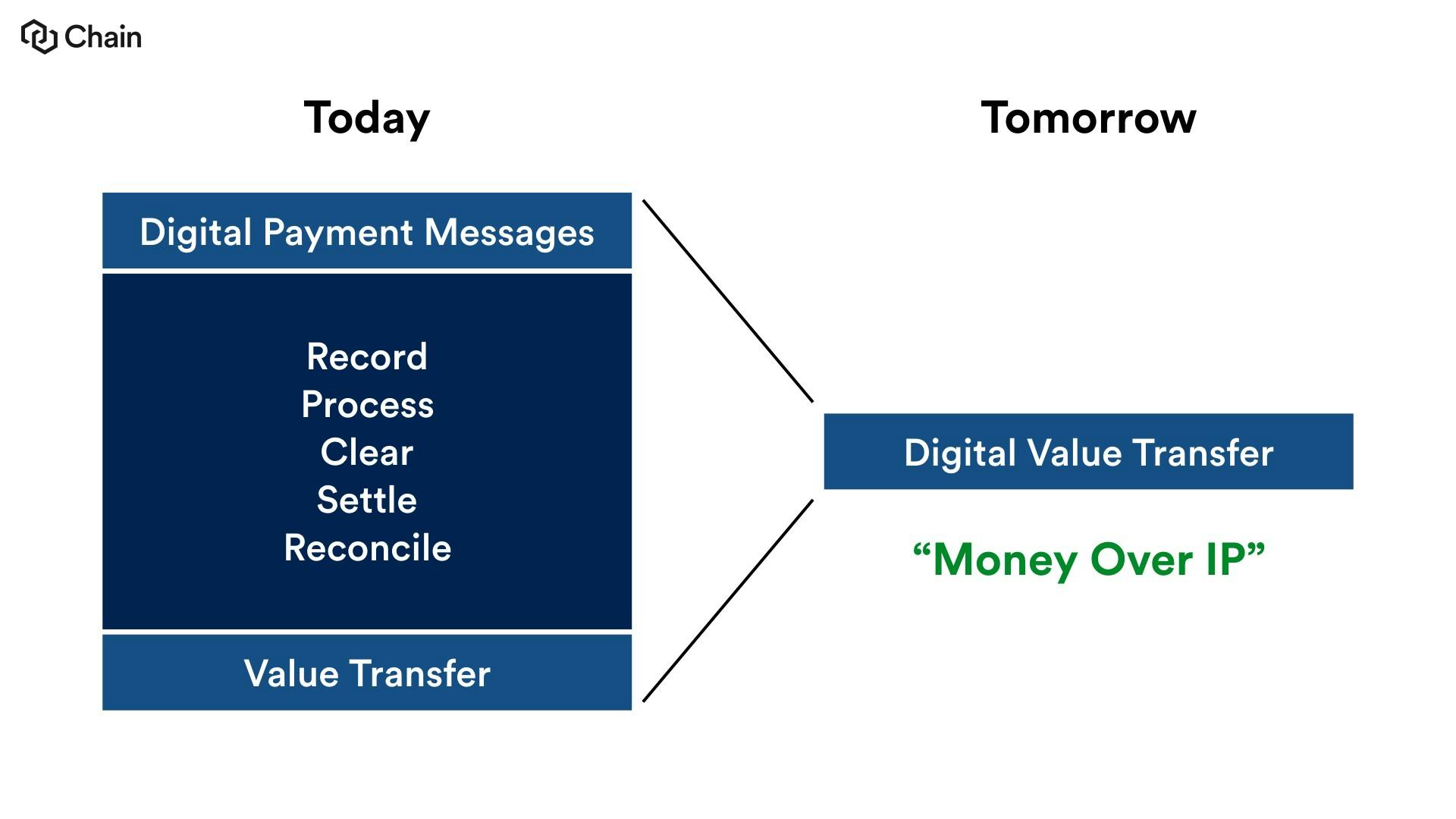
The goal of the blockchain industry is to sell its software to computer illiterates. Its goal is not greater efficiency, transparency or integrity; all of those things are gained from Bitcoin, and are negated by running private “permissioned” databases. In his analogy, Adam likens the blockchain industry to having a dollar to make a settlement, but this analogy is flawed; there is only one issuer of dollars, and what blockchain industry vendors are offering are not a single trusted, best, infallible authority as the US was when it issued its gold certificates, but counterfeit Bitcoin. Money over IP is a neat way of describing Bitcoin, but the TCP/IP and all other protocols are global and standardized. You do not have separate Internet network protocols for each nation on earth; they are all on the same protocol by default. That is why they are interoperable. FedCoin interacting with EUCoin interacting with RubleCoin interacting with IranCoin, where each one has a separate incompatible blockchain, each with a different money supply and policy is a non interoperable model.
Bitcoin, if it is the TCP/IP of money
must be a global standard, with a set of rules that are unbreakable. If you do not want to participate in Bitcoin (the Internet) then you are free to decline the offer, but you cannot impose a broken standard on the entire globe. This is what Adam is advocating.
A future enabled by digital bearer instruments on blockchain networks is not possible if there are different blockchains with different rules. They will not be able to interoperate and share a base of tokens and the one true Bitcoin will always dominate. There will be no market advantage to using these alt-coins, even if they are issued by the Federal Reserve. The world is bigger than the USA, and other countries will not accept US domination, as they refused it with GSM.
Digital transfer without copying: Yes its impossible
Understanding Bitcoin is hard. Not only do you need to throw away years of training but you need to have an understanding of computers and the nature of data. Not many people have these attributes.
Adam claims that Bitcoin works because you can transfer a “digital object” without copying it. This is false. Bitcoin doesn’t have anything to do with objects. It works by digital signatures. Saying “It works by digital signatures” by itself cannot convey what a digital signature is, but that doesn’t matter right now. What matters is that Adam does not know what a digital signature is, and if he does, he failed to explain it to the central bankers at this meeting.
You can call Bitcoin “digital bearer instruments” but someone else could call them another thing. Why should your definition be the default that everyone is forced to live by and adhere to by law? And if you convince a great number of people that your description is appropriate, why once again, should anyone be forced to operate by it? No single man or group of men has the right to define what software is or the sole legitimate purpose of it. These people do not have the right to fence in software and compel everyone to operate by their rules.
No one needs perfect analogies to describe Bitcoin; the use cases and products come from software engineers and entrepreneurs only and not from bureaucrats, journalists and busybodies.
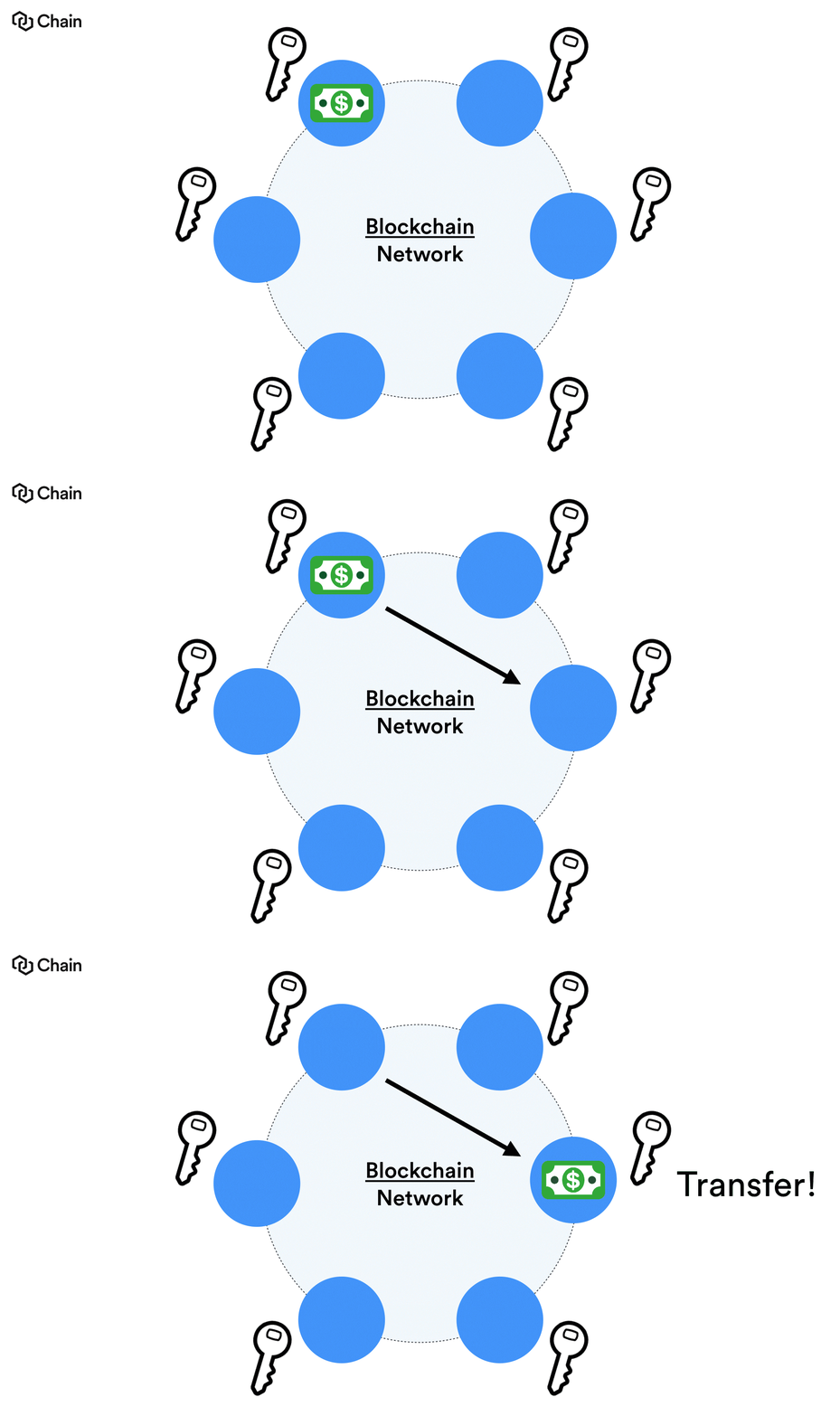
Transfer without copying is not a good analogy. What happens in the Bitcoin database is no different to what happens in other databases; data is copied. The thing that makes Bitcoin special is that you need special permission to copy data on the database, and this is through private keys.
Credit where credit is due; Adam’s description here is perfect:
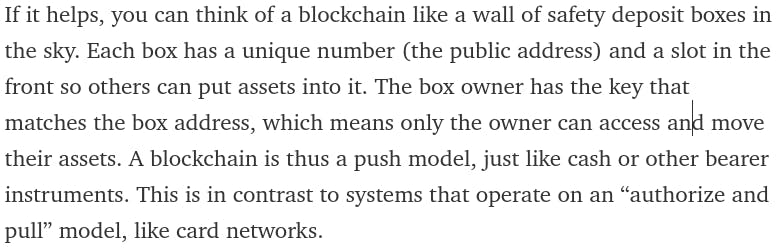
He got this right.
But then he goes on to claim that “We can put many different types of assets on blockchain networks.” which is not true. Bitcoin only stores signatures, and nothing else. Nothing can be put on to it, and there can be no “blockchain networks” just as there can’t be more than one Internet. There can only be one Bitcoin, and you do not control it.
Bitcoin tagged to shares can be traded without counterparties, but that cuts out the State and its mechanisms. A first big attempt at doing it is The DAO, and this idea has been floating around for some time. All the best models see the State and actors like Adam as a threat, because they are courting the State to make it harder for people to enter the market. They want to close off software developer’s access to the people. It is unethical and evil, and they cannot ever win.
How do financial assets get on the network? They don’t.
Bitcoin exists only to fulfil its purpose; to show which keyholder controls what database entries, and that is all. It does nothing else, and that is sufficient for it to act as an intermediary in all transactions for goods and services.
You do not need to “put an asset on the network”. All you need Bitcoin for is a means of accounting for something. Once again, this idea of “putting assets on the network” is an example of computer illiterates trying to find a use case for something designed to do a job that they do not believe needs to be done. None of these people believed that there was a need for Bitcoin before Bitcoin existed; they were all happy with the Federal Reserve and its fiat currency, inflating money supply and all the ills that were borne of it. They had no interest in cryptography, privacy and especially financial privacy, which they believed was inherently criminal and they still do.
Now a tool emerges that solves problems they did not even know they had, and they cannot accept that they have been wrong about something central to their existence and identity their entire lives: money. Rather than accept that their eyes have been opened and they are now free to emerge from Plato’s Cave, they stamp their feet and like a spoiled child and say NO!. “We are going to re-purpose this tech for something else; we are going to ensure the continued existance of this dark cave by adapting Bitcoin to the Federal Reserve, where we feel safe!”.
Unfortunately for them, staying in the cave is not an option. Millions of people are going to escape, and because Bitcoin will absorb all the money and assets on Earth, they will not be able to eat falafel without touching Bitcoin in some way. Today, you cannot buy or sell oil in anything other than US Dollars. Iraq was destroyed because it tried to denominate its oil in a currency other than the Dollar. In the future, all commodities will be denominated in Bitcoin. No one will accept any fiat currency for real world goods, because the the Emperor will be stripped naked; everyone will understand that fiat currency is fraudulent and insecure (in more ways than one) and the only acceptable money for international trade will be Bitcoin.
A FedCoin will not be accepted globally for several reasons. First, it will be technically inferior from a monetary theory perspective and a privacy perspective. Second it will have the taint of the US Government on it, making it unpalatable to many countries on Earth. Only Bitcoin, the neutral, technically superior, a-political, global crypto-currency will be universally acceptable. It is policy neutral, ethical, untainted, reliable, fungible and the most secure. It cannot be revoked, changed, restricted, and very soon, spied on. Bitcoin respects your human rights; this is something that the Federal Reserve and the central banks can never offer, because they are wedded to Keynes, the childless, “The future doesn’t matter” wealth destroyer and his demonstrably false economic theory.
The “Internet of Things” fad is fascinating, but it is not needed to make Bitcoin more exciting. What is exciting about Bitcoin is the complete transformation of society from fiat currency to irrevocable sound money. Bitcoin is not needed to open your car door, or do some other Heath Robinson function. Bitcoin is transformative enough as a single use tool. Its effects will be unprecedented and global. The petty, unimaginative, low horizon scenarios where Bitcoin is stuffed into 20th Century business models are quite frankly, boring. No, not that Boring.
Anyone is free to develop whatever software they like, of course, but this FedCoin proposal is unethical because it will have the force of law behind it in the form of Legal Tender laws. In a properly operating market, these ideas
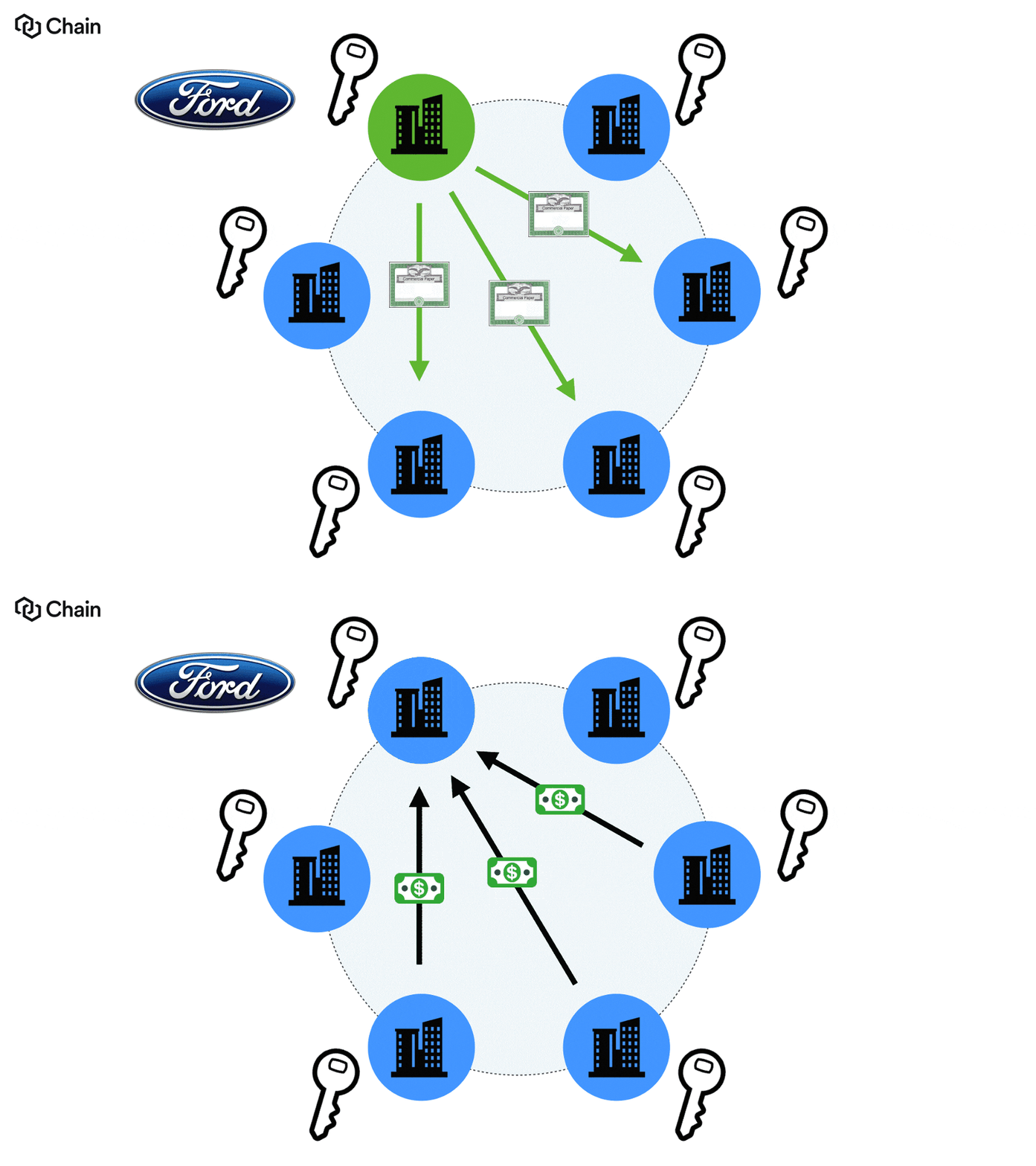
DERP
would die because they are bereft of merit. In a world where there is a monopoly of force in the market, bad ideas can be made to appear to succeed, which is absolutely unnatural; as unnatural as the idea of “issuing dollars onto the network”. This statement betrays a fundamental misunderstanding, and if not misunderstanding a wholesale rejection of the raison d’être of Bitcoin.
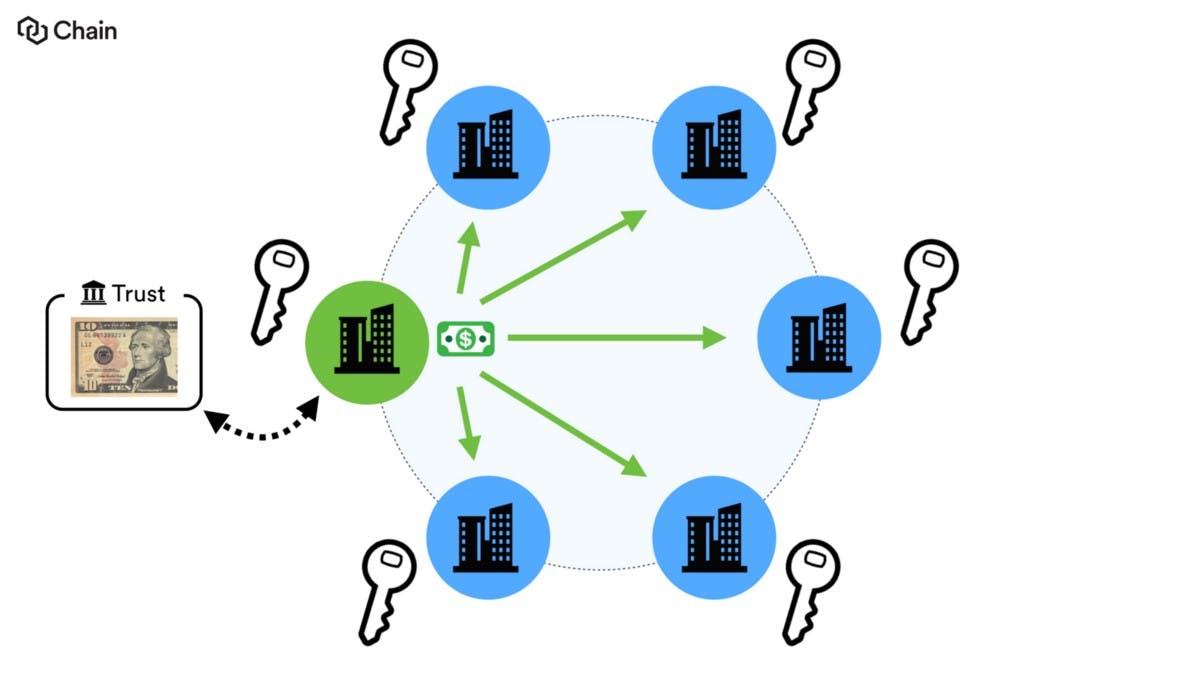
This is so…. WRONG!
The diagram to the left is completely absurd. The word “trust” appears above the central bank, which is in fact the very fount of distrust, deception and theft. If the central bank is the seed of this diagram, everything that flows from it is fundamentally flawed and tainted. This is precisely the present fiat currency system, only transposed to Bitcoin. It is exactly the trusted central bank element of this diagram that Bitcoin was designed to exterminate. The funny money, worthless, backed by nothing, multi colour Jefferson note is now a symbol of fraud, not trust, and this shocking realization is spreading globally. Even the repulsive “IS” knows that the US Dollar is the enemy of all living people and they are doing something about it:
The fiat dollar coming from this trust box of course, will not be a limited supply currency, but a fraudulent digital currency guided by Keynesianism, whose parameters will be secret and whose operation will also be hidden on private servers. This is an absolute requirement by government, as seen in the video above of Bernanke being grilled by Socialist Bernie Sanders. The Federal Reserve and other central banks use secrecy as a governance and policy tool. The radical transparency of Bitcoin is anathema to them, and they will never accept that everyone everywhere on Earth will be able to audit them by downloding and querying their private blockchain. Can you imagine a tool like OXT showing all the Federal Reserve’s manoeuvres in real time? It even makes me shudder.
Central bank digital currencies are a non starter. First of all, in order to launch one, it would de facto mean invalidating all existing digital balances and paper dollars on Earth. You could not have two systems, a digital alt-coin dollar and the old Oracle / paper systems running in parallel. Additionally it would be like the Federal Reserve or central bank offering consumer banking services direct to the public. Why would anyone need a Chase account if they can get their FedCoin and its iPhone wallet directly from the Federal Reserve? Furthermore. there would be no way to stop people developing software to send and receive these coins anywhere in the world, and of course, to secure the network, they would have to employ the hash power of people outside the government, which would limit the amount of control they had. The Bitcoin network is the most secure because it is big and mined by different self interested parties. Any network that is small can be attacked; you can’t expose your digital tokens to the public and also maintain complete control. You either have an Intranet where its trusted nodes and users, or you have an Internet where trust is moved from the center to the peers. There is no half way measure in this; its one or the other.
Central bank digital currencies are not “a better model” they are a disaster. Just ask the Canadian Royal Bank about their doomed Mint Chip project:
[Why Mint Chip DiedThe Canadian Royal Mint’s attempt to launch its own digital currency has failed. These are the reasons why._medium.com](https://medium.com/@beautyon/why-mint-chip-died-673faa065a82?ref=hackernoon.com)
Based on many of the false assumptions and hubris we see in the central bank’s approach to Bitcoin, Mint Chip was doomed from the beginning because it did not take into account the reality of what money should be. They worked from an incorrect set of assumptions, and built a product to a specification that was entirely in error. Bitcoin on the other hand, was built from entirely correct assumptions and observations about how central bank issued fiat currencies work. That is why it is so powerful; it is fundamentally correct.
That anyone can claim that a FeCoin is good because it is “backed by the full faith and credit of the U.S. government.” shows they either know nothing about the true nature of government fiat currency or they are being sarcastic. Full faith and credit is meaningless. The destruction of the US Dollar is proof of this
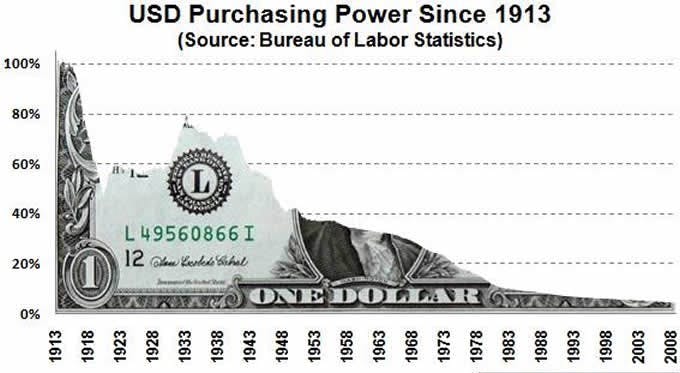
This same organization, that oversaw the obliteration of the value of the US Dollar, is now, for no reason, going to be trusted with the creation of an alt-coin that is to replace Bitcoin? Surely this is a joke.
All the elements proposed to make this FedCoin digital currency a reality were invented by the free market. From the idea of wallets on phones onward, none of it has come from the State. That everyone should now just give up their Liberty to accept a FedCoin is a risible idea. There is no way this is going to happen, and if it is mandated in the USA, it will be GSM vs CDMA all over again, and the USA will be forced to capitulate. No one on Earth will accept the domination of a US controlled alt-coin as the global reserve currency. Only a neutral, global, ethical, unmalleable, transparent and stateless digital currency, Bitcoin, will be acceptable to everyone as the keystone money of the Earth. What the Esperanto people failed to do with language, Bitcoin will succeed with money!
What does the future hold for central bankers and regulators?
The answer to this is nothing.
This is the explicit purpose of Bitcoin; to eradicate the central banks and put the money function out of reach of regulators permanently. People are asking the wrong questions about Bitcoin. One of these wrong questions is “What role should we (the state) play in the emerging digital asset economy?” The answer is you have no role to play. You are now nothing more than peers on the network at best. You will only be tolerated if you provide a useful service. Any anti-Bitcoin action you take will be rejected by the network’s users. Your only option now is to capitulate gracefully and set up a mining farm. Perhaps you could set one up in Fort Knox, which would be an appropriate site. Or perhaps you could re-purpose your redundant, obsolete and repugnant Internet espionage centre in Utah:
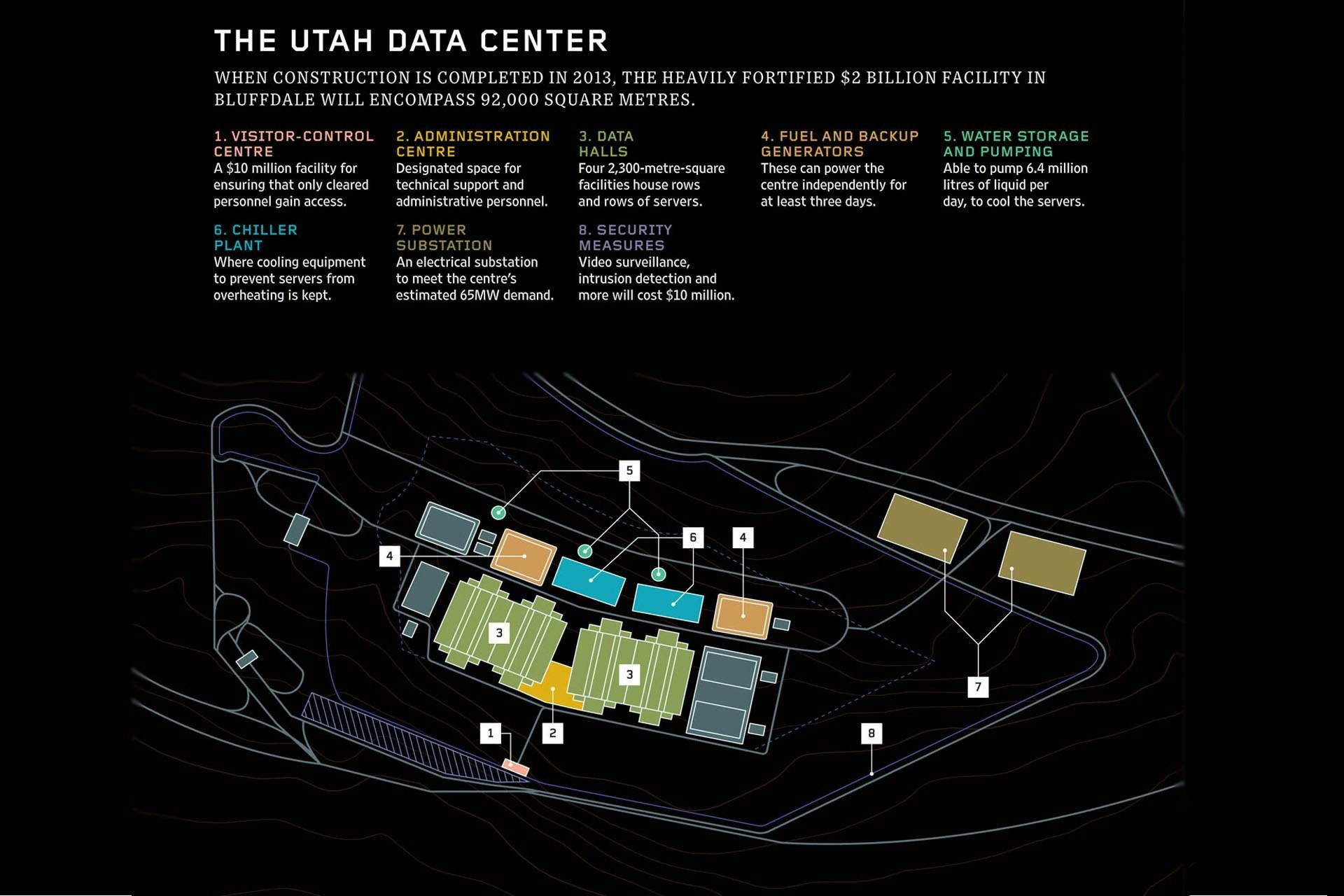
Thanks to Apple and other providers, this espionage den in Utah will soon be made absolutely redundant. Everything is being encrypted; all handsets, email, phone calls and web sessions are going dark with military grade encryption and there is nothing that the NSA can do to stop it. These facilities could however be repurpused to mine Bitcoin, helping to secure the network and earning legitimate money for the US Government.
who knows? Who cares. You people are finished as players in the money business and that is an entirely good and exiting prospect.
Five imaginary roles for pre Transformation actors
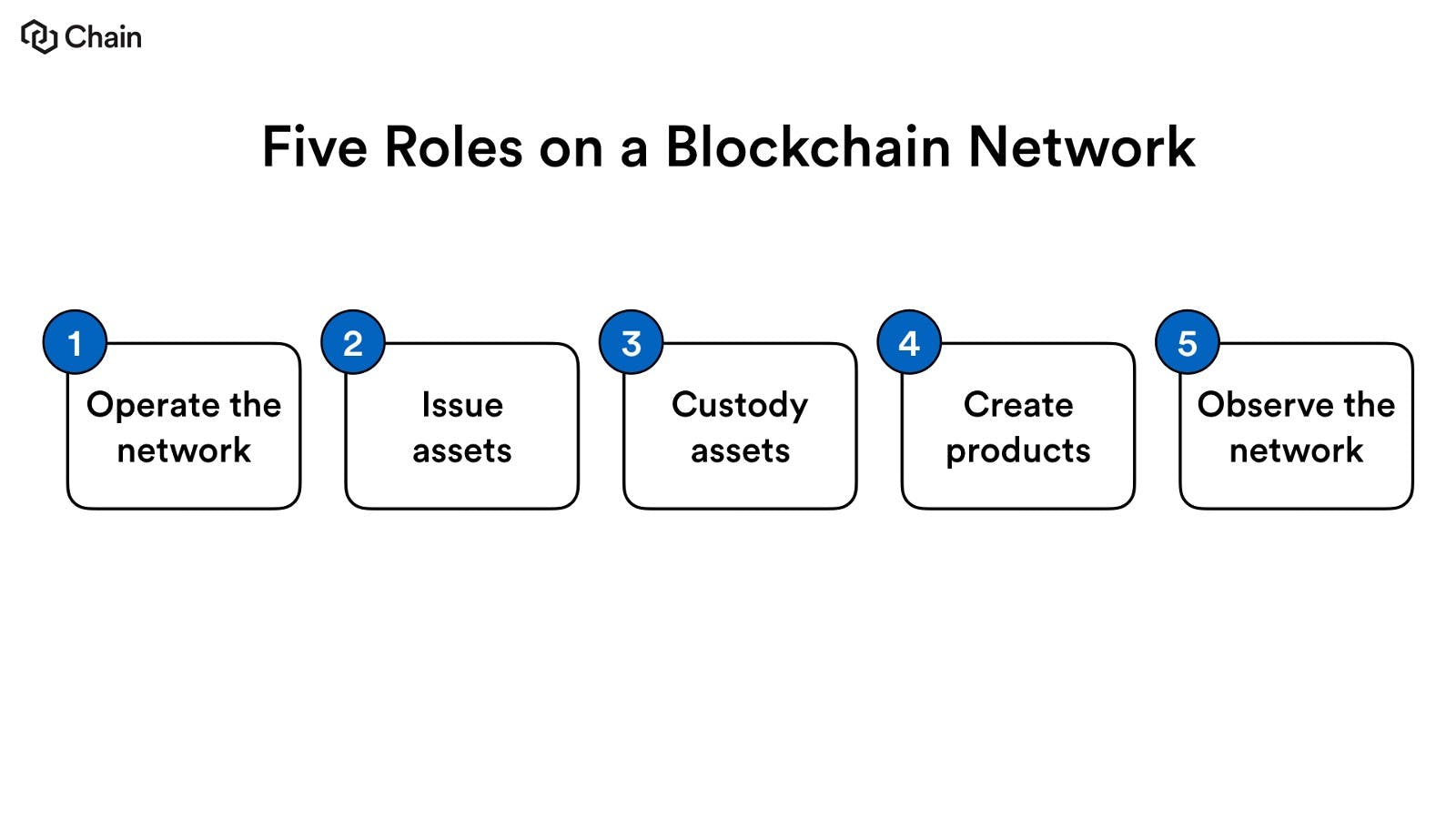
Policymakers have no role in Bitcoin. The policies are all described in the software. No one has a “say” over how it works.
Now on to the five point cheat sheet, presented at the talk, which is typical of the sort of thing produced by faulty assumptions.
You can initiate and operate a network, but it will be worthless because it is not Bitcoin, you can issue assets onto it, control who has access to it, write your own rules, create products and services that run on your network, but it will never be Bitcoin, will never have the commercial advantages or global network effects of Bitcoin and there will always be a better competitor on the Bitcoin network, that offers products without hassle or intrusions into user privacy.
The DAO is a good example of this. No one knows who is investing in it and it has raised $180 million in Etheriums “Ether” coins. There is no requirement to identify yourself to The DAO; the network takes care of identity, which is folded into who controls the private keys. Everyone who can think wants a system like this, and the more systems like The DAO succeed, the more popular they will become. A FedCoin cannot ever keep up with Open Source free market innovations and products. They can barely understand the first generation that now exists. They have no hope of competing, not only because they have a technology deficit, but because they are competing against the network - the entire global network.
Bitcoin provides protections for privacy. You may have a tool to measure the system, but you will be powerless to interfere in its operation.. Compliance is set to become a thing of the past. You will not be able to ever again answer questions about collateral ownership and anything else to do with what people are doing on the market. Central bank digital currency will never replace Bitcoin, it will never power international settlement, and the system will operate with no counterparties. Policy makers are going to be made redundant. Their means for influencing liquidity will be permanently disallowed and banished. This is the true face of the future staring central bankers in the face; absolute annihilation and obliteration.
Imaginary “Blockchain networks” will not lead to a safer and better payments system; that system already exists, and has a seven year service record of uninterrupted and perfect performance: Bitcoin. Central bank alt-coin currencies will not be the foundation of a global system; they will be exposed as fraudulent in the white light, white heat of Bitcoin. The rate of innovation in Bitcoin will outpace any central bank offering, and the vendors relying on Bitcoin Core’s software who may be Statists cannot control the new features being added to it. Bitcoin is being developed for the people of the world, not the benefit of central banks.
Public sector leadership is not and never has been key
Governments have played no role at all as inventors or funders at the infrastructure stage of a Bitcoin. It is a perfect Black Swan emerging from Pandora’s Box. Bitcoin exists at a time where decentralization and disintermediation are the most powerful forces on the market. Just as telephony, photography and news dissemination have changed forever, money is last piece of the puzzle because it was the hardest to solve. It has now been done, and there is no reason why government should be involved in it, just as they were not involved in the switch from nitro cellulose film made by Kodak to digital cameras. Bitcoin is no different to digital photos; its just another data service, and the State has no special privilege or right to control it.
Your offer of a FedCoin will be rejected by the market. There is no way you will be able to stop Bitcoin. In the end, Bitcoin will dominate. You will offer yourselvs as consultants, guardians, guarantors and arbitrators. The answer to all of your offers will be.
No thank you.
If you like the content and feel so obliged to send some love via BTC donations you can do so at the address below:↴

The Brinkmanship of Crypto
By BTCtheory
Posted June 9, 2016
“A specter is haunting the modern world, the specter of crypto anarchy. Computer technology is on the verge of providing the ability for individuals and groups to communicate and interact with each other in a totally anonymous manner. Two persons may exchange messages, conduct business, and negotiate electronic contracts without ever knowing the true name, or legal identity, of the other. Interactions over networks will be untraceable, via extensive rerouting of encrypted packets and tamper-proof boxes which implement cryptographic protocols with nearly perfect assurance against any tampering. Reputations will be of central importance, far more important in dealings than even the credit ratings of today. These developments will alter completely the nature of government regulation, the ability to tax and control economic interactions, the ability to keep information secret, and will even alter the nature of trust and reputation.” ― Peter Ludlow, Crypto Anarchy, Cyberstates, and Pirate Utopias
States believe themselves to be above and beyond the laws and constitutions that created them. They believe they are the law itself, no different from the kings and emperors that came before them. This has driven the world under the leadership of state governments into a dangerous power struggle with their own people. This game of brinkmanship has led to the extreme development and deployment of cryptography as a means to resist tyranny, and will cause for the downfall of states in the coming years as they lose control of the means of communications, exchange, and ultimately their population.
Due to the constant transgressions of all States into a territory to which they have no claim, we have been forced to use the power of encryption to shield ourselves from their glaring eyes. We use encryption to protect the very rights to which we are entitled, but which the state would still deny us. The same aggressive, violent and illegal behavior states display outwardly towards each other, they now present towards their own people. The have pushed us into a brinkmanship that can only end in our mutually assured destruction:
The people, as bound and sworn subjects, and States, as sovereign governments that reign through the power of the Social Contract and constitutions that bind us.
This is how the old social contract is destroyed, and new smarter one is deployed.
Encryption as Resistance to Tyranny
The power struggle for states to control all communications has each state engaged in a civil war against their own citizen for control of all information. States violate civil liberties of their citizens systematically, utilizing violent police actions to respond to our political actions. We are fed propaganda that such actions are for our own safety, and that the state must see all and approve of all to protect against ‘terrorist’ that are little more than a fabrication. We are brainwashed from a young age not to disobey authority or we will be met with the truncheon and broken teeth. Direct physical resistances is impossible and merely gains us broken bones, and lengthy prison sentences. To abscond into bits is our only hope now.
These repressive bodies of armed men under the authority of the state has driven the circumstances which impels the development of cryptosystems. This dangerous game that has all states engaged in brinkmanship against their citizens, violating their right to privacy and interloping into every facet of life for ‘security reasons’. Through these actions, states have caused for the extreme development and use of cryptosystems across the global. States have proven themselves to no longer be trusted, and we must use crypto to protect ourselves from them. People around the globe can now use crypto to negate the economic and political functions of the state, and evade their unjust draconian laws.
Digital currencies are the economic empowerment of cryptosystems that fights against both corrupt bankers, and the corrupt state fiat money system. Over the next several years there will be a florishment of activity from System D, and the global south as they discover what crypto can do for them. This will be at the expense of the contemporary economic and political system, as more and more people choose to exit state economies and political systems, and join the new digital ones.
Economic Resistance Through Digital Currencies
It is inevitable that this new form of technological capital will clash against the old forms industrial capital. Through the creative deconstruction of money as a social ideal, bitcoin recreates capital as access to, and direct ownership of the social network that is money. It renders a new kind of capital that is based upon mathematics, encryption, and technology; which is superior and more efficient that the violent monetary monopolies of state fiat capital.
Crypto provides absolute protection of both ones communications, and now wealth as well. It is from this base of power that we can start to understand the true power at the root of digital currencies.
Bitcoin and cryptocurrencies are new forms of capital that any person can use from anywhere on the planet. We are creating a new world that all may enter without privilege or prejudice accorded by race, economic power, military force, or station of birth. We are creating a world where anyone, anywhere may express his or her beliefs, no matter how singular, without fear of being coerced into silence or conformity. State legal concepts of property, expression, identity, movement, and context do not apply to us. They are all based on matter, and there is no matter here.
Through the understanding and application of cryptocurrenices and cryptosystems to the modern economic and political machine, we are forging a new future; outside and beyond the controls of states from the past.
Digital Solidarity
There is solidarity to be found in our mutual quest to have transparent, privacy-protected form of wealth. This solidarity is transnational in its nature, and can be found among people in every corner of the globe. We now have a mode of true economic resistance that will allow for us to reject the corrupt beast of government and capitalism, while forging a more egalitarian system for all. There is now an economic system which makes economic exploitation much more difficult. This will create a rising tide for all, at the expense of the contemporary capitalist class. Crypto gives people a way to organize, communicate, and exchange for themselves, without the approval of the state and outside of the banking system. This new form of international money can operate outside the bounds and beyond the limitations of any, and all states. It is truly a manifestation of a digital sovereign; an economic and political power that is beholden only to itself.
People of the world will adopt cryptocurrencies in the coming decades, not from the majesty that is offered by the mathematical security of these systems, but the from the sheer economic efficiency they present against the old monetary system. Digital currencies are too efficient and inexpensive when compared to the expensive, corrupt, inept system of finance, exchange, economics, and banking the world has today–the transaction cost of cryptocurrency systems are just too low compared to fiat ones. Digital currencies can help our society solve the fundamental issue that has always existed between money, and exploitation: the control of money itself.
Hidden from the all-seeing oppressive panopticon of the technological totalitarian state; crypto is the organizational weapon against the bureaucratic state, their police armies of death, and their alliances with corrupt capitalist who poison and permanently destroy vast swaths of the natural world. We can now fight back without needing to subjugate ourselves to the violence that will meet us if we organization in the streets. We must strike at the root of the problem, which is economic in nature, and has manifest itself though the control money by a small corrupt group of politicians and bankers. We must end this exploitation, and the only way is to create and use another system of money which they can have no power over.
Crypto Endgame
There is a total war that is happening against all people right now–a grand civil war that has all states engaged against all people. This war is pervasive, all-seeing, and complete in the most insidious ways. The web of torment and despair we have endure can only be made present by the catastrophe asAngelus Novus sees it. This is about far more than just money and economics–this is about justice, redemption, and the creation of a free future for all.
As people start to see through the illusion of money and how governments use that to control their populations; their will be a slow abandonment of government fiat currencies for cryptocurrencies. Through withdrawing our support of fiat money, the old system will collapse upon itself, and there will be a grand jubilee. States will be forced to acknowledge our economic power, and ask for our help–to which we will say no, and we will watch them burn.
The war by the state against citizens is larger than about simply having privacy, or a right to personal wealth–this is about fascism. The insidious, hidden mode in which intolerance and oppression is allowed to exist through an authoritarian state masters commanded by capitalist. These people in government care more about controlling people through violence, than to resolve the problems that propel their populations to demand justice. We can now create that on our own; without their help and beyond their control.
The Fundamental Problems with Ethereum
By Beautyon
Posted June 17, 2016

This was written by Dr. Saifedean Ammous. It was typed in response to a question on twitter… and I agree with it!
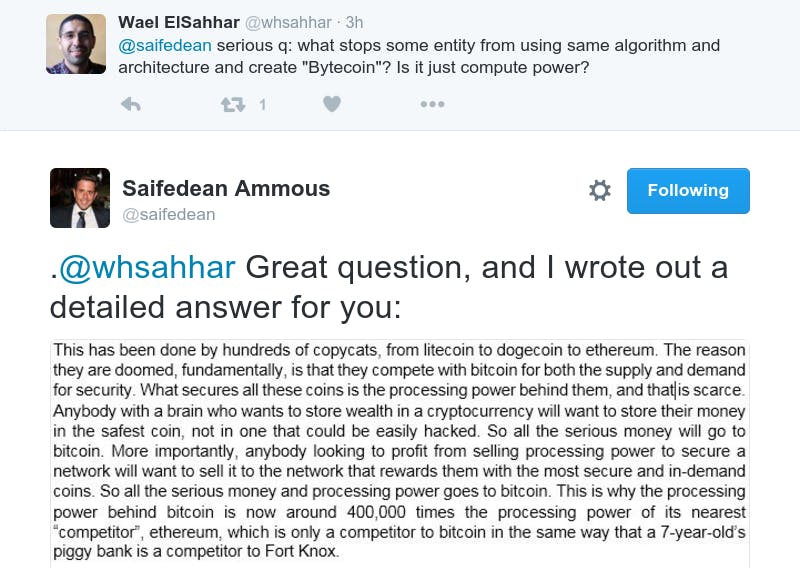
This has been done by hundreds of copycats, from litecoin to dogecoin to ethereum. The reason they are doomed, fundamentally, is that they compete with bitcoin for both the supply and demand for security. What secures all these coins is the processing power behind them, and that is scarce.
Anybody with a brain who wants to store wealth in a cryptocurrency will want to store their money in the safest coin, not in one that could be easily hacked. So all the serious money will go to bitcoin. More importantly, anybody looking to profit from selling processing power to secure a network will want to sell it to the network that rewards them with the most secure and in-demand coins. So all the serious money and processing power goes to bitcoin. This is why the processing power behind bitcoin is now around 400,000 times the processing power of its nearest “competitor”, ethereum, which is only a competitor to bitcoin in the same way that a 7-year-old’s piggy bank is a competitor to Fort Knox.
The processing power bitcoin possesses is an indomitable first-mover advantage. If you introduce an exact copy of bitcoin, there is absolutely no reason why anyone would put money on it, or waste processing power on it. It will die. So all these copycats have tried to introduce features to differentiate them from bitcoin, but that is also doomed, because any useful feature will be better implemented on bitcoin, with better security.
Ethereum have launched a very sophisticated propaganda drive to detract from bitcoin, and got plenty of backing of powerful bitcoin enemies, but they could only do all that by having a central planning committee that decides everything, can change the protocol, and runs a demented Keynesian inflationary monetary policy. So not only are you getting far less processing power and security than bitcoin, you’ve also got yourself a central planning board that could change the rules and fuck everything up on short notice. If you are happy to have the value of your money determined by a central planning committee, you are far better off sticking to the US Dollar because at least its central planning committee is made up of people old enough to testify in court.
Once a cryptocurrency is centralized, the entire point is defeated, and you’re better off relying on centralization in the hands of a government than a bunch of nobody teenagers from a basement unaccountable to anybody. Not to mention that a centralized cryptocurrency can be very easily destroyed by hacking, destroying, blackmailing, and threatening the central planners.
Bitcoin, having no single point of failure, reliant on the word and competence of nobody, and with an unfathomably enormous processing power arsenal protecting it will remain in a class of its own. And anybody who doesn’t believe that will pay a heavy price for failing to understand this, like what happened with the suckers who invested in the DAO. I just hope the customer service of Ethereum is every bit as shitty as that of banks so the lesson is learned with searing effectiveness.
Follow Saifedean Ammous on Twitter.
The Physics of Brute Force
By Aaron Toponce
Posted June 19, 2016
Introduction
Recently, MyDataAngel launched a Kickstarter project to sell a proprietary encryption algorithm and software with 512-bit and 768-bit symmetric keys. The motivation was that 128-bit and 256-bit symmetric keys just isn’t strong enough, especially when AES and OpenSSL are older than your car (a common criticism they would mention in their vlogs). Back in 2009, Bruce Schneier blogged about Crypteto having a 49,152-bit symmetric key. As such, their crypto is 100% stronger, because their key is 100% bigger (than 4096-bit keys?). Meganet, which apparently still exists, has a 1 million-bit symmetric key!
It’s hard to take these encryption products seriously, when there are no published papers on existing primitives, no security or cryptography experts on your team, and you’re selling products with ridiculous key lengths (to be fair, 512-bit and 768-bit symmetric keys aren’t really that ridiculous). Nevermind that your proprietary encryption algorithm is not peer-reviewed nor freely available to the public. Anyone can create a symmetric encryption algorithm that they themselves cannot break. The trick is releasing your algorithm for peer review, letting existing cryptography experts analyze the design, and still coming out on top with a strong algorithm (it wouldn’t hurt if you analyzed existing algorithms and published papers yourself).
So with that, I want to talk a bit about the length of symmetric keys, and what it takes to brute force them. Bruce Schneier addressed this in his “Applied Cryptography” book through the laws of thermodynamics. Unfortunately, he got some of the constants wrong. Although the conclusion is basically the same, I’m going to give you the same argument, with updated constants, and we’ll see if we come to the same conclusion.
Counting Bits
Suppose you want to see how many bits you can flip in one day by counting in binary every second. Of course, when you start counting, you would start with “0”, and your first second would flip your first bit to “1”. Your second second would flip your second bit to “1” while also flipping your first bit back to “0”. Your third second would flip the first bit back to “1”, and so forth. Here is a simple GIF (pronounced with a hard “G”) counting from 0 to 127, flipping bits each second.

By the end of a 24-hour period, I would have hit 86,400 seconds, which is represented as a 17-bit number. In other words, every 24 hours, flipping 1 bit per second, I can flip every combination of bits in a 16-bit number.

By the end of a single year, we end up with a 25-bit number, which means flipping a single bit every second can flip every combination of 24-bits every year.

So, the obvious question is then this- what is the largest combination of bits that I can flip through to exhaustion? More importantly, how many computers would I need to do this work (what is this going to cost)?
Some Basic Physics
One of the consequences of the second law of thermodynamics, is that it requires energy to do a certain amount of work. This could be anything from lifting a box over your head, to walking, to even getting out of bed in the morning. This also includes computers and hard drives. When the computer wishes to store data on disk, energy is needed to do that work. This is expressed with the equation:
Energy = kT
Where “k” is Boltzmann’s constant of 1.38064852×10⁻¹⁶ ergs per Kelvin, and “T” is the temperature of the system. I’m going to use ergs as our unit, as we are speaking about work, and an “erg” is a unit of energy. Of course, a “Kelvin” is a unit of temperature, where 0 Kelvin is defined as a system devoid of energy; also known as “absolute zero”.
It would make the most sense to get our computer as absolutely cool as possible to maximize our output while also minimizing our energy requirements. Current background radiation in outer space is about 2.72548 Kelvin. To run a computer cooler than that would require a heat pump, which means adding additional energy to the system than what is needed for our computation. So, we’ll run this ideal computer at 2.72548 Kelvin.
As a result, this means that to flip a single bit with our ideal computer, it requires:
Energy = (1.38064852×10⁻¹⁶ ergs per Kelvin) * (2.72548 Kelvin) = 3.762929928*10-16 ergs
Some Energy Sources
The Sun
Now that we know our energy requirement, let’s start looking at some energy sources. The total energy output from our star is about 1.21034 Joules per year. Because one Joule is the same as 1107 ergs, then the total annual energy output of the Sun is about 1.2*1041 ergs. So, doing some basic math:
Bits flipped = (1.2*1041 ergs) / (3.762929928*10-16 ergs per bit) = 3.189004374*1056 bits
3.189004374*1056 bits means I can flip every combination of bits in a 2187-bit number, if I could harness 100% of the solar energy output from the sun each year. Unfortunately, our Sun is a weak star.
A Supernova
A supernova is calculated to release something around 1044 Joules or 1051 ergs of energy. Doing that math:
Bits flipped = (1051 ergs) / (3.762929928*10-16 ergs per bit) = 2.657503608*1066 bits
2.657503608*1066 bits is approximately 2220-bits. Imagine flipping every bit in a 220-bit number in an orgy of computation.
A Hypernova
A hypernova is calculated to release something around 1046 Joules or 1053 ergs of energy. Doing that math:
Bits flipped = (1053 ergs) / (3.762929928*10-16 ergs per bit) = 2.657503608*1068 bits
2.657503608*1068 bits is approximately 2227-bits. This is a computation orgy turned up to 11.
Of course, in all 3 cases, I would have to harness 100% of that energy into my ideal computer, to flip every combination of these bits. Never mind finding transportation to get me to that hypernova, the time taken in that travel (how many millions of light years away is it?), and the cost of the equipment to harness the released energy.
Bitcoin Mining
As a comparative study, Bitcoin mining has almost surpassed 2 quintillion SHA-256 hashes per second. If you don’t think this is significant, it is. That’s processing all of a 60-bit number (all 260 bits) every second, or an 85-bit number (all 285 bits) every year. This is hard evidence, right now, of a large scale 256-bit brute force computing project, and it’s barely flipping all the bits in an 85-bit number every year. The hash rate would have to double (4 quintillion SHA-256 hashes every second) to surpass flipping all the bits in an 86-bit number every year.
Further, we do not have any evidence of any clustered supercomputing project that comes close to that processing rate. It can be argued that the rate of Bitcoin mining is the upper limits of what any group of well-funded organizations could afford (I think it’s fair to argue several well-funded organizations are likely Bitcoin mining). To produce a valid conspiracy theory to counteract that claim, you would need to show evidence of organizations that have their own semiconductor chip manufacturing, that has outpaced ARM, AMD, Intel and every other chip maker on the market, by several orders of magnitude.
Regardless, we showed the amount of energy needed anyway to flip every bit in a 256-bit number, and the laws of thermodynamics strongly imply that it’s just not physically possible.
Asymmetric Cryptography
Things change when dealing with asymmetric cryptography. Now, instead of creating a secret 256-bit number, you’re using mathematics, such as prime number factorization or elliptic curve equations. This changes things drammatically when dealing with key lengths, because even though we assume some mathematical problems are easy to calculate, but hard to reverse, we need to deal with exceptionally large numbers to give us the security margins necessary to prove that hardness.
As such, it because less of a concern about energy, and more a concern about time. Of course, key length is important up to a point. We just showed with the second law of thermodynamics, that brute forcing your way from 0 to 2256 is just physically impossible. However, finding the prime factors of that 256-bit number is a much easier task, does not require as much energy, and can be done by only calculating no more than half of the square root amount of numbers (in this case, 2127, assuming we’re only testing prime numbers).
As such, we need to deal with prime factors that are difficult to find. It turns out that it’s not enough to just have a 512-bit private key to prevent the Bad Guys from finding your prime factors. This is largely because there are efficient algorithms for calculating and testing prime numbers. So, it must also be expensive to calculate and find those primes. Currently, best practice seems to be generating 2 1024-bit prime factors to produce a 2048-bit private RSA key.
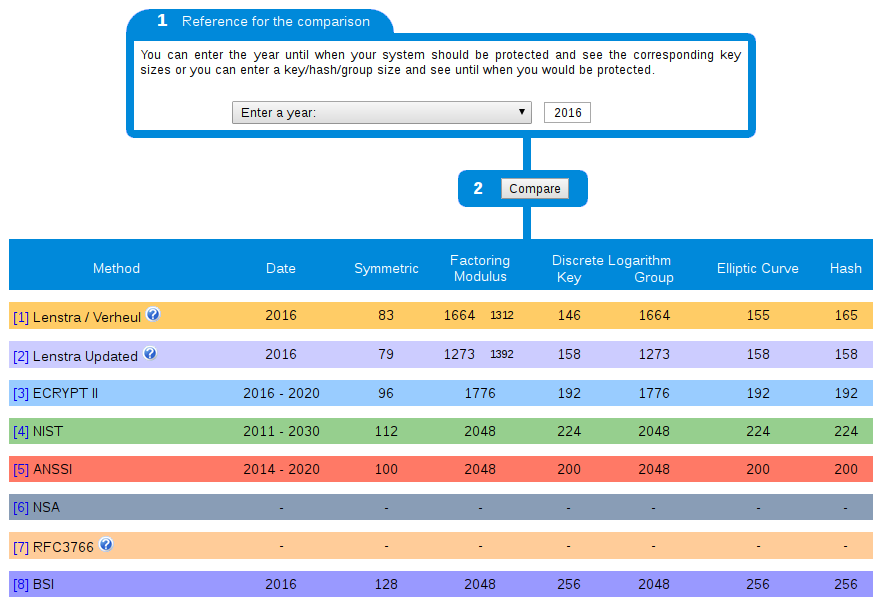
Fixed-length Collision-resistant Hashing
Fixed-length collision-resistant hashing puts a different twist on brute force searching. The largest problem comes from the Birthday Attack. This states that if you have approximately the square root of 2 times 365 people in the room (about 23 people), the chances that any two people share the same birthday is 50%. Notice that this comes from any two people in the room. This means that you haven’t singled out 1 person, and the odds that the other 22 people in the room have that same birthday is 50%. This isn’t a pre-collision search. This is a blind search. You ask the first person what their birthday is, and compare it with the other 22 people in the room. Then you ask the second person what their birthday is, and compare it with the remaining 21 people in the room. And so on and so forth. After working through all 23 people comparing everyone’s birthday to everyone else’s birthday, the odds you found a match between two random people is 50%.
Why is this important? Suppose you are processing data with SHA-1 (160-bit output). You only need to calculate 280 SHA-1 hashes before your odds of finding a duplicate hash out of the currently calculated hashes reaches 50%. As we just learned with Bitcoin, this is practical within one year with a large orchestrated effort. Turns out, SHA-1 is weaker that that (we only need to calculate 264 hashes for a 50% probability), which is why the cryptographic community has been pushing so hard to get everyone and everything away from SHA-1.
Now you may understand why 384-bit and 512-bit (and more up to 1024-bit) cryptographically secure fixed-length collision-resistant hashing functions exist. Due to the Birthday Attack, we can make mince meat of our work.
Conclusion
As clearly demonstrated, the second law of thermodynamics provides a clear upper bound on what can be found with brute force searches. Of course, brute force searches are the least effective way to find the private keys you’re looking for, and indeed, there are more efficient ways to get to the data. However, if you provide a proprietary encryption algorithm with a closed-source implementation, that uses ridiculously long private keys, then it seems clear that you don’t understand the physics behind brute force. If you can’t grasp the simple concept of these upper bounds, why would I want to trust you and your product in other areas of security and data confidentiality?
Quantum computing does give us some far more efficient algorithms that classical computing cannot achieve, but even then, 256-bits still remains outside of the practical realm of mythical quantum computing when brute force searching.
As I’ve stated many times before- trust the math.
Rusty’s Remarkable Unreliable Guide to Bitcoin Storage
By rustyrussell
Posted June 25, 2016
Rusty’s Remarkably Unreliable Guide To Bitcoin Storage: 2018 Edition
About This Guide
This is an opinionated guide to storing your bitcoin securely. You should read this before buying bitcoin.
I wrote this because existing guides are all aimed at experts1, assume knowledge you might not have, or skip over important things like backups, or actually spending your bitcoin.
Check You Have The Right Guide!
This guide is digitally signed by me: you can download it from github where you should see a green “Verified” next to the latest version.
For the technically inclined you can also find my GPG fingerprint here, and my signature on this document in README.md.sig (gpg --verify README.md.sig README.md)
About The Author
I’m Rusty Russell, a Linux kernel hacker best known for writing iptables. I stumbled into bitcoin a few years ago and promptly got distracted by all the cool technology; I ended up employed by bitcoin innovation developers Blockstream because I told them bitcoin is like Linux and I know Linux (no, really!).
Part of this salary deal was about $5000 of bitcoin per year, paid monthly after the first year. I decided to document what I’m doing in the hope that greater minds will provide feedback on what I did wrong. And then return my coins please…
Getting Started
Bitcoins are digital cash; if you get my private key (a big, long, secret number), you can spend my bitcoins from anywhere in the world. This makes me nervous, and it should make you nervous too.
Letting someone else hold my coins isn’t viable either: the history of bitcoin is one of scams and hacks, and it will take decades before we have any idea which bitcoin services are reliable, and which will collapse and take the funds with them.
There are four main concerns for those holding bitcoin:
- Failure: All bitcoins will become worthless. This is a real possibility, but I can’t help you with this one.
- Loss: I will lose my private key and nobody will be able to spend the coins.
- Theft: Someone will steal my private key and take my coins.
- Inconvenience: It will be really hard for me to spend my coins when I want to.
Loss protection, theft protection and convenience are all competing goals, so I’m going to provide a quick guide:
- Beer money. For less than $50, I’d keep it in any online wallet you want. Risks: they could get hacked, go bankrupt, or stop your account. Pros: really easy to use.
- Small investment. For less than $10000, my preference would be any service which doesn’t control your keys, say using 2 of 3 multi-sig, where you control 2 and they control 1. I’ve only got experience with the Greenbits wallet for Android2 (you can also use Green Address’s Chrome app3). Their initial setup UX is mediocre, but they provide two factor for spending above your chosen limit, ability to save your wallet phrase in case you lose your phone, a failsafe if they ever vanish, and they don’t have access to your coins. (Disclaimer: I have Blockstream stock, and they own GreenAddress). Risks: if you use SMS verification on the same phone as the Greenbits wallet, software which hacks your phone could intercept that and spend your money. If you use a different method (eg. phone for SMS verification, laptop Chrome for the app), the hacker would have to hack both phone and laptop. Pros: almost as easy to use.
- Larger investment. For less than $50000, you could use a hardware wallet with a screen. The main options here are the Trezor4 and the Ledger5; it’s probably possible to extract the secret key from the device, but it’d be fairly hard (thus, not worthwhile) and they’d almost certainly need physical access. Risks: the device might be replaced (or “pre-initialized”) before you get it. If someone hacks your laptop, they could silently change the address where you’re sending the funds, so you want to double-check the address using another device for large transfers. They can’t change the amount though. Pros: still fairly easy to use.
- Serious investment. For larger amounts, or the paranoid, a completely offline “safe” is a good idea. That’s what this document is mainly about, and this is what I’m doing: I plan on being at Blockstream for a while, and not spending the bitcoin. Risks: someone hacks your offline machine before you take it offline, or someone substitutes the address you’re sending the funds to and you pay to the wrong place, or you lose the private keys, or you get frustrated with how long it takes to spend bitcoin and make a mistake. Pros: most secure against theft.
- More money than I will ever have. For those carrying millions, I don’t have any useful advice; you need to find a professional who won’t steal all your money.
Setting Up An Offline Safe
We’re going to use bitcoin-core, the bitcoin reference software, to generate a few bitcoin addresses on a machine which has no way of contacting the outside world, we’re going to write down the private keys on paper, we’re going to double-check them, and we’re going to protect those pieces of paper.
Create an Offline Safe
You will need:
- A pen
- Four pieces of paper
- Two USB keys (one least 2GB aka “big”, one at least 4M aka “small”).
- A laptop with two USB ports
For The Extra Paranoid
The extra paranoid will destroy or never reuse those the USB keys in any other machine, maim the laptop, ensure it stays offline forever or destroy it: you can simply buy a cheap $200 laptop or use an old one.
Step 1: Download and Prepare Ubuntu 18.04 (20 minutes)
Ubuntu is a simple, free operating system. It’s easy to install and use, and downloaded thousands of times each day. You can get it from http://releases.ubuntu.com/18.04/ubuntu-18.04-desktop-amd64.iso. You will need a recent laptop (if it’s over 10 years old, it might not support 64 bit, and you’ll get a message about “This kernel requires an x86-64 CPU”).
You should check that you have the real Ubuntu, if you can. On Linux and MacOS this is easy, on Windows you’ll need sha256sum.exe. Use the following commands to sum the file you downloaded, which should match the example below:
- MacOS: shasum -a 256 /tmp/ubuntu-18.04-desktop-amd64.iso
- Windows: sha256sum.exe ubuntu-18.04-desktop-amd64.iso
- Linux: sha256sum /tmp/ubuntu-18.04-desktop-amd64.iso
This should give a number
a55353d837cbf7bc006cf49eeff05ae5044e757498e30643a9199b9a25bc9a34
If the number you get is different, STOP. Something is badly wrong.
Now we need put it on the big USB, so we can install it on the cheap laptop; here are instructions for Windows, MacOS and Linux.
Extra Paranoia (Optional)
Use DVDs instead of the USB sticks, and a laptop which doesn’t have a DVD burner so you know it can never write anything back.
Step 2: Putting bitcoin on the small USB key (10 minutes)
Format the small USB key and put the helper script which matches this HOWTO:
You also need bitcoin and friends on the USB key:
- bitcoind
- libdb4.8++
- libboost-chrono1.65.1
- libboost-filesystem1.65.1
- libboost-program-options1.65.1
- libboost-system1.65.1
- libboost-thread1.65.1
- libevent-core
- libevent-pthreads
- libminiupnpc10
- libssl1.1
- libzmq5
- libsodium23
- libpgm-5.2-0
- libnorm1
- qrencode
- libqrencode
Extra Paranoia (Optional)
(TECHNICAL USERS ONLY) Use the “tar” command (on MacOS or Linux) to place the files directly onto the raw USB device, instead of using a filesystem. This avoids any potential filesystem exploits, and makes it harder for other files to sneak on.
Extra Paranoia (Optional)
Physically remove the wireless and bluetooth cards in your laptop, as well as the speaker. This makes it almost impossible for your private keys to leak out, even if the laptop were compromised somehow.
It won’t help if they laptop has been physically compromised with a secret transmitter, of course. But we have to stop somewhere!
Step 3: Booting Ubuntu on Your Laptop (10 minutes)
- Find the “airplane mode” icon on the keyboard. Mine is on F2; pressing “Fn” and F2 while the laptop is on should stop it transmitting anything. If you don’t have one, goto step 3.
- Turn the laptop on, and activate airplane mode. Then turn it off again. We’re going to leave it in airplane mode from now on.
- Put the big USB into a USB port and turn the laptop on. To make it start from that USB you usually need to hit F12, F2 or F1 during the boot sequence. Google is your friend here, for your particular laptop (or there may be a message on the screen).
- You’ll see a black screen with some text. You can select the “Try Ubuntu without Installing” option and hit return or simply wait.
- You’ll see a purple background with a dots blinking underneath the word Ubuntu as it boots up. Eventually you’ll see a desktop. On the top right, you’ll see 3 icons: left-click the top right, and you should see “Wi-Fi Not Connected”. Left-click on that, then click on “Turn Off”. Now you should see a little airplane on the top right of the screen.
- Insert the small USB.
- Start a terminal: we’re going to do the rest as manual commands. Do this by clicking on the dots at the far bottom left, and typing “term”. You’ll see a TV icon with a
>_in it: click on this. We’re going to type into that box where it saysubuntu@ubuntu:~$. - Let’s make sure the script is the right one, and nobody has modified it. Type the following then hit enter (it’s a single line):
sha256sum /media/ubuntu/*/offlineYou should get the following result numbers and letters (ignore after the space). If not, STOP, something is wrong.
`afc1503fdedb51adaa072719c8a54eafd59ea068311af487afea90033034059a /media/ubuntu/USBKEY/offline`
- Hit F11 to make the terminal full screen.
- Run the script by typing:
python3 /media/ubuntu/*/offline
Step 4: Generating Some Private Keys (5 minutes)
- The script installs and runs the bitcoin program every time; it will complain if something goes wrong, and you should too.
- Make sure nobody can see your laptop screen. No windows, no reflections.
- Type “create” then press enter.
- You will get an address like “342ftSRCvFHfCeFFBuz4xwbeqnDw6BGUey”. Anyone can send bitcoin to this, and only the private key can spend it. You will also get a private key like “L2b68o8EwXQQfWTu7K77Y7Pz9hLqzfb5vjVviJ8NadLXMWHdGYAv”. This is a standard key you could import into other wallets later if you wanted to.
- Write down the public address(es) (3…) on one piece of paper, and write down the private key(s) (L… or K…) on three pieces of paper. It shows you where to split the key into two or three parts, too.
- To generate more addresses and keys, you can do this as many times as you like.
Step 5: Reboot and Check (5 minutes)
Let’s make sure we wrote down that private key correctly!
- Hold down the power button until the laptop turns off. It will forget everything we’ve done.
- Turn it back on, booting off the big USB key again.
- Turn off networking, select “Try Ubuntu”, put in the small USB key, open a terminal, press F11, and run
python3 /media/ubuntu/*/offline. - Select “restore”, and enter your private key (L… or K…). If you got it correct, it should show you the public address which matches. If you didn’t, check for typos (you can use the left and right arrow keys to change your previous answer, and backspace to delete backwards).
- Restore all the private keys you created to check them all.
- Hold down the power button to turn the laptop off.
Extra Paranoia (Optional)
Never put those USB keys in another machine ever again, as it’s possible that malicious software on your laptop could have written information about your keys to them. Keep them with the laptop, and never allow the laptop to go online ever again.
Step 6: Store the Keys Safely
The public address (3…) you can write on the fridge, record in your diary, or email to your own gmail account. The only reason to keep this secret is so that people don’t know how many bitcoins you have. You can get this back as long as you have your private key, anyway.
The private keys must never be disclosed. They’re about 52 letters-and-numbers long, and the first 1 and last 5 or 6 digits are redundant, so if someone got most of the other 45 they could figure out the rest.
A simple scheme would be splitting the three copies of the private key into two pieces as shown by offline; keep the first parts at home, work, and your parent’s house. The second parts at your friend’s house, in your handbag, and in a sealed envelope with instructions wherever your will is stored (eg. with your lawyer).
Sending Bitcoins to your Offline Safe.
Simply send to that public address.
For your own convenience when you come to spend it, you should record the transaction ID, the amount sent, and which output went to your public address: the first output is number 0, the second is number 1, etc (it will usually send some change to another address as well, hence two outputs).
Extra Paranoia (Optional)
Use multiple addresses, and send randomized amounts at different times on different days. Divide it up roughly using random-looking numbers, then for each one, flip a coin: if it’s heads flip again. If that’s heads, make it a round number of bitcoin, otherwise make it a round number of USD at the current exchange rate. This will blend in with other transactions fairly well.
Spending Bitcoins from your Offline Safe (20 minutes)
We will get your offline safe to create and sign a raw bitcoin transaction, which you can send out onto the bitcoin network for miners to include in blocks.
Bitcoin is essentially a ledger of payments: an incoming transaction pays into your address, and you spend that by creating a transaction which sends coins to a new address. Your offline bitcoin progream obviously doesn’t know what transactions exist, so you need to tell it what transaction paid you manually; it can be made to create a new transaction and sign it1. There’s a quick way, and a slow way.
You’ll need:
- Slow way: the raw transaction which paid bitcoins into your address. This looks like “0100000001344630cbff61fbc362f7e1ff2f11a344c29326e4ee96e787dc0d4e5cc02fd0690 00000004a493046022100ef89701f460e8660c80808a162bbf2d676f40a331a243592c36d6b d1f81d6bdf022100d29c072f1b18e59caba6e1f0b8cadeb373fd33a25feded746832ec17988 0c23901ffffffff0100f2052a010000001976a914dd40dedd8f7e37466624c4dacc6362d8e7 be23dd88ac00000000”. And you’ll have to type it all in without making mistakes.
- OR Quick way: The amount, transaction ID and output number of the transaction which sent funds to your address. A transaction ID looks like “a9d4599e15b53f3eb531608ddb31f48c695c3d0b3538a6bda871e8b34f2f430c” and you’ll have to type it all in without making mistakes. If you didn’t record this when you sent it, a block explorer should be able to find it if you give it your public address. The first output is numbered “0”, the second “1”, etc.
- The address you want to send the funds to. For large amounts, you should get this address in two different ways, to make sure someone else hasn’t substituted it with their own address. This might mean getting it via your cell phone as well as a laptop, or even having the recipient read it out to you over the phone.
- The fee rate you should pay to miners so they’ll mine your transaction. I have no idea what this will be: 5000 satoshi per kilobyte is currently reasonable. Google for “bitcoin fee estimator” and you’ll find several.
- (Optional) Another address in your offline safe to send the change to, if you’re not sending the entire amount.
- A phone camera or QR code scanner to get the resulting transaction out.
Now you have those:
- Turn your laptop on, booting off the big USB key again. Turn off networking, select “Try Ubuntu”, put in the small USB key, open a terminal, press F11, and run
python3 /media/ubuntu/*/offline. - Restore the private key which received the payment.
- Now enter the transaction you received (slow way) or the transaction ID (quick way).
- Slow way: the program will now look through the transaction for which output paid to you, and how much it was. If you typed the transaction wrong, it probably will fail to work when you try to broadcast the final transaction (it may simply fail to decode the transaction immediately, if you’re lucky).
- Quick way: you will tell it the output number and the amount that was sent. If you get the output number or transaction ID wrong, it will fail when you try to broadcast the final transaction. If you get the amount wrong it will also fail then.
- Now enter the fee rate, and address to pay to. Fees are required to get miners to include your transaction in a block.
- Now enter the amount to send: to send it all (minus the fee), just hit enter.
- If you didn’t elect to send it all, enter one of your public addresses to receive the change. I don’t recommend reusing addresses, since that makes it obvious which output is payment and which is change.
- It will complain if the change amount is tiny, or the fee amount seems huge.
- It will then describe the transaction; check this is correct. If you elected to receive change, write down the transaction id, output and amount for spending in future.
- Press Enter and it will then show you the completed, raw transaction as a QR code. Google for “bitcoin send raw transaction” and you’ll see various web sites where you can paste it in to send it to the bitcoin network.
- If you don’t want the transaction, don’t send it: you can simply try again to create a new one.
Extra Paranoia (Optional)
Run your own bitcoin full node somewhere (online). Use bitcoin-cli importaddress 342ftSRCvFHfCeFFBuz4xwbeqnDw6BGUey (except with your own public key). You can do this once for each address, and use bitcoin-cli getbalance to see your bitcoins. Use bitcoin-cli listtransactions "*" 1000 0 true to show received and sent transactions. Use bitcoin-cli getrawtransaction to get a particular raw transaction. Use bitcoin-cli estimatefee 6 to get the fee rate.
If you need to use a block explorer to find transactions, connect via Tor.
Final Words On Security
No security is perfect, but it’s even more common for people to lose their keys altogether. Make sure your loved ones know your bitcoins exist, and where to ask for help if you get struck by lightning.
Good luck!
Rusty.
References and Other Resources
[1] Greg Maxwell’s offline signing example with bitcoin 0.7
[2] Greenbits Wallet for Android (NOT the older GreenAddress wallet, which has usability issues)
[4] The Trezor Hardware Wallet
[5] The Ledger Hardware Wallet
License
This guide is licensed under a
Creative Commons Attribution-ShareAlike 4.0 International License
.
The offline script is licensed under CC0 (public domain).