
May 2016 Journal
WORDS is a monthly journal of Bitcoin commentary. This issue collects the May 2016 writing in the WORDS archive. For the uninitiated, getting up to speed on Bitcoin can seem daunting. Content is scattered across the internet, in some cases behind paywalls, and content has been lost forever. That’s why we made this journal, to preserve and further the understanding of Bitcoin.
Beach Boy Bitcoin
By Beautyon
Posted May 6, 2016

There are many interesting people in Bitcoin, with different views of the world coming from almost every nation on Earth. Part of the problems people encounter in Bitcoin, stem from attempts to agree on the terms used to describe it. I just came across a fascinating example of this posted by Balaji S. Srinivasan, concerning the meaning of “faith” and “truth” . These tweets are a useful foil to explain an interesting and important problem.
Dr. Craig Wright, who is now widely regarded as a scammer, failed to produce a proof that he is Satoshi, the inventor of Bitcoin. He failed to demonstrate he is Satoshi because he could not sign a message with Satoshi’s private key, or send Bitcoin from one of the addresses controlled by private key believed to be known only to Satoshi. Creating this proof is simple for anyone competent in Bitcoin. To demonstrate that he is Satoshi, all Wright had to do is open his Bitcoin client and sign an arbitrary string of text like this
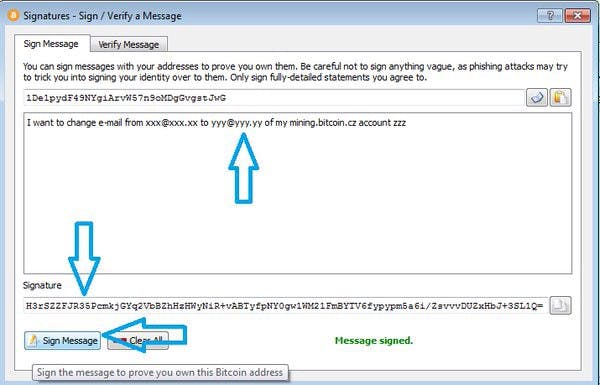
Proving who you are is central to Bitcoin’s operation. That is different however to identity as understood by Statists. At no point do I have to invoke a command line shell, or a patched version of OpenSSL as Craig Wright claimed in his Heath Robinson fake proof. It’s easy to prove who you are in Bitcoin. See how I prove that I control the Bitcoin address used to send me tips on Twitter, in two Tweets, using the Bitcoin client. Only I can sign with the private key; the key used by the Beautyon twitter account by me to send Bitcoin. It’s simple and easy to understand. The first tweet is a statement made by me, “I control the key that receives Bitcoin on the @Beautyon_ twitter account.” The second tweet is the unique signature created by the private key used to send Bitcoin from the address used to receive Bitcoin by me. HFT2IUm1Yul0hADmiF6tSRjPAJ5DBbfWA6lLvfyqYd6qdXQJlpwjmL9BmZCTRmzno0GJtUvLFItGlq04BNQP0Qs= Anyone who wants to prove they are Satoshi simply needs to make a signed statement from inside BitcoinQT and one transaction. Thats it.
This feature in the reference client will create a signed message that anyone can verify was created using the secret key that only Satoshi knows. It is a powerful form of proof. Anyone anywhere can verify the signature, without special knowledge; all they need is a copy of the Bitcoin software and the signed message, and it can be categorically verified that the signature was made by the person who controls the private key.
Note how I am careful to say what a signature actually means. It does not prove anything other than the person claiming to have the power to sign has that power. In business, this is sufficient to prove that you have control of money, and that is all that matters. A signature, no matter what the medium is that it is made in, cannot prove that you will perform in the future or compel an obligation or anything else. All it does is prove that the person controlling the key made a valid signature.
Exuberant Leaps of Faith
What Balaji Srinivasan and others are doing, is taking this incredibly powerful idea, and running with it, making claims that it can do things that it simply cannot do.
The idea that is spreading like H1N1 Swine Flu, that a cryptographic proof is a universally applicable truth is a myth. What just happened with Craig Wright, is a man who made a claim was unable to verify that claim, nothing more. It is no different to a failure to produce evidence of any kind and the “crypto” aspect of this is not relevant to this matter or the nature of truth.
Hebrews 11:1
11 Now faith is the substance of things hoped for, the evidence of things not seen.
Faith is only for things not seen as Paul says; it is not for explicit proofs in math. Furthermore, things outside math can be true even if you have never seen them, or formally proved them.
Math has nothing to do with belief and its utility in the Bitcoin and cryptography context does not extend infinitely in all directions. It is only applicable in a narrow, self referential context. Cryptography can only prove things inside its context, not outside of it. This is why a balance showing in a Bitcoin wallet service where you do not have direct control of your private key is nothing but a meaningless number; at best, you may be able to take it as a promise to pay, depending on the contract you agreed to when you opened your account. The number these services display to you is out of context in Bitcoin, because you have no power to personally act on the network by signing a transaction message with a secret key.
Next he goes further and makes an illogical leap when he says:
Just because someone hashes a video and inserts that hash into the Blockchain, it does not mean that what they have hashed is true. And just because a signature is not on the Blockchain, or indeed, that an event was not seen by anyone living, it doesn’t mean that any fact is not true by default, and the fact that you can’t find a signature on the Blockchain is not a reason to reject that any event actually happened. This sort of thinking leads inevitably to a world where, “if it is not on the Blockchain, it cannot be true”. More on that later, with a terrifying real life example.
The Royal Mail: Proto Private Blockchain
The Blockchain in the context of storing hashes of documents is nothing more than a dumb time stamping device, like the ones you get at the Post Office, that you can use to prove that you posted something at a certain date. It is the modern equivalent of “Poor Man’s Copyright” where content creators send themselves a copy of their work by special delivery post (which gives a clear date stamp on the envelope), leaving the envelope unopened on its return. Blockchain time stamps are similar to custom postage franks in this function.

UK Post Office frank from Biggart Baillie LLP Solicitors. You can buy your own custom frank from the Post Office in the UK. You can buy a custom frank from the Post Office in the UK, to make your postage pretty.
The frank in this image was made in the offices of the law firm Biggart Baillie on the 6th day of may 2008, and is loosely analogous to a Blockchain time stamp. Stamps made on the Blockchain are of course far more secure, since they cannot be made by anyone but the private key holder and therefore cannot be forged by a stranger. The authority (or network owner) in this case is the Post Office, who allows Biggart Baillie access to its private franking service and agrees to convey the message in an envelope through its system of connected nodes (Sorting Offices). The cost of the stamp was 50p; stamping things on the Blockchain also has a small cost, to pay for adding messages to the Blockchain. This is done by miners, losely analogous to Sorting Offices that cancel the franks and deliver the mail. Bitcoin miners are of course, independent of each other and compete to sort mail for money.
The image above proves (to a high level of certainty, not absolutely) only that the stamp was made by someone in the offices at that law firm at a certain time. It does not and can not prove that the contents of the letter are true. Cryptographic signatures can verify if the contents of a message have not been tampered with, like an ideal wax seal on an envelope flap, but they can offer no insight in to the context of any envelope’s contents. A bald faced lie can be verified as having a good signature:
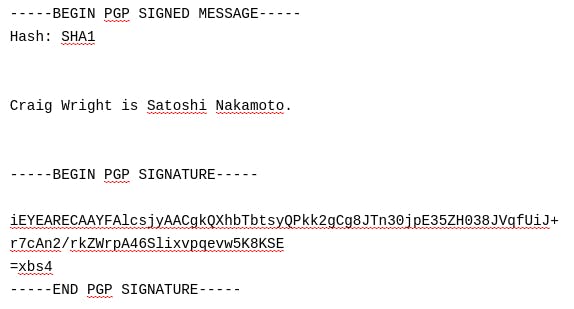
This is a cryptographically true lie.
that is a cryptographically good signature on a lie. You can use GPG to verify that the signature is good yourself using my GPG public key but what is signed with it is not true.
It is a critical error to believe that because something is “on the Blockchain” that you can certify that it is true. All you can prove about it is that the person with the private key made that transaction at a certain time, and nothing more. Understanding this is very important, because computer illiterates, sold the Snake Oil that, “The Blockchain is the Ultimate Source of Truth”, will believe anything they find on it. This has frightening real world consequences for justice when the vast majority of people are simple minded computer illiterates, and, as promised above, here is a terrifying example of bad stuff happening in real life as a result of this broken thinking.
“The computer said you did it, so you did it”
This is the story of a man who was arrested on the evidence of a computer. It does not take much thinking to transpose this to the Blockchain, and perhaps, this is the problem:
A FYLDE coast student was arrested after posting Christmas cards to his familyStunned David Atkinson found himself at his local police station under suspicion of stealing the festive greetings he last saw when he put them in a postbox five years ago. Due to fingerprints found on the mail which was stolen then recovered police thought they had their man. However, it transpired the “suspect’s” fingerprints were those of the student who had innocently sent the cards to relatives when he was 15.
Mr Atkinson, now 21, of [the newspaper printed his address, but this was redacted at BLOGDIAL], was arrested because his DNA and fingerprints had been kept on record under controversial Government laws to combat terror.
It was only after Mr Atkinson asked officers to look more deeply into the crime his innocence was proved.
The law student said it has shattered his confidence in the system. He said: “The potential incompetence, laziness, or over enthusiasm of an individual officer means an innocent, law-abiding citizen can never truly have confidence in the giant police database.”
It was the second time Mr Atkinson had been arrested twice for crimes he did not commit. He has now lent his support to a campaign to force a rethink by the Home Office.
The mix-up began last March when Mr Atkinson was arrested on suspicion of criminal damage but, when the real culprit gave himself up to police, he was released without charge.
During his short time with the police, he had his fingerprints and DNA taken as part of the arrest procedure but, under recently passed laws, all details no matter whether the person is innocent or guilty are kept on a national computer.
Mr Atkinson thought nothing of it until he got a call from officers a month later asking him to go along to the station. He said: “I was arrested as soon as I went in. “The officer told me he had a computer report which had automatically matched my fingerprints with those recovered from a number of items of post which had been stolen from a letter box in December 2000.
“As a result of this report alone, and no further investigation, the officer advised me to ‘get the matter out of the way quickly and take a caution now’.
“After refusing to admit a crime I’d not committed, I was bailed while further investigations were made.”
“The recovered letters were in fact my family Christmas cards which had been taken after I had posted them five years ago.”
“This innocent explanation had not even crossed the officer’s mind and, as far as he was concerned, if his computer report said I was guilty then I had to be.”
Mr Atkinson complained to Lancashire Constabulary and eventually received an apology. But, he claims, without the Government’s “menace to our freedom”, he would not have been put through the ordeal. A police spokesman said: “We can confirm that we did receive a complaint in August about a wrongful arrest concerning stolen post. “This was investigated thoroughly under our normal complaints procedure and dealt with locally to the satisfaction of both parties. “Under current legislation, all police forces can retain and record DNA taken for arrestable offences no matter what the eventual outcome of the investigation.”
And there you have it. The police said that as far as they were concerned, if the computer report said he was guilty, then he had to be. Only a very simple minded person cannot see that this is directly transposable to the “Blockchain as truth” meme, and the horrific effect is made even more powerful in the Blockchain mediated world by several orders of magnitude, because the Blockchain is not like a puny, error prone, outsourced national police crime computer or Driving license database; it is a gigantic, global verification system, the most powerful computer network ever created, trusted by everyone on Earth. In that nightmare world, if the Blockchain says you did something, then you did it. Period.
This is nonsense, given the true nature of digital signatures and what they can actually do. It is very much like the thinking of “Blockchain not Bitcoin” types who engage in the “tech” version of magical thinking, attributing abilities to tools that they simply do not have. Cue “The Song”.
Proofs on Paper
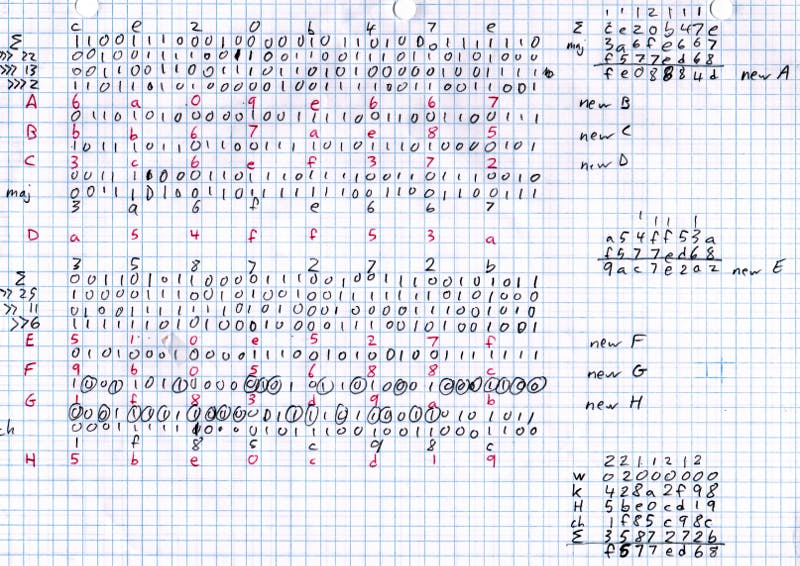
Every calculation used in Bitcoin can be done manually on paper. Bitcoins are mined using a cryptographic algorithm called SHA-256. This algorithm is simple enough to be done with pencil and paper. One round of the algorithm takes 16 minutes, 45 seconds which works out to a hash rate of 0.67 hashes per day.
And here we come to the point that I started this post with. There is a difference between trust, truth and faith. “Faith is the substance of things hoped for, the evidence of things not seen”. Truth in the Bitcoin and math sense is a formal proof that can be openly and repeatedly demonstrated any where at any time, either in a machine or on paper. No one in their right mind, “Trusts” or “has faith in” math; math simply is, and does not require trust. There is no such thing as gradations in truth or a “higher truth”; truth is binary, a statement in math is either TRUE or FALSE.
And yes, you can prove any mathematical statement on paper, even the truth of a Bitcoin signature:
The power of Bitcoin is that it does not require faith or trust. In Bitcoin, you can prove what you are saying is true; the question is, “what is it that you are trying to prove?”
In Bitcoin, you cannot prove anything other than what is on the Blockchain:
1/ That you control a private key2/ That you wrote an entry on the blockchain
and that is all. There is nothing more to it than that, and incredibly, this is enough to transform the entire world away from fiat currency, central banking, banking as a service to the public and many other services where a trusted verifier-intermediary is required in an information service.
Bitcoin is a very exiting tool, and it has people in a frenzy, trying to come up with new ways to work with it. It’s like the early internet, (or the insane “Internet of Things”) where people were permuting every English language word against “dot com” to come up with the new killer idea. You now see “Blockchain medical records”, “Blockchain identity management”, “Blockchain stock trading”, “Blockchain voting” the infamous “R3CEV” and lots of other ideas that in the majority of cases, will come to nothing.
There is nothing wrong with trying new applications for software, and this work is required both as a means to find new ideas and test them, and as a way to spread the idea of Bitcoin as a tool. What is not correct however, is conflating faith with mathematical truth, or attributing abilities to Bitcoin that it simply does not have.
This sort of bad thinking is what created the BitLicense, and the cancerous, parasitic industry that is trying to feed off of the Bitcoin ecosystem. Perfect Chemotherapy is coming to destroy that cancer. But you know this!
Chocolate mousse cake and a double espresso ↴

Problem with Proof of Stake and “coin voting” in general
By Oleg Andreev
Posted May 9, 2016
The problem with “voting by coins” is that most coins do not vote. This leaves a small fraction of UTXO to actually vote which is not representative and highly volatile since anyone risking to use idle keys to a large stash of coins can dramatically affect the voting outcome.
Most coins are locked up well “under matress” with multisig, time locks and possibly even with HSM-controlled keys. Also, pubkeys to long-term stashes do not want to be exposed from under their hashes in order to be better protected against a QC development in the long term.
In other words, most coins that matter, cannot and will not vote.
This leaves only the least important coins to perform voting. Obviously, the result of such voting will be worthless.
UPDATE: it is possible that people annotate output scripts with a dummy “voting hash” that commits to a separate pubkey, intended only for voting and stored elsewhere. But then security of the voting keys is not equivalent to the security of bitcoin keys which is what we want to begin with: that voters perfectly map to actual bitcoin holders.
Trust No One
By Beautyon
Posted May 14, 2016

There is a problem with many of the arguments being put forward in the Block Size debate, which is essentially over now. If you want to argue about anything, make a case for something, you need to do it cleanly, logically, and without fallacies. Because Bitcoin is inextricably linked with money, its difficult to get people to argue cleanly about it, but it can be done, and in the case of the Block Size argument, it has been done, and the correct side won, because their arguments are better.
In this matter and all other matters to do with software, only the arguments matter not the people making them. Because the outcome of software changes can be known in advance; its easy to say that putting spyware in the Linux Kernel is a bad thing, because violating people’s privacy is a bad thing. We can make this argument without mentioning the NSA who proposed it or Linus Torvalds who stopped it.
If you really believe that the State is planning to come up with its own cryptocoin to destroy Bitcoin, and you believe you are in a race against them, and you believe that since Bitcoin has “only” ten million users and that big blocks are the answer to this problem, and Bitcoin will not change to support these assumptions, and you have access to millions of dollars then the answer is absolutely clear.
Fork Bitcoin.
Fork Bitcoin to a Big Block Alt-Coin and then capture What’s App, SnapChat, Facebook with your centralized big block alt-coin. Since Bitcoin “is trivially small”, abandoning it is inconsequential compared to the big prize of capturing global social media integration and a strong network effect. If Bitcoin doesn’t matter, if it is trivially small, this is the logical step to take, and talking to Bitcoiners is a waste of time.
Bitcoin having the biggest network effect cannot be a reason to stay with it, if its size is also “trivially small”. This is a clear contradiction. Either Bitcoin is too small to matter, or it is too big to abandon; which is it? It cannot be both at the same time. You can claim that Bitcoin has the most attention; this will change overnight with What’s App, SnapChat, Facebook and other social media all promoting your new alt-coin as a feature to their users. In one day, the mind share will move to you and away from Bitcoin. The “Bitcoin has mind share, so we can’t abandon it” argument is not strong at all.
There are other developers out there that can fork Bitcoin for you, like Gavin Andresson, Chief Scientist at the Bitcoin Foundation. He could bring Mike Hearn away from R3CEV to form the core of a crack team for you. Why not do it? Bitcoin cannot have the best chance of becoming a currency used all over the world unless someone becomes ruthless about integrating it with the big social media apps. Perhaps you should partner with Whisper Systems, who just added end to end encryption to 100,000,000 WhatsApp users. Your dream team is sitting there waiting for you: Andressen, Hearn and Marlinspike, the latter already has connections to WhatsApp and can sell this alt-coin as an upgrade to Whisper Systems.
Bitcoin’s current features make it very attractive, but the most important of them is that it is decentralized. It cannot be controlled, and centralizing it “to beat the banks” would kill this.
If Bitcoin is centralized into a few high capacity nodes, it would be easy for the State to mandate any rules that it wants, and there is not a single Bitcoin company that would not obey. The Big ones already do KYC/AML without even being asked, and the EU Cookie directive is a very good example of how weak minded people cave in under the slightest pressure.
The EU Cookie directive has caused sites all over the world to interrupt the design of their sites. This was done without a threat, without a prosecution or any other act than the simple passing of an extralegal “EU Directive”. In Bitcoin it will not be a directive; it will be a law, bolstered by a prosecution to put the fear of the State into anyone running a full node, and as I have said, the people running large public facing Bitcoin services are already inclined to reflexively obey anything that the State wants, or that they imagine the state wants.
This is why Bitcoin must be easy to run on a cheap, quick to install platform, and not the exclusive reserve of millionaires. You are more likely to get a robust global network of nodes with a system that takes little hardware investment to run. These are the simple facts of the matter. Big nodes in the hands of a few is an idea that no sane man thinks can produce a trust free system, and anyone saying, “Give us Big Blocks. Trust us, we will not let you down.” is hopelessly naïve. All you have to do is look at the cookie directive and the Bitcoin exchanges for the true picture of how people will behave in a future big block scenario.
On the other hand, look at BitTorrent. That is the picture of a resilient network, where no matter what any jurisdiction wants, it can never be shut down. No government even utters the words, “Shut down the BitTorrent Network” because they know this is a stupid thing to ask for. This is the ideal position for Bitcoin to be in. Anyone can run it and send and recieve money from anywhere. It is permanently beyond the reach of the State, and it is global by default. No one is in charge of the protocol, and it gets stronger by the adoption of new features that are unarguably beneficial. Magnet Links, trackerless torrents and all the other innovations in BitTorrent are all perfect examples of what it should look like.
It is commonly believed that more people need to be using Bitcoin. It would be great if this were to become the case, but the fact of the matter is that no one cares about Bitcoin; they care about convenience. If the Federal Reserve comes up with a digital currency that gets integrated into Facebook WhatsApp, Twitter and the other social media apps, the billion users of those services will not care that they are not using real Bitcoin. All they care about is the balance on their screens that means they can go out and spend with their phone.
Very few people who use WhatsApp care that it is now a private system. This indifferent behaviour was completely predictable to anyone who has tried to promote GPG to the ordinary user; they simply do not care about privacy; the tools have to be forced on them. Privacy fanatics are working to get the world on to our side so the majority can act as a shield for us, not because those people “deserve privacy”, and the same goes for Bitcoin. No once cares about fiat money and its built in theft. They care about convenience and nothing more.
Bearing this in mind, it is clear that a Lightning powered Bitcoin side-chain on WhatsApp, Facebook, Twitter and the other services is indistinguishable from Bitcoin to the ordinary user. They simply don’t have the capacity to understand any of this; as long as they can go to Starbucks and pay with their phone, they are satisfied.
If Lightning can provide this backbone on the Bitcoin blockchain, then both requirements of ethical Bitcoin are satisfied. Anyone can run a Bitcoin full node, and anyone can do instant transactions on it either with Lightning or a Lightning clone. Remember; anyone can write a side-chain platform that piggybacks on Bitcoin. It is not the unique and sole reserve of a single company, quite unlike Big Block Bitcoin, where only a handful of companies will have gatekeeper access to all apps and integrations no matter what.
Side-chain powered Bitcoin can explode onto the market with the correct PR and partnerships. It is already well understood how to do promotion, and Whisper Systems have paved some of the perception road in advance. Its now up to software developers to create generalized tools that make adding this feature trivial. This is infinitely more preferable than centralizing Bitcoin in the hands of a few “trusted” companies who are under no obligation whatsoever to maintain any sort of business model or ethical practice. This is the true face of “on chain scaling”; putting the keys (literally) of access to Bitcoin into the hands of a tiny, fragile, justifiably self interested minority.
There is no reason to believe that the number of full nodes will increase if the block size is large, and it is not hard to understand why. Big Blocks means bigger capital outlays and a steady growth in infrastructure requirements. If something becomes more expensive to do over time, the number of people able to do it will decrease. Then there is the technical aspect that cannot be overlooked. You can run a full node on commodity software out of the box. Mega nodes will require bespoke configurations that ordinary people simply cannot manage. At a best minimum, it will cause the creation of an out of the box extendible Bitcoin node industry. If it isn’t regulated of course, and why shouldn’t it be? They regulate the export and selling of RSA and Random Number Generators, so why not Bitcoin rigs?
More people using Bitcoin will not happen because the Block Size is increased. Getting people to use Bitcoin is a problem of marketing and PR, not technical specification. Advocating against KYC/AML and for easy access is far more important, especially now that the argument over Block Size is decided. Once again, the number of full nodes is crucial, because the specification is harder to change by force in a vast number of nodes in different jurisdictions. A small number of nodes in a single jurisdiction is the most dangerous scenario of all.
In the nightmare scenario where Big Block Bitcoin is the norm, you will not be able to switch nimbly from one service to another, either as a user or a thin client developer reliant on a “Blockchain Provider”. Thin client developers will be required to register with “Blockchain Providers” and they will also be required to meet strict specifications including KYC/AML and all other nonsense to control user access. If users don’t like it, they can’t have Bitcoin. They won’t be able to export their private keys and jump to another client; that will be construed as illegal “Money Laundering”. Underestimating the creativity of the Statist in its capacity to invent new crimes is a very big mistake, and in the light of BitLicense there is no excuse whatsoever for it. Once all the parameters involved in Bitcoin clients of all kinds is written down, it will be easy for the next Bin Lasky to write regulations governing every action that a user can make in a client. If you don’t believe this is possible, then you are not dealing with reality. Centralized Big Block Bitcoin is about removing choice for developers and users. Period.
Compromise is very dangerous. If you are willing to compromise your principles because you’re frightened that the State is preparing it’s own centralized cryptocoin, then you’re free to do what you want in the market to deal with that perception. You might believe that “we” are no worse off with a centralized and controlled Bitcoin, but who is the “we”? It breaks down like this:
1/ The people who run infrastructure now and who would be in charge of Big Block Bitcoin would end up in the same government controlled world with them as the multi billionaire gatekeepers. Everyone is gate-kept.
2/ In a Fed Coin world, Everyone is gate-kept, but it is the Federal Reserve that controls the Bitcoin infrastructure, not the Big Blockers running infrastructure now. Other men become the multi billionaire gatekeepers. Everyone is gate-kept.
This is essentially the whole argument. Either “we” accept one set of companies becoming the gatekeepers or another set of yet to be anointed gatekeepers is anointed and they pen us in. This is a false choice, obviously.
If you really believe that your ideas are sound, you would have already gone for a big block fork and would have stopped dealing with Bitcoin. There is nothing to discuss; the choice is obvious. Brand recognition is irrelevant in any of this. Whisper Systems, that no one has heard of, managed to get their software into WhatsApp and a hundred million users without “brand recognition”, so there is no reason why an alt coin cannot integrate with them in a similar way. Brand recognition is a distraction and red-herring; It appears to the casual observer that you simply don’t want to do the work of starting from zero, which doesn’t make any sense, given the claimed market capturing world beating benefits of big block bitcoin.
Its obvious that the Lightning approach is the most logical. Combined with better clients, (for example, that don’t commit anti-consumer UX errors like requiring you to provide an email address before you can spend your own money, or any other extraneous information) this could form the bedrock of a large and fast system that cannot be stopped, like BitTorrent cannot be stopped. Properly designed clients and user experiences with easy to use on-ramps like Azteco are what is required before talking about destroying Bitcoin because the Federal Reserve MIGHT be working on a “Fed Coin”. And of course, the idea that there is only one government and central bank in the world that matters in the 21st century and constantly invoking it is painfully parochial and insular. Moving the perception of Bitcoin is as important as building the software. The generic “Fed Coin”, nightmare is less likely to emerge if they don’t think that Bitcoin is money, which of course, it is not. The governments are not scrambling to create their own WhatsApp, Twitter or Facebook, despite these services being a clear threat.
The history of software development is crucial to knowing exactly what should be done. Firstly, compromise should be off the table for good. Secondly all fallacious arguments should be identified and rejected. Finally, even if a “Fed Coin” were to emerge, this would not stop a Bitcoin future from emerging, and in fact, it could cause it to come to pass. Even a bad UX “Fed Coin” app would inure everyone to the idea of “money on apps”. In a world where everyone is educated in this way, it will be easier for a mass switch to a new system, no different to Candy Crush with its 93M daily players, 500M installs or any of the other apps that are well designed and irresistible, that people are used to switching to from other games.
In any case, the road ahead for Bitcoin is set. It is now a matter of who writes what software, and who has the ability to get their client in the most hands, and who can feed them with money easily. The latter task is what Azteco solves. There is everything to win, and there is no need to compromise to do it. This is the true essence of Bitcoin, not compromise or capitulation, but the hard work of innovation guided by principle. That is what gave us Bitcoin in the first place.
Pay Bitcoin to this QR Code. Before you’re not allowed to. ↴

The Swiss win the Bitcoin Unicorn
By Beautyon
Posted May 16, 2016

The DAO, which whether or not it succeeds, has raised more money than almost any other crowd-funding drive in history is using a Swiss company as its entry and anchor point to the physical world. Why did they choose Switzerland rather than, say New York in the USA or the UK? London is the home of “Tech City” where the government wants to encourage a global tech hub to grow, and New York is trying to position itself as a great place to incorporate if you are in the “Blockchain Business”. Switzerland has made no such public calls to attract business in this new sector, so why did the people who run the DAO choose Switzerland?
If you have been reading the medium posts on this account, you will know exactly why. The USA and the UK are both toxic to innovation in Bitcoin, and Switzerland is not. No one who can think is fooled by grand plans to refurbish Old Street with stolen money, and no one thinks that “BitLicense” and government regulation helps foster business.
These are the reasons why people are avoiding the USA and UK (USUK).
- USUK thinks Bitcoin is money. It isn’t. It is a global distributed Super Database.
- USUK think there is a distinction between “Virtual Currencies” and “Digital Currencies”.
- USUK assert that virtual game makers “in game” coins are inherently different to Bitcoin.
- USUK wants to intervene to support the development and usage of digital currencies.
- USUK listened to lawyers who insisted that there need to be laws specific to the Blockchain and Bitcoin.
- USUK wants to outlaw encryption in their jurisdiction, Switzerland does not.
- USUK wants to protect people from fraud in a fraud free space.
- USUK sees risk when they are actually looking at opportunity.
All of the above are cherry picked bullet points from a must read post on the subject of Bitcoin and regulation, which ends with this
Anything less than a total hands off approach will result in Britain missing the first great technology breakthrough and opportunity of the 21st century, a breakthrough similar in magnitude to the invention of the printing press or the commodity home computer. This breakthrough is the emergence of a world-transforming new technology, shifting all registration and transfers of property, money, things and processes we cannot imagine, to a neutral, infallible, incorruptible, “Silent Automated Guardian of Transactions”, the ultimate impartial witness. The Blockchain.
And it is coming to pass. Even if this DAO does not work for any reason, the next one will, just as I said, in 2011 that either Bitcoin, or one of its successors is going to change everything.
After having been forced to weaken banking secrecy, the Swiss are set to rule the world via Bitcoin, where not only will all corporations be founded and completely private, but money and shares will also revert to being absolutely private. You heard it here first.
Raclette at the mercy of the chef↴