
March 2016 Journal
WORDS is a monthly journal of Bitcoin commentary. This issue collects the March 2016 writing in the WORDS archive. For the uninitiated, getting up to speed on Bitcoin can seem daunting. Content is scattered across the internet, in some cases behind paywalls, and content has been lost forever. That’s why we made this journal, to preserve and further the understanding of Bitcoin.
Doing nothing is a choice
By LaurentMT
Posted March 5, 2016
“Ask not what bitcoin can do for you, ask what you can do for bitcoin” - J.F. Kennedy (Biography - Apollo Editions)
Dear Brian,
First, I would like to apologize for the length of this letter and my crappy english.
A bit of context. During these last 12 months, I’ve been working on the development of an analytics platform dedicated to the bitcoin blockchain. Long hours spent on charts taught me a few things that I would like to share with you.
One of these things is that bitcoin is still a small economy and therefore it’s still possible that the activity of a single actor/service has a very noticeable impact.
Some occurrences of this phenomenon are related to well-known events like the growth of the number of transactions in 2012 (launch of Satoshi Dice).
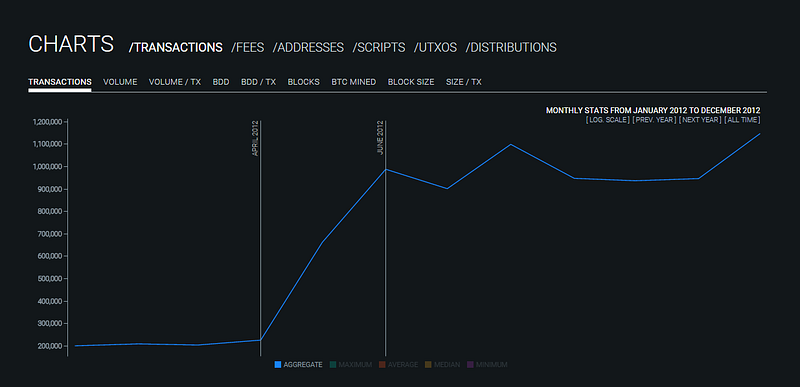
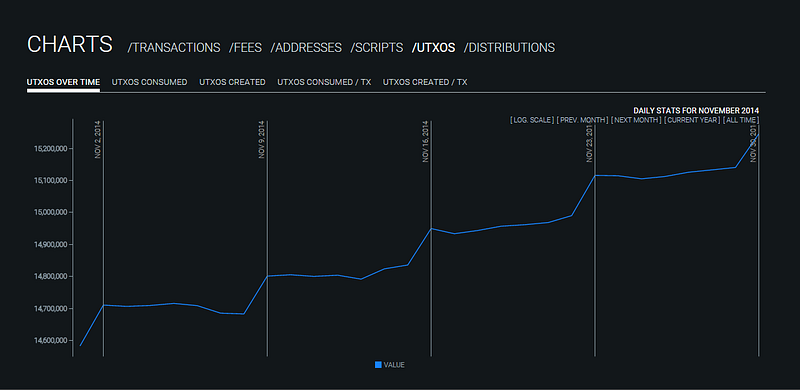
Some others are less well-known. For instance, there is this step pattern in the growth of the UTXO set which is likely to be caused by a small number of faucets doing weekly payments.
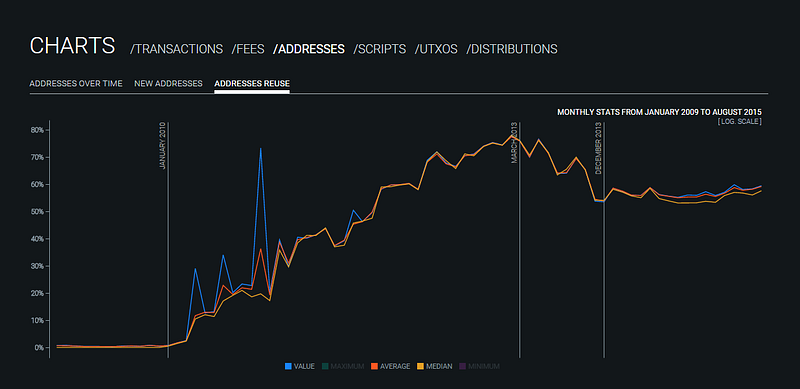
At last, some cases remain mysterious (at least to me) but are likely to be the result of the activity of a single/small number of services, like this surprising decrease of address reuse between Q2 and Q4 2013.
Ok. Back to the subject. Some times ago, I was playing with a chart displaying the number of transactions VS the average size of transactions (aggregated by months).
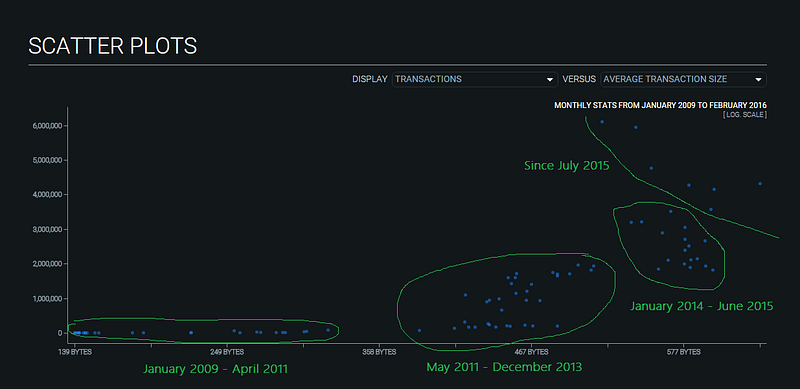
I couldn’t help but notice that it looks like bitcoin had several distinct phases in its history (note that my “classification” is 100% manual & subjective but you get the idea) and it seems that since July 2015, the network has entered a new phase which is… kinda “weird”. My interpretation is that a part of this new behavior is related to the spam attacks from last summer and to cleaning operations done by mining pools after the attacks. At this point, I have no explanation for observations from October to now.
A few days ago, I was playing with statistics provided by blockchain.info about long chains of transactions and I was really surprised by the growth of long chains during the last 6 months


Even if we all know that correlation isn’t causation, this time I couldn’t help but wonder if this activity is “natural” or not. Because, you know, the debate is hot in the community and it has already created a few collateral damages (spam attacks, ddos of services,…). For the sake of “neutrality”, I’ve decided not to follow a specific hypothesis but to check in the blockchain if I could find recurrent patterns explaining this activity and these long chains and I’ve found two things.
1/ It seems that there was a lot of peeling chains lately and to be honest, I don’t get what people try to achieve with this pattern. Usually, it is used to obfuscate the trail of a financial flow or to gain more privacy. For instance, it was used by Mark Karpeles in 2011, before and after its proof of solvency transaction.

Now, here’s the problem with this explanation. Since 2011, several startups doing blockchain analysis have been funded ($100k - $1M). Moreover development of tools allowing to detect this kind of pattern (at least manually) is a no brainer. Even someone like me can build this kind of tool. So, my conclusion is that if these transactions are created for obfuscation, the sender should stop and find another method because this one isn’t going to help her. If they are spam, it may be difficult to prove it but actually it doesn’t matter (more on this later).
2/ If you look at the chart of long chains, you can observe a very specific fingerprint: growth seems to start in September with a peak in December, a low just after Christmas and a new peak in February. My platform processes a few algorithms allowing to cluster addresses in entities. I’m cautious with these results because the work is still early stage (especially the manual task of tagging addresses) and the results are obviously still incomplete. Anyway, I was surprised to find a pretty good correlation between the activity on some exchanges and the fingerprint observed for long chains.
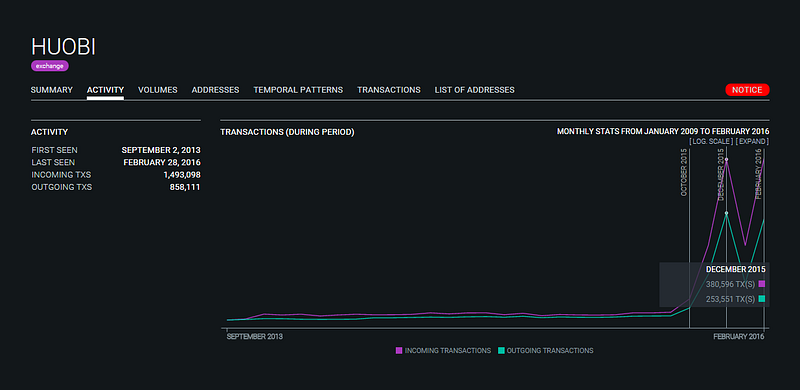
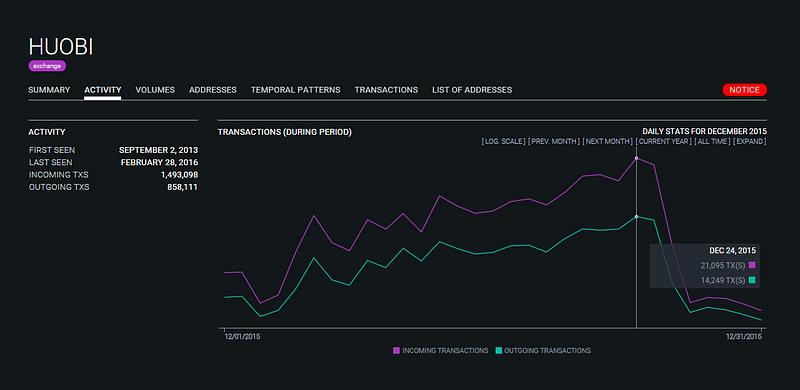
Without being a rocket scientist, I guess that the recent price increase plays a role here. It seems quite possible that a part of these long chains are just correlated to this surge of activity and how some services process their transactions. For instance, Huobi seems to follow the rule “1 transaction per withdrawal” with transactions forming long chains. I may be wrong but I don’t know any reason to suspect a malicious intent in this case.
As you see, these are just a few checks done in the blockchain while looking for clues and certainly not definitive proofs of anything.
More importantly, these observations lead me to this conclusion:
“On the blockchain, any sufficiently inefficient process is indistinguishable from a spam attack” — Satoshi’s third law
I’m more and more convinced that we should stop talking (myself included) of spam or malicious activity when we talk about a public blockchain aiming to provide censorship resistance. Instead, we should focus our efforts and discussions on efficient processes & “good practices” VS inefficient processes & “bad practices”. The main reason is that human intents don’t matter for the bitcoin blockchain and there is no difference between a spam attack and an inefficient process because consequences are the same for the blockchain.
The point is that many services have grown very quickly and sometimes technical solutions which were fine at small scale (even when not optimized) start to have a very noticeable impact when the service grows (you remember my intro ?). It’s likely that many services (exchanges, online wallets, gambling websites, …) have room for optimizations and that just a few major services implementing a few optimizations would make a visible difference.
For instance, I’m convinced that many exchanges may aggregate some of their operations (like withdrawals) in a single transaction instead of using long chains. Bitcoin allows this. Why not use the feature ?
Your own company, Coinbase, creates 2 transactions per withdrawal. I get the reasons for this choice and there are obvious improvements to be done by others services in terms of refund transactions. But is it really the best that we can achieve ?
Obviously, a proper scaling requires work at protocol level and this is the job of the core devs (whatever the implementation) but fact is that all developers and services can help to greatly improve the efficiency of the network.
Sadly, this discussion about the role played by the ecosystem NEVER happened in the past 12 months of debate.
In my humble opinion, these improvements aren’t going to become a reality because people are naturally good or benevolent but because there’s a voluntary and collective effort (a new Blockchain Alliance ?) aiming to fight against this never ending “tragedy of the commons” scenario.
I may be too optimistic but I still think that we (the 2016 bitcoin ecosystem) are better than the “tragedy of the commons” and that we can collectively improve this situation if we really want to.
There’s only one question that each one of us should answer as a conclusion of this too long debate: “Do you want to ?”
In the eyes of the rest of the world, we’re the crazies following in the footsteps of a crazy who was thinking that he could reinvent money. Why would we be afraid of things deemed impossible ?
My 2 satoshis. laurentmt
Back Away from the Bitcoin Barbed Wire
By Beautyon
Posted March 7, 2016

This is a rebuttal to a Tweet Storm that recently appeared on the subject of Bitcoin’s “Governance”. It serves as a perfect vehicle to explain away some of the myths, misinformation and FUD swirling around Bitcoin. Every problem in Bitcoin can be solved by software. If you want a higher rate of transactions between peers, you need to design software that achieves that.
“Design software that achieves that” does not mean change Bitcoin’s nature, raison d’être or core objective a achieve your ends. If the answer to your problem is changing Bitcoin, you have the wrong answer. Only changes that do not alter the nature of Bitcoin are acceptable.
Here is the complete Tweet Storm. As usual, I do not name who made these Tweets because who said it doesn’t matter; it is the ideas expressed that matter, not the personalities. Bitcoin is not a Soap Opera.
1/An oft touted attribute of Bitcoin is that it is open source.
People misunderstand what Open Source actually means. All it means is that you can see the source code used to compile the binary that you run on your machine. It does not imply any form of license or copyright or right to alter and distribute the work. Just because a software project is Open Source, it does not automatically follow that the programme is superior in its function, or fit for any particular purpose. All it means is that you can see exactly how it works if you understand the language it was written in.
2/Supposed benefits of open source are higher security and more innovation (via more implementations). Both are key to winning.
This is false. If you run a programme that is open source that is insecure the fact that it is open source doesn’t help you. The only thing that helps you is if someone fixes its flaws. A project being Open Source is not a panacea or guarantee of any kind. Also, source being viewable does not immediately imply that others can implement other versions without a license.
3/#Bitcoin no longer benefits as much as it should from open source-like innovation.
This is false. Bitcoin benefits greatly from being Open Source because many eyes are on it. This prevents people from injecting bad software into the code base that gets compiled into binaries that men run on their machines. Bitcoin is a particular case where there can only be one implementation for everyone to get the benefit of it, because each running instance relies on other running instances. This is completely different to a GNU plus Linux distribution for example, which can be and has been forked several times. Each running instance of GNU plus Linux is completely separated from every other installation and no installation relies on any other for its operation.
4/No system where even 75 percent agreement is deemed “too contentious” to effect change can sufficiently innovate.
This is false. Because all Bitcoin nodes rely on each other, they must all be running the exact same version of the protocol. This is how Bitcoin actually works; it is not like other software that does not rely on other copies running correctly and concurrently. All copies of Bitcoin running must be in agreement, or the system collapses. This is part of the breakthrough of Bitcoin; the Double Spending Problem has been solved by all nodes on the network agreeing on a single version of the transaction record, binding them all together into one distributed system. 75% of the truth is not the whole truth.
5/Any network-based system that requires “overwhelming consensus” for change will quickly be left behind by competitors that don’t.
Absolutely false. Bitcoin is not “any network-based system” it is a new innovation designed to solve The Double Spending Problem. It is not like other software or networks as I describe above. As for other systems that are trying to usurp Bitcoin’s position, they all have absolute consensus as to how they should run; the 25% that does not agree on how Bitcoin should operate becomes 100% consensus when they fork Bitcoin and go off on their own.
6/#Bitcoin security is essential. But a highly secure system that cannot quickly/safely adapt to environment or competitors will not win.
This is false. Bitcoin is doing what it is designed to do. What is changing are the requests of people who do not understand it, who want it to act like fiat pocket change. What Bitcoin is and how it should be used is still being discovered. And the new layers being built on top of it may provide some of the functions that consumer observers think people want. Bitcoin does not need to change to cater to consumer observers, and asking it to do so is like a child asking for a flying turtle. Turtles do not fly, and Bitcoin may not be what you need to use to buy your “Starbucks”. This does not mean that there is not a solution to that problem.
7/A system that is “secure enough” now, and can be made even more so later, but that can quickly adapt, will be the universal #blockchain.
This is a baseless prediction. It could become true, it might not. Software developers will decide this, and no one else.
8/#Bitcoin maximalists insist that just being the most secure settlement system is enough to guarantee success. It’s not.
There is no such thing as a “Bitcoin Maximalist”, just as there is no such thing as a “Math Maximalist”. Anyone discussing this matter needs to refer only to the facts of the software, and what designs they propose. It is clear that Bitcoin could be the settlement layer for huge networks of users, and people have written software that proves this is true. Saying “it’s not” doesn’t mean anything; only writing software means something in Bitcoin.
9/Something that is “secure enough” but that can adapt faster than Bitcoin, while doing everything else that bitcoin can do, is a threat.
This is true! Betamax vs VHS is a good example of this. Betamax was superior to VHS, which has inferior picture quality and bigger cassette sizes. VHS won the market because you could get movies on it. VHS players proliferated, and the virtuous feedback loop was unstoppable. In Bitcoin, the equivalent will be a shitty alt coin, a multi platform wallet, frictionless conversion into the coin from fiat and widespread merchant adoption. The only problem will be securing their chain, which would take billions in hardware if they could not grow a mining community organically. Yes, Bitcoin already has most of this, and first mover advantage.
10/quick adaptations that spur rapid adoption and more use cases are essential for #Bitcoin’s continued success.
This is true! That’s what we are doing at Azteco.
11/Quick adaptation cannot happen where devs continue to insist on “overwhelming” consensus for any hard fork. Even 75% is prbly too much.
This is False. See above.
12/Internet is a case in point. TCP/IP was not first, most secure or elegant, but it was secure enough. It won because most adaptable.
This is False. Internet is a set of peer devices that are not reliant on each other as Bitcoin peers are. They all use the same base protocol to share data packets but the system model is profoundly different. This is a bad analogy, nothing more.
13/By insisting on overwhelming consensus while discrediting alt implementations, CoreDevs deny #Bitcoin a key benefit of being open source.
This is False. Alt implementations, like Bitcoin Classic discredit themselves by trying to steal the network with a non compliant client in an ecosystem where compliance is absolutely required. Core Developers are preserving the integrity of the network and public record which is the key innovation of Bitcoin.
15/#Bitcoin’s development may as well be centralized. For all intents and purposes it is.
This is False. Because Bitcoin requires everyone to use and add to the same public record which must never be corrupted, a new dynamic of responsibilities has emerged. The public record must not be corrupted at any cost, and it must change only in ways that do not affect the networks topology. Bitcoin is a new type of system and new modes of cooperation need to emerge to manage its core function. This is an unintended consequence of Bitcoin’s development, and it will be solved. While it is being solved, spectators should be patient while these difficult tasks are being undertaken.
16/As is, #Bitcoin gets most of the “bad”’of centralized development (slow adaptation) w/o the good (strong leadership).
This is False. Bitcoin gets all of the good of a team of experts working on it, without any of the bad, i.e. interference from Lawyers, Statists, Petit Banquiers, CIA agents and other types, who do not have the network’s users best interests uppermost in their minds. The call for strong leadership is a vestige reflex of believers in democracy, who like the idea of a “Strong Leader” to make things happen. “MAKE AMERICA GREAT AGAIN!”. No, Bitcoin, math and software does not work like that. The only purpose in having a character like Linus Torvalds in charge of Bitcoin is that he would not hesitate to tell Lawyers, the NSA and other people with no stake in Bitcoin to “Fuck off”, as he has done to the NSA and any person trying to taint the Linux Kernel. Even with the “leadership” of Bitcoin as it is now, its enemies have been defeated twice. The system of governance is working as it should. The network is protected from wreckers and Mokachino Heads and the momentum of Bitcoin is unstoppable.
17/I will take true open source rapid adaptation over strong leadership any day, but without either, #bitcoin is in jeopardy.
Unless you are running a full node farm or are a software developer, or running a Bitcoin business, no one cares what you will take or not take. Literally what you think does not matter. I have been through this before. Bitcoin is not in jeopardy, at all; that is plain nonsense.
18/So long as overwhelming consensus is required for rapid adaptation, #bitcoin is doomed without a strong leader who can forge it.
The consensus meme, and the Straw Man Fallacy that it is required are both nonsense. Bitcoin is not doomed, and its leadership is very strong and resolute. No one is going to corrupt Bitcoin, usurp it, Americanize it, and that is not just an assertion, its now a proven fact.
Armagnac, vanilla wafers, double espresso ↴

Bitcoin Maximalism
By Oleg Andreev
Posted March 7, 2016
Ok, here’s a rant in favor of so-called “bitcoin maximalism”.
TL;DR: Bitcoin will win the “cryptographic gold” title and every other altcoin imaginable will die. All fancy features like higher capacity, smart contracts etc will be bolted on top of Bitcoin as long as it’s safe to do with all excessive demand satisfied by commercial blockchain networks, separate layers and protocols on the side and on top of Bitcoin.
Why I’m so sure? Lets bust some myths.
“Bitcoin must scale to accomodate more users and more transactions, otherwise it will be dumped for another system”
If another system demonstrates how it can offer the same level of safety as Bitcoin (e.g. not being highly centralized and vulnerable to opinions and politics) while allowing higher capacity, it will immediately be implemented by Bitcoin via soft or hard fork with full support from major holders. It will be much less risky than to replay 7 years of market price discovery. We’ve already have seen examples when bugfixes and improvements are smoothly deployed via soft forks.
“Bitcoin must support fancy features like Ethereum has does in order to not lose to ETH”
If stakeholders are seriously considering this, they’d rather hardfork into Aethereum preserving all their balances than buying into a corporate offering which Ethereum is and aspires to become to an even bigger extent.
Also, Ethereum is much-much harder to scale and harder to upgrade to better privacy options than BTC. So if Bitcoin cannot survive because “it does not scale”, then Ethereum could not for sure as well.
“If the miners adopt a hard fork to boost capacity, Big Holders will be required to follow the larger hashrate”
No. Big Holders tolerate existing mining cartel only as long as it behaves. The mining cartel knows very well that Big Holders are those who give the value to BTC that’s converted into their daily earnings and that these holdings are well-protected by tons of irreversible proof of work. Should the mining cartel decide to play dirty, a different proof of work algorithm will be adopted (still cheaper than to buy into a completely new blockchain) and someone else will get paid for mining all blocks after the block N. Coins will be immediately dumped on the legacy chain and safely kept on the new chain with a different PoW.
But most importantly, and above all these specific issues, there’s one fundamental property of Bitcoin:
Should there be a precedent of a market abandoning one consensus in favor of another without all possible attempts to maintain it, that would become an eternal proof that such consensus is not safe long-term and can be sabotaged infinite number of times to satisfy politics du jour.
And that’s the main reason why Bitcoin will not go away after multi-billion dollar capitalization achieved over 7 years of expensive market activity. If miners want to stay in the game, Bitcoin will be infinitely extended with soft forks to address real concerns (those that put on-chain value at risk, not somebody’s business model). And if miners decide to fool around, they’d be hard-forked out of the game, not the other way around. In the worst case a bad precedent hurting stakeholders will trigger a nuclear war: everyone will lose money and all decentralized blockchain experiments will be considered irredeemably failed.
None of the above are due to specific design decisions. Bitcoin is the civilization’s consensus first of all, no matter how beautiful, ugly, efficient or inefficient it is. Should we prove just once that we can’t reach consensus, we will not deserve a second chance.
How Soon is “Now”?
By Beautyon
Posted March 7, 2016

The impatience to see Bitcoin dominate is understandable. Its benefits are so manifest and desireable, no man can not want to see it spread like wildfire. It should not and cannot however, spread at any cost.
The argument that Bitcoin will be delivering less value at a higher price because the fees rise is false. In order for this to be true, the price of sending Bitcoin must be greater than equivalent methods (which there are none in terms of utility) and its is premised on the existence of another network or remittance system that is better and cheaper than Bitcoin that does not exist, and that Bitcoin is for remittances. The fact of the matter is that Bitcoin is for what people use it for; it is not for a single purpose. No software is for a single purpose, even if the designer of it had a specific intention. It may be the case that Bitcoin is not destined to be used for buying coffee, but is instead destined to destroy central banks. If it does only the latter, it will have been one of the greatest success stories in human history, right up there next to the Gutenberg Press or the internal combustion engine.
There is no reason of course, why a bespoke layer cannot be built on top of Bitcoin to serve the people who want to use it for small purchases. The Blockchain wallet, for example, is well suited to implement this, with over three million accounts. All they have to do is build an internal MySQL powered layer where Blockchain users can transfer balances between each other “off chain”. If enough users and merchants become Blockchain users, then they will have a huge ecosystem of users and merchants under their direct control, who have access to an instant value transfer system that also has access to the Bitcoin blockchain.
If Blockchain did this, it would increase capacity on the Bitcoin Blockchain. In fact, if every business user of Bitcoin did this, the capacity problems would be diminished over night, because the majority of transactions are happening “off chain”. It means writing new software to sit on top of Bitcoin internally, but that isn’t a problem conceptually and the people in these companies are some of the best developers in the world.
This “problem” could be solved in one month if everyone decided to treat Bitcoin as a scarce resource, instead of insisting that the scarce resource change to suit their models that do not accommodate the limitations of Bitcoin. It is not rational to expect a pint glass to accept two pints of bitter; you have to drink one at a time, and who cares if you have to do that? The point is you are in the pub, having a drink.
Concentrating on the price of Bitcoin is nothing more than a Straw Man. The price of Bitcoin doesn’t matter; its what the Bitcoin network can do that matters. All the arguments about capacity remain the same whether the price of Bitcoin is high or low. Its the throughput that matters, not the price. Looking at price falls and presenting this as a reason for a block size increase is a Straw Man argument. We’ve heard these arguments before and they are a little stale, to say the least.
Bitcoin users are not paying more for less. They are paying for access to something very new and novel that is in its infancy. If they are sending money internationally, they are saving money, transacting privately, saving time, indignity and hassle, thanks to, amongst others, Blockchain’s excellent wallet. Bitcoin users who buy goods on Amazon with the Purse.io service are not paying more for less. They are saving money with Bitcoin. What needs to happen is the development of new business models that accommodate Bitcoin’s nature, which for the moment, means there is a cap on the number of transactions per second and the capacity of blocks. If fees go up, this is a reflection of the true price of sending and receiving Bitcoin, and there is nothing wrong with this. What is wrong and irrational is expecting Bitcoin to emerge into the world almost fully formed, needing only tweaks when it is clear that it is going to take new classes of software to bring it to billions of people.
QR Codes, which everyone takes for granted now, were added to Bitcoin as a layer to help people manage the moving of addresses. Using the logic of the Bitcoin Classic people, they would say that the address system of Bitcoin needs to change, because it is not user friendly, and is hurting adoption. We know that QR Codes solve that problem beautifully and also present other opportunities like paying people who flash thier codes on any surface. These uses and possibilities are taken for granted now, but there was a time before Bitcoin had QR Codes; someone had to add them to clients to make this potential happen. The capacity problem is a more difficult one, but only because QR Codes and the developer libraries to create them already exist. If they did not exist, someone would have to invent them, and the “Bitcoin Address Problem” would be a huge task. QR Codes are a novel invention and were patented, by the way.
The idea that Bitcoin can scale by concentrating mining into a small number of super scale super nodes would be perfectly acceptable in a world without the State. That world, if it existed, could never see Bitcoin come into existence in the first place, because in that imaginary world, there is no government to regulate software or steal money by forcing legal tender laws and fiat currency on men. In a free world there is no need for Bitcoin. Bitcoin was written precisely because the State exists and is a threat to everyone. It exists in a distributed network form because centralized e money systems have all failed not because of any technical limitation, but because the State comes in and shuts them down, or regulates them into worthless and difficult to use pseudo banks.
Bitcoin has to be distributed amongst many nodes precisely because it is an Enemy System that is designed to replace the State’s central bank’s fiat currency and it is openly against the Crony Capitalist banks. Centralizing Bitcoin to gain an increase in capacity is simply not acceptable, because the State will kill Bitcoin. We have seen it before, and only a man who does not know his history or the nature of the problem Bitcoin solves wants he number of nodes to decrease and the mining power to coalesce into super nodes. The smart Bitcoin businesses know this instinctively on some level; that is why they incorporate in jurisdictions that favour their business models and not New York. Asking Bitcoin to become centralized for the convenience of a few business owners is like saying you should move your company from Hong Kong to New York because, “you like the Mets”. Bitcoin cannot change to serve your business model or software. If your software and business model has a problem integrating with Bitcoin, you need to change your software and business model. If you are reciving a glut of complaints about a feature your software offers, do not run to change the Bitcoin protocol to solve this problem, change your software to fix the problem.
In the case of a Bitcoin wallet that is having speed problems, a wallet to wallet solution is one possible answer. Cellular telephone operators have been doing something like this for decades. If you have an O2 account in the UK, you pay nothing for calls and SMS to other O2 numbers. If you want to text or call a T-Mobile number, then you have to pay a tiny fee. The effect of this is that families all get SIMs on the same network. Instead of everyone being on their own network, you multiply the number of users dramatically on your own network, because everyone wants to save money by not paying for calls or SMS.
Blockchain, for example, with its three million users, could increase the number of its users exponentially using this effect, and they would have no problems with Bitcoin network speed problems, because all their users are trading balances between each other and not on the Blockchain. Also, it means that people can send a Satoshi to each other in this closed system, because there are no network fees to pay. The dream of buying a Coffee at Starbucks lives! All you have to do is get people onto the Blockhain.info ecosystem and lock them in, just as Apple locks in its customers.
Honestly, I should be charging for this advice.
All of the politics of the scaling debate goes away if service developers form their own internal markets. Bitcoin becomes the “Bankbone” of this system, and of course, development to increase capacity and other neat things like anonymity continue unabated. Bitcoin’s nature remains intact, everyone gets served, including with coffee.
Bitcoin is a free market tool. In order to stay that way, it needs to be kept away from the State. That is more important than anything. Without keeping Bitcoin away from the toxins of the State, it will cease to be Bitcoin. The people who are well entrenched and already operating at scale will still be rich in a Bitcoin that is corrupted, but the idea will have been killed. Some people are not willing to let this idea die, and they prioritize the idea above short term gainst and conveneince. The easy route is to change one parameter. The hard route is to write alot of software, add to your interface, educate your users, test and test again, batten down the hatches and do the difficult work. The people who wrote Bitcoin and who have been dreaming of it for decades are not going to give it up for some milennials who want to buy coffee. They are hardened, principled men; the men who wrote Bitcoin, and they are not going to see it corrupted or wrecked without reason.
Anyone can start their own version of Bitcoin encourage people to run it, mine it and try to profit out of it. In the early days of the internets, men started up email companies and sold their services to the public. There were many companies, CompuServ, AOL, Excite, Pegasus that provided this new and exiting service. You can be sure that Bitcoin clones are going to continue to emerge and some of them will be very large. This is the true nature of the free market; anyone is able to start up a service and then offer it. The free market does not mean that you can take something that exists and then demand that the existing users of it behave in a way that you require to suit your broken business model and software.
It also does not mean that you can run software that amounts to an attack on other people because you have a different business model. The only ethical choice you have is to run the Bitcoin client that everyone else is running and then adapt your private software to work within the limits of the system with the rules that everyone agrees to abide by. This is exactly what all the original ethical email providers did. They do not, like Microsoft, try to embrace and extend email, or HTML standard; they worked with the protocols and standards as they are and then built on top of them. That is why the incredible inbox by Google can send email to anywhere, and still beat all other email clients. Bitcoin companies need to think like that, and not act in a hostile manner to the network. In the end, the network will reject their clients and they will be forced to go along with everyone anyway, so why not be a good democratic citizen and go along with the majority from the off? There is no logical reason not to.
I’m sure everyone would very much like it if Satoshi himself weighed in on this and made a definitive statement to kill or coronate Bitcoin Classic. The original vision of Bitcoin is to bring sound money to the entire globe. Whether this is done directly on the blockchain or by layers on top of it is not important to the user; what is important is the user experience; meaning no inflation and no State interference in sending messages between clients. The world is moving towards this, as companies like Apple explicitly reject the State’s power to control people’s messages. For Bitcoin to centralize now would be a hideous capitulation without a cause, and you do not need Satoshi to tell you that.
Everybody knew from the beginning that Bitcoin was an experiment. It still is an experiment, and nothing about it is set in stone. No matter how much time you have invested in Bitcoin you should be ready to abandon it if it does not meet with your expectations, and do not think for an instant that you can force others to lower their standards or horizons to suit your purposes.
Finally, 2m blocks are coming in Bitcoin. The capacity increase that Bitcoin Classic supporters want is just around the corner. If you want two meg blocks, you are going to get them, so there is no reason to switch clients. This is not about 2m any more; this is now explicitly about who controls Bitcoin, what sort of Bitcoin we are going to have in the future, and who can be trusted with the keys to the kingdom.
Wagyu Short Ribs, Westmalle Tripple, fries, house merlot. ↴

One Chain to Rule Them All
By Paul Sztorc
Posted March 7, 2016
Bitcoin will reign supreme as “the” blockchain, no matter how many blockchains there are.
Quarrels of the Ignorant
How Many Blockchains?
Bitcoin Maximalism is an extremely pro-Bitcoin approach. It says: “Bitcoin is the best, and will remain so”. It strongly rejects Altcoins – if an Altcoin invents something cool (~0% likely), Bitcoin can (and will) join it in doing that cool thing!
However, some people disagree. They believe that there will be many blockchains.
But, even if we allow many chains, notice this: Viewpoint A, “one chain to rule them all”, doesn’t actually contrast with Viewpoint B, “a billion blockchains”.
After all, the phrase “them all” is plural.
Merged Mining
All true blockchain-experts can remember a time, April 2011, when Namecoin merged with Bitcoin, so that they could coexist in productive harmony. Namecoin was a “second” blockchain, but it was “ruled” by Bitcoin. Thanks to something called “merged mining” (another Satoshi invention), anyone who mined Namecoin could re-use that mining for Bitcoin. Merged-mining allowed Namecoin blocks to exist “inside” Bitcoin blocks!
Right-click > “view” to enlarge.
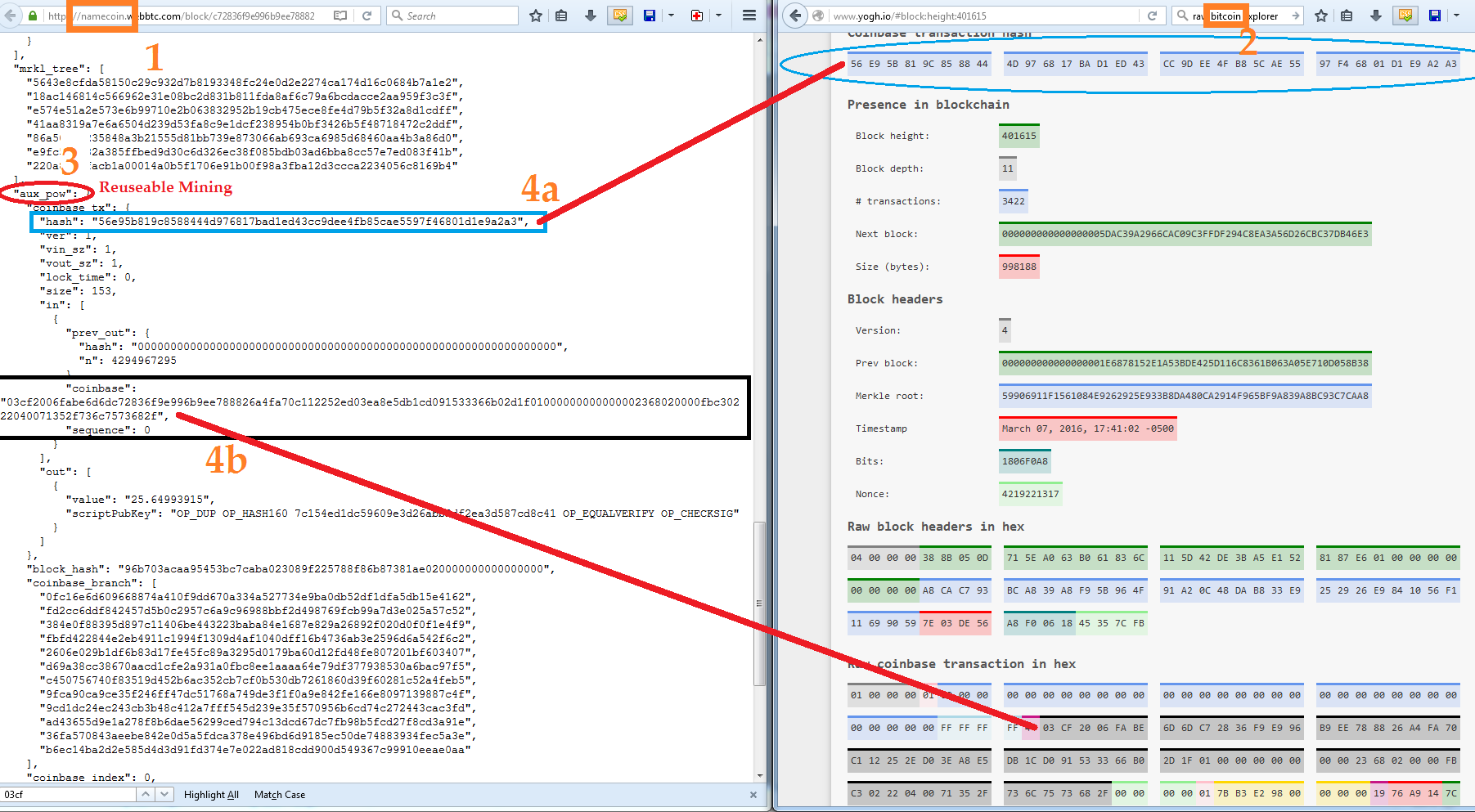
Namecoin demonstrated that any number of chains could hide inside Bitcoin, and simultaneously share the same PoW. Specifically, Namecoin was allowed to use all of Bitcoin’s PoW for free if only the miners would run the Namecoin software!
Merged-mining is a waterwheel which, if you clip more machines on it, does not slow down and can actually spin faster.

( This is why we always say “[using] the blockchain” or just “[using] Bitcoin”, in contrast to the clueless people who say “[using] blockchain” or “[using] blockchains”. )
Even though no one uses Namecoin today, the NMC chain is currently 271,844 times more secure than Ethereum (the current #2 coin by marketcap), and 187,919 times more secure than Litecoin (the 2nd most secure proof-of-work coin).
Anchoring
The story is even better for those who want immutability, but don’t need blockchain-consensus.
The process of “anchoring”, or using a PoW-blockchain to create an unalterable time-stamp, is so breathtakingly convenient that it has no requirements. Thanks to some fancy crypto, anyone can anchor any number of files, of any size (even whole databases) at a cost of zero. Bitcoin miners don’t need to run new software, and users don’t even need to send their data anywhere.
Whether you choose to merge-mine a blockchain, or to anchor a file, you will want to use Bitcoin (aka “the blockchain”) as your base-layer blockchain, because…
Only Bitcoin’s Hashrate Stands a Chance
Hashrate is graded “pass/fail” – either yours is high enough to achieve “immutability”, or it isn’t.
Let me use a new mining-analogy to explain this.
The All-or-Nothing Radio
Antithesis
Let me first explain how PoW-security does not work.
It does not work like a car radio.
When I was younger, I wanted to listen to my iPod in my car. Unfortunately, my 2001 Jimmy was too new to have a cassette player. ( Recall that the 1/8th-inch-to-cassette adapter was $5-$10, and worked perfectly. ) So, I had to get a (much more expensive) device which functioned as a mini radio broadcast tower. You’d set it to broadcast on some unused frequency, and then you’d simply tune your car radio to pick up that frequency.


The funny thing is, every now and then, you’d meet someone on the road who, evidently, had the same setup as you did (down to the same ‘unused’ channel). As you approached each other, there would be static interference. Sometimes, you would hear their music instead of yours, or both audio tracks at the same time! And, I assume, other drivers could occasionally hear my music (without my realizing it). My broadcaster, however, seemed to be pretty weak (it lost a lot) probably because it was a cheaper model.
Anyway, that is an example of broadcasting-interference on a continuous scale. The static starts small, and continuously increases as the rival cars approach each other.
Blockchains are not like that.
Thesis
Instead, imagine that all the miners are power plants, producing power. They use this power to broadcast from their mini-towers. Each separate blockchain system (for example, Bitcoin, Litecoin, Ethereum) would be on a different radio frequency – they don’t interfere with each other, they aren’t aware of each other.
However, let us turn our attention to attackers: competing broadcasts on the same frequency.
This is where we’d expect “static” to arrive. If the honest miners were broadcasting “A” on 88.5 with 90% of the power, and attackers were broadcasting something different, (“B”) also on 88.5 (the Bitcoin channel) with 10% of the power, we might expect to hear a distorted version of “A”. But we hear nothing of the kind; just pure, crisp, crystal-clear “A”.
In fact, we can get clarity with <50% of the hashpower. Image only 40% of the miners are broadcasting “A”. If 5 different (non-identical) attacker groups, of 20%, 20%, 10%, 5%, 5%, are broadcasting overwhelmingly-similar-but-not-identical-to-A versions of “A”, then everyone on the network would still hear pure, unmolested “A”. No static.
On the other hand, if a fully-coordinated attacker group got 51% of the mining power, they could broadcast “B” (or “C” or “Q” or whatever they like). The original “A” message wouldn’t come through at all – everyone would be listening to “B” (and “B” would be coming in crystal-clear).
Bitcoin’s offer to share its hashpower is a generous one. It allows you to broadcast whatever you like, on 88.5, with 100% of 88.5’s voltage.
Join The City’s Hottest Party!
Bitcoin currently has the maximum available hashrate on the planet, making it immune to attack from the world’s supercomputers.
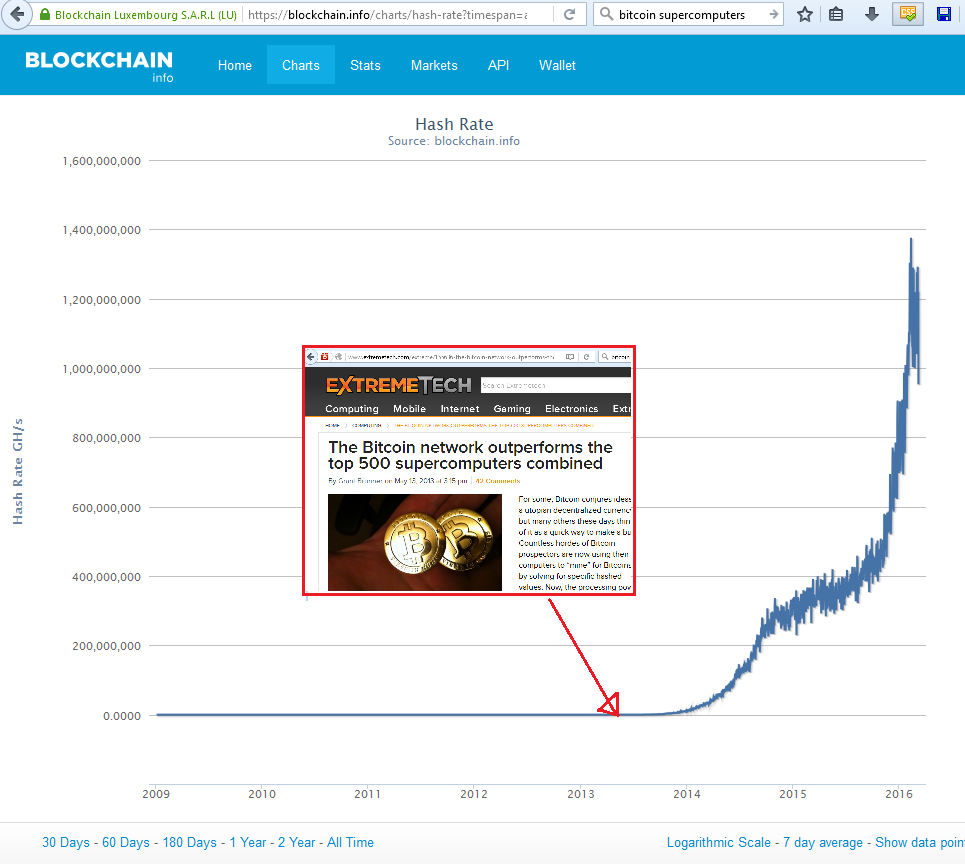
Again, recall that this offer is (nearly) free (requiring only that miners choose to run your software). With certain tweaks, it is completely free.
Conclusion
There will be “one chain to rule them all”. Being “ruled by Bitcoin” is awesome. It’s like living in your own personal copy of the world’s most heavily-secured, most luxuriously-appointed mansion…rent free!
Those who resist Bitcoin’s blockchain, don’t understand the deal they are turning down. It’s that simple.
Add Disqus comments.
comments powered by
Disqus
Why I think hysteria about block size is market manipulation by big buyers
By Oleg Andreev
Posted March 7, 2016
Yesterday I was bored and tweeted that people flood reddit and blogs with concerns about the block limit in order to buy as many coins as possible before July’s halving that will trigger a huge price increase and expose to the whole world how important and valuable Bitcoin has become.
Seriously speaking, I don’t see another explanation for seemingly inconsistent behaviour on part of some people than either outright stupidity or participation in a mild short term conspiracy aimed at supressing the price until the next mining reward drop.
1. If someone’s business model is really at stake, they’d be coding real scalability solutions rather than debating opinions and appealing to authority.
I can understand how respectable Bitcoin businesses such as online exchanges and payment processors earn fees from the users’ activity. They obviously would like to process as many transactions as possible in order to earn as much commission as possible. Nothing wrong with it. However, if that’s really the case, then these companies should really invest into better codebase, improved block propagation techniques, better wallets etc - in order to be able to say “hey, we’ve improved the overall infrastructure and now we can raise the stupid limit” .
However, the only people who actually fix the infrastructure are those who care about long-term value of Bitcoin which is self-consistent and does not need any conspiracy theory to explain.
2. Some people point to ETH pumping as an evidence that people sell BTC for ETH.
This is total bullshit. Ethereum is much harder to scale. Dumping BTC for ETH because of scaling concerns makes no sense.
3. Some think that miner’s hashrate should decide hard fork matters, but yet do not like miner-enforced soft fork that improves Bitcoin in multiple ways
If miners “should” decide some matters, wouldn’t it be easier to just implement whatever you want using their existing powers (soft forks) rather than demanding that they have more power?
These inconsistent arguments can be explained either by total stupidity, by a big conspiracy theory (“USG wants to sabotage Bitcoin”) or by a small conspiracy theory (“Bitcoin is going to eat the world in a few months and we need to win some time to improve our position in it ahead of Chinese/Russians/Americans”).
Bitcoin Parallels from 1985
By Beautyon
Posted March 20, 2016

Watch an astonishing segment on Bulletin Board Systems from “The Computer Chronicles — Modems & Bulletin Boards” originally broadcast in 1985. The section you need starts at 14:15 and runs to 22:39.
In 1985, before everyone was on the Internet, a small number of people were using “Bulletin Boards” to communicate with each other. They posted articles, participated in forums and used email, over modems that are slower than the connection you get on a 3G phone today.
In the section of the programme you just watched, the owner of “The Well” BBS, Matthew McClure, one of the most famous and populated boards at the time, describes what The Well is and what sort of things people discuss there. It sounds like a primitive monochrome microcosm of what people do today on the internet.
At 17m:00s the producers of this programme bring in a lawyer, Assistant District Attorney Don Ingram. Then the journalists begin the questions. When these people start to talk, I am sure you immediately were subjected to an overwhelming sense of deja vu and acute nausea, brought on by:
How does the law currently view a Bulletin Board? Is it like a newspaper with first amendment rights, or is it like a utility subject to government regulation?
That is very familiar isn’t it?
Its exactly the question journalists ask about Bitcoin today! Here it is, phrased for the Bitcoin generation:
How does the law currently view Bitcoin? Is it like cash, subject to KYC/AML rules, or is it an asset subject to SEC regulation?
What you have witnessed here should have you in shock. The journalists of today, thirty one years after this programme was transmitted, are coming at a new use of software with exactly the same questions and thinking that were in use in 1985. There is no difference in tone. There is no difference in the core assumptions (that government has a “right” to regulate everything) or the use of the Appeal to Fear in their questions.
Journalists have not progressed at all, in thirty years. The world has moved on, but they have remained stuck in the mid 20th century. This should be very disturbing for anyone involved in software, but at the same time, deeply re-assuring. The free, open and unregulated Internet came to pass, just as free open and unregulated Bitcoin will. There is no way these people can keep up with the inevitable “Transformation” that is coming, because their profession and the thinking that is standard in it is stagnant and stuck in the last century.
Note also that the example DA Don Ingram gives as a threat is “child pornography”. This is the go to trigger phrase and has been since at least 1985, though thanks to Edward Snowden, this trigger is losing its effectiveness.
The world of 1985 had total surveillance of all faxes, telexes and phone calls. No one knew about it, and people were still innocent about the State and the evil it was doing. Few people even knew what the letters, “NSA” stood for.
Now of course, everyone knows about the insidious NSA and what they have been doing for decades. Everyone is outraged at being violated, from the man in the street to Tim Cook, CEO of Apple, who has taken it upon himself to protect the 74.5 million iPhone users in the world from invasive and unethical surveillance.

Furrowed brows, panic attacks, Appeal to Fear. “You see? This is the problem!”
McClure makes a good case for the system operators being free of liability, and to his credit Don Ingram reflexively makes the case for owners not being liable for what is posted on their systems, but then destroys his credibility by saying if instructions (text) that he does not approve of are disseminated by a BBS, it should be “taken down”. This line is in character with the DAs of today, who gaol for life the likes of Ross Ulbricht, who was convicted of running a Bulletin Board.
This video gives us an insight into how journalism fails to understand technology, how it has failed to progress with technology, and what we can expect the outcome to be of the current confusion over Bitcoin’s nature and its regulation.
Just as these journalists and legislators in 1985 couldn’t decide if a BBS is a newspaper or a mail service, journalists and legislators today cannot decide if Bitcoin is an asset, programming tool for “Smart Contracts” or money. The outcome will be the same as it was for the “how to define a BBS problem”. The communications protocols that underlay these systems will remain, new services will be built on top of them, hundreds of millions of people will use new services and none of these new services (like Hotmail, Gmail, Facebook and WhatsApp) will be regulated.
The journalists and regulators cannot keep up with innovation, do not have the intellectual capacity or ethical character to serve the public correctly, and will simply be ignored, just as Google, Hotmail, Facebook, Uber and WhatsApp ignored regulators when they designed and launched their products.
None of their lies about Bitcoin will work (the pornography, and now “terrorism” Appeals to Fear) just as their lies about BBS systems in the 1980s did not work. They may execute some raids, wrongly imprison some hapless victims in sting operations, but none of that will make any difference in the long run. Just as it was in 1985 it is today, only more accelerated, because the internet pushes innovation thousands of times faster than it ran in 1985.
This is the central source of thrust in The Transformation, where the world moves away from one system of mediation of human interaction to the new system that is software mediated.
“It’s not hard to see another unique event, when you missed the beginning, and you miss the end.” — Wire “40 Versions”

James Bellington on the “Austrians vs. Bitcoin” Debate
By Beautyon
Posted March 30, 2016

James Bellington September 19, 2012 at 12:35 amThe attitude of the Austrians is very odd behaviour indeed, and as Bitcoin grows, the excuses they don’t give will make it harder for them to explain why they did not get start accepting it sooner.
Will they say that Bitcoin was not big enough to justify accepting it? And when they do end up accepting it, will they claim that they did not think that it was money, but now they do? Will they say that they were waiting for other people to accept it before they did, relegating them to the level of a herd of followers of the ignorant masses? What possible excuse can they have for rejecting Bitcoin? One thing is for certain, in the end, they will be using and accepting Bitcoin and they will have nothing to fall back on as an excuse for not doing so sooner rather than later. This is important, because they are asking people to change their minds about deeply held beliefs about money the law, rights and ethics and how the world could work as a free society. If they are not willing to accept Bitcoin to help make this change come about, in the most crucial area of life that keeps the empires running, money, it means there is a serious disconnect and flaw in their thinking. The question is where is that flaw, and what is its character.
Many in the Austrian camp have bravely and to great effect, embraced the power of superdistribution in the giveaway model. Almost every book sold in their online stores is available as a free download in many different formats. For certain, this has accelerated the spread of their correct ideas, and caused the sales of their paper books to increase. Not accepting Bitcoin is the equivalent of refusing to allow people to download PDFs without charge and using restrictive copyright clauses to try and prevent readers from spreading the books and ideas. It is pure Luddite in its character, and very out of character for a group of people whose focus and purpose is creating a future where liberty is spread all over the globe.
A few of these Libertarian Bitcoin refusers will claim that Bitcoin is not money, therefore they cannot accept it in exchange for goods. They will refer to the Mises regression theorem to assert that Bitcoin is not money. This is a position that I understand completely because strictly speaking, Bitcoin is not backed by anything.
The other reason why they may not accept Bitcoin is that they are all computer illiterates. This is possible, though unlikely. Remember, these are the same people who have embraced download for free and copy as you like superdistribution of the books they are selling; a revolutionary, counter intuitive manoeuvre that to most book publishers is anathema. In this respect, once again, they are very forward thinking, out of the box, and ahead of the curve. And it has worked spectacularly.
Perhaps what we are seeing here is a classic case of The Emperors New Clothes. All of these people are subjects in the same Austrian Empire, and none of them wants to be the first to stick his head out and take the risk of accepting Bitcoin. In a small community with decades of reputation and good will built up, accepting Bitcoin, in the unlikely event that it fails spectacularly, may tarnish their reputation forever. Bitcoin is risky, for ‘apostates’ and is not part of the mainstream yet. On the other hand, being able to accept Credit Cards is a mark of respectability and stamp of approval; it gives buyers a sense that the people selling these ideas are acceptable, not a threat, or group of anarchists. Even though they are. Bitcoin is still of the underground, it’s an unknown quantity. When you are trying to convince someone to throw away decades of statist brainwashing, any barrier to entry is a bad thing, and perhaps, the thinking is that Bitcoin would put people off. Of course, this doesn’t work at all, because Bitcoin can be used side by side with Credit Card payments and PayPal. This is not an either or proposition, it’s a pure win enhancement for everyone.
Really there is no excuse for not accepting Bitcoin. As I say above, Bitcoin sales cannot cannibalise PayPal and Credit Card sales, it can only add to your bottom line.
I fear this can only be a philosophical, psychological objection to Bitcoin, and given the brush off the owner of this blog received in an email exchange with the owner of one of these sites, it’s clear that the Emperors New Clothes effect is what is causing a point blank, fingers in ears refusal to integrate Bitcoin payments into their carts.
Despite all of this, I am not at all concerned that the Austrians are rejecting Bitcoin.
There is not a single movement started by man that has not fallen to dust. The people who make up the Austrian School will eventually all die, and their useful ideas will be picked up and adapted by the people of the coming centuries, the bad ideas discarded.
No one in the future will have any problem being a Libertarian and using Bitcoin; it will be as natural as drinking water. Historians will look back at the first two years of Bitcoin and wonder how it was that rational, highly intelligent, educated people who were deeply integrated into the web and understood its potential to spread ideas could have missed this crystal clear example of a game changing revolution, in the very field of their expertise: money. That many of them were historians will make the puzzle even more perplexing. No doubt, a book will be written on this subject, with a title along the lines of, “The Bitcoin Luddites: How the Austrian School Failed to Spot the Monetary Revolution”.
Either way, Bitcoin does not need Austrians to spread all over the world. The internet and its global spread did not need the advocates of the Austrian School to promote it, and it has changed everything and is everywhere, and the same thing will happen with Bitcoin. We do not need the Austrian school to achieve a breakthrough in the adoption of Bitcoin. It is already inevitable.
The problem for the reputation of the Austrians is that the internet is not concerned with money especially, and so it is excusable for them to not have predicted it or been boosters of it from its infancy. Bitcoin is a different matter however. Bitcoin is only about money and Liberty, and it is very much concerned with the matters that Austrians specialise in and have correct. That they have actively rejected it, with irrational hostility does not auger well for their reputation as forward thinkers and shapers of the future.
James Bellington was a commenter that left many pieces of analysis like the one above on the topic of Bitcoin, and the dismissive and very odd response to it from certain men in the Austrian School camp.
The curious can use Google to find some of them, but it’s a safe bet that many of them are lost forever, as comments on websites are the fragile edges that deteriorate first on the ephemeral internet.
As Bitcoin reaches sustainable record high prices, every argument made against it by its many detractors has been utterly demolished. Bitcoin is going to do everything its designer meant it to do, and the world will greatly benefit from it, in ways we can only just imagine, and which the Statists will not like at all.
James Bellington is a nice chap.Send him Bitcoin, and I’ll make sure he gets it.

The Disruptor Can Be Disrupted
By Beautyon
Posted March 30, 2016

In order to make a good argument you must do so plainly, without resorting to fallacies like the Appeal to Fear Fallacy, where you claim, “something bad might happen if you don’t do what I say”. This is true everywhere, including but not limited to Bitcoin.
The fact of the matter is that business models need to adapt to the market, no matter who they are or what their business is. Even what their business is is open to direct challenge, disruption and disintegration. I will explain this by analogy.
Lets say you run a software company. Its 1994, and your product runs very successfully on Windows 3.1.
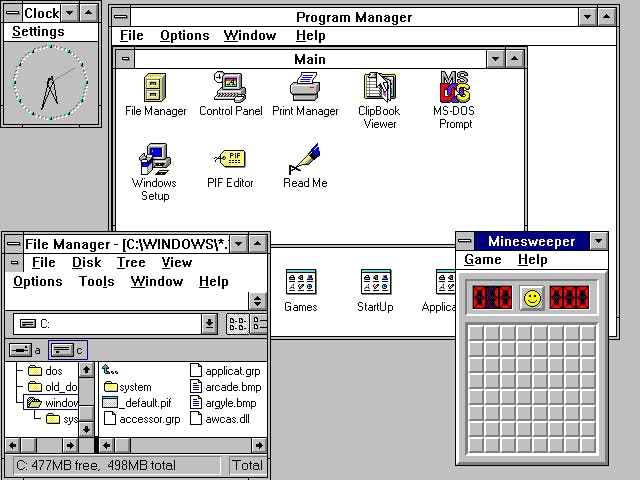
Windows 3.1 desktop workspace
You have a large installed user base and are profitable. Then 1995 rolls around and so does Windows 95 with a screaming and dancing Steve Ballmer.
All of your customers are upgrading to Windows 95. They are doing this because their machines run better under Windows 95, and the other software vendors are abandoning Windows 3.1 versions of their products. What do you do?
Do you mount a campaign to keep everyone on Windows 3.1? Of course not; you re-write your application so that it runs perfectly on Windows 95, and then charge everyone to upgrade to the new version.
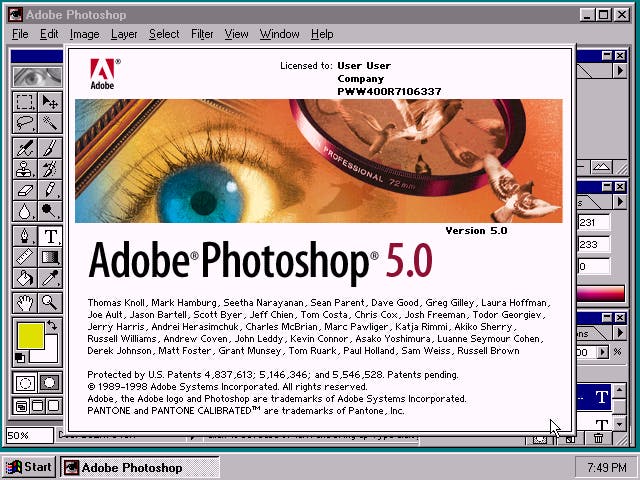

Adobe Photoshop 5 and 7 running on Windows 95 and Windows Vista respectively.
This is exactly what is happening in Bitcoin. In order to keep Bitcoin decentralized and free of coercion, the block size cannot increase. This is a fact. If you want to process more transactions per second in your service, you are going to have to find another way to do it; you can’t ask Bitcoin to change because your business model relies on Bitcoin doing something it can’t presently do.
In this analogy, Bitcoin is… Microsoft. Yes. I actually typed that.
Microsoft is only interested in running on the latest hardware, as fast as possible and securely as possible. They are not concerned with the needs of individual software developers, but software developers in general. Their software APIs make the best advantage of the Windows OS so that consumers get the best experience.
Now of course, if you know anything about operating systems, and Microsoft in particular, you know that they had secret APIs that were available only to Microsoft developers, giving software written by them an advantage over software written by third parties. But Bitcoin can’t suffer from this, because it is open source. All the API calls are public; there are no secrets in Bitcoin. Its up to you to develop your own methods of increasing capacity to your customers, and I have described how this can be done previously.
Bitcoin is a scarce resource. It is not like fiat currency that can be printed out of nothing and distributed for nothing. There is a cost to mining Bitcoin and creating it. You can’t simply increase the supply of a resource you need because your broken business model requires it at the expense of others; you have to change your business model to accommodate the reality of Bitcoin.
Scarcity is not artificial; it is a reality of life and economics. Before Bitcoin, the people who are now in it used to believe that only the government can (and should) produce money, and that it is entirely correct that the money supply should inflate at a rate set by the government. Now that these same men are in Bitcoin, they have abandoned the idea of inflation and Keynesianism because they have been educated by Bitcoin. They now understand the Austrian School is correct with respect to money supply needing to be strictly limited. What they do not yet accept is the core principle; that there is nothing that can be unlimited in supply without an economic consequence. This failure to understand the true nature of supply and demand shows these men have not yet completely absorbed Austrianism, or economics. Perhaps Praxgirl can help.
Your Feelings Do Not Matter
None of this is a matter of feelings. This is a matter of facts. If the block size is increased to 8mb and above, Bitcoin will become centralized. This is not a hunch or a feeling. It is a fact, and it is anti-Bitcoin. There is no such thing as “constrained growth” in a system with naturally limited resources. Bitcoin can only grow to a certain size while remaining pure Bitcoin. You can change Bitcoin to something else so it grows exponentially, like Keynesian money, but that is not Bitcoin, it is something else, and you are of course, free to design and deploy it and risk exposing it to the market. Someone has already tried this and the market has rejected it.
The real world is what Bitcoin Core is dealing with. They want Bitcoin to remain Bitcoin and to spread everywhere with its utility and character intact. They understand the reality that new software needs to be developed, and that there is no getting around this. They are facing reality head on, and doing the incredibly difficult and dangerous work of creating exactly what is needed to solve this problem. The people who are not offering software solutions, the only solutions that matter and that will be accepted by the market, are the ones who are not facing reality. Changing a parameter is not the same as developing a solution to a problem. Destroying Bitcoin because you can’t fit into it is not a solution either.
Bitcoin will always be useful for its users; that is why they use it. To say that Bitcoin will be less useful to its users if the block size does not increase is a pure Straw Man Fallacy. A mythological user that wants to buy coffee at Starbucks is held up as the typical user and then struck down because she can’t do that. No one that can think is accepting these arguments, and making them over and over doesn’t change their fallacious character. Bitcoin’s true place in the market is still being discovered. Artificially setting the target as a fictional user who buys coffee at an American food chain, above all other users in the entire Earth, the majority of which have never seen a Starbucks, is parochial and ridiculous.
The fee market has started to develop. Software is being written to make a good guess at the level of fees that are needed to get a transaction through in a timely manner. Obviously, as a guide to setting the correct fee, this work is very beneficial, and even if this software is only partially accurate, you can always add as small insurance amount on top to make absolutely sure you are going to have your payment processed. This should be done to keep your customers happy and on your platform knowing that solutions to your problem are under way either in your company or outside it. This cost of doing business could be passed on to the customer, who in any case is not going to mind since they are already making huge savings over traditional fees in most business cases.
The Spam Argument
If a glass is 80% full filling it to 100% with spam costs little to some malicious man who wants to flood the network. With Big blocks, instead of sending a million messages, say you need to send a hundred million messages. To a well financed attacker, this difference doesn’t mean anything. She simply sends one one hundredth the amount. Also, in that scenario the centralizing solution means everyone has lost Bitcoin, and is dealing with “Amazon Coin” or some other repugnant Bitcoin derivative where there are only three mega providers and all service providing companies are connected to them for Blockchain access. Even if this spam argument is sound (it isn’t) spam attacks are always intermittent and never permanent; look at the LOIC attacks against PayPal for a real world example.
Low Orbit Ion Cannon (LOIC) demonstration
They lasted for a short amount of time, and then went away. PayPal is still operating smoothly. Who in their right mind wants to destroy Bitcoin to prevent a potential spam attack that can only last a few hours at most? This is a pure Straw Man Argument, where the Straw Man of a Spam attack is held up to be knocked down. It is also the Appeal to Fear Fallacy, where we are meant to be made frightened by the potential of a devastating Spam attack that lasts months or even years.
Dynamic Fees
Its easy to assert that Dynamic Fees are not the solution, when the software to manage this is in its infancy. The same arguments were made against Bitcoin that, “It will never work” despite it working perfectly in front of everyone who cared to look. The fact that it is being done means that it has potential; what that potential is is the unknown. Lets say that it is in fact a half-measure as some describe. A half measure that keeps Bitcoin as Bitcoin is better than changing Bitcoin into a centralized permissioned network run from a single country. The next argument offered is that dynamic fees currently only look backwards; is there any market analysis software anywhere on Earth that 100% accurately predicts markets IN ADVANCE? This is a very pure Straw Man Fallacy, but its an interesting one. In Bitcoin, because it is acting like money, when there is alot of usage data open to everyone, it may be possible to make very accurate predictions about what fees will be required, propagating in waves across the world as night follows day. Once again, no argument for centralizing Bitcoin as the only possible solution has been offered, only fallacies, and software that has never been and which can’t possibly exist. These fallacies really will not cut it.
The Fee Market is not a Real Market
Another objection put on the table is that the fee market is not a real time market. So what? This is the Moving the Goalposts Fallacy. Once again, the stock market and other markets are able to trade successfully (on a mechanical level) and there is no reason why those software methods can’t be superimposed on to the Bitcoin fee market. This is an argument one step backward from the complaint that the future can’t be predicted by software. If a company creates a tool to 90% accurately predict and then disseminate fees levels for consumption by Bitcoin software companies, they will make a fortune. Perhaps a company like Eliptic can pivot to an ethical model like that.
Conflating consumer confidence and the fee “problem” is another fallacy; Appeal to Popularity. If your business model doesn’t insulate your customers from fee fluctuations, your business model is broken and needs to change. If you are a big Bitcoin company, you should either bid for guaranteed block space at a fixed price with a miner so that your fees are a known factor, or group together with other big Bitcoin companies and build your own mining farm so that you can control this key process yourself. It simply is not reasonable to demand that the nature of Bitcoin changes by increasing the block size so that you do not have to do any work or innovation. To stay in Bitcoin you must build new software, you must come up with new ideas and it seems you must also own a mining operation. You can’t simply concentrate on consumer interfaces and other easy things. Owning a mining operation will also solve another problem some people have; Sinophobia. If you build your own Bitcoin mining pool that is large, then you will no longer have to worry about “Communist China taking over Bitcoin” as Mike Hearn invoked.
Two mining companies have already signed deals to process Bitcoin transactions. Knowing this, a rational man with the means would either build his own mining company or sign a contract for priority mining services. Whichever is cheaper and most effective long term is the best option. None of this by the way, is a “race to zero” (the correct phrase being “Race to the Bottom”) which is something that a Socialist thinks when they have free market competition unleashed on them. Bitcoin’s inherent limitations are a huge business opportunity for the mining industry, which will be set to expand to accommodate all the companies that want to have their transactions mined no matter what, on fixed terms.
Once again, Bitcoin has exposed people (by force) to the ideas of the free market and Austrian Economics, but the quivering vestiges of statism and the disturbing stench of Socialism is still wafting about, with men claiming that free market competition is a “race to the bottom”. Bitcoin will put pay to this bad thinking also eventually.
If predictability is important to customers, it is something they will be willing to pay for. Providing it is a market opportunity, just like any other customer need. It is not and should not be used as a pretext to centralize Bitcoin and no capitalist would ever suggest such a thing.
Block Space Scarcity Is Bad for the Openness of the Network
Finally we come to the most strange of all the arguments. It is clear that a centralized Bitcoin with big blocks will be a less open network, since the “Blockchain Providers” will be forced to force KYC/AML verification on all consumers of their API (take a look at the terms and conditions for some of the Bitcoin exchanges now. If you apply as a business, they are some of the most over the top and excessive requirements imaginable, and that is without any explicit written law requiring them to do so!. They want your entire business plan, projections and everything else).
The simple fact is that larger start ups can buy their way into a Big Block Bitcoin, and small developers will be priced out. Saying that small developers will not be able to code their platforms with a fee structure in place is completely false. Anyone can develop Bitcoin related software and test it against a testnet on their local machine; there will be no change in how software is developed on a test platform and saying otherwise is simply not true, and rather odd. Companies like Electrum will suffer more under Big Block Bitcoin, because the cost of running a full node to service their customers will be prohibitive. Instead with a fee market, they will simply pass the slightly bigger fees on to their users, who, once again, will be paying far less than they would be to send money globally with traditional services. They may not be incentivised to use Electrium to buy coffee, but that is a Straw Man use case as I have already described.
The barrier to entry into Bitcoin is low, because downloading the entire blockchain is doable for anyone who wants to; that is the true, present and very low barrier to entry, and is the real reason that small projects would be priced out of Big Block Bitcoin. Smaller start ups in a big block world will need to spend tens of thousands and even more if they want to run their own complete copy of the blockchain. That is far more of an impediment than tiny dynamically calculated fees being spread across millions of users, and from this comes the key insight;
“Big blocks concentrate the cost of being in a Bitcoin business benefiting incumbents and harming Bitcoin, small blocks push operating costs out into the network, benefiting everyone and Bitcoin.” — Beautyon
That is the whole matter in a nutshell.
Bitcoin will not “offer less value” if the block size is maintained to preserve the network’s distributed geometry; it will spread the operating costs fairly. Value is subjective, not objective, and there is no single ideal Bitcoin user or use case; the market decides what Bitcoin is for, not a single Bitcoin business.
Finally, disruption is not reserved for the banksteristas; it is for anyone who refuses to quickly adapt to the needs of the market. Freezing Bitcoin development is simply not going to happen. The market will continue to improve Bitcoin, without changing its essential nature, including adding bullet proof anonymity, and anyone who wants to come along, innovate and profit on it is welcome, and in fact, can’t be prevented from doing so.
And that is the best kind of disruption of all.
Wild mudroom omelette, spinach, fresh bread, fresh butter, Ruggeri, Vecchie Viti Brut, Valdobbiadene Prosecco Superiore 2010 ↴