
February 2016 Journal
WORDS is a monthly journal of Bitcoin commentary. This issue collects the February 2016 writing in the WORDS archive. For the uninitiated, getting up to speed on Bitcoin can seem daunting. Content is scattered across the internet, in some cases behind paywalls, and content has been lost forever. That’s why we made this journal, to preserve and further the understanding of Bitcoin.
Some misplaced explanations of bitcoins as tradable units
By Konrad S. Graf
Posted February 4, 2016
POST HEADER
POST BODY
This is an excerpt from Chapter 8, “Some illusions of enlightened explanations,” in my book, Are Bitcoins Ownable: Property Rights, IP Wrongs, and Legal-Theory Implications.
As important as it is to gain at least a basic technical understanding of Bitcoin, attempts to describe what its tradable units “really” are, as elaborated from some allegedly more enlightened perch, can sometimes distract more than aid when applying economic and legal concepts. For example, pundits discussing whether bitcoin falls under what they each consider to be “money” or not sometimes explain that bitcoin is really just a “ledger entry” or a “protocol token,” a harmless technical artifact of a promising new “blockchain technology.”
Whatever the root of or strategy behind such discourse, however, a bitcoin buyer does not in fact seek a share in a distributed ledger or any other such tortured monstrosity. He wants to buy a bitcoin in the same sense that he might want to buy a grapefruit. He in no way sets out toward the market to buy a share of a global orchard cooperative that also happens to entitle him to one grapefruit that day.

Molecular diagram of grapefruit mercaptan. Tasty.Nor is it relevant that a grapefruit is “really” organic molecules, water, and some other substances. For that matter, a physicist might go further and insist that a grapefruit is “really” nothing but some occasional quarks suspended in vast stretches of empty space. All such misused reductionism is irrelevant to understanding the buying and selling of grapefruit. It likewise has no bearing on whether grapefruits can be eaten without being paid for and how or if people ought to react if they are.

Really just quarks and empty space (Wikimedia Commons, Aleph)Economic theory and legal theory are fields concerned with human acts, such as acquiring, holding, trading, and stealing. Action is marked by verbs. If one is interested in understanding the grapefruit market, one does not seek first to master grapefruit-tree cellular biology, let alone quantum mechanics. It is sufficient for economics to view those grapefruits actually being traded as the relevant goods, the production, pricing, and distribution of which are to be examined using economics methods.
This implies the importance of taking care in selecting which fields of knowledge, aspects of the phenomenon, and “layers” of reality are the most relevant to consider in understanding what bitcoin “really” is, including with regard to whether it is ownable.
One must also proceed with caution in applying analogies. For example, it is easy to view bitcoin as just like other digital blips buzzing around the internet. However, it should be emphasized that buying a bitcoin is notlike buying other digital goods, such as a copy of a song file. One does not buy a copy of a bitcoin, but a bitcoin itself. A bitcoin seller no longer possesses the bitcoin in question after the sale (and contextually sufficient confirmations). When one buys (a copy of) a song file, in contrast, the possessor retains copies from which to make more copies.
Most digital goods, such as documents and song files, are nonrival. They canbe copied. Multiple people can use multiple copies simultaneously. “Stealing a copy” leaves the original as it was. It is not gone after being “stolen.”
Likewise, not only can a whole blockchain be copied, but some key part of its value derives from its actually being so copied and distributed with redundancy to numerous independently operated locations. A signed bitcoin transaction is also a short digit string that can be copied, sent, and resent around the globe in fractions of seconds. These are nonrival goods, as are cryptographic signing keys. With nonrival goods, one person can have one copy and another person can have another copy and each person can control these respective copies independently and simultaneously.
However, this is not the case with bitcoins. A bitcoin cannot be copied in any such way. It is rival in the same sense as a physical object or spatial location. In addition, a bitcoin cannot be sufficiently described as “just a ledger entry” because a ledger entry records something. This formulation alone does not yet explain what it is that is recorded.
From a unit perspective, bitcoins function as a digital monetary commodity according to strict economic-theory definitions. From an integral perspective, the units are inseparable aspects of the Bitcoin blockchain. They cannot exist without it and it does not exist without them. There is a nondualistic relationship between bitcoin units and the Bitcoin blockchain; while they are distinguishable conceptually, they are not separable in reality.
POST FOOTER
/post
/content-wrapper
The Flat Screen Dilemma
By Beautyon
Posted February 4, 2016

There is a lot of talk about using “Blockchains” to improve data integrity, but what all these solutions fail to address is what I call “The Flat Screen Dilemma”. Just because something is displayed on a screen, it does not follow that it is true.No matter how your back end is arranged in terms of databases and languages used, the result of whatever is running is displayed on a flat screen in front of people who have no way of knowing the truth of what is being displayed, if they do not have the power to alter the record to their advantage to another independent system.
In digital cash systems before Bitcoin, there was no way of preventing double spending of tokens without tracking all the tokens and who controlled them in a central database controlled by an issuing institution.
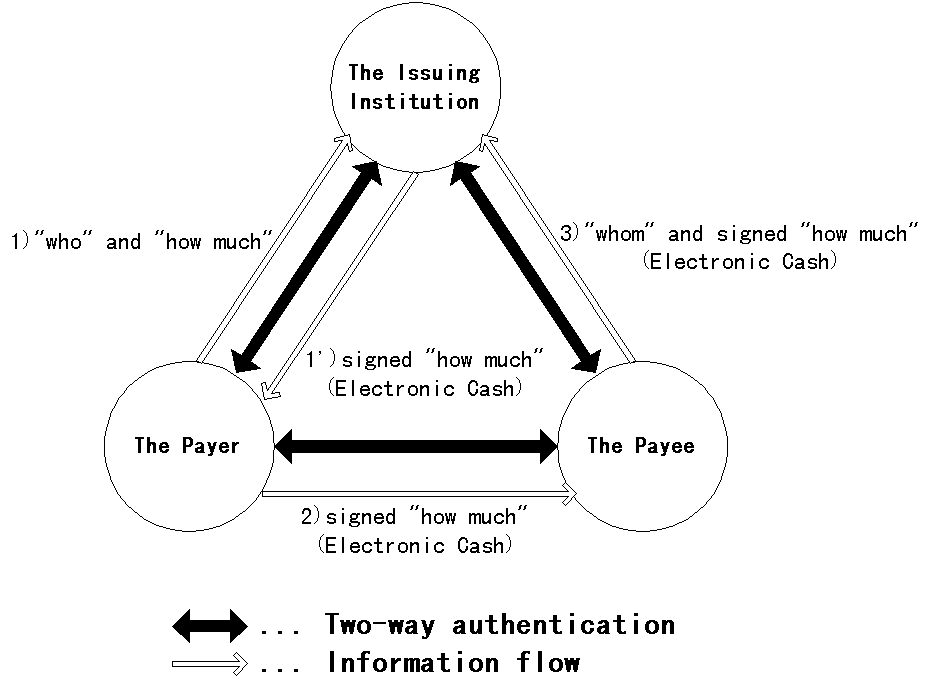
Pre Bitcoin digital cash system with a central issuer
Satoshi Nakamoto invented a new system of keeping track of who controlled what token in a distributed database. When one person transfers control of a token to another person, this is independently verifiable for the layman because there are many different systems all looking at the same database and confirming that a legitimate transfer has taken place and this makes cheating impossible.
In a closed system, where the only people directly exposed to the data in a database are employees, users have no way of verifying that an entry is true when it appears on their screen; they must trust the administrators that the system is showing something that is true. They cannot send the value of an entry to another system; they can only transfer entries between accounts in the same system. There is no way for a person looking at a screen to know what is really happening at the database level, and whether or not it is true or false. All they can see on the screen are unverifiable, unauditable characters, without any tools or means to truly, independently audit what has taken place or what is on display.
This is quite different to many adversarial eyes looking at the same database to detect cheating; that is what happens in Bitcoin.

A Mexican Stand off. Everyone covering everyone else. Everyone wants to stay alive, no one shoots. Its a bad analogy. I know. I just like Mexican stand offs.
When you see a Bitcoin balance on a screen, anyone can verify that an address has a balance, and know that it is true. You can check it from different screens fed by different independent analysis companies and even download the entire blockchain yourself to verify the truth of a balance. In a proprietary closed system, this ability goes away entirely.
Anyone who owns stock and relies on a closed system is vulnerable to the administrators displaying screens that show false information. A stock exchange that runs off of the distributed Bitcoin network on the other hand, is absolutely verifiable from anywhere without needing to refer to a single authority for verification. That is why Bitcoin is a trustless system.
“Private blockchains” introduce the need for trust. This is regressive, introducing a flaw into a system designed to remove it. The client of any service using a private blockchain has to trust that the system administrators are not going to cheat. This trust requirement is something that modern thinkers and entrepreneurs are trying to remove, and Bitcoin does this very well.
What is shown on a screen should not be taken as the truth, unless you have a way to independently verify the data the system is displaying is true. For this to happen, you need to be able to transfer whole control over what someone claims you own to another independent system without needing to refer to a system administrator. If you need to rely upon the service vendor to do transfer control, they could be lying to you, and simply showing you a screen with a false entry that they promised to fulfil to you, like X amount of Apple stock, “credited” to your account.
This is obviously applicable to any screen showing any financial data. When you go to an ATM and are shown a balance, that number is meaningless. You are trusting that the bank has that money, will release it to you on demand and will not confiscate it arbitrarily while you are not looking. It is immaterial to the truth that the bank is using a private blockchain database to store your account data.
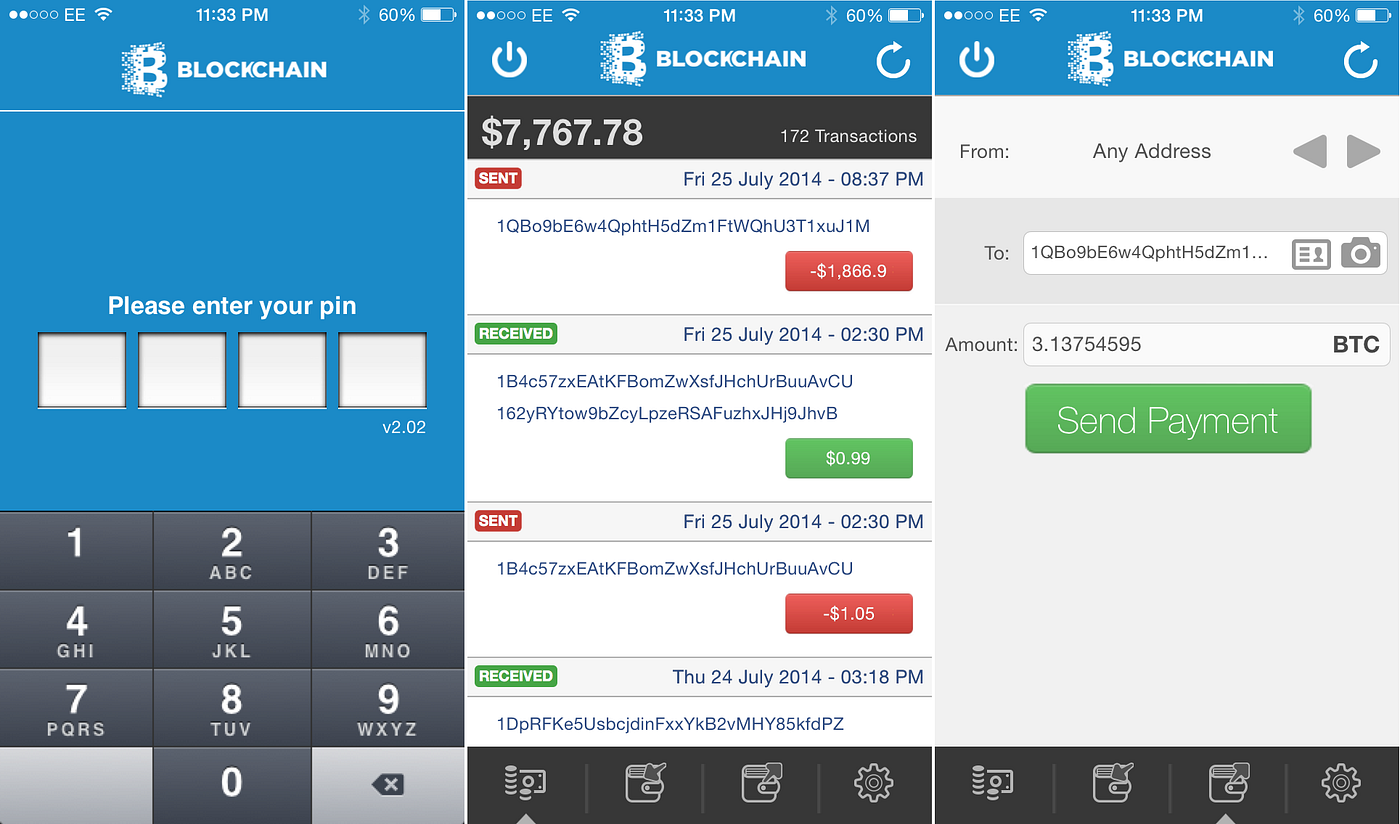
Blockchain Wallet with a verifiable balance
Contrast that with the balance display on your Blockchain wallet. They are showing you your balance as a service, not as a deposit they hold on your behalf. This is a fundamentally different proposition to a simple screen display, and it is something that the “Blockchain not Bitcoin” advocates do not understand because they are computer illiterate, and think that anything on a screen that is well designed is true by default.
Its all very well to use new software to improve the efficiency of your back end systems, if indeedyou can actually do what you claim to be doing, it is actually more efficient, and there are real advantages. What you cannot claim however, is that as far as the user is concerned, what you display to the viewer of an account is more true simply because you are claiming to use a “Blockchain without Bitcoin”. That is absolutely false.
Medium fillet stake, fries, spinach, house red, lemon sorbet.⤵

The Only Thing Living in This World Will Be Metal
By Beautyon
Posted February 12, 2016


There is no “man in charge”.
Bitcoin is not about human flaws or feelings. It is about software. This is the factor that everyone who isn’t a software developer doesn’t want to accept. If you don’t develop software, you don’t get a say. You can have meetings, write on Bitcoin, vote, go on retreats and do whatever else you like, but you have no effect or say in Bitcoin. That is a fact. Even if you are a software developer, if what you design is worthless, it will not be incorporated or run by anyone.
The “human side” of Bitcoin does not exist. Bitcoin is a purely technical software problem, and what irrelevant people think about it does not matter. If there are irrelevant people, you might ask, “Well then, who are the relevant people?” That’s easy to answer. The men and women who write the software and run the services are the relevant people. They are the ones that matter, and no one else.
No one needs a “Cellphone Community” to be able to make and receive calls on their phone, they don’t need a “Bitcoin Community” either. Apple and Samsung make phones, and there is no “Samsung Community” for you to join and “have your say”. You buy your phone, make your calls, pay your bill and that is it. If you don’t have a Samsung or Apple phone: no calls for you. If you want to have an influence on Bitcoin, run a full node,
build a new business on it, build a mining company, or learn to write C. Those are the only ways you can have influence, and even then it will be limited by how well you are doing what you are doing. And that limitation is a very good thing, because it keeps everyone secure.
Who is “we”?
Over and over we hear talk of this “we”. Who is “we” exactly, and why do people keep referring to them? Who says who is part of “we” and who is not? Thankfully in Bitcoin, who “we” is is a pure meritocracy; only the developers and entrepreneurs are “we” and no one else. They have the power, and they exercise it. No lawyer, association runner or blogger matters; silicon cannot execute what they have to offer.
There is no “Bitcoin rift”. Bitcoin is not broken and is running exactly to its specification. The people involved in the Bitcoin Soap Opera on the other hand, have reached an impasse. So far, every time an attack is launched on Bitcoin, the last one being being the Bitcoin XT coup attempt, the people in Bitcoin worked quietly to defend the network. And they suceeded. This is a very good thing. It strengthened Bitcoin, and showed that hostile takeovers won’t be tolerated.
The problem here is that there are people who want to control Bitcoin, or a network like it, but who don’t want to do the work in building a new network from scratch. If you really believe in your large block size plan, then start an alt-coin from nothing and use your prodigious social skills to get everyone to run your client. The problem is that no one will follow such a plan; everyone instantly becomes absolutely rational and ruthless when it comes to money, and the soap opera is switched off. That is why starting from nothing is a non starter for the people who want to capture the actual Bitcoin network and its incredible power.
This is not about personal relationships and codes of conduct. This is about people trying to steal the power of Bitcoin and take control of it, centralize it and neuter it. No amount of talk, weekends in the Bahamas and private conferences can change the nature of theft, or convince people who believe there is nothing wrong with the CIA that what they are doing is fundamentally unethical. Obviously all men and women who are rational would rather live without this idiotic drama, but for the people who only have drama as their sole connection to Bitcoin, this is what Bitcoin is. It is a series of characters, names to invoke, positions to hold, single page vertical scrolling websites with countdown tickers and other interactive things.
Whilst all of that entertainment is going on, the people who are moving forward are the billionaires, entrepreneurs and software developers who are getting on with their difficult, hideously complex, insanely risky, mostly experimental, ground breaking and dangerous work. Those are the people who matter, and no one else.
Trust, But Verify
Fool me once, shame on you, fool me twice shame on me. The only way that anyone can be trusted is if their position is correct, and their actions are in line with Bitcoin. If their actions are not in line with Bitcoin, no treaty, mea culpa or confession will be of any value. All it will mean is that you have left the door open to a man who you already know is an enemy and a thief, to corrupt and destroy your work and try to steal from you again. Only a fool trusts a thief twice.
Forgiveness is proper behaviour, but it does not, once again, mean leaving yourself open to attack over and over. Anyone who is trying to fork Bitcoin is an enemy of Bitcoin. This is non negotiable. Anyone who is launching a coup against the single true network is trying to steal the network. There are no two ways about this. It isn’t a matter of opinion, nuance or point of view. Trying to hijack Bitcoin is unacceptable, and you can be assured that it won’t be tolerated, just as XT was not tolerated and purged.
To assert that logic must come above emotion is correct, but ethics are important also. It is simply unethical to launch a hostile Bitcoin client on the network in an attempt to fundamentally change its nature and hijack it. The Bitcoin network doesn’t belong to you, and no, just because you held a vote, it does not mean that you can suddenly own something that doesn’t belong to you. Bitcoin is not a democracy.
This is about people’s behaviour. If you launch an attack on Bitcoin, what you think doesn’t matter; its what you are doing that matters; you are trying to steal something that does not belong to you. That is the only behaviour that matters; are you attacking the Bitcoin network with your software or not? Speech is irrelevant and so are people’s feelings. This is about software only, not feelings and nebulous “Community”.
The Metal. The Software. That’s it.
The only thing that matters in Bitcoin is the software. That is the framework that you have to live inside. That is the sole source of guidelines that are required. The only code of conduct that matters is how the protocol mediates and interacts between Bitcoin clients. Everything outside of this is noise and a distraction. If you remove the noise from the picture. there are few problems in Bitcoin, and the ones on the table are great, solvable challenges, but the software attacks are intolerable and evil and grossly unethical, and you don’t have to be involved in Bitcoin on any level to understand this. Stealing is wrong. Breaking contracts is wrong.
The answer to this nagging problem is already being implemented. The hostile Bitcoin XT coup was defeated and so will other attempts to Americanize and centralize Bitcoin. Even American lawyers are warning that putting your name to a new version of Bitcoin will get you in very deep water.
Your best bet, if you are trying to pollute Bitcoin, is to back down now, permanently, and work on software ancillary to Bitcoin. In the unlikely event that you succeed, the State will punish you severely. In the very likely event that you fail, you will have wasted your time for nothing, and wound up making the thing you are trying to destroy stronger. Trying to corrupt Bitcoin is the very definition of a fools errand, and you should quit now while you are ahead.
Signing pledges in software is worthless; imagine a thief burgling your house and asking him to sign a pledge not to steal from you. This is the nature of what is being asked for when people ask others to sign a toothless pledge not to misbehave. Every contract has clauses specifying what happens when a party defaults. We are talking about individuals who have no conscience or ethics, and who think nothing of trying to steal a multi-billion dollar software network, who think government blacklists are acceptable to add to Bitcoin and other hideous, unethical totalitarian garbage. These bad actors are actively trying to destroy Bitcoin, and rather than asking them to cease and desist and sign a piece of paper where they are under contract with grave consequences for breaking its terms (not a meaningless unwritten pledge that is in any case, only good for gentlemen) they are being asked to sign a pledge to be…
Polite.
You couldn’t make this up if you tried.
The participants who run Bitcoin have proven that they are very good at protecting the network, and I have a strong feeling that they will continue to do so, and quite aggressively. This power and bespoke arrangement has been achieved without open discussion or worthless paper pledges. There is too much at stake in terms of money and power. The face of the enemy is out in the open, and no one is being fooled by them, even once. The reason for this success is that the objective truth of this is in the software, not in anyone’s mind. The software in the metal is the only thing and place that matters, and defending it rigorously is being done.
Being Held to High Standards
If anyone wants to be held to a high standard, they should say explicitly what those standards are. Here are two for you.
1/ Don’t steal.2/ Don’t attack Bitcoin.
Those two foundational principles alone are enough to destroy these problems forever. Unfortunately, there are those who want to use Bitcoin as a skeleton to hang their professions on, or as a tool to enslave people. Improvements to Bitcoin are going to make these acts impossible, no matter what you want or vote for. And for the record, you are better off going along with Bitcoin rather than fighting it. Ask the MPAA/RIAA about BitTorrent and their attempts to kill it for a clue.
The trappings of the past, codes of conduct, voting, majority rule, summits of non developers, have no place, value, or power in the software that mediates between users. That is what Bitcoin is for; it is the arbiter, the judge and the means of dispute resolution. You either have the keys or you do not. The people who want to slather human layers of tears and grease on top of this pristine construct of symbolic logic and metal are not in Bitcoin. They want a place in it, but there is no place for them, because they don’t develop software or run Bitcoin businesses. If they did, they wouldn’t be suggesting any of this. They would simply say, “yes” or “no”, and that would be it.
What we are seeing is a glimpse into a world where opinion doesn’t matter. Pieces of paper you sign have no power or effect. Only the math matters, only the private keys matter. You are free to say whatever you like, go wherever you like, form associations, break associations, be polite, be rude. None of it matters. The only thing that matters is software in general and Bitcoin in particular. It is a profound transformation of society from one of force to one of math. There is no place for feelings in the execution of math. Of course, your feelings in human interactions remain unchanged, but this is of no effect in math and Bitcoin, and it should not be.
We can only hope that in the future, a version of Bitcoin emerges that has self defence built in to the protocol, where if rogue clients appear on the network, they are detected and all the nodes DDOS it. This “Self Healing Bitcoin Network” could run unattended, since it is self protecting, rejecting all attempts of the Statists to launch hostile clients. Who knows what is going to emerge to strengthen Bitcoin; all we can say for certain is that it is clear who is right and who is wrong in these matters, and there is no excuse for attacking the network and invalidating other people’s agreements.
Anyone who wants to fix problems doesn’t try to appease the enemy. They rebuke them and at the very least, try to make them cease and desist. Normal people don’t appease burglars; they lock them out permanently, improve security, lay out razor wire and sharp spikes. This isn’t a kindergarten; this is real life, and Bitcoin is a project of historic significance, perhaps, even more important than the advent of the internet itself. Anyone who wants to destroy Bitcoin is an enemy of mankind. The enemies of Bitcoin will be stopped and permanently prevented and locked out from being able to poison, centralize, Stateize and corrupt it. I am confident that they will fail completely.
On a final note about failure. There are understandable doubts about R3CEV and their vapourware, which we are now being told will be Open Source.
“What they’re (R3CEV) trying to do is protect themselves,” said Mullen. “They need a way to protect their business so they’re trying to develop a new infrastructure, a new protocol, to communicate among banks and various financial institutions.”
As I said before, the “Blockchain not Bitcoin” fad is just that, and anyone who wants to build real applications does so on Bitcoin not in a siloed private system better suited to MySQL/Oracle. What this looks like is Lightning
layer that sits on top of Bitcoin. Notice what Lightning is doing; rather than trying to steal the network or supplant it, they are harnessing its enormous power and making it more useful with their software. This is innovative, ethical and beneficial to everyone.
Why are R3CEV making their tool Open Source? Do they think that the words “Open Source” will confer legitimacy and the sheen of ethics on to what they are doing? Who is going to contribute to their code base from the public, and what incentive have they to do so? For a prediction on how many contributions they will get look a the GitHub repo of Open Source “Blockchain not Bitcoin” vendors and see how many contributions they have. It is literally zero across all files.
Open Source isn’t a magic formula to get people to write software for you, and people who try and polish their image with it don’t understand why software developers spend time on projects; they are human beings, and will work only on projects that benefit them. Working for free for a company trying to replace the back end of banks with irrational garbage isn’t an attractive prospect.
The banks and their cheerleader fan boys are trying to put on the clothes of The Software Transformation (“The Transformation”) and as they do so, they demonstrate that they simply don’t get it. When they have something to show for their efforts. Software developers aren’t stupid. Many of them are political. They know what the Federal Reserve banks and their cronies have done, and the very existence of Bitcoin is borne out of that deep understanding. All it takes is one developer to change the entire world. Whether that be Bram Cohen or Satoshi Nakamoto, or even Zooko Wilcox-O’Hearn, the new “Public Enemy Number One”
amongst the plentiful enemies of the State. Once the idea is out it can’t be recalled, and if it is a good idea, the GitHub repo will be full of commits.
This is the end. They don’t know it yet, just as the book stores had no idea that the internet would wipe them out. Bitcoin will do the same to many parts of the financial industry, from the top to the bottom. No one with any sense wants to go back to a time before Amazon, and soon, the idea of life without Bitcoin, real Bitcoin, will be unthinkable to every man in the street.
Organic roasted and salted Pistachios, a fine Belgian blonde beer ↴

Lets get this straight, Bitcoin is an experiment in self-organizing collective intelligence.
By Jordan Greenhall
Posted February 16, 2016

There have been a lot of conversations about Bitcoin over the years. Is it a currency or an equity or a commodity? Is it a store of value? Is it a “settlement mechanism”? Is it not money at all, but merely an example of a decentralized application on the Blockchain? The short answer is: none of the above.
Bitcoin is a self-organizing collective intelligence. As such, what it becomes is entirely a function of what it can do — that is, it is a function of the capacity of its collective intelligence to overcome the challenges that it encounters in its environment.
In some sense, we’ve seen this sort of thing many times. Every “movement” or “scenius” (to use Brian Eno’s ingenious term for “collective genius”) is a form of self-organizing collective intelligence. The Punk Rock movement, skateboarding, Ruby on Rails. What makes Bitcoin important is that it represents a new mutation in self-organizing collective intelligence.
In order to explain what I mean by this, I’m first going to have to spend a few minutes laying out what I mean by self-organizing collective intelligence.
The Development of Self Organizing Collective Intelligences (SOCI)
The basic dynamics of a SOCI is as follows. It begins as some sort of attractor — some aesthetic sensibility or yearning — that is able to grab the attention and energy of some group of people. Generally one that is very vague and abstract. Some idea or notion that only makes sense to a relatively small group.
But, and this is the key move, when those people apply their attention and energy to the SOCI, this makes it more real, easier for more people to grasp and to find interesting and valuable. Therefore, more attractive to more people and their attention and energy.
Thus begins the generative loop: as the SOCI becomes more real and attracts more people it begins to encounter challenges. Maybe Impressionism is being rejected by the status quo and it needs to find some way to display itself. Maybe hand-coded HTML is too burdensome and clumsy and this SOCI needs to get easier to use.
If the SOCI has enough capacity within its collective intelligence to resolve the challenge, it “levels up” and expands its ability to attract more attention and energy. If not, then it becomes somewhat bounded (at least for the present) and begins to find the limit of “what it is”.
Different SOCI will resolve challenges through different mechanisms. Some will form relatively centralized nodes (ICANN, Rolling Stone Magazine) that will accelerate problem solving in certain areas — but at the cost of losing some of the generativity and flexibility of decentralization. Others will mutate and proliferate exploring their niche like a slime mold (Protestantism and electronic music might be a good examples here).
As the SOCI develops, the choices that it makes — the solutions that it crafts — become part of its core architecture. “Frozen accidents” in its development, these begin to shape and define its future paths, slowly accreting structure and topography as the SOCI moves from its vague, open and highly creative infancy through adolescence and finally into its mature, effective, but much less creative adulthood.
In the end, the development of a SOCI is defined by the challenges it faces, its capacity to surmount those challenges, and the consequences of its solutions on its own further development.
Bitcoin as a Self Organizing Collective Intelligences (SOCI)
Bitcoin is a SOCI. And its future will be determined precisely by the dynamic tension between the problems it faces and its capacity to solve those problems.
Over the years, Bitcoin has worked its way through a complicated childhood. It was able to attract the attention and energy of a core of developers who built software that made it possible for less technical folks to participate and apply their energy. It has been able to create online exchanges and marketplaces and then survive the collapse and redesign and collapse and redesign of these pieces of its architecture.
As it did this, it expanded its “reality” and attracted the attention and energy of more “professional” entrepreneurs and venture capitalists — whose work significantly expanded Bitcoin’s capacity (and birthed an offshoot in the form of the “blockchain SOCI).
Over the past year and a half it has struggled mightily with its most recent challenge: governance. For most of its developmental history, Bitcoin has been defined by two different governance mechanisms. The vast majority of the work has been highly decentralized — activities like wallet construction and exchange building that is entirely done “at the edge” and with little to no governance outside of simple architectural boundaries. The remainder of the work has been handled through an ad hoc oligarchy of the “Core Developers” who have been broadly able to maintain a highly technocratic coherence.
This loose governance mechanism broke down as the collective intelligence couldn’t achieve coherence on purely technical grounds: two paths emerged that each presented valid, compelling and incompatible attraction to different sensemaking elements of the collective intelligence. The result was the exploration of what might be a fundamental feature of this kind of SOCI’s governance — a “hard fork” where doctrinal and values differences are physically formalized into two separate code bases.
So now we wait. Will the “hard fork” be the next level up for the Bitcoin SOCI and lead to an expansion of its ability to attract more intelligence? Or is this the hill that Bitcoin can’t climb and the beginning of its senescence?
This is the current question. But as interesting and important as this question is on its own terms, the real meaning of the Bitcoin experiment is deeper. This is because Bitcoin represents a new form of SOCI and is the first real test of the power and adaptive capacity of this new SOCI organism.
Bitcoin as a New form of self-organizing collective intelligence
Lets step back and consider what the Bitcoin SOCI has already done.
Beginning with essentially no backing and no resources Bitcoin has been able to organically attract attention and energy to grow into something that includes dozens of exchanges in something like 40 different countries and a computational infrastructure that processes an astounding 14 Million PetaFLOPS.
And it has done this while innovating directly against one of the most fundamental components of our current social fabric: money. The beaches are littered with the bodies of well funded efforts to step into this space and, indeed, even a major victory like PayPal required the improbably combined genius of Peter Thiel, Elon Musk, Luke Nosek, Reid Hoffman and the rest of the much gloried PayPal Mafia simply to carve out a nice niche in online payments.
And the Bitcoin SOCI has done this in merely seven short years.
This is no ordinary SOCI. The deep importance if Bitcoin is that it represents the first example of an entirely new SOCI organism in our landscape. One that clearly represents a new kind of power and capability. In fact, one that might relate to our legacy forms of collective intelligence in the same way that Homo Sapiens related to Homo Neanderthalensis.
What is the essence of this new form of collective intelligence that represents so much potential? My guess is that this can really only be answered with the benefit of hindsight. But I’ll venture a guess:
- It is intrinsically global. More to the point, it is geographically unconstrained, and, therefore able to take advantage of any attention and energy anywhere in the world.
- It is intrinsically virtual. In other words, it is able to connect with resources anywhere with minimal lag and at minimal cost.
These two features combine to mean that in principle this new form of SOCI can attract and utilize the total collective intelligence of the human species almost instantly. While in practice this level of concentrated collective intelligence isn’t likely to happen the potential of tapping into and connecting precisely the girl in Phuket and the team in Slovenia when where and how they are needed is flat out revolutionary.
- It solves motivation, reward and collective action problems through an architecture that is responsive to nuanced and changing value landscapes without being bottlenecked by concentrated (and, therefore, intelligence reducing) decision-makers.
This needs to be unpacked. Consider digital SOCI like, say, WhatsApp, Facebook and Instagram. While these collective intelligences are both global and virtual, their ability to connect with, motivate and apply the attention and energy of their communities is either very narrow (you can contribute to the Instagram SOCI by uploading photos, liking and commenting them, but little more) or bottlenecked by a relatively small team of people who have exclusive power to adapt the architecture (like when the Facebook team added the ability to upload videos).
Bitcoin-like SOCI use the technical capabilities of the blockchain, crypto-tokens and smart-contracts to provide a motivational architecture that can be highly adaptive to the real needs of the SOCI without bottlenecking through some concentrated control structure. As these techniques mature, they provide this new class of SOCI with an “executive function” that has little to no agency risk and can scale without creating a bottleneck on the SOCI.
To get a better sense of what I mean here, consider Bitcoin as an extremely early prototype of how this kind of motivational architecture can work. By linking “run hashing software” with “be the source of coin creation”, Bitcoin created an invitation to value contribution at an architectural level. Anyone who could understand and act on the invitation could participate without any human agents getting in the way to bottleneck the process.
And by carefully wiring up difficulty and scarcity, Bitcoins became at least potentially appreciating assets — motivating anyone who could appreciate and act on this invitation to figure out how they could best give their value to the Bitcoin SOCI in exchange for increasingly valuable coins.
While rough and coarse-grained, this approach worked. It was flat out brilliant in incentivizing the construction and rollout of mining infrastructure, and as mentioned has delivered on a tremendous amount of creative activity.
Of course, the Bitcoin approach has known issues. High volatility, a dependence on risk seeking speculation, too much concentration in the hands of early adopters, coarse-grained focus on mining, etc. Arguably, these design elements limit the effectiveness of the SOCI to attract and deploy collective intelligence and, therefore, its overall potential.
With regard to the Bitcoin SOCI in particular, the future is uncertain. Will it overcome its governance challenges and emerge on the other side with still more collective intelligence? I honestly have no idea, I suspect it will, but these moments are always deeply uncertain.
If it does, however, it will come out the other end much stronger than it has been so far. Governance is a major challenge. If Bitcoin survives this current crisis, my bet is that the collective intelligence will focus its efforts on governance much like it has on past crises like the Mt. Gox collapse — and the result will be a much, much more capable SOCI.
The Future of Self Organizing Collective Intelligences
Regardless of the specific result of the Bitcoin experiment, we are clearly in the middle of a new era. As I discussed in The Future of Organization, a lot of smart people are currently hard at work understanding, generalizing and optimizing the deep code of these new forms of collective intelligence.
The limitations of Bitcoin’s approach to motivation and collective action are well understood and new technical layers like Ethereum’s smart contracts and Backfeed’s distributed governance system magnify the potential intelligence of this kind of SOCI at least as much as the neocortex magnified the intelligence of the mammalian brain.
I really wish the reality and importance of this new frontier were more broadly understood. My sense is that over just the next five years this new form of SOCI will go through its gestation, birthing and childhood development stages. The result will be a form of collective intelligence that is so much more capable than anything in the current environment that it will sweep away even the most powerful contemporary collective intelligences (in particular both corporations and nation states) in establishing itself as the new dominant form of collective intelligence on the Earth.
And whoever gets there first will “win” in a fashion that is rarely seen in history.
“Proper Governance” is the New “Legitimacy”
By Beautyon
Posted February 24, 2016

I read an incredible Tweet that spurred the writing of this post. It demonstrated perfectly how, like in the animation above, men’s understanding of Bitcoin is distorted by their prejudices, education, background and other reality warping factors.
This Tweet was posted by a talented developer, working on a piece of software that will completely disrupt how people buy goods in a global, encrypted, unregulated, “virtual swap meet” that is unprecedented and beyond the reach of the State. It will be beyond regulation once it is released, and it can never be withdrawn once it is on the internet, because it is an Open Source project, like BitTorrent.
The developer said that what he is doing should not be controlled by a self appointed committee because, “his software is code”. Bitcoin on the other hand, needs “better governance”.
This is ridiculous, obviously.
As I have said before many times, and each repetition is true and necessary, Bitcoin is text. Bitcoin is software (which is text). Bitcoin is not money (it is text) . It should not be regulated, and it does not need “governance”, and even if you concede that it did, that governance should not come from a monoculture of compliant, brainwashed Statists from a single country.

A stadium wave.
From the Beginning, Bitcoin has had waves of thinking propagating through its “community” like waves of fans hands travelling around a stadium. Some of this is beneficial, as what Bitcoin is is made more clear, and some of it is not beneficial. “Legitimacy” was one wave, where some were desperate to appear to be legitimate and steer “the conversation” and perception of Bitcoin away from the tiny fraction of users who were trading it to facilitate paying for forbidden goods.
Now we are at the end of another wave; the “Consensus” stadium wave. After nauseating and tiresome bickering lasting weeks, Bitcoin is firmly under the control of men who have its best interests at heart, and everyone is starting to realize that Bitcoin is not democratic and never will be. They are also starting to realize that everyone does not “have their say” in Bitcoin; only the powerful have a say, just as Mircea Popescu has been correctly stating for years.
Just as the “Consensus” wave is crashing onto the rocks of the eternal shore of reality, a new wave is gaining amplitude; the wave of Political Correctness inspired “Non Confrontation” where everyone is told they must conform to uniform standards of speech and etiquette when talking about Bitcoin. This wave too will reach the shore, crash into white foam, be absorbed by the sand, and fade away eventually.

Whatever memes, tropes, fads and other nonsense people come up with, all of them are meaningless in software, and all of them will eventually disappear, leaving the utility of Bitcoin as the only constant.
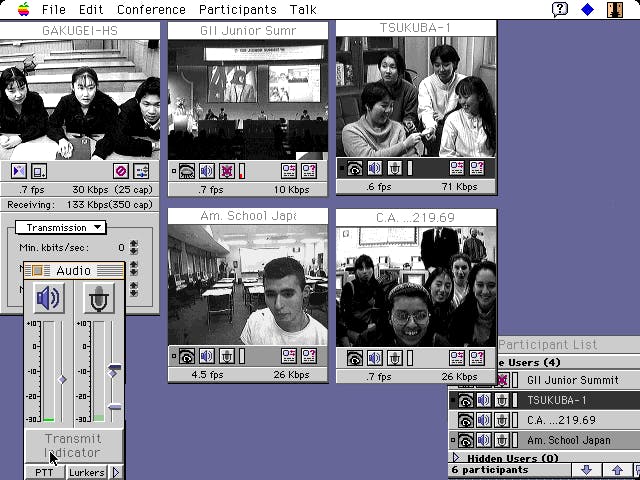
CuSeeMe Chat application from the early internet. People today use tools like Blab in their browsers, but this is where it all started.
Just as the old browsers like Netscape Navigator, and the other tools like CUSeeMe have all been replaced and the companies that developed them vanished, the protocols underneath them and software principles remain intact. Instead of CUSeeMe you have Blab. Instead of Netscape Navigator you have Chrome. The internet culture that existed when these early apps were essential is also mostly vanished. Only a tiny remnant of users uses USENET to read news or share files any more. News is read from Twitter and files are shared from Kickass Torrents and other sites using BitTorrent.
The same will happen with Bitcoin and its “community”; which will eventually vanish into history, diluted by the millions of new users who have adopted it, and those who don’t even know they are using it, all of whom have absolutely no interest or need to talk incessantly about Bitcoin. There is no “Dollar community” or “Euro Community”. No one reads /r/dollar or /r/euro; there is no need for them, any more than there is a need for /r/hammer. If you want to bang a nail in, you use a hammer. It is not the center of your life, or a cause célèbre. That is what Bitcoin will become.

That being said there is nothing at all wrong in people spending their time in whatever way they like on line. Users of CUSeeMe had many useful sessions where they made friends and at the very least, saved money on phone calls.
I say again. It is the software that matters, and nothing else. You can’t call for governance of other people’s software projects while you yourself run a super disruptive Open Source project that will change the entire world, and expect to be left entirely alone to do what you like, because you are “special”. It simply is not rational. I have no doubt whatsoever that if a group of Statist men formed to steal the project I am talking about in order to cripple and de-decentralize it (by forking it and dismissing the original developers just as Bitcoin Classic tried and failed to do) those developers would not be happy about it at all, and would correctly argue that they, as the original developers with the correct and ethical vision should carry on as sole maintainers of the code base. Quite how these men have missed the direct parallel to the control of their own work is baffling.

If you believe it, a new form of money. If a new form of money, freedom, if you want it.
Bitcoin, because it is mistaken for money, has attached to it all the illogical and fallacious thinking that is attached to money. Men see that the Dollar is managed by the Federal Reserve with its imposing Roman edifice, secret chamber, Popish head and the reverence poured on The Chairman’s office. They immediately make the leap of logic that because Bitcoin is money, that it needs a similar “Federal Reserve of Bitcoin” with “Proper Governance”, grave and intimidating men in suits, tall glass buildings, government tentacles in every side, and all the other trappings of big finance. They simply do not understand that Bitcoin is a revolution in every possible sense of that word.
Bitcoin is a revolution in how people send money, store data, bank, verify facts, trade shares and all the other things that Bitcoin can do, that we know about now, and that are yet to be invented. Why do these people think that the sclerotic and inferior governance systems and management styles of 20th Century corporations and the State are appropriate for Bitcoin? Because fundamentally, what Bitcoin is and what it represents has flown right over their heads, and the split in Bitcoin users between the the

Bitcoin Coke. It wasn’t the real thing.
“Bitcoin Coke” side and the true Bitcoin side is a very strong indicator of the philosophies and understanding of each camp. This is so true that you can predict the philosophy of the advocate by what side they have taken in this event. You can make up your own mind which side is right or wrong, and which side has a better understanding of why Bitcoin is important and how it should grow. That doesn’t affect your ability to predict people’s position on this crucial matter, or that one side was soundly crushed in Hong Kong and beyond.
You can’t ask for governance of other people and the destruction of their software and private agreements but also want your software project and agreements to be immune from tampering. Double standards in a free society simply do not wash with rational men, and its the old idea of surveillance being needed for the elusive “other guy” who is ever present, unknown and lurking around the corner. The reasoning goes like this, “Mass surveillance is not appropriate for you and me, of course, we are OK. Its the bad people in society that we have to watch out for. That’s why we should all accept default blanket surveillance. Nothing to hide, nothing to fear!”. We’ve heard these woeful, wafer thin arguments over and over over the years; they were fallacious when they were first made, and they are still wrong in the age of Bitcoin.
In any case, all of this is moot. There is nothing anyone can do to stop Bitcoin. No rogue developer, venal venture capitalist, social media saprophyte or Bonk’s Revenge BitLicence wielding Crony Capitalist will stop Bitcoin. Just as excellent and breakthrough software like CUSeeMe is now a part of internet history, as are AOL, Hot Bot and many others, all companies that do not serve the market correctly or that are simply superseded are doomed to disappear. The Bitcoin protocol will remain, and continue to serve everyone when these bad actors are crushed to footnotes.
A double whiskey sour, roasted almonds.↴