
December 2016 Journal
WORDS is a monthly journal of Bitcoin commentary. This issue collects the December 2016 writing in the WORDS archive. For the uninitiated, getting up to speed on Bitcoin can seem daunting. Content is scattered across the internet, in some cases behind paywalls, and content has been lost forever. That’s why we made this journal, to preserve and further the understanding of Bitcoin.
Bitcoin Year-In-Review 2016
By Pete Dushenski
Posted December 4, 2016
As with our 2014 Edition and somewhat stillborn 2015 Edition, it’s that time of year again when we review the past twelve months and take stock of what The Most Serene Republic of Bitcoin has accomplished. Without further ado :
- USD lost 40% of its value relative to BTC.
- Network difficulty and hashrate increased nearly 3x.i
- The block reward halved for only the second time.ii
- BitBet entered receivership.iii
- Chinese mining cartel busted politically.iv
- MPEx went private.v
- S.MPIF closed.vi
- Court transitioned from #bitcoin-assets to #trilema following BitBet schism.vii
- Redundant logs implemented.viii
- First Republican block explorer / slicer released.ix
- Raft of new bots introduced in-channel.x
- T – ticket management system released.xi
- New WoT visualiser and browser released.xii
- No Such lAbs (NSA) unveiled FUCKGOATS entropy dongle.xiii
- Republican mailhole released.xiv
- Altcoins and their pimply pumpers frankly continued to fizzle.xv
- The Real Bitcoin Foundation celebrated its second birthday and officially released client.xvi
- GPG parachute designed.xvii
- AMD hardware debugger unbricked.xviii
- Hanbot wrote the best Elliot Rodger-themed fanfic.xix
- Eulora lifted off.xx
- Unicode badly bludgeoned.xxi
- The Deep / Dark Web officially defined.xxii
- DNS fell out of favour while, ironically, the prospect of a Republican DNS registry materialised.xxiii
- Block cipher competition announced.xxiv
- Courts Circus competition winners announced.xxv
- Jokes were had.xxvi
- TMSR participation levels made explicit.xxvii
- Leaner and meaner Lordship list announced.xxviii
- Gossipd spec updated.xxix
- The SFYL playbook formalised.xxx
- Potentially very, very silly WoT bet made.xxxi
- Phuctor broke a lot more RSA keys than anyone expected.xxxii
- Bubble bullet dodged.xxxiii
- Republic selected upcoming US President.xxxiv
See you in another twelve short months!
- Difficulty increased from 103
880340815 to 286765766821 while hashrate increased from 743604444 GH/s to 2052749`317 GH/s.↩ - As of July, miners are now awarded only 12.5 BTC plus tx fees, down from 25 BTC, which was the rate for roughly the last four years. It was 50BTC ~every ten minutes prior to that. ↩
- The foremost perimutuel betting website in Bitcoin was dissolved by its founding partners following a contractual dispute. I then lost a pretty thrilling live auction for the tainted bones. ↩
- Apparently the miners don’t control Bitcoin after all. Who knew ? ↩
- This resulted in the largest (~250kbtc) and cleanest unwinding of stock issuance in the history of Bitcoin when S.MPOE was delisted. ↩
- Turns out that investing in anything Bitcoin-related that isn’t Bitcoin proper is no mean feat. ↩
- kakobrekla, punkman, and Funkenstein_ were the most notable stragglers, the rest move forward, onwards, and upwards unflinchingly.↩
- Public-facing channel logging had previously been dependent on kako, which obviously couldn’t stand going forward, so phf and Framedragger stepped up and released their own public log sites, each with differing formats. Redundancy and complementarity FTW! ↩
- Our man Ben Vulpes released the mythologically-named Mimisbrunnr. ↩
- The bots directory has them all listed with their ever-expanding functionalities. This past twelve months has seen Vietnam War-levels of explosions in bot capability and scope. Trinque even made vpatches for an IRC bot and a log bot. ↩
- mod6 made this spiffy little tool for keeping track of TMSR software development projects and objectives. ↩
- Old maintainer mike_c was lost to meatspace commitments as near as anyone can decipher. So trinque, who also maintains deedbot, took charge and crafted a replacement. ↩
- Entropy is a tricky business, as we know, so 0.028BTC for FUCKGOATS is an exceedingly modest sum for an auditable and WoT-manufactured source. Particularly as more whitening “bugs” come to light. ↩
- Ben Vulpes at it again! ↩
- Zcash sputtered and started like an old VW diesel, Ethereum and its unscrupulous founders flopped about like fish out of water, and “Classic” / “XTcoin” / “Hard fork” / “Soft fork that’s really a hard fork” all sucked a dead donkey. Bitcoin 2.0… what was that again ? ↩
- After thorough and iterative testing conducted by yours truly as well as a whole host of other dedicated Republicans, mod6 officially released a decrufted v0.5.4 client and made possible offline builds. Huzzah! ↩
- Alf outlined how one can stave off cryptographic death and the attendant, and quite isolating, stench of rot. ↩
- Alf cracked the puzzle of this time-limited hardware peripheral for x86-64 iron. ↩
- There was a competition, she won. And paid her tax too! ↩
- The Ministry of Games’ principal title is officially up up and away
- Why ? Because it’s fucking stupid. ASCII FTW. ↩
- As is so often the case, MP had the definitive take on the subject. ↩
- MP both launched the formal attack on DNS and is jointly crafting the specification for the registry with Framedragger. ↩
- With a stonking 10 BTC to the winrar. And yet it remains open to this day! Ten months on!!1 ↩
- mats plugged away hard on this one and took home 24.7779686 BTC (USD$ 16.5k at time of tx) for his efforts while the helping hands of hanbot took home 2 BTC (USD$1.3k). Indeed, there are always and everywhere jobs for the industrious and well-connected. ↩
- Qntra had a contest for best Clinton/Cosby jokes. Yours truly snagged a piece of the prize pie! ↩
- Where do you fit in ? ↩
- Much fat was trimmed. ↩
- But it’s really the comments section where the debate gets juicy. Oh, so, sooo juicy. Kinda like this organic mandarin orange I’m presently enjoying. ↩
- Bingoboingo set the record straight and laid out the steps in a readily digestible manner. ↩
- Will Ben or I massively regret this bet ? Stay tuned to find out! ↩
- All of which invariably “unhappened” of course. Why ? Because reality is a cold and cruel mistress, like Mata Hari but less forgettable, certainly in our present digital age of ~free reproductions. So it is that previously adaptive behaviours – ones suited to life at linear speeds – are now maladaptive at the connected world‘s exponential speeds. Shitty break for you to be born into this missilic morass, this frantic freight train, eh ? ↩
- What’s a movement without a monarch ? TMSR was this close to a going Full Cat-V. ↩
- Trump was always the man to beat, but the Republic sealed his fate. ↩
Better Fork Terminology
By Paul Sztorc
Posted December 5, 2016
When it comes to protocol upgrades, we need better words.
Simply
My proposed new terms are:
- Hard: Creates a new network.
- Mean: Forces miners to constrain everyone on an existing network.
- Loud: Creates ecological discrimination towards those who don’t upgrade.
- Friendly: none of the above.
Motivation
The goals of this post are:
- Help people understand each other, wrt. protocol changes.
- Point out how soft forks can become hard, and vice-versa, to help people realize what they should actually be caring about, instead.
In general, I feel that clearer language helps all of us be aware of Bitcoin’s attack surface. The more aware we are, the better we can prepare.
I will be expanding on my previous comments here and this section.
Does it Matter?
Often, conversations of this kind are Talmudic hairsplitting, at the expense of practicality. Usually (when we refer to Soft, Firm, Evil, or Hard forks), a clever person will grasp enough context to decipher the speaker’s original meaning.
However, in the context of a contentious scaling debate, fraught with misinformation, motivated-reasoning, and outright propaganda, it might be worth the extra effort to be as-clear-as-possible about what you mean.
( But hey…they’re just suggestions. Take ‘em or leave ‘em. )
Current Problems
Full-time Bitcoiners work very hard to agree over the ‘softness’ of a fork (or of equivalent notions, such as how many hard/soft forks we’ve had in the past).
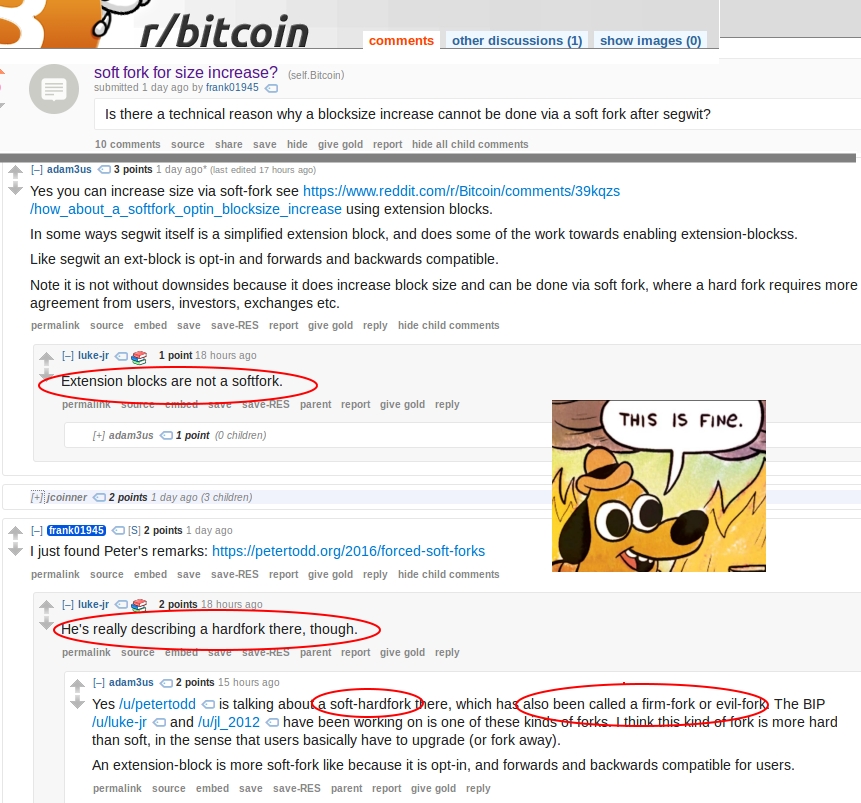
Disagreement is even more pronouned for proposed future changes. And, of course, disagreement is highest over the relative costs, benefits, and risks of hard and soft forks.
Why does this conversation always progress so little?
1. Ambiguity
The existing definition (that soft forks ‘tighten’ the rules, and hard forks ‘loosen’ the rules), is more ambiguous than it might appear.
For example, a soft fork would include all of the following changes:
- A fix for a severe bug that allowed someone to counterfeit 184 billion BTC.
- Support for a new feature, CheckSequenceVerify (and thus support the Lightning Network).
- A freeze the money in Address X, forever (and, by the properties of money, cause value to be redistributed to others).
- A new policy, to only mine empty blocks forever (this change is indistinguishable from a 51% DoS attack).
- A policy where no one is allowed to broadcast to the chain at all, until they upgrade their software.
In other words, the current usage of ‘soft fork’ includes a wide range of phenomena; it lumps bugfixes, upgrades, and attacks into the same cateogry. This make it hard to talk sensibly “about soft forks” (as so little of what is said will really be ‘true’ for all soft forks).
2. Poor Logical Foundation
As the 5th bullet point (above) reveals, the soft fork label is not only unclear, but it is also self-contradictory.
In fact, out of necessity, others have needed to move Bullet #5 into a new category: the ‘evil fork’ (what I will call a “100% Mean” fork).
In the evil fork, the protocol rules are altered to become informational substrate for arbitrary data (and, upon this blank slate, a new protocol is written).
Let me elaborate with a non-Bitcoin example. Consider “Chess II”, which we’ve implemented by soft forking “original Chess”. Chess II might only allow the players to move their queenside knight, to one of three squares (initial position, left, and right).* By doing this the players can encode bits of information – “0” for left, “1” for right. In so doing, they can signal their moves for any other game – even something like Checkers, Connect 4, or (by advancing frame by frame) Starcraft II.
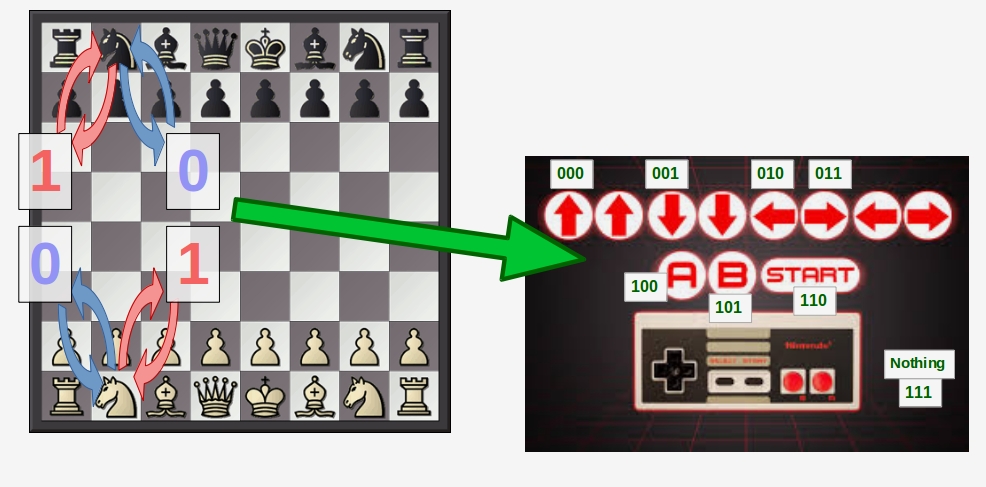
How did this happen? Well: the “rules” of “chess” ceased to define a game, and instead functioned as informational substrate – they are the paper upon which information was written.
The result, is that we have a way of ‘loosening’ the rules…by tightening them.
- Ordinarily, standard chess rules would quickly trigger a draw, via threefold repetition (and/or, the 50 move no capture rule). But the problem is trivially avoided by forcing the players to play multiple games in a row. (Moreover, we can lengthen games by forcing all other pieces to increment in a predetermined sequence, or we can simply force both players to always decline the draw.)
The Culprit
In my opinion, these problems are largely the result of imprecise terminology. Often, “softness” is used to describe (at least) three separate ideas.
- Is a new protocol created?
- To what extent are miners now obstructing users, all of the sudden?
- To what extent do users feel indirect pressure to upgrade?.
Solution
I therefore propose that we expand our existing language:
- Hard Forks (vs. non-Hard)
…by further dividing the non-Hard category as follows:
- Mean Forks (vs. Kind)
- Loud Forks (vs. Soft)
All Mean forks would be Loud, and all Soft Forks would be Kind. Kind Forks, however, are allowed to range from Loud to Soft, as shown here:
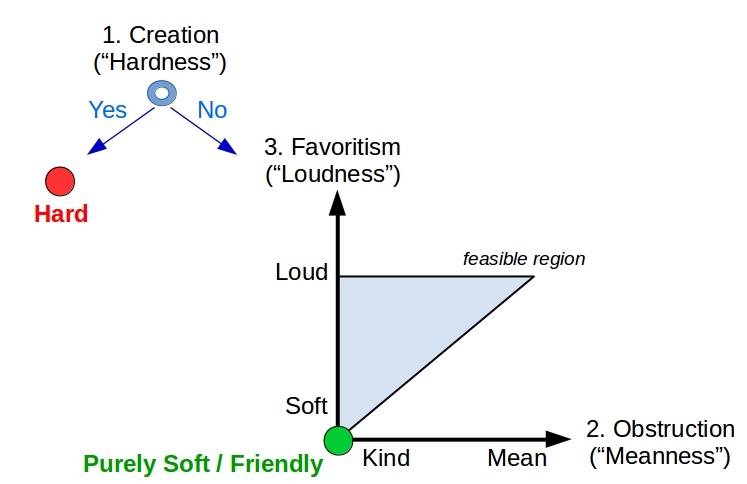
Soft Forks score the lowest of all, on three measurements. These measurements correspond to [1] creation, [2] obstruction, and [3] favoritism (the three enumerated points above).
I’ve plotted several upgrades on the triangle graph, to give you an idea what I mean.
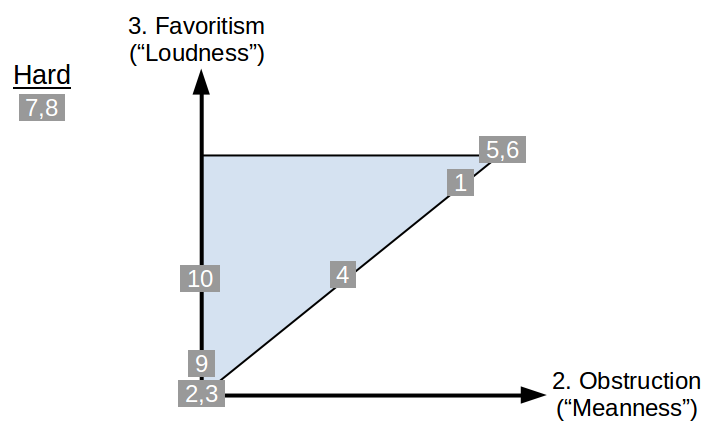
…and here is the corresponding table:
Table
No.
Item
Hard?
Mean?
Loud?
1
When
Satoshi imposed the infamous 1 MB block size limit
.
No
95%
(95%)
2
Sipa’s
limitation of the coin supply to 21 Million
.
No
0%
0%
3
The
value overflow
fix.
No
0%
0%
4
The
s-value discouragement
.
No
49%
(49%)
5
A version of Bitcoin where blocks are always empty.
No
100%
(100%)
6
An
‘Evil Fork’
upgrade.
No
100%
(100%)
7
March 2013 Upgrade Bug
Yes
(100%)
(100%)
8
Bitcoin Classic
Yes
(100%)
(100%)
9
Adding support for
CSV
No
0%
5%
10
Adding support for
SegWit
No
0%
40%
11
Satoshi’s change from ‘longest chain’ to ‘heaviest chain’.
*
*
*
| No. | Item | Hard? | Mean? | Loud? | Notes | :– | :—– | ——- | ——- | ——- | 1 | When Satoshi imposed the infamous 1 MB block size limit. | No | 95% | (95%) | While the fork prevents miners from introducing new funds (and might then be slightly ‘Loud’), | 2 | Sipa’s limitation of the coin supply to 21 Million. | No | 0% | 0% | While the fork prevents miners from introducing new funds (and might then be slightly ‘Loud’), | 3 | The value overflow fix. | No | 0% | 0% | This did remove one option (to improperly create BTC), but, the option was self-destructive (one would never be able to use the option, to use the protocol to do anything). Therefore, no user optionality was destroyed. Also, while this involved a re-write of the chain (debatably, a “benevolent 51% attack”), reorganizations always occur “within” a given protocol / network (vs. an upgrade which modifies the protocol / network). | 4 | The s-value discouragement. | No | 49% | (49%) | This is the perfect example of a “Harsh” fork – not hard, but (in order to send money) everyone must use compliant software (ie, “everyone must upgrade”). | 5 | A version of Bitcoin where blocks are always empty. | No | 100% | (100%) | Users are required to upgrade, to “use” the protocol. The fact that the upgrade is terrible doesn’t change it’s attributes. | 6 | An ‘Evil Fork’ upgrade. | No | 100% | (100%) | Users are required to upgrade, to “use” the protocol. The fact that the upgrade is terrible doesn’t change it’s attributes. | 7 | March 2013 Upgrade Bug | Yes | (100%) | (100%) | The 0.8.0 software was (surprisingly) a completely new protocol. It was therefore a Hard upgrade, and it was quickly and intentionally deprecated (and later redone as a 100% soft fork). | 8 | Bitcoin Classic | Yes | (100%) | (100%) | 9 | Adding support for CSV | No | 0% | 5% | 10 | Adding support for SegWit | No | 0% | 40% | 11 | Satoshi’s change from ‘longest chain’ to ‘heaviest chain’. | * | * | * |
Discussion
The Hard Fork Creates an Altcoin
I will save my major complaints about hard forks for tomorrow’s post.
For now, I will just point out that, if ‘Altcoin’ is defined as “a cryptocurrency which is not Bitcoin”, then a hard fork of Bitcoin always creates an Altcoin.
For example, consider a “spinoff” where we create “Bitcoin 2.0” (as a hard fork of Bitcoin 1.0) which inherits the UTXO set of 1.0. Everyone could upgrade, and we could all live happily ever after.
However, if the spinoff succeeds, we have discarded Bitcoin 1.0 as a failure and started over with something new. We will fail to define Bitcoin at all, unless we define it as “the set of X rules (and Y genesis block), and all subsets of these rules”. Else, the definition will either entangle [a] itself in tautological circularities (such as “Bitcoin is what most people think Bitcoin is”), or [b] it will include obvious non-Bitcoin, such as the CLAMS Project (or worse it will include every blockchain). Neither of these two outcomes is unacceptable.
What Mean Forks Remove: Functionality
The software of this quad robot at 6:55 allows it to reach any point in space, even if some of its appendages are removed. If we assume that ‘yaw-flying’ is one of the many algorithms programmed into the ‘original’ quad, then the decision to disable a few wings (for whatever reason) is not a ‘mean’ fork with respect to range. While the quad has lost one degree-of-freedom wrt motion (yaw), it can still reach any location in the room. Therefore, the three dimensions (of range) that we care about are unaffected. To restate: losing two wings is Mean wrt yaw, but Kind wrt range. Losing two wings is also Mean wrt flying mode, cargo stability, battery life and (probably) altitude, top speed, etc.
To be mean, you have to be prevented from acheiving a goal with your present software. This is why re-purposing the ignored OP NOPs to create new opcodes is 0% mean.
These protocol upgrades do filter (ie, “censor”) the users: they can no longer broadcast certain anyone-can-spend txns, if these are of a certain structure. However, the upgrade does not prevent a stubborn non-upgrader from achieving the same goal as before. There are hundreds of still-valid ways to create an anyone-can-spend txn. Moreover, the upgrade does not interrupt those ways which were in popular use at the time of the upgrade.
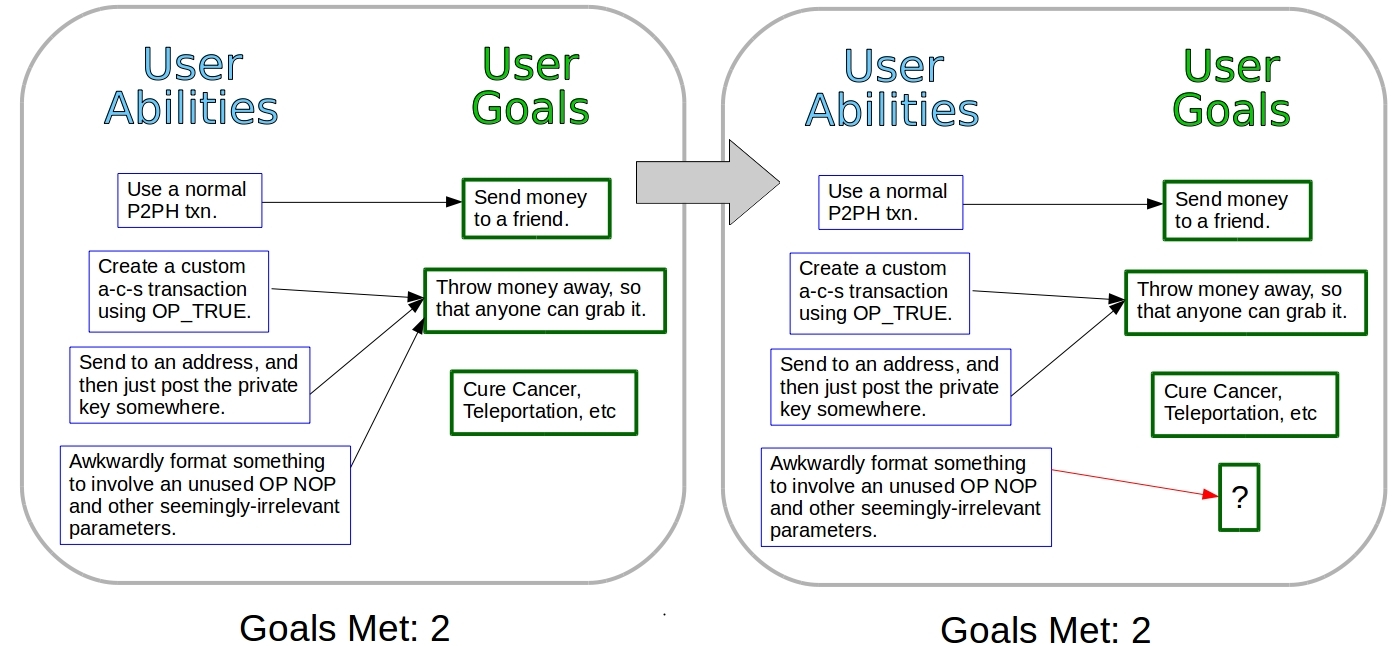
Figure: since the “goals met” metric has not decreased from 2, the upgrade (left-to-right) is not mean.
The value-overflow bug itself removed functionality (removed the ability to receive value), and the functionality created by the bug was not used by anyone before its discovery. It is therefore not Mean. The s-value fix, however, prevented affected users from sending money via signatures, until they had upgraded. Pre-upgrade, users could only receive money. It was therefore almost half Mean.
No ‘Extra Credit’ For New Functionality
‘Meanness’ measures the number of options destroyed. It intentionally IGNORES any “new” options that are brought in to replace it, even if those options are “identical”. This is because the labor involved in checking all of these rules (to know if you’ve been paid), is the entire purpose of the protocol.
So, to have a user redo it, out-of-protocol, would be a contradiction. Call it the “Reductio ad PayPal”.
In this way, the ‘evil fork’ (described above) is just 100% mean (and indistinguishable from a 51% attack of empty blocks).
Loudness is About Users, Not Miners
When the Bitcoin miners coerce behavior directly, this is Meanness. However, if miners merely induce an unwelcome change, this is mere Loudness. For example, we might pass a law banning VCR rentals, which would close down Blockbuster (Mean to Blockbuster), or we might pass a law allowing Cable to sell video-on-demand, which would result in Blockbuster hurtling towards bankruptcy (Loud for Blockbuster).
SegWit is Loud, because it causes ecological changes to the network in a few ways. The most important is that Alice may wish to send money to Bob, but Bob is only configured to use the Lightning Network. Alice is then pressured to upgrade, in order to send money. Another source of Loudness is that, when Carol wants to send money to Alice, Carol may want to use SegWit (which offers a fee discount under many conditions), which will put pressure on Alice to upgrade, so that she can validate these kinds of incoming payments.
(Miners, however, should always accept anything that pays a high fee/kb, regardless of its format.)
None of the Above
Finally, consider:
- The “Friendly Fork”, which is neither Hard, Mean, nor Loud. (Notice that, a fork cannot be Kind unless it is not-Hard, and a fork cannot be “100% Soft” unless it is simultaneously 100% Kind.)
- Satoshi’s modification of the chain selection rule from ‘longest’ to ‘most work’. This “upgrade” technically did not change anything about block validity (ie, which blocks were-or-were-not valid). In fact, in principle, it was a purely cosmetic change…only displaying one up-to-date history, instead of another up-to-date history. It was, of course, a crucially important change; but -in a quirky way- it was not a fork of any kind (IMHO).
- Similarly, reorganizations (big or small, intentional or otherwise), aren’t really ‘upgrade forks’ either. In this way our terminology is particularly counterintuitive – the only ‘upgrade fork’ which literally “forks” [ie, actually splits a blockchain into two] is the Hard Fork. Meanwhile, our real-life chain regularly splits into two (ie, stale/orphan blocks), and later remerges, but these events are not considered ‘forks’ anywhere in this article (nor by most people).
- Imagine an ‘inverse soft fork’ where a permanent >51% hashrate group decided to drop support for the most recent soft fork. From one vantage point (those running the most up-to-date software), this would be an unabiguously Hard, but from other vantage points (those running any other software) the fork would be 100% soft. It is purely Hard for some people and purely Soft for others – very curious!
Conclusion
I hope that this set of terms is useful.
In particular, I hope that it clarifies the status of the ‘evil’ fork, as indeed evil. And I hope that it allows users to complain about “loudness”, without forcing them to also complain about “soft forks”.
Add Disqus comments.
comments powered by
Disqus
Against the Hard Fork
By Paul Sztorc
Posted December 6, 2016
The hard fork presents tremendous risk to the entire Bitcoin Ecosystem, in exchange for almost no marginal benefit. Instead, use extension blocks or sidechains.
Intro
Overview of Problems
A Hard Fork is a categorical replacement of one protocol with another. When compared to an Alt-chain (an Altcoin or Sidechain), they have a number of obvious problems:
- They attempt to break an existing contract, and replace it with an “updated” version . The entire purpose of a contract is, of course, that it is binding unless all parties agree to update it. However, such an agreement-to-update is often difficult to measure, due to many factors, the most important being the size, heterogeneity and clandestine nature of the Bitcoin Community. Due to monetary network-effects, contracts can be violated, by hard fork, even by a small minority of Community Members.
- Relatedly, the Hard Fork introduces a non-peer “Authority” to answer the question “Which Bitcoin Network is the Real One?”. This is unambiguously not Peer-to-Peer! Hence, it is not surprising that the Hard Fork also spits in the face of Nakamoto Consensus, as Satoshi’s Heaviest Chain Rule answers the very same question (and is the entire purpose that the Bitcoin software exists).
- They reset the clock on the Accumulation of Security. Bitcoin has a chicken-and-egg problem, such that there’s no way to know if something is secure until people trust it with large amounts of money.
- They virtually guarantee that, eventually, Users will have their funds stolen and Developers will be violently coerced.
I’ve previously written and commented about the first two, which (I think) are well known, so this post will focus primarily on the nexus of phenomena supporting #3 and, especially, #4 (which are more novel).
( But, if you blur your eyes, you’ll notice that all four are really the same reason: Satoshi created a P2P network so that there would be no single point of attack. )
Benefits of Hard Forks
To be fair, I will point out the following advantages of Hard Forks.
- Less Baggage: Hard Forks are unambiguously ‘cleaner’ - they accomplish their goal directly and as simply as possible. An excellent metaphor is the laryngeal nerve of the giraffe. If nature could ‘hard fork’ it would redesign the nerve, from scratch, to travel in a direct path of 2 inches. However, Mother Nature’s process of Darwinian evolution -being unable to ‘design’- will blindly preserve as much “backwards compatibility” as possible, thematically akin to our ‘soft fork’. As a result, the nerve is longer by a factor of ~140 for no reason; pure inefficiency.
- More Transparent: Hard Forks tell a user that they need to upgrade, and how to do so. There is no ‘secret’, behind-the-scenes forced upgrading.
- More Sovereign: A user can choose to outright reject a Hard Fork. This is a benefit when the change is bad, but it is also a severe drawback the change is good.
- More Flexible: Given that one is starting from scratch, a Hard Forks can be used to do anything. (Again, as many rival cryptosystems have discovered, this flexibility can cause many more problems than it solves. To continue with the biological metaphor, it might be analogous to the fact that over 99.999999% of mutations do not cause species-evolution, and instead cause the animal to simply die of cancer.)
In truth, few of these benefits are marginal benefits, given that ‘advanced soft forks’ (extension blocks, sidechains) can also score very highly on baggage, transparency, sovereignty, and flexibility. And most of the flexibility lost, by downgrading from HF to ASF, is flexibility that no one is interested in pursuing anyway (such as increasing the 21 million coin limit).
In general, such a paltry benefit is not enough to outweigh the tremendous costs, as I will now explain.
Users don’t care about upgrades, and won’t tell you how little they care. Free work isn’t free, because you have to check it. Some people are un-upgradeable, and their contribution to the network effect might make the entire network un-upgradeable.
Keep these three thoughts in mind, when considering the strategy of protocol upgrades.
1. Upgrade Reluctance
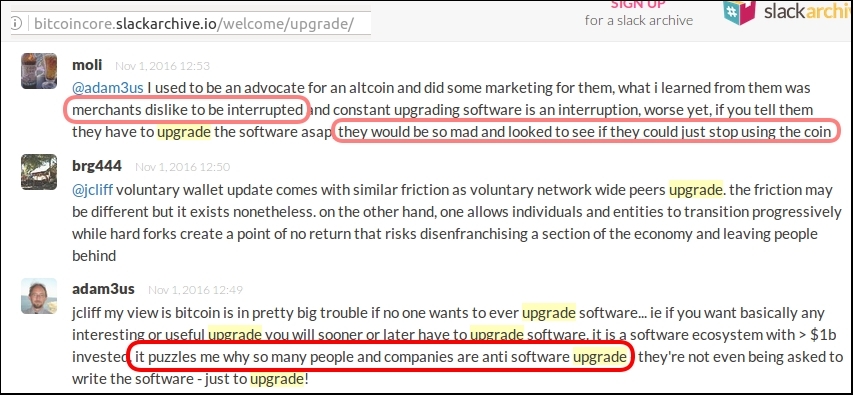
People are reluctant to upgrade their software.
Cell Phones
This attitude surprises many developers, but it doesn’t surprise many cell phone users.
Upgrading your phone is tedious, and can often break things. In return, the benefits are usually zero – after all, at any given time, most people are blissfully unaware that updates to their phone are even possible. Life’s serene tranquility is then ambushed by this random box on your phone that won’t go away.
Henry Ford / Steve Jobs can complain that ‘customers don’t know what they want’, but that maxim cuts both ways! How many current Bitcoin users were chomping at the bit, to use RelativeCheckLocktimeVerify (or even the lightning network, for that matter)?
( Why? )
It is well-known that people have a bias towards the status quo. This is probably because thinking consumes scarce biological resources. Secondly, it is known that humans have a loss aversion bias. One synthesis of these phenomena, is to point out that ‘ignoring gains’ is free, but ‘ignoring losses’ is impossible – losses might require you to rewrite your whole plan. And they therefore require some of your (scarce) attention.


Upgrades Suck
The point is that upgrades suck. They can break your workflow in all kinds of ways!
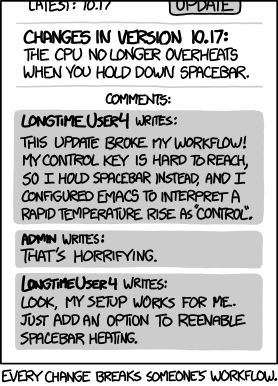
For most people, it is rational to just avoid the whole upgrade process. And it is most rational of all, for these users not to tell developers how little they care about the incredibly sexy world or ‘version numbering’ and ‘release notes’. Upgrading will always be an uphill battle, and it will always be more-uphill than expected.
2. The Cost of Free Work
Imagine that you need to hire someone for a job. (And conversely, recall your first job search). Who should you hire (how do you get hired)?
You do not care about how hard your employee works. He may produce something you ultimately cannot use, or never wanted. Conversely: people do not care how hard you work. Many toil in the farmlands, or construction sites, and their relative prosperity is low – they are out-earned by sloths residing in comfy offices.
Clearly you need an employee who produces something valuable – something you value. And, relatedly, their paychecks must sum to a cost that is less than the value they produce for you. The employee must be profitable.
But, even now, you face a critical problem: checking the quality of your employee’s work. Assume the following: [1] a job takes 1 hour, [2] your time is worth 10 $/hr, and [3] you can hire someone to do this job in 2 hours at 3 $/hr. By hiring, you would be up +$4 ( = $10 - (2 * $3)). However, if it takes you 30 minutes to check your employee’s work, you have lost an additional $5 and are now at a net -$1.
Worse, your efforts to check your employee’s work might fail. Your employee might even hide something, and your hard-earned reputation might be damaged or destroyed.

Because work can’t be checked for free, even ‘free’ work can easily cost you a fortune.
Hiring is expensive! (This explains why, in our world, there’s simultaneously [1] plenty of work to do, and [2] many people who are willing to work, but can’t find a job.)
3. Coordination and Ambiguity
a. March 2013
Consider this writeup of Bitcoin’s March 2013 emergency.
I agree that this case can help us understand Bitcoin Upgrades. I don’t agree that: “Without the central co-ordination of the Bitcoin Core developers and the strong trust that the community places in them, it is inconceivable that adopting this counterintuitive solution could have been successfully accomplished”, however.
In fact, it is because the Core developers were unable to coordinate, and because they were not able to convince (ie “get”) the community, that the (supposedly “counterintuitive”) solution would have inevitably manifest itself.
That said, the CoreDevs did minimize the damage. And you can’t knock that response time.
b. The Power of Being Unable
Taleb recently noted that certain conditions would produce a ‘tyranny of the minority’. network effects would allow the most intolerant person to win.
This would not have surprised Tom Schelling, who noted in 1956 that the most constrained (ie, most intolerant) person would always hold a brutal negotiating advantage. Your boss and you agree that you are worth between $10 and $20 an hour – the smartest thing is to say “I cannot accept less than $20”, and to back-that-up by fastening on a collar that explodes if you indeed get <$20.
( Both pieces of writing are of superb quality. )
c. A Good Night’s Sleep
The central question of March 2013 was: “how do we re-merge the fork”, and the most relevant fact, in answering it, was the following:
23:30 Pieter Wuille: and we _cannot_ get every bitcoin user in the world
This outright disqualifies the “everyone upgrades” strategy – the “un-get-ables” are wearing explosive collars. By process of elimination, this leaves only the “everyone downgrades”. It is the kind of thing that is, apparently, “counterintuitive” to computer scientists; in my experience, game theory is not part of the CS curriculum.
The blockchain allows users to coordinate on a single network (by using a simple ‘heaviest valid chain’ rule, that a computer can automatically calculate). Schelling would say that successful coordination requires participants to read a ‘common signal’ from the situation itself (not from each other). Some participants will never get an ‘upgrade signal’, and some will ignore a signal they do get, and a third group will actively fight the upgrade.
Anyone concerned with ‘being on the wrong network’ would, inevitably, reach the same conclusion as Pieter Wuille: the downgrade would win. In any situation of ‘motivated ambiguity’, the downgrade will probably always win. Worse, this conclusion has momentum – the cleverer individuals would realize sooner, thus transmuting an initially-ambiguous situation into a ha-ha-losers-sorry-for-your-loss cutthroat meritocracy.
The Devs did minimize the transition period, however, which minimized the collateral damage.
Conclusion: Each of these three points favors the soft fork over the hard fork.
Footnote: Hashpower as an Upgrade Coordinator
Many argue that hashpower will provide the common signal (dooming the less-heavy chain to extinction).
This argument has many points in its favor: Hashrate is a good barometer of health (a neglected chain cannot proceed), and it is globally-available to all decision-makers (and this is common).
However, the argument suffers, because of the inherent reactiveness of mining. First, notice that [1] there is an infinite number of hard-fork-paths forward, from any given block, and no objective criteria with which to disqualify any of them. The decision to bless one of them with hashpower, is, therefore, inherently both arbitrary and reversible. Second, notice that [2] if investors support one chain, this financial support will necessarily attract hashpower to the chain.
So, any decisions the miner makes can-and-will be reversed by investors. Hashrate would coordinate more-effectively, if Hashers could prove that they were unable to ever support a chain. Since they cannot prove this, the metric is flaky.
The Game Theory of Bitcoin Upgrades
Bitcoin’s Upgrades are safe, because they are optional.
Upgrade Model
Here is a simple game, where:
- An update, which is one of two types (‘vulnerable’, or ‘not vulnerable’) is proposed,
- Row Player decides whether to ‘upgrade’ or ‘not’,
- Column player decides whether to ‘attack’ or ‘not’.
The Column Player knows [1] if attack is possible, and [2] how to attack (and can attack for free). The Row player bears an ‘investigation cost’ of “a” – it costs Row a units, to learn the update’s type.
        Payoff Matrix                      Interpretation

           |Attack | Don't |                |Attack  | Don't  |
 ---------------------------      -----------------------------
 Do        |     0 |     0 |      Do        |nothing |nothing |
 Nothing   | 0     | 0     |      Nothing   |happens |happens |
 ---------------------------      -----------------------------
 Check     |    -2 |     1 |      Check     |attack  |user    |
 First     |-a     | 3-a   |      First     |thwarted|paranoia|
 ---------------------------      -----------------------------
 Upgrade   |     4 |     1 |      Upgrade   |attacker| lucky  |
 w/o Check |-10    | 3     |      w/o Check |  wins! | user   |
----------------------------     ------------------------------
If the user declines to update, nothing changes (hence the zero payoffs). The attacker (left Column) prefers to succeed in his attack, scoring 4 if he can trick Row into upgrading. If the attack fails, the attacker is embarrassed and loses 2. Nice devs (right Column) score 1 if their good upgrades are installed. Row Player prefers to upgrade (scoring 3), but loses 10 if installs an Attack. Row must pay ‘a’ to learn the state of the upgrade (‘vulnerable’ or ‘not vulnerable’).
Equilibria of Game
For a>0, there is a Nash Equilibrium at { Do Nothing, Attack }, and when a=0 there is a second equilibrium at { Check First, Don’t Attack }.
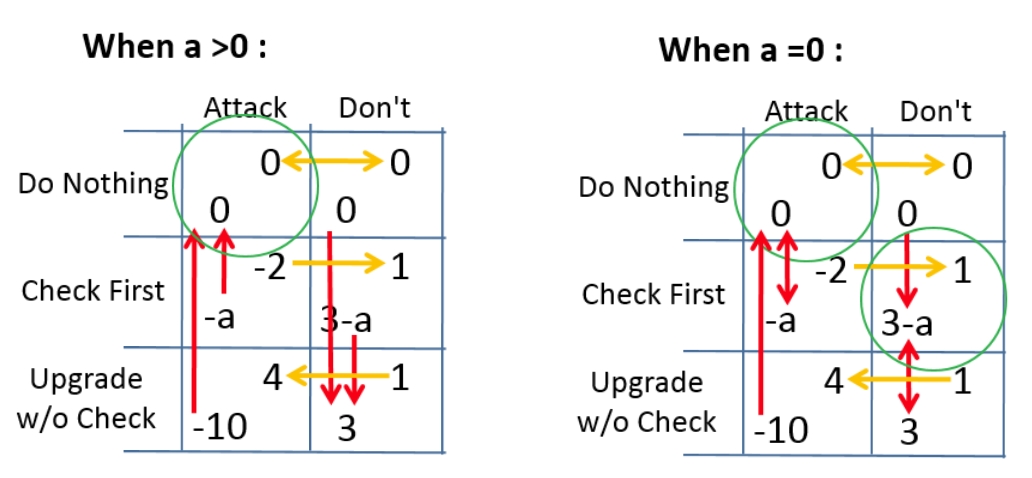
When a is high, upgrades are very unsafe. However, when a=zero, everything changes. Not only is the new equilibrium {3,1} a Pareto improvement over the old {0,0} one, but, by forward induction, we can assume that, if Column Player bothers to propose a software update, he is avoiding the { Do Nothing, Attack } equilibrium.
When is a=0 ?
Some people derive great pride and personal satisfaction from contributing to Free Software. Thus, for them, “a” may be zero or even negative.
If we discuss hard forks, the conversation ends with this tiny minority (<0.1%) of people. But what about mainstream users, who are accustomed to secure, high quality software, but who are completely unfamiliar with terms like “gitian”, “checksum”, “binaries”, etc? What’s the plan for reaching those users? Is there a plan?
Well, with soft forks, everyone (even grandma) can use “indirect evidence” to lower their a to zero. Simply, they wait for other people to install and use the software, while keeping an ear open in case anyone sounds the alarm. By being slow to upgrade, they can “check” the software for free. The more technically-illiterate users can simply choose a longer update-lag-time.
Soft forks “flip” the process of validating the new code – users can assume the code is bad, and falsify that hypothesis by watching their friends. It also “flips” the cost – with a hard fork, users must “pay” to validate the software,
Who Protects The Developers?
If Devs commit to a policy of Soft Forks, then an attacker gains nothing by coercing them.
A world of Hard Forks is a DevoCracy – whoever controls the devs, controls the software.
A world of Soft Forks is…what exactly? Our model (above), applies regardless of how many attacks are attempted by evil devs. Whether all the proposed updates are malicious, or none of them are, the process above will passively filter out all attacks (thus making each individual attack pointless).
The converse is true: if we lack a process for filtering out Dev-misbehavior, then there is a reason to attack.
The crucial point: Dev’s inability to do harm is also their inability to be intimidated.
Of course, such immunity is far from perfect. Historically, there has unfortunately been some intimidation of Devs, and more than a fair share of stress. But it is noteworthy that, for an enterprise of this size (billions of dollars) and quality (constant dark net criminal activity, scams, fraud, and misrepresentation, little/no identify verification or background checking) the harassment of developers has been so minimal. There has been some doxxing, and “mean comments on the internet”, and this post which I’m 95% certain is merely a complex pun on Bitcoin’s concept of “verifiable”.
In fact, the most threating thing to happen so far, was not an attack on Bitcoin itself, and merely an example of the complete technical incompetence of today’s prosecutors, and their pedophilic obsession with a completely inert demo of an opt-in browser plugin.
I attribute this relatively continuous pacifism to our commitment to soft forks (notice: we have never actually hardforked). In other words, I attribute safety of the Bitcoin Developers and Researchers to the fact that we don’t actually control who gets paid. We cannot undo payments, reset passwords, etc. We can’t do any of that.

( Finally, consider the process of Mining: it not only discourages attackers from rewriting the chain, but also divorces any individual from the issuance process – this means that, if an attacker wanted to obtain newly-issued coins, there is no one for him to extort. )
Supposed Counterexamples
Many readers will notice that Ethereum has hard-forked several times. BitShares also hard-forked many times. And so has everything, really – VISA, SWIFT, Google, and so forth.
If hard forks appear in the wild, why can’t we conclude that they’re safe for Bitcoin?
1. Jumping the Gun
One large piece of this puzzle is that these protocols were released too soon. In the design state, the protocol ‘hard forks’ innumerable times, in the mind of the designer. This is a normal part of the creative process – surely, Satoshi revised his Bitcoin design in many ‘hard fork’ ways before finally presenting the finished project. In contrast, the Altcoin Community consistently releases too early, because of the tremendous “FOMO effect” where projects scramble to grab anyone who is interested and has initiative.

( Note: This, in turn, results from the fact that there is no acceptable way to short bad ideas [yet]. If we could short bad ideas, anyone who invested in them would be punished immediately, and capital would be diverted away from these malinvestments, toward productive activities. However, since malinvestments don’t die immediately, we have to endure this annoying pump-and-dump parade. )
2. Product Differentiation
Secondly, the willingness to hard fork is an opportunity for Eth / BTS to distinguish themselves from Bitcoin. Bitcoin Unlimited behaves the same way, priding itself on a willingness to hard fork and on a general atmosphere of flexibility, adaptability, and hospitality. This is not so much “a hard fork” as much as it is an advertisement for centralization.
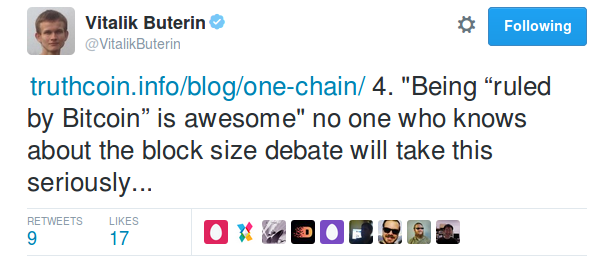
Above: Vitalik cites the blocksize debate as a negative for Bitcoin. While the debate can be annoying at times, most people are generally happy that a debate is required to change the rules (and happy that the eventually-agreed-upon rules are enforced as written).
In keeping with this emphasis-on-flexibility, once Ethereum hard-forked for an arbitrary reason, despite the fact that many users decline to consent to the fork. When the chain split, ~90% of the project wealth stayed on Vitalik’s chain, which would seem to indicate that the fork had, relatively, succeeded.
But I see this as a reiteration of Reason 2. Ethereum desired to compete with Bitcoin, and to do that it wanted to be “the adaptive one”. In my opinion, Ethereum is not actually a computer network. To the extent that its owners have an investment thesis at all, they are betting that cult-of-personality that is Vitalik Buterin will exploit a second-mover-advantage to skillfully maneuver Ethereum into replacing Bitcoin.
Conclusion
The hard fork is unacceptable in many ways – it breaks Bitcoin’s contract, risks user’s funds, and puts developers in danger.
This isn’t to say that we should never Hard Fork, ever – it may be appropriate when we have absolutely no other alternative.
Fortunately, everything you’d need to use a Hard Fork for, you can do with sidechains or extension blocks.
Cutting Room Floor Morgoth can explain all of this to you: But ever the Noldor feared most the treachery of those of their own kin, who had been thralls in Angband; for Morgoth used some of these for his evil purposes, and feigning to give them liberty sent them abroad, but their wills were chained to his, and they strayed only to come back to him again. Therefore if any of his captives escaped in truth, and returned to their own people, they had little welcome, and wandered alone outlawed and desperate. - J.R.R Tolkien, The Silmarillion Something tells me that Richard Stallman is a Soft Fork kind of guy. Even more interesting, killing / coercing CoreDevs , what does it accomplish ? We can return to our game three diagram .. draw game tree .. compare SoftWorld to HardWorld Trust a group of bankers / regulators / politicians / experts / CoreDevs, or Verify Everything Yourself. The implausibility of stealing, itself creates trust. It also alters the decision calculus of Bitcoins adversaries. If all upgrades are to be soft forks, there is nothing to be gained by, say, threatening to murder a CoreDev’s family. Pareto Improvement – unintentional ways of breaking critical workflow – wielding the ability to ‘pick winners and losers’ is a dangerous obliteration of Bitcoin’s raison d etre SegWit was an improvement on Bitcoin’s design. solve malleability, it also allowed us to observe that the blockchain actually stores two classes of data – public txn ID and private sig data. More efficient use. Was nonethless a new design. A literal requirement, to upgrade. Vs. the possibility of a practical requirement, to upgrade. Hard fork creates a new thing. Soft fork is a filtration – this filtration can removal of bugs, or it can just remove everything. ### The Open Loop Hard fork is de-facto incompatible. Meaning that, to maintain compatibility, software itself is not sufficient. The Bitcoin software, acting alone, is literally unable to maintain consensus across multiple hard forks. Bitcoin Unlimited might be an instructive example here. BU creates a new system where one rule, the 1 MB limit, is removed, and consensus is maintained with proof-of-work alone. But the point is that this new system is incompatible with the existing system. After BU, someone could This drastically changes Bitcoin’s threat model. —- Ideally, a dropdown menu —— Often, users do not want to have the ability to do know, or do, something. For example: * The convenience store safes, and stickers which say “Time-locked safe. Cashier cannot open store safe”. THis prevents cashiers from being coerced. * A landlord who suspects his tennant of running a (lucrative) drug operation. If he ‘knows’, he is obliged to report it to the police, but if he merely ‘suspects’ he can collect the rent on time (and, perhaps, increase the rent). The landlord may prefer to be strategically blind or deaf. * Supposedly, a law was passed in ancient England, which put to death any individual who paid a ransom. This removed the ability to pay ransoms, which made kidnappping pointless. (The phrase “we don’t negotiate with terrorists” attempts to invoke a version of this.) —- Signaling Stubbornness What is better: stubborn or accomodating? If we are unsatisfied, we want to change something. This makes stubborn bad. But is ‘accomodating’ really much better? #### Gym Metaphor Say there are two Health Gyms in your neighborhood: Old Reliable and Nueva Du Jour. In OR, all of the equipment is bolted to the ground, but in NDJ, you are allowed to move the equipment around, and put it in-and-out of rooms and closets. You see, people go to GYMs for different reasons: to lose weight, to bulk up, to meet like-minded people, to take classes, to flirt, and to spend time with their friends. Some people go, it seems, solely to jusify the money they already spent on the membership. You might prefer to have all the freeweights on the main floor – you can do your lifting, with lifting buddies, and not be distracted. Do you sign up at OR, or at NDJ? If you choose NDJ, you can move all the freeweights. Then they’ll be right where you want them…for the present. Next week, you may arrive at the GYM to find that they have been moved to the closet. #### Investor Sovereignty One’s choice of gym may be a matter of preference. But, when it comes to investments, NDJ is outright unacceptable. The investor is the one who researches the choices, and selects the one which is best for him. The ‘flexibility’ advertised by projects such as Ethereum, is a double-edged sword. It is as helpful today, as it is anti-helpful tomorrow. And by being inconsistent it contradicts the purpose of an investment. — ### People Hate To Upgrade Core slack “it puzzles me why so many people and companies are anti software upgrade”. To users, computer science is as incomprehensible. Even for programmers, reading code is as much work as is writing it, if not more. The upgrade might as well steal all of their BTC, keylog everything, hack all of their email, automatically scan all their emails for online accounts, reset all passwords, and hack into all of those. It could just cause their computer to melt, as far as they know. ~3 doors - upgrade 1 2 3 ~ The only real way to know that an upgrade isn’t compromised is to take your time. ~sequence – you first~ —————————– Stability - can make plans accordingly If soft fork world, those plans will involve innovation, research, the creation of new products, technologies, and business models. In hard fork world, those plans might be the same. However, there is a real risk that they involve a lot of whining, campaigning, and coercion of prominent developers or community leaders. ## Two Worlds Soft – someone can archive and circulate the old software, and it will continue to work, continue to allow you to send money. Once you make a contract, by depositing your fiat “into” BTC, the contract will be honored. Join today, and you’re in the club forever. Your membership never expires. Hard – you wake up from a coma, and Group Alpha tells you that Alpha is the correct Bitcoin software to install, and Group Omega tells you that Omega is the correct software. How do you decide? You have lost the protection of the ‘longest chain rule’. (You still have your money, yes, but is it still as ) Even if you avoid comas diligently, the fact remains that you must expend effort, maintaining your software. You are obligated to check everything for exploits, bias/coercion of the developers, etc. This maintenance is just too expensive – it makes running a node very very expensive. Bank of America maintains its own software for free, and they always refund you if they ever make any mistakes. ——————- ### Practice Paradox backhand practice, use it less shield-aiming —} weakest link If we shorten our walls, we will be safe. The enemy is not attacking our gate, we do not need to guard it. ### Truth Settlement Vitalik’s Conflation —} certainty on Linux kernel, principles of software-use, all hardware, laws of physics, axioms of logic, etc. Certainty on these accrues over time, and can be re-applied. I have never seen my Linux kernel malfunction, and why would this time be different? The rules of tennis are a subset of the laws of physics – a “soft fork” of them, if you will. ##### Conclusion
Add Disqus comments.
comments powered by
Disqus
The “War on Cash” is Fake News
By Beautyon
Posted December 21, 2016
After the Indian government “surprise withdrew” some of its banknotes people are getting worked up about the “War on Cash”, claiming that this is the beginning of a nightmare totalitarian phase of society coined, “The Cashless Society”. This is absolutely ridiculous, and betrays a profound ignorance of the nature of the cash in use today.
The paper “money” people imagine is real money, that they, their parents, and their parents, and their parents have been using is not money. For generations, these people have been the victims of a fraudulent system of “fiat currency” that is backed by nothing and which has been stealing from citizens for generations.
Now that computers are powerful enough and are all connected all the time, the people who control this fraudulent paper money system have decided that they want to switch to an all electronic version of their fraud. This switch to electronic fiat is far less of a big deal than the generational paper fiat fraud.
The money people are so worked up about losing is already worthless. It is backed by nothing, and its supply is infinitely expanding by design. It is deliberately made to steal the wealth you’ve earned by a system called “inflation” which is an increase in the supply of money.
What is Inflation?
The nature of inflation can be boiled down to the following illustration. Here are 100 apples:

100 Apples
Lets say dollars (with all that implies) are money, there are 100 $100 dollar bills on Earth and only 100 apples, and one apple costs one dollar.

A stack of 100 $100 bills. All the money in the world!
You have 5 dollars in your bank account. You’re rich! If you want to buy an apple, you take one dollar and buy an apple. But what if the government can make more dollars? Lets say that the government doubles the supply of dollars in one day.

Where did those extra dollars come from? What the….!
Now there are $200 dollars in circulation. That means there are twice as many dollars chasing the same 100 apples. That means that each apple costs 2 dollars, because the amount of money chasing them has doubled. If you want to buy an apple, you now need to withdraw and spend 2 dollars instead of one.
Do you see what just happened? All of a sudden, your savings can buy half as much as they used to; half of your spending power has been stolen from you, without anyone touching your money. The amount of money in circulation has doubled, but your bank balance remains the same. This process, which is called inflation, is at the very heart of the system of money you use. The target rate of inflation that the government thinks is acceptable is 2%; that means if you store $100 this year, next year it will have $98 worth of spending power.
This is theft, pure and simple, and the only reason why people don’t get up in arms about it, is because its invisible to them. If their actual balances went down by that much by government diktat, they would burn the Statists alive at the stake.
Inflation has been going on for generations with the government created money systems populations are forced to use through “Legal Tender” laws. Every single currency ever created by government has died due to inflation, the most recent examples being the Zimbabwe dollar.

The Zimbabwe Dollar. Rotten to the core!
The fact that governments are removing the paper token element to their fraudulent system is completely irrelevant. The bigger, “meta problem” is the nature of the money itself, not the physical form of the token.
Imagine the glee of the Statists who laugh out loud at the hapless and utterly stupid public who are braying like donkeys for the fraudulent cash they are inured to being kept in circulation. These poor unfortunate men have no idea of the true nature of the fraud being committed on them, and are so blinded, so deep in the subterranean Platonic fiat delusion that it never occurs to them that they are utterly lost.
Even if cash is never removed from society, the fraudulent fiat and legal tender system will remain intact, forcing people to use bad money and ready for the shears; just like sheep.

This is the true story behind the “War on Cash”. You shouldn’t be at all worried about the elimination of cash; it’s a non problem in today’s world with ready, robust and complete solutions, and anyone who tries to stoke up your fear about it, at a minimum, does not understand the problem.
The Solution to this Problem Exists
Luckily for you, there is a total solution to the fake “War on Cash”, that is complete, convenient and irrevocable. This solution also solves the meta problem of the nature of money, forever destroying the fiat fraud that has plagued mankind, facilitated war and stolen for generations.
I am of course, talking about Bitcoin.
In the past, people who wanted to stay away from the fiat system and its built in theft could stack silver and store gold coins. This protected them from inflation, but gold and silver are not convenient for every day use; these refuseniks still had to use government fiat and its licensed money multiplying fractional reserve banks to live on a daily basis. On top of that, the silver and gold markets are hopelessly corrupted, gamed and do not in any way reflect the true value of precious metals.
Now with Bitcoin, you can spend your money globally and locally without ever having to touch government fiat, or have your money locked in a bank, using the very same devices the State is going to try to employ to force its fiat fraud onto the public.
Never before has it been possible to send and receive money to and from any person, anywhere in the world without the help of a third party service provider; that is what Bitcoin brings to the table, and it could not have come at a better time.
You can store your money in gold and silver and use Bitcoin to send cash from A to B, and for as long as it lasts, use the paper (now plastic) fiat for paying refusniks. If you arrange your affairs in this way, you will rarely have to dirty your hands with fiat, smell the stink of the inside of a bank, expose your hard earned wealth to the theft of inflation, subject your affairs to default surveillance or find yourself crippled by arbitrary limits. Your affairs will be private, free of theft or arbitrary restrictions, permission-less and subject only to the rules of the market, and nothing else.
That is a situation worth more than money. It is called Liberty. Don’t worry about the fake “War on Cash”. Like Neo from The Matrix you were born into a lie that you can now escape from.

And in the real world where you escape the Matrix, the steak is real.
Steak is real. I eat it. It costs money ↴