
June 2015 Journal
WORDS is a monthly journal of Bitcoin commentary. This issue collects the June 2015 writing in the WORDS archive. For the uninitiated, getting up to speed on Bitcoin can seem daunting. Content is scattered across the internet, in some cases behind paywalls, and content has been lost forever. That’s why we made this journal, to preserve and further the understanding of Bitcoin.
Ten Things Every Economist Should Know about the Gold Standard
By CatoInstitute
Posted June 4, 2015
googleoff: index
googleon: index
June 4, 2015 11:01AM
At the risk of sounding like a broken record (well, OK–at the risk of continuing to sound like a broken record), I’d like to say a bit more about economists’ tendency to get their monetary history wrong. In particular, I’d like to take aim at common myths about the gold standard.
If there’s one monetary history topic that tends to get handled especially sloppily by monetary economists, not to mention other sorts, this is it. Sure, the gold standard was hardly perfect, and gold bugs themselves sometimes make silly claims about their favorite former monetary standard. But these things don’t excuse the errors many economists commit in their eagerness to find fault with that “barbarous relic.”
The false claims I have in mind are mostly ones I and others–notably Larry White–have countered before. Still I thought it would be useful to address them again here, because they’re still far from being dead horses, and also so that students wrapping-up the semester will have something convenient to send to their misinformed gold-bashing profs (though I urge them to wait until grades are in before sharing!).
For the sake of those who don’t care to wade through the whole post, here is a “jump to” list of the points covered:
- The Gold Standard wasn’t an instance of government price fixing. Not traditionally, anyway.
- A gold standard isn’t particularly expensive. In fact, fiat money tends to cost more.
- Gold supply “shocks” weren’t particularly shocking.
- The deflation that the gold standard permitted wasn’t such a bad thing.
- It wasn’t to blame for 19th-century American financial crises.
- On the whole, the classical gold standard worked remarkably well (while it lasted).
- It didn’t have to be “managed” by central bankers.
- In fact, central banking tends to throw a wrench in the works.
- “The “Gold Standard” wasn’t to blame for the Great Depression.
- It didn’t manage money according to any economists’ theoretical ideal. But neither has any fiat-money-issuing central bank.
break
1. The Gold Standard wasn’t an instance of government price fixing. Not traditionally, anyway.
As Larry White has made the essential point as well as I ever could, I hope I may be excused for quoting him at length:
Barry Eichengreen writes that countries using gold as money ‘fix its price in domestic-currency terms (in the U.S. case, in dollars).’ He finds this perplexing:
But the idea that government should legislate the price of a particular commodity, be it gold, milk or gasoline, sits uneasily with conservative Republicanism’s commitment to letting market forces work, much less with Tea Party–esque libertarianism. Surely a believer in the free market would argue that if there is an increase in the demand for gold, whatever the reason, then the price should be allowed to rise, giving the gold-mining industry an incentive to produce more, eventually bringing that price back down. Thus, the notion that the U.S. government should peg the price, as in gold standards past, is curious at the least.
To describe a gold standard as “fixing” gold’s “price” in terms of a distinct good, domestic currency, is to get off on the wrong foot. A gold standard means that a standard mass of gold (so many grams or ounces of pure or standard-alloy gold) defines the domestic currency unit. The currency unit (“dollar”) is nothing other than a unit of gold, not a separate good with a potentially fluctuating market price against gold. That one dollar, defined as so many grams of gold, continues be worth the specified amount of gold—or in other words that one unit of gold continues to be worth one unit of gold—does not involve the pegging of any relative price. Domestic currency notes (and checking account balances) are denominated in and redeemable for gold, not priced in gold. They don’t have a price in gold any more than checking account balances in our current system, denominated in fiat dollars, have a price in fiat dollars. Presumably Eichengreen does not find it curious or objectionable that his bank maintains a fixed dollar-for-dollar redemption rate, cash for checking balances, at his ATM.
Remarkably, as White goes on to show, the rest of Eichengreen’s statement proves that, besides not having understood the meaning of gold’s “fixed” dollar price, Eichengreen has an uncertain grasp of the rudimentary economics of gold production:
As to what a believer in the free market would argue, surely Eichengreen understands that if there is an increase in the demand for gold under a gold standard, whatever the reason, then the relativeprice of gold (the purchasing power per unit of gold over other goods and services) will in fact rise, that this rise will in fact give the gold-mining industry an incentive to produce more, and that the increase in gold output will in fact eventually bring the relative price back down.
I’ve said more than once that, the more vehement an economist’s criticisms of the gold standard, the more likely he or she knows little about it. Of course Eichengreen knows far more about the gold standard than most economists, and is far from being its harshest critic, so he’d undoubtedly be an outlier in the simple regression, y = α + β(x) (where y is vehemence of criticism of the gold standard and x is ignorance of the subject). Nevertheless, his statement shows that even the understanding of one of the gold standard’s most well-known critics leaves much to be desired.
Although, at bottom, the gold standard isn’t a matter of government “fixing” gold’s price in terms of paper money, it is true that governments’ creation of monopoly banks of issue, and the consequent tendency for such monopolies to be treated as government- or quasi-government authorities, ultimatelyled to their being granted sovereign immunity from the legal consequences to which ordinary, private intermediaries are usually subject when they dishonor their promises. Because a modern central bank can renege on its promises with impunity, a gold standard administered by such a bank more closely resembles a price-fixing scheme than one administered by a commercial bank. Still, economists should be careful to distinguish the special features of a traditional gold standard from those of central-bank administered fixed exchange rate schemes.
2. A gold standard isn’t particularly expensive. In fact, fiat money tends to cost more.
Back in the early 1950s, and again in 1960, Milton Friedman estimated that the gold required for the U.S. to have a “real” gold standard would have cost 2.5% of its annual GNP. But that’s because Friedman’s idea of a “real” gold standard was one in which gold coins alone served as money, with no fractionally-backed bank-supplied substitutes. As Larry White shows in his Theory of Monetary Institutions (p. 47) allowing for 2% specie reserves–which is more than what some former gold-based free-banking systems needed–the resource cost of a gold standard taking advantage of fractionally-backed banknotes and deposits would be aboutone-fiftieth of the number Friedman came up with. That’s a helluva bargain for a gold “seal of approval” that could mean having access to international capital at substantially reduced rates, according to research by Mike Bordo and Hugh Rockoff.
Friedman himself eventually changed his mind about the economies to be achieved by employing fiat money:
Monetary economists have generally treated irredeemable paper money as involving negligible real resource costs compared with a commodity currency. To judge from recent experience, that view is clearly false as a result of the decline in long-term price predictability.
I took it for granted that the real resource cost of producing irredeemable paper money was negligible, consisting only of the cost of paper and printing. Experience under a universal irredeemable paper money standard makes it crystal clear that such an assumption, while it may be correct with respect to the direct cost to the government of issuing fiat outside money, is false for society as a whole and is likely to remain so unless and until a monetary structure emerges under an irredeemable paper standard that provides a high degree of long-run price level predictability.*
Unfortunately, neither White’s criticism of Friedman’s early calculations nor Friedman’s own about-face have kept gold standard critics from repeating the old canard that a fiat standard is more economical than a gold standard. Ross Starr, for example, observes in his 2013 book on money that “The use of paper or fiduciary money instead of commodity money is resource saving, allowing commodity inventories to be liquidated.” Although he understands that fractionally-backed banknotes and deposits may go some way toward economizing on commodity-money reserves, Starr (quoting Adam Smith, but failing to look up historic Scottish bank reserve ratios) insists nonetheless that “a significant quantity of the commodity backing must be maintained in inventory to successfully back the currency,” and then proceeds to build a case for fiat money from this unwarranted assertion:
The next step in economizing on the capital tied up in backing the currency is to use a fiat money. Substituting a government decree for commodity backing frees up a significant fraction of the economy’s capital stock for productive use. No longer must the economy hold gold, silver, or other commodities in inventory to back the currency. No longer must additional labor and capital be used to extract them from the earth. Those resources are freed up and a simple virtually costless government decree is substituted for them.
Tempting as it is to respond to such hooey simply by noting that the vaults of the world’s official fiat-money managing institutions presently contain rather more than zero ounces of gold–31,957.5 metric tons more, to be precise–that response only hints at the fundamental flaw in Starr’s reasoning, which is his treatment of fiat money as a culmination, or limiting case, of the resource savings to be had by resort to fractional commodity-money reserves. That treatment overlooks a crucial difference between fiat money and readily redeemable banknotes and deposits, for whereas redeemable banknotes and deposits are generally understood by their users to be close, if not perfect, substitutes for commodity money, fiat money, the purchasing power of which is unhinged from that of any former money commodity, is nothing of the sort. On the contrary: its tendency to depreciate relative to real commodities, and to gold in particular, is notorious. Consequently holders of fiat money have reason to hold “commodity inventories” as a hedge against the risk that fiat money will depreciate.
If the hedge demand for a former money commodity is large enough, resort to fiat money doesn’t save any resources at all. Indeed, as Roger Garrison notes, “a paper standard administered by an irresponsible monetary authority may drive the monetary value of gold so high that more resource costs are incurred under the paper standard than would have been incurred under a gold standard.” A glance at the history of gold’s real price suffices to show that this is precisely what has happened:
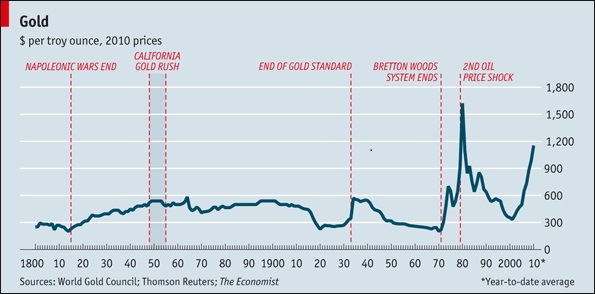
From “After the Gold Rush,” The Economist, July 6, 2010.
Taking the long-run average price of gold, in 2010 prices, to be somewhere around $470, prior to the closing of the gold window in 1917, that price was exceeded on only three occasions, and never dramatically: around the time of the California gold rush, around the turn of the 20th century, and for several years following FDR’s devaluation of the dollar. Since 1971, in contrast, it has exceeded that average, and exceeded it substantially, more often than not. Here is Roger Garrison again:
There is a certain asymmetry in the cost comparison that turns the resource-cost argument against paper standards. When an irresponsible monetary authority begins to overissue paper money, market participants begin to hoard gold, which stimulates the gold-mining industry and drives up the resource costs. But when new discoveries of gold are made, market participants do not begin to hoard paper or to set up printing presses for the issue of unbacked currency. Gold is a good substitute for an officially instituted paper money, but paper is not a good substitute for an officially recognized metallic money. Because of this asymmetry, the resource costs incurred by the State in its efforts to impose a paper standard on the economy and manage the supply of paper money could be avoided if the State would simply recognize gold as money. These costs, then, can be counted against the paper standard.
So if it’s avoidance of gold resource costs that’s desired, including avoidance of the very real environmental consequences of gold mining, a gold standard looks like the right way to go.
3. Gold supply “shocks” weren’t particularly shocking
Of the many misinformed criticisms of the gold standard, none seems to me more wrong-headed than the complaint that the gold standard isn’t even a reliable guarantee against serious inflation. The RationalWiki entry on the gold standard is as good an example of this as any:
Even gold can suffer problems with inflation.Gold rushes such as the California Gold Rush expanded the money supply and, when not matched with a simultaneous increase in economic output, caused inflation.The “Price Revolution” of the 16th century demonstrates a case of dramatic long-run inflation. During this period, western European nations used a bimetallic standard (gold and silver). The Price Revolution was the result of a huge influx of silver from central European mines starting during the late 15th century combined with a flood of new bullion from the Spanish treasure fleets and the demographic shift brought about by the Black Plague (i.e., depopulation).
Admittedly the anonymous authors of this article may not be professional economists; but take my word for it that the same arguments might be heard from any number of such professionals. Brad DeLong, for example, in a list of “Talking Points on the Likely Consequences of re-establishment of the Gold Standard” (my emphasis), includes observation that “significant advances in gold mining technology could provide a significant boost to the average rate of inflation over decades.”
Like I said, the gold standard is hardly free of defects. But being vulnerable to bouts of serious inflation isn’t one of them. Consider the “dramatic” 16th century inflation referred to in the RationalWiki entry. Had that entries’ authors referred to plain-old Wikipedia’s entry on “Price revolution,” they would have read there that
Prices rose on average roughly sixfold over 150 years. This level of inflation amounts to 1-1.5% per year, a relatively low inflation rate for the 20th century standards, but rather high given the monetary policy in place in the 16th century.
I have no idea what the authors mean by their second statement, as there was certainly no such thing as “monetary policy” at the time, and they offer no further explanation or citation. So far as I can tell, they mean nothing more than that prices hadn’t been rising as fast before the price revolution than they did during it, which though trivially true says nothing about how “high” the inflation was by any standards, including those of the 16th century. In any case it was not only “not high” but dangerously low according to standards set, rightly or wrongly, by today’s monetary experts. Finally, though the point is often overlooked, the European Price Revolution actually began well in advance of major American specie shipments, which means that, far from being attributable to such shipments alone, it was a result of several causes, including coin debasements.
What about the California Gold rush, which is also supposed to show how changes in the supply of gold will lead to inflation “when not matched with a simultaneous increase in economic output”? To judge from available statistics, it appears that producers of other goods were almost a match for all those indefatigable forty-niners: as Larry White reports, although the U.S. GDP deflator did rise a bit in the years following the gold rush,
The magnitude was surprisingly small. Even over the most inflationary interval, the [GDP deflator] rose from 5.71 in 1849 (year 2000 = 100) to 6.42 in 1857, an increase of 12.4 percent spread over eight years. The compound annual price inflation rate over those eight years was slightly less than 1.5 percent.
Once again, the inflation rate was such as would have had today’s central banks rushing to expand their balance sheets.
Nor do the CPI estimates tell a different story. See if you can spot the gold-rush-induced inflation in this chart:
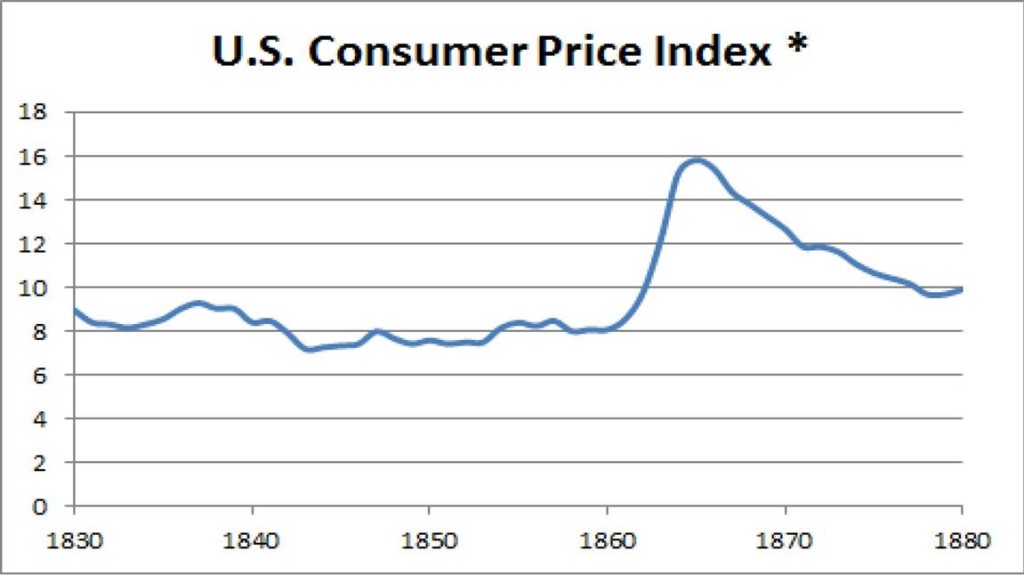
*Graphing Various Historical Economic Series,” MeasuringWorth, 2015.
Despite popular beliefs, the California gold rush was actually not the biggest 19th-century gold supply innovation, at least to judge from its bearing on the course of prices. That honor belongs instead to the Witwatersrand gold rush of 1886, the effects of which later combined with those of the Klondike rush of 1896 to end a long interval of gradual deflation (discussed further below) and begin one of gradual inflation.
Brad DeLong is thus quite right to refer to the South African discoveries in observing that even a gold standard poses some risk of inflation:
For example, the discovery and exploitation of large gold reserves near present-day Johannesburg at the end of the nineteenth century was responsible for a four percentage point per year shift in the worldwide rate of inflation–from a deflation of roughly two percent per year before 1896 to an inflation of roughly two percent per year after 1896.
Allowing for the general inaccuracy of 19th-century CPI estimates, DeLong’s statistics are correct. But that “For example” is quite misleading. Like I said: this is the most serious instance of an inflationary gold “supply shock” of which I’m aware. Yet even it served mainly to put an end to a deflationary trend, without ever giving rise to an inflation rate substantially above what central banks today consider (rightly or wrongly) optimal. As for the four percentage point change in the rate of inflation “per year,” presumably meaning “in one year,” it’s hardly remarkable: changes as big or larger are common throughout the 19th century, partly owing to the notoriously limited data on which CPI estimates for that era are based. Even so, they can’t be compared to the much larger jumps in inflation with which the history of fiat monies is riddled, even setting hyperinflations aside. Keep this in mind as you reflect upon Brad’s conclusion that
Under the gold standard, the average rate of inflation or deflation over decades ceases to be under the control of the government or the central bank, and becomes the result of the balance between growing world production and the pace of gold mining.
Alas, keeping matters in perspective–that is, comparing the gold standard’s actual inflation record, not to that which might be achieved by means of an ideally-managed fiat money, but to the actual inflation record of historic fiat-money systems, is something many critics of the gold standard seem reluctant to do, perhaps for good reason.
While we’re on the subject, nothing could be more absurd than attempts to demonstrate the unsuitability of gold as a monetary medium by referring to gold’s unstable real value in the years since the gold standard was abandoned. Yet this is a favorite debating point among the gold standard’s less thoughtful critics, including Paul Krugman:
There is a remarkably widespread view that at least gold has had stable purchasing power. But nothing could be further from the truth. Here’s the real price of gold — the price deflated by the consumer price index — since 1968:
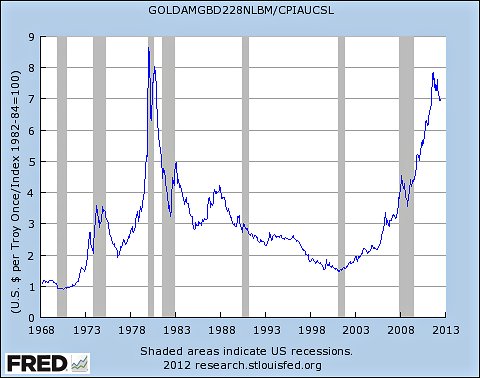
Compare Professor Krugman’s chart to the one in the previous section. Then ask yourself (1) Has gold’s price behaved differently since 1968 than it did before?; and (2) Why might this be so? If your answers are “Yes” and “Because gold and paper dollars are no longer close substitutes, and gold is now widely used to hedge against depreciation of the dollar and other fiat currencies,” you understand the gold standard better than Krugman does. But don’t get a swelled head over it, because it really isn’t saying much: Krugman is one of the observations that sits squarely on the upper right end of y = α + β(x).
4. The deflation that the gold standard permitted wasn’t such a bad thing.
The complaint that a gold standard doesn’t rule out inflation is but a footnote to the more frequent complaint that it suffers, in Brad DeLong’s words, from “a deflationary bias which makes it likely that a gold standard regime will see a higher average unemployment rate than an alternative managed regime.” According to Ben Bernanke “There is…a high correlation in the data between deflation (falling prices) and depression (falling output).”
That the gold standard tended to be deflationary–or that it tended to be so for sometimes long intervals between gold discoveries–can’t be denied. But what certainly can be denied is that these periods of slow deflation went hand-in-hand with high unemployment. Having thoroughly reviewed the empirical record, Andrew Atkeson and Patrick Kehoe conclude as follows:
Deflation and depression do seem to have been linked during the1930s. But in the rest of the data for 17 countries and more than 100 years, there is virtually no evidence of such a link.
More recently Claudio Borio and several of his BIS colleagues reported similar findings. How then (you may wonder), did Bernanke arrive at his opposite conclusion? Easy: he looked only at data for the 1930s–the worst deflationary crisis ever–ignoring all the rest.
Why is deflation sometimes depressing, and sometimes not? The simple answer is that there is more than one sort of deflation. There’s the sort that’s caused by a collapse of spending, like the “Great Contraction” of the 1930s, and then there’s the sort that’s driven by greater output of real goods and services–that is, by outward shifts in aggregate supply rather than inward shifts in aggregate demand. Most of the deflation that occurred during the classical gold standard era (1873-1914) was of the latter, “good” sort.
Although I’ve been banging the drum for good deflation since the 1990s, and Mike Bordo and others have made the specific point that the gold standard mostly involved inflation of the good rather than bad sort, too many economists, and way too many of those who have got more than their fare share of the public’s attention, continue to ignore the very possibility of supply-driven deflation.
Of the many misunderstandings propagated by economists’ tendency to assume that deflation and depression must go hand-in-hand, none has been more pernicious than the widespread belief that throughout the U.S. and Europe, the entire period from 1873 to 1896 constituted one “Great” or “Long Depression .” That belief is now largely discredited, except perhaps among somenewspaper pundits and die-hard Marxists, thanks to the efforts of G.B. Saul andothers. The myth of a somewhat shorter “Long Depression,” lasting from 1873-1879, persists, however, though economic historians have begun chipping away at that one as well.
5. It wasn’t to blame for 19th-century American financial crises.
Speaking of 1873, after claiming that a gold standard is undesirable because it makes deflation (and therefore, according to his reasoning, depression) more likely, Krugman observes:
The gold bugs will no doubt reply that under a gold standard big bubbles couldn’t happen, and therefore there wouldn’t be major financial crises. And it’s true: under the gold standard America had no major financial panics other than in 1873, 1884, 1890, 1893, 1907, 1930, 1931, 1932, and 1933. Oh, wait.
Let me see if I understand this. If financial crises happen under base-money regime X, then that regime must be the cause of the crises, and is therefore best avoided. So if crises happen under a fiat money regime, I guess we’d better stay away from fiat money. Oh, wait.
You get the point: while the nature of an economy’s monetary standard may have some bearing on the frequency of its financial crises, it hardly follows that that frequency depends mainly on its monetary standard rather than on other factors, like the structure, industrial and regulatory, of the financial system.
That U.S. financial crises during the gold standard era had more to do with U.S. financial regulations than with the workings of the gold standard itself is recognized by all competent financial historians. The lack of branch banking made U.S. banks uniquely vulnerable to shocks, while Civil-War rules linked the supply of banknotes to the extent of the Federal government’s indebtedness., instead of allowing that supply to adjust with seasonal and cyclical needs. But there’s no need to delve into the precise ways in which such misguided legal restrictions to the umerous crises to which Krugman refers. It should suffice to point out that Canada, which employed the very same gold dollar, depended heavily on exports to the U.S., and (owing to its much smaller size) was far less diversified, endured no banking crises at all, and very few bank failures, between 1870 and 1939.
6. 0n the whole, the classical gold standard worked remarkably well (while it lasted).
Since Keynes’s reference to gold as a “barbarous relic” is so often quoted by the gold standard’s critics, it seems only fair to repeat what Keynes had to say, a few years before, not about gold per se, itself, but about the gold-standard era:
What an extraordinary episode in the economic progress of man that age was which came to an end in August, 1914! The greater part of the population, it is true, worked hard and lived at a low standard of comfort, yet were, to all appearances, reasonably contented with this lot. But escape was possible, for any man of capacity or character at all exceeding the average, into the middle and upper classes, for whom life offered, at a low cost and with the least trouble, conveniences, comforts, and amenities beyond the compass of the richest and most powerful monarchs of other ages. The inhabitant of London could order by telephone, sipping his morning tea in bed, the various products of the whole earth, in such quantity as he might see fit, and reasonably expect their early delivery upon his doorstep; he could at the same moment and by the same means adventure his wealth in the natural resources and new enterprises of any quarter of the world, and share, without exertion or even trouble, in their prospective fruits and advantages… He could secure forthwith, if he wished it, cheap and comfortable means of transit to any country or climate without passport or other formality, could despatch his servant to the neighboring office of a bank or such supply of the precious metals as might seem convenient, and could then proceed abroad to foreign quarters, without knowledge of their religion, language, or customs, bearing coined wealth upon his person, and would consider himself greatly aggrieved and much surprised at the least interference. But, most important of all, he regarded this state of affairs as normal, certain, and permanent, except in the direction of further improvement, and any deviation from it as aberrant, scandalous, and avoidable.
It would, of course, be foolish to suggest that the gold standard was entirely or even largely responsible for this Arcadia, such as it was. But it certainly did contribute both to the general abundance of goods of all sorts, to the ease with which goods and capital flowed from nation to nation, and, especially, to the sense of a state of affairs that was “normal, certain, and permanent.”
The gold standard achieved these things mainly by securing a degree of price-level and exchange rate stability and predictability that has never been matched since. According to Finn Kydland and Mark Wynne:
The contrast between the price stability that prevailed in most countries under the gold standard and the instability under fiat standards is striking. This reflects the fact that under commodity standards (such as the gold standard), increases in the price level (which were frequently associated with wars) tended to be reversed, resulting in a price level that was stable over long periods. No such tendency is apparent under the fiat standards that most countries have followed since the breakdown of the gold standard between World War I and World War II.
The high degree of price level predictability, together with the system of fixed exchange rates that was incidental to the gold standard’s widespread adoption, substantially reduced the riskiness of both production and international trade, while the commitment to maintain the standard resulted, as I noted, in considerably lower international borrowing costs.
Those pundits who find it easy to say “good riddance” to the gold standard, in either its classical or its decadent variants, need to ask themselves what all the fuss over monetary “reconstruction” was about, following each of the world wars, if not achieving a simulacrum at least of the stability that the classical gold standard achieved. True, those efforts all failed. But that hardly means that the ends sought weren’t very worthwhile ones, or that those who sought them were “lulled by the myth of a golden age.” Though they may have entertained wrong beliefs concerning how the old system worked, they weren’t wrong in believing that it did work, somehow.
7. It didn’t have to be managed by central bankers.
But how? The once common view that the classical gold standard worked well only thanks to its having been carefully managed by the Bank of England and other central banks, as well as the related view that its success depended on international agreements and other forms of central bank cooperation, is now, thankfully, no longer subscribed to even by the gold-standard’s more well-informed critics. Instead, as Julio Gallarotti observes, the outcomes of that standard “were primarily the resultants [sic] of private transactions in the markets for goods and money” rather than of any sort of government or central-bank management or intervention. But the now accepted view doesn’t quite go far enough. In fact, central banks played no essential part at all in achieving the gold standard’s most desirable outcomes, which could have been achieved as well, or better, by systems of competing banks-of-issue, and which were in fact achieved by means of such systems in many participating nations, including the United States, Switzerland (until 1901), and Canada. And although it is common for central banking advocates to portray such banks as sources of emergency liquidity to private banks, during the classical gold standard era liquidity assistance often flowed the other way, and did so notwithstanding monopoly privileges that gave central banks so many advantages over their commercial counterparts. As Gallarotti observes (p. 81),
That central banks sometimes went to other central banks instead of the private market suggests nothing more than the fact that the rates offered by central banks were better, or too great an amount of liquidity may have been needed to be covered in the private market.
8. In fact, central banking tends to throw a wrench in the works.
To the extent that central banks did exercise any special influence on gold-standard era monetary adjustments, that influence, instead of helping, made things worse. Because an expanding central bank isn’t subject to the internal constraint of reserve losses stemming from adverse interbank clearings, it can create an external imbalance that must eventually trigger a disruptive drain of specie reserves. During liquidity crunches, on the other hand, central banks were more likely than commercial banks to become, in Jacob Viner’s words, “engaged in competitive increases of their discount rates and in raid’s on each other’s reserves.” Finally, central banks could and did muck-up the gold standard works by sterilizing gold inflows and outflows, violating the “rules of the gold standard game” that called for loosening in response to gold receipts and tightening in response to gold losses.
Competing banks of issue could be expected to play by these “rules,” because doing so was consistent with profit maximization. The semi-public status of central banks, on the other hand, confronted them with a sort of dual mandate, in which profits had to be weighed against other, “public” responsibilities (ibid., pp. 117ff.). Of the latter, the most pernicious was the perceived obligation to occasionally set aside the requirements for preserving international monetary equilibrium (“external balance”) for the sake of preserving or achieving preferred domestic monetary conditions (“internal balance”). As Barry Ickesobserves, playing by the gold standards rules could be “very unpopular, potentially, as it involves sacrificing internal balance for external balance.” Commercial bankers couldn’t care less. Central bankers, on the other hand, had to care when to not care was to risk losing some of their privileges.
Today, of course, achieving internal balance is generally considered the sine qua non of sound central bank practice; and even where fixed or at least stable exchange rates are considered desirable it is taken for granted that external balance ought occasionally to be sacrificed for the sake of preserving domestic monetary stability. But to apply such thinking to the classical gold standard, and thereby conclude that in that context a similar sacrifice of external for internal stability represented a turn toward more enlightened monetary policy, is to badly misunderstand the nature of that arrangement, which was not just a fixed exchange rate arrangement but something more akin to an multinational monetary union or currency area. Within such an area, the fact that one central bank gains reserves while another looses them was itself no more significant, and no more a justification for violating the “rules of the game,” than the fact that a commercial bank somewhere gained reserves at the expense of another.
The presence of central banks did, however, tend to aggravate the disturbing effects of changes in international trade patterns compared to the case of international free banking. Central-bank sterilization of gold flows could, on the other hand, lead to more severe longer-run adjustments, as it was to do, to a far more dramatic extent, in the interwar period.
9. “The “Gold Standard” wasn’t to blame for the Great Depression.
I know I’m about to skate onto thin ice, so let me be more precise. To say that “The gold standard caused the Great Depression ” (or words to that effect, like “the gold standard was itself the principal threat to financial stability and economic prosperity between the wars”), is at best extremely misleading. The more accurate claim is that the Great Depression was triggered by the collapse of the jury-rigged version of the gold standard cobbled together after World War I, which was really a hodge-podge of genuine, gold-exchange, and gold-bullion versions of the gold standard, the last two of which were supposed to “economize” on gold. Call it “gold standard light.”
Admittedly there is one sense in which the real gold standard can be said to have contributed to the disastrous shenanigans of the 1920s, and hence to the depression that followed. It contributed by failing to survive the outbreak of World War I. The prewar gold standard thus played the part of Humpty Dumpty to the King’s and Queen’s men who were to piece the still-more-fragile postwar arrangement together. Yet even this is being a bit unfair to gold, for the fragility of the gold standard on the eve of World War I was itself largely due to the fact that, in most of the belligerent nations, it had come to be administered by central banks that were all-too easily dragooned by their sponsoring governments into serving as instruments of wartime inflationary finance.
Kydland and Wynne offer the case of the Bank of Sweden as illustrating the practical impossibility of preserving a gold standard in the face of a major shock:
During the period in which Sweden adhered to the gold standard (1873–1914), the Swedish constitution guaranteed the convertibility into gold of banknotes issued by the Bank of Sweden. Furthermore, laws pertaining to the gold standard could only be changed by two identical decisions of the Swedish Parliament, with an election in between. Nevertheless, when World War I broke out, the Bank of Sweden unilaterally decided to make its notes inconvertible. The constitutionality of this step was never challenged, thus ending the gold standard era in Sweden.
The episode seems rather less surprising, however, when one considers that “the Bank of Sweden,” which secured a monopoly of Swedish paper currency in 1901, is more accurately known as the Sveriges Riksbank, or “Bank of the Swedish Parliament.”
If the world crisis of the 1930s was triggered by the failure, not of the classical gold standard, but of a hybrid arrangement, can it not be said that the U.S. , which was among the few nations that retained a full-fledged gold standard, was fated by that decision to suffer a particularly severe downturn? According to Brad DeLong,
Commitment to the gold standard prevented Federal Reserve action to expand the money supply in 1930 and 1931–and forced President Hoover into destructive attempts at budget-balancing in order to avoid a gold standard-generated run on the dollar.
It’s true that Hoover tried to balance the Federal budget, and that his attempt to do so had all sorts of unfortunate consequences. But the gold standard, far from forcing his hand, had little to do with it. Hoover simply subscribed to the prevailing orthodoxy favoring a balanced budget. So, for that matter, did FDR, until events forced him too change his tune: during the 1932 presidential campaign the New-Dealer-to-be assailed his opponent both for running a deficit and for his government’s excessive spending.
As for the gold standard’s having prevented the Fed from expanding the money supply (or, more precisely, from expanding the monetary base to keep the broader money supply from shrinking), nothing could be further from the truth. Dick Timberlake sets the record straight:
By August 1931, Fed gold had reached $3.5 billion (from $3.1 billion in 1929), an amount that was 81 percent of outstanding Fed monetary obligations and more than double the reserves required by the Federal Reserve Act. Even in March 1933 at the nadir of the monetary contraction, Federal Reserve Banks had more than $1 billion of excess gold reserves.
Moreover,
Whether Fed Banks had excess gold reserves or not, all of the Fed Banks’ gold holdings were expendable in a crisis. The Federal Reserve Board had statutory authority to suspend all gold reserve requirements for Fed Banks for an indefinite period.
Nor, according to a statistical study by Chang-Tai Hsieh and Christina Romer, did the Fed have reason to fear that by allowing its reserves to decline it would have raised fears of a devaluation. On the contrary: by taking steps to avoid a monetary contraction, the Fed would have helped to allay fears of a devaluation, while, in Timberlake’s words, initiating a “spending dynamic” that would have helped to restore “all the monetary vitals both in the United States and the rest of the world.”
10. It didn’t manage money according to any economists’ theoretical ideal. But neither has any fiat-money-issuing central bank.
Just as “paper” always beats “rock” in the rock-paper-scissors game, so does managed paper money always beat gold in the rock-paper monetary standards game economists like to play. But that’s only because under a fiat standard any pattern of money supply adjustment is possible, including a “perfect” pattern, where “perfect” means perfect according to the player’s own understanding. Even under the best of circumstances a gold standard is, on the other hand, unlikely to achieve any economist’s ideal of monetary perfection. Hence, paper beats rock. More precisely, paper beats rock, on paper.
And what does this impeccable logic tell us concerning the relative merits of gold versus paper money in practice? Diddly-squat. I mean it. To say something about the relative merits of paper and gold, you have to have theories–good ol’ fashioned, rational optimizing firm and agent theories–of how the supply of basic money adjusts under various conditions in the two sorts of monetary regimes. We have a pretty good theory of the gold standard, meaning one that meshes well with how that standard actually worked. The theory of fiat money is, in contrast, a joke, in part because it’s much harder to pin-down central bankers’ objectives (or any objectives apart from profit-maximization, which is at play in the case of gold), but mostly thanks to economists’ tendency to simply assume that central bankers behave like omniscient angels who, among other things, understand the finer points of DSGE models. That may do for a graduate class, or a paper in the AER. But good economics it most certainly isn’t.
I close with a few words concerning why it matters that we get the facts straight about the gold standard. It isn’t simply a matter of winning people over to that standard. ThoughI’m perhaps as ready as anyone to shed a tear for the old gold standard, I doubt that we can ever again create anything like it. But getting a proper grip on gold serves, not just to make the gold standard seem less unattractive than it is often portrayed to be, but to remove some of the sheen that has been applied to modern fiat-money arrangements using the same brush by which gold has been blackened. The point, in other words, isn’t to make a pitch for gold. It’s to make a pitch for something –anything– that’s better than our present, lousy money.
I’m astonished to find that Friedman’s important and very interesting 1986 article, despite appearing in one of the leading academic journals, has to date been cited only *64 times (Google Scholar). Of these, nine are in works by myself, Kevin Dowd, and Lawrence White! I only wish I could attribute this neglect to monetary economists’ pro-fiat money bias. More likely it reflects their general lack of interest in alternative monetary arrangements.
[Cross-posted from Alt-M.org]
This work by Cato Institute is licensed under a Creative Commons Attribution-NonCommercial-ShareAlike 3.0 Unported License.
googleoff: index
googleon: index
/#content
Killing the Dragon Named “Bitcoin is Money”
By Beautyon
Posted June 8, 2015

A recent academic paper “A First Look at the Usability of Bitcoin Key Management” by Shayan Eskandari, David Barrera, Elizabeth Stobert, and Jeremy Clark of Concordia University, ETH Zurich and Carleton University, has yielded an unexpected gem to anyone interested in the correct technical definition of Bitcoin. In this paper, there is a very precise and vivid description of exactly what Bitcoin is:
A. Bitcoin is a cryptographic currency deployed in 2009 which has reached a level of adoption unrealized by decades of previously proposed digital currencies (from 1982 onward). Unlike many previous proposals, Bitcoin does not distribute digital monetary units to users. Instead, a public ledger maintains a list of every transaction made by all Bitcoin users since the creation of the currency. A transaction in its simplest form describes the movement of some balance of the Bitcoin currency (XBT or BTC) from one or more accounts (called input addresses) into one or more accounts (called output addresses). Bitcoin addresses are indexed by the fingerprint of a public key from a digital signature scheme. They are not centrally allocated or registered in any way — the addresses become active when the first transaction moving money into them is added to the ledger.
In Bitcoin, every transaction must be digitally signed using the private signing key associated with each input address in the transaction. In order to spend Bitcoin, users require access to the signing key of the account holding their Bitcoin. Thus users do not maintain any kind of units of currency; they maintain a set of keys that provide them signing authority over certain accounts recorded in the ledger.
The ledger (known as the blockchain) is maintained and updated by a decentralized network using a novel method to reach consensus that involves incentivizing nodes in the network with the ability to generate (known as mining) new Bitcoin and collect transaction fees. The details of the Bitcoin consensus model are not relevant to this paper, but we note that clients in the network participate in the consensus model by downloading and cryptographically verifying the integrity of the blockchain. As of writing, the Bitcoin blockchain is roughly 25 GB in size.
One subtlety of Bitcoin’s transaction architecture is that in order to spend Bitcoins, the entire value of unspent outputs (i.e., from previous transactions) must be spent. To accommodate this, Bitcoin clients automatically spend the full amount of unspent outputs and create multiple components in the transaction: one component will send part of the unspent coins to the intended recipient, and the other component will send the remaining inputs back to the sender as change. It is technically possible (and some clients behave this way) to send change back to the sending address. However, to enhance anonymity, the reference client generates fresh addresses (and corresponding private keys) to receive the remaining transaction amount.
As more transactions are made, Bitcoin clients must keep track of multiple private keys for use in future transactions. Many clients prominently display a Bitcoin balance on the main screen, which represents the sum of all unspent outputs for which private keys are available.
This is a very significant paper, because it has a rarley seen, clear, terse and precise description of what Bitcoin is, and it puts to death several widely held misconceptions about Bitcoin which have caused it to be mischaracterized as money, resulting in the disastrous “BitLicense” (for the unlucky residents of New York) misapplication of Anti Money Laundering and “Know Your Customer” (AML and KYC) regulations, Bitcoin being banned entirely in poverty stricken and backwards countries like Thailand, Viet Nam, Iceland and Bangladesh.
Now for some observations.
First, the fact that Eskandari, Barrera, Stobert, and Clark use the word “currency” in their paper does not mean that Bitcoin is money. It is well understood even by laymen that the simple use of a good in exchange does not make that good money. The misuse of English is one of the big problems facing anyone trying to explain what Bitcoin is, and the paper approaches this problem and identifies it as one of the main usability hurdles faced by anyone trying to make Bitcoin more user friendly.
When we present Bitcoin to the layman, we can use whatever nomenclature and design that we like to contextualize our service. Bitcoin is software that presents a software interface that we can “paint” over to achieve our service goals and expose our features.
This is what companies like Abra are doing by abstracting away Bitcoin from their users so they only see a dollar balance and three buttons. Their users will not even know they are using Bitcoin.
The Bitcoin wallet Blockchain does something similar by showing users a balance and removing all the complexity of transaction signing, generation and network broadcast via four buttons and a familiar timeline.

The Blockchain Wallet interface. It abstracts away the complexity of creating Bitcoin transactions, and shows the user a plain number that represents the amount of Bitcoin his private key can assign to another address. There are other pieces of information made user accessible, like previous signature events and a user address book, all of which have nothing to do with the nature of Bitcoin. These elements could be represented in any form for any purpose.
The authors assert correctly that Bitcoin does not distribute digital monetary units to users, and that instead, a public ledger maintains a list of every transaction. This line alone kills the idea that Bitcoin is money. The fact that in a Bitcoin wallet the user sees an integer representing her balance has no bearing on the nature of Bitcoin. That display is only for the convenience of the user; it is a metaphor, a convention, a symbol, shorthand, a sign only, a familiar point of reference that hides the incredible complexity of everything happening “under the hood” of Bitcoin transactions and “balances”.
The authors assert correctly that Bitcoin users do not maintain any kind of currency (despite in their own words, Bitcoin being a currency!) and that users only maintain control over a set of keys that provide them authority over entries in the public ledger. In this perfect explanation, we see that not only do Bitcoin users never receive or send Bitcoin, but that all they control is a set of keys, that are not even physical keys, but are themselves pieces of text. The fact that users never receive or send Bitcoin, negates the idea that Bitcoin is “sent” or “received” or that any actual transaction or exchange has actually taken place. A Bitcoin transaction is automated digital signing of a piece of text that is a contract without terms; all it is is the handing over of control of a piece of meaningless text from one set of cryptographic keys to another, without any context or meaning.
The security of these pieces of text that is the subject of this paper, but that subject is for another post; it should be clear to anyone that can think that Bitcoin is not money. It never was, and never will be money. It is something very different, and as I have said before, the uses to which this software can be put (including acting as a sound money substitute) are being discovered, and it is incredibly useful; more useful than any mere money.
Even if you believe this characterization is wrong, and want to maintain that because the illusion of “balances” are moved from one address to another on the Blockchain that that makes Bitcoin money, what you cannot say is that any user of Bitcoin ever takes possession of Bitcoin, no matter who he is. Bitcoin, if you insist on calling it money, is money that is never collected or redeemed. It remains forever on the Blockchain, which is the only place where the text entries that make up Bitcoin have any useful context.
As more and more academics begin to grasp what Bitcoin is (and these will most likely be specialists in math and software, not economists) the idea of Bitcoin being money will continue to die, and this is an entirely good thing. We can fully expect economists, especially the dreaded Keynesians to completely misunderstand Bitcoin and even lie about it, but this is stating the obvious; what is important is the effect of rigorous papers like the one cited here will have in bringing forward the date where the ultimate confrontation between the State and math takes place.
Bitcoin is math, not money. The State cannot claim that it has the right to govern the performance or execution of mathematics. When this goes to court, every academic, writer, user and developer of software will come under direct threat from the consequences of Bitcoin regulation, for the following reasons.
If the State succeeds in enshrining its Bitcoin regulation in law, they will inevitably try and regulate other areas of software development. If the State is forced to back down, then the Bitcoin developers will have an iron clad case to demand that restrictions be removed from them, since the practices they use to develop software are no different to the practices used by developers of any other type of software.
All software development is threatened by BitLicense and the deeply ignorant and perverted thinking behind it. Anyone who codes anything, from a command line customization tool to an Open Source word processor will face the possibility of compulsory licensure and prior restraint of code releases. The evil State licenses people to perform haircuts and puts them in gaol if they refuse to comply; do you really think its impossible that software developers will never face licensing? For an industry that powers and controls literally everything on Earth?
The State, if it were run by rational men with a long term view who were not computer illiterate, would see these challenges coming and remove themselves from the firing line entirely. By their logic, whatever the means of making a profit is, it is exposed to taxation by them; the law saying activities should be taxed has nothing to do with defining reality. By trying to redefine reality, the competence of the State is called into question, and since software mediates much of man’s activities today, this is very dangerous ground for them to be goosestepping across.
Bitcoin is nothing more than a distributed public ledger controlled by keys that are in turn controlled by the users. Bearing this in mind, how can anyone claim that KYC/AML applies to Bitcoin? If they can claim that the law has something to say about Bitcoin private keys, then surely the law should have something to say about SSL private keys that are used to secure all e-commerce globally? If not, why not? It is exactly the same software technology that powers SSL behind Bitcoin; the only difference is in the novel arrangement of Bitcoin. Billions of dollars are secured by SSL; how is it that e-commerce, which is clearly a matter of national security, remains completely unregulated, but Bitcoin, whose market cap is miniscule, comes under suffocating regulation of the BitLicense? It does not make any sense at all.
Next the hysterical Bitcoin regulation fanatics will claim that this novel arrangement of cryptographic software alone is to be regulated, but if that is the case, then all novel arrangements (inventions) in software are potentially subject to regulation, simply because some ignoramus claims that it should be so.
When to use s, ss or ß? The German government decrees how these letters are to be used in the German language. By law. In that country, you can expect laws that are totalitarian, but in a free country like the United States of America, the idea of the State legislating how English is defined is absolutely absurd. The same is true for math. How math is conducted or communicated and the means by which this is done is an entirely private matter, not a matter for the State or regulation. This is the default that you expect in a free country. In Germany, not so much.
If you think this is an exaggeration, you are mistaken. The New York “BitLicense” has a provision written in it that says not only that the state should control the software behind Bitcoin businesses, but the State must have prior approval on any new software innovation in Bitcoin before it is made available to the public. That means any new wallet or service must have prior approval before it is released. The authors and administrators of the BitLicense clearly do not have the intelligence or competence to assess cryptographic software, and they know nothing about the future of software and how the market will interact with it. That they claim to have the power to veto software is a clear violation of the First Amendment of the Constitution, on top of being insane.
Leaving aside that software is speech and that this regulation clearly violates the First Amendment, since all citizens have the right to transmit speech, this law makes improvements to how Bitcoin software is written impossible and puts the public at risk. It also puts all entrepreneurs in New York at a disadvantage on the global software stage. BitLicense is a problem easily solved for any entrepreneur with a passport or a PATH ticket, but the residents of New York who cannot move are stuck living under the Software Fascism of Laski, “Donaudamptcryptishfahrtselektrizitätenhauptbetriebswerkbauunterbeamtengesellschaft” of New York.
Bitcoin is no different to email, SSL, Apache, Ngnix or any other software that is used in business world-wide. None of those pieces of software are regulated, and neither should they or Bitcoin be; Bitcoin is nothing more than another tool in the software developers toolkit, to be employed and stretched to the limit of man’s imagination. Treating it differently to any other software is absurd, insulting and unacceptable, and it will be robustly challenged both inside and and outside of court and everywhere the internet touches, as people use it without permission, peer to peer.
Bitcoin regulation is unacceptable to any rational man. The idea that Bitcoin is money should be completely abandoned because it is incorrect, and in addition to that, it is confusing to the Statists, and extremely corrosive to the fabric of modern society, the basis of which is software.
Computer illiterates, fascists, and crony capitalists must not be permitted to set global standards and define reality; they must be made to take their proper place as rank and file consumers and be quiet, as the men who make the world get on with their difficult work.
If you like the content and feel so obliged to send some love via BTC donations you can do so at the address below:↴

The Bitcoin Gauntlet
By Beautyon
Posted June 11, 2015
The Facts
The unilateral proposal to fork the Bitcoin network to a different reference client has been floated, and now everyone has the choice between running this risky new client and the safe, original reference client.
The only important side effect of this new client is the increase in the amount of data that will need to be stored by anyone running it. Moving to the new client will make it impossible for people on small hardware platforms to run full nodes. The effect of these changes is shown with the math in this post:
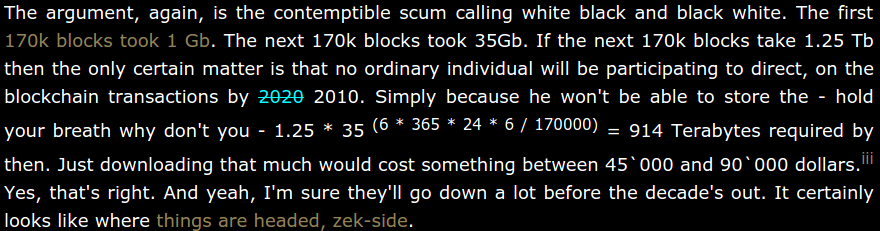
This is the math outlining the resources required to run the discriminatory new reference client. The size of investment needed to download the blocks alone is astronomical for ordinary users but for companies with deep pockets its trivial.
The effect of the proposed change to a new reference client will have the side effect of completely centralizing Bitcoin, with only a few billionaire funded “Blockchain Providers” controlling a complete copy. Only the very rich will be able to run this client in any meaningful way, and they will be repositioned as gatekeepers to the entire Bitcoin ecosystem. If you want to write a Bitcoin wallet, or other service, you will need to get their permission before you can connect to it to serve your customers or innovate with the protocol.
The Future
The small number of companies running full nodes will be very careful about who they allow to access their API, because “Its money we’re talkin’ ‘bout here”,and they will be 100% compliant with regulations and even proactive and punitive with their own “just to be safe” bespoke rules masquerading as law, and anticipating new laws in their terms of service. You will have to reveal your business model to them in advance, and if your model is not approved by them, then your software will not be able to provide services to your users. Essentially, “Megablock Bitcoin” will be exactly like the Apple App Store.
This is how it will work. If you want to run a service that takes Bitcoin or uses Bitcoin, your application or service, and the people who wrote it and own the software, will be scrutinized in a review process and either accepted or rejected by the “Blockchain Provider”. You will have to identify yourself, sign a contract, accept their terms, and do other onerous and invasive things just to send messages to and from your application. You will not be able to offer services globally, and will have to restrict access to countries and individuals that are not banned by the State. And of course, if you get too popular or the law changes in the jurisdiction where the the Megablock Provider is incorporated, your app could be de-listed, disconnected, banned and all your customer’s Bitcoin confiscated. This is already happening with Coinbase. And of course, Blockchain had their client removed from the Apple App store, stopping its adoption on “your” iPhone. There cannot be anyone who is ethical who believes this is a good thing.
Bitcoin is meant to be a decentralized tool where there are very low barriers to entry and freedom to transact, so that all the problems of centralized control of money supply and access to the financial rails are eliminated. Increasing the block size so that only the rich, Crony Capitalists and cowards can run a full node and expose an API is completely contrary to that idea.
The Decision
When the new reference client is released, you can either decide to run it or not. You are free to choose whatever software your hardware can accommodate. If enough people run the new reference client, the original, clean, blockchain will be split, and if you do not want to lose your Bitcoin, you will need to switch to the new reference client, and eventually when you can’t afford the hardware, move your Bitcoin to a third party wallet provider under their control and contract.
On the other hand, if there are a majority of nodes running the existing, safe reference client that everyone is already running, these changes will be de facto rejected by the network, and all those disruptor nodes running the new toxic centralizing client will be compelled to go with the consensus that incremental, safe, non destructive, non centralizing change is what the network participants want. Or they lose their investments and Bitcoin.
The solution
If you want the network to advance safely, and you want to preserve your ability to run a node yourself, and are philosophically minded to reject the centralists, there is something that you can do to prevent these changes being forced on the network, perhaps changing the direction of Bitcoin forever.
You can run a powerful full node yourself for as little as €2 a month.
Pete Dushenskihas an article on how to do this. (and in fact, installing Bitcoin by command line is easier than described there. All you need to do is run “apt-get install bitcoin” you don’t have to compile it yourself.). You can run a full Bitcoin node without needing to download and run the Blockchain on your own hardware. All you need to do is run an instance on an inexpensive virtual server in the cloud. Clearly this is not something that the casual user can do, but there is no reason why this process cannot be automated so that you pay €2 a month and a new node pops up an hour later. Anyone with some money could run 100 nodes in this way. Clearly, if all the people who do not want this change ran a few of these nodes, the debate would be over. Whats more, you can pay for these cheap nodes with Bitcoin.
There is no reason why many thousands of new safe, clean reference clients could not be deployed in this way, and perhaps, even more than that. These clean nodes in combination would drown out any damaging clients and force anyone trying to disrupt the network to retreat, because the majority of the nodes will still be running the true Bitcoin reference client. This will at the very least, stall the dismantling of the network, and at best, will permanently exclude any self interested minorities ability to wreck Bitcoin.
In sum, this needs to happen.
1) Scripted creation of new nodes triggered by a payment of the €2 hosting fee. The user sends Bitcoin to an address, with an email address. The script creates a new server, downloads the clean reference client, runs it in daemon mode. Recurring monthly payments are notified by email.
Thats it. People would be voting for Bitcoin with Bitcoin.
The Other Point of View
If your experience of life is that there is nothing wrong at all in any way with the CIA or the Federal Reserve, and everything in the world is perfectly fine, and the way things work should not ever change, then centralizing Bitcoin and dismantling its, to you, very dangerous and disruptive idea, is a no brainer. The government, and everything it does is always right, never wrong, they are in fact incapable of doing wrong, and they are to be trusted always because they always know what is best. Their permission is to be sought in advance before doing anything, even writing software.
If your experience of life in software is working for one of the biggest data corporations on Earth, and treating users like cattle to be managed and milked, then centralizing Bitcoin is a no brainer. The public doesn’t know what it needs, and only a centrally managed service can provide the expertise that’s needed to run anything at scale. There is no other way that things can be done, ever, and anyone that tries to change anything away from centralized control is painfully naïve. Plus, anarchists are full of jive.
There are lots of people opining about a subject they are not qualified to give an opinion on. They all think they deserve an answer, to “have their say” and they all think that you work for them. For nothing. The software engineering problems you are dealing with are difficult and novel, and the interactions of all the parts, including the social ones, is very complex. There are Merzbow levels of rage noise and conspiracy theories swirling around and directed at you. Life would be much easier if your only clients were a handful of billionaire entrepreneurs to whom alone you were responsible. And they would pay.
The solution is obvious, and beautiful. Centralize Bitcoin. It makes the noisy anarchists go away, reduces the number of people you are responsible to to a handful of billionaires with fine wine and food, and guarantees you a salary for decades and a seat on the round table at the centre of the biggest revolution since the web. Travel the world First Class, get fat. Live easy.
Which side would you choose?
The Choice is a No Brainer.
Do not believe for an instant that if the network is split in two and there is a corporate Bitcoin and a free Bitcoin, that the State will allow free use of a decentralized Bitcoin. They will make use of Free Bitcoin illegal. The chilling effect will kill Free Bitcoin, as no one wants the hassle of prosecution. If the true Bitcoin network is the de facto standard, then the Statists will choose to live with it, since they can’t kill it, just as they now choose to live with the Wild West Internet just as it is. Everyone is profiting off of the Wild West Internet, and there is too much money to lose in trying to lock it down and tame it. The same will be true for Real Bitcoin. That is why this block size increase and centralization proposal must die now.
What is being proposed by the centralizers is that everyone’s money should be in effect confiscated, and put to their personal use. This network does not belong to them, and the money, work and time invested and Bitcoin owned on the network does not belong to them either. It is not correct that two men can unilaterally decide to put the resources of others to a use without the consent of the owners.
But here we get into the realms of who owns what in Bitcoin, and what Bitcoin is. No one “owns Bitcoin”; for the sake of argument the network “owns” itin as much as an inanimate, intangible thing can own something. You do not have true control over your Bitcoin, because changes at the protocol level can lock you out at any time. What is being asserted here is ownership of theBitcoin Network, by two men.They want to take it, shut off access to it, and make it submit to their ideology. The idea that there is a “Bitcoin Community” that can decide how the software is developed is clearly absurd. The only thing people can do is choose to run one client rather than another. That is the only choice they have in this matter.
And they can do it. There is nothing to stop them if no one is minded to openly challenge them with their own software and solutions. Talk cannot change software. They have said openly if everyone switches to their client they will pull the trigger, and if not, they will not. If anything goes wrong, or anyone expresses surprise at the outcome, no one will be able to claim that they were not warned or did not have a choice to reject their client.
Ultimately this is yet another reason why Bitcoin is not money; it is something that is collectively controlled by consensus,unlike money which is accepted by consensus. In any new definition of money there should be a clause saying that its nature is independent of anyone’s opinion or act.Clearly how Bitcoin works and its nature is not independent of anyone’s act; it is vulnerable, certainly at this early stage of its development, to the opinions of a small number of men, and that is very dangerous.
Once this conflict is over and there are millions of clean nodes it will be much harder to destroy Bitcoin by a centralizing protocol change at the whim of a single man. No one will agree to it; there will be too much at stake. The best the disruptors could hope for is a once in a generation change, the same way “Internet 2” took a quarter of a century to specify, attain consensus and complete. By then, it will be too late. Bitcoin will be everywhere, in everything, running free and wild, and will have so much momentum that no one will be able to stop it or corrupt it.
Conclusion
If no one comes up with a meaningful software challenge and makes it real, then the centralizers deserve to win, profit and gloat. They will be demonstrably the superior, insightful, realistic, resourceful and talented men, and the spoils rightfully belong to them.
If you want to have direct influence over how Bitcoin is developed, run a few full nodes immediately. Running software is the only thing that matters, not written proposals, wishes, legislation or talk. The gauntlet has been thrown down. Are you man enough to pick it up?
Hottest summers on record require the coldest beers in the store!

Preview: “The market for bitcoin transaction inclusion and the temporal root of scarcity”
By Konrad S. Graf
Posted June 20, 2015
POST HEADER
POST BODY

What do you see in those blocks? Source: Wikimedia Commons: “Crown Fountain” by Tony Webster.I have been considering the Bitcoin block size debate for quite a few months (next to some other large projects), reading, learning, and applying principles. It is such an important and contentious issue that I have taken extra time before commenting at all to research and keep following the wide range of factors, opinions, and related issues.
In seeking to apply economic theory in new ways, and when addressing Bitcoin in particular with it, I try to take even more care than usual to first acquire a sufficient technical understanding so that I can usefully apply such theory to the case. The block size issue has set that bar still higher than it had been with other Bitcoin topics I have addressed.
I am convinced the roots of much of the contention are based primarily in economic-theory differences and only secondarily a technical or even social ones. Additional issues of governance and decision-making likewise come to the fore mainly when people are severely conflicted on what the right thing to do is and the issues then descend into “political” contests of influence and persuasion. There are also economic ways to understand the kinds of circumstances under which issues tend to become viewed as “political” in nature rather than not.
In short, if it were clear what ought to be done, that could be implemented with some work. Yet not only has widespread consensus on the right thing to do been slow to arrive, but the disagreements appear rooted more in differing opinions on economics, a specialized field entirely distinct from engineering, programming, and network design. Worse, too much of what passes for “economics” in the official mainstream today has been built upon a foundation of long-refuted non-sense.*So usingthat*is unlikely to help matters along either.
A 30-page written treatment is in the editing and review phase. For now—in response to numerous behind-the-scenes requests for comment—here is a summary preview of some of the essentials of my take on this as of now. The forthcoming paper contains citations, support, and step-by-step context building and also covers many more related topics than this summary can touch on.
Summary of some findings
The block size limit has for the most part not ever been, and should not now be, used to determine the actual size of average blocks under normal network operating conditions. Real average block size ought to emerge from factors of supply and demand for what I will term “transaction-inclusion services.”
Beginning to use the protocol block size limit to restrict the provision of transaction-inclusion services would be a radical change to Bitcoin. The burden of proof is therefore on persons advocating using the protocol limit in this novel way. This protocol block size limit was introduced in 2010 as an anti-spam measure. It was to be an expedient to be removed or raised at a later stage as normal (non-attack) transaction volumes climbed. It was not envisioned as having anything to do with manipulating transaction fees and transaction-inclusion decisions on a normal operating basis. The idea of using the limit in this new way—not the idea of raising it now by some degree to keep it from beginning to interfere with normal operations—is what constitutes an attempt to change something important about the Bitcoin protocol. And there rests the burden of proof.
If that burden is not met, the limit ought to be (have already been) raised—by some means and by some amount. Those latter details do veer more legitimately into technical-debate territory (2, 8, or 20MB? new fixed limit or adaptive algorithm? Phased in how and when? etc.), but all such discussions would be greatly facilitated by a shared context on the goal and purpose of any such limit having been placed into the code. A case for establishing some completely new reason to retain this same limit—other than as an anti-spam measure—would have to be made by its advocates if they were to overcome the default or “when in doubt” case. The context shows that this when-in-doubt default case is actually raising the limit, not keeping it unchanged.
Casual and/or rhetorical conflation of the block size limit with the actual average size of real blocks is rampant. This terminological laziness begs the key questions of: whether any natural operational economic constraints on block sizes exist (or could become even more relevant in the future), what those natural constraining factors might be, and what degree of influence they might have on practical mining business decisions. In strict terms, nothing can be done without some non-zero cost. For example, including a transaction in a candidate block carries some non-zero-cost and larger blocks propagate more slowly than smaller ones, other things being equal.
How can the real influences of such countervailing factors be discovered within a dynamic complex process? Markets and open competition excel at just this type of unending trial-and-error tinkering problem. However, setting a blanket restriction at an arbitrary numerical level on the output of transaction-inclusion services across the entire network distorts such processes, preventing accurate discovery and inviting both general economic waste and hidden zero-sum transfers.
Transaction-fee levels are not in any general need of being artificially pushed upward. A 130-year transition phase was planned into Bitcoin during which the full transition from block reward revenue to transaction-fee revenue was to take place. The point at which transaction-fee revenue overtakes block reward revenue should not have been expected to arrive any time soon—such as within only the first 5–10% of time that had been planned for a 100% transition. Transaction-fee revenue might naturally come to exceed block reward revenue in say, 20, or 30, or 50 years, or whatever it ends up being. Yet even that is still only a 50% milestone in the full transition process. Envisioning the long-term future of mining revenue should also factor in the clear reasons for anticipating steady secular growth in real bitcoin purchasing power.
Most fundamentally, scarcity is being treated in this debate largely using an intuitive image of “space in blocks.” However, scarcity follows from the nature of action as inevitably occurring within the passage of time. Actors would like to accomplish their objectives sooner rather than later, other things being equal. Time is the ultimate root and template for scarcity, because goods are only definable in relation to action and any action taken precludes some possible alternative action (“cost”). Scarcity of transaction-inclusion should therefore be understood in terms of relative time to confirmation—which is already today statistically influenced by fee levels.
Finally, discussions of whether bitcoin should or should not be used for “buying coffee” sound embarrassingly like Politburo debates. Market discovery through real supply, demand, and pricing over time allow socially best-possible levels of [average fee multiplied by transaction volume relative to real bitcoin purchasing power] at any given point in (in-motion) time, to be discovered dynamically. The same goes, at the same time, for the relative pros and cons for users of the entire possible existing and future spectrum of off-chain transaction options relative to on-chain ones. The protocol block size limit was added as a temporary anti-spam measure, not a technocratic market-manipulation measure. The balance of evidence still seems to indicate that it should remain restricted to its former role.
POST FOOTER
/post
/content-wrapper
Class Consciousness of The Digital Age
By BTCtheory
Posted June 24, 2015
“This means that formallythe class consciousness of the bourgeoisie is geared to economic consciousness. And indeed the highest degree of unconsciousness, the crassest, form of ‘false consciousness’ always manifests itself when the conscious mastery of economic phenomena appears to be at its greatest. From the point of view of the relation of consciousness to society this contradiction is expressed as the irreconcilable antagonism between ideology and economic base.Its dialectics are grounded in the irreconcilable antagonism between the (capitalist) individual, i.e. the stereotyped individual of capitalism, and the ‘natural’ and inevitable process of development, i.e. the process not subject to consciousness. In consequence theory and practice are brought into irreconcilable opposition to each other. But the resulting dualism is anything but stable; in fact it constantly strives to harmonise principles that have been wrenched apart and thenceforth oscillate between a new ‘false’ synthesis and its subsequent cataclysmic disruption.
This internal dialectical contradiction in the class consciousness of the bourgeoisie is further aggravated by the fact that the objective limits of capitalism do not remain purely negative. That is to say that capitalism does not merely set ‘natural’ laws in motion that provoke crises which it cannot comprehend. On the contrary, those limits acquire a historical embodiment with its own consciousness and its own actions: the proletariat.”
György Lukács, History and Class Consciousness, 1923

To fully grasp the revolutionary nature of bitcoin, we first need to understand the internet and its role in forming a new class consciousness. I call this new class consciousness and its manifestation in the world The Digital Sovereign. Barley 20 years in the making, the internet is already the most powerful tool of global communication and information exchange that we have ever seen. With 3.2 billion people and growing with each day, the internet has put more people in contact with one another than at any other time in history. Digital communication is near instantaneous, access is ubiquitous and allows for a scale and magnitude of organization that has never been conceived. What unites the 3.2 billion people beyond the marketing and capitalist rubbish of the internet is a new crystallized form of class consciousness. This class consciousness is the true proletariat; the cohesive whole of humanity and the great society which contains us all.
What is Class Consciousness?
Class consciousness is the awareness of our identity as not as individuals, or even as a group, but as an entire classes of people. Historically, the class consciousness that we have been aware of since the advent of capitalism have been false consciousness based upon racial, nationalistic, religious, political; but most of all, economic consciousness. As Marx stated in, The German Ideology:
The Base and the Superstructure
“The ideas of the ruling class are in every epoch the ruling ideas, i.e. the class which is the ruling material force of society, is at the same time its ruling intellectual force. The class which has the means of material production at its disposal, has control at the same time over the means of mental production, so that thereby, generally speaking, the ideas of those who lack the means of mental production are subject to it. The ruling ideas are nothing more than the ideal expression of the dominant material relationships, the dominant material relationships grasped as ideas.”
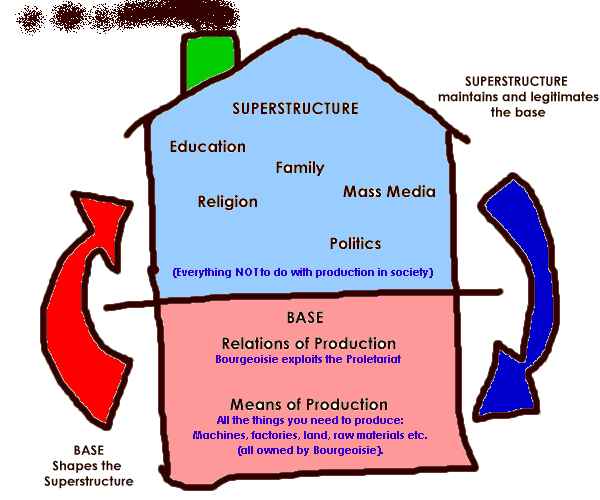
Each time that we trace back the origin of prior false class consciousnesses we come to find that the ‘facts’ upon which they are based are little more than propaganda of the ruling class, only to be torn asunder by the next epoch. The only real class consciousness that we have been given by the various ruling systems is a consciousnesses of exploitation and objectification–alienation in its most sinister forms.
False Consciousnesses as Consumers and Citizens
The false consciousness that we experience in society today is based upon the process of reification; in which we develop a false identity in the reflection of the ruling system. This started long ago with the industrial development of the cultural industry being sold as mass enlightenment. As Theodor Adorno and Max Horkheimer explain so well, the cultural industry is a form of mass distraction and deception forced on to the whole population as bourgeois enlightenment. We were birthed into a world where for many decades the mythos of state and capitalism has reigned supreme, and crass avarice as seen as zenith of benevolence. For generations the masses have mindlessly obey the state and enthusiastically participated in capitalism. This has created a sort of stockholm syndrome of society under the barbarism of the state, and exploitation of capitalism. People truly believe that the answer to environmental catastrophe and genocide can be found within consumption and statism. Our identities are so entangled and interwoven as being subjects of both the state and capitalism that we cannot conceive any other sort of socioeconomic situation. This is where we find our common ground.

The false identities of consumer and citizen alike has made us into weak, solitary, individuals against the omnipotence of the states and markets–we are forced into roles and identities as only individuals to be exploited, not as empowered class of people who can resist. Within the system of state capitalism we cannot be autonomous, self-empowered humans; but only things to be exploited by capitalism, and subjugated by the state. This is why despite the power of the numbers that we have to actively resist such a system, there is no ‘consciousnesses’ that has formed to created such a resistance. From nearly a century of inundation and bombardment of mass culture, we no longer have any sort of a vision of what life can look like free of the state, or capitalism–the vast majority simply believe there is only a one-dimensional existence. Luckily, the revolutionary tools that will shatter these false identities, and unite us as a single people are already at play, and cannot be stopped.
Internet Sociology
The development of the internet and the formation of the social web has created a new territory. This space is unlike any other space or territory that we have ever encountered before because it is a sovereign space of non-physicality:
The axiom that the internet functions from is that it can only and explicitly exist non-physically, which is also the praxis of its inevitable success. Only expression can exist within the confines of this screen–the physical contact needed for violence and intimidation explicitly cannot exist here. Furthermore, the anonymizing properties of information dissemination via the web allows for personal discovery outside of the official indoctrination of state capitalism. These combine attributes of the internet have created the conditions for a new kind of social relation that has manifested as an ideological apparatus.
The self-interest of this apparatus (the internet) is to perpetuate itself; to freely disseminate information–that is what the internet does. This alone has made it a threat towards both the state and capitalism, however, it is the conscious organization of the internet into a political vehicle which will allow for it to defeat state capitalism. The revolutionary praxis of the internet demands for meaningful and constructive communication, which in turn is reliant on the freedom and liberty offered in this territory.
The freedom and liberty of the digital territory is not the vulgarized freedom of nation-states and capital markets, but that of an idealist one. Here is a territory in which we can all freely project our thoughts, while the physical corrosion and intimidation of the ‘real world’ cannot exist. This means that people have the freedom to both personally, and ideologically discover for themselves what the true nature of the world is for themselves through this space.
Only for so long will people fall for the ruse of state and capitalist propaganda masquerading as facts; and with each new lie this system purports acts as a testament against its own bankruptcy. In this digital territory we are stripped of our individual and state identities, and given new digital ones. This homogenization of people through the banishment of physicality, allows for us to see ourselves more as a single people than we could have ever experienced in the physical realm. The internet is what allows for us to see, organize, and interact for the first time on a truly global scale. This is the natural outcome of a world that has existed under the full weight of a century of globalized imperialist capitalism.
The Coming Digital Sovereign
This transformation of class consciousness is only in the very early stages. Even today the internet is still seen by most people as only a mode of communication which must be subservient to the state. But as we advance into the 21st century and experience the power that the internet has to shatter borders and disseminate the harshest of truths, we will find a class consciousness in that very power. As more and more people discover the radical personal empowerment the internet can offer in a world of unrelenting barbarism via state capitalism, the internet will take on the powerful ethos of the global proletariat.

The culmination of the ethos of the internet into a full social, political, and economic organization is the global proletariat; and the internet is its most powerful weapon of organization.
The internet thus far has been mostly used for the trite and vulgar needs of capitalist exploitation. The modes of power that exist to exploit individual users within the internet are present today, and they are very powerful, but so are the the modes of counter-resistance. In fact, this game of brinkmanship between the state and the individual in the digital realm has reached an end game that the state has lost. Crypto has reached sophisticated enough levels to hide the likes of men like Ed Snowden, and other whistle blowers, and there are plenty more of them to come.
Within the digital realm it is left up to individual actors to choose to what level of exploitation they will face, or how they will resist it. This is radically different from the world in which we live in. The panopticism of everyday existence forces us to conform to the will of the state capitalist system. This is what Max Weber called the iron cage. The internet is what gives us an exit, and a way to subvert this system.
It cannot be understated how powerful it is that a non-physical space can have a sociological influence on the physical world. It is within the very fact that the digital territory of the internet creates its power as The Digital Sovereign. The Leviathan of our time; the internet serves as the cohesive tool that can allow for humans to radically organize on a praxis that forces non-violent organization–the Achilles Heel of all States.
There is no immediate physical space in which violence can exert itself. The internet does this while directly influence the physical world, particularly in times of crisis. This in turn has allowed for the internet to become an ideological apparatus that will both organize and fight for its own existence, while finding solidarity for its fight in every corner of the globe. It is by no mistake that the several regimes spanning decades collapsed after the Arab Spring Revolts, which the internet was the influencing factor.
The Internet and The Global Proletariat
Slowly the interpellation of**the values of the internet are overtaking that of the state. We are still subjects of our respective states, but no longer under the spell of statism. The radical values upon which the internet was created, and because of how the internet functions and influences our lives, we now have more loyalty to this territory than that of our own states. Due to the sovereignty of this territory, it has acted as a space for the radical education and dissemination of information throughout all of cyberspace, which in turn has self-propagated its own development. The truth can be demanded and told through this medium, without the direct physical oppression of states, or exploitation of capitalism.

The historical embodiment of people being used and exploited by state capitalism is now found in every person and everywhere around the globe. We have advanced so far and so deep into capitalism that there is no person, no space, or territory that has not been fully defined by capitalism. This in itself gives us a united identity as a single people through the shared exploitation and turmoil that we are all subject to under this system. With the advent of the internet and digital technology, the class consciousnesses that we all share as The International Proletariat is starting to gain momentum. It is forming itself through a variety of modes that cannot be stopped by states, or their capitalist allies. This consciousness is the pure historical information that has created the conditions of the proletariat.
The internet has made the suppression of information nearly impossible which allows for the naked facts of what is to be seen by all. This freedom of information is the bases of power for the class consciousness of the internet and the global proletariat. The free organization, collaboration, and dissemination of the facts of the world as it is, free of the propaganda of states and capitalists alike, allows for a new lens of view to come into focus: The true class consciousness of the global proletariat united through the internet.
—
Next: The Revolutionary Vanguard of The Digital Age