
February 2015 Journal
WORDS is a monthly journal of Bitcoin commentary. This issue collects the February 2015 writing in the WORDS archive. For the uninitiated, getting up to speed on Bitcoin can seem daunting. Content is scattered across the internet, in some cases behind paywalls, and content has been lost forever. That’s why we made this journal, to preserve and further the understanding of Bitcoin.
What is the Intrinsic Value of Bitcoin?
By Elaine Ou
Posted February 2, 2015
[
What is the intrinsic value of Bitcoin? What are Bitcoin’s fundamentals? What is its cash flow, earnings, coupon, yield?
Zero, of course. You could ask the same thing of gold. Or Steve Cohen’s art collection. Or TWTR, whose fundamentals are so negative they ought to be paying people to hold their shares.
An asset with no intrinsic value is not an investment, it’s a trade. More specifically, it’s a greater fool trade.
Fiat money, the pieces of paper in your wallet, has no intrinsic value*. We are willing to accept it for goods and services because we know we can trade it for more goods and services. This makes it an established medium of exchange.
Bitcoin’s true potential lies in its ability to serve as a global medium of exchange. The people buying bitcoin as a speculative asset are doing the community a huge disservice because they take bitcoin out of circulation and spend dollars instead. Bitcoin cannot establish itself as a medium of exchange if no one actually uses it to buy stuff.
Bitcoins aren’t assets. They exist only as entries in a public ledger. Owning bitcoin doesn’t mean having a banknote in a digital wallet; it means having the right to transfer a balance to someone else.
Bitcoin has no central bank to prop up its value. As long as Bitcoin is treated as an investment, its only value will derive from the existence of a greater fool willing to buy that balance.
The good news is that Bitcoin is totally rallying this week if your investments are denominated in Mexican Pesos.
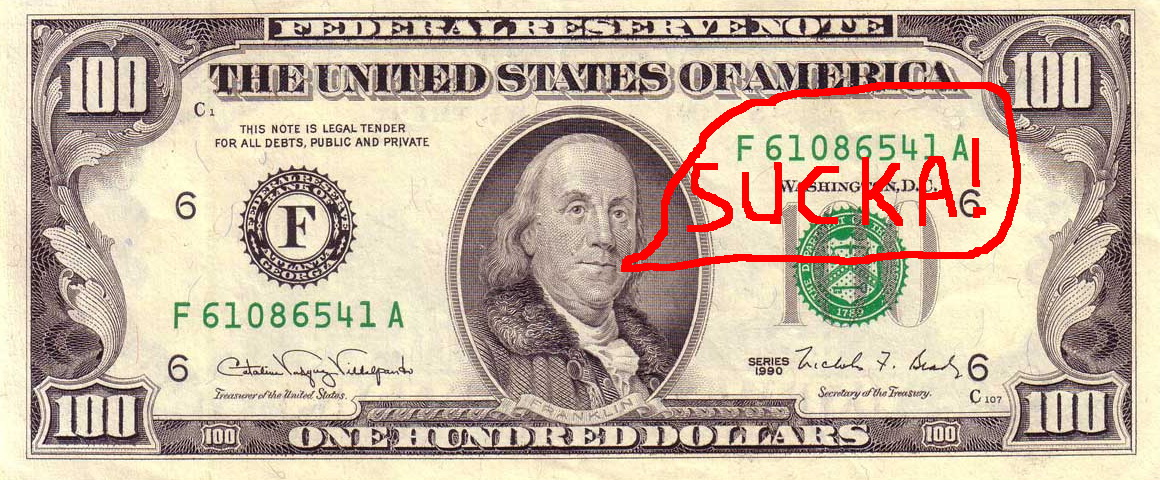
*Guess what, your dollars aren’t even really money. The top of a paper bill says “Federal Reserve Note”. It’s a contract that says the Federal Reserve owes you something. Don’t you feel silly accepting a Federal IOU for that lapdance you gave earlier this evening!
[
See Also:
The economics of sinking 20 MB Gavincoin blocks.
By Pete Dushenski
Posted February 11, 2015
Since there still seems to be a handful of holdouts who disagree that a bigger blockchain is less secure and that the block size ain’t gonna increase any time soon, let’s do some math to further the point, shall we ?
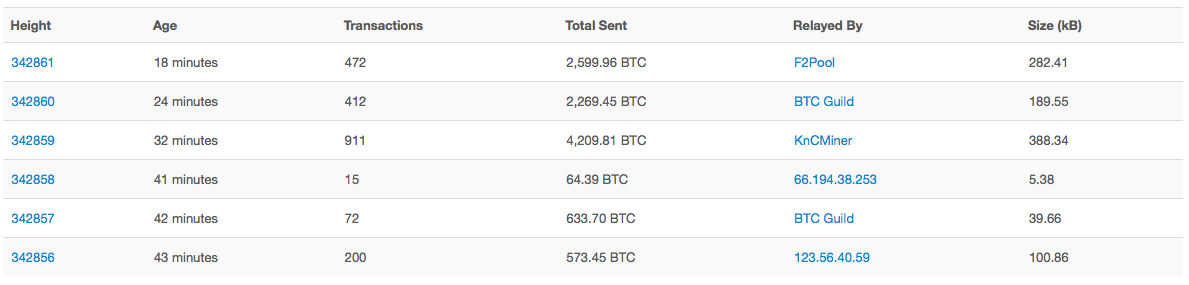
Of the last six blocks mined in the last 41 minutes,i the average block size was 161.09 kB and the average number of transactions was 347. This wasn’t what was ideal, what it “should be” in order for Bitcoin to be the African Visa card “the community” dreams of, this is what it was. This is what the market decided.
Take a good hard look at what the people with the money to make decisions actually did, not what the people without the money thought they should do because reasons. In case you haven’t heard, this is how the world works today and going forward into the foreseeable future. Democratic socialism is dead, we’re just making the necessary funeral arrangements.
But back to the math. So you want spam-a-licious 20 MB blocks and some arbitrary number of transactions per second because you think that’s a meaningful measurement of anything. Fine. Let’s run the numbers and see what that’s going to cost you. Because yes, this decision bears costs, no matter what USGavin says and no matter what he or anyone else imagines to be a “free lunch“, there are expenditures implied by his proposal and consequences you may find undesirable flowing therefrom.
Currently, the Bitcoin blockchain is growing at a rate of ~1.2 GB every single month.ii Gavincoin’s 20 MB blocks would grow the size of its blockchain by 2.88 GIGABYTES PER DAY or 1.05 TERABYTES PER YEAR since they will be filled with essentially zero-feeiii spam transactions by design.
If you’re hosting your Gavincoin node on a VPS, you’re looking at costs in the order of $1,000 per year, or 50x what a Bitcoin node costs! Even if you’re running your Gavincoin node at home, and you want to buy 5 years of storage up-front, you’re looking at $300 for the hard drive and another $250 per year in additional Internet bandwidth capacity, which is again, about 50x more than you’re currently paying.
This little bit of math should make it completely, utterly, painstakingly obvious that imposing such costs on nodes (not miners now) will reduce the overall number of nodes in the network and fragilise the distributed model that makes Bitcoin the world-eater that it is. This weakness in the Gavincoin model can and will be exploited by state-level actors, those of us in Bitcoiniv who intend to enforce by any and all means the doctrine of scarcity until our dying breath, and of course those miners who want to protect their transaction fee revenue for down the road when the block reward dries up.
Gavincoin can and will be defeated because it’s meaningfully worse than the alternative, just as USD, “property values,” and whatever other unit of account you previously found to be useful can and will be defeated. Lesser options don’t overcome better options just for the saying so of “the people.”
What is this, the future ?
- Yes, the hashrate continues its upward ascent, indicating that it’s still sufficiently economical to mine Bitcoin at $200 per coin with a network hashrate of ~320 PH.↩
- It’s worth noting that this increase isn’t hugely impacted by the block size because blocks are rarely full. This is the present state of affairs: even 1 MB blocks are rarely full. That an American is proposing a “pre-emptive strike” to prevent the consequences of some boogeyman is no coincidence, it’s de facto USG policy, lest we forget the sorry story of America’s lost decade in Iraq on account of their scapegoating Herr Saddam Hussein. Remember him ? the guy who didn’t actually have WMDs ?↩
- Yes, larger blocks reduce the scarcity of space and therefore reduce the ability of miners to demand higher transaction fees. This is given that there’s no proportionate increase in demand for Bitcoin transactions, which is pretty reasonable given that a 20x increase in transaction volume on short notice is as likely as you becoming a good poker player in a similar time frame.↩
- That is, those of Satoshi’s chain, and those who set its policy today. This obviously doesn’t include USGavin in any way whatsoever.↩