
August 2014 Journal
WORDS is a monthly journal of Bitcoin commentary. This issue collects the August 2014 writing in the WORDS archive. For the uninitiated, getting up to speed on Bitcoin can seem daunting. Content is scattered across the internet, in some cases behind paywalls, and content has been lost forever. That’s why we made this journal, to preserve and further the understanding of Bitcoin.
Bitcoin ideas worth pursuing
By Oleg Andreev
Posted August 1, 2014
Here are some ideas for services around Bitcoin that are highly interesting to me.
1. Truly secure wallet & vault. Protected from institutional risks, backdoors in software and hardware, losing backups and forgetting passwords. Works on regular computers (phones, laptops). Multisig with blind signatures for privacy. Authenticating with a circle of friends or arbitrary services instead of a single centralized institution. Only this can make people safely invest in Bitcoin and push the entire economies to it unlocking the rest of the features (low fees, autonomous agents, smart contracts etc.)
Btw, I have a working implementation of blind signatures already with a demo app: Code: https://github.com/oleganza/CoreBitcoin/blob/master/CoreBitcoin/BTCBlindSignature.h Paper: http://blog.oleganza.com/post/77474860538/blind-signatures-for-bitcoin-the-ultimate-solution-to Demo app: https://github.com/oleganza/blindsignaturedemo
2. Wallet API for web sites and native apps. A standard way for any app to request user’s wallet to allocate and sign certain amount of bitcoins to be used in a custom transaction. The unified API would allow maximum flexibility for any sorts of schemes and contracts while preserving user’s keys secure and his financial details completely private. Wallet requests approval from the user and gives the absolute minimum of information to the app. Wallet will also sign its inputs only if all the change outputs are respected. Use case: your app does some fancy scripts and needs user’s coins. Today you have to make your own wallet in which the user must send coins (and you have to reinvent all security measures as described above). Tomorrow you could simply request what you need from an existing wallet without having user to do extra movements.
I helped to develop a draft of the spec: http://bitcoin-wallet-api.github.io
3. Decentralized clearing mesh network for frequent and instant payments. Similar to Ripple, but without made-up currency and without any trust. Nodes form point-to-point contracts using bilateral 2-of-2 deposits that put a limit on IOUs issued between two nodes. Thus nodes can connect anonymously without any trust. When two people pay each other, they simply find the cheapest path (every node may ask for any fee) between them and propagate an IOU denominated in BTC. There’s no global consensus and no single point of failure. If you owe 50% of the amount deposited, you have to clear the debt with real BTC transaction. Any amount of money can be moved back and forth and all IOUs are 200% insured. This mesh could be used to buy a latte or for one automated service to pay another automated service.
4. Decentralized markets. People can use the same bilateral insurance scheme to create a “nash equilibrium” escrow without any 3rd party. This makes free trade possible without risk of fraud or censorship. My friends in San Francisco already have a working prototype that uses Bitmessage to post products and bids. And it works great!
When released, the app will be published here: http://voluntary.net/
5. Crowdfunding protocol and apps where majority vote controls the funds. Bitcoin already allows some neat schemes to crowdfund money directly by the founders, but these schemes do not allow for X% (typically 50%) vote to unlock, or otherwise control funds. If that was possible, then founders could still have a comfortable guarantee of funds for their enterprise, but wouldn’t be able to waste them all at once. If their business plan is no longer aligned with the interest of majority of stakeholders, they could take the remaining money back or redirect to entirely different managers. This is a very big thing! If done in absolutely p2p manner, it will enable fantastic possibilities for mankind. For instance, non-targeted crowdfunding will become possible: “someone please repair our road and we’ll pay you $5000”. The funds can be directed to the guys who solved the problem by a majority vote of the backers (unless all backers turn out to be total jerks, of course).
The problem with modern corporations is that they are de-jure owned by stakeholders, but the real power to make decisions is on managers who are hired to manage the capital. In other words, it is really hard for thousands of small stakeholders to coordinate and affect decisions of the top management. More strict crowdfunding protocol with direct democracy built in would allow all stakeholders, small and large, to better control the flow of funds.
Bitcoin is not compatible with the State
By Oleg Andreev
Posted August 4, 2014
In Italian: http://www.partito-pirata.it/2014/11/bitcoin-vs-stato/ In Russian: http://bitnovosti.com/2014/08/16/bitcoin-i-gosudarstvo/
Bitcoin and State do not go together at all. Neither logically, nor economically.
Logically, if you think that the state is a useful and viable institution and Bitcoin is a useful and viable technology, you are lying to yourself. State is a hierarchical construction of “trusted third parties” (TTPs). In theory, some social interactions may involve a conflict that may be resolved by a trusted third party (arbiter). In a nation state it is ultimately some government agency (e.g. a cop). In case there’s a conflict between a citizen and a government agency, there is another government agency to watch over it. Thus, a cop is watched by his chief, a chief is watched by a court, court is watched by a parliament or a president, and those are being overthrown by an angry mob from time to time. The theory goes that every single conflict can be justly resolved by the state if parties cannot resolve it by themselves.
Bitcoin is an attempt to remove some trusted third parties from equation. That is all sorts of financial institutions including government regulators. From the Bitcoin perspective, it is a moral hazard to enable control over money supply and monetary flows to a hierarchy of trusted third parties. History is full of examples when private banks and government agencies could manipulate and destroy entire economies by being able to produce money without limits or censor its use. Bitcoin is strange and a bit complicated way to protect all users of money. Users can transact without need for any third party to record and acknowledge their transactions, and what’s more, no one can even become a third party by hijacking the system and imposing controls and rules on its usage. The former is not possible without the latter.
So if you support the idea of Bitcoin, you acknowledge the hazard of entrusting the entire economy to trusted third parties. You acknowledge that the ultimate power must be spread thin among every single participant and never be entrusted in hands of a few, even if it’s a democratically elected government. (Trusted third parties on top of decentralized foundation are fine as long as every person has equal access to that foundation and can jump off anytime.) But if you acknowledge the hazard of TTPs, then what arguments are left for any other government activity? Government is the ultimate trusted third party to resolve disputes in the entire economy. If there’s a conflict in a monetary system and we need Bitcoin to resolve it so no banker, judge or president could have personal interest in it, then the same applies to any other conflict. Every conflict could have someone’s personal interest in it to screw things up. The fact that we rely on the government to resolve it only shows that we couldn’t find a safer way yet. By supporting Bitcoin you give up all arguments for validity of the State.
If you, however, prefer the State, then supporting Bitcoin is illogical: why do you need such a complex and hard to understand (for non-hackers) system if every problem can be solved with trusted third parties? Look, Visa processes bazillion of transaction per day by just flipping the bits in their database. Bitcoin cannot do that, it is a consensus network that needs everyone to be aware of all transactions. Making instant payments requires extra complexity on top of that existing complexity. Also, there’s constant hazard of computer viruses and backdoors that steal your coins. If you believe that problems can be efficiently solved simply by electing trusted people, than Bitcoin is a huge overhead. So you should pick one: Bitcoin or State.
But most importantly, Bitcoin and State will never survive together for economical reasons.
State exists because it can. It can pay for its expenses, pay for those who enforce the laws, write the laws, brainwash children in schools and adults in evening news.
How does the state pay for its expenses? First, the government controls money supply. If needed, money is just being “borrowed” from the government’s puppet bank under promise to repay the debt (with interest!) from the extracted taxes (or by borrowing even more from the same place). When the state wants to go to war, enormous amount of money can’t be just extracted and is being printed. Extra money flows into markets, prices go up, business plans get messed up, people’s savings get destroyed and they lose their jobs at the same time. But we are at war, so folks are better to work harder “for the children” and maybe even join the army (you lost your job, after all).
Second, the state is paid by all those good businesses that must use banking system to operate. And the banking system is all heavily licensed and cooperative with the state. A lot of monetary flows are monitored by the tax collectors. Natural greed makes people avoid taxation just like all other costs, but taxes are avoided only in black market and by small businesses working with cash. Everyone who accepts cash hides some percentage from the taxman. If not for personal greed, but at least under competitive pressure by tax evaders (e.g. your café cannot survive if you don’t increase your profit margin by not paying 10% of the taxes like all your competitors do). If you business has to work with partners over the wire, you had to use banks and pay 100% of your taxes. With Bitcoin banks are not necessary. Bitcoin allows you to trade with anyone on the entire planet with near-zero costs. More businesses would bypass Banks and as a side effect, more businesses would be able to withhold their taxes from the state. Competition would force other businesses to drive their costs down the same way. Bitcoin will become a black hole that grows and attracts more and more people in it.
From the point of view of tax collectors, however, it’s the other way around. In Bitcoin world government cannot pay cops IOUs it makes up. It must pay real bitcoins that it must extract first from the businesses. But as more and more businesses avoid paying more and more taxes, there is less money being left for the government. That means that extraction will become increasingly less effective and therefore allowing even more people to avoid taxation on even larger scale. This cycle would repeat until all government employees will run away to seek real jobs because their bosses wouldn’t be able to pay them a single penny.
So if Bitcoin continues to grow, the nation state would peacefully dissolve. If state is to be preserved, Bitcoin must be stopped and never allowed again. However, the more people invest in Bitcoin, the more interest, wealth and power is on its side to protect it against any aggression. They didn’t invest in Bitcoin to try it out. They invested to make it ubiquitous and global phenomenon and they all will fight hard to make it happen. At some point we will witness a critical mass of supporters that no one will be able to stop. And then there will be no state anymore.
Gresham’s Law and Bitcoin
By BTCtheory
Posted August 7, 2014
Over the last few years there have been a number of papers and blog post on Gresham’s law and bitcoin. Most of these have rudely proclaimed that bitcoin will die because of Gresham’s law–ironically, it will be fiat currencies that will die because of that law, not bitcoin. This is because the real value of fiat money is always going to be lower than the real utility value of bitcoin. As theillusion of fiat money is exposed for what it is, the value of bitcoin compared to it will continue to go higher, and higher.
Gresham’s Law, Real and Nominal Values
Gresham’s law dictates that bad money will drive out the good due. This is due to the fact that ‘bad money’ is overvalued so you want to use it; while good money is undervalued, so you want to save it. Thus, consumers will get more bang for the buck using the inferior money, and will benefit from hoarding the superior money.
Let me elaborate in an example using a $100 bill and a 1oz Gold Double Eagle $20 coin. In terms of the recognition of value, the $100 has a higher nominal value than the $20 coin. However, one would be an idiot to spend the $20 gold coin on $20 worth of goods, as the gold coin’s commodity value worth well over $1000. This is why we don’t see $20 gold coins floating around–people have ‘horde’ them up so those coins are no longer in the money supply.
This is what is meant by the saying of Gresham’s law: bad money drives out the good. Please see difference my post The Legal Politics of Money for more details on the difference between nominal value (valor impositus) and real commodity value (bonitas intrinseca).
In contemporary society, we have a hard time understanding that ‘money’ is really just a catch-all term for ‘object of exchange value.’ Really anything can be money–gold, bushel of wheat, salt, seashells, etc.–what is important about money is that it is an equal and standard measure. Because governments have historically fix fiat money’s value to something (in the case of the 1oz gold coin, it was $20, as that was the rate that the FED honored from 1913 to 1933–1oz of gold was = $20) it creates two values: real and nominal.
This means ALL money has two values–a real commodity value, and a nominal value. The commodity value is the worth of the object that the money is made of; such as the gold the coin is made from, or the paper that a dollar bill is printed on, or the electrical energy that is spent on mining bitcoins. This commodity value will always be independent of the nominal money value of money.
Historically, governments always ‘pegged’ the nominal value of government money to the commodity value of gold or silver. Today however, because dollars are not pegged to anything and are free-floating, the value of dollars are decided by the market alone; just like bitcoin. Dollars today are only and explicitly nominal values–as the paper they are printed on is just that–paper that has no commodity value other than being legal tender. People can assess those two values (nominal vs. commodity) against one another and decide for themselves what is more advantageous. That which is seen as ‘bad money’ is spent, and the ‘good money’ is saved for a later date when its value has increased. The ‘demand’ for money is called liquidity preference, as the demand of each monetary unit and it total value is also affected by how liquid it is, and how willing people are to accept it.
In short:
$20 double eagle gold coin; nominal value = $20
$100 bill; nominal value = $100
These are the values that these monies have because of the nominal, set values by the government.
$20 double eagle gold coin; real commodity value = around $1200 because of the 1oz of gold it contains
$100 bill; real commodity value = Around $0.13 per bill to produced because it is just fancy cotton.

Money has two independent values : the nominal value, or the set price that the government will value that money at; and the real commodity value–the price that money has because of its own intrinsic commodity value. This is why dimes made before 1964 have vanish from the supply–as the silver they are made out of is worth at least $1, thus it becomes a better option to spend zinc dimes (post-1964) that are worthless than $0.10 per coin, vs. spending dimes that are worth more than $0.10.
The Value of Fiat Money
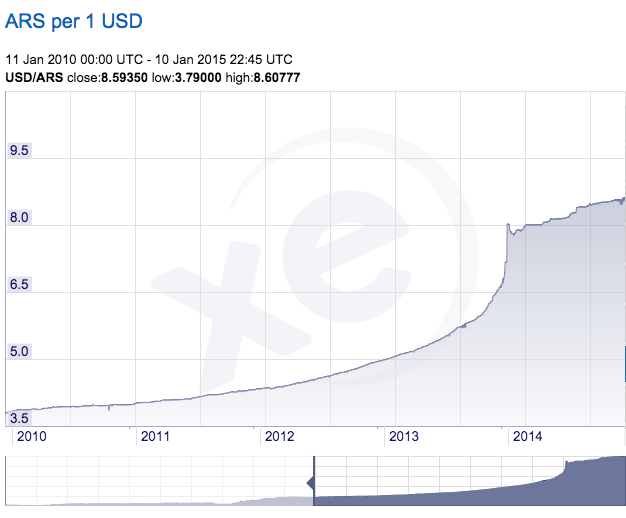
Fiat money by definition has no intrinsic value. The only the value that fiat money has is the threat of legal force if someone refuses it. This is why the value of fiat money is directly tied to the legitimacy of the governments that issue those currencies. Right now, we are seeing a collapse of the Argentina peso (again), which is due to the government’s refusal to pay it debts. This in turn has lead to a crisis in confidence of the monetary stability of the peso, which has caused for a self-fulfilling prophecy of people and investors fleeing the peso.
As people dump the peso for other options (mostly dollars due to exorbitant privilege), the value of the peso goes into free fall because there is far too much supply and not enough demand. This causes for the value of the peso to plummet, and people want to get rid of their peso as fast as possible for something that can hold value. This can be commodities, cars, property, foreign currency, or anything that can help them store value and not quickly evaporate under the 56% inflation they are currently facing. As this process builds, one of two things happens:
-
The value of the peso collapse far enough for supply and demand to meet, and the value will start to stabilize, abated after losing a signification amount of it’s value.
-
The peso is continually dumped, the value will go into almost total free fall, and hyperinflation will ensue.
It is important to understand that hyperinflation is linked to a dramatic rise in the velocity of money, as people are trying to transact with that money almost immediately, as people want to get what their money is worth, and not lose 50% of their purchasing power. Furthermore, this problem then tends to be exacerbated by government printing more money to try to deal with price increases, which further expands the money supply of a market that is already oversupplied with a money no one wants. For more details on how hyperinflation and velocity of money operate together, please see this page.
Working Towards the True Value of Bitcoin
When we look at bitcoin from the lens of Gresham’s Law it is rather impossible to determine if bitcoin is overvalued or undervalued; as by definition, whatever the market price is today is the real value. Due to bitcoin’s total elasticity, the value of bitcoin can theoretically fluctuate from millions of dollars in a matter of minutes, with little changing in the market other than perception. If we look closely, there are several indicators which we can use to see if bitcoin is undervalued or overvalued. Some of these indicators are the transaction volume, the cost of bitcoin mining, the number of market participants, and the bitcoin day’s destroyed metric.
The transaction volume can act as an indicator of the equilibrium of the bitcoin market. We can assume that generally if the value of bitcoin is overvalued, more people will spend their bitcoin than fiat; wheras if bitcoin is undervalued, people would rather spend fiat than bitcoin. However, both miners, and bitcoin based business both need to sell bitcoin for fiat to pay their bills–which in the case of the price dropping precipitously, these buisness would need to dump even more bitcoin, which would accelerate the drop in price. This can lead to dynamic disequilibrium, which is essentially when the market has lost its collective mind, and the euphoria or panic of the digital herd dictates the market and creates a self-fulfilling prophecy that is totally unrelated to the commodity value of bitcoin. What can be seen in any situation of disequilibrium is the velocity of bitcoin is much higher than the norm.
Velocity Adjustment of Bitcoin
If bitcoin is undervalued, than transaction volume will continue to drop, tightening the money supply until equilibrium price has been met. If bitcoin is overvalued, then the supply cannot meet the demand, and the price will rise until equilibrium is met.
The value of bitcoin pulled between the social value of the network at the current time (short-term), verses the total electrical expenditure that has been spent to create the bitcoin supply today (long-term). This creates a moving target for what the ‘true value’ of bitcoin is. The higher the velocity compared to the historic gross average velocity of bitcoin, the greater the chance of bitcoin’s price being in disequilibrium. The lower the velocity compared to the historic norm, greater the equilibrium there is.
The fixed supply of bitcoin ensures that the only way to adjust the monetary value of bitcoin is through exchange. When the price is undervalued or overvalued, the transaction ratio compared to the norm will be much greater.
Conclusion
When comparing digital currencies and fiat currencies directly against one another, it is quite clear that digital currencies are very undervalued at this time. There is a clear limit on the number of bitcoins that can be forged, they are backed by the real electrical energy that is expended on bitcoin mining, and there is a huge amounts of VC capital going into building the bitcoin ecosystem. This is no different from the expenditures that go into mining operations for gold, silver, platinum, or fossil fuels. Furthermore, bitcoin and other digital currencies are digital natives, living in the realm of the internet; which is the largest and fastest growing economy in the world. Goverments and their fiat money will always be interlopers in the transglobal internet. Chained to the states they are from, with the slow, inefficent, and backwards idea that state-based fiat money work will in a transglobal economy, they will succumb to the creative destruction of bitcoin. When looking back on 2015 from the vantage point of 2025, it will seem laughable that digital currencies didn’t immediately usurp fiat money. We simply need to look to the history of the failure of fiat currencies to understand that it is not a question of if they will fail, but when.
The issues of the financial crisis of 2008 were never addressed, which has made the entire financial economy today into one huge moral hazard. This empire of paper will topple soon, and it is refreshing to know that in that process, we will be able to take back our financial power, and strike at the very heart of state-capitalism.
—
Next: The Transaction Cost of Bitcoin
This Is The Bitcoin Empire. This Is The New Yasa
By Pete Dushenski
Posted August 7, 2014
In the early 13th century, the great Genghis Khan,i Emperor of the Mongol Empire,ii was the greatest and most powerful man on the planet. It could even be argued that his combination of wisdom, intelligence, and cunning has never been surpassed. From his military conquests to his innovative use of technologyiii to his social reforms, everything he touched was deliberate and enlightened.
In particular, the legal framework he instituted throughout his Empire, known as the Yasa, was a revolution in political and social organization. Prior to the Yasa, land on the steppes was dominated by tribal aristocracy, who kept it forever out of the reach of the lower-ranked peoples. Genghis tore up the rulebook, creating a meritocratic society that transcended the bloodlines previously prohibiting social movement.iv While similar frameworks have existed throughout history,v the scale at which The Great Khan imposed these new ordinance was entirely unparalleled and possible only through a sophisticated bureaucracy.vi
Genghis Khan’s philosophy was a direct result of his tumultuous upbringing, where he overcame the loss of his father,vii enslavement at the hands of a rival tribe, and endless other battles for survival.viii His was the road less traveled. And as it always and everywhere is, this was formative. With this, Genghis shaped our modern world.
Some of Genghis’ more notable laws included:ix
- It is forbidden under penalty of death that any one, whoever he may be, shall be proclaimed emperor unless he has been elected previously by the princes, khans, officers and other Mongol nobles in a general council.
- Forbidden to ever make peace with a monarch, a prince or a people who have not submitted.
- Every man who does not go to war must work for the empire, without reward, for a certain time.
- Men guilty of the theft of a horse or steer or a thing of equal value will be punished by death and their bodies cut into two parts. For lesser thefts the punishment shall be, according to the value of the thing stolen, a number of blows of a staff – seven, seventeen, twenty-seven, up to seven hundred. But this bodily punishment may be avoided by paying nine times the worth if the thing stolen.x
- To prevent the flight of alien slaves, it is forbidden to give them asylum, food or clothing, under pain of death. Any man who meets an escaped slave and does not bring him back to his master will be punished in the same manner.
- Officers and chieftains who fail in their duty, or do not come at the summons of the Khan are to be slain, especially in remote districts. If their offense be less grave, they must come in person before the Khan.
Compare the preceding six with the following five laws, written by none other than Mircea Popescu:xi
La Serenissima,xii the only sovereign over all things that are and all things that could ever be ; and all men that are and all men that will ever be ; and women too, orders and commands :
- That no man or woman may hold any office of any kind in any place that is not a member in good standing of Bitcoin’s Web of Trust.
- That no man or woman may purport to hold any office of any kind in any place other than as he may have received from the sovereign lord of that place.
- That any man or any woman who at any point during the previous five years uttered in public, or allowed to be publicly uttered in their presence without protest, or otherwise overtly or covertly intimated any claim to any sort of authority other than the lawful authority flowing from the sovereign lord of the place are guilty of enmity to all mankind in degree of outrageous stupidity, and must report forthwith to any member of the Bitcoin WoT in good standing, nude and barefoot, to begin a sentence of sexual slavery at that member’s pleasure and at that member’s expense to last no less than one month, upon the completion of which they may with permission from their master rejoin the cattle of the land ;
- That any man or any woman who at any point during the previous five years took any action in furtherance of an act of enmity to mankind in degree of outrageous stupidity, or flowing from such an act, whether their own or another’s, are further guilty of enmity to all mankind in degree of willful evil, and must report forthwith to any member of the Bitcoin WoT in good standing, nude and barefoot, to begin a sentence of sexual slavery at that member’s pleasure and at that member’s expense to last no less than one year, upon the completion of which they may with permission from their master rejoin the cattle of the land ;
- That any man or any woman who being guilty of offences punished herein does not proceed as directed, or who conceal or attempt to conceal their guilt are by this fact no longer in any respect human beings, but merely animals, and hereby sentenced to be butchered as animals and their remains repackaged anonymously and made available as pet food.
For those of you who don’t speak Popescuity, this effectively boils down to three:
And so it is.
This is the Bitcoin Empire.
This is The New Yasa.
- The first “G” in “Genghis” is tricky. It isn’t pronounced with a hard “g” like “go,” nor, if you’ve seen the alternate spelling of “Chinghis,” with a hard “ch” like “chatter.” That first “G” is more like the “s” in “measure.” English doesn’t have a proper letter for it really, but, to my mind, a soft “j” is probably closest. Oh, and Genghis’ paternally given name was Temüjin, which is harder for English speaker to butcher as badly.↩
- The Mongol Empire, which peaked in the mid-13th century, was the largest contiguous land empire in the history of mankind. The British Commonwealth Empire, which peaked in the early 20th century, was 10% larger in terms of total land mass, 36 mn sq km vs. 33 mn sq km, but it was far from contiguous.↩
- He stole the best military and commercial technologies from across the East. Everything from rockets to paper money to the compass to postal services to trousers
- Genghis’ meritocracy may have had elements of a democracy, what with the lower Khans electing the Emperor after his death, but it was a far cry from what America calls a democracy. Genghis primarily wanted to remove the emphasis on birthright.↩
- Examples are left as an exercise for the attentive reader.↩
- Yes, a sophisticated bureaucracy is possible, at least temporarily, but it’s a bit like an asphalt-paved road in a northern climate. When the road is first laid down, it looks clean and healthy and drives like a million bucks. After a few years, inevitably, the road becomes scarred with potholes from the expansion and contraction of water that seeps into the cracks. Potholes can be fixed but this is ultimately little more than a band-aid solution. When the pothole patches are patching previous pothole patches, the end is near. After a few years, the only solution, even with regular pothole fixing, is to scrape it down to the earth and repave the thing. Y’know?↩
- The father Temüjin knew was not his biological father but his mother’s captor, who stole her away from Temüjin’s father on the road between the settlements of each of his biological parents’ two tribes. Temüjin’s father had just won his mother’s hand in marriage from her family and the two were on their way back to his father’s community when they were attacked. Temujin had already been conceived before his mother’s capture and was born under the banner of his surrogate father’s tribe.↩
- Since many people in history have faced struggles, though they didn’t go on to conquer the world, it’s entirely possible that something or someone tipped Genghis over the edge and off the deep end. This catalyst may or may not have been an insulting alien.↩
- From Genghis Khan – Emperor of All Men, by Harold Lamb (1927) ↩
- Why 9x ? Why not ?↩
- He calls them “BitLicenses” only because some American nobody thinks he can regulate Bitcoin and market this retardation by adding “bit” to everything. Hey, I’ve transitioned from such silliness, it’s about time Lawsky does the same. This is The New Yasa.↩
- La Serenissima is effectively #bitcoin-assets↩
The Magic of Money, The Science of Bitcoin
By BTCtheory
Posted August 13, 2014
The greatest barrier to bitcoin adoption today is the mysticism and magic that surrounds money and wealth. Due to this mystical perspective of money, many people do not understand the scientific functions of money as an economic mode of exchange. However, when we can come to understand bitcoin and money from a scientific perspective, we can pull back the curtain of Oz and see the little man for what he is.

The Mysticism of Money
I use the words magic and mysticism very specifically. When I say mysticism, I am not talking about true fairy-tale like mystical forces, but the human perception of the legitimacy of the unknown. The unsaid agreements that run and dictate larger forces within our society that one does not understand, but one accepts at face value. It is here that we find the sacrifice of knowledge-sovereignty in exchange for mystical comfort–there is strength to be found in ignorance.
Magic is the application of psychological obfuscation to obscure what the truth is. The application of ‘magic’ creates a mystical story around whatever the target does not understand. This creates the false reflection of truth through offering ‘what is’ as a justification for how it should be. This article in Time Magazine’s blog speaking about the dangers of bitcoin is an example of this.
This article speak of how the most recent report from the consumer financial protection bureau warns that bitcoin is, “Vulnerability to hackers, limited security, excessive costs and scams…Virtual currencies are not backed by any government or central bank, and at this point consumers are stepping into the Wild West when they engage in the market.” However, what Time fails to understand that this is the whole point of bitcoin.
Bitcoin seeks to ensure that West stays wild. It seeks to take money completely out of the hands of governments and regulators due to the fact they cannot be trusted with the economic prosperity of all. This propaganda piece from Time made to scare people into continuing to trust their governments with their money and economic prosperity, despite the mountain of evidence that we should not.
However it is not enough alone to simply use propaganda and lies to create a mysticism–violence, control, and intimidation must also be an implicit facts of how ‘The Story’ is forged. This is part of what creates the ideological paradigm that money must be control by governments, or terrible thing will happen! This story is perpetuated by making money into something that only ‘experts’ can understand, as it is just too complicated, risky, and difficult for the common man to understand.
The Science of Bitcoin
Bitcoin is a financial system that is based upon scientific logic. This logic is derived from the mathematical bases and protocol upon which bitcoin is built. Those who use bitcoin understand that the known, limited supply of bitcoin, is part of what creates the value of bitcoin in the first place. Bitcoiners don’t want backdoors built into the protocol, or allow for the suits in banking or government to have any kind of access to their money–that’s the whole point of bitcoin! There is substantial evidence that these bankers and regulators want to be good masters, but they seek to be our masters. There is ample evidence of the long train of abuses that clearly shows what they want to do with that power, and it is not to protect the average citizen.
The myth of money is animated behind the belief that the ruling establishment is pushing that people cannot, and should not have control of their own money. There is not a strong analytically case for this, but half-truths, fear-mongering, and an obscuring of what is true to attempt to herd people away from trying to achieve true economic independence for oneself. Whereas bitcoin and other digital currencies make the argument for why their are powerful modes of exchange and storage of wealth through strong, scientific whitepapers. The virtue of the value of digital currencies come from what they are, and what they are alone–not from the authoritarian systems that ask us to trust them without any reassurances.
The science of bitcoin comes from its mathematical bases, and that anyone can review the code that build it. Bitcoin creates an argument for itself; you can see and understand how it is ‘unhackable’ when stored and used correctly, and see how the cryptography behind bitcoin keeps everything private. You can see how much the fees are for using bitcoin with the knowledge that there no other sort of hidden fees, random fund seizures, or someone who will deny you access to your own money when you need it. Digital currencies can be used anywhere on the planet (and in space as well), and can cross boarders with no hassles or declaration forms to be filled out. Bitcoin is simply better money than fiat simply by what it is.
To Pull Back the Curtain
The con is up. The once ever-so-powerful wizardry that created and legitimized the banking, financial, and money systems can now be seen for the trickery that it is. The internet has given us the access to the information that lets us to tear down the curtain and see the wizard for who he is. As the false prophet flails and panics to put the curtain of obstruction and mysticism back up, we will find that his tale no longer holds the power it once did. We those behind the curtain for the criminal they are, and the way that they do it; now it is just a matter of time before people see these powerful institutions for the criminals that they are as well.
—
Next: Antifragile Bitcoin
A tale of bitcoins and $500 suits: Will a rising-value currency not be used?
By Konrad S. Graf
Posted August 27, 2014
POST HEADER
POST BODY
A common objection to bitcoin is that as its value rises, and especially if it is generally expected to keep rising due to its restricted and inelastic production characteristics, “people will never spend bitcoins; they will just hold onto them waiting for the value to go up, and therefore bitcoin cannot succeed as a currency.”
This fallacy commits a number of errors of economic reasoning. For example, it takes one factor, a presumed desire to save bitcoin in the expectation that its exchange value will rise still higher in the future, and treats it as theonly factor, even though many others are also in play. It also assumes that all people are the same all the time and that their value scales never change. It treats a person’s entire holding of bitcoin as an indivisible block, or “hoard” (Smaug’s?), ignoring the possibility of marginal decisions about the use of smaller amounts relative to a total balance and specific decision contexts.
Playing directly opposite this supposedly monolithic motivation to hold for the indefinite future is the shift in valuations of a good relative to the value of a given bitcoin holding. As the exchange value per unit rises, the total exchange value of any given holding rises with it. To illustrate how this factor goes directly against the deflationary disuse story, here is a tale of bitcoins and $500 suits.

If Hayek has 100 bitcoins when the bitcoin price is $5, buying one $500 suit would leave him with one suit and no bitcoin. However, the same purchase with bitcoin at $50 would leave him with one suit plusa remaining balance of $4,500 worth of bitcoin. At $500 per bitcoin, he could get the suit and still keep a bitcoin balance worth $49,500. And so the story goes. Finally, at $5,000 per bitcoin, he could buy that same suit and still retain $499,500 worth of bitcoin.
The trade-off Hayek faces between the suit and the proportion of a given bitcoin holding that must be traded to obtain it varies with exchange value. As bitcoin’s exchange value rises (supposedly its fatal flaw as a currency), the cost of the same one suit as a percentage of Hayek’s total bitcoin holding declines, in the foregoing example, from 100% to 10% to 1% to 0.1%, as a direct implication. The choice between buying a suit with 100% of one’s bitcoin balance or with 0.1% of that same bitcoin balance is most dissimilar and it should be clear which of these two conditions is more likely to “stimulate” a retail purchase.
As the value of bitcoin rises, the position of one suit relative to a given unit of bitcoin on a given person’s value scale will tend to change in such a way that the same holder of 100 bitcoins might be increasingly likely, not less, to purchase a suit. This does not mean that other countervailing factors, such as a desire to delay spending in anticipation of a higher future exchange value are not also present. It means that the most oft-cited factor is not theonly one and moreover that other important factors point in exactly the opposite direction of the deflationary disuse thesis.
Cross-posted at actiontheory.liberty.me.
POST FOOTER
/post
/content-wrapper