
June 2014 Journal
WORDS is a monthly journal of Bitcoin commentary. This issue collects the June 2014 writing in the WORDS archive. For the uninitiated, getting up to speed on Bitcoin can seem daunting. Content is scattered across the internet, in some cases behind paywalls, and content has been lost forever. That’s why we made this journal, to preserve and further the understanding of Bitcoin.
Does Time Back Bitcoin or Does Bitcoin Back Time?
By Pete Dushenski
Posted June 5, 2014
Ahead of yet another 12-14% difficulty increase coming in the next 15 hours,i the Bitcoin network has reached nearly 100 petahashes of processing power,ii less than 8 piddling months after hitting 1 petahash.
Let that sink in.
It’s insane. It’s beautiful. It’s utterly mesmerizing.
And it’s precisely why, even as I sit here in a sprawling private apartment in the heart of Old Montreal, ready to tap into a city alive with Grand Prix fever, nothing else in the world matters.
So why is this so special? I’ll let #bitcoin-assets take it from here:
Naphex:iii So.. if the difficulty adjusts itself to do sha256 for 10 minutes, isn’t bitcoin backed by TIME? woah Apocalyptic:Mind blown Naphex:Someone should give that to the presses to annoy all silver/gold/money bugs. So yeah maybe proof of work is the future future. How else can you pack 10 minutes of yard work ? mircea_popescu:Yes. And time conquers all. Naphex:Nothing else more valuable.
Naphex is right on the money, and yet, the Bitcoin-Time relationship could be deeper still. In addition to time backing Bitcoin, it could also be Bitcoin that backs time, where Bitcoin acts as the world’s metronome, relentlessly ticking no matter how bad the storm is. Amid the complete chaos of our digitally globalized society, where multiplier effects comingle with cascading effects to create ever larger black swans,iv Bitcoin is nearly as predictable as the moon itself.v Time being the construct that it is, it’s getting increasingly hard to tell the two apart.
To paraphrase Lincoln, “the best thing about the future is that it comes one bitcoin at a time.”
Hash… Hash… Hash…
- Nearing us ever closer to 14B difficulty on Bastille Day. Who said you can’t make money in Bitcoin?↩
- It’s currently at 95,024,859 GH/s according to Bitcoin Wisdom. By the time you check it yourself, it’ll almost certainly be higher. ↩
- Naphex operates the Romanian Bitcoin Exchange btcxchange.ro and is a #b-a regular.↩
- Both positive and negative black swans, of course.↩
- As such, Bitcoin will, according to MP, soon start controlling the price of electricity. This isn’t that hard to imagine. What’s harder to imagine is what Bitcoin won’t soon control. Weird thought: can you imagine if women adapted their menstrual periods to, instead of occuring once every lunar cycle, occured once every two network difficulty resets? The difference is only about a day so it couldn’t take that many generations… ↩
Strange spikes revisited!
By Dave Hudson
Posted June 5, 2014
About 3 months ago I looked at how the BTC price seems to spike up approximately every 7 months. It seems to be happening again!
Over the last couple of weeks the BTC price has reversed its earlier falls and has yet again started to jump back up again. The timing is pretty-much consistent with previous spikes.
Let’s look at the graph (plotted on a logarithmic Y axis):

Chart of BTC price over time
The trend of high points in the graph (red line) shows another theme park ride. Like any good thrill ride we see regular highs and lows; here the peaks are anywhere between 212 days and 235 days, but in general the later ones have been nearer 235 days. 235 days from the last high would be 2014-07-24. It will be interesting to see if the current rises follow the same trend and if that’s near our next destination.
While our roller coaster may be an entertaining ride for many, the gentle slopes of the low point trend (green line) form an intriguingly steady path. Perhaps it’s this trend that should be attracting far more attention?
Bitcoin Is Great, But It Won’t Fix Our Monkey Brains
By Andrea Castillo
Posted June 10, 2014
Bitcoin is now generally understood to be A Thing, and a particularly exciting one at that. Once-fashionable skepticism for its own sake is quickly becoming less click-worthy than this gripping Stephensonian saga written in real time. Take care you don’t go overboard. I’ve done it myself. I’m sure I still do, in some way or another. There are many trees and the forest is still taking shape. And boy, can those trees captivate. This presents new problems.
Visions receive more attention than game plans. We know we want to “decentralize,” at least. Growing pains notwithstanding, the old ways simply will not do. Power corrupts, we are reminded from birth. The worst get on top, fewer learn later. Men are not angels but too many of them still run the world. No, our doomed synthetic seraphocracy must go.
We say we desire the opposite: A way to remove the need for trust in human judgment among the commanding heights. Or, as the Telegraph put it yesterday, an “anarchic future where centralised power of any kind will dissolve.” Imperial obsolescence or a Techno-Leviathan, depending on your ideological bent. Creatively destroying our inherited repositories of human derp and replacing them with a null set. Well, more like a mostly-unbreakable cryptographic constitution that enforces institutional neutrality. Upon this first-best taxis will a constellation of (monotonic) cosmos proliferate. Good Things should follow, in whatever form you please.
In its most basic form, this cryptoinstitutional utopianism belies a seductive, but incomplete, understanding of both human social systems and of Bitcoin’s potential.
Let’s start with the easy stuff: human nature.
Partly grounded in hopeful affiliation and WEIRD moral universalism, cryptoinstitutional utopianism misses the forest of human sociality for the trees that line adherents’ individual Minecraft plots. It does not consider that institutions may be largely endogenous to human populations or that some human populations may prefer their “non-inclusive” institutions, thank you very much. Nor that Alice and Bob are secretly guided by a grab-bag of heuristics, impulses, and tribal connections. Like it or not, we too are compelled by a number of “irrational” drives—religious, familial, and national—that thwart our tidy utility models and foil the according schemata for “optimizing” outcomes. Bitcoin provides us with tools, but these will not immediately transform worldly humans into the homo economicus who would best wield them. Our monkey brains, at least in the foreseeable future, are here to stay.
We should therefore not be surprised when Bitcoin-based institutions emerge with the same deficiencies that riddled outdated models. It is not the protcol’s fault, for instance, that consumers fork over their private keys to third party processors without batting an eyelash. And why would they balk? Top Bitcoin boosters promote expansion as an end in itself, a confederacy of carpetbaggers are too eager to oblige. (Say what you will, at least Tim May was forthright.) Inspired amateurs can’t help that they harbor normal human distastes for abstraction. Trust in math? Yeah, right. They are drawn to familiar forms so Xapo gives them debit cards. We truly trumpet trustless exchange in name only. “Bitcoin” is decentralized, “Bitcoin” is private, “Bitcoin” is secure…oh, but Circle is my #brand. The lesson here is that if you’re going to mass market a commercial anti-value, you should expect a lot of nihilistic consumption.
By “anti-value,” I mean a value that is defined by the absence of a perceived ill. Liberty, for instance, is an absence of tyranny. Equality is an absence of hierarchy. Libertarians and egalitarians can generally only try to extend “liberty” or “equality” by chipping away at their opposing forces. If a revolutionary adhocracy were ever to eradicate tyranny or hierarchy, no binding virtue would remain to guide “freed” communities. Only weak vigilance to the void lingers to blind and bind—which is to say that a sexier number soon swoops in to comfortably fill it. Anti-values are quite useful to rationalist reformers seeking the disruption of their opposites, but provide no substantive moral content on their own. They are hollow, tenuous shells in which humans pack our narratives, neuroses, and loyalties. (For these reasons, they tend to backfire.)
In the case of Bitcoin, cryptoinstitutional utopians sell the technology as a kind of “anti-trust,” as a way to escape or beat back the need to rely on other humans. “The requirement of trust is unacceptable,” reads the first general statement of a recent “App Coin” whitepaper, for instance. Not quite a cognitive exit to the cold efficiency of those dreamy DACs, but a promising start. Sources of social friction that previously mandated trust and justified control can now be subverted. All you will need in the world of tomorrow is a screen, a utility function, a fistful of bitcoins, and a Rube Goldberg multisignature transaction and baby, you’re ready to price discover. What more could an atomized WEIRDo ask for?
The problem here is not the diagnosis, which I share, nor the proposed solutions, which are proper and potent to repel the growing democratic sickness that chokes human creation. Bitcoin provides us a critical escape from forced trust in unaccountable monopolies. However, trust in transactions, per se, should not be the object of ire and in fact cannot be if we want to participate in beneficial ways. Distributed ledgers obviate the need for trust in the money changers, but humans are still trust-seeking and Bitcoin is still money and money is still trust. In a post-Bitcoin world, trust will become more important than ever.
The case of distributed markets illustrates how objective features can be anchored as a normative ideal. Last month, fellow Ümlauteer Jerry Brito, Houman Shadab, and I released a comment draft of our forthcoming working paper on regulatory threats facing existing and developing Bitcoin-based financial products and platforms called, “Bitcoin Financial Regulation: Securities, Derivatives, Prediction Markets, & Gambling.” We describe different ways that tinkerers and entrepreneurs are applying Bitcoin to higher financial activities before describing how they might run afoul of U.S. regulations, or if they can even be “regulated” at all.
As a peer-to-peer medium of exchange, Bitcoin allows us to transfer funds without the need to rely on a third party ledgerkeeper. Unfortunately, it presently does not provide an adequate messaging space or platform for price discovery. In other words, Bitcoin provides an ideal transfer mechanism but no immediate way to find desired trades or negotiate terms in this vast digital cavern where no one knows you’re a dog. Centralized exchanges fill a market gap to varying degrees of competency, but they create choke points that regulators can target and shut down. Project teams race to create a platform that provides the option of permissionless, anonymous, peer-to-peer trading (and obviates the possibility of pesky federal interference). Distributed reputation systems and messaging platforms, it is purported, can be fashioned and combined to provide these functions for Bitcoin, albeit not in the most accessible manner.
The implications for the shit triangle are pretty straightforward, but I don’t think the distributed market model will dominate the Bitcoin economy. During the transition, distributed markets will be attractive options for individuals operating in black and grey markets, for obvious reasons. For most above ground professional investing, however, the gains from near-anonymous discovery and negotiation—even when aided by given reputation systems—will pale in comparison to the gains from harnessing trusted associates’ tacit knowledge to gauge the trustworthiness of potential trading partners.
In fact, this is the model that many early Bitcoin adopters and professional traders have employed for years now over IRC channels. Each day, traders in channels like #bitcoin-assets swap information, shoot the breeze, develop relationships, and watch the MPEx ticker by the minute. Here, competency and reputation are currencies in themselves.
A Web of Trust reputation system serves as a social coordination mechanism. To join the WoT, individuals must authenticate themselves to the channel bots with their personal Bitcoin address or GPG identity. From there, individuals are expected to lurk and to learn, to tune into the channel’s daily logs and associated ring of blogs, lest they embarrass themselves and develop a poor reputation before they’ve even really begun. Over time, individuals work to demonstrate value and return favors, thereby increasing their numbers of trusted connections and potential trading opportunities. Adherents praise the system for reducing search costs, since unknown traders are vetted by trusted allies, which therefore reduces the potential for scamming or ignorant trading.
I should note that this thousand-foot view of the #bitcoin-assets world is hardly adequate to convey its many nuances. For now, the basic presentation is instructive as an example of a community that applies the revolutionary tools of Bitcoin in a manner that plays to the strengths of our human nature. In sacrificing the marginal benefits that pure “decentralization” could provide, IRC Bitcoin investors gain the assurance of tacit personal knowledge and communal reputation management. While it is unclear how this model could scale, it provides a good indicator of trends to come.
Political imperialism locked in our options, political stagnation closes the door to reform. Bitcoin provides us alternatives to compelled trust in monopolies but it can never obviate the need for trusted human connections. Nor can it protect us from our own pesky brain bugs’ ambiguous filters on perceived reality. Trying to supplant our nature with technology is a losing prospect that gets it completely backwards. Early path dependencies look to be converging on a reinvigoration of the status quo, so distributed options currently look like a viable alternative. However, future Bitcoin fortunes will favor proven competency advertised through earned trust. Consider it an upgrade.
Lies, damned lies and Bitcoin difficulties
By Dave Hudson
Posted June 10, 2014
Bitcoin difficulty and hash rate statistics should be considered an illness. The symptoms include anxiety, depression, sleeplessness and paranoia. Bitcoin miners follow their every movement, rejoicing at smaller-than-expected difficulty changes and collectively dismaying when things go the other way. Authoritative-looking charts have people puzzling about why things are so erratic and chasing non-existent mining conspiracies. The truth is out there…
Difficulty charts
When we start to think about mining, difficulty charts are not far away. Most of them are presented something like this:
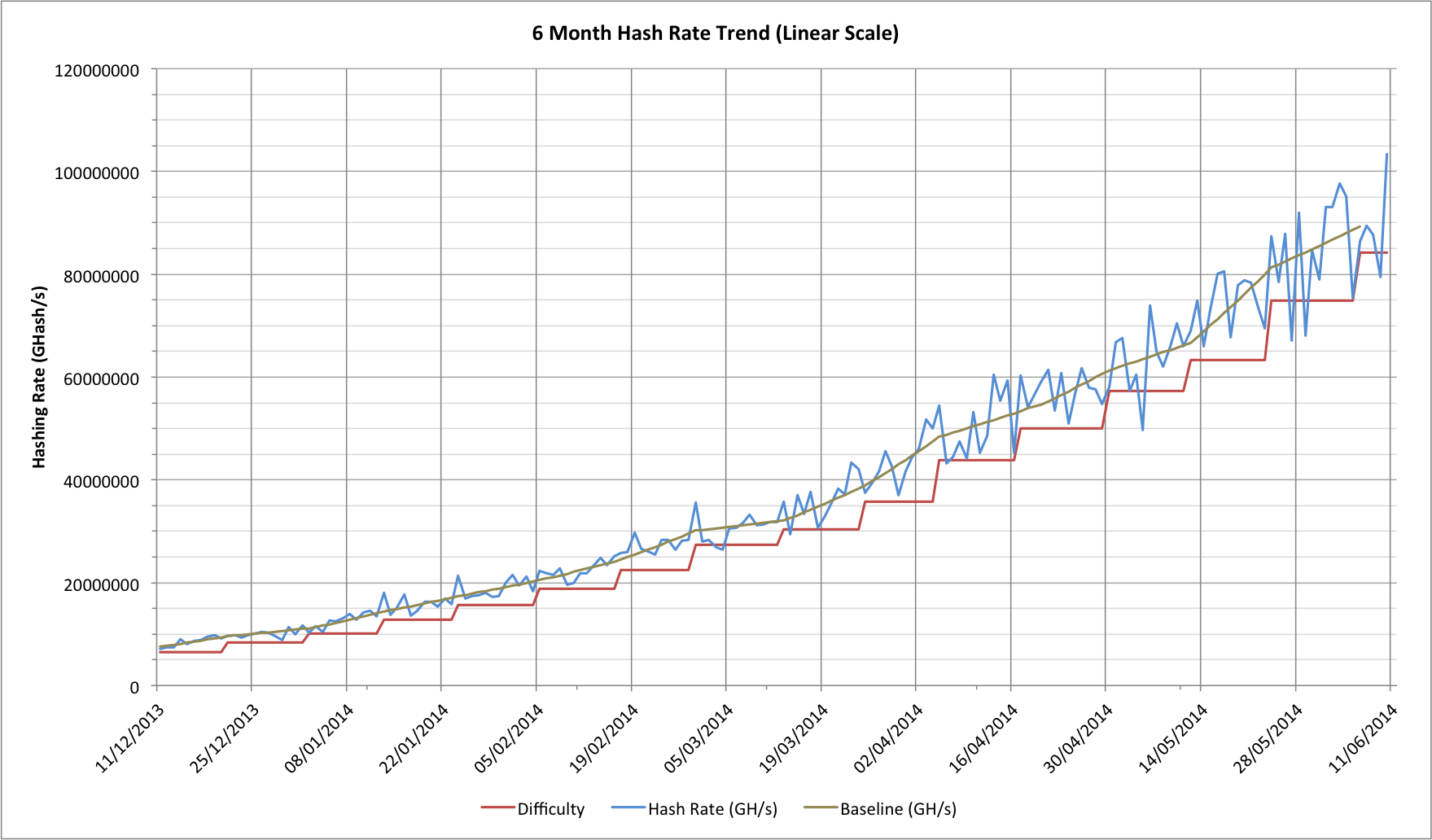
Bitcoin hash rate for the last 6 months (June 2014) on a linear scale
This chart shows the last 6 months of daily hash rates and the rising difficulty. It also shows a baseline trend line but we’ll look at that a little later.
Aside from that inexorable increase in difficulty and the cries of woe from miners watching it, the most striking characteristic is that way it’s getting progressively much more “spiky”! Look at how smooth it used to look? In fact this assessment is actually just plain wrong; if you were to look at 6 months of data starting 3 months earlier then that nice “smooth” part would end up looking just as bad as the most recent data. The problem is a question of scale; the variations in the hash rate become numerically larger as the overall hash rate increases.
When confronted with this sort of data, many statisticians switch to logarithmic graphs instead of linear ones because log charts show the magnitude differences rather than absolute differences. Here’s the same data on a log chart:
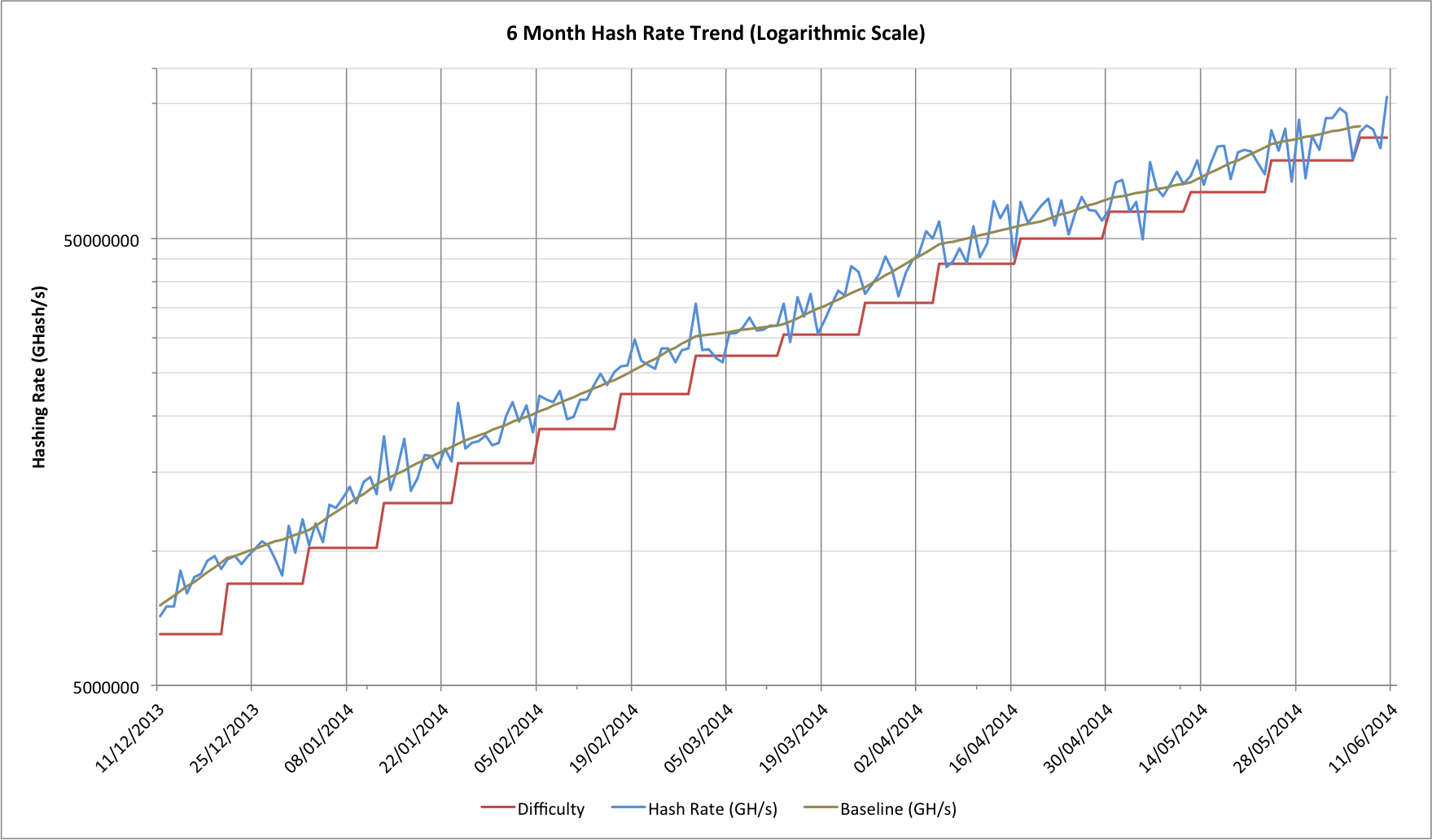
Bitcoin hash rate for the last 6 months (June 2014) on a logarithmic scale
Notice how the spikes in the blue hash rate look pretty much the same all the way across now? If you’re observant you might argue that the ones on the left are slightly less spiky, but that’s because the slope of the graph is steeper there. Even there though it’s clear that the statistical noise on a day-to-day basis is actually much larger than the overall trend. That overall trend shows that hashing rate, and thus the difficulty, increases are slowing down for now (and probably for the foreseeable future). The slowdown wasn’t evident on the linear scale graph and so we can see another advantage of logarithmic scale graphs.
Calculating a baseline
Most Bitcoin miners tend to think in terms of “difficulty” because it’s what determines the complexity of any mining. On both of the graphs we’ve just looked at, though, the difficulty is clearly lagging behind the hash rate. The problem is that it’s set retrospectively, and set at a level that would make the preceding 2016 blocks take exactly 14 days to find. This means that the difficulty lags around 5.5 to 7 days behind the actual hash rate even when it’s changed. If we want a real baseline to think about hash rates we need something more up-to-date.
In both of the charts we’ve just seen there is a baseline trace, and that trace represents “something more up-to-date”. The baseline is calculated by looking at the days where the difficulty changes and taking the square root of the ratio of a new to previous difficulty level and then multiplying it by the new difficulty. In-between these fixed points is an interpolation that assumes a steady percentage growth rate between them.
This particular baseline isn’t perfect because it has no way to account for statistical noise in the hashing rate (see “Hash rate headaches”) but it turns out to be a surprisingly effective estimate nonetheless.
Checking the baseline
Visually our baseline looks pretty reasonable. We know that even if the hash rate was constant the difficulty would change as a result of random noise (see “Reach for the ear defenders”). The question is what does our noise profile look like if we subtract out the baseline hash rate estimate? This should approximately follow Bitcoin’s Poisson process noise profile and should oscillate about zero. Here’s what it actually looks like for the last 12 months:
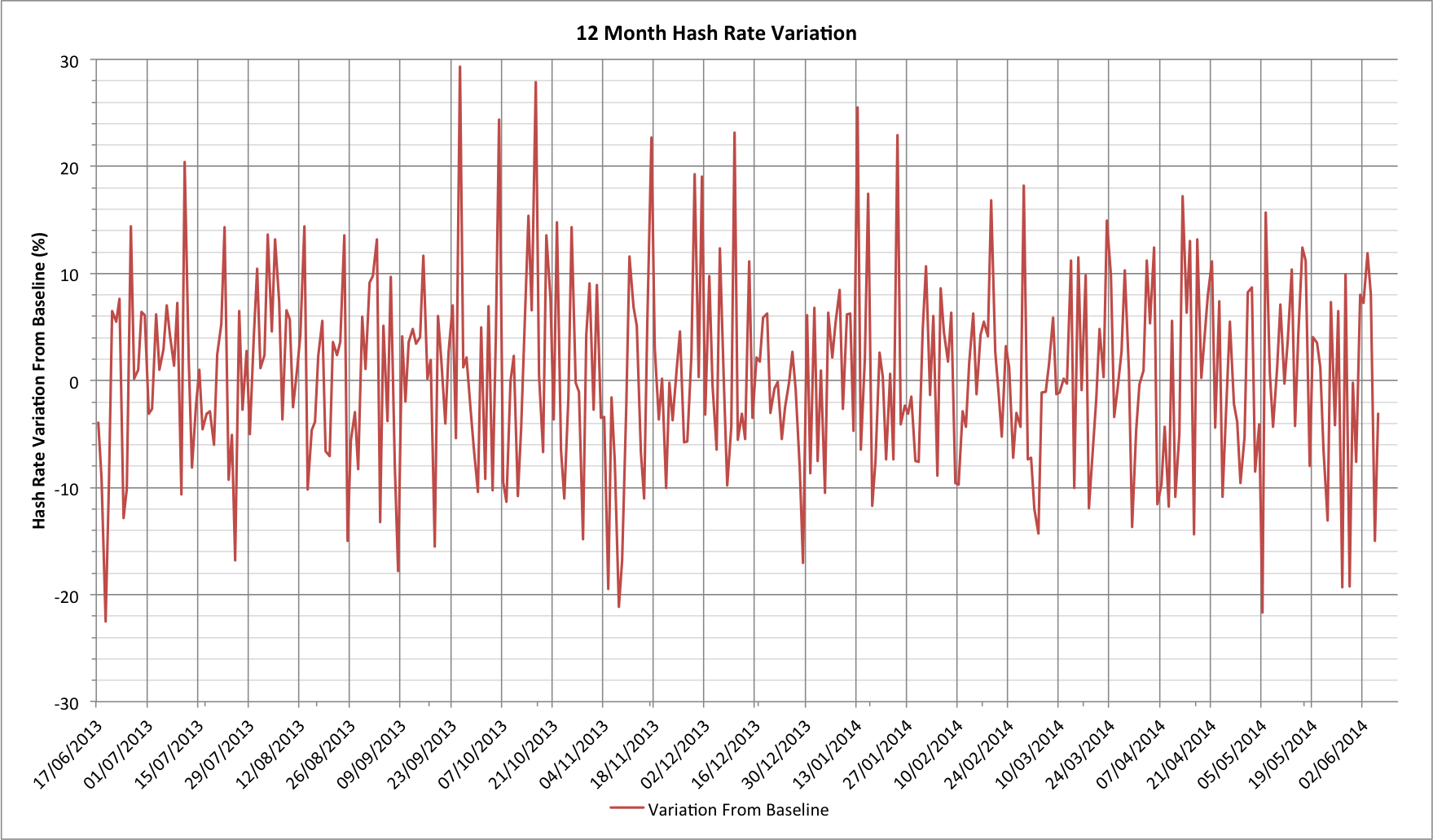
12 month Bitcoin hash rate variations (June 2014)
Comparing this with what simulations suggest for 24 hour variations this looks remarkably consistent. This pretty-much suggests that there has been very little if anything unusual happening over the last 12 months and that hashing capacity has been reasonably steadily added throughout. One final check though is to look at the probability histogram for the variations about our baseline:

12 month Bitcoin mining hash rate variation probability histogram (June 2014)
While it’s not perfect, it has just the sort of probability distribution we would expect to see.
What have we gained?
We started out trying to understand how key statistics were presented. We’ve seen how linear charts can be highly misleading. By devising a way to estimate the hash rate baseline, we’ve been able to go one step further and see just how much the day to day hash rate estimates will oscillate quite wildly. We can now be confident that even 20% swings from the estimate are surprisingly likely, and that day-to-day swings can be even larger!
The gods of statistics didn’t want us to worry about what happens in the course of hour or even a few days; those numbers, tantalizing as they may seem, are largely meaningless. They are the lies among the truth that only becomes apparent over a much longer timescale.
Finding 2016 blocks
By Dave Hudson
Posted June 16, 2014
2016 blocks is the magic number that corresponds to each change in difficulty within the Bitcoin network. Nominally it should take 14 days to find this many blocks, but how long does it really take?
The simple case
In an earlier article, “Hash rate headaches”, I looked at the probabilities of finding a particular number of blocks in a given time. This time around the goal is to work out how long it takes to find 2016 blocks.
To work out the behaviour I wrote a Monte-Carlo simulation that models the behaviour of mining during a 2016 block period. The simulation was run 10 million times in each run shown here in order to get good smoothing of the data.
Let’s start with the simple cases where the global hashing rate isn’t changing:

Time to find 2016 Bitcoin blocks with a 0% hash rate expansion
As we’d expect, the average time to find 2016 blocks is indeed 14 days. We can see the effects of the [object Object]in the hashing design though and how once every 10 difficulty changes we’d be likely to see the time at +/- half a day (i.e. 13.5 days or less, or 14.5 days or more).
Practical complexities
PreviouslyI’ve talked about how Bitcoin hashing is a Poisson process. @coinometrics pointed out on Twitter that things become more complex when the hashing rate is expanding because it then becomes a non-homogeneous (or inhomogeneous) Poisson process. Towards the end of the difficulty change we’re going to see blocks being found faster than at the start. The observation is, of course, quite correct and the simulations here now account for that. The assumption is that hashing capacity comes online at a steady exponentially expanding rate, so, say, the hashing capacity assumed at 5 days is larger than that at 4.9 days, irrespective of the number of blocks found.
Another complication is that the current difficulty level doesn’t really indicate the the actual hashing rate of the network even on the day it’s first set. In the article, “Lies, damned lies and Bitcoin difficultiesI showed that a more accurate starting measure was to multiple the new difficulty by the square root of the difficulty increase. The simulations account for this too.
Let’s see what happens when we have a 1% daily hashing rate expansion:

Time to find 2016 Bitcoin blocks with a 1% hash rate expansion
With a 1% daily expansion rate we now typically find our 2016 blocks after 12.37 days (a little under 12 days, 9 hours). It also equates to a difficulty increase of 13.1%.
Now let’s look at a 2% daily hashing rate increase:

Time to find 2016 Bitcoin blocks with a 2% hash rate expansion
With a 2% daily expansion rate we now typically find our 2016 blocks after 11.19 days (a little over 11 days, 4.5 hours). This equates to a difficulty increase of 24.8%.
It’s interesting to note that doubling the hashing rate expansion per day doesn’t correspond to doubling the next difficulty change because we get to the next change quicker and thus compensate faster too.
The numbers also have an interesting implication for the block reward halving dates though as the dates move closer all the time.
Putting it all together
Here’s a final chart. This shows the 3 earlier charts superimposed on each other:
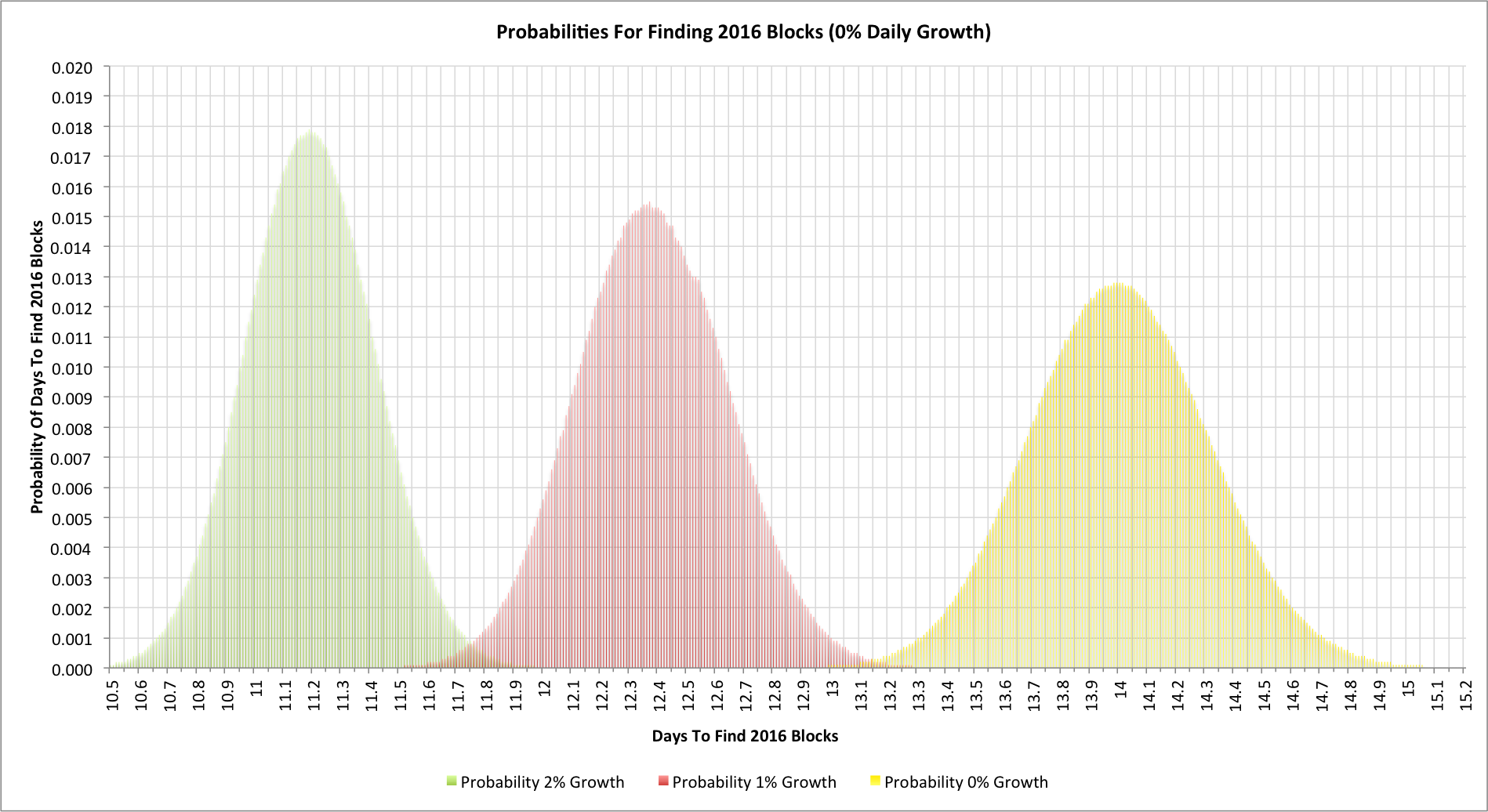
Time to find 2016 Bitcoin blocks with 0%, 1% and 2% hash rate expansions
It’s worth noticing the effect of noise again. The overlaps between the 2% and 1% expansion rate are pretty clear. When we see a difficulty change at 11.75 days are we really seeing the effect of 13.1% extra hashing capacity, 24.8%, or more likely somewhere inbetween? It could be even more divergent though!
Over the last few days there has been much discussion about the GHash.IO mining pool’s hashing rate. It clearly has a very substantial fraction but the error margins even across an entire 2016 block period are surprisingly large. As ever Bitcoin statistics often lead to more questions than answers!
51% of the network
By Dave Hudson
Posted June 23, 2014
Every so often a Bitcoin mining pool is reported to manage more than half of the Bitcoin hashing capacity, exposing the spectre of a so called “51% attack”. Ignoring the perceived threat though, can we really trust the statistics? We’ve seen, previously, that Bitcoin mining statistics aren’t quite as obvious as we might hope, so what do they look like in these cases?
A day in the life of a 50% mining pool
Let’s look at what happens when a Bitcoin mining pool has 50% of the actual global hash rate and see what the estimated statistics look like for 24 hours. We’ll start by considering what happens when there’s no expansion occurring in the network. Here’s what we find from a Monte Carlo simulation with 10M trials:
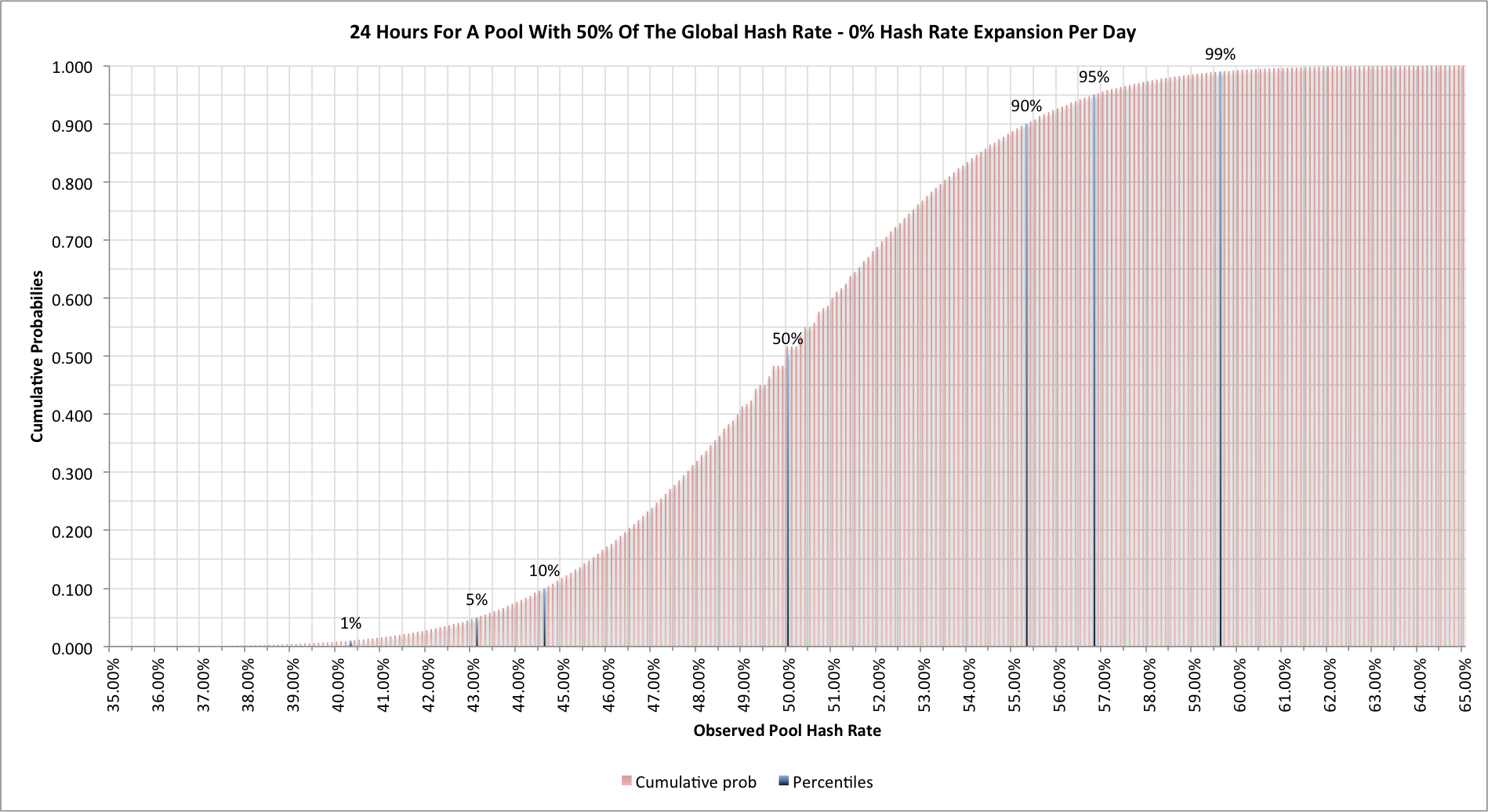
Observed hash rates for a mining pool with 50% of the Bitcoin network over 24 hours, assuming no network hash rate expansion
One curious thing is to note that around the 50% level we see the cumulative statistics actually become a little “blocky” but that’s because there turn out to be a limited number of values that can occur.
With 50% of the hashing capacity we do indeed see an average rate where 50% of the blocks are found by our mining pool, but one day in ten we’ll see the network hashing rate for the pool at 43.1% and less, or 56.8% or more. In practice if we’re not seeing more than 50% every other day then the pool we’re looking at probably doesn’t really have at least half of the network hash rate; an odd day above is really not as interesting.
Let’s see if it makes much difference if our network hash rate is expanding at 2% per day:
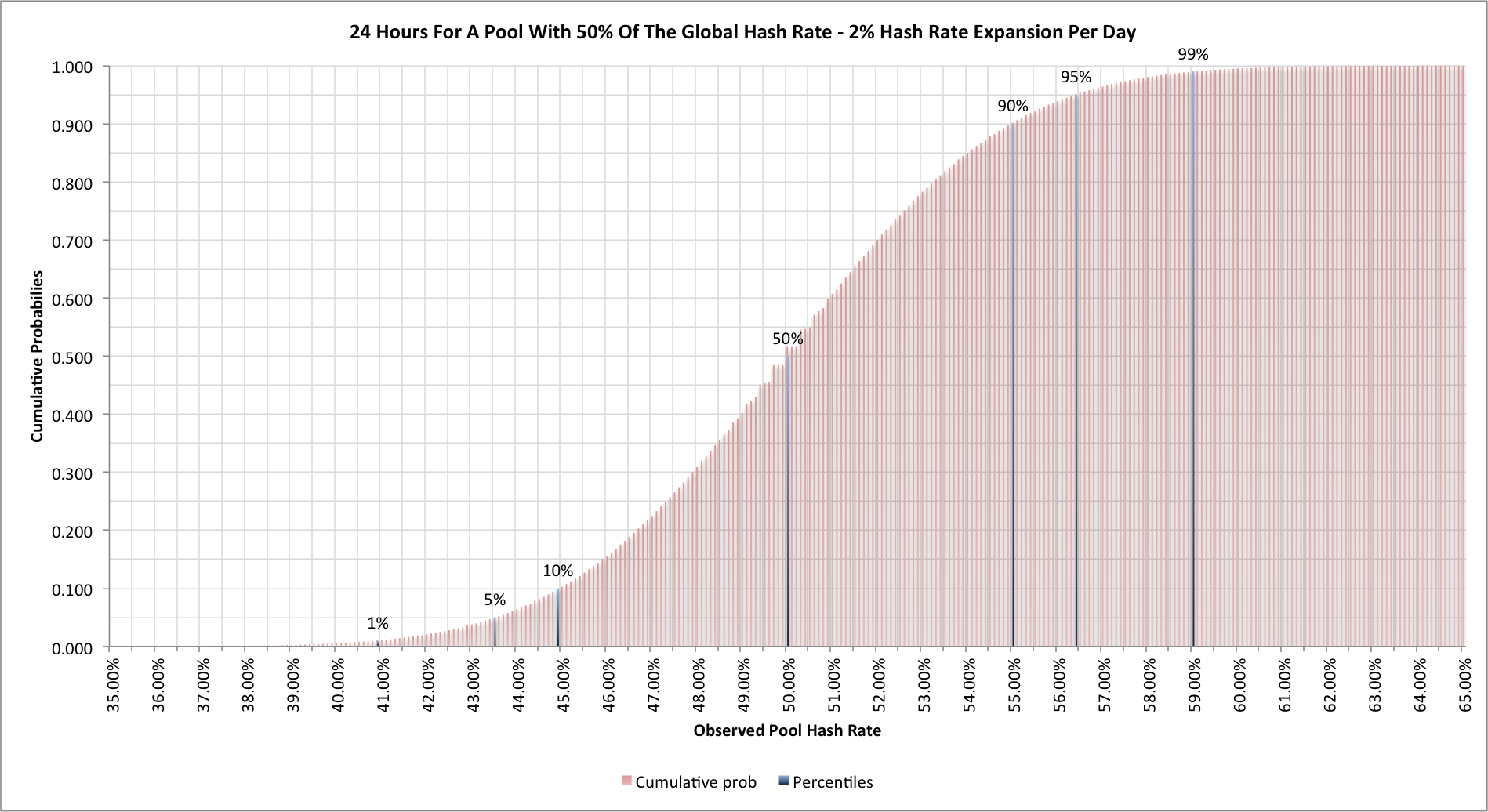
Observed hash rates for a mining pool with 50% of the Bitcoin network over 24 hours, assuming a 2% network hash rate expansion
The 2% per day hash rate expansion is pretty extreme, corresponding to a difficulty change of 24.8% on average, but this doesn’t actually make much difference. Our “once in ten days” metric now has ranges of 43.5% or less and 56.4% and greater.
50% for 2016 blocks
We’ve seen what happens on a daily basis, but what happens when we look at the 2016 block difficulty change? Here’s the simulation for the network when no expansion is occuring:
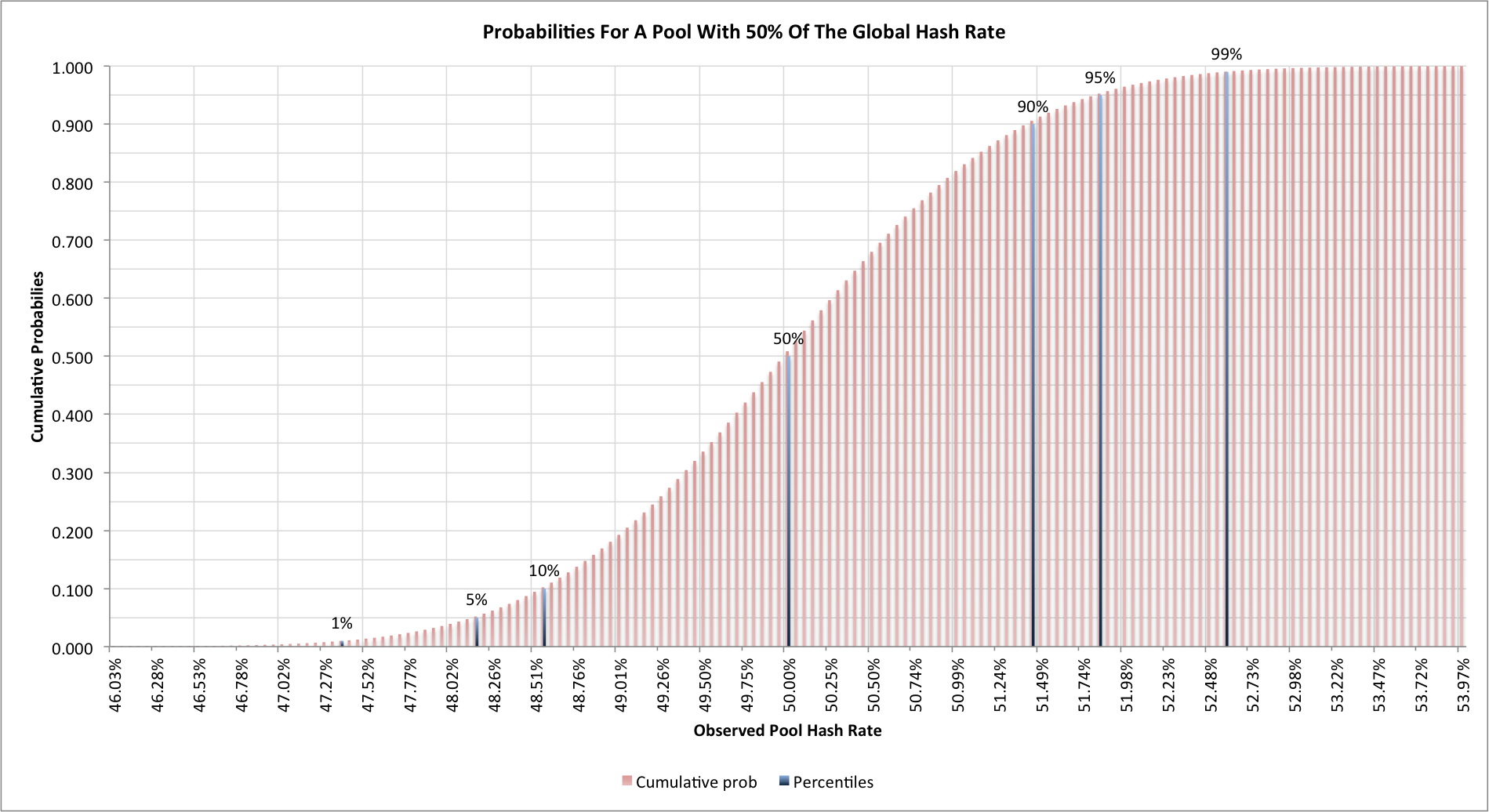
2016 Bitcoin blocks for a pool having 50% of the network and with no network expansion
Even over 2016 blocks (14 days on average) we can see quite a lot of variability in the measured hash rates. One difficulty change in five we’ll see a discrepancy in the estimated pool hash rate of more than +/- 1.4%.
Final thoughts
As with many of the Bitcoin statistics we’ve seen, things are rarely as clear-cut as they first appear. We really need to see more than 55%, and probably close to 60%, of the hash rate being assigned to a pool within any 24 hour period before that alone is sufficient to say that the pool has achieved 50% of the network hash rate.
None of this diminishes the potential risk associated with a single owner gaining a majority of the network hashing, but as we’ve seen before, we should be wary that daily statistics alone aren’t enough to show that this level has been reached.
Bitcoin and The History of Money
By BTCtheory
Posted June 23, 2014
To understand Bitcoin, we need to also understand the history of money. This is a long and complex topic that has changed dramatically over the last 400 years, and has a total history of more than 3000 years. In order to understand both money, and bitcoin, we need to understand that there are two distinct functions that money has, that are independent of each other, but both influences money’s value: the payment function of money, and its storage of value function.
Both of these features have important functions for money, but it is important to understand how each one of these affect money differently. I cover this in more detail in what is the intrinsic value of bitcoin, and bitcoin as commodity money.
The best way to think of it is that bitcoin is a threat to both common storage of value; such as precious metals like gold and silver, but it is also a threat to normal fiat money because of the bitcoin payment network. These two features of bitcoin create one type of money that is superior to both precious metals and fiat currencies. To understand why bitcoin works as money, we need to understand the history of money over the last century.
The History of Banking
To understand banking, we need to know what is a mode of exchange, how did it come about, and why it was needed in addition to a storage of value.
A mode of exchange is just that, a mode in which you can engage in the exchange of one good for another. Before modern money, this could be anything that was commonly exchanged, and the value was well understood by the general public. Throughout history, this has been everything including bushels of wheat, tobacco, land, etc. As long as both parties understood the value of what was being exchanged and chose to accept it, it could function as a mode of exchange.
As gold became the common standard for exchange during the mercantilism era, there became substantial risk in carrying large amounts of precious metals. Instead of carrying around a brick of gold, people could carry around notes that were redeemable at banks for the same amount of gold as the note. This is how banking has been practiced for most of its existence. It has only been in the last century that fiat paper money with no convertibility to a commodity has become the norm.
It is substantially important to understand that fiat money came about to represent an actual storage of value to make real payments. The only reason fiat money ever did come about is because it was a technological innovation that was fiat money. To be able to spend the value of gold, but carry it around in a lighter paper form what a huge technological development that fundamentally changed how exchange was preformed. This allowed for people to continue commerce in the same ways as before, but now with their wealth from the threat of theft.
Ironically, the creation of banking notes that can be redeemed for a storage of value also created the needed framework for the current system of fractional reserve banking that all states use today. This created a kind of banking system where banks no longer operated on how much money they have available, but they operate on only a fraction of the total they should have available. Banks use this system to cheat their profits by using the multiplier effect to multiply their profits–and their losses. These losses can become so substantial that it can destroy the entire banking system and economy. This is what happened during the Great Depression, and more recently during the 2008 meltdown.
The Bretton Woods Era
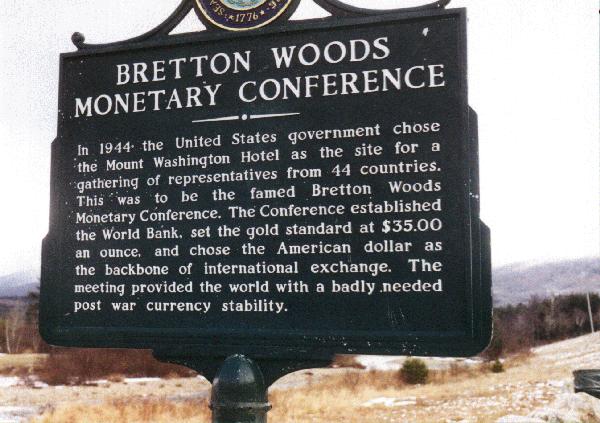
near the end of WWII, the allies came together in secret meeting in Bretton Woods to negotiate how the new global economy would be built. Keynes wanted an International Clearing Unionwhich would use a fair international banking currency based off of trade deficits called the Bancor. This became the official position of the UK when negotiating at the BW conference.
Keynes’ idea was rejected (despite its popularity), and instead the dollar was to replace the international currency unit, which today gives the U.S. a special power in international finance call exorbitant privilege. To do this, $35 was set as the redeemable price for one ounce of gold (almost twice what it was worth when it was seized from U.S. Citizens back in 1933), and what would become the IMF was setup. Keynes understood the huge issues this would create in international monetary system, and offered incredible insight to how this would play out 20 years later.
This system would have worked, if the U.S. was not cheating on their balance of payments. From 1945 to 1971 more and more U.S. dollars started circulating around the globe because the U.S. was importing more than they were exporting–creating a negative balance of payments. In fact, so many dollars were exported like this that the U.S. could not cover all of the outstanding gold that the dollars represented. The French were suspicious of this in the 1960s and started to repatriate their gold, which led to Nixon shock. In 1969, Nixon announced that the dollar was no longer convertible to gold, and created a 10% tariff to protect american industries from the shock of this. $35 was no longer worth an ounce of gold–it was worth nothing.
Nixon Shock
In order to make sure that the dollar did not enter into a death spiral of hyperinflation, Nixon as put in place tariffs, wage freezes, and a fixed exchange rate until he figured out what to do to give the dollar value. In 1973, Henry Kissinger struck a deal with the Saudi King. In exchange for arming and supporting the Saudis and their brutality domestically, they would agree to sell oil in only U.S. Dollars. This created the ‘petrodollar‘ which propped up the value of the dollar now that it was no longer exchangeable. So from 1973 on, the dollar was no longer worth gold, but oil.
**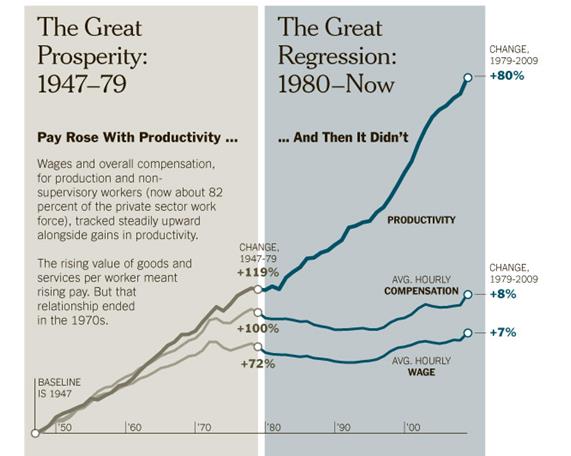
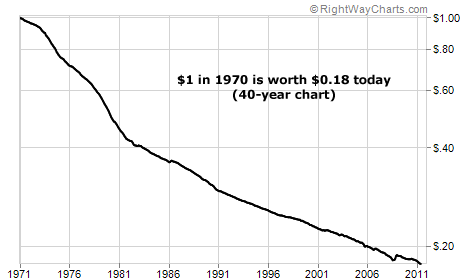
Nearly thirty years later we can see the evidence of how decoupling the dollar from gold has shattered faith in the global monetary system and the dollar. This had huge consequences for the purchasing power of the dollar and everyone who used it. Below is a chart of the purchasing power of the dollar since 1970–today the dollar of 1970 can only purchase $0.18 of goods today–it lost more than 4/5th of its purchasing power in just 45 years.
The Theft of The World
Now that money was no longer tied to the actual value of commodities and is free-floating, it became possible for the theft of the productive capacity of not just entire nations, but the world itself through the monopolization of money by state governments. Slowly over decades, inflation simply caused for the slipping purchasing power of not only the dollar, but all fiat currencies. This was done so slowly and deliberately that few could understand what Keynes had warned people of so many years before:
“Lenin is said to have declared that the best way to destroy the capitalist system was to debauch the currency. By a continuing process of inflation, governments can confiscate, secretly and unobserved, an important part of the wealth of their citizens. By this method they not only confiscate, but they confiscate arbitrarily; and, while the process impoverishes many, it actually enriches some. The sight of this arbitrary rearrangement of riches strikes not only at security, but at confidence in the equity of the existing distribution of wealth. Those to whom the system brings windfalls, beyond their deserts and even beyond their expectations or desires, become ‘profiteers,’ who are the object of the hatred of the bourgeoisie, whom the inflationism has impoverished, not less than of the proletariat. As the inflation proceeds and the real value of the currency fluctuates wildly from month to month, all permanent relations between debtors and creditors, which form the ultimate foundation of capitalism, become so utterly disordered as to be almost meaningless; and the process of wealth-getting degenerates into a gamble and a lottery. Lenin was certainly right. There is no subtler, no surer means of overturning the existing basis of society than to debauch the currency. The process engages all the hidden forces of economic law on the side of destruction, and does it in a manner which not one man in a million is able to diagnose.”
–JMK, The Economic Consequences of the Peace (1919)


Today the inflation that we face is not due to new gold being introduced to the fractional-reserve banking system, but from the value of the dollar simply decreasing. Today there are more dollars in the world today than yesterday due to quantitative easing (i.e. making more dollars). The decrease in the purchasing power of the dollar is a direct loss to you and everyone using the dollar; and a direct gain for the government and banks who benefit from the creation of new dollars. We have been told that these are good men, and that they will use monetary policy to create price stability and keeping unemployment low, but the facts show something much different and much more insidious.
Failure of Gold as a Storage of Wealth
Gold has been used as a storage of wealth for millennia because of the total fungible nature of gold. However, what happened from the start of the 20th century, to the end of WWII, was a consolidation of gold in the hands of the State through legal confiscation and violence. By 1973, almost all gold was in the hands of the state through force and theft.
This was done in two distinct ways. There was state-to-state confiscation of gold and precious metals, such as the reparations from WWI and imperialism. This concentrated gold in the global north in the hands of a small number of elite bankers and business magnates. The other way was through the war that governments carried out against the private wealth of their own citizens.
This can be seen throughout the world with the restrictive legislation from states around the globe; such asExecutive Order 6102, The AustralianBanking Act 1959,and the IndianGold (Control) Act 1968.Instead of protecting citizens from the tyranny of wealth seizures, holding gold actually made people a target for the state. Through this violent seizure of wealth, governments essentially gained an oligopoly on gold. This allowed for governments and their allies in banking to manipulate the price of gold through holding or dumping; but more importunately, they have rendered gold meaningless as a source of payment and storage of value. Today, almost no one will take your gold or silver as payment, despite the fact it truly is worth more than paper money.
**The Need for Protection From The State
It should be obvious that the greatest threat to ones personal wealth is not some foreign or personal aggressor, but the State itself. This puts us in a predicament because the State is the owner of the means of exchange, and the arbitrator of all legality. Through controlling the means of exchange, the State can manipulate the value of the dollar on a large scale for its own benefit (such as quantitative easing or unlimited funding for war), while also being the gatekeeper of the finance system. The greatest issue with this is that even if you find a suitable alternative means of exchange (like bitcoin), the state can still call it illegal, and bring violence to you and your family for not complying.
If one is to control a large portion of wealth, it can only be done with the explicit approval of the State. At any time they can choose to seized you wealth, and you can go to prison. The accumulation of large amounts of wealth becomes impossible without the approval of the State in modern society. If the State does not approve of it, they will call it ‘money laundering’ and treat you as a criminal. This means that it is impossible for someone to be against the state, while still being able to control their wealth. This helps explain why the state is so active in financial oppression against its own citizens, while allowing for out right crimes to be preformed by some of the largest banks in the world, and letting police execute its citizens.
This explicitly displays that the State has the power to stop these criminals today, and yet they choose not to do so. This is because the government is in bed with these organizations. Politicians receive ‘donations‘ from these companies and former CEOs are given elite, secure jobs from the government later down the line in exchange for this. These companies have bought laws and protection for themselves at the direct expense of other citizens through the corruption of the legal, and political system. It should be clear and obvious for all to see: we cannot recover this system of government, economics, and finance, and we must reject the system as a whole.
Now that we have bitcoin, we can actual do that. Once we reject the money of the State, and their crony capitalist bankers, the value of their fiat money will collapse. The State will no longer be able to pay for their wars, bloated salaries, or mechanisms of fear and terrorism. There will be a great unwinding and no one will accept their shitty paper money anymore.
Conclusion

The State over the course of the last hundred years has pulled off one of the greatest stunts ever: getting people to believe that paper is worth more than real commodities. Through the slow theft of gold for paper, people have been robbed of their ability to have independent wealth. Wealth today can only be acquired at the good will of the State because the State monopolizes the legal authority for how you can get money. The State, and their banker allies siphon off as much value as they can from the productive capacity of normal, hard-working people through devaluing fiat money through quantitative easing and interest.
From the end of gold standard in 1933, to all of the usurpation that brought us to where we are today, it should be clear that governments cannot be trusted with our wealth. Bitcoin and digital currencies offers people a chance to have a financial system that does not empower the State, or elite banks, but protection us from them.
Bitcoin is a global payment system, and storage of wealth that allows for a new system of finance and economics to be built. One based upon the principals of mathematics, privacy, and provability. A new system where we are not punished for saving and protecting our wealth, but rewarded. A system that understands, respects, and protects people’s right to privacy, and their right to conduct commerce with anyone in the world, no matter what State has their bootheel on their back, demanding a portion of their wealth.
Change is coming, and it will be radical, and it will change the world for the better.
—
Next: The Absolute Value of Crypto
Bitcoin’s Rugged Individualism
By Daniel Krawisz
Posted June 29, 2014
Bitcoin and the Agency Problem
Whereas for earlier moneys, it was generally the case that most people could expect to be better off storing the bulk of their money with agents, for Bitcoin the opposite is true. The Bitcoin network obviates traditional financial institutions and there are really only two agents that Bitcoin users need: exchanges and payment processors. The exchanges are temporary; they are only required because fiat currencies require them. Once the fiat currencies have died, centralized currency exchanges will no longer be required. As for payment processors, they are only required over time scales of about an hour or less to ensure that a transaction gets into the block chain. With Bitcoin there is no need for anything like a bank that would store bitcoins over a long term.
Being nearly superfluous is not the only problem with Bitcoin agents. To whomsoever a private key to a Bitcoin address is known, the bitcoins it holds are far easier to control than dollars or gold are under almost any circumstance. This is because controling bitcoins is simply a matter of keeping a number secret and requires neither securing physical matter (as with gold) or the permission of issuers (as with dollars). Thus there is a fundamental agency problem with Bitcoin. Agents can disappear or simulate a heist upon themselves. They cannot rationally be trusted without extreme costs being imposed on them which are more stringent than traditional banks. Furthermore, agents must advertise their services and consequently become the targets of hackers. They must take extreme measures to achieve a level of security similar to that which an individual person achieves with much less.
The inherent agency problem in Bitcoin is borne out by Bitcoin’s extraordinary history of hacks and thefts. Bitcoin institutions seem to be worse than the banks that Bitcoin replaces. As Bitcoin proponents must point out repeatedly to naysayers, people lose bitcoins not by an inherent flaw in the protocol, but by misuse. They stored them with Mt. Gox, Atlantis Market, or one of many other companies that imploded or disappeared. Bitcoin has had a problem with amateurish entrepreneurs, but I expect that we will see continued failures even when established institutions attempt to use Bitcoin.
Despite this, there are still a lot of Bitcoin agents. The practice of storing bitcoins in web wallets, like those provided by CoinBase and Circle, abounds. People are still used to dealing with banks as a necessary evil and are not yet comfortable with the skills required to safeguard a private key. This is a problem because it means Bitcoin adoption requires a real change in peoples’ habits. Everything that helps people to learn new habits is greatly appreciated.
The only solutions to the agency problem are either to remove agents or to remove their agency. In other words, people must either take control of their own bitcoins or, if they do not wish to, they must cede control of their bitcoins in a way that does not give control to an agent. The only way to do this is to spread the control over many different parties who are not expected to collude. This could be done with multisig wallets or Open Transaction voting pools. This is a fairly drastic solution because it means no one can do anything with the bitcoins on his agency alone.
Bitcoin Institutions
The agency problem becomes especially interesting when it comes to Bitcoin organizations because an organization has no autonomy of its own and all its members act as agents to it. All, whether employees or owners, have a similar incentive and ability to steal that other Bitcoin agents have. This is not a new problem, but Bitcoin gives it a new character.
An organization inherently cannot take control of its own bitcoins, so its only solution is to remove the agency of its own employees and owners. It is not enough for an organization to distribute keys between its own people, although that will help. However, it is much easier for people within an organization to collude than without, and furthermore within an organization people will tend to have similar characters so the probabilities that each is a bad actor are not independent of one another. Votes must come from different organizations on order to maximize the security of the wallet.
Criminal Organizations
Whereas individuals can do whatever they want with their bitcoins, organizations must seek outside approval. They must subject themselves to constant auditing in order to deserve any measure of trust. It has long been understood that Bitcoin gives more control to individuals, but the complement to that is not yet well enough understood. I believe history has shown it to be an important effect, but it is not yet clear how important it will be. Maybe people will be able to work around it or maybe they will have to replace most organizations with distributed systems.
Of course, the requirement of being constantly audited and losing control over the funds it holds is less of a problem for honest organizations. It is much worse for criminal organizations or for organizations that want to keep their internal operations secret. Mafias, cults, and governments will have a greater difficulty adapting to Bitcoin than will publicly-traded companies.
All organizations tend to evolve so as to resist change, but governments, being subject to the problems of socialism, suffer much worse from this because government operations lack a clear concept of efficiency their overall success, the relative importance of any of its parts, or the relative merits of alternative organizational structuring. Consequently, governments can more easily evolve into labyrinthian structures that nobody understands without anyone realizing what is happening.
An eye-opening article called Sinkhole of Bureaucracy describes a surreal example of this phenomenon in an outstandingly incisive way. In an abandoned Pennsylvania mine, which is now an office containing 600 federal employees and endless filing cabinets, process all the federal retirement pensions on paper by hand. The system is widely understood to be insane and dysfunctional, but despite repeated and ceaseless attempts to automate the process beginning in the early 80’s, the system has not changed. It is not a problem of will, but of knowledge: there is no one available with the skills to carry through the transition successfully, no one who knows precisely what those skills would be, and no one who can evaluate anyone else for them. As a result, the attempts to develop an automated process failed because the software engineers did not understand the laws and the bureaucracy well enough to design something correctly, and the bureaucrats did not know how to tell if the software engineers knew what they were doing.
Will the federal government be able to adapt to Bitcoin? This would require building an a system not just for the one department, but for the entire organization, and it would have to be built properly—it must distribute decisions enough so that bitcoins cannot be stolen easily by employees. After reading that article, I think it is reasonable to think that the government may not be up to such a task at all.
Bitcoin’s Shroud of Subtlety and Allure
By Daniel Krawisz
Posted June 29, 2014
Attacks on Bitcoin
A successful attack on Bitcoin means attacking Bitcoin’s value. There might well be a bug that could be exploited to put the network out of commission temporarily, but would soon be fixed and then the network would be up and running shortly thereafter. To destroy Bitcoin permanently means to end the profit opportunities available with it, and that means either a malicious hashing attack on the network that makes mining impossible or such a malevolent policy against Bitcoin trade that even the black market abandons it. Both of these require spending resources in proportion to the profits that Bitcoin enables.
In this article, I will discuss three reasons why such an attack is unlikely to succeed: antifragility, subtlety, and attacker defection. The interplay of these three defenses makes Bitcoin into a kind of wave that rewards those who ride it and drowns those who resist it.
The first of these, antifragility, is exemplified in the fact that malicious hashing is impossible up to a certain fraction of the network. Below the point that selfish mining becomes possible[1] additional hashes per second are almost certainly beneficial because they increase the security of the network. Any potential attacker, therefore, must weigh in the possibility that he may end up benefiting the network instead of destroying it. A similar risk accompanies a legal attack on Bitcoin. Bitcoin can adapt to half-hearted attacks. It would move deeper into the black market where it would become permanently strengthened. Furthermore, a legal attack could be easily corrupted into one that brings as many bitcoins as possible to the government agents instead of one that destroys it (see below).
Bitcoin’s Subtlety
Bitcoin adoption happens one person at a time, and this is true for potential attackers as well as the rest of us. It takes an entrepreneurial mindset to be able to imagine what Bitcoin could become, given how comparatively small it is now. It takes time and meditation for people to take Bitcoin seriously because most of its value is in the future. By the time this happens, Bitcoin has become much more expensive than when they first learned of it.
Thus, Bitcoin is protected from attackers by being initially beyond their understanding. When Bitcoin was very small, it was very stealthy and was completely unknown to the establishment. Now they laugh at it, just as it has begun to grow bold. Of course, we don’t know who really dismisses it and who is deliberately trying to draw attention away from it.
Bitcoin’s Allure
Furthermore, potential attackers are at a disadvantage for another reason. Bitcoin tends to oppose organizations rather than people. Even someone who stands to lose from Bitcoin by not reacting to it, such as a banker or government agent, stands to gain a great deal by buying now. Only the very wealthiest people might reasonably expect to be worse off attempting to buy up as much as possible now than if it were gone. (This could happen if their attempt to buy caused the price to rise too fast relative to their ability to acquire additional bitcoins, to the point that they ultimately had less influence over the future Bitcoin economy than they have over the economy of today.) Thus, the agency problem with Bitcoin affects bitcoin competitors as well as Bitcoin holders.
Nearly any government agent who begins to see bitcoin as a potential threat must also simultaneously see it as an opportunity. He, too, can invest in Bitcoin. And why shouldn’t he? Bitcoin may be a threat to his livelihood, but it may well be making him an offer he can’t refuse. How can an organization that stands to lose by the adoption of Bitcoin provide its members with a better opportunity for staying loyal than Bitcoin provides for defection?
Even those who might resist the temptation to defect would have to think about the defection of his fellows. How quickly is adoption happening? Is there time to mount an attack before Bitcoin becomes too powerful? How easily could the resources for such an attack be amassed, given both the ignorance and treachery of the other agents. If such an attack would be unlikely to succeed, then buying now would be the only intelligent action. Regardless of whether he liked Bitcoin, it would be futile to continue pursuing a doomed cause.
Potential Bitcoin attackers are in a Prisoner’s Dilemma. In the same way that the people cannot easily rebel against the king owing to a lack of coordination on their part, governments cannot rebel against Bitcoin for the same reason. The government puts the people in a Prisoner’s Dilemma against one another, and Bitcoin does the same to government agents.
Bitcoin is like Invasion of the Body Snatchers. Bitcoin attracts inside men to act as covert saboteurs. There have long been predictions from both bitcoiners and naysayers of impending government attacks, but I think there is a possibility that Bitcoin could win without suffering much resistance. Moreover, although I said above only that any legal bitcoin attack could be perverted, the considerations discussed in this section tend to make such diffusion very likely.
Bitcoin defends itself by being obscure, but once it has attracted someone’s attention, its best interest is for that person to understand the logic presented here. For then he will also understand that his best course is to deny Bitcoin’s threat to his superiors and quietly to become its willing slave.
- Right now Bitcoin Core does not follow the proper strategy to protect against selfish mining even at very low hashing rates, but the fix would be extremely easy to implement and would make selfish mining impossible up to 25% of the hash rate. ↩︎
The Bitcoin Future: Super Cell London
By Beautyon
Posted June 30, 2014
In the near future, London will be a super prosperous free zone where all services are provided voluntarily and paid for with Bitcoin.
Whilst roving around a major city in the UK, I was overwhelmed by the filth, the poverty, the distorted faces, the ground-in misery, the decay and the hopelessness in evidence whichever way you cared to look.

Contrast this with the shining, enthusiastic, clean, efficient, free, beautiful, soaked with hope and promise Internet, where everything is possible, if you can write software or operate a mouse.
Buying things in the streets is a disgusting experience. Not only are people ugly and rude, but the streets themselves are incredibly filthy, with layers of ground in grime from the feet and garbage of millions of residents who leave every type of food and waste behind them like upright slugs trailing dirty slime behind them.
You may be lucky enough to need something from a shop that is clean and neat, and it may even have staff that can speak in a polite manner. When you enter, if you are really lucky, it could even have air conditioning. Even if that is the case, after you have done your business, for which you are robbed of an extra 20% on top of the price you pay for no good reason, you have to return to the pig-filthy streets to get anywhere, and you had to arrive by those same foul streets to get there in the first place, and when you leave, you are burdened with packages.
Contrast this with shopping on the Internet. You click through some beautifully laid out pages, compare and contrast prices from different ‘stores’, read the voluntarily donated opinions of other decent, literate people who are honest and who have your best interests at heart, and then, when you make your decision, you click a button to find that the next day your shoes arrive.
Even then, if you do not like your new shoes, you can return them and get your money back, no questions asked.
The online world is much better than the ‘real world’. It is travelling without moving. It is connecting without effort. It presents a face to you that goes out of its way not to offend you. It is intelligent, cultured, educated, funny, humble, gentle, easy to get on with, inoffensive, useful and entirely beneficial.

What happens when you try and connect these two worlds, to try and bring the benefits of the online world to the ‘real world’? When you try and bridge the gap between the real world and the world that is online, you immediately come up against all the repulsive, ignorant, downtrodden, negative, broken people of ‘society’ and their diseased thinking. Men who have given up on life, or that have never tasted how sweet it can be, or who want to destroy anything that smells of that sweetness.
You come up against a culture where nothing can work, it is expected that nothing should work, where anything new is bad, or a bad risk, or not interesting. You come up against small mindedness, closed mindedness; a disinterest in new things, dull resignation and evil. You come across people whose eyes glaze over when you use words that have more than two syllables, people who have tattoos on their arms of the faces of men they cannot identify.
You hit a brick wall of people who are made of stupid.
You come up against broken people.
As the men who make the world run continue to move everything online, and express everything in software, we will see a very distinct split between those who understand the potential of life and the tools we have to hand, and those who cannot see this potential.
By virtue of their perceptions of what life is and how it can be, the enthusiastic, the productive, the imaginative and the engineers who can write software will essentially inhabit a different culture and live a completely separate life from everyone else, the latter being reduced to a population that exist only to be potential customers, ruthlessly subjected to calculation, so that they can fit inside the business models of The Developers.
Let me make this perfectly clear; there is nothing wrong or immoral about this. Business and the free market are the only way that prosperity can be spread to the maximum number of humans without any ethical violations. My concern, as a man who can empathise with the plight of others, is that there is a huge mass of mankind, inside a country that is ‘civilised’ who are living in a psychological state that can only be described as sub-human in character.
I grieve for these people. I mourn the loss of their thoughts, their vibrance, their input and experience, the loss of colour that is absent from their life. Not everyone can be a millionaire, or a genius, or a world changer, and this is not what I am talking about at all. I am merely talking about simple happiness, sweetness of life, joy, hope, peace of mind, serenity, the ability to think and share these things. What these subjects have instead of these goods is fatigue, worry, bitterness, sadness, and an abundance of fear.
All of these bad elements are the stuff of the syrup that these unfortunates live in and wade through up to the neck every day, and because you cannot reach them, they are doomed to be turned into homo-units, along with their children, grunting screeching and grumbling their way into a vile future of ugliness.
This is what I am talking about when I say that the Internet is starving the streets. All the positive, intelligent, humans are abandoning the ugly streets for the safety of their own homes, some restaurants, perfectly manicured and managed shops like Wholefoods, places like Westfield and so on.
They are using the Internet to connect with each other, to buy from each other, and to completely bypass the ugly streets.
Eventually, the true humans who want to live in ‘real life’, in the room with the blue ceiling as they do on the Internet, will wall themselves off from the ugliness of the world, into giant gated communities, where ugliness is simply not permitted. Think of it as a new form of gentrification without the nasty brainwashing implanted connotations. At the beginning of this process the sectioned off areas will be small in size and number. They will grow in both parameters as the manifest advantages they offer become apparent.
The number of these islands of cleanliness and optimism, once separated by bad areas, will suck in all the connected men, causing them to grow until they touch each other. You would then have a ‘Supercell of Clean’, with a distinct osmotic border separating the inside from the out.
And this is how the breakthrough will happen; in a place where all the enlightened decide to live in a contiguous free space, who decide to contract with each other in a completely voluntarist manner, the end of the State can be brought about by a gentle transition.
Everything in that supercell would be privately owned, including all the streets. It would in effect, become a natural society.
The police stations would be privately run and financed… you know the story, (and if you do not, watch that lecture and then read this); essentially, the State would be completely excluded from operating in this area.
It would go something like this…
After a massive, historic and unprecedented influx of money and brains, due entirely to the Bitcoin revolution and the collapse of the Dollar and all fiat currency, London became the most wealthy city in the entire world. A 21st Century, “Venice of the Bitcoin Age”.
The suffering of populations living in the other cities of the earth, being chaffed and crushed under the oppressive yokes of their respective States, the universality of the English language and other factors, caused the extraordinary mass migration of capital and human beings.
The demand for services and space caused the prosperous and safe areas of the city to expand rapidly, until there were no more ‘no go’ areas, ghettos, black spots, depressed areas or parts of the city suffering from economic suppression.
It happened almost overnight; like a sudden change in the weather. There was a change in atmosphere, a change in attitude. There was no one left in London who considered that the State mattered any more.
Londoners had for themselves, a clean, efficient, private, happy, free and peaceful city. Everything was done on a voluntary basis. The streets were immaculately clean. The traffic flowed without the sclerotic and unnatural systems of control imposed by the now defunct State.
There were no arbitrary fees collected by ‘Town Councils’ that previously squeezed out small businesses. The oppressive surveillance grid was dismantled. The number of restaurants, coffee shops and all manner of food providers exploded, as there was no longer a state to arbitrarily license, extort and restrict their growth and operation.
Anyone could rent a space, put in a Gaggia and start their own Café, and live on its takings, even if they were meagre, because the owners kept all of the money they collected and did not have to service the State with any of it.
These owners could, for example, live inside their Café, as well as serve food from it; the absurd and distorting ‘zoning’, ‘planning permission’, ‘use classes’ and ‘building regulations’ having been consigned to the dustbin. This meant a massive change in the patterns of how residents lived in the city. The dynamics of renting changed utterly. There was greater availability and dramatically lower rents.
You could eat cheaply. In fact, you can do everything more cheaply in Super Cell London. First of all, everything in “SCL” is 70% cheaper than it is everywhere else, because there is no ‘Value Added Tax’ to pay on anything, and all stealth taxes do not exist. All transactions are _two party; t_he State is not a third party in any financial transaction. These are the effects of the elimination of all the taxes, duties, and thefts of the State.
Oh yes, no one in SCL uses government money. They have their own money, created by private business to serve the needs of all Londoners and the world at large, connected throughout the Internet. (N.B. Does this sound familiar? Bitcoin! this essay was written August 24th, 2011)
Contrary to what the peddlers in negativity, the inhuman Statists and the power drunk socialists predicted, as the nature of this transformation became evident, SCL did not become an armed camp or an unwelcoming, CCTV festooned fortress. The only thing that changed was that the population was happier. They had more money. They had less stress. They were secure in their persons and their papers. They were living like human beings, and not caged animals. This was despite the fact that the population of London had increased dramatically. It was found that without the State distorting everyone’s behaviour, the capacity of London was far greater than anyone had previously imagined.
The abundance of money in the city spontaneously gave birth to the most unprecedented and efficient systems of charity ever created. They were mediated by software. The waste level ran at near zero levels. No one went without dentistry, medicine, emergency care or any of the needs that families have when they fall upon misfortune. Londoners fell over themselves to help others, because they knew that there was no one else there to help the needy but them.
Super Cell London became the envy of the world. It was widely hated. After all, a single city had managed to sequester almost all of the best entrepreneurs and families of the rest of the world’s capitals for itself. These exsanguinated States, when they realised what was happening, initiated capital flow controls and exit visas for all the citizens who were unfortunate enough to be caught in those places and who did not escape in time from those unnatural societies.
In foreign cities where copycat Super Cells were first attempted, there were not enough citizens left to peacefully push out the State. There was retaliation through legislation and violence of course, from the State and its legion of rapacious clients, cronies and parasites, and this further destroyed the economies of those unnatural societies. Eventually they came round, because there was no one left to finance their insane and violent way of life.
Super Cell London, being very much like a biological, living entity, continued to grow, spreading its seeds all over the country. The idea and example of SCL was enough to cause what happened next to happen.
It was only a few years later that a tipping point was reached and the prosperity and liberty of London spilled out, spreading geometrically over all the land. The old State actors, parasites and violent types were not purged or pushed into the sea (a fate that they deserved); they were instead, _absorbed _into the natural society. Their skills were put to non violent, non coercive uses, and they prospered.
The Transformation could not have been more profound or exhilarating. As people had their minds finally unshackled from the disease of Statism, a flowering of a character and on a scale that is difficult to comprehend in 2011 took place, that turned Britain into the engine that saved the entire world.
The State, as an idea was finally dead.
All over the world, like a beneficial plague of light, the State was completely abandoned. The resulting free flow of money, manpower and resources caused a chain reaction of prosperity that wiped away a century of waste in a few short years.
In a house somewhere in a very quiet place in rural England, a young man studies history with his cat for company. He shakes his head in complete disbelief at passages in his book that give an accurate historical account of how men lived, what they thought, and what they tolerated in the first decade of the 21st century.
So shocking, counter-intuitive, bizarre and disgusting are the words he is reading, he suddenly says out loud, “This _cannot _be true!”
It _was _true, but it was not true any more. Lucky him!
Make The Transformation happen by buying me croissant and espresso. ⤵

The gambler’s guide to Bitcoin mining
By Dave Hudson
Posted June 30, 2014
What’s the best way to get a return when we mine Bitcoins? Should we mine on our own, mine with a small pool or mine with a large pool? How much difference does it really make?
Whether we want to be a gambler or an investor is really a question of how much risk we’re prepared to take, but what are those risks and what are the odds of success?
Starting thoughts
Before we can look at the odds of getting a particular return we need to establish a few starting conditions. Let’s assume that we’re planning to mine using hardware that, at the outset of our mining, is able to hash at 0.01% of the total global hash rate. If we have 120 PH/s of hashing then that means that we have 12 TH/s of hashing hardware, but if that global rate was 600 PH/s then we’d need 60 TH/s. The actual numbers don’t matter though, just the percentages.
We’re going to assume that the network is expanding at 1% per day. For most of 2014 it has been above this but the trend is generally downwards and we need to assume something. At 1% per day then over 6 months (approximately 183 days) we’d see the global hash rate increase by a factor of 6.177 by the end, so our 0.01% of the network is only 0.0016188% after the 6 months. We’re not expecting to add new capacity as we go though, so we only have the hardware that we start with.
Bitcoin mining is highly erratic (see “Hash rate headaches”) so it’s not easy to calculate how our mining will progress so instead I built a Monte Carlo simulator. The results presented here all come from that simulation with 10M simulations of each scenario to ensure that the data is well smoothed.
Solo mining
Let’s start with the simplest case. We’re going to assume that we’ll use all of our hashing capacity to mine for blocks on our own. What might we expect?
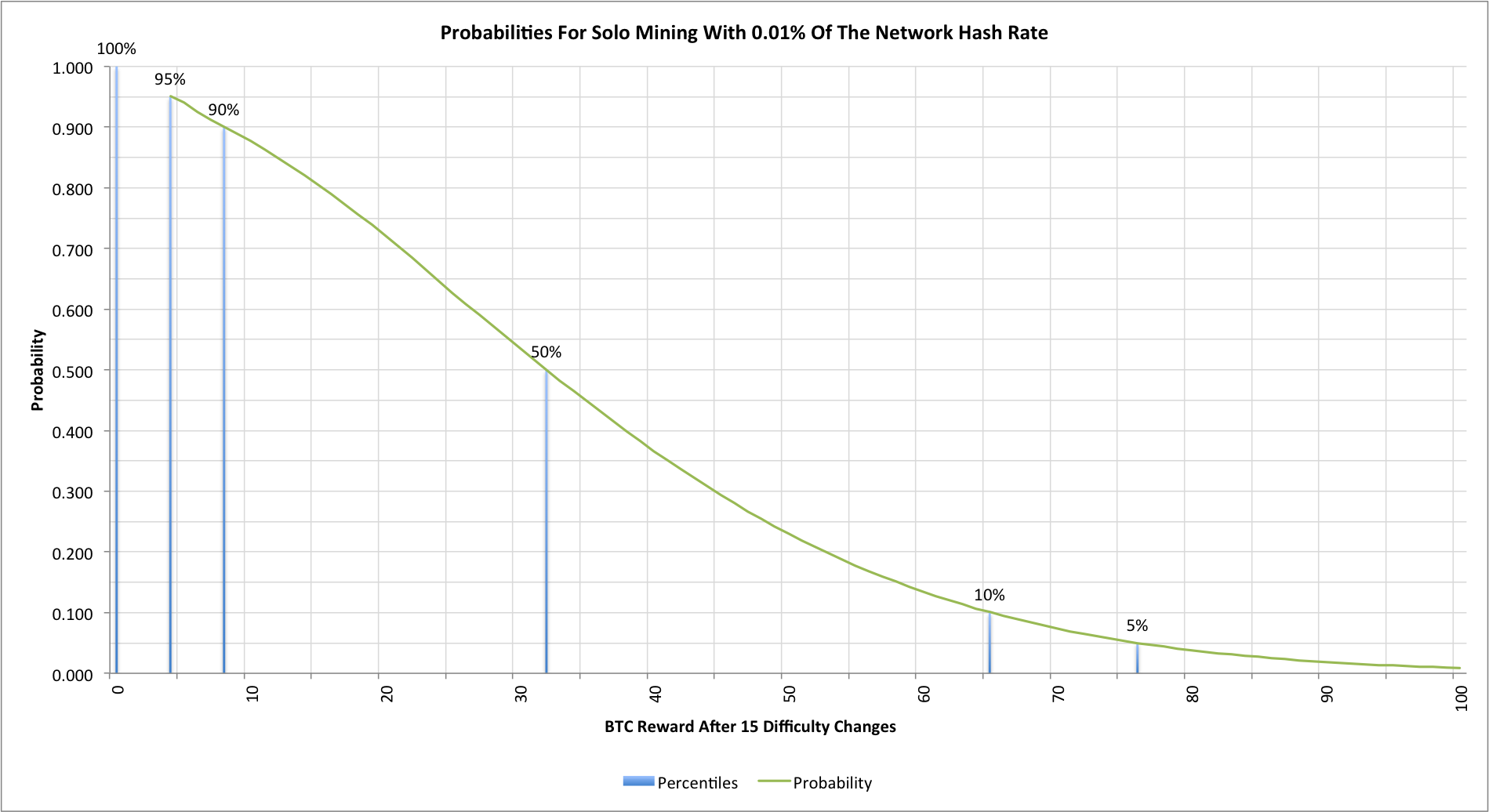
Probability of different rewards for solo mining with 0.01% of the Bitcoin hash rate over 15 difficulty changes
The chart shows 15 difficulty changes (6 months). It plots the cumulative probability of achieving a particular BTC reward. 50% of miners will achieve 32 BTC or less at the end of the 6 months, while 5% will receive nothing at all! It’s not possible to get smaller amounts in this time period by solo mining so that’s why there’s a discontinuity in the graph at the start. 10% of miners will actually receive 65 BTC or more.
The gambler in us might be attracted to the potential for high rewards; that part of us that wants to be an investor though is probably going to look at this graph in horror!
Mining with a pool
The easiest way to mitigate some of the risk is to join a mining pool. Let’s ignore pool fees or anything that doesn’t just give an equal share for hashing capacity provided to the pool. What might the same hardware achieve when run this way?
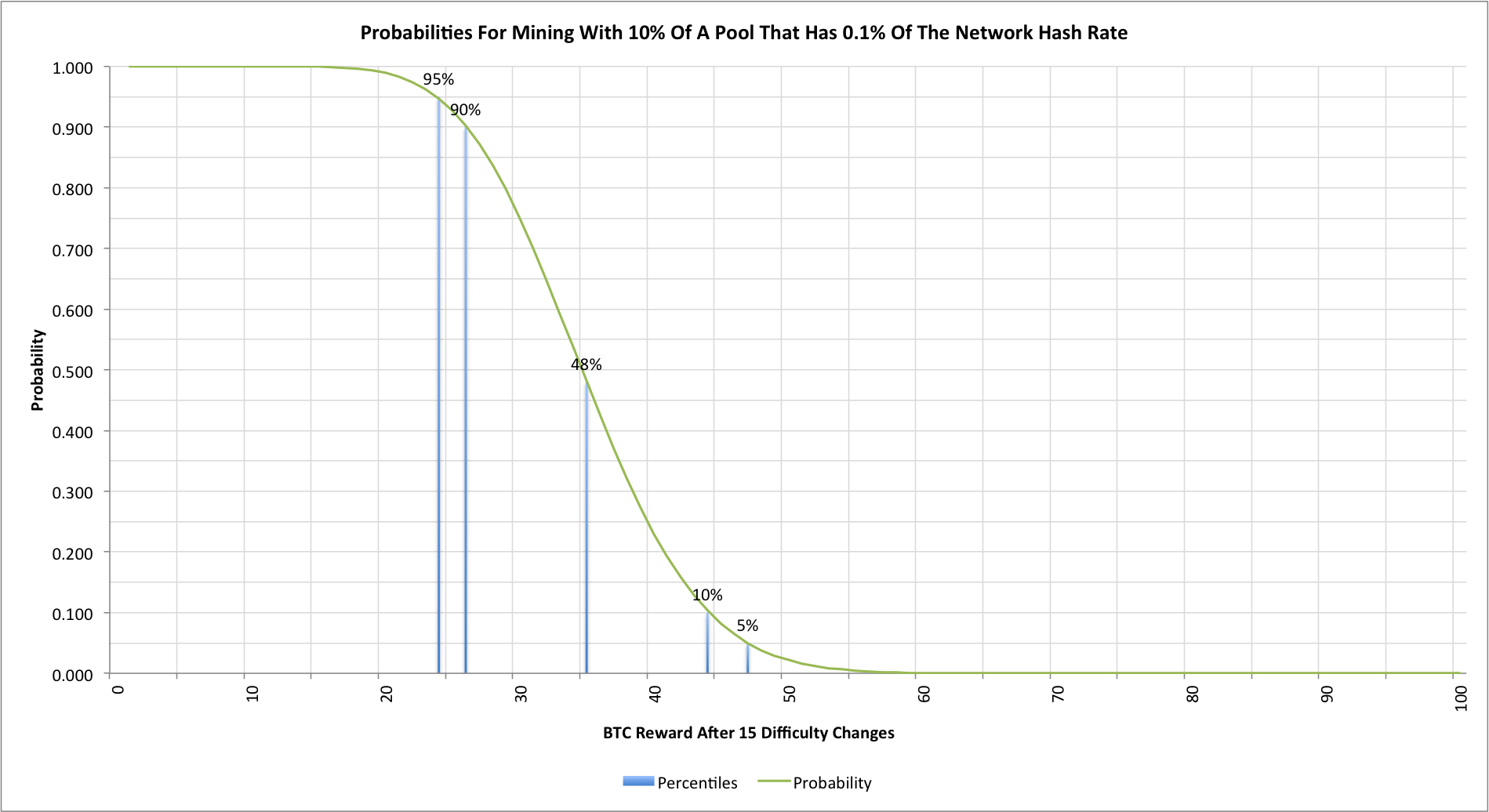
Probabilities of Bitcoin mining rewards with 10% of a pool that has 0.1% of the total network hash rate
Our gambler self may be disappointed to see that the potentially large payouts have vanished; 10% of miners will achieve 44 BTC or better. Our, more rational, investor self is probably much happier though as only 10% of miners achieve less than 26 BTC. The simple exercise of merging with a pool that has 10x the total mining capacity has made a huge difference to the variance of the mining rewards. Our 50% reward point is higher too (the chart shows 48% to keep things simpler)!
What are the effects of using larger mining pools?
Now that we can see the reduction in variance from using a mining pool we really need to ask questions about just how much does the mining pool size change the statistics. In order to do that we need to consider a few different ways to deploy our hardware.
The following graph shows a much narrower span of BTC rewards. It also shows the effects of mining as part of a pool controlling 0.1%, 1%, 10%, 25% and 50% of the global hash rate. That last one is sure to be controversial as a pool with 50% of the hash rate is deemed to pose a potentially serious risk, but rational miners have been keen to participate in such pools. Just how good are the reasons to do so?
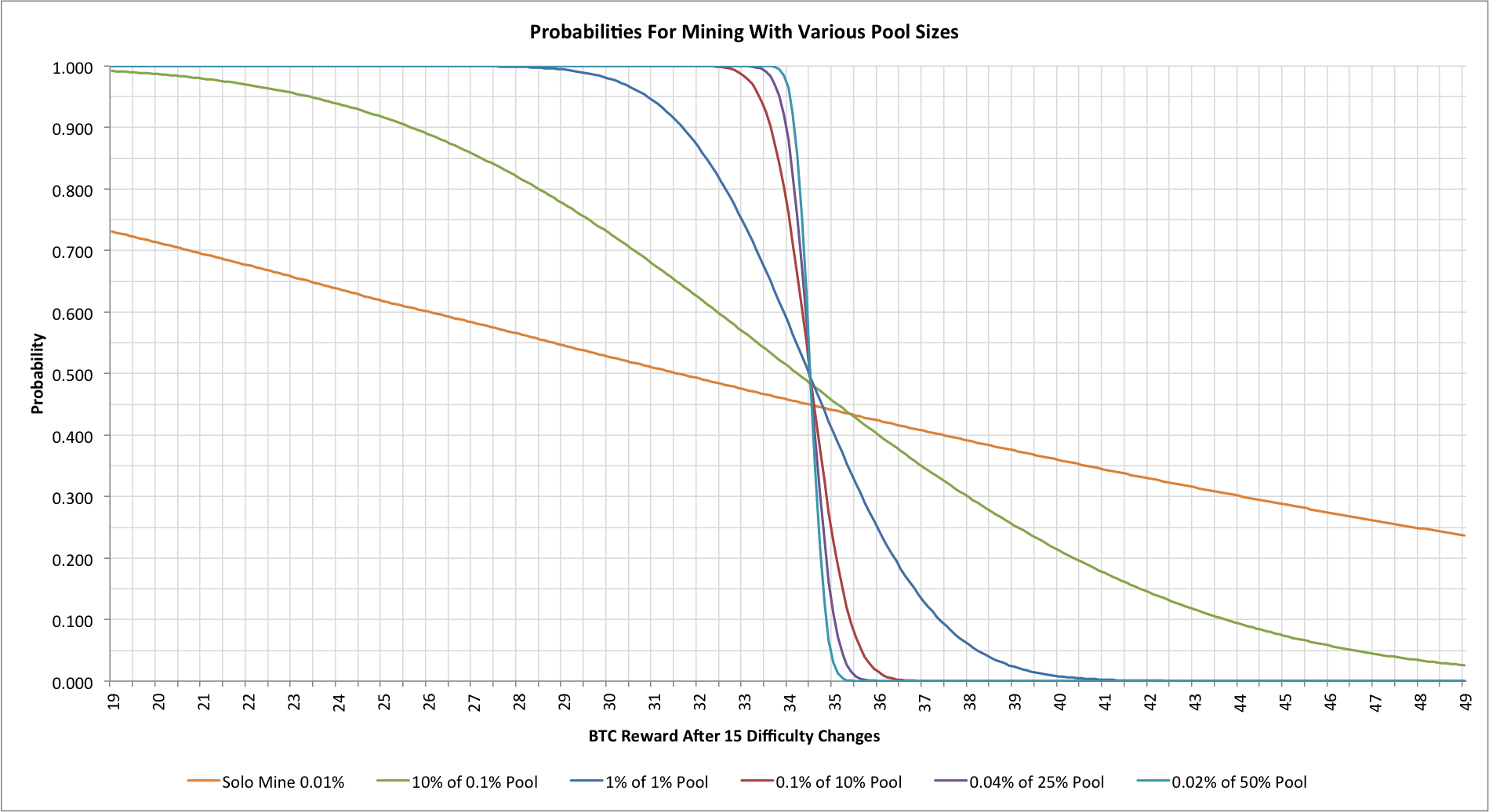
Comparison of Bitcoin mining rewards for different pool sizes
The first things to notice are just how bad the solo mining and 10% membership of 0.1% pool now look! The larger pools are definitely more attractive to anyone seeking predictable returns.
Mining pools are here to stay?
In a simpler world the Bitcoin mining network might only be expanding very slowly and miners could attempt to allow time to smooth out the effects of mining variance. In practice though, as the network expands and the ever-increasing difficulty consumes the usefulness of any current hardware, then best known way to avoid the vagaries of random mining behaviour is to use large blocks of co-ordinated mining. Solo mining and mining in small pools is a strategy for gamblers, not investors.
Arguments may rage regarding the risks posed by large mining pools and their tendency towards centralizing our supposedly decentralized network, but it seems very unlikely that they will be disappearing any time soon. Any proposal to remove them will have to address the issue of variance if it is to gain any sort of widespread acceptance.