
May 2014 Journal
WORDS is a monthly journal of Bitcoin commentary. This issue collects the May 2014 writing in the WORDS archive. For the uninitiated, getting up to speed on Bitcoin can seem daunting. Content is scattered across the internet, in some cases behind paywalls, and content has been lost forever. That’s why we made this journal, to preserve and further the understanding of Bitcoin.
How We Know Bitcoin Is Not a Bubble
By Daniel Krawisz
Posted May 3, 2014
The Value of Money
No matter how many times Bitcoin grows by orders of magnitude, holdouts still remain who argue that it is a bubble destined to fail. To address this claim, I will describe a theory that describes how to appraise Bitcoin according to the Austrian theory of money.
In Austrian economics, money is valuable because it is liquid. This means that a given value of money is demanded everywhere and can easily be traded for goods. For example, say I had enough bitcoins to buy a 100-oz gold bar. In late 2010, this would have been worth around one to two million bitcoins and would have been impossible to sell on the open market without drastically affecting the price. By contrast, in early 2014, 100 ounces of gold was worth about 100 bitcoins, and this amount could easily have been traded quickly on one of the major exchanges without affecting the price noticeably. Thus, in early 2014 Bitcoin was more liquid than in late 2010, and was therefore a better currency.
Unfortunately, this insight about the value of money does not give us a means of appraising it because the liquidity cannot be separated from the price. This is kind of a problem—it sounds like a circular argument because it says that Bitcoin’s value is caused by its price! This allows for no way to detect whether Bitcoin is overvalued or undervalued.
In order to prevent this model from being causally circular, a time element is required. Our observations about money come from the past, whereas our judgments about its value are about the immediate future. This makes the value of money into a positive feedback loop. If the network is growing, then it will tend to continue to grow, whereas if it is shrinking, it will tend to continue to shrink.
This model of money has no independent quantity that estimates anything like an underlying value. Any price is as good as any other—the only thing that matters is the direction it is moving. This is not really an appraisal after all—but it is still the right way to understand Bitcoin’s price.
Bubbles
In the short term, there is money to be made by buying anything whose price is showing an upward trend if one spots the trend early enough. In other words, if one can predict that other people are likely to appraise a good more highly in the future, regardless of whether that appraisal is rational or irrational, then it makes sense to buy into the change of sentiment. If lots of people begin to think this way, then they can create a positive feedback among one another and bid up the good beyond any rational appraisal of it. This is a bubble.
A bubble bursts because eventually people have to get around to using a good for its ultimate purpose. Once it is understood that the people who actually use the good are being bid out of the market, then the price crashes because people stop predicting higher and higher appraisals to the price.
Money, however, need not have any ultimate use. It may only ever passed around from person to person, without ever being consumed. A stock is valued by the sum of its interest-adjusted dividends. A bond is valued by its redemption value adjusted by the interest rate and the risk of default. A commodity is valued by the value of the goods it can be used to produce. However, for money, there is no independent quantity to provide a reality check. All money is like a bubble that never bursts.[1]
Metcalfe’s Law
Some of the theory of money can be understood in terms of Metcalfe’s law from computer networking. Metcalfe’s law says that the value of a network is proportional to the square of the number of nodes. The rationale is that the network should be valued according to the number of connections it supports, which is approximately proportional to (n^2) (for large (n) ). Consequently, as the network grows, it presents a better and better opportunity for new members. As new members enter, the network improves for all its present members.
Metcalfe’s law must be adjusted slightly to apply to media of exchange because some nodes in the trade network will be more valuable than others. Those who have a lot of the medium are potentially able to spend more than those who have little. Therefore, use the market cap of the medium of exchange as (n) instead of the number of people. Similarly, some transactions are also worth more than others, so it makes sense to use the transaction volume rather than the number of transactions.
A striking test of Metcalfe’s law in Bitcoin recently appeared on the Bitcointalk forums, created by Peter R. I have made my own chart here.
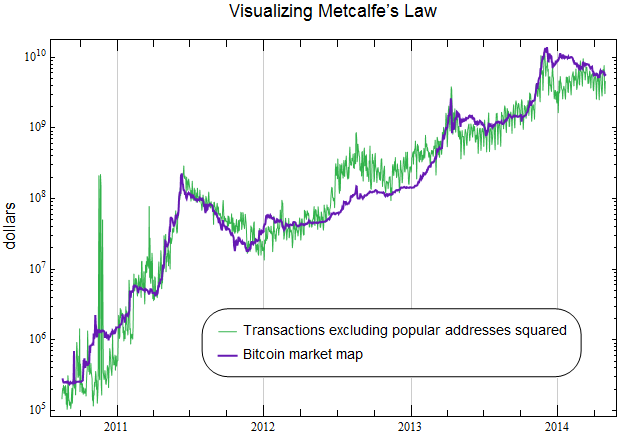
This chart plots the market cap in blue and the square of the transaction volume excluding popular addresses in green. The axis on the left is the price in dollars. Exactly as Metcalfe’s law predicts, the transaction volume increases very neatly as the square root of the size of the network. The correspondence is beautiful. I wish I had thought to make it first!
I would like, however, to criticize the interpretation of the diagram. On the original Bitcoin Talk, thread, the green plot has been labeled as the “Metcalfe Value”, as if it is an appraisal of the Bitcoin that estimates what it could cost.
This interpretation is incompatible with the theory of the value of money I presented above. In my theory, the value causes the transactions, whereas in the diagram, the transactions cause the value. However, it is only potential transactions that cause the value. Past transactions are of no value to anybody. The current size of the network and the consequent opportunities it is likely to provide tomorrow are what motivate people to buy and sell today.
This may seem like hair-splitting, but a confusion of cause and effect can have serious consequences. For example, many people believe that it is necessary to spend bitcoins and increase the transaction volume in order to make Bitcoin more valuable. Of course this is nonsense; all this does is fill up the network with transactions for things that nobody actually wanted. That does not present a good value for a newcomer because he will want a network that presents him with real opportunities, not just ways of artificially increasing transaction volume. The more that the Bitcoin network is focused on artificially increasing the transaction volume to make it look good, the more it resembles a Ponzi scheme. Rather, to make the network more valuable, we should be hoarders. This is more likely to present newcomers with lots of potential uses for Bitcoin as a medium of exchange.
Appraising Bitcoin
A real good can be valuable because of the ways that it can be consumed or because of the trades that can be made with it. Mises called these causes of value “use value” and “exchange value”. Gold, for example, can be money and used as components in electronics. Evaluating whether a good is a bubble or not requires taking both factors into account; it is not enough observe that the price of a is far greater than can be explained by its use value to conclude that it is a bubble.
To put this another way, suppose that gold was only used in electronics. If that were the case, its price should be expected to be much less than it is now. However, some people started holding gold for longer periods of time before producing anything with it. This would cause the price of gold to go up, which would therefore make gold less useful as an electronics component. However, it would also make gold more useful as a medium of exchange. If gold’s improved exchange value was enough to induce more people to buy it despite its reduced use value, then the price of gold could sustainably continue upwards. Its price chart might look like a bubble, but without the expectation of an imminent crash.
This brings us to Bitcoin. To what extent is Bitcoin’s price a rational appraisal or an investment bubble? The answer is easy, much easier than with a commodity like gold. Bitcoins have almost no use other than as a medium of exchange. Thus, the fact Bitcoin has any price at all is evidence that there is a real network effect and that the cause of its price is its exchange value. With gold one has to consider the interplay between its use and exchange value, but with Bitcoin there is no such confusion:
Any demand for Bitcoin at all is enough to enable it to function as a medium of exchange. If demand continues to grow, then it becomes a better medium of exchange. There is no end to this process because the primary value of Bitcoin is the network effect surrounding it, not any final productive use. Each step in Bitcoin’s growth follows a similar pattern of investment in the coin, improving Bitcoin’s liquidity, creating more opportunity for its use as a medium of exchange, followed by investment in Bitcoin’s infrastructure, thus realizing those opportunities.[2]
Thus, Bitcoin is not a bubble, or at least the available evidence strongly suggests that it is not. Its growth is like a self-fulfilling prophecy: as more people believe in it as a medium of exchange and become willing to buy it, they create the very conditions required of it to make it more useful.
Conclusion
Every time you buy Bitcoin, a fairy gets its wings. Now clap your hands, click your heels together three times, and believe in Bitcoin! It will only take faith the size of a mustard seed.
[Update 5/15/2014: Clarified section ‘Appraising Bitcoin’ in response to criticisms.]
- One of the best arguments against the bubble theory of Bitcoin was presented by Peter Šurda in “The Economics of Bitcoin”, in which he asks “What would replace Bitcoin?” The point of the question is that because Bitcoin reduces transaction costs over its alternatives, people have at least some reason to continue holding it until a superior alternative emerges. ↩︎
- This analysis leaves something to explain—if the value of a medium of exchange is just the market cap, why does Bitcoin go through hype cycles? Every time Bitcoin goes up in price, that is an increase in its underlying value, so why does its price ever crash? I don’t know the answer, but I think I have a reasonable hypothesis: the network takes time to adjust to the enormous number of newcomers during each hype cycle. Each member of the network adds value, but this takes time—the members of the network must learn something about one another before the value they add to the network is more fully realized. If this effect is real, then the price could temporarily rise more rapidly than the growth that the network can support. ↩︎
Bitcoin is like…
By Oleg Andreev
Posted May 8, 2014
Bitcoin is like physical cash: it is not reversible and you are responsible for handling it. If you lose your wallet, you lose your money. You can give bitcoins to someone to hold them for you, but it will be like with any bank: you have to trust them that they won’t run away with your cash.
Bitcoin is unlike physical cash: you can store as much as you want and it will not take any space. You can send it over the wire to anyone. It is impossible to counterfeit. You can’t give it in one second: to actually guarantee that transaction has happened, you have to wait 10-15 minutes for the cryptographic proof to be produced by the network. However, for small in-person payments you sometimes can accept zero-confirmation payments with relatively low risk of transaction being cancelled.
Bitcoin is like gold: it cannot be produced at will, there’s a limited amount of it and this amount is scattered in spacetime continuum (mostly time). To get some bitcoins someone should give them to you, or you should mine them. Like gold, Bitcoin is shiny: it attracts people with its beautiful engineering, built-in contract programming language, wise incentives, and libertarian promise of freedom from coercion.
Bitcoin is unlike gold: supply of Bitcoin is completely fixed via scheduled mining (only so much bitcoins are created per hour). You have a guarantee that no one will suddenly find a mountain of bitgold or mine it on asteroids. Unlike gold, Bitcoin difficulty is adjusted to the mining efforts to keep the schedule fixed. You may dig up all the gold in one day, but it will never be possible with Bitcoin no matter how fast computers will ever become. Growing mining efforts can only bend schedule slightly (network adjusts difficulty to producing 6 blocks per hour, but if network constantly grows it may produce 7-8 blocks per hour).
Bitcoin is like bank: there are computers, a database and transactions. Database stores entire history of all incoming and outgoing payments: who send how much to whom. Everything is digital. There are no vaults with gold or personal deposit boxes, only bookkeeping in a single “ledger”.
Bitcoin is unlike bank: everyone can verify the integrity of the ledger. There is no manager in charge of updating the ledger and making sure it is not tampered with. Any person may have as many accounts as they like and all accounts are anonymous (unless one reveals his identity himself). Ledger does not store names, only balances and account numbers. There is no possibility of “fractional reserve” when bank loans out more money than it actually has. In fact, there are no debts on bitcoin ledger: either you have money on your address and it is fully yours, or you don’t and you can’t use it at all. Also, Bitcoin allows to lock money with “contracts”: cryptographic puzzles designed to spread the decision making between several people or across time.
Bitcoin is like Monopoly money: there are abstract tokens that are not claims to any value. People value them because they choose to play the game. In fact, the same is true for gold or any other money.
Bitcoin is unlike Monopoly money: there is a limited supply of tokens and no one can counterfeit them. This makes them a good candidate for a universally recognized collectible like gold or silver coins.
Bitcoin is like Git: in Git (a distributed version control system) all your changes are organized in a chain protected by cryptographic hashes. If you trust the latest hash, you can get all the previous information (or any part of it) from any source and still verify that it is what you expect. Similarly, in Bitcoin, all transactions are organized in a chain (the blockchain) and once validated, no matter where they are stored, you can always trust any piece of blockchain by checking a chain of hashes that link to a hash you already trust. This naturally enables distributed storage and easy integrity checks.
Bitcoin is unlike Git in a way that everyone strives to work on a single branch. In Git everyone may have several branches and fork and merge them all day long. In Bitcoin one cannot “merge” forks. Blockchain is a actually a tree of transaction histories, but there is always one biggest branch (which has the value) and some accidental mini-branches (no more than one-two blocks long) that have no value at all. In Git content matters (regardless of the branch), in Bitcoin consensus matters (regardless of the content).
Bitcoin is like Bittorrent: the network is fully decentralized, there is no single “mint” or “bank”. The blockchain is like a single file on bittorrent: cryptographically authenticated and shared across many computers. Every participant, including miners are acting on equal grounds. If one part of the network becomes disrupted, transactions can flow through other parts. Even if the entire network goes down, information about transactions is still stored on many thousands of independent computers and no one’s money is lost. When people connect with each other again, they can continue sending transactions like nothing happened. Both Bitcoin and Bittorrent can survive a nuclear war because information does not become radioactive and can be safely replicated.
Bitcoin is unlike Bittorrent: instead of many independent “files”, there is one file that always grows: the blockchain. Also, the most important participants: miners are actually getting rewarded for their work with real money.
Bitcoin is like freedom of speech: every transaction is a short public message that can be pronounced no matter where or how. If some miners hear it, they will add it in the blockchain and that message will be forever in the history. Everyone will see it and no one will be able to erase it.
Bitcoin is unlike freedom of speech: saying something comes with a cost. Transaction moves coins that you must have to start with. So not every moron is allowed to shout, but only those who had a merit to acquire some coins in the first place. Also, miners may reject transaction if it’s spammy or does not contain enough fees. So no one provides anyone with freedom as “in beer”, but everyone tries to cooperate on a voluntary basis.
Bitcoin is like magic internet money: it simply is.
The Rothschilds of Bitcoin
By Pete Dushenski
Posted May 9, 2014
Remittances are a hot topic for redditards, forumites, and yes, even some -assettes. The egregious fees levied on the planet’s poorest send pangs of privileged guilt through their weak hearts. “Whoa the injustice!” they bemoan. And bemoan some more.
Of course, they’re as welcome as anyone to undercut Western Union and PayPal in facilitating transfers to the perfectly-well-developed-thank-you-very-much world.i Companies like BitPesa and ZipZap have been waving their magic wands in this direction but seem to have made little progress relative to their media buzz.ii Bitcoin remittances seem to take advantage of Bitcoin’s low fee network, but the physical remittance infrastructure still has to be built, and therefore built overtop of whatever WU and PP have. Unfortunately, this business model is therefore stuck in the days of voting rightsiii and touches fiat, both of which miss the point. To boot, it wouldn’t surprise me if BitPesa and ZipZap don’t undercut the old boys by as much as we’d imagine. The reason being that transfer fees pale in comparison to infrastructure costs.
So if our imaginary remittances corporation isn’t quite as practical or useful as we might’ve hoped, what else can we imagine a globally distributed yet tight-knit group of Bitcoin players accomplishing?
Well, how about what Mayer Amschel Rothschild’s kids did c. 1800?
It was mainly in connection with this movement in bullion that the remarkable plan was adopted of having one of the Rothschild brothers in each of the chief capitals…
James, the youngest of the brothers, was not established in Paris till 1812, the year of Mayer Amschel’s death, and then secretly for the purpose of collecting French coin to forward to Wellington for his advance through southern France; the firm of Rothschild Frères was not founded in Paris till 1817; Karl did not go to Naples till 1821; and Salomon went to Berlin in 1815 to arrange for payments through London to Berlin to the Englishman Herries. It was evidently Nathan who made these arrangements…
The elector’s money had been sent to Nathan in London, who in 1808 utilized it to purchase £800,000 worth of gold from the East India Company, knowing that it would be needed for Wellington’s Peninsular campaign. He made no less than four profits on this: (1) on the sale of Wellington’s paper, (2) on the sale of the gold to Wellington, (3) on its repurchase, and (4) on forwarding it to Portugal. This was the beginning of the great fortunes of the house, and its early transactions may be divided into three stages, in each of which Nathan was the guiding spirit: namely, (1) from 1808 to 1815, mainly the transmission of bullion from England to the Continent for the use of the British armies and for subventions to the allies; (2) from 1816 to 1818, “bearing” operations on the stock exchange on the loans needed for the reconstruction of Europe after Napoleon’s downfall; and (3) from 1818 to 1848, the undertaking of loans and of refunding operations, which were henceforth to be the chief enterprises of the house.
It is reckoned that from 1814 to 1822 no less than £18,000,000 sterling was transferred by them to the Continent, and it was for this reason that the brothers were raised to the Austrian nobility.iv
It’s not that hard to imagine a syndicate of well connected Bitcoin players stretching out to the four corners of the globe, creating a blood-bound financial network. What’s harder to imagine is that anyone with Rothschildsesque connections and means would focus their attention on remittances rather than financing the wars and industrial growth of the future. Bitcoin is a better gold, after all, and it’ll be in high demand as a reserve currency with which to fund global expansion. Bitcoin has already solved the centralization of global currency control, but it will never resolve humanity’s struggles over scarce resources, nor the need to pay for said struggles. In a few decades’ time, it will make far more sense to make such BTC-denominated loans,even if it doesn’t right now.
To create a global lending operation such as this would be a huge strain on anyone’s WoT, and I’m skeptical if even a decade in #bitcoin-assets would suffice. We may therefore be waiting until suitable kin take the charge. After all, while bitcoin can be transferred to anyone, anywhere, anytime, there’s no replacement for local relationships and local enforcement of contracts, which means a brother in every capital.
After the Rothschilds of Bitcoin find their way to the top, we can only hope that their children become such noble patrons of the arts.
Then, we will have our rennaissance!
- The “Developing World” needn’t be further fucked by USMegaCorps, their non-neutral net, and their “progressive ideas.” It’s colonialism or nothing at all.↩
- Media Buzz »> Product Development is largely par for the Bitcoin course. For now.↩
- mircea_popescu: Voting rights are nonsense in bitcoin anyway. what the fuck are they going to do, get a confederatied majority and… what, oust you ? Take over ? Voting rights made sense in the old days of geographically fixed agents and material means of production. that situation changed. fluffypony: lol mircea_popescu: Immaterial means of production and geographically dispersed agents reduces the corporate voting to meaninglessness. Not that it worked too well pre bitcoin, either. chetty:buying stock should indicate confidence in management, sell is lack of such – what better votes are there? mircea_popescu: chetty exactly. but in the old days of imperfect economy, people actually had to have a backchannel, and take over the tractor or whatever it was. Because you couldn’t afford to let a physical tractor go to waste, as a society. These days, a website going to waste ? heh. via ye olde #bitcoin-assets.↩
- via not Retardopedia.↩
Bitcoin is the Best Unit of Account
By Daniel Krawisz
Posted May 10, 2014
In an earlier article, I conceded too much and suggested that Bitcoin doesn’t need to be a unit of account. What I should have said is that Bitcoin is a great unit of account—much better than the dollar.
The objection that Bitcoin is not a good unit of account actually hides a circular argument that invalidates it. Bitcoin’s utility as a unit of account depends on what you already believe about Bitcoin. If you are skeptical of Bitcoin, then it makes no sense to use Bitcoin as a unit of account. If you believe that Bitcoin will become the world currency, then it makes no sense to use anything else. You want to end up with as many bitcoins as possible, so it makes sense to price any investments or ventures in Bitcoin. That’s how you know if you are winning or losing against your benchmark. Thus, to say that Bitcoin will fail because it is a bad unit of account is to say nothing more than that it will fail because it will fail.
There is, of course, no objective unit of value that is measured with a unit of account. This is why it is possible for two people to prefer such wildly different behaviors from their units of accounts. Someone still lost in the dollar world looks at Bitcoin and sees wild and extreme volatility, whereas someone in Bitcoin looking back at the dollar sees the worst and longest economic crash in history.
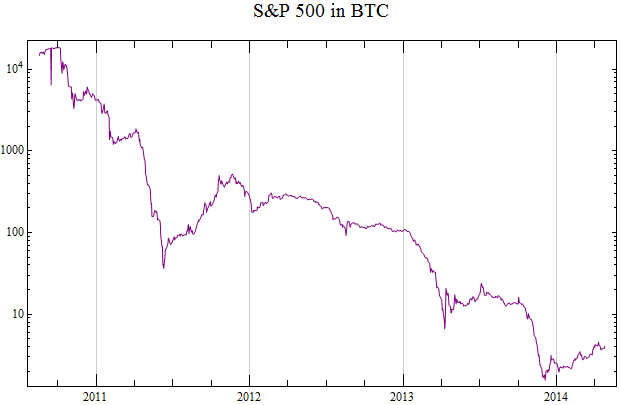
Worst recession ever.
Upon entering the Bitcoin world, one gradually realizes that dollars make a lot less sense in this new world. Suppose, for example, that one considers getting into Bitcoin mining. The most important question is whether the mining rigs will mine more bitcoins than they cost—dollars don’t enter into question at all. Other businesses that perform Bitcoin-related services also must think similarly because one must always ask for any investment in the business, did it earn as many bitcoins as it cost to create?
Ok, so sure Bitcoin accountancy works within Bitcoin, what about interacting with the rest of the world? This also works fine. In fact, it works great. It just means that all prices in Bitcoin are rapidly falling. What’s the problem with that? That’s just Bitcoin’s way of telling people to keep holding it. It just feels like everything is becoming rapidly cheaper. Not a bad feeling. Not bad at all!
I feel like I went through a subtle psychological shift recently. When I use dollars, they feel like play money to me. Buying with them feels like using the colorful foreign cash during a vacation overseas. It no longer feels quite like real money. Bitcoin is my unit of account.
Addendum (July 15, 2016)
An observation I made today upon investigating something interesting happening in current events is that the price of ethers as listed on ethereumwisdom.com is listed first in Bitcoin, second in U.S. dollars. This is interesting, and a little ironic (in the sense of a player in a drama who does something without understanding its full significance) because it means Bitcoin is seen as the primary unit of account for the people investing in ethers. This reddit post also suggests that Bitcoin is like a unit of account for these people.
I guess Bitcoin must not be such a terrible unit of account if that’s what people are using it for. I want to talk a little about why this might happen.
In the short term, cryptocurrencies tend to trade against the dollar in the same way. If Bitcoin prices rise or fall against the dollar, then other cryptocurrencies will tend to move similarly. From the standpoint of someone trying to choose between Ethereum and Litecoin, the price changes common to all cryptocurrencies are uninteresting. If the prices of ethers and litecoins are compared in terms of a common denominator which moves with them, then their similarities are less evident and their differences more evident. A specialist would want to look at them in the way that most emphasizes their differences.
Investors have chosen to do this by comparing prices in terms of Bitcoin. This makes perfect sense. Among people who think cryptocurrencies are going to be a big deal, you really want to compare everything to Bitcoin because it’s the most obvious winner here. The irony is that once you start using Bitcoin as your unit of account, then you’re using it like money, which means that you’re not using your altcoin investments as money, which is the only thing they’re good for.
I really like this development because it shows that people are getting more skeptical. The more people start to compare everything in terms of Bitcoin, the more they’ll start to demand something that’s actually useful. “Yes, but is it really going to beat Bitcoin?” is the question everyone should ask first about any investment in the Bitcoin world.
Capital Exit, Capital Strike
By BTCtheory
Posted May 16, 2014
“If a thousand men were not to pay their tax-bills this year, that would not be a violent and bloody measure, as it would be to pay them, and enable the State to commit violence and shed innocent blood. This is, in fact, the definition of a peaceable revolution, if any such is possible.”
-Henry David Thoreau,
Capital Exit
In his 2013 Startup School talk, Balaji Srinivasan, the CEO of 21.co the bitcoin computer, proposes the idea of Silicon Valley’s Exit. It’s a brilliant talk and I highly recommend watching it. I have to wonder after watching it if he really eluding to is that Silicon Valley already is exiting?
Software has eaten the world alright, and bitcoin is the software of money. These are arguably some of the best investors in the world who specialize in high-tech, and they are the ones that are the most excited for bitcoin and digital currencies. They must know that bitcoin cannot be seized if the right precautions are taken. They understand that bitcoin and digital currencies are a very real and meaningful exit for capital from the current system. Not that Silicon Valley itself is going to outright secede from the union, and dump all of their money into digital currencies–Heaven’s no. They are simply going to build the tools so people can make that choice for themselves.
Nearly a billion dollars has been invested into the bitcoin ecosystem by VC firms, and that number is growing at a rapid pace. These investments are not direct investments in bitcoin itself, but into companies that are building the architecture around digital currencies–this is the dawn of digital banking. The banking system in desperate need of something to replace it, and bitcoin is just the thing to do it.
Both banking and finance are ripe for disruption and there are huge markets that digital currencies can realistically replace. Today remittance transactions can be done with bitcoin for practically nothing and can reduce consumer fraud to practically nothing. When you consider that remittance transaction are a $500 Billion dollar a year market and that merchants spend $3.5 billion a year in fraud cost each year these are just too big of markets to be ignored.

Remittance flows: Taking over this market is the real target of Bitcoin
The opportunity here is just too good because this is a totally new market. Banking and finance have been a monopoly for a very long time, and when you smash monopolies, you create new markets. Digital currencies are trying to smash the largest and most powerful monopoly that has even been created: Fiat money.
To free capital from the chains that banks and government have wrapped them in is revolutionary in scope, and monumental in size–like the internet, but bigger.
Digital currencies will engage in Schumpeter’s creative destruction and eat the world of finance, banking, and eventually governments themselves. Ironically, Srinivasan and the team at Andreessen-Horowitz may be investing in the very architecture that is going to destroy their system of capitalism all together, and evolve it into a tool for something much greater than the small, oligarch system it is today.
This is the ultimate exit; the one where we build a new system of finance, economics, banking, and government itself to serve anyone with an internet connection. We can use this system to ensure that the violence they want to bring to our bodies can never be done, because they can never find out who we are, or where we keep our money.
Capital exit from fiat currencies and moving to a digital currency is not only an incredible profitable move–it is a righteous and just one too.
Capital Strike
Digital currencies are not just an alternative new money, they are an implicit rejection of the current economy system.Anyone who wants to can organize their own capital strike can simply reject the economy system they have been forced into. Be it that you are tired of getting fucked by late fees at your bank, having ANY government steal your money to fund their wars, or you simply don’t trust having a bank account (as you should not), then bitcoin can help you fight back.
Bitcoin levels the playing field because people now have choice. You can use the bitcoin system to save and move money, or you can use the banking system.
Their system is one of 9-to-5 bullshit jobs, college tuition that is out of the reach of most Americans, and one where government-issued money WILL devalue by 33% over the next 20 years. This is a system that enslaves more people of color than at the peak of slavery in the US, while allowing for banksters to fund terrorist and get away with it. It is quite obvious that this system was not made to benefit you or me, but a very, very small, elite class of people. That is not a system I want anything to do with, and so I am walking away from it.
With bitcoin anyone can walk away from this system, and build something for themselves. Anyone can post an address online and sell their own items, labor, skills, or talents within a huge market that is totally independent of the State and banks.
Sure it’s risky, but you know what? It’s a hell of a lot better then giving your money, time, and labor to a system that is designed to impoverish you.
Opportunities are endless for anyone to join and to build what they want for themselves in the bitcoin ecosystem. The only promise I will give you is that the protocol will not lie–and that is enough to challenge their system of money that is built upon lies and theft.
Either our government has the power to right the wrong and unconstitutional actions this government has engaged in, or they are powerless to do so. In either case, they have proven themselves unfit to govern a people that call themselves free. The tools at are at your disposal, you are free to make the decision for yourself and join us with what we are building.
Either way, I don’t care what you do. What we are building cannot be stopped or denied, and it will change the world.
—
Next: Bitcoin’s People Problem
The Correct Strategy of Bitcoin Entrepreneurship
By Daniel Krawisz
Posted May 16, 2014
We’re All in This Together
Bitcoin entrepreneurs have yet to appreciate fully collaborative nature of the Bitcoin economy and its implications for entrepreneurial strategy. Every successful entrepreneurial act improves the Bitcoin economy and attracts more people in, thus raising the value of the coins. Each new service benefits everyone else who is already invested. Consequently, Bitcoin businesses do not necessarily need to see themselves as competitors to one another. Even if they have the same business model, they both have more to gain from the influx of new users from outside than by taking customers from one another.
Furthermore, the growth of any Bitcoin business is limited ultimately by the growth of Bitcoin itself. Since the number of coins is strictly capped, the currency must grow with its price. This means that few businesses, if any, can be expected to earn a much better return than the coin itself over time. Entrepreneurs should therefore invest in coins, not businesses, because coins are where the profit is. In addition, if Bitcoin fails, then the Bitcoin businesses fail—so Bitcoin is less risky than any Bitcoin business too. Thus, Bitcoin entrepreneurs should be less interested in making money than in making bitcoins into money. An entrepreneur who follows that precept should generally be expected to be more successful than otherwise because the potential for Bitcoin itself is so much greater than any Bitcoin business he could invest in.
Of course, Bitcoin cannot succeed without businesses, or at least some sort of entrepreneurship. What is the best way to fund ventures in an environment in which they are relatively poor investments? The trick, I propose, is to think of these ventures more as donations to the Bitcoin economy than as profit-seeking ventures. Any useful Bitcoin service will tend to make the Bitcoin price increase because it adds value to the network. It may, therefore, be perfectly rational for a Bitcoin investor to contribute the service to the economy for free. Furthermore, the success of such a business being desired by everyone who holds coins, such a business can be run more like a non-profit or open-source project than an business. Thus, a new venture may attract investment even if it is not profitable as long as it provides a service the Bitcoin world needs.
In mid 2013 Armory, an open-source Bitcoin wallet project, received $600k in seed funding without even though nobody knows how it will eventually be monetized. These people have the right idea, but they shouldn’t try to monetize it at all—it is obviously making all the coins more valuable.
Don’t be a venture capitalist—be a speculative philanthropist.
Labor Is Scarcer than Ideas
The task ahead of us is monumental—the construction of a new financial economy to replace the one built around the national currencies. This will take a lot of work. Unfortunately, a lot of work is being wasted right now. The venture capitalists are looking to invest in a sharp team with a cool idea but the group of people that matters most is the entire network of Bitcoin users, and the idea that matters most is Bitcoin itself. Big new ideas get hyped up almost every week around here, and the Bitcoin economy will work a lot better if people would try harder to ignore them.
There are lots of business ideas floating around and limited time to create them. Only ideas that have a very high probability of being an important part of the future Bitcoin economy should be implemented because that is all we have time for and those are the only ideas worth risking Bitcoins on.
The proof that ideas aren’t scarce is that anybody can make his own altcoin at any time. Already there are hundreds, and every one of them a bad idea from people who don’t understand the cumulative benefits of cooperation. Since entrepreneurs don’t understand Bitcoin very well yet, it is easy to dazzle them with technobabble and funnel investment into flawed projects like Protoshares, Mastercoin, and Ethereum that have a very low probability of furthering Bitcoin adoption to any significant degree.
There is no real reason to keep secrets because the more that everyone knows about what everyone else is doing, the more easily they can decide what the Bitcoin economy most needs of them. Everything about a business can be done openly for the benefit of the entire industry. Product development, future plans, market research, finances; everything except private customer data, which shouldn’t be collected anyway, and, in the case of illegal Tor businesses, the real identities and locations of the owners. We need open business and open businesses.
Entrepreneurship as a Collaborative Scientific Enterprise
In an open-business world, less experimentation is necessary to produce a workable system than among other businesses because there is no reason to keep secrets from one another. All trial-and-error should immediately benefit all the other Bitcoin entrepreneurs so that everyone can more easily figure out the most effective way to work. Open business as a generally accepted best practice would have eliminated terrible businesses like MtGox and Butterfly Labs early on. But even that would have been too late. Everything possible should be done to try to eliminate ideas before they can turn into failed businesses. That means sharing all ideas with the community, and investing in nothing that does not already have widespread community support.
Much of the Bitcoin world already works very openly. Lots of terrible ideas get shot down all the time in the Bitcointalk.com forums. All the software is open source. However, more is required: Bitcoin entrepreneurship should be run more like scientific research than a gold rush or an Internet bubble. There should be open research into the future Bitcoin economy, complete with peer review and consensus over which ideas are the most useful and important. Investment should focus on ideas that already have been vetted by the community. It should be considered reprehensible for startups to invent their own cryptographic algorithms.
It is too much of a waste of resources to test ideas in experiments with real businesses. All business models ought to be carefully critiqued beforehand and only the most necessary ones that we have time for should be created. This is not central planning; it is consensus-based entrepreneurship. No one shall be forced to follow any idea at all; it is simply in everyone’s best interest to cooperate. If I am right, then soon investors will learn to back only heavily vetted ideas and entrepreneurs will it as well.
In the early Renaissance, mathematics was practiced in secret and mathematicians carefully guarded their own discoveries because a mathematicians’ career depended on being able to show patrons that he could solve problems other mathematicians could not. However, in 1545, Gerolamo Cardano sparked a new trend with Ars Magna, the first published work to include the general solutions of the cubic and quartic equations. He even included secret work (with citation) by Niccolò Fontana Tartaglia, which whom Cardano had promised not to reveal. Gradually, mathematics transformed into a tradition characterized by publication rather than secrets. Open-access publishing is now demanded. Entrepreneurship is in its Renaissance still.
Conclusion
In a low-growth economy, one grows rich by carefully leveraging one’s skills and assets so as to negotiate the most profitable trades. In other words, wealth comes from performing better than everyone else. It makes sense to guard closely any edge that one might have. Whereas in a high-growth economy, wealth comes from doing as well as everyone else. It is more difficult to improve one’s state relative to everyone else than to enjoy the overall growth that improves everybody’s state.[1]
The Bitcoin world understands this instinctively, but needs to take it to its logical conclusion. The entire Bitcoin economy needs to be open-sourced. This is how to make Bitcoin succeed most quickly and with the least effort, which is the best outcome for everyone.
Let’s get to work.
- In a post-singularity world, everything should be expected to grow at a phenomenal rate, similar to the growth of the Bitcoin economy today. Thus, I would expect the attitude of sharing and collaboration should apply generally. ↩︎
Hash rate headaches
By Dave Hudson
Posted May 20, 2014
One of the more infuriating challenges when trying to do any sort of analysis of Bitcoin mining is to understand the current world-wide hashing rate and how this affects difficulty changes. The very best “live update” websites seem to show the hash rate being all over the place. Large spikes occur frequently and it appears that huge amounts of hashing capacity have either come online or gone offline. This explanation may appeal to conspiracy theorists, and will sometimes be the real cause, but there is a much more mundane reason most of the time (but nonetheless surprising).
Isn’t mining set up to generate a block once every 10 minutes?
The first thing to look at is the way mining operates. The use of the SHA256 hash is intended to make it effectively impossible to predict what will or won’t give a particular hash result without actually computing the hash and seeing if it solved a block. Essentially each minor change in the an attempt to solve a block gives a totally random effect, so trying one hash means that the next attempt is neither no more likely, or no less likely, to succeed! This highly random nature means that mining is a Poisson Process As each attempt to solve a block is unpredictable then in theory everyone might mine all day and never solve a block. Similarly it’s also possible that a single miner might find 6 blocks in a succession. Both outcomes are possible, but both are staggeringly unlikely!
A Poisson process
Poisson Processes have some very well understood characteristics. We can prediction how many events (finding blocks in our case) will occur in a particular period of time when we know what the average number of events will be.
For Bitcoin mining where the difficulty isn’t changing (the hash rates are constant) then we should see an average of 6 blocks per hour, 144 per day, or 2016 per 2 weeks.
Here’s what the probabilities look like for a single hour:

Probabilities of blocks in any given hour
The chart shows the probability (between 0 and 1) for each block count in yellow and the cumulative probability in red. Even though we might expect 6 blocks every hour we will actually see 2 or fewer blocks around once every 16 hours; we’ll also see 10 or more blocks once every 24 hours too. It may seem surprising but once every 2.8 days we’ll find an hour between consecutive blocks [2015-02-05: This originally stated 16.8 days and not 2.8 days, but I had mistakenly multiplied by 6.]
What happens when difficulty levels are increasing?
When difficulty levels are increasing we see a change in the probabilities. Let’s look at our original cumulative probability chart and add in a chart for where the average block finding rate is 10% higher (we’re seeing 6.6 blocks per hour):

Cumulative probabilities
Our original statistics are in red and the new ones are in blue. It’s now more likely that we’ll see a slightly higher block finding rate, but we still see much lower and much higher numbers occurring quite frequently!
Hash rate calculators
Hash rate calculators have a huge problem as a result of the randomness shown by the statistics. All they can do is measure the event rate and make an estimate of the rate, based on the block finding rates. They have no way of telling if the statistics for any given period of time were normal, low, high, very low, very high, etc.
Difficulty changes
Difficulty changes occur every 2016 blocks. They play a very interesting role in hash rate statistics because they’re computed by taking the time it took to find the previous set of blocks and to set the difficulty to a level where they would have taken 14 days to find.
Let’s look at the probabilities for a 14 day period:

Probabilities of finding different numbers of blocks in a 14 day period
The scale here is different to our original graphs, and we’re only looking at the numbers closer to the nominal 2016 blocks that should be found in 14 days. There are some interesting markers shown.
As we might expect, the most likely outcome is that we will see 2016 blocks found, but 10% of the time we’ll see fewer than 1958. Similarly 10% of the time we’ll see more than 2073. Of course the difficulty will be reset after 2016 anyway but in that case it would be set about 2.8% higher than it should be. If we think about those two 10% numbers this means that every 5 blocks we will see a difficulty level that is either 2.8% higher or lower than it should be. In the next difficulty change period we will probably see that counteracted, but there’s no actual guarantee since we may see two consecutive high estimates.
We can also look at the 1% and 99% markers. They represent things that between them will happen about once every 2 years. Approximately once every 2 years the hash rate estimates at the difficulty change will be out by more than 5% and so the difficulty will be set incorrectly by as much as 5%!
What’s really important here is that even if the worldwide hash rate was constant we’d still appear to see significant difficulty changes occurring every 2016 blocks!
As for hash rate estimation, doesn’t it now look much more complex than it seemed it would?
Source code
This article was written with the help of data from a C language application that generates the probability distributions. The data was rendered into charts using Excel. The source code can be found on github: https://github.com/dave-hudson/hash-rate-headaches
The helpful fable of the “bitcoin”: Duality models revisited
By Konrad S. Graf
Posted May 20, 2014
POST HEADER
POST BODY
Bitcoin is many things, all referenced under the same word. Confusion about its nature and valuation naturally arises from insufficient differentiation of these facets, combined with a general human tendency toward “either/or” thinking. Often, the situation is more “both/and,” which becomes clearer after looking through first impressions and simple or even misleading analogies.
A short section of Francis Pouliot’s 17 May 2014 post on the Bitcoin Foundation of Canada blog caught my attention: “The currency and the network, although conceptually different things, cannot be separated. Bitcoin the network is valuable in itself because of its characteristics and, because you need to obtain bitcoins in order to use it, so is Bitcoin the currency.”
This reflects the kind of unit/system duality approach that I have found helpful, and it started me considering some further implications (I discussed the application of unit/system duality and economic/technological duality concepts to Bitcoin in “On the origins of Bitcoin” (3 November 2013)).
Discrete tradable bitcoin units are one of the integral aspects of the Bitcoin network, which in turn is a live instantiation of the Bitcoin protocol (language/convention/consensus system). The value of the units is what enables the distributed financing of the entire network; the existence of this network enables the existence, security, and value of the units.
Along another conceptual axis, economic theory supports the interpretive understanding of whatpeople do. What things are is addressed in this case as what I call the technological layer. These layers interact, but the methods appropriate to studying them differ. One is the domain of action theory, with concepts such as ends, means, and preference; the other, in this case, of computer science, networking, and cryptography.
Still, the technological layer of Bitcoin (the system) can give hints toward economic theory interpretations of the value of bitcoin (the tradable units). Additional economic insights might at times be inspired by checking back to see what is “really” going on in the technological layer, and then clarifying the relationships between the layers.
The helpful fable of the “bitcoin”
In applying economic-theory concepts to interpreting actions, the interpreter references the more specific constructs that the people in question use in their own acts. In this case, among Bitcoin users, this construct is the operative image of “bitcoins” or other such units as interchangeable, tradable digital objects.
Yet when dialing the technology layer up into a higher presence in awareness and overlaying it on the action-interpretation layer, “bitcoins” begin to look like something of a made-up image, albeit one that enables people to interact with the technology layer in a meaningful way. The image makes it intuitive for people to use the system to accomplish their own objectives—to create, hold, and adjust balances and to buy and sell products, services, or monies out of such balances.
The tradable units on the network are not bitcoins, and are in a sense not even satoshis (100,000,000 to a bitcoin). Satoshis are an abstract unit of account within the network, whereas the elements held and traded are “unspent outputs” of all possible sizes denominated in this abstract unit (or more convenient multiples thereof). Satoshis are not now generally useful in the form of a single unspent output of one satoshi. Unspent outputs, each defined in part as some number of satoshis, are assigned to an address in a state from which they can be reassigned to other addresses (including to change addresses as needed), provided the specified signatures and other transaction data are relayed to the network.
All of this can work for a general population of end users because none of them needs to understand any of it to use the network for their own purposes. Even those who do understand such details do not have to think in such literal terms when interacting with the network in the role of end user themselves. The fable of the existence of “bitcoins” helps facilitate the human-network interaction at a practical level.
So long as the practical effect of such an image fills this role without causing errors or deceptions, it is a purely pragmatic and instrumental issue. For example, it does not matter at this level if a car’s steering wheel turns the wheels on the road mechanically or sends electronic control signals to electric motors that actually steer the vehicle—provided that the practical result in either case is that the vehicle actually turns as intended in response to the human-generated directional signals.
A dualistic valuation
In this way, combining the unit/system duality and economic/technological duality approaches can lead to additional insights about the way people value Bitcoin/bitcoin. The network is only in a loose metaphorical sense valued “as a whole.” The principle practical way for users to value it is via their own possession of and ability to transfer specific tradable units. Such units are an integral characteristic of the system. Viewed together as a social phenomenon, this could suggest the superficial appearance of a mass user valuation of the system in general. However, an idealistic “in general” valuation or mere widespread sentiments of technological appreciation could not support a functioning monetary system; only individual user valuations of discrete units can do that, and it is from there no surprise that this is precisely what Bitcoin “the system” enables.
Unspent outputs denominated in satoshis and multiples of them form a key part of the end-user interface of the protocol/network. Users value these and incorporate them into their respective structures of action. The units (or rather, the interface construction of the units) cannot function as they do in this role without the system; nor can the system exist as it does—or be entirely self-financed in a distributed way as it is—without the scarce and discretely valued tradable digital objects denominated in the system’s own abstract accounting unit.
POST FOOTER
/post
/content-wrapper
Gold standards, optionality, and parallel metallic- and crypto-coin circulations
By Konrad S. Graf
Posted May 21, 2014
POST HEADER
POST BODY
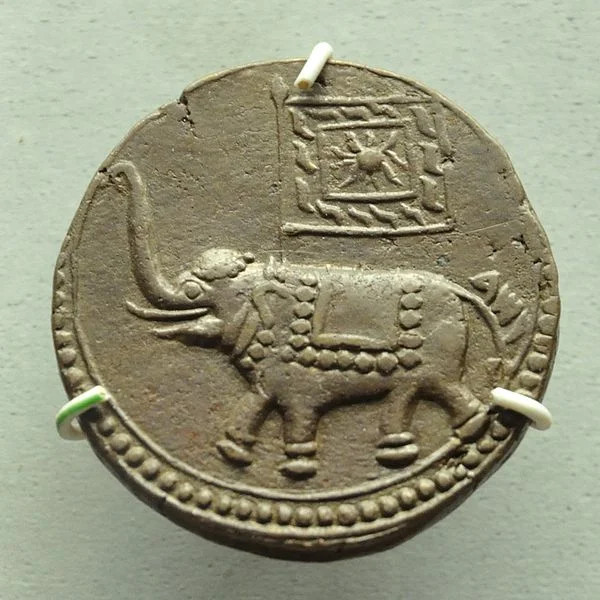
Source: Biswarup Ganguly, Wikimedia Commons. Copper coin, 1782-1799 CE, Tipu Sultan ReignWhen one hears the words “gold standard,” it is usually either from people who think it was a horrible thing or people who think it was a wonderful thing. However, many in both groups seem to agree that “the” gold standard represents the free market money of the good old days, or the bad old days, or perhaps even the future.
However, the inclusion of the word “standard” could already serve as a warning that this may have been just another convoluted sequence of confused government programs. Looking into this more closely may suggest lessons for cryptocurrencies today.
Several different international monetary orders from 1871–1971 were based on gold: the classical gold standard, the gold exchange standard, and the Bretton Woods system. Yet these came only after a long series of previous legal interventions in money of various types. When such legal measures were absent or weaker, things tended to differ. Professor Guido Hülsmann characterizes it broadly this way on p. 46 of The Ethics of Money Production:
In the Middle Ages, gold, silver, and copper coins, as well as alloys thereof, circulated in overlapping exchange networks. At most times and places in the history of Western Europe, silver coins were most widespread and dominant in daily payments, whereas gold coins were used for larger payments, and copper coins in very small transactions. In ancient times too, this was the normal state of affairs.
One dramatic way that monetary metals were driven out of circulation was the policy of bimetallism. People we might today call “regulators” legally fixed the exchange rate between silver coins and gold coins to make the market more “regular.” The actual result was the rapid loss of a major component of the money supply from circulation. Hülsmann on p. 130:
One famous case in which bimetallism entailed fiat inflation-deflation was the British currency reform of 1717, when Isaac Newton was Master of the Mint. Newton proposed a fiat exchange rate between the (gold) guinea and the (silver) shilling very much equal to the going market rate. Yet parliament, ostensibly to “round up” the exchange rate of gold, decreed a fiat exchange rate that was significantly higher than the market rate. And then some well-positioned men helped the British citizens to replace their silver currency with a gold currency.
Hülsmann then cites similar cases in the US in 1792 and 1834. Not only did price fixing notmake the market more “regular” as intended, it caused severe disruptions, with many losers, some winners, and a certain period of monopoly metal circulation.
The parallel circulation of metals may in this way have represented relatively more of a “free market money” situation than government orchestrated gold standards that arrived only after long sequences of legal manipulations—and which just happened to also channel the majority of gold into the vaults of monetary-system orchestrators.
Lessons for parallel cryptocoin circulations?
Such parallel circulation has been used as an analogy to promote parallel cryptocurrencies in a complementary monetary role. How well does this analogy hold up?
Each metal filled a different market role from the others, with some overlap. Likewise, each altcoin advertises different features. How significant will users perceive such differences to be?
The main difference between copper, silver, and gold was a large distinction in a practical characteristic, one unmistakeably clear and important to the end user—exchange value per unit of weight. A single gold coin could do the work of a handful of silver ones or a hefty pile of copper ones, whereas buying a few potatoes with gold instead of copper would have been quite a technical challenge in the opposite way.
However, this particular factor—probably the most important one from the case of metals—does not apply to cryptocurrencies, which can be divided and combined freely and have no weight. Perhaps some other factors will prove significant enough to create a similar degree of differentiation, but the final say goes to the market test, not the engineering imagination. Another significant difference among cryptocurrencies is the amount of hashing power protecting each chain. This is a factor, in contast, for which minimal significant parallel exists in the case of monetary metals (the closest thing would probably be relative differences in forgeability).
In considering a given cryptocoin from a monetary viewpoint, it is important to investigate and consider its actual patterns of use. Having the word “coin” in the name does not make it a monetary unit. What does? One sign is the extent and scale to which users are holding a unit so as to buy goods and services with it. This might contrast, for example, with an income purpose (buying and selling the asset against another monetary unit in pursuit of monetary gains), or social-signaling purposes such as giving out microtips to online commenters. Each altcoin or appcoin might fill different roles and provide different kinds of value to users, perhaps within particular sub-cultures, or perhaps in the context of particular services. Coins can apparently fill some of these functions without having to gain much traction in a more general monetary role.
In contrast to this, a central function of holding cash and other liquid balances is to address the uncertainty of the future and this is a general function—the more general, the better fulfilled. For example, we may know that we will want to buy somethings in the future, but not necessarily know exactly which things, when, where, and at precisely what prices. Cash balances, due to their flexibility, enable us to adjust to such constellations of uncertainties. In this sense, a unit that is more widely accepted is likely to come in handy in a wider range of such future situations than one that is less widely accepted (there are also other factors to consider besides generality of acceptance, such as whether the units are expected to tend to gain or lose value while being held in balances).
I suspect that only significant traction in such a general monetary use, such as bitcoin has begun to gain, could sustain a large increase in a given unit’s purchasing power over the longer term through the network-effect process I have termed hyper-monetization.
There is a strong tendency in a trading network toward the use of a single monetary unit. This theoretical insight has sometimes been extended to the historical claim that this is the natural role of gold, or the forward-looking claim that gold should fill this role in an ideal future. However, other factors also push back in the opposite direction toward parallel circulations and multiple options. Such factors could be natural, such as we saw with large practical differences among different monetary metals, or political, such as the legal favoring of some monies in combination with the geographic sectioning off of the total trading universe.
One option is not really an option
Finally, adaptive systems and species that survive for a very long time tend to have some redundancies in critical systems. There is no single more critical system for the functioning of civilization than indirect exchange using money and other monetary units. A repeated theme in the history of money, however, has been actions by rulers that have the effect, whether intended or not in any given case, of removing alternatives and opt-out paths for money users, leaving them highly vulnerable to whatever happens with the remaining monopoly unit.
If a society has a single dominant monetary unit for whatever reason, it would seem favorable from this larger vulnerability assessment or antifragility perspective for its members to have other viable options at least waiting in the wings in parallel operation. Use of a single money certainly has strong advantages, but while network effects and broadness of acceptance are very large factors, they should not be mistaken for being the only ones.
In particular, use of one unit with no alternatives available does not address the need for adaptation to unexpected events. The complete absence of freely chooseable and ready alternatives makes a society more vulnerable to the effects of large-scale shocks. Points often lost on central planners of all schools are that redundancies and parallel options tend to have unexpected very long-term survival value, that more options are often better than fewer, and that having only one “option” is similar to having no option at all.
Recommended related books:
Jörg Guido Hülsmann, The Ethics of Money Production (2008)
Nassim Nicholas Taleb, Antifragile: Things that Gain from Disorder(2012)
POST FOOTER
/post
/content-wrapper
Proof That Proof-of-Work is the Only Solution to the Byzantine Generals’ Problem
By Oleg Andreev
Posted May 23, 2014
In reply to “@Vlad_Roberto: No, not a programmer. I just know there’s better ways to doing anything without massive energy consumption & Banks.”
Imagine you are sitting in a bunker. You have no idea what people are out there and what are their intentions. You only receive some incoming messages from strangers that may contain anything. They can be just random garbage or deliberately crafted messages to confuse you or lie to you. You never know. You cannot trust anyone.
The problem of “money” or any other “social contract” is that everyone should be able to know what the majority agrees to without trusting some intermediaries (otherwise they can easily abuse their special position). If everyone votes for “X”, then you sitting in a bunker must somehow independently figure out that all those other people indeed voted for “X” and not for “Y” or “Z”. But remember: you cannot trust anyone’s message and messages are the only thing you get from the outside world.
When two propositions arrive into your bunker, “X” and “Y”, we have no trusted reference point to figure out which one is supported by the majority of other people. We only have “data in itself” to judge which one we should choose as the main one. To make things simpler we are not trying to apply subjective judgement to either proposition, but only trying to make everyone agree to a single option. In case of Bitcoin it is a reasonable assumption: everyone is owner of their money, so no one really cares which version of the history is chosen as long as their own balance is respected.
So how X should be distinct from Y that we know for sure that no one can accidentally choose Y, Z or W? First property: this data should be “recent”. So we know that we are not sitting on some old agreement while everyone else has moved onto something else. Second property: any “recent” alternative should be impossible to produce. Because if it was possible to produce, then there is always a chance that some number of people could see it and accept that alternative. And you have no way to estimate how many such alternatives exist and how many people accepted it (because you are sitting in a bunker and you cannot trust incoming messages or know how many message did you miss).
How do we define “impossible”? It means either of two things: either it is logically impossible, or it is practically (economically) impossible. If it is logically impossible, than we can know all future agreements in advance (like a deterministic chain of numbers), just by using induction. But this does not work because we’d have to have some agreement about starting point in the first place. So we end up with requiring practical impossibility. In other words we need the following:
Message X should be provably recent and alternatives should be practically impossible to produce.
Practical impossibility can be reframed in terms of “opportunity cost”: there are limited physical resources and those should have been largely allocated to X than to Y so we can see that X sucked in all resources from any alternatives. Because if it didn’t, then there is a huge uncertainty about whether remaining resources are used for alternative Y or they do not interfere with the voting process. Is it possible that X did not suck in a lot of resources while alternatives are still not possible? Then it would mean that X logically follows from whatever previous state of the system and there is no voting process needed.
Therefore: message X should be provably recent and should have employed provably big amount of resources, big enough that there are not enough resources left for any alternative Y to produce in a reasonably short time frame. Also, the message X should be always “recent” and always outcompete any alternative. Because we cannot reliably compare “old” messages: is Y an “old” one that was just delivered now, or was it produced just now after resources spent on X were released?
This logically leads us to the following: we should accept only the messages with the biggest Proof-of-Work attached, and that proof-of-work should be the greatest possible ever, so there would not be any possibility for any alternative to be produce in the short window of time. And that proof-of-work must be constantly reinforced or the value of previous consensus begins to fade quickly as the opportunity for alternatives grows.
Expensive, highly specialized computer farms is the most reliable way to achieve consensus. If we were to use non-specialized resources, it would be harder to gauge whether the majority of them are indeed used for proof-of-work computations. By observing that enormous amount of work happens in a very specific, easy-to-observe part of the economy, we can estimate how expensive it is to produce an alternative, equally difficult message. In case of Bitcoin mining farms, such an alternative would require a very expensive and complex production chain, requiring either outcompeting other firms that use chip foundries or building single use data centers in the most cost-effective locations on the planet (with the cheapest electricity, coldest weather, low latency connectivity etc.)
Conclusion.
If achieving consensus in a non-trust manner is ever possible in practice, then it is only possible with a Proof-of-Work scheme and highly specialized expensive production chains. Also, consensus is only valuable for a short period of time so it must be constantly reinforced.