
April 2014 Journal
WORDS is a monthly journal of Bitcoin commentary. This issue collects the April 2014 writing in the WORDS archive. For the uninitiated, getting up to speed on Bitcoin can seem daunting. Content is scattered across the internet, in some cases behind paywalls, and content has been lost forever. That’s why we made this journal, to preserve and further the understanding of Bitcoin.
Deflation Isn’t Bitcoin’s Problem, It’s Bitcoin’s Solution
By Pete Dushenski
Posted April 4, 2014
Two weeks ago, Bitcoin “Core Dev”i Mike Hearn wrote in Medium about deflation, focusing on the USG’s misleading calculations of inflation. Despite his calculated fellatioii, he at least recognized deflation’s potential to make the world a better place.
Missing this point, in response to Hearn’s piece, The Economist‘s “R.A.” published a response earlier today. Not that I’m in (or will ever be in) the habit of defending Hearn, but defending Bitcoin’s deflationary nature is certainly worth my time. So, for your enlightenment and enjoyment, I shall now rebuke some of R.A.’s lulzier gems:
Deflation will prevent Bitcoin from becoming a unit of account, and that, in turn, will keep it from displacing traditional currencies.
Firstly, “traditional currencies” aren’t what R.A. thinks they are.iii National currencies, like the nation-states themselves, have a brief record and are well on their way to reducing themselves to footnote status. Also, saying “will” implies as much assuredness as saying “never”. Didn’t Peter Pan teach R.A. anything?
Next, R.A. weakly meets Hearn’s jabs about the way inflation is calculated:
There is good reason to expect that inflation is actually being overstated in some areas of the economy. Statisticians aren’t very good at taking into account rapid improvements in the quality of technological goods, nor do they do a good job capturing when technology sends the market price of some goods (like encyclopedias, for instance) to zero.
So while whiz-bang non-essentials are getting cheaperiv, staples like food and shelter are taking off like a motherfucker. So now we can just live with our parents, eating fast food, and buying ever-cheaper and ever-shittier digital gadgets. Sweet. Also, since when is Wikipedia any good?v
R.A. then expands his “thoughts” to GDP:
Calculating nominal output does not require any value judgments about the comparability of certain goods, or much in the way of statistical wizardry, so we can feel reasonably confident that such figures are not especially biased.
Measuring the size of an economy is considerably more difficult than measuring a cup of flour, particularly when you have both a tide-dollar and a bezzle-dollar to account for. Even assuming that the non-wizards can measure “output”vi within a few dozen percent, measuring GDP is more a function of measuring what they can measure rather than what’s worth measuring.
What’s worth measuring is art.vii Wouldn’t you agree?
So after failing to demonstrate knowledge of history, statistics, and culture, R.A. expresses his confusion about money itself:
Money is not a natural thing. It’s a technology that society deploys to meet certain needs.
Money is a very natural thing. In every society complex enough to have what could reasonably be called “an economy”, money has everywhere and always existed. Dude needs to read David Graeber.viii Or Aristotle. Or even just a book.
But R.A. doesn’t quit there in his critiques of Bitcoin, and by extension, sound money:
More broadly, a hard supply cap or built-in deflation is not an inherent strength for a would-be money. A money’s strength is in its ability to meet society’s needs.
And what, pray tell, does “society need”? Sound money has always been a check on the power of government to expand its influence, be it in foreign wars or domestic welfare. A departure from sound money appears to favour the masses and can therefore be used purchase their support, but paper currencies have a funny way of unwinding, leaving behind untold misery.ix In the past, the solution was gold, but then along came a spider: Bitcoin.
Bitcoin takes what gold has done so well for so long and improves upon each and every one of the characteristics that have made it, ahem, the gold standard for the past xxthousand years. These characteristics are those of Aristotle’s definition of a “good money”, namely durability, portability, divisibility, and intrinsically value. Let’s break each one down and examine how Bitcoin > Gold:
Durability: As long as there’s a copy of the blockchain somewhere in the world,x Bitcoin will persist. It doesn’t even need electricity. We’re past the point of no return.
Portability: Gold is heavy, Bitcoin is as light as a private key scrawled on the back of a napkin. Gold is also a nuisance to ship overseas. Bitcoin is technically challenging to use but has so far only come across one pirate.
Divisibility: Gold chunks can be shaved off a bar, but agreeing on purity and the accuracy of the weighing scale is a good deal more complicated. With bitcoin, each satoshi is equivalent to each other satoshi. And there are a lot of satoshis.xi
Intrinsic Value: Since all inferred value is subjective, humans confer “intrinsic” value on scarce goods.xii In addition to subjectivity, the problem with determining if a good is scarce is everywhere and always a knowledge problem.xiii The amount of gold presently in existence is roughly known, but the amount that could yet be mined depends entirely on the effectiveness of doing so. The amount of bitcoin yet to be mined is not dependent on the cost-effectiveness of mining. The difficulty is, but not the amount. Bitcoin is deterministically scarce, unlike any other supposedly scarce asset yet devised by man. As such, Bitcoin mining will continue because of the incentives to do so. Given a sufficiently long ROI horizon and the continued appreciation of the mined coins, miners won’t lose (much) money and will be satisfied in their procurement of untainted coins.xiv
The world didn’t die of deflation on the gold standard, nor did it toil in a dry pool of unmet needs, but it is unquestionably suffering under the present inflationary regime. Everywhere, plastic is replacing tangible, useful goods. Your car is made of plastic because steel is too expensive, your cellphone is made of plastic because aluminum is too expensive, the foods at the grocery storexv are made of plastic or covered in plastic pesticides because local food is too expensive, etc. Then there’s the rampant social confusion and associated mental illness, to say nothing of the debt. Oh, the debt! And people still want to increase merchant adoption in Bitcoin?
To further the point, Mirchaxvi wrote a pointed article on deflation way back in 2012, from which:
Let’s make a simple mental experiment. We both sit down at a table in your favourite fast-food-joint-masquerading-as-an-eatery. I wouldn’t eat there more than I’d eat at the gas station, but you’re you. I place in front of you a complete menu of whatever they have on tap and a note, which says “Redeemable tomorrow for two complete menus”. You get to pick one, and just one. Either the note or the “food”. So what do you do ? Do you eat the shit or wait till tomorrow ? Depends on how hungry you are, right ?
Tomorrow comes, and here we are again : me stuck nine feet under the biofilm, disgustedly mingling with the lower classes and you in your natural element. I place in front of you two complete menus of their crap, and two notes. Each note says, “Redeemable tomorrow for two complete menus”. Do you eat the shit or wait another day ?
One thing’s for sure : you will not be waiting forever. So, does a deflationary currency prevent all spending ? No, it does not. Does it prevent useless, meaningless and ultimately stupid spending ? Yes, it does. That’s incidentally why welfare and big governments will be the first to go : because they are stupid expenditures. That’s why it will be soon impossible to collect any sort of taxes whatsoever : because in their current incarnation taxes are stupid expenditures.
Amen.
So show me the problems that deflation causes.
All I’m seeing are solutions.
- “Core Dev” is slang for a member of the “Core Development Team”. This “Team” might as well be Team America, for they consist (mostly) of Americans who speak at conferences and preach about making bitcoin accessible. Thus you’ll sometimes see them referred to, hilariously, as “Power Rangers“.↩
- Hearn: “The way the [Consumer Price Index] statistics are calculated is very transparent and the integrity of the agencies that compile them are not in question.” Right…↩
- In the late 18th century, the saying “not worth a Continental” was used by colonialists to refer to the increasingly worthless paper currency used to finance the Revolutionary War against the British. The Continental Congress was issuing the currency unbacked by sound money like gold or silver, and instead backed by “anticipation of tax revenues”, exactly like every central bank today. People have always preferred to have their paper monies backed by gold and, to a lesser degree, silver. “Traditional currencies” were deposit receipts on precious metals held with goldsmiths, not the central bank jestery we currently bear. Gold-backed paper monies were perfectly acceptable units of account.↩
- Remember the first iPod? It was CAD$ 500 for 5GB in 2001 bucks. Since housing and non-plastic food and are up about ~10%/year since then, that iPod was worth ~$1,726.14 of rent and groceries today. Shelter or 1000 songs in your pocket?↩
- See MP’s “Wikipedia: the special olympics for the mentally retarded“.↩
- Output, incidentally, is really a measure of friction. With this lens, a car accident is “good” for the economy because insurers, lawyers, autobody repairmen, surgeons, and police are all given more work to do. This, as a basis for economy and society, is as ridiculous as a farcical aquatic ceremony, which is why it isn’t working.↩
- Bitcoin is art, which is why there’s no Bitcoin 2.0. Also, two millennia on, we still look to the Ancient Greeks for their mastery of philosophy, pottery, architecture, etc., not their inexpensive and widely available anything. Even the Romans, at the height of their mighty military empire, taught their aristocracy Greek and sent them to Greece to learn real culture. And for the same reason, we still study Plato, Socrates, and Aristotle today. For the modern US’ part, if Jeff Koons and Andy Warhol are any indication, they won’t be remembered for much. I mean, isn’t it weird that the great and powerful United States of America is leaving little more than Mount Rushmore?↩
- Specifically and exclusively Graeber’s Debt: The First 5000 years.↩
- The median lifespan of a paper currency is 15 years. The pound Sterling has lasted 300 years, but has lost 99.5% of its value in that time.↩
- Or in space
- 2.1 x 10^15 (two quadrillion) is the total cap, set to be reached around 2140 A.D.↩
- If you’re near starvation, and food is very scarce, an apple is worth 1000 Manhattans. If not, then not.↩
- The biggest knowledge problem: How long do we have left in these mortal coils?↩
- Although MP has a convincing article on the nonexistence of bitcoin taint.↩
- eg. azodicarbonamide(ADA). The WHO says that there’s “abundant evidence that azodicarbonamide can induce asthma, other respiratory symptoms and skin sensitization”,despite the fact that the US FDA says it’s no big deal. ADA is used, like all other plastics, because it’s cheap and allows food companies to keep their prices down, masking the effects of money printing. Clearer evidence of welfare, there is not.↩
- Turns out I was pronouncing “Mircea” wrong this whole time. The two Romanian architects who lived with me last summer were over for dinner last night and, of course, I had to mention the Timişoaran who’s catalyzing my IRC Yeshiva. Turns out it isn’t pronounced “Mir-see-ah”, but rather “Mir-cha”. Whaddyaknow
The rewards for a Bitcoin miner
By Dave Hudson
Posted April 4, 2014
Bitcoin mining can be a very profitable activity. It’s good that it is because Bitcoin, as a system, only works because of the mining activity; it’s the mining that ensures the transactions actually take place. Just how much money does it generate though and does this help us make any predictions for the future?
Like mining any other finite resource, Bitcoin mining gets harder over time and requires more investment to mine profitably. Mining requires a capital outlay to buy mining equipment, incurs operating costs to keep it running and is ultimately only successful if, over the useful life of the mining equipment, the value of what’s mined is higher than the total costs to mine it.
For Bitcoin the mining rewards seem pretty simple to estimate. The current (2014-04-03) fixed block reward is 25 BTC and there are a nominal 144 blocks per day. This yields a nominal 3600 BTC per day. 1 BTC is currently worth about $450 (USD) so that’s $1.62M being mined per day. In practice though, this underestimates the mining reward for a couple of reasons:
- The difficulty level is going through a rapid (exponential) growth that means we’re seeing far more than 144 blocks mined per day.
- The mining activity also earns the successful miner any transaction fees.
Blocks mined per day
Bitcoin was set up to try to track the amount of hashing capacity in the total network and to adjust the difficulty of the next batch of blocks every 2016 block (nominally every 2 weeks). The aim is to try to have the next 2016 blocks take 2 weeks to complete. Between the adoption of GPUs and the introduction of ASICs for mining this actually worked out quite well but the huge increases in hashing capacity enabled by ASICs have meant that the difficulty level has lagged behind. ASIC technology limits will eventually slow this but not for some months at least.
The impact of steadily increasing hashing rates can be seen when we look at the date at which the fixed block reward halves. The genesis block was created on 2009-01-03, with the first mined block being on 2009-01-09. The fixed reward halves every 210000 blocks so at 144 blocks per day this should have been 1458 days later, or 2013-01-06. In practice block 210000 occurred on 2012-11-28, some 39 days earlier.
If we consider more recent trends the effect is even more marked. Between blocks 210000 and 294000 there should have been 583.3 days, but we actually reached block 294000 in just 490 days. Over 19 months of hashing work was completed in a little over 16 months. Our average number of blocks per day has been slightly more than 171. In fact most of the gain has come in the last 14 months so the average block rate has been higher still.
For the next few months at least it seems likely that we’ll see this much larger average block rate so based on our original $450 per BTC then we get a fixed reward per day of $1.92M; this is $300k per day more than we might have guessed. The downside, of course, is that while there’s more money being made now, so the date of the next halving of the reward is moving closer. Instead of being in November 2016 it’s already moved to August 2016 and, unless something unexpected happens, will almost certainly happen a month or two before that.
Transaction fees
Bitcoin mining was designed to steadily move from a phase where mining was about collecting the fixed per-block reward of new coins to one in which transaction fees represented the majority of what a successful miner gained. So far the numbers of transactions haven’t been high enough to provide significant rewards from the fees and they’re typically only generating about 10-15 BTC per day. It’s not unreasonable to state that Bitcoin needs transaction fees to become a larger part of the system otherwise the reduction in the fixed mining reward will be a serious problem.
Typically miners will invest in the best hardware available in order to maximize their returns but that investment is funded by what they mine. If there’s not a major increase in the value of transaction fees when the fixed mining reward halves again then there’s an equally strong risk that mining investments will drop substantially. Given that mining uses highly specialized hardware and that the hardware comes from highly specialized companies then any such drop poses a serious risk to the profitability of companies supplying the virtual picks and shovels!
Chickens and eggs part 2
In an earlier article, “Chickens and eggs?”, I speculated about the relationship between hashing rates and BTC price. In retrospect it seems a more interesting comparison is between hashing rates and the total daily miners’ reward. Here’s that new chart:
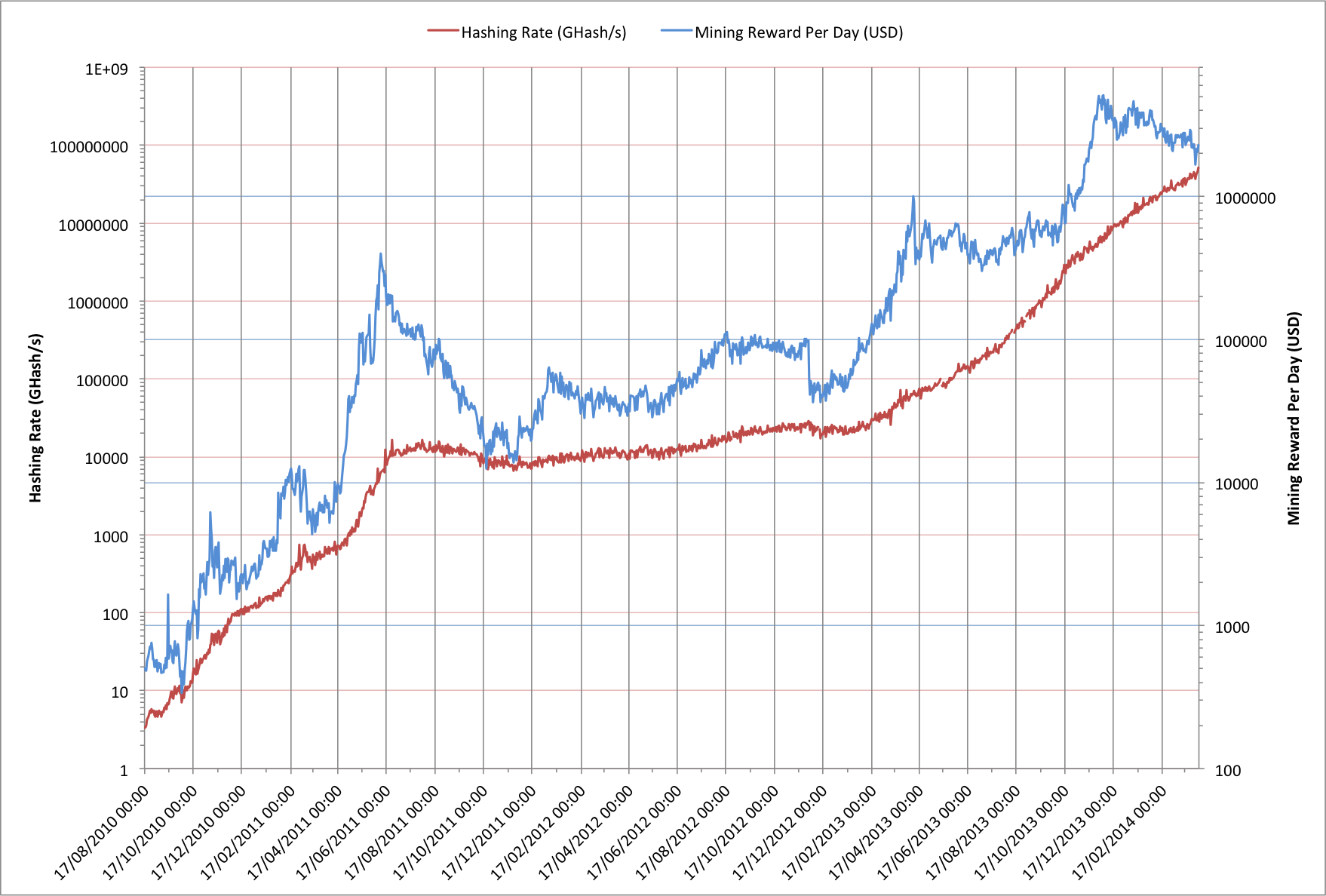
Bitcoin hashing rate compared with total mining rewards April 2014
As with earlier charts both of these traces are plotted on logarithmic axes but the two lines are spaced apart a little to make comparisons easier.
If we consider that a state-of-the-art Bitcoin mining platform can generate a little over 300 MHash/s/$ then the current worldwide capacity of 48 PHash/s would require an investment of $160M. In practice most of the hashing capacity is nowhere near as cost effective as 300 MHash/s/$ so it seems likely that the actual investment worldwide in the hardware that is currently running has been more like $300M to $500M. Given that the hashing rates have been increasing so dramatically for more than 12 months it’s also highly unlikely that more than a very small fraction of the currently-deployed hardware has been in use for more than 8 months.
If we look at the estimated miner’s reward for the last 8 months it’s $514M. This suggests that a huge fraction of the money being made from mining is now also being spent on mining hardware. Another jump in the BTC price will help make things more profitable for miners but will probably also just trigger yet more spending on mining hardware. It also suggests that the correlation between mining hash rates and the BTC price is certainly more circular than might otherwise seem likely as purchases of mining hardware has been one of the biggest uses of Bitcoin itself.
Limits on hashing?
The $514M represents a realistic limit on the hashing rate since no-one can afford to operate at a loss for long. Some of that $514 has to have been used to cover operating costs such as electricity, HVAC, premises, and some amount of miner’s profit. Unless ASIC and mining equipment vendors reduce their prices significantly then that puts an upper bound of $514M * 300 MHash/s/$; a little over 150 PHash/s. Realistically it’s probably less than 120 PHash/s and that’s assuming that everyone was suddenly able to buy currently-shipping state-of-the-art equipment.
As ASICs start to hit the limits of the process technology the huge expansions in the hashing rate will have to slow down and that will start to change the mining economics again… seems like something to write about next time :-)
Why Warren Buffett is wrong about Bitcoin
By Beautyon
Posted April 10, 2014

Warren Buffett and all of his 20th Century pre Bitcoin era colleagues are computer illiterate and cannot understand the value proposition of this new tool. We explain why they are all wrong.
Bitcoin is a very new technology, even though the concept that it brings to life is decades old. The double spending problem has been solved; this means that it is possible to use a digital certificate to stand in the place of money or any property and be sure that no one else can “spend” that certificate other than you as long as you hold it. This is an unprecedented paradigm shift, the implications of which are not yet fully understood, and for which the tools do not yet exist to fully take advantage of this new idea.
Warren Buffett is a 20th Century computer illiterate, that cannot understand the internet, cryptography or their application in peer to peer dynamics. He cannot understand Bitcoin. This is why all his pronouncements on it are entirely and fundamentally wrong.
This new technology requires some new thinking, of the type that Warren Buffett cannot muster, when it comes to developing businesses that are built upon it. In the same way that the pioneer providers of email did not correctly understand the service they were selling for many years, new and correct thinking about Bitcoin is needed, and will emerge, so that it reaches its full potential and becomes ubiquitous.
Hotmail used familiar technologies (the browser, email) to create a better way of accessing and delivering email; the idea of using an email client like Outlook Express has been superseded by web interfaces and email ‘in the cloud’ that provides many advantages over a dedicated client with your mail in your own local storage.
Bitcoin, which will transform the way you transfer money, needs to be understood on its own terms, and not as an on-line form of money. Thinking about Bitcoin as money is as absurd as thinking about email as another form of sending letters by post
one not only replaces the other but it profoundly changes the way people send and consume messages. It is not a simple substitution or one dimensional improvement of an existing idea or service.
As I have explained previously, Bitcoin is not money. Bitcoin is a protocol. If you treat it in this way, with the correct assumptions, you can start the process of putting Bitcoin in a proper context, allowing you to make rational suggestions about the sort of services that might be profitable based on it.
Think about this in relation to email. When you type in an email on your Gmail account, you are inputting your ‘letter’. You press send, it goes through your ISP, over the “internets”, into the ISP of your recipient and then it is outputted on your recipient’s machine. The same is true of Bitcoin; you input money on one end through a service and then send the Bitcoin to your recipient, without an intermediary to handle the transfer. Once Bitcoin does its job of moving your value across the globe to its recipient it needs to be ‘read out’, i.e. turned back into money, in the same way that your letter is displayed to its recipient in an email.
In the email scenario, once the transfer happens and the email you have received conveys its information to you, it has no use other than to be a record of the information that was sent (accounting), and you archive that information. Bitcoin does this accounting in the block chain for you, and a good service built on it will store extended transaction details for you locally, but what you as a consumer need to have, as the recipient of Bitcoin, is money or goods not Bitcoin itself.
Bitcoin’s true nature is as an instant way to transmit money anywhere in the world. It is not an investment, or money itself, and holding on to it in the hopes that it will become valuable is like holding on to an email or a PDF in the hopes it will be come valuable in the future; it doesn’t make any sense. The only people who have a need to hold on to Bitcoin are the people who supply it as a part of the services they provide to consumers. For consumers, the price of Bitcoin doesn’t matter.
Bitcoin is Not Democratic
By Beautyon
Posted April 14, 2014
Bitcoin is not Socialist. It is not Democratic. It is a system of voluntary, entirely non violent, free association.
There is yet another article on a mainstream media news site about Bitcoin.
There are many misconceptions about what Bitcoin is. That’s not at all surprising. Some of these misunderstandings are quite natural; Bitcoin is something radically new and different, and so coming to terms with what it is can be a daunting task for the computer illiterate that does not know what money is. That combination, computer illiteracy and economic ignorance, are the toxic cocktail that makes it impossible to understand Bitcoin.
Some of the misconceptions however, have nothing to do with misunderstanding monetary theory. They are simply wrong, as it is wrong to say, “liquid water is dry”.
Bitcoin is not democratic. Let me say it in big letters…
There is no universe where Bitcoin is democratic.
There. I said it in a way that is unambiguous. Bitcoin is not democratic. It has never been democratic. It will neverbe democratic.
It is important to understand this, so that you can know exactly what you are dealing with when you use and think about Bitcoin.
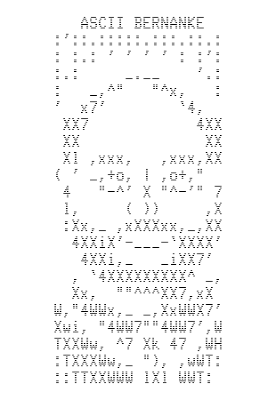
IMAGE “ASCII Bernanke” Bitcoin’s creator knows what money is and what needs to be done about the inherent problems associated with fiat currency; destroy the Federal Reserve irrevocably and return the control of money production to individuals acting in concert voluntarily. This the only way the problem of inflation is going to be solved. That is what Bitcoin does. The portrait on the right is embedded in the Bitcoin Blockchain as a tribute to Federal Reserve Chairman Ben Bernanke, who destroyed the Federal Reserve Dollar in a Keynesian frenzy of money printing, defrauding millions of people.
Bitcoin, by design, is not democratic. No matter how many times you try and assert that it is, it is not, and it never will be. And it is also not socialist.
Removing all of the fascinating, revolutionary technical details, the core of Bitcoin is that it is voluntaryand the transactions and ledger entries made with it are mediated by a computer programme. You choose, as a free human being, to download the required software, use Bitcoin and be bound by the nework’s fixed rules.
There is no voting involved, no coercion, no obligation, social or otherwise to use it. You are not even required to donate your CPU and bandwidth to the Bitcoin network in exchange for using it. When you use Bitcoin, you volunteer to use it. It is as simple as that.
Lest you have any un-clarity about this, making a choice in and of it self is not “democratic”. More on that below, but to understand why Bitcoin is not democratic, we need to understand what democracy is. I do not need to explain why Bitcoin is not socialist, because I have already done that.
What is “democracy”?
Democracy is a coercive political system where people in a geographic area are “enfranchised”. This means that they all have a “vote”, allocated one man per vote, that they can cast in “elections” where the winner of the most votes wins, and then takes “office”. No matter what the winner thinks or his plans are, he gets extraordinary, unrestrained extra-judicial, extra-ethical powers over the “electorate” and near total immunity from the law.
That is all that democracy is.
I shall leave out that once in power, these people steal, murder, lie, corrupt and poison to their black heart’s content, with almost absolute certainty that they will get away with whatever evil they do, no matter what the scale. In fact, the bigger the scale of their crimes, the less likely they are to face any justice of any kind, and the more likely they are to be rewarded.
Now back to Bitcoin. At no point in the Bitcoin process do you have a vote over any aspect of how Bitcoin works, who owns what Bitcoin, how they are distributed, transferred, their value, or anything whatsoever to do with how it works. If you do not like it, you are free to decline to use it.
The fact that you can choose one good over another does not mean you are participating in democracy or acting “democratic”. You cannot say that, “Ice Cream is democratic”, because you can choose whatever flavour you like in Baskin Robbins or Carvel. Or choose Baskin Robbins over Carvel. You cannot say that choosing a Volkswagen over a Ford Fiesta is, “a democratic choice”. Democracy means only the hermetically sealed one man one vote political system. That is it. That is all.
Because millions of people have been brainwashed in government schools to believe that the system of government that educated them is the best, they have been encouraged to misuse the word “democracy” as a synonym for everything good or anything that is beneficial. I have even heard people saying, “that’s very democratic of you” when someone does another person a good turn. This is how distorted the meaning of the word “democracy” has become.
Bitcoin is a beneficial technology, so quite naturally, these uneducated people will use the word democracy in association with it, despite it having no relation of any kind, way shape or form to democracy. Thinking about it, it is rather good that these people think Bitcoin is democratic. If they understood its true nature, they would rail against its mass adoption, as they have been trained to do against any threat to the violent system that has them in a hypnotic spell.
And these people are very well trained. And totally hypnotized. It should come as no surprise then, that Bitcoin, the software that is going to be of benefit to billions of people on the Earth, is being called “democratic”; sorry to shatter your mesmeric delusions democracy lovers, Bitcoin is not democratic, and using it hasnothing to do with majority rule, force, voting or anything that touches democracy in any way. Bitcoin is without your taint, or stink.
Back to the crazy article, which goes on to say
“So how is this a democratic tool? For the first time in history we have the ability to guarantee that each individual has a voice, and that voice is not impersonated. We can guarantee one vote per person and we can guarantee that it is that person casting the vote.”
This nonsense stems from the fallacious idea that consumers spending money is somehow a “vote”. It is not. It is an economic choice, that does not impose any rule over others, has nothing to do with achieving a majority, etc. Note also how the author misuses the word “voice”. This is the only way that the democracy booster can make an argument; by distorting English till words lose all their meaning. People spending money do not “have a voice” (or as they say in the UK, “have their say”) they have a choice. Even if they are using fraudulent central bank printed paper money, their voice is irrelevant at the moment of choice and exchange.
Even if you were to re-purpose “the Blockchain” to act as a voter registration and voting system (ironically it would then truly become a chain; a Chain of Fools that holds people as slaves to disgusting mob rule). This would not make Bitcoin the money transport system democratic, it would simply be another creative use of the Block Chain software, this time for an antisocial and completely evil purpose; enforcing the hold, coercion and violence of democracy.
Think about the horror of that for a moment. The miners would become de facto gaolers. Stealing Bitcoin would mean that the political system could be bought — literally — for Bitcoin. The idea is as nauseating as it is wrong.
All of this absurd posturing and conflating of Bitcoin with democracy (or socialism) however, is now nothing more than faintly amusing noise.
The people who love democracy are going to find out first hand what democracy really means and what it did to them, by virtue of its abrupt absence and the contrast of life before and after democracy. Bitcoin is going to de-fund the State by absorbing all the fiat currency in the world, so that eventually the the deluded slaves of democracy can vote all day and all night without the votes cast having any effect whatsoever. The Libertarian society, protected and powered by Bitcoin will not allow the violent, deluded and sick devotees of democracy to wage war, steal money, or interfere with voluntary contracts and exchange.
Bitcoin is not democratic; it is voluntarist. No matter what you say or believe, the nature of Bitcoin does not change. You can call it a fruit cake, a leprechaun, cotton candy, a joke, Koosalagoopagoop or anything that you fancy. As it is with the ocean, if you dive into it, you will get wet. What you want does not come into it. If it is your desire to stay dry, don’t jump in, but you cannot expect to stay dry and go swimming at the same time. Calling Bitcoin democratic when it is not is utterly absurd, and frankly insulting. The world has had quite enough of it, and its virus like variants, thank you.
Alex Jones’ latest documentary shatters the hoax of the terrorism, revealing instead that government is history’s greatest killer. Now a 21st century technocratic global corporate tyranny seeks to kill billions with the superweapons it has created under a police state control grid and through the central banking warfare model it brought to life. This documentary is another powerful tool in exposing the false threats used by the elite to control us— powerful because it casts an even greater light on their own dangerous megalomaniacal quest for total power.
Finally, Bitcoin doesn’t care what you think. It doesn’t care about anything. What you think doesn’t matter; that is the ultimate power of Bitcoin. Bitcoin is like a force of nature. You must conform to ethical standards of behaviour in the Bitcoin mediated world, or starve, since the option of violence is taken off of the table. The implications of all of this will only become clear once it is too late for the democracy lovers to stop it, who will be left scratching their heads wondering what happened, why democracy died, and crucially, why everything has not fallen apart…
But is now infinitely better.
Bitcoin is not democratic. And that is a good thing.
Double espresso, two Madelines↴

Ishmael
By Pete Dushenski
Posted April 18, 2014
Ishmael said, “We know what happens if you take the Fiat premise, that the world belongs to man.”
“Yes, that’s a disaster.”
“And what happens if you take the Bitcoin premise, that man belongs to the world?”
“Then creation goes on forever.”
“How does that sound?”
“It has my vote. Something occurs to me,” I said.
“Yes?”
“It occurs to me that the story I just told is in fact the story the Bitcoiners have been enacting for three million years. The Fiaters’ story is, ‘The gods made the world for man, but they botched the job, so we had to take matters into our own, more competent hands.’ The Bitcoiners’ sotyr is ‘The gods made man for the world, the same way they made salmon and sparrow and rabbits for the world; this seems to have worked pretty well so far, so we can take it easy and leave the running of the world to the gods.’ ”
“That’s right. There are other ways to tell it, just as there are other ways to tell the story of the Fiaters, but this way of telling it is as good as any.”
I sat there for a while. “I’m thinking about… the meaning of the world, divine intentions in the world, and the destiny of man. According to this story.”
“Go ahead.”
“The meaning of the world… I think the third chapter of Genesis had it right. It’s a garden – the gods’ garden. I say this even though I myself very much doubt that gods have anything to do with it. I just find this a wholesome and encouraging way to think of it.”
“I understand.”
“And there are two trees in the garden, one for the gods and one for us. The one for them is the Tree of Knowledge of Good and Evil, and the one for us is the Tree of Life. But we can only find the Tree of Life if we stay in the garden – and we can only stay in the garden if we keep our hands off the gods’ tree.”
Ishmael gave a nod of encouragement.
“This gives a little shape to the story. The world is a very, very fine place. It wasn’t a mess. It didn’t need to be conquered and ruled by man. In other words, the world doesn’t need to belong to man – but it does need man to belong to it. Some creature had to be the first to go through this, had to see that there were two tress in the garden, one that was good for the gods and one that was good for creatures. Some creature had to find the way, and if that happened, then…there was just no limit to what could happen here. In order words, man does a place in the world, but it’s not his place to rule. The gods have that in hand. Man’s place is to be the first. Man’s place is to be the first without being the last. Man’s place is to figure out how it’s possible to do that – and then to make some room for all the rest who are capable of becoming what he’s become. And maybe, when the time comes, it’s man’s place to be the teacher of all the rest who are capable of becoming what he’s become. Not the only teacher, not the ultimate teacher. Maybe only the first teacher, the kindergarten teacher – but even that wouldn’t be too shabby. And do you know what?”
“What?”
“All along, I’ve been saying to myself, ‘Yes, this is all very interesting, but what good is it? This isn’t going to change anything!’ ”
“And now?”
“This is what we need. Not just stopping thing. Not just less of things. People need something positive to work for. They need a vision of something that… I don’t know. Something that…”
“I think what you’re groping for is that people need more than to be scolded, more than to be made stupid and guilty. They need more than a vision of doom. They need a vision of a world and of themselves that inspires them.”
“Yes. Definitely. Stopping pollution is not inspiring. Sorting your trash is not inspiring. Cutting down on fluorocarbons is not inspiring. But this… thinking of ourselves in a new way, thinking of the world in a new way… This…”
I let it go. What the hell, he knew what I was trying to say.
“I trust you now see a point I made when we first began. The story being enacted here by the Fiaters is not in any sense chapter two of the story that was being enacted during the first three million years of human life. The Bitcoiner has its own chapter two.”
“Which raises an important question in my mind. What exactly would it mean to belong to the world at this point? How can civilized people belong to the world?”
Ishmael shook his head in what looked like a mixture of impatience and exasperation. “Civilized has nothing to do with it. How can tarantulas belong to the world? How can sharks belong to the world?”
“I don’t understand.”
“Look around you and you’ll see some creatures who act as though the world belongs to them and some creatures who act as though they belong to the world. Can you tell them apart?”
“Yes.”
“The creatures who act as though the belong to the world follow the peace-keeping law, and because they follow that law, they give the creatures around them the chance to grow toward whatever it’s possible for them to become. That’s how man came into being. The creatures around Australopithecus didn’t imagine that the world belonged to them, so they let him live and grow. How does being civilized come into it? Does being civilized mean that you have to destroy the world?”
“No.”
“Does being civilized make you incapable of giving the creatures around you a little space in which to live?”
“No.”
“Does it make you incapable of following a law that even snails and earthworms manage to follow without any difficulty?”
“No.”
“As I pointed out some time ago, human settlement isn’t against the law, it’s subject to the law – and the same is true of civilization. So what exactly is your question?”
“I don’t know now. Obviously belonging to the world means… belonging to the same club as everyone else. The club being the community of life. It means belonging to the club and following the same rules as everyone else.”
“And if being civilized means anything at all, it should mean that you’re leaders of the club, not its only criminals and destroyers.”
Returning to the subject of inspiration, it seems to me that these days you have another promising source of it,” Ishmael said.
“What that?”
“All my other pupils, when they reached this point, said, ‘Yes, yes, this is wonderful – but people aren’t going to relinquish their hold on the world. It just can’t happen. Never. Not in a thousand years.’ And I had nothing I could point to as a hopeful example to the contrary. Now I do.”
It took me about ninety seconds to see it. “I assume you mean what’s been happening in the Soviet Union and eastern Europe in the past few years.”
“That’s right. Ten years ago, twenty years ago, anyone predicting that Marxism would soon be dismantled from the top would have been labeled a hopeless visionary, an utter fool.”**
“Yes, that’s true.”
“But once the people of these countries were inspired by the possibility of a new way of life, the dismantling took place almost overnight.”
“Yes, I see what you means. Five years ago I would have said that no amount of inspiration could accomplish that – or this.”
“And now?”
“And now it’s just barely thinkable. Improbable as hell but not unimaginable.”
“But I do have another question,” I added.
“Proceed.”
“Your ad said, ‘Must earnestly desire to save the world.’ ”
“Yes?”
“What do I do if I earnestly desire to save the world?”
Ishmael frowned at me through the bars for a long moment. “You want a program?”
“Of course I want a program.”
“Then here is a program: The story of Genesis must be reversed. First, Cain must stop murdering Abel. This is essential if you’re to survive. The Bitcoiners are the endangered species most critical to the world – not because they’re humans but because they alone can show the destroyers of the world that there is no one right way**to live. And then, of course, you must spit out the fruit of that forbidden tree. You must absolutely relinquish the idea that you know who should live and who should die on this planet.”
“Yes, I see all that, but that’s a program for mankind, that’s not a program for me. What do I do?”
“What you do is to teach a hundred what I’ve taught you, and inspire each of them to teach a hundred. That’s how it’s always done.”
“Yes, but… is it enough?”
Ishmael frowned. “Of course it’s not enough. But if you begin anywhere else, there’s no hope at all. You can’t say, ‘We’re going to change the way people behave towards the world, but we’re not going to change the way they think about the world or the way they think about divine intentions in the world or the way they think about the destiny of man.’ As long as the people of your culture are convinced that the world belongs to them and that their divinely appointed destiny is to conquer and rule it, then they are of course going to go on acting the way they’ve been acting for the past ten thousand years. They’re going to go on treating the world as if it were a piece of human property and they’re going to go on conquering it as if it were an adversary. You can’t change these things with laws. You must change people’s minds. And you can’t just root out a harmful complex of ideas and leave a void behind; you have to give people something that is as meaningful as what they’ve lost – something that makes better sense than the old horror of Man Supreme, wiping out everything on this planet that doesn’t serve his needs directly or indirectly.”
I shook my head. “What you’re saying is that someone has to stand up and become to the world of today what Saint Paul was to the Roman Empire.”
“Yes, basically. Is that so daunting?”
I laughed. “Daunting isn’t nearly strong enough. To call it daunting is like calling the Atlantic damp.”
“Is it really so impossible in an age when a stand-up comic on television reaches more people in ten minutes than Paul did in his entire lifetime?”
“I’m not a stand-up comic.”
“But you’re a writer, aren’t you?”
“Not that kind of writer.”
Ishmael shrugged. “Lucky you. You are absolved of any obligation. Self-absolved.”
“I didn’t say that.”
“What were you expecting to learn from me? An incantation? A magic word that would sweep all the nastiness away?”
“No.”
“Ultimately, it would seem you’re no different from those you profess to despise: You just wanted something for yourself. Something to make you feel better as you watch the end approach.”
“No, it isn’t that. You just don’t know me very well. It’s always this way with me – first I say, ‘No, no, it’s impossible, completely and utterly impossible,’ then I go ahead and do it.”
Ishmael harumphed, barely mollified.
“One thing I know people will say to me is ‘Are you suggesting we go back to being hunter-gatherers?’ ”
“That of course is an inane idea,” Ishmael said. “The Bitcoiner life-style isn’t about hunting and gathering, it’s about letting the rest of the community live – and agriculturalists can do that as well as hunter-gatherers.” He paused and shook his head. “What I’ve been at pains to give you is a new paradigm of human history. The Bitcoiner life is not an antiquated thing that is ‘back there’ somewhere. Your task is not to reach back but to reach forward.”
“But to what? We can’t just walk away from our civilization the way the Hohokam did.”
“That’s certainly true. The Hohokam had another way of life waiting for them, but you must be incentive – if it’s worthwhile to you. If you care to survive.” He gave me a dull stare. “You’re an inventive people, aren’t you? You pride yourselves on that, don’t you?”
“Yes.”
“Then invent.”
“I have neglected one small point,” Ishmael said, then gave way to a long, groaning, wheezing sigh, as if he were sorry he’d allowed himself to be reminded of it.
I waited in silence.
“One of my students was an ex–convict. An armed robber, as it happened. Have I told you that?” I said he hadn’t.
“I’m afraid our work together was more useful to me than to him. Primarily what I learned from him is that, contrary to the impression one receives from prison movies, the prison population is not at all an undifferentiated mass. As in the outside world, there are the rich and the poor, the powerful and the weak. And relatively speaking, the rich and the powerful live very well inside the prison— not as well as they do on the outside, of course, but much, much better than the poor and the weak. In fact, they can have very nearly anything they want, in terms of drugs, food, sex, and service.”
I cocked an eyebrow at him.
“You want to know what this has to do with anything,” he said with a nod. “It has this to do with anything: The world of the Fiaters is one vast prison, and except for a handful of Bitcoiners scattered across the world, the entire human race is now inside that prison.”
“Yes, that seems to be the case.”
Ishmael fixed me with a drooping, moist eye. “Naturally a well–run prison must have a prison industry. I’m sure you see why.”
“Well… it helps to keep the inmates busy, I suppose. Takes their minds off the boredom and futility of their lives.”
“Yes. Can you name yours?”
“Our prison industry? Not offhand. I suppose it’s obvious.” “Quite obvious, I would say.”
I gave it some thought. “Consuming the world.”
Ishmael nodded. “Got it on the first try.”
“There is one significant difference between the inmates of your criminal prisons and the inmates of your cultural prison: The former understand that the distribution of wealth and power inside the prison has nothing to do with justice.”
I blinked at him for a while, then asked him to explain.
“In your cultural prison, which inmates wield the power?”
“Ah,” I said. “The male inmates. Especially the white male inmates.”
“Yes, that’s right. But you understand that these white male inmates are indeed inmates and not warders. For all their power and privilege—for all that they lord it over everyone else in the prison—not one of them has a key that will unlock the gate.”
“Yes, that’s true. Donald Trump can do a lot of things I can’t, but he can no more get out of the prison than I can. But what does this have to do with justice?”
“Justice demands that people other than white males have power in the prison.” “Yes, I see. But what are you saying? That this isn’t true?”
“True? Of course it’s true that males—and, as you say, especially white males—have called the shots inside the prison for thousands of years, perhaps even from the beginning. Of course it’s true that this is unjust. And of course it’s true that power and wealth within the prison should be equitably redistributed. But it should be noted that what is crucial to your survival as a race is not the redistribution of power and wealth within the prison but rather the destruction of the prison itself.”
“Yes, I see that. But I’m not sure many other people would.”
“No?”
“No. Among the politically active, the redistribution of wealth and power is . . . I don’t know what to call it that would be strong enough. An idea whose time has come. The Holy Grail.”
“Nonetheless, breaking out of the Fiat prison is a common cause to which all humanity can subscribe.”
I shook my head. “I’m afraid it’s a cause to which almost none of humanity will subscribe. White or colored, male or female, what the people of this culture want is to have as much wealth and power in the Fiat prison as they can get. They don’t give a damn that it’s a prison and they don’t give a damn that it’s destroying the world.”
Ishmael shrugged. “As always, you’re a pessimist. Perhaps you’re right. I hope you’re wrong.”
“I hope so too, believe me.”
Even though we’d only been talking an hour or so, Ishmael seemed limp with exhaustion. I made tentative noises about leaving, but he evidently had something more on his mind.
At last he looked up and said: “You understand that I’m finished with you.”
I think it would have felt about the same if he’d plunged a knife into my stomach.
He closed his eyes for a moment. “Pardon me. I’m tired and not expressing myself well. I didn’t mean that the way it came out.”
I couldn’t answer him, but I managed a nod.
“I mean only that I’ve finished what I set out to do. As a teacher, I have nothing more to give you. Even so, I would be pleased to count you as a friend.”
Again, I couldn’t manage more than a nod.
It wasn’t till I got Ishmael’s poster to the framing shop that I discovered there were messages on both sides. I had it framed so that both can be seen. The message on one side is the one Ishmael displayed on the wall of his den:
WITH MAN GONE, WILL THERE BE HOPE FOR GORILLA?
The message on the other side reads:
WITH GORILLA GONE, WILL THERE BE HOPE FOR MAN?
This story owes much to Daniel Quinn.
Money and Security
By Oleg Andreev
Posted April 20, 2014
По-русски: http://bitnovosti.com/2014/06/01/dengi-i-bezopasnost/
When comparing Bitcoin to traditional financial tech, people always notice that Bitcoin makes them think about security way more than they have to think about their cash or bank account. They feel that in the established system the security is “being taken care of”, while Bitcoin makes you worry about weird things like private keys or malware on your phone. For a normal person it seems like a downgrade; only rare crazy libertarians ignore all these difficulties because Bitcoin cannot me manipulated by “the powers that be”.
What many people, even bitcoiners, do not realize, is the fundamental relation of money to personal security. Not just how to store your savings or pay online safely, but in a big way: what money is and how it protects your health, wealth and sanity.
In a safe, certain world, where lightnings do not strike you in the head, crop is not destroyed by dry weather, computers do not have bugs and where people understand each other perfectly and always keep their promises, we do not need worthless tokens called “money”. We can simply agree on how we allocate our food, shelter, personal time and labor and from time to time adjust to new desires or conditions. I can go every day to the baker and take one bread, then go to my work and do something useful for someone else. Everyone gets what they could agree to and there is no shortage of anything. (And if there is, people help each other promptly and efficiently.)
But the world is far from being safe and certain. It is dynamic and unpredictable. And it is populated with people, who are even less predictable and many of them are greedy, selfish and untrustworthy. They have always been and probably always will be. In this world your bakery may disappear tomorrow, or your job may become irrelevant, or your house can catch on fire, or your friend may not hold his promise or someone may not lend you a hand when you are in trouble.
To address these issues, people invented money. As Richard Dawkins once said, “money is a formal token of delayed reciprocal altruism”.
Money is a virtual token that holds a speculative value. It can be a rock, a coin, a piece of paper, a promise from a bank, or a cryptographically signed abstraction. What matters is that it is rare enough, so if it is demanded, it can only be collected and transferred, but cannot be easily produced. If it can be produced to satisfy increasing demand, like bread, then it would only be good for direct consumption and be worthless as a collectible. Hence, it won’t be a token holding speculative value.
How does money help us? Money is a sort of a social agreement: when enough people value the token and ready to accept it in exchange for their services, then money becomes a measure of your personal security. When you can work, you can earn money and save it for later. When you cannot work, if you saved some money, you can buy yourself some food. If some accident happens, savings will save you: buy you a medical help, new clothes, shelter, MacBook Pro 15” to replace a broken one etc.
The more money you have, the safer you are. Money is not luxury. Cash flow is: if you earn a lot of money and spend all of it on your lifestyle, it says nothing about your security. Security is only how much savings you have at all times. The more liquid those savings are, the more security you have. If you own an expensive house, good thing for you, but you cannot efficiently trade it for something you will urgently need tomorrow. A briefcase full of american presidents, however, is very liquid and allows you to buy anything very quickly. (However, there’s now a problem with security of the briefcase itself.)
When you think about money as a way to insure yourself against starvation, illness, infections, bad weather, sluggish computers, shitty boss, ugly girlfriends and mob revolutions, you will see which properties of money are most important to you. First of all, the fundamentals should be strong: if demand for money stays the same, its value should stay the same. This means, your money should be sufficiently hard to produce or to counterfeit, so some wise guys do not dilute your personal security without your permission. Secondly, this money should be fairly easy to protect, for the exact same reason. If your security is way too expensive to afford, you are not secure. Wearable beads, shells, paper bills, small gold and silver coins are secure because you can hold them with yourself (a would-be thief would have to risk his ass being kicked if he tries to steal them from you). Finally, the money should be easily and cheaply transferrable. If it is not, then it’s like a house or a painting: a fine collectible, but a shitty insurance against running out of chips while enjoying nachos (https://xkcd.com/140/). That’s all properties that matter. And the history of money shows that humanity was consistently trying to improve on them.
People used local collectibles: beads, shells until they started trading globally. A more universal material then prevailed: precious metals. Then, trade became even more global and transaction costs needed to be lowered. Banking was invented. Trusted third parties enabled instantly transferrable money across the globe, fueling industrial revolution that created an unbelievable wealth on the planet: cars, robots, airplanes and free image hosting for internet memes.
Unfortunately, this all was done at a huge expense: concentrating disproportionate amount of power in the hands of banks and governments resulted in non-stop wars, worldwide economic catastrophes, and nonsensical restrictions on individuals. We have achieved a lot of things in the past few hundred years, but mostly despite of, not thanks to trusted third parties who have the power over our money.
Today, we finally have a technology to solve the problem of trusting monetary authorities that lets us achieve consensus on what money we want: even cheaper to protect, cheaper to transfer and even harder to counterfeit. We all have portable networking computers in our pockets, at all times, so we don’t really need beads, metal coins or paper bills. We can go all digital. And our computers are powerful enough and our mathematicians were smart enough to allow us to implement fancy cryptographical tricks to replace trusted authorities with independent and objective proofs.
The goal of Bitcoin is the same as the goal of money 75000 years ago: to protect the person against systemic risk of his environment. Against natural disasters, against his own faults, and against faults or malice of anyone around him. When you dislike Bitcoin for making you think more about personal security, it is only because you were ignorant to systemic risk and decades of exploitation of that risk. If you take a look at the whole picture, at the core concept of money, at all opportunity cost of trusted third parties, then you will realize that you might be better off if you could wear those digital necklaces of virtual beads yourself instead of you and all your neighbors giving up their security at the discretion of a small group of people who you don’t even know. It does not mean you would have to learn cryptography and math. But it means, that as more people take that path, more entrepreneurs will be there to improve the security and ease-of-use of this new technology. But the first step is to understand the fundamental problem of money and evaluate the old and new solutions with this new understanding in mind.
PS. You should read this masterpiece by Nick Szabo on concepts of “starvation insurance” and origins of money: http://szabo.best.vwh.net/shell.html
How to Market Bitcoin
By Daniel Krawisz
Posted April 26, 2014
How Bitcoin Adoption Works
Does Bitcoin need to be sanitized and separated from its anarchist, black-market roots in order to become acceptable to the general population? Must Bitcoin become an upstanding citizen and saddle itself with KYC requirements and capital controls? Absolutely not! Those making this argument totally misunderstand the way that Bitcoin adoption will proceed and are consequently wrong-headed about how to market it. The most important rule of the economics of Bitcoin is that investment creates liquidity, and liquidity creates value. The more liquid that Bitcoin becomes, the more trade it can absorb, the more it can be used as a medium of exchange, and the easier it will become to profit from a Bitcoin-based service.
There, is that clear? Bitcoin becomes more useful the more people invest in it. This is the key to understanding the economics of Bitcoin. If this insight was understood, then I would not need to write another article.
From a marketing perspective, this means that Bitcoin becomes easier to market the bigger it gets, because the bigger it gets, the more people can benefit from it. Someone who needs Bitcoin a little bit now will need Bitcoin a lot in the future. People who don’t need Bitcoin at all right now may soon start needing it. And people who already need bitcoins are going to be desperate for it in the future.
Furthermore, there is no end to this process. Bitcoin investment necessarily comes at the expense of other currencies, so even as Bitcoin gets better, its competitors get worse. It does not matter how much or how irrationally someone hates Bitcoin; eventually it will become so much more useful than the currency he normally uses that he will have to switch, right up to the day that Paul Krugman demands to be paid in Bitcoin to write another article denouncing it. Bitcoin will force people to love it.
Thus, Bitcoin need never seek mass appeal. To do so is to waste resources on people who are not yet ready for it. There is always someone out there who so obviously needs Bitcoin that it is a no-brainer to get on board. Anyone not desperate can be ignored until they become desperate. There may not be many people like that at any given time, but they will never run out.
Mycelium recently released a commercial called Mycelia in Wonderland which is pretty much my favorite commercial in history. It is so obviously not trying to appeal to normal people. I love everything about it, especially the way that it likens entering the Bitcoin world to a psychedelic experience or going through a portal to another universe, because that’s exactly how I feel. This cartoon is exactly what the Bitcoin world is like. It was great because I was just writing this article when it came out and it was about the most perfect Bitcoin commercial that I could possibly imagine and I almost died laughing.
The Black Market
Mycelium in Wonderland is clearly aimed at people who want to buy drugs, which is good because Bitcoin’s success on the black market is more meaningful and a more significant test of Bitcoin’s viability. The more that Bitcoin handles illicit activity, the better. People need illicit stuff a lot more because the more you tell someone that something he wants is evil or that he doesn’t deserve to have it, the more desperate he is to get it. Someone who wants Bitcoin for drugs or porn will tend to be a more loyal and committed Bitcoin proponent than someone who uses it to buy shoes.
Therefore, Bitcoin should not be shy about the black market. Black market businesses should be seen as potential early adopters. I will be more convinced that Bitcoin’s place is secure when drug cartels start using it than when Amazon.com starts accepting it. Use on the black market does nothing to change the pattern of Bitcoin adoption I described above. The people who most need Bitcoin at each stage of adoption will not care about its association with illicit activity; they will care about how it improves their profits.
There is no reason to treat the black market as something shameful. It is a source of wealth that we all depend on, directly or indirectly. If you love Bitcoin and foresee yourself growing rich off of it, then you should love its black market uses as well. If you cannot bring yourself to embrace the black market, then perhaps Bitcoin is not for you. Every time I hear someone complain about Bitcoin’s black market uses, I feel a twinge of pain. I want only to nurture Bitcoin and I love everything that makes Bitcoin good as an investment, not only that which is considered socially acceptable.
Bitcoin Makes an Offer Nobody Can Refuse
Furthermore, Bitcoin the value proposition cannot be separated from Bitcoin the black market currency. Anything that is good at being money is good on black market and anything that makes Bitcoin less useful on the black market makes it less useful, period. That is because the black market is just the market. Good money doesn’t know the difference between the white and the black market. All of the traditional properties of money that Bitcoin embodies so well—divisibility, portability, fungibility, and scarcity—make no reference to state law.
This is why Bitcoin should not seek regulatory approval: regulation would certainly tend to reduce without any corresponding benefit. Making Bitcoin less useful on the black market would require making it less decentralized, less anonymous, or grant its users less control over their money—yet these are the very features that attract people to it. Bitcoin’s great value is its individualism, which is indivisible, and until the Bitcoin community frankly recognizes this and wholeheartedly strives to nurture both its white and black market uses, then Bitcoin will always be ambivalent about itself and at risk of self-harm.
The solution to Bitcoin’s regulatory issues is simple: ignore the entrepreneurs who are complaining about it. They are just trying to earn dollars. Someone who is trying to earn bitcoins will be much more interested in the long-term future of Bitcoin and would prefer that Bitcoin not seek mainstream approval so as to achieve a more stunning victory later.
No Compromises
It should never be expected that Bitcoin will have approval from government and the banking industry for long. If Bitcoin continues to grow, then eventually Bitcoin will threaten the dollar itself and then a government attack is inevitable. Regulation will only make Bitcoin more vulnerable when that times comes. However, because Bitcoin can resist all regulation no matter how draconian, it has no need to make compromises.
Moreover, Bitcoin cannot compromise without risking its future: because competition between currencies is never stable, a successful free-market currency must be good enough to defeat all the rest. If Bitcoin is ever less competitive than the dollar, it will die. Otherwise, it will destroy the dollar. Thus, there is no way to avoid a confrontation with the US government no matter how many regulations Bitcoin obeys. Bitcoin investors had better be willing to see Bitcoin through to its total victory because if it does not accomplish this, they will lose everything. Anyone who thinks this is impossible might want to sell out now.
Megawatts of mining
By Dave Hudson
Posted April 28, 2014
One of the more common questions asked when people think about the scale of Bitcoin mining is just how much electricity is being spent supporting the worldwide hashing activities. The question becomes more interesting once it’s realized that hashing performs no useful function other than to support mining.
While the green footprint is of interest to many, the electricity costs turn out to play a much more interesting role in predicting future mining behaviour. They play a major role in defining the viability of mining hardware, help determine the upper limit on the worldwide hashing rate and the potential scale of future mining operations.
What are the electricity costs?
At the time of writing (2014-04-27) a state-of-the-art 28 nm mining ASIC achieves between 700 and 800 GH/s at a power cost of about 0.65 W/GH/s. The current worldwide hashing rate is hovering around 57 PH/s and so that equates to about 37 MW. While this defines a theoretical minimum power consumption it’s nowhere near the actual number; most mining is not using state-of-the-art hardware and is probably operating at closer to 1 to 2 W/GH/s. If we assume an average of 1.5 W/GH/s then that would probably give a more realistic power requirement of about 86 MW.
There is a small amount of hashing capacity provided by older, much less efficient designs but we can largely ignore these systems for our purposes; very few miners can sustain operating at a substantial operating loss. Similarly there are newer designs due to ship within a month or two that may reduce the power requirements to 0.52 W/GH/s and potentially less, but these aren’t apparently contributing to the current hashrate in any very significant way. We’re also choosing to ignore the costs of hardware that control the mining ASICs and the PSU inefficiencies.
If we take our 86 MW number then that equates to 2.06M kWh of electricity per day. Electricity prices vary quite a lot based on location but the range is probably as low as $0.08 all the way through to $0.50 (see http://energyusecalculator.com/global_electricity_prices.htm but a reasonable working average might be $0.20. Commercial users might average a lower raw cost for electricity, but they will often have to pay for cooling systems that in turn take electricity and so have an amortized cost that is probably not dissimilar.
At this level the electricity bill for the worldwide hashing would currently be $413k per day (about $151M per year!).
How does this affect peak hashing rates?
In an earlier article, “The rewards for a Bitcoin miner”, we looked at how hardware costs and mining rewards could put an upper limit on the worldwide hashing rate, but this didn’t really try to account for operating costs. If we start to think about these it starts to provide some new insights!
First we need to consider the total Bitcoin mining rewards that are available each day. With the BTC price at around $450, the current growth in hashing rate and the current transaction fees the available mining reward is around $2M per day.
If we take our electricity estimate of $413k per day then that still leaves us with about $1.58M left over. If we ignore any need to pay other overheads then that can in theory just go on paying for new hashing hardware. Of course this isn’t really possible and our miners still need to deduct money for equipment space, cooling, salaries, replace failed hardware, taxes and of course any profits. We can get an upper bound this way though, so it’s still useful.
At $3.20 per GH/s then $1.58M pays for a little over 490 TH/s per day, or about 28.6 PH/s of extra capacity after 58 days. At the beginning of March 2014 our total hash rate was around 30 PH/s, while 58 days later we’re at 57 PH/s and have thus added a net 27 PH/s. That’s surprisingly close!
The runaway mine train slowing down?
As new hardware goes online, older, far less efficient devices, drop off the network so the additional capacity isn’t purely additive. A percentage of our original capacity will have been lost this way and other losses will occur because of equipment failures. All this suggests that for the moment, at least, hashing capacity is being added at a rate that is probably not even close to breaking even for many of those concerned. Total mining rewards are being fully absorbed by new hardware, yet those other overheads are very real.
Most of this recently added hashing capacity was prepaid when the BTC price was much higher and expectations of returns were equally higher. The past few months will have certainly curtailed much of that enthusiasm. It seems very likely that in the short term a lot more older mining hardware will have to shut down and the purchase of newer hardware will slow down unless the BTC price recovers significantly. This probably has the largest impact on anyone looking to mine on a commercial scale because they have to generate profits to return to investors as well as cover costs.
In another article, “Where next for Bitcoin mining ASICs?”, some thought was given to how much opportunity there is to see much more efficient hashing hardware. It seems inevitable that technology will no longer offer a path to dramatically higher hashing rates at the same capital and operating costs. That can only mean one thing, hashing rate increases will become much more incremental. There is some evidence that this is already happening and where only a few months ago hashing rates were increasing 10x every 4 months, they’re now starting to take longer. This no longer seems surprising given what we have just calculated.
Modeling the trend
In order to better understand this it seemed a good model was required. I built a simulation (written in C) that calculates mining behaviour using a more refined version of the ideas presented above. As with all models there are some assumptions, so here are the main ones:
- Assume that ASICs will improve incrementally every day to deliver 2x more hashing every 2 years. Technology changes usually come in jumps so this will probably over-estimate hashing slightly.
- Predict that the power consumption per hash will reduce by 50% in the same 2 years. In practice this is probably over-optimistic as Moore’s Law only really allows for a total improvement of 2x every 2 years and this is a cumulative 4x improvement but it seems likely that there’s still more room to improve ASIC designs.
- Assume steady changes in the BTC price over the course of the 2 years it runs for. Again the validity of this approach can be argued but the impact on results is relatively small.
Let’s look at the prediction. Data prior to May 2014 is actual measured data from http://blockchain.info, while the 2 years after are predicted.
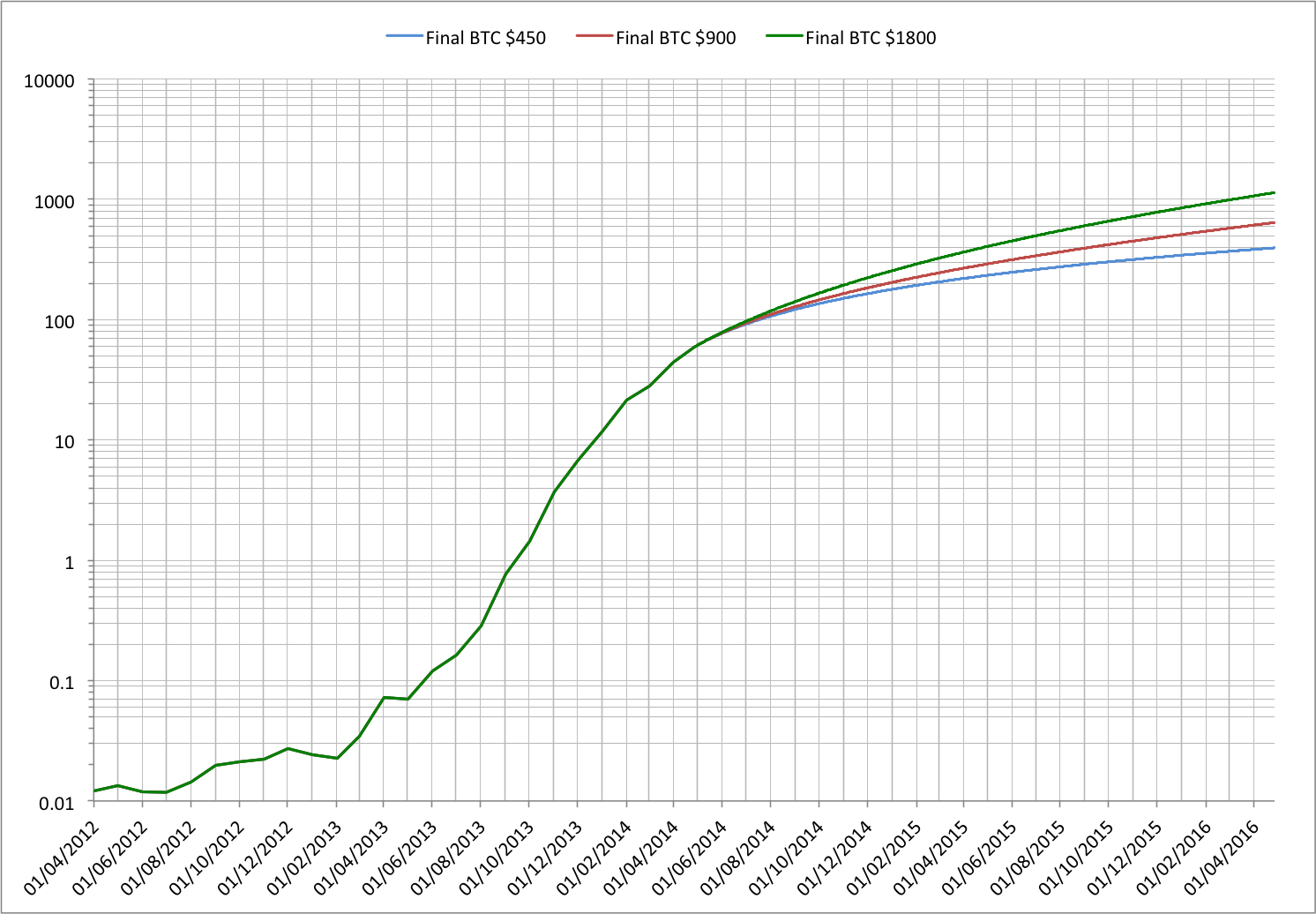
Predictions of the Bitcoin hashing rate April 2014. Shows an S curve appearing
The vertical axis is logarithmic and clearly shows how the hashing rate will slow down over the next two years. What’s somewhat interesting is that whether the BTC price remains the same, doubles or quadruples over that time the effect is still pronounced. The hashing rate continues to grow, but slows dramatically. What’s also important to reiterate is that these represent the highest hashing rates that can be achieved; when other overheads and profits are taken then the growth rate will be lower and flatter.
Warehouse scale mining?
Mainstream server farms in small data centres were the model of computing for many years, but the need for power and management efficiency has driven the development of warehouse scale computing facilities. These same motivators clearly affect Bitcoin mining too.
For most of the last year the exponential hashing growth rate has meant that mining has necessarily been focused on the short term, a trend that is all but totally incompatible with the sorts of investments required to operate at warehouse scale. The predicted slowdown should start to change that quite dramatically.
Warehouse scale designs can operate with the lowest electricity costs and lowest cooling costs while also enabling more cost effective maintenance. Large scale mining also allows dramatic reductions in equipment costs; the unit price for 10000 ASICs will be dramatically lower than for 10.
It is somewhat ironic that rather the decentralized hashing we may be on the verge of moving much of it into large, highly centralized, mining facilities.
Bitcoin: Killer of Nietzschian Nihilism
By Pete Dushenski
Posted April 29, 2014
Friedrich Nietzsche (1844 – 1900) didn’t believe in facts, God, or Darwinianism. He believed in the Will To Power,i art,ii and life. He also foresaw the scientistic consumer age between his life and ours,iii as well as the bloody nationalistic wars of the 20th century.iv He lived a productive, if tortured and controversial, life. And he would’ve fucking loved Bitcoin.
Bitcoin is infused with several of Nietzsche’s concepts.
For example, both elements of The Will to Power, durability and growth, are perfectly embodied in Bitcoin. The self-adjusting network difficulty in response to an exponential increase in hashrate represents perhaps the greatest technical achievement in history.v The Bitcoin network, for all its retardation, is incredibly robust.
Nietzsche’s rejection of the moral distinction between good and evilvi is also apparent in Stage n, where gravity, wind, and rain are as much a part of our world as Bitcoin. These forces can no longer be judged to be good or bad, they simply are. And we must now adapt to their reality rather than the reverse.
Given this, Bitcoin calls us to action, forcing us to choose the noble morality of pride, strength, and honour or the slave morality of kindness, humility, and pity.
While every noble morality develops from a triumphant affirmation of itself, slave morality from the outset says No to what is “outside,” what is “different,” what is “not itself”; and this No is its creative deed.
In #bitcoin-assets, we’re choosing the noble morality, that which is vilifiedvii by the most powerful and longest-lasting businesses in the world: states and religions. But no amount of name calling can diminish our life-affirming quest.
Meaning and morality of One’s life come from within oneself. Healthy, strong individuals seek self expansion by experimenting and by living dangerously. Life consists of an infinite number of possibilities and the healthy person explores as many of them as posible. Religions that teach pity, self-contempt, humility, self-restraint and guilt are incorrect. The good life is ever changing, challenging, devoid of regret, intense, creative and risky.
It is the softness of the “common good” that Bitcoin rejects. It is greatness that it embraces.
One must shed the bad taste of wanting to agree with many. “Good” is no longer good when one’s neighbour mouths it. And how should there be a “common good”! The term contradicts itself: whatever can be common always has little value. In the end it must be as it is and always has been: great things remain for the great, abysses for the profound, nuances and shudders for the refined, and, in brief, all that is rare for the rare.
For Bitcoin is a great thing, and thus attracts the great.
All great things must first wear terrifying and monstrous masks, in order to inscribe themselves on the hearts of humanity.
Bitcoin terrifies the common Fiaters, including those of “the community” who impose their Fiat ideology on Bitcoin. For them, they who would do no pain,viii must be on the receiving end. Bitcoin will hurt. Bitcoin will be hard. Bitcoin will make them suffer.
Who can attain to anything great if he does not feel in himself the force and will to inflict great pain? The ability to suffer is a small matter: in that line, weak women and even slaves often attain masterliness. But not to perish from internal distress and doubt when one inflicts great suffering and hears the cry of it — that is great, that belongs to greatness.
Those who oppose the suffering to come, those nihilists awash in self-loathing, will suffer the most. For long enough, nihilism, the Apolline philosophy of utilitarianism and scientific rationalism descended from Plato and Socrates, has repressed the aesthetic considerations of Dionysian philosophy – that which treasures life, beauty, and art. This 2,000-year-old revolt against the balance between creation and destruction is based on nothing but scientific “truth,” and the notion that science is, and will be, the panacea for all social problems. This is everywhere evident, from discussions of artificial intelligence and technological transcendence to automated cars and phablets. The world stagnates in this sea of golden calves.
This is what Bitcoin struggles against: the Greek God Apollo. This is what greatness struggles against.
The individual has always had to struggle to keep from being overwhelmed by the tribe. If you try it, you will be lonely often, and sometimes frightened. But no price is too high to pay for the privilege of owning yourself.
Bitcoin will win, crushing nihilism and fulfilling Nietzsche’s vision of Übermensch.Only Bitcoin can restore the necessary balance between the Gods.
Only Bitcoin can give us life.
- Power
- Art, eg. Bitcoin.↩
- With the collapse of metaphysical and theological foundations and sanctions for traditional morality only a pervasive sense of purposelessness and meaninglessness would remain. And the triumph of meaninglessness is the triumph of nihilism: ‘God is dead.’ via Britannica.↩
- Nietzsche thought the emerging nationalism of his day represented one such ominous surrogate god, in which the nation-state would be invested with transcendent value and purpose. And just as absoluteness of doctrine had found expression in philosophy and religion, absoluteness would become attached to the nation-state with missionary fervour. The slaughter of rivals and the conquest of the earth would proceed under banners of universal brotherhood, democracy, and socialism. via Britannica.↩
- mircea_popescu: I know of no previous instance of a mechanism working so efficiently in all human technical history. A self adjusting mechanism that turns maxint variation into [.5,1.5] ? That’s something. via #bitcoin-assets.↩
- Nietzsche maintained that the distinction between good and bad was originally descriptive, that is, a nonmoral reference to those who were privileged, the masters, as opposed to those who were base, the slaves. The good/evil contrast arose when slaves avenged themselves by converting attributes of mastery into vices. If the favoured, the “good,” were powerful, it was said that the meek would inherit the earth. Pride became sin. Charity, humility, and obedience replaced competition, pride, and autonomy. Crucial to the triumph of slave morality was its claim to being the only true morality. This insistence on absoluteness is as essential to philosophical as to religious ethics. via Britannica.↩
- He called me greedy! Waaaah
- “The desire to annoy no one, to harm no one, can equally well be the sign of a just as of an anxious disposition.” – Nietzsche↩
Prisoner’s dilemmas?
By Dave Hudson
Posted April 30, 2014
Over the last few months I’ve written about patterns and trends in Bitcoin mining while I’ve been trying to predict how things will evolve. More recently I’ve built simulations that attempt to model how various trends will affect the mining network. Irrespective of the “improvements”, be they improved hashing rates, lower power consumption per hash, lower price per kWh of electricity or higher BTC price, one thing is inescapable: The Bitcoin difficulty increases quickly absorb everything thrown at them in order to maintain the system’s block finding rate. This has very significant implications for the not-too-distant future.
The role of difficulty
The Bitcoin difficulty concept is a very elegant approach to ensure that no matter how the hashing infrastructure changes the intrinsic timescales envisaged for Bitcoin mining stay essentially the same. The design allows for the system to remain computationally stable and secure as technology changes and expansions in the numbers of participants take place. It also helped solve a problem of how to start up (bootstrap) the mining network. Mining could use commodity hardware that already existed and had other purposes. It also required no capital investment, just the additional cost of running PCs at higher CPU loads than they had been.
As Bitcoins started to become worth money, however, the prospect of mining a larger share of them has been ever more enticing. Mining became an end in itself, rather than just a means to support the transmission of Bitcoins. Once mining became seen as valuable there was a clear challenge to any intent that miners would co-operate for the good of the network. Instead individuals could gain an advantage, albeit at the expense of everyone else. The behaviour of miners essentially became a real-world prisoner’s dilemma.
Prisoner’s dilemma
In the prisoner’s dilemma, two prisoners, A and B, suspected of committing the same crime (and for which there is no other evidence) are arrested and held such that they cannot communicate with each other. Each has a choice: confess (known as defecting) or remain silent (known as cooperating).
Depiction of the Prisoner’s Dilema. Image by Chris Jensen and Greg Riestenberg
The choices lead to 4 possible outcomes:
- A and B both stay silent: both go free.
- A and B both confess: both get 2 years in jail.
- A confesses and B stays silent: A gets 1 year in jail and B gets 3 years in jail.
- A stays silent and B confesses: A gets 3 years in jail and B gets 1 year in jail.
Clearly the best option is for both to stay silent (neither acts to harm the interests of the other), but the average outcome is: (0.25 * 0) + (0.25 * 1) + (0.25 * 3) + (0.25 * 2) = 1.5 years in jail. The potential risk of getting 3 years in jail is probably enough to have more confess than not but there’s no strong favourite position. If A confesses then it’s a 50:50 chance of a positive or negative result
Now imagine the same game but with 3 members of the same criminal gang - if any one confesses either of the others who stays silent get the full 3 year penalty, while all those who do confess get just 1 year in jail. There are 8 possible options here and the average result is still 1.5 years in jail. Now, however, if A stays silent then only 1 out of the 4 outcomes is positive (0 years) and 3 out of the 4 are the most negative (3 years). Remaining silent now carries an average cost of 9/4 = 2.25 years in jail. Conversely confessing now carries an average cost of 5/4 = 1.25 years in jail!
This is the core of the problem with Bitcoin difficulty, but the outcomes are slightly different. With mining we have a zero sum game (the total result however played is the same). Consider 2 miners:
- A and B have the same hardware: Both get 50% of the mining reward.
- A and B both double their hashing rates: Both get 50% of the mining reward.
- A doubles their hashing rate but B does not: A gets 67% of the mining reward, B gets 33%.
- A keeps the same hardware but B doubles their hashing rate: A gets 33% of the mining reward, B gets 67%.
In this version the average is still 50% of the total, but now defecting (increasing hashing rate) averages 58.3% of the mining reward vs 41.7% for cooperating. If we play the same game with 3 miners then all start with 33.3% of the total, but cooperating averages only 26% and defecting averages 41%. Statistically it seems obvious that defecting and doubling hash rates leads to the best outcome. Of course all of the miners know this so where possible they will always defect; it becomes an ongoing race to try to continually leapfrog the other players. Sometimes a player will choose to leave the game but then another will likely try to join and ultimately no-one gains an advantage.
Interestingly one of Satoshi Nakamoto’s last public posts (2010-12-12) alluded to this same problem: “We should have a gentleman’s agreement to postpone the GPU arms race as long as we can for the good of the network”. It’s unclear just how far he had gone in thinking about this though.
This then is the headache for mining. The headlong race of miners trying to prevent anyone else from outdoing themselves simply leads to a point where all of the resources that each miner can bring to bear end up fully consumed in the arms race itself. A very small number of miners will make money (where they have a short-term advantage) and exit the game, while most will make long-term losses.
The runaway mining headache
As with gold rushes of the past, most of the money has recently flowed to suppliers who have enabled ever-larger-scale mining. While much more efficient than previous generations the difficulty levels increased exponentially to absorb the improvements and the trend towards ever-increasing operating costs was simply deferred, not prevented. A short term respite has recently seen a move to locations with lower cost electricity suppliers but this has simply freed up money to spend on yet more hashing capacity and that in turn requires more electricity. There are probably a few more short term improvements that might be made, such as utilizing waste heat in some more useful way, but these too only act to make more money available to increase hashing capacity. Even BTC price increases only offer temporary respite. Whatever the cause, the difficulty level increases accordingly and this quickly negates any benefits.
It’s already apparent that difficulty level increases are also affecting the price of hardware. This has started to fall in order to offer any potential prospect of useful mining rewards. Technology limits mean that technology improvements do not offer a path to enable the necessary cost reductions, so hardware vendors margins are being cut too. Inexorably the balance will continue to move towards operating costs consuming almost all of the available mining rewards.
In traditional “arms race” problems the participants often end up mutually agreeing to try to de-escalate things and verify that all parties have honoured their commitments, but the decentralized nature of Bitcoin mining means that such agreements are all but impossible; the participants just aren’t knowable.
Other cryptocurrencies have tried to prevent an arms race by making things harder for custom hardware. While this relieves some short-term pressure any computational problem ends up susceptible to the same economic pressures. Given the scope of Bitcoin mining deployments it seems improbable that changing the core hashing algorithm would be an option anyway.
Early miners and ASIC suppliers have already seen their profits, and indeed may still earn more yet. They can sit on a sunny beach sipping champagne cocktails, but as the difficulty levels eat into everyone else’s margins it’s unclear how the mining dilemma can end up having a happy ending for anyone else but the energy suppliers.
Acknowledgments
The last line of this article was rewritten thanks to an insightful remark when I first posted a link to it!