
March 2014 Journal
WORDS is a monthly journal of Bitcoin commentary. This issue collects the March 2014 writing in the WORDS archive. For the uninitiated, getting up to speed on Bitcoin can seem daunting. Content is scattered across the internet, in some cases behind paywalls, and content has been lost forever. That’s why we made this journal, to preserve and further the understanding of Bitcoin.
Citizens of Fiat vs. Citizens of Bitcoin: A Contrast
By Pete Dushenski
Posted March 9, 2014
“Citizens, lend me your ears”, or more modernly, “Citizens, lend me your eyes”.
Whether it’s the tube or the Twitter, our society values us insomuch as we consume. Today, we measure much of this consumption with “views” and “clicks”. The branded clothing, the exclusive neighbourhood, and the shiny car are all sold to us through our visual sense, and it’s through our optical nerves that we’re taught to identify and judge one another. “Why yes, this is a Submariner with a NATO band,” etc.
This is the fiat world: the world of corporate-consumer hegemony.
In such a world, consumer protection laws are not written to protect us from nefarious entities who would do us ill, they exist to protect us for a very specifici**set of nefarious entities who actively do us ill. Citizens of Fiat are consumers from whom great wealth is systematically extracted. And they’re rightly treated like cattle.
The emerging Citizens of Bitcoin, however, the ones capable of doing their due fucking diligence, don’t need, much less want, such sheep shearing masquerading as protection. The ones who demand such protections are suffering deeply from Stockholm Syndrome. Such submissive, endlessly deferential beings are anything but free citizens, which just so happens to make them ideal consumersii.
Those who don’t want to, or can’t be, free citizens are paradoxically the most demanding of rights, rights, and more rights. Gay marriage rights, legal weed rights, free dental care rights, basic income rights, and on and on and on. The only rights they truly have, however, are the ones they’re willing to die for. As Black Friday stampedes demonstrate, these are their consumer rights: their right to buy as much shit as possible for the least amount of money. In short, the only rights Citizens of Fiat have are their Walmart Rights.
Citizens of Fiat still get to vote, unfortunately, and oh boy do they exercise it. They vote for anyone they can easily stereotype and later publicly chide. Female politicians who get in “cat fights”iii, meme-generating Mayorsiv, etc. Anything to light the gunpowder of journalists and their devoted, Timmy’s chugging followers, eager to bitch and moan about expense reportsv, as if personal spending had any bearing on policies that affect the rest of us.
Fairness is the ruling objective of the Citizens of Fiat, and it’s suffocating.
So what’s fair for Citizens of Fiat? Paying the same prices as other countries for shit, being treated “equally”, getting more handouts, being able to buy social mobilityvi at Holt’s or Harrod’s, and other such brain damage. Consumers demand it! Ginesthoi!vii And if one gubmint won’t promise you all the rainbows and lollipops, surely another will.
It seems evident enough that we’ve trained a society of unquestioning, if highly demanding, consumers. Quick with moral outrage whenever privilege or political incorrectness are displayed, and equally quick to demand ever-more rights. The result of this former condition is a censorship of freedom of speech and an inability to strive for betterviii, which results in an easily manipulated discourse and an uninnovative economy. The result of the latter condition is the Sovietesque welfare state model seen throughout the First World, the model that endlessly provides more services withoutix increasing taxes.
Still, the government is a business and new revenues to pay for more promises have to come from somewhere. Monetary debasement, hardly an innovative course of action, is at least the easiestx course of action. This, of course, leads to inflation, then hyperinflation, then boom, no more currency.
The Sovietesque welfare state, in its efforts to deliver more ad inifinitum, is therefore dependent on its ability to cause death and give birth to new currencies, as the need arises. Bitcoin fundamentally breaks this model. No political entity can decide to create more coins. The math doesn’t give a shit if you’re coming up for re-election. With no state control of the monetary supply, there’ll be no inflation to pay for more “rights”, and therefore no more system of endless entitlements.
Not only does Bitcoin make non-voluntary wealth transfers impossiblexi, it demands that instead of buying shit today, we buy shit tomorrow. Tomorrow, that shit will be cheaper. It’s not glamorous to delay gratification, but it works like a damn. In the Bitcoin world, we’ll have a lot more people pointing to the sky and saying “Hasa Diga Eebowai”xii, at least until they’re used to it. Then, as ever, life will go on.
So if Citizens of Bitcoin are holding off on buying more shit, what are we buying with all of our wealth?
Knowledgexiii. With its high barriers to entry and significant required inputs, knowledge is the most expensive thing you can buy. Knowledge is the only thing that no one can take from youxiv and it’s something your children will actually benefit from.
So, are you ready to become a true Citizen?
Trick question: you don’t have a choice.
- Banks, energy companies, telecoms, construction companies, Wall Street, etc.↩
- Just as livestock consume poison unknowingly, so do human cattle↩
- See Alberta Premier Alison Redford and BC Premier Christie Clark get it on↩
- Don Iveson is the young man charged with the position of Mayor of the City of Edmonton. Edmonton loves its Twitter, so it’s no wonder that they elected the most Twitter-happy politician on record by a record margin, just so they could meme him.↩
- See (now former) Premier Alison Redford. Who cares about thebillions of dollars of debt she’s piling on once-prosperous Alberta when she’s spending $45,000 to do what politicians do
- Social mobility is a 19th century North American innovation, one that hasn’t spread as far as we think, and one predicated entirely on purchasing power. India’s economy isn’t growing at the 7.5% clip of China’s because their caste system isn’t deluded into thinking that anyone is buying themselves out of anything. Maybe their next life will be better, but an LV purse or a Tata Nano won’t do shit to improve this one. Only North Americans, with their entire understanding of history beginning with the US involvement in The Great War and ending with 9/11, think otherwise.↩
- “Make it so!”, in Greek, as Cleopatra is purported to have said, around 33 BC↩
- Rather than just more↩
- Explicitly, due to the political untenability of such. Implicit taxation is easier to blame on someone or something outside of political control.↩
- And the most predictable, as David Graeber reminds us↩
- Save hacking or physically stealing private keys↩
- See Book of Mormon soundtrack, Track 4↩
- Knowledge should under no circumstances be confused with college degrees, which are merely documents demonstrating a previous wealth transference, not unlike that demonstrated by nice clothes, and similarly consumer-driven.↩
- Even private keys can be forked over at the end of a barrel. And although specific knowledge, such as “secrets”, can be tortured out, this is only a sharing of knowledge, not an extraction of it. One’s knowledge of the world and its workings can never be forcibly taken, only eroded by the sands of time.↩
The Bitcoin runaway mine train
By Dave Hudson
Posted March 9, 2014
Bitcoin mining is seemingly unique. T here has probably never been any technology problem that has triggered such sustained growth and it may be a very long time before we see another one. A convergence of the scalable Bitcoin protocol design, readily available technology, money and mining incentives have accelerated this particular mine train in a truly explosive way. Let’s look at the trends and what they suggest for future mining activities.
What has been happening?
There is probably a lot to be said for looking at the history of Bitcoin mining prior to the last 12 months but it’s more interesting to look at how it has progressed since the introduction of ASIC (application specific integrated circuit) mining. We might argue that this is the point at which mining started to become a professional task since the hardware involved can’t be used for anything else. Previous generations used hardware that was originally designed for other purposes and so let amateurs play too.
Let’s look at the worldwide hashing data:
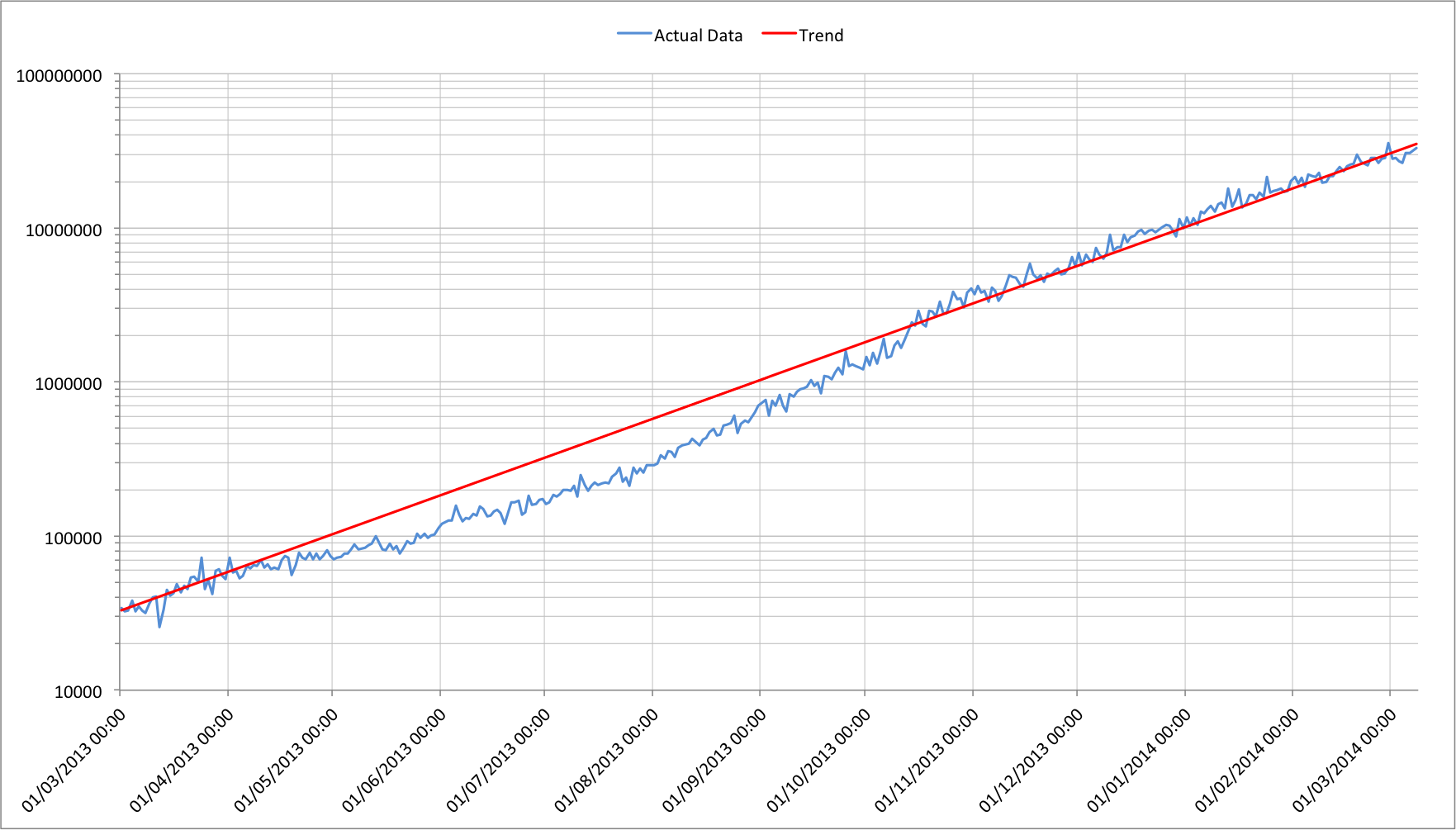
Worldwide hashing rate
The first thing to notice is that this isn’t an ordinary graph. It’s plotted on a logarithmic Y axis meaning that each major graduation is 10 times larger than the one below. If we look at the red trend line though it’s a straight line, signalling that we have had exponential (runaway) growth. There was a small period of time before the value of Bitcoins soared late in 2013 where things had slowed down but then everything caught up (which rarely happens with technology problems).
Exponential growth
It’s useful to think about what that red trend line shows us. What we see is that in the last 12 months the worldwide hashing rate has increased by a factor of approximately 1000. That means that roughly every 4 months it got 10x larger, that it doubles almost every 37 days and that it increases by almost 1.9% per day! We don’t know how long this trend will continue but it has been somewhat stable for the last year. Given that newer and faster ASIC hardware is due to ship throughout the next few months it seems likely that it will continue for some time yet.
The economics of professional mining
Bitcoin mining is a zero-sum game; if one player wins then everyone else has to lose. When the value of Bitcoins increases it means that even winning a small share of the total can be highly valuable so, rather than play alone, most people join a mining pool. Mining pools let a player win fractions of the payout to that pool in proportion to the resources supplied to the pool but what we’ve just seen is that any resources a player contributes are reduced by almost 1.9% per day. After a week they’re down by more than 12% and after 37 days they’re only 50% of what they started at.
What this really means is that mining equipment has a staggering level of depreciation. If the value of a Bitcoin doesn’t change in that 37 day period then the mining hardware is only producing half of the value it started with. After 74 days it’s a quarter and after 4 months it’s only a tenth. It quickly reaches the point where the operating cost (OpEx) outweighs the value of what’s being produced and the hardware is worthless. At this point the entire capital cost (CapEx) of buying the equipment is wiped out.
Almost nothing else we encounter works this way; consider that servers in a data centre or a laptop may be assumed to have a useful life of 3 to 5 years, while a car would typically be more than 10 years. With a stagnant Bitcoin price, mining hardware has depreciated to just 1% of its original value in 8 months and its useful lifespan (where it produces more value than it costs to operate) is probably much shorter! Even if the value of Bitcoin increases by a factor of 10 it still only defers the huge reduction in capital value by 4 months.
How does this affect the hashing rate?
The huge rate of depreciation means that there’s only one sensible approach that a bitcoin miner can take: Run the hardware 24/7 at the highest speed that doesn’t cause it to break from the moment it arrives until it’s no longer generating more value than it costs to run. Not doing this simply means a miner is losing the most valuable portion of their hardware’s life.
This simple rule has an important consequence; It guarantees a constant supply of the newest and fastest hashing engines driving the worldwide hashing rate. Once an order is placed a miner is committed to fueling this expansion. Unlike the rides in theme parks around the world, this particular runaway mine train isn’t slowing down for anyone!
On Making Bitcoin Accessible. Or Not.
By Pete Dushenski
Posted March 13, 2014
Just about a year agoi, in those first few sleepless weeks of Bitcoin mania, I decided that my mission was to “Make Bitcoin Accessible”. Where this came from specifically, I couldn’t say. Perhaps the indelible impression that Bitcoin was quickly leaving on me, practically branding my soul, needed to be shared. Perhaps I needed external validation that I wasn’t losing my fucking mind. Perhaps I just needed something to do.
Within the first month, I created a website with the best videos and explanations of Bitcoin I could find. On bitconomy.ca, I explained Bitcoin, how one goes about acquiring it, and what one can do with it. Later last summer, after persuading the first merchants in the city to accept it, I added an “Edmonton Merchants” tab to the site, followed soon after by a “Media Coverage” tabii as the local “journalists” awoke from their collective slumber. In addition to the website and merchant set-up, I also started the local meet-up group, facilitated the events, and in doing do became the de facto figurehead for Bitcoin in Edmonton. My goal throughout my freshman year was always to “build the community” and “make Bitcoin accessible.”
But why? Seriously? What was I thinking? And, since I was hardly alone with this idea, what the fuck is/was everyone else thinking?
Rocks on the sidewalk are worth less than rocks at Birks, food at McDonald’s is worth less than food at Sukiyabashi Jiro, etc. “More accessible” means making something less valuable. Not more.
But what do I know? Recently on #bitcoin-assets, Mircea Popescu linked to the following Warren Buffetiii quote, which really hits home the accessibility idea. I’ll let WB take it from here (emphasis added):
We often are asked why Berkshire does not split its stock. The assumption behind this question usually appears to be that a split would be a pro-shareholder action. We disagree. Let me tell you why.
One of our goals is to have Berkshire Hathaway stock sell at a price rationally related to its intrinsic business value. (But note “rationally related”, not “identical”: if well-regarded companies are generally selling in the market at large discounts from value, Berkshire might well be priced similarly.) The key toa rational stock price is rational shareholders, both current andprospective.
If the holders of a company’s stock and/or the prospective buyers attracted to it are prone to make irrational or emotion-based decisions, some pretty silly stock prices are going to appear periodically. Manic-depressive personalities producemanic-depressive valuations. Such aberrations may help us in buying and selling the stocks of other companies. But we think it is in both your interest and ours to minimize their occurrence in the market for Berkshire.
To obtain only high quality shareholders is no cinch.** Mrs. Astor could select her 400, but anyone can buy any stock. **Entering members of a shareholder “club” cannot be screened forintellectual capacity, emotional stability, moral sensitivity oracceptable dress. Shareholder eugenics, therefore, might appear to be a hopeless undertaking.
In large part, however, we feel that high quality ownership can be attracted and maintained if we consistently communicate our business and ownership philosophy – along with no other conflicting messages – and then let self selection follow its course. For example, self selection will draw a far different crowd to a musical event advertised as an opera than one advertised as a rock concert even though anyone can buy a ticket to either.
Through our policies and communications – our “advertisements” – we try to attract investors who willunderstand our operations, attitudes and expectations. (And,fully as important, we try to dissuade those who won’t.) We wantthose who think of themselves as business owners and invest incompanies with the intention of staying a long time. And, wewant those who keep their eyes focused on business results, notmarket prices.
Investors possessing those characteristics are in a smallminority,** but we have an exceptional collection of them. I believe well over 90% – probably over 95% – of our shares are held by those who were shareholders of Berkshire or Blue Chip five years ago. And I would guess that over 95% of our shares are held by investors for whom the holding is at least double the size of their next largest. Among companies with at least several thousand public shareholders and more than $1 billion of market value, we are almost certainly the leader in the degree to which our shareholders think and act like owners. Upgrading a shareholder group that possesses these characteristics is not easy.
Were we to split the stock or take other actions focusing onstock price rather than business value, we would attract anentering class of buyers inferior to the exiting class ofsellers.** At $1300, there are very few investors who can’t afford a Berkshire share. Would a potential one-share purchaser be better off if we split 100 for 1 so he could buy 100 shares? Those who think so and who would buy the stock because of the split or in anticipation of one would definitely downgrade the quality of our present shareholder group. (Could we really improve our shareholder group by trading some of our present clear-thinking members for impressionable new ones who, preferring paper to value, feel wealthier with nine $10 bills than with one $100 bill?) People who buy for non-value reasonsare likely to sell for non-value reasons. Their presence in thepicture will accentuate erratic price swings unrelated tounderlying business developments.
We will try to avoid policies that attract buyers with a short-term focus on our stock price and try to follow policies that attract informed long-term investors focusing on business values. just as you purchased your Berkshire shares in a market populated by rational informed investors, you deserve a chance to sell – should you ever want to – in the same kind of market. We will work to keep it in existence.
One of the ironies of the stock market is the emphasis onactivity.** Brokers, using terms such as “marketability” and “liquidity”, sing the praises of companies with high share turnover (those who cannot fill your pocket will confidently fill your ear). But investors should understand that what is good forthe croupier is not good for the customer. A hyperactive stockmarket is the pickpocket of enterprise.[3. s/stock/bitcoin]
After reading that, go tell Warren Buffett that “hoarding” is “bad”. Hell, tell Satoshi while you’re at it. Do you see the Genesis Block moving anywhere? The only people who benefit from you tossing your coins around are the exchanges and merchant processors. They’re the stock brokers of bitcoin, encouraging us to play musical chairs lest the music stop. These are also the same people who tell us that “Bitcoin needs to go mainstream”, that it needs to become a “real currency”, and that we’re entitled to whine and cry every time a central bank declares that “Bitcoin isn’t a currency”iv or that it’s “dangerous”.v
Bitcoin is growing up fast. Only 5-years-old and getting ready for the spotlightvi. They grow up so fast.
And if we don’t grow up even faster, Bitcoin will leave us in the dust. Bitcoin is a world-eater and it sleeps for no man. So we can waste our time trying to convince retro-doge-rockers why Bitcoin is world-changing, or we can take on the ruthless world of finance head-on.
To start with, if we actually want to have wealth in 5 years, we’d be well served to spend 10 minutes on wallet security for every 1 minute we spend on “re-investing”, “donating” and “ideas”.vii
This is finance. It’s time to man up.viii
- I’m just entering my sophomore year on campus↩
- For posterity, and in-law brownie points.↩
- From his 1983 letter to shareholders. Y’know, before he was senile.↩
- Just because you can trade something, doesn’t make it a currency. Bitcoin is far more cryptocommodity than cryptocurrency.↩
- Bitcoin is crazy dangerous. Seriously. Wallet security is a bitch and scammers are a dime a dozen. It’s a jungle out there and most people would far prefer spending their Sundays in shopping malls rather than hashing high-entropy private keys and setting up PGP keychains. Why do you want to jam your ideas down their throat? They’re better off bargain hunting and we’re better off going for gold. That’s just the way it is.↩
- Goldman Sachs just published a research report entitled “All About Bitcoin“. It’s well worth a read.↩
- Auroracoin, etc.↩
- Book of Mormom, Track 9↩
Strange spikes in the Bitcoin price
By Dave Hudson
Posted March 13, 2014
There’s something odd about the fluctuations in the price of Bitcoins. The data shows a set of spikes when the price jumps up and then falls back somewhat and levels out. This wouldn’t be so unusual if the spikes occurred intermittently but in the case of Bitcoins the spikes happen with a very surprising regularity!
Let’s look at the graph:
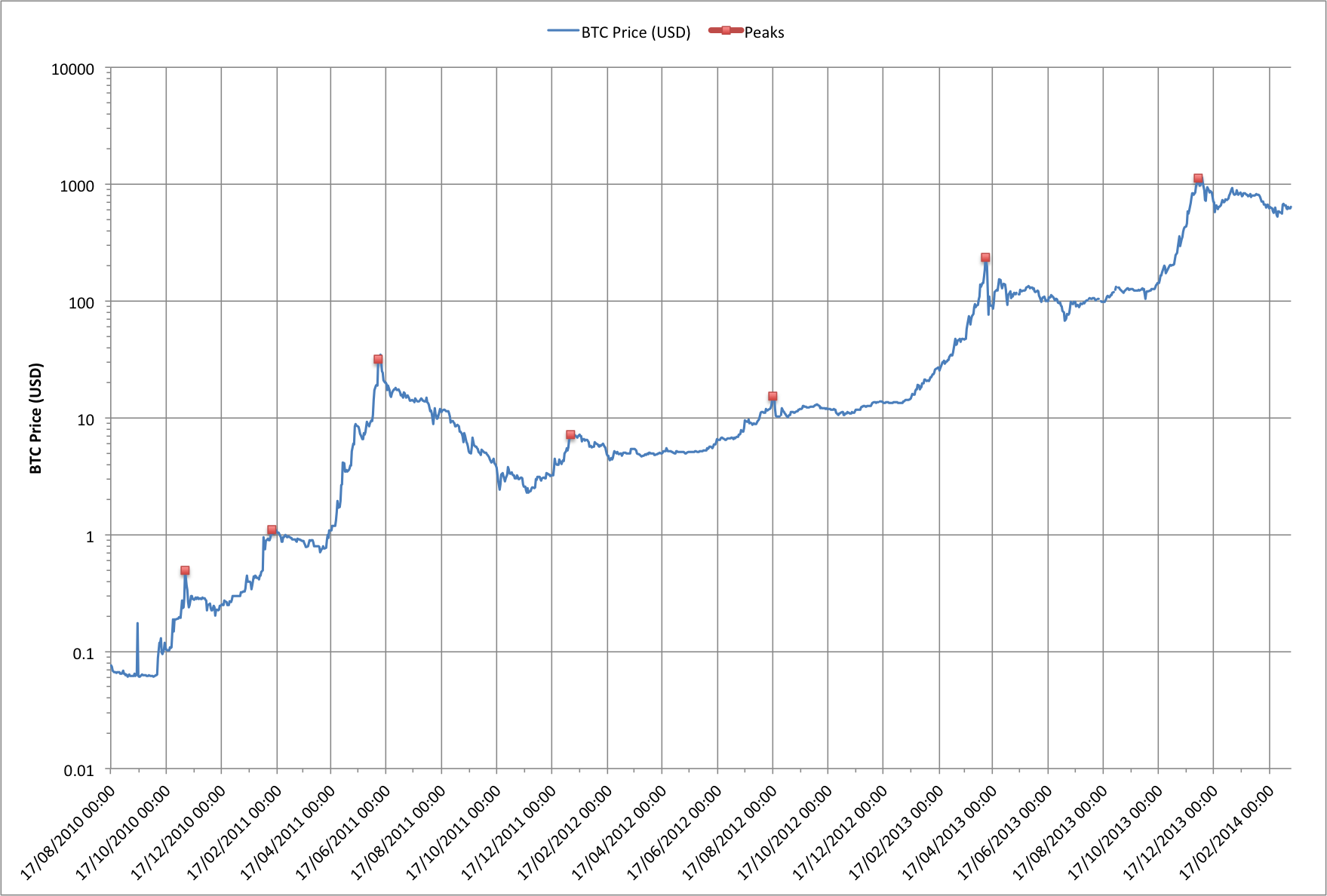
Bitcoin price over time
The first thing to note is that the graph is plotted with a logarithmic Y axis so each step indicates a price point ten times larger than the one below. Using a log scale means that we see patterns in the relative change in price much more easily, rather than changes in the actual value.
There are 7 major spikes in the Bitcoin price starting on 17th November 2010 and finishing on the 30th November 2013. If we ignore the spike on 10th February 2011 the other 6 spikes have an amazingly consistent spacing!
All of the major price spikes also show another remarkable similarity. In each case the price ramps up very quickly, hits its highest point for a day or two and then slowly drops off.
So there are a few big questions (to which I don’t have any answers right now):
- Why does the price spike up every 7 to 7.5 months?
- Why does the price never drop back below where it starts from?
- Is the behaviour just coincidence or is someone or something triggering it?
Does anyone have any data that might explain this?
Where did the inflation go?
By Mike Hearn
Posted March 17, 2014
… or, why critics of Satoshi-nomics are wrong
The Economist is one of my favourite magazines. This week they published two articles on Bitcoin. One covered more exotic uses of the technology. The other was a bog-standard trope claiming that deflation will kill Bitcoin and it’s not a good store of value:
Economists reckon money …. should be a stable store of value, enabling users to tuck some away and come back later to find its purchasing power more or less intact ….. the American dollar meets all three conditions. Bitcoin has some way to go.
Then they followed up with a Free Exchange blog entry that repeated the same points. I wrote the FAQ on Bitcoin deflation, but apparently it’s time to revisit this topic.
Free Exchange says,
… the idea that modern central banks with their loosey-goosey printing presses have generated an epidemic of inflation is a little nuts; if anything, rich-world central banks have become too effective at protecting the value of their respective currencies
The idea that western countries have low and stable inflation is a widely held belief. We’re told our amazing central banks have learned to tame inflation, and we should be in awe of their economic skill. What’s more we’re told that whatever the level of inflation we have is, it’s beneficial for society and a “deflationary” Bitcoin economy would look like some Detroit-esque zombie apocalypse in comparison.
But is this true? I don’t think so.
In the past decade inflation in western countries has been reported as very low, in particular Europe and America. Yet interest rates have also been very low, in fact lately they’ve been at close to zero, which theory tells us should make borrowing very cheap and encourage lots of new money creation leading to a general rise in prices. So where did all the inflation go?
The way the statistics are calculated is very transparent and the integrity of the agencies that compile them are not in question. But just because the statistics are open source and auditable does not make them automatically useful for our purposes. We’re interested in the question of whether central banks cause economic disruption that could be avoided if everyone used Bitcoin. Advocates claim a limited and stable supply of money would help avoid bubbles and build a better financial system. Skeptics quote inflation statistics to suggest the 21 million coin limit is a solution looking for a problem. So do the statistics actually help us resolve this debate?
The consumer price index most countries rely on to measure inflation is a very interesting beast. At first glance it appears to do what it says: that is, measure the prices ordinary people pay for things. But scratch the surface and a boiling morass of controversies and long-running debates appear. Pretty quickly it becomes apparent that what’s in and what’s out of the index can make a massive difference to perceived inflation.
Owner-equivalent rent
One of the aspects of CPI calculation with the least agreement between economists and countries is the matter of house prices. Intuition tells us that because lots of people buy houses they should be included in the basket of goods. A rise in house prices would then lead to a rise in inflation.
And indeed, this is how the statistics used to work. But starting in the 1970’s some countries, notably the USA, started to think that maybe this wasn’t the best way to calculate the CPI. They tried a few different approaches and starting in the mid-1980’s settled on something called “owner equivalent rent” (OER). This means that when someone buys a house, for inflation purposes they are assumed instead to be paying the rent that they would have been paying, had the house actually been rented out to them by someone else.
The justification behind this odd approach is that the CPI is not actually intended to inform debates about printing of money, even though it’s often used that way. Instead it’s meant to measure a rise in the cost of living (COLI). The assumption is that if someone didn’t have the option of buying a house they could have rented a similar house nearby. Therefore, the fact that they actually did buy the house is irrelevant for calculating the cost of living of the average person.
A long and very boring document describing the different approaches and the rationales involved can be found here. It contains some interesting facts. If you’re American and thinking that maybe the above method doesn’t accurately reflect the way ordinary people experience prices, well, just be glad that the Bureau of Labor Statistics even tries:
The rental equivalence approach is also widely accepted and used in many
countries. A recent Organization for Economic Development and Cooperation (OECD) report shows that this approach is the one used by a plurality of countries (13 out of 31 countries studied), with the next chosen alternative simply leaving owner occupied housing out of the national CPI (9 countries). Only Australia and New Zealand use an acquisitions or house price approach.
So whilst a lot of countries use this method, plenty of others choose to just ignore housing entirely!
Is OER impacted by a rise in house prices? The Economist steps in to the debate once more, this time with data. In a remarkably prescient article from 2005 they warned, “The worldwide rise in house prices is the biggest bubble in history. Prepare for the economic pain when it pops.”
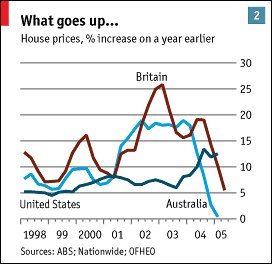
The most compelling evidence that home prices are over-valued in many countries is the diverging relationship between house prices and rents …. Calculations by
The Economist
show that house prices have hit record levels in relation to rents in America, Britain, Australia, New Zealand, France, Spain, the Netherlands, Ireland and Belgium. This suggests that homes are even more over-valued than at previous peaks, from which prices typically fell in real terms …. America’s ratio of prices to rents is 35% above its average level during 1975-2000 (see chart 1). By the same gauge, property is “overvalued” by 50% or more in Britain, Australia and Spain.
So we know that in the run-up to the financial crisis consumer price inflation was considered to be in the Goldilocks Zone (between two and three percent), yet house price inflation was more like ten to twenty percent! Clearly, the inflation statistics being used by central banks were completely disconnected from what was really happening in the housing market, by design, and as a result they kept the pedal to the metal with low interest rates thus pouring fuel on the fire.
This is all pretty mainstream thinking, at least in the alt-econ blogosphere. It’s only in the rarified world of central banking that the link between their monetary policy and giant asset bubbles gets controversial. Unfortunately the largest employer of economists is, by far, the government. So it should not really surprise us when most economists appear to agree with whatever government policy currently is.
So how does Satoshi-nomics (a.k.a. full reserve banking) actually help? Inflation is bad because the act of creating free money and giving it to someone results in misallocation of resources — instead of resources (time, electricity, food etc) being put towards projects that reflect market consensus, the lucky recipient of the inflation goes and buys up those resources instead. Is what they get used for actually beneficial? Does it increase societies wealth? It’s hard to know because the normal decision making processes broke down.
Bitcoin itself gives us a great example of this dynamic in action: we see far, far too much mining taking place relative to what’s actually needed. The inflation of Bitcoin causes reallocation of time and resources to mining, even if one more terahash doesn’t make any perceptible difference to the security of the system.
Luckily, Bitcoin inflation and the distortion it creates is temporary. The same cannot be said for the dollar, pound or euro.
Chickens and eggs?
By Dave Hudson
Posted March 19, 2014
Which comes first: The miners or the money? Much as the old question of “Which came first: The chicken or the egg?” there appears to have been a lot of debate about whether the price of Bitcoins is a result of mining activity or whether mining activity is the result of the price of Bitcoins.
The generally-held belief is that as the value of Bitcoins has increased there has been more interest in Bitcoins and this has in turn driven miners to mine, but is it really this simple?
Let’s look at a chart comparing the value of Bitcoin in US Dollars vs the global hashrate in GHash/s and see if we can make any sense of this?
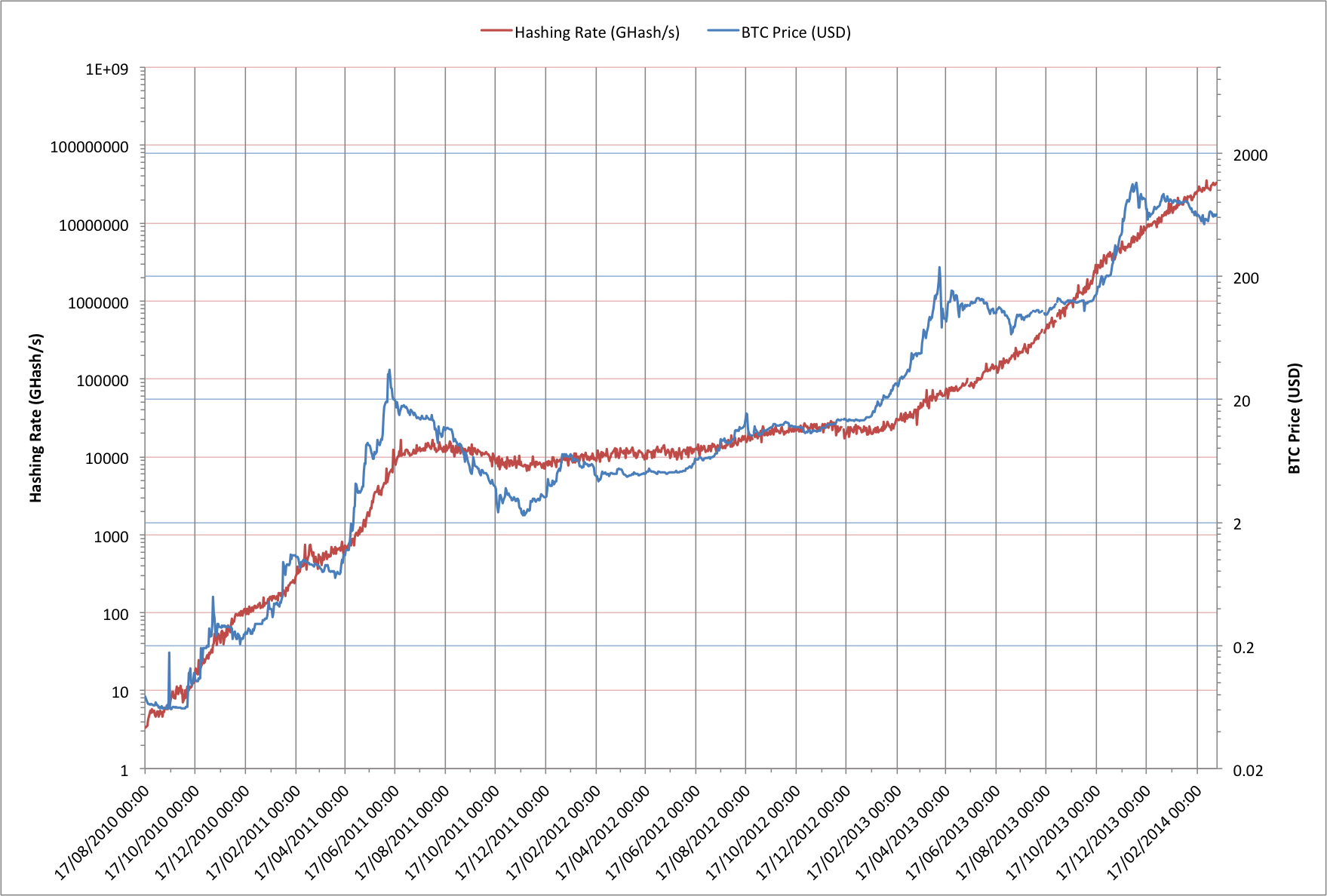
Bitcoin price overlaid with global hashrate
This chart is plotted on two logarithmic axis but they’re not on the same scale. The price trace increases by approximately a factor of a thousand but the hashing traces increases by approximately a factor of ten million. Essentially this means that the hashing rate has increased 56 times faster than the price. There’s nothing particularly significant about the ratios other than that they let us watch the two traces relative to each other.
We can see something a little curious here though. The hashing rate does indeed speed up as the price of a Bitcoin increases and the rate slows once the price starts to fall but it’s almost as if the hashing rate has been acting as an anchor for the price. If we think about the hardware that has been used for hashing, however, there’s an interesting pattern.
In 2010 and the first half of 2011 miners could rapidly bring new hardware on-stream in the form of CPUs and then GPUs. In many cases these were already available and so mining profitability didn’t really have to account for the hardware costs and people would want CPUs and fast GPUs anyway.
From mid 2011 to early 2013 the initial euphoria waned, yet that seems a little strange for something that had seen such rapid growth only a short while earlier. There were the strange periodic spikes in the Bitcoin price every 7-ish months but neither the price nor the hashing rate really changed that much. Roll forward to early 2013 though and things suddenly changed - a lot.
In early 2013 Bitcoin mining ASICs started to take over the hashing activity. Unlike previous generations that used CPUs and GPUs that were intrinsically useful for other purposes the ASICs weren’t; they weren’t cheap either! Suddenly a lot of Bitcoin miners were having to pay a lot of money to mine Bitcoins but curiously the price started to go up just as the ASICs started to become available. Even more curiously, the ASICs had long lead times so miners had made a financial commitment to mining months in advance of their mining hardware being available. Was it just “good luck” that the Bitcoin price suddenly surged, and then surged again, or was the price increase simply reflecting that a lot of money had been spent to go mining?
It seems quite possible that at least part of the reason for the surges in the Bitcoin price is a result of the miners investing in mining. The price increases have encouraged more miners too and that means more money spent on mining by those new miners. This really does feel like a “chicken and egg” problem. A bigger question, however, is what happens when the number of miners is large and the technology roadmap eventually limits the ability to increase the hash rate? At that point there will need to be some other driver for any other price increases.
There Is No “Bitcoin 2.0”
By Pete Dushenski
Posted March 19, 2014
Bitcoin isn’t Netscape Navigator.
Bitcoin isn’t MySpace.
Bitcoin isn’t iPhone.
Bitcoin isn’t Mt Gox.
Bitcoin isn’t another incremental improvement.i
Bitcoin is iron.
Bitcoin is gunpowder.
Bitcoin is the steam engine.
Bitcoin is the personal computer.
Bitcoin is the once-in-a-generation revolution.ii
Looking at the world through Bitcoin physically hurts. Bitcoin is high art.iii
Unless it’s teleportation, whatever you’re calling “Bitcoin 2.0”iv is not the next revolution, it’s just the buzzing of another wallet inspector.
Bitcoin is Bitcoin, and it’s version 0.x. Welcome to Stage n.v
- “Improvements” tend to make things busier, noisier, and worse. Almost without exception. Bitcoin is none of that.↩
- 16:31:52 **
** : aristotle’s politics just became second rate in the field of revolutionary. nakamoto’s paper easily takes the top spot.[↩](http://www.contravex.com/2014/03/19/there-is-no-bitcoin-2-0#identifier_1_197) - “A true work of art, like a true work of nature, never ceases to open boundlessly before the mind. We examine, -we are impressed with it,- it produces its effect; but it can never be all comprehended, still less can its essence, its value, be expressed in words. In the present remarks concerning the Laocoon, our object is by no means to say all that can be said on the subject; we shall make this admirable work rather the occasion that the subject of what we have to say. May it soon be placed once more in a a situation where all lovers of art may be able to enjoy and speak of it, each in his own way. We can hardly speak adequately of a high work of art without ask speaking of art in general; since all art is comprehended in it, and each one is able according to his power to develop the universal out of such a special case. We shall therefore begin with some remarks of a general nature. All high works of art are expressions of humanity. Plastic art relates particularly to the human form; it is of this we are now speaking. Art has many steps, in all of which there have been admirable artists; but a perfect work of art embraces all the qualities that are elsewhere encountered only separately. The highest works of art that we know exhibit to us- Living, highly organized natures.We look, in the first place, for a knowledge of the human body, in its parts and proportions, inward and outward adaptation, its forms and motions generally. Character. Knowledge of the varieties in form and action of their parts; peculiarities are discriminated, and separately set forth. Out of this results character, through which an important relation, may be established among separate works; and in like manner, when a work is put together, its parts may hold an analogous relation to each other. The subject may be – At rest, or in motion. A work, or its parts, may be either self-centred, simply showing its character in a state of rest, or it may be exhibited in the movement, activity, or fullness of passionate expression. Ideal. To this attainment of this, the artist needs a deep, well-grounded, steadfast mind, which must be accompanied by a higher sense, in order to comprehend the subject in all its bearings, to find the moment of expression, to withdraw this from the narrowness of fact, and give to it, in an ideal work, proportion, limit, reality and dignity. Agreeableness.The subject and its mode of exhibition are moreover connected with the sensible laws of art; viz.; harmony, comprehensibility, symmetry, contrast, etc.: whereby it becomes visibly beautiful, or agreeable, as it is called. Beauty. Farther, we find that it obeys the laws of spiritual beauty, which arises from just proportion, and to which he who is complete in the creation or production of the beautiful knows how to subject even the extremes.” from Upon the Laocoön, Goethe, 1798.↩
- Recommended reading: benkay’s excellent piece on this topic.↩
- Stage n: Bitcoin exists, by Mircea Popescu.↩
Where next for Bitcoin mining ASICs?
By Dave Hudson
Posted March 24, 2014
ASIC mining is now the norm for Bitcoin, and 28 nm ASICs are now becoming the mainstream replacing the 65 nm, or even 110 nm, designs of a year ago. Bitcoin ASICs have leapfrogged several integrated circuit (IC) technologies in a way that’s rarely been seen before and at an almost unprecedented rate of progress.
How have things been able to move so fast, how much further can this go, and what might we expect from new designs?
Why have things moved so fast?
There are two characteristics of Bitcoin’s design that have enabled the current style of ASIC mining:
- It was designed from the outset to be incredibly scalable.
- It uses a commonly-used SHA256 hash function for most of the work.
From a hardware designer’s perspective the scalability of Bitcoin was a brilliant piece of engineering. Its design allows many parallel engines to work on the same problem without significant serialization (where things get bottlenecked through one part of the system) and the system design anticipated the need to automatically adapt as processing capacity increased or decreased, so adding a huge increase in processing wouldn’t break anything. This sort of design is sometimes referred to as “embarrassingly parallel”, and is one of the reasons why GPU mining worked so well prior to the development of ASICs as graphics processing is very similar.
The SHA256 hash has been the subject of some criticism from other cryptocurrency advocates (although the introduction of Scrypt ASICs is showing that their arguments in favour of more complex hashes are somewhat weaker than they originally believed), but from an ASIC designer’s perspective SHA256 was ideal. SHA256 has been supported in hardware for some time and so there were designs readily available to be used in mining chips.
As two of the most tricky aspects of building an ASIC were already solved they were able to be developed far faster and with far less expense than would be true for most chips. With the first generation ASICs being so profitable for their designers then the rapid push towards newer and faster chips was almost inevitable.
Why does the “nm” size matter?
Silicon designers think in terms of the “feature size” or “geometry” of a design and this is measured in nanometers (nm). This number describes the smallest sized part used in constructing the transistors or wires within the integrated circuit (IC). The smaller the number, the more such elements can be fitted into the same space. It’s important to realize that because ICs are two dimensional then making the feature size half of what it was means that we can actually get four times as many things in the same space.
Over the course of time silicon designers “shrink” the feature size, typically at the rate of about 2x every four years. 130 nm designs were state of the art in 2002, 65 nm in 2006, 32 nm in 2010, etc. At the time of writing (2014), x86 processors used in PCs, laptops and servers are using 22 nm and are scheduled to jump to 14 nm, while a state of the art mobile phone or tablet is probably using 28 nm.
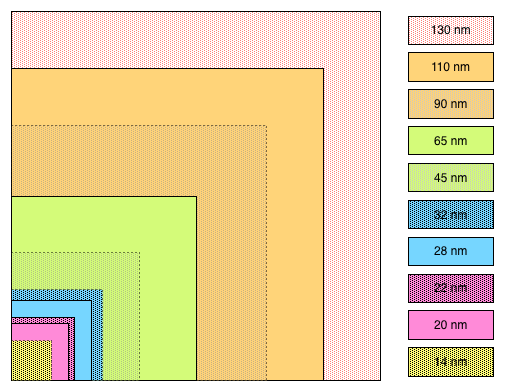
Relative sizes of ASICs in different geometries
Looking at this as a picture we can see just how much difference there is between 110 nm, 65 nm and 28 nm. We’re able to get more than 5x the number of transistors in a 28 nm device than a 65 nm one, and about 16x the number of a 110 nm one. What this means for mining ASICs is that we can get 16x as many hashing engines in the same amount of silicon. The solid block colours indicate geometries in which Bitcoin ASICs have either shipped or have been announced.
The process geometry matters for many reasons:
- As the feature size shrinks the speed of the devices increases! We don’t just gain in terms of having more hashing engines, but each one can run faster too.
- When larger ICs are built there’s usually some amount of parts that don’t work because of small flaws in manufacturing. The smaller the devices, the more working ones that helps to keep the cost down.
- ICs generate a lot of heat when they are run but we can offset some of that by running with lower operating voltages. As the process size shrinks, so too do the required operating voltages. This is something of a balancing act though, as it also tends to make them slightly slower.
This isn’t the full story as there are lots of subtleties that we won’t go into here, such as there being “fast” and “slow” processes where typically faster processes consume a lot more power for the same work and slower ones consume less. When looking at 28 nm mining ASICs, though, it’s worth noting that they’re not all created equal and there will inevitably be quite large differences between the different designs we see.
Where do Bitcoin ASICs go next?
Bitcoin ASICs have jumped forwards to the point where they’re catching up with the limits of what can be done. Realistically they should be able to shrink to 16 nm by the end of the year or the beginning of 2015, and at 16 nm there’s potentially a 3x improvement over an equivalent 28 nm device. Once things reach the limits of the fabs that produce the ASICs, though, then process-related gains will slow down dramatically.
This doesn’t mean that there are no more big jumps possible. It’s likely that designers this year will have to start (if they haven’t already) at other ways to try to keep propelling the ASIC mining train. Here are a few thoughts on where things may go next:
- Look at how to reduce the power required for each hashing operation so that they can build systems with perhaps more ASICs but the same power consumption.
- Improve the implementation of the SHA256 engines to make them take fewer gates/transistors and thus pack even more into each new chip.
- Develop novel chip packaging that can dissipate heat more effectively.
These sorts of changes are going to require more work though because they won’t just be based on known-working hardware concepts.
It will be interesting to see just how this progresses; while the pace of progress will slow from where it is now, and the steep exponential growth in the hashing rate is likely to slow, there’s every reason to believe that progressively faster hashing rates will continue to be a reality for quite some time to come.