
February 2014 Journal
WORDS is a monthly journal of Bitcoin commentary. This issue collects the February 2014 writing in the WORDS archive. For the uninitiated, getting up to speed on Bitcoin can seem daunting. Content is scattered across the internet, in some cases behind paywalls, and content has been lost forever. That’s why we made this journal, to preserve and further the understanding of Bitcoin.
Why Bitcoin Will Continue to Grow
By Daniel Krawisz
Posted February 1, 2014
The Value of Money is the Value of a Community
Currencies are unusual in that their usefulness as currencies is a result of their demand. The more deals that can potentially be made with one, the better it is. It is only indirectly because of a currency’s inherent properties that it can turn into a good currency. To an alien with no interest in human culture or technology, both dollars and bitcoins would be equally worthless, even though he would be able to see that bitcoins are a superior medium of exchange.
In economics, this is often called the network effect because it is the network of people using it that convinces everyone that the good has value. This can appear to lead to circular reasoning: everyone believes it has value because everyone else believes it has value because everyone else believes it has value… and so on. It is almost like a cartoon monkey that picks itself up by the end of its own tail!
However, a better physical metaphor might be the formation of crystals. A liquid can be supercooled into a state that can support crystals, but no crystals form because there are no initial crystals that the liquid particles can attach to. However, once a tiny impurity, or “seed” is introduced into the liquid, a crystal will form around it and grow quickly until the liquid has been absorbed.
By this metaphor, the supercooled liquid is the world as of a few years ago, ripe for a monetary revolution, and the seed is the initial bitcoin purchase. The fact that Bitcoin successfully transformed into something with value seems like a miracle. However, it was no miracle. It was a result of the dedication and faith of its community, whose members will not let go of the beautiful vision of a Bitcoin future. It might be better to use a word like “crystallization” to describe the formation of the initial “seed” of Bitcoin trading rather than a metaphor like “bootstrapping”, which depicts a physical paradox.[1]

Thus, when people dismiss Bitcoin as valueless and call every upward price movement a bubble, they are really missing the point. An investment in bitcoins is an investment in the Bitcoin community. It was in late 2012 that I came to realize just how wonderfully fanatical this community was, and this was what convinced me to treat my bitcoins not as simply an utter speculation, but as something with very real prospects.
The Network Effect for Currencies
Social networks are a familiar and often-cited example of the network effect. Facebook and G+ both have a lot of nice features, but the feature that makes Facebook so much more useful is that all your friends are already on it. Thus, it is really the network that uses Facebook that makes it valuable.
This example can be confusing when analogized to currencies. Facebook and G+ have the property that either can be used at a low opportunity cost of using another. In other words, if I am already spending some time crafting the most narcissistic Facebook status update that I can think of, there is little additional effort to posting it on G+ too. Both Facebook and Google support chat protocols, so there is little additional effort to using a program such as Jitsi that can run both protocols and log me in to both services simultaneously. Thus, it is possible for a social network to succeed without diminishing the size of the others. It can expect to attract members without necessarily drawing them away from the others.
However, for currencies the situation is different. Owning any one currency carries a high opportunity cost of owning any other. I cannot use the same money to buy an investment in bitcoins and in silver coins or Canadian dollars. If I want more of one, I necessarily must have less of another. If any one currency is acknowledged to be the winner over the rest, then there is no additional benefit for anyone to own other currencies.
While it is possible for two social networks to coexist, the world is not big enough for two currencies. Any initial disparity between two currencies, no matter how small, positively reinforces itself, and there is no reason to expect this effect to end until one currency is driven out of existence. As the price of currency A begins to rise relative to currency B, holders of currency B begin to see that their investment is looking less and less reasonable. As more people flee currency B, its decline accelerates until it has effectively ceased to be a currency.
This conclusion does not appear to be borne out by our everyday experience of different national currencies within each nation-state. This is explained by the fact that these states typically have legislation such as legal tender laws and capital controls that artificially reduces the usefulness of other currencies within their respective borders. There is no jurisdiction in which Bitcoin is legally privileged, so there is no group of people required to treat it differently than any other. Thus, there is no reason to expect Bitcoin ever to be in a stable equilibrium with national currencies, the way that they are in equilibrium with one another.
From these considerations, it follows that Bitcoin’s future is an all-or-nothing proposition. If Bitcoin is good enough to compete with other currencies despite their legal privileges, then it will overtake them. If not, then it is a bubble and eventually no one will want it but a few true believers.
It might be argued that Bitcoin could retain its uses on illegal markets, but there is no reason for a drug dealer to accept bitcoins as payment if there is no one who wants to use it as a store of value or as an investment. He must either want to keep it himself or have someone he can sell it to in order for him to use it. Thus, if Bitcoin fails as an investment, it fails as a payment system, even for purposes to which it is especially adapted.
The Meaning of Bitcoin’s Upward Trend
All things being equal, a larger network is better than a smaller one. This puts Bitcoin at a disadvantage with respect to national currencies. One would therefore expect Bitcoin to decline relative to dollars or euros. The fact that this is not the case tells us that all things are not equal. It shows us that Bitcoin is still good enough compared to the national currencies. It can grow anyway despite their advantages over it. The network effect means that the bigger Bitcoin gets, the better its prospects. The fact that Bitcoin has grown in the immediate past is strong evidence that it will continue to grow in the immediate future.
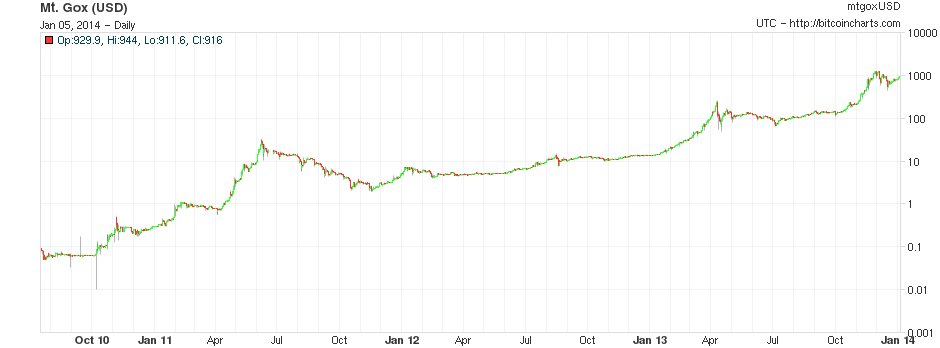
A possible objection is that Bitcoin’s demand is mostly investment demand rather than demand as a currency. Therefore, the objection goes, it is no longer the case that Bitcoin’s demand is self-promoting. However, a currency becomes more useful as a result of any kind of demand, not just demand as a currency. I would bet that most people who are invested in bitcoins today would be happy to get more by trading goods and services for them. They are also happy to serve as a facilitator for bitcoin trades via the dollar, which is effectively what happens when a merchant accepts bitcoins as payment and then immediately converts them to dollars. Thus, their investment demand enables more use of Bitcoin as a currency. By merely investing in Bitcoin, they enable more potential trades and make Bitcoin a better currency.
The interesting thing here is that we should expect the advantages of the national currencies over Bitcoin to decline as Bitcoin grows, and eventually to become disadvantages. Therefore, not only will Bitcoin’s expanding network further drive its growth, but the declining networks of its competitors will as well.
Based on this, my prediction for Bitcoin’s future growth is not just exponential growth, but faster than exponential growth. If it is successful I predict Bitcoin will take over the world faster than anybody expects, including myself. This prediction has been borne out in my own case: I am continually astonished by Bitcoin’s successes. Now one of my biggest fears in writing about Bitcoin is that my predictions will come true before I can publish them.
The End of the Trend
Predicting a change to Bitcoin’s growth trend requires thinking in terms of effects that are not relevant at present. This makes things difficult because it is hard to say what will become relevant first. It could be, for example, that Bitcoin’s growth will outpace its technology and the network will become congested enough that it hampers the adoption rate. If there was a concerted effort from governments around the world to destroy Bitcoin, this could greatly hamper Bitcoin’s growth as well—but at this point I doubt it could be stopped.
For now at least, Bitcoin’s present trend is self-reinforcing with no equilibrium in sight.
- Crystallization implies a transition from liquid to solid, which is not appropriate for Bitcoin. An even better physical metaphor would be the more general concept of spontaneous symmetry breaking, which includes not just crystallization but all kinds of other processes without a transition from liquid to solid. However, unfortunately not enough people understand what that is to make it a good metaphor. ↩︎
The Economic Functions of Bitcoin
By BTCtheory
Posted February 10, 2014
The economic functions of the bitcoin network causes it to behave like a central bank. This has a few effects: bitcoins (the payment unit) behave like stock due to the fixed, known supply of units being subject to open market operations. What happens when the market price of bitcoin changes is the velocity of bitcoin falls into disequilibrium until a new equilibrium is found. This is why the transaction volume of bitcoin its extraordinarily high during the bubble cycle, both on the way up, and on the way down. From this observation we can see the velocity of bitcoin also serves as the price finding mechanism for the immediate price of bitcoin. Before we dive in deeper, lets first take a look at how bitcoin acts as a private bank in the digital world.
Bitcoin: The Private Bank for The Digital World
If bitcoin was a private bank it would have the following maxim as its monetary policy:
- Whomever secures the Network shall be reward 50 bitcoin with each new block. This amount shall decrease by 1/2 every 210,000 blocks until it cannot be halved any longer.
This is the issuance of bit-coins, the currency unit, is made from the electrical energy spent mining bitcoins. We can see the monetary inflation schedule for bitcoin below. The supply of bitcoins is 100% totally fixed–the only way that new coins can be created is through solving a specific block, and the reward for that is drops every 4 years.
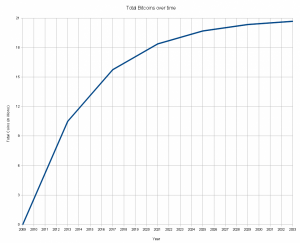
bitcoin supply growth over time
In order to have a money system that needs no central authority, Satoshi made bitcoin based upon rules that are fixed and secured by the mining process. This allows for a system where all bitcoin units are known at all times, thus making the double spend problem solved.
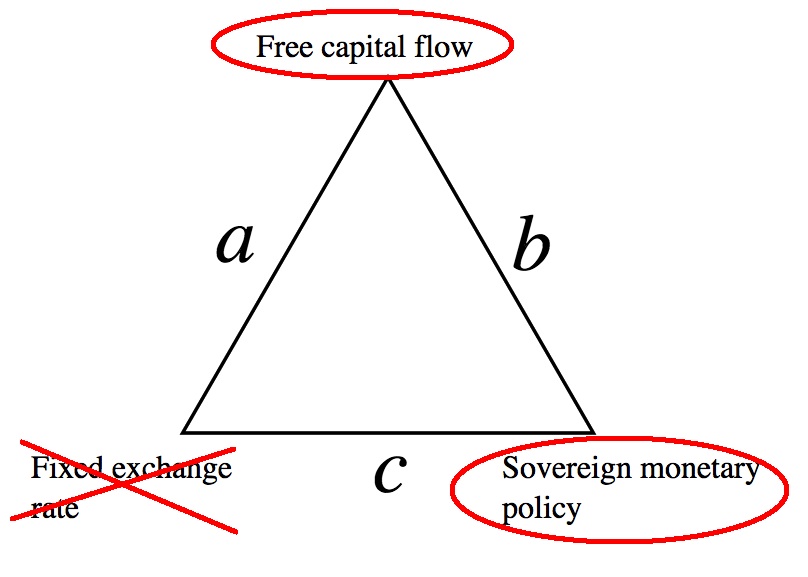
If bitcoin is a central bank, it would have to solve the impossible trinity problem that all central banks face (except the U.S. but that is a different story). Bitcoin accomplished this by creating a computer program with an independent monetary policy that humans cannot interfere with. The block reward, how the competition for the block reward is done, and the fixed supply of units are all parts of the bitcoin program that cannot be changed.
Anyone with a bitcoin address can use bitcoin, and it is impossible to know who is controlling each address, so bitcoin must be freely exchangeable. This means that the ‘sacrifice’ that bitcoin has made in terms of the impossible trinity is that it has no fixed exchange rate–the market must find an exchange rate based upon bitcoin’s perceived value, and the number of units available to the market. This free flow of capital from any sources is what allows for bitcoin to have been worthless just a few years ago, and why it could be worth $10,000s per coin one day. The free flow of capital is what creates the total elasticity that bitcoin experiences.
Bitcoin and Deflation
When economist have called bitcoin deflationary they are referring to its economic property of rising in value over time. This is due to the restricted supply of bitcoins while there is increasing demand for them. This is similar to how if you had bought Apple stock in 1980 during its IPO you would have paid $22 per share. Due to the restricted supply of Apple stock and the increase in demand, today it is valued at $520 per share–and that is after 3 splits.
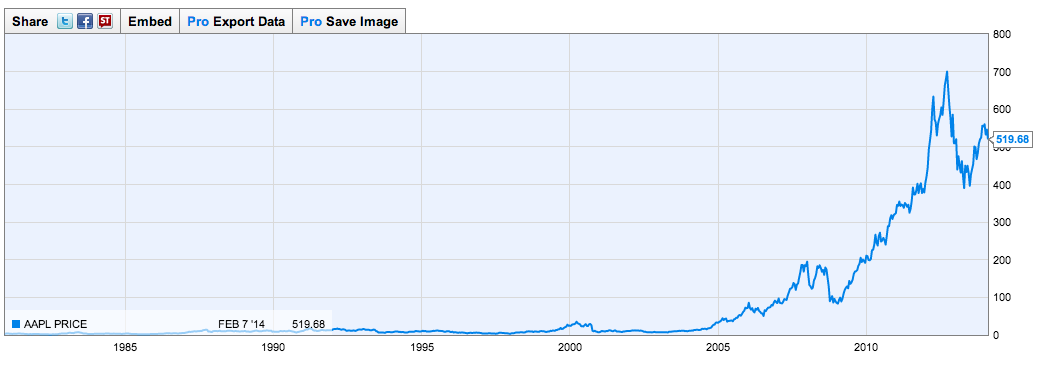
You could say that Apple stock “deflated” in value.
This occurred while the supply of the stock (# of shares) of Apple increased–it inflated. On three different occasions Apple had their stock split increasing the total number of Apple stocks there were. Again, this is due to the dramatic increase in demand for the stock. This is the kind of deflation that Bitcoin is experiencing overall, despite the volatile ride bitcoin has had over the last few year.
Why Deflation Supposedly Bad
Deflation is bad according to modern monetary theorist who charade as economist because contemporary economies are based upon debt. Fractional reserve banking and debt cannot exist without one another, so when deflation happens, it happens to debt as well. This means the real value of debt becomes harder to service, which means defaults, and bankruptcy will increase. In 1931, Irving Fisher presented his theory on debt-deflation, which explains this process in greater detail.
This kind of deflation does not happen with bitcoin. There is no need to service ‘debt-bitcoin’ with bitcoin, so debt deflation does not happen. If this were true, we would see a similar collapse in the velocity of bitcoin during deflationary episodes, but in fact we see the opposite. The velocity of bitcoin increases correlatively to the price change of bitcoin in the short-term.
The Price of bitcoin
The price of bitcoin is derived from the total utility of the bitcoin network. In otherwords, bitcoin’s value is specifically tied to how many people are in the network, how useful the network is, and what the perceived value of bitcoin is. This is similar to how Twitter and Facebook have created social value that has translated into real economic value; which is reflected in the stock price of both of these companies. Without their userbases, each one of these networks would be worthless. All networks have a hidden utility that translates into direct economic value.
The value of bitcoin is based in part off of this network abstraction. In order for price discovery to happen individuals need to use their subjective preference to decide how much each bitcoin is worth, and how much the network itself is worth. This is how the general, long-term price levels for bitcoin are discovered.
The short-term price is discovered according to network externality, such as exchange failures, or political issues. An example would be how bitcoin is ‘more expensive’ in Argentina because of the high rate of inflation that the peso is experiencing. Another would be the dramatic drop in price, and then recovery after the Silk Road was shut down. These network externalities, unlike fiat money, causes for great volititly in the price because there is no goverment to fix the price of bitcoin; only the market. The price of bitcoin reponds to these events through change, which causes for the velocity of bitcoin to increase until a new equilibrium is found.
The Velocity of Bitcoin
Due to the fixed supply of bitcoin, the only way that the price can be adjusted is in one way: through exchange and transaction. This is why during the most volatile times of bitcoin, we see a higher transaction volume. This applies to both increases as well as decreases in the price. Due to the fixed supply of bitcoin, the only way someone can acquire bitcoins is to mine them, or to buy them. Thus if the price of bitcoin is to increase or decrease in ANY WAY, an exchange or transaction must take place for that value to be accounted into the market.
Conclusion
Bitcoin’s deflation is similar to a technology stock where individuals are making real gains though holding a risky asset while it grows. Because bitcoin has a fixed monetary supply that cannot be manipulated, the price of each bitcoin is determined through supply and demand mechanisms. This is reflected in the increase of the velocity of bitcoin. If bitcoin were facing true currency deflation, we would not see the velocity of money decrease.
—
Next: Gresham’s Law and Bitcoin
Mt. Gox and fractional reserve banking
By Peter Surda
Posted February 11, 2014
While Mt. Gox has been long accused of running a fractional reserve system, the accusations increased during the last couple of days due to an escalation of the transaction malleability aspect of Bitcoin, and the inability of Mt. Gox to handle it on the technical, managerial and PR level. Some of the more elaborate accusals have been done by Dave Howden (first, second). While I don’t know whether Mt. Gox is or isn’t running fractional reserves, I thought I’d bring up a bit of my research on the theory of anti-FRB arguments. In an earlier version of the draft of my master’s thesis, dating about two years ago (i.e. long before the situation at Mt. Gox started escalating), I had a section analysing the legitimacy of FRB from Austrian perspective. It didn’t make it into the final version because my advisor argued that it is outside of the scope of the topic, so I should consider leaving it out (he was probably right). I think that it might be useful to look at the Mt. Gox situation from this perspective. The next section is quote from the draft (with some minor modifications).
Redeeming deposits on demand
de Soto (2009) argues that a deposit contract requires that the deposited item be redeemable on demand, and because it is impossible to redeem all fractional reserves on demand in all cases, it is illegitimate:
“Its [deposit contract, ed.] fundamental purpose is the custody or safekeeping of the good and it implies, for the duration of the contract, that the complete availability of the good remain in favor of the depositor, who may request its return at any moment. … The obligation of the depositary is to guard and protect the good with the extreme diligence typical of a good parent, and to return it immediately to the depositor as soon as he asks for it.” [emphasis added]
I submit that there are cases where redemption on demand is refused even during a full reserve deposit. Following is a list of some of these cases:
- it is outside of the opening hours of the bank
- the bank is undergoing an audit during which access to reserves is suspended
- the particular branch does not have sufficient reserves1
- there are technical difficulties in accessing the reserves, for example a malfunction in the lock in the safe, or the person with the key is indisposed
- there is an issue with verifying the authenticity of the withdrawal request2
- the deposits were stolen by a third party and the bank was unable to obtain enough reserves from the insurance/bank owners/other financing source on time
In none of these cases is there a fraudulent behaviour by the bank. The last three cases could be argued to be a consequence of negligence and give a rise to liabilities, however the first three are perfectly legitimate occurrences. Therefore, the impossibility to redeem the deposit on demand is not a sufficient criterion to conclude illegitimacy.
There is also the praxeological issue of differentiating withdrawal on demand and after a fixed period. The act of withdrawal is a type of action, and as such takes some time. It begins with the depositor initiating a contact with the bank, continues through the bank obtaining identification of the depositor or at least the bearer instrument he provides, verifying it, accessing their reserves, recording the withdrawal in their accounting systems and presenting the specie to the withdrawer3. During this time, the bank can liquidate some of their investments to compensate for the lack of reserves at the time of initiation of the withdrawal request. So from praxeological point of view, it is impossible to differentiate between on demand and not on demand deposits.
Applying the theory onto Mt. Gox
Based on known facts, Mt. Gox suffered from points 2, 4, 5 and 6. Their automated system for processing withdrawals is broken, they cannot verify if a withdrawal did or didn’t occur, and have a mess in their accounting as a result and are re-auditing their systems. We don’t know for sure if any of the deposited bitcoins have been stolen as a result of this, but previously, the US Department of Homeland Security and the US Secret Service seized (i.e. stole) about 5 million USD from Mt. Gox’s bank accounts in the USA.
I’m not going to speculate whether Mt. Gox can fix this mess, but at least theoretically the problems casued by transaction malleability should be possible to audit, and at least there where account holders themselves successfully performed a double spend attack, Mt. Gox knows who they are, and can attempt legal action against them.
What can we learn from this?
I would like to introduce a saying: “Whatever bad happens with Bitcoin happens to Mt. Gox first”. In other words, Mt. Gox is a lucrative target, because of its history, market share, poor management and PR skills. Attacks thus tend to affect Mt. Gox first. This generates knowledge, and entrepreneurs and users who observe these attacks, their consequences and reactions of Mt. Gox can learn from this, and not repeat the mistakes. Maybe we can argue that Mt. Gox should have spent more on management, auditing, PR or lobbying (to avoid the account seizures), but not all of this can be known in advance, and thus some level of experimenting is necessary. I don’t want to present myself as Captain Hindsight. Nassim Taleb argues that we should honor failed entrepreneurs for showing us what doesn’t work. Maybe we should do the same thing with Mt. Gox. After they repay everyone their deposits back.
Footnotes: 1An analogous situation would be an ATM running out of cash. 2In a security breach in May 2012, Bitcoinica lost their main trading database and they had to gather the data required for the verification from other sources, which was a time consuming process that took many weeks. Recent announcement (June 13th 2012) indicated that the payouts have started, however at the time of writing (June 17th) there were still unprocessed claims. Update for this blog post: Bitcoinica entered liquidation in November 2012 and still hasn’t concluded. 3The process described is exactly the same irrespective of whether the withdrawal is done through a clerk, through an ATM or online banking.
I’m Hoarding Bitcoins, and No You Can’t Have Any
By Daniel Krawisz
Posted February 12, 2014
Those nasty hoarders! You know the ones. They won’t use bitcoins because they think they’ll be worth so much more later. But how can we convince businesses to accept bitcoins if no one will spend them? We need to guilt those hoarders into spending their bitcoins to support the merchants! This article is about why this line of reasoning is exactly wrong.
If You Sell Bitcoins, You Aren’t “Selling” Bitcoins
I’m sure you’ve heard a story like this. “I’ve been going to all the local stores and telling them how awesome Bitcoin is! But none of them wants to take payments in Bitcoin! Why don’t they like it?”
Let’s think about that for a minute. You are essentially telling the merchant, “Hey look at this totally awesome thing that I want to get rid of! You should trade me some stuff for it!” Not actually much of a sales pitch, is it? Why would the merchant want something that you, apparently, don’t want? If you really want him to start accepting bitcoins himself, ask him, “Do you take worthless paper money at this store? Good, because you’re not getting a satoshi from me!” That will convince him that you think they’re valuable.
How about this instead? Tell your local merchants that you want to be able to spend cash in their stores and get the change in bitcoins. That’s the kind of store I’d like to shop at. And then when the merchant later says “I’m not going to do that anymore. I want you to pay me in bitcoins!” you know he’s become a true hoarder.
Hoarders Give Bitcoin Value
The initial price of bitcoin was caused by people who wanted to hold it, not people who wanted to spend it. Furthermore, each subsequent step in Bitcoin’s advance must begin with more holders, not more spenders. The business that bitcoins can absorb is limited by its market cap. At a market cap of two or three billion dollars, Bitcoin can absorb many small businesses but it cannot be used for international oil trade. It would have to be dozens of times more expensive for that, and it can only achieve that if the peoples’ desire to hold bitcoins continues to increase faster than their desire to spend them. Thus, one who wants Bitcoin to become mainstream should never want its price to be lower. He should want an ever-increasing supply of hoarders.
It is true that Bitcoin’s price can occasionally and temporarily outpace the growth in its real prospects, but this is merely a byproduct of Bitcoin’s phenomenal success. A commodity which increases in price as quickly as bitcoins can be expected to experience shocks and manias on its way up because it would be difficult to tell the difference between a sustainable price increase and short-term speculation. However, does it make really sense to prefer an alternative history for Bitcoin in which its price has increased slowly enough that it never developed any manias? I do not see how that could possibly be preferable. The faster Bitcoin grows, the more complete and decisive will be its victories, and the more difficult it will be for its natural enemies to react to it.
Who Needs Merchants Anyway?
One of the most annoying things about Bitcoin is that it’s so convenient to make payments with it that sometimes it is extremely tempting to spend it and avoid the hassle of using dollars. One of the ways to help deal with the temptation to spend is to demand a Bitcoin discount at any store that accepts Bitcoin. This is perfectly reasonable because not only is the store lowering its own costs by using Bitcoin, but it is asking me to give up an inherently superior commodity.
Hoarders are more important than merchants. If a restaurant downtown starts accepting bitcoins, this does not necessarily create an incentive for anybody to buy more bitcoins. Why would anyone bother if they can still just use a credit card? If you can convince a merchant to accept bitcoins and stop accepting dollars, then I’ll be impressed.
Unless a merchant is offering something that cannot be bought for dollars, or at least offering a discount, he is only benefiting Bitcoin to the extent that he encourages more hoarding. If he immediately converts the bitcoins he receives as payment into dollars, and if his customers only buy bitcoins so as to spend them at his shop shortly thereafter, then neither has much direct effect on Bitcoin’s demand. The real hero is the hoarder behind the scenes who buys from the merchant and enables him to convert his payments into dollars.
Greed is Your Friend

There can be no spending of bitcoins without the buying of them, and thus all use of bitcoins as a medium of exchange depend on someone who wants to increase his holdings, i.e., a hoarder. Without them there could literally be no Bitcoin trade. Furthermore, it is counterproductive to try to turn hoarders into spenders. There really is no compelling reason that anybody should spend bitcoins any time soon—if everybody is hoarding, that will just make the price go up until finally someone can’t help spending some.
Currencies are unusual in that the greater is its market cap, the more useful they are. This is in contrast to a more ordinary security, such as a stock, because a stock has a better value the cheaper it is in relation to the underlying assets of the company. A more expensive currency is ipso facto more marketable (more liquid), thus making it a superior medium of exchange. The more bitcoin hoarding there is, the better it is as a medium of exchange.
Thus, the success of Bitcoin is, to some extent, a self-fulfilling prophesy. Belief in Bitcoin improves the Bitcoin network, as long as people back-up that belief by the the action of acquiring and holding more. The more greedy people are for Bitcoin, the better are its chances. You should never want people to spend more—you should want everyone to be as greedy as possible.
All Hail the Hoarders
Let out your inner hoarder. Don’t deny your urges. Let him out and come to terms with him. Imagine how he would look if he could sit on your hoard of bitcoins. Doesn’t he look terribly happy? Let him roll in your bitcoins. Doesn’t he look so cute poring over his copy of Atlas Shrugged? Look at how gleeful he is as he buries it in his basement. Now let his avariciousness flow over you. Let it seep under your skin. Let your hands clutch! Let you teeth clench and your mouth contort into a covetous grimace. I want to hear cackles!
Now didn’t that feel good? The Bitcoin economy will thank you in the end!
I conclude with one proviso: it can be very effective to give out small amounts of bitcoins just to help accustom people to having them. However, the reason this is effective is that it helps spread avarice around.
Summary update on Bitcoin transaction malleability adjustments
By Konrad S. Graf
Posted February 14, 2014
POST HEADER
POST BODY
Here is a quick summary of the current state of the response to transaction-malleability attacks on some exchanges, based on what I have gathered mainly from Github, Reddit, and Twitter discussions. One note on terminology at the outset, transaction-ID malleability would probably make this easier to understand for the general public at first glance—the substantive content of transactions cannot be alterned at all through this issue.
The MtGox exchange was still hardest hit in its particular implementation, but more importantly, it is mainly suffering in addition due to a general lack of market confidence in its business and solvency, which has built up over a very long period. The “price” it currently displays is not really a “Bitcoin price,” but mainly a market risk assessment of the likely state of the exchange’s own solvency. The current issue and MtGox’s response have come as a “last straw” for the market’s view of this company. This business-specific factor has also amplified the wider public impression of how significant the actual general technical issue itself is (this is typical for Bitcoin news, but still).
That said, MtGox’s infamous Monday press release blaming the Bitcoin protocol for its own woes was not entirely fanciful after all, and some wider adjustments are being made to tighten up this issue at some other exchanges and even in the reference implementation itself. These code adjustments in response to transaction ID malliators (those taking advantage of the situation to reissue transactions with altered transaction IDs) are taking shape and are in the process of being approved and implemented.
What we are apparently getting is a new “normalized transaction ID” field in transactions. This reflects the substantive content of the transaction itself and is therefore immune to the malliation to which the standard ID is subject prior to confirmation. To clarify for those who have not followed this closely, this issue has never had any direct effect on the content of transactions, that is, on who gets what. The exploit is only a way to fool some wallets into not seeing that a confirmed transaction has in fact been confirmed.
The work underway is precisely to fix these particular implementations so that they correctly perceive that confirmed transactions actually have appeared on the blockchain. These implementations had been relying on the initial standard transaction ID for this function. Not everyone understood that during a window after initial submission to the network and before confirmation, a transaction could be copied and the copy reissued with an altered transaction ID by changing the format of the signature.
Reference wallet features to make use of this new normalised ID are well in process. These include detecting copies of the “same” (in terms of hard content) transactions with differing standard transaction IDs. This is called “Walletconflict detection.” “Conflicted” transactions, that is, versions of a transaction that did not confirm due to ID malleation, are to be reported as “confirmations: -1 and category: ‘conflicted.’” This status is based on detection of multiple transactions with the same (new) normalised transaction ID as one another (only one such transaction can ever be confirmed, but this new feature brings any ID-malleation attempts to the ‘attention’ of the wallet software by showing all malleated and non-malleated versions that carry the same content).
The Bitstamp exchange announced Friday morning (in Europe) that its system adjustment, built with support from core developers, had passed internal testing and that it is likely to resume withdrawals later in the day.
There is more to be done to support more complex and as yet rarely used Bitcoin features in terms of the standard transaction ID issue, as this ID is what is used in inputs to future transactions. This is complex, because the malleability of the standard ID could also have positive uses in the future in facilitating certain types of complex transactions. The current adjustments with the addition of the normalized transaction ID and related code should be a sufficient immediate adaptation to the issue.
POST FOOTER
/post
/content-wrapper
Bitcoin Has No Image Problem
By Daniel Krawisz
Posted February 25, 2014
Why Doesn’t Bitcoin’s Success Speak For Itself?
Bitcoin has an image problem! Everyone thinks Bitcoin is for drug dealers, hackers, and anarchists. It’s used to gamble and buy porn. People think it’s a Ponzi scheme! Bitcoin needs to grow up and repudiate its youthful indiscretions. Its services must be run by professionals, not amateurs![1] Soccer moms will never use Bitcoin if they think it’s used for drugs and porn. Bitcoin will never be acceptable and gain widespread adoption otherwise!
In this article, I will show why the above paragraph is totally misguided.
Bitcoin is far too useful to expect that prejudice will stand in its way. Almost everyone who has ever bought bitcoins had to overcome an initial skepticism, and this will continue to be the case right until Bitcoin takes over. To want bitcoins requires a person who can see ahead a little bit better than everyone else. The only way to convince most of them that Bitcoin is in their future is to build that future and show it to them. Those with a less entrepreneurial mindset will simply have to be in much worse financial straights without it before they will be ready to adopt.
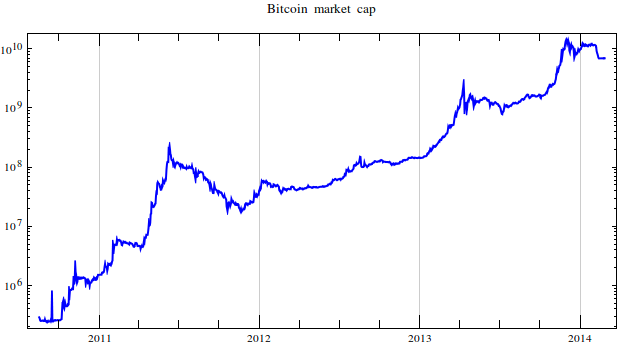
The data on Bitcoin’s adoption rate show no evidence of an image problem. First look at this log chart of Bitcoin’s market cap.
Now take a look at the number of MyWallet users over the past two years. This is also a log chart.
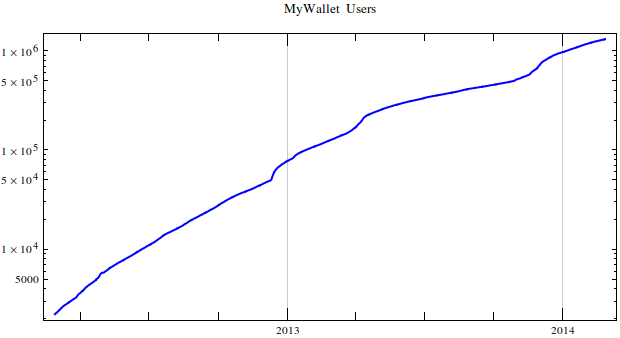
That’s an increase of like 500 times in two years. Ooo, I’m so terrified Bitcoin’s image will stop people from wanting it.
And what about BitPay, Bitcoin’s premier payment processor? In September of 2013, they signed up their 10,000th merchant. By December, they had over 14,000. On Black Friday of 2012, they processed 99 payments. That same day of 2013, they processed 6,296.
Are you kidding me? I’ve never seen anyone want anything this badly. People can’t get enough bitcoins. Every indication of Bitcoin’s adoption shows a rapid exponential growth. The idea that Bitcoin has an image problem is empirically ridiculous.
You could run an ad campaign for Bitcoin that tells people it’s the stupidest idea ever and punch people in the face when they bought in and they would still flock to Bitcoin. You know how I know that? Because that’s basically what has been happening since the beginning of the Bitcoin economy. N00bs enter the bitcoin world to find scams and sophomoric novices that give them terrible advice. They lose their investment from simple mistakes and they get raped by the markets. These are serious problems that need to be ameliorated, but the point is that people can have very bad experiences when they enter the Bitcoin world, and they still want more Bitcoin. This is how we know we don’t have to worry about Bitcoin’s image.
Bitcoin’s Image is Actually Great
I think Bitcoin has a great image and that Bitcoin’s association with illicit activity should not be seen as a problem for it. I can’t think of any better way to generate interest in Bitcoin than drug-dealing, hackers, and anarchy. When was the last time you heard someone say, “Oh, Bitcoin! I’ve heard of that. That’s that new currency that’s great for remittances, right?” Never, that’s when. Drug dealing, hackers, and anarchy are great lead-ins to a conversation.
I remember the days when Bitcoin was so unknown that I was not even recognized as a dork for talking about it. In those days, nobody wanted to hear about Bitcoin, not even libertarians. If I tried to talk about it, it was like people didn’t even hear me. Now everyone wants to hear about it and I wouldn’t have it another way.
Furthermore, Bitcoin’s improvements to the illegal drug industry and to practical anarchism have been one of its greatest successes, so why shouldn’t people associate Bitcoin with drug dealers and anarchists? Not only is that honest, but it is a strong endorsement. If Bitcoin is good for illicit activity, that means it empowers people. If people think that Bitcoin can help them to evade contraband laws, to taste the forbidden fruit, to satisfy needs that society would rather have them suppress, then that is a fantastic advertisement.
Bitcoin is subversive as more than just a payment-processing technology. It is not just a cool new gadget that ordinary people can use without fearing that it will lead them unexpected new directions that test their ability to grow as a person. It has the potential to change their lives irrevocably. It has the potential to drastically change the balance of power in society. It is perfectly reasonable for people to be suspicious. People should feel a real twinge of danger when they first get bitcoins. It can usher them into realms which their society has long told them were off-limits. If we got people to believe that Bitcoin was only good for revolutionizing e-commerce, then Bitcoin would have an image problem because that would not be honest.
The Disconnect
These “image problem” people are like if the Clampetts discovered that they were sitting on a swamp made out of crude oil and worrying that people won’t accept it because it’s too ugly and gross, so they try to convince people that it’s a pretty shiny pink and tastes like cherries.

Oh Narcissus, you’ll never understand Bitcoin.
The only way to think Bitcoin has a bad image is by marketing it to the wrong people. Yes, just about everyone could benefit from Bitcoin right now, but for most people, the immediate benefit would be relatively small, and it is too much to ask them to understand both the economics and the cryptography that would be required to convince them that Bitcoin has a vastly greater potential than it has yet achieved. Instead of marketing Bitcoin to the people creative enough to see its potential, or to those who so desperately need it now that its benefits are obvious, entrepreneurs like Jeremy Allaire are attempting to market Bitcoin to the average American as a payment-processing system. This is premature because Bitcoin’s benefit as a payment system is only significant after lots of people already have it—therefore the benefit is marginal to most people. As Bitcoin improves, and particularly when it begins to weaken the fiat money system, more and more people will find it prudent to adopt it.
Bitcoin inspires suspicion among bankers and regulators. Bitcoin has a bad image with them, but that’s their problem, not Bitcoin’s problem. Those who are worried about banks boycotting Bitcoin or the government regulating it out of existence should not plan to start a Bitcoin business under such regime uncertainty. Eventually, Bitcoin will have become so widespread that it will have drastically reduced the scope of both banks and government. Then that will be a good time for payment-processing companies.
This is all a bunch of narcissism. It’s an emphasis on appearance without substance and respectability among people who don’t matter. Bankers aren’t Bitcoin owners yet, and until they are, their opinions are not important. If Jeremy Allaire thinks that Bitcoin has an image problem, he should try smuggling it into Argentina instead of marketing to Americans and bothering with American banks.
How to Improve Bitcoin’s Image
The best way to improve Bitcoin’s image is simply to improve the Bitcoin economy. With every new service, the incentives for more people to join us grows. We should feel lucky that we are in on such a wonderful secret as Bitcoin. If people mistrust and misunderstand it now, then we should be happy if it gives us a little extra time—however brief—to buy more. Every time someone figures out how great Bitcoin really is, he makes Bitcoin even more great by joining in.

When you’re an immortal distributed system that can’t be controlled, you don’t have to care what other people think.
Bitcoin is stronger than all its enemies put together. It is so strong that its image does not matter one bit. It is the 800-pound gorilla that can sleep where it pleases. It is only through timidity, and by failing to see its own strength, that it will bow to outside forces.
- I wrote this before Mt.Gox crashed. I’m very glad it’s gone. Bitcoin still doesn’t need “help” from regulators and bankers. ↩︎
On Matters of Merchant Adoption
By Pete Dushenski
Posted February 25, 2014
In the present era of fiat economics, delaying gratification just doesn’t work. Branded as unpatriotic, unproductive, and selfish, waiting to save up for something you really want is a one-way ticket to social alienation. If you’re not stimulating the economy, constantly injecting fresh capital into the bloodstream of the junky, it’s going to collapse, go into withdrawal, and die. You have to buy that shit right now. Or else? Well, you won’t be keeping up with the Joneses and inflation will rob your ass.
This lens, that of citizen-as-consumer, is a bizarre worldview indeed. It’s a sort of fascist bread and circus routine. You’ll be happy as long as the multi-nationals have something to sell you. Won’t you?
But you can’t trick the Bitcoiners! Oh no! We’re better, smarter, faster, and (can afford to hire people who’re) stronger! We don’t succumb to materialism, the temptations of The Man, etc. That’s for other people. Lesser people.
But if that’s so, why do the vast, vast majority of Bitcoiners (at least those on bitcointalk, /r/bitcoin, and Facebook) constantly expound the virtues of merchant adoption? Why does the ommmm of mainstream Bitcoiners sound suspiciously like “Amazoooooooon”.
The logic of merchant adoption appears to be loosely based on the idea that the more people see “BITCOIN ACCEPTED HERE” signs, the more people will know about Bitcoin, the more people will want it, the more demand pressure will squeeze the known supply, the more to the moon. This line of logic continues, with a known BTC supply increase of 11.11% in 2014 and a perfectly efficient market (which, if Mt Gox is anything to go by, is a ludicrous notion), we can infer that any USD/BTC price increases represent an increase in demand net of that supply increase. All because of merchants. Because obviously.
Aside from the increasingly obfuscated price signali, there’s a philosophical contradiction here. Bitcoin is powerful because it’s outside of the current paradigm, outside of the existing infrastructureii, and because it presents an opportunity to abjugate ourselves from a fossilized system. Yet our birthplaces and our places of habitation, soaked in deep layers of consumerist muddle, prevents us from seeing what lays beyond yonder mountain of Walmart refuse.
If independence means freedom, in the emerging Era of Bitcoin, independence means freedom from physicality, both geographic and material. If Germany had its wealth stored in BTC instead of gold, it wouldn’t have to beg the USG to please, pretty please, let it audit its own stores under Manhattan. If Germany stockpiled bitcoin instead of gold, it might actually be an independent nation.
Merchants like your local coffee shop have never accepted diamonds for goods or services rendered. And diamonds aren’t available from ATMs in the shopping mall. Incredibly, rappers still think they’re crazy valuable. Funny how that works.
Effective marketing rarely, if ever, increases the value of a product by making it 100% accessible all at once – it tends to be the opposite. De Beers hoards that shit in warehouses so it’s only as available as they want. Why don’t we do that with BTC? Rather than feeding into our consumerist leanings and making bitcoin easier to buy and spend, perhaps we’d be far better off making it more exclusive, like a velvet-roped night club, but for numerically competent folks. A velvet-roped library, then.
As the individual responsible for helping several local businesses accept BTC, this conclusion seems a bit contradictory coming from me. Perhaps the best spin I can put on it is that I’m helping local entrepreneurs promote themselves, strengthening their positions in the community and putting a bit of the world’s most valuable asset in the pockets of some of the city’s most well connected people.
Bitcoin, unlike fiat, demands that we delay gratification. For once. This can be confusing at first, but it’s a lesson we soon learn. I learned it last summer when I spent 3 BTC on a $450 case of wine in Kelowna. Today, I could’ve bought that case for 0.64 BTC, and probably more like 0.1 BTC before long, then 0.001 BTC, etc.
For those of you holding, be patient, watch bitcoin grow, and fight the temptation to spend it. Your future self will thank you for it.
- See Mircea Popescu’s February 2014 statementfor his options-trading and securities exchange outfit, MPOE.↩
- Bitcoin is sovereign.↩
MtGox fiasco highlights advantages of Bitcoin and damage from regulation
By Konrad S. Graf
Posted February 27, 2014
POST HEADER
POST BODY
The bankruptcy of a centralized Bitcoin exchange, such as the MtGox collapse, is a prime example of the type of “trusted third party” risk to which Bitcoin itself was designed to provide an alternative. Although the original Bitcoin white paper particularly pointed out problems with people having to trust some third party to conduct financial transfers, an exchange facilitating impersonal market trading is also a type of trusted third party.
Customers of such exchanges do not maintain direct control of their bitcoins, but instead exchange these for entries in a customer account on an internal corporate system. Customers then rely on the particular quality and reliability of the internal management, data, and auditing systems of their chosen exchange to the extent and duration to which they leave balances there.
Bitcoin was designed to be a new type of solution to the kind of counterparty trust/risk problem that the MtGox news brings to light, although the same issues are all too familiar to students of the long history of fractional-reserve bank runs and systemic financial crises (importantly, this one is not systemic, but company specific). One objective of Bitcoin’s design was to reduce or eliminate the need for end users to rely on any such centrally managed (or mismanaged) credits—whether centrally issued monetary units themselves (first from banks of issue and later from central banks) or the particular internal accounting entries of specific service providers.
Users who directly control the keys to their own bitcoins, such as by using paper wallets, client software, and to a large degree also legitimately client-side encrypted web wallets, carry no trusted-counterparty risk (but still risk of user error and theft). However, if users do not hold bitcoins in some such direct way, they do not hold them at all. Rather, they hold a claim on a specific exchange company or secure-storage service.
MtGox customers were holding what were essentially Goxcoins, that is, MtGox-brand bitcoin credits (and/or MtGox-brand fiat account credits). They were not holding bitcoins. Such services can and should be sound of practice and strong of reputation, as appears to be the case with a number of other existing services. For example, Bitstamp-brand bitcoin account credits and Coinbase-brand bitcoin account credits have attracted none of the fear and discounting of MtGox-brand bitcoin account credits. All of them have the same status from a purely economic-theory point of view and none of them equate to the direct holding of bitcoin itself. However, their qualitative differences, from brand to brand, on the market have become increasingly vast.
One key innovation of Bitcoin was eliminating from within its own design any single point of failure from centralization in the core protocol and network. This has eliminated for users the need to rely on what I call a “trusted fourth party” that is, a centralized currency-unit issuer. However, next to broad Bitcoin-community enthusiasm about the potentials for decentralized designs, this does not necessarily imply a need to eliminate any and all points of centralization, such as the ordinary business design of competitive third-party services, whether centralized or decentralized. (De)centralization is negative when misapplied and (de)centralization is positive when well applied.
That said, Bitcoin does raise the competitive bar for financial service providers in original ways. It gives users an unprecedented opt-out path from the third-party financial services market as a whole. From a user standpoint, Bitcoin eliminates the need to necessarily rely on any third party whatsoever to aid in conducting one’s financial affairs. One who does not find some third-party service helpful can choose instead be one’s “own bank.”
I contrast, the traditional banking system’s only true opt-out path for end users is to be “unbanked” and thereby excluded from significant opportunities to engage with extended commercial society. With no true opt-out path for customers, but only a choice of fundamentally similar Bank A and Bank B, banking systems became increasingly cartelized over the course of centuries in the pursuit of coordinated inflation at the long-term expense of end users. Bitcoin has now provided end users exactly such an alternative to the familiar array of cartelized non-choices in financial services. It has also provided an opt-out path from the need to use reliably value-losing fourth-party-issued currency units.
A cause of certain irregularities
As MtGox has shown (to varying degrees for years and only now to its clearest extreme), particular third-party service providers can be unsound in their business practices. What is somewhat more mysterious is that such entities could continue to exist despite a long-standing negative business reputation, as well as the parallel presence of at least some apparently sounder alternatives.
One major factor in this is the high degree of regulatory risk and uncertainty in financial services in many countries. This has held back—by years—the entry of additional and higher-grade competitors, including not only start-ups, but potential new service offerings from existing firms. Many firms that could have easily started offering more professional Bitcoin services much sooner, did not do so due to risk avoidance in the face of a pervasive climate of regulatory fear and uncertainty.
Such companies—the market entry of which no one ever witnessed because it did not happen (Bastiat: “that which is not seen”)—had an abundance of just that expertise in systems, internal controls, and financial management in which MtGox seems to have been painfully deficient. In any less hampered market than financial services, such a company as MtGox should have easily been outcompeted and/or acquired by superior entrants long before reaching such a significant scale and being in a position to be a conduit for as much damage to its customers as it has.
“Regulation,” far from being a comfortable universal-savior solution, is in this way squarely to blame as a major factor in setting up the competitively hobbled business climate that helped enable such a weak firm to remain in business far past its expiration date. That stronger firms are now growing and new ones appearing is a positive development for the Bitcoin ecosystem. That more and stronger new entrants were missing in action starting at least two years ago owes a great deal to the artificial ex ante political blockades to social progress collectively known as “regulation.” The up and down tides of market sentiment regarding the range of potential regulatory actions have also played a major role in amplifying bitcoin price volatility. This component of volatility is then naively blamed on “bitcoin” instead of on the irrational and unpredictable regulatory climate, market expectations about which shift with every passing “official” mumbling, musing, or rumor from anywhere in the world (though much less now than in the past).
Constructive work is underway to apply the conceptual and technical solutions that Bitcoin has brought into the world to the specific business of exchanging global bitcoin for various local monies. These include a range of decentralized exchange protocols, and methods of using the blockchain to confirm customer reserves. Contracting for independent third-party audits would also seem a reasonable business measure for participants in a competitive exchange landscape. Offering such audits could be another un- or under-tapped potential business opportunity. Once again in this case, progress has been impeded by regulatory fears that have helped prevent relevant established professionals from getting involved much sooner just where most needed—in an entirely new world-changing start-up industry.
As the less content-oriented among media participants scramble to conflate as thoroughly as possible the emerging disasters of the MtGox company with their own vaguely formed fantasy images to which they attach the word “Bitcoin,” I take note that the really existing Bitcoin was designed as an innovative solution to the centuries-long institutional problems of users having little choice but to trust some “trusted third party” in their financial affairs. What has been dubbed “Empty Gox” is only the latest particular manifestation of this long-running problem, to which Bitcoin itself has arrived on the historical scene as a significant new class of solution.
Suggested reading: “Bitcoin: A Peer-to-Peer Electronic Cash System,” Satoshi Nakamoto (Oct. 31, 2008) [PDF]
POST FOOTER
/post
/content-wrapper
The Wallet Inspector’s Promise
By Pete Dushenski
Posted February 27, 2014
There are no shortage of pie-in-the-blockchain promises being spewed forth from the self-appointed leaders in today’s Bitcoin space. “Presenting a revolutionary new way to use smart this to decentralize that”, or some variation thereof. Sound familiar?
Unless you’re so new to Bitcoin that you’ve never heard of BitShares, Ethereum, or Mastercoin, such promises should ring as clear as the Vatican’s bells on Christmas Eve. Anyone who’s “anyone” in North America’s Bitcoin scene is bleating at the top of their lungs about the promises of such innovations. Bitcoin-powered drones acting as Decentralized Autonomous Corporations that execute smart contracts to deliver GPUs from Amazon right to your 10th floor apartment balcony is pretty much the mashed up embodiment of this wet dream. It’s also as likely as flying cars and equally ignorant of reality.
Those of us interested in Bitcoin tend to be idealists. We imagine a brighter future for humanity by separating money and state, and in the process returning transactional privacy to individuals. Now that this appears to be fait accompli (even though it’s far from it), we can’t help but shift our collective sights to the next fantastical image of the future. And presumably, the next one after that as well.
Despite innumerable painful reminders, pie-in-the-blockchain promises are just that: promises. Butterfly Labs promised to ship your ASICs, Mt Gox promised to keep your coins safe, BitFunder promised to let you trade securities, and on and on and on. But would you, in your wildest dreams, pay for (much less blindly pre-order) a $15,000 car from a random manufacturer you’ve never heard of, just because they had a glitzy website, some Pixar doodles, and specs promising both 0-60 in 3.2 seconds and 200 mpg? Hell, especially if they made such audacious claims? As if! You’d only buy such a car, and such promises, from VW or perhaps Honda because you know that both of these companies have public identities with public executives and a long history of delivering the goods. This is normal logic that normal people have. Yet such logic is completely out the window in the Wild West of Bitcoin Greed and Idealism. Everyone with two bitcents to rub together thinks they’re an investor, rendering them gibbled prey to the wolves with slick websites and calculated appeals to idealism. Unbelievably, such wolves are consistently able to raise MILLIONS, even TENS OF MILLIONS of dollars worth of BTC, then walk away as if nothing happened. This is as criminal as it is preventable.
The solution: Due Fucking Diligence.
It’s hard to say how many times the Bitcoin wolves will be able to trick the Bitcoin sheep. Maybe there’s no limit. But time breaks bullshit. The fly-by-night operations and their skeezy operators will come and go, but their proportion in the Bitcoin Economy will continue to dwindle as legitimate players outwit and outlast them.
These are the very embryonic stages of something monumental. Rest assured that Mother Nature will weed out the useless mutants, just like she always does. So before you throw more valuable coins on yet another promising promise (eg. CoinTerra, NeoBee, etc.), consider more than just what’s being promised, consider who’s making the promise. If they’re anonymous or an unknown quantity, you’re “investing” with them in the same way that you “invest” with a wallet inspector.
Trust them at your peril. Because it’s all about trust.