
December 2014 Journal
WORDS is a monthly journal of Bitcoin commentary. This issue collects the December 2014 writing in the WORDS archive. For the uninitiated, getting up to speed on Bitcoin can seem daunting. Content is scattered across the internet, in some cases behind paywalls, and content has been lost forever. That’s why we made this journal, to preserve and further the understanding of Bitcoin.
There is only one blockchain and it’s called Bitcoin
By Oleg Andreev
Posted December 3, 2014
The purpose of the blockchain is to help those who are interested to continuously establish global consensus on an ever-growing dataset without trusting any authority and assuming presence of active attackers that may gain measurable advantage by manipulating that consensus.
Consensus is securely established because every updated version of the dataset has a sufficiently large proof of work attached to it. Contrary to a popular belief, this proof of work should not simply be marginally larger than any alternative version. Active attacker may not advertise their version equally to all nodes so you could comfortably choose the most difficult one. What we need from the proof of work is to be infeasible to redo. There should not be even a possibility for someone to build a secret facility that can redo the same amount of proof of work that was produced by all “honest” (i.e. open) participants.
Lets imagine I receive $1M on a Bitcoin address and wait 1 week for it to be buried under a 1-week worth amount of work. What we need is to make redoing this work cost more than $1M. The amount of work done in one week should really cost more than $1M. In other words, for a blockchain to be actually secure, there must be a huge gap in cost between that blockchain and the next best competitor. In addition, number 2 blockchain cannot be considered secure or valuable because it has a dramatically lower cost of attack and the very existence of number 1 shows how feasible that attack is.
Note that choosing an incompatible PoW algorithm does not change that. In a well-developed Bitcoin world where mining is done with highly-specialized hardware, mining algorithms do not matter. Both Bitcoin and your scrypt altcoin are measured in amount of bucks to be invested to rewrite their histories.
This gap between number 1 and number 2 keeps growing because of opportunity cost. Those who invest in mining have to invest 100% into the most potentially profitable blockchain. Those who speculatively invest in coins themselves have to invest in the most promising and most secure storage (i.e. blockchain), inviting more miners to make it even more secure and more speculative investors to make it more valuable.
In the end there could only be one blockchain worth talking about and so far it seems like Bitcoin is winning that title.
The Creative Destruction of Bitcoin
By BTCtheory
Posted December 4, 2014
A little more than a year ago I covered bitcoin’s creative destruction, and how bitcoin is more efficient money system on several economic levels. We also explored how the near-zero transaction cost of cryptocurrencies creates a monetary system that shall always be more efficient than fiat monetary systems. It is because of this fact that we shall see bitcoin destroy the contemporary models of finance, banking, and monetary systems; while as the same time building something new, better, and more egalitarian in its place. As the bitcoin ecosystem grows, we will see a radical shift of money, finance, and banking away from huge institutions that are embedded within the capitalist structure, to a decentralized, global framework of economic exchange divorced from the state. Schumpeter described this process of creative destruction in chapter 7 of Capitalism, Socialism, and Democracy and how capitalism incessantly transforms the economic landscape:
“In capitalist reality as distinguished from its textbook picture, it is not that kind of competition [oligopolistic competition] which counts but the competition from the new commodity, the new technology, the new source of supply, the new type of organization (the largest-scale unit of control for instance)—competition which commands a decisive cost or quality advantage and which strikes not at the margins of the profits and the outputs of the existing firmsbut at their foundations and their very lives.”
Smashing Monopolies with Advanced Technology
The superiority of bitcoin as a money system is something that will be proven in the long-run of decades. What bitcoin has accomplished in 5 years alone is astonishing. As a non-goverment money system, bitcoin is not subject to the same legal system, taxation, inflation, or political pressures that all fiat money systems must experience. Bitcoin explicitly lacks the charlatan features that all fiat money systems–this is a feature, not a bug.
Bitcoin exist outside the framework of sovereignty of the state. Bitcoin cannot derive any legitimacy from laws or enforcement, but only from its own merits as money. In doing this, bitcoin points out how corrupt our current economic and political system is, while creating a totally new form of money that is a radical alternative. Bitcoin points out the corrupt relationship between the state, institutions of money, and how that relationship creates oppression for all people.
Today, the oligopolist and monopolist have won. A small handful of companies control vast swaths of industry with the full cooperation of the state. Government pay huge subsidies to mega-corporations while child homelessness is at an all-time high. Governments use the money they control not to help those in need, but to make illegal wars both domestically and abroad. Politicians are paid off openly and without shame, while the banks readily kick hundred of thousands of people out of their homes and into the streets with the full support of the law. Police openly murder children and are readily acquitted and protected by the legal system.
This is a form of inverted totalitarianism monopolizes the structure of power through omitting any democratic process from the economy system. The monopoly of banking, the monopoly of the law, and the monopoly of the issuance of money have all been forcibly justified through extreme campaigns of fear-mongering around the ‘need for safety’. This has nothing to do with economics, efficiency, or safety–it is about corruption and using the state to create laws that protect incumbent industries and politicians.
Breaking these monopolies is the kind of creative destruction that bitcoin is engages in through applying a superior technology. The restructuring of economic power into a digital realm will not only dramatically redistribute wealth away from the old order, but it will also radically transform the size and breadth of the financial economy by several fold. The financial and banking systems will become much more accessible, the nearly 10 million american adults lacking a bank accounts today, and the 2.5 billion unbanked all over the world can now have a real opportunity at financial access in a way that has never been experience before. Those who build these new systems, and utilize the power of bitcoin to revolutionize the financial and banking industries, will be the champions of this new digital economy.
The Revolution of Accounting
The creative destruction of bitcoin strikes at the very root–the very object of exchange–of the capitalist economic structure: money. It is through the explicit destruction of the current payment systems, legal tenders, and the monopolization of those, that bitcoin will reinvent the entire economic. From destroying these old model of finance, banking, and exchange; the entire infrastructure around economic exchange will be recreated in a better, more effective model. A similar revolution happen around 800 years ago in the north of Italy with ‘discovery’ of double-entry accounting.
This novel approach to accounting allowed for merchants to have a much better understanding of their total assets and liabilities, as opposed to the old version of just keeping a daily diary of what they possessed. The real revolution that came from this accounting system was the way to measure, value, and utilize various assets and liabilities in new ways–equity was birthed into the world. This transformed non-active capital that was previously doing nothing, into doing something. Adam Smith talks at further length about this in The Wealth of Nations:
“
It is not by augmenting the capital of the country, but by rendering a greater part of that capital active and productive than would otherwise be so, that the most judicious operations of banking can increase the industry of the country. That part of his capital which a dealer is obliged to keep by him unemployed and in ready money, for answering occasional demands, is so much dead stock, which, so long as it remains in this situation, produces nothing, either to him or to his country. The judicious operations of banking enable him to convert this dead stock into active and productive stock; into materials to work upon; into tools to work with; and into provisions and subsistence to work for; into stock which produces something both to himself and to his country.”
-Adam Smith, The Wealth of Nations

Though this seems to be the most boring possible topic to be revolutionary, it certainly was. With the development the merchant banks in Northern Italy, now there was a way in which the ‘dead stocks’ of stationary capital could be commoditized. From the ability to much more accurately understand one’s own finances through double-entry accounting, there became a whole new way to utilize, and understand money. This was the revolution that helped create finance as we know it today, and is what also propelled the advancement of capitalism to its place on the world stage it is today.
The great advancement that came from double-entry accounting was the novel approach of pooling money through banks, and then being able to utilize that capital as an active, and productive investment, rather than a dead stock. This meant that many, many more people could access capital for investments than there ever had been available before. This new market for capital and mode to utilize it, fundamentally restructured the economic fabric of life in a way that would indelibly change the future, and advance it towards one of capitalism. This was the first revolution of accounting, and now 800 years later, we are having the second revolution of accounting and measurements.
Building The New in The Shell of the Old
The creative destruction embedded within capitalism can best be understood as a dual force of creative power. It seeks to destroy and defile old ways in the quest to create something more efficient, more masterful of the task at hand. The only way that we can build a new and better world, is through first through destroying the old ways. It is only once we have cleansed ourselves of the inefficiencies of the past, that we are able to fully manifest and powerfully produce the changes we wish to see in the world.

Luca Pacioli–remembered for writing down how to do double-entry account. No one knows who that other guy is.
The revolution of bitcoin is not just in destroying these old financial industries; but building the new system that will be radically better than anything we could imagine. In this brave new world we are quickly coming into, the financial industry as we know it will be crushed in order to make way for the new system of finance. Bitcoin and other digital currencies simply have too low of a transaction cost when compared to the transaction cost of any fiat money system.
The development of the triple-entry accounting system of the blockchain has at its core the same praxis and creative destruction that double-entry account had: to destroy the old order of exchange, to make way for the new, better, and more effective system that can reach and serve many more people than the old system ever could. What is so revolutionary about this new mode of economic organization is now the arbitrator of measurements within the system of exchange (bitcoin itself) is subject to the same accounting standards as all other actors within the system–the bankers and politicians cannot cheat this system for their own benefit. The bitcoin ecosystem has no way it can just make up new bitcoins, as the state and banks can do with fiat money, or how they can debauch commodity-monies. The real revolution within bitcoin is that makes the banksters, the financiers, and the state subject to the same economic laws that govern everyone else.
Through eliminating the costly, inefficient, slow, burdensome, and corrupt contemporary system of banking, finance, and money itself; there is a whole new economy world to be created. This will exponential increase the productivity of capital, as it no longer has to be subservient to the state, their regulations, or laws that protect their cronies. Bitcoin ensures there is no longer any physical space that must be defended to protect money, so the infrastructure of this new form of capital can extend well beyond the branches of banks, or physical kiosks. Money no longer has any masters–it is free to create the world it sees fit.
What Must Be Done

We have the tools, now we must build the new system. Rome was not built in a day however, and what we are attempting to do is to fundamentally restructure the most prominent aspect of our society and world today: money and wealth. This is an ideological battle of the greatest kind. We are not just trying to address the economic issues at hand, but the mysticism and magic of how money functions. These are huge political, social, and ethical issues that many people today would rather not question or talk about–they would prefer to simply shove their head in the sand and refuse to believe that this is possible.
However the younger, technologically inclined and technology trusting generations will soon come into power against a political and economic system that has willingly and enthusiastically sold them out, disparaging them each step of the way. Spite and the demand for justice is a very powerful thing, and the true revolution is going to come when the youth from all around the globe realize that they can economic and politically organize themselves against the respective systems that have exploit them. The revolution is already in motion; what remains to be seen is how quickly people are going to be willing to seize it for themselves.
—
Next: Hayek’s Promise
Bitcoin, Economic Resistance, and Justice
By BTCtheory
Posted December 6, 2014
“After all, the practical reason why, when the power is once in the hands of the people, a majority are permitted, and for a long period continue, to rule, is not because they are most likely to be in the right, nor because this seems fairest to the minority, but because they are physically the strongest. But a government in which the majority rule in all cases cannot be based on justice, even as far as men understand it. Can there not be a government in which majorities do not virtually decide right and wrong, but conscience? — in which majorities decide only those questions to which the rule of expediency is applicable? Must the citizen ever for a moment, or in the least degree, resign his conscience to the legislator? Why has every man a conscience, then? I think that we should be men first, and subjects afterward. It is not desirable to cultivate a respect for the law, so much as for the right. The only obligation which I have a right to assume is to do at any time what I think right. It is truly enough said that a corporation has no conscience; but a corporation of conscientious men is a corporation with a conscience.”
-Henry David Thoreau, Civil Disobedience

I love Thoreau’s unapologetic diatribe against the state, and the banal evil of the hollow men of governments–I cannot recommend more highly to read Civil Disobedience. More than a century and a half ago, Thoreau could plainly see the preposterousness of the idea of a just government. Governments are institutions amongst men, and derive their power and justice from the magnanimity of the men within those institutions. When these institutions of government are taken over by cowards and make their objective to destroy the very constitutional rights from which their power is formed; such organizations can no longer be called legitimate. The whole world knows of the crimes of the American Empire and its axis of capitalist corruption. Now is the time to resist, and fight back before it is too late.
Direct Economic Action
I have always been one to believe that there is no revolutionary action except for direct action. Resistance is something that must be preformed at the exact time and space where injustice is occurring in order for true change to be manifested. This is deeply problematic when we live in a capitalist society that itself is the bases of injustice, exploitation, and alienation. How can one resist an entire social, political, and economic system that is based upon systematic injustice by the state working hand-in-hand with the corporate, oligarchic machinery of late capitalism? The totality, and wholeness of this vast complex of power relations finds their nexus within the legal structure of the state, seems impossible to change or resist.
That is until now.
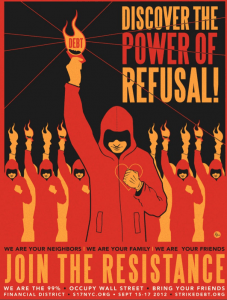
Nation-States, from the most corrupt failed states, to the superpowers of China, Germany, and the United States; ALL maintain their power and control on their populations only and explicitly through the control of capital–if they cannot control the money, they cannot control the population.
If even 5% of the world’s population refuses to use their governments fiat currency; this would cause for a collapse of their unjust monetary system overnight. The governments, politicians, and capitalists who use our money to fund their wars cannot exist within the digital currency ecosystem. If you want to fight back directly, in a way that will true hurt these monsters; than withdraw your economic support for their corrupt money.
Through this single action–the rejection of using and holding fiat money–can cause for a financial collapse of the old, antiquated, corrupt system of money, while bolstering and legitimizing the new digital economy. This is a capital strike–a refusal to invest or participate in the corrupt economic structure that has left 3.5 billion people with the same amount of wealth as 85 people. I refuse to participate in this evil system, and I refuse to let these fascist use any of my labor, wealth, or exchange to support these conditions.
My revolution is now, and it is permanent–I hope you will join me.
Digital currencies will replace fiat government systems of money–it is simple too effective as a money system. At some point, be it 5, 10, or 30 years down the line, citizens across the globe will take the power of the purse away from government hands, and returning it to the people. By using new, alternative forms of money that the state does not explicitly control, people all over the world can choose to reject their government’s money systems and the endemic and systematic corruption of power enables.
If you truly want to fight back against the state and their oligarchic allies; than the most powerful action you can take is refusal. Refusing to participate in their official economy, using their money institutions, or being a cog in their machines. By refusing to use, or hold fiat currency, one can help start the process of stripping the state, and the banks they are lapdogs to, of their economic power. This single action alone can be what can take down the capitalist empires of exploitation, and return economic power to the hands of the people, where it rightfully belongs.
Student Debt Resistance
I need not to make the argument for the injustice at the price of education, nor the way that people are made into indentured servants of the state for little more than wanting to educate themselves. There is more student debt today that what the entire budget of the United States federal government was in 1965. Private profiteers, and banksters of the most unscrupulous sort, are allowed to leech profits from this debt, participating with the state in direct exploitation of students, and former students, as equitable partners with the state for this right of mass extortion. This is debt bondage in exchange for a certificate of graduation that offers one the false promise of employment upon graduation. You were scammed, and now you must repay them.
On the poverty of student life
was an influential piece of writing from 1966 that helped ignite the shortly lived revolutions of May 1968. This work speaks broadly about the hope of youth for a future that was not determined by the exploitation of capitalism and the demand to fight for that future. The underlying point is that being a student is as subservient to the capitalist structure of the world today just as much as any other corporate job. So called ‘education’ within the ridged structure of capitalist universities is not education–it’s ideology. The apparent freedom of university is the iron cage of academia where the erudite elitism of the intelligentsia is a reflection of the same narrow, manufactured dialog of politics. The education systems are not about empowerment or agency, but subservience to the current superstructure of the capitalist world today.
To strike debt; to refuse to pay or service it can and will bring the whole system to a stand still. If a debt strike can be organized for people to default on student debts, or debts of all kinds at the same time, would cause for a total collapse of the monetary and banking systems–international financial contagion would be inescapable. If executed correctly it would take less than one month to see systemic economic crisis. This is the system that has sold out our future, has allowed for the total and complete destruction of the environment and millions of species, all while leaving our posterity broke and impoverished. This can only be defined as unjust and despotic. Resistance must begin somewhere, and I see no better place then here.
To Struggle
We have been taught, ingrained in a pavlovian way, to feel powerless against what seems to be an omnipotent force of the state that is fully against our struggle. It seems easier to simply give up, to not struggle, to find a way to compromise with the system as it is. We pretend that there is not a gross psychological damage that we undertake by living in this capitalist world where everything is for sale, nothing is sacred, and the largest criminals of all go free. We are permitted to have our own little fiefdom of superfluous trinkets and toys, in exchange for our compliance and silence with the machinery of capitalism. We are told by others and ourselves that this is a fair exchange only to find ourselves sobbing inconsolably on top of our piles of trinkets; knowing the price of our estrangement from our innermost self.

Suicide now one of the leading cause of premature death in the united states, and depression is the world’s leading debilitating illness. The estrangement of meaning and purpose from everyday live; ripped away and replaced with the meaningless, soul-sucking existence of bullshit jobs, and vacuous social connections has launched us headlong into the society of the spectacle unhinging itself. The world makes visible the primacy of commodities dominating all that is lived. The world of the commodity is thus shown for what it is, because its movement is identical to the estrangement of men among themselves and in relation to their global product.
It is nothing short of childish to not see the mental toil and exhaustion from living under this despotism. We must valiantly and passionately strike against this way of life that has robbed our lives of dignity, meaning, and purpose for far too long. Inside of each one of us is the drive to zealously seek for something better–the hope of building a better tomorrow is what drives us, and this force alone can change the world. The revolutionary struggle patiently awaits us; whispering to us to rise and taken our proper place in chronos of the liberation of mankind.
To Take Justice
Justice must be taken. It will not be freely given by these governments, or the political institutions that are part of them. That request was made in the streets years ago and it was met with the heavy truncheon of the state’s fascist police armies. Protesting is little more than being a lamb to the slaughter, displaying that political reform is impossible. If we are to have justice, it must be something that we make for ourselves, and refuse to compromise on.
To directly attack capital itself is to strike at the very root and essence of our struggle. Our quest is to fracture the unholy alliance between capitalists and the state through destroying the object that unites them: fiat money. This is a direct plan of attack; an offensive and purposeful mode of resistance that as it gains momentum, it can become the revolutionary force of a general capital strike. If you want justice, than go and take it!
Refuse to accept the conditions which have been impressed upon you! Fight back and struggle against those who keep you under the bootheel of poverty and totalitarianism for their own benefits. Disparage the cowardly fascists who sell your security, freedom, and rights for their own temporary safety. No one will come and tell you fight back against an entire system that seeks to exploit and alienate you from your own being and worth–you must find that inside of yourself and will-to-power the meaning to fight back and resist! The commanders of this economic and political system are cowards and fascists who care nothing for the meaning of justice, liberty, or freedom. They are scare and pathetic little men who allow for their morals and ethics to be commanded by others as thoughtless machines. Allow for the labor and wealth that you command to be a friction against the machine, and part of the great liberation of the digital economy away from the bloody and grimy hands of the state and the capitalist pigs that control them.
—
Next: Financial Insurrection
Pool wars?
By Dave Hudson
Posted December 8, 2014
A few days ago, Ittay Eyal published an intriguing paper, “The Miner’s Dilemma”. It describes an attack where an open mining pool may be attacked using block withholding. Given that most Bitcoin mining is managed by open mining pools then it seems like it ought to raise a few eyebrows (perhaps more than it has already). Just how does this attack work though, who wins, who loses and by how much?
Mining pools
Before we can really talk about winners and losers we really need to take a simple look at how mining pools pay out to their miners.
A mining pool needs to use a way to have its contributors demonstrate that they’ve been working to find Bitcoin blocks. Given that Bitcoin is designed as a trust-less system this isn’t a trivial problem. The approach that is taken is to have miners submit “shares” where a share is defined to be a proof-of-work solution towards the Bitcoin block that the pool is trying to find but that doesn’t necessarily meet the difficulty requirement for a full Bitcoin block. Shares that don’t meet the Bitcoin network’s difficulty aren’t actually useful (there’s no concept of incrementally building a viable solution) but can be used to estimate how much work each pool contributor has performed.
Say, for example, the Bitcoin network has a difficulty of 40B (40,000,000,000) and we have a mining pool that has a nominal 1% of the network. On average the contributors to our pool will find one full block 1.44 times per day (assuming the network isn’t growing). To work out who is contributing what, our mining pool might take submissions that are 100k (100,000) times less difficult (400,000 in this case). Now the pool would receive 144,000 submissions per day, of which, on average, 1.44 would find full blocks for the pool. If one miner contributes, say, 1% of our pool’s hashing capacity then that miner will be responsible for a nominal 1440 shares per day.
Mining pools use a variety of different schemes to reward contributions but most use some form of paying out rewards from any full Bitcoin block that the pool finds, based on some proportion of the shares submitted beforehand by its participants. Let’s assume that we’re looking at a reasonably simple case where the payout is proportionate to the number of shares submitted since the pool last found a block. Our pool, on average, finds a block 1.44 times per day and thus receives 100,000 shares between blocks that it finds, of which the last one is the solution to a block. Our 1% miner will have submitted 1000 of these shares and the pool will pay out a proportionate amount of the mined block reward. At its most simplistic the pool might charge 0% fees but, say, keep the transaction fees, so if the block reward is 25 BTC then our 1% miner receives a nominal 0.25 BTC every time the pool finds a block; 0.36 BTC per day.
To the miner this is a far more consistent reward than the one block every 69.4 days that they might hope to achieve on average mining on their own, and carries a much lower variance in terms of potential returns.
We should note that all of the above is a simplification because mining is a Non-Homogeneous Poisson Process and as such all of the numbers are mean values. For example our miner may end up submitting 1050 shares for one block and 950 for the next and 1000 for the one after that; it won’t be a consistent 1000 for each.
Block withholding
Block withholding is a scenario in which a miner submits valid lower-difficulty shares but does not submit shares that match full Bitcoin blocks. If they do this then they still receive a proportion of anything else that the pool earns but prevent the pool from claiming the reward for any blocks that they should have contributed. In the case of our hypothetical 1% miner again and pool, they would reduce the pool’s income by 1% but would still continue to gain 1% of what the pool did earn. The miner would have harmed the pool by a small amount at a much lower impact to their own returns. The withholding miner does not get to keep the block as pools protect against this!
Intuitively this seems like it would be a bad idea for the miner withholding blocks unless they simply wished to attack the pool. Eyal’s paper shows that this isn’t necessarily the case.
Let’s consider a large-scale example. Imagine that we have a pool with 25% of the network hash rate and it wishes to attack another open pool that has 25% of the network:
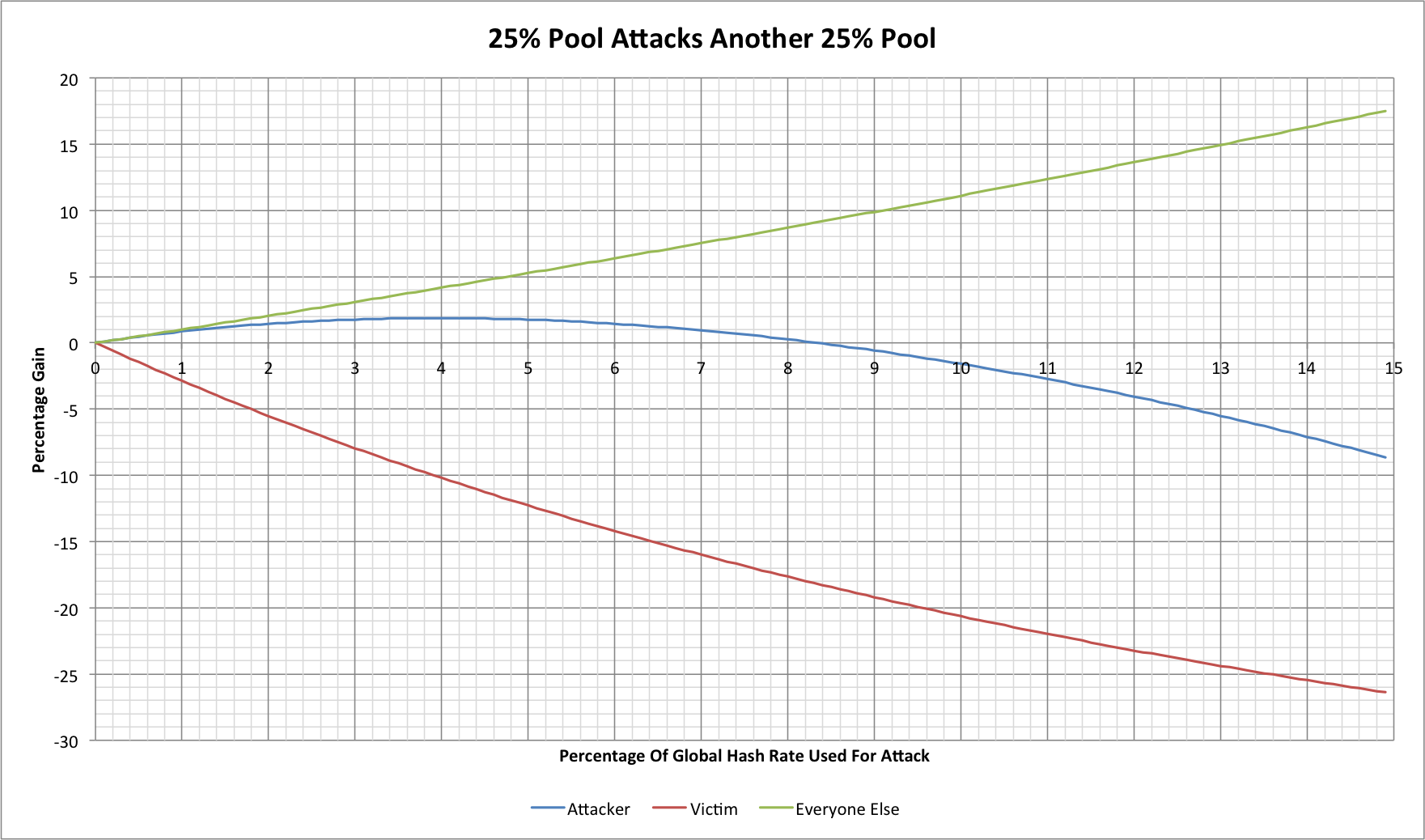
A 25% mining pool performing a block withholding attack against another 25% pool
The vertical axis shows the percentage gains that the various participants in the network will see above what they would have seen if no-one was conducting an attack. The horizontal axis shows the percentage of the total network hash rate allocated to the attack. In this case the maximum value would be 25% as that is the total available to the attacker.
There are some very striking trends! First the biggest winners in any such attack are the neutral third parties. The attack removes hashing from the network and so everyone else finds more of the blocks (albeit more slowly until after the next difficulty change reduces the difficulty). The more intriguing aspect is that the attacker also gains financially! At up to 4% of the network hash rate (approximately 16% of the pool’s capacity) the attacker achieves a 1.87% increase in their total revenue. At that same 4%, however, our victim has lost 10.2% of their revenue meaning that this has significantly harmed the other miners in the victim pool.
There is an interesting quirk in all of this as regards the operator of the victim pool. If they mine within their own pool then they will also suffer losses from the attack, but if they don’t then they may actually see increased income too! The attacker reduces their own hash rate and so the victim pool is actually going to find a larger percentage of the total blocks. In the example above, if the attacker shifts 4% of the total network hash rate to the attack then the victim pool’s original 25% is now 26.04% of the network and thus sees a total revenue increase of 4.17%. A pool operator who takes a percentage of mined rewards or takes the transaction fees will actually see a 4.17% increase in their own income even as the victim miners see a significant reduction in theirs.
Smaller scale?
We might now ask what happens if our pools are smaller. Say our attacker has 10% of the network hash rate and our victim has 10%:

A 10% miner performing a block withholding attack against a 10% open mining pool
The curves are similar, they’re just scaled down. In fact the attacker has less scope to win, achieving a maximum gain of 0.28% when deploying 0.55% of the global hash rate during the attack (approximately 5.5% of the pool’s capacity). Conversely though the losses to the victim accumulate faster because a fixed amount of hash rate targeted towards it represents a proportionately larger fraction of the pool’s capacity.
If we consider two pools each of which have 1% of the global hashing capacity then things scale even further. There is still a tiny margin for an attacker to see a positive reward but it is only at 0.005% of the global hash rate (approximately 0.5% of the pool’s capacity). It’s clear that the nominal rewards from this style of attack scale dramatically in percentage terms as the attacker and victim hold larger percentages of the total network capacity.
Scaling effects (part 1)
The scaling effects we’ve just considered may seem surprising, but a little thought reveals that they are not. The attacker wins by gaining a larger share of the victim pool’s revenue and at the same time causes the victim pool to actually still generate more revenue. If the amount of hashing involved in an attack is small, however, then the attacker’s switched hashing doesn’t affect the global hash rate by very much. The larger the attack, the larger the effect. This has other implications that we will return to later.
Mutually assured destruction?
If one party can attack another then surely the victim might retaliate? There are some wrinkles to this but for now let’s just consider that. Here are our original two 25% sized protagonists withholding blocks from each other in similar proportions:
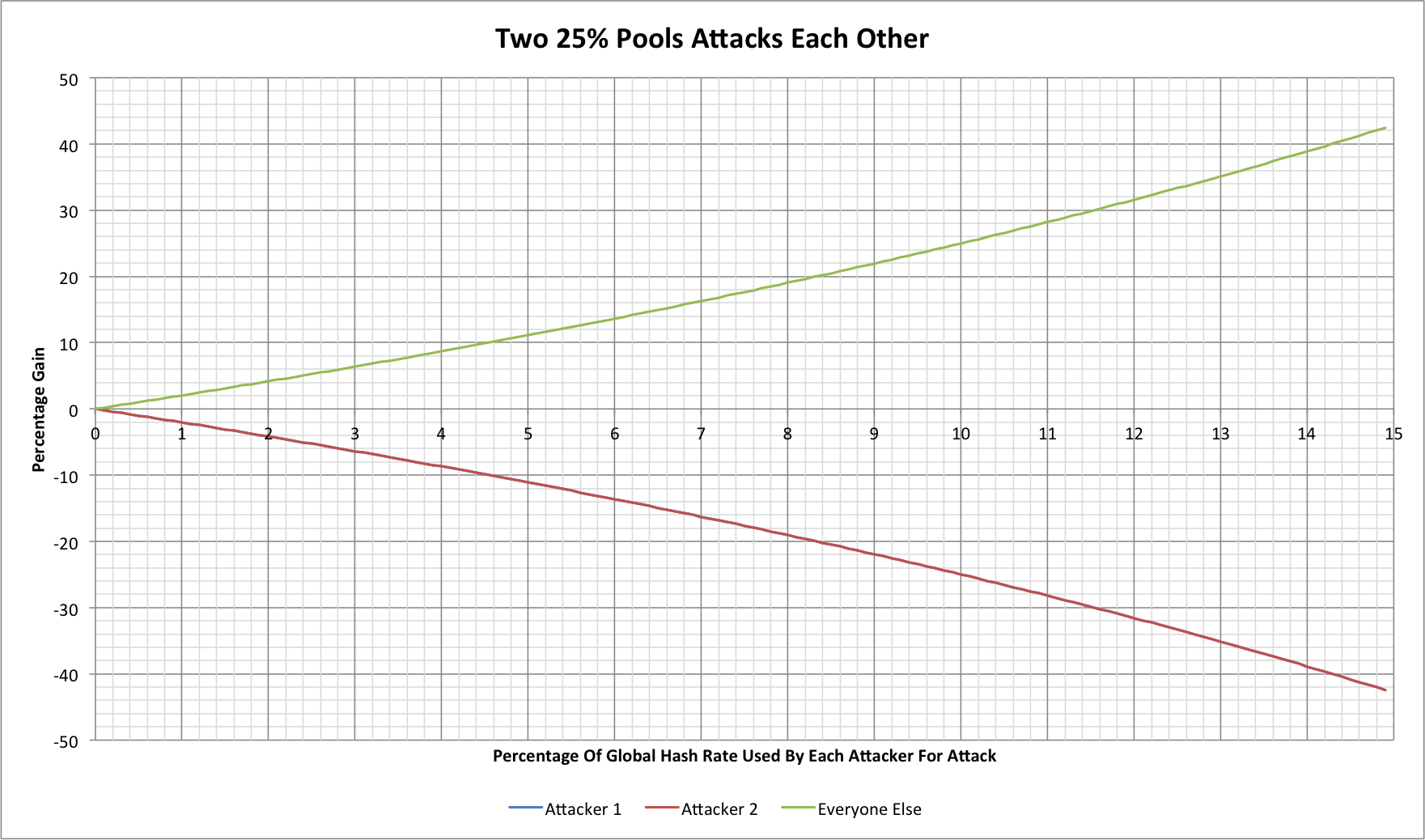
Two 25% mining pools performing block withholding attacks against each other
Attacker 1 isn’t off the chart here, they’re just on the same trend line as our previous victim, now “Attacker 2”. Now it’s clear that “Everyone Else” would sit back and enjoy the fight. The more the two antogonists contribute to the fight the quicker both lose!
We might assume that the attackers could simply try to harm everyone else too, but the attack only works against open mining pools in which participants can sign up and contribute shares without an element of trust between the mining pool operator and the miners who contribute shares. This is the wrinkle noted above; if our attacker has 25% of the hash rate but operates a private/closed mining pool then the victim cannot retaliate. If the “Everyone Else” capacity is found in closed mining pools then they cannot be victims of this type of attack either.
Big vs little?
We’ve seen two large pools involved, but what happens with a large attacker and a small open pool?
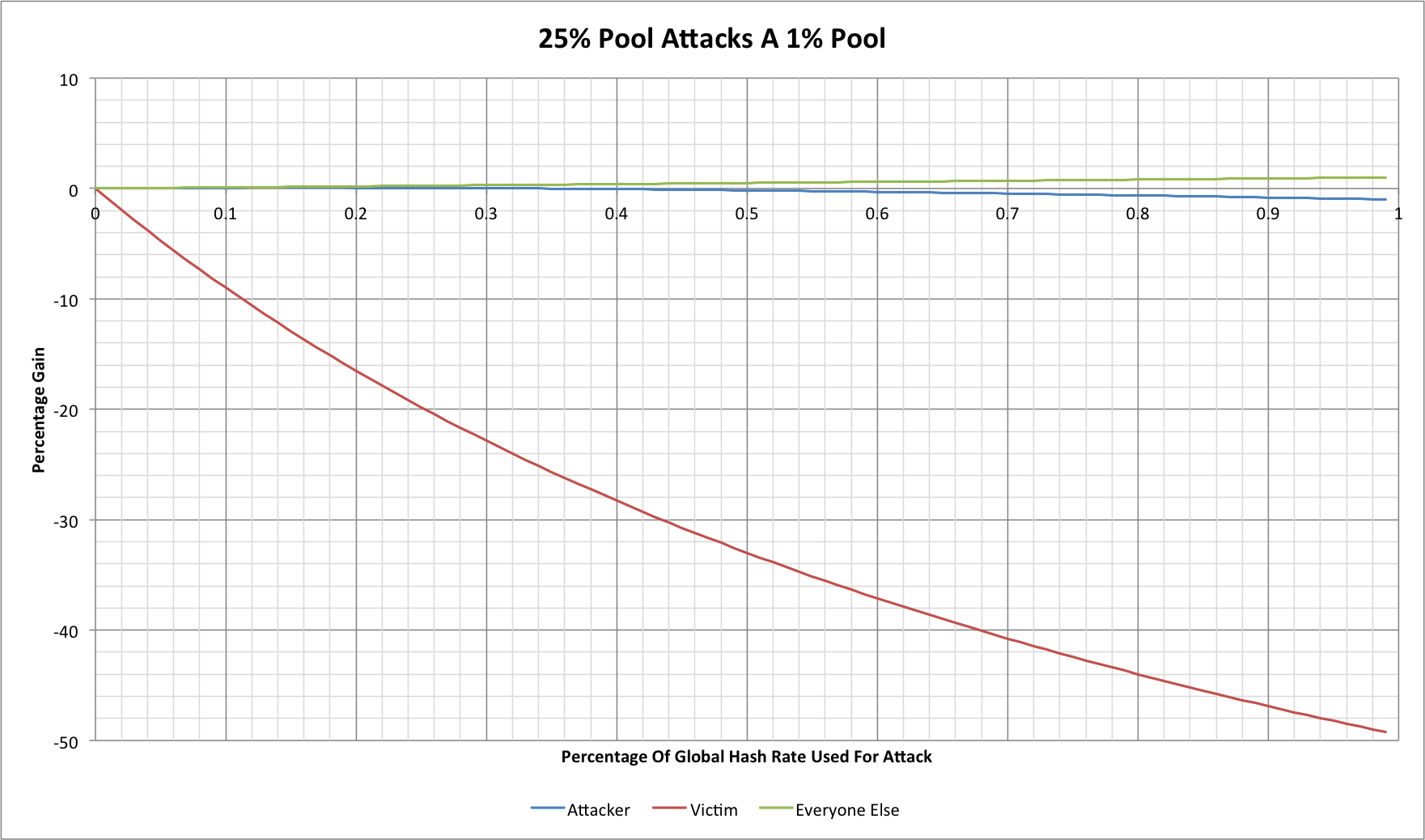
A 25% miner performing a block withholding attack against a 1% pool
There is a very small period here where the attacker makes a slight gain, but it quickly dissipates. At the point where 0.33% of the global hash rate has been used (1.33% of the pool’s total) the attacker is no longer gaining, but the victim pool’s miners sees a 25% reduction in revenue. At that sort of loss in revenue it would be likely that miners would start seeking other ways to mine more profitably.
Little vs big?
If this works one way round then can it work the other way round?
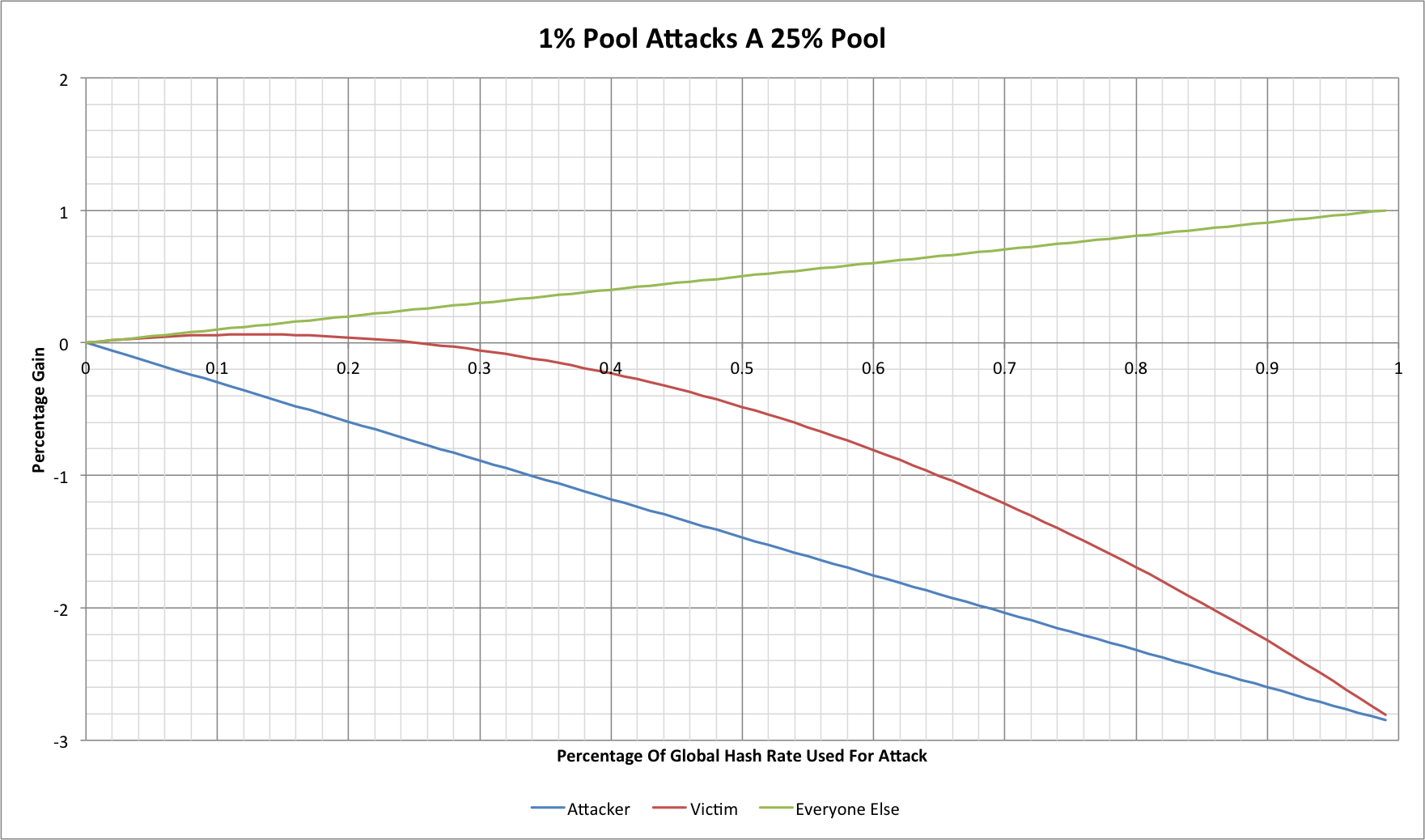
1% miner performing a block withholding attack against a 25% mining pool
Clearly the answer is yes a small attacker can still gain a small amount at the expense of a large victim! It’s worth noting though that in order to do this they must use 12.7% of their total hashing capacity to achieve the largest gain and that the gain in question probably isn’t sufficient to be worthwhile.
Scaling effects (part 2)
So far what we’ve seen is that large attackers and large victims result in big gains for attackers and that attackers not operating in open pools cannot be victims of retaliation. We’ve also seen that small pools can certainly suffer at the hands of large ones but not in ways that are directly profitable to larger pools (other than damaging competitors). It might seem that this is a clear win for small mining pools, but let’s not get too hasty! There are (at least) 2 problems:
- Small mining pools suffer from significantly worse reward variances as we’ve seen before in, “The gambler’s guide to Bitcoin mining”
- The block withholding attack scales up by attacking multiple pools!
Let’s consider 2 victim mining pools with 12.5% of the total hash rate each, and an attacker that has 25%. Now if our attacker targets each with 2% of the global hash rate then the effects are identical to using 4% to attack one pool with 25% of the total hash rate. Similarly attacking 25 pools with 1% of the global hash rate each and targeting 0.16% at each has the same effect. In fact if an attacker has a reasonable estimate for the hash rate of potential victims then an attack can be made, proportionate to each one’s size.
There is a potential problem for would-be attackers though. If two attackers target the same victim with a large enough combined attack then they will actually push the potential gains into negative territory for both of them.
Countermeasures?
The only real way to prevent an attacker or group of attackers from being able to gain from this sort of attack would be to reduce the mining rewards paid by pools for shares rather than for actual full blocks.
In the case of a 10% pool attacking another 10% pool we would require that shares be paid no more than 90% of the total mined reward in order to prevent an attacker from gaining. In the case of a 25% pool attacking another 25% pool then the share-only reward would have to be no more than 75% of the total mined reward while a 40% pool attacking another 40% pool would require that share-only rewards be 60% or less of the total earned.
As we’ve seen before, though, the problem is that this attack scales so attacking 25 pools of 1% size is the same as attacking one of 25%; the pools couldn’t set share payout levels that reduced the vast majority of miners’ payouts by 25%, even though a few lucky miners would gain far more for finding full blocks.
Bring on the stealth weapons
In the scenarios we have considered so far our attacker transfers some of their hashing capacity from mining to attacking so that hashing capacity ceases to find blocks that are declared to the rest of the network. With very large pools the loss in hash rate should at least raise some eyebrows, especially if the same hashing capacity didn’t reappear somewhere else. With this said, however, statistical variance would certainly mask some of this.
An alternative, however, would be for an attacker to deploy “stealth” hashing. This is hashing capacity that has never been used for conventional mining but is brought online solely to attack open pools. As this capacity would never have contributed to hash rate statistics then it won’t be noticed by anyone, potentially including the victim pool, because it can be targeted in small chunks of a few TH/s each.
Let’s see what this might look like:
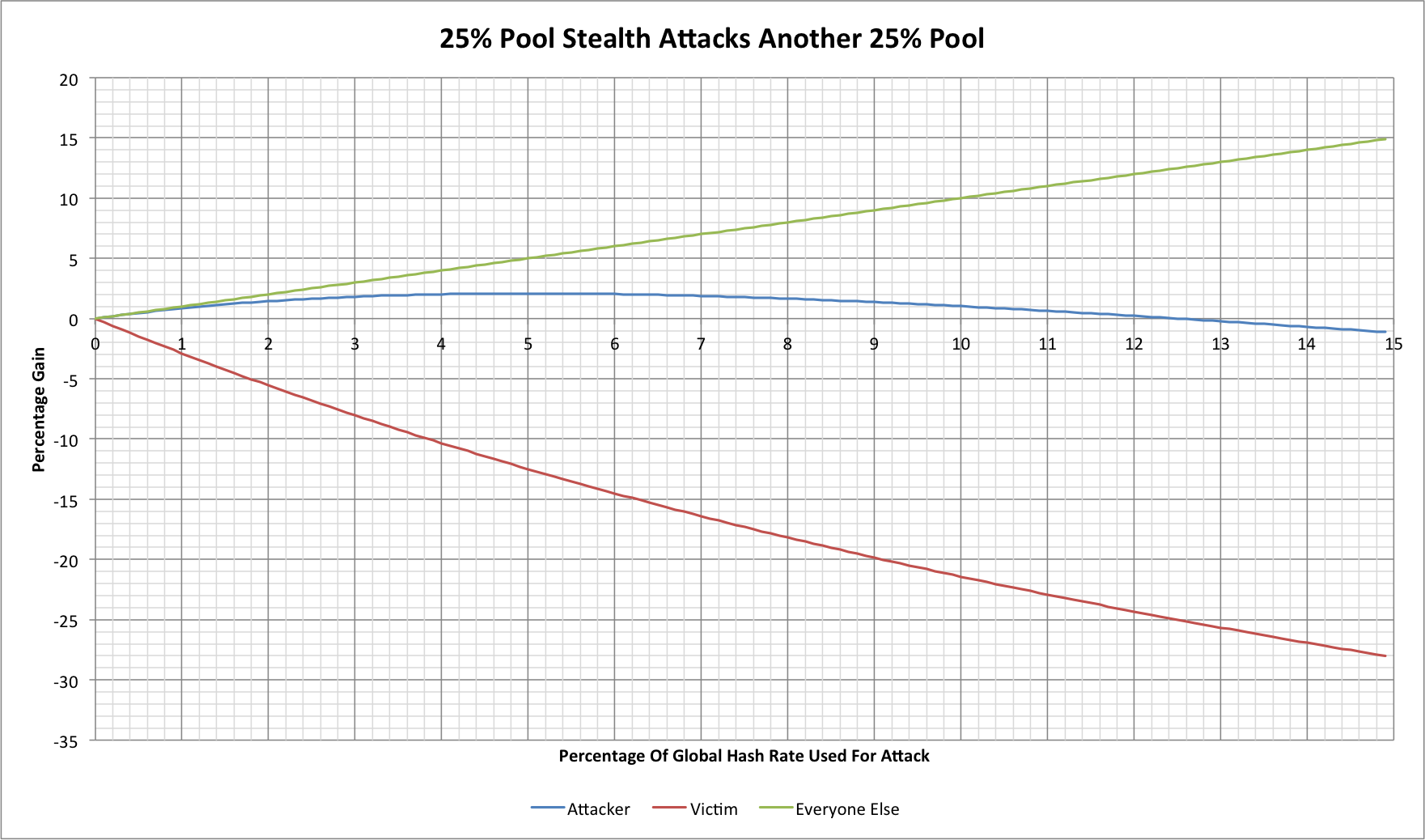
A 25% attacker stealth attacks a 25% open pool
Consider a case where our attacker adds 5% of the useful global hash rate for the purpose of attacks. They now control 28.6% of the total hash rate (their new 5% dilutes their old 25%) but are achieving 2.08% more than their 28.6% would normally achieve. The victim pool (or pools) loses 12.5%, however! Our attacker knows that they have gained but no-one else is any the wiser, while our victim appears to be suffering from bad luck, and it could take months to statistically demonstrate that this wasn’t just bad luck in any meaningful way. No external observers would be any the wiser unless the victim pool publishes its share data for analysis (which most pools would probably not wish to do for privacy reasons).
More than just a theory?
Are we actually seeing this style of attack on mining pools already? Realistically unless someone published verifiable details of what they had done then it’s probably impossible to tell. Have we seen large-scale attacks? Perhaps not, but as with so many other Bitcoin network statistics there’s a lot of room for things to hide!
Source code
This article was written with the help of data from a C language simulation. The data was rendered into charts using Excel. The source code can be found on github: https://github.com/dave-hudson/pool-wars
Reciprocal Altruism in the Theory of Money
By Daniel Krawisz
Posted December 8, 2014
Methodological Issues
Richard Dawkins said in an offhand comment in The Selfish Gene that “Money is a formal token of delayed reciprocal altruism.”i This turns out to be a rather insightful way of looking at money, and the purpose of this essay is to explore the idea more deeply to see how far it can take us. Nick Szabo later used some of the ideas in The Selfish Gene to describe the historical origins of money in his essay “Shelling Out”,ii but this essay will be about the theory of money.
It is first necessary to get some methodological issues out of the way. Biology and economics are similar in the way that they treat the interactions of many individuals in terms of the incentives that they all put upon one another. They then find the strategies which are most successful under the circumstances. In biology, especially in the theory of social evolution, this is often treated explicitly in terms of the language of game theory.iii In economics theory this is done somewhat less often, but ultimately any discussion of incentives, which is what economics consists of, can be treated in terms of game theory. Both theories suppose that the strategy which produces the greatest benefit for individual actors will tend to win out. In biology, it is assumed that the natural selection is the means by which this happens, whereas in economics this happens because of learning or cultural evolution.
Individualism is important in both biology and economics. In biology, the problem is often to explain how highly cooperative and altruistic behavior can be explained in terms of the self-interested behavior of organisms attempting to spread their genes. In the 1960’s, an idea had become popular in biology called group selection, which is that selection can act on groups of organisms rather than just on individuals, and consequently that organisms can have traits which can be deleterious to individuals yet beneficial to the group as a whole. However, if any individual in a group could out breed its fellows by reducing those deleterious traits, it would. Adaptations which appear to be good for the group must therefore, always be good for the individual.iv
In economics it is the other way around: the problem is often to show how certain kinds of rules—say a government regulation—produce adverse effects because they fail to be individually beneficial to the people subject to them. The greater the resources that the government employs enforcing its rules, the greater the benefits to successful cheaters. Therefore, no amount of expenditure is ever enough to produce the desired outcome.
Both sciences search for functional explanations of behavior in terms of rewards and punishments rather than in terms of mental processes. In biology, an animal’s psychology is just like any other body part—it evolved to serve specific purposes. Therefore, we do not explain animal behavior in terms of how it feels or wants. Its feelings and desires are to be explained in the same way as everything else about it: as part of a strategy to maximize expected future offspring. In economics, we wish to explain peoples’ actions in terms of consumption. Consumption may be anything that may be treated as an immediate reward. It does not matter what a person claims about why he does something. What matters is what he actually chooses, and the problem of economics is to explain his choices in terms of his preferences. It is easy to see that this approach is necessary by the way people treat money: though everyone uses it every day, very few can give a satisfactory explanation of it.
Thus, both sciences are behaviorist in a certain sense. As in behavioral psychology, we are attempting to explain behavior in terms of rewards and punishments, rather than in terms of invisible feelings, behavioral psychology attempts to explain behavior as the result of a past schedule of rewards and punishments, whereas economics and evolutionary biology attempt to explain behavior in terms of future expected rewards and punishments. Experimental psychology thus treats organisms more like physical processes which are expected to respond in predictable ways to past stimuli, whereas in economics and evolutionary biology, organisms are goal-oriented, machines that respond to incentives (that is, expected rewards and punishments) in search of some optimum.
There is a common criticism of economics which says that economic theory is invalidated because real people are irrational, whereas the people in the theory are much too rational. Biology is a good standpoint to explain the problem with this objection. Typically in game theory, we define equilibrium strategies in terms of players with perfect knowledge of the game, who are able to compare the likely outcomes of every strategy and who assume the same of their opponents. Of course, it is not true that the organisms being modeled by the game actually know anything about strategy—or anything at all—but the game-theoretic models still work. This is because the equilibrium strategies of the game (if they exist) are precisely what an adaptive system will tend toward, even if it is not intelligent or rational at all.
All life adapts by natural selection, but some, preeminently humans, adapt readily by learning. However, the mechanism of adapation is irrelevant: it just means that humans adapt much more quickly than other animals. The objection that humans are too irrational for economic theory to apply to them is a failure to think in behaviorist terms. People must necessarily adapt to a set of rewards and punishments, and they do so by learning. We do not need to assume that people reason their way to the best strategies in a game; we only need to assume that people tend to imitate the more successful among them, and that consequently the more successful behaviors tend to beat out the less successful. The people do not need to understand what they are doing or why in order for this process to work.
Furthermore, applications of economic theory normally depend on how the optimal behavior changes rather than its absolute value. This allows us to make statements about the economy without knowing precisely what the optimal behavior is and without assuming that anybody actually is behaving optimally. A typical economic prediction takes a form like the following: “circumstance (A) rewards behavior (x) more than circumstance (B) . Therefore if there is a change from (B) to (A) , we should eventually expect more of behavior (x) than before.” As long as the premise of the argument is true, then the prediction that there will be more behavior (x) can be made with great confidence, but not with great precision. Because the precise way that people will react to a change from (A) to (B) depends on how strongly the two situations reward or punish them, and on how quickly they learn to adapt, it would be very difficult to say how much more (x) could be expected. However, ceterus paribus, a change from (A) to (B) certainly cannot cause less (x) . Thus, for example, I can say without hesitation that a minimum wage, if it is set high enough, will cause unemployment, but I cannot say how much.
Those are the similarities between biology and economics. The most important difference between them is the way that they treat value. In economics, value is subjective. People can value many things, even things that do not make sense, and it is not the economist’s job to ask why that should be. Goods which are considered to be valued for the immediate satisfaction they provide when they are consumed are called consumer goods. Not all goods are consumer goods, however, and the value of everything which is not a consumer good must be explained in terms of the consumption that it ultimately makes possible. For example, people generally do not want to own factories just because they like factories; they want to own a factory in order to earn a profit with it, which they can then spend on consumption. A factory is an example of a capital good. Ultimately its existence in the economy can be explained because it can be used to produce other goods.
On the other hand, in biology, value is not subjective. There is one ultimate value, and that is the maximization of an individual’s expected future offspring, or more properly, the maximization of the expected rate with which its genes will spread throughout a population. A puzzle in biology is when an organism exhibits behavior that appears to devalue things like food and status because it is very easy to see how such things would promote its survival and mating success. If an organism gives food away or rejects status, then that needs to be explained. On the other hand, in economics there is no particular need to explain someone who is an anorexic or a cynic philosopher. That would be a job for a psychologist; to an economist those are just his preferences. Consequently, whereas in economics, interpersonal comparisons of value are impossible, in biology they are possible between members of the same species.
Concepts in biology can be carried over directly into economics by taking account the difference between the treatment of value in each. If a biological idea which can be adapted to explain economic behavior in terms of the consumption that it ultimately enables—accommodating the fact that people may have very different preferences about what they like—then it is as valid in economics as it is in biology.
Altruism in Economics and Biology
To the economist, altruism simply means gaining satisfaction from benefiting other people. Nothing about that requires an economic explanation. Peoples’ preferences are exogenous, and if they enjoy helping others, that is not an economic issue per se. Whereas in biology, the only value is that which best spreads genes. It is easier to understand how this should produce selfishness on the part of an organism, so an organism which enjoyed helping others would be in need of an explanation.
In biology, altruism cannot be explained in terms of feelings and satisfaction because feelings are difficult to observe. Altruism needs to be defined in terms of observable behavior. Many animals are not capable of having feelings at all, but even very simple organisms are capable of cooperating. We can therefore abstract feelings away entirely. There is even a concept in biology called parasitic altruism, which means that an animal is a host to a parasite and is better off continuing to feed the parasite than attempting to remove it, which would be too expensive. More likely an animal in that circumstance would feel resentment, not benevolence.
Therefore, in biology, altruism is defined is an action which reduces an organism’s own fitness and increases the fitness of another. The word fitness has to be clarified. Of course no behavior could survive in a population that does not help to maximize an organism’s offspring. Fitness must be understood in an experimental sense. An organism’s true fitness is not easily observable because it is, first of all, probabilistic, and second because even to estimate it would require observing an organism over its whole lifespan and beyond to learn how many children it raised compared to others of its species.
Instead, experimental fitness is hypothesized to relate to something more easily observable, such as resource-gathering capacity and a study is done to disprove the hypothesis. For example, if resource-gathering capacity was our hypothesized definition of fitness, then an altruistic animal would be one that gave resources away to another. To observe a population in which animals habitually gave resources to one another would prove that resource-gathering capacity alone does not truly measure their fitness. In biology, altruism is a bit of a loaded word—it does not stand for its face value, but rather for a behavior in need of an explanation.
Any altruism that is observed in biology implies that there are benefits which take a longer time to play out than that which is required to make the observation. This is the only way that an observation of apparent altruism can be reconciled with the theoretical requirement of explaining everything in terms of individual benefit. This does not mean that every single altruistic act must be calculated to produce some future benefit. The benefit may be probabilistic. For example, consider the case of a bunch of soldiers who go to war for their home country. They are behaving altruistically toward the people of their nation because they are putting themselves at risk in order to keep their friends at home safe. Let us say that most of these soldiers will die. Can their altruism still be explained in terms of future benefits? Yes, certainly. For some of the soldiers will survive and will return home to receive great honor and status, and it is not known who will survive beforehand. If the expected value of ones future status as a veteran offsets the probable cost of dying horribly in battle, then it can be expected that soldiers will want to go to war.
The Problem of Money
The first step for talking about money is to define it in behaviorist terms and to pinpoint what about that behavior is most in need of explanation. We don’t think of money as a thing; instead we think of it as a behavior. We’re not humans living and working in our own economy anymore; we’re biologists or economists observing the human species and theorizing about why monetary behavior is a successful strategy.
In economics, the interesting thing about money is that it is not consumed, just held. Even a miser who loathed to spend money and who simply hoarded it without any apparent plans to spend it is not treating it like a consumer good because if the money he was hoarding hyperinflated and became valueless, he would presumably throw it away. (We could imagine someone who just loves to collect money regardless of whether it can be spent, but that person would just be a coin collector, and in that case he would be treating the money as a consumer good. There would be nothing to explain in that case.)
Of course there is no need to explain why someone would spend money because that is when he gets resources for consumption, which improves his fitness. There is, furthermore, no reason to explain why someone would rob money at gunpoint or burglarize a house for money. If we know why someone would trade goods and services for it, then we know why someone would steal it. Another thing that does not need to be explained is why someone would manufacture or counterfeit money. None of this is altruistic.
The puzzling thing about money is that everyone wants it in the first place. If that can be explained, then everything in the previous paragraph is explained immediately. In economic terms, a person who accepts money in payment gives up a good that can be consumed for something he does not intend to consume. In biological terms, he makes himself less fit by taking the money and makes the buyer more fit because he gives up real resources or incurs a cost to himself in energy or time to the immediate benefit of another. From a biological standpoint, this is clearly an example of altruism, although not for the economist. However, from the standpoint of both sciences, the same behavior is in need of explanation.
This behavior I call monetary behavior, and I define it as the acceptance of money in trade; i.e. monetary behavior is to trade something for a good whose most valuable use to the one receiving it is to trade it again later. I wanted to coin the term monetary behavior because we tend to be so used to thinking reflexively of money as something that everyone wants and of the value of money being somehow in the money good itself that it is difficult to remind ourselves consistently that this is not the case. Thinking of money as a behavior rather than as a thing is a way of consciously reminding ourselves that the only possible value of money is other people.
It may seem obvious why monetary behavior exists: people want to spend it on something else later! However, there is a problem here: they only want money because other people also want money. Which is the same reason they all want money too! Everyone wants money because everyone else wants money because everyone else wants money… This is really pretty extraordinary. How can a whole society behave this way? It sounds like it is holding itself up by its own bootstraps. One could object at this point that there is no infinite regression because originally what is now money may have been used for other purposes. However, recall that economics is future oriented, not past oriented, so the past uses of the money good are irrelevant. It matters not a whit to me whether a gold coin will one day be used to make a watch or necklace. As far as I care, it could well continue to be traded as cash forever. The problem is to explain how monetary behavior can be sustainable.
One might say that he is selling goods because he produced much more of a good than he would want himself, for the very purpose of trading it. Typically people specialize in what they produce and then use the money they make to buy what they need. However, that puts the cart before the horse. Specialization to that degree depends on the existence of money, not the other way around. This explains why money is socially beneficial, but we need to explain why it is individually beneficial. It has to be explained in terms that would make people want to start using it before they depend on the highly specialized economy that it enables.
As I observed above, altruism implies no particular emotional state. A moneymaker may not feel very altruistic about amassing wealth, but to convince everyone to use money would be a roughly similar problem to convincing everyone to live in a commune “from each according to his ability and to each according to his need.” In a commune, I would depend on the good behavior of everyone else. If I worked hard and everyone else slacked off, then I would be taken advantage of. Everyone must do his duty or the system fails. By the same token, if I begin to accept payment in money and to hold savings in it, I am depending on other people behaving the same way. What if I started saving in money, but no one else did so? Then I will have done a lot of work for nothing because my money would not be accepted anywhere. Thus, it is not just a rhetorical move to call money a form of altruism; there is a very deep and conceptually useful sense which makes the use of money very similar to other behaviors which people would more readily identify as altruistic.
Reciprocal Altruism in Simple Games
An allegory from many folklores says that hell is a table full of delicious food, but everyone must use such long utensils that no one can bring the food to his own mouth. Therefore, everyone starves in the midst of plenty. Whereas heaven is exactly the same, except that everyone feeds the people sitting across from him rather than attempting to feed himself. This is essentially the idea of reciprocal altruism, which is an idea introduced by Trivers in 1971.v
The idea is that pairs of animals provide favors to one another and are better off because of the expected benefit of being able to receive favors when in need. Of course, if everyone were completely indiscriminate with their favors, no such system could persist because it would be open to abuse by cheaters. A selfish animal could benefit by receiving favors but never giving out any. Therefore the selfish behavior would be self-promoting, and would soon take over the population. In fact, as selfishness became more and more prevalent, altruism would become less and less beneficial because the altruists would meet one another less and less often, and therefore would spend more and more of their energy benefiting selfish animals. Unless there is a means to prevent cheating, reciprocal altruism fails to be individually beneficial. The problem in evolutionary theory is to clarify what makes this sort of interaction possible.
Theoretical studies of reciprocal altruism involve repeated two-person games. There are a variety of two-person games which allow for the development of reciprocal altruism. In these games there is one optimal strategy for a single round of the game, but a different optimal strategy if the game is going to be repeated many times. This is precisely what is expected; altruism must always be explained in terms of future benefits, so if there is no future, altruism is impossible.
A successful altruistic strategy has two characteristics: first, it must be preferable to be an altruist with another altruist than to be a non-altruist with another non-altruist; second, players can choose how to react to the past behavior of their opponents. This allows a player to be altruistic with other altruists or non-altruistic with others who are not. Reciprocity discourages non-altruism. The non-altruist reaps what he sows. Under these circumstances, altruism will succeed in repeated games as long as the probability of repetition is high enough.
One example of a game that models reciprocal altruism is the famous Prisoner’s Dilemma.vi This is a two-person game, in which each player has two options: cooperate or defect. The payoff matrix for the Prisoner’s Dilemma looks like this:
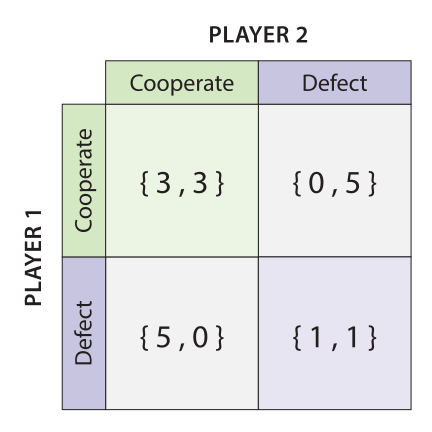
In this diagram, each box represents an outcome after both players have made a choice. The first item in the list for each outcome is the reward to player one, and the second is the reward to player 2. The numbers in the boxes are arbitrary—what matters only is some ordering relations between them. A more abstract (but equivalent) payoff matrix for the Prisoner’s Dilemma is this:
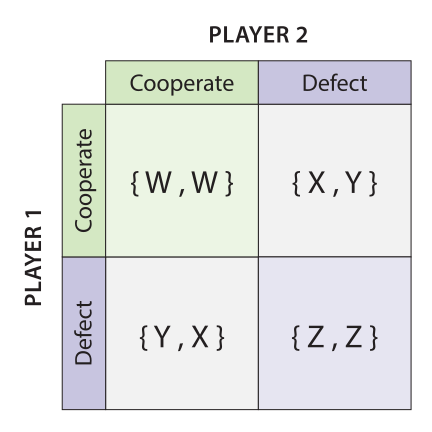
where (Y>W>Z>X) and (X+Y<2 W) . This second condition means that outcome (W) is preferable to equal odds of outcome (X) and (Y) .
The Prisoner’s Dilemma may seem like an odd choice to model reciprocal altruism because both players must cooperate at the same time. That seems more like mutualism! However, each cooperative move on the part of either player is altruistic because, in the one-round case, every cooperative move is less beneficial to itself and more beneficial to the other player. Mutualism only occurs when it is immediately beneficial to both players to cooperate. It is possible to alter the game so that the players must alternate at behaving altruistic to one another, but it is easiest to understand the Prisoner’s Dilemma first.
The one-round Prisoner’s Dilemma is very simple—the outcome is that both players defect. This is the best outcome that either player can ensure for himself. They can’t cooperate because neither can prevent the other from defecting. On the other hand, the iterated Prisoner’s Dilemma is a much more complicated game because there are an infinite number of possible strategies. The game has still not been solved completely, so instead of attempting to find the best of all possible strategies, we enumerate a subset of simpler strategies and compare them. This is perfectly alright—normally we do not know for certain which strategies are the best in real-life scenarios. Instead we try to understand real situations by comparing a few alternative strategies. If we cannot, then we have to discover new strategies.
Before talking about specific strategies, however, we have to talk about how to evaluate them. Suppose two players cooperate every round, for an infinite number of times. They get a benefit of three each round, which comes to infinity. Now suppose they defect instead. That’s a benefit of 1 each round—which also comes to infinity. How do we compare these outcomes? I know of two reasonable approaches, and both of which lead to the same qualitative results. One is to say that there is a cut-off and that the game ends after a fixed number of rounds. The other is to say that each round becomes successively less important the further in the future it is. In other words, a player who earns a reward (X) each round for an infinite number of rounds earns
[ R^3 X+R^2 X+R X+X+\ldots =\frac{X}{1-R} ]
where (R) is some rate that determines how quickly the value of future rewards declines. This rate could be interpreted as a probability, or as a rate of time preference, or as a combination of both.
- Always cooperate.
- Always defect.
- Tit-for-tat: the player cooperates on the first round and subsequently repeats whatever the opponent did on the previous round. This can be thought of as a strategy which punishes defection and rewards cooperation. Tit-for-tat is actually known to win out against a very complex array of strategies, not just the very simple ones considered here.
- Alternating: the player defects on the first move and subsequently alternates between cooperation and defection each turn. (This strategy is going to be important later on.)
Other simple strategies are possible, but they aren’t interesting theoretically because they are neither successful nor do they make any intuitive sense either. I will not go through all the game theory mathematics but merely state some results.vii
- Cooperation and tit-for-tat do equally well against one another.
- As long as no one plays tit-for-tat, defectors always do better than cooperators. This means that in a population of cooperators, if a single defector evolves, its strategy will propagate through the entire population until everyone is a defector.
- If (R) is low enough, then defection succeeds no matter the composition of the population.
- On the other hand, if (R) is high enough, then a single defector does poorly in a population of tit-for-tatters.
- A single tit-for-tatter does poorly in a population of defectors no matter how high (R) is (it cannot be greater than one).
The gist of these results is that a population will always either end up all defectors or all tit-for-tatters, depending on (R) and on the initial composition of the population. If tit-for-tat wins out, then it is indistinguishable from a population of cooperators because no one ever needs to be punished. Every round looks like pure altruism.
A crucial element of tit-for-tat is its charitable opening move. If one is the only altruist in a population of defectors, then it is very bad to give everyone the benefit of the doubt. For any proportion of altruists to defectors, there is always some interest rate such that it is better to be a defector, and the defectors do better and better as they become more numerous. Thus, with cooperation there is a network effect. It is better to be a cooperator among lots of other cooperators than among lots of defectors.
What exactly does this analysis prove? Rather a lot, actually. The Prisoner’s Dilemma has a very wide applicability. Of course in real life, people generally have more options available to them that just cooperate or defect, but other options can be ignored if they do not affect the optimal strategy in a given circumstance. Thus, the Prisoner’s Dilemma can apply to much more complicated circumstances than it may at first appear.
Furthermore, the game does not need to be played exactly the same way each round. The conditions that (Y \gt W \gt Z \gt X) and (X+Y \lt 2 W) can be satisfied in many different ways by many kinds of possible future interactions. As long as the relations hold, it is not necessary to assume that each of (W) , (X) , (Y) , and (Z) refers to the same thing each round, or takes the same value to the players. It is still true that tit-for-tat can be the right strategy in any individual round as long as there is a high enough likelihood of similar interactions in the future.
So the Prisoner’s Dilemma appears everywhere. To show more concretely how it can hide in other contexts, I will show how it appears in another two-person game. If the Prisoner’s Dilemma is modified so that (X+Y>2 W) , then the players would be better off alternating cooperation while the other defected. This is called the modified Prisoner’s Dilemma. This would seem more like a realistic model of reciprocal altruism, if we could get the players to take turns with one another. In this case, tit-for-tat doesn’t work as well because it can be beaten by the alternator. An alternator, however, is still beaten by a defector, so altruism does not win out with any of the simple strategies already presented.
It turns out the best strategy is one that mixes alternation with tit-for-tat, according to some probability whose value is determined by the precise nature of the payoffs. Two players following the mixed strategy will eventually become permanently in sync with one another. This strategy wins out if the probability of future interaction is high enough and it has a network effect is well. It retaliates against other players that go out of sync with it—eventually. Because it only follows tit-for-tat with some probability, it may take several rounds to react. If we allowed for more complex strategies, we could devise a strategy that retaliated more reliably. All it would require is for the player to react to the last two moves rather than the last one, but it would be very similar—it would be an alternator or a tit-for-tatter under a specific condition rather than a probability.
Of course, if more complex strategies were allowed, then the players could exchange favors according to more complex rules than mere alternation. One player could cooperate twice in a row as long as the other defected twice in a row. This would all work out as long as the players remained even on average. Of course, this would require a degree of coordination between the players which we have not allowed for. However, allowing for it does not change the nature of each individual round of the game, only the schedule of favors that may be available in the future. Thus, allowing for it does not change the conclusion that altruism is a successful strategy under the right circumstances.
So now we have two kinds of reciprocal altruism, right? Not really; there is nothing much new here because we can find the Prisoner’s Dilemma hiding in them. This table explains how to combine moves in the modified Prisoner’s Dilemma to construct the same outcomes as the standard Prisoner’s Dilemma.
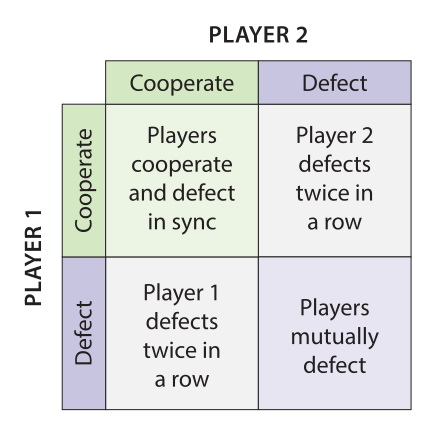
Other possible moves exist in the modified Prisoner’s Dilemma over two rounds, but they can be ignored because they do not affect the winning strategy.
Tit-for-tat is the winning strategy once again in this new way of looking at things, and that is what one is really doing with the winning strategy of the modified Prisoners Dilemma. Players still win by cooperating with other cooperative players and punishing non-cooperative players. It is just that cooperation plays out over several moves. Other two-person games with altruistic strategies can be treated the same way.viii There are a few different games which are similar to the Prisoner’s Dilemma. Some of them allow for altruistic strategies and others do not. Those that do all have (at least) three similar properties. First, altruism can only succeed if the future is not discounted too rapidly, or alternately if the number of rounds of the game is high enough. In other words, the future must be important to the players of the game. Second, there is a network effect for altruistic strategies. Third, a successful altruistic strategy must be capable of retaliating against non-altruists.
Altruistic Groups
Obviously, the use of money does not require pairwise reciprocity, so it is quite different from the two-person games described in the last section. However, the two-person case is easy to generalize to larger groups. It is not logically necessary that altruism should always occur in pairs. For example, if animal (A) was altruistic to animal (B) , and animal (B) was altruistic to animal (C) , and animal (C) was altruistic to animal (A) , then their system ought to work out just fine, even though there is no pairwise reciprocation. This is the sort of thing that Dawkins apparently meant when he referred to “delayed” reciprocal altruism. There is not direct reciprocity between pairs of organisms, but the value of altruism is the same: the value of the favors that one eventually receives is worth the cost of giving them out. What goes around, comes around.
As with the iterated Prisoner’s Dilemma, a complete theory of group altruism would be extremely difficult to elaborate, but we can still compare different kinds of simple strategies without describing every possible one, and the lessons from the two-person games hold true. For example, imagine an organism in a group that chooses to act altruistically to other organisms based on their past interactions with other group members. If organism (A) watches organism (B) behave altruistically toward organism (C) , then, given the opportunity, (A) will act altruistically toward (B) . After that, (A) may never interact with (B) again, but other organisms may have seen (A) ’s altruism toward (B) and will act altruistically toward (A) at the next opportunity. On the other hand, organisms in whom altruism is not observed do not receive it. Under circumstances in which the potential benefit of receiving favors is greater than the cost of giving them out, this sort of behavior will enable altruistic organisms extract that benefit without allowing non-altruists to mooch off of them.
Altruistic groups require more complex behavior on the part of the animals because detecting cheaters requires them to observe and keep track of more relationships than just their own. Nonetheless, some more complex systems of reciprocal altruism are known. For example, some very intelligent animals, such as apes, are able to form coalitions. They are more altruistic toward other group members than to non-members without always expecting direct reciprocity.ix Humans, of course, are very good at forming altruistic groups. I am sure that you have experienced this: when you learn that someone belongs to a group that you belong to, you feel much more willing to act altruistically toward him and vice versa, without reciprocity necessarily being expected from either side. This is possible because anyone can damage their reputation in the group by not acting altruistic within the group. (To be clear, I am not claiming to describe peoples’ real feelings toward one another when they interact in groups. They are not necessarily going through a calculation like this. Rather, people just have an instinct to feel more warmth toward other members of groups to which they belong.)
It is possible to make the simple models of the previous section directly applicable to group cooperation by treating one player as a cooperative group that coordinates its treatment of another individual, represented by the other player. Suppose that (N) organisms have learned to coordinate their treatment of one another. They can then encourage altruism in an (N+1) th organism by treating it to a coordinated tit-for-tat strategy. When the (N+1) th organism fails to be altruistic to any member of the group, the group as a whole must deny him the next time he needs help.
If the (N+1) th proves to be capable of coordinating with the rest, then later they can open relations with an (N+2) th organism in the same way. Group coordination can be considered to be a form of altruism in and of itself, so organism (N+1) is observed to follow the group rules with regard to organism (N+2) , then it is rewarded or punished accordingly.
I’ll go over this construction again because I have described several different interactions as two-player games and it is important to keep them all straight in under to understand why this should work. I have described how the organism (N+1) can encourage organism (N+2) to behave altruistically to the group of (N) organisms. This is not any particular kind of altruism—just a reward or punishment that depends on whether organism (N+2) is altruistic or not. Of course, in reality, there would be many relationships of this kind. Every organism from (1) to (N) would also treat organism (N+2) in this way. And they would also treat one another according to the same terms. I have also described how the rest of the group encourages organism (N+1) to coordinate with it. It is rewarded or punished according to whether it has correctly rewarded or punished organism (N+2) . I have treated organisms (N+1) and (N+2) as if they were outside the group, but really they might as well be on the inside. Everyone in the group is also always treating everyone else according to the same rules, and every member is simultaneously playing simple games with one another and with the group as a whole.
Group altruism, therefore, can be individually beneficial under certain circumstances. If the members of a group have the ability and the incentive to keep track of their members so as to remember who has been the most altruistic, then altruistic groups can grow by accretion.
Money as Group Altruism
Money satisfies the conditions of reciprocal altruism and, in fact, allows for a much greater degree and extent than any other that has ever existed. It is so easy: everyone simply trades some kind of token with one another to keep track of how altruistic they have been. When you provide a favor to a group member, you get tokens from him, which you can later use to redeem favors from someone else in the group. There is no need to know anything about another person in order to detect cheating. You do not need to know his group loyalty. You only need to know whether he has money or not. If he has run out, then he needs to provide some favors rather than call them in. Cooperation with money connects all people in an economy, regardless of religion, nationality, or other group loyalties.
A money system does not place any practical limits on the size of the group. Anyone can enter the group of altruists by choosing to perform a favor in exchange for money. Once in the group, he does not need a reputation and no one needs to know about his relationship to other members. All they need to know is whether he has any money left. I said that group altruism requires rather complex behavior, but actually it is not all that complex—as long as a group of organisms can count, they don’t have to watch one another or coordinate closely.
All of the rules of group altruism that I have described in the previous section are followed by a money system. To check this, let us imagine some of the organisms from the previous group as people who are using money. Organism (N+1) can be Alice and organism (N+2) can be Bob. The problem is to show how the group uses money to encourage Alice to coordinate with the rest to punish and reward altruism in Bob.
First, suppose Bob deserves to be rewarded. This means that he has acted altruistically toward some group member. He has done a favor and received money for it. Now the group requires Alice to reward Bob by behaving altruistically toward him. If she does, and she performs a favor for him in return for money, then she gets a reward for this—she can use the money to redeem a favor from someone else. On the other hand, if she does not reward Bob, then she is not rewarded either. She doesn’t get the money and therefore cannot redeem favors. Now suppose, that Bob failed to be altruistic to the group, and needs to be punished. When it is Alice’s turn, all she has to do is refuse to serve him. Her reward for doing so is simply the opportunity cost of performing a favor without being rewarded. On the other hand, if she is altruistic toward Bob, then her punishment is that she receives no money from him, and hence cannot redeem a favor later from someone else.
Note that the “punishment” in this style of game is nothing more than an opportunity cost. Physical punishments and social pressure are not necessary. People who do not coordinate with the group simply forgo future altruism from group members. In fact, Alice may very well have reasons to behave altruistically toward Bob though he has no money. They might develop their own system of reciprocal altruism between the two of them instead. If the money system was not useful enough, then everyone would revert to that, which would apparently be a kind of gift economy.
Earlier in this article I described a paradox of money. How is it possible for everyone to want money because everyone wants money because everyone wants money, etc.? Once most of a population begins to behave this way, then anyone who does not is punished by being excluded from the money economy. We all must value money, even though it may not appear to make any rational sense and the whole concept may seem fraught with paradox. This does not explain how monetary behavior begins, but it explains why it persists once it is established, and it does so by reference to the individual benefit of the behavior. This answer may seem trivial or obvious, but it is not: how many people go around thinking of the money in their pockets as a means of punishing one another for not being altruistic enough? We all know that it is horrible not to have any money, but this theory gives an explanation as to why.
This is not to say that charity is bad or that paupers deserve to be miserable. To show that something is functional is not the same as justifying it absolutely. Rather, there is a reason that a money system works and why it should be expected to remain successful. Radically different arrangements are likely to fail against it, and social theory must take this into account.
I have argued in an earlier section that monetary behavior is a form of altruism and I have shown here that it satisfies one of the conditions of reciprocal altruism—that of punishing non-altruists, or of preventing them from benefiting from the altruism of everyone else. The other condition required of reciprocal altruism is that there should be lots of expected future opportunities to call in favors. In monetary economics, the word for this is liquidity, and it roughly refers to the demand for money. A money is more liquid the more easily a given sum of goods can be sold for money without markedly altering its demand. If a money is liquid, therefore, then many opportunities for redeeming favors all around. If money is illiquid, then society might run out of favors to give before one runs out of money, which means that the money must become less valuable. Thus, as with other forms of altruism, therefore, money has a network effect. If lots of people want lots of money, then the system is more effective than when few people want it.
What Is Good Money?
If money is a form of reciprocal altruism, we can have a very good idea of what makes good money. Good money is whatever is closest to an ideal system of reciprocal altruism. It is easy to see how many of the traditional qualities of good money serve to enable this ideal. I’ll just list a few here. Some of these qualities have been attributed to Aristotle, but this is a misattribution, and I don’t know where they originally came from.
A money system just needs to be an association of a number with each person that they can transfer to one another, and which can be used to track a person’s altruism. Money must be scarce because if it were not, then anyone could easily increase the size of their number associated with them without having to provide favors for them. Money must be difficult to counterfeit because if it were not, it that just means that it is hard to tell what the correct number associated with a person should be. Money must be fungible, divisible, and durable, or else it won’t act like a number at all. Finally, money must be portable because then it could not be easily transferred and would necessarily be less liquid. In a global economy, in which people do business from opposite ends of the world, money should not only be portable, but teleportable.
The earliest form of money was commodity money, which means that the monetary unit was a good whose scarcity is a result of the physical difficulty of producing it. Before the days of mass production, money could be produced from materials that were not scarce or valuable because the scarcity and inefficiency of human labor kept them in short supply. For example, wampum was a kind of hand-made bead produced from clam shells. Other forms of commodity money, such as gold, are scarce because there is a strictly limited amount on Earth.
Commodity money has the advantage of allowing for cooperation between people who have no knowledge of one another. It can enable trade routes between Europe and China during times when the Europeans have no idea what China is like and vice versa. It is the only form of money possible when communication between different peoples is limited. Even knowing nothing of the technology or culture of different lands, probably no one there can cheaply manufacture gold and silver. This assumption has sometimes backfired; during the age of exploration, European settlers and merchants caused monetary crises in the lands they visited because the natives relied on money that they could not mass produce, but which the Europeans could. This was the fate of wampum and the famous Yap stones.
The problems with commodity money is that it is not very portable and costly to protect from theft. People have often resorted to storing their commodity money in secure warehouses, which came to be called banks. If a bank is well-known, people can trade in receipts which grant them the right to redeem the commodity money from the bank. This leads us to a second form of money.
Fiat money is a kind of money that exists because it is stamped with the brand of an institution. An institution issues units of currency, and it can make as much as it likes. The units may be imprinted on physical pieces of paper or may be nothing more than numbers in a ledger. It is the responsibility of the institution to ensure that it continues to function properly as money. The integrity of fiat money is backed by the reputation of the issuing institution.
Historically, fiat money has arisen out of banknotes whose convertibility into commodity money was gradually reduced to nothing. If this is done slowly enough, people continue to use the bank notes as money even though they are no longer backed by a commodity. This is a dishonest practice, but fiat money is not necessarily dishonest. We could imagine an honest fiat money that was never issued under false pretenses, though this is certainly not the historical norm. The result is a kind of money which is much more portable than commodity money but whose scarcity is protected by the promise of the issuing institution rather than the physical difficulty of producing it. Fiat money requires a greater degree of communication between a people for it to work. Someone is certainly not going to accept pound notes if he doesn’t know what England is or dollars if he has never heard of the USA.
The principle of concentrated benefits and distributed costs has meant that issuers have often been able to take advantage of users by manipulating the money supply to their benefit. The issuers of money can effectively evade punishment for a failure to be sufficiently altruistic by creating extra units of money at a very low cost. Unlike regular folk, who must never run out of money, the issuers can continue to spend and never run out.
Finally, money as a distributed system is the latest step in the evolution of money.x This is what Bitcoin is. The principle which protects Bitcoin from manipulation is the difficulty of changing the behavior of the distributed system. Money as a distributed system has no physical presence at all. It is one huge ledger, one which must be duplicated over many locations. It must be impossible for someone to change a copy without being detected, and there must be some process in place to ensure that all copies remain in agreement.
Money as a distributed system requires a much greater degree of communication between everyone in order to function properly. Fiat money requires that there be one well-known institution, but a money as a distributed system requires everyone to be in communication with everyone else. If this is possible, its advantages are many. The supply can be strictly limited—not just to some unknown amount of something in the Earth, or to an amount that an issuer can change, but to a specific number that no one can change. Trusting a well-designed distributed system is more like trusting the laws of physics than trusting a human agent. Because it can be protected by cryptography, it can be made very difficult to steal at a low cost. Therefore I would conclude that a distributed system is capable of coming closest to the ideal of perfect delayed reciprocal altruism.
Monetary Fallacies
Reciprocal altruism is a great first start as a theory of money because it so neatly undercuts a lot of the most common fallacies. First, what gives money value? An adherent of commodity money might say that it is the industrial uses of the money good, whereas an adherent of fiat money might say that it is the force of the government issuing it, and the loyalty people have toward their government. Neither of these answers is true. It is true that some system is required to keep track of who has money and who does not, but that is not what makes money valuable. The value of money is the value of cooperation. It is that simple. The value of money is not somehow in the monetary unit; it is in the whole of society and in peoples’ desire to cooperate.
Second, is there value in changing the supply of money? Evidently not; changes to the money supply only prevent the money from functioning as a form of reciprocal altruism. Whoever first received the new money would be able to spend it without having done anything to earn it. Such a money system allows non-altruists to benefit. It allows for cheating. It would be possible, of course, for all money everywhere to multiply by the same proportion at the same time. This could be done for real in a distributed system. If that happened, no one would benefit disproportionately. But what would be the point? Doing so clearly changes nothing about the real state of the economy and would have only the effect of immediately changing all prices by the inverse proportion.
Finally, is there anything inherently antisocial about being wealthy or about amassing wealth? If making money means just granting favors, then it is not inherently antisocial no matter how much money someone makes. The only question is whether it is possible to give out favors that are not as beneficial as they may at first appear, but this is a very subjective question that would arise in any system of cooperation. A person who has a high income is just someone able to provide very useful favors. A person with a large savings is even better; he is someone willing to donate to the economy without demanding much back. If he spends his money eventually, then he was giving to the economy on a loan; if he is willing to maintain his savings permanently, then he is willing to remain permanently invested in the future productivity of the economy. This is social behavior, not antisocial!
In an economy like ours with billions of humans all cooperating with one another, some people will figure out ways of doing favors for billions of people all at the same time and consequently will end up with thousands or millions of times the amount of money that people have on average. Even this cannot be criticized. The possibility of becoming one of those extra-helpful individuals is part of the benefit of altruism, and it is therefore part of the incentive that fosters cooperation. If it is curtailed with a system of progressive taxation, then that reduces the everyone’s willingness to cooperate, not just those paying the tax.
This is not to say that there may not be other reasons for progressive taxation, but not because excessive wealth is somehow damaging to the social order. Rather, the contrary is true: progressive taxation will tend to make people less cooperative, at least as far as the money system is concerned.
There are, however, other systems of cooperation that humans rely on. All of them require investment by the participants, and they are therefore all in competition with one another. I think that the extraordinary benefits of money explain much about why group ideologies like religions, political parties, and nationalist ideologies maintain teachings which are so averse to it. Both the money economy and ideological groups are enablers of group altruism. Consequently, they are in competition with one another. Both require investment of their members’ time and effort, and a person can only give so much. Yet the money economy gives such a superior return for most things than do ideological groups that it leaves the groups at a severe disadvantage. When you hold a large cash balance, you are investing in the whole human race rather than in one group, and you are invested in a system capable of a vastly greater degree of specialization and invention. Such steep competition would threaten the cohesion of any ideological group.
Conclusion
That monetary behavior is a form of altruism, and of reciprocal altruism in particular, has been demonstrated by relating the properties of money to the definition of reciprocal altruism and to its required features. The theory of reciprocal altruism is not, however, a complete theory of money. It leaves some things out. In the first section of this article, I explained that importing a concept from biology into economics requires that it be treated according to a very different theory of value. I have not done so here. That is what is missing from a complete theory of money. In particular, a subjective theory of value allows for two new phenomena not treated here.
First, the services which most animals can perform for one another are very limited. Studies of reciprocal altruism in the wild usually look at only two goods: a single kind of favor which the animal give one another, and the debt that animals owe to one another for having received it. In a human economy, there are many, many goods. Money tends to result in a set of unitary prices for all goods, but the theory of reciprocal altruism does not explain price formation and why there should be a unitary set of prices.
Second, the value of money can change relative to the entire economy. In other animals, altruism evolves as an instinct over generations, whereas a human economy can rapidly change in the degree to which it rewards cooperation. A human can get the idea that his money is going to be worth more or less relatively soon and change his behavior accordingly in anticipation. Money cannot be fully understood without developing these topics.
Special thanks to Jonathan Vaage of BTC Design for the diagrams.
Footnotes
- Dawkins, R., The Selfish Gene, Oxford University Press, 1976. ↩
- Szabo, N., “Shelling Out: The Origins of Money”, The Satoshi Nakamoto Institute, 2002, SHA256:30f7eea01d4b60c3ca33b6337a32b391. ↩
- See Smith, J., Evolution and the Theory of Games, Cambridge University Press, 1982, SHA256:88fdfb61c32b2758863e7f338b97a7e9 for the classic exposition of this idea. ↩
- The truth is actually more complicated—in biology, individuals and groups exist on many levels. Within a cooperative colony of animals, we would need to explain why an individual animal cannot benefit at the expense of everyone else; but each animal is itself a eusocial colony of individual cells which are extremely regimented in how they cooperate with one another. So there is also a need to explain why all the cells are better off cooperating with one another to be an animal that cooperates with others of its own kind instead of all turning into individualistic cancers. And a cell, too, functions because the many genes within it all cooperate very nicely instead of competing to replicate out of control. See Dawkins and Trivers, R., Social Evolution, The Benjamin/Cummings Publishing Company, Inc., 1985 for decisive criticisms of group selection. The idea of group selection has recently been revived under the name multilevel selection theory. See (put citation here) I’m not a professional biologist, so take this for what it’s worth, but I think that this article rather misses the point. ↩
- Trivers, R., “The Evolution of Reciprocal Altruism”, vol. 46, no. 1, Quarterly Review of Biology, 1971, pp. 35-57, SHA256:4c2dfb4acc63492b06151bce8db7c452. ↩
- Stevens, C., “Modeling Reciprocal Altruism”, vol. 47, no. 4, British Journal for the Philosophy of Science, 1996, pp. 533-551, SHA256:7847130bd62ba99c21b3a83fdf528662. ↩
- For a delightful introduction to game theory, see Luce, R., Raiffa, H., Games and Decisions: Introduction and Critical Survey, Dover Publications, 1989. For an introduction that is also free, see Watson, J., Strategy: An Introduction to Game Theory, 3rd ed., W. W. Norton & Company, 2013, SHA256:2ce0ccbea55ca88c908b876f22bbb379. ↩
- Stevens, 1996, pp. 533-551. ↩
- Trivers, 1985. ↩
- I follow Graf, K., “Bitcoin Decrypted Part III: Social theory aspects”, KonradSGraf.com, 27 Dec 2013 in treating cryptocurrencies as a separate category from commodity money or fiat money. ↩
Bitcoin is Not About Money
By BTCtheory
Posted December 10, 2014
####
It’s about power
Bitcoiners are part of a new political, economic, and social class. At the core of our tenets is the recognition that bitcoin and digital currencies are powers in themselves, and that they cannot be restricted by the despotic tyranny of States, or their capitalist allies in banking. We are not united by our creed, nationality, or gender, but by our economic objectives and the advancement of our technology. We are the ones that shall force the fiat banks towards their death, and we are the ones that shall make the State capitulate on its monopoly on legal tender and the mode of exchange. It is time for the youth of this world to rise and take their rightful place in history by striking down the awful corrupt governments of the past that have sold us out. No longer do we need to remain subservient to this system of exploitation and alienation.
The Digital Vanguard
There is nothing that ties any of us together–no names, no identities, no bodies–just Bits of data being sent across the Great Commons of the Internet. Together we have created a multi-billion dollar economy from nothing just five years ago. Those who hodl bitcoin are far past the point of doubting the success of bitcoin–we know bitcoin will be successful. We see its power, we see its efficiency, and we see the world that we are to create with it–and governments of the world and their corrupt allies are not part of it.
We are the Vanguard of bitcoin. We are the ones who shall fight the Goliath of Finance and the Leviathan of the State and watch them fall from the pedestal of human they mounted themselves upon. We shall watch them fall, we shall watch them burn, and we will do nothing but stoke the flames. We will do simply laugh and walk away, disengaging them and continuing to build the new economy that is based upon the values and virtues that has been put into the code.
Over the last few years we have poured our hearts, minds, souls, and fortunes into this project. We have made the market, built the applications, and connected the nodes, and militantly worked on security to ensure our success.
Indeed, detractors will do everything they can to discourage us. Even in that very word, we can see their cowardice; to dis-courage. They lack courage; and are spineless, sniveling, fear-dominated people who couldn’t fight anyways. They only see a world of 9-to-5 enslavement as a favor that we should be grateful for. These people cowtow under the unjust laws of their masters; for anything their masters choose, for them becomes law and justice. We refuse to bend our necks to these men: we know the crime against humanity they have purported, and we shall resist them.
Together, united in the cause of building a better money, we shall also build a better world. We have made ourselves nearly invulnerable to the malice of the state, and rage of the banks though ensuring our Privacy. We know from the code that Privacy is our immutable Law; for privacy is what assures us not only our safety, but our equality in dialog as well. We know nothing of the other parties that participate with us, except for the Solidarity we have with one another. Together we are building an economy that is based upon fairness, equality, and individual sovereignty–and we are not asking for permission to do this.
To Build a Free World
We are the ones that have ensured the success of bitcoin, and we have been and shall continue to be rewarded kindly for such loyalty. No one came to us and said, “You need to invest and support this,” In fact, many of us were mocked and called fools for ever believe in it. But onward and upwards we went, making the long journey from the obscure origins of bitcoin to the multi-billion dollar economy it is today. No one told us we would make 5, 10, or 20 times what we originally invested–we did that.
Famous vulgar philosophers, politicians, investors, economist, and journalist from all around the world have insisted that bitcoin would be nothing. They said it couldn’t be a currency, and that it was only used by drug-dealers and pedophiles. Every single step of the way they laughed at us, mocked us, and insulted us…and yet we are still here, growing, building, and pulling more and more into our sphere of influence, and away from theirs with each passing day. So quietly and seditiously, people are coming to understand the nature of money, and realizing that the banks, and the state are using that to keep them oppressed, and divided from our true political goal:

Freedom.
True, unadulterated, messy, complex, Freedom.
Freedom that cannot be suffocated because of the fears of pathetic men who need to terrorize us into compromising this most sacred of rights. Freedom that cannot be taken at the whims of the states, or the cries from banks.
Freedom–despite being so thoroughly abused, manipulated, and contorted by men of power for nefarious deeds–is a word that still has meaning. Words will always seek to give themselves means for what they are and what they represent. The word ‘freedom’ will always sound hollow coming from the mouths of oppressors to justify their despotism, which will also make present the need and demand for what ‘freedom’ truly means.
Tragically, we were birthed into a world where the fascist won long ago, and created a sophisticated oppressive apparatuses of nightmares to terrorize us into giving more and more power to the state, and their allies. This manufactured terrorism from our masters has allow for us as a people–fearful, and trembling–to sacrifice our essential liberties, bastardizing our sacred constitutional rights, proving their worthlessness without the force of men, and the will to protect it behind them.
Bitcoin is not about money
It has never been about money, it’s about freedom and what that means for our society today. As we descend into the panopticon the state is erecting at this very time, preparing the gulags in the deserts, and military control of these states, we declare that we shall not go quietly into that dark night. We declare that a government that is marked by every act which may define a Tyrant, is unfit to be the ruler of a free people. Together we are building the mode of resistance that shall cause for the empire of paper to collapse, which will free everyone from the shackles of debt, and the chains of domination.
We shall no longer be force and intimidate us into playing by the corrupt and hollow laws of the state. We see the men of government, banking, and capitalism for the criminals they are, and for the damage they have done to us. We see how they have betrayed their oath, their nation, and their honor. Their words, and their threats are meaningless to us. We are building a better world that they are not a part of, nor will they be allowed to be a part of. We no longer need them.
—
Next: Revolutionary Syndicalism of Bitcoin
Meditations on Cypherpunk Nightmares
By Michael Goldstein
Posted December 24, 2014
Epictetus,The Enchiridion
Crypto Anarchy Spreads
In his classic “Crypto Anarchist Manifesto,” Timothy C. May offered a vision of the future that offers society plenty of challenges to grapple with, thanks to public-key cryptography. A particularly interesting challenge is the anonymous information market:
The State will of course try to slow or halt the spread of this technology, citing national security concerns, use of the technology by drug dealers and tax evaders, and fears of societal disintegration. Many of these concerns will be valid; crypto anarchy will allow national secrets to be trade freely and will allow illicit and stolen materials to be traded. An anonymous computerized market will even make possible abhorrent markets for assassinations and extortion. Various criminal and foreign elements will be active users of CryptoNet. But this will not halt the spread of crypto anarchy.
Just as the technology of printing altered and reduced the power of medieval guilds and the social power structure, so too will cryptologic methods fundamentally alter the nature of corporations and of government interference in economic transactions. Combined with emerging information markets, crypto anarchy will create a liquid market for any and all material which can be put into words and pictures. And just as a seemingly minor invention like barbed wire made possible the fencing-off of vast ranches and farms, thus altering forever the concepts of land and property rights in the frontier West, so too will the seemingly minor discovery out of an arcane branch of mathematics come to be the wire clippers which dismantle the barbed wire around intellectual property.
[Emphasis mine]
Two lessons here:
- All information will be on the market.
- This market will exist whether you like it or not.
Also, by will, I mean already.
We have already seen WikiLeaks and Edward Snowden open the floodgates for State secrets (which include your secrets). We have also already seen Bitcoin enable the Fappening marketplace of celebrity nude pictures.
And now a website promoted by WikiLeaks’s Twitter account wants to take it to the next level. Slur.io promises to be WikiLeaks 2.0:
Slur is an open source, decentralized and anonymous marketplace for the selling of secret information in exchange for bitcoin. Slur is written in C and operates over the Tor network with bitcoin transactions through libbitcoin. Both buyers and sellers are fully anonymous and there are no restrictions on the data that is auctioned. There is no charge to buy or sell on the Slur marketplace except in the case of a dispute, where a token sum is paid to volunteers.
For everything from trade secrets to State secrets to zero-day exploits to “the complete databases of social media sites like facebook,” there will be a price in Bitcoin.
I would recommend that anyone alive in 2014 not only assume that their secrets will be leaked, but live as though they have already been leaked.
Ancient Wisdom
Coping with this idea is not easy, as we all have said something in the past we regret or something we did not intend for public consumption. These problems, however, are not made new by the Internet. Instead, the Internet allows us to rid ourselves of past illusions of privacy that were largely unchallenged before. With this in mind, we can look to the ancient Stoics for timeless advice.
On change
Marcus Aurelius,Meditations(Book IV, 3.4)
If we take Tim May’s words, and empirical data, seriously, crypto-anarchy as he describes it is happening and continues to happen. Technology is a double-edged sword in that everyone from criminals to people of virtue get to employ it to suit their ends. However, this should just be taken as a fact of nature, as wishing for a way to stop it is utopian at best and totalitarian at worst. When Cody Wilson and Defense Distributed gave the world the Liberator, we were forced to face the fact that technology is not democratic. There was no vote for whether 3D printed guns, public-key cryptography, Bitcoin, or BitTorrent should exist. Each was just the product of entrepreneurship by Cody Wilson, Whitfield Diffie & Martin Hellman, Satoshi Nakamoto, and Bram Cohen. They came into existence, and we must deal with the consequences. If bad people can use these technologies, we must use them even better.
The world changes, and that is not good or bad. Only our perceptions and reactions matter.
On Maintaining a Virtuous Mind
Marcus Aurelius,Meditations(Book III, 4.2)
Strong cryptography is great at protecting information from prying eyes, but using cryptography is a matter of risk management rather than finding panaceas. Expecting even encrypted or anonymized information to remain in that state forever, even if likely, is problematic if not only for tricking us into cultivating bad habits and being too risky with where we let our minds and actions take us. Unencrypted communication is like sending a postcard, as Phil Zimmermann described it, completely readable to anyone it passes.
A solution to this is to aim to be virtuous in thought and action in the first place, such that all communications, public and private, remain true to your goals and principles. This would not make the leaking of your secrets enjoyable, but rather minimize the exposure to downside risks to your reputation. And even if that is not the case, you will have stayed true to yourself, and that is what matters most.
On Friendships and Trust
Seneca,“On True and False Friendship”
As I said above, strong cryptography is not a panacea. Even the strongest end-to-end encryption does not protect you from information leaking from the other end. It is therefore important to know and trust who you are communicating, both on virtue and on security capabilities. To trust in cryptographic communication should be to have confidence in your peer and to understand their vulnerabilities. Nice people can be hacked, too.
Therefore, make the best friends. Build strong, trusted relationships with other individuals, and know the limits of those relationships. Sign keys, verify fingerprints, and most importantly, know what value you truly give one another. Do not let social media devalue the word friend, lest you fraternize with scammers.
Conclusion
There was never such a thing as privacy. The Internet just made the fact clear. Privacy can and should be constructed, but it will never be perfected. Protecting ourselves from the dangers of crypto-anarchy requires embracing it even more fully and internalizing and practicing the virtues that have helped great men weather the storms of life since antiquity.
Addendum (February 13, 2015)
When this article was written, people rightfully referred to Slur.io as vaporware. At the time, the project’s GitHub repository was empty, and it remains so today (yet they still managed to scam people out over 3 BTC). This article was not intended to be about Slur.io in particular, but the threat and inevitability of these technologies. Indeed, in the blink of an eye, the nightmare became real. Just over a month later on January 28, an unSYSTEM project called Darkleaks was unveiled, with working code. On February 11, the purported lead programmer for the Silk Road 2.0 announced a Darkleaks auction for pretty much every last bit of data the website backend had to offer, from user tables to source code. And the initial data leaks appear to be authentic. As the pseudonymous Zozan Cudi declared in the Darkleaks announcement, “The gloves are off. The revolt has begun.”
For an in-depth overview this leak so far, see “The Silk Road 2.0 Database Is Up For Grabs in the First Darkleaks Auction” by Andrea Castillo.
Suggested Readings and Actions
Stoic Literature
Stoic wisdom has guided great men throughout history and will continue to do so.
- Meditations by Marcus Aurelius (Translations in this post are from the Penguin Classics edition)
- Moral Letters to Lucilius by Seneca
- Enchidrion by Epictetus
- The Obstacle is the Way by Ryan Holiday
The Cypherpunks and Crypto-Anarchy
The better you understand crypto-anarchy, the better you can contend with the future.
- Satoshi Nakamoto Institute
- Cypherpunk mailing list archives
- Nick Szabo’s Essays, Papers, and Concise Tutorials
- This Machine Kills Secrets by Andy Greenberg
- Crypto by Steven Levy
Tutorials
Friends don’t let friends not understand basic GPG and Bitcoin security.
- “Please To PGP (Guide for Linux, OS X, Windows)” by Pete Dushenski
- “On Making High-Entropy Paper Wallets” by Pete Dushenski (Make it even easier with Pierre Rochard and my Entropic)
- “Biting Into The WoT Elephant (And IRC Nicknames)” by Pete Dushenski
- “The Six Pillars for Surviving in Computer Times” by Pete Dushenski
Information Diets and Media Manipulation
Everything you read is probably a lie. Keep your signal to noise ratio as high as possible.
- Trust Me, I’m Lying by Ryan Holiday
- Fooled by Randomness by Nassim Nicholas Taleb