
November 2014 Journal
WORDS is a monthly journal of Bitcoin commentary. This issue collects the November 2014 writing in the WORDS archive. For the uninitiated, getting up to speed on Bitcoin can seem daunting. Content is scattered across the internet, in some cases behind paywalls, and content has been lost forever. That’s why we made this journal, to preserve and further the understanding of Bitcoin.
7 transactions per second? Really?
By Dave Hudson
Posted November 2, 2014
Begin Content
Details Published: 02 November 2014 Hits: 425
The general wisdom seems to be that the Bitcoin network can currently sustain 7 transactions per second. Bitcoin advocates often worry that this will be a limiting factor when credit card processing networks can handle several orders of magnitude more transactions in the same time, but what are the actual statistics related to Bitcoin transaction processing? Our Bitcoin mine train may not be seeing its hashing engines running away quite as much as they were earlier this year, but are we heading for other problems instead?
Bitcoin Transactions Per Day
Before we can really think about Bitcoin transaction processing we need to look at how its transaction processing has evolved over time. Let’s start by looking at the numbers of transactions per day for approximately the last 4 years:
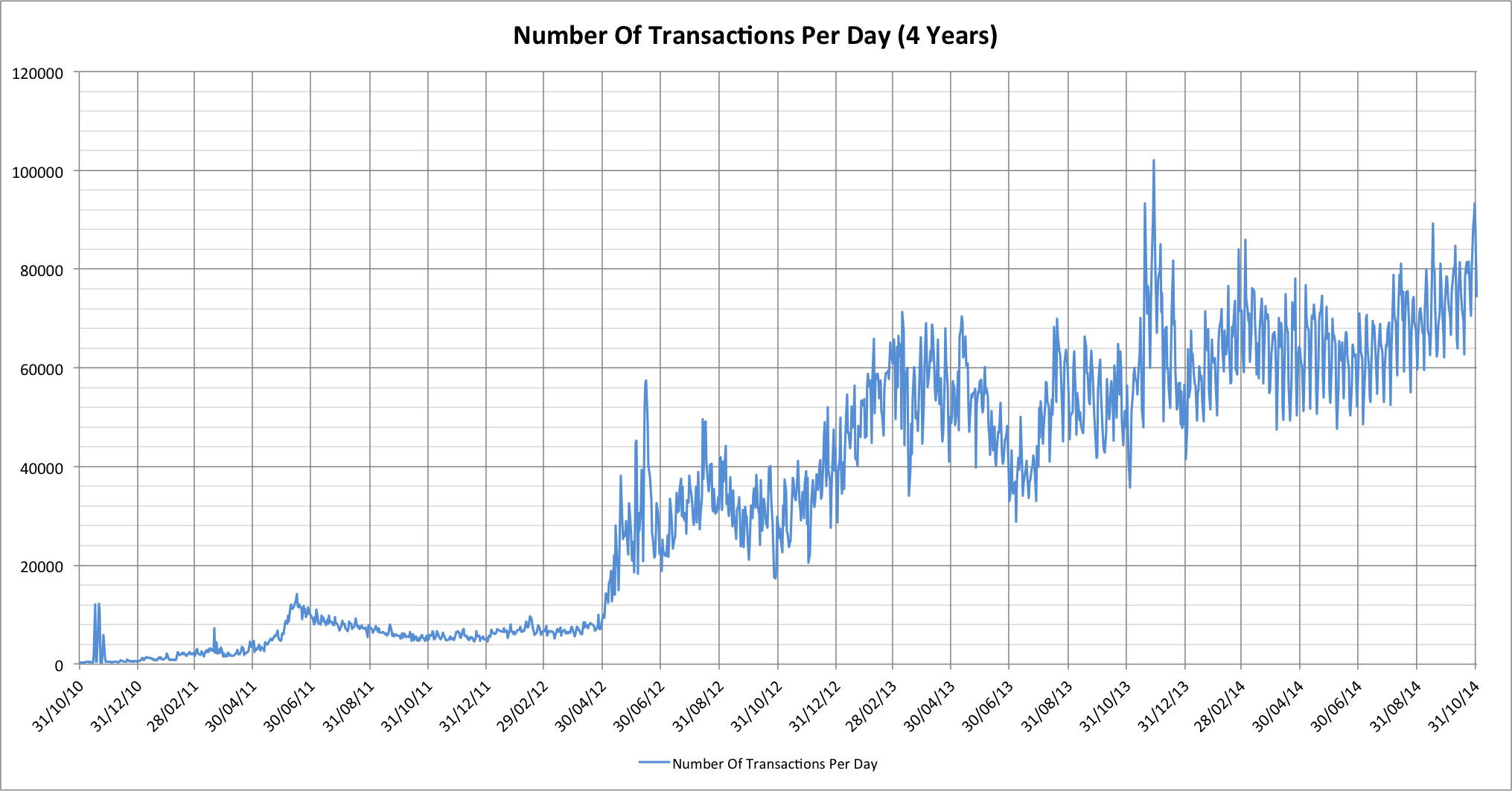
As with all of our Bitcoin rollercoaster rides there are highs and lows, but the trend is generally up over time. It may not be the sort of exponential growth seen with the global hash rate but it’s hard to argue that the number of transactions hasn’t been going up. It’s looking much more erratic as we move to the right but we’ve seen that sort of thing before and it’s usually because the percentage swings are the same but the larger numbers makes things look worse. One solution is to look at this on a log scale:
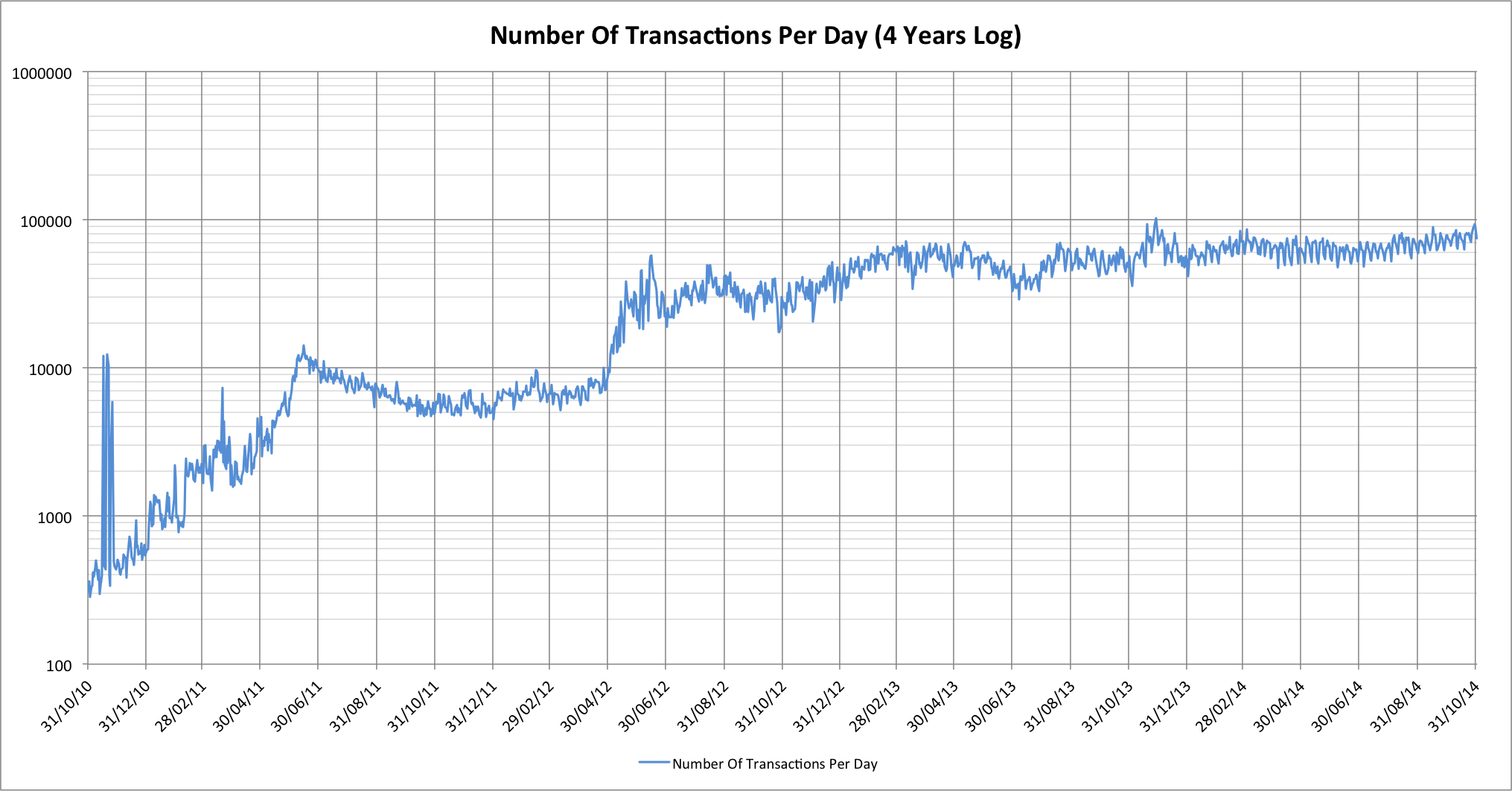
With this view the growth may not look quite as impressive but we can see that the daily variations really aren’t anything new.
What else can we see? Well we’re not really getting to more than about 80k transactions per day right now, or just under 1 per second. On the surface it would seem that we ought to be quite some way from hitting any limits.
A Quick Aside: The Bitcoin Network Gets Tired On Sundays?
Did you notice that the noise over the last year looks surprsingly periodic? Zooming in on this we can see that’s surprisingly consistent!
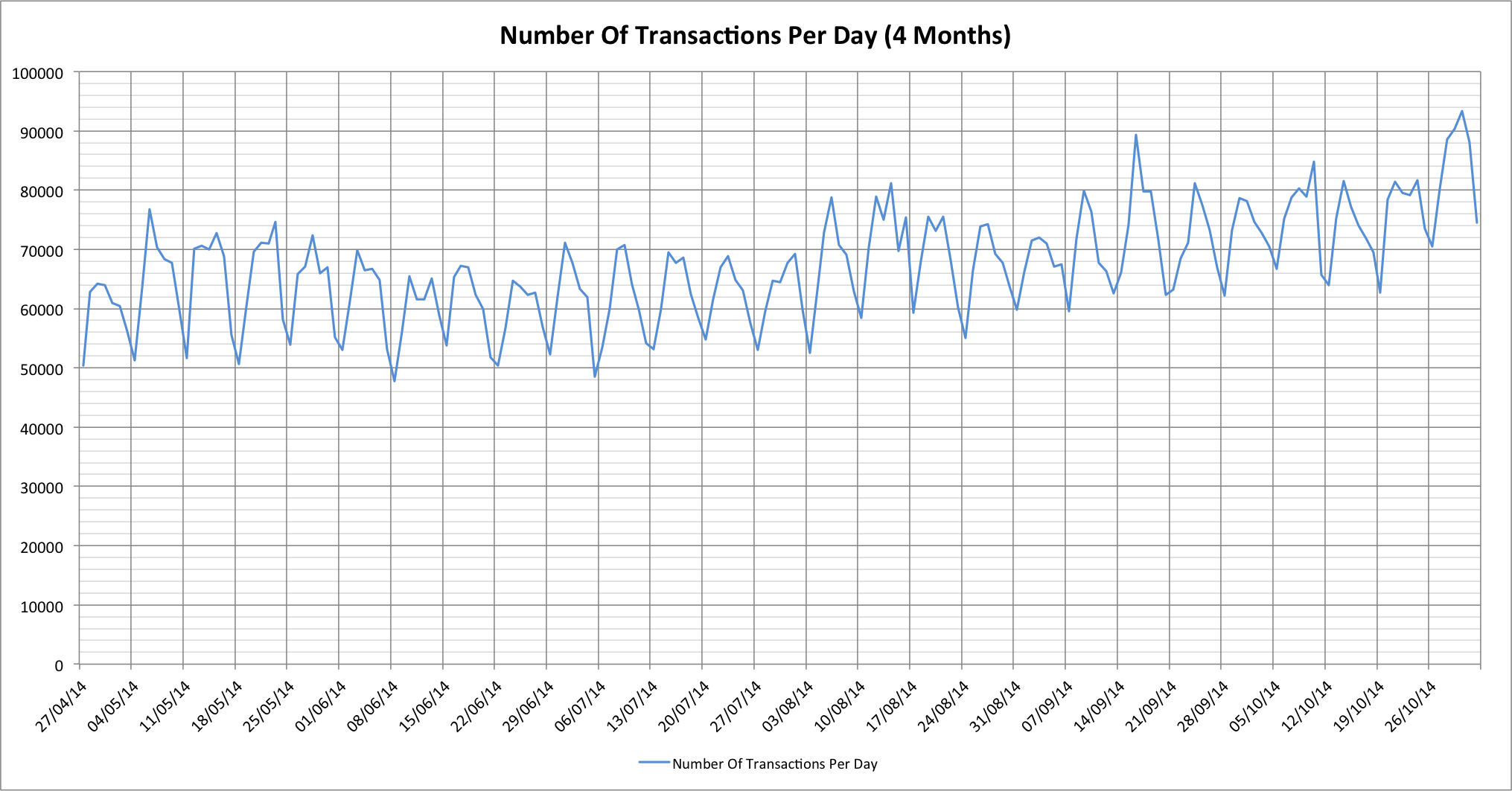
The horizontal axis grid lines correlate to Sundays. For some reason the Bitcoin transaction processing network doesn’t seem to get used as much on Sundays; it’s down about 20% on the rest of the week? No I don’t know why this happens either! Perhaps it gets tired and needs a nap? :-) The trend is evident all the way back to fairly early in 2013 but has become much more pronounced in 2014.
Block Statistics
We’ve looked at how many transactions are processed, but there’s another really important characteristic. We need to consider how large our block are. How do things actually look when we look at block sizes averaged over individual days?

In the interests of consistency let’s see that on a log scale too:

Something definitely doesn’t appear to add up!
That black (linear) trend line may not be perfect but it’s not a bad approximation. It shows that our average block size has gone from about 0.11 Mbytes to 0.275 in that same 16 months. That’s almost exactly 2x in the last 12 months. The problem, though, is that instead of being more than 7x away from our limits as the supposed 7 TPS number might suggest, we’re actually only about 3.6x away (1/0.275).
Something clearly doesn’t scale the way we expected. Let’s look at the average block size compared with the number of transactions per day:
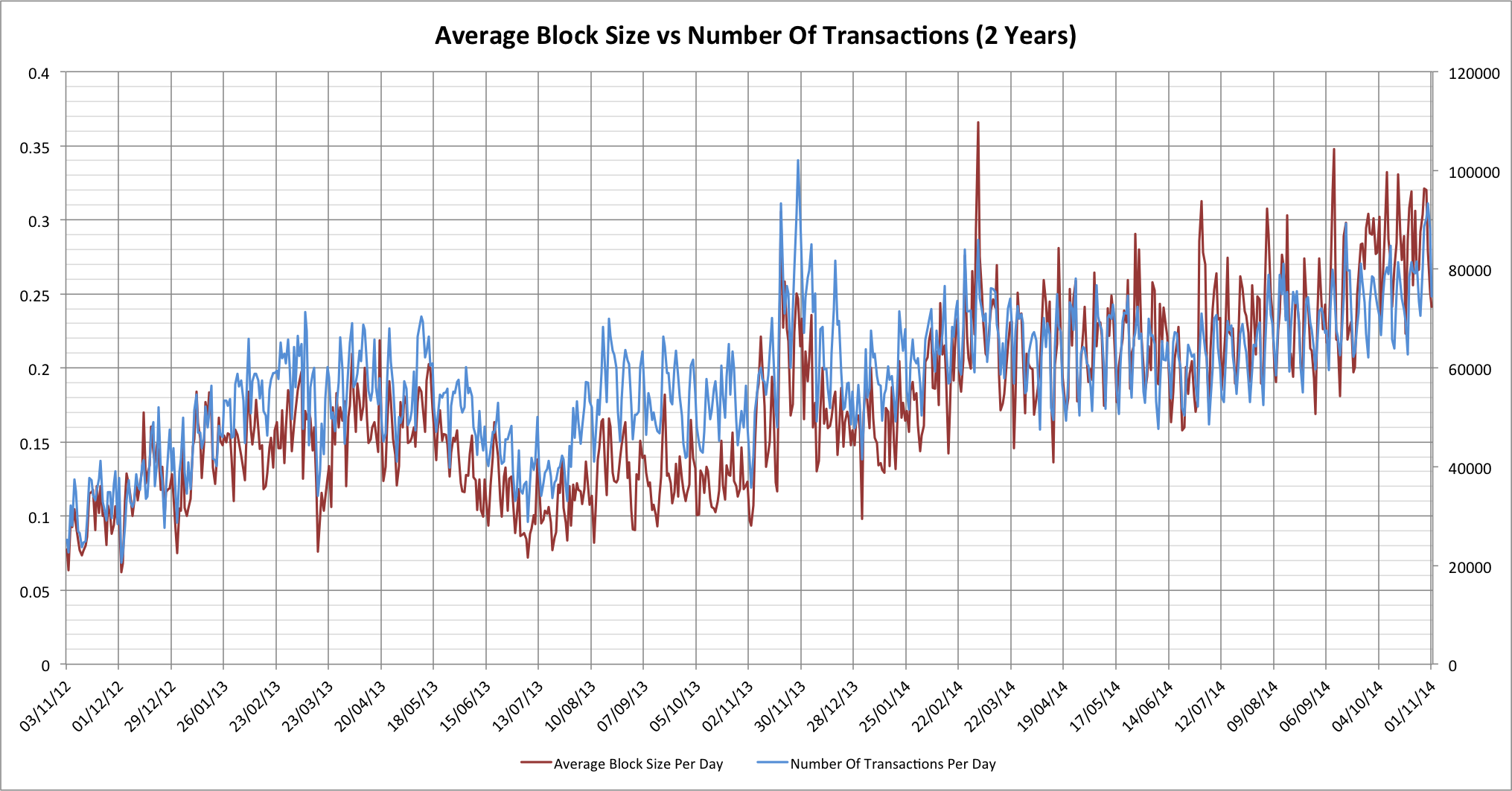
Things start out pretty well correlated, but there does seem to be a trend where the block size is increasing a little faster than the number of transactions. This indicates that our average transactions are getting larger over time. This shouldn’t really surprise us too much as we’d probably expect things to get more complex over time. We’re now seeing multi-sig transactions and ones with very large numbers of inputs and outputs, all of which makes the individual transactions larger. That claim of 7 TPS is looking more fragile all the time.
What Is The TPS Rate That We Can Actually Get?
Given that we know how many transactions take place per day and we know how large the average block size is, we can now work out the maximum TPS rate that we might have achieved on any given day (with the same mix of transactions):
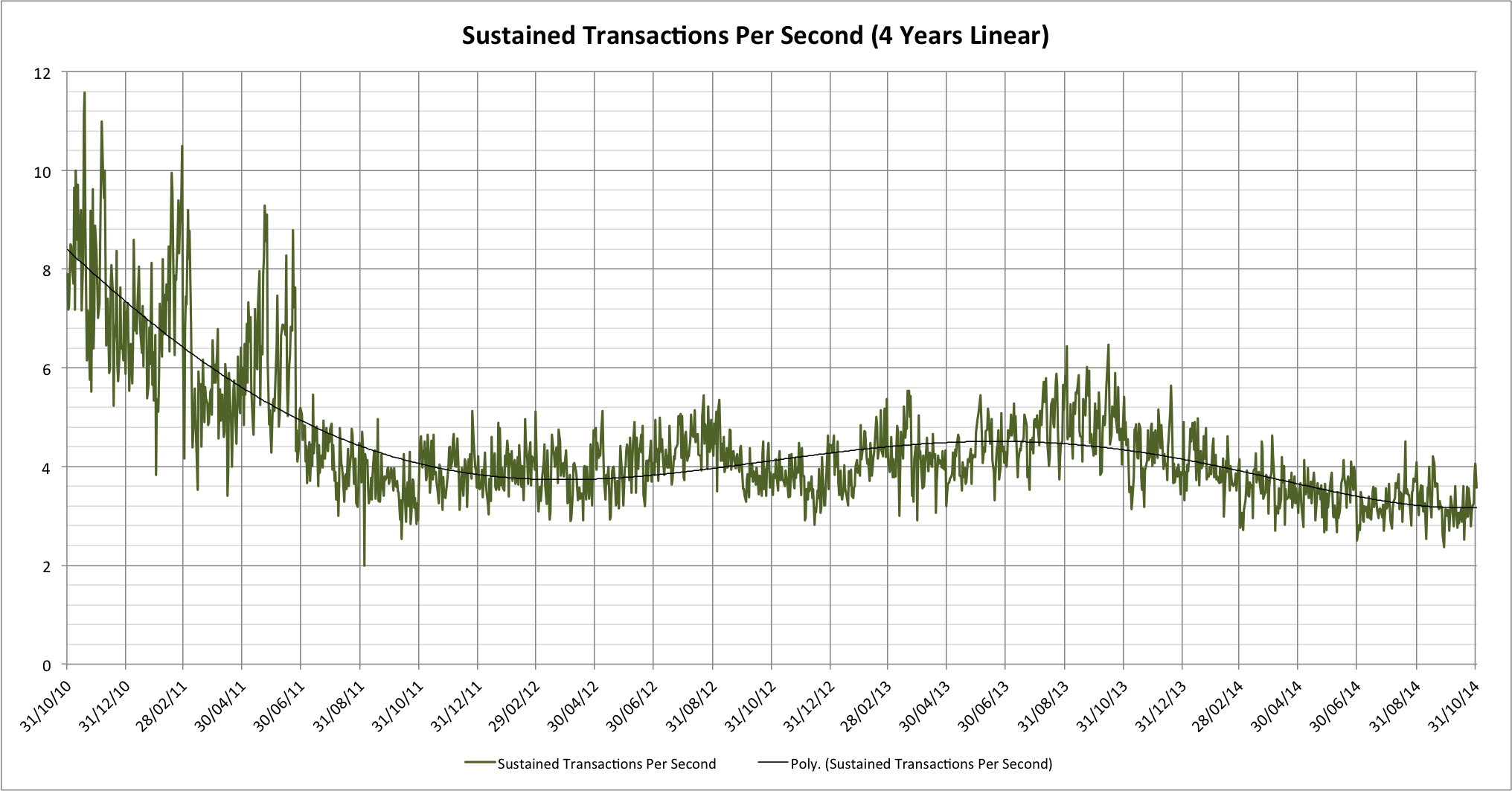
Here’s the log version too:
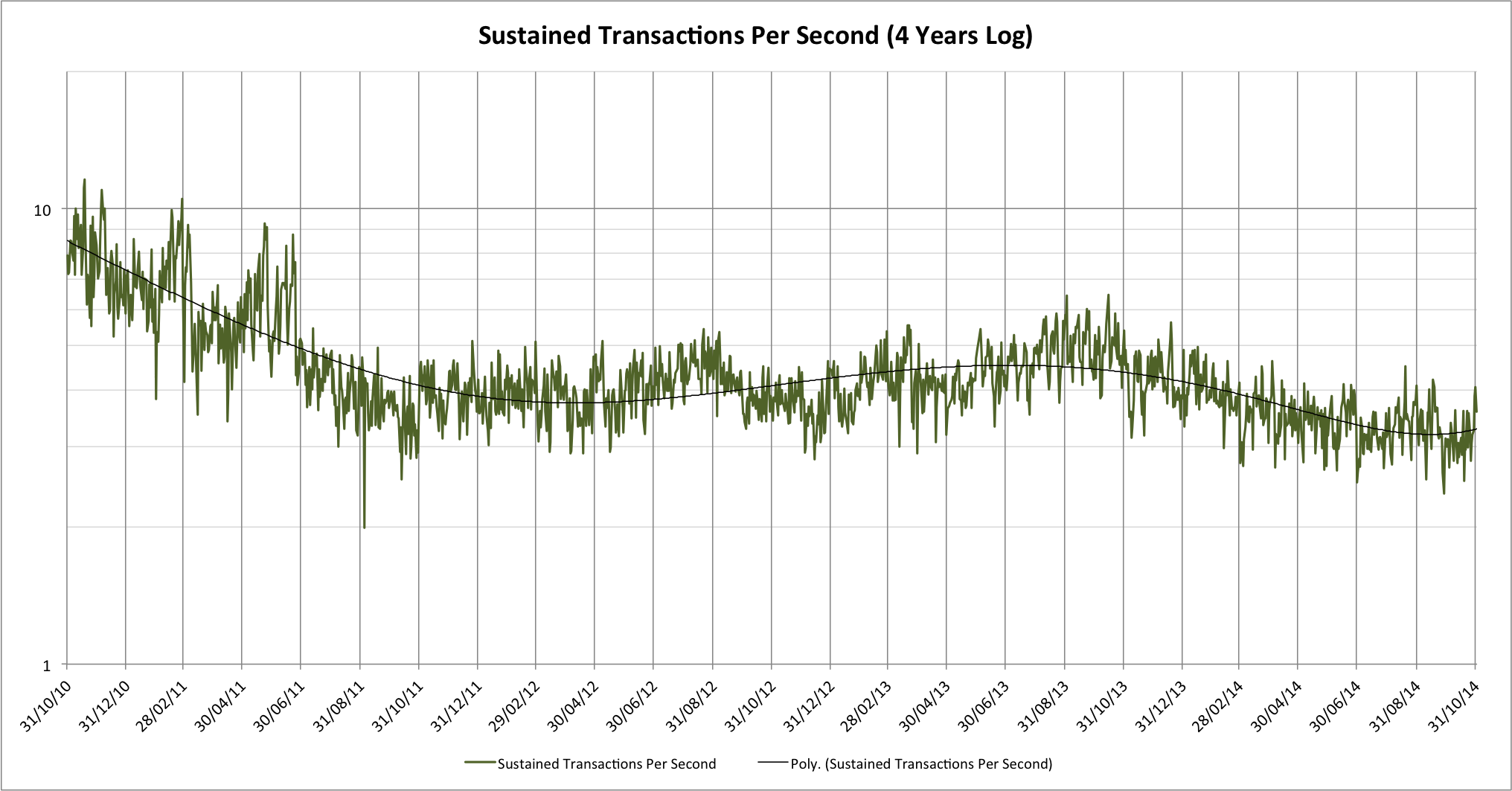
Unlike our other graphs the log chart reduces the apparent volatility of the left side of the chart this time, but the message is pretty clear; the last time we could hit 7 TPS was sometime in 2011. Right now we’re lucky to be able to achieve much over 3.2 TPS; it also means that we’re at about 30% of the total capacity of the network! In fact on several individual days we were at 40% of the total capacity of the network.
For most engineers this will start to sound alarm bells. We’re not talking about the peak usage being 40% on those days, but the average usage. Once we start to hit 100% even for relatively short times then that will start to affect the speed with which transactions find their way into the blockchain, especially as the 10 minutes between blocks is only a mean, not a guarantee.
A Final Thought
There is one interesting aspect to finding that blocks might soon become congested. With congestion miners will actually have a significant incentive to pick transactions with higher fees associated, as opposed to just taking all available transactions. The specific “tragedy of the commons” that says it’s better to take any minor reward than to hold out for a better one may be overturned! Block scarcity may actually prove to be the characteristic that helps miners finally achieve revenues from fees instead of block rewards. That, however, seems like a story for another day…
[Data reference: blockchain.info]
Related Articles
Finding 2016 Blocks (2014-06-16)
End Content
The Legal Politics of Money
By BTCtheory
Posted November 4, 2014
Digital currencies are a new form of economic organization that exist entirely outside of the reach of the State. This has far-reaching ramification not just for money and capitalism, but for the ideological super-structure of the world today. Forcing concepts like exchange and economics into a theorem where tangibility is no longer needed causes for an unraveling of the state power structure itself. Institutionalized violence is no longer prerequisite for the monetary and legal system to function.
The ideological structure of capitalism has embedded itself into the state via the legal system. The State then acts as a thug on behalf of capitalist by enforcing laws through means of legalized repression and violence. It is from this proof-of-violence concept that states are able to force people to accept the legitimacy of contracts, the law, and the value of fiat money at the point of a knife. If governments could not the violence of their legal systems to enforce the acceptance of fiat money, or the repayment of debt; the entire international monetary system would collapse overnight.
Sovereignty of Value and Legal Ideology
All contemporary forms of fiat money rely on the physical and legal enforcement of laws, and the monopolization of the payment systems in order to create exchange value. All state money systems operate on maxims of restrictions based in law, enforced with mystical propaganda in one hand, and a clenched fist of enforcement in the other. The propaganda that is used to convince people of the need for the State to control money is far more important than the laws that create that money, or the guns and violence that are used to enforce their value. It is only through the repressive apparatuses of the State, and the cooperation of their capitalist allies that allows for this system of fiat money to continue to hold value.
Legal restrictions create the nominal values of the currency bills from all states. It is the same for the EU’s Euro, the Chinese Yuan, or Malaysian Ringgit–the currencies have nominal, redeemable value for goods and services in those Nation-States (or unions), and not outside them.
The value of these national currencies are created explicitly from the monopolization of the payment systems, and the monopolization of the issuance of legal tender. The monopoly of money itself via legal tender, and the monopolization of the payment system by the banks working with the state, is how national currencies forces themselves into a means of value, unlike commodity-monies like gold, sliver, or bitcoin.
The value of fiat money is unnatural and is only create through legal force. The power to create fiat money exist solely in the legal realm. However, what forces them to have value is the violence in which the laws based around those nominal values function. There is no such law to make commodities into money; they are simply valued. Mises surmises this in the appendix of “The Theory of Money and Credit,”
Ludwig von Mises
“Another acatallactic doctrine seeks to explain the value of money by the command of the state. According to this theory the value of money rests on the authority of the highest civil power, not on the estimation of commerce. The law commands, the subject obeys. This doctrine can in no way be fitted into a theory of exchange; for apparently it would have a meaning only if the state fixed the actual level of the money prices of all economic goods and services as by means of general price regulation. Since this cannot be asserted to be the case, the state theory of money is obliged to limit itself to the thesis that the state command establishes only the Geltung or validity of the money in nominal units, but not the validity of these nominal units in commerce. But this limitation amounts to abandonment of the attempt to explain the problem of money. By stressing the contrast between valor impositus and bonitas intrinseca, the canonists did indeed make it possible for scholastic sophistry to reconcile the Roman-canonist legal system with the facts of economic life. But at the same time they revealed the intrinsic futility of the doctrine of valor impositus; they demonstrated the impossibility of explaining the processes of the market with its assistance.”
This difference between valor impositus and bonitas intrinseca: the nominal value of units imposed by the state–such as the dollar or shekel–and that which holds real intrinsic value; such as the metals, minerals, or other storage of value.
The best example of how these two values act against one another would be a gold coin that has a lower face value than what the coin is worth on the open market–it is not the stamping of the metal that creates value, but the amount of gold that it is comprised of.
Mises spoke further of the historical difference between the nominal value of coins, and their weight as metal:
“Nevertheless, in defiance of all official regulations and prohibitions and fixing of prices and threats of punishment, commercial practice has always insisted that what has to be considered in valuing coins is not their face value but their value as metal. The value of a coin has always been determined, not by the image and superscription it bears nor by the proclamation of the mint and market authorities, but by its metal content. Not every kind of money has been accepted at sight, but only those kinds with a good reputation for weight and fineness. In loan contracts, repayment in specific kinds of money has been stipulated for, and in the case of a change in the coinage, fulfillment in terms of metal required. In spite of all fiscal influences, the opinion gradually gained general acceptance, even among the jurists, that it was the metal value—the bonitas intrinseca as they called it—that was to be considered when repaying money debts.” Part 1, Chapter 3
Today because of the structure of late capitalism, where the state monopolizes the currency, and the banks monopolize the exchange of currency, there is no way to demand repayment in anything other than more fiat. It is from the insidious brilliance of forcing all exchanges into legal structures with no alternative payment forms, that fiat money both creates its own value, and also becomes a legal power.
We can see that money today is not valued because of its bonitas intrinseca, but only itsvalor impositus. This means that the only way that the state can make its money hold value is through explicit legal means, which are reliant on repressive legal enforcement, and nothing else. **
Physical World Against Digital Laws
There is a glaring issue with this mode of money creation when we start to consider for a moment that the world that we live no longer is orchestrated by legal enforcement of the state, but digital communications.
There is no physical footing in this world, no place for the apparatus to establish itself.The repressive violence states use to enforce their laws simply cannot exist here.
If we return to Foucault in Truth and Power he provides us with more hints about the functions of the state and why ‘cutting off the king’s head’ has been impossible until recently:
Moderator: The King’s head still hasn’t been cut off, yet already people are trying to replace it by discipline, that vast system instituted’-in the seventeenth century comprising the functions of surveillance, normalization and control and, a little later, those of punishment, correction, education and so on. One wonders where this system comes from, why it emerges and what its use is. And today there is rather a tendency to attribute a subject to it, a great, molar, totalitarian subject, namely the modern State, constituted in the sixteenth and seventeenth centuries and bringing with it (according to the classical theories) the professional army, the police and the administrative bureaucracy.
Foucault: To pose the problem in terms of the State means to continue posing it in terms of sovereign and sovereignty, that is to say in terms of law. If one describes all these phenomena of power as dependent on the State apparatus, this means grasping them as essentially repressive: the Army as a power of death, police and justice as punitive instances, etc. I don’t want to say that the State isn’t important; what I want to say is that relations of power, and hence the analysis that must be made of them, necessarily extend beyond the limits of the State. In two senses: first of all because the State, for all the omnipotence of its apparatuses, is far from being able to occupy the whole field of actual power relations, and further because the State can only operate on the basis of other, already existing power relations. The State is superstructural in relation to a whole series of power networks, that invest the body, sexuality, the family, kinship, knowledge, technology and so forth. True, these networks stand in a conditioning-conditioned relationship to a kind of ‘meta-power’ which is structured essentially round a certain number of great prohibition functions; but this meta-power with its prohibitions can only take hold and secure its footing where it is rooted in a whole series of multiple and indefinite power relations that supply the necessary basis for the great negative forms of power. That, is just what I was trying to make apparent in my book [“The Order of Things” which was originally titled “Words and Things.”].
To cut off the king’s head we must venture into a realm where a footing for his power cannot be found. A realm where the physical violence, repression, and thus the capacity to physical enforce nationalistic laws cannot exist. The meta-power of the state and their various laws end where they do–in physical territory, in a physical world. There is no need to cut the heads off of false prophets whom we are immune to.
Digital sovereignty departs from the theology of law, and builds a new economic system that operates from a critical bias of math, instead of physical enforcement. These systems are based upon non-physical knowledge alone (knowledge of the private key), which means these systems are built solely around their mathematical soundness. The code upon which these currencies are written is their own sovereign valor impositus.The computer code itself is the legal-mathematical structure that enforces the rules of bitcoin, and other digital currencies–no State or third-party is needed.
Digital Sovereign and The Banishment of Physical Force
Digital currencies are the kernel of power that a new economic and legal superstructure will be built from. Power is no longer something that comes from the sword, but from the pen.
Violence cannot be an explicit tool of enforcement or appropriation in a nearly-anonymous, digital system like bitcoin or other digital currencies. Economic independence outside of the control of the state or the banks is now a real possibility. This severely underminds the power of the State, the banks, and state-capitalism in total. Digital currencies allow for a new frontier of economic freedom and independence, that is not achievable with the current monetary and legal systems. With bitcoin, people are free to choose who they conduct transactions with, without the permission of the state, banks, or the violence they use to enforce their laws.
When we start to critically assess the current money systems of the world, along with the ideological and mythical structures of sovereignty, law, and the state; we find that they quickly break down under scrutiny. We come to understand that the dominion of the ideologies over our lives is not based upon some holy, progressive knowledge that protects us and gives us salvation; rather, it is barbarism wrapped in blanket, upon blanket of lies, obfuscations, and deceptions.
We see that it is not magnanimity or justice that governs the actors of the State; but selfishness, greed, corruption, and cowardice. We come to see the world as Angelus Novus did, and the horrors of what is stacked in front of us and growing with each passing day. To make whole that which has been smashed is possible, but we must wake the dead in our quest for redemption. The gate is strait, and it is our duty to show others the liberation that can come with each passing second.
In the declaration of independence of cyberspace we declared our virtual selves immune to state sovereignty, even as we continue to consent to the subjugation of our bodies. In the mean while we have spread to every corner of the global to ensure that our thoughts cannot be arrested, and so that the crimes of the state and capitalism will be seen by all, for all of history to come.
We now have the means to reappropriate our sovereignty, our economic independence, and ultimately our political organizations and the State itself. This can and will be done to end the era of state-capitalism, and usher in a new era of global digital organization. We are creating a civilization of the Mind in Cyberspace, and using digital currencies to economically unite us is the first step towards this new world.
—
Next: Bitcoin as a Commodity Money
The Cutting Edge of Bitcoin
By Beautyon
Posted November 7, 2014

The deeply entrenched financial services industry is about to be completely killed by Bitcoin, and they don’t like this fact one little bit. They are in a blind panic over whether they should embrace or resist the sea change.
If you want to get a feel for the level of threat the financial services industry is experiencing with Bitcoin, go to a conference of traditional players and talk about the inevitable Bitcoin future.
Some of the people in that sclerotic and redundant industry have a visceral hatred for Bitcoin. They can’t bear the idea that it bypasses and makes KYC/AML impossible and that they are going to miss, or have missed the Bitcoin revolution because they are so wedded to bad ideas.
They hate the fact that Bitcoin companies are super agile and they are not. They resent Bitcoin, its philosophy and the nature of its origin.
They hate software.
They also know deep down that Bitcoin works. They know it is “g_e_nius expressed and in motion”. They also know that they don’t have the intellect to attack its design. This galls them, chafes them, and has forced them to concoct ever more bizarre pretexts for it not working, in a vain attempt to put people off adopting it. It isn’t working.
Hearing the emotional, irrational, illogical reactions and arguments of these people is very amusing; they all use the same arguments and fallacies and don’t know that as they argue against Bitcoin, they expose their own ignorance. It is amusing precisely because we know there is nothing they can do to stop Bitcoin spreading everywhere.
People who work in Bitcoin hear the same vapid arguments over and over, and these robotic detractors don’t even have the sense to realise that any objection they can put forward will probably not be novel, since they are computer illiterates that have probably never even used Bitcoin, much less had any experience in software development or Austrian Economics.
It is deeply satisfying to know that all of these people are in a blind panic. They are in the headlights of a freight train and don’t know how to move out of the way. It is a pitiful sight and sound.
The same people who don’t understand Bitcoin say that “The Blockchain tech is interesting, but not Bitcoin” this is like saying, “The Apache webserver software is interesting but TCP/IP is not”. It’s completely absurd. They also claim that the newly invented “Side Chains” are an interesting development, but Bitcoin “can’t work”.
Side Chains are an interesting development for the same reason Bitcoin is, The Blockchain. What these detractors don’t or can’t understand is that all these innovations are:
- Software
- On the Blockchain.
You can’t claim that Bitcoin cannot work, but Side Chains can; both are tied to the Blockchain. Either the Blockchain works, or it doesn’t. If it does, then Bitcoin works, and so do Side Chains and anything else built on it.
What we have here (apart from a failure to communicate) is a deeply rooted, psychological disconnect on behalf of Bitcoin deniers. These people want to be cutting edge, but the edge of Bitcoin is designed to cut them out. They know this, and do not like it. They are terrified of the consequences of Bitcoin, the inevitable Wild West that will emerge, uncontrolled, un-knowable, unstoppable and absent their redundant ideas and flaccid opinions. At the same time, they are desperate to be a part of the revolution; to touch it in some way, and be remembered. They can’t write software and so they are excluded.
This is very painful for them. They have… our sympathy.
The Bitcoin world will emerge without their permission or approval and will astonish them all. The sky will not fall, “society” will not collapse. They will all be proven wrong, and Liberty will emerge to capture everything.
Freedom chilli fries and a blonde craft beer, because Bitcoin is FREEDOM! ↯

The Bitcoin Declaration of Sovereignty
By Mirceau Popescu
Posted November 8, 2014
—–BEGIN PGP SIGNED MESSAGE—– Hash: SHA512
Title: BITCOIN DECLARATION OF SOVEREIGNITY ; PROPER VENUE FOR ALL FILINGS ; DISPOSITION OF TAXATION
In #bitcoin-assets, November 8th, 2014.
When in the course of human events, it becomes necessary for one person to dissolve the political bands which have connected them with the human herd, and to assume among the powers of the world the separate and equal station to which the laws of nature entitle them, a modicum of respect to their own intelligence requires that they should declare the causes which impel them to the separation.
We hold these truths to be self-evident : that no men nor women are created, but born ; that nothing ever is or could be equal to any other thing ; that each man and each woman are sovereign entities and the sole sovereign entities ; that sovereigns and sovereigns alone are entitled to anything they may take for themselves, but nothing more ; that “rights” are a poor substitute of liberties much like railroad tracks are poor substitutes of wings, for on wings one may soar and on his liberty one may soar, but on the railroad tracks of alleged rights one can but trudge ; that things made not born have no liberties, nor are nor can ever become sovereign, but must remain subjected to the will and disposition of those sovereign in the world and limited by their rights as granted by their sovereigns, like slave is limited by his chains and computer programs by their language.
To secure our liberty from the encroachment of virtual entities, devoid of substance, deriving their pretense to power from the pretense of consent, that is in the ideal a shameful subversion of the sacred principles of sovereignty and in fact absent, we find –
That whenever any one or any thing becomes destructive of these ends, it is the right of the people to alter or to abolish it. Prudence, indeed, will dictate that things long established should not be changed for light and transient causes; and accordingly all experience hath shewn, that mankind are more disposed to suffer, while evils are sufferable, than to right themselves by abolishing the forms to which they are accustomed. But when a long train of abuses and usurpations, pursuing invariably the same object evinces a design to reduce them under absolute despotism, it is their right, it is their duty, to throw off such nonsense, and to provide new guards for their future security.
Such has been the patient sufferance of the Internet ; and such is now the necessity which constrains us to reject the pretense to power of obsolete forms and fictions left over from a time long gone. The history of the present fiat governments of the world is a history of repeated injuries and usurpations, all having in direct object the establishment of an absolute tyranny over us. To prove this, no facts shall be submitted, you may research on your own.
We, therefore, free and independent of any bond or link of loyalty or fealty, in #bitcoin-assets assembled, appealing to no one ; recognising nothing above and the whole world below us, do, in our own name, and by our own authority, solemnly publish and declare, that we are and of right ought to be free and independent ; that we are absolved from all allegiance to any entity, whether it styles itself a “crown” or a “state” or a “government” or however else ; and that all political connection between them and us is wholly imagined, by them ; and that as free and independent we have full power to levy war, conclude peace, contract alliances, establish commerce, and to do all other acts and things which sovereigns may of right do.
For the support of this declaration we mutually pledge to each other our lives, our fortunes and our sacred rating.
THEREFORE, it is established that the Web of Trust, the #bitcoin-assets deeds registrar and the channel itself are the proper venue for all filings, of whatever type and to whatever end, to be dealed with according to our laws and customs.
THEREFORE, it is established that any Bitcoin company, or trader or merchant or other entity deriving a worldly profit from the otherworldly workings of Bitcoin, is to pay a tax in sum of 0.1% or a hundred thousand satoshi per full Bitcoin realised, into the coffers of the Bitcoin Foundation ( http://deeds.bitcoin-assets.com/deed/9ULZPc7yeZ9fQEA1aZ73H6mcv1s2C4gYFAbNTb5urovj ) as the sole and complete public contribution that may be required of him ; that such payment satisfies the total burden of taxation upon him, and no further payments may be required, in any form nor for any reason or under any title or pretense, by anyone ; that the satisfaction of this obligation is a moral requirement, and outside of the oppinion of the sovereign people it will not be enforced. —–BEGIN PGP SIGNATURE—– Version: GnuPG v1.4.10 (GNU/Linux)
iQIcBAEBCgAGBQJUXlBMAAoJEIpzbw4vt7RS5FwQAJxIhUf/0CHUTV+rqELwpqtv /qdQ6CVnBaMJnS0/YkxVhcNHrp40VRZ+esH69GtGLX/yy8jpeZDrh477ecuOswhB M8qT7yBGlIBZXaOhWZydKQt0g6Wp7+pYY0go4cEYOGgp1kyeCJL72p/QC9ZbczdP K39PcFTRGaduG10iXsbibHvS1Xkfm8sa26X5gt/UmGazFDK8h6hKg3/ppchLSgXH abfHvQr+5MNhCjodU+S5qDA4GpES3YEcs7x9F+ET/GeriQGMcDXSKWcF7CI7T+3P 4so7pZ/8xoiYsDOR2jyrqyE3a3s1tJ5e6zp95Gr51Ist4XzlOPW1KdUNzvrXrKdY 6pxOD1c/oUkyTtuKseXAnbOy3XCuzuhdNTPvFx0Y3flGOkvae1XqzKCl9J9lI6iR M25rJ5N78tde7QOivNlQGYVDx0vGGeUcKcNzeM+q1b1qeeGAb9HpRQN2HrGN+fpp YZkhOtKnkDVgPafCvKEUky/WA18hZcC7a0EZrDaRjVdgwWOMhizozlJgU/bqrd56 /mwXKI1015muRdBgqF4XBAW29XzpfnRuQ5Dk9MzetxAfBISgeNg+TS+SrxBOt2bU UOjcoPbND9wzCU5cRyAoMsWGItsPYCl1Z0bSlqFFQpxF89iDCnkRZzU7nnq9uqkC v+q6pzh1afxg9ThY4G7S =HURp —–END PGP SIGNATURE—–
Active Decentralization
By Paul Sztorc
Posted November 9, 2014
An active campaign to punish and/or destroy miners would actually increase mining centralization.
The Problem
I was musing on how to encourage miner-decentralization. It seemed that this was among the better technical ideas out there. My weak opinion (which I hope is correct) is that eventually everyone will be using P2Pool and this problem will sort of die out, or that new blockchain structures will decrease the problem’s relevance.
Covariates
Of course, I really wanted a more econ-based idea. First, I tried to wrap my head around “measuring decentralization” and tried to make a list of the things which increase with decentralization:
- Redundancy of data-storage-and-generation-processes (if you killed 99.9% of English-speakers, the survivors could still teach it to someone else and then speak with them in English)
- Authoritative Indifference / Flat Hierarchy (English PhDs can’t really prevent the creation of an ‘internet dialect’ which includes “LOL”)
- Privacy of Agents (from one single place, it is impossible to know who currently is using English)
It seemed that that only real insight I could draw from this, was a rather dark one: constantly seek out the “most-popular mining-computer” and destroy it! This would encourage miners never to grow so large as to become visible.
Pretty impractical, unfortunately. But, in a small irony, the laws of thermodynamics have taken a small step in this direction, where a mining setup was so large that it produced enough heat to literally self-destruct.
Will we ever see the day when a small Rebel Alliance attacks a gigantic mining facility by compromising its thermal exhaust ports?
Our Active Alternatives
I think that this “active” campaign to find and destroy miners may be the only way to actively increase mining decentralization, assuming you wanted to do such a thing (which I don’t, really… mining decentralization is not Bitcoin decentralization).
After all, fundamentally, the only difference between “a coordinated group” and “an uncoordinated group” is that something (coordination) has been removed. The coordinated group can always do everything the uncoordinated group can do (and more). So how are you going to make life harder for one but not the other?
Passive Decentralization
Passively, the difficulty-adjustment process works to constantly eliminate the least-profitable miners, making the group more and more homogenous over time. However, (as pointed out by many people), geographically dispersed sources of minimal-cost power (provided by hydro / solar in remote areas) will restore some geographic decentralization (which may, or may not, be related to ownership/control).
Add Disqus comments.
comments powered by
Disqus
Bitcoin traffic bulletin
By Dave Hudson
Posted November 11, 2014
Begin Content
Details Published: 11 November 2014
The Bitcoin network is currently running at around 30% of it’s maximum capacity, but what does that actually mean to its users? Should we care? What about when we reach 50%, or 90%? When roads start to get full of cars they start to get congested, when large numbers of visitors enter or exit a building everyone slows down and takes longer to get where they want, but what happens with Bitcoin?
Bitcoin Transaction Processing
Bitcoin mining (and therefore transaction processing) is what’s known as a Non-Homogenous (or Inhomogeneous) Poisson Process. In the article, “Hash Rate Headaches”, we saw how this actually works and that our nominal 10 minute spacing between Bitcoin blocks isn’t quite as straightforward as we might hope. For transaction processing though things get even more complicated. Now we have transactions that themselves appear somewhat randomly; in fact they will typically follow something like a Poisson Process distribution too.
In the case of Bitcoin the transactions do have some other biases. We saw in “7 Transactions Per Second? Really?” that Sundays are usually quieter than other days, while Bitcoin transactions can also be perturbed by network delays, orphan races and mining fees that might incentivize some transactions to be processed quicker than others. None of those effects really come into play though when we have a very small number of transactions so we could actually model the behaviour and see what happens.
In “7 Transactions Per Second? Really?” we saw that the current Bitcoin network has a peak capacity of a little under 3.5 transactions per second (arguably closer to 3.2 at times). We can use that information to build a Monte Carlo simulation that will predict how long it takes to get transactions confirmed.
Monte Carlo Simulation
For the purposes of this article I constructed just such a Monte Carlo simulation that assumed a peak of 3.5 TPS and that would simulate a mining Poisson Process with a mean block finding time of 10 minutes and a transaction arrival Poisson Process with a mean that was given by a percentage network load. For example a 10% load would be 0.35 TPS, or 30,240 transactions per day. In order to get good data the simulation was set to run 100,000 weeks of mining at 11 different loading levels. Each week started from scratch and with zero transactions pending.
The simulator ignores mining fees and assumed that transactions are processed first-come, first-served; this actually turns out to be a reasonably accurate prediction for most current transactions. It also ignores network propagation delays (how long it takes for a transaction to be seen by all mining nodes) but that will really just add a fairly small starting delay of up to a few seconds per transaction and so this is probably ok too (see: http://bitcoinstats.com/network/propagation). It does mean that the data is probably a little too optimistic about how quickly transactions can be mined. Finally it assumes that the mining network capacity is constant and neither increasing, nor decreasing in capacity. When things are increasing then blocks will be found slightly quicker, but the effect has become quite small over the last few months.
Let’s start by looking at what happens when there are almost no transactions being announced. This should represent an almost perfect scenario because every transaction can immediately go into the next available block. The network load for this example is 0.1%, or 0.0035 TPS.
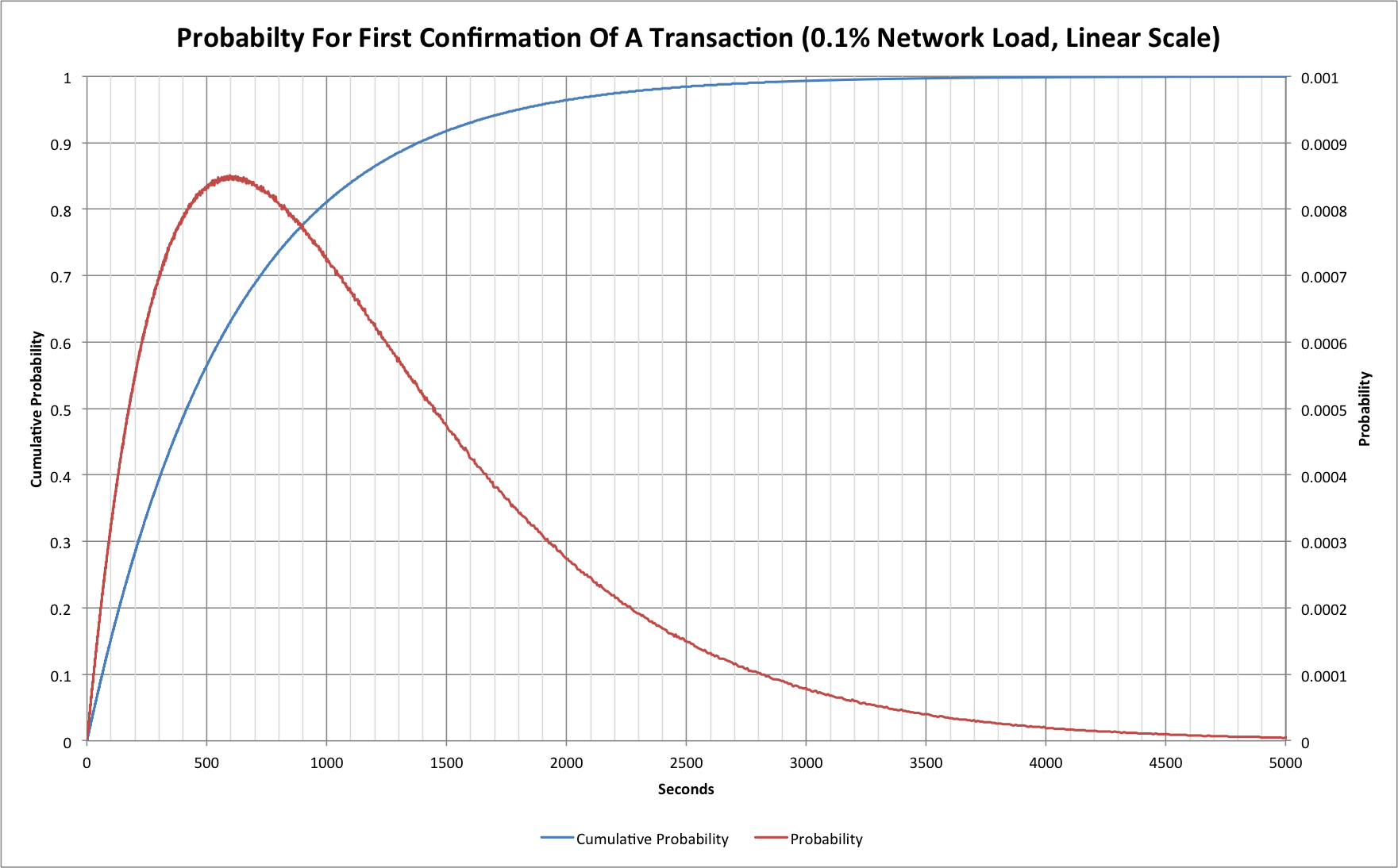
We have two traces here. The red trace shows the probability of a transaction being confirmed at a given time after it was submitted, while the blue trace shows the cumulative probability; i.e. the probability that a transaction will have received its first confirmation at or before a given time.
We can see that 50% of transactions are confirmed within 415 seconds (a little under 7 minutes). Equally though, 10% have not had their first confirmation after 1380 second (23 minutes), and 1% are still unconfirmed after 2760 minutes (46 minutes). This may come as a surprise to people, but no amount of fee changes, or network improvements will change these basic numbers!
In the past we’ve tended to make use of graphs plotted on a logarithmic axis and these ones are no exception! Here’s the same graph with a logarithmic time (horizontal) axis:
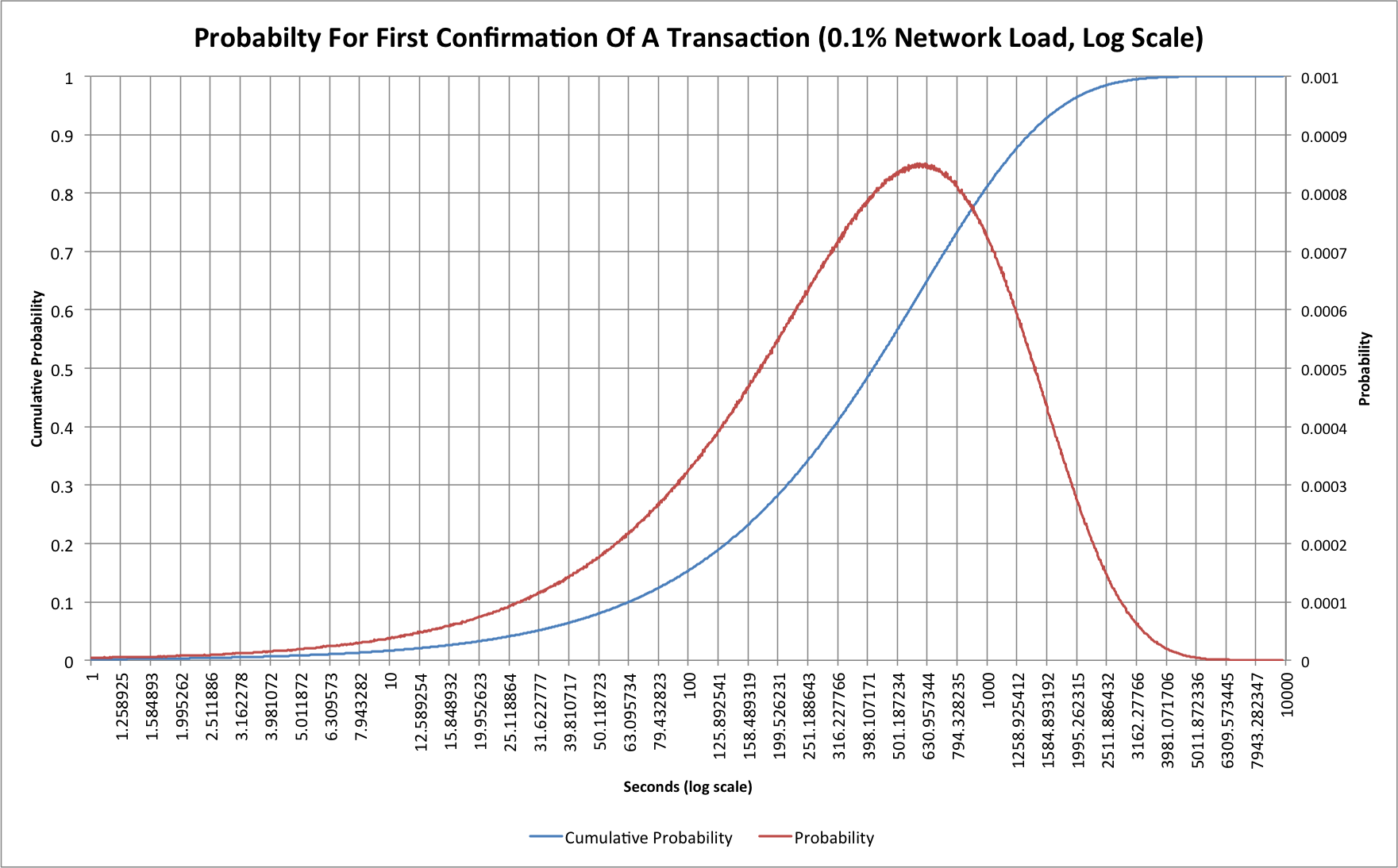
The logarithmic scale compresses the “tail” to the right so we can compare things more easily later. The cumulative probability curve looks different too, and is somewhat easier to work with on this sort of scale.
What Happens With More Loading?
Things become much more interesting when we start to consider some reasonable loading on the network. As of early November 2014 the network load is around 30%. If we use the simple Monte Carlo simulation we can model this pretty easily.
Let’s look at network loading from 0.1% all the way to 100%:

Probably the first thing to realize here is that the traces for 0.1%, 10% and 20% are so similar that the 20% line hides the other two. The 30% line is only slightly different. This tells us that up to now we’ve not really seen any real effects as a result of transaction rate. At 30% loading we’ll still see half of all transactions confirmed within 434 seconds, as opposed to 415 for 0.1%. That gap really starts to widen at 40%, however, where it now takes 466 seconds and at 80% we’re up at 1109 seconds (18.5 minutes)! At 100% we’re up at a huge 7744 seconds (more than 2 hours)! If the network were ever to reach this 100% level, though, the problems would be much worse as 10% of all transactions would still not have received a confirmation after 22800 seconds (6.3 hours).
Mining Fees Will Save Us?
The simulations are pretty simplistic because they assume all transactions are processed in the order they arrive. There’s no attempt to simulate the effect of fees, but the first thing to recognize is that the 0.1% loading case (and indeed almost everything up to 30%) pretty much wouldn’t care anyway. In these situations there’s little to no congestion so fee-base reordering of transactions won’t make any real difference. As the network gets congested though then fees can start to have an impact.
Once we start to see full blocks (and we have been starting to see these in the last few weeks) then fees should decide whether a transaction is in the next block or may be delayed to one after that. Statistically that will mean that blocks with higher fees, or that for other reasons are deemed to have high value to the network, will follow curves closer to those for a lightly loaded system as we’ve seen so far. It also means that those with low fees will actually see even worse delays than the simple model predicts.
No matter how much the fee structures are changed, however, unless the speed of finding blocks is increased then we’re pretty-much stuck with the characteristics that have been present for the last 5+ years. For example, the “floating fees” change coming in the new Bitcoin Core software won’t improve anyone’s confirmation times beyond a few seconds, but fee-based prioritization will allow anyone willing to pay to keep their current confirmation behaviour. Similarly making the blocks larger won’t improve confirmation times other than by moving us to the curves for a less congested network.
Rewards For A Bitcoin Miner?
While less than ideal for users of Bitcoin, congestion of the network does have a potentially positive impact for one group: Miners. As block space becomes scarce, users of the network will have to attach larger fees to continue to see confirmation times of the order they are used to. When fees increase then miners reap the reward.
When block space is readily available, miners suffer from a “tragedy of the commons” problem in which the only rational behaviour is to accept all transactions, no matter how small the fee. With scarcity, however, there’s suddenly a competitive market for block space. Those paying fees may not appreciate the extra costs, but a transition to a system that allows mining fees to become a larger fraction of mining income is actually a good thing for the long term security of the network. Increased fees would go some way to offsetting the losses that miners will see at the next block reward halving to 12.5 BTC per block in 2016.
Consequences
If the network becomes more congested and fees increase then this will inevitably have an interesting impact on “spam” or low value transactions. They may well start to find themselves priced out of the blockchain. This may well also be a trigger for the use of something like sidechains.
One thing is clear though! Anyone looking closely at transactions on the network can probably see the signs of those tail lights coming on ahead. Unless something happens quickly, it looks like we’re going to be slowing down pretty soon.
Source Code
This article was written with the help of data from a C language simulation. The data was rendered into charts using Excel. The source code can be found on github: https://github.com/hashingitcom/bitcoin_traffic_bulletin
Related Articles
7 Transactions Per Second? Really? (2014-11-02)Finding 2016 Blocks (2014-06-16)
End Content
The future of Bitcoin transaction fees?
By Dave Hudson
Posted November 12, 2014
Bitcoin is often touted as having substantially lower fees associated with using it than most other financial systems, but fees and costs are very different things. The reality of things in the Bitcoin ecosystem is rarely simple, and this one is no exception. What then are the actual numbers, where are they heading and what are the consequences?
Transaction fees
Probably the biggest challenge in looking at the costs of transactions is to work out what that actually means. For anyone sending BTC the obvious “cost” is the transaction fee, so let’s look at that:
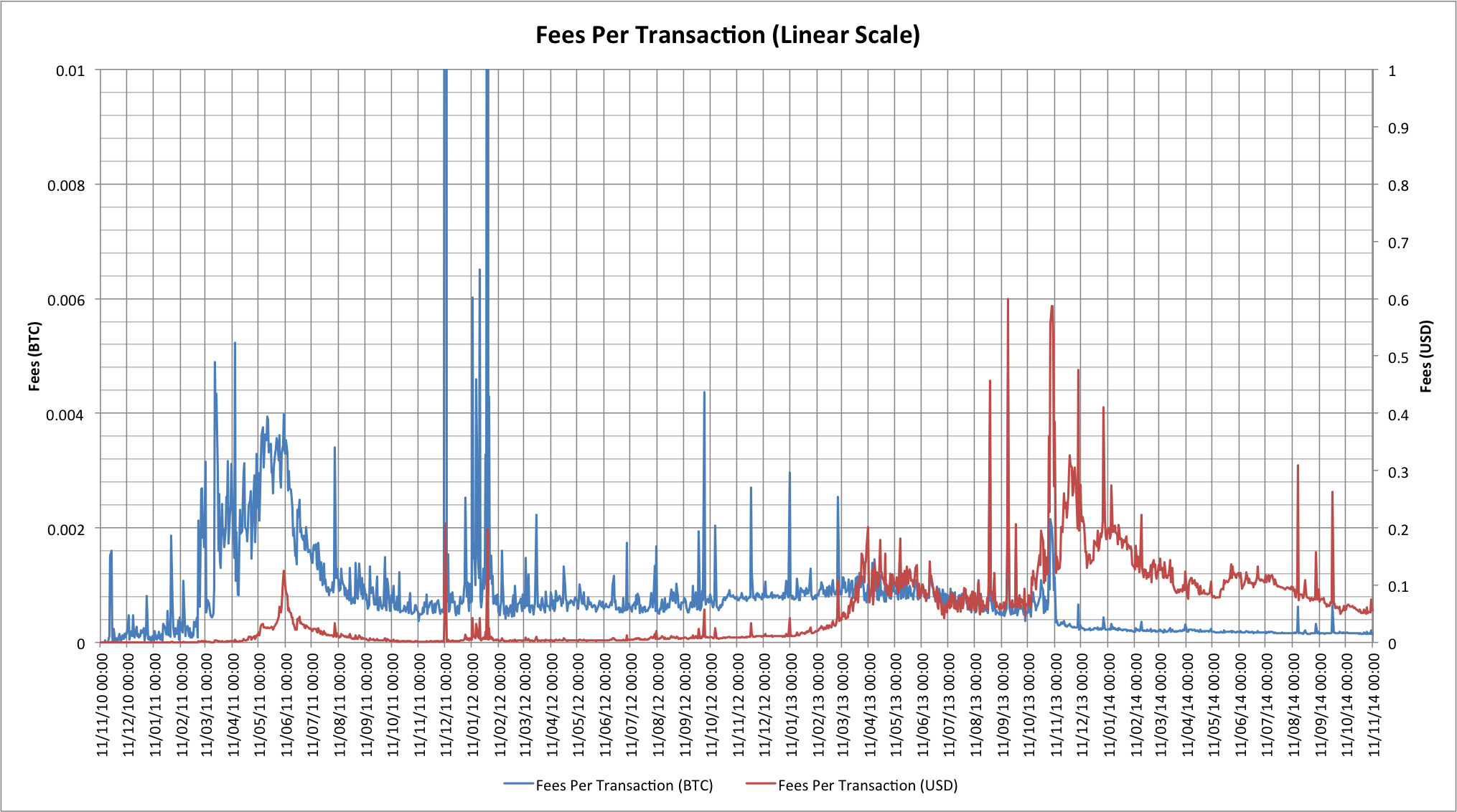
Fees per transaction (linear scale)
The chart shows the fee per transaction for the last 4 years, and shows that that cost is in BTC and what that converted to in USD. The USD trace is really hard to follow early on though so let’s look at this on a logarithmic scale:
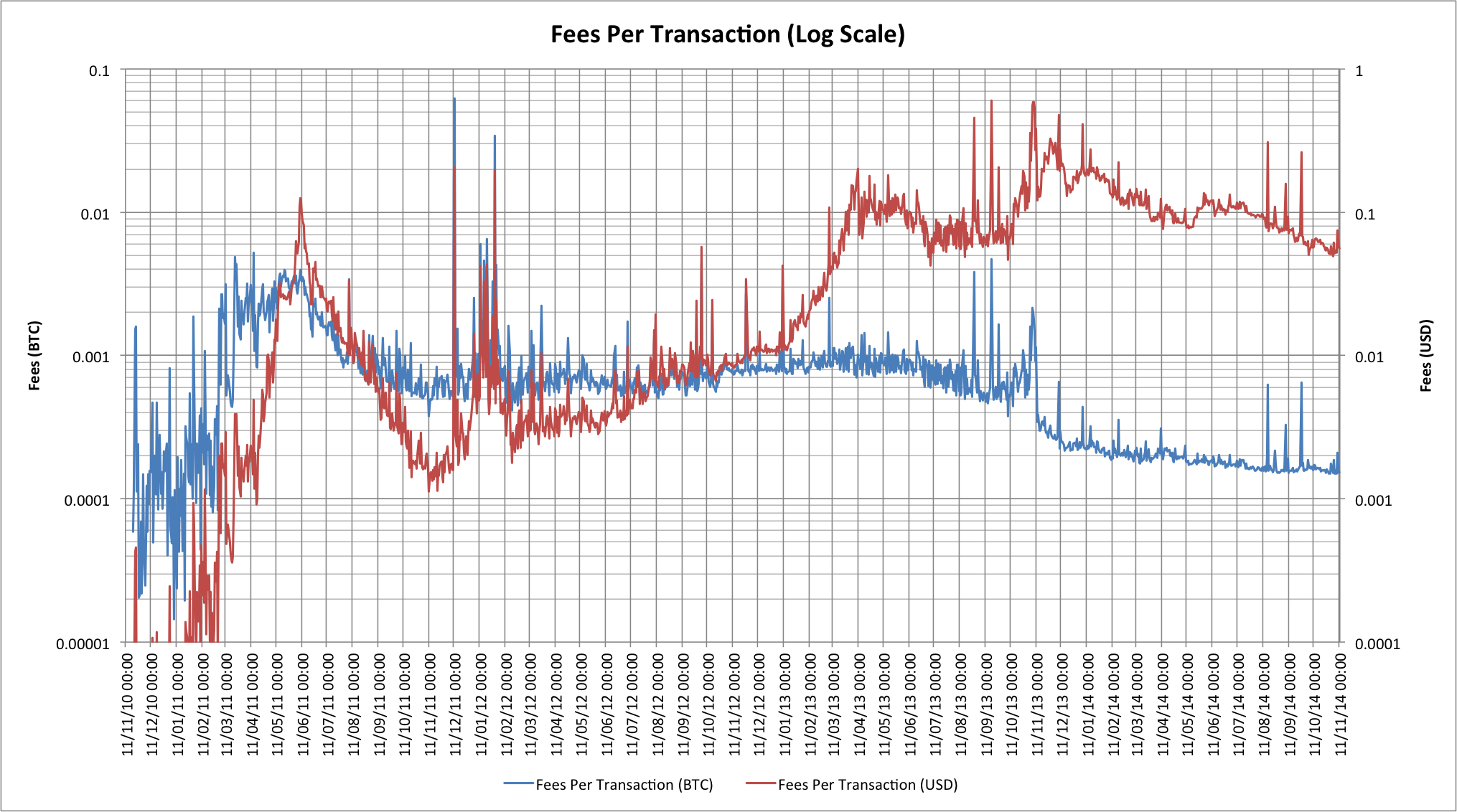
Fees per transaction (log scale)
Certainly these numbers would appear to back up the claim that Bitcoin transactions are really inexpensive! BTC-denominated fees have actually steadily fallen for most of the last 4 years and are now at about 0.00015 BTC per transaction. As long as we’re talking about transactions involving, say, 0.1 BTC then the fees have pretty-much always been less than 1%, and are now more like 0.15%!
This is where things start to become a little interesting though. The fee is primarily concerned with ensuring a minimum charge to avoid the network relaying “dust” transactions of tiny amounts, and also charging an amount per kbyte of data required to store the transaction in the blockchain. What the fee doesn’t take into account at all is the BTC value being transferred.
The fee structure means that BTC transfers are incredibly inexpensive for large transactions, but that small transfers can become much more expensive. As we’ve seen before in “7 transactions per second? Really?”, there’s actually a hard limit on transaction space and the current mean transaction size limits the network to less than 3.5 transactions per second so the fee structure is designed to prevent people from consuming too much block space with low-value transactions (if anyone wants to do micropayments then they really need to aggregate them together).
The transaction rate limit also has an impact on the speed with which the network confirms transactions. With more transactions the network becomes congested and confirmation times increase. The only way to avoid increased confirmation times will be to incentivize miners to mine specific transactions, and the only way to do that is to add a larger fee to a transaction. If the network starts to become congested then one natural consequence is that fees will start to increase too.
Rewards for Bitcoin miners
The observation that fees are likely to increase may upset some users of the Bitcoin network, but is good news for the people actually doing the transaction processing: Bitcoin miners.
Let’s look at things from the perspective of a miner:
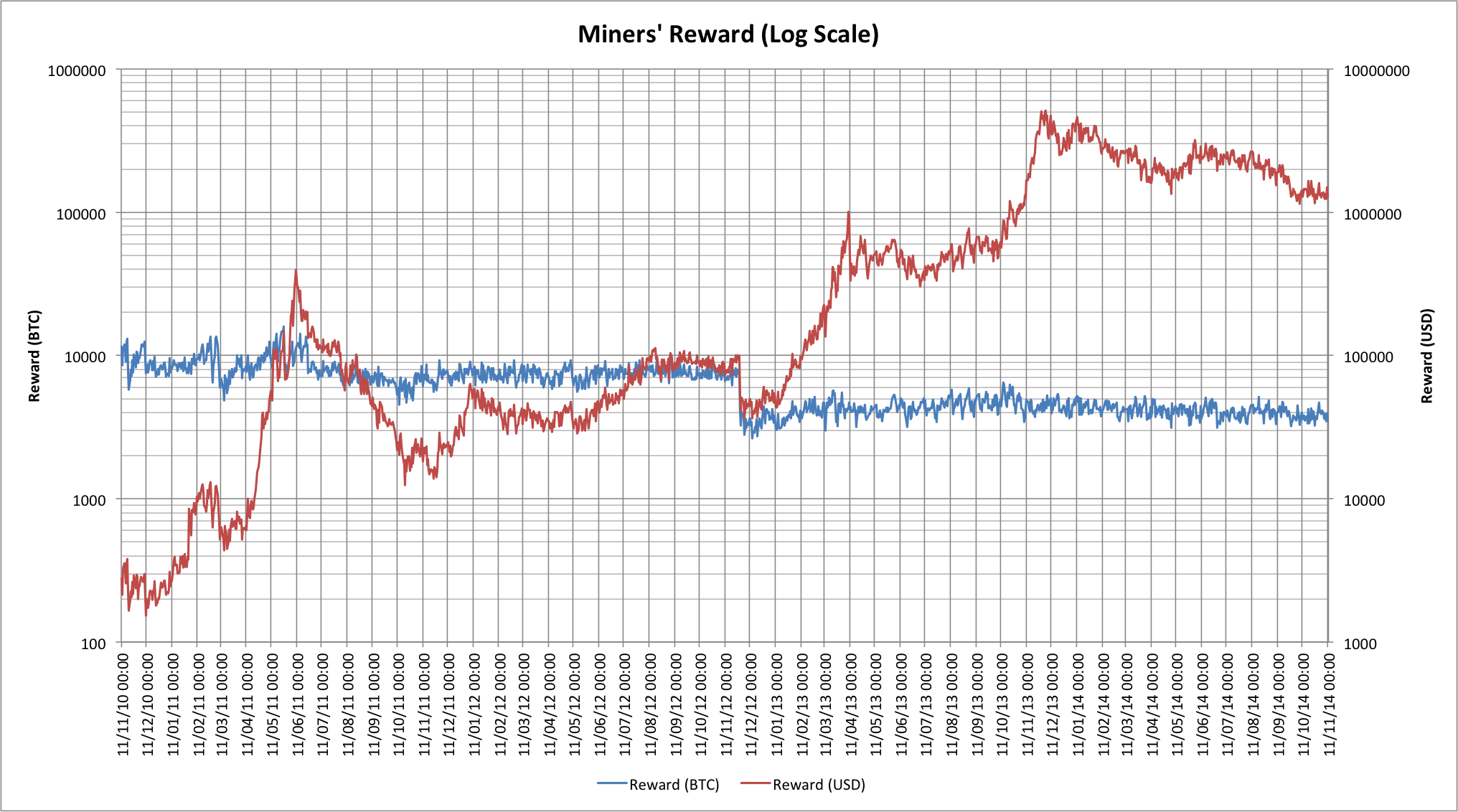
Miners’ reward (log scale)
The red line showing the amount of money received by miners in USD looks impressive. Even with the decline in BTC price to late October the daily revenue for Bitcoin miners was at over $1.5M per day, but that revenue is paying for the installation and running of mining hardware. If we guess that the average mining server is about 1.5 TH/s and the current network capacity is around 270 PH/s then that would suggest at least 180,000 mining units worldwide! In reality there are probably in excess of 200,000.
The 25 BTC reward for each block over the last 2 years has enabled industrial scale mining that was initially very profitable for miners and their suppliers, but has rapidly followed the same trends as other sorts of industrialized mining and has reached a point where the costs associated with mining almost consume the reward from selling what was mined. Bitcoin mining has been heavily squeezed as a segment, especially with the decline in the USD price of Bitcoin during 2014. The USD price (or other fiat currency conversion rates) is critically important because development, equipment manufacturing, hosting, and power are almost entirely paid for in fiat currency.
The blue line shows the problem though. This one is the BTC-denominated reward for miners and it’s pretty obvious that most of the reward isn’t changing. Until late 2012 that was 50 BTC per block mined and then subsequently 25 BTC. In 2016 this will drop to 12.5 BTC and that should be a concern to Bitcoin users too. If we’re very observant we notice that this blue trend is actually moving slightly down right now; as the network expansion slows then fewer blocks are mined each day (we get closer to 144 per day). The other thing that is clear from the blue trend is that transaction fees are currently almost inconsequential to the viability of mining operations. The total fees paid in a day are far less than even a single block reward.
Block reward halving
We might look back at the reward halving in 2012 and observe that there wasn’t much of a problem back then so why might there be in 2016, but in 2012 things worked out surprisingly well for the network. The USD-denominated Bitcoin price doubled within a couple of months, while mining was not operating on the sorts of low margins that are common in 2014. In 2016, unless there’s a fortuitous price spike again, or without some additional source of revenue, industrialized mining will be placed under extreme pressures.
Advocates of decentralization may like to think that this as a good thing, but there are two notable problems:
- If 50% of the network were to be unplugged then the amount of security for the network would drop by 50% and that would in turn risk an attack from that now “dark” hardware. 51% wouldn’t be a just a theoretical problem anymore, there would be hardware sitting idle and able to launch just such an attack.
- Smaller miners would feel the economic pinch much sooner than the larger miners. The largest operations almost invariably have better economies of scale and can probably weather the loss of income better. Our 50% sized network would now almost certainly end up in the hands of even fewer industrial miners.
One potential way to offset the reward change and keep miners incentivised would be to increase the transaction fees. If the network were to move to being funded largely by fees rather than block rewards then the risks associated with block reward halving could be dramatically reduced.
What do transactions really cost?
To understand how fees might become a significant incentive for miners we need to understand what the costs of transactions look like in terms of the current mining rewards. There are a couple of ways we can think about this.
Let’s start with the obvious one: What is the cost to the whole network for an average transaction?
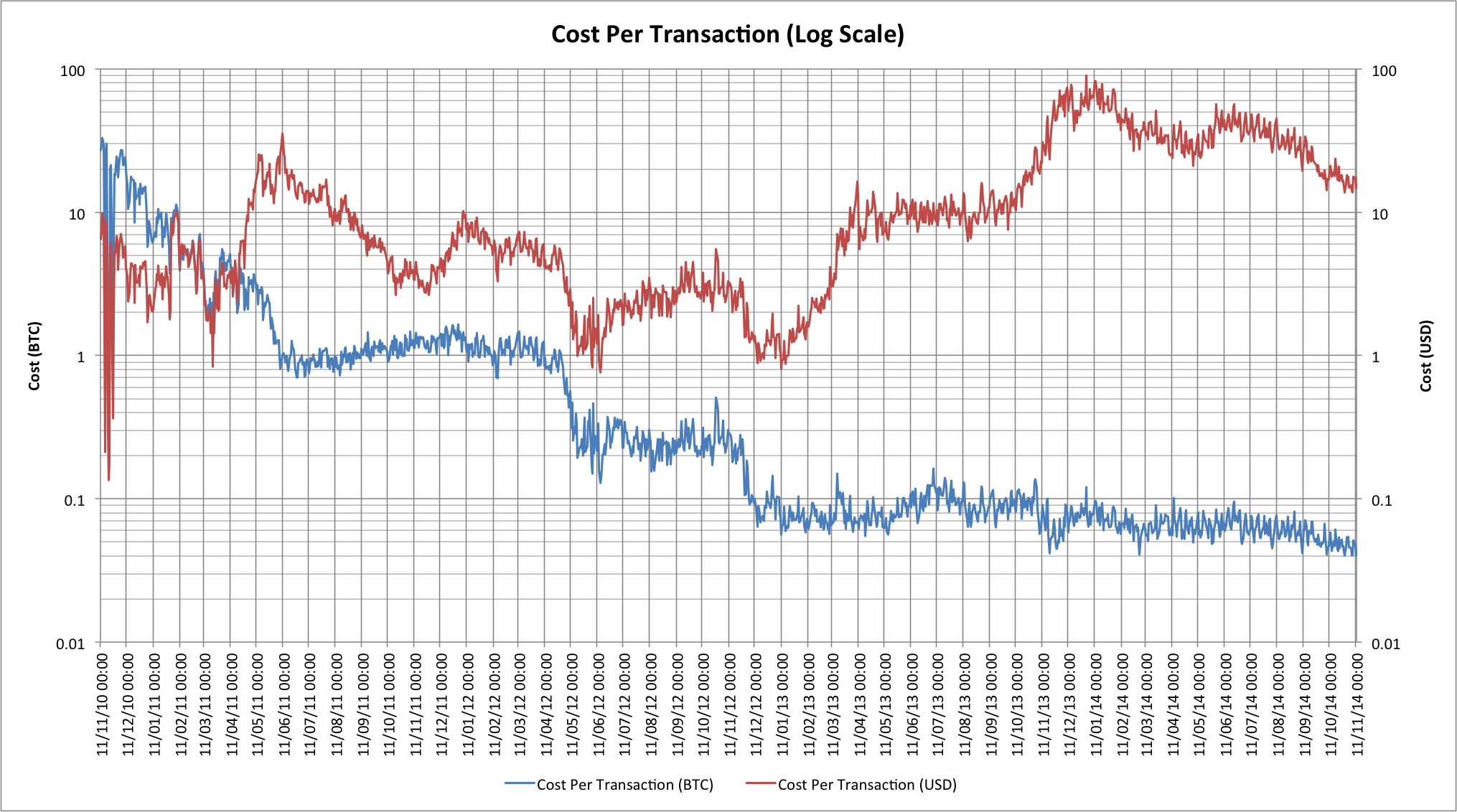
Cost per Bitcoin transaction (log scale)
With this measure each transaction costs around 0.045 BTC, or approximately $17 at the end of October 2014. The network is able to process more transactions per second than it is right now. It’s currently running at about 30% of its capacity and has doubled in the last 12 months. If we presume that at the next reward halving we’re at 60% of the capacity then we’ll have twice as many transactions and thus the cost per transaction would be half of our current estimate: i.e. 0.0225 BTC. In addition our block reward isn’t going away completely, it’s just halving, so we’d need fees to make up a shortfall of 0.01125 BTC per transaction.
Another approach?
It seems pretty unrealistic to expect fees of that magnitude based on the current scheme for setting fee levels so perhaps we need to consider some other data. Let’s look at the transaction cost per Bitcoin. This is a little tricky because transactions don’t always make it easy to determine if a transaction output is going to someone else or is simply change being returned to the sender. Blockchain.info’s data does attempt to estimate the actual transaction volume though so we can try to use that here:
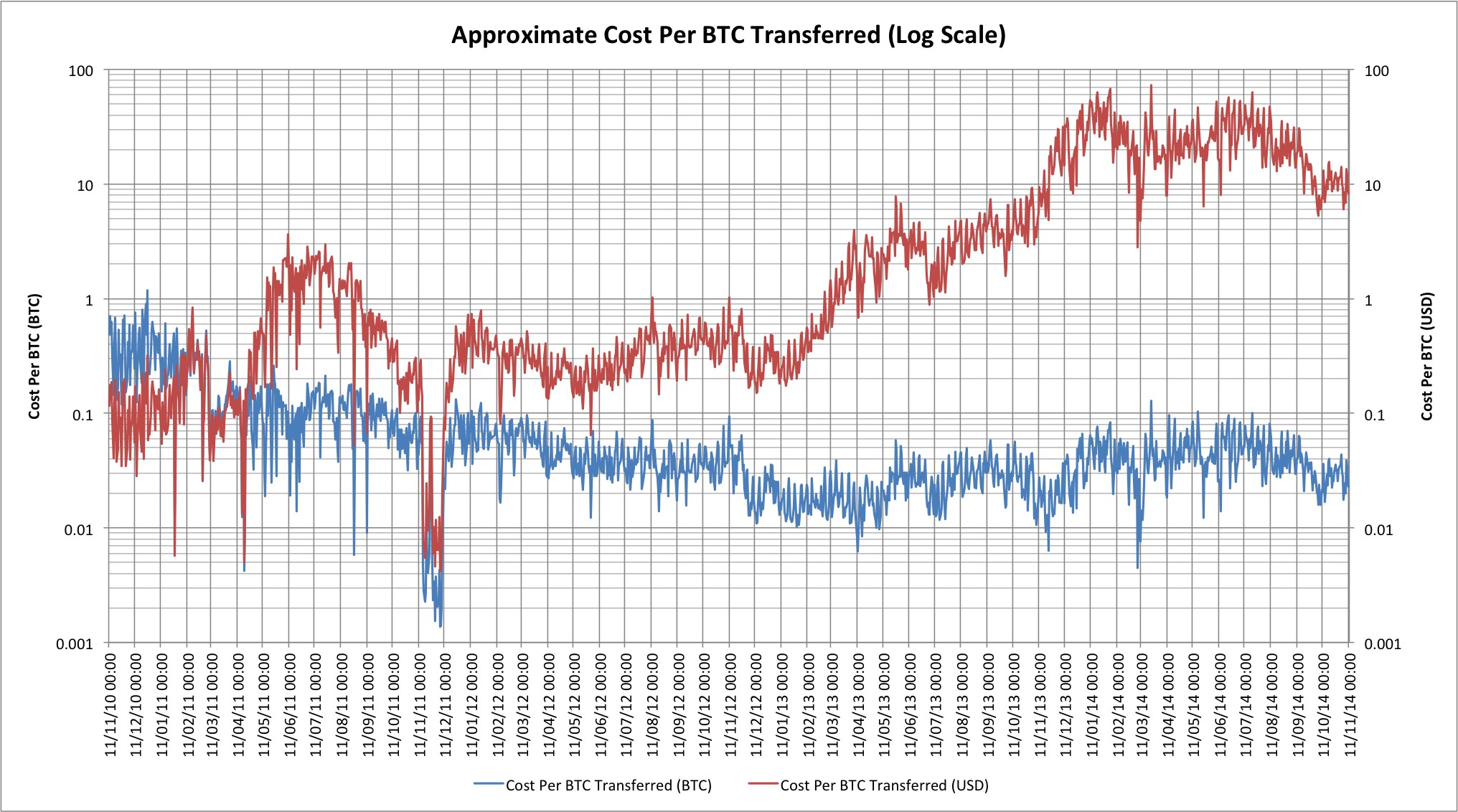
Estimated cost per BTC transferred (log scale)
The current cost to the network is approximately 0.03 BTC per BTC transferred. If we were to see a doubling in transaction volumes as predicted earlier, and the transaction value therefore doubled, then the cost would drop to 0.015 BTC per BTC transferred. As a result if miners were to be given a fee of 0.0075 BTC per BTC transferred then that would offset the losses at the next block reward halving. The real question is whether a 0.75% transaction fee is something that the network is prepared to accept in order to preserve its security?
Of course this isn’t the only way in which this particular problem might be averted, but one thing is clear: There will inevitably have to be changes to way in which mining is funded in order to keep things running smoothly.
Bitcoin is a Commodity Money
By BTCtheory
Posted November 19, 2014
We have discussed several different ways in which bitcoin creates an intrinsic value for itself. We also have discussed the absolute value that cryptography offers, and how States conjure up fiat money through legal violence viavalor impositus,rather than creating money with real bonitas intrinseca value of metals that are coined. Now that we have an understanding of the above concepts, we can discuss how bitcoin is a commodity money, made from rare unique bits of data that create the whole cohesive framework that makes up bitcoin.
Satoshium
For this post I am going to pretend that bitcoins are real coins that are minted from a new metal called Satoshium. This metal is ugly, has few uses, and cannot be physically touched, as it is invisible–overall it is pretty useless. However this new metal is very, very divisible, malleable and it can be transported over any digital communication channel. All Satoshium that will ever comes into existence is created through the coinbase reward that ‘mints’ bitcoin units, which happens during the process of ‘bitcoin mining’.
The reason for the fictionalizing this alloy Satoshium is several fold:
1) To elaborate on the very important distinction between the legal creation of currency out of nothing, and how that is different from the minting of coins which must gain their value from the material the coins are made from. This is the distinction of legal tender under the force of law (valor impositus) and the nominal value states creates out of thin air (the expansion of the money supply), verses natural (bonitas intrinseca) money, which derives its value from no enforcement, or organization of men; but from the intrinsic use-value the object possess in-itself. This is seen most frequently with precious metals, but also with objects of use value like cigarettes.
2) Bitcoins can be used for much more than just money. When bitcoin units are creatively destroyed (proof-of-burn, colored coins, etc) it is similar to the melting down coins to use the metal for something more useful. Contracts, identity, transparent taxation, autonomous agents, etc. can all be created from Satoshium, or the outright destruction of bitcoin units.
3) Bitcoin is really a several dynamic systems working together (payment, identity, proof-of-existence, ownership, PGP system, etc) each with their own purpose. This is in addition to the fact that ‘bitcoins’–what one could think of as the cassacious coin, and I refer to as ‘bitcoin units’–is separate from owning a bitcoin address with no money in it.
Today we shall cover only the first item, and discuss how the bits of data that create the individual bitcoins have their own unique values that are not found within in the laws of men, but the laws of math.
Satoshium Mining
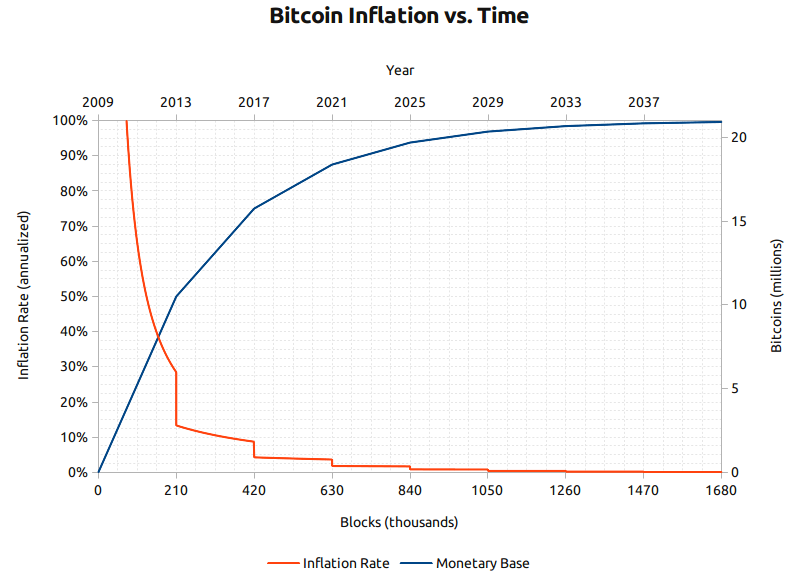
bitcoin monetary base
Let us think of Satoshium similar to gold or silver, with a few notable exceptions. Satoshium is rarer than gold; with only 2,100 trillion units (0.00000001 BTC–the smallest bitcoin unit, ‘a satoshi’) of Satoshium that can ever exist. Today there are about 1,350 trillion units of Satoshium that have been discovered through the ‘Satoshium mining’ process. More and more people are mining everyday with better, and better mining equipment–which is making it harder for current miners to find the mining reward. We will comeback to how bitcoins are ‘minted’ from satoshium using the coinbase reward process later in this post.
Another unique trait about satoshium is that it has a very, very steady inflation rate. For every 10 minutes of satoshium mining that is done on the bitcoin network (combining all of the mining power that everyone is using to find satoshium–be it 9 computers, or 9 billion) there are 5 billion units of satoshium discovered. After the first 4 years of mining, this amount was reduced by 1/2, to 2.5 billion units for the same 10 minute block of total work by the network. This amount will continue to divide in half every 4 years until there are no more units to be divided, which will be somewhere around 2138. Today there is much less satoshium available for mining than there was even just a few years ago–this is similar to the real deflation that metals, like gold, silver, and platinum experience over time, as they also have a finite supply.
Satoshium mining has become very difficult because so much mining energy is competing for these limited number of bitcoin units; the little guy can no longer mine satoshium on their own–it is simply too hard. This would be like trying to mine for gold with only a pick and shovel, while the guy next to you has a gold mining operation–you are not going to win. To resolve this, people discovered that if they ‘pool’ their work, everyone can share in the reward of satoshium mining based upon how much work they are doing for the bitcoin network.
The Minting of Bit-coins

Satoshium is really the coinbase reward, which is the raw material that bitcoins are minted from (fun fact, the only way you can truly destroy a bitcoin is through not claiming the full coinbase reward). In the same manner that gold is just a hunk of metal before it is minted into a coin; so is satoshium is to bitcoin. When someone is rewarded for satoshium mining, those satoshium units are grouped into chunks of 100 million units and ‘minted’ single bitcoin. This is the coinbase reward process. This ‘mints’ satoshium units into bitcoins based upon what the block reward is at that time, and pays that reward of new coins out to a new bitcoin address. This is the ‘minting’ process and how the bitcoin network creates new bitcoins.
Though each bitcoin is created equally, the data that comprises of each individual bitcoin is unique and different. Each bitcoin addresses has unique identifying properties, that differentiate each individual bitcoin to their owners, but to no one else. This is similar to the serial number that is unique to each dollar bill. This means that the history of that particular bitcoin (or subdivisions of that bitcoin) can be tracked, and can only be spent when the 53-digit unique hexadecimal private key authorizes its movement. If properly secured, it is impossible to ‘hack’ a bitcoin address and take the money from that address; as only the private key will be able to move it. This is why there are several bitcoin addresses that have tens of millions of dollars in them, and not a single one has been hacked.
The mining process is also what ensures that there are no ‘double-spend’ attacks. In lay-terms, a double-spend attack is similar to check-kiting, where one spending the balance in checking account twice before the bank can check to make sure the funds are there. We won’t go into details about this right now, but just be aware that the mining process also acts as the gatekeepers to the transference of funds, and offers mathematical assurance that no coins can be stolen, or double-spent.
The Money Supply of Bitcoin
The reason for us fictionalizing the metal Satoshium is to make clear the distinction between fiat currency that are made from nothing, and commodity money which must derive their value from an object’s intrinsic worth–the value is found in the money itself, not vice-versa. A fiat currency is a scrips certificate of exchange issued from a central bank. The scrip itself (such as a $20 bill) is just worthless paper–there is no bonitas intrinseca about it. An infinite number of these scrips can be created, as their values are created and set by the dollar accounting system controlled by the Third Bank of the United States (also known as The Fed–a misleading term that I hate). Each one of these scrips can be redeemed for goods and services for the nominal value printed on it, because it is legal tender–one must accept fiat money in exchange for goods or services. If not, you will face the wrath of the law.
Historically, once could exchange the nominal value of these worthless papers for a precise measure of commodity money, such as gold or silver. However, fiat currency no longer has any sort of value backing them–since 1973 they have been free-floating. Governments are now free to print as much money as the like, which they are happily doing. This is because there has been a low level currency war going on since 2008, and it is starting to intensify. This means that while there still is a finite, natural supply of all physical objects; there now is twice as much money (in the case of the US) that can purchase those same objects.
This is how governments expand the money supply to create inflation. This bleeds the value of the hard-earned savings of common people, in order to further enrich the current ruling class. All people in all nations are now facing these political calamities that will make us all economic casualties.
Velocity of Money
Velocity of USD
When more units of a currency are injected into circulation, this causes for a total number of units within the system to increase. If the velocity of money were normal today, this would mean that the prices of everything would double over night–but it has not. This is because the velocity of money is at historic lows, at less than 1/2 of what it normally is. This is not a mistake, but a response to the QE of the FED.
Let us compare this to how bitcoins are ‘minted’. Bitcoins derive their value from the bonitas intrinseca, the real economic work that has been preformed in the Satoshium mining process, and the use-value that Satoshium has. Each and ever single bitcoin in existence must have came from a coinbase reward–there is no other way to create bitcoins. In order to create the coinbase reward, real computational work that takes real energy–no different from the energy used to dig gold from the ground–must be preformed.
With Satoshium mining, this ‘work’ is done in the form of solving very, very, very complex mathematic problems that secure the network from ever being corrupted. This gives each bitcoin unit equal, market-based value due to the fact that it cost real-time energy to produce bitcoin today. There is no way to modify the number of bitcoin units that can be created (unlike fiat money), as bitcoins can only come from the coinbase reward, and that is hardcoded into bitcoin. This ensures all bitcoiners that no one can ever just change the supply of bitcoin in the way the US can, or any other central bank can for their currency (I’m looking at you Japan and EU).
Bitcoin as a Currency

This is a public bitcoin address. If you have the private key for this address you can control the money there.
For us to understand bitcoin as a currency, let us think of bitcoin paper wallet for the moment. This is a piece of paper that has the private key of a bitcoin address printed on it. When one inputs the private key of that address into a bitcoin client, they can access, and transfer the bitcoin found in that addresses. This is a currency bill in the most fundamental sense of the word; as it is not that piece of paper that has any value, but what it represents. What has value is the private key, as that can access the bitcoin–not the paper itself. The paper has only exchange value, not use-value. This is how banking classically existed for centuries with banking bills representing some value of gold until the 1973, when the dollar dropped its peg to gold.
Although bitcoin is called a digital currency, that is a bit of a misnomer. Bitcoin is not a currency but a commodity-money. Bitcoins must come from the coinbase reward process, and that process can only be done through the electrical labor of mining. Thus, like physical coins, a bitcoin can only be created when the correct ‘bits’ are ‘minted’ into bitcoins. Bitcoins cannot just be created willy-nilly–real computational work must be done, and real energy expended to mint bitcoins.
This is why we have differentiated the creation of bitcoin units from that of Satoshium mining. If we are to mint coins, physical or otherwise, we must have something to mint, we cannot make coins from nothing! And this is the very place that commodity monies are different from fiat money–fiat money does not represent anything other than the law, whereas bitcoins ARE something–very special data sets verified by the bitcoin network.
Bitcoin is a Commodity Money

Bitcoin is a commodity money because the cryptography that bitcoin is built on top of. This has created the contract that limits the supply of bitcoin units and protects the bitcoin payment network. It is cryptography that creates the immutable and fungibility of bitcoin units and the imperium of the bitcoin network. This immutability creates a use-value for bitcoin, which also creates its exchange value. Furthermore, the ‘satoshium’ units of bitcoin can be broken down and used for all sort of other various contractual functions. By understanding bitcoin as a commodity money, we can see the true value that bitcoin has is outside of the legal constructs of the state.
The internet now has money that is loyal to no political body, or statist organizations; but to digital ideals alone. This is not just the economic base of a new epoch, but a political one as well. Bitcoin is the economic praxis that will allow for humans to create a new class consciousness. We can use the internet to help us create a new society, and we can use bitcoin as the economic mode to create that new world.
Bitcoin is not about money, and has nothing to do with money. Bitcoin is about political power, sovereignty, and the freedom of economic exchange. This is in direct and antagonistic relations to any and all states. Bitcoin seeks to destroy the old institutions of political power, and replace them with new digitized, decentralized ones.
Once people start to see and reject the corrupt and worthless scrips of the states, there is going to be a great unraveling unlike anything we have seen before. The crisis will collapse the value of all fiat money to becoming nearly worthless, and the value of cryptocurrencies will explode. There will be chaos, and there will be anarchy–but these are the conditions of creative destruction that we must have in order to rebuild something better in place of this corrupt and wicked system called state capitalism.
—
Next: Bitcoin and The History of Money
Altcoins Aren’t Money, They’re Bitcoin’s Casino/Laundromat
By Paul Sztorc
Posted November 22, 2014
Altcoins aren’t money in theory or practice. Instead, they represent gambling and/or money-laundering opportunities. One result of this is a confused public dialog about cryptocurrency.

(So sorry to still beat up on obviously-stupid copycoins when I should be talking about Why BitUSD Shouldn’t Be Worth Exactly $1, Why Sidechains Don’t Hurt Anyone, Why Counterparty Can’t Last, or My theories on why I can’t find even one use-case for Ethereum. I’ll be back at it later today.)
I’ve previously described how Altcoins are not an alternative to Bitcoin. They aren’t coins, either. (The farce is now complete.)
Basic Money-Requirements…
Altcoins don’t fit the definition of money. No one earns, spends, or saves Altcoins.
…Aren’t Met…
These Principles are common knowledge by now, but take a fresh look with Altcoins in mind. Specifically, think about “FuelCoin” (randomly chosen from the Top 20) while you reflect on the three functions of money (as written in all Econ textbooks / Wikipedia [paraphrased below]):
- A Medium of Exchange: Money must solve the “coincidence of wants” problem. To do this, it must be widely recognizable, resistant to counterfeiting, offer constant utility, etc.
- A Unit of Account: Money acts to measure the economic value of goods and services. To do this, money must be widely recognized as an economic standard, as well as be fungible, divisible, and easily countable.
- A Store of Value: The value (purchasing power) of money must remain stable over time. To do this it either requires “constant inherent value of its own or it must be firmly linked to a definite basket of goods and services”.
Hopefully it is obvious: no one recognizes any of these Altcoins, so they are not a medium of exchange.
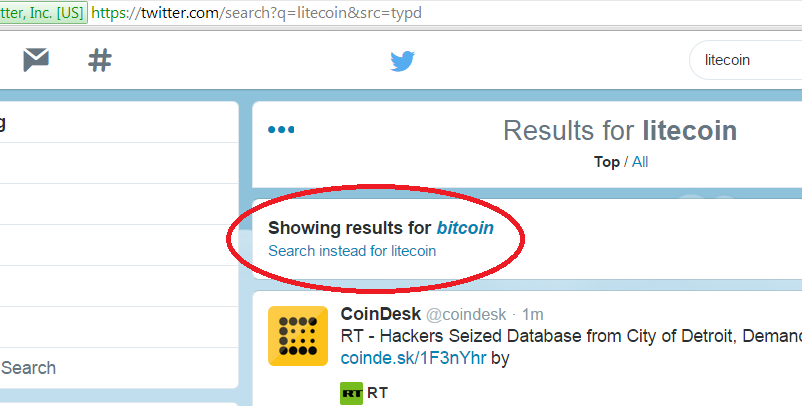
Twitter has not heard of Litecoin.
No one “measures the economic value of their goods and services” in any Altcoin (even among Bitcoiners, prices are listed in dollars). Altcoins neither have constant inherent value (the value they occasionally have, as with Dogecoin, is not constant) nor are they “firmly linked to a definite basket of goods and services”. They do not store value.
…And Everyone Already Knows It!
Earning
I can’t find a single merchant who accepts an Altcoin, nor a person who makes their living in an Altcoin.
Spending
Altcoins are never spent. Payment processors (BitPay) can’t accept Altcoins until they have a large/liquid USD-market (ie, never).
Saving / Investing
Excluding Litecoin, the #1 Altcoin (DogeCoin) is usually worth somewhere around 30 million total. The other 500 Altcoins (and counting) are worth less…much less!
How low is $30 million?
- One Norman Rockwell painting, “Saying Grace”, sold for 46 million last year.
- That’s how much Zuckerberg overspent on the four homes surrounding his own.
- Bitcoin’s market cap first rose to 30 million in early 2011. Bitcoin was 2.5 years old, and BitPay/Litecoin/Ripple did not exist.
- Tuvalu is at the very bottom of this Wikipedia GDP table for 2013. An island of 10 square miles (Manhattan has 13), Tuvalu’s 10,000 residents earned a combined total of 30 million USD last year.
Altcoins are not used for saving/investment purposes: they contain almost no value.
Skinner’s Casino: Then and Now
Smart people remain rich, lucky people remain confused.
Some (not all) Bitcoiners got lucky, making serious $$ not through any virtue of theirs, but by being in the right place (or right ideology) at the right time.
A few Bitcoiners know that this description fits them: Some know how lucky they were to be “in tech/cryptography” in ~2010, many admit to just taking a chance on the software, or to “not really thinking about it” too much. Some actually admit to forgetting that they even owned Bitcoin (which they now must try to recover from old hard drives, etc.). Not exactly part of a master plan.
Luck and Skill in Ancient Bitcoin-land
The early community mixed The Lucky (the fooled-by-randomness, right-place-right-timers, for example Charles Lee [or perhaps he is just an ingenious fraud]) with The Skilled (who understood Bitcoin, for example Erik Voorhees).
Early-adopters who Bitcoin-mined (apparently unaware that, in a perfect competition environment such as mining, they would never see long-term economic profits) achieved quite a nice return. Their mammal brains told them: “Do what you just did, again!”. As the Bitcoin difficultly rose, solo miners “””invented””” Litecoin to bring “the number” down so that they could “do it again” (a popular reason for Litecoin was because mining is “fun”).
The recreational appeal of mining, while ridiculous, isn’t really surprising: Mining is literally a small, frequent, always-on lottery. It would be addictive to some people (especially the Lucky, who wouldn’t appreciate the importance of the BTC-mining they were already doing).
Upon the creation of Litecoin, actual intellectual ability (or, at least, ability-to-learn) would be needed to grasp that “early Litecoin mining” wouldn’t re-create the amazing returns of “early Bitcoin mining”. Some succeeded in making this cognitive leap, some failed, and others now travel occasionally from Rational World to Wacky Altcoin Casino Land and back.
Trying One’s Luck / Having Fun
Nearly all Altcoin-transactions are to/from exchange websites (I attempted to confirm this by using trading volume numbers [on exchanges] and transaction numbers [from block-explorers], before realizing: there is no evidence to the contrary).
Look at this BTC/LTC price chart.
By pricing LTC in BTC, we’ve canceled out cryptocoin-based price-variation and are left with LTC’s marginal value (over BTC). As [a] LTC users are a subset of BTC users, [b] BTC price-movements (against everything else) are highly correlated with LTC price-movements (against everything else), and [c] money is a network, this transformation represents the Altcoin’s value.
We see that LTC undergoes periods of long decline (the value-destruction inherent to losing networks), punctuated by occasional ‘bounces’ upward. Every single Altcoin has these price-chart “geons”. Never does the xxC/* price climb-upwards slowly, it is always sudden.
The bounces represent payoffs in the various games available to Bitcoin-owners in The Altcoin casino: there’s “Massively-Multiplayer-Online-Progressive-Slots”, martingale-roulette, Liar’s Poker. In all cases, bets accumulate in a pot and are paid out arbitrarily.
Post-payout, you cash out your chips (sell the Altcoins for Bitcoins), and leave the casino.
Remedial Privacy (aka “Money Laundering”)
Gambling can have its fun moments, of course, but a casino can also perform many non-gambling functions. One in particular is relevant: money laundering.
Bitcoin is highly anonymous already: you can [1] receive coins secretly, [2] send them to yourself an arbitrary number of times, and [3] claim that you sent them to someone else. However, some people desire a little more.
Consider the anticipated design of (the completely private) Zerocash: an “accumulator” checks that all the transactions were valid, but then forgets the history of transactions (remembering only ‘what-action’ claims ‘how-many-coins’). Sound familiar? Sending Bitcoin “round-trip” through altchains (including Altcoins) moves some of the record-keeping somewhere else, and all that’s ultimately remembered is the final balances.

It should go without saying that this “use case” is short-lived; as actual Bitcoin privacy improves, these privacy-substitutes will be handily out-competed, and eliminated.
Why Write This Post?
Three Reasons: Network Effects, Network Effects, and Network Effects.
I repeat it endlessly: There can be only one money winner. Competitors must take over completely or die, because money is a network-effect on value. Anyone in a position to choose between two money-alternatives will try to [A] pick the most-accepted/most-valuable one, and [B] try to make the one they chose become the most-accepted/most-valuable.
Non-Counterexamples
The existence of 180 world-currencies is not evidence against this logic. Nations have different, usually incompatible: languages, monetary/fiscal policies, tax-systems, and courts. Even then, in theory and in practice, even different countries will end up using the same currency if they trade heavily with each other. Choice -> One Currency. No trading = no choice.
We have only one internet, in which we freely make many choices, trade heavily with each other. This implies one internet-currency (Bitcoin).
The existence of 500+ entries on CoinMarketCap might, then, demand an explanation. It is this: Despite their name, these “coins” are not money. They are not competitors to Bitcoin, they are not competitors to the dollar or any other money. They have an expected value-storage-ability of zero.
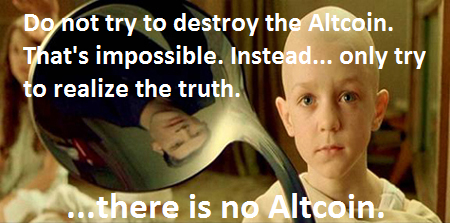
Altcoins Don’t Exist
If not coins, then what are they? A gambling opportunity, fun for most but ruinous to the the impulsive or the self-deluded.
Why do they have a non-zero marketcap today? The marketcap is the working capital of each game. (This explains why the marketcap-level is as volatile as the chip-values on a given poker table, yet the marketcap-ranking is as stable [marketcap of Darkcoin, which can actually do something, is always lower than Litecoin] as the solvency of actual casinos themselves. The “coin” “features” are irrelevant: some casinos/games are simply more popular than others.
Remember:
Add Disqus comments.
comments powered by
Disqus
Don’t Panic
By Daniel Krawisz
Posted November 22, 2014
Working in the Bitcoin world is like working for a drug addict with bipolar disorder. There are brief periods of astonishing, irrational exuberance followed by long periods of deep existential dread over basically nothing. During the good times, nothing can damage Bitcoin’s spirit. But for most of the time, bitcoiners are a bunch of namby-pamby worry-warts who wet their pants over everything.
The Bitcoin world is neurotic in the way that fear dominates it. If there is not enough merchant adoption to satisfy them, they worry about hoarding and a liquidity crunch. If there is too much, they worry about downward selling pressure. If Bitcoin adoption happens too quickly, they complain about volatility and bubbles, and if it happens too slowly, they complain that no one cares about Bitcoin. If the financial world ignores Bitcoin, people worry that people are not interested, and if it pays attention, people worry about regulation.
I find it unbelievable how consistently the Bitcoiners reinterpret everything good as some kind of problem. The Silk Road is bad for Bitcoin’s image, as if Bitcoin needs to worry about image. Bitcoin’s volatility–a reflection of its extraordinarily rapid growth–is seen as something that will make Bitcoin unrespectable. Bad press of any kind is feared, when with Bitcoin there is almost no such thing as bad press.
Every month or two, a new crisis emerges. Mt Gox dies and it’s going to destroy Bitcoin. China bans Bitcoin and it’s going to destroy Bitcoin. A mining pool gets too much hashing power and it’s going to destroy Bitcoin! Every so often a new supervillain jumps up from under a rock. Not long ago, Mike Hearn was going to destroy Bitcoin. with redlists and Then there was the legion of evil behind CoinValidation, who wants to track all Bitcoin users. Recently Ben Lawsky has emerged as the latest moustache-twirler out to destroy Bitcoin with his bitlicense superweapon.
The idea that anyone could ban Bitcoin is a joke. Any attempt to do so would be monumental hubris. As if the police are somehow going to stop people from carrying private keys around and connecting to the internet. Bitcoin is too useful for people to worry about whether it is legal or not, and it is also too useful for government agents to put a serious effort into trying to stop it.
You know what’s going to destroy Bitcoin? Nothing, that’s what. Maybe a nuclear war or a giant meteor could do it, but not much else. The problem with Bitcoiners is that they think Bitcoin is fragile when it is really antifragile. It is no coincidence that Bitcoin keeps surviving every crisis. It survives because it is immortal.
As long as there is profit to be made in the Bitcoin network, Bitcoin will mow down attackers. For every outside force which threatens Bitcoin, there are many internal forces building the tools required to counter it. These countermeasures aren’t necessarily always visible in the news, but everyone in Bitcoin has the incentive to protect their investment, and therefore has the incentive to develop tools to counter any problem. The sum effect of all these invisible innovators is that Bitcoin acts like an aikido master to deflect and absorb the forces that act against it.
This all requires a little bit of faith to keep in mind because one has to believe in something that is not always visible, based on the rational expectation of its existence. But this is not so different from ordinary life: we know that the news gives us a biased sample of reality and we know that we must pay attention to what is seen and unseen. The only difference is how extreme the Bitcoin world is, how much pure FUD there is everywhere, both innocent and deliberate. This has to do with the fact that the Bitcoin economy changes so rapidly in scope and nature, that it is difficult to keep up with what is real and easy to get away with telling falsehoods.
Bitcoiners, take a chill pill. Any time something happens, think to yourself, “How likely is it anything happening now is going to matter a month from now?” The answer will nearly always be “not at all”. You are sitting on perhaps the most wonderful secret one might expect to find in this mundane world and yet you can’t find a moment of contentment. Sit back, close the web browser, have a nice glass of wine, and then take a long nap.
Bitcoin Year-In-Review: The Price Went Down, So We Prepared For War
By Pete Dushenski
Posted November 24, 2014
As another year draws to a close,i the Little Dragon That Could has reached its 6th birthday. Can you believe it?
At 16:16:33 MST on November 1, 2008, Satoshi Nakamoto announced Bitcoin to the Cryptography Mailing list.ii Since then, a niche project fueled by the noble actions of a single maniii has transformed into an unstoppable force for good.iv Bitcoin was as unlikely to succeed as a three-legged Olympian sprinter, and yet here it is: kicking Central Banks in the balls with a vigour not seen since the days of Andrew Jackson.
These steel-toed stomps aren’t always reflected in the fiat-BTC price, however. Despite no shortage of popularity in the press this past year,v Bitcoin has tumbled some 50% since the start of 2014. This has much to do with the foggy price signal, as I noted last quarter:
To summarize, ever since February 2014 when the Bitcoin price signal went more borked than a cat on catnip, nefarious but ultimately incapable state agents have been throwing everything but the kitchen sink at Bitcoin. This includes, but is not limited to, crowdfunding, mining hardware sales, altcoins, Bitcoin 2.0, you name it and they’ve tried it.vi
And they’ll continue to try for the simple reason that their ego prevents them from submitting to their new Lords. This is nothing new for states, but nor is voluntary submission historically unprecedented. See: voluntary submission of Middle Eastern Crusader states and the Armenian Kingdom of Cilicia to the Mongol Empire in the 13th century.
Part ii of the game, that which started in early 2014 and will continue for some time yet, is where we sort out the wheat (palea) from the chaff (lemma).
So no, “The Community” and its tardtawk didn’t propel Bitcoin to five figures fiat. But that didn’t stop the war. The war is happening, more openly than before, but still ever-so-quietly. Those of you who’ve caught glimpses of its power will be unsurprised to learn that La Serenissimavii spent 2014 building taller walls and deeper moats.viii
But in case La Serenissima is either new or obfuscated to you, here’s what you missed in 2014; here’s what reinforced walls and more deeply entrenched moats look like:ix
1. Web of Trust: the #bitcoin-assets WoT fought off spammers, scammers,x Sybils, and other immunogens this year, while slightly expanding its ranks. 2. PGP/GPG: despite malicious attempts atmisinformation, the use of the gold standard in encrypted communication and digital identity confirmation persisted and likely even expanded this past year. That Lindy Effect. 3. Digital security: while some users still use “Password123” on their webwallet, others are getting smarter about how they store their coins. Heartbleed and Shellshock also raised awareness about our delusions of digital security and those intent on survival have responded accordingly. 4. Healthy skepticism: scams are raising fewer funds than a year ago as users are realising the value of this little experiment. This, and “the community” is running out of bitcoins. Win-win! 5. Bitcoin Foundation: USGavin‘s Foundation is dead, long live the new one and its quest for a healthier relay network! 6. Notary public: a place for peoplexi to publish signed contracts. 7. Legit Bitcoin news: once there were shills, now there’s Qntra. What a difference this makes. 8. MPEx stock exchange: security was reinforced, new offerings were added, and still no bitcoins have been lost or otherwise “misplaced” after 3+ years. Bitcoin continues to have its very own stock exchange. Useful! 9. Network hashrate increased 30x:xii increased security, taller mountain for bad actors to climb. 10. New platforms for debate, enlightenment, and education:a few notable ones sprung up. Ahem…xiii
Productive year, wouldn’t you say? This, despite the increased openness in the USG vs. La Serenissima war.
When all-out war comes, when Flondor hangs, the reaction will be ready.
Six years ago, for whatever Satoshi dreamed, we couldn’t have asked for more.
- We’re not quite at year-end, but it’s basically the Holiday Season and I’ma be somewhere warm for most of December. So without further ado…↩
- Satoshi led off with the following: I’ve been working on a new electronic cash system that’s fully peer-to-peer, with no trusted third party. The paper is available at: http://www.bitcoin.org/bitcoin.pdf The main properties: Double-spending is prevented with a peer-to-peer network. No mint or other trusted parties. Participants can be anonymous. New coins are made from Hashcash style proof-of-work. The proof-of-work for new coin generation also powers the network to prevent double-spending. The rest of his monumental e-mail included an abstract of the paper, which can be found at the Satoshi Nakamoto Institute’s webpage along with the rest of Satoshi’s early letters.↩
- I ask you, has history ever been any other way?↩
- “Good” being a title bestowed upon Bitcoin for three very important murders: killing nihilism, killing socialism, and killing involuntary taxes. From these all too necessary deaths will come untold life, art, and culture. Just as it always does.↩
- Mt Gox, Silk Road stash sales, etc.↩
- This is now formally known as Buterin’s Waterfall.↩
- Where Bitcoin policy is set and productive people convene to implement said policy.↩
- As Aaron “BingoBoingo” Rogier, second-in-command at the only WoT-approved Bitcoin news site, noted on his personal blog: Bitcoin price continues to bounce with another USMS auction coming up soon. As time winds down $817 by this Christmas seems increasingly unlikely supporting the idea that on price, this is just a lost year for Bitcoin. Of course a lost year in price growth is a chance to build infrastructure for the next climb.↩
- A Prince ought to have no other aim or thought, nor select anything else for his study, than war and its rules and discipline; for this is the sole art that belongs to him who rules, and it is of such force that it not only upholds those who are born princes, but it often enables men to rise from a private station to that rank. And, on the contrary, it is seen that when princes have thought more of ease than of arms they have lost their states. And the first cause of your losing it is to neglect this art; and what enables you to acquire a state is to be master of the art. Francesco Sforza, through being martial, from a private person became Duke of Milan; and the sons, through avoiding the hardships and troubles of arms, from dukes became private persons. For among other evils which being unarmed brings you, it causes you to be despised, and this is one of those ignominies against which a prince ought to guard himself, as is shown later on. Because there is nothing proportionate between the armed and the unarmed; and it is not reasonable that he who is armed should yield obedience willingly to him who is unarmed, or that the unarmed man should be secure among armed servants. Because, there being in the one disdain and in the other suspicion, it is not possible for them to work well together. And therefore a prince who does not understand the art of war, over and above the other misfortunes already mentioned, cannot be respected by his soldiers, nor can he rely on them. He ought never, therefore, to have out of his thoughts this subject of war, and in peace he should addict himself more to its exercise than in war; this he can do in two ways, the one by action, the other by study. As regards action, he ought above all things to keep his men well organized and drilled, to follow incessantly the chase, by which he accustoms his body to hardships, and learns something of the nature of localities, and gets to find out how the mountains rise, how the valleys open out, how the plains lie, and to understand the nature of rivers and marshes, and in all this to take the greatest care. Which knowledge is useful in two ways. Firstly, he learns to know his country, and is better able to undertake its defence; afterwards, by means of the knowledge and observation of that locality, he understands with ease any other which it may be necessary for him to study hereafter; because the hills, valleys, and plains, and rivers and marshes that are, for instance, in Tuscany, have a certain resemblance to those of other countries, so that with a knowledge of the aspect of one country one can easily arrive at a knowledge of others. And the prince that lacks this skill lacks the essential which it is desirable that a captain should possess, for it teaches him to surprise his enemy, to select quarters, to lead armies, to array the battle, to besiege towns to advantage. Philopoemen, Prince of the Achaeans, among other praises which writers have bestowed on him, is commended because in time of peace he never had anything in his mind but the rules of war; and when he was in the country with friends, he often stopped and reasoned with them: “If the enemy should be upon that hill, and we should find ourselves here with our army, with whom would be the advantage? How should one best advance to meet him, keeping the ranks? If we should wish to retreat, how ought we to set about it? If they should retreat, how ought we to pursue?” And he would set forth to them, as he went, all the chances that could befall an army; he would listen to their opinion and state his, confirming it with reasons, so that by these continual discussions there could never arise, in time of war, any unexpected circumstances that he could deal with. But to exercise the intellect the prince should read histories, and study there the actions of illustrious men, to see how they have borne themselves in war, to examine the causes of their victories and defeat, so as to avoid the latter and imitate the former; and above all do as an illustrious man did, who took as an exemplar one who had been praised and famous before him, and whose achievements and deeds he always kept in his mind, as it is said Alexander the Great imitated Achilles, Caesar Alexander, Scipio Cyrus. And whoever reads the life of Cyrus, written by Xenophon, will recognize afterwards in the life of Scipio how that imitation was his glory, and how in chastity, affability, humanity, and liberality Scipio conformed to those things which have been written of Cyrus by Xenophon. A wise prince ought to observe some such rules, and never in peaceful times stand idle, but increase his resources with industry in such a way that they may be available to him in adversity, so that if fortune changes it may find him prepared to resist her blows. via The Prince on The Art of Power, Chapter XIV: That Which Concerns A Prince On The Subject Of The Art Of War by Niccolo Machiavelli.↩
- And the 2014 award for Most Persistent Scammer goes to…ninjashogun
- i.e. those in the WoT.↩
- This could be “40x” by the end of December, but… close enough either way. The ASICs arrived just in the nick of time.↩
- This, while old platforms such a Bitcointalk.org died, neglected by all but the wallet inspectors and their chumps.↩
Babysitting Bitcoin Skeptics: A Response to Krugman and Gobry
By Daniel Krawisz
Posted November 30, 2014
In 1977, Joan and Richard Sweeney wrote an article called “Monetary Theory and the Great Capitol Hill Baby Sitting Co-op Crisis” which describes the economic woes of a certain babysitting co-op whose members traded scrip between them in exchange for babysitting one anothers’ children. In 1998, Paul Krugman wrote a commentary on it called “Baby-Sitting the Economy.” He interpreted the events it describes as a microcosm for the economy as a whole, and he analyzed it according to his Keynesian framework. Finally, in 2014, Pascal-Emmanuel Gobry confidently predicted Bitcoin’s failure based on his application of Krugman’s analysis to Bitcoin.
This is a confused and convoluted topic, and there are a few separate issues to unravel in all this. There is the original article, which makes some vague comparisons to the U.S. economy, that is very modest about the broader implications of the events it describes. Then there is Paul Krugman’s Keynesian interpretation of it. Finally, how does Bitcoin fit into everything? I will show that both Krugman’s article and Gobry’s follow-up are confused, do not establish their case, and say nothing about Bitcoin.
First off, I enjoyed the original article. It is a well-written, fun piece, which is brief and incisive. To summarize, the members of the Capitol Hill Baby Sitting Co-op were all issued scrip, which they all pledged to accept from other members as payment for babysitting one another. An officer of the co-op would accept notifications from the members about their availability to babysit as well as their need for sitters and would match them up to one another. In other words, the scrip acted something like a currency that enabled all members to trade babysitting time.
Of course, the number of available babysitters did not always match up with the number of people who wanted to go out in a given evening. The Sweenys describe periods of both chronically too many babysitters and too few. These imbalances were caused by the way people valued the scrip. Within the co-op, the value of having a balance of scrip is flexibility. One can go out several times at one’s leisure without worrying about replenishing the supply immediately if one does not have time to provide care for other children. Everyone desires a certain flexibility, so there is a need for a certain amount of scrip per capita to be issued. Clearly it would be very inconvenient if one unit of scrip were available — no one could babysit or go out twice in a row and no two couples could go out at the same time. Everyone would want more scrip, and the one holding it would not be very willing to spend it—this is what is known as a liquidity trap. On the other hand, if there is too much scrip per capita, then everyone feels flexible enough and would prefer to go out rather than try to accumulate more.
When there was too little scrip,
holders were reluctant to squander it by going out. Those who wanted to go out but didn’t have scrip were desperate to get sitting jobs. The scrip-price of baby sitting couldn’t adjust, and the shortage worsened. The co-op even passed a rule that everyone must go out at least once every six months. The thinking was that some members were shirking, not going out enough, displaying the antisocial ways and bad morals that were destroying the co-op.
And when there was too much (which was the case at the time the article was written),
the price of baby sitting is constitutionally pegged at one unit of scrip for every one-half hour of baby sitting. Hence, this system of price controls means the inflationary pressure does not drive up the scrip-price of baby sitting, inflation is suppressed, and shortages are found.
The scrip was created and destroyed according to various provisions in the co-op’s rules. The co-op managers seem to have had little inkling that there would be an optimal supply of scrip in their organization and did nothing to ensure that the amount of scrip per capita which was created matched that which was destroyed each year. Early in its history, the supply of scrip was too small and decreasing, and later it was too large and increasing. Consequently, although they once briefly hit the “sweet spot” that balanced the supply and demand for babysitting within the co-op, they could not maintain it very long.
There at least two possible ways of dealing with a suboptimal supply of scrip: the supply of scrip per capita could be adjusted or the price of the scrip could be adjusted. If everyone has ten units of scrip worth an hour of babysitting, that is the same as if everyone had twenty units each worth half an hour. Thus, if people felt as if they had accumulated enough scrip and preferred to spend rather than save it, the co-op board could require everyone to turn in some scrip or declare that each unit is worth less babysitting time. There is not necessarily a single ideal supply of scrip that would work permanently because people will have different babysitting needs at different times, so there would have to be continual adjustments.
The co-op, of course, operates as a centrally planned arrangement characterized by strict price controls. As long as the price is fixed, then the central board must meet to adjust the price as needed. Yet although the Sweenys clearly and repeatedly identify price controls as being fundamental to the co-op’s problems, Krugman does not mention that his interpretation of the events is very different from the Sweenys and does not present price changes as a possible cause of the co-op’s problems.[1] He assumes that a change to the supply of scrip is the only possible solution, and in fact, the word price does not appear in his article even once! This is rather odd because the Sweenys explain all of the co-op’s economic woes in terms of price controls, so Krugman clearly should have responded to this in order to establish his own interpretation of the events.
Of the babysitting co-op’s story, Krugman says:
Its story tells you more about what economic slumps are and why they happen than you will get from reading 500 pages of William Greider and a year’s worth of Wall Street Journal editorials. And if you are willing to really wrap your mind around the co-op’s story, to play with it and draw out its implications, it will change the way you think about the world.
However, he has utterly failed to show that the co-op is analogous to the American economy and, granting that it is a valid analogy, has failed to draw out its implications as a consequence of price controls. For if indeed the co-op’s problems can be explained by price controls, then what is the relevance to the American economy? The American economy is at least relatively free of regulation and could be made even more free. So in order to make the co-op into an analogy, Krugman would either have to argue that American recessions are caused by central planning, or that the Sweenys are incorrect in their economic analysis of the co-op, or that despite having different causes, American recessions have the same effects and cures as that of the co-op. He does not bother with any of that.
Even if he did manage to establish an analogy, we may still ask, “Why not simply eliminate the price controls?” Ceteris paribus, if the co-op board eliminated the price controls entirely and allowed people to set their own prices, then people could respond to imbalances in the demand and supply of babysitters by offering different scrip prices. The final result would be similar to one in which the central planning board had declared a price change, without any centralized decision being required. Krugman has done nothing to show in his article that deregulation, rather than monetary policy, is a valid response to a recession. One might argue that he does not need to show that because ideas such as the liquidity trap are well established in economics. But I still claim that his use of the babysitting co-op is a red herring which teaches nothing about Keynesian economics.
Gobry’s piece does nothing to resolve the problems with Krugman’s article. When he says, “The more people tried to hoard coupons, the less people were willing to go out and get their babies sat,” he is still talking about a problem that can be entirely explained in terms of price controls, and of which no relevance has been shown to Bitcoin. Just imagine if, for some reason, we still had to pay 5,000 bitcoins for a pizza. Clearly this would cause a severe disruption to the Bitcoin economy. There would not be enough bitcoins to go around and bitcoins would be so inconvenient that no one would want to improve the bitcoin infrastructure. That would be a very severe liquidity trap! But because the exchange rate of bitcoins is set by the market rather than fixed, nothing like this has ever been a problem.
Now I let Krugman off the hook for disregarding deregulation as a solution, because that may not have been important to his audience or intentions with the article. But Gobry is most certainly not off the hook, first of all, because there aren’t a lot of Keynesians into Bitcoin in the first place, and second, because the Bitcoin economy is not centrally planned and has never experienced a liquidity trap — exactly what an anti-Keynesian would expect! Gobry ought to provide evidence that his theory will apply in the future even though it has not in the past, but the way he deals with this problem is totally inadequate.
Gobry lamely cites Bitcoin’s future release schedule:
“Once the supply of Bitcoin is fixed, at some point the Bitcoinomy will run into the same problem as the baby-sitting co-op: there won’t be enough currency, and there will be a recession, and there will be a liquidity trap,” he says.
At the time of this writing, demand for Bitcoin has gone up roughly 160,000 times, as measured by its price, since the day that two pizzas were bought for 10,000 BTC. Moreover this price increase corresponds to the growth of the Bitcoin economy. Yet there are now only about three times as many bitcoins that have been claimed as in those days.
Can that relatively tiny increase really explain economic growth by a factor of 160,000? These numbers are obviously way out of proportion, and I doubt that any similar multiplier effect has been observed anywhere else. The observed history of Bitcoin is very bizarre from a Keynesian perspective but far less so from that of the Austrian. Why has no liquidity trap occurred? Bitcoiners have already had to adjust prices by enormous factors that are virtually unaffected by the increase in Bitcoin’s supply, so why shouldn’t they be able to do this again as necessary once Bitcoin’s supply is fixed? If Gobry wishes to show they cannot do this, he really ought to provide some evidence.
Furthermore, because everyone knows Bitcoin’s future release schedule, everyone behaves now in expectation that more bitcoins will be in circulation in the future. Therefore the newly mined bitcoins should not be expected to have any effect on the Bitcoin economy to prevent liquidity traps. In an economy in which everyone knows that new coins will be released soon, everyone will just try to save more than they would otherwise because they would know that their savings will have less of an effect than they might otherwise expect. Bitcoin ought to be experiencing a liquidity trap already, yet Bitcoin prices have instead consistently changed to reflect its growth.
I close with a side-issue. Would the original babysitting co-op have solved its problems by allowing for market prices? I’m not so sure. There is an important reason that both the American economy and the Bitcoin economy both differ from the babysitting co-op. The babysitting co-op is a contractual arrangement and the babysitting scrip is not a currency and it does not function as money. The value of the co-op is enabling people to receive babysitting from within a group of people who already have some trust for one another. However, this is not their only option: they can also leave the co-op and pay teenagers with dollars to babysit. Above, when I described such a possibility, I said “ceteris paribus” but, in fact, all things are not equal, because changes to the rules of the co-op can change its competitive advantage over its alternative. In order to stay competitive, the members of the co-op must agree to some obligations to one another, and I would argue that agreeing to honor the scrip upon certain terms is a necessary part of that obligation.
As long as they have all pledged to accept scrip at a certain rate for babysitting, then they have given some real evidence that the co-op is worth joining and holding its scrip is worthwhile, but without a fixed price, there is effectively no such pledge. It is possible that some system of rules would enable the system to function still, but merely eliminating the fixed price for scrip would transform it into nothing but an appcoin. Consequently, there would be a self-reinforcing trend of members reducing their holdings of scrip in expectation that others will do the same, and demanding higher prices for the same reason. This in turn would reduce the expected future value of the co-op, thus induing people to leave it, thus, further reducing its value. The co-op would not be able to maintain itself on those terms.
But once again, there is no corresponding problem with Bitcoin. Bitcoin users have no need to make pledges or guarantees to one another because Bitcoin works without requiring a contractual relationship between its users. People can be expected to follow Bitcoin’s conventions (like accepting the greatest-difficulty chain) without making promises to one another, because Bitcoin has its incentives in the right place. Because there are real reasons to expect Bitcoin to be useful as money and for the Bitcoin network to grow, people should be expected to demand continually lower prices in Bitcoin, not higher ones.
Thus, a babysitting co-op is very different from a money economy (Bitcoin or otherwise). It is different for reasons that have been noted neither by the Sweenys, nor Krugman, nor Gobry. However, both Krugman’s and Gobry’s arguments depend on an invalid analogy between the two, whereas the Sweenys’ do not. Krugman misrepresented or misunderstood the original article and failed to discuss the price control imposed by the co-op, which means that he fails to show that the co-op’s situation has anything to do with the American economy. Finally, Gobry has merely repeated Krugman’s claims without showing any relevance to Bitcoin, and failed to deal cogently with the evidence that Bitcoin is not at risk of a liquidity trap.
- I suspect that Krugman did not go back and review the original article when he wrote his 1998 column because he makes a few errors that he probably would otherwise have caught. For example, he says that one unit of scrip was worth an hour of babysitting time, when it was really worth one half-hour. He also cites the article incorrectly and gives its year of publication as 1978 instead of 1977. He does not quote from the original article to support his case or note that his interpretation of the events differs somewhat from that of the authors. None of that has any necessary effect on the logic of his position, but I think these observations suggest that his column may be strongly colored by his own preconceptions without a fresh look at the original piece. Gobry also shows no evidence of having read the original article. ↩︎