
September 2013 Journal
WORDS is a monthly journal of Bitcoin commentary. This issue collects the September 2013 writing in the WORDS archive. For the uninitiated, getting up to speed on Bitcoin can seem daunting. Content is scattered across the internet, in some cases behind paywalls, and content has been lost forever. That’s why we made this journal, to preserve and further the understanding of Bitcoin.
Bitcoin and Liquidity Preference
By BTCtheory
Posted September 8, 2013
- would anyone outside of a lunatic asylum want to hold money? What an insane use to put it! For it is a recognized characteristic of money as a store of wealth that it is barren; whereas practically every other form of storing wealth yields some interest or profit. “ –John Maynard Keynes
This is how Keynes understood the functions of money. He believed that individuals should be self-interested enough to want to maximize the utility of money. Keynes believe that ‘the public’ held money for three purposes:
- to have on hand for ordinary transactions
- to keep as a precaution against extraordinary expenses
- to use for speculative purposes.
This is called liquid preference, and it is the idea that we would rather have a dollar that can purchase anything now, in our hands (as it is the official mode of exchange and legal tender), than to have a bar of gold that is subject to storage fees, a house that is deteriorating, or food that is rotting. Because physical items that are subject to physical decay cannot be immediately exchanged as money can, everything become more illquid than money. The more illiquid something is, the more ‘risk’ that is taken on in holding it; which creates the need for a higher dividend yield, or ROI for holding that object when comparing it to money today. This preference for money today is due to the special properties of liquidity that money has. When two monies are compared side by side, Gresham’s law take effect, with the bad money driving out the good.
In order to understand how bitcoin operates as a payment system, we must first understand how governments created money. This is a very long and esoteric topic which I explain in some detail in bitcoin and the history of money. Essentially over the course of several centuries, governments have changed money (i.e legal tender) from being backed by commodities, like land, gold, or silver; to being backed by nothing except for their own legal force (which is why you cannot exchange your dollar for gold or bitcoin down at the bank). This allows for governments to augment the money supply to attempt to change the velocity of money–this is the equivalently of change exactly how much more ‘liquid’ legal tender is, then any other commodity.
So how is bitcoin different? Well, Bitcoin is not money…
Bitcoin’s intrinsic value is derived fromits ability to act as money, while still having an independent commodity value.
So in reality, bitcoin is not a ‘money’ in the most traditional sense of the word–it is not recognized as being an official form of legal tender, nor is it created in the same way that money is created by the state. What this means is that if bitcoin is not created by any state entity as a legal tender, then it must be a classic form of money: commodity money. This is something like gold, silver, bushels of wheat, cigarettes–really anything you can imagine, it just has to be something that is of value to society, and is plentiful enough to be readily exchanged, while still being divisible, portable, and difficult to counterfeit.
What happens when we understand bitcoin from Keynes perspective (that money is a barren storage of value)? We can see that his statement is true–but then, why is bitcoin worth something? Because again, bitcoin is not money–it is a commodity that acts like money. This means that the whole payment network of bitcoin while still working, acting, and functioning like money, it distinctly is not money.
Bitcoin is a commodity which is used primarily as storage of value that is readily exchangeable–more so than any other form of legal tender, or commodity-money that has ever existed. What happens when we do a side-by-side comparison of bitcoin-as-money, against all other forms of money, is that bitcoin will always be a superior form of money. Always.
Bitcoin flips the idea of liquidity preference on its head because bitcoin not technically money–it is a commodity-money with a built in payment system. Bitcoin has all of thefeatures of sound money, with the extra twist of living on the internet, which inherently makes it superior to all forms of legal money. Over time, as people come to know and understand, how and why bitcoin is a better form of money, people will start abandoning fiat money causing for both hyperinflation and hyperbitcoinization.
—
Next: Bitcoin’s Creative Destruction
The Intrinsic Value of Bitcoin
By BTCtheory
Posted September 10, 2013

There are several features that create the intrinsic value of bitcoin, but the primary one is its production cost. Bitcoin is a commodity money like gold, sliver, or copper which means that the energy cost to extract these raw materials creates their base value. The actual exchange between two people is totally subjective, as the subjective theory of value shows us, but we can assume that practically no one would sell their commodities for a price below what it cost them to extract the commodity. Today, the cost of mining bitcoin is getting to be quite difficult, which is part of the reason for the increase in price we have seen.
The Base Value of Bitcoin
Let us take a moment to think about how mining for bitcoin is similar to mining for gold. If you go into your backyard and try to see how much gold you are going to find, you’ll probably come away empty handed. That’s because you are using a pick and shovel, and it is no longer the 1850s–someone else got that gold (if it was there) long ago.
That just like how bitcoin mining is today–well more like 95 years ago when gold was about $20 to the ounce. Check and see how many bitcoins you could make with this mining calculator. Most likely it’s not a lot. This is because just like with gold mining, someone developed a better way to mine for bitcoins, making mining with a normal computer unprofitable today. This is because the newest bitcoin miners use energy more efficiently to mine bitcoin.
Keep in mind that the commodity value is just the base amount–that is just the production cost. Bitcoin, like gold, is a special commodity–it’s a commodity AND money at the same time. These special commodities are appropriately called commodity money. Commodity monies are special in that they have an inherent value by being a commodity, but because of their traits, they make great money too.
It is this secondary value of being good form of money that creates the secondary social valueof bitcoin and other commodity monies.It is both the production cost of bitcoin, along with the properties of good money that it exudes which creates the total value of bitcoin.
Commodity money creates a secondary value as a mode of exchange through the base production value. It is because of this trait of being made from a real commodity that commodity-monies can ‘bootstrap’ their way into becoming a mode of exchange. Once this happens it allows for market mechanisms to decide on the price of the commodity money beyond its production value. This is how commodity monies become more than just commodities, and become modes of exchanges and in some cases a storage of wealth. This is why gold became the most sought after commodity during the mercantilism era: it met the four qualities of good money better than any other object in the world, and was by far the best storage of wealth. This was not because it was shinny, but because it was incredibly rare. This is also why gold and silver have 3,000 years of history as being used as money and a storage of wealth–due to the intrinsic qualities they hold because of their scarcity.
The Value of Fiat Money
Where Fiat money eventually ends up: An arm full of Zimbabwe money that is worth nothing.
So than why is fiat money valued at all? Fiat currencies are not independent, nor is there any value contained in the money itself–it’s just paper. So how do these worthless pieces of paper have value?
Through the governments guarantee that it will accept fiat currency as legal tender, and that all transactions within its economy will meet this basic minimum standard of the law. This is what allows the government to bring violence to anyone who challenges the legitimacy of government’s monopoly on money. The power of fiat money is derived from the government’s legitimacy–that is why they can just make new money up out of thin air.
Statists argue that seigniorage from the state is not only needed, but is desired. For the State is the law, and the law is a means to an end in itself–that is why the state has the legitimacy of violence to decide if a person deserves to live or die. It is through this power of that the State can redistribute, protect, or harm their own citizens–for the benefit of all, or for a few. It is from this base of power that states create the laws to conduct economic transactions within their sphere of influence. This is why fiat money is only valid within particular nation-states own sphere of influence, and not that of other nation-states.
Philosophy of Value
The intrinsic value of bitcoin far beyond its commodity value. What creates its real value is the mathematical assurance that the bitcoin ecosystem cannot be predicated upon force,unlike fiat money. This is because of the cryptography that bitcoin is built on top of allow for two very distinct things:
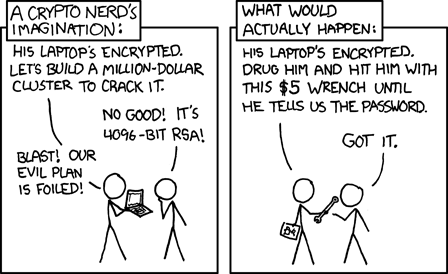
For this to work, a robber would need to know all of the wallets that you have, and the amounts you have in them.
-
It assures that the vast majority of transactions within the bitcoin economy are based upon voluntary participation, which in turn ensures:
-
Almost all transactions must be non-violent, unlike state-based currencies, where the legitimacy of the currency comes from the state’s ability to bring violence to you for not complying with their laws or legal structure.
These qualities result from the privacy function of Bitcoin. Privacy, within the context of an economy is what allows for a fair, voluntary economic system to be created. Bitcoin exchanges ‘the protection’ of the law, for the mathematical assurance of cryptography.
Bitcoin has made a new economy in which the categorical imperative is not the law; but privacy. We prefer to have no laws, because privacy allows for us to build the voluntarily social contracts without the threat of violence from the state, or anyone else because our true identities are unknown. We understand voluntary transactions ultimately lead to a lowertransaction cost for both parties because policing and enforcement does not have to be paid for.
Conclusion
In another age, fiat currencies and national governments were tools that we needed to evolve technologically. This economic mode was an excellent model for the growth and development of an advanced industrialized society, and all that came with it. Today however, both national governments and fiat currencies are anachronism that keeps greater humanity from advancing itself to its next stage of societal evolution: Anarchism.
—
Next: Understanding The Economic Functions of Bitcoin
Bitcoin as medium of exchange now and unit of account later: The inverse of Koning’s medieval coins
By Konrad S. Graf
Posted September 14, 2013
POST HEADER
POST BODY
A new article by JP Koning at the Moneyness blog revisits the idea that two monetary functions can be separated: medium of exchange (that which is used to actually buy things) and unit of account (what prices are quoted in and accounts generally kept in). He does this through a historical account of the monetary milieu of some medieval European cities. This has direct implications for viewing contemporary monetary developments half a millennium later.
In “Separating the functions of money—The case of medieval coinage” (13 September 2013), Koning suggests that a common unit of account (the pound/shilling/pence system) for pricing existed alongside a plethora of actual coins of various and sundry sizes, qualities, and metals. Each had to be repeatedly assessed and reevaluated due to wear, fraud, and outright devaluation in terms of the common unit of pricing. This had to be done so that such objects could actually be applied toward paying in specific transactions. Meanwhile, he claims that actual coins corresponding to this unit of account may well have been rare or might not have existed at all at certain times, at least relative to the mass of actually circulating crudely formed hunks of various metals (crude as retroactively judged by subsequent industrial coinage standards).
This is a thought-provoking discussion and I am sure there is more to be assessed and debated about the historical details. Nevertheless, the basic theoretical idea is that the unit used for pricing and what people actually hand over in trade to pay asked prices do not necessarily have to be the same. This implies that the problem of barter comprises at least two distinct issues: 1) no common unit of pricing for cost accounting, economic calculation, and comparison shopping and 2) no commonly accepted unit to be employed in concrete acts of payment. Koning thus seems to present a transitional hybrid case in which (1) is more developed while (2) is still a work in progress, or has broken down.
As it turns out, we are now witnessing a rapidly evolving case of just such a separation of functions. The difference is that, for now, it is the exact inverse of Koning’s medieval coins.
The opposite of medieval
Those who pay in Bitcoin today overwhelmingly pay prices that are listed in the local fiat currencies of the politically-defined jurisdictions they find themselves trading within. There are already a few exceptions, such as the Trezor high-security hardware wallet (priced at 1 bitcoin) and some mining shares, but such examples remain rare.
In current Bitcoin transactions, despite pricing still being largely denominated in euros, dollars, and the like, the actual “coin” being tendered differs from the unit of account and pricing. This separation of functions is much easier, quicker, and more accurate today than it was in, for example, Basel, Switzerland 600 years ago, due to the combination of real-time global networking and public exchange markets for both Bitcoin (see the new CoinDesk Bitcoin Price Index) and other forex pairs. This means accounting and thinking about relative exchange values can easily be done for present convenience using existing pricing constellations.
According to Koning’s account of the medieval cases he describes (taken at face value for our purposes here), the unit of account itself may even have been virtual, while the actual media of exchange handed over in transactions were the various and sundry physical coins people had managed to acquire in their previous work and trading. In diametric contrast, with Bitcoin today, we have a “virtual” coin with global circulation that is mathematically perfect in its uniformity and fungibility. These ideally homogenous global “coins” now circulate next to a hodgepodge of national-monopoly units of account/payment which have all sorts of shifting real values. Specifically, almost all such “shifting” of paper currency values is downward, just at differing rates of descent.
The potential for role reversal and later convergence
If and as Bitcoin grows and its price volatility stabilizes with expanding adoption, market participants could in time come to use it as a global unit of account against which the various and sundry unstable fiat currencies continue their extended monetary Danse Macabre. Bitcoin-denominated prices could be paid in Bitcoin, of course, or they could also be paid in a local fiat money, if both traders agree. Fiat would substitute for the relatively stable Bitcoin at the current day’s exchange rate in a way precisely opposite to their current respective roles.
Beyond this, in a long-term Bitcoin success scenario, medium of exchange and unit of account functions would most likely tend to move further toward convergence—price in Bitcoin, pay in Bitcoin. This would tend to greatly enhance convenience for all the buyers and sellers of the world (meaning everyone). That is the sort of thing that the American founding generations of the late eighteenth century would have called “the common good.”
In a more recent Europe, as Philipp Bagus explains in The Tragedy of the Euro (2010), the monetary authorities of more inflationary national currencies were repeatedly embarrassed by the relative strength of the less inflationary deutschmark. They therefore sought a coordinated means of inflating through the euro system, so that rates of monetary depreciation could be “harmonized.”
Likewise, in a future world with a successful Bitcoin, the inflationary paper monies of the world (that is, all of them) may eventually become rather self-conscious if compared to a global rising-value currency. This time, however, the inflationists may have a harder time sparing themselves distress than they did in pressuring German politicians to end the deutschmark against the general sentiment of the German people.
This is because the Bitcoin “cat” is not only out of the bag; it has spawned a global tribe of at least 200,000 currently active network nodes located in nearly every corner of the earth, any one of which contains a complete copy of the block chain.
Much more difficult than herding politicians, is herding cats.
POST FOOTER
/post
/content-wrapper
Satoshi on Bitcoin design
By Oleg Andreev
Posted September 19, 2013
The nature of Bitcoin is such that once version 0.1 was released, the core design was set in stone for the rest of its lifetime. Because of that, I wanted to design it to support every possible transaction type I could think of. The problem was, each thing required special support code and data fields whether it was used or not, and only covered one special case at a time. It would have been an explosion of special cases. The solution was script, which generalizes the problem so transacting parties can describe their transaction as a predicate that the node network evaluates. The nodes only need to understand the transaction to the extent of evaluating whether the sender’s conditions are met.
The script is actually a predicate. It’s just an equation that evaluates to true or false. Predicate is a long and unfamiliar word so I called it script.
The receiver of a payment does a template match on the script. Currently, receivers only accept two templates: direct payment and bitcoin address. Future versions can add templates for more transaction types and nodes running that version or higher will be able to receive them. All versions of nodes in the network can verify and process any new transactions into blocks, even though they may not know how to read them.
The design supports a tremendous variety of possible transaction types that I designed years ago. Escrow transactions, bonded contracts, third party arbitration, multi-party signature, etc. If Bitcoin catches on in a big way, these are things we’ll want to explore in the future, but they all had to be designed at the beginning to make sure they would be possible later.
I don’t believe a second, compatible implementation of Bitcoin will ever be a good idea. So much of the design depends on all nodes getting exactly identical results in lockstep that a second implementation would be a menace to the network. The MIT license is compatible with all other licenses and commercial uses, so there is no need to rewrite it from a licensing standpoint.
Professor Walter Block is clueless about Bitcoin
By Peter Surda
Posted September 22, 2013
This is a second article in a series (the first being Mises Institute is clueless about Bitcoin). Sadly, one of my favourite Austrian economists, Walter Block, seems to be making the same blunders as some of the other economists associated with the institute. The purpose of the post is to address some of the fallacies he produced and explain where exactly the error is.
Some of the arguments were not actually made by professor Block but by people talking with him and he did not subscribe to them. However, they are common fallacies and show cluelessness of their proponents, so I decide to pool all of them together
The source
The primary source of my complaint is the following video, published about a week ago couple of days ago on youtube. The relevant part starts at 4:21 (transcript on the below):
- 4:21 – Caller: We also seem to agree that it only exist because they’ve suppressed gold. And my question I guess is this is the biggest one, doesn’t that make it by definition malinvestment?
- 4:35 – Block: Doesn’t it make Bitcoin malinvestment?
- 4:39 – Caller: Yes. If it only exists because of the fiat, and the artificially lowered interest rates, and the counterfeiting and all the rest, isn’t that by definition malinvestment?
- 4:53 – Block: Yes, I think it’s malinvesment and it’s contrary to Menger’s theory.
- Now to the individual issues.
Bitcoin shows that Austrians do not really understand Menger
I am still baffled how an Austrian economist, in particular one who researched money, can invoke Menger as a method of “disproving” Bitcoin. Research in this area has been done and published by Konrad S. Graf, Daniel Krawisz, and of course me. One might argue that I’m a nobody and can be ignored. However, Graf had a paper published in Libertarian Papers and met with professor Block. Daniel Krawisz had articles published on mises.org.

What happened with Bitcoin and how does it match what Menger wrote
One of the most irritating things is the sheer ignorance of “Mengerian critics” of Bitcoin. They do not take the time to collect historical data, yet proclaim certain judgement about what did or didn’t happen. The information is public and reachable with not much more than a search engine (not to mention that in my master’s thesis I already did a lot of the work and summarised the findings for the lazier ones). Another summary for the lazy ones is the “History” page on the Bitcoin wiki site. Let’s take it step by step and iterate through what actually happened with Bitcoin, and how that matches the writings of Menger and Mises.
On October 31st 2008, “Satoshi Nakamoto” published his paper. At that time, Bitcoin as a “thing” did not exist yet. There was only an idea of Bitcoin. Ideas are not catallactic phenomena, so it’s not really important, it just is a milestone that helps us in our understanding.
On January 3rd 2009, the “Genesis Block” of Bitcoin was created by Nakamoto. From that moment on, bitcoins have existed as “things”. However, a bitcoin was not a good at that time yet, it did not fulfil the four Mengerian requirements for goods. People did not know how to use bitcoins to satisfy their needs. One of the early adopters, Mike Hearn, reminisces (at 4:27):
“I found it very early on, when noone was using it, so noone, no exchanges, had no exchange rate at all, so they were just completely floating in an abstract space. You know, what was one coin? Well, nothing really.” [emphasis added]
On October 5th 2009, one of the early miners, “NewLibertyStandard”, published the exchange rates he was using to sell bitcoins. How did he know how much to charge? This is what he writes:
“During 2009 my exchange rate was calculated by dividing $1.00 by the average amount of electricity required to run a computer with high CPU for a year, 1331.5 kWh, multiplied by the the average residential cost of electricity in the United States for the previous year, $0.1136, divided by 12 months divided by the number of bitcoins generated by my computer over the past 30 days.”
In other words, he was using his own variable production costs as his asking price. “Theymos”, who was also one of the early adopters, did not like the price and three years later, wrote:
“His pricing methodology will seem very strange nowadays… At the time, I performed similar calculations and thought he was charging too much.”
Theymos’ objection exposes the fundamental problem with the critiques of Bitcoin (Theymos himself isn’t a critic, he just exposes the problem). It does not matter what Theymos, Block, Korda, Smiling Dave and a whole bunch of other clueless critics think or thought. The fact is, sales occurred. That is the only relevant factor for an economist. There is no other way for prices to emerge than through catallactic processes. They cannot emerge by a critic liking it and disappear by a critic disliking it. That we do not like it or do not understand the reasons behind it is completely irrelevant. In Antifragile, Nassim Nicholas Taleb scolds theoreticians who imply that our understanding can influence whether something happens or not. Empirically, it did happen. I don’t know if “NewLibertyStandard” was the first seller ever, but he probably is very close to being the first one. What we can safely say however is that from then on, Bitcoin was a good, which is demonstrated by people exchanging it for the US dollars.
On February 6th 2010, the first traditional Bitcoin exchange launched. Its founder, “dwdollar”, announced:
“I am trying to create a market where Bitcoins are treated as a commodity. People will be able to trade Bitcoins for dollars and speculate on the value. In theory, this will establish a real-time exchange rate so we will all have a clue what the current value of a Bitcoin is, compared to a dollar. I have an early version up at http://98.168.168.27:8080/
This is only a small demonstration of what I have in mind and to show everyone I’m actively working on it. Feel free to register and try it out. You will get 10 phoney dollars and 10,000 phoney bitcoins to trade. ONLY the limit orders work. Market orders will come later. [emphasis added]
The reason why this was an important milestone is the emergence of bid and order books for Bitcoin, and an easy mechanism for trading. The exchanges are what Menger refers to as “organised markets”, places where people trading congregate, and allow for a qualitatively more efficient way to obtain price information and execute trades. The bid and ask order books, together with a trading mechanism, make, in Menger’s terms, it easier to sell at “economic prices” and make a good more saleable:
“A commodity is more or less saleable according as we are able, with more or less prospect of success, to dispose of it at prices corresponding to the general economic situation, at economic prices.” [emphasis added]
Unlike Block, Menger recognised the connection between specialised markets and liquidity:
“Some commodities, in consequence of the development of markets and speculation, are able at any time to find a sale in practically any quantity at economic, approximately economic, prices.” [emphasis added]
From the time Bitcoin exchanges with orderbooks existed, Bitcoin was not merely a good, but a liquid, or in Mengerian terms, saleable, good. And exactly as Menger predicted, specialised services that help buyers and sellers to coordinates their plans, played a significant role in the process. Many of the people attempting to determine the early motivations (e.g. Robert Murphy, who, unlike Block, definitely is not clueless about Bitcoin) theorise that speculation was one of the factors. And indeed, again exactly as Menger predicted.
On May 22nd 2010, Laszlo Henyecz, or just “laszlo”, managed to purchase two pizzas for 10,000 bitcoins. The purchase was facilitated by a Bitcoin buyer “jercos”, who used a credit card to order two pizzas, to be delivered to Laszlo. This example of a trade of Bitcoins for a pizza is indirect exchange and therefore, from that time on, Bitcoin has been a medium of exchange. This trade was only logically possible because at that time, Bitcoin not only had a price but also was liquid (or saleable, as the Austrians say). It would have been logically impossible to do this otherwise. A good without a price cannot be a medium of exchange, and as Menger brilliantly figured out, an illiquid good cannot be a medium of exchange either. Furthermore, as Mises elaborates, liquidity must emerge as a catallactic phenomenon and cannot be made up.
I actually thought, based on his lecture (transcript below):
“You can’t have a piece of paper be money. Let’s suppose I wrote over on this piece of paper, I write “ten Blockheads”. And I go around the room and I say, hey, Erin, will you give me your car I’ll give you ten Blockheads. You know she’s gonna look at me as if I’m a little weird. They don’t call me Walter Weird Block for nothing. That’s part and parcel of it. The point is that if somebody just printed up a piece of paper, noone would accept it, except in some sort of weird way. Murray Rothbard used to do this and he would say “Well, suppose I printed up ten Rothbards and tried to trade…” and I would raise my hand and say “I’ll accept them, I’ll give you my bicycle for one” and he would say “Shut up Block, I’m trying to make a point here”. But the point is, you see, ten Rothbards, if I really had ten Rothbards, I could probably sell it for a lot of money. But it would not really be money, it would be more like, art or something like that, a unique kind of thing. But forget about that sort of thing. In any real case, if someone said “Here is ten Rothbards, give me your house, …” Well, ten Blocks. Ten Rothbards I don’t know what you can do with it, if it was real ten Rothbards, but you get the point.” [emphasis added]
that Block comprehends that liquidity makes goods into media of exchange. It was actually this lecture that made me comprehend the whole issue. We’re now apparently in a weird situation where the teacher teaches a student something the teacher himself doesn’t know.
While it was logically possible for “laszlo” and “jercos” to use Bitcoin as a medium of exchange, why did they actually do it? Let’s just ask Menger:
“But the willing acceptance of the medium of exchange presupposes already a knowledge of these interest on the part of those economic subjects who are expected to accept in exchange for their wares a commodity which in and by itself is perhaps entirely useless to them. It is certain that this knowledge never arises in every part of a nation at the same time. It is only in the first instance a limited number of economic subjects who will recognize the advantage in such procedure, an advantage which, in and by itself,is independent of the general recognition of a commodity as a medium of exchange, inasmuch as such an exchange, always and under all circumstances, brings the economic unit a good deal nearer to his goal, to the acquisition of useful things of which he really stands in need.” [emphasis added]
Because “laszlo” and “jercos” recognised that Bitcoin is a liquid good, this provided them with the knowledge to use it in indirect exchange. Just like this knowledge arises in some people first, it consequently arises in other (clueless) people late. The latter seem to be in a majority now, but that is not a fundamental issue for an economist.
What happens when a medium of exchange evolves into money?
Some of the “Mengerians” seem to think that the “regression” applies to the evolution of a medium of exchange to money. Regrettably, it is not always clear in either Menger’s or Mises’ writings whether the theorem is supposed to explain the origin of media of exchange as such, or only that of money. They both arbitrarily change between “medium of exchange” and “money”, add and remove “general acceptance” and that money is, and isn’t, praxeologically different from other media of exchange. However, we can produce the following quotes by Menger:
“If we grasp this, we shall be able to understand how the almost unlimited saleableness of money is only a special case,—presenting only a difference of degree—of a generic phenomenon of economic life—namely, the difference in the saleableness of commodities in general.” [emphasis added]
If there is only a difference in degree (i.e. what nowadays would be called a quantitative difference), then we cannot make praxeological distinctions between a medium of exchange and money. If the regression theorem is a praxeological insight, it either applies to both a medium of exchange and money or neither. Another relevant quote by Menger is the following:
“The reason why the precious metals have become the generally current medium of exchange among here and there a nation prior to its appearance in history, and in the sequel among all peoples of advanced economic civilization, is because their saleableness is far and away superior to that of all other commodities, and at the same time because they are found to be specially qualified for the concomitant and subsidiary functions of money.” [emphasis added]
Let me translate this into a more digestible form. Once a good becomes a medium of exchange (and we thus know it is saleable/liquid), then it competes with other media of exchange not on the basis of its origin, but on criteria unique to media of exchange, such as liquidity and transaction costs. The question of its origin becomes irrelevant. The Austrian critics of the origin of Bitcoin are too late. Their objection would only have been relevant in the narrow timeframe between October 2008 and May 2010. Since then, the criteria determining the future of Bitcoin, as Menger explains, have changed. Sadly, the Austrian critics didn’t shift their attention accordingly, and remain silent on the issues of liquidity and transaction costs. This problem is emphasised in another video where Block comments on Bitcoin and the theorem:
37:47: Will it work? No, I don’t think it will work either. 38:07: If you compare it to gold or silver, where you have some intrinsic value, not intrinsic, but market value, Bitcoin won’t work. On the other hand, if you compare Bitcoin not to market money, but to fiat currency, well now it’s a bit of a horse race. Now I’m not sure, that’s an empirical issue. Bitcoin is not based on the Mengerian theory of the creation of money. But on the other hand, if you compare it to theft, which is fiat currency, maybe not so bad. So I don’t know about that.
I fully agree that the issue “Bitcoin vs. fiat” is an empirical issue. What Block does not recognise however is that “gold vs. Bitcoin” is also an empirical issue. Not only is Bitcoin based on the Mengerian theory, it also already works. As I just said, Block’s objection comes too late (in addition to, regrettably getting confused on the “market value” question and being silent on the issue of liquidity).
Is it possible to “violate” the regression theorem?
As Daniel Krawisz points out, if we interpret the regression theorem as a praxeological insight, then it must not be possible to violate it. If there is a disconnect between empirical data and a theory, then either we do not understand it or we do not correctly interpret the empirical data. Daniel Sanchez explains this in one of his articles:
“Yet the most history can do for an economist is to provide either an example with which to illustrate (but not prove) an economic theorem to help students grasp the concept by giving them a concrete manifestation of it, or a clue that perhaps he has performed fallacious reasoning in deriving the economic theorems he has been operating with. But even in the latter case, he must use discursive reasoning to catch the fallacy, and then to adjust his theory according to the corrected reasoning.” [emphasis added]
The claim that Bitcoin can “violate” or “be contrary to” the regression theorem is methodologically absurd. Sadly, Sanchez himself allegedly is clueless about Bitcoin, and professor Block appears to commit all three offences (not understanding the theorem, not interpreting the empirical data, and claiming that you can “violate” praxeological fundamentals) togehter.
One could also argue, as Gary North in The Regression Theory as Conjectural History (was published in The Theory of Money and Fidicuary Media (ed. Jörg Guido Hülsmann), that the theorem is merely a probabilistic conjecture rather than an aprioristic argument. I do not agree with this, and I also do not think that Menger and Mises viewed their arguments regarding the theorem from the Northean point of view. Mises in particular wrote:
“And all these statements implied in the regression theorem are enounced apodictically as implied in the apriorism of praxeology. It must happen this way. Nobody can ever succeed in construction a hypothetical case in which things were to occur in a different way.” [emphasis added]
And he also denied that there can be exceptions in other forms of money:
“This link with a preexisting exchange value is necessary not only for commodity money, but equally for credit money and fiat money. No fiat money could ever come to existence if it did not satisfy this condition.”
Professor Block, and other Austrians clueless about Bitcoin should really spend some time on actually reading Menger and Mises. And of course, their own writings and lectures.
Conclusion regarding the regression theorem
As a medium of exchange, Bitcoin emerged exactly as Menger predicted. He and Mises also explained that it would not have been logically possible otherwise. It is regrettable, that people who proclaim to adhere to Menger’s teachings do not recognise it when it happens right under their noses. It also is something which already happened over three years ago and cannot unhappen. My recommendation is that the “Mengerians” need to shut up and move on.
Is Bitcoin a “token” because it traded against the dollar first?
(presented by the caller rather than Block himself) This fallacious idea seems to have been popularised by Patrik Korda. I already posted several rebuttals to that argument, the most specific one is the second one, where I quote several Austrians, including Mises and Rothbard, in that token money must be a par value claim on the underlying base money. Bitcoin never was a claim on, or even had a peg to, any underlying base money, and its price was not derived from the price of the US dollar. However, that is not important here. Here another issue arose: the fact that it trades against money, seems to invoke in some observers the impression that that this somehow makes it suspicious.
On the contrary. There is nothing unusual about a new good to trade against money if we already live in a monetary economy. We do not have barter now anymore, and most exchanges occur with a medium of exchange. Indeed, from Mengerian and Misesian perspective it would be suspicious if Bitcoin did not at first trade against money, but against consumer and producers goods. As a new good, Bitcoin barely had a price and wasn’t liquid. Such a good cannot act as a medium of exchange. What would such a good trade against in a monetary economy? Against consumer/producer goods rather than media of exchange? There would have been little motivation to use Bitcoin in barter (direct exchange). And as Menger explains, only as a good gains liquidity, do people start accepting it in a trade as indirect exchange. The fact that Bitcoin at first traded against fiat money (the most liquid one, the US dollar), is exactly what, according to Menger, happens at the beginning of the emergence of a good in a monetary economy. The other alternatives would have been either implausible or logically impossible.
That Bitcoin could “piggyback” on the US dollar is nothing strange. Different types of goods emerge in a monetary economy than in a barter economy. A barter economy has higher transaction costs, a lower specialisation of labour and does not allow for complex investment projects. A computer, for example, would not have likely been produced in a barter economy, and has to “piggyback” on a preexisting monetary system. Does that make computers suspicious?
Furthermore, even as it gains liquidity, there is still nothing unusual about a medium of exchange to trade against other media of exchange. Quite the opposite. The world forex market is the most liquid market that exists. According to wikipedia, the dailyworld forex volume was about four trillion USD in 2010. The article also lists the following characteristics that distinguish forex markets from others:
- its geographical dispersion;
- its continuous operation: 24 hours a day except weekends, i.e., trading from 20:15 GMT on Sunday until 22:00 GMT Friday;
- the variety of factors that affect exchange rates;
- the low margins of relative profit compared with other markets of fixed income; and
- the use of leverage to enhance profit and loss margins and with respect to account size.
Someone who spent at least five minutes researching the history and performance of Bitcoin exchanges can immediately recognise the first four points, and if you remember the now defunct Bitcoinica, you’ll recognise the last one as well.
The critique that there is something suspicious about Bitcoin because it trades against other media of exchange has no basis in the Mengerian/Misesian approach to emergence of liquidity. It contradicts it, and is to be classified, using the same arguments as Mises in his own critique, as an acatallactic monetary doctrine, right next to the one which says that the opinion of an economist, rather than actual trades, determine prices and liquidity.
Can Bitcoin be used to discredit the Austrian school?
The caller submitted the hypothesis that Bitcoin can be used to discredit the Austrian school by associating it with illegal things (such as drug dealing). Well, gold-based payment systems have already been shut down (E-gold or Liberty_dollar) for exactly the same reasons, i.e. the Four Horsemen of the Infocalypse. GoldMoney has been neutered, they probably choose to not actually provide a competing system in order to prevent being shut down. I don’t see how Bitcoin can be used to discredit the Austrians more than the gold based systems.
Gold, not Bitcoin, is a malinvestment
Professor Block made the argument that Bitcoin is a malinvestment (i.e. he agreed with the caller). They are not the first ones making this argument, it has been made by Patrik Korda before, and some other guy in a youtube interview (which I did not save and can’t find it anymore, I thought it was Chris Duane but it looks like it wasn’t). I will take the opposite side and make the argument that gold, rather than Bitcoin, is the malinvestment.
The concept of malinvestment is popular in particular with the
Austrian Business Cycle Theory
. The argument is that artificially lowered interest rates make it appear to be profitable to invest into projects farther removed from the consumption, even thought the availability of capital and the time preference of consumers do not make such a project possible at such a price structure. Eventually, either the project will run out of actual resources, or the prices adjust in a way unpredictable by the investors making the project unprofitable (the latter is more likely to happen in a market economy, only if the price adjustment is prevented you’ll actually run out of all resources). The investment into the projects farther removed from consumption is called malinvestment, because the structure of available capital does not allow it to satisfy the needs of the consumers. The project will fail and the investment has to be liquidated at a loss. If the interest rate wasn’t disturbed by an increase of the money supply through lending to investors, this would have been recognisable in advance and wouldn’t have happened.Media of exchange are not producer goods. Furthermore, I don’t know how about gold, but there appears to be little or no evidence that the purchasing of Bitcoins is fuelled by loans made at an artificially low interest rate. Certainly there is little reason to believe it is happening at a higher proportion with Bitcoin than with gold. So what other type of malinvestment can there be?Media of exchange serve in indirect exchange. They allow it to mitigate the uncertainty by having liquid goods and thus the ability to make unpredictable purchases in the future easier than doing so with illiquid goods. We can therefore posit that for media of exchange, whether obtaining them is a malinvestment depends on their future liquidity.Let us now compare the possible future liquidity of gold and Bitcoin.
Is gold evolving into money?
Many of the Austrians think or argue that the impeding fiat system collapse will make gold (or another “real” commodity) into money. There appears to make sense, doesn’t it? Once fiat hyperinflates or actually stops working (banks go bankrupt), what will people use? The most liquid good that still works, i.e. gold.
Not so fast. First of all, the majority of transactions nowadays happen electronically, in particular in “western” countries. These transactions will need to find a replacement, not the physical exchange of a good. There would be a huge logistical issue of how to make gold, both in the physical sense as well as a clearing mechanism, work. Banks might have support for gold as a unit, but how will they gain gold-backed reserves? By people depositing their gold into the banks, right after a massive bank collapse? A more likely scenario is an increased role of gold in the assets of central banks, combined with a confiscation of physical gold from the populace, i.e. something like the gold exchange standard, where a normal guy never actually sees a gold in a transaction or has the ability to redeem his fiat for gold. GoldMoney would probably be one of the first stashes to be confiscated, accompanied by the statist propaganda how it is necessary to “fix” the economy.
One also needs to remember that normally, it is liquidity, rather than the use value or even the question of fraud, that determines the use of a medium of exchange. Even more strongly it is phrased by Hans-Hermann Hoppe:
“Driven by no more than narrow self-interest, man will always prefer a more general, and if possible, a universal medium of exchange to a less general or non-universal one.”
If a fiat money collapses, it is thus replaced by a more liquid fiat money, because fiat money, whether we like it or not, is more liquid than gold. We’ve seen this empirically occur many times. The event is also called Dollarisation rather than “Goldisation”. Collapsing fiat systems are spontaneously replaced by the US dollar, not by gold. In other words, for gold to gain liquidity, it is the US dollar that needs to collapse, not just any fiat currency.
Of course, it could actually get so bad that there is a global collapse of the supply chain, something that David Korowicz or Karen Hudes warn us about. Gold is not going to fix that, because what is needed to prevent it is a replacement for the financial system, not a replacement of the unit. Merely liquidating unsustainable debt, while a necessary step, is completely inadequate to address this issue.
The only possible scenario which is advantageous for gold is that the financial system collapses without having a replacement, while at the same time the economy still having a sufficient amount of division of labour, and at the same time finding out some way of permanently preventing the possibility of fiduciary media or fiat money. Unless this prevention can be put into place, the “reign of gold” will be short, and will be replaced by fiduciary media and/or fiat money, it would just take longer than in a case of an “orderly” reform of the financial system.
I am not the only one skeptical about gold being able to fulfill the requirements of the Austrian critics of our monetary system. Michael Suede, asked what the point of a gold standard is if we already know if failed. It is not money anymore, it is merely a highly liquid good. Did gold gain new features that make it more likely to resist substitution and confiscation? I haven’t noticed any. Comparing gold to Bitcoin is indeed, as professor Block argues, silly. To be fair, there have been technological advancements in helping gold be a medium of exchange:
- Valcambi CombiBar which seem to be a favourite of Peter Schiff
- GoldMoney popularised ultrasound testing of gold bars
- small gold weights can be put into transparent plastic casings. Historically, there was a technical problem with small change in gold, which plastics solve.
However, all of these are inadequate from the broader perspective. None of them allow gold to be sent electronically and none of them make it easier to transport, control, and with the exception of small change, resist substitution. And unless you find out how to violate the fundamental physics and chemistry laws, gold won’t be able to overcome these obstacles (additionaly, if you find out how to violate these laws, then gold would become useless as money anyway). The situation is exactly the opposite as the caller and Block submit. Gold is amedium of exchange that does not solve any of the real issues (i.e. it does not work), while Bitcoin, so far, has been working. We don’t know for sure how well it will be able to handle the issues in the future, however it has shown a path of how it is possible so solve them.
In summary, irrespective of a collapse of fiat money, the outlook for gold to gain more liquidity looks bleak.
Is Bitcoin evolving into money?
Bitcoin is, I would say, less liquid than gold. It has less people using it, less mature organised markets, more problems with cooperating with the banking sector or the regulators. However, there is nothing either fundamental or problematic with this. Bitcoin does not need the banking sector to work. It already can be traded in over 3000 cities in 169 countries. It does not need to cooperate with the regulators, because there is no middleman.
For Bitcoin, the issue is exactly the opposite as with gold. The reason why it has a comparative advantage as a medium of exchange is not because of liquidity rank, but because it decreases the transaction costs. It provides a payment processing system that is a replacement for the more common systems like POS terminals for debit cards, ATMs, paypal and so on. Except you don’t need a middleman to either provide the service or to entrust your money to. The early adopters of Bitcoin are niches that can benefit from this decrease of transaction costs the most: online gambling, black markets, donations, charity, online products and so on. Event the emergence of altcoins proves that Bitcoin decreases transaction costs: they piggybacked not on the US dollar, but on Bitcoin, and with small exceptions, they don’t even have markets where they can be traded against the US dollar.
Not only does Bitcoin decrease transaction costs from the narrow point of view of a medium of exchange, it also does it from the point of view of a financial system. It provides a replacement for the Wall Street, notaries, corporations, and in general anything that has to do with transfer and enforcement property rights. It is a framework that implements an enforcement of transfer of property rights, analogous to the title-transfer theory of contract, where the transfer itself is transparent and enforced automatically or semi-automatically. All the problems with statist provision of services that has to do with property rights now have a competition not because the state permits it, but because it is more efficient.
What would happen to Bitcoin if the fiat system collapses? First of all, already the “dollarisation” is being amended by “bitcoinisation”, such as in Argentina or Iran, despite the maybe overhyped media portrayal. In Kenya, which already has a high mobile payment penetration, Kipochi provides an integration between M-PESA and Bitcoin. Bitcoin also allows them to overcome capital controls in a way that neither the dollar nor gold can. People in those countries are then increasingly more likely to migrate to Bitcoin rather than dollar or gold as their monetary system collapses. The USA might well be the last country where Bitcoin reaches sufficient liquidity to be called “money”, and at the greatest cost. If the financial system collapses and is not reformed quickly (by the state), Bitcoin will still continue working, while there won’t be a gold-based alternative for a while.
To be sure, there are many obstacles that Bitcoin has to overcome during its growth, such as scalability, user friendliness and so on. But there are no fundamental problems here. These are empirical issues that can be solved by entrepreneurship, and the development is happening right now as I write this. Can gold do any of that? I don’t think so. That is why the liquidity of Bitcoin will most likely rise, and the liquidity of gold will most likely remain at approximately the level it is now. Maybe calling gold a malinvestment is an exaggeration, but I wanted to provoke the reader.
Concluding remarks
It is interesting that Austrians understood money 100 years ago better than their successors living now. We have been confused by the existence of all kinds of forms of money and media of exchange. It’s long past to confront the confusion and improve clarity.Empirically, it ultimately does not matter whether Block is or isn’t clueless about Bitcoin. The opinion of an economist does not take precedence over catallactic phenomena.
The libbitcoin Manifesto
By Amir Taaki
Posted September 23, 2013
Cody Wilson, Defense Distributed
As humans, we share little in common. But that little we do share is the deep core of our being. We search for purpose. We are curious. And we thrive on new information. Our self-awareness, rationality and sapience are the high level features that make up a person. They are our capacity for good or evil.
As people, we need to ask ourselves whether we act with purpose, intent and ambition, ask how are we defining ourselves, and what are the values that our lives are promoting.
Are you taking concrete steps now to achieve your objective?
It’s important we ask ourselves these questions, and decide which end of the spectrum between liberty and security we fixate on. A safe life of luxury, and comfort closed in by 4 walls. Or a life of freedom. Freedom to make love, play loud music, create art, wrestle naked, and raise confident kids that think.
In criticising the world we’re born into, it’s easy to point the finger at this or that politician or resign problems to circumstance. And with the perceived lack of power to concede the situation is unfixable and utterly broken. But if we want to know who to blame, we need only to look into a mirror. We support the situation. It is people, not rulers, who create the world of today.
Some of us conclude that the situation is just a normal state of affairs, and simply human nature. As if there were one human nature! And disregarding that we all evolve and grow as people in different directions during our lives.
Think of the values we are taught as children. How we are taught to behave as civic citizens. The phrases we are told by our parents, teachers and friends. The system is not just the state and corporations, it is a machine encompassing all spheres of life.
You might hear for example:
- “Respect for authority figures is a sign of maturity.”
- “Men with good jobs dress smart and respectably.”
- “Work hard for a good job and a good life. Retire young.”
- “Don’t talk to strangers.”
- “Life is about money. Money makes the world go round.”
I was told all of these sentences in my life. That learning to accept authority is an inevitable part of growing up. That my character is defined by how I look, not how I act. That my single purpose is to be a work-slave. To avoid interaction with random unknowns outside my circle. And that responsibility starts and stops with myself.
All of them are bad values.
We are not born with these values. They are hard-wired into us from a young age. Luckily knowledge feeds the unlearning process and the internet is an unlearning tool.
Have you ever questioned the 15 years of our precious childhood from kindergarten to highschool. We attend a prison with fixed schedules and dinner at an allocated time. We’re forced to wear uniforms. If you want to speak, you need to raise your hand. If you need the toilet, you must ask permission. And the lessons amount to little more than drilling information with the given promise of honours and qualifications.
The reward for faithfully jumping through all these hoops for 15 years is a worthless piece of paper that isn’t even required for a job at McDonalds. And the workers still need training. Our children aren’t taught how to cook a healthy meal, grow a garden or even a rudimentary concept of how to organise or lead groups of people without even a glimmer of understanding on how to resolve conflicts without violence. Or the principles of logic, and how to question an ideology. Kids are taught to sit at a desk and listen obediently as the world is packaged into neat boxes.
School is little more than a training camp for salaried drones designed to format young minds for a life of subservience, too stupid to question the system itself or the authority of those running it. We are not born with bad values. They are wired into us from a young age.
Lets talk about good values.
Responsibility is about fulfilling your needs to have a dignified existence, and then expanding that circle to the people around you. To help bring up and out the potential of other free people so that together we thrive. Community and collective action is absolutely essential if we want to rise up. The system thrives by separating people into isolated pockets who get their information from TV and their culture from corporations. United together, we are stronger.
Vires in numeris
Independence and autonomy is the ability to act. If we always need third parties and central organisations to resolve disputes, solve our problems and coordinate us then we are doomed as a species. Central authorities are always a magnet for corruption and that will never change. Learn to be self reliant and make things happen.
Understanding is not an easy skill to develop, but it is very powerful. Being able to get into people’s minds, to listen and be able to meet their needs is leadership. A leader serves and inspires people into action, whereas a ruler uses coercion. For all their grandeur and force, rulers cannot harness the real potential of people. Nobody thinks under duress.
We need assertive individuals who stand unyielding for what they believe in. If you know something is right, then fight for your vision. It will happen. The system feeds off passivity, and giving consent to its exclusive hold of force feeds the machine.
Lastly lets approach the world as artists, and bring creativity to our work. The world is diverse, colourful and vibrant. Humans are not meant to live in little boxes and grey concrete jungles. Live art and be creative. Your work is art. Good art makes people think and feel.
The role of good people is the vanguard of tomorrow.
Plato
It’s an old story. David vs Goliath. Starfleet rebels vs galactic deathstar. Anarchist revolutionaries vs the fascist empire. Both sides have existed for centuries and the struggle continues. However in recent decades with the unique political situation, the internet and a dawning awareness among people, the balance of power is shifting in our favour this time around.
Humans can look to a future less dominated by the command hierarchies of the past, and more by thriving marketplaces of knowledge and merit.
I remember an amateur blue webpage in the summer of 2010 describing a p2p currency that “cannot be controlled by governments or central banks”. Extremely skeptical, I dived into the code and discovered an idea which burnt itself in my memory. My mind latched onto Bitcoin. I realised this unknown project is the future of money.
Bitcoin is a tool of resistance gifted to us by Satoshi. The idea has escaped and the idea of cryptocurrency will not be stopped. Bitcoin or some other cryptocurrency will succeed.
Bitcoin is about direct trade from peer to peer. The purest value transfer possible between 2 or more people. A direct and personal interaction over digital infrastructure. Welcome to the future of the black market. Real values, real people and uncorrupted markets.
The internet is a tool of freedom and self-determination. Meddling in its mechanics is destructive. Whenever a website is blocked, a protocol is corrupted at some low level or undesirable traffic shaping occurs then seismic ripples of censorship and destruction lead to degradation of the network. The internet is fundamental to humanity, and must be protected at all costs.
Bitcoin is no different, and must be kept pure. There are real risks to Bitcoin.
The protocol is not an axiomatic system fixed by Satoshi. It’s been constantly changing, rapidly evolving and the pace is accelerating. The risks are more subtle and probable than a government demanding changes to the fundamentals of Bitcoin’s protocol. The chilling effect of self censorship.
We don’t even need to touch the protocol.
As Bitcoin grows, the inevitable specialisation is kicking in. The blockchain is moving towards specialised services, and the future of full Bitcoin nodes is on the server, not personal computers. We have to wake up, adapt and work with the reality rather than persisting in self denial.
If development is too centralised, with a small core infrastructure, then businesses will put real pressure to have features that destroy the integrity of the Bitcoin network. The excuse will be to protect themselves from liability. Self-censorship.
And what they demand does not have to be protocol changes. They will demand features in the software they use. Software which remains compatible with the network, but works against the interests of individuals, small businesses and the black market.
The possible malicious scenarios are endless. Stuff like p2p blacklists to create a ‘legitimate’ walled garden, or tracking technologies like large databases of IP addresses to triangulate where transactions came from. At the other end of the spectrum, is putting development effort into diversifying the ecosystem to protect against censorship and proxy relay nodes, anonymising mixers, small privacy tweaks and other technologies. That’s where developers who believe in Bitcoin should devote time to. Corporations are powerful enough. To developers: serve your community.
A diversified Bitcoin of many wallets and implementations is a strong and pure Bitcoin. To protect the integrity of the network, we need to eliminate single points of failure. An inbred Bitcoin with the same software code everywhere shares the same weaknesses, and is susceptible to the same attacks. A single pathogen can wipe out a genetically homogenous population. And centralised software is vulnerable to the dictates of whoever controls development of that software code, and any dictates pressured onto them.
The implications of a diversified Bitcoin is a Bitcoin difficult to control. It also sets the protocol in stone, as nobody has sole power over the standard. Consensus from many parties is the way forwards.
The proper way to develop a standard is by having many different competing parties that require mutual interest and agreement to pass through changes. History is rife with abuse like when Internet Explorer dominated the browser market, and constantly broke the web standard by introducing proprietary extensions. Their motive was to swallow the market and lock users into Internet Explorer. The result was a broken web. A monopoly likes to dominate the market, shut out competitors and erect high barriers to entry.
A diversified ecosystem protects against feature-creep or bloat of the standard. Extra features go beyond the basic function of Bitcoin and so can result in over-complication rather than simple design. Viewed over a longer time period, extra or unnecessary features seem to creep into the system beyond the initial goals and the small code of 15,000 lines set by Satoshi. The result will be a Bitcoin that becomes increasingly difficult to understand or implement without a huge initial investment of resources, time and people. No single person will fully understand Bitcoin anymore, and development monopolies will be further enforced.
Linux is the most secure operating system because of its diversity. There is no single exploit that is universal across all versions of Linux. Bitcoin must evolve in the same way to become a resilient and tough system able to serve a global audience.
A massive standard is difficult to reimplement. Satoshi Nakamoto gifted us a small, focused and pure Bitcoin.
There is no need for compromise. Lets push for our complete vision. Bitcoin is here. We have the initiative and we make our stand now. We have the power and now is the time. Not later. Now.
Within a century of the printing press being invented, wars, social strife and revolutions erupted across Europe. Old kings, revered religious leaders and tyrannical rulers were removed from power. People could now read what was being written in their bibles. Mass printing of the bible was subversive. And what was written in their bibles, is not what they were being fed. In the face of hard evidence, people dispelled old notions of what their religion was saying.
Our economy will change. Bitcoin will rise as a fundamental technology. Seeking approval from the halls of Washington, and consent from the status quo is mere pandering as lapdogs at the feet of the system. Why would you willingly give your power away? Are you stupid?
Some people make the argument that throwing Bitcoin under the bus and corrupting the core of this technology is needed to help businesses which specialise in the exchange of failing government fiat paper-money with Bitcoins. Are we willing to sacrifice the purity of this tool for a few short term gains that primarily benefit US corporations? Do they serve the need of Bitcoin?
Others even go further, arguing we need the masses. That being a majority protects people from assaults. Typical herd mentality.
And that regulation (and the measures to implement them) are a typical process of acceptance. I have news for you: majorities have been slaughtered like pigs all throughout history. Being “pragmatic” is code speak for obedience and cowardice.
Bitcoin is the future. Act like you believe it. Act to prevent corruption of the system. Act to prevent Bitcoin becoming coopted in any way. We must preserve the principles of Satoshi Nakamoto.
We have the initiative and the power. You know the truth of the world. Stop supporting your own enemies. We don’t need them. They need us. You are the one empowering them. Withdraw your consent. Withdraw your support. Don’t accept their terms or try to win a game where they set the rules. Don’t try to win your ruler’s favour. Don’t bother to beg for welfare or good treatment. Worst of all, don’t help them hunt down your neighbour.
Time we stick our flag in the ground, and make our stand.
Wired September article about Bitcoin Foundation joining a task force to combat child pornography.
One day master told slave: “Do this small thing and everything is fine. Keep up the good work.” The slave was happy because not much was asked so he started to create something cool. The master walked in a week later, and said “do this as well.” The slave was shocked. “But master, we had an agreement, you said I only needed to do this?” Master responded “I changed my mind. You need to do this as well.” The slave reluctantly agreed. At least it wasn’t that bad.
Over time, the master more and more increased his demands on the slave. By now the slave had created something totally wonderful and was dependant on it, but the master controlled his work and owned him.
Lierre Keith
The road is long, and real work is needed. Less talk, more action. There are too few people in this world working on worthwhile things for the people. But eventhough the work-load is immense and daunting, there are concrete steps to achieve the global objective.
Truth happens. We will succeed. Don’t wait around for others to take action. We must dive head first without regard for consequences, and break the inertia of passivity. When enough people do this, the real change will occur.
Fight for what you believe in. If you believe, and uphold a truth, then all your energy should be devoted to your objectives. Anytime you are accepting compromise, you are acting against your objective. None of us are pure. We are flawed and imperfect. But as good people we must strive for uncomplicated directness in our actions. Our actions must be transparent in motive and pure in reasoning.
The power is within us. It always has been.