
June 2013 Journal
WORDS is a monthly journal of Bitcoin commentary. This issue collects the June 2013 writing in the WORDS archive. For the uninitiated, getting up to speed on Bitcoin can seem daunting. Content is scattered across the internet, in some cases behind paywalls, and content has been lost forever. That’s why we made this journal, to preserve and further the understanding of Bitcoin.
The m’s and b’s of millibitcoin redenomination
By Konrad S. Graf
Posted June 3, 2013
POST HEADER
POST BODY
We could change where the display shows the decimal point. Same amount of money, just different convention for where the [commas and periods] go…moving the decimal place 3 places would mean if you had 1.00000 before, now it shows it as 1,000.00.
—“Satoshi Nakamoto,” February 10, 2010
In the Kingdom of Geekdom, my €2.60 espresso this morning might have cost 0.0283 BTC (at the 90-day weighted moving average of €92/BTC), perhaps pronounced “point zero two eight three bitcoins.”
Such a string of sounds could only happily emerge from the mouths of card-carrying Geekdom denizens channeling Mr. Spock himself, but it would be most unlikely to pass the lips, or be long tolerated by the ears, of the average Katie, Hans, Taiwo, or Eijiro on the streets of this planet.
And thus a resurgence of interest in changing the standard Bitcoin denomination from a bitcoin (1 BTC) to a millibitcoin (0.001 BTC) has taken shape on the Bitcoin Forum with an informal survey. The top responses to “Should we start using mBTC as the standard denomination?” are 53% for “Yes,” and 20% for “After the price is at $1,000, dollar parity for the mBTC.”
Maybe, but what do we say at checkout?
Designed for convenience at much lower value levels, the initial standard “bitcoin” unit, which equals 100 million satoshis, the more fundamental unit within the Bitcoin system, has grown to become far too valuable for most people’s ordinary way of thinking and speaking about prices. A bitcoin has traded over the past several weeks mainly in the $110–$130 range with the 90-day weighted moving average now just shy of $120. Unlike bitcoin exchange values from earlier years—a few cents and later a few dollars—most ordinary items now have to be bit-priced entirely within the decimal point range, although the luxury houses and cars at Bitpremier could just stay priced in bitcoins. A hypothetical rise to $1,000/BTC would greatly amplify this situation.
A redenomination would only impact the way price numbers are displayed and discussed and would make no fundamental changes to values held. A person with 1 bitcoin could just as well be said instead to have 100 centibitcoins or 1,000 millibitcoins.
In contrast, when political money managers talk of devaluation, redenomination, and most recently “easing,” such machinations actually do signal an active manipulation of purchasing power (always to its detriment). This current discussion simply seeks consensus on practical and linguistic conveniences by, for, and among the wholly self-selected community of participating Bitcoin developers, service providers, merchants, consumers, traders, and even observers.
Yet the difficulties of finding spoken language for naming this new unit, language capable of seeing wide global adoption in everyday use, have proven a lingering challenge. To address this topic, I will draw on conventional pricing usages in several different countries and languages in search of common patterns to use as criteria. I will then apply these criteria to existing proposals for a spoken-language name for the too technical “millibitcoins,” and then offer two suggestions, the second of which I have not yet seen proposed elsewhere.
Before moving on, let us be sure to put this whole “problem” in perspective. This is a “sound-currency problem,” in the sense of the “first-world problems” meme. A rising currency and falling prices of goods and services denominated in it are the kinds of “problems” most people ought to be happy to face. The long, sad history of declining political currency values has systematically punished savers and planners and rewarded debtors and those with less effective foresight, leading to shortening time horizons and eroding senses of personal responsibility.
Falling currency values leave families struggling to meet ever-rising prices for goods and services. By several estimates, the United States dollar, for example, has lost some 97%–98% of its value since its “management” was assigned to the Federal Reserve System in 1913 (I refer those who fear falling prices, the deflation-phobic, to my 29 March 2013, A short Bitcoin commentary on “Deflation and Liberty” and the works linked from it).
Speaking of prices
Since the Bitcoin network spans this entire planet, such linguistic research ought to begin by at least attempting to reference practices in several countries and major languages. I will select examples below from the US, Germany, and Japan, based simply on my own degree of direct familiarity with each (please add other instructive usage examples in the comments). The three numerical examples below are of roughly similar purchasing power in each zone, probably enough to buy another espresso.
The first thing I notice is that it is common to use two decimal places, “cents” after a main unit. Second, in shopping language, the unit names are often omitted altogether. Thus, in the US, a spoken “two-sixty” means two dollars and sixty cents ($2.60). In Germany, “zweisechzig” likewise means two euros and sixty cents (€2.60), or more formally “zwei euro sechzig” (but still most often omitting “zent”). Omitting the unit is facilitated in both cases in the same way: two individual numbers are spoken in sequence, the first specifying the whole unit; the second, hundredths of it.
In Japanese, ¥260 is “nihyaku rokujuu-en”. Here, there is no decimal point, but in effect “hyakuen” (¥100) takes the place of the base unit in the dollar and euro examples. The “yen” (actually pronounced “en”) is not omitted in speech, but it only takes a quick syllable to say it and units are not optional in general. The “hyaku,” also lightning fast to say in Japanese, already works to create a division in ¥260 between the two hundreds and the sixty. This makes it less functionally different from the English and German examples than it might at first appear.
Generally speaking, when the names of currency units are not contextually omitted in speech altogether, they can almost always be pronounced in just two syllables: dollars, euros, pesos, kronas, rubles, rupees…bitcoins. In contrast, “millibitcoin” or “mBTC” (pronouncing each letter) each take up a hefty four syllables and are as such unlikely to survive in non-technical spoken usage.
The bit is dead; long live the bit?
So, what might that unit be called in ordinary speech? Some commentators have identified a problem with “coin.” It is by nature indivisible. On the other hand, “the coin of the realm” does give a more uncountable sense of a money in use in a particular place.
Either way, this provides an easy opportunity to cut out a syllable, and with “coin” duly exiled, proposals for spoken options for millibitcoin have included “millibits,” “embits,” “mills,” “mill,” “millies,” and “bits.” Those thinking way ahead have already termed a microbitcoin (0.000001) a “Mike,” presumably the thin, but loving partner of the much heftier Millie.
“Millibits” came out ahead in an informal naming poll for millibitcoin way back on May 14, 2011. Unfortunately, at three syllables, it is still a mouthful for everyday speech, exceeding the conventional two syllable mainstream for currency unit names.
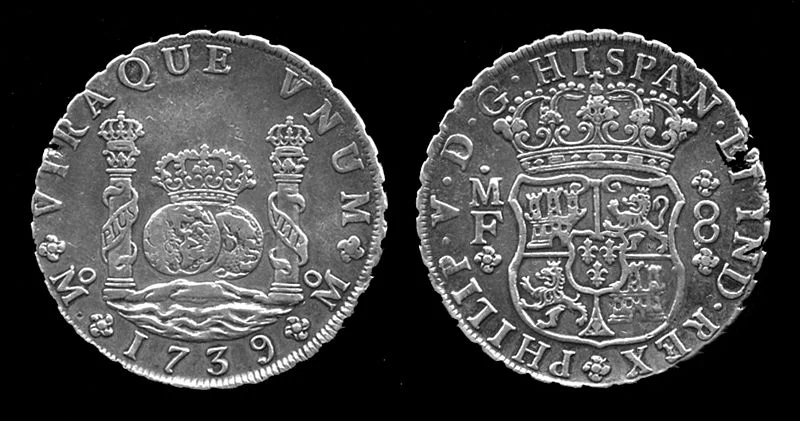
You want change? Anybody got some tools?
“Bits,” at just one syllable, already have a long and storied history in coinage. For centuries, the Spanish silver dollar was a preferred unit of global trade due to its relative freedom from debasement of silver content and its wide international adoption. The peso de a ocho coin was worth eight reales and became known as “pieces of eight” in English, giving pirate parrots something to prattle on about. It has also been said that certain coins were physically cut into eight pieces or “bits” as a way to improvise around small-change shortages using the resulting sharp metallic pie pieces. I am not sure of the ratio of fiction to fact on that one.
The resulting related use of “two bits” to mean a quarter dollar has only recently been fading out of informal use in the US after a long run. Unfortunately, fiat inflation eventually left a quarter dollar unable to buy much of anything and the meaning of “two-bit” declined with it, coming to characterize something of poor quality. A “two-bit coffee” might thus sound rather dilute to modern ears.
Could “bit” be brought back in a decimal-based, high-tech reincarnation? A millibitcoin (0.001 BTC) is now trading at about US $0.13. Twenty of these might buy that espresso at $2.60 and “twenty millibitcoins” (20 mBTC; 0.020 BTC) might be shortened in speech to “twenty bits.”
The centibit challenge and foodie what-ifs
If such bits stood for centibitcoins (0.01 BTC) instead of millibitcoins (0.001 BTC), that espresso might cost about “two bits” after all (assuming $130/BTC). With centibitcoins, a family sushi dinner that might add up to $65.95 would come to “fifty (bits) seventy-three,” or the waiter could say, “in Bitcoin, that’s fifty seventy-three.” That’s 50.73 centibitcoins versus 507.3 millibitcoins and 0.5073 bitcoins.
A centibitcoin redenomination could thus bring things into a familiar range for dollar and euro users right away. At around $130/BTC, a centibitcoin would trade for $1.30, €1.00, and ¥100. That seems intuitively perfect, but only under approximately current rates.
Bitcoin exchange values could stay level or fall. Expecting a long, level trend or modest decline would speak in favor of centibitcoins as the standard unit. If Bitcoin does continue to climb impressively, though, how long before its dollar exchange value adds another digit?
Let us say that the bulls have it and the exchange value of a bitcoin moves to $500 and then $1,000 over the next several years. How would these two alternative redenominations then play out with some everyday examples?
At $500 per bitcoin, a $2.60 espresso would cost 0.0052 bitcoins, 0.52 centibitcoins, and 5.20 millibitcoins. Millibitcoins would win according to the balance of the above criteria (“in Bitcoin, that’ll be five twenty”). The big sushi dinner would be 0.1319 bitcoins, 13.19 centibitcoins, and 131.90 millibitcoins. In this case, either one might look okay.
At $1,000 per bitcoin, the espresso would cost 0.0026 bitcoins, 0.26 centibitcoins, and 2.60 millibitcoins. Millie would win. The sushi would then come to 0.06595 bitcoins, 6.595 centibitcoins, and 65.95 millibitcoins, and millie would win again.
While a centibitcoin transition would make sense for now, an assumption of further exchange value growth would point in favor of the proposed millibitcoin unit. Either way, a redenomination could well be positive. A key challenge for Bitcoin entrepreneurs is helping to broaden adoption into more frequent everyday payments and purchases. Making Bitcoin units easier for contemporary people to talk about in everyday language and think about closer to everyday price numbers could well be helpful.
So how about just putting “m” and “B” together?
“Embies” (mB) is another option I have proposed based on pronouncing “m” and “b”. The B can also be written with the proposed Bitcoin currency symbol when it makes its way into standard character sets. Embie matches the conventional two-syllable criteria. It strikes me as easy to pronounce on a multilingual basis. It also seems friendly and familiar; it could be a pet’s name. I find it easier to say than the two-syllable “embits” candidate. Not all sets of two syllables are equally easy to pronounce.
Still, some people seem to hate it, while others like it. It may be that the name for BTC 0.001 that will prevail in the end has not yet been coined.
For additional articles on this topic, visit my Bitcoin Theory page on this site.
**
POST FOOTER
/post
/content-wrapper
How to deal with a deficit of available Bitcoin outputs
By Oleg Andreev
Posted June 10, 2013
You just installed a Bitcoin wallet and received your first 10 bitcoins. Do you think you can easily spend these 10 bitcoins in 10 shops during a visit to a mall? Not really.
Bitcoins do not exist as individual items. Once you received your first bitcoin payment, all you have is a single “transaction output” that you can spend. Once spent, it is no longer valid. In its place you’ll have two new outputs: one as a payment to someone else and another one as a “change” sent to yourself. To pay the second person you need to use this new output (“change”). But this new transaction will not be accepted or even relayed by the network before its parent transaction (you first payment) is included in the blockchain. So to make a second payment you’d have to wait 5-15 minutes before the first one is included. And to make another one, you’d have to wait another 5-15 minutes after that.
In addition, if you try to send a small amount from a relatively “fresh” output, people would ask for transaction fees to relay or mine your transaction. This is done to prevent DDoS attacks on the network. If you wait 24 hours after creating a new “change” output, you could send it for free, but doing so earlier will result in unpredictable and lengthy delays. Although, the usual transaction fee is very-very small at current prices (around 5 cents), you’d still have to wait for all previous transactions to be included in the blockchain before you can successfully publish another transaction.
In a sense, you may call a single output a “coin” (with some amount written on it). The more “coins” you have, the cheaper and faster your transactions will be. Think of it like having a single $50 bill when you need a quarter to pay for parking. You’d need to go somewhere to exchange that $50 for smaller bills and coins. Unlike real coins, transaction outputs are not displayed in any wallet app, so you don’t know in advance how many transactions can you spend. And even if they were displayed, it would add unnecessary complexity for the user.
This side of Bitcoin obviously sucks, but can be managed easily.
First, you may ask to receive money in multiple outputs. E.g. if you receive a big monthly payroll, you may ask to send you money in a single transaction with 10–20 distinct outputs, so you could spend several of them right away. They all may use the same address and your wallet will figure everything out automatically. The only thing you’ll notice is that you don’t have to pay extra or wait longer to get a couple of your simultaneous payments to get through.
Secondly, you can split your money by yourself in multiple outputs. This will result in the same result as above, except now it’s you who will pay transaction fees (fees are calculated per Kb, and for smallest transactions they are rarely required).
Third, your bitcoin wallet can keep track of your spendable outputs and it is running short of them, it may add an extra “change” output to the next transaction to increase amount of outputs. I don’t know if any of the existing apps can do that already.
Also, bitcoin wallet can make automatic transactions on your behalf using rarely needed outputs to split them in a more useful collection of different “denominations”. It can also mix these coins with other users to increase you privacy (so that random merchants wouldn’t know how much do you have in your pocket).
As of today, people don’t pay ten times a day with Bitcoin, but when this happens, we would need an automatic solution to have our transactions relayed quickly and cheap. Hopefully, developers of bitcoin wallets will take a note and think on solving this problem.
The universe wants one money
By Oleg Andreev
Posted June 28, 2013
In this post I address issues of competing government currencies, competing private currencies, gold, silver, bitcoin and alternative “crypto-currencies”.
We all know that variety and competion is a good thing. We all want slightly different things, value the same things differently or make different trade-offs. That’s why we have a wide variety of products, prices, quality, colors and materials on the market. Interestingly, money is different. We all want one single universal money. It may not be obvious to many people, so let me explain.
How money is different from everything else? On one hand, money is just an asset. You can produce, buy, sell or hold it. On the other hand, money is a medium of exchange. It allows you to trade your 8 hours in the office for a new iPhone. It also allows you to delay consumption decision. You can spend 8 hours of work today, but then be free to decide when and for what to spend your salary. If suddenly you need to buy a ticket to Hong Kong, you can do it without working extra couple of hours to earn it.
The function of money is to exchange the widest variety of products between each other. iTunes credits allow you to choose between many songs. This make them money to some degree. But dollars are even better money because they can buy all those songs, but also a myriad of other things as well. Therefore, people tend to keep savings in dollars, not in iTunes credits.
It seems obvious that the best money is the cheapest and the most widely recognized and accepted one. Cheapest in a sense of handling it. If your money is a huge stone you have to carry around, it is more expensive than a small gold coin (provided they both have the same price in terms of goods they can buy). Piece of paper named “gold certificate” could be even cheaper than gold itself, but carries a risk of fraud, so in some cases it could be even more expensive to hold than the gold itself.
For a huge part of the civilized human history we used two metals as money: gold and silver. They were not perfect, but universally accepted and recognized. All other things like seashells, diamonds, IOU papers were less universally recognized, so they were naturally used in some very niche markets while everyone was keeping cash in gold or silver.
Both gold and silver were durable, easy verify, easy to cut and melt together, compact enough to be stored and moved around cheaply. And they were very hard to obtain, so there was very low inflation cost (every new gram of gold created eats into everyone’s savings because it increases purchasing power of its owner comparing to everyone else around). Other things were either easy to produce, or not durable, or hard to split in arbitrary parts.
Why gold did not outcompete silver? Or vice versa? That’s because they both had weight. For small purchases gold would have to be split in tiny difficult to handle pieces, while to make big purchases one would need to move several kilograms of silver comparing to much smaller amount of gold. This naturally created two parallel global markets: one for small purchases where the silver was used (and small droplets of gold would be impossible to handle) and another market for big purchases where silver was too heavy, so the gold was used instead.
Make a thought experiment now: if there was a gold-like metal that allowed moving both big and small amounts equally cheaply, it would be useful on both “small” and “big” markets. Thus it would be more marketable (more exchangeable) which by definition would make it a better money. Better than gold and better than silver. People would then tend to keep their cash in that magic metal because it would allow them access to bigger variety of goods: from bread to houses. And they would not lose money on conversion rate like when they sell some silver for gold or the other way around.
There was a competition in private coinage. Kings and private merchants were making their own coins in gold and silver and selling them for premium. The well-recognized coin was easier store and to verify if you trust the issuer. Instead of measuring each coin, you could simply read the number on its face. Names like “dollar”, “pound sterling” and others were all names for private coins or bullion and meant particular weight of the metal. That is, dollar was not some sort of separate money, it was simply a name for a certain amount of silver, like “gram” or “ounce”. The money was still the same — gold or silver, but there was a big variety of shapes of that money.
Of course, gold and silver were still quite limited. You could not drop a bag of gold across the ocean. That’s why people invented banking. Bank was simply a warehouse for your metal. You give them gold, they give you a receipt. Then, if the bank had good reputation and connections with other banks in the world, you could transfer those receipts of any face value quite cheaply anywhere. The only real cost was trust in those banks. Because if the bank is robbed or steals your metal, your receipt becomes worthless. If the bank prints additional receipts for the same amount of metal, the value of your receipt goes down proportionally (or you face a risk of bank run, when more people try to redeem their receipts than is available in the vault).
In old days, private currencies were simply those receipts for gold or silver. Each currency could have different name and different reputation. Bigger bank’s notes had more value on the market because they had less risk associated with them and as a result, wider acceptance. But ultimately, they all were receipts for the same metals that you could redeem at any time and move to any bank or under a mattress. Because people valued receipts only for their ability to represent readily accessible metal. Without the metal, those pieces of paper would be worthless.
Today things are different. After several huge economic disasters created by the governments of Russia, Europe and U.S. in the beginning of 20th century, we now have state-issued money in almost every country with a nice twist that now the money is not redeemable for metals. People use that money, though, because various controls and regulations make it almost impossible to use gold, silver or respective certificates in daily transactions. Every bank needs expensive license and must not be very creative at what it can offer to its clients.
Dollars can buy things in U.S., euros can buy things in E.U., but if you try to use them in inappropriate places, you would have to pay very high conversion fees. (Setting up your own clearing house or exchange with the lowest fees is not possible due to regulation.) It should be clear now that if, for instance, U.S. Dollar can buy more than Russian Ruble, Russians would tend to use Dollars in daily life. The reason why it does not happen anymore (it used to during liberal times in the 1990s) is stricter controls on currency exchange that make it illegal to price goods in dollars and expensive to exchange currencies frequently. For the same reason, gold and silver are not used: they are too expensive or illegal in some contexts, or there is a huge risk and cost on those who are going to store them. Several years ago, Liberty Dollar, alternative silver-based currency was shut down and all silver was confiscated by U.S. government. Founder was pronounced guilty of “making, possessing, and selling his own currency”.
Here we do not discuss whether it is good or moral to make your own currency or store other people’s money. The point is about demand for a single, most universally accepted money. If gold, silver and foreign currencies need violent intervention to not be used, it’s only a proof of existing demand. Because if there was no natural demand, no government would care setting up restrictions in the first place.
Now we enter crypto-currencies. It is a fancy name for Bitcoin and its many clones based on the same source code. Bitcoin itself is very different to ubiquitous government money, application-specific “credits” (like in multiplayer games) or gold and silver. It is absolutely digital, does not have a single controlling entity and is very cheap to store and transfer both huge and tiny amounts of money. This property makes Bitcoin very useful on certain markets: be it illegal market, or “sending money to family in another country”, or a market where banking is unavailable or too expensive.
What about alternative Bitcoin-like currencies? They all provide the same security risks and benefits. Nominally, they all have different divisibility (so called “larger number of coins”), but at the scale of trillions of smallest units in total money supply extra divisibility does not really matter.
Economically, all Bitcoin clones (altcoins) have the same problem: they all have much smaller market exposure than Bitcoin while not technically superior. When people decide in which one to keep their money, they would keep it in the money with the biggest market. There is not point in “diversification” in the long term. If Bitcoin fails for some reason, all its clones fail for the same reason automatically. If Bitcoin works well, any amount in altcoins is simply inferior in its purchasing power. It does not mean there won’t be any market. You can always keep some empty plastic bottles for selling later, but the bottles can only buy cash, while cash can buy anything.
Second problem of alt coins is mining. In the long term, any miner will throw 100% of computing resources into the most profitable currency. Even if Bitcoin is only 1% more profitable than Litecoin, since there is no fundamental difference between them, all the resources will be thrown into Bitcoin. In the short term, there are plenty of enthusiasts who find themselves equipped with a lot of outdated GPU hardware that was once used for Bitcoin, but now cannot compete with specialized ASIC hardware. These people now mine Litecoin in short-term expectation for any amount of reward. It is sort of a private club of people trading in their own funny money. All new miners devote all their energy to Bitcoin, while people who will sell or retire their GPUs will make Litecoin network weaker and less technically stable.
In the end, it is clear that we want the single money to be able to sell anything and buy anything. We all want it to be cheap to store, move and verify. And secure. With as little trust in middlemen as possible. Today we find ourselves with a lot of artificial barricades in the sphere of money, which causes artificial demand for various local currencies. Gold is being seized or moved from the country. Foreign currency is prohibited for merchants to price their goods at. Legal tender laws force you to accept government-issued currency as a payment for debts. Regulations and licensing limit variety of private currencies or money substitutes. But all that trouble only proves almost universal desire to use the single virtual entity for buying food and saving for the future. Bitcoin gives us a mechanism to overcome all these regulations and trade as freely as was ever possible. Maybe it will allow us to achieve that single, most marketable entity that we all so desire.