
April 2013 Journal
WORDS is a monthly journal of Bitcoin commentary. This issue collects the April 2013 writing in the WORDS archive. For the uninitiated, getting up to speed on Bitcoin can seem daunting. Content is scattered across the internet, in some cases behind paywalls, and content has been lost forever. That’s why we made this journal, to preserve and further the understanding of Bitcoin.
How Bitcoin will change society
By Oleg Andreev
Posted April 2, 2013
When Bitcoin kills money printing and slashes a lot of taxes, smarter people will run from the government while the dumber ones will take their positions.
As economy gets more liberated, the parasites will get less and less efficient and more discredited in the eyes of population. More stupid restrictions will become law which will only accelerate resistance, but will never achieve anything useful for tyrants. Politicians and police will be massively bribed to not interfere with private business.
Government will become less and less relevant until it ends with a bunch of starving die-hard socialists and racists lying in an empty post office.
Bitcoin vs. Gold
By Oleg Andreev
Posted April 3, 2013
Some people think that gold is easier to hide or bury than Bitcoin. They like that gold was used for 5000 years and you can touch it. They dislike 4-year old internet protocol because they do not understand it.
First of all, money is information. Gold encapsulates information “I own that much of current purchasing power” via its hard-to-duplicate physical properties. The harder it is to duplicate and easier to verify, the more liquid it is. To hide information embodied in gold, you have to hide your brick somewhere in the physical world. Since 1 kg of gold has quite a big market value for a single person, hiding it is not a big problem.
How does Bitcoin look from that perspective? Bitcoin stores information about your purchasing power using decentralized database. Bitcoin is much harder to duplicate or create (you can suddenly find some gold in the ground, but with Bitcoin supply is known in advance). Bitcoin is much easier to validate with 99,9999999999999999999% certainty using cheap commodity hardware anywhere in the world. Gold verification ultimately needs to be melt down and checked by experts, or you have to trust some certificates and less accurate checks.
How would you hide Bitcoin? Even easier than gold. If you print your private keys or passwords on a piece of metal, you can use the same hiding techniques that apply to gold. But you have also purely digital options. You can simply remember the password. Or write it on a small insignificant piece of paper. Or split the secret via Shamir’s Secret Sharing Scheme and send pieces to friends and relatives.
Finally, the killing feature of Bitcoin is that you can split your stash in 100 pieces and send them to 100 different people anywhere in the world in a matter of minutes without any single person knowing about that. If you need to buy something with Bitcoin, you can do it right away. With a brick of gold — not so much.
The Bitcoin Bubble and the Future of Currency
By Felix Salmon
Posted April 3, 2013
Bitcoin market cap, from http://blockchain.info/charts/market-cap
A few days ago, the value of all the bitcoins in the world blew past $1 billion for the first time ever. That’s an impressive achievement, for a purely virtual currency backed by no central bank or other authority. It’s also temporary: we’re in the middle of a bitcoin bubble right now, and it’s only a matter of time before the bubble bursts.
There are a couple of reasons why the bubble is sure to burst. The first is just that it’s a bubble, and any chart which looks like the one at the top of this post is bound to end in tears at some point. But there’s a deeper reason, too — which is that bitcoins are an uncomfortable combination of commodity and currency. The commodity value of bitcoins is rooted in their currency value, but the more of a commodity they become, the less useful they are as a currency.
Still, it’s worth taking a look behind the bitcoin bubble, because there are fascinating implications for anybody who cares about payments, or currencies, or trust.
First, though, let’s go back to the night of Sunday June 12, 2011. That was the date of the first big bitcoin heist: a theft of such simplicity and audacity that it might well be considered the perfect crime. A man — we know him only as “All In Vain” — went to bed that night with his Windows computer turned on and connected to the internet. On that computer was a wallet containing 25,000 electronic coins. When he woke up on Monday morning, the wallet was still there. But the money was gone.
Those 25,000 coins were, at the time, worth some $500,000; today, they are worth about $3.5 million. If All in Vain had noticed the theft within a couple of minutes of it happening, it’s conceivable that he could have got his money back. But he was asleep — and ten minutes after the theft occurred, it was utterly permanent and irrevocable. The only way All in Vain could get his money back would be if the thief were to simply transfer it back into his wallet.
No one will ever find the person who stole All in Vain’s coins. That’s because the coins were designed, by another pseudonymous internet denizen known only as Satoshi Nakamoto, to be the perfectly anonymous payment mechanism for a digital world. That’s one of the things about bitcoins: once you send them, they’re sent. Similarly, if someone sends you bitcoins, you know for sure that you own them. You don’t need to know or trust the sender — all you need to know is that the coins have arrived in your virtual wallet, ready for saving or spending.
Bitcoins were designed to be – and, in many ways, are – the perfect digital currency: they’re frictionless, anonymous, and cryptographically astonishingly secure. For anybody who’s ever suffered the incompetence of a bank, or bristled at the fees involved in just spending money, either domestically or abroad – that is to say, for all of us – the promise of bitcoin is the holy grail of payments. Especially since, to all intents and purposes, bitcoins are invisible to law enforcement and the taxman.
Those strengths are also weaknesses. No one wants to risk losing millions of dollars worth of currency overnight, just because they were outsmarted by some computer hacker.
Still, for the time being, bitcoin is in many ways the best and cleanest payments mechanism the world has ever seen. So if we’re ever going to create something better, we’re going to have to learn from what bitcoin does right – as well as what it does wrong.
The source code for bitcoin is free and public, which means that just about every hacker and cryptographer in the world has had a crack at it. And they’ve all come to the same conclusion: it really works. There are question marks over just how anonymous it is and just how scalable it is, but when bitcoins first arrived in early 2009 – right at the height of a massive global crisis of capitalism – they had immediate and magnetic appeal to the anarcho-utopian crowd of techno-libertarians who drive an enormous amount of innovation online.
Such people, including Satoshi Nakamoto, are far from unique in their mistrust of all existing financial institutions. What sets Nakamoto apart is that he turned that mistrust into a philosophy, the most important driving force behind the bitcoin project. When he introduced bitcoin to the world in February 2009, Nakamoto boasted that his new currency was “completely decentralized, with no trusted parties”. And he explained in some detail what he saw as the problem in need of a solution:
The root problem with conventional currency is all the trust that’s required to make it work. The central bank must be trusted not to debase the currency, but the history of fiat currencies is full of breaches of that trust. Banks must be trusted to hold our money and transfer it electronically, but they lend it out in waves of credit bubbles with barely a fraction in reserve. We have to trust them with our privacy, trust them not to let identity thieves drain our accounts.
Nakamoto’s no paranoiac crazy: what he’s saying here is not all that different from what Warren Buffett wrote in his 2012 letter to shareholders.
Investments that are denominated in a given currency include money-market funds, bonds, mortgages, bank deposits, and other instruments. Most of these currency-based investments are thought of as “safe.” In truth they are among the most dangerous of assets.
Over the past century these instruments have destroyed the purchasing power of investors in many countries, even as these holders continued to receive timely payments of interest and principal. This ugly result, moreover, will forever recur. Governments determine the ultimate value of money, and systemic forces will sometimes cause them to gravitate to policies that produce inflation. From time to time such policies spin out of control.
Even in the U.S., where the wish for a stable currency is strong, the dollar has fallen a staggering 86% in value since 1965, when I took over management of Berkshire. It takes no less than $7 today to buy what $1 did at that time.
If you hold dollars, you’re trusting the US government not to destroy your wealth. Bitcoin, by contrast, is based on mistrust — it’s specifically designed so that it’s every man for himself. All in Vain was blamed by many in the bitcoin community for his stupidity: what was he thinking, keeping his wallet on a Windows computer attached to the open internet?
But even with bitcoin, people nearly always end up trusting someone – and the entity they’re trusting often turns out to be unreliable. MyBitcoin, turned out to be a fraud; Mt Gox was hacked. The latest hot new bitcoin company is Coinlab, but given how much money can be made by hacking into these companies, and given that law enforcement authorities are unlikely to make any attempt to go after the perpetrators, there will always be a pretty substantial risk that clients will lose their money.
The level of mistrust built into bitcoin is both feature and bug – most of us actually like being able to outsource our wealth-hoarding to some large trusted institution, rather than burying $1,000 under a black volcanic rock in a dry stone wall next to an old oak tree, or wrapping $90,000 in hundred-dollar bills in aluminum foil and hiding it in the freezer. Looking after your own coins is dangerous, and requires a pretty substantial level of tech-savviness. But trusting someone else to look after your coins requires the very trust that bitcoin was designed to circumvent.
Bitcoin’s built-in mistrust of institutions doesn’t just set it apart from fiat currency, it also sets it apart from other virtual currencies, such as Facebook credits in the US, QQ coins in China, or Linden dollars in Second Life. All those currencies are closely controlled and guarded by the companies that invented them – and have very little value outside that particular ecosystem. (That said, credits in World of Warcraft are valuable enough that Chinese prison guards reportedly force convicts to perform monotonous tasks within the game for 12-hour stretches at a time, building up credits which can then be sold for many times the guards’ official salary.)
Some of these virtual currencies are roughly the same order of magnitude as Bitcoin in size, although it’s hard to make apples-to-apples comparisons. Revenues from Facebook credits are running at a rate of about $1 billion a year, for instance, and the market in QQ coins was so big in 2007 that the Chinese central bank, fearing that it was losing control of the money supply, cracked down on their use, calling on companies to stop trading in them. In this latest bubble, bitcoin transaction volume has managed to exceed $30 million in one day, and most days are seeing volumes of more than $5 million. That works out to about $2 billion in volume per year, so long as the bubble doesn’t burst.
But the biggest difference between bitcoin and other virtual currencies is that bitcoins are the only one which have speculative value. What’s more, because they’re not tied to a corporate parent, bitcoins appeal to the web’s anarcho-libertarians in the way that no other virtual currency can. Bitcoins hold exactly the same gleaming promise for techno-utopians as gold does for Glenn Beck. They’re a scarce resource, and there’s no government or corporation which can control that resource.
Bitcoins, like gold, are beholden to no government; they can’t be printed by any central bank, and they certainly won’t be subject to hyperinflation, since the global supply of bitcoins will never exceed 21 million. Like gold, bitcoins are mined; but unlike gold, no one can stumble over some large seam and make a fortune. Mining for bitcoins involves an enormous amount of computer power, and very little luck, and the global rate at which new bitcoins will be mined is both predetermined and slowing down. There were about 3 million coins outstanding at the beginning of 2010, there are about 11 million coins outstanding today, and we’ll get to 14 million in early 2014. Come 2021 or so, assuming bitcoins are still used then, the rate of growth of bitcoins will be so low that to a first approximation the money supply will be constant. This carries with it its own problems, as we’ll see. But there’s no risk that some central bank will print millions of new bitcoins, thereby diluting or inflating away the value of existing ones.
As the reverberations from the financial crisis continue to echo, people betting on a decline of trust in government have been stocking up on gold and bitcoins. (Or rather, gold or bitcoins: although they can be equally zealous and vehement about their respective asset classes, there’s surprisingly little overlap between goldbugs, on the one hand, and the bitcoin community, on the other.) These are the perfect assets for rugged individualists, who trust their guns or their ultra-secure passwords more than they do their country. And in times of global turmoil, as we’re seeing today, such assets can perform very well.
The immediate impetus for the current spike in bitcoin prices, of course, is the events in Cyprus. There, the government, under extreme pressure from the European Union, first proposed taking all bank accounts – even the insured ones – by at least 6.75%. That didn’t work, but now uninsured account holders at Cyprus’s two largest banks stand to lose most of their money. It’s a stark reminder of the dangers associated with depositing money in a bank.
Bitcoin has become suddenly popular in Cyprus for obvious reasons: no government can confiscate your bitcoins, or prevent you from transporting them out of the country. (On the other hand, if your bank account is frozen, it’s hard to find the money needed to buy coins.)
More generally, bitcoins could be emerging as a very useful currency in police states, or anywhere that monetary policy could fail catastrophically. At the end of 2011, for instance, there was a significant uptick of bitcoin activity in Belarus and Ukraine, two countries at severe risk of hyperinflation. If you want to protect your wealth from the policies of your national government, or from the inflationary policies of a heterodox central bank, then bitcoins can be a very good way of doing so in a largely undetectable manner.
Of course, acquiring bitcoins in such countries can be non-trivial: there’s not a lot of liquidity on the major internet exchanges from people looking to sell bitcoins and buy the Ukrainian hryvnia. And even if there were, your local Ukrainian bank might frown on sending lots of hryvnia to Mt Gox. But it’s conceivable that people in Ukraine and Cyprus, especially information workers, might start working for bitcoins, spending them on goods and services, and introducing them into the local economy that way. At which point one can envisage the coins getting the same kind of status, at least among the information elite, that dollars had in the Soviet era.
Bitcoins, then, are like cash — but they take the idea a step further than has ever been possible. If you give me a $100 bill, the transaction is anonymous and untraceable, but we both need to be in the same place at the same time. And it helps if we both live in a country where the US dollar is an accepted unit of currency.
With bitcoins, transfers can take place across continents and timezones with no problems, no timelags, and only minuscule transaction fees. No banks are involved; no central bank controls the money supply; no taxes ever need to be paid. Once you’ve obtained a stash of bitcoins, they’re yours to do with as you like.
And there’s lots that you can do with bitcoins. You can convert them into any of a dozen currencies, on various online exchanges. (Although at that point you’re going to start needing a bank account.) You can gamble with them in online casinos. Or you can just go out and spend them. The list of things which have been bought with bitcoins is very long, and is by no means confined to laptop computers and computer-programming services. Hotels take them, a sock manufacturer in Massachusetts is famous for accepting bitcoins, and the more enthusiastic members of the bitcoin community regularly do things like split checks at a restaurant – even one which doesn’t take bitcoin itself – by transferring coins to the person paying in dollars.
And then, more notoriously, there’s Silk Road – a site which is not only a hub of bitcoin activity, but also played an important role in the first bitcoin bubble, the vertiginous rise in market value of bitcoins in 2011 which made the rest of the world sit up and pay attention to what was going on.
Silk Road — and bitcoins — hit the public consciousness on June 1, 2011, a couple of weeks before the All in Vain heist. That’s when Gawker’s Adrian Chen published an article headlined “The Underground Website Where You Can Buy Any Drug Imaginable”. His post was viewed more than 1.5 million times, and caused a sensation, with Senators Joe Manchin, of West Virginia, and Chuck Schumer, of New York, writing an outraged (and entirely ineffective) letter to the Attorney General and the head of the Drug Enforcement Administration, demanding Silk Road be taken down.
Bitcoins were – and still are – the only currency accepted on Silk Road, and overnight they became a speculative bet on the online future of illegal trading. The price of bitcoins, which had never before traded in the double digits, soared in just one week to as much as $33 apiece.
The value of bitcoins, it turns out, is highly sensitive to media coverage: a year earlier, in July 2010, the influential technology site Slashdot posted a short item about bitcoin which sent the price soaring tenfold — from less than a cent to about 7 cents per bitcoin — also in a few days. And a single post on Time.com in April was enough to double the price of Bitcoins in a week, from 80 cents to $1.60. Even the article you’re reading now is appearing now because of the current bubble, and will, at the margin, help to continue to inflate it.
For speculators, the math is incredibly compelling. If you spent $100 on bitcoins the day after the Slashdot article came out, those coins would have been worth $72,500 when the Gawker article came out just under a year later. And they would have been worth $250,000 a week after that. Today, they would be worth more than $1 million. There aren’t many perfectly legal investments which offer that kind of return.
All of which helps explain the current bitcoin bubble as well. Each time the value of a bitcoin hits a new high or a new milestone, there’s more press coverage of the phenomenon, drawing new people in, and sending the value of bitcoins even higher. Indeed, if you chart the value of bitcoins against the number of times that they’re being talked about on Twitter, you’ll see a very strong correlation. And because of the Cyprus connection, mainstream publications have a handy real-world news hook, now, with which to explain the bitcoin phenomenon.
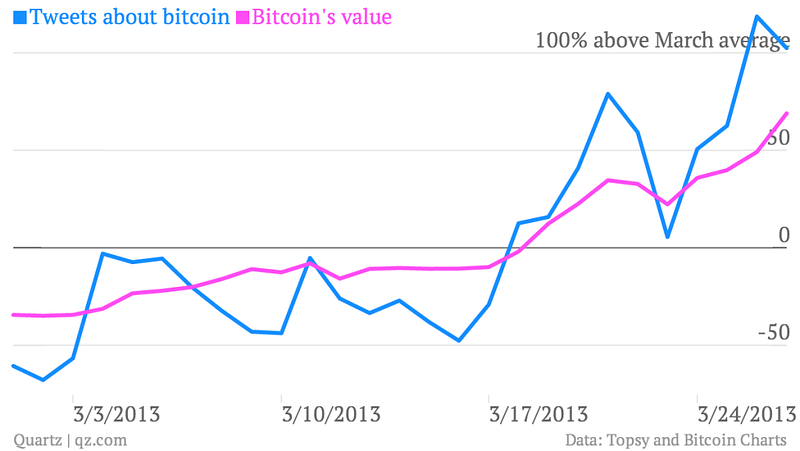
This is actually a serious problem, if you’re trying to put together a currency, rather than a vehicle for financial speculation. If the currency of a country ever fluctuated as much as bitcoins did, it would never be taken seriously as a medium of exchange: how are you meant to do business in a place where an item costing one unit of currency is worth $10 one day and $20 the next? Currencies need a modicum of stability; indeed, one of the main selling points of bitcoin was that it couldn’t be destabilized by government institutions. But that comes as scant comfort to people watching the value of a bitcoin behave like some kind of demented internet stock during the dot-com bubble.
And just like demented internet stocks, bitcoins have seen busts as well as bubbles: in the second half of 2011, for instance, the value of bitcoins retreated from their peak around $30 each to a low point closer to $3. (Today, they’re trading above $140.)
In reality, then, bitcoin doesn’t really behave like a currency at all. In terms of its market value, it looks much more like a highly-volatile commodity. That’s by design: bitcoins were created to be the most fungible commodity the world had ever seen – to the point at which they would effectively erase the distinction between a commodity and a currency.
But is that a good idea?
Dollars are a universally accepted unit of account: if something in the world has a price, it has a price in dollars. Dollars are not, on the other hand, physical commodities. The overwhelming majority of dollars in the world are deposited safely and electronically in banks: there’s something weird and self-defeating about the kind of people who keep their savings stuffed under the mattress. In Hollywood, if you show someone counting out huge sums of cash, that’s an easy way for the director to say that he’s a criminal.
Bitcoin was constructed to behave like a currency: it’s very easy to use bitcoins to pay for goods and services, especially if what you’re buying is in a different country. Right now, there’s literally no way to build a website selling some kind of service, and have a meaningful fraction of the world’s online population be able to pay you for that service. Bitcoin was designed to solve that problem; to be, in effect, the lingua franca of online commerce.
But it’s very hard to be a currency when you’re also a commodity, governed by rules of scarcity and subject to speculative attack. And it’s also very hard to be a currency – or even a commodity, for that matter – when you’re as small as bitcoin is. Even now, at the top of a huge bubble, the total value of all the bitcoins in existence is the equivalent of about 2,000 standard gold bars – not remotely enough to revolutionize the global payments and currency systems as we know them. Given the choice between something old and solid, on the one hand, and something new and virtual, on the other, the market is still voting for the asset class which has proved its worth over millennia.
On a good day, at the top of the bubble, the trading volume in bitcoins can be more than $20 million. But by the standards of global currency markets, those kind of figures aren’t even a rounding error. The foreign exchange markets see volume of $4 trillion per day. That’s 200,000 times greater than what we’re seeing in the bitcoin market, and it happens on a regular, day-in and day-out basis.
On top of that, there are really no traders in bitcoins, since for the time being it’s (almost) impossible to bet that the price of bitcoins will go down. As a result, there’s no reliable source of liquidity in the bitcoin market: there’s no bank or trading house which you can be sure will be there if and when you want to sell your coins.
And just to make bitcoins even less attractive, it’s far from clear that bitcoins are even legal. The FBI is on the record as saying that “it is a violation of federal law for individuals… to create private coin or currency systems to compete with the official coinage and currency of the United States”. And laws against operating an unlicensed money-transmitting business have been used against electronic currencies in the past, and would seem to apply equally to bitcoin.
The biggest problem with bitcoins, however, is conceptual: if they succeed, they fail.
If millions of people started using bitcoins on a regular basis, the soaring value of bitcoins would actually be disastrous. You’ve heard of hyperinflation: this would be hyperdeflation. Take a gold bar valued at $600,000. At $60 per bitcoin, the value of that bar is 10,000 BTC. But then assume that bitcoins rise in value to $600 apiece, and then to $6,000, and then to $60,000 — as would have to happen if the fixed number of bitcoins was being used to store hundreds of billions of dollars in value. Then the value of the gold bar would plunge, in bitcoin terms — to 1,000 BTC and then 100 BTC and finally just 10 BTC. The same thing would happen to all other goods and services in the world, including your own salary. Everything would be constantly going down in price, if you thought in bitcoin terms.
Inflation is bad, but deflation is worse. The reason is that in a deflationary environment, no one spends money — because whatever you want to buy is sure to become cheaper in a few days or weeks. People hoard their cash, and spend it only begrudgingly, on absolute necessities. And they certainly don’t spend it on hiring people — no matter how productive their employees might be, they’d still be better off just holding on to that money and not paying anybody anything.
The result is an economy which would simply grind to a halt, with massive unemployment and almost no economic activity. In a word, it would be a Depression. In order to have economic growth, you need monetary growth as well — and that’s something which is impossible to achieve in a bitcoin-based system. Currencies such as the dollar, with a central bank which can print money at will, have succeeded for a reason. As economies grow, the money supply has to be able to grow with them. And that’s why bitcoin can never really succeed over the long term.
Rick Falvinge, then, the founder of the Swedish Pirate Party who has invested his entire net worth in bitcoins, might be a multi-millionaire right now, but he is doomed to end up a poor and disappointed man unless he changes his mind. His coins will, at some point, become worthless, rather than turning him into some kind of visionary cyberbillionaire.
But that doesn’t mean Falvinge isn’t onto something. There’s a lot to be said for a fast, efficient, peer-to-peer payments system which bypasses centers of authority and which has negligible transaction costs. It just doesn’t need to be its own currency.
Historically, the government has subsidized the most common forms of payment – coins (which are often worth less than they cost to mint), notes, and checks. But it stopped doing that when credit and debit cards came along: Visa and Amex and Mastercard, as well as their web-savvy successors like PayPal and Square, are all run on a for-profit basis by companies looking to make billions of dollars by skimming off a small slice of every transaction.
A peer-to-peer payments system, allowing anybody on the internet to pay anybody else on the internet without having to sign up with some financial-services behemoth first, could revolutionize global commerce. It would have to be able to work with any currency, including bitcoin; it wouldn’t need its own unit of account. It would have to be flexible, too: some transactions would be cashlike and irreversible, while others would allow some kind of chargeback.
And, most importantly, it would work with, rather than against, today’s established monetary institutions. Yes, it would be disruptive, and could cost them quite a lot of money in terms of lost interchange fees from plastic cards and ATMs. But it wouldn’t aspire to delegitimize them – quite the opposite. Because it turns out that financial-services companies are a very important part of any democracy.
It’s because we place so much trust in banks, after all, that they are forced to take on a great deal of responsibility. Banks and central banks are given an important job to do, are regulated and scrutinized, and can be held responsible for their actions. The population of the entire country, as represented by the government, stands behind bank deposits and promises to honor them even if the bank goes bust. Money, in other words, is a key ingredient in the glue which keeps the social compact together. (What we’re seeing in Cyprus is in large part a demonstration of what happens when that compact starts becoming unglued.)
Bitcoin, in that sense, is anti democratic. It’s based on mistrust rather than trust, it refuses to take any responsibility onto itself – indeed, it doesn’t even have a self to take responsibility onto. It’s nihilistic, and an attractive alternative only to things which are downright bad.
And in any event, bitcoin is never going to work as a global payments system. Not only does it suffer from having a slow-growing money supply and a metastasizing transactions file which has to live on every user’s computer, it also encourages destructive computer hacking. The way that the money supply grows, in the bitcoin system, is by people harnessing the power of hundreds or thousands of computers to solve very complicated mathematical tasks, earning bitcoins for doing so along the way. And the easiest and cheapest way of doing that is to do so illegally, by stealth: set up a “botnet” of hacked computers to do your bidding for you. The incentives, here, are very bad indeed.
I do have hope that in the future, someone, somewhere, is going to learn from bitcoin’s mistakes, and build a better system. One which needs less technological expertise to use; one which can grow organically, instead of only at a predetermined rate; one which is designed to be used primarily as a payments mechanism, rather than as a store of value and a unit of speculation.
When that happens, cash will start looking decidedly anachronistic, as will wallets. We’ll have everything we need on our phones and in our web browsers, which we’ll be able to use for everything from paying for on-street parking to sending flowers to a friend in New Zealand to buying and selling shares of Google and Apple on the New York Stock Exchange. If we want to keep our money in a bank, we can; if we don’t, that’s fine too. And of course we can keep it in any mix of currencies we want as well.
In the very early days of the world wide web, there were attempts to build a payments tag deep into the very architecture of HTML web pages. Those attempts failed, killed by a financial-services industry very suspicious of anything new. And as a result, the web has evolved along an advertising model, where instead of users paying for content, we have advertisers paying for users. But a universal payments system with no friction or interchange costs could change that model dramatically. And it would certainly help to level the playing field – for good and for bad – between skilled service-sector workers in countries like India and Russia and China, on the one hand, and their counterparts in countries like Germany, Japan, and the US, on the other.
Payments walls, these days, are extremely effective barriers to trade, and if they come down, then we’ll get much more trade, with transactions getting orders of magnitude smaller than what we’re seeing now. The disruption – and the global wealth creation – could be truly enormous.
It’s impossible to know when – or even whether – this is going to happen. Bankers in general, and central bankers in particular, tend to be extremely conservative, and anything which could facilitate money laundering or other illegal transactions is going to have a lot of difficulty getting traction. Bitcoin took off quickly because it never asked for permission; its successor is going to have to be a lot more diplomatic.
But whatever it looks like, in the end, we can be sure of one thing: it will owe a very large debt to Satoshi Nakamoto and his audacious attempt to invent a whole new currency. Bitcoin isn’t the future. But it has helped to light the way ahead.
Hyper-monetization: Questioning the “Bitcoin bubble” bubble
By Konrad S. Graf
Posted April 6, 2013
POST HEADER
POST BODY
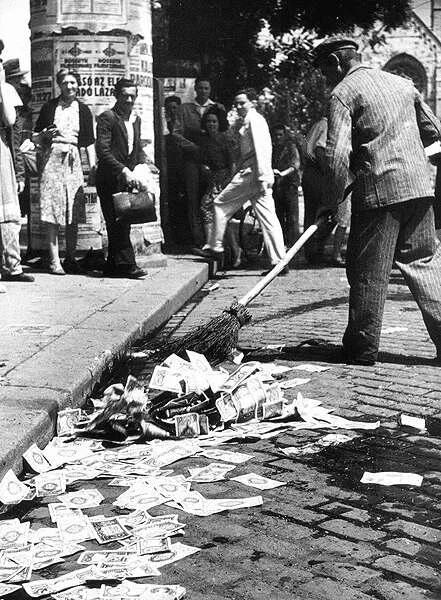
What is the opposite of this? Sweeping up in 1946 after the hyperinflation of the Hungarian pengő. Source: Wikimedia Commons, Magyar Nemzeti Múzeum Történeti Fényképtára, Budapest.
Many observers have likened the rise of Bitcoin to an asset bubble. It is so customary today to use the “bubble” word in articles about Bitcoin that there may in fact be a sort of “bubble” bubble.
Another less common word introduced in this context is hyper-deflation. Some say such a thing is horrible, others that it is great. I suggest a quite different possible interpretation of these events and a word to label them: hyper-monetization.
I first heard the term “hyper-deflation” (used in a positive sense) when Bitcoin was rising rapidly from the low thirties to the high thirties over a few days in early March (Yes, this was only a month ago). While a few specialists of a certain persuasion understand “deflation” to be a great thing for ordinary people (see, for example, my 30 March 2013 post, “A short Bitcoin commentary on Deflation and Liberty”), the word still has a public-relations problem. Along with some technical issues from its several possible definitions (price level changes versus quantity of money changes, for example), and negative interpretations in conventional economics circles, it just sounds depressing, regardless of the stated technical sense in which one attempts to use it.
The word “hyper-monetization” first occurred to me around that time as a more positive term, and perhaps a more accurate antonym for the catastrophic hyperinflations that have repeatedly killed off fiat paper monies throughout their history. A related term, “de-monetization,” denotes the process of a widely used medium of exchange ceasing to function as such.
A total hyperinflationary collapse is one way de-monetization can happen. Another type of historical example of de-monetization is “bimetallist” legal tender price-fixing schemes driving one precious metal, say silver, out of circulation in favor of another metal, say gold. Yet another historical example is when a pure fiat paper standard is created after monetary authorities permanently “suspend redemption” of their legal tender notes into the precious metals they had promised to deliver.
The opposite process of “monetization” denotes something that was not a money beginning to function as one. When euros took over the respective jobs of various European national currencies, euros monetized and the previous national currencies de-monetized. Now they are historical paper relics, but no longer function as monies.
In contrast to such a legal tender conversion/transition, however, something that gains exchange value from scratch on the open market (rather than taking up exchange value through a conversion)—and does so at a logarithmic pace—might then reasonably be described as being in a process of “hyper-monetization.”
The trouble with the “bubble” bubble
Bitcoin’s high historical and current price volatility is unquestioned. However, one problem with the “bubble” analysis is that in an asset bubble, certain fundamental matters are quite different. In a business cycle mania phase, prices of the most popular asset classes for that particular cycle are bid up as people pile their freshly printed fiat money and freshly produced fiat bank account digits into booming fields. Each party in this rush competes with all the others to acquire some of the bubbling assets. These people are misled by artificially low interest rates to bid up certain asset prices unsustainably, and this all eventually collapses, as described in Austrian business cycle theory.
However high the prices of bubble assets go, they do remain the same goods. In the case of a monetization event, though, the practical use-value of the trading unit (not only its price in terms of other goods or monies) actually does rise with the number of people using it and the depth of the market. To imagine how different this is from a classic asset bubble, it would be as if not only the price of bubble-era houses were rising, but also that their actual sought-after qualities as houses were improving spontaneously at the same time. Such houses might sprout new rooms with no one building them, with new paint jobs appearing mysteriously overnight without any painters having visited.
In this way, quite unlike the case of an asset bubble, the more people “pile into” a medium of exchange, the more valuable it actually isin its function as a medium of exchange from the point of view of its users. This is a separate matter from its price, as a few astute observers out there have so far already been noting.
This type of value has been likened to the use-value of a language rising the more people there are who can speak it. Another analogy would be to the use-value, from the point of view of each user, of a given social networking site rising the more people join it and the more they use it.
These are called network effects. In this case, the exchange value of the unit for each holder is directly related to each holder’s expectations of being able to use the unit in future exchanges (much like the value of knowing a language relates to one’s expectation of being able to communicate with it). This is in turn related to how many people accept the unit, how readily, and for what. It is important here to note, due to long-standing and common economic misconceptions, that the “future” in this sense is any future time—from five seconds from now to however many vaguely numbered years into the future a particular acting person might happen to have in mind.
When it comes to network-effect growth, the more the merrier. An analogy can be made not only to the rising stock price of a growing social networking site, but also, and more importantly, to the number of users of that site and how much it is used.
Check this box for a perspective shift
Yesterday, I saw a tweet from the insightful Bitcoin watcher Jonathan Waller. He wrote (enthusiastically, I think) that, “The bitcoin all-time chart is not even slightly sensible,” and linked to a chart [showing logorithmic growth shown on a linear scale].
This tweet got me thinking (yes, this is also a possible function of tweets). How can we make sense of this trend? Might taking some other perspective help?
This chart struck me as looking quite similar to a hyperinflation. However, instead of the exchange value of a trading unit plummeting toward the abyss as in an archetypal fiat paper-money collapse, Bitcoin has been doing the opposite.
Checking the log-scale box on the bitcoin price chart reveals a different picture. It shows a (so far) intuitively ascertainable long-term historical course with a large bump or two and some curves in the road. In this longer-term view, the exchange rate has been growing, not so much from one to two to three to four, as on a linear scale, but from 0.1 to 1 to 10 to 100. It has grown by several orders of magnitude during these couple of years.
Of course, the usual caveats must be quickly noted. “If present trends continue” can and often is infamously followed by them not doing so. But what might nevertheless be observed about this trend?
If one were somehow witnessing a phase in the first “hyper-monetization” in history, is this not more or less what one would expect to see?
Mark my words
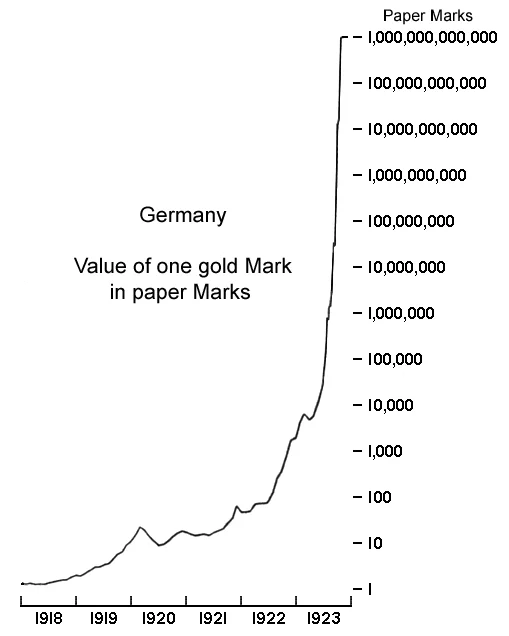
The value of a paper money at the tail end of a hyperinflationary event is mainly the direct value of the physical paper (burning, wall-paper, etc.), but there is a more gradual build-up before the final collapse. The following chart is the price of Goldmarks in terms of Papiermarks from 1918–1923 in the Weimar Republic. This includes a steady logarithmic trend from 1918 to mid-1922. The exchange rate also moves from roughly 1 to 100 during those few years.
After that, however, the 1923 portion looks incomprehensible even on a log scale. As monetary authorities run the presses full speed and add new zeroes to denominations, a point is reached toward the end when the primary objective of market participants is to rid themselves of paper as quickly as possible before the last shred of exchange value evaporates.
The USD/BTC trend shows the price of Bitcoin against (also steadily depreciating) US dollars. This bears a certain similarity to the pre-1923 phases of the Weimar Papiermark/Goldmark chart. One difference is that the trend for Bitcoin from autumn-2010 to spring 2013 is the inverseof the trend for the ill-fated Papiermark from 1918 to mid-1922. In other words, for the years in question, the rise of Bitcoin’s relative exchange value shows a statistical pattern with similarities to the decline of the exchange value of the paper mark. Of course, the specific factors behind these events are quite different. In one case, the destruction was driven by ever increasing, arbitrary production of more units. In the other, the growth appears to be driven by voluntary adoption (with all its various motivations) and network effects.
If we were now actually witnessing early stages of an unprecedented hyper-monetization event, what might the top of such an event look like eventually? This is a fantastic and entirely speculative question and certainly invites the ever risky “if present trends continue” types of thinking. Looking toward the future should never be confused with looking into the past.
That said, during such a singularity-like event, were such a thing to be occurring, one might at some fairly early stage expect to see an Epic Rap Battles of History installment called, “Bitcoin vs. Fiat Money.” The key question would then soon become:
“Who won? You decide.”
For additional articles on this topic, visit my Bitcoin Theory page on this site.
[UPDATE: Seven months later, a new article including revised highlights of this article along with new material appeared: Hyper-monetization reloaded: Another round of bubble talk (7 November 2013).]
POST FOOTER
/post
/content-wrapper
Advice about Bitcoin
By Oleg Andreev
Posted April 9, 2013
In a nutshell, this is what I tell people when they ask me if they should buy some bitcoins:
- Bitcoin is a huge thing that can transform many things in society.
- No one knows what will actually happen, there were no historical precedents.
- Do not put more money than you can afford to lose tomorrow. Do not borrow anything, do not put more than 50% of your savings, do not touch money you already have made plans for. It’s tempting, but just don’t.
- Before putting in more than $100, learn about Bitcoin, how it works, why it works, its weaknesses, popular myths, how past problems were solved etc.
- Be aware of viruses, lost passwords, lost backups, bugs, human mistakes, panics on exchanges, DoS attacks etc.
- Check and double-check and triple-check before doing anything. Play with small sums when trying a piece of software, or a service. Then wait a week and play with a bigger amount if nothing is lost or broken.
- Never blame anybody except yourself.
- You most probably will be disappointed at some point in time. You will be scammed, your money will be stolen or lost. Prepare for it.
- Never trust anyone (including me). No person has authority in Bitcoin. Even core developers are more like explorers as they didn’t write the original code and did not make a lot of decisions. And Satoshi has disappeared a long time ago.
I cannot stress it enough: even if Bitcoin becomes huge, you may still lose everything for many reasons. Be careful.
It’s a great journey ahead of us, but it’s bumpy. Don’t dive in without proper training.
The Mises Institute is clueless about Bitcoin
By Peter Surda
Posted April 17, 2013
The Ludwig von Mises Institute (the one behind mises.org, located in Auburn, Alabama) posted several articles over the last week or so about Bitcoin:
- http://mises.org/daily/6399/The-Moneyness-of-Bitcoins (Nikolay Gertchev)
- http://mises.org/daily/6401/Bitcoin-Money-of-the-Future-or-OldFashioned-Bubble (Patrik Korda)
- http://mises.org/daily/6411/The-Bitcoin-Money-Myth (Frank Shostak)
Prior to that, they posted about it during June 2011, by Justin Ptak:
- http://archive.mises.org/17249/ideological-and-irrational-exuberance/
- http://archive.mises.org/17294/a-clear-concise-look-at-bitcoin/
- http://archive.mises.org/17356/another-bitcoin-crash/
And one in October 2011, by Jeffrey Tucker:
In the meantime, Jeffrey Tucker became a Bitcoin enthusiast (disclaimer: I’ve been interviewed by Jeffrey and Laissez-Faire Books is publishing my book about Bitcoin, so I might be biased). Justin Ptak appears now to be friends (on Facebook) with Bitcoin fans. This may or may not imply his change of opinion, but it doesn’t look like he published anything more about Bitcoin at least.
Now, there is nothing wrong with criticism. And Bitcoin can be criticised, there are many legitimate objections to it. But to criticise something merely because someone feels a pressure to criticise, and then rushes to hastily print something quickly is not scholarly work. It is symptomatic that the institute didn’t publish anything in between. They are under pressure to publish something when there is a media interest in Bitcoin, and hence hastily rush to assemble something. But actual academic research appears to be absent.
The main issue appears to be the conflation of money, unit of account and a medium of exchange. Unit of account is not a necessary function of either money or a medium of exchange. It is merely a possible byproduct of it.
A further issue is the “self-reinforcing monetary spiral” (i.e. which mainstream economists call the network effect), in which one medium of exchange emerges victorious and beats all other media of exchange and that we call money. But this is merely a hypothetical model that is furthermore prone to misinterpretation. First of all, transaction costs can prevent this spiral to escalate to its final stage. Currently, we have hundred something currencies all over the world. Legal restrictions prevent this spiral from playing out. But this is merely an empirical factor, rather than a rule that gives legal restrictions magical powers. Even without legal restrictions, we can’t be entirely sure that the transaction costs won’t hinder a full monetisation.
The second issue is the neglect of other media of exchange, those that are not money. Mises calls them “secondary media of exchange”, and Rothbard calls them “quasi-monies”. These goods are liquid, and a part of their demand is due to their liquidity. They are not liquid enough to be money, but nevertheless they serve, not only through their other uses, but also through their liquidity, a valuable purpose. This is what Bitcoin is. This is what gold is too. And this is also the pool for potential candidates for money. Before something can be money, it must be a medium of exchange.
Bitcoin is somewhat liquid, and it has a very important advantage against extant money: it reduces transaction costs. It reduces transaction costs even further than existing payment mechanisms, so that even a fluctuating price is not enough to offset this reduction. We can therefore expect Bitcoin to be used as a payment mechanism in those areas where it can substitute for other payment mechanisms. This is also a type of network effect. Once they use it as a payment mechanism, people may decide that they do not actually need to fully convert it to/from fiat, and use Bitcoin as a store of value as well. Indeed, Tony Gallippi from BitPay reported (can’t find the link now) that their customers are increasingly opting to keep a larger proportion of the payment in Bitcoin, whereas at the beginning they just converted the whole sum to fiat money.
Yet again I have to quote White in his brilliant insight, which has not yet been processed by other Austrians:
“Coinage reduces transaction costs compared to simple exchange, because of authentication and weighing. Bank liabilities also reduce transaction costs. But these are empirical factors, and not something inherent in all possible monetary systems.”
Rather, other Austrians make empirical (!!!) statements like this (Salerno):
“With the use of clearing systems, money substitutes are virtually costless to transfer.”
An adoption as a payment mechanism, and expansion into a store of value are the early stages of monetisation. This is the same mechanism as the Austrians hypothesised occurred during pre-monetary times, only we now already have a different money. But already existing money is not a showstopper for this mechanism to work. Liquidity is just not the only factor influencing the choice of media of exchange. The argument of Hoppe that
“Driven by no more than narrow self-interest, man will always prefer a more general, and if possible, a universal medium of exchange to a less general or non-universal one.”
is therefore false. It is only apodictically true in a world without transaction costs. It still may happen in a world with transaction costs, we merely can’t be sure about it. And Bitcoin is a hint that empirical factors can’t be dismissed entirely. EDIT: If the statement of Hoppe was true, once money exists, it could never have been replaced by a new money, and we clearly know from history that that’s not the case.
Will Bitcoin ever become money? That’s an empirical issue and we can’t know this in advance. But equally we cannot dismiss it, unless we find a competitor to Bitcoin based on fiat money (or precious metals like gold) that is able to mitigate the transaction cost advantage of Bitcoin. And that would be very difficult to pull off. One of the reasons is the transaction costs associated with the boundary between money in the narrower sense and money substitutes (such as redemption, settlement, and so on), which Bitcoin does not need. Bitcoin is form-invariant and can exist in practically any imaginable (and unimaginable) form. The second one is regulation (management of money and money substitutes is strictly regulated and burdened by many restrictions which have nothing to do with monetary policy, such as anti-money-laundering, capital controls, war on drugs and so on). Even if regulation affects Bitcoin, unless there is an alternative that isn’t affected by regulation, there is still no reason for Bitcoin users to switch to something else.
But Bitcoin can do much more than become money. With algorithmic contracts, it can make large parts of the financial sector obsolete. With its ultra low transaction costs, it can make money substitutes redundant (and, obviously, without money substitutes there is no credit expansion and without credit expansion there is no business cycle). Again with its transaction costs and abstract base, anyone can make a payment to anyone, anytime, anyplace. Nothing that has existed so far in the history can do that. And even if we disregard it as a hypothetical, we just need to remember that gold already failed, because it was reduced from money to a secondary medium of exchange. This was only possible because money substitutes emerged. If nothing else, Bitcoin shows that money substitutes are merely an empirical quirk and not an inherent feature of monetary systems, and for that alone is it should change the landscape of the Austrian literature forever, and open a wide spectrum of possibilities for research and our understanding of money.
For more in depth analysis, I recommend my master’s thesis, or if you wait a while you can get an updated version in a book format.