
March 2013 Journal
WORDS is a monthly journal of Bitcoin commentary. This issue collects the March 2013 writing in the WORDS archive. For the uninitiated, getting up to speed on Bitcoin can seem daunting. Content is scattered across the internet, in some cases behind paywalls, and content has been lost forever. That’s why we made this journal, to preserve and further the understanding of Bitcoin.
Bitcoin and social-theory research highlights: Digging for kryptonite
By Konrad S. Graf
Posted March 6, 2013
POST HEADER
POST BODY
As I work here to organize and refine my own theoretical interpretations of Bitcoin, I try to keep searching and scanning for solid material that is already available, so as to minimize wheel-reinventing. Here are a couple of promising sources and intellectual resources I have identified so far as part of this process. Given the volume-to-quality ratio of talk out there right now, this can be a little more like digging for kryptonite than mining for mere gold or bitcoins.
Matonis, Šurda
First, wondering last weekend if Guido Hülsmann had written anything on Bitcoin thus far, I came across Jon Matonis citing Hülsmann’s “Deflation and Liberty” in an article on deflation and Bitcoin in Forbes, “Fear Not Deflation” (23 December 2012). “Deflation and Liberty” was a precursor to Hülsmann’s concise treatise, The Ethics of Money Production (2008).
Matonis’s Twitter feed soon led me to a discussion thread that contained a link to a late-2012 Diploma Thesis from the University of Vienna by Peter Šurda entitled Economics of Bitcoin: Is Bitcoin an alternative to fiat currencies and gold? [download 90-page PDF]. My first impression is that this contains significant solid information and analysis and I am looking forward to examining it. It looks like an in-depth work by somebody who combines a good grounding in economic theory with a solid understanding of what Bitcoin is, a rare blend.
I already recognized his name from various comment threads, but this discovery helps me understand one probable factor behind his comments standing out from the crowd in my eyes. One such comment thread is ongoing under the post Is Bitcoin Money? and Šurda is making what I think are some stellar observations in that conversation.
Tucker, Boyapati
Just today, I watched the new half-hour interview between Jeffrey Tucker and Vijay Boyapati on Bitcoin and monetary theory (embedded below). I think it offers an informed discussion with a refreshing frequency of solid and balanced ideas and interpretations. It was interesting for me to note matches between some ideas in this interview and similar points in my recent initial foray into this topic, “Bitcoins, the regression theorem, and that curious but unthreatening empirical world” (27 February 2013).
First, I also came up with “used for economic calculation” as one of the interpretive indicators to look for on the question of whether bitcoins are “money” or not. The empirical question this implies is: To what extent are actors doing their planning, decision-making and profit/loss calculations using the unit directly, and to what extent are they referring back to local fiat currency exchange rates?
At the same time, this “Is it ‘money’?” issue seems to be of mixed explanatory importance. While “medium of exchange” is a precise concept, the word “money” tends to suffer from being more colloquial and susceptible to shifting and varied definitions of what is or is not to be included. Debates built on shifting or non-matching definitions do not end. The value of using the “money” word therefore varies greatly with the degree to which a specific definition is out and on the table, and its use should always be tested against whether or not it is actually advancing understanding.
Second, similar to Boyapati’s take here on the first emergence of bitcoin value, my article also traced back to “coolness factors,” etc., which I characterized as psychological, motivational, and sociological elements in initial valuations. Once again, dismissing such factors as “merely” imaginary or subjectively felt factors, and comparing everything back to gold, which is “inherently valuable” (!) may risk falling back toward or into an objective-value approach in the struggle to stuff the bitcoin genie into one old bottle or another.
For additional articles on this topic, visit my Bitcoin Theory page on this site.
**
POST FOOTER
/post
/content-wrapper
Re: Bitcoin Bubble 2.0 by Patrik Korda
By Peter Surda
Posted March 6, 2013
Patrik Korda recently published an critique of Bitcoin: http://seekingalpha.com/instablog/7761841-patrik-korda/1616371-bitcoin-bubble-2-0.
I get agitated when I disagree with others, so I wrote a rebuttal.
Competition under the network effect
Korda’s first argument is that because it is easy to create a new cryptocurency, they will compete each other out of the market, kinda “race to the bottom”, ending up with a hyperinflation and a collapse. However, he does not seem to understand the network effect, one of the most important aspects of money. The network effect both allows that money actually exists in the first place, as well as creates switching costs. As JP Koning said, “liquidity is sticky”.
The problem with Korda’s argument becomes more apparent because he himself shows a counterexample. He quotes Mises in explaining that silver has been replaced by gold and this demonetised silver. This explains how competition works under the presence of a strong network effect: the expected long term state is where a small number (maybe even one) media of exchange are the dominant ones, and other market players are far less liquid. For the same reason, a situation where there is a large number of competing cryptocurrencies without clear dominant players is not a stable state, rather a small number of dominant players will emerge. The network effect is recognisable in particular with immaterial goods: there are a small dominant number of general purpose operating systems (Windows, iOS, Linux), a small dominant number of languages (Mandarin and English dominate, then Spanish and Hindi follow after a gap, and those four account for about half of the world population (I’m approximating, as people can speak more than one language)), there is only one dominant general purpose communication protocol (what we commonly call “the internet“), and so on. Surely, the composition of the dominant players can change, but it is a relatively slow process that does not magically happen overnight. Surely, there are a myriad of minor players, but there always tend to be a low number of dominant players.
If I said that everyone can create their own language, therefore without barriers to entry, everyone would end up with their own language and the ability to communicate would collapse, you’d surely think that I’m a moron.
Another important factor related to the network effect is path dependence. This means that the order in which choices are made influences the end result. This can mean, for example, the first mover advantage. Bitcoin is the first practically usable cryptocurrency, so it has a head start against others. And surely, JP Koning has a useful infographic showing that the market capitalisation of Bitcoin, the first mover, far outstrips the market capitalisation of others (by a factor of 100, at the time of making the graphic). This is also consistent with my claim from above that there typically is a small number of dominant players. Even though there is government interference in the choice of media of exchange (what we call fiat monies), international trade is affected significantly less than national, and we still have a small amount of major players (the USD and Euro).
I’m not arguing here that Bitcoin can’t be replaced by something else, but that the scenario described by Korda makes no sense.
Usability
Korda makes the argument that Bitcoin is only usable with electricity and smart phone, but this is incorrect. Bitcoin is the first form-invariant medium of exchange, and can be used in almost any imaginable form, without having to rely on a middleman. Something like this never existed before in the history. People that criticise Bitcoin from this point of view tend to confuse implementation with the fundamentals.
Mises’ Regression theorem
Korda, unfortunately, missed the core point of Graf’s article. Even if there appears to be a wide disagreement on what the regression theorem actually says, we can be pretty sure about what it doesn’t say. It doesn’t say what happens to a medium of exchange afterit becomes medium of exchange (and Robert Murphy concurs). It only talks about what happens beforeit becomes a medium of exchange. It does not say what happens between a medium of exchange becoming a medium of exchange and it becoming money, and it does not say what happens after it becomes money. It also does not talk about the scope of usage as a medium of exchange, how many people use it for something else than a medium of exchange, which media of exchange are sustainable, or any such invention that is frequently ascribed to it in particular by critics of Bitcoin. So unless Korda decides to mimick Smiling Dave and claim that Bitcoin is not a medium of exchange (and neither are gold, blue chip stocks or US bonds), the objection with respect to regression theorem is methodologically flawed.
Can Bitcoin become money?
Similarly as in the section about the regression theorem, Korda conflates medium of exchange (whatever is used in indirect exchange) and money (the most liquid good, and thus by implication, the most liquid medium of exchange). I consider the question of Bitcoin becoming money irrelevant for the near future. I have the same opinion as Vijay Boyapati, I think that if Bitcoin becomes money, that would be an unprecedented success. It would be the end of fiat money, and possibly also the state. But the implied criticism of Korda is a false dichotomy: either Bitcoin is money, or it’s useless. I dub this fallacy money or nothing (and chicks for free). Contrary to this dichotomy, there is a wide range on the liquidity scale which is called “secondary media of exchange” (Mises) or “quasi monies” (Rothbard), that do provide, through liquidity, useful services. Bitcoin’s further advantage is the decrease of transaction costs, which can be practically utilised as long as some level of liquidity persists. It already can be utilised now. There already are plenty of situations where the switch to Bitcoin improves utility. The criticism is like saying that unless everyone learns English, it makes no sense to learn it. Or even better, that it makes no sense to get an email address unless everyone uses email already.
Classification according to ToMC
As I wrote in my thesis, as Bitcoin is not money (yet), merely a medium of exchange, it is impossible to use the classification system of Mises to classify Bitcoin. If it becomes money, then we would have a classification problem. How to solve it I leave open in this post, as I consider it merely a theoretical question with no practical relevance. In my thesis I present options for solving it.
Now, Korda claims that Bitcoin is token money. However, going upwards from the bottom of the graphic in Mises’ ToMC Appendix B, Bitcoins are not token money, because they are not fiduciary media, because they are not money substitutes. The Austrians use two definitions of money substitutes (I explain the difference between the two in my thesis):
- absolutely secure and immediately payable claims to money (in the narrower sense)
- things that act as full substitutes to money (in the narrower sense) from economic point of view
Irrespective of which of these definitions is correct, Bitcoins, clearly, are neither, as there is no underlying “money in the narrower sense”. So the attempt of Korda to provide a classification of Bitcoin failed.
Anonymity
This is a complicated question, I just want to dissolve some unclarities. While some information about Bitcoin transactions is recorded in the blockchain, and publicly available, this information does not include any references to the identity of the parties involved in the transaction. While a vector analysis can reveal some relationships hidden upon first look, there are on the other hand many other things that can be done to obfuscate this. Examples are mixers (either explicit ones or ones that can do that function indirectly, e.g. Satoshi Dice), and some features that have not been fully implemented yet, e.g. transaction rewriting, or proposals for new opcodes.
From economic point of view, the “perfectness” of Bitcoin’s anonymity is not the relevant question. The relevant question is whether this is significantly (from the point of view of users) better than the alternatives, and if it presents a significant cost increase for the attacker (e.g. the state). I’ll leave this one open too, I’ll just add that for transactions that do not involve a physical meeting of the trading parties, anything else than cryptocurrencies is highly unlikely to provide a comparative advantage over Bitcoin from the perspective of anonymity.
Bubble
Korda seems to think that the question of the Bitcoin price being a bubble is important. I on the other hand consider it completely irrelevant. The relevant question is if Bitcoin decreases transaction costs, and the answer is that it does. Whether the price changes are a bubble or not does not change the answer to the question whether it has a comparative advantage against other media of exchange. The price is irrelevant (thanks for the slogan, Tony). Emphasising the bubble is kind of like saying that when the dot com bubble burst, this must mean that the internet is unsustainable and must collapse.
Almost all critiques of Bitcoin entirely ignore transaction costs. It’s like arguing that there’s no point in internet if we already have the library, the post office and the TV. According to the logic of these critiques, the businesses will decide to forego a highly profitable opportunity of providing services that increase the efficiency of social interaction and their potential customers are going to forego a reduction of costs of these interactions. Instead, the arbitrary judgement of these critics concludes that the target market is somewhere entirely elsewhere (in barter in a village, for example), and at the same time that arbitrary target market is not a good match for Bitcoin. It baffles me all the time. But I hear it all the time too. People have fixed ideas about what they think money should do, and when Bitcoin doesn’t fit into that scope, they don’t understand it. It is difficult to recognise a paradigm shift while it’s happening, but it is always obvious after it already has taken place. I guess some people just have to endure having their brains in an ignorant state while the market structure changes around them and those with more foresight are able to increase the efficiency of their business operations (and increase their profit)
My recommendation for serious economic analysis of Bitcoin is to ignore the price as much as possible, as long as there is one (i.e. the price is higher than zero). It’s simply not relevant.
Conclusion
Regrettably, Korda’s criticism contains many flaws. Hopefully I manged to address them. My most important argument is that one should be careful to avoid mixing theoretical and empirical issues. To summarise my counterarguments:
- Due to network effect, the market structure will move towards a small number of dominant cryptocurrencies, so there’s no hyperinflation
- Whether Bitcoin can become money is not important, as using it is already advantageous now, as a medium of exchange. If it ever becomes money, that would really rock though.
- Non-economists do not understand the regression theorem and invent their own versions of it which are nonsensical
- Bitcoin is not token money as it never was a money substitute
- Bitcoin is pseudonymous, and has a comparative advantage against competitors from this point of view
- The price of Bitcoin is irrelevant
The classification and the future of Bitcoin (another Re: Patrik Korda)
By Peter Surda
Posted March 12, 2013
A short while ago I wrote a post where I made some arguments regarding an earlier article about Bitcoin by Patrik Korda. Patrik and I had a long session in the comment section after the article and I’d thought I’d provide a followup. I hope I don’t misrepresent his position, but I think I have a pretty good idea by now.
Patrik looks like a smart chap, he makes plenty of reasonably arguments, and it turns out that we actually agree on a very large proportion of arguments about economics and Bitcoin in specific. He can make on topic responses, which is not that common in internet debates. Nevertheless, in some important issues we disagree and I think these merit a closer assessment.
Classification of Bitcoin
Patrik argues that it is problematic to classify Bitcoin from Austrian perspective as a type of money, because it does not clearly fit into the decision tree presented by Ludwig von Mises in Theory of Money and Credit. So far, I agree with him. This is what I wrote in my thesis:
However, should it develop into money, it could present a problem. Bitcoin is not and never was a money substitute, never had a special legal status, nor was it a claim against anybody, nor was a commercial commodity. Therefore, it would not fit into any of the subcategories of the classification.
Now, merely because we cannot classify something, that does not really mean that there is an actual empiricalproblem. In Antifragile, Nassim Nicholas Taleb argues that the inability to formulate knowledge verbally is not a valid reason for ignoring this knowledge. I remember that during my studies I read something similar. Tacit knowledge still has an important role in our activities, and ignoring it decreases our ability to make sound decisions. It’s funny that I agree with Taleb, because I’m usually pretty anal about getting the definitions right and I go mental when people cannot formulate coherently.
The issue here, however, is not some abstract classification for its own sake, so that I know what shelf to put books about Bitcoin into in a library. The purpose of the classification system provided by Mises is to assist in the economic analysis of trade, money supply, price building, liquidity and so on. From this perspective, if we insist that we must keep the number of categories the same that Mises used, the economically closest category of Bitcoin would be commodity money.
There are several reasons for this. First of all, Bitcoin never was a claim against anyone (credit) (or, if we use the second definition of money in the broader sense, it never was a nearly perfect substitute to any other money). Patrik claims that if Bitcoin trades against fiat money, it means it’s a money substitute, and the issue of a exchange rate is irrelevant. However, the Austrian economists disagree:
- Rothbard in Austrian Definitions of the Supply of Money (referring to Mises):
Because, as he pointed out, bank demand deposits were not other goods and services, other assets exchangeable for cash; they were, instead, redeemable for cash at par on demand. Since they were so redeemable, they functioned, not as a good or service exchanging for cash, but rather as a warehouse receipt for cash, redeemable on demand at par as in the case of any other warehouse. Demand deposits were therefore “money-substitutes” and functioned as equivalent to money in the market. Instead of exchanging cash for a good, the owner of a demand deposit and the seller of the good would both treat the deposit as if it were cash, a surrogate for money.
Bluechip stocks, for example, can be easily sold for money, yet no one would include such stocks as part of the money supply. The operative difference, then, is not whether an asset is liquid or not (since stocks are no more part of the money supply than, say, real estate) but whether the asset is redeemable at a fixed rate, at par, in money. Credit instruments, similarly to the case of shares of stock, are sold for money on the market at fluctuating rates. The current tendency of some economists to include assets as money purely because of their liquidity must be rejected; after all, in some cases, inventories of retail goods might be as liquid as stocks or bonds, and yet surely no one would list these inventories as part of the money supply. They are other goods sold for money on the market. [emphasis added]
To paraphrase the Austrian masters, money substitutes are perfectly secure and IMMEDIATELY convertible, PAR VALUE claims to standard money which, by virtue of this immediate convertibility substitute FULLY for standard money in individual’s cash balances, and as such, are used by individuals as a surrogate for cash – namely, a thing that all other goods and services are traded for, the final payment for such goods and services on the market. [emphasis added]
- and finally, the urquelleof all, Mises in The Theory of Money and Credit:
The special suitability for facilitating indirect exchanges possessed by absolutely secure and immediately payable claims to money, which we may briefly refer to as money substitutes, is further increased by their standing in law and commerce. [emphasis added]
Admittedly, he does not use the term “par value” here, but later, he points out to the difference in price when differentiating between credit money and money substitutes:
A third category may be called credit money, this being that sort of money which constitutes a claim against any physical or legal person. But these claims must not be both payable on demand and absolutely secure [i.e. the criteria that Mises uses to define money substitutes, ed]; if they were, there could be no difference between their value and that of the sum of money to which they referred, and they could not be subjected to an independent process of valuation on the part of those who dealt with them. [emphasis added]
Bitcoin is not a claim, nor is it treated at par with anything else. It is, to use Mises’ terms, subjected to an independent process of valuation. It therefore cannot be a money substitute according to Mises. The issue is exacerbated because Patrik refuses to answer the question who is Bitcoin a claim against, i.e. whois obligated to redeem it (I’m sticking to Misesian terminology here, I disagree with the Austrians that money substitute must be a claim, but that just means I put more relaxed restrictions on Patrik than Mises would).
This eliminates the option of classifying Bitcoin as a money substitute, but also credit and fiat money (as according to my interpretation of the regression theorem, these have to begin as money substitutes), and the only option remaining is commodity money. Another reason for classifying Bitcoin as commodity money is the inelasticity of supply. Detlev Schlichter made the same argument, and the paper of George Selgin can probably also be interpreted from this perspective. Yet another alternative approach is that with commodity money, the marginal production costs and the market price tend to be close to each other (and Bitcoin fits here too).
If we insist on the Misesian definition, then we’re stuck with the controversial question of whether Bitcoin is, or was, a commodity. I don’t want to get into that. The alternatives that I provide might or might not mean it’s a commodity, but I think it gets the economic fundament of both gold and Bitcoin more accurately. But we should at least be able to say that Bitcoin is a quasi-commodity, or that it’s a commoditised service, if we insist on using “commodity”.
Bitcoin is not the only medium of exchange that shows the Misesian definitions inadequate. For example, the old Somali Shillings still work as money. They do not have a special legal status anymore, they just used to have one in the past (that is how they obtained their initial value). So they used to be fiat money, but they evolved into something which a strict Misesian can’t classify (quasi-commodity money, as Selgin suggests). The old Somali Shillings have been counterfeited so much that their production price is close to their market value. During the inflation the supply was elastic but now that the market price has dropped it’s not elastic anymore. We see on this example that the removal of the legal status causes them to eventually gain features similar to the “real” commodity money. Another example of insufficient classification system are various complementary currencies, mutual credit, LETS, or privately issued scrip like Ithaca Hours or BerkShares. Now, these are technically not money yet, merely media of exchange (same situation as Bitcoin), but if they ever developed into money, the question of classification would arise (I use a bit more relaxed definition than Mises, so to me, they would then count as money substitutes).
I think that rather than insisting on a particular umbrella classification system, the classification should be done from the perspective which is most relevant for a particular context. In most economic debates, I tend to agree with Schlichter and Selgin that the elasticity of supply is the most relevant criterion. But I presented several other options too, they might be more suitable for different situations.
The future of Bitcoin
The question of classification of Bitcoin might be a bit boring. The question of the future of Bitcoin is probably much more interesting.
Patrik makes two separate arguments. The first one is that the latest price developments of Bitcoin are a bubble. I have absolutely no problem with this argument. I’ve been hesitant to make predictions about price myself, I don’t think that that fits into the economic category. He could very well be right in this point. This is what I wrote on March 5th, around the same time that Patrik wrote his article:
BTW I would be caution of not calling the increased price a bubble. The relevant factor for monetisation is liquidity and I haven’t seen an improvement of liquidity (measured as bid/ask elasticity of Mt. Gox as laid out in my thesis), however I didn’t analyse data after beginning of January (I don’t have the full data set yet), so I am not making a final statement.
This post is not publicly available but I’m sure people who have access to it can confirm that I’m not making this up.
However, Patrik makes a second argument too. He claims that this is relevant for the future of Bitcoin. And here is where we disagree. In the previous article, I argued that due to the network effect, I expect a small number of dominant cryptocurrencies to emerge, even if their relative market share and composition changes. Patrik however seems to have a more fundamental argument, in that the market shares will change quickly and unpredictably. This I also do not hold realistic, and will attempt to address it in this section.
This section will be a bit more loose than normally. I’m not going to make a “hard” argument, merely point out to factors Patrik missed and that might be relevant. First I will formulate a “rule of thumb” for how I think the network effect behaves under competition, and then I’ll explain it on the examples presented by Patrik, and some of my own.
- If a protocol is technologically better suited to fulfill the requirements of the users, it will take the leading role
- Friction could prevent a change in the market share if the advantage is not sufficient
- If protocols are technologically too similar to provide advantages vis-a-vis each other, a lagging one won’t overtake the leading one (path dependence)
- State interference can count as technological advantage
- Multihoming (using of more than one standard simultaneously) is only possible to a certain extent, and can’t affect the fundamental issues long term
The example Patrik uses are P2P protocols. Let’s take a look at the history of the leaders (I’m approximating):
- 1999-2001: Napster. First mover advantage.
- 2001-2004: Kazzaa (FastTrack protocol). Won over Napster because Napster shut down.
- 2004-2007: eDonkey. I think it won because it was less centralised and Kazzaa was hostile against third party clients.
- 2007+ BitTorrent. I think it won because it is less centralised, and open source. BitTorrent is the only one that actually gained wider industry acceptance (e.g. Blizzard downloader uses it).
There is nothing unusual here. All this is perfectly reasonable in hindsight. Purists might argue that Napster shut down because it lost a trial and that’s not an endogenous failure, but clearly if a leader wants to keep its leading position, it needs to be able to resists the law, i.e. the resistance, or lack of it, is an endogenous property. We can also note that the newer leaders were increasingly less centralised and more resistant to legal action: while Napster was shut down with a single lawsuit, BitTorrent has several unrelated trackers, and also DHT, so a shutdown of one company has little effect on all users.
Furthermore, as the old leaders do not provide an technological advantage against Bittorrent, they are unlikely to take leading position again. What would take a leading position is something with a significant technological advantage over BitTorrent. At the moment there is no visible challenger. We could say that the technology matured.
Let’s take at other examples. Some of the reasons below are subjective, if you think you have a better explanation, I can adapt it.
Browsers. Internet Explorer was the market leader. Then Microsoft stopped spending development resources on it because they didn’t appreciate upcoming technological challenges. Eventually, Chrome took the lead, and I think it’s because it’s technologically superiour.
The internet took over IPX, NetBeui and other stuff because it’s technologically superiour. There is no visible challenger at the moment (at best, IPv6 is a challenger to IPv4). VHS took over Betamax becuase it provided longer recording time.
Then we have examples of standards that are too similar. The metric system versus the imperial system only switch due to state interference. BluRay was too similar to HD-DVD and they also had similar market shares, but BluRay eventually got a majority of industry support and HD-DVD discontinued.
Now, how do we apply that to Bitcoin? The various altchains are, in my opinion, too similar to Bitcoin. None of them provides a meaningful technological superiourity. Therefore, I expect Bitcoin to remain the leader. If something challenges Bitcoin, it would be something with meaningful technological superiourity. Furthermore, the relevant factor that approximates “market share” isn’t really the market capitalisation. Rather, it’s liquidity. Even if one of the cryptocurrencies bubbles up and overtakes, unit per unit, the price of Bitcoin, it still won’t overtake Bitcoin unless it also overtakes its liquidity. And that takes much longer to build up than just one bubble.
Furthermore, while people might multihome different cryptocurrencies (i.e. to use them in parallel, the costs are relatively low, so it’s not a big problem), in the end they still use one standard for economic calculation. Nowadays this is typically their national fiat money. Even if then every cryptocurrency user would multihome, as their industry sector moves from fiat to cryptocurrency, they would choose one of them to do economic calculation, and then there would be a convergence on this level, and this would play out as the network effect. Rothbard makes the converse argument than me, in The Case for a Genuine Gold Dollar. He argues that merely because competition in media of exchange is allowed (as per Hayek), that does not mean that people would switch their unit of account (and without it the network effect can’t kick in). That’s essentially the point (3) from above. He however misses the possibility of capturing market share through technological improvement (Hayek missed it too, so I’m not really blaming Rothbard). He implies that the Hayekian private media of exchange would have the same transaction costs as coins or money substitutes that people use otherwise.
Summary
The classification of Bitcoin is problematic, but it’s not an unsolvable problem. Bitcoin is not the only thing that challenges the Misesian definitions though. I recommend analysing economic fundamentals and context.
Competition under the network effect does not behave erratically, even if the people involved might. While switches in the leading position can occur, they are, within reasonable limits, predictable. More precisely, we can reasonably predict what won’t happen. Altchains are unlikely to displace Bitcoin, due to path dependence.
I’m too lazy to check the whole post thoroughly, if you find any errors please let me know and I’ll fix them.
IN-DEPTH | The sound of one bitcoin: Tangibility, scarcity, and a “hard-money” checklist
By Konrad S. Graf
Posted March 19, 2013
POST HEADER
POST BODY
The first purpose of a scientific terminology is to facilitate the analysis of the problems involved.
—Ludwig von Mises on the role of monetary terminology

IMPORTANT UPDATE: What follows has been substantially updated, revised, and republished in other versions. The final version appeared in The Journal of Prices and Marketsas, “Commodity, scarcity, and monetary value theory in light of bitcoin” (accepted 20 Oct 2014; published 24 Feb 2015; HTML, PDF). The arguments are substantively similar, but whereas the final version is more refined and academic in tone, the following was an initial overview treatment.
Tradable bitcoin units viewed as discrete objects of human action appear to be a new type of phenomenon, unprecedented. At times, they even appear to elude trusted monetary classification schemes. If such typologies were sound, however, they should not require correction so much as some careful revisiting within a new context of knowledge.
In this second installment on Bitcoin theory (following “Bitcoins, the regression theorem, and that curious but unthreatening empirical world” (27 February 2013), we seek to further clarify the economic nature of Bitcoin by closely reexamining the concepts of scarcity, goods, and tangibility. We distinguish what we will label economic-theory and property-theory senses of the word “scarcity” and attempt to more clearly differentiate scarcity from tangibility. This distinction helps overcome difficulties that have arisen in considering Bitcoin in relation to the monetary classification scheme pioneered in Ludwig von Mises’s The Theory of Money and Credit (TMC; original German 1912).
With these proposed building blocks in place, we examine bitcoin units viewed as scarce objects of human action using a typical set of criteria for explaining the historical-evolutionary strengths of metallic coins as media of exchange. How do tradable bitcoin units stack up directly on a list of “hard-money” criteria?
We also stress that the economic analysis of empirical cases must always be comparative. States of perfection, while useful in the advancement of pure theory, cannot legitimately be smuggled in to represent real empirical possibilities and serve as standards for comparison. How something compares to an imaginary state of perfection may help the theorist reason, but it is no cause to reject or prefer any real empirical option, which, whatever it may be, can never compete with any unrealizable, imaginary state.
The focus this time remains on the perspective of individual actors and discrete objects involved in action (which includes both tangible and intangible “objects”), with a central focus on economic theory. Planned future installments will then shift toward more system-level, market-level, and legal-theory perspectives. This step-by-step procedure reflects one aspect of an integral approach to the interplay of individual and system perspectives, as well as the parallel use of multiple, discrete fields, to enhance the totality of understanding.
Part I: Money Unveiled
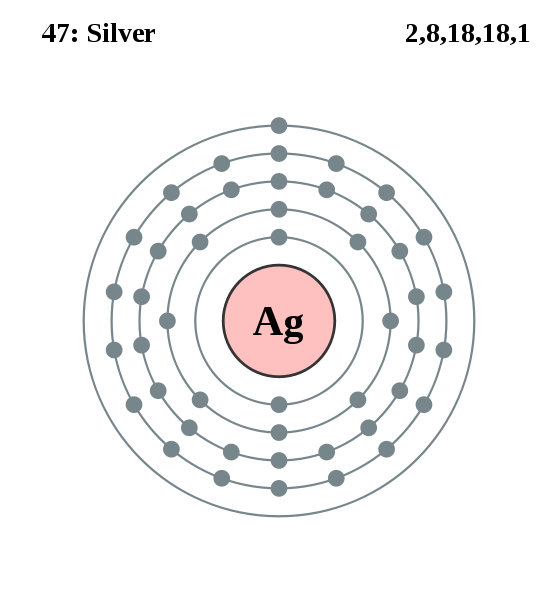
“I can pay you in eggs or a bunch of these specially configured nested electron-shell wrapped neutron/proton bundles. Your choice, buddy.” Image source: Pumbaa (original work by Greg Robson), Wikimedia Commons.
The thing is…
In taking a strictly subjectivist position on the nature of goods, the fact that bitcoin units might be described as “merely” the current status of accounting entries in the ubiquitously duplicated block chain (and therefore not “really” goods at all in themselves), poses less of a difficulty than it might at first appear to. Of interest for action-based economic theory is the observation that large numbers of market actors on a global scale are nevertheless treating these units as a type of scarce economic good in general and as a medium of exchange in particular. By way of illustration, quipping that silver is “really” just one particular and generally pointless arrangement of sub-atomic particles is of no avail for praxeology, which is based on a strict dualist distinction between teleological concepts and the more objective, causal concepts of the natural sciences.
If no existing category or “box” on a given monetary classification proved sufficient to contain Bitcoin, a new category might have to be appended. In investigating a new case, terms and categories should facilitate understanding rather than hinder it. In developing his terminology in Chapter 3, “The Various Kinds of Money,” in TMC (pp. 50–67), Mises sought to employ terms that would specifically facilitate economic analysis more effectively than the conventional and positive-law terms of the time (pp. 59–60). He notes on pp. 61–62 that:
Our terminology should prove more useful than that which is generally employed. It should express more clearly the peculiarities of the processes by which the different types of money are valued. [it should also help to overcome] the naive and confused popular conception of value that sees in the precious metals something “intrinsically” valuable and in paper credit money something necessarily anomalous. Scientifically, this terminology is perfectly useless and a source of endless misunderstanding and misrepresentation.
I do not believe that Mises’s classification scheme from TMC requires any fundamental revision to account for Bitcoin. We may only need to take a further step in the direction of a strictly dualistic action theory. This is the same direction of travel that gave rise to those classifications in the first place as Mises began to carry economic theory step by step further away from its objectivized past and toward its action-based future. Mises warned sternly in 1912 (p. 62) that:
The greatest mistake that can be made in economic investigation is to fix attention on mere appearances, and so to fail to perceive the fundamental difference between things whose externals alone are similar, or to discriminate between fundamentally similar things whose externals alone are different.
A fresh mystery from Vienna
Stephansdom in Vienna. Photo by Konrad S. Graf.
Among its many other contributions,Peter Šurda’s 2012 thesis, “Economics of Bitcoin: Is Bitcoin an alternative to fiat currencies and gold?” [90-page PDF; Vienna University of Economics and Business) carefully examined Bitcoin in terms of Mises’s monetary classification scheme from TMC. Up to a certain point, Šurda interpreted the situation in largely the same way as I have.
In a procedure reminiscent of the 1939 Agatha Christie novel And Then There Were None, he rejected, correctly I believe, one candidate after another as a place for Bitcoin within the TMC scheme (pp. 23–28). It is not any kind of money substitute (Bitcoin is not “redeemable” for any more fundamental unit). Even within Mises’s “money in the narrower sense” (senses other than money substitutes), Bitcoin is not credit money (no creditor/debtor relationship exists) and not fiat money (it lacks any legal-tender status or any other state-sponsored privileges, stamps, or certifications whatsoever to “prop it up”).
Somewhat disquietingly perhaps, Šurda and I had each arrived independently at just one final suspect. The only candidate that is even a remote possibility is: “commodity money.”
Yet surely this could not be quite right either. At this point, one might think it would have been easier to start by rejecting commodity money, and then try to make an analogy to some of the other categories. Commentators have tried to do this variously with fiat money and token money, for example. However, I do not think such claims hold up to scrutiny.
It is certainly quite odd in this context to begin trying to imagine Bitcoin as a “commodity.” True, in certain other contexts, “commodities” can have a quite broad meaning. In its broadest theoretical usage in purchasing-power theory, “commodities” are sometimes the euphemistic label for everything that is not money—all that against which money prices are paid. Nevertheless, for the most part, and certainly in this context, “commodity” takes its narrower and much more common meaning. It is a fungible physical material or product, such as metal, oil, grain, or these days interchangeable “commodity” memory chips or other general-purpose electronic components.
The opposite perspective: Vienna from high above in Stephansdom. Photo by Konrad S. Graf.
In the face of this apparent impasse, Šurda’s thesis next proposed several considerations. First, since he had already argued that Bitcoin is not a “money” (yet), but a secondary medium of exchange (p. 22), it need not necessarily fit on a chart of “money” in any case. Yet he also recognized that to some degree this just kicks the can down the road a few more yards. What if Bitcoin did somehow grow to eventually qualify as “money,” even by his own chosen definition? To this he proposed some alternative terminology from several existing sources (p. 26), such as “quasi-commodity money.”
He offers additional detail on this issue is in his recent post, “The classification and future of Bitcoin” (12 March 2013), where he notes perhaps the most important point of all:
The issue…is not some abstract classification for its own sake. The purpose of the classification system provided by Mises is to assist in the economic analysis of trade, money supply, price building, liquidity and so on. From this perspective, if we insist that we must keep the number of categories the same that Mises used, the economically closest category of Bitcoin would be commodity money.
I think further clarification may still be possible from some different directions. I suggested in the previous installment of this series that substituting the more subjectivist word “good” for “commodity” may already be a useful step, at least from a meaning-content point of view. This time, we venture further into language and context.
As always, meaning must come first; words have to follow along as best they can. Concepts are one thing; the words used to signify them another. To me these are not just theoretical claims, but my lived experience working as a professional translator for many years (Japanese to English as it so happens). A good translator is constantly at play with the concepts and meanings that the various words are employed, at times somewhat imperfectly, to get across from mind to mind in given times and contexts. One of the first things it occurs to my translator self to do is to check into the source text and consider what, if anything, might be noticed there that may not occur to a reader of the resulting translation. It is also often helpful to consider the background context of debates in which words were employed.
TMC is a translation of Mises’ 1912 Theorie des Geldes und der Umlaufsmittel. “Commodity money” was the term used to translate Sachgeld.Although some issues have been found with the TMC translation, including most notably the title itself (see the recent centennial symposium volume,The Theory of Money and Fiduciary Media(2013), “commodity money” seems a perfectly reasonable translation in this case. To be clear, I am aware of no reason to think that Mises would have objected, or did object, to this choice. In Nationalökonomie, the 1940 German precursor to Human Action, many instances of Sachgeld are accompanied by the usual examples of gold and silver, which also serve as the stock examples of “commodity money” in Human Action in 1949.
Nevertheless, our purpose is not to toy with words, but to better understand their theoretical content and meaning, and specifically to look for some assistance on the challenge of reconciling Bitcoin with Mises’s original categories. Bitcoin is a novel enough development that it forces us to revisit in a new context of knowledge fundamental concepts that were arranged and labeled as they were in a previous context of knowledge.
In this process, one language might provide hints that another withholds. A word that was unobjectionable in the past might begin to suffer now for the first time from outmoded or non-essential connotations. Moreover, this is likely to occur somewhat more strongly with regard to the particular words and senses of words used in one language than with the corresponding words and senses of words used in another. It is in this spirit that some multilingual brainstorming might lead to a missing clue.

Lt. Cdr. Data sleuthing in Star Trek: The Next Generation.And indeed, the two-part compound construction of the German word Sachgeld suggests some related connotations that “commodity money” in English does not. Die Sache is a “thing,” in either a concrete or abstract sense. Alternative senses from this word and associated compounds readily include such abstract senses as “the matter at hand,” “the facts of the situation,” and “the main or most important point or issue.” A Sachbuch is a non-fiction book (not a “commodity book,” but a book about any non-fictional topic, a “factual book” as opposed to a fictional one). Sachgeld itself in modern dictionaries comes across as any “thing” (or even animal or person) that was historically used as a medium of exchange, or simply the earliest forms that money took historically (note that historically here also implies prior to the evolution of money substitutes).
It appears that Sachgeld, in its first, most literal possible sense, looks like “thing-money” or “fact-money.”
This may already be enough of a clue to begin threading a path through the “commodity” puzzle that Bitcoin, perhaps now for the first time ever, presents. One of our central underlying themes this time will be continuing to seek ways to disentangle the concept of tangibility from various other concepts relevant to monetary theory, especially scarcity. A “thing” is usually considered tangible, but unlike “commodity” in its relevant monetary meaning (a fungible physical material), “thing” more easily also covers abstract senses such as “matters at hand,” “conditions,” and so forth, as in, “The thing is…” or “How are things going?” or “It is a curious thing, this Bitcoin.”
At this stage, rather than creating an alternative category, or turning to a sub-category such as “quasi-commodity money,” it may only be necessary to revisit the original concept of Sachgeld such that it takes on a more abstract and subjective, and less concrete and objective, sense than it has ever been asked to. This would also seem to be in keeping with the overall long-term direction of development of the Austrian school of economics in distinguishing ever more carefully between action-based teleological concepts and objective characteristics of various means employed in acting.
It appears, then, that we might interpret the central economic meaning of Mises’s monetary category of Sachgeld as something like “thing-in-itself money,” or “money in itself,” or “money in fact,” and my re-reading of Chapter 3 of TMC does not appear to exclude this possibility. Much as a silver coin in the old days functioned directly as “money in itself,” and was not “backed by anything,” a bitcoin unit is likewise not “backed by anything.” Nor is it even a perfect or imperfect substitute for anything else. From the point of view of economic actors using it, a bitcoin unit is the tradable good itself. No intermediating substitutes stand between it and its user. And the mere existence of various service providersdoes not automatically imply that money substitutes are in play.
Paper fiat money is “backed” by such factors as user experience from the past, legal tender laws and user expectations of their continuation, and other powers suppressing certain forms of competition. But Bitcoin enjoys no such force of either habit or law. Moreover, a study of the Bitcoin system suggests no obvious need or function for such money substitutes as have historically grown up around metallic currencies. Not that they are impossible, just that they would not appear to add value. They could even subtract value by adding superfluous risk layers. Many of the advantages that typical money substitutes had in the past, such as freedom from the weight burdens and creeping heterogeneity of precious-metal coins from gradual wear, are already provided in Bitcoin from the point of view of users of “the thing itself” (a topic also addressed in more detail below).
Some knightly context
For an initial check on how well this proposed interpretation might mesh with the greater context in which TMC appeared and its major contributions, we rely on Professor Hülsmann’s definitive intellectual biography, Mises: The Last Knight of Liberalism (2007).
First, we find that Hülsmann noted on p. 215 (emphasis mine) that:
In dealing with the nature of money, Mises relied heavily on the work of Carl Menger. The founder of the Austrian School had shown that money is not to be defined by the physical characteristics of whatever good is used as money; rather, money is characterized by the fact that the good under consideration is (1) a commodity that is (2) used in indirect exchanges, and (3) bought and sold primarily for the purpose of such indirect exchanges.
The words “good” and “commodity” as we read this passage would normally seem to point to physical characteristics, and this was most likely also the intended meaning. But what if we try reading again with abstract senses for these words in mind? The substantive points in this paragraph are all about functional characteristics of money for actors. Look for the verbs: used as, bought,andsold. Moreover, “physical characteristics” are specifically singled out as factors on which money is “not to be defined.”
In quickly reviewing Mises’s typology of monetary objects (pp. 216–217), Hülsmann notes that:
[Mises] distinguished several types of “money in the narrower sense” from several types of “money surrogates” or substitutes. Money in the narrower sense is a good in its own right. In contrast, money substitutes were legal titles to money in the narrower sense. They were typically issued by banks and were redeemable in real money at the counters of the issuing bank.
Here we have the word “good” again. We also have “a good in its own right.” This seems reminiscent of our hyper-literal attempt at rendering Sachgeld as “thing-in-itself money,” or more simply “money in itself.” So far as I am aware, Bitcoin currently has no significant substitutes and virtually no issuers of any such substitutes. Perhaps with a few arcane or experimental exceptions, Bitcoin is so far traded directly**as itself at freely fluctuating rates against all other goods, services, and monies. While the construction of Bitcoin-denominated financial instruments is possible, most all of the actually traded forms of Bitcoin are direct instantiations of bitcoin units.
As Šurda explained (pp. 9–18), Bitcoin is already inherently “form-invariant,” much as language can come in spoken and written forms, but remains language. “Transfer of Balances (ToB)” methods convey Bitcoin units from one wallet to another, while “Transfer of Keys (ToK)” methods, suited for offline use, transfer physically instantiated wallets that contain specified Bitcoin balances (effectively denominations). The private key is physically contained inside a ToK object in the shape of a coin, smart card, etc. with structural and one-time-change physical security features such as holographic coverings and color-change chemistry. Critically, the current wallet balances on ToK objects can be verified if necessary using only the public key without the need to expose the physically concealed private key to any party. None of these ToK objects are Bitcoin substitutes; they are each native forms of Bitcoin itself.
The question of whether actual Bitcoin substitutes and associated practices entailed in the kind of “banking” we are accustomed to could evolve on top of Bitcoin is a separate and open one. Šurda has also just recently offered some further observations on this in an interview with Jon Matonis in American Banker, “How cryptocurrencies could upend Banks’ monetary role” (15 March 2013).
The key issue seems to me that Bitcoin both functions as a money in itself and delivers many of the benefits of historically evolved money substitutes, leaving little demand for them to grow up in relation to Bitcoin, at least in the same old ways. In a provocative take on the question of Bitcoin money substitutes, Pierre Rochard has suggested that this type of development might simply render the ongoing debate about banking reserve practices not so much resolved as obsolete (22 February 2013). People will of course attempt to construct all such familiar instruments, but whether they can add any value relative to native Bitcoin and attract any sustained and significant use remains to be seen.
Mises, in developing his own monetary theory in TMC, was also arguing against the assignment theory of money, which holds that money has no real value of its own to actors, but merely functions as a sort of neutral receipt that facilitates deposits and withdrawals on the “social warehouse” of goods. Money, in this view, is simply a “veil,” functioning as a sort of mere claim ticket exchangeable for other goods, but not a good in itself.
On p. 237, Hülsmann explains that:
Mises’s great achievement in his Theory of Money and Credit was in liberating us from the veil-of-money myth…Mises could even rely on Menger’s theory of cash holdings, which already contained, in nuce, the insight that money is itself an economic good and not just representative of other goods.
Böhm-Bawerk had put it this way in an early-1880s lecture (p. 235):
Money is by its nature a good like any other good; it is merely in greater demand and can circulate more widely than all other commodities. Money is no symbol or pledge; it is not the sign of a good, but bears its value in itself. It is itself really a good.
Hülsmann explains the role of Mises’s strict terminology in countering the prevailing assignment theory of money (p. 237):
To combine these elements into one coherent theory required a radical break with time-honored pillars of monetary economics, in particular, with the classical tradition of presenting money as a mere veil. Mises was fully conscious that this was the key to his theory, which is why, in an introductory chapter of his book [Chapter 3], he engaged in the somewhat tedious exercise of distinguishing various types of money proper (money in the narrower sense) from money substitutes. It was these substitutes in fact that were the sort of tokens or place holders that Wieser and the other champions of the assignment theory tacitly had in mind when they spoke of money…While it is true that the value of a money substitute corresponds exactly to the value of the underlying real good (for example, one ounce of gold), the value of the gold money itself does not correspond to anything; rather it is determined by the same general law of diminishing marginal value that determines the values of all goods.
This greater context clarifies that “money in the narrower sense” is a form of money valued directly without any intermediation of substitutes and without mere veiled representational reference to other goods. Money was not just a placeholder or accounting entry, a claim ticket for other goods. It was one good trading for other goods on the market. Moreover, Sachgeld, “money in itself,” was further differentiated from Mises’s other two monies “in the narrower sense” by not being a debt instrument (credit money) and also not depending on any official legal certification or special legal status (fiat money). The primary distinction of money in the narrower sense among all other goods was its wider relative marketability, as Böhm-Bawerk had explained.
This higher degree of marketability then gives rise to an increased value of money as a hedge against uncertainty. If no uncertainty existed, there would be no need to hold cash balances. As Hoppe explains in “‘The Yield from Money Held’ Reconsidered” (2009), in the real and always uncertain world, we do not know in advance exactly what we will want to buy and when, but we do know with much higher certainty that we will want to buy something sometime. The holding of cash balances can be understood as a forward-looking measure we take in relation to this degree of perceived uncertainty.
No coinbug likes inflation
Whatever the future brings, for today, at least, Bitcoin seems to behave very much like a “money in itself,” but one unlike any the world has ever seen. It is digital and it is apparently impossible for any party to manipulate its total supply. This is critical, because one of the central political-economic monetary issues is inflation, by which I mean specifically, the ability of money producers to manipulate the money supply for whatever reasons they might happen to have in mind or cite at a given time.
As Mises wrote in TMC (p. 428):
It is not just an accident that in our age inflation has become the accepted method of monetary management. Inflation is the fiscal complement of statism and arbitrary government.
He also explained the social-protective advantages of having precious-metal coins circulate physically (p. 450):
Gold must be in the cash holdings of everybody. Everybody must see gold coins changing hands, must be used to having gold coins in his pockets, to receiving gold coins when he cashes his pay check, and to spending gold coins when he buys in a store.
This might seem at first to be the definitive Misesian endorsement of circulating metallic coins. Yet as Hülsmann notes in this context, “Mises had not become a gold bug. He had no fetish about the yellow metal or any other metal” (Last Knight, p. 922). Hülsmann then points us to the reasons behind Mises’s proposal—to help counteract the advance of inflationary policies (TMC, pp. 451–52):
What is needed is to alarm the masses in time. The working man in cashing his pay check should learn that some foul trick has been played upon him. The President, Congress, and the Supreme Court have clearly proved their inability or unwillingness to protect the common man, the voter, from being victimized by inflationary machinations.
The function of securing a sound currency must pass into new hands, into those of the whole nation [world?]…Perpetual vigilance on the part of the citizens can achieve what a thousand laws and dozens of alphabetical bureaus with hordes of employees never have and never will achieve: the preservation of a sound currency.
At this point, much appears to hinge on the definitions of “good” and “commodity.” Must they necessarily maintain their historical associations with tangibility? It is therefore to tangibility, and in particular its relationship with scarcity, that we now turn. Against all the temptations to try to drop Bitcoin into one old basket or another, can Bitcoin nevertheless stubbornly hold out and demand recognition as something new in the world?
[Intermission]
Part II: The Sound of One Bitcoin
That intangible sense of scarcity

In further considering Bitcoin and monetary theory, the concepts of goods, scarcity, and tangibility must be carefully differentiated. Scarcity and tangibility were long inseparable in the form of monetary metals. They remain fused in most familiar goods.
But what if factors other than tangibility, per se, such as relative stability of total supply, durability, and divisibility, were the essential factors even in evolutions of metallic media of exchange? What if tangibility was something of a monetary “inactive ingredient,” a “material carrier” for those other qualities, which had actually always been the essential ones?
Digital goods have brought the separability of goods from tangibility front and center in the modern world. To apply these concepts now to the case of Bitcoin, we revisit their various senses and definitions, including some recent refinements.
Copying is not theft
Most digital goods, such as song or text files can, in principle, be copied ad infinitum even as any earlier copy from which other copies are made remains entirely unchanged.
This was the essence of the digital-information revolution. Unlimited numbers of people could use copies at the same time without direct mutual interference or degradation of the integrity of any earlier copies. A copy could be made without the original disappearing, as would be the case with theft or any other kind of transfer. Moreover, any copy could then become a new, equally serviceable “original” from which new copies were made from there. “Originals” would not even degrade with time or use, as is the case with analog reproduction methods, with their analog “master” copies.
The difference between copying and theft has been humorously and quickly illustrated in the “Copying is not theft” one-minute meme. Since a video may be worth 10,000 words, it might repay the time to view this now to see the essence of this distinction (literally one minute) before proceeding.
The advent of mass digital replication dealt a crushing blow, at least within the abstract realm of knowledge and patterns, to an age-old enemy—inherent or natural scarcity. In response, we have been witnessing a legal and technical scramble to create artificial scarcity to replace it. The major methods have been expanding and tightening legislation and enforcement and the application of digital rights management (DRM) technologies. This combination of developments brought the dusty old issue of “intellectual property” front and center. To make any sense of this odd scene in a principled way required a fresh look at basic social-theory definitions and concepts.
As one important step in this effort, Jeffrey Tucker and Stephan Kinsella in “Goods, scarce and non-scarce” (25 August 2010), focused on distinguishing perfectly copiable goods, such as ideas, methods, and most digital goods, labeling them as “non-scarce goods.” They quoted from Kinsella’s landmark “Against Intellectual Property” (2001), which addresses the relationship between tangibility, scarcity, and the core social function of property rights. Kinsella (p. 19) asked:
What is it about tangible goods that makes them subjects for property rights? Why are tangible goods property? A little reflection will show that it is these goods’ scarcity—the fact that there can be conflict over these goods by multiple human actors. The very possibility of conflict over a resource renders it scarce…the fundamental social and ethical function of property rights is to prevent interpersonal conflict over scarce resources.
This sense of “scarce” is a social-relational one. It refers to the physical impossibility of a rivalrous good being used for different purposes simultaneously by more than one party. For example, one person cannot, under any imaginable scenario, drive from Rome to Vienna while another drives from Sydney to Brisbane in the same car. This specific sense of scarcity derives from the property theory reasoning of Hans-Hermann Hoppe, who wrote in A Theory of Socialism and Capitalism (p. 235) that:
insofar as goods are superabundant (‘free’ goods), no conflict over the use of goods is possible and no action-coordination is needed…To develop the concept of property, it is necessary for goods to be scarce, so that conflicts over the use of these goods can possibly arise.
Care must be taken, as we shall see, because scarcity is sometimes used with a different meaning in economic theory. In that usage, “scarcity” is a necessary attribute of any economic good, by definition. Moreover, in popular colloquial usage, “scarce” has yet a third meaning of “in short supply” or “not enough to go around” relative to an assumed “normal” or ideal baseline situation, which is completely distinct again from either of the two foregoing technical meanings.
Tucker and Kinsella mentioned that tangibility is not inherently necessary for scarcity, citing airspace and radio waves as examples (one transmitter can interfere with another). Yet the practical conclusion seemed to be that tangibility and scarcity do coincide in almost all cases. All of the examples in an informal and illustrative chart of “scarce” goods (and non-goods) happened to also share the attribute of tangibility, while the non-scarce examples were all intangible. And indeed, this is almost always the case. Yet they left no doubt about the key point:
The term scarcity here…means that a condition of contestable control exists for anything that cannot be simultaneously owned: my ownership and control excludes your control.
While the meaning and purpose of their argument is clear in its context, in strictly economic theory terms, one must still act to obtain even a “free” or “non-scarce” copy of a good. One must still click on one free file icon rather than another, for example, displaying choice and preference through this action, and making the clicked-on file a means in action and the runner-up file an opportunity cost. As a result, great care must be taken with the overlapping and sometimes reversed senses of these two meanings of the word scarcity. For example, in the property theory sense, even a “non-good” can be scarce, which is impossible in the economic theory sense. Yet once again, Tucker and Kinsella took care to make their meaning clear:
Something can have zero price and still be scarce: a mud pie, soup with a fly in it, a computer that won’t boot. So long as no one wants these things, they are not economic goods. And yet, in their physical nature, they are scarce because if someone did want them, and they thus became goods, there could be contests over their possession and use. They would have to be allocated by either violence or market exchange based on property rights.
This subtle difference in the meaning of scarcity in economic theory and property theory reflects the respective clarification tasks at hand. Economic theory is in the first instance concerned with the nature of economizing action as such, which can only be taken by individual actors (“Crusoe”). Property theory is first of all concerned with individual action in its capacity as occurring in a social context of other similar actors (Crusoe plus Friday on up). This latter context gives rise to the binary descriptive possibilities of either cooperative (consenting) or conflicting (violent) relationships. One sense of scarcity is used for the purpose of considering Crusoe only, while the other sense of scarcity is used for the purpose of considering the possible classes of interactions between Crusoe and Friday.
Property rights are a fundamentally social phenomenon; they are irrelevant to the consideration of Crusoe alone. And this goes for the narrower sense of the word scarcity used in property-theory reasoning. With Crusoe and Friday situations onward, however, social action theory posits binary action possibilities of either cooperation or violent conflict. These encompass a descriptively possible totality of all possible human interactions (on this, see Murray Rothbard, Man, Economy, and State[MES, 1962]pp. 79–94, and Guido Hülsmann, “The a priori foundation of property economics”(2004)). This particular set of binary classifications has been selected (either more or less consciously) by investigators as being valuable for helping to explain differential social phenomena.
Confusion in discussions of scarcity could also arise from the use of the term “free goods,” which Kinsella and Tucker also associated with non-scarce goods. In the strictly economic theory sense, “free” goods are not really “goods” at all, but the background conditions under which actions take place. They are not means in themselves within an (intentional) structure of action. Rothbard put in this way in MES (p. 8):
The means to satisfy man’s wants are called goods. These goods are all the objects of economizing action…The common distinction between “economic goods” and “free goods” (such as air) is erroneous…air is not a means, but a general condition of human welfare, and is not the object of action.
Air would not be a means for a jogger unless this particular jogger were an obsessive economist who had in mind “using” air as a “means” to go jogging. The air outside under normal circumstances is a background environmental condition, but not itself an object of action, and therefore not a good, unless its supply or quality is threatened. In strict dualist fashion, Mises emphasized how the concept of a means only arises in relation to the study of action (Human Action, pp. 92–93; my emphasis):
Means are not in the given universe; in this universe there exist only things…Parts of the external world become means only through the operation of the human mind and its offshoot, human action…It is human meaning and action which transform them into means.
Means are necessarily always limited, i.e., scarce with regard to the services for which man wants to use them. If this were not the case, there would not be any action with regard to them. Where man is not restrained by the insufficient quantity of things available, there is no need for any action.
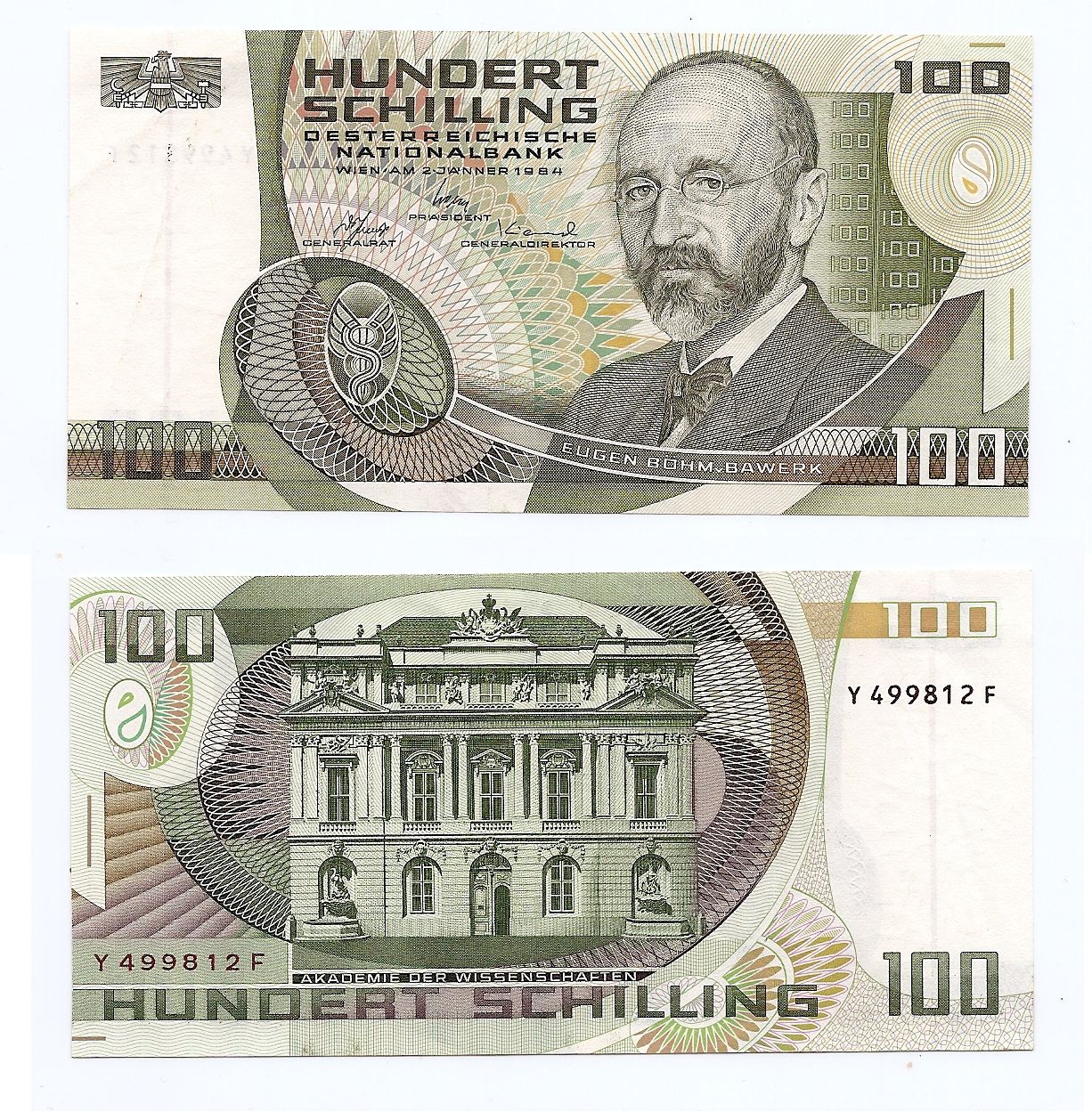
Eugen Böhm von Bawerk’s image on 1984 “Austrian” fiat paper. Andrew Jackson sympathizes. Source: Berlin-George, Wikimedia Commons. Good for what?
A “good” is thus something that serves as a means within the structure of human action. Gael J. Campan argues that this was already explained in Eugen Böhm-Bawerk’s 1881 paper, “Whether Legal Rights and Relationships Are Economic Goods.” The first part of Campan’s article “Does Justice Qualify as an Economic Good?” (1999) explains the subjectivist conception of a “good” that Böhm-Bawerk advanced (my emphasis):
While scarcity is commonly referred to as an essential feature of an economic good, this must not be understood purely in a physical sense, i.e., a fewer number of items compared to the quantity of others. Indeed, if all means are scarce by definition, it is specifically because they are limited with respect to the actual ends that they are capable of satisfying…The characteristics of a good are not inherent in things and not a property of things, but merely a relationship between certain things and men.
The thing named a goodmust have useful properties, which is not to be understood in a strictly physical sense.
As quoted by Campan, p. 24, Böhm-Bawerk wrote (my emphasis; and try it once omitting “corporeal”):
Whatever importance we accord to the corporeal objects of the world of economic goods derives from the importance we attach to the satisfaction of our wants and the attainment of our purposes…It is the renditions of service rather than the goods themselves which, as a matter of principle, constitute the primary basic units of our economic transactions. And it is only from the renditions of service that the goods, secondarily, derive their own significance.
Define “scarce”
We have seen that scarcity in the property-theory sense pertains not to whether something is a good or not in this broader economic-theory sense, but rather to the native potential for rivalrousness of consumption and, specifically, to the presence or absence of the attributes of copiability and simultaneous shareability. Since the broader economic concept of scarcity is already contained within the definition of a “good,” the narrower property-theory sense appears more useful for the current explanatory tasks.
Building on this property-theory sense of scarcity from Hoppe, Kinsella, and Tucker, I propose defining a “non-scarce good” as:a good that is copiablewith perfect remainder of the original anduseable by multiple actors simultaneously without mutual interference.
Here the two travellers from our previous example, each now with a car of his own, can simultaneously drive to Vienna and Brisbane, respectively, while each listens to identical digital copies of the same album by the same band (each driver incurring his own respective speeding citations). The variable cost of producing each additional playing of this same album is effectively zero (at any rate, quite unlike producing an additional “copy” of a car).
The point for right now is not to enter into the pros and cons of copyright legislation and entertainment business models (on which I recommend work done at C4SIF.org and Techdirt.com), but rather only to show the relevant *descriptivedistinctions* involved. A copy of a non-scarce good can be freely produced with no objective effect on previous copies, while a “copy” of a scarce good such as a car cannot be made in this way. Either control of the given instance of a car must be transferred (through sale, gift, or theft), or an entirely new instance of a car must be constructed from new and different scarce instances of the requisite materials and energy.**
The point of Tucker and Kinsella’s article was to create a relevant binary classification along these lines (my emphasis):
One helpful way to understand this is to classify all goods as either finite and therefore normally scarce or nonfinite and therefore naturally nonscarce…It is scarce goods that serve as means for action, while nonscarce goods that can be copied without displacing the original are not means but guides for action.
…[A] recipe can be shared unto infinity. Once the information in the recipe and the techniques of making it are released, they are free goods, nonscarce goods, or nonfinite goods.
By contrast, according to my suggested definition of a non-scarce good above, the definition of a scarce good (in the property theory sense) would be the negation: a good that isnotcopiablewith perfect remainder of the original andisnotuseable by multiple actors simultaneously without mutual interference.This proposed definition encompasses what most people think of colloquially as “goods” in general: groceries, clothes, and so forth.
In the modern age, such “non-scarce goods” have proliferated. As Tucker and Kinsella put it, “The range and importance of non-scarce goods has been vastly expanded by the existence of digital goods.” For the most part, non-scarce goods include all sorts of abstract goods such as ideas, text and music files, patterns, plans, recipes, methods, and so on. Specifically, it includes the meaning and content of all types of media and text, and other abstract and digital “things.”

Except…
In the case of Bitcoin, matters are different. Each bitcoin unit can exist in only one wallet at one time due to the Bitcoin protocol’s methods of ubiquitously recording transactions and preventing double-spending. It is critical to understand that these qualities of Bitcoin scarcity are not merely due to add-on “security measures.” They are not appended legal or technical “protections.” Rather they are integral**and inseparable attributes of a system protocol of which a given bitcoin unit is one element.
As should be clear by now, it is not necessary to fuss over objectivistic considerations such as whether an abstract collection of digits in certain configurations can “really” be a “good” or not. Böhm-Bawerk’s insertion of the word “corporeality” into his 1881 sentence is not a separate criterion for something to serve as a means, a point we can much more easily see today than over 130 years ago. Böhm-Bawerk nevertheless clearly explained that one must observe what people are doing to understand what economic goods are, an insight that Mises would later take up and run with in his action-based reconstruction of economic theory.
Bitcoin has now brought authentic**scarcity into the world of digital goods.
This is not the artificially imposed, legally constructed “scarcity” of “intellectual property” legislation, which was the target of Tucker and Kinsella’s important work. It is not even a type of tacked-on DRM system that attempts to use technical measures to create artificial scarcity out of informational objects that are in their nature not otherwise scarce. The Bitcoin system has set up a type of scarcity that is inherent to the nature of the good itself. This possibly unique achievement of an inherent scarcity within the digital realm is an essential part of the innovation that has made Bitcoin a new type of good.
A bitcoin unit viewed as an object of action also meets another essential criterion from Böhm-Bawerk—it can be controlled. As Campan explained (p. 24):
It is necessary that the thing in question be disposable or available to us. We must possess the full power of disposal over it if we are really to command its power to satisfy our wants…the possession of a good cannot simply be decreed: either you possess effective control over it or not.
The Bitcoin system achieves this through private key/public key encryption, which allows effective control of bitcoin units in a user’s wallet, provided said user maintains control of their private key and/or related passwords. Once a bitcoin unit is transferred from one wallet to another, it is no longer “in” the originating wallet, but only “in” the destination wallet.
Thus, in the property-theory sense of scarcity, a bitcoin unit qualifies, not as non-scarce like most other abstract or digital objects, but as scarce, since according to our proposed definition, it is “a good that isnotcopiablewith perfect remainder of the original andisnotuseable by multiple actors simultaneously without mutual interference.”
Once a private key to a Bitcoin wallet is copied, more than one party can have the key at the same time, as with any other non-scarce good. However, even so, only one party can succeed in using this private key to make use of any given bitcoin unit associated with that wallet. Only one transaction with a given bitcoin unit can be confirmed in the block chain. Even though a private key or password can easily be copied if obtained, even in this case, only one person can end up succeeding in making use of a given bitcoin unit because of the system’s prevention of double-spending. A known compromised key pair (wallet) can be abandoned. Additional key pairs are free and plentiful.

What is the sound of one bitcoin?
Two hands clapping make a sound. What is the sound of one hand?
—Koan attributed to Zen Master Hakuin Ekaku 白隠 慧鶴 (1686–1768)
We have seen that the concept of scarcity in both economic-theory and property-theory senses is useful to understanding bitcoin units as objects of human action and that scarcity and tangibility are separable. But can the quality of tangibility, so essential to the familiar story of the evolution of precious metals as monies, just be unceremoniously dropped? It is said that an experienced examiner can distinguish the authenticity of a precious metal coin by dropping it and listening to its ring. But what is the sound of a bitcoin dropping?
It was tangibility in the monetary-evolution story that had seemingly held together all the numerous traditional monetary-commodity characteristics in the form of a nice solid coin of silver, gold, or copper. It appears that some observers steeped in that story, upon seeing that Bitcoin lacks tangibility, concluded that it must also lack the other associated monetary characteristics such as durability and relative stability of supply.
In this context, we find it insightful that Jon Matonis, a long-time observer of and writer on cryptocurrenices, recently said in a Reddit interview (19 March 2013) that one way to quickly understand Bitcoin better is that it is distinguished from gold in that “it depends on mathematical properties rather than chemical properties.”
A “hard-money” checklist check
With these considerations in mind, this paragraph from Professor Hülsmann from “How to Use Methodological Individualism” (27 July 2009) will be helpful. The essay was on a different theme, but the following paragraph from it contains a great deal of interest for our current topic all in one convenient place (my emphasis):
Media of exchange become ever more generally accepted to the extent that they are objectively more suitable than their competitors in arranging indirect exchanges. Silver is more suitable as a medium of exchange than cherry cakes because it is durable, divisible, malleable, homogeneous, and carries a great purchasing power per weight unit. Market participants are likely to recognize this relative superiority in a process of learning and imitation, and eventually most of them will use silver to carry out their transactions. Hence, one can explain why the technique of indirect exchange is adopted on an individual level; and one can explain why specific media of exchange become generally accepted and thus gradually turn into money.
There is much of relevance in that paragraph, but for now, I will only consider how bitcoins seem to fare against silver coins on those very characteristics (plus stock stability) on which silver coins beat cherry cakes:

Divisible, malleable, and scarce. Source: Mikela, Wikimedia Commons. Are bitcoin units…
- Durable?Perfectly. Abstract digital objects do not change. However, this is subject to recording and replication, substrate non-destruction, private keys and passwords not being lost, etc.
- Divisible?Current theoretical maximum of 2.1 x 10¹⁵ units to be reached around 2140, with future extensions apparently also possible (finally enough tradable units for the “needs of trade”?).
- Malleable? Irrelevant; not tangible. However, analogs of this quality may be found in the variety of “transfer of keys” code-recording methods such as hologram- and color-change-protected code-bearing physical coins and cards.
- Homogeneous? Perfectly. More homogeneous than possible with any conceivable physical material because the homogeneity is mathematical (by definition) rather than physical (by empirical measurement relative to a definition).
- Purchasing power per weight? Infinite. Intangible code patterns lack the characteristic of weight altogether, rendering the slightest purchasing power infinite in per-weight terms.
- Now add: Relative stability of supply? Quantitative growth and terminal maximum quantity and timing are determined computationally; macro supply of bitcoin units (theoretically) not subject to human manipulation.
On this initial reading, it appears that Bitcoin obliterates metallic coins on factors 2–5, whereas factors 1 and 6 are open to contingencies and informed technical debates. Just as silver coins beat cherry cakes on these criteria (except malleability!), Bitcoin beats silver coins outright on four of six criteria. The other two criteria require further investigation, but Bitcoin also appears potentially competitive and possibly superior on these characteristics as well. These are questions for empirical observation, debate, prediction, and speculation about the specific course of the future, not for abstract theory as such.
This analysis of Bitcoin suggests several other points with regard to several of these characteristics.
First, purchasing power per weight was a major impetus in the evolution of paper and account entry substitutes for precious metal coin monies. Bitcoin’s purchasing power per weight is already infinite, and is therefore, quite literally, unbeatable on this factor. Another problem with metallic coins was gradual wear from circulation, which would eventually give rise to weight variations—a loss of homogeneity resulting from imperfect durability. Bitcoin does not share these particular defects with metallic coins that helped lead to market demand for substitutes.
Second, people tend to interpret the traditional hard-money characteristic of durability as a mainly material one. Tires, for example, are described as being more or less durable. On reflection, however, a temporal aspect is central to the concept of durability in that it refers to measurement of change over time in relation to use. To ask about durability is to ask the extent to which an object tends to change over time in certain of its properties under certain conditions. In the case of an abstract code relationship, the code need not change at all. Although its recording substrates might change, the code itself can be perfectly copied and copied again, and it is in this specific sense that its durability as a code sequence is theoretically infinite for any relevant purpose.
Third, regarding divisibility, whereas fiat money issuers stand ready to add as many integers (“zeroes”) to paper fiat notes as they like to facilitate the steady loss of value of fiat monetary units; the Bitcoin system is capable of supporting divisibility to as many decimal places as are demanded to facilitate a steady gain of value over time. This is a diametric contrast the further implications of which would be difficult to overstate.
Competing ways to approximate a golden spiral. Source: Silverhammermba, Wikimedia Commons. Comparative versus imaginary-perfection methods
The ultimate potential for manipulation of the total Bitcoin stock (factor 6 above) is a key question that is certainly a very technical one, possibly with philosophical aspects. Can it be established that future quantitative supply manipulation at the macro level cannot occur? Would that require “proving” a technical and empirical negative?
Whatever the factors and answers, it is important to apply the realistic comparative perspective of the true economist rather than the “imaginary-perfections” perspective of the false one. For example, with fiat monies, we know above all that large-scale, distortive, quantitative manipulation of the money supply can occur—and**in all known cases actually does.
Even with metallic currencies, comparisons on hypotheticals would still have to be even-handed. The stock of precious metals adjusts slightly over time with mine output and other factors (though always with much less volatility than the stock of a fiat money). Nevertheless, at the extreme, can it be shown that cheap synthetic gold could not ever be produced (as the alchemists had forever dreamed), thereby collapsing the price of gold by inflating its supply? (as the alchemists may or may not have thought through far enough).
Gold can apparently already be synthesized in particle accelerators and nuclear reactors, just not cheaply. If one of the criteria required of a candidate for becoming a sound money is proof of a fantastically complex technical and empirical negative, then such must be required equally of all potential candidates. If, for example, it must be “proven” that no mass quantitative manipulation of Bitcoin could ever possibly take place under any imaginable conditions, then it must likewise be “proven” that no future cheap gold synthesis could ever possibly take place.
Empirical perfection never comes to pass. In all such matters, the comparative method must be recalled and put to use. Pros and cons of possible alternatives must be assessed. Critical comparisons against made-up and wholly unrealizable hypothetical states of empirical perfection must be identified and rejected.
Unfortunately, just such clouded thinking has been ingrained and normalized through the practice of assuming that state actors can successfully and perfectly accomplish whatever they like by enacting legislation and setting up a bureaucracy. This patently absurd dream is then compared (at best) to the forever imperfect efforts of the living human beings who by contrast inhabit the so-called “market” (which euphemistically seems to mean “reality”).
Human action is by nature always a choice among perceived possibilities. The Misesian tradition of economics is positioned as one part of the study of human action. The study of society is the study of acting persons joined in a grand, interacting process of trial and error writ large.
It is not the role of economic or legal theory to predict the future. However, they can and do have useful and unique contributions to make to basic understanding. These can in turn prove useful in such other fields as investing, forecasting, and business-model development that do attempt the always-speculative and risk-bearing task of peering ahead into the soon-to-become empirical future.
For additional articles on this topic, visit my Bitcoin Theory page on this site.
POST FOOTER
/post
/content-wrapper
Is Bitcoin a money substitute?
By Peter Surda
Posted March 24, 2013
Intro
This post is a third reaction to Patrik Korda’s article about Bitcoin. There have been three main topics in our debate:
- regression theorem
- competition under network effect
- money substitutes
With respect to the regression theorem, tomorrow, Korda is debating Konrad S. Graf at the weekly University of Texas Mises Circle. I assume as usually with the meetings, it will be done over Google+ Hangout and available on youtube after a couple of days. Graf’s arguments are very similar to mine, so I don’t think I have anything to add there. I’m just looking forwards to watching the debate.
The competition under the network effect I believe I addressed sufficiently. Korda does not see any mechanism for competition under the network effect (apart from barriers to entry), and appears to believe it’s random, so the market shares of individual cryptocurrencies will randomly wildly fluctuate. I addressed the mechanics of competition under the network effect in previous two articles (first, second), and I think that Korda hasn’t addressed my points sufficiently. So for the time being, I’ll wait up his reaction on this topic.
The last discussed issue is whether Bitcoin is a money substitute (fiduciary medium, token money), or not. While I find it absurd, I decided to address the issue in yet another post. There are several reasons for it. First of all, I think that a proper scholar should address all arguments with a logically mounted defense, no matter how absurd they claim. So it’s a matter of principle. The second issue is that I apparently have readers (how it happened is a mystery to me), and I have an obligation to explain the issue to them. So it’s a social issue too. Last but not least, I tend to make very abstract arguments that expose implicit assumptions, and criticise my opponents for making these implicit assumptions and lacking imagination. But this problem is universal, I am not immune to making implicit assumptions either. In other words, it could be that I’m just arrogant and wrong, and miss a logical fallacy that I’m making myself. So it’s a matter of pragmatism as well. I’m new to blogging so it’s a learning process for me. I hadn’t really put much thought about meta-blogging, I just thought that it’s better to have a dedicated outlet for channeling my thoughts rather than having them distributed across dozens of sites of other people. But I now made the conscious decision that I’ll stick to proper scholarly work, and I’ll treat apparent absurdities seriously. I think I tend to do that often anyway (treat absurdities seriously, that is), so it’s not really much effort, I just need to remain conscious about it.
Definition of money substitutes
With respect to money substitutes, Korda made several interesting arguments that I hadn’t considered before, and in fact shows that some of the points Mises makes are incomplete. Foremost, he is the only Austrian I know of, apart from me, that does not think that money substitutes need to be claims. While I still think his classification of Bitcoin is wrong (and I intend to prove it conclusively in this post), I sense that he, similarly as me, has the ability to expose implicit assumptions. I think if he thinks about the issue more deeply, he’ll recognise the problems in his arguments. Austrian school and Bitcoin can benefit greatly from his skills. And even if we never end up agreeing, I think that defending from attacks is what makes assumptions stronger.
The issue with Korda’s argument becomes most apparent if we try to understand the purpose of Part 1, Chapter 3 of Mises’ Theory of Money and Credit (and the picture in Appendix B). I already touched upon that in my previous posts, where I argued that the reason for the classification is economic analysis, but I missed something even more fundamental (which Korda missed too). The purpose of the whole book is to analyse the exchange ratio between goods, with the particular emphasis on media of exchange (of which money is an example). In other words, Mises attempts to analyse prices. Why is it then necessary to divide money into different classes? Because the mechanisms of determining the price of individual classes of money are different. If the mechanism was the same, for the purpose of the whole book, a classification would be irrelevant. Mises realised that prices of different classes of monies are established differently, and that is why he invented those classes. In other words, he invented the class of money substitutes because the price of money in the narrower sense is determined by a different mechanism than that of money substitutes.
It is exposed a bit if we look at Part 3, Chapter 15:
The fact that is peculiar to money alone is not that mature and secure claims to money are as highly valued in commerce as the sums of money to which they refer, but rather that such claims are complete substitutes for money, and, as such, are able to fulfill all the functions of money in those markets in which their essential characteristics of maturity and security are recognized. It is this circumstance that makes it possible to issue more of this sort of substitute than the issuer is always in a position to convert. And so the fiduciary medium comes into being in addition to the money certificate.
Korda interprets this in such a way that Mises was trying to show that money substitutes compete with money in the narrower sense. But this is an incomplete interpretation. If we view it from the perspective of the pricing mechanism, we realise that Mises was also trying to explain that the price of money substitutes is not determined by the same mechanism than that of money in the narrower sense. The price of money substitutes is derived from the price of the price of money in the narrower sense. That is the essence of the quote.
Now, Mises, and the Austrians that follow him, have a more precise definition of money substitutes, they argue that they are “mature and secure claims to money [in the narrower sense, ed]”. In my thesis, I argued that this is imprecise from both sides: first, not all mature and secure claims to money are money substitutes (it’s unlikely if the claim does not decrease transaction costs), and second, causal relationships other than claims also may result in money substitutes (so-called “complementary currencies” for example). But I didn’t analyse the question of price in that depth. I assumed that the price is the same (now, other Austrians do that too, as I thoroughly quoted from in my previous article, so don’t blame me, I didn’t start it).
Korda argues that the price of money substitute doesn’t have to be the same as the money in the narrower sense. I countered that the price of the money substitute can be (in the extreme) lower, but it can’t be higher. Korda argued that Mises himself showed examples of money substitutes that trade at a premium. I was kind of rushing my argument, so I didn’t really think it through and I must admit he has a point. I didn’t find a Mises quote to the same, but I found mises.org wiki article on the Bank of Amsterdam which confirms it.
This caused me to think more deeply about the issue of price. Austrians in general assume that money substitutes have the same price as money in the narrower sense. There are few exceptions. Rothbard, I believe in America’s Great Depression, argued that some claims must only be considered from the point of view of money supply only at a discounted rate. JP Koning, on the other hand, argues all the time that different forms of money have different liquidity levels and also different prices. So, the argument that the price needs to be exactly the same certainly is flaky. Heck, if Korda is right in attributing the report of premium on bank notes to Mises, Mises contradicted himself. That’s a problem, and it needs to be fixed. I am pretty strict about having consistent definitions.
So how do we fix it? We define money substitutes from the same point of view that caused Mises to create the classification: the mechanism of establishing of price. But how to do that to allow for fluctuating prices? We borrow the concept of derivation from mathematics. In other words, if a price of money in the narrower sense changes, ceteris paribus, the price of the money substitute will change proportionately (i.e. there’s a linear dependence). This allows for the possibility of a price change for another reason. If there is a perception of risk in the claim, the substitute will trade at a discount. If the money substitute is perfectly riskless, then it may appreciate to reflect the saving of transaction costs. It can’t get out of these boundaries, because that would create an arbitrage opportunity. The funny thing is that the arbitrage opportunity also arises when complementary currencies (which I also count under money substitutes) attempt to trade at a fluctuating exchange rate, an argument which I made some time ago in another debate. Now, my point isn’t that other factors can’t influence the price, but that the price of the underlying money in the narrower sense must. I don’t think that there are factors other than perception of risk and transaction costs, but I’m not building my argument to rely on that. For the purposes of this post, I will call this derivative relationship “coupling”. The price of a money substitute is coupled to the price of the underlying money in the narrower sense.
In order for me to conclude my definition, it helps to investigate what happens when the price decouples, i.e. that changes in the price of the underlying money in the narrower sense won’t have a proportionate effect on the money substitute anymore. Assuming that the former money substitute survives, it evolves into the new monetary base. One possibility that Mises himself mentioned was credit money, which happened when the country went off a metallic standard and people were expecting this to be temporary. Another possibility, one that many of us know from personal experience, is fiat money. In my thesis, I demonstrate this on the example of the Euro: at the end of 1998, the exchange ratios of 14 (if I calculate correctly) currencies were fixed with respect to Euro, and thus the Euro became a money substitute. After the old currencies were decommissioned, the Euro became fiat money (a separate money in the narrower sense). Yet another possibility, arguably, is commodity money: Luther and Symes can be interpreted in a way that this is what happened with the old Somali Schilling: after the central bank and legal tender laws broke down, this increased the (now competitive) production of paper notes, until the production price of those notes was very close to the market price of these paper notes. Technically, the old Somali Schilling had been fiat money, not money substitute, but I argue in my thesis that all fiat money must begin as a money substitute, and according to Symes’ historical analysis, originally, Somalia did have multiple competing commodity monies, and several monetary reforms after that, which introduced paper money substitutes.
Which subtype of money in the narrower sense will be the result of a decoupling depends on the circumstances. But the point is that the coupling is a necessary feature of the money substitute. Without it, it either collapses or changes its nature, i.e. its price will be determined by a different mechanism.
What determines the price of Bitcoin?
Now, let’s look back at Bitcoin. Korda argues that Bitcoin is a money substitute of all of the fiat currencies it trades against. Let’s take then the dollar for example. What happens to the price of Bitcoin if the price of dollar decreases by 1%? We don’t know. It may change or it may not. We certainly can’t be sure that it will decrease by 1%. We can’t even be sure it will change in the same direction, it could perfectly well cause people to prefer Bitcoin to USD and increase its price. The issue becomes even more apparent if we investigate what happens if the USD decreases by 1%, and the EUR increases by 1%. The price of Bitcoin is not coupled to any other money, or any other good for that matter. So it’s not a money substitute.
What’s even more, it never was coupled to anything else in the first place. As I argue in my thesis, the first available records of market price of Bitcoin show that at the beginning, the market price was derived from the variable production costs of Bitcoin. It wasn’t coupled to any other good, i.e. it wasn’t only not a substitute of money, but not a substitute of anything. Once again, the term “substitute” in this context does not refer to the similarity, rather to the causal relationship, the “coupling”.
Conclusion
I believe that, motivated by Korda’s resolute defense, I managed to both explain and fix the gaps in Mises’ arguments. I exposed the essence of Mises’ arguments, and the essence of a money substitute. I also showed that Bitcoin does not have this essence, and never had.
If Korda (or anyone else for that matter) would like to counter my argument, I’ll make it very easy to respond. The only thing he needs to do is to answer the question “How is the price of money substitutes determined?”
Why Bitcoin grows unusually faster than normal businesses
By Oleg Andreev
Posted March 25, 2013
When people see that Bitcoin grows 300% in a couple of months, they do not believe there is a real reason for it. It must be a speculative bubble, things normally do not grow that fast.
When you invest in a company, it takes time to produce something. The value cannot simply jump through the roof because there are humans working, everything is hard and no one knows if the final product will be appreciated by the consumers.
Except, in case of Bitcoin this analogy does not apply. First, Bitcoin in a sense, is already a product available for everyone. It is already produced and proved to work, so you do not really invest in something that does not yet exist. Secondly, when investing in Bitcoin you do not invest in some particular business with a group of people managed by a single CEO. You invest in a huge variety of businesses in multiple countries with different business models, different risks and legal environments. So even if one of the businesses makes a big mistake, Bitcoin is still in demand by many others.
Of course, it does not prove that Bitcoin is inherently less risky. Even if the number of global risks is lower than in a private company, one single risk can outweigh all benefits and destroy your investment. But you should understand the fundamental difference between individual stocks and Bitcoin: investing in Bitcoin is like investing in the whole stock market 100% filled with startups and hot new ideas, not some portfolio of relatively stable stocks with the proven business models and moderate revenue streams. Of course, many startups fail. But when some succeed, they succeed spectacularly and cover all the losses. Buying Bitcoin is being a venture capitalist yourself on a worldwide scale.
A short Bitcoin commentary on “Deflation and Liberty”
By Konrad S. Graf
Posted March 30, 2013
POST HEADER
POST BODY
I just finished reading the monograph Deflation and Liberty (published 2008, but originally produced more than five years earlier) by Jörg Guido Hülsmann. I am a big fan of Hülsmann’s 2008 work The**Ethics of Money Production (not to mention just about everything else he has written). However, I had understood the shorter work to have been a mere precursor to The Ethics of Money Production. Now that I have finally read it, though, my impression is that it is quite different in content and certainly warrants its own reading. Besides, I had to catch up with the indefatigable Mises Circle at UT group, which read and discussed Deflation and Liberty a few weeks ago.
Deflation and Liberty was written years before Bitcoin appeared, and even more years before Bitcoin began to rise to superstar status in recent weeks. My collection of quotations below read in a different light now that Bitcoin has risen as a “third way” in the exchange space.
Bitcoin is not technically deflationary under one definition because its supply is set to grow gradually up to a terminal limit (inflation and deflation in this sense refer to quantity of units rather than relative exchange value). The important point is that the Bitcoin supply is set to grow at a specific, pre-defined, and gradually declining rate that no particular person or group can manipulate. Its growth rate is fundamentally knowable and predictable by all market participants, and presumably less variable than even the total market supply of a given precious metal in any given year.
After the Bitcoin supply growth trend ends in about 2140, I understand new production ceases and its supply is to remain stable and then decline ever so slightly based on incidental micro events such as individual password misplacements. I therefore believe it is even now “deflationary,” not in the letter, but in much of the spirit in which Hülsmann used the term in this monograph. At any rate, it provides a diametric contrast with the familiar inflationary policies that take the form of arbitrary fiat increases in the money supply conducted for special-interest political ends.
In another sense of the word deflation, however, Bitcoin does qualify, for the moment at least. The general exchange rates of Bitcoin against all other goods and services will of course tend to decline so long as Bitcoin is gaining in exchange value; Bitcoin-denominated prices will tend to fall so long as its exchange value grows.
With this context in mind, let us see how Bitcoin stacks up in light of the following quotations, keeping in mind that no such thing as Bitcoin existed at the time this monograph was written. I will add some minimal commentary in brackets with emphasis in bold.
Selected quotations from Deflation and Liberty with commentary
p. 16 fn 8: Speaking of “an economy” we mean the group of persons using the same money.
[Bitcoin, though not yet technically a “money” by many definitions, is not geographically defined, but rather defined by the community of its actual users and producers on a global basis. Use and production is entirely voluntary and entry open. To join this community, one need merely aquire a free “wallet.”]
p. 30: In a truly free society, the production of money is a matter of private initiative. Money is produced and sold just as any other commodity or service. And this means in particular that in a free society the production of money is competitive. It is a matter of mining precious metals and of minting coins [and of mining Bitcoins], and both mining and minting are subject to the competition emanating from all other market participants.
[Bitcoin “miners” cobble together or buy their “rigs,” connect to the network, and set work in motion, all of their own volition.]
p. 31: The production of money in a free society is a matter of free association. Everybody from the miners to the owners of the mines, to the minters, and up to the customers who buy the minted coins, all of them benefit from the production of money. None of them violates the property rights of anybody else, because everybody is free to enter the mining and minting business, and nobody is obliged to buy the product.
[Bitcoin mining, exchanges, wallet services, users, etc. would all appear to qualify under this criterion of free association. No one is obliged to buy Bitcoins. Indeed, in perfect contrast, many people are currently scrambling to figure out how to acquire them.]
No game.p. 32: The producer of fiat money (in our days typically: paper money) sells a product that cannot withstand the competition of free-market monies such as gold and silver coins, and which the market participants only use because the use of all other monies is severely restricted or even outlawed. The most eloquent illustration of this fact is that paper money in all countries has been protected through legal tender laws. Paper money is inherently fiat money; it cannot thrive but when it is imposed by the state.
[Bitcoin is by no means imposed by the state. In diametric contrast, all that can be said of it on this count is that a few state agents are slowly starting to ascertain (and only roughly) what it is several years after its launch]
p. 35: It would not be uncharitable to characterize inflation as a large-scale rip-off, in favor of the politically well-connected few, and to the detriment of the politically destitute masses. [Fiat inflation] always goes in hand with the concentration of political power in the hands of those who are privileged to own a banking license and of those who control the production of the monopoly paper money. It promotes endless debts, puts society at the mercy of “monetary authorities” such as central banks, and to that extent entails moral corruption of society.
p. 39: That leaves barter as the only legal alternative to using paper money, and barter is so much less beneficial than monetary exchange that market participants typically prefer using even very inflationary monies rather than turning to barter.
[Bitcoin has now landed out of the cyber ether as a sort of “third alternative” to this scenario]
The considerable social advantages of deflation**
p. 40: Deflation…abolishes the advantage that inflation-based debt finance enjoys, at the margin, over savings-based equity finance. And it**thereforedecentralizes financial decision-making and makes banks, firms, and individuals more prudent and self-reliant than they would have been under inflation. Most importantly, **deflation eradicates the re-channeling of incomes that result from the monopoly privileges of central banks. It thus destroys the economic basis of the false elites and obliges them to become true elites rather quickly, or abdicate and make way for new entrepreneurs and other social leaders.
p. 41: Deflation is at least potentially a great liberating force. It not only brings the inflated monetary system back to rock bottom, it brings the entire society back in touch with the real world, because it destroys the economic basis of the social engineers, spin doctors, and brain washers.
p. 43: The dangers of deflation are chimerical, but its charms are very real. There is absolutely no reason to be concerned about the economic effects of deflation—unless one equates the welfare of the nation with the welfare of its false elites.
[In conclusion], pp. 43–44: The purpose of these pages is not to appeal to the reason of our monetary authorities. There is absolutely no hope that the Federal Reserve or any other fiat money producer of the world will change their policies any time soon. But it is time that the friends of liberty change their minds on the crucial issue of deflation. False thinking on this point has given our governments undue leeway, of which they have made ample and bad use. Ultimately, we need to take control over the money supply out of the hands of our governments and make the production of money again subject to the principle of free association. The first step to endorsing and promoting this strategy is to realize that governments do not—indeed cannot—fulfill any positive role whatever through the control of our money.
For additional articles on this topic, visit my Bitcoin Theory page on this site.
**
POST FOOTER
/post
/content-wrapper