
February 2013 Journal
WORDS is a monthly journal of Bitcoin commentary. This issue collects the February 2013 writing in the WORDS archive. For the uninitiated, getting up to speed on Bitcoin can seem daunting. Content is scattered across the internet, in some cases behind paywalls, and content has been lost forever. That’s why we made this journal, to preserve and further the understanding of Bitcoin.
End the Fed: Hoard Bitcoins
By Pierre Rochard
Posted February 19, 2013
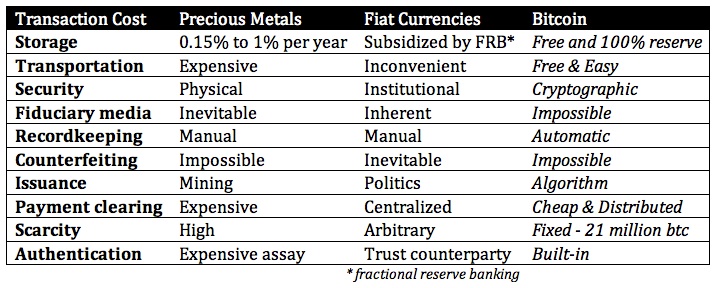
The libertarian strategy for undermining fiat currencies has always centered on making gold and silver viable alternatives. This effort has failed because it is impossible to compete against a digital currency, like the dollar, with a physical commodity due to the high transaction costs associated with the latter. The only way metals can succeed is if fiat fails. While it may be the case that fiat currencies inevitably collapse over the long run, waiting for this possibility is unacceptable given the amount of damage that central banks are inflicting on humanity’s accumulation of capital.
The mantra of passing an Audit the Fed bill, miring it in scandal, and “legalizing currency competition” ignores public choice economics as well as the fact that digital fiat currencies have already won the competition against metals and would win it again. We don’t need another political solution to an economic problem, what we need is a more competitive market currency. Enter Bitcoin.
Low transaction costs make Bitcoin the most competitive medium of exchange in humanity’s history, and it may be the case that a currency with even lower transaction costs is theoretically impossible. To learn more about bitcoins I would recommend our excellent Bitcoin Reader.
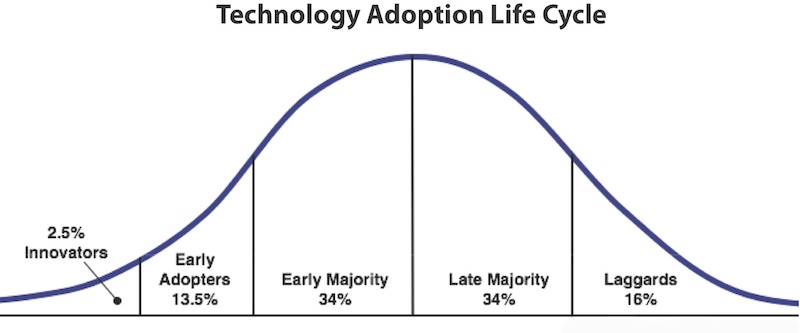
Bitcoin is slowly supplanting metallic and fiat mediums of exchange. It is currently transitioning from the “Innovators” to “Early Adopters” phase:
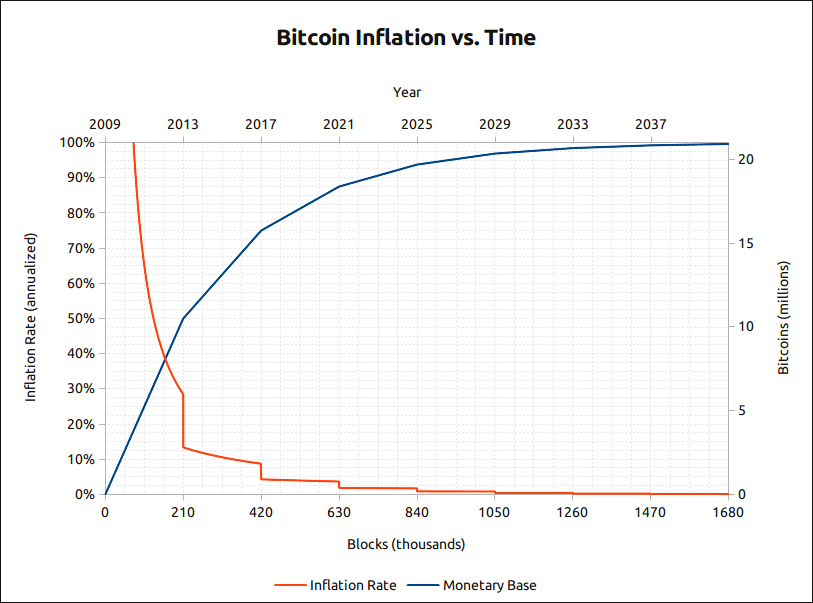
This transition is accelerated by new intermediaries, like Coinbase, that are driving down the cost of selling fiat money for bitcoins. At the same time as demand is increasing, bitcoin inflation slowed considerably due to the block reward halving:
The dollar value of all bitcoins in existence now exceeds $300 million:
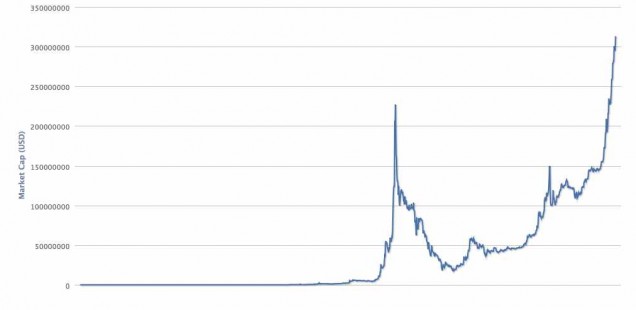
This leads us to an interesting question: is the value of bitcoins a speculative bubble?
The price of fiat currencies (and the debts denominated in fiat) is the bubble that will burst; the relevant question is when the purchasing power of bitcoins will peak. The appreciation of bitcoins relative to consumer goods will slow down when the adoption rate tapers off and hoarders will use their gains to buy consumer goods. Simultaneously, fiat currencies will be in a hyperinflationary tail-spin and real interest rates will be spiking. High real interest rates will incentivize hoarders of bitcoin to buy productive investment assets and lend to borrowers now unencumbered by fiat-denominated debts. At that point bitcoin’s purchasing power for capital goods (i.e. interest rates) will decline, but the purchasing power for consumer goods will continue to drift higher due to productivity-fueled deflation.
If you’re interested in getting rid of central banking I would recommend hoarding bitcoins by transferring your dollars to coinbase.com (1% fee) and sending the bitcoins you buy to a secure computer. This hoarding sets off a virtuous feedback loop that accelerates Bitcoin adoption:
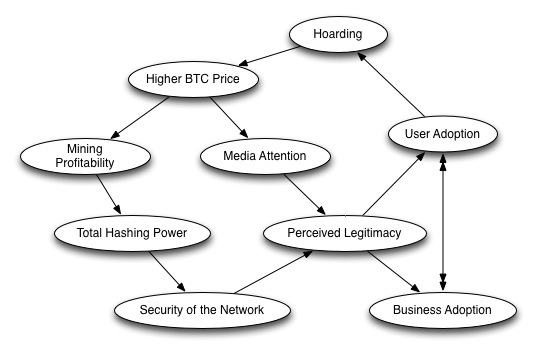
(Flow chart based on Zangelbert Bingledack’spost.)
Economics of block size limit
By Oleg Andreev
Posted February 22, 2013
Bitcoin blockchain has a built-in limit of 1 MB per block of transactions. Bigger blocks are rejected by other nodes as invalid. This means that at 10 minutes per block and with average transaction size of 400 bytes, Bitcoin network registers about 40 transactions per second.
The limit was set in place initially to make sure that the network is not spammed with huge blocks with useless transactions when people were just starting playing with Bitcoin and mining blocks was possible on personal computers. Huge blocks could lead to excessive use of bandwidth which could lead to higher percentage of orphaned blocks due to higher synchronization delays. There was no empirical proof for this limit, it was mostly an intuitive safety mechanism, “good enough” in the short run. Satoshi, the initial developer, suggested that the limit is temporary and should be raised or removed once the network becomes more powerful and could sustain larger amount of transactions.
It is important to keep in mind, that the limit was almost never exercised. So even if there was no hard limit, the blockchain would not grow faster. It was just a precaution. (Assuming, the soft limit of 250 Kb which is not enforced, would still be there.)
Today the number of transactions is steadily growing and may hit the block limit within a year or two. So people start discussing whether the block size limit should be raised, eliminated or if there should be scheme to adjust it dynamically. To change the limit, a consensus will be required. More than 50% of nodes running the full chain must agree to a new rule to switch to it.
What are the factors at play?
Some people fear that if block size will become unlimited, miners will include a lot of spammy transactions, eat everybody’s bandwidth, fees will get lower (thus undermining sustainability of the blockchain in the future) and some miners with poorer connection will be forced out of the market which is supposedly unfair to them.
In reality though, Bitcoin as any other free market, has nothing to do with fairness, but everything to do with mutual satisfaction of self-interests. Miners are motivated by increasing their revenue short term as long as ensuring their investment and raising value of BTC in the long term.
Is there any natural limit on the block size? Sure there is: it is network bandwidth and the costs of storage and transaction verification. The more transactions you need to verify and transmit, the higher your operating costs and (most importantly) the higher the risk of orphaning a block. If the block is too big to be distributed and verified by other peers, the risk of somebody else creating a shorter block in parallel gets higher. If the shorter block gets validated by majority faster than the longer one, the latter will become orphaned. Orphaned blocks mean immediate loss of time and money for miner, and since transactions are rescheduled and delayed, frequently orphaned blocks undermine market value of miner’s savings.
Miners already can choose any block size within the limit and many use the default soft limit of 250 Kb. If it was profitable for some of them to create bigger blocks, they would do that already. Since they do not, it shows that there are market forces at play and hard limit does not matter yet. Even if it was 100 Mb, the blocks would still be compact.
As the base reward is still comparatively big (25 BTC till 2017), miners are even more likely to keep the blocks as small as it does not hurt the market price. Transaction fees contribute 1.12% of the revenue, while bigger blocks with more transactions increase risk of losing 25 BTC. As time goes by, more transactions would compete with 25 BTC reward, increasing average transaction fees. Increasing fees will motivate miners to allow slightly larger blocks (until the risk of losing reward is balanced by the amount of fees). Halving days would only increase motivation to include more transactions. And as blocks and fees get larger, miners would take care of ensuring better connectivity to keep risk of losing blocks low.
It is true that the miner cares about propagating the block as fast as possible to reach the 50%+ of other miners. Some people think the bigger block sizes will favor miners with better connectivity and poor miners somewhere in Botswana will be out of luck. This is shortsighted speculation. A miner with slower connection can always create smaller blocks than other miners to compensate for the connection problems. If it is not profitable for him, it’s not a problem of other users. If I want to mine from a middle of Siberian forest, no one has any obligation to respect my decision. It is entirely possible that in the future 90% of mining will happen in Iceland where the electricity is cheap. There could be great connection between miners, blocks could be bigger and allow a lot of transactions to be put in with lower fees. The rest of the world could download the whole chain without worrying about its delays and sizes. If you want to verify it yourself, just pay for the bandwidth and storage. There is no real threat that by being closer to each other, miners will form a cartel (they can do that today already). Even if they do, arbitrarily raised transaction fees would lower the market value of their own savings, and also any member of cartel can undercut everyone by dropping his fee requirements and earning much more than the rest of them.
What about poor geeks on slow connections with old clunky hard drives that protect our freedom by chatting on Bitcoin forums and sharing 0.0001% of a mining pool? They would need to adjust. Just like CPU miners were losing to GPU miners, and both of them — to ASICs, they would need to adjust to a bigger blockchain. This does not hurt anybody’s freedom except their own. Millions of regular customers would never bother downloading blockchain. They would either trust others, or use escrow payment systems anyway. And those people will provide real value on the market and will make sure that they have their connections faster, drives harder and operations as cheap as possible. Being a lonely chatty geek in Botswana does not bring any value to anybody.
If the miners hit the block limit, it would only mean one thing: there is a desire to process more transactions, but historical untested agreement does not allow it. Then miners and other full nodes will either raise the limit (the smaller the increment, the bigger support it will have), or transaction fees will go up as people compete for the space in blocks. As transaction fees go up, not only miners, but also regular users and service companies using the full blockchain would desire increment of the limit. So it will be even easier to achieve a consensus about raising the limit.
My prediction is that the block size limit will probably never be abolished, but will be constantly pushed up by a factor of two as amount of transactions approaches the limit. Maybe after a couple of updates, people would decide that it’s safe to abolish the limit completely if it is cheaper to account for it, than to have uncertainty of a hard fork.
Fractional Reserve Banking is Obsolete
By Pierre Rochard
Posted February 22, 2013
In the definitive treatise on Austrian Business Cycle Theory, Money, Bank Credit, and Economic Cycles, Jesús Huerta de Soto establishes the inevitability of economic crises wherever there is fractional reserve banking. All that is left for monetary scholars to do is analyze past crises and lobby the government to have the right reforms. Fortunately, for the first time in history, we are in the enviable position of not having to wait for reforms that may or may not lead to sound money. I explain why here.
My favorite part about the Bitcoin network is not that it makes society freer, more prosperous, or more just. My favorite part is that it will finally settle one of the longest debates in the history of economics: whether or not money printing and cheap credit are ever needed to stimulate growth.
Austrians know that artificial credit expansion inevitably causes a mispricing and misallocation of capital, whether it’s due to fractional reserve banking alone or in conjunction with a central bank. What is debated is the ethical legitimacy of fractional reserve banking, one side sees lending out deposits as inherently fraudulent while the other sees deposits as an especially liquid loan.
With a deposit, you are improving the custody and safe-keeping of your money and receiving other peripheral services (cashier and bookkeeping services), while at all times retaining the full availability of your money. You are relying on this service to lower the transaction costs of using your gold, silver, or government scrip. A superior service is built into Bitcoin.
- Mathematically, there is no better custodian or safe-keeper for your money than an encrypted digital wallet. If you use strong passwords, back up your data, and secure your computer, then your bitcoins are safer than your person.
- Bitcoin is the ideal cashier: it is available anywhere in the world with an Internet connection, it can make infinite amounts of change, and it can transfer money to any account almost instantly.
- The distributed, unalterable blockchain puts banks’ bookkeeping and check clearing systems to shame.
With this level of perfect security and complete convenience there is no reason to deposit your money with a 3rd party. In other words, bitcoins make fractional reserve banking an obsolete technology, and bitcoin wallets are the best 100% reserve banks conceivable.
As Bitcoin adoption increases we will finally be able to “empirically validate” what Austrians have been arguing for decades: 100% reserve banking with a scarce medium of exchange prevents speculative manias, financial crises, and economic depressions.
Ludwig von Mises
This is how block size limit will be raised
By Oleg Andreev
Posted February 24, 2013
The last post was filled with different ideas and did not show clearly the single principle behind it. Here I will try to explain it on a simple example.
Imagine you are selling apples. You are selling, like 100 apples per day for $1 each. Suddenly the demand for apples grows. People want to buy more than 100 apples per day. If you haven’t yet increased the supply of apples, people will try to outbid each other. Say, the most prominent apple lovers are willing to pay $1,5 per apple. For you it means an immediate increase in revenue: up to $150 per day instead of $100.
For a minute lets suppose that your apples are special and you have no competition. Will you earn even more if you increase supply of apples? You cannot really know in advance because you never know the “demand curve” (because it does not really exist and demand changes over time). On one hand, your revenue may drop down: more apples mean less competition for them and a lower price. On the other hand, the price may get lower, but the increase of purchases will be greater, so the total revenue would be even bigger. Also, if you reduce supply to 10 apples per day, it does not mean that you will find customers willing to pay $15 or more to make a bigger revenue. Maybe at some point they’ll buy something else or abstain from buying at all.
The important point is that the only way to know the best price and the best amount of supply is to try different amounts and settle at the optimum point. In other words, when demand grows, you should always be able to increase the supply to see if it increases your revenue or not. If it does not, you may lower the supply back to optimal amount.
Back to the block size. Today, miners and customers do not hit the limit of 1 Mb per block. The limit virtually does not exist (blocks are typically under 250 Kb due to optional limit). The limit could be 100 Gb and the blocks would still have the same size we have today. So nobody would take the risk to change the rule because the rule does not affect anyone.
Fast forward a year or two from now: the amount of transactions is growing. If the miners do not find it efficient to send bigger blocks (due to bandwidth latencies causing more orphaned blocks, or storage costs, or time spent on verification or something else), they will not send bigger blocks. So the limit still would not matter. But if they find it efficient to send blocks up to 1 Mb in size, they will “feel” the limit. Block size cannot be arbitrarily increased, so transactions will begin competing for a place in the block. Transaction fees will rise. But we don’t know how much they will rise. At some point, for some people it would be cheaper to use external clearing houses that will offer lower fees and sync with blockchain less frequently. For miners that would mean uncertainty. How much would they earn in fees if the block size can be increased? Will they have bandwidth problems? Will they have bigger or smaller revenue? The only way to know for sure is to try, but you cannot try it unless you increase the limit. So they would naturally be motivated to increase the limit to be allowed to find an optimal block size.
Who else would be motivated to do so? Customers, of course. They would like to pay lower fees for non-mediated transactions instead of relying too much on clearing houses. Even clearing houses would like to have a bigger limit so they pay lower fees. Because clearing house provides additional service of instant confirmation (vs. 10-20 minute confirmation by the blockchain) and there would always be people willing to pay for that service. In addition, clearing houses may provide arbitration and many other extra services. In other words, everyone who creates raw transactions is interested in having lower mining fees.
The only people in disadvantage are nodes that have bandwidth/storage problems. Those who mine on lower bandwidth are having the same economical disadvantage as having slower computer. The fastest miners earn more and that’s what matter for clients. It is absolutely the same as with people who mined on a single GPU and now have to switch to ASIC or drop out. The non-miners would have to compare their costs of delayed validation with the costs of upgrading their network. If they choose slow network and delays, their customer base will be limited: customers who want faster validations will switch to faster competitors. In the end, if the majority of miners and other users sees it economically more profitable to try bigger blocks, they will switch and the minority would have to adjust. But since there is some level of uncertainty here, the limit will never be abolished or raised too much. Most probably, it will be increased by a factor of two, so everyone can easily calculate their costs and risks. And if the 2 Mb block turns out to be too expensive, miners would simply create smaller blocks until we have better networks or faster computers.
And the last point: the hard fork does not imply that everyone should switch some other rules at the same time. Updating software is not that expensive. It is expensive to come to a consensus. And the more stuff you put into a proposal, the harder it will be to get a consensus. However, if people feel need to update two simple lines of code and bump the limit from 1 Mb to 2 Mb, it will be much easier to come to an agreement. And repeat again when necessary.
Summary: no one will change the block size limit until it is reached. And when it is reached, Bitcoin users will switch to a slightly higher limit (e.g. from 1 Mb to 2 MB), so everyone can try and see if it is profitable. If it is not, then miners will simply mine smaller blocks. But if it is profitable, more transactions will go through, until we hit the limit again and repeat. Most probably, the block size limit will never be abolished because of the fear, uncertainty and doubt that people generate in a hard fork discussion.
IN-DEPTH | Bitcoins, the regression theorem, and that curious but unthreatening empirical world
By Konrad S. Graf
Posted February 27, 2013
POST HEADER
POST BODY
It
must
happen this way. Nobody can ever succeed in constructing a hypothetical case in which things were to occur in a different way.
—Ludwig von Mises on the regression theorem
Some observers of the bitcoin phenomenon have been puzzled that it does not appear to conform to the monetary regression theorem, an explanation for the initial origin of the value of money as money. This has led to various claims and counterclaims. In essence, one camp claims that bitcoins are not “really” money (and will probably fall apart any time), while the other counters that bitcoins actually are here, and most likely here to stay, adding that if anything is broken, maybe it is these stodgy theorems, which we might have to revise.
In addressing this, I will attempt to account for the emergence of bitcoins in terms of the monetary regression theorem. In doing so, I will argue that 1) the existence of bitcoins does not and could not challenge the regression theorem and 2) the regression theorem does not constitute any particular problem for bitcoins in terms of economic theory. That said, 3) the investment analysis of bitcoins is a separate matter from the economic-theory analysis and is a good (but separate) topic for vigorous debate.
One early approach to this, for example, was, “Bitcoin does NOT violate Mises’ Regression Theorem” (27 July 2010) which argued that bitcoin values trace back to an initial translation with fiat currencies through early bitcoin exchanges. This explains how one currency can launch on top of another one once a conversion rate emerges or is set by fiat as in, say, the German mark or French franc to euro transition (btw, some people in Germany still back-translate euro to deutschmark prices—and are suitably horrified). Yet mere translation does not show any initial direct-use or direct-exchange value separable from expected indirect-exchange value, so this brings us right back to the regression-theorem/bitcoin paradox where we started.
While this fiat-currency exchangeability factor played, and is playing, a large role in the spread and growth of bitcoin use, the approach below considers direct-consumption values separable from the beginning of fiat-currency translation or other sources of rising market expectations of indirect-exchange value. An example of a recent attempt that started off nearer to the approach below was “Bitcoin and the Regression Theorem of Money” (7 December 2012). However, this explanation still mainly referenced speculative demand relative to existing fiat currencies and as such remained less than completely satisfying vis-à-vis the regression theorem (nevertheless, the author appeared to realize this. Several comments under that post were more in line with elements of my approach here, and I quote one of them below).
Are bitcoins “money” or not?
We begin with the relatively simple issue of whether or not bitcoins are “money.” Murray Rothbard (MES2004, 192–93) can help us get started (we will discuss this use of the word “commodity” later):
A commodity that comes into general use as a medium of exchange is defined as being a money. It is evident that, whereas the concept of a “medium of exchange” is a precise one, and indirect exchange can be distinctly separated from direct exchange, the concept of “money” is a less precise one. The point at which a medium of exchange comes into “common” or “general” use is not strictly definable, and whether or not a medium is a money can be decided only by historical inquiry and the judgment of the historian.
If we say that money is a medium of exchange, then bitcoins are money. If we say that money is a “widely accepted” medium of exchange, then we have an interpretive and empirical argument about what “widely accepted” means and whether and at what point bitcoins might qualify, and for that matter, where. For example, if we say that money is “the most” widely accepted medium of exchange, bitcoins would fail to qualify, but then so would Mexican pesos, beaten out by dollars, euros, and others. So then we have to add, “in a given geographic area defined by a local monetary monopolist’s borders” to make our peso collection into “money” again.
The task of economics is to help explain phenomena of the market. In this sense, if we see bitcoins functioning as a medium of exchange, all our theorems cannot make them go away and cease doing so. Even if they were to collapse next week, they are still a medium of exchange now. People are acquiring them in order to save them or sell them or buy things with them or donate them to bloggers. Our job as economic theorists is to figure out how, in what sense, and to what degree, this is happening, not whether it is.
Besides the “widely accepted” element remaining debatable (literally; cases could be made either way), I might not call bitcoins money just yet because my impression is that many users still view them primarily through the lens of relationship to exchange rates against their local fiat money. Even Bitmit, a dedicated bitcoin-denominated auction site, automatically and helpfully translates all bitcoin prices into the local fiat currency instantly customized for visitor location after the bitcoin price.
In contrast, if significant pricing, planning, and economic calculation began to be conducted directly in bitcoin-denominated terms without reference back to fiat-money prices, and if some notable number of people began to earn income denominated in bitcoins, these could serve as interpretive landmarks for the “money” question. Interestingly, Jeffrey Tucker recently reported some signs of early stages of just such expansion in “Top Alternatives to Paper Money” (25 February 2013).
In conclusion, one could make a case for calling bitcoins “money,” or not doing so, but they clearly do qualify under the more precise concept of a medium of exchange.
The regression theorem explains how a good can gain an initial value as a medium of exchange. The theorem states that to do so, the good must have at a point prior to acquiring medium-of-exchange value some other value as a good in itself, a direct-use value and then also an actual or potential direct-exchange (“barter”) value. Yet many observers have found themselves challenged to find any “direct-use value” in bitcoins. These objects appear to have value only as a medium of exchange.
A few points should help clear up the confusion. I will first state these briefly, then explore each one and its implications in greater depth. First, the regression theorem is a praxeological statement. It does not admit of any qualifications in the form of value judgments on the part of observing economists. Therefore, the only challenge for the regression theorem/bitcoin relationship is to find anydirect-use or direct-exchange value prior to and separable from the emergence of indirect-exchange value. Second, it is helpful to clarify and define what bitcoins are in economic theory terms as types of objects of human action. Third, the regression theorem specifically explains how a good first acquires value as a medium of (indirect)-exchange. This raises the question of whether bitcoins were ever used in direct exchange before also acquiring a medium-of-exchange use.
Not whether, how
As a praxeological statement, the monetary regression theorem is not threatened at all by the existence of bitcoins, nor are they threatened by it; the two merely gaze across the intellectual landscape at one another with knowing smiles. If we understand the regression theorem clearly, we already know that there must have been some direct-use and direct-exchange values, because 1) having them is a prerequisite for becoming a medium of exchange and 2) bitcoins are a medium of exchange.
Our challenge, then, is not to “test” our regression theorem as if it were a hypothetical “theory,” but rather to stretch our interpretive capabilities to the demands of the empirical case at hand. Our question as economists is not, “Was there a prior direct-use value?” but rather “What was it?”
As is typical, Mises already carefully addressed this specific relationship in 1949 (Human Action, p. 407 in 1998 edition), well before bitcoins, the internet, or even personal computers:
To explain an event historically means to show how it was produced by forces and factors operating at a definite date and a definite place…To explain a phenomenon theoretically means to trace back its appearance to the operation of general rules…The regression theorem complies with this requirement…It deduces a more special case from the rules of a more universal theory. It shows how the special phenomenon necessarily emerges out of the operation of the rules generally valid for all phenomena.
It does not say: This happened at that time and at that place. It says: This always happens when the conditions appear; whenever a good which has not been demanded previously for the employment as a medium of exchange begins to be demanded for this employment, the same effects must appear again; no good can be employed for the function of a medium of exchange which at the very beginning of its use for this purpose did not have exchange value on account of other employments. And all these statements implied in the regression theorem are enounced apodictically as implied in the apriorism of praxeology. It must happen this way. Nobody can ever succeed in constructing a hypothetical case in which things were to occur in a different way.
Thus, even if every single interpreter, including myself writing now, were to end up failing to find any prior direct-use or direct-exchange values, we would still know that bitcoins had had one. All that we would establish by not finding one would be the failure of our own interpretive efforts. That said, I will now proceed with my own attempt at such an interpretation along several lines.
First, one element to consider for intangible objects such as bitcoins are various “inherent” direct-consumption values that may be primarily psychological or sociological in character. Consider, for example, the geek value hackers find in creating and attempting to crack encryption codes of any kind: “Dude, look at this code; I bet you can’t crack it,” may indeed be more highly valued to some people in some contexts than certain “real” economic objects or specific quantities of fiat money. Regardless of any potential future indirect-exchange value, one can imagine such persons expending hundreds of hours of effort in creating and breaking encryption codes, just because they like to. This may be true, separate from any degree of dependence on any particular expectations of future exchange values of code objects.
The value of any such virtual object or system would then tend to rise, still entirely within this context of direct valuation, if it began to prove robust. It need have no other characteristic or uses whatsoever to still be valued as such among those persons who understand and value such things. We will discuss some further context for this claim and some other such psychological or social direct-consumption values further as we go along.
In an insightful comment under the post “Bitcoin and the Regression Theorem of Money,” mentioned above, “QBG,” writing on 8 December 2012, captured what I was thinking on this point nicely in relation to gold, an angle I had not thought of:
What good was gold thousands of years ago?…The only significant original direct use of gold was making pretty things. The original adopters of Bitcoin were the type of people (as a result of being interested in crypto-currencies) to see Bitcoin as something beautiful. As a result, Bitcoins had a small intrinsic value to them, and so it had its place on the value scales of those individuals. A system of barter was then able to emerge as people with different valuations traded Bitcoins for other goods.
Even now, well after their initial emergence, there appears to be a “mystique value” and a “curiosity value” attached to bitcoins among widening circles of newcomers who, compared with founders and earlier adopters, tend to understand the underlying mechanics of the system less and less, but have the impression that participation is a way to be proud and to send a message of being techno-savvy, up to date, in the know, etc.
In other words, mere possession, knowledge, and use can carry social membership signaling functions in various sub-cultures, much as wearing certain styles of clothing does. These are alsodirect-consumption values to those concerned with such signaling. Direct-use values, whether psychological or sociological, do not have to be recognized by anyone other than those in a given sub-culture actually doing the valuing (according to methodological individualism and subjective value).
Scarcity, not commodity, is the name of the game
This has several broader implications for the clear understanding of economic theory in our contemporary context. Goods do not have to be tangible to inspire the relevant types of human action; they only have to be scarce (a nice walk-through on this distinction is “Goods, scarce and non-scarce” by Kinsella and Tucker, 25 August 2010). A bitcoin is a scarce, intangible good. Being scarce, it already satisfies the minimum requirements of becoming an object of action, without also having to be tangible.
Some people may have become confused by the use of the word “commodity” in the treatment of monetary theory in Austrian economics classics. However, the quality of being a “commodity” as we usually think of one does not appear especially important in light of contemporary developments. It may be that these writers, thinking mainly of historical examples such as gold and silver, used this word as a result of having only such examples in mind, along with auxiliary examples such as tobacco, sugar, salt, cattle, nails, copper, beads, tea, and cowrie shells, to take Rothbard’s list from MES, p. 192. The distinction between scarcity and tangibility has since become clearer and clearer with the spread of digital goods.
But there is no a priori reason why any “good” or even “thing,” whatever it may be, cannot serve as a medium of exchange, provided it is scarce and satisfies other key monetary characteristics such as durability (not physical, but temporal!), divisibility, and fungibility (interchangability). The quality of tangibility was also characteristic of historical monetary-emergence patterns, but it is scarcity rather than tangibility that is the essential quality for a good. This should have become especially clear at the very point that we observed some intangible, scarce object actually serving as a medium of exchange!
If we do not want to call bitcoins a “commodity,” the solution is not to begin pretending that bitcoins are not “really” a medium of exchange. Instead, the solution is to select a word that can better encompass all those types of objects that actually serve, have served, or could ever serve as a medium of exchange. “Good” should serve in general. In this case, bitcoins are a “scarce, intangible, digital” good in particular.
In working within a science of human action, the stress is not on things, but on the structure of actions, on intents, means, and purposes. What counts is not what a thing is in objective or objectivistic terms, but what it is that we observe people doing with it, interpreted in terms of action.
To help contextualize this, witness the millions of gamers around the world expending tens, hundreds, and thousands of hours each of labor, planning, and at times socially coordinated effort, to obtain in-game cash and virtual objects (and sometimes glory), even though these have no or little indirect exchange value outside the particular game (with some exceptions, as we will see). The game Runescape is one prominent example that will serve. This game has “over 200 million accounts created and is recognized by the Guinness World Records as the world’s largest free MMORPG and the most updated game,” according to Wikipedia.
In this particular game world, available means of obtaining objects and in-game cash (called, appropriately enough, coins or gold pieces), include: original appropriation (finding things and picking them up); production of intermediate and final goods using various tools, machines, raw materials, and lesser intermediate goods; direct and indirect exchange with other players and non-player characters (“NPCs”); market speculation and price arbitrage; lending at interest; pickpocketing; and combat (the last two also being normatively acceptable within the context of the game). Some items are bartered, sold, or given away informally with other players; others are sold in public markets with listed market price trends.
Virtual in-game cash even has a tendency to spill outside of such game environments into real cash markets, sometimes against the rules of the game itself, sometimes systematically, as in the real-world activity called “gold farming.” Neal Stephenson’s 2011 novel Reamde plays with the fictional in-game cash dynamic by setting up a [moderate spoiler alert:] fictional MMORPG in which gold farming is NOT against the rules and the game interfaces explicitly with the “real” economy. It is basically Chinese youth mining in-game gold and selling it to richer Westerners who don’t want to do the in-game hard work, but decide they have more fiat cash than in-game cash to burn.
Bitcoins do have a wider element of future indirect-exchange expectations than, say, an in-game currency limited to within the game, but this may be in addition to other value components. It does not have to exclude the parallel presence of more intrinsic direct-use valuations, particularly among early actors. The creators built a new class of scarce intangible goods. In doing so, there was some degree of direct value to the relevant hacker-actorsjust for the sake of creating them as a new type of secure, scarce virtual object. Soon, there emerged an additional curiosity value among others in acquiring these objects, studying them, challenging their security, etc.
The particular security value of these digital objects sets up something similar to the kinds of in-game cash that gamers are already accustomed to, but makes it suitable to direct uses as a new “real-world” cash. Still, this new real-world cash functions almost entirely within a structural context of secure (more or less) computer-mediated communication that is remarkably similar on the user side to that of MMORPGs with cash economies: get online, log in, and conduct transactions among user accounts.
A bit of bartering?
There is also no reason that some initial transactions of bitcoins may not themselves have had characteristics of barter rather than indirect exchange. “I’ll give you two slices of pizza for a bitcoin” just because I want to have a bitcoin, is a barter transaction, not an indirect-exchange transaction. And indeed, it appears that perhaps the first “real” bitcoin transaction was a somewhat legendary swap of a large block of coins for a pizza. According to the Bitcoin Wiki’s history entry for 21 May 2010, “Laszlo first to buy pizza with Bitcoins agreeing upon paying 10,000 BTC [currently exchangeable for about $310,000] for ~$25 worth of pizza courtesy of jercos.”
I might also want a bitcoin for any reason I feel like having one.I might want to just study it and see how it works or collect it as a virtual souvenir or trophy. I might want to use some of its code string as T-shirt art. I might want to stay up nights trying to crack the system because it’s there, like the proverbial unclimbed mountain. I may just want to feel cool and smart by having a bitcoin and telling friends about it. None of these purposes constitutes an indirect-exchange purpose. These are all direct uses.
But this is already somewhat more than needs to be shown. The regression theorem concerns the emergenceof indirect exchange characteristics on top of previous direct-use and direct-exchange characteristics. Yet the only one who knows the difference is the person using it. The only way to find out whether little Timmy just bought a bitcoin because he thought it was cool to have one or because he thought he could later buy other stuff with it is to ask little Timmy,and then we are still not sure if he is telling the truth. These are empirical questions.
Nor does any direct-use value have to persist once indirect-exchange value has emerged. The regression theorem is only a temporal-sequential explanation of the initialemergence of indirect-exchange value. After that, the initial direct-use value is no longer required: the emergence of indirect-exchange value has both already happened and already been explained.
All that is required for a transition from direct to indirect exchange is an increasing number of people wanting to have a good just because they want it—for any reason, which in turn can give rise to some people realizing that they might want to obtain that good because they know of other people who want it—also for any reason. Actors therefore begin to expect that indirect exchanges will start becoming more widely possible with this good. The indirect exchange component thereby begins to grow relative to the direct-use and direct-exchange components. Even if the value components other than indirect-exchange value have fallen away completely (which I don’t think they have, although risks are present, as we soon discuss), this does not impact the regression theorem, which has already done its work right at the beginning and is now free to return to its Viennese study and resume smoking its pipe undisturbed.
The foregoing may still not seem to some observers like much in the way of direct-use value components for bitcoins, but they are something, and something is all that is needed to interpret the case in terms of the regression theorem. The economist’s own value judgments should not play into assessing whether objects are “really” valuable or not. The actions of those persons actually acquiring and using these objects in these ways are already enough to tell us otherwise. Whatever the observed actors were thinking, no matter how crazy it may seem to some observers, economists just have to deal with it.
A house of virtual cards?
Admittedly, the expected indirect-exchange-value component now appears to reflect a very large share of the value of bitcoins. The other value components we have sought to identify above, to the extent they persist, also appear highly dependent on this component. A hypothetical total evaporation of the exchange value (through some successful crackdown or “impossible” system failure) would also diminish most of the aforementioned geek coolness, curiosity, collector, and social signaling values right along with it. The scale and independence of the direct-use values are tenuous and apparently tied tightly to the indirect-exchange value. This may be why some observers have missed these components altogether or just do not trust them. If indirect-exchange value is really all that remains, a crash could well indeed take the money down to zero exchange value and extinction as a money.
Such lack of trust might arguably be wise from a historical, ethical, and financial planning point of view, and this is a reasonable subject for vigorous debate. However, this is not a problem for the praxeological regression theorem. It does not concern itself with such forward-looking ethical evaluations based on a particular claim to wise judgment one way or the other.
I am not saying the values of bitcoins outside of their expected indirect-exchange values have ever been large or stable, only that such valuations were, have been, and still are present among the relevant actors to varying degrees. All one needs to show to erase the alleged regression-theorem/bitcoin paradox is that direct-use and direct-exchange values were present: 1) at all(no degree-of-presence judgment is relevant); 2) at the very beginning (not needed later), and 3) within the value scales of the actual persons involved in creating and dealing with the objects early on (not within the value scales of later users or later economists).
Based on the above considerations, it appears that the regression theorem and bitcoins need have no quarrel with one another. Just because the direct-consumption value components were (and are) psychological or sociological in the sense of pertaining to factors such as inherent geek appeal, professional challenge to specialists, curiosity, and membership signaling, does not mean they were therefore non-existent. And existent was all they ever had to be.
For additional articles on this topic, visit my Bitcoin Theory page on this site.
**
POST FOOTER
/post
/content-wrapper
Philosophy of Bitcoin
By Oleg Andreev
Posted February 28, 2013
There is no philosophy in Bitcoin. It is not anarchic, libertarian, Austrian or anonymous. It is just an internet protocol and a bunch of people that use it to transact between each other.
The protocol has purely technical and monetary measures to prevent spam, DoS, double spending and reversal of transactions. Transactions themselves do not advertise their purpose or identities of people involved.
It is not “against Bitcoin spirit” to have non-anonymous service built on top of Bitcoin. It is not a “hack” to use Bitcoin addresses generated not from random numbers, but from document hashes to implement secure document timestamping.
You can do whatever you want with Bitcoin as long as your transactions are compliant with the protocol and you pay the fees when needed. You can use it as a currency. Or as a payment system. Or as an investment. Or not use any of its monetary properties whatsoever, but use it to register predictions about the future. You can use it in clear to accept donations for a good cause, or you can use it through Tor network to buy illegal stuff. You may require others to identify themselves before accepting payments, or you may allow your customers to hide their identities from you. After all, you can avoid the whole thing completely and live a happy life.
If there is a single philosophical thing about Bitcoin, it is this one: voluntarism. On the internet, across oceans and thousands of walls, you cannot force another person to do what you want. And neither can he or she. Therefore, to make a deal with another person, you have to negotiate and find consensus. And if you envision risks and potential problems, you are free to creatively find voluntary solutions to them, which will also be part of negotiation. No amount of unilateral declarations, laws or appeals to objectivist philosophy will make another person send you bitcoins. Only negotiation and reasoning give you a chance to get what you want.